Teaching on the Holocaust

One of the most powerful books I read as a preteen was Fran Arrick’s Chernowitz. A young adult novel about bullying and antisemitism, I recently revisited it as I read it aloud to my own kids. Told mostly in flashback form, the novel leads up to an episode of revenge by the victim to the antisemitic bully, followed by a school assembly about the Holocaust led by the school principal as an attempted antidote. While the victim goes through tremendous personal growth as he realizes the limits of vengeance, his tormenter is portrayed as blinded by bigotry and beyond redemption.

I wondered how the themes would hold up a generation later and in the context of my own kids’ lives. Given that at the time I first read it I attended Jewish day school and was surrounded by almost all Jewish friends, I wondered how my kids – who are one of only a few Jewish kids at their large public elementary school – would react. I like to think that their Jewish identity is solid and their friendships nurturing enough to feel secure from the ignorance from which racism and prejudice stems. On this, time will tell.

The theme of revenge is also apt in today’s political climate, where cycles of violence are all too prevalent on a global scale. While it can taste sweet at the time, revenge – rather than justice-seeking – all too often leaves a bitter aftertaste. The book succeeds in mining this ethical complexity. I also appreciate the author’s unvarnished treatment of bigotry and the lesson around how important and sometimes challenging it is to keep parent-child communication open and flowing.

But the book’s final scene – that of the school assembly where graphic Holocaust footage is shown to the students – left me wondering. Assuming empathy and awareness are good antidotes to all kinds of prejudice including antisemitism, how much exposure is too much, particularly when it comes to images of Nazi atrocities?

My own kids know that their paternal grandfather was a survivor of Auschwitz. They have heard of Hitler – he is a common word in their vocabulary, for better or worse, and they know something of the Holocaust. But, as I read the final pages of Chernowitz to them aloud, I found myself omitting much of the excruciatingly graphic imagery, which included references to Mengele’s victims.

When it comes to Holocaust education, the consensus now seems to be that graphic imagery should be used “judiciously,” in the words of the U.S. Holocaust Memorial Museum – and “only to the extent necessary to achieve the lesson objective. Try to select images and texts that do not exploit the students’ emotional vulnerability or that might be construed as disrespectful to the victims themselves,” the museum advises educators on its website.

Julie Dawn Freeman, a professor of history, has warned that exposing students to too much graphic imagery can backfire in multiple ways: it can desensitize students to the subject, it can provide students with a sense that classroom trust has been violated, it can unwittingly provide a voyeuristic experience and it can dehumanize as well as stereotype the victims.

On all of these counts, the fictional principal’s shocking assembly, while well-intentioned, probably failed.

For these and other reasons, many of us have tended to focus on individual perspectives. In this vein, Anne Frank’s diary has, of course, had great impact. And many educators have made wonderful use of direct survivor testimony. When my father-in-law Bill Gluck was younger, he made a point to visit Vancouver schools and community centres to share his tale of survival. I have been fortunate to host Ottawa’s David Shentow in my course at Carleton. But, as we know, and as my own family experienced firsthand this year with the loss of my father-in-law, our own loved ones in the form of Holocaust survivors won’t be around forever.

Prejudice, hatred, suffering and revenge are heady themes for kids and preteens. Whatever our methodology for getting students to think ethically, at the very first, we can work our hardest to get them to think about basic impulses like kindness.

Mira Sucharov is an associate professor of political science at Carleton University. She blogs at Haaretz and the Jewish Daily Forward. This article was originally published in the Ottawa Jewish Bulletin.
Writers Fest appoints Nozick

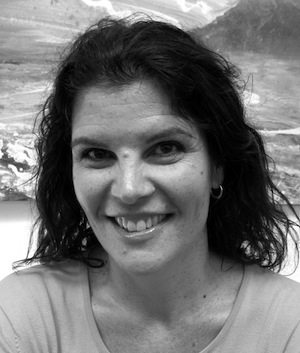
photo - Nicole Nozick
Nicole Nozick (photo from Nicole Nozick)

The board of directors of the Vancouver Writers Fest has appointed Nicole Nozick as executive director, effective June 22.

“Nicole brings to the Writers Fest extensive experience in festival management, journalism and communications, a collaborative approach to her work, and many business skills. We are excited to welcome her to our team,” said board chair Sandy Jakab. Nozick takes over from the Vancouver Writers Fest’s current executive director, Camilla Tibbs, who will move to her new role as executive director of the Richmond Gateway Theatre.

“I am honored to be joining the team at the Vancouver Writers Festival – a festival whose accomplishments I have long admired,” said Nozick. “With its sterling international reputation as one of North America’s premier literary events, the VWF is a cornerstone of Vancouver’s festival scene, well reflecting the energy, curiosity and vibrancy of our city. I am looking forward to working with the VWF board and artistic director Hal Wake, in co-leading this remarkable literary showcase that enriches the lives of so many.”

Nozick holds a BA in English from University of Cape Town and a post-graduate diploma in journalism from Tel Aviv University. Most recently, she was director of the Cherie Smith JCC Jewish Book Festival.

Giving is a way to live well

Graduates of the Jewish Seniors Alliance peer support program, and teachers. (photo by Binny Goldman)

On June 11, I walked into a room filled with givers – of themselves. It was the special occasion of the graduation ceremony of the fifth class of peer counselors, which took place at the Peretz Centre for Secular Jewish Culture.

They were 13 men and women of various ages who had met as strangers and quickly become an extended family of friends. Through 11 weekly five-hour sessions in which interactive role-playing was used, they were taught how to listen, comprehend and use their newly acquired techniques.

Charles Leibovitch, coordinator of peer support services, warmly welcomed those gathered – family and friends of those receiving certificates and members of the board of the Jewish Seniors Alliance of Greater Vancouver. He introduced himself and Grace Hann, trainer and supervisor of the peer counseling program, then credited the founder of JSA, president emeritus Serge Haber, for being instrumental in initiating the program and working diligently to ensure that it thrived through continuous and crucial funding issues to meet the ongoing needs of our growing senior community.

Leah Deslauriers, coordinator of seniors at the Jewish Community Centre of Greater Vancouver, informed the audience of the many and varied activities open to all people (Jewish or not) at the centre for a nominal fee. She encouraged all to visit and partake in yoga, swimming, card playing and just general socializing. Expressing the wish for further partnering with the JSA, she extended a mazel tov to the graduates.

Barb Kirby of Community Resource Network said that, in both a personal and professional capacity, she had seen many gaps in the care of seniors over the years. “One of the greatest gaps we see is lack of support causing social isolation of seniors and that is why your job is so important. Your training and expertise provides a lifeline to those who truly are in greatest need,” she said.

“They say it takes a village to raise a child. I believe it take a village to care for the elderly and it takes a special kind of person to care for the elderly. You are that caring voice or the person sitting next to someone who truly needs a caring human connection or to go one step further to help get the further supports they might need.” One individual, organization or government cannot do it alone, said Kirby. “Speaking up, sharing knowledge and best practices will help make our communities a safer, more enjoyable place for those who need our support.”

She thanked Haber and JSA president Marilyn Berger “for providing all the invaluable services to bring awareness through education and support to our communities.”

Becky Herrmann of Angels There For You noted that people want to be needed, sought after and validated. She recommended the book Give to Live, and said there were no side effects to giving of oneself, urging everyone to try doing so. Larry Shapiro, one of the graduates, countered with, “There are side effects, but no negative ones.” Herrmann later presented each of the graduates with a gift.

Shapiro spoke next, sharing with the audience that, having completed the course, he felt prepared to go out and serve as a counselor. He proceeded to give a little history of peer support counseling in British Columbia, which has been present since the 1980s, addressing social isolation and other daily issues affecting seniors. Shapiro felt the course had taught him empathy, as well as the skills and techniques necessary to offer others methods of self-help.

Fellow graduate Neveen Hossameldin said that, as an immigrant, what one missed most were the friendships left behind, and that she didn’t have another 55 years to forge new ones. Yet, after 55 hours as part of this group, she had indeed made new, lasting friendships. Hossameldin appreciated that Haber had told the class that they were not working for JSA but were part of JSA. Echoing what others had said, she praised Hann for making the sessions pleasurable and warm.

Hann, laughing, said that since Shapiro had stolen a good chunk of her speech, she would just thank JSA and its founder, Haber, who deserved a special tribute for his vision, without which the program would not exist. She underscored that self-absorption kills empathy, that focusing on ourselves makes our world contract whereas giving to others broadens our world.

Leibovitch spoke of the ongoing need for peer support services and of the graduates who go out in the community to help combat the loneliness he sees daily. He said that phone calls to the office are often by those who have been guided by others to use the peer services, and that this essential, relevant help has become very valuable in the community. Karon Shear, coordinator of JSA, and Rita Propp were thanked for their constant commitment to excellence and giving of themselves.

Haber said, “Don’t do unto others what you don’t want others to do unto you,” a teaching found in other religions as well. Giving of yourself – so necessary both to the giver and the receiver – helps to alleviate loneliness, isolation and perhaps even remove the tarnish from the gold quite often present but hidden in the “golden years.” JSA is very proud of this program, he said, adding that he, too, had taken the course to familiarize himself with what was being offered and that he, too, had learned to really listen and hear what was being said. He concluded with the wish that all the graduates would go out and spread good will.

Certificates were handed out along with a rose to each graduate, as was a hug from both Hann and Leibovitch.

Ruby Boychuk, one of the graduates, presented Hann with a bouquet of yellow roses, explaining that yellow roses symbolized love and appreciation.

Family and friends proudly took photos of the celebration, while Stan Shear took a video that will be posted on the JSA website. Refreshments shared by all helped bring the evening to a close, leaving a sweet taste in our mouths and in our hearts. Mazel tov, graduates. Mazel tov, JSA.

Binny Goldman is a member of the Jewish Seniors Alliance of Greater Vancouver board.

Restoring sacred space

The process of restoring headstones comprises many steps. (photos from J.B. Newall Memorials Ltd.)

photo - Among the headstones restored in the Jewish section of Mountain View Cemetery was that of Bessie Rosenberg.
Among the headstones restored in the Jewish section of Mountain View Cemetery was that of Bessie Rosenberg.

Last month, the restored Jewish section of Mountain View Cemetery was rededicated in a public ceremony that was the culmination of three years of work undertaken by a group of volunteers headed by Shirley Barnett and others. Among the contributors to the project was J.B. Newall Memorials Ltd.

“The restoration project in the Jewish section at Mountain View Cemetery was a very special project for us,” Meghan Newall told the Independent in an email. “Knowing that many of these pieces were designed and created by the Newall family over the past decades gave us a sense of honor and pride to be able to work on them once again. A great deal of work went into the cleaning, restoring and re-stabilizing of the markers and monuments, as each piece is unique and required a number of different methods and procedures (and patience!).”

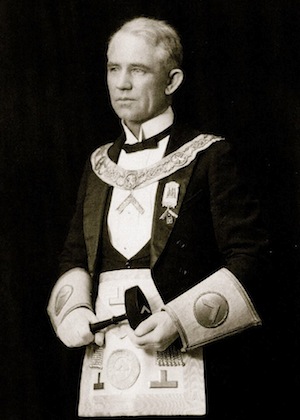
photo - John Brodie Newall established J.B. Newall Memorials in 1909
John Brodie Newall

Newall’s great-grandfather, John Brodie Newall, established J.B. Newall Memorials in 1909.

Described as “an accomplished poet, scholar and master mason,” on the company’s website, the history reads that he “parted with his family in 1905 from the town of Dalbeattie, Scotland. He left his brother David the family business – a granite quarry and monumental works company that gave birth to the town of Dalbeattie in 1820 – which continues to produce today.”

Shared his great-granddaughter, “We are (unfortunately) unsure why he decided to leave the granite business in Scotland to start over in Vancouver but are happy he did!”

She added, “I recently had the opportunity to visit the town in Scotland where our family started out and even saw one of the original quarries that is still in operation today, though it is now a sand and gravel quarry operated by a different company.”

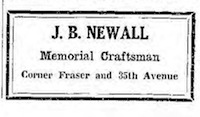
scan - One of the first ads run by J.B. Newall in the Jewish Western Bulletin. This one appeared Aug. 8, 1933. The company stills supports the community paper.
One of the first ads run by J.B. Newall in the Jewish Western Bulletin (Aug. 8, 1933). The company stills supports the community paper.

Eventually, her great-grandfather arrived in Vancouver. “He set up shop here, at our current location in 1909, where his son Nathan Newall continued the tradition,” explained Meghan.

Grandson Alan, his wife Rosemarie and their children, Meghan and her brother Brodie, “continue to create memories out of stone,” said Meghan. “Our works can be seen throughout British Columbia cemeteries as well as civic projects throughout the city.”

For more information about the cemetery restoration project, search jewishindependent.ca for “Mountain View Cemetery.” For more information about J.B. Newall Memorials, visit jbnewall.com.

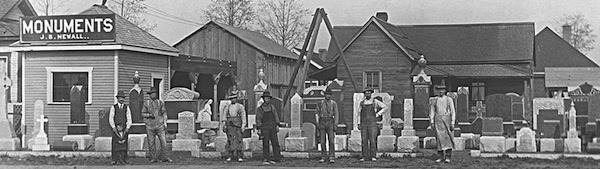
photo - J.B. Newall has been in the same location since its establishment in 1909.
J.B. Newall has been in the same location since its establishment in 1909.

Walk Winnipeg’s North End

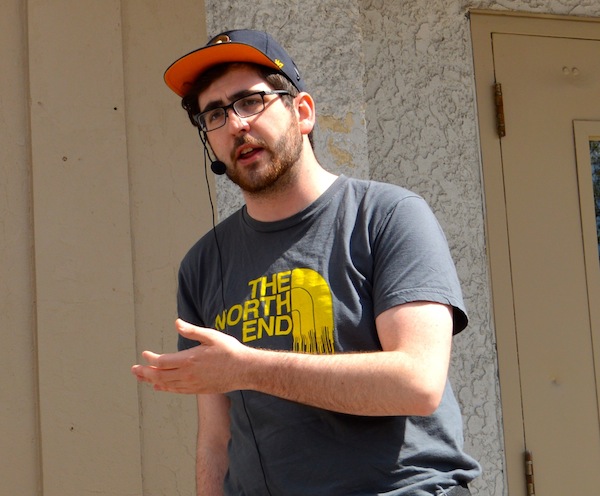
Walk participants explore the Ashkenazi synagogue, the oldest in Winnipeg, on a tour led and organized by Zach Fleisher. (photo from Zach Fleisher)

Not so long ago, Winnipeg’s Jewish community hub was the city’s North End. With Yiddish spoken on the street, Jewish businesses could be found on many corners, as could kosher butchers and synagogues. Since then, however, many Jews and Jewish-owned establishments have moved south or closed down entirely. Some of the North End buildings have been rebuilt or redesigned, while others have been preserved for various reasons. A recent walk – set up via Jane’s Walk – showcased the area’s history and current-day reality.

The early May tour was led by Zach Fleisher, 22. A history buff and University of Winnipeg student, he is chairperson of the Canadian Federation of Students Manitoba. In his spare time, he is involved with other projects, with the main goal of making Winnipeg a better place.

“I’ve always found myself enamored with the work of famous American-Canadian urbanist Jane Jacobs (for whom Jane’s Walks are named),” said Fleisher. “And, I’ve always been interested in how we build and define community. In that spirit, I’m quite interested in the history of Winnipeg and the Jewish population, especially the North End area.” He hopes people who took the tour will see the area differently now that they are aware of its history.

According to its website, “Jane’s Walk is a movement of free, citizen-led walking tours inspired by Jane Jacobs. The walks get people to tell stories about their communities, explore their cities, and connect with neighbors.” The free walks are held annually in more than 100 cities in 22 countries around the world on the first weekend of May each year, including in Vancouver.

Fleisher attended a few Jane’s Walks in Winnipeg last year and has informally given tours of different areas for a friend of his, Nicholas Audette, who suggested he get involved with the movement in a more formal way.

While some people RSVPed for his walk, there was no requirement to do so. “That’s what makes the Jane’s Walk so unique – the lack of commitment and organized structure that culminates in a strong sense of community,” he said.

Fleisher’s May 4 walk attracted more than 70 people. “I think a lot of people know that the North End carries a lot of history, but they are always interested in hearing a bit more about the area and its unique history,” he said.

The tour began from what used to be the old Canadian Pacific Railway station at 181 Higgins Ave. “The CPR station, where thousands of immigrants passed through, is now home to an aboriginal centre, housing a variety of offices,” explained Fleisher. “It was a place of great significance and a proper starting point, as almost every Jewish newcomer to the city would also have begun their story in Winnipeg at that same spot.

“This station was one of two major train stations in Winnipeg, the other being Union Station on Main Street.” The station fell out of use in the 1970s, he said.

Walking through Point Douglas on Austin Street, the tour headed toward Chesed Shel Emes funeral home. Along the way, Fleisher pointed out what was formerly the Sharon Home, which was originally established as a rehab centre, but became a personal care facility; it is today located in the city’s South End, and called the Saul and Claribel Simkin Centre.

Although the North End has not seen a significant Jewish population in two generations, the many buildings and sites that are historically relevant remain, along with a number of other key cultural institutions.

“At its peak, it’s believed that over 15,000 Jews – primarily from the Ukraine, Poland and Russia – called the North End home,” said Fleisher.

Once at Chesed Shel Emes, participants were given a brief history of the facility by Sharon Allentuck, who was representing the chapel because its executive director, Rena Boroditsky, was away. The funeral home was founded in 1930 by volunteers who wanted to ensure that every Jew had access to a proper Jewish burial and, in 1947, the chapel was built, she explained.

The walk then continued along Main Street to Burrows Avenue, to Congregation Ashkenazi. “The Ashkenazi is the oldest synagogue in Winnipeg and has a second floor only for women,” said Fleisher. “According to [its] tradition, non-married Jewish men don’t wear tallit, because the women on the second floor then got to pick their husband.”

Saul Spitz, who organizes the maintenance and care of the building, was on hand to give a talk and lead a tour of the synagogue.

“The North End has a rich tradition that continues today,” said Fleisher. “Along with the times, the type of community has changed. While the Jewish North End may be a memory of years past, it’s important to recognize the heritage of the area.”

photo - Zach Fleisher in front of what used to be the building housing the city’s Hebrew Sick Benefit Association
Zach Fleisher in front of what used to be the building housing the city’s Hebrew Sick Benefit Association (photo from Zach Fleisher)

After passing by the German Club at Flora and Charles streets, which was the home of the Talmud Torah at one time, the walk continued on to one of the few Jewish businesses still around in the North End – Gunn’s Bakery, which opened in 1937.

Fleisher noted that Gunn’s is located next to what was formerly the Hebrew Sick Benefit Hall, now home to a Christian worship group, though the building still retains the initials HSB.

Fleisher said he would love to organize another walk if there’s interest, and “to branch out a bit as well. So many of the folks who made it out had their own additions to the oral history of the walk and were able to contribute as necessary. I aimed to provide a basic framework for the walk and so many people were able to bring their own lived experience to the table.

“The walk was a great experience and it was great to see that I’m not the only one with a passion for the rich diversity of the area,” he continued. “The Jewish component is only one part of the rich diversity of the North End and I’d encourage everyone to read up a bit more on such a dynamic area.”

The next Jane’s Walk weekend is scheduled for May 6-8, 2016. To find out about walks in the various cities or to organize one of your own, visit janeswalk.org for more information.

Rebeca Kuropatwa is a Winnipeg freelance writer.

Help Ringelblum doc

Emanuel Ringelblum (left), Rachel Auerbach (third from the left) and other Jewish intellectuals in Poland, 1938. (photo from whowillwriteourhistory.com)

Many Vancouverites will remember the 2008 traveling exhibit hosted by the Vancouver Holocaust Education Centre called Scream the Truth at the World: Emanuel Ringelblum and the Hidden Archive of the Warsaw Ghetto. It provided an overview of Warsaw historian Ringelblum and a secret group, Oyneg Shabbes (Joy of Sabbath), who during the Holocaust worked to document and preserve material relating to their experiences. The artifacts they buried in milk cans and metal boxes – some 30,000 items – were found in the rubble of the Warsaw Ghetto in 1946.

Now, Katahdin Productions is raising funds to make a feature documentary about Ringelblum and the Oyneg Shabbes archive. The film, Who Will Write Our History, is based on the book of the same name by historian Samuel Kassow.

Writers, artists, scholars, journalists, poets and diarists, more than 60 diverse people, handpicked by Ringelblum, collected and recorded as much as possible about every aspect of life in the ghetto – poems, paintings, photographs, underground newspapers, essays on hunger, smuggling, the Jewish police, clandestine schools and literary evenings and more. Their common goal was to ensure that the truth would survive even if they did not, as was the case with Ringelblum.

Only three members of Oyneg Shabbes survived the war. Among them was Rachel Auerbach, a prolific writer who would spend the rest of her life memorializing Ringelblum and Oyneg Shabbes. It is Auerbach’s writing and point of view that will provide the narration and narrative structure of the film. She will be voiced in the film by Academy Award-nominated actress Joan Allan.

In 1946, before Auerbach left Poland for Israel, she and the other two Oyneg Shabbes survivors led rescuers to the location of the first cache of the ghetto archive. The rescuers unearthed 10 metal boxes that had been buried on the eve of the Warsaw Ghetto Uprising. A second cache of two milk cans was discovered when Polish construction workers were building new apartment buildings on the site of the former ghetto. The third cache was never found and is believed to be buried under what is now the Chinese embassy in Warsaw.

Directed and produced by Roberta Grossman with Nancy Spielberg as executive producer, Who Will Write Our History (whowillwriteourhistory.com) will make the story accessible to millions of people around the world. Katahdin Productions’ documentaries include Blessed is the Match: The Life and Death of Hannah Senesh, which won the audience award at 13 film festivals, was broadcast on PBS, nominated for a Primetime Emmy and shortlisted for an Academy Award; Hava Nagila (The Movie), which was the opening or closing night film at more than half of the 80 film festivals where it screened, and was released theatrically; and Above and Beyond, about Jewish-American pilots who volunteered to fly for Israel in its War of Independence, which earned 20 audience awards and critical acclaim. (For an article on the latter, visit jewishindependent.ca/spielberg-opens-film-festival.)

The goal of the Indiegogo fundraising campaign is to raise $100,000 to fund 10 days of shooting in Warsaw in fall 2015. On average, each day of shooting costs $10,000. Some days are much less expensive; for example, shooting exteriors of streets in Warsaw involves only a small crew. Other days are quite involved. For example, shooting recreations of key events in the story with props, costumes, actors, lighting, sets, stages, etc., requires a crew of 20+ people and costs as much as $20,000 per day. If the $100,000 goal is not reached, it will mean fewer filming days in the fall; if it is exceeded, there will be more, as needed to complete production.

For more information, including a video about Who Will Write Our History, visit indiegogo.com/projects/who-will-write-our-history-production#/story. There is about a week and a half left to contribute to the campaign.

Hebrew in Tri-Cities

A photo from Aleph in the Tri-Cities’ Facebook page about their Hebrew classes.

Three years ago, a group of parents, all members of the Facebook group Aleph in the Tri-Cities, decided to create their own Hebrew Sunday school. It took more than a year of preparations before everything fell in place, but last September, the Tri-Cities Hebrew School began serving 14 elementary schoolchildren from Burnaby, Richmond and Coquitlam. They recently completed their first year.

The educational program was designed by Limor Friedman, a former IBA (Israel Broadcasting Authority) foreign correspondent. “We wanted to provide language and culture to our children, not only prepare them for a bar mitzvah. Our program was designed for children to learn about Israel through songs, books, reading and writing. The children were introduced to Israeli poets and authors that expanded the experience beyond the regular aleph-bet. We celebrated the Jewish holidays with emphasis on Israeli tradition, not just the Jewish perspective. One of my favorite classes was for the children to learn the map of Israel and to recognize which city or town their parents came from – it was a great way to discover their own roots and learn about their own personal background.”

The three-hour weekly class was led by Noa Marnin Gilad, who was a teacher in Israel, with the help of 19-year-old Ram Alexaiev; story time was led by Dovrat Vitis. Yossi “Joe” Dagan was the administrator, whose vision helped establish this new venture.

“Our Facebook group went through major changes over the last year,” explained Dagan over the phone. “We are now officially a registered not-for-profit organization with a mission statement to provide Jewish experience to the growing Jewish population of the Vancouver suburbs. It’s a challenge to build a budget based on donations but we love what we do and our community members love what we do, so it keeps us motivated for the future.”

Friedman’s proudest moment of the school year came over the Passover dinner table. “Seeing my daughter singing all of the Passover songs brought tears to my eyes. Our guests were amazed, too. That is the greatest benefit of group learning. Some parents think it’s better to teach Hebrew in the privacy of their own home, but then the child feels alone and he is insecure about the whole experience. In a group, children feel that they are not alone, that this is not something that only their own parents care about. The power of the group turns it into a positive lesson and it becomes important for them to do well, not just for us, but for themselves as well, and that is priceless.”

Aleph in the Tri-Cities’ Hebrew school will resume in late August before the High Holidays. For more information, email alephintc@yahoo.com.

Shahar Ben Halevi is a writer and filmmaker living in Vancouver.

Mystery photo … June 30/15

Children with bicycles, possibly at a Beth Israel parade, Vancouver, 1970. (JWB fonds; JMABC L.09774)

If you know someone in the photo above or any of those below, please help the JI fill the gaps of its predecessor’s (the Jewish Western Bulletin’s) collection at the Jewish Museum and Archives of B.C. by contacting archives@jewishmuseum.ca.

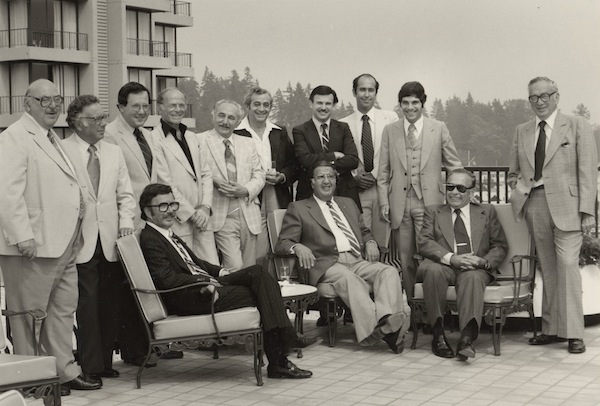
photo - Group of men on an outdoor patio, Vancouver, Aug. 30, 1979. Morris Wosk is standing, fifth from the left, and Joe Cohen is seated in the centre
Group of men on an outdoor patio, Vancouver, Aug. 30, 1979. Morris Wosk is standing, fifth from the left, and Joe Cohen is seated in the centre. (JWB fonds; JMABC L.14739)
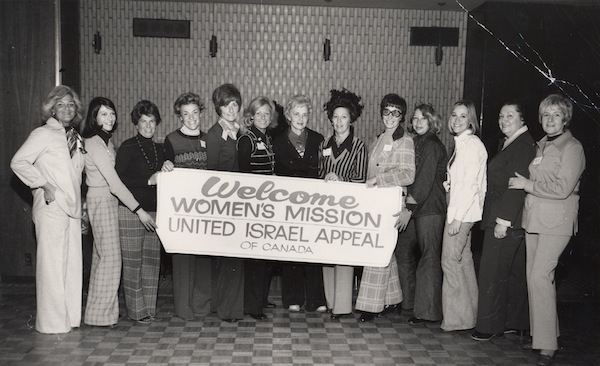
photo - Women holding the banner “Welcome, Women’s Mission, United Israel Appeal of Canada,” Vancouver, March 26, 1975
Women holding the banner “Welcome, Women’s Mission, United Israel Appeal of Canada,” Vancouver, March 26, 1975. (JWB fonds; JMABC L.15296)
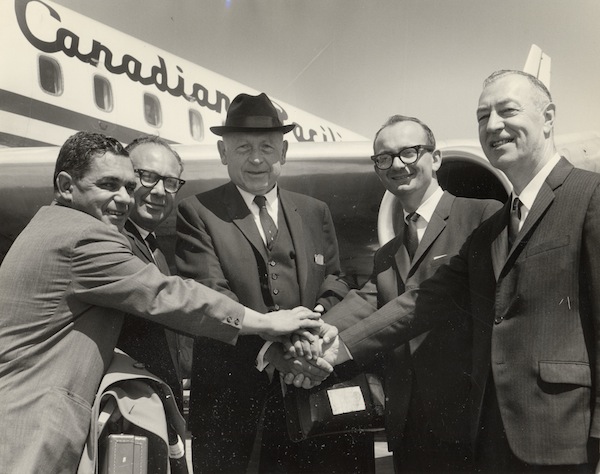
photo - Men alongside a Canadian Pacific aircraft with Karl Silberman, special representative for projects, Keren Hayesod, 1968
Men alongside a Canadian Pacific aircraft with Karl Silberman, special representative for projects, Keren Hayesod, 1968. (JWB fonds; JMABC L.15161)
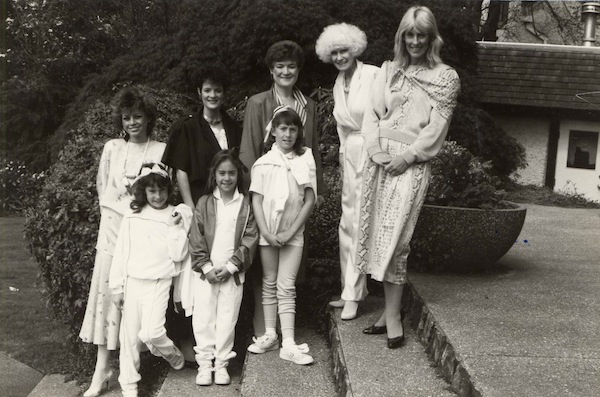
photo - ORT fashion show: Dianne Faber (extreme right), Leta Jones (third from the right), Vancouver, May 30, 1985
ORT fashion show: Dianne Faber (extreme right), Leta Jones (third from the right), Vancouver, May 30, 1985. (JWB fonds; JMABC L.14068)
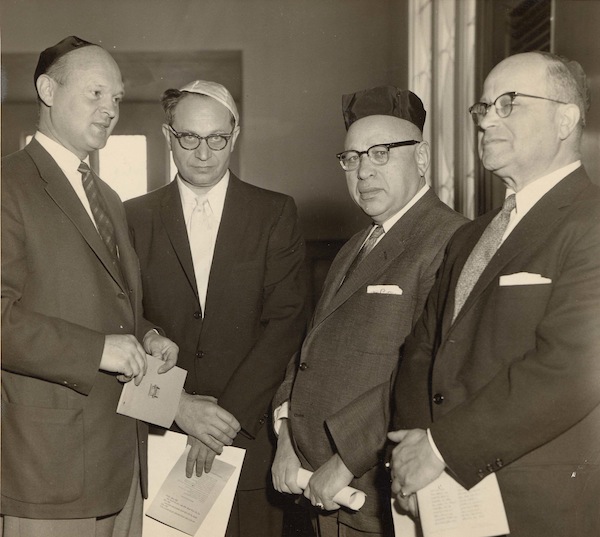
photo - Centenary presentation at Schara Tzedeck, Vancouver, circa 1955. Jack Diamond is second from the left
Centenary presentation at Schara Tzedeck, Vancouver, circa 1955. Jack Diamond is second from the left. (JWB fonds; JMABC L.14275)
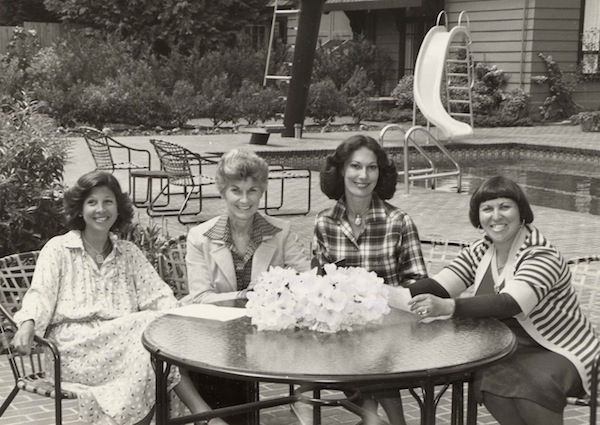
photo - Women at poolside table, Vancouver, 1980
Women at poolside table, Vancouver, 1980. (JWB fonds; JMABC L.14058)
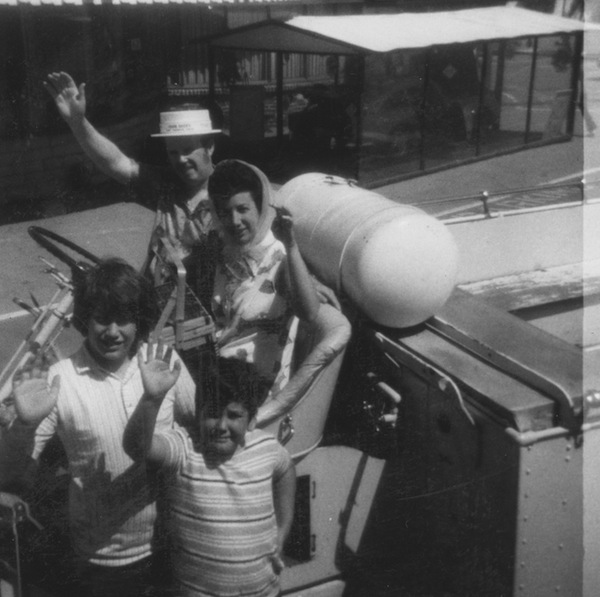
photo - “Good old days” revived at B’nai B’rith picnic, 1972
“Good old days” revived at B’nai B’rith picnic, 1972. (JWB fonds; JMABC L.09560)

Radio host visits Israel

U.S. radio host Dr. Joy Browne discusses the post-traumatic physical and psychological challenges of terrorism at OneFamily. (photo from OneFamily)

American syndicated radio host and clinical psychologist Dr. Joy Browne had a meeting with victims of terrorism at the headquarters of OneFamily during her first-ever visit to Israel earlier this month.

Hosted by Chantal Belzberg, chief executive officer of OneFamily, Browne met with former residents of the United States, Canada and the United Kingdom who were dealing with physical and emotional wounds in the aftermath of terror attacks across Israel over the past few years. She interviewed Cheryl Mandel, Kay Wilson, Steve Bloomberg and Rebecca Fuhrman, as well as some of OneFamily’s psychologists and therapists for a future segment on her program.

“After experiencing the aftermath of 9/11, we all share a common echo and I am impressed with the resilience of the people here who have worked or who are working to transcend fear and are getting on with their lives,” said Browne.

Mandel, a native of Toronto, who made aliyah nearly 25 years ago, lost a son, Daniel, who was killed during an Israel Defence Forces anti-terrorism mission in Nablus (Shechem) in 2003. Mandel, in tears, told Browne, “Our entire family, including myself, lives life to the fullest and I am an optimistic person by nature, but one never is prepared for the shock that comes with the death of a son, whom I never thought twice about sending to the army.”

Browne’s trip to Israel was sponsored by the Office of the Prime Minister and America’s Voices in Israel.

מוכרחים להיות שמח

שון אקור (ted.com/talks, צולם מאי 2011 בTEDxBloomington)

מוכרחים להיות שמח: סדנאות ללמד עובדים לשמוח תופסות תאוצה בקנדה והמעסיקים שמחים

הטרנד להפוך את העובדים לשמחים ופוזיטיביים תופס תאוצה משמעותית בקנדה. מרבית הסדנאות ללמד עובדים וסתם מתעניינים אחרים איך להיות שמחים, מלאות עד אפס מקום ורשימת ההמתנה ארוכה מאוד. מעסיקים רבים מתחילים להבין סוף סוף שעובדים שמחים זה נכס אמיתי למקומות העבודה שלהם. חלק מהמעסיקים אף מפעיל סדנאות מקצועיות במקום העבודה לרכישת כלים, ללמוד להיות שמחים. מעסיקים אחרים שולחים את עובדיהם לסדנאות חוץ. והתוצאות מוכחות באופן חד משמעי: אצל עובדים שמחים התפוקה והמכירות עולים משמעותית.

הפסיכוג האמריקני שון אקור, שמעביר קורסים ללמוד איך להיות שמחים, אומר שלהיות שמח זו בחירה של כל אחד ואחד מאיתנו. אפשר להפוך אדם פסימי לאדם אופטימיסט, על ידי תרגול של שתי דקות ביום בלבד במשך שלושה שבועות. תוך כחודש המוח שלנו יהפוך את את השמחה להרגל קבוע בחיים שלנו.

לדברי אקור שבעים וחמישה אחוז מהעובדים המצליחים הם בני אדם פוזיטיביים, שמחים ובעלי תמיכה חברתית חזקה. הם רואים במתח פשוט אתגר ולא שום איום. כשבודקים מדוע אנשים שמחים או שאינם שמחים, רק עשרה אחוזים תלויים בגורמים חיצוניים, ולעומת זאת תשעים אחוז תלויים באיך שמוחם של בני האדם מתפקד.

אקור מוסיף: “אנו גדלנו בתרבות שמעריצה אנשים שעובדים קשה מאוד, כי אז בוודאי הם יצליחו ולכן יהיו שמחים. אך המציאות מוכיחה שזו טעות יסודית. לאחר שאלו שעבדו קשה השיגו מטרה אחת, הם כבר לא מרוצים מהמצב ומציבים לעצמם מטרה נוספת וכך שוב ושוב. המוח שלנו עובד בדיוק הפוך. כשאדם שמח הוא הרבה יותר יעיל, אנרגטי, קריאטיבי ואף מתברר שהאינטליגנציה שלו גבוהה יותר. המחקרים מוכחים בוודאות שמוח של אדם פוזיטיבי מעלה את תפוקתו של עובדים למשל בשלושים ואחד אחוז, וכן את מכירותיהם של אנשי המכירות בשלושים ושבעה אחוז. ואצל רופאים שמחים גם יש משמעות רבה כיוון, שמהירות ההבחנה שלהם עולה בתשעה עשר אחוז”.

 הבעלים ישלם: עדיין לא נמצא רוכב אופנוע שנהג במרץ בתוך מרכז קניות בסרי ונעלם

המשטרה הפדרלית עדיין מחפשת את רוכב האופנוע שנהג בפרעות ובמהירות, במרכז קניות הומה ‘גילפורד’ בעיר סרי ונעלם. האירוע החמור אירע במרץ וכאמור עדיין לא ברורה זהותו של רוכב האופנוע. השוטרים מצאו את האופנוע הנטוש שלו אך אין להם קצה חוט מי הנהג, מלבד העובדה שהוא בן כ-40.

ממש כמו בסרטים נועזים הרוכב ברח משוטרים לאחר שנהג במהירות גבוהה מאוד וביצע עבירות תנועה חמורות. בין היתר הוא נכנס עם האופנוע למרכז הקניות ‘גילפורד’. הוא ירד עם האופנוע במדרגות הנעות כשאחריו רצים שוטרים ושומרים, אל מול עיניים משתאות של מי שנכחו במקום, שחשבו שאולי מדובר בצילום סרט אקשן. לאחר מכן הרוכב האמיץ יצא בדלת הראשית כהשלקוחות נסים על נפשם. ומשם הוא המשיך בטיסה לכביש הראשי, עלה על גשרי להולכי רגל וחזר אל הכביש. כל אותו זמן ניידות רדפו אחריו, כשבשמיים חג הליקופטר משטרתי. בשלב מסויים הרוכב נטש את האופנוע ונעלם. צוות החקירה השתמש בסרטון שתיעד את המרדף לצורכי לימוד, ובטעות הוא הודלף ליוטיוב, והפך ללהיט מבוקש ברשת.

בינתיים החליטו לפני מספר ימים במשטרה הפדרלית לקנוס את בעלי האופנוע ב-13,500 אלף דולר. מבחינת המשטרה הוא אחראי לאופנוע גם אם לא נהג בו. במשטרה ספרו 58 עברות תנועה מצד הרוכב האלמוני והאחריות כאמור נופלת על הבעלים של כלי הרכב.