
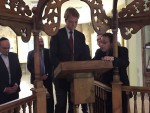
Chris Alexander, Canada’s citizenship and immigration minister, at the Jewish Cultural Centre and Holocaust Museum in Dnipropetrovsk, Ukraine. The minister visited Dnipropetrovsk and Kyiv between April 26 and 28 to reaffirm Canada’s support of a democratic and sovereign Ukraine. (photo from Citizenship and Immigration Canada)
Author: Citizenship and Immigration Canada
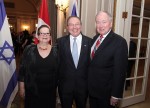
Yom Ha’atzmaut in Ottawa
Ambassador of Israel to Canada Rafael Barak, centre, with his wife Miriam and Foreign Minister Rob Nicholson at the Israeli embassy’s Independence Day reception held at the Chateau Laurier in Ottawa on April 29. The more than 600 attendees included ministers, MPs, senators, Supreme Court justices, members of the diplomatic corps, government officials, rabbis, other clergy, representatives of the Jewish community and other supporters of Israel. (photo from Israeli embassy)

הליגה להגנה יהודית רוצה לפעול גם בוונקובר
חברי הליגה להגנה יהודית לקחו חלק בהפגנה נגד ועידת סביל בחודש שעבר בוונקובר. (צילום: Ariane Eckardt)
מחממת את הקווים: הליגה להגנה יהודית רוצה לפעול גם בוונקובר
הארגון הימני הרדיקלי הליגה להגנה יהודית, בודקת את האפשרות להתחיל ולפעול גם באזור ונקובר. זאת כדי להתמודד עם לא מעט ארגונים פלסטינים ופרו פלסטינים מקומיים שפועלים בעיר, ויוזמים כל העת מבצעי חרם נגד ישראל. פעולות אלו נעשות כמעט ללא הפגנות נגד מצד תומכי ישראל.
המשרדים הראשיים בקנדה של הליגה להגנה יהודית נמצאים בטורונטו. אירועי הלחימה מבצע “צוק איתן” בין ישראל והחמאס, בקיץ 2014, גרמו להפגנות קשות נגד ישראל ותומכיה בקנדה, והביאו אף לגידול משמעותי באלימות ובפעילות האנטישמית נגד יהודים בקנדה מצד מוסלמים. לאור זאת הוחלט בליגה להגנה יהודית להגביר והרחיב את הפעילות גם לאזור נוספים בקנדה. בהם ערים מרכזיות: מונטריאול, ונקובר, אוטווה וקלגרי. במונטריאול נפתח כבר משרד של הליגה, ועתה כאמור גם ונקובר נמצאת על מפת הארגון הימני הקיצוני.
נציגים של הליגה הגיעו לאחרונה לוונקובר וסיכמו בחיוב את הביקור, שמשמש כשלב נוסף בהכנה להקמת הסניף כאן.
בליגה להגנה יהודית המציינים כי מתפקידם לשמור על היהודים, ולאמן אותם להגן על עצמם בפני כל תוקפנות. בראש הליגה בקנדה עומד מאיר ווינשטיין (58), ובארגון חברים כיום קרוב לאלפיים איש.
במרכז לענייני ישראל והיהודים בקנדה לא אוהבים את הרחבת הפעילות של הליגה, ומקווים שלא תהפוך לאקטיבית מדי.
יצוין כי שלטונות צרפת פועלים להוצאתה מהחוק של השלוחה הצרפתית של הליגה להגנה יהודית.
מופע חדש: סירק דו סוליי שנמכר לקונסורטיום אמריקני-סיני תמורת כ-1.5 מיליארד דולר, מגיע לוונקובר
הקרקס הקנדי הידוע בעולם סירק דו סוליי (בתרגום לעברית: “קרקס השמש”) נמכר לאחרונה לקונסורציום בינלאומי (אמריקני-סיני-קנדי), תמורת כ-1.5 מיליארד דולר. עריכת ההסכם המסובך והארוך בוצעה בצורה סודית עד לחתימה הסופית. רק אז הבעלים והמייסד גאי לליברטה, הודה כי הוא מכר את הקרקס לשלושת הגופים. על פי ההסכם: תשעים אחוז ממניות הקרקס שבבעלות לליברטה, עברו לידי הקונסורציום שכולל את חברת ההשקעות הפרטית האמריקנית טי.פי.גי’ קפיטל, תאגיד ההשקעות הסיני הענק פוסן וקרן פנסיה ציבורית מקוויבק אאיסה דה פוט. יצויין כי טי.פי.גי’ קפיטל מחזיקה בעשרים וחמישה אחוז ממניות חברת שטראוס, ואילו פוסן שגם פועל בישראל מנסה לאחרונה לרכוש ארבעים וארבעה אחוז ממניות חברת הביטוח הפניקס.
לליברטה ניסה מזה מספר חודשים למכור את סירק דו סוליי, והוא שכר למטרה זו את שירותי בנק ההשקעות האמריקני הגדול גודלמן סאקס. הוא קיווה שיצליח לקבל כשני מיליארד דולר עבור המכירה אך כנראה שהירידה בהכנסות הקרקס בשנים האחרונות, הורידה גם את שווי אחזקותיו לכ-1.5 מיליארד דולר. עם מימוש העיסקה לליבטרה שמחזיק במיעוט המניות בקרקס, ימשיך לעבוד בחברה שמפעילה אותו על תקן של יועץ.
קרקס סירק דו סוליי הוקם ב-1984 במונטריאול, בסיסו עד היום נמצא בעיר והוא מעסיק כיום כ-4,000 עובדים.
הקרקס יקיים בחודשים הקרובים מספר הופעות של ההצגה “וראקי” בקנדה. החודש הוא יקיים הופעות בוונקובר בן ה-20 ל-24 בחודש. לאחר מכן הקרקס יעבור לויקטוריה ויקיים שם הופעות גם כן החודש, בין ה-27 ל-31. משם הוא ימשיך לאדמונטון ויקיים הופעות ביוני בין ה-18 ל-21 בחודש. אחרי כן יגיע לויניפג גם כן ביוני ויקיים הופעות בין ה-24 ל-28. לאחר מכן יגיע לאוטווה ויקיים הופעות ביולי בין ה-2 בחודש ל-5 בחודש. ואילו בחודש בספטמבר יגיע הקרקס לטורונטו ויקיים הופעות בן ה-2 ל-6 בחודש.
הקרקס יחזור לישראל שוב עם המופע חדש “קוידם” וההצגות יתקיימו ביולי, בהיכל נוקיה בת”א בין ה-2 ל-16 בחודש.
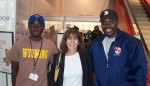
America’s pastime in Africa
Ruth Hoffman with baseball player Arthur Lusala, left, who today studies developmental economics at university, and coach George Mukhobe. (photo from Ruth Hoffman)
Vancouver baseball teens and their parents piled into the Rothstein Theatre on Sunday, April 19, for Opposite Field, a documentary by Jay Shapiro about a Ugandan Little League baseball team and its struggle to compete on the international stage.
The story caught Shapiro’s eye several years ago when he learned about an American businessman, Richard Stanley, who was sponsoring Uganda’s first baseball field and creating a Little League team. It was comprised of tenacious youngsters, many from poverty-stricken homes and unable to afford the most basic baseball gear. But the Ugandan team proved you don’t need fancy equipment to be a winner. What they lacked in material possessions they more than made up for in determination and skill, eventually traveling to Poland in 2011 to play in the regional championships. There, they earned the right to compete in the Little League World Series in Williamsport, Penn., where they would have been the first African team in history to participate.
 Bureaucratic red tape forced the cancelation of their trip, when visas to the United States were declined due to insufficient documentation. One player in Opposite Field explained that unlike most families in North America, who possess and protect important documents like their children’s birth certificates, in Uganda this is close to impossible. Birthing clinics fail to record information and families struggling to feed their children have other priorities than obtaining and keeping the documents.
Enter Ruth Hoffman, a Vancouver accountant who heard about the plight of the Uganda Little League team in August 2011, not long after their visas were declined. A specialist in microfinance who has worked in Kenya and the Democratic Republic of Congo, Hoffman is a mother of three and well acquainted with baseball.
“My twin boys competed in Poland and their team made it to the World Series in 2006, something that became the highlight of their youth,” she recalled. Her sons’ trip had almost been canceled, too, as they were trying to fly to the United States at precisely the same time as the shoe bomber’s failed attack was discovered, stopping most international flights. Hoffman recalled hovering at the airport among the reporters, waiting desperately to get onto a flight. Determined as they come, she told her boys’ story to a reporter – that they were scheduled to play but couldn’t get a flight out to their destination. It quickly garnered media coverage with surprisingly positive results. “British Airways put the boys and their team on the first flight [possible],” she said.
With this experience in mind, if there was anyone could change the plight of the Uganda Little League team, it was Hoffman. First, she called the mayor of Langley, B.C., as the team had been scheduled to compete at the World Series against the Langley Little League team. She suggested they bring the Uganda team to British Columbia to play Langley. After further discussions with Uganda coach George Mukhobe, it was decided that the Langley team would visit Uganda, instead.
Shapiro and his cameras were there for the January 2012 trip, as were three members of Major League Baseball, Jimmy Rollins, Gregg Zaun and Derrek Lee, who felt compelled to join the unique journey. Hoffman partnered with a humanitarian organization, Right to Play, which encouraged her to leave a legacy for what became known as the Pearl of Africa series. Together they raised $155,000 for this trip, funds used towards education of the Uganda team players, equipment, improvement and construction of baseball fields and a player transportation fund.
 It might have ended there but that was just the beginning for Hoffman. In Part 2 of the Pearl of Africa project, she raised another $40,000 for the Uganda team, funds that helped train Uganda softball and baseball coaches. Her goal for Part 3 is to raise another $20,000 for the Uganda Baseball and Softball Association.
Opposite Field tells some of this story, focusing mostly on the time leading up to the Langley team’s visit. Filmmaker Shapiro humanizes the team by focusing on individual members, their personal struggles and their motivations and goals. In the process, he takes viewers deep into Uganda, revealing a level of poverty unrivaled in North America. It’s a beautiful story with a happy, or happier, ending, one that’s still in the making.
View an excerpt online at opposite-field.com or look out for the entire documentary, whose Canadian rights have been purchased by CBC, on television.
Lauren Kramer, an award-winning writer and editor, lives in Richmond, B.C. To read her work online, visit laurenkramer.net.

Shakespeare remixed
Caroline Cave appears in a Shakespeare double feature, May 5-17. (image from escapeartists.ca)
Shakespeare’s plays are favorites with both actors and audiences. In Vancouver, the Shakespeare annual summer festival Bard on the Beach is a sold-out affair. This year, local actress Caroline Cave appears in a Shakespeare double feature here in May. Both are world premières created by Tracey Power’s theatre company, the Escape Artists, reimagining Shakespeare for an all-female cast.
“Tracey thought that there are too few roles for women actors in theatre. She set out to change that,” Cave told the Jewish Independent.
Power’s original musical Miss Shakespeare centres on an imaginary underground all-female theatre group in Shakespearean times, when women were forbidden to tread the stage. In tandem with Miss Shakespeare comes J. Caesar. This re-worked tragedy about Julius Caesar and Brutus is set in a dystopian future, where women rule. Like the original version, it deals with honor, friendship and patriotism.
“It’s Shakespeare’s play,” Cave said. “All the words are by Shakespeare, but all the roles are played by seven female actors, the same ones that participate in the musical.”
The roles Cave plays in each show are nearly opposite in personality. “In J. Caesar, I play Brutus. Brutus is a strong character, both physically and mentally, a rebel. Unlike Brutus, my character in Miss Shakespeare, Susanna, is a prim and proper woman, very religious and conforming to the society rules. Not a rebel at all.”
Cave is not a novice in playing complex characters. Her repertoire includes several award-winning theatre and screen roles. Twice, in 2010 and 2011, she won a Gemini Award for lead actress for her portrayal of Catherine Scott in the Showcase original series Cra$h & Burn. She also won awards for her theatrical performance in The Syringa Tree by Pamela Gien – a play about South African apartheid.
Cave grew up in West Vancouver. She studied piano and ballet as a girl and then received her training as a classical actress at the University of Alberta. She also apprenticed at the Royal National Theatre Studio in London.
Despite her much more lucrative work for the screen, she loves theatre. “Theatre feeds my soul. It keeps me humble,” she said, contemplating the differences between mediums. “Theatre is inspiring and challenging. You have to find the connection with the audience. On the other hand, camera allows much more intimacy. You don’t have to tell the whole story, just pieces. You can concentrate on one scene and forget all else for awhile. Not so in theatre. Here you tell the whole story in one evening, and it’s a different story every night.”
According to Cave, theatre depends on the actors as well as the public, the audience. “Theatre brings people together, and the actors feel it. We play with our public, as well as with our fellows on stage. The reaction of the audience is very important.”

Cave admitted that she loves British audiences the best. “In England, the public is much more honest, much freer than here, in Canada. Canadians are more repressed in the theatre, as if theatre is for some sort of elite. But it is not. It is for all of us.”
The most difficult audiences she’s encountered have been in Montreal. “The audience there is hard: stiff, unresponsive, very quiet.”
Theatre shouldn’t be quiet, she continued. “It should be visceral, brave, daring. It shouldn’t be a clone of reality, like a movie. It should be like magic. That’s why Cirque du Soleil is so popular,” she suggested.
To instigate a visceral experience for audiences, an actress needs all the tools in her creative arsenal. Among those tools are two types of acting. One is when an actor plays herself in the given circumstances. Another – when an actor transforms into her character. “I can do both,” said Cave. “When I played The Syringa Tree, I had to be 24 different characters. In one evening, I had to switch between men and women, young and old, black and white. It was demanding and wonderful and very physical. I couldn’t be myself there. Other roles don’t need this kind of transformation. They might be closer to me physically, too, so the approach is different.”
Being an established, sought-after actor in Canada, Cave is lucky to be able to consider roles with different theatre companies. “I don’t audition for theatre in Canada anymore,” she said. “But, for the screen, I audition for every role, big or small. In movies and TV, there are so many factors out of my control, luck among them. I might do the best audition work ever, and they wouldn’t cast me. Or I might be dissatisfied with my audition, but I would be cast. Theatre is different. In theatre, it’s mostly on merit. If you do your job well, if you are professional, have a strong work ethic and respect for the craft, you can make it.”
When she was invited to participate in Miss Shakespeare and J. Caesar, she gladly accepted. “A chance to play Shakespeare doesn’t come often,” she said with a happy smile.
Both plays run at Performance Works on Granville Island from May 5-17, and at the Kay Meek Centre for the Performing Arts in West Vancouver, May 21-29. For more information and for tickets, visit escapeartists.ca.
Olga Livshin is a Vancouver freelance writer. She can be reached at [email protected].
A more realistic future
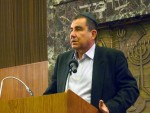
Ari Shavit speaks at Winnipeg’s Shaarey Zedek Synagogue. (photo by Rebeca Kuropatwa)
As part of the Jewish Heritage Centre of Western Canada’s Annual Sol and Florence Kanee Distinguished Lecture Speaker Series, leading Israeli columnist and writer Ari Shavit addressed a packed room of 300 people on the topic Is Peace Dead? The talk took place April 19 at Shaarey Zedek Synagogue in Winnipeg.
Shavit, who described himself a “diehard peacenik,” said he is more comfortable referring to what some call “the Arab Awakening” as “the Arab Chaos.”
He explained, “We were hoping for an Arab Spring. It turned into something else and the result is the Arab Chaos. The old order that ruled over the Arab world has collapsed, but it was not replaced by any liberal democracy. It was replaced with more tribalism, more fanaticism and much more violence. We now see a human catastrophe engulfing a large part of the region and the acute situation of instability. I care about my fellow humans and we have to be saddened that we have such a terrible human catastrophe.”
Even worse, in Shavit’s view, “There is no more chance in the upcoming years to have the old kind of peace we hoped for,” he said. “I don’t think we can have the kind of peace agreement like with Egypt or Jordan in the coming years, because those were peace agreements that were signed with tyranny.”
Shavit used Syria as an example, saying that, back in the 1990s and in early 2000, he very much supported a peace agreement with Syria. But, he said, “Now, there is no one to make peace with.
“The good news is the more clear division within the Arab community. Many Arab moderates are now terrified by Iran, by ISIS, by the Islamic Brotherhood, by Al-Qaeda, by extremists, [so] they actually are closer to Israel than they ever were in the past. So, there is a kind of interesting potential within this sad, tragic, acute situation.”
According to Shavit, the road to peace today begins with the understanding that we cannot reach a two-state solution with the Palestinians in the coming months or years.
“We won’t have the comprehensive peace we hoped for,” said Shavit. “But, on the other hand, we should not accept the status quo. And, I think we should launch a two-state dynamic, which would lead to a two-state state to start with, and eventually lead to a two-state solution.”
Regionally, Shavit stressed the need for Israel to work much more closely with Egypt, Saudi Arabia, the Gulf countries and Jordan, as, he said, “They are closer to Israel than they ever were.”
Though Shavit conceded that the likelihood of signing a new formal peace agreement may not currently be in the cards, he encouraged “building a kind of peace based on economic interests, mutual interests and strategic interests.”
What Shavit envisions is “the kind of peace agreement [Israel] had with Jordan before the 1994 peace signing. There were no embassies, there were no Nobel Prizes, no White House ceremonies, but we had a very close, intimate relationship – quite a lot of the time – better than after the formal signing. That should be an example of what can be done in this new chaotic situation.”
Shavit sees potential for “cooperation as opposed to a utopian peace.” Potential partners for this cooperation, Shavit suggested would include “the major Arab Sunni nations led by moderate people…. [People who] are not deeply concerned or interested in human rights or democracy, but they don’t want extremists. Saudi Arabia and the other Gulf States fall into that category. So, the strategic game now is pretty much controlled by two non-Arab countries – Israel and Turkey – and, I would say, Egypt and Saudi Arabia.”
As to whether or not these partners are interested in just cooperation or a more lasting peace, Shavit said, “I think they want to live and they want stability. Therefore, if we promote this new peace concept, I think there’s a chance of having a better relationship. I think many of them see Israel as a partner in that.
“It’s not that they are going to have a religious conversion…. I don’t see a kind of relationship that France and Spain have or Canada and the U.S. do, but, I do see a kind of Middle East-style relationship – the ability to create a structure that can be formed again if we endorse the right ideas.”
Regarding Israel’s recent elections, Shavit feels that the left lost more than the right won. “The lack of a peace plan of action had a lot to do with that. Even the left-wing part[ies] were not very aggressive at promotional peace. The peace talked about in the national community is a kind of peace that is totally detached.”
Shavit is hopeful that Israelis will open their hearts to peace, in the case where “a kind of new peace, a concept that is more realistic, comes around. As long as the community talks about European-style peace, when we have a kind of evil political reality in a large part of the Middle East, Israelis will not buy into that.”
International support is critical to any potential peace progress and, while Shavit loves Canada in many ways, he said, “I appreciate that Canada is supportive of Israel, when there aren’t many that support Israel in such a way. [But] obviously, the real relevant player is the United States.
“I hope that America will endorse a new kind of peace policy and then build a wide coalition – first of all with Canada, then with the European powers and then with the moderate Arabs and Israelis – addressing the issues in a realistic way.”
Shavit believes that the “dysfunctional relationship” of Binyamin Netanyahu and Barack Obama is not advancing the situation. “I hope I can be successful in encouraging an intellectual process to be helpful in bringing some change to that,” he said.
Shavit, like many others in Israel and around the world, is waiting to see what kind of Israeli government will be formed. “If we do have a right-wing government, with [Avigdor] Lieberman being the centre, I worry that we will have unpleasant legislation that will alienate the Arab minority even more and jeopardize the fragile relationship with them. If it will be more moderate in the centre, there is less danger.
“I think the last six months were very troubling, with unprecedented legislation or attempts [to discriminate], though most failed. I hope and pray that our power will not go back to that kind of approach. I think it will endanger Israel’s soul in a serious way.”
Shavit is hopeful that minority rights will not be trampled, as “the tradition of the historic Israeli right always combines nationalism with liberalism, with a deep respect for democracy. I really hope we will not see dark forces in Israel rising to power.”
Rebeca Kuropatwa is a Winnipeg freelance writer.

This week’s cartoon … May 1/15
For more cartoons, visit thedailysnooze.com.
Raising a network of voices
Ari Ne’eman was diagnosed with Asperger’s syndrome at the age of 12. He did not have an easy childhood, being forced to leave his Solomon Schechter day school and, later, being expelled from Camp Ramah.
He is now head of the Autistic Self-advocacy Network (ASAN), and serves as one of President Barack Obama’s appointees on the National Council on Disability. Earlier this year, he received the Ruderman Family Foundation’s $100,000 Morton E. Ruderman Award, which “recognizes an individual who has made an extraordinary contribution to the inclusion of people with disabilities in the Jewish world and the greater public, and is based on past achievements and the potential for future contributions to the field.”
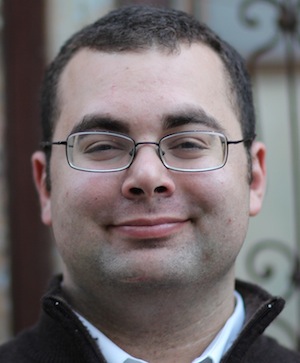
In 2006, Ne’eman co-founded ASAN. “Too often in conversations about autism policy or public discussion, researchers and family members are given precedence over autistic voices,” he told the Independent about the need for the organization. “This is due to a tendency not to recognize that a self-advocate perspective is distinct and different from those of family members, providers or researchers.”
The goal of ASAN is to ensure that those on the autism spectrum are represented in the public discourse and have their own collective voice. “People with disabilities are often perceived as incapable of representing themselves or as being unreliable in being the narrators of our own experience,” he said. “Really, both of those perceptions are very inaccurate and unfortunate.
“Unfortunately, society has certain perceptions about people with disabilities – in particular of autistic people and people with developmental disabilities. This often leads them to seek out the voices of our family members or service providers rather than hearing our own voices.”
According to Ne’eman, many people believe autism is a recent epidemic or a tragedy and, as a result, focus on advocacy related to research around causation and cure. ASAN believes the focus should be on services, supports and rights protection throughout their lifespan.
“Many families have been exploited by groups that seek to sell pseudoscientific cures predicated on the idea that autism is somehow connected to vaccination, which has been very thoroughly discredited,” he said. “From our point of view, there’s a need to really debunk those myths and communicate more accurate information to families.”
Ne’eman said that different autism diagnoses can be given to the same person by different doctors, and that these can also differ depending on when in their life a person is diagnosed. “This is partly because, even though there’s tremendous diversity on the autism spectrum, there aren’t clear dividing lines when it comes to different diagnoses,” he said. “We have this idea that there’s this thing called
‘Asperger’s’ and this separate thing called ‘autism.’ But, in fact, there is no clear dividing line between the two. What we have is a single, very diverse autism spectrum.”
ASAN includes people across the spectrum. For example, they have members who need augmentative communication technology to communicate (cannot speak). “We also have members and leaders, like myself, who do [speak],” said Ne’eman. “We have some who can talk in some contexts, but not in others. Some members have intellectual disabilities or various forms of cognitive or behavioral challenges.”
The network has invested largely in leadership development, and is active in lobbying state governments to change the funding of disability services to a more inclusive model. “We are in the process of expanding our work with respect to bringing people to a more integrated form of service provision, and supporting people out of institutions and group homes,” said Ne’eman.
ASAN advocates for students with disabilities, whose treatment varies greatly between districts and schools.
“As a matter of federal law, students with disabilities have the right to receive a free and appropriate education in a least restrictive environment,” said Ne’eman. “There’s a real need for a stronger emphasis on supporting students with disabilities in the general education classroom.
“In adulthood, people with disabilities also have a right to receive services in the most integrated setting under the Americans with Disabilities Act,” he continued. “In the U.S. today, there are 13 states that have eliminated institutionalization for people with developmental disabilities. I’ve seen significant positive outcomes as a result. When you get down to it, people aren’t more disabled in New Jersey, which has a lot of institutions, than they are in Oregon, which has no institutions.”
ASAN also promotes equal wages for people with disabilities. “Right now, approximately 200,000 people with disabilities in the U.S. are paid less than minimum wage under the Fair Labor Standards Act,” said Ne’eman. “If you look at the provision that allows for subminimum wage, it dates back to the 1930s, when there was one set of assumptions about people with disabilities. Today, 25 years after the Americans with Disabilities Act, we have different assumptions.”
Ne’man said that the Ruderman Award “was particularly an honor because of the importance of the foundation’s work in the Jewish community.”
He said, “Growing up, like many Jews with disabilities, I experienced challenges in being accepted in Jewish communal life. Many people with disabilities have to leave Jewish day school and other Jewish communal settings because of an unwillingness to provide accommodations.”
Ne’eman put a significant amount from the award toward a new disability rights-related project that he is not yet prepared to discuss, noting, “Hopefully in the coming year it will become visible.”
Rebeca Kuropatwa is a Winnipeg freelance writer.
Glimpse into Schiffer’s work
Jennifer Levine, Fred Schiffer’s daughter, speaks at the opening of the exhibit of her father’s work. (photo by Cynthia Ramsay)
On April 16, with the help of volunteers from King David High School and others, the Jewish Museum and Archives of British Columbia welcomed more than 250 visitors to the opening night of Fred Schiffer Lives in Photos. At the Make Gallery until May 31, the exhibit is part of the Capture Photography Festival.
Michael Schwartz, coordinator of programs and development at the JMABC and curator of the exhibit, gave the crowd a brief overview of what the JMABC does, and how the Schiffer photos fit into the museum’s holdings.
Of the 300,000 photographs housed by the JMABC, said Schwartz, “The Schiffer collection comprises over 10,000 photos. The JMABC has been working on this collection – organizing it, processing it – since it was donated by Schiffer’s family in 2001. To date, we’ve digitized 2,000 photographs, which are available to researchers online. The 45 photos that you see in this exhibit are selected from those 2,000, and an additional six photos are on display at the atrium of the Langara library through May 4th in a satellite exhibit.”
Schwartz explained that Schiffer fled Vienna, seeking refuge in England, where he stayed for 10 years before heading to Argentina, where he also lived for 10 years. “He arrived here in Vancouver in 1958 with his wife Olive and their two young children, Jennifer and Roger.”
The Schiffers operated a small studio under the Hudson’s Bay Co. building, on Seymour Street. “Schiffer was respected by his peers, not only for his skill but for being a kind and generous man, a true mensch, as we say,” said Schwartz. “He was president of the local photographic association, wrote frequently for the association newsletter and shared his knowledge of the trade with his colleagues.” He was one of the people who “led the charge to develop a professional photography program at Langara.”
After thanking the partners and funders of the exhibit, as well as his colleagues, Schwartz introduced Jennifer Levine, Schiffer’s daughter, who attended the opening from Toronto.
While her father was the person behind the photographs, she said, “he had two quite remarkable women who loved him and worked with him”: her mother, “who was the person you would always meet in the studio and who was also the organizer and the bookkeeper,” and her aunt, Irene, “who was not only a master retoucher but, also, I think she did some of the printing … together they discussed how things should be, and collaborated to make the prints happen.”
The family came to Vancouver from Buenos Aires, which had a “very lively photographic culture and my father was part of a group of photographers who met together, collaborated, discussed their work … they were sophisticated, they had annual photo shows in art galleries,” said Levine. When he came here, he thought he could interest the Vancouver Art Gallery in his work. “The response was, ‘Oh no, that’s photography, that’s not art.’ And it’s interesting that Vancouver has become such … an international centre for exciting work in photography, but let me tell you that, in the ’50s and ’60s, that was not happening.”
For her father, she said, “coming to Vancouver, which he chose to do, I think, largely for his children … because he had a sense of what was happening in Argentina, meant that the exploratory and experimental nature of his work would have to be held in because people in Vancouver were not interested…. I see how he had to shape his work for the marketplace and I know he did it for us and I honor him for that…. Artists have to make compromises sometimes for the people they love, and my dad did. I’m really proud of him as a photographer but I’m proud of him as a dad, too.”
– With the video file of Wendy Fouks

A rockin’ Yom Ha’atzmaut
Israeli musician Micha Biton headlined the community’s Yom Ha’atzmaut celebration. (photo by Rhonda Dent)
It was just shy of a sellout crowd on April 22 at the Chan Centre for the Performing Arts, as Israeli rock pioneer Micha Biton headlined the community’s main celebration of Yom Ha’atzmaut.
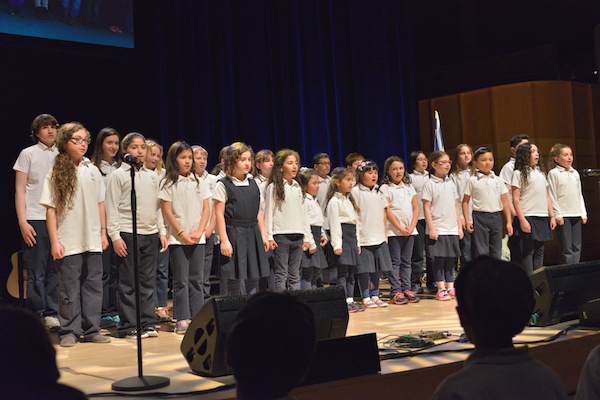
As it does every year, the evening began with the conclusion of Yom Hazikaron, led by Geoffrey Druker. In the singing of the national anthems, Vancouver Talmud Torah Choir was joined by Partnership2gether twin school Alei Givah Choir in Kfar Giladi (by video) for O Canada, while Richmond Jewish Day School Choir and Partnership2gether twin school Hameginim Choir in Kiryat Shmona (by video) sang Hatikvah.
Diane Switzer, board chair, Jewish Federation of Greater Vancouver, which led the celebration supported by some 50 community partner organizations and countless sponsors and volunteers, spoke briefly. She provided an overview of how the funds raised here for our partnership region in Israel – Eztabah Hagalil (the Galilee Panhandle) – are spent.
“Our Gesher Chai (Living Bridge) program aims to deepen connections with Israel on a person-to-person basis,” she said. “It builds lasting ties between our two communities, and is a cornerstone of Jewish Federation’s work.
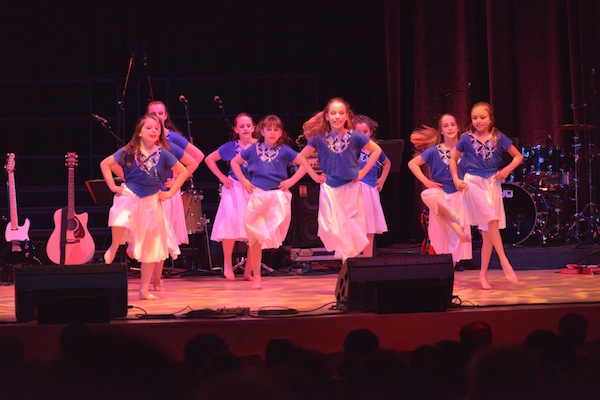
“Through Gesher Chai, we help local day school students build enduring relationships with their peers at their sister schools in Israel. We fund exchanges between local educators and their Israeli counterparts so they can develop a shared curriculum. And we help connect the JCC Or Chadash dancers you’ll see tonight with the Hora Goel dancers from our partnership region. The impact of these programs, which promote Jewish identity and unity for elementary and high school students, can be felt around the world and here at home.
“Etzbah Hagalil is geographically, economically and politically removed from the centre of Israel,” she continued. “It is surrounded on three sides by Syria and Lebanon, and often bears the brunt of attacks when tensions flare. High unemployment and limited opportunities for education and advancement are ongoing concerns, and the area is home to many at-risk youth. Jewish Federation’s strategic investment in this region is aimed at breaking the cycle of poverty, improving living standards and developing the region’s long-term economic prospects.”
Warming up the crowd before Biton’s performance was the Or Chadash dancers. The evening also included greetings by video from Premier Christy Clark, as well as from mayors Benny Ben Muvchar (Mevo’ot Hermon), Giora Saltz (Galil Elyon), Rabbi Nisim Malka (Kiryat Shmona), Ilan Or (Yesod Hama’ala) and Herzel Boker (Metula).
For more photos from the event, click here.