Skip to content
  • Home
  • Subscribe / donate
  • Events calendar
  • News
    • Local
    • National
    • Israel
    • World
    • עניין בחדשות
      A roundup of news in Canada and further afield, in Hebrew.
  • Opinion
    • From the JI
    • Op-Ed
  • Arts & Culture
    • Performing Arts
    • Music
    • Books
    • Visual Arts
    • TV & Film
  • Life
    • Celebrating the Holidays
    • Travel
    • The Daily Snooze
      Cartoons by Jacob Samuel
    • Mystery Photo
      Help the JI and JMABC fill in the gaps in our archives.
  • Community Links
    • Organizations, Etc.
    • Other News Sources & Blogs
    • Business Directory
  • FAQ
  • JI Chai Celebration
  • JI@88! video

Recent Posts

  • Eby touts government record
  • Keep lighting candles
  • Facing a complex situation
  • Unique interview show a hit
  • See Annie at Gateway
  • Explorations of light
  • Help with the legal aspects
  • Stories create impact
  • Different faiths gather
  • Advocating for girls’ rights
  • An oral song tradition
  • Genealogy tools and tips
  • Jew-hatred is centuries old
  • Aiding medical research
  • Connecting Jews to Judaism
  • Beacon of light in heart of city
  • Drag & Dreidel: A Queer Jewish Hanukkah Celebration
  • An emotional reunion
  • Post-tumble, lights still shine
  • Visit to cradle of Ashkenaz
  • Unique, memorable travels
  • Family memoir a work of art
  • A little holiday romance
  • The Maccabees, old and new
  • My Hanukkah miracle
  • After the rededication … a Hanukkah cartoon
  • Improving the holiday table
  • Vive la différence!
  • Fresh, healthy comfort foods
  • From the archives … Hanukkah
  • תגובתי לכתבה על ישראלים שרצו להגר לקנדה ולא קיבלו אותם עם שטיח אדום
  • Lessons in Mamdani’s win
  • West Van Story at the York
  • Words hold much power
  • Plenty of hopefulness
  • Lessons from past for today

Archives

Follow @JewishIndie
image - The CJN - Visit Us Banner - 300x600 - 101625

Author: Pat Johnson

Hebrew U marking 90 years

Hebrew U marking 90 years

Duvdevan elite unit veterans who visited Vancouver on the weekend are, left to right, Gilad Waldman, Daniel Kolver, noted singer and actor Tzahi Halevi, who sang at the event, Ariel Rubin and Boaz Faschler. (photo by Robert Albanese Photography)

The historical, contemporary and future impacts of the Hebrew University of Jerusalem were celebrated Sunday night at Congregation Beth Israel.

Several hundred members of the community gathered to mark the 90th anniversary of what has become one of the world’s great academic institutions.

Founded in 1925 by some of the greatest thinkers of the 20th century, including Martin Buber, Chaim Weizmann, Chaim Nahman Bialik and Albert Einstein, the university has produced seven Nobel laureates and is routinely recognized as one of the 100 best universities in the world.

The culmination of the evening focused on four young Israeli soldier-students and a scholarship project intended to both reward dedication to the state of Israel and to ensure that individuals who have demonstrated that they are among the foremost citizens of that country will continue to contribute productively throughout their lives.

The young men who addressed the audience are recent veterans of Duvdevan, an elite anti-terror undercover unit of the Israel Defence Forces.

Daniel Kolver was motivated to strive to become a member of the elite unit after being a teenage eyewitness to the Passover massacre at the Park Hotel in Netanya, in 2002, at which 30 Israelis were murdered by a terrorist at a seder.

He explained that Duvdevan members often operate as “Trojan horses,” charged with locating and arresting – or killing – the most dangerous terrorists, those “ticking bombs” who are minutes or hours away from executing attacks.

Each year, about 15,000 17-year-old Israelis apply to serve in Duvdevan and 150 are accepted. After some of the most intensive military training in the world, these soldiers are entrusted with hostage rescues, capturing terrorists in extremely dangerous urban warfare situations and delicate counter-terrorism operations.

Last year alone, the unit participated in more than 400 missions – each one of which involved at least one suspect. Kolver screened dramatic video of an operation in which his unit had two minutes to get through a labyrinthine neighborhood, detonate an explosive to blow the door off the home of a terrorist, identify the man hiding behind his wife and extricate the target and the unit from the premises within 10 seconds.

Another speaker, Ariel Rubin, admitted that he initially sought acceptance to Duvdevan to show off that he got into the elite unit. But the excruciatingly tough training eliminated all ego and superfluous motives.

“You disconnect your head from the physicality and you say, I’m doing this for my country … to protect Israel, to protect the Jewish people, because if we’re not there, nobody’s going to do it for us,” he said.

Fellow unit veterans, Boaz Faschler and Gilad Waldman, spoke of the difficult transition from being in one of the most secretive military units to assimilating into everyday life.

Among the purposes of the presentation was to raise support for the scholarship fund at Hebrew U, which awards 50 scholarships annually to soldiers from Duvdevan after their years of service.

The evening event, organized by the Vancouver chapter of Canadian Friends of the Hebrew University, featured two other presentations.

Ambassador Ido Aharoni, consul general of Israel in New York, acknowledged that Israel is not winning the global war for public opinion. Significant to the problem Israel faces is that a huge proportion – 40% of North Americans and Europeans and 30% of much of the developing world – can be defined as “infosumers,” a tech-savvy group of individualists who seek out their own information and share specific traits. Among the characteristics of this growing demographic is that they see themselves as part of an expanding global identity whose national identities are eroding. They are also significantly unfavorable toward force, whether by the military or police. Aharoni’s thesis was reinforced by the fact that riots had been taking place for days in the United States over police brutality and murders of African-American civilians.

Screening a photograph of a presumably Palestinian youth throwing a rock at a tank, Aharoni noted that this is the global image most associated with the Israeli-Palestinian conflict. But he also noted that polls indicate that in both Europe and North America, small numbers of people identify with either side in that conflict, most falling in the middle. Israel’s contradictory message of being both victim and victor, he said, is difficult to comprehend. And images of tanks versus stone-throwers, however unrepresentative this might be of the genuine power dynamic or context in the Israeli-Arab conflict, is not being successfully countered.

A more successful approach, he said, would be to appeal not to those who identify as opposed to the Israeli narrative, but to the large majority who subscribe to neither narrative. He called for greater emphasis on Israel’s contributions in fields of medicine, science, culture and other areas that benefit humankind.

Following the ambassador’s presentation, Prof. Noam Shoval of Hebrew U’s department of geography, spoke about the geographic realities of the city of Jerusalem.

Using a range of GPS and technological tools, researchers have studied the movement of Jerusalem’s residents and visitors, day and night, over time, to discover that the perception of Jerusalem as a culturally divided city is not accurate. There is an enormous amount of interaction by Jewish, Muslim and other residents of Jerusalem throughout and across areas of the city that are otherwise generally acknowledged as Jewish or Arab.

Shoval acknowledged that he would like to see Jerusalem remain united under Israeli jurisdiction, but he acknowledged that others might see a unified Jerusalem jointly administered by Israel and a future Palestinian state, or unified under some sort of international governance as was proposed in 1947. He concluded that dividing the city is not an ideal resolution.

“A division of the city is an outcome of war – not of peace,” he said.

Pat Johnson is a Vancouver writer and principal in PRsuasiveMedia.com.
Format ImagePosted on May 8, 2015May 6, 2015Author Pat JohnsonCategories IsraelTags CFHU, Duvdevan, Hebrew University, HU, IDF, Ido Aharoni, Israel Defence Forces, Noam Shoval

Caring for Bedouins’ health

Dr. Rania Okby was in Vancouver last week, speaking to several groups, including students at King David High School. On May 1, she addressed a small gathering at the University of British Columbia.

Fittingly, this latter talk was held in the Clyde Hertzman Boardroom of Human Early Learning Partnership, which is, according to its website, “a collaborative, interdisciplinary research network” whose “research explores how different early environments and experiences contribute to inequalities in children’s development.”

photo - Dr. Rania Okby
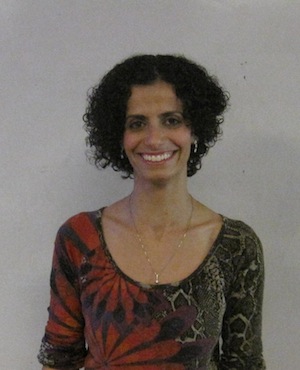
Dr. Rania Okby (photo by Cynthia Ramsay)

Okby spoke about traditional and environmental factors that affect the health of Bedouin women in Israel. Currently doing a one-year obstetrics fellowship at Sunnybrook Health Science Centre at University of Toronto, Okby is a graduate of the Centre for Bedouin Studies and Development, Ben-Gurion University (BGU), and is part of the staff at Soroka University Medical Centre and faculty of health sciences at BGU, specializing in high-risk pregnancy.

David Berson, executive director the B.C. region of Canadian Associates of BGU, welcomed guests to the Hertzman Boardroom and presented a brief video of the Israeli university, while UBC professors Adele Diamond and Judy Illes chaired the event. Sally McBride of HELP gave a brief overview of her organization.

In introducing Okby, Diamond highlighted the difficulties of crossing between cultures, which can make “you no longer feel at home in any one because you’ve tasted a little bit of the other, and so you’ve changed. Not only is she forging a balance between Bedouin life and Western life, but she’s also forging a balance between being the mother of two girls, ages 7 and 5, and having an incredibly active career. And, she’s not only doing that, she’s forging a balance between clinical work, teaching and research.” To do any one of these things would be a job for a lifetime, said Diamond.

Okby’s presentation offered insight into some of the health challenges facing her community. “As Bedouin women, we are discriminated in Israel on three levels,” she said. First, by living in Be’er Sheva, which is a community on Israel’s periphery; second, by being a minority with a Jewish majority; and, third, by being women in a male-dominated culture. These and other conditions – such as the rapid change from being a semi-nomadic people to living a more stationary, Western lifestyle – influence both the physical and mental health of Bedouin women, and she went on to explain in what ways.

Defining a Bedouin as “someone born and raised in the desert,” Okby said there are Bedouin living around the world. “Being a Bedouin is a lifestyle, so it has nothing to do with religion, nothing to do with nationality,” she said. There are 200,000 to 220,000 Bedouin in Israel, about half living in recognized villages; the other half not. The Bedouin comprise about 25 percent of the total population in the Negev, and are a diverse group.

In the early years of Israel, explained Okby, about half the Bedouin did not agree to leave their land to settle in cities, and these tribes are still in a dispute with the government over land ownership. People who live in unrecognized villages are not permitted to build permanent homes, so live in metal houses. There is no, or little, electricity, access to health care or public transportation, few roads and a lack of educational infrastructure.

Okby presented a statistical picture of the situation of Bedouin women: 6.2 years average education, 14.5% never went to school, 10.4% have higher education, 10% are working women, the average age of marriage is at 18.6 years old and the number of children per woman is 6.13. “When I started medical school 18 years ago, the number was 10, so things are improving and the numbers are decreasing, but still it’s a lot of [children],” she noted. Consanguinity, marrying within the same family, is 60 percent, while polygamy is 34 percent, “which has a bad influence on the mental and psychological health of the women and the kids.”

Issues such as post-partum depression, which affects one in three Bedouin women, are a challenge to treat, as the general view of psychiatry is not positive among Bedouin communities. Another major health concern, said Okby, is high infant mortality: 12% among the Bedouin compared to 6.6% among the Arab and 2.8% among the Jewish populations of Israel. “These numbers – you cannot ignore it, it is very clear,” said Okby, attributing the high rate to genetic disease or malformation, among other factors. Because of their religious beliefs, most Bedouin women won’t terminate a pregnancy beyond 17 weeks, even if prenatal screening detects problems, she said.

In addition to traditional factors, environment-related ones also affect infant mortality, including infectious disease and hypothermia. From ages 1 to 4, there are 12.7 Bedouin kids per thousand births who die from trauma compared to 1.9 in the Jewish community, and most of these Bedouin children are living in the unrecognized villages. The injuries result from a lack of awareness as well as way of life, cooking on open fires, for example.

Then there is the increasing incidence of Western illnesses, like diabetes and obesity, which are affecting the Bedouin, with lesser activity, poor knowledge about nutrition, and poverty. “About 30% of the diabetic patients don’t have enough money to get their medication, they have to choose medicine or food.” As well, Bedouin women are more at risk of breast cancer, and the average age of diagnosis is higher than in the Jewish community.

“There are lots of obstacles for the Bedouin women for better health, but there are lots of things to do, and lots of things are being done,” said Okby.

There are two main groups who can improve the situation: the Bedouin and the Israeli government. The other two important players, she said, are BGU and Soroka hospital.

To make things better, more education (of men and women) is needed, said Okby, as are systematic changes: for example, increased public transportation and doing prenatal screening before 17 weeks. Already, the age for mammography screening has been reduced to 40 (from 50) and there are mobile mammography units. As well, folic acid is being added to the bread made and sold in Bedouin villages.

Regarding BGU, Okby spoke of its Centre for Bedouin Studies and Development. When it started 18 years ago, there were only five female students, she said. There are now 265 women and 167 men in the program, said Berson.

The program has developed and now, among the changes, it includes a preparatory year, said Okby, to help with the cultural transition from community to university. And there are others helping in the region, such as the Arab Jewish Centre for Equality, Empowerment and Cooperation-Negev Institute for Strategies of Peace and Development (AJEEC-NISPED), whose contributions Okby highlighted.

In the discussion period, it was noted that the Negev comprises 60% of the land of Israel, but only about seven percent of the population. Until recently a neglected part of the country, the army is relocating its main base there and other developments are literally changing the landscape.

“This is a really important side of Israel,” said Berson, “even though there are a lot of challenging issues with the Bedouin population, there is a lot of really good news, a lot of hope here, and it really dovetails with what’s going on in the desert with Ben-Gurion University.” He said that people who haven’t visited Be’er Sheva in the last few years would “be shocked to see the changes taking place there.”

Posted on May 8, 2015May 8, 2015Author Cynthia RamsayCategories WorldTags Bedouin, Ben-Gurion University, BGU, CABG, Canadian Associates of Ben-Gurion University of the Negev, health, Rania Okby, Soroka
Sharing business vision

Sharing business vision

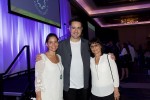
Innovators Lunch speaker Brian Scudamore with Kate, left, and her mother, Wendy, who received supportive services from Jewish Family Service Agency in a time of need. (Adele Lewin Photography)

The 2015 Innovators Lunch raised almost $296,000, with more expected. The total was boosted by speaker Brian Scudamore, founder and chief executive officer of 1-800-Got-Junk?, donating back his fee to the Jewish Family Service Agency.

On April 29, 545 people came out to hear Scudamore speak at the Hyatt Regency Vancouver. They also watched a video featuring several people who had been helped by JFSA’s programming and service provision, one of whom, Michael Narvey, addressed the crowd. The audience also heard from JFSA board chair Joel Steinberg, Beth Israel Rabbi Jonathan Infeld, day-of-event co-chairs Megan Laskin and Hillary Cooper and senior management consultant Richard Fruchter. Shay Keil of Keil Investment Group, which was a co-presenting sponsor with Austeville Properties, introduced Scudamore.

Though Scudamore dropped out of high school and out of university, he said, “I love to learn. I love asking questions, meeting people and learning why they are successful, what motivates them and drives them in life. It just happened to be that school did not work for me.”

So, he became an entrepreneur, with a focus on vision, people and systems. He illustrated the importance of these three things in the story of how he became a businessman.

In summer of 1989, he was one course short of high school. Knowing he wasn’t going to complete that course, he talked his way into Langara College, one of the four colleges he would attend briefly. His vision at the time was to go to college and that’s what he did. However, he had to find his own way financially, as his parents weren’t going to fund his studies, given his history: “I don’t think it was a good ROI [return on investment],” he admitted.

While waiting in the line of a McDonald’s drive-through, Scudamore noticed that pickup truck in front of him had the hauler’s phone number on the side. He thought, “What a great idea. I had a thousand dollars in the bank, took 700 of it to go buy a pickup truck of my own.” He spray-painted his number on the side and parked it in different locations around the neighborhood. “Mobile billboards got me business and, within two weeks, I had a business that was humming and making money.”

The experience of building something, his interactions with customers and having fun inspired him to consider business as a future. “My grandparents, my Jewish grandparents … ran a small Army Surplus store in a fairly impoverished area of San Francisco downtown. I used to go down every spring break, summer, Christmas holiday, Chanukah, go work at the store, and I loved it. I loved watching how they treated people. They were the only store on the street that wasn’t robbed once a week. In fact, in their history, they were only robbed twice because I saw that they would give an ear to anyone who came in…. They would never give money, but they would give love, attention and time of day to somebody. They developed a group of friends in the community and the word out on the street was that you just don’t mess with the Lorbers, they’re nice people.

“I learned that business wasn’t just about ringing the cash register and making money. It’s never been that for me, and thank goodness for the influence of my grandparents. For me, business is having fun, bringing people on board and building something special together.”

By 1991, he was at the University of British Columbia. Bored, he made a deal to sell his business, which fell through. This failure taught him “that the low moments precede the highs.” And something good did happen. He grew the business and, in 1992, on the advice of his then girlfriend, he told his business story to the press. The result: a front-page article in the Province. He described it as a “full-sized ad, for free…. I’m going to systematize this and start doing more.” That day, he not only “felt like a rock star,” but he got “100 phone calls in 24 hours.”

In 1993, he finally sat down with his dad to tell him that he was dropping out of university. He incorporated his business, went from one to three trucks and was at about half-million dollars in revenue by 1994.

He had 11 employees but nine of them weren’t the right fit, he said, so he fired them all. He took full responsibility for not being a good leader, for hiring the wrong people. He apologized, and learned from the experience. Among the most important lessons: “it’s all about people.”

He spoke about The EMyth, “the most incredible business book” he’s ever read, which recommends running your business like a franchise even if you don’t plan to make it one. Franchises tend to be more successful, he explained, because they are based on systems of best practices that can be replicated. He followed that direction and, in 1997, hit a million dollars in revenue.

He joined the (Young) Entrepreneur Organization. For him, “it was a way to learn from others, other businesspeople, entrepreneurs that had been successful. I could understand what works and what didn’t, and that filled my thirst for knowledge.” He also actively sought out mentors and people on whom he could rely for advice.

In 1998, he was “bored” and wanted more. He wrote a short list of possibilities, or goals, including “being the FedEx of junk removal,” being “on the Oprah Winfrey Show” – “I envisioned a future that was so crazy, but I started to read it and I’m, like, my craziness actually seems real to me. I could see the vision, the picture in my mind, and I latched on to it and I said I will make this happen – not if, I hope to, want to, will try to, I will make this happen, and I crystal-balled the future.”

At the time he wrote down this vision, he had almost 10 paycheques written to himself that he couldn’t afford to cash, and there were employees who quit over his new direction. Nonetheless, he began to learn about how to franchise. He spoke to many people, he got over hurdle after hurdle, including having to find out who owned the phone number 1-800-Got-Junk and buying it once he did – from the Idaho department of transportation – as he’d already designed the logo with the number. The first franchise was created in 1999 and it made $1 million in the first year, “because we had the systems.”

In the next several years, the focus was on franchising and also on systematizing the media aspect, which had proven so useful before. “Fortune magazine did this three-page feature and we had 506 inquiries in the first week, and I’ll say the first week was Thursday to Sunday.”

He asked his employees what they could imagine with regard to growing the business, with the caveat that they would have to take responsibility for bringing the idea(s) to fruition. The company also works with employees to help them set and accomplish personal goals and, in 2004, 1-800-Got Junk? won British Columbia’s best company to work for contest. They immediately set upon figuring out how they could win it again, not for the sake of winning, but to keep improving the business and the work environment.

At $100 million in sales in 2006, the rollercoaster descended, he said. They dropped $40 million in revenue and he had to fire his best friend – “thankfully he knows it was the right decision.” They were both quick shooters and the business needed a more cautious partner. In the end, the entire leadership team was changed, dozens of people laid off, “partially because of mistakes we made, partially because of the recession. It was awful.” Three and a half years of rebuilding, however, turned things around.

Scudamore has learned to embrace mistakes, to learn from them, and he encourages his employees to do so, as well. “If you’re not making mistakes, if you’re not getting out of your comfort zone and taking risks in life, you’re not living,” he said.

Once he found the right-hand person who best complemented his strengths and weaknesses, Eric Church, the business expanded into other companies, such as Wow 1 Day! Painting and You Move Me. He also expanded personally into other areas, such as becoming involved in Free the Children with his family, thanks to Lorne Segal. He “didn’t have this sense of philanthropic community” when he was a kid, but his daughters, now 10 and 7, believe they “can actually change the world.”

He said, “I believe that we all have a purpose to do something great in our lives and we’ve all got to get to building something, a family, community, charitable organizations and business.… I think, again, it comes down to, ‘It’s all about people.’ Can you inspire people, can you find the right people and treat them right?”

One thing Scudamore loves about community, “is people helping other people.” He concluded, “I don’t know if everybody knows their purpose and what they’re doing. I often believe sometimes you need to be a little crazy to think you can change the world, but I think that we’re all a little crazy, and I know that we can.”

For more on Scudamore, visit 1800gotjunk.com/us_en/about/brian_scudamore.

Format ImagePosted on May 8, 2015April 12, 2021Author Cynthia RamsayCategories LocalTags 1-800-Got-Junk?, Brian Scudamore, Innovators Lunch, Jewish Family Service Agency, JFSA
Some superior senior solutions

Some superior senior solutions

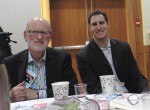
Michael Geller, left, and Dr. Eric Cadesky. (photo by Binny Goldman)

Every year, we look to the Jewish Seniors Alliance Spring Forum for inspiration and the 170 people gathered in the Wosk Auditorium at the Jewish Community Centre of Greater Vancouver on April 26 found it.

Debbie Cossever, representing the Jewish Seniors Alliance, and Claire Weiss of the L’Chaim Adult Day Centre were co-chairs of the partnered event, entitled YOLO: You Only Live Once – How Full is Your Cup?

Marshall Berger opened the afternoon’s program with a humorous song to the tune of “Side by Side” about a newly married aged couple. Cossever welcomed the audience, described the aims of JSA and invited newcomers to join the organization. JSA has approximately 700 members, including 34 affiliates representing more than 5,000 seniors in the Greater Vancouver area.

Cossever introduced Weiss, who explained that the afternoon was also a celebration of L’Chaim’s 30th anniversary, the group having started in the Beth Israel Youth Lounge in 1985 and then moving to the J in 1988. Last year, their staff delivered 1,933 client hours. She reminded those present that they are always looking for more members to join their “family.” The candles on a huge chocolate cake celebrating the 30 years were lit and all sang “Happy Anniversary,” which ended with calls of mazel tov!

Moderator Gloria Levi, a social services consultant, was then introduced. Levi has a master’s degree in public policy and is the author of Dealing with Memory Changes As You Grow Older and a series of booklets, Challenges of Later Life.

She introduced Michael Geller, an architect, planner, real estate consultant and property developer, who serves on the adjunct faculty of Simon Fraser University’s Centre for Sustainable Community Development. The talk was conducted in an interview format.

Geller’s topic was Lessons My Father Taught Me. He acquainted listeners with the unique and collaborative relationship he shared with his father, Sam Geller, who was one of the first members of the Jewish Senior Advisory Council (the original name of the JSA). He passed away 11 years ago at the age of 92.

Sam Geller was born in England and was a soldier in the Second World War who had survived being a prisoner of war. That occurrence colored his life. The very fact that he had survived made him happy and grateful to be alive and he never sought material things for happiness, often saying that things could have been so much worse. He moved to Vancouver from Toronto and enjoyed life at Langara Gardens, his grandchildren visiting him, doing Sudoku, crosswords, swimming and exercising daily. Then, after an emergency life-saving surgery, Geller said his father attempted to live each day to the fullest, saying, after all, it could very be his last.

Geller said his dad was a stoic, truly enjoying what he had rather than accumulating more items just to impress others who he may not care about in the first place. The lesson he received from his father was “Do what you enjoy, what makes you happy and continue contributing to the happiness of others, as that increases one’s own inner joy.” Geller recommended the book The Ancient Art of Stoic Joy by William B. Irvine.

The love and respect that Geller said he felt for his father was reflected on his face throughout the talk. Thoughts of his father swimming are with him as he does his own laps in the pool.

Levi then introduced Dr. Eric Cadesky, a family physician, assistant professor at the University of British Columbia, medical coordinator at Louis Brier Home and Hospital and a board member of Doctors of British Columbia. His presentation was entitled Getting It Just Right: How to Maximize Your Quality of Senior Life.

Cadesky disclosed that his mother-in-law was amused when she learned of his topic and asked, “What do you know about aging?” He explained that all of us age, no matter our number of years, but it is how we do it that is really important.

Cadesky believes that some of the choices we make act to decrease our quality and length of life and suggested that people live by three guidelines: Do enough. Not too much. Start now.

Enough means to be active, to walk or swim, as movement will lessen and ease pain. Enough also means to eat fresh, colorful foods that don’t require a microwave or have an expiry date. Enough means to socialize, learn a new language, do puzzles, these activities help to keep dementia at bay. Enough also means to use patience to deal with people who give you advice and knowing what advice to toss aside.

Not too much reminds us that anything that sounds too good to be true usually is. Certain vitamins (except for Vitamin D and B12) can be unhealthy to take in pill form. For example, post-menopausal women should not be taking calcium, and A, C, E, copper, zinc and selenium should be acquired from fresh food only. It is very important to be honest with your doctor when seeking medical advice. Sometimes “de-prescribing” is necessary – and an assessment can be made on all of your medications.

Start now means that we should be discussing with our doctors challenges that may be stopping us from doing what we want to be doing. Also, we generally do more for others than we choose to do for ourselves and we should start thinking of ourselves.

Cadesky advised us to have a realistic approach to life and not to fall for advertisements, which may be totally misleading. Scrutinize, be critical and intelligent in your choices and have confidence in your doctors, he said. Remember, too, he said, making others happy enriches our own happiness.

Audience questions were many. How can we ease a senior’s loneliness? Get involved in activities, he said, perhaps at JSA or L’Chaim. What are the benefits of fish oil? There is benefit in eating fresh fish but not in taking fish oil in pill form, he answered. There was also a discussion around the value of probiotics and alternative medicine. Cadesky recommended directing individual questions to your physician and stressed how critical it is to be honest with your doctor. A question, which made everyone laugh, was “Are you taking any new patients?”

Marilyn Berger, JSA president, and Serge Haber, JSA president emeritus, thanked the many volunteers who made the event possible. Special thanks went to the co-chairs, table sponsors and staff, Annica Carlsson, Karon Shear, Rita Propp, and to Stan Shear for videotaping the session, which will be posted to the JSA website (jsalliance.org).

Door prizes were then handed out to the delight of the recipients. Over tea and coffee and chocolate cake, as well as fresh fruit and veggies by Susy Segal’s Nava Catering, helped by Bagel Club volunteers Ophira Schwartzfeld, Harriet Corda and David Benbaruj, attendees felt we had experienced an extraordinary afternoon and had adhered to the advice of our two speakers and that adage of Dr. Charles Glassman, “Live your everyday extraordinary!”

Binny Goldman is a member of the Jewish Seniors Alliance of Greater Vancouver board.

Format ImagePosted on May 8, 2015May 6, 2015Author Binny GoldmanCategories LocalTags Eric Cadesky, health, Michael Geller, seniors

Sunday’s trio of milestones

When counting blessings, our community has much to celebrate. If proof were needed, there is plenty at the newspaper. Not only have we been sorting through 85 years’ worth of the Jewish Independent in preparation for our special anniversary issue next week, but we joined hundreds of other community members this past Sunday to mark three significant community milestones.

In the early afternoon, a remarkable event took place at Mountain View Cemetery. The city-owned burial site has, since 1892, included a small section consecrated as the Jewish cemetery. In recent years, that section has declined. A dedicated group of volunteers set about to return it to the stature it deserves and, on a very sunny Sunday, the community gathered to see the results and celebrate the place. There was, it’s not inappropriate to say, a sense of festivity mingling with the solemnity of the event. While we were marking the rededication of a Jewish cemetery, we were also explicitly honoring and celebrating the lives of the people who built this community – and all those who are working to maintain and grow it.

Later that day, Temple Sholom held a siyum hasefer, marking the completion of a new Torah commemorating the congregation’s 50th anniversary. This “Torah of volunteerism,” in which the hands and spirits of so many people are ingrained in its beauty, is another symbolic and tangible act uniting the past, present and future of our community.

The day’s festivities drew to a close at the new Beth Israel, one of the oldest congregations in our community. The rebuilt synagogue provides some of the city’s best new meeting spaces and, in this case, we celebrated one of Judaism’s greatest achievements – well, of the modern era, at any rate. Canadian Friends of the Hebrew University, Vancouver chapter, convened an evening of education, entertainment and tribute in honor of that institution’s 90th anniversary.

It is hard to overestimate the impact of Hebrew University on the modern life of the Jewish people or of Israel. Founded by luminaries, including no less than Albert Einstein, it is a monument to the Jewish commitment to learning. However, to call it a monument is almost an aspersion, because it is an organic microcosm of Jewish life – and, as Jewish life has been throughout the ages – a light to the nations, welcoming scholars from around the world.

Attending these three milestones was affirming in several ways. It was a reminder of just how many people – of all walks of life, ages and affiliations – are dedicated to this community, working to make it better and trying to make sure that it has a future. It was also a reminder that, while the internet has its many advantages, there is something very special and irreplaceable about tangible records. There is something very special and incomparable to sharing a moment – joyous or sobering – with other human beings.

Headstones in a cemetery, a Torah scroll, the pages of a newspaper – they physically mark the path on our way long after we’ve made our way. We can touch them, which somehow connects us to them and each other in a way that cannot be reproduced in the virtual world. Laying a stone on a grave, scribing or reading from the Torah, even flipping through decades-old copies of the community newspaper – these present-day acts place our lives solidly in the continuum of humanity. This is both humbling and reassuring.

As we celebrate the minor miracle of the newspaper’s presence in and contribution to the community for 85 years, we are proud, not only of our own accomplishments, but those of the entire community. Together, may we go from strength to strength!


Posted on May 8, 2015May 6, 2015Author The Editorial BoardCategories From the JITags Hebrew University, Mountain View Cemetery, Temple Sholom

This week’s cartoon … May 8/15

For more cartoons, visit thedailysnooze.com.

Format ImagePosted on May 8, 2015May 6, 2015Author Jacob SamuelCategories The Daily SnoozeTags gladiators, thedailysnooze.com

Perseverance, hope, faith

I was barely 18 when I found myself sitting in the airport in Riyadh, Saudi Arabia, petrified that despite my false Turkish papers, I would be discovered, and returned to Iran to face execution. My forged Turkish passport had brought me to the airport in Saudi, but I spoke not a word of Turkish. I sat in the huge terminal in Riyadh, hungry, thirsty and terrified.

I had finally boarded the Montreal-bound Air Italia flight after three abortive efforts but fate had me in its thrall. One of the airhostesses was Turkish: I was terrified that she would realize that the thin girl masquerading as Turkish could speak not a word of her language, and then inform the captain of the ruse.

At age 13, my passion for social justice led me to defend a Baha’i schoolmate from a bully with Hezbollah connections. While I was surprised that my defence of a friend resulted in my suspension from school, I never dreamed that a spontaneous, spirited comment would lead to my flight.

I am a proud Shirazi woman, and my family can trace our roots back 2,500 years, back to the Babylonian exile. But in the late 1970s, when I was only 13, I joined university students as they protested for freedom: I desperately wanted to read books banned by the shah. I craved freedom as a bird craves flight, but after over a year hiding from Hezbollah, my mother made me realize that to find a life for myself, I first had to court death.

During my time in the desert, I experienced events that made me believe strongly in my faith. My flight was provoked by my defence of a Baha’i friend but it was a Muslim woman who informed my mother that I was blacklisted and a Pakistani border guard who saved me from the smugglers who were swindling me, and ensured that I did not die in the desert.

I had been told that the desert crossing would consist of a short walk and a five-hour journey by car. It turned out to be a forced march of 20 hours across the Kavir-e-Loot desert, and hours of terror as a dozen or more Afghani extremists passed inches away, on the other side of a small sand dune on their journey to join Hezbollah in Iran. They cried out, “Allahu akhbar!” God is great! I was 17, heartbroken at leaving my mother and home. I hope to never again experience the depth of despair that I knew that night as I lay, pressed into the sand beside the smugglers.

But if my desire for freedom and justice had led me into the desert, it was the contrast between the depth of my despair and the sight of the stars so far away that inspired me to this very day. I knew that my distant ancestors had crossed another desert under those same stars and I felt that if I fell down, I would just have to get back up. That philosophy helped me persevere through uneasy days in Pakistan, that terrible flight to Riyadh and further, into my life in Montreal.

I had to leave Iran because I wanted the taste of freedom on my lips, because a life lived in fear is not a life at all, and because only freedom allows the human being to carve out a life of meaning. I knew then and know now that my message of hope, faith and perseverance is important and compelling.

We are all sisters and brothers under our skin. Whether we cover our heads or whether our hair is loose, we are all God’s children and fate’s playthings.

Dr. Sima Goel is the author of Fleeing the Hijab: A Jewish Woman’s Escape from Iran.

Posted on May 8, 2015May 6, 2015Author Dr. Sima GoelCategories Op-EdTags Fleeing the Hijab, Hezbollah, Iran
It’s every day that counts

It’s every day that counts

The author and her mother at Matanuska Glacier on a previous Mother’s Day adventure. (photo from Masada Siegel)

At a party a few years back, a high school friend approached my husband and cheekily said, “You do realize your wife Masada is going to turn into her Jewish mother. Are you prepared for that?”

My husband, a serious look on his face, responded, “ I should be so lucky.”

My friend’s grin turned to shock and I laughed, knowing why his greatest wish is for me to turn into my Jewish mother.

My mom is organized, thoughtful, kind and a fabulous cook who makes everything from scratch. She is the perfect hostess, makes people feel at ease, a great listener, advisor, diplomat and one of the most well-read people I have ever met.

My brother-in-law Gabe agrees. He always jokes that he married my sister, Audrey, because our mom was already taken – my sister was the next best option.

The truth is moms never get enough credit for the backbreaking work they do to make their families lives better. Mother’s Day is an opportunity to recognize the commandment to honor your mother and father. It’s special to focus on the woman who gave us life, and Jewish mothers, like mothers all over the world, are obsessed with making sure everyone else is happy. Often that means they never take time to look after themselves.

My mom, a former sergeant in the Israeli army, happens to be the queen of doing for others, and not so good at relaxing and taking care of herself. So, to celebrate her, I took her to the Omni Scottsdale Resort at Montelucia for a spa day.

At first, she protested the concept of an 80-minute massage. She’s not great at sitting still, always feeling the need to be productive. We both shook our heads: Mom at how she could have a daughter who writes about life and leisure, and me on how I could have a mom who is such a giver and less good at receiving.

Entering the Omni’s Joya Spa is like taking a trip to Morocco, between the low-light entrance and a room filled with plush red couches and endless pillows to the pool overlooking the spectacular Camelback Mountain. After wandering into a most comfortable, quiet room filled with canopy beds, we headed off to enjoy our Joyambrosia massages.

After, we indulged in a poolside lunch and I asked my mom what other Mother’s Day experiences she would enjoy. She laughed, “It’s about being appreciated daily, and family making an effort all year long to be close and loving. Sharing time together and making wonderful memories are what matter most in this world.”

I began to think of new ideas for celebrating people who I love. All it takes thoughtfulness and creativity, as simple as printing and framing a photo or making a tasty breakfast.

Another idea is to take your mom away from the everyday; go away for a weekend or take a day trip. A few years ago, I took my mom through the wilds of Alaska. We took trains, planes and automobiles, hiked glaciers, experienced fabulous food and drank in the beauty of a new place and time spent together.

Whatever you decide to do for that special person, be it your mom, a family member or friend, the most important gift you can give is your time. That said, you can never go wrong with a luxurious massage! Happy Mother’s Day!

Masada Siegel is an award-winning journalist and photographer. Follow her @masadasiegel and visit her website, masadasiegel.com.

Format ImagePosted on May 8, 2015May 6, 2015Author Masada SiegelCategories Celebrating the HolidaysTags Mother’s Day
Time to work-study abroad

Time to work-study abroad

The author at the Great Wall. (photo by Rebecca Shapiro)

Finishing university for me, like many others, brought with it employment worries and life dilemmas, alongside the obligatory cheesy graduation shots. My parents had just moved from North London to West Vancouver, post father’s mid-life crisis. I had no idea where I was now based, let alone what I wanted to do with the rest of my life, thanks to that cross-continent move and an unspectacular arts degree.

This led to my spur of the moment application to intern in Shanghai through CRCC Asia, the biggest provider of work experience placements in China. My family was confused, my friends intrigued, but knowing that the company had organized more than 5,000 internships for students and graduates worldwide, I felt secure. That was, until I arrived. The journey from Pudong’s sprawling airport taught me plenty: the vast majority of people in China don’t speak English, nor do they follow traffic rules of any sort or bother to hide their gawping at your Western appearance.

Thankfully, everyone on other internship placements was lovely, as was the media production company I worked at. The city itself was beautiful, buzzing and completely bonkers. I demolished street food daily and consumed glitzy clubs’ free alcohol almost as often, resulting in a lot of hungover sightseeing. In between weekends away hiking the Yellow Mountains and evenings making dumplings, my lifelong hobby of writing became a solid career aspiration. I set up a blog, nabbed some work experience at an ex-pat magazine and eventually bagged a coveted internship at ELLE Canada.

Aside from job gains, a more curious side effect of this trip, for me, was a renewed pride in my religion. As the only practising Jew on the internship scheme, I felt a duty to explain festivities and traditions and set a good example. This resulted in my British friend calling me “the keenest Jew” he had ever met, a title I promptly failed to live up to when Yom Kippur was spent guzzling water after a heavy night out.

Keeping kosher also proved a near impossible challenge. Though my only fluent Mandarin sentence was a proud “I don’t eat pork,” being fully vegetarian in China would have meant far too much plain rice for my liking. Sorry, all.

But, there were some success stories for Jewish life in China. After three years spent actively avoiding Chabad in my university city of Leeds in the United Kingdom, I found myself on their home turf during Rosh Hashanah in Shanghai. Back home, I would have spent the Jewish New Year in relative indifference, but in this foreign function room I was touched by how many Jews living in China had made the effort to assemble for prayer and the customary apples and honey. I met people of all ages, listened to their stories, shared mine, and engaged in what all Jews love best – eating good food, and a lot of it.

Pressure from my parents meant that my Jewish duties did not stop there. Having not yet found the financially stable, nice – and most importantly Jewish – lawyer of their dreams, I would at least fit in a dose of Jewish history. And so commenced a trip to the Shanghai Jewish Refugee Museum. Small, but filled with extremely interesting exhibits, it taught me that Shanghai accepted 30,000 Jewish refugees fleeing the Holocaust, between 1933 and 1941. It also led me through the Tilanqiao historical area, which has preserved the only features of Jewish refugee life inside China during the Second World War. Hardly surprisingly, this experience solidified both my adoration for Shanghai and my love for Judaism.

So, there you have it: the unlikely relationship between interning in China and Jewish pride.

photo - Shanghai skyline
Shanghai skyline. (photo by Rebecca Shapiro)

Not convinced to follow my lead? Your resumé will be. If there’s one thing employers like more than work experience, it’s international work experience. In a recent survey of 10,000 employers in 116 countries, 60% of respondents said they would give extra credit to graduate applicants who had worked abroad. In terms of my particular internship program, 89% of students and graduates who intern though CRCC Asia are employed in a graduate-level job within three months of returning home.

Unfortunately, only 3.1% of Canadian university graduates currently participate in study or work abroad program. The comparative stats for those in the United Kingdom, United States and Australia fall between 18% and 38%.

But, in the words of Bob Dylan, the times they are a’ changing. University leaders recently met in Calgary to discuss strategies for globally mobile students; CRCC Asia just announced a partnership with the University of British Columbia to offer internships in several Chinese cities; and graduates are increasingly starting to take the plunge.

I, for one, couldn’t welcome the trend more. Canadian businesses, and diplomatic and trade relations, sure aren’t complaining either. Give it a try and, who knows, you might even rediscover your religious roots.

Rebecca Shapiro is a freelance journalist, amateur photographer and blogger at thethoughtfultraveller.com. A recent politics graduate, she manages to maintain bases in London, Vancouver and Toronto, while focusing a disproportionate amount of time planning new adventures. She has been published in the Times (U.K.), Huffington Post (U.K.), That’s Shanghai (China) and ELLE Canada.

Format ImagePosted on May 8, 2015May 6, 2015Author Rebecca ShapiroCategories WorldTags CRCC Asia, Holocaust, Shanghai Jews
Jewish values in Kenya

Jewish values in Kenya

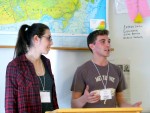
Hannah Fogel and Daniel Kroft. (photo by Rebeca Kuropatwa)

Held earlier this year in March, Limmud Winnipeg featured a couple of young community members sharing their experiences of volunteering in Kenya. Their talk, Walking the Talk of Jewish Values in Kenya, reflected on how their Jewish upbringing was an essential ingredient in being able to give of themselves abroad.

Presenters Hannah Fogel and Daniel Kroft graduated from the Gray Academy of Jewish Education in 2012 and traveled to Kenya for three weeks in June of that year instead of going on their class graduation trip. “This was kind of our alternative grad trip idea and everything worked out,” Fogel said of her choice.

Once in Kenya, the two learned there are many misconceptions when it comes to the day-to-day lives of Africans. “There’s actually quite a big difference in levels of development in the country,” said Fogel.

Kroft reflected, “We spent one night in Nairobi and then we drove out to Mara, [which is] basically a game reserve, a rural area with villagers.”

Fogel said they spent their nights in a military-style tent and their days helping build school classrooms and playing with local children – having a chance to learn a little bit about their lives, challenges, and experiencing the “contagious positive vibe they have … regardless of their difficult existence.”

Describing their personal living conditions, Fogel said, “Due to the lack of running water, we had to use bucket showers that were filled by Kenyan staff that worked at our camp. One of them, his job was basically getting hot water. So, they’d heat up this big tub of water over a fire and you’d ask them to fill the bucket over your shower, two people per bucket.”

Ever since the trip, Kroft said he has continued using the Kenyans’ conservative showering strategy he learned there. “They recommended we take staggered showers – so to turn on the water, get wet, turn off the water, soap up, then turn it on again and try to use very little water.”

Kroft said he learned that the local Maasai boys are sent off to become men – going on a quest and returning as warriors – at the age of 13. They spend time in the wilderness, doing strength training and learning how to use bows and arrows.

While Kenya has begun offering free elementary school education for all, there are not enough teachers, schools or resources to go around. “In a lot of communities like this, the parents came together and built their own classrooms for the kids to go to,” said Fogel. “Finding teachers and resources was still a big problem. They have a limited number of pens and pencils in the room. Kids share one pencil between the three of them.”

Kroft was struck by the similarities between the mission statement philosophies at the Kenyan school and his home school, Gray Academy. “You have things like community, cultural values and leadership,” he said. “You go halfway around the world and you have the same sort of values being promoted.”

Both Fogel and Kroft were happily surprised to be able to connect with the children so easily. “We didn’t know very much Swahili or their tribal language, and they knew very little English,” said Kroft. “Our facilitator basically dropped us off and said, ‘OK, go play!’ It was actually surprisingly easy to find ways [to connect], through hand gestures, hand signals … lots of hugs, and they love soccer.”

There were less light moments, as well. “We listened to a university professor speak who came to our camp to discuss hunger and starvation,” said Fogel. “And we learned some stats. More people have died from starvation in the past five years than all the battles, wars and murders in the entire world in the last 150 years. That’s something we can’t imagine in Canada. To think of that is a whole other level of poverty.”

Seeing how all people have similar struggles and needs particularly impacted Kroft. “Agriculture, food security, health, clean water – these are all issues that aren’t just isolated to Africa,” he said. “These are things that are going on in Manitoba, in Canada, on some of the reserves.”

Kroft and Fogel found that most Jewish values are values held by other religions and cultures throughout the world, as well.

“We are not that different after all,” said Kroft. “Jewish values were definitely in the back of our minds going, just because it was the culmination of graduation from the academy – 13 years surrounded by Judaism and Jewish values. It was something that we thought about.”

Fogel added, “Also, we had no idea what to expect, but there were similarities. At the school, people we met had similar values, regardless of what they had or the communities they grew up in. It was also interesting learning about Maasai culture, a similar coming of age at 13 [in Judaism].”

Kroft interjected, “Actually, when they come back from their journey, the similarity of practice…. The men get circumcised at 13 and it’s a sign of weakness to flinch during the process. So, it’s a really big deal, a shame on the whole family [if they flinch].”

Kroft also felt that education plays a central role in the Maasai community, similar to what we see in the Jewish community. “They don’t really have the means…. They are starting to get it now, but idealistically it’s really important to them,” he said “Family values, togetherness, respect are big things…. To be a teacher, which, again, is like Judaism. There are similarities and differences.”

Returning home, both youth described wanting to remain committed to social justice issues. Kroft said, “I’m chaperoning with a Washington trip this year. One thing, we did a session last week on food security and the lack of food at the concentration camps and things like that. And, in order to give the kids a sense of what that means, we had them tally up their daily intake of calories at the end of the day. We had a big list of foods and the amount of calories they’d eaten that day – you’d have 2,000, 3,000, 4,000 calories a day. Then, you’d tell them how much they were given in concentration camps as a perspective thing. It was something I’d personally seen in Africa, not to the same extent … that’s something that comes to mind.”

An organization Fogel volunteers with in Winnipeg is Osu Children’s Library Fund. “It was started by a woman in Winnipeg and she was living in Ghana for awhile with her family and realized the lack of educational books for the kids there,” she said. “So, she started this fund, collecting books from relatives, and put together a library in an old corrugated metal box car. They’ve built libraries in 10 different countries, mainly in Africa. So, I volunteered with her collecting books and going to her house and packaging them. She’s into photography and has written some children’s books with the pictures she’s taken.”

Rebeca Kuropatwa is a Winnipeg freelance writer.

Format ImagePosted on May 8, 2015May 6, 2015Author Rebeca KuropatwaCategories WorldTags Daniel Kroft, Gray Academy, Hannah Fogel, Jewish values, Limmud

Posts pagination

Previous page Page 1 … Page 564 Page 565 Page 566 … Page 649 Next page
Proudly powered by WordPress