Moriah Congregation’s prayer books were among items destroyed in the Haifa fires. (photo from masorti.org)
The Masorti Foundation for Conservative Judaism in Israel put out an international call for donations to help Moriah Congregation rebuild from the ashes after the recent week-long wildfires that raged across Israel. But it was two small, local initiatives that put the damaged synagogue into the headlines.
On Nov. 30, a group of worshippers from all faiths attended a special prayer service for the new Hebrew month of Kislev and to show support for the rebuilding of the community. A local member posted Facebook photos of the service. One of the photos showed 20 saplings donated by a man from Baqa al-Gharbiyye, an Arab city in the Haifa district, as a gift to replace the trees in the courtyard that had been burned in the fires.
And he wasn’t the only one bearing gifts.
Two Muslim tradesmen from Umm al-Fahm, another Arab town in the Haifa district, also came to the service and were greeted with great applause for their contribution of wood panels to the synagogue.
Moriah Congregation – the oldest Conservative synagogue in Israel – suffered extensive damage in the fires. The whole second floor and roof of the building were destroyed, including their beit midrash, all of their books, their education wing and their youth club.
At first, the Moriah community turned to a Jewish carpenter for help. He agreed to work pro-bono but asked that the synagogue pay for the wood. He went to get a price quote from wood suppliers Walid abu-Ahmed and Ziad Yunis. When they heard that the previous tables were destroyed in the fires that devastated 13 neighborhoods in Haifa, they chose to donate enough wood for 10 tables.
“I had tears in my eyes when I heard what was happening,” Rabbi Dov Hiyon, who heads the Moriah community, told Ynet news. “It was so emotional to hear that Muslims were asking to donate to a Jewish synagogue. I’ve invited them to evening prayers to personally thank them.”
“I decided to help and not receive any payment,” abu-Ahmed told the Hebrew daily news site. “Jews and Arabs live together in Haifa, and there is no discrimination. We must continue with this coexistence and promote peace.”
Israel21C is a nonprofit educational foundation with a mission to focus media and public attention on the 21st-century Israel that exists beyond the conflict. For more, or to donate, visit israel21c.org.
The inscription in the Tosher Rebbe’s first copy of Kehilat Ya’akov, which recently sold at auction for $4,920 US. (photo from IMP Media Group Ltd.)
Even with the passing of the fourth Tosh Rebbe, Rabbi Meshulam Feish Segal-Lowy II, in 2015, Tosh Chassidut still exists in rural Quebec. The Tosh dynasty was founded in the 1800s and has roots in the Chassidic tradition, tracing their tradition back to the Ba’al Shem Tov.
Last month offered a unique opportunity to connect to the legacy of the Tosher Chassidut. The copy of Kehillat Ya’akov owned and used by the first Tosh Rebbe, Rabbi Meshulam Feish Segal-Lowy I, was available for auction at Kedem Auction House in Jerusalem. It was passed down within his family, and made it to the United States when his great-grandson fled Hungary. At the Nov. 15 auction, the item sold for $4,920 US.
The first Tosher Rebbe was a leading rabbi in the greater Jewish community in Hungary due to his standing in Torah and commitment to helping Jews. A 1966 article in the Canadian Jewish News by Norman Abrahams described the Tosher Rebbe’s dedication to his followers, many of whom were Holocaust survivors who turned to him for guidance: “This great man stays up most of the night fulfiling the many requests for advice and prayer and it is not uncommon to see him eating breakfast, his first meal of the day at five o’clock in the afternoon.”
Born in 1811 in Moravia (part of modern-day Czech Republic), Lowy I gained a reputation for his holiness and ability to perform miracles and became the first Tosh Rebbe, as well as a leading rabbi in Hungary. He received rabbinic ordination from Rebbe David (Spira) of Dynow, one of the leading rabbis of his time.
Although he passed away at 62, the first Tosher Rebbe had enormous impact on Torah Judaism. Lowy I served as rabbi and av beit din (literally, father of the court) of the city of Nyirtass, Hungary, and was known for his commitment to Torah. People came from all over to receive his blessings.
In 1873, a cholera epidemic broke out and killed almost 200,000 people in Hungary alone. The rebbe prayed to be an atonement for the Jews and, after his death, the epidemic did indeed come to an end.
The Tosh dynasty continued after Lowy I’s death, but was almost completely destroyed during the Holocaust. His namesake and great-grandson, Lowy II, was appointed rebbe by the few surviving Chassidim of his father, Rebbe Mordechai Marton Lowy, who was murdered in Auschwitz with most of his extended family.
Lowy II was born in Nyirtass in 1921, managed to survive the Holocaust in the Hungarian Labor Service and was liberated by the Red Army from a camp outside Marghita in October 1944. In 1946, he married Chava Weingarten, a direct descendant of the Noam Elimelech (Rebbe Elimelech Weisblum of Lizhensk). After being appointed rebbe, he set up court in Nyiregyhaza, but, in 1951, fearing the communist government, he ordered his followers to leave Hungary and immigrated to Canada, settling in Montreal.
Committed to maintaining the integrity of the Chassidut that his great-grandfather had started, and concerned about outside influence, in 1963, he decided to move his Chassidim to Boisbriand, Que., a small rural area now known as Kiryas Tosh.
After his death in 2015, Lowy II’s son, Rabbi Elimelech Segal-Lowy, became the next Tosher Rebbe.
The piece of Tosh history that was for sale is also inscribed by the first Tosh Rebbe’s grandson, Rabbi Moshe Shmuel Rottenberg, who received it from his father, Rabbi Yehosef HaLevi, author of Bnei Shileshim.
If the entire population of the United States changed their diet from a beef-heavy plan to one based on chicken, it would be possible to feed 120 to 140 million more people with the same resources. (photo from wis-wander.weizmann.ac.il)
How much does a steak really cost? Or chicken nuggets, or a plate of hummus? New research by Prof. Ron Milo and Alon Shepon of the plant and environmental sciences department of the Weizmann Institute of Science, together with Prof. Gideon Eshel of Bard College in New York, took a look at the figures – including the environmental costs – of the different foods we eat. The research appeared in Environmental Research Letters.
The data for the study came from figures for cattle and poultry growing and consumption in the United States. To compare, the researchers calculated the nutritional value of each – usable calories and protein – versus the environmental cost. The latter included the use of land for fodder or grazing and the emission of greenhouse gases in both growing the food and in growing the animals themselves.
Chickens, according to the study, produce much more edible meat per kilogram of feed consumed, and they produce their meat faster than cattle, meaning more can be grown on the same amount of land. For every 100 calories and 100 grams of protein fed to beef cattle, the consumer ends up with around three calories and three grams of protein. For poultry, that figure is about 13 calories and 21 grams of protein.
The researchers then asked what would happen if the entire population of the United States were persuaded to change their diet from a beef-heavy plan to one based on chicken. Their answer: it would be possible to feed 40% more people – 120 to 140 million more people – with the same resources.
What would happen if the same population was persuaded to adopt an entirely plant-based diet? That is, instead of using land to grow cow or chicken feed and then eating the animals, to use that land to grow nutritional crops – mainly legumes, including peanuts, soya, garbanzos and lentils. These can supply all of a person’s nutritional requirements, except vitamin B12, which can be obtained from nutritional yeast.
A separate study, published in Environmental Science and Technology – “Environmentally optimal, nutritionally aware beef replacement plant-based diets,” by Milo, Shepon, Gidon Eshel and Elad Noor – suggests that an extra 190 million people could eat off the same environmental resources in this way.
“If we changed our diet, we would change the environmental price we pay, with every meal,” said Shepon. “Eating a plant-based diet can both meet our nutritional requirements and save on land use, as well as the release of greenhouse gases into the atmosphere and excess nitrogen from fertilizers into the water supply. These are real costs that we all bear, especially when people eat beef.”
Milo’s research is supported by the Leona M. and Harry B. Helmsley Charitable Trust; Dana and Yossie Hollander, Israel; and the Larson Charitable Foundation. Milo is the incumbent of the Charles and Louise Gartner Professorial Chair.
For more on the research being conducted at the Weizmann Institute, visit wis-wander.weizmann.ac.il.
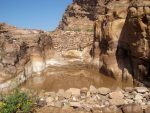
An ancient water reservoir at Petra. (photo by Orli Fields)
Desert living is tough. The toughest part of it is having water fit for consumption. Nobody knew this better than the Nabatean people. The desert was their home.
Some 2,600 years ago, the Nabateans daringly accepted the challenge of finding and supplying water to their people. They did this by building desert towns with life-sustaining water systems.
Archeologists and hydrologists have studied the waterworks at the Nabatean town of Petra. They report that Petra stood in a huge desert canyon, in what is today the country of Jordan. This area receives little rain. Petra gets only about six inches of rain a year. Temperatures go from a low of 34°F to a high of 94°F (1.1°C-34.4°C). For about half the year, the daytime temperatures are quite high. Yet 30,000 people once lived in Petra.
Petra is far from any ocean, sea, river or lake, but the Nabateans did not lack for water. Three things made this possible: the Nabateans had very smart water engineers, they had skilled builders and they had talented water managers.
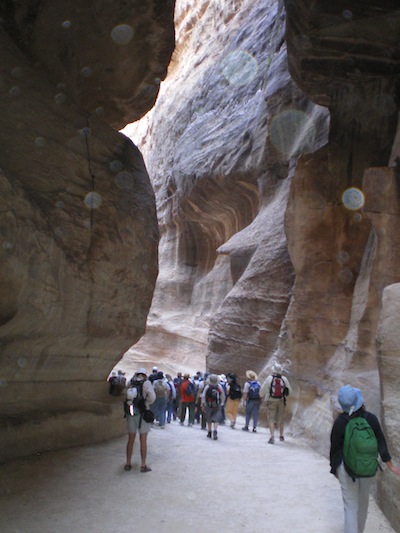
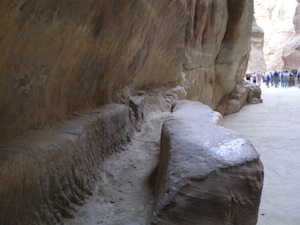
Petra’s water engineers had to consider the ups and downs of yearly rainfall, the ups and downs of temperature, and the ups and downs of Petra’s mountainous surroundings. (photos by Deborah Rubin Fields)
The engineers’ biggest worry was getting Petra to save as much water as possible. So, first, they designed a water system covering the whole city. The system collected a maximum amount of water from two sources: from rain and from local springs.
The engineers had several considerations. For instance, they had to worry about the ups and downs of yearly rainfall. They had to take into account the ups and downs of temperature. And they had to overcome the ups and downs of Petra’s mountainous surroundings.
The engineers also had to lower the risk of the system getting blocked. They realized that water pipes that ran along the side of a mountain would be hard to clean. Thus, they designed special water filters. These filters made it easy to trap and remove rocks or silt. If there were particles, they would settle in the reservoirs, not in the pipes. The engineers’ design was practical. It functioned throughout the year and, importantly, provided for a lot of water storage. It included crisscrossing water pipelines, channels, dams, tunnels, reservoirs and cisterns (totaling some 200 surface and underground units).
When looking at Petra’s water system, it is important to note how it was built. There were no motorized digging machines or hauling trucks, of course. All work was done by hand. The chisel was probably the most commonly used tool and, with this simple tool, builders carved an amazing water system.
Water managers had to maintain good water pressure and water flow. Too much pressure, for example, would cause a pipe to break, and that would result in wasted water. The managers’ goal was to maximize flow while minimizing leakage. They did this in part by operating a partial flow of water.
Also to reduce water leakage, the water managers used a particular kind of pipe. This pipe was often made from clay baked at high temperatures; it was short, with thin walls. Even with this innovation, Petra’s mountains and its irregular rainfall and temperatures must have meant that water managers were always on the alert.
And, sometimes, they were really “put to the test” – for example, when a large camel caravan entered Petra. When a large group of dusty and thirsty traders and animals arrived, it meant one thing: a sudden increase in the demand for water. Water would be needed for drinking and bathing. For such situations, water managers needed to ensure that back-up water sources were working.
In times of real emergency, the Nabateans had numerous storage centres. Scientists figure that some sites held three weeks’ emergency supply while other sites held several months’ supply. Thus, inhabitants had some insurance against a siege or drought.
Scientists have estimated that about 12 million gallons (or more than 45 million litres) of fresh spring water ran through Petra’s water channels daily. Water was relatively plentiful and also accessible – residents could easily reach the water that ran into nearby fountains.
The Nabateans also traveled through present-day Israel. Along what is today recognized as the UNESCO World Heritage Incense Route, the Nabateans established forts and settlements. In agricultural communities such as Shivta, they “captured” rainwater to grow grapes for wine production.
Both in travel and at home, the Nabateans’ water systems were as complex as they were practical. Even in ancient times, they overcame the harshness of desert living. They harnessed its unpredictability and thrived.
Deborah Rubin Fieldsis an Israel-based features writer. She is also the author of Take a Peek Inside: A Child’s Guide to Radiology Exams, published in English, Hebrew and Arabic.
The HMS Caroline, a First World War light cruiser, is worth visiting. (photo by Deborah Rubin Fields)
Identified for so long – from the late 1960s to the late 1990s – by “the Troubles,” peace appears to be bringing both social and political stability to Northern Ireland. This, in turn, has led to an economic upswing.
Greater Belfast, and some of the other coastal towns, such as Derry, once had successful shipbuilding and textile industries. At the height of Belfast’s shipbuilding, for instance, Harland and Wolff, the biggest company, employed 35,000 workers. Edward James Harland and Gustav Wilheim Wolff, who came from a German-Jewish family, started this company in 1861. They designed and built the White Line ships, the most famous of which was the doomed Titantic.
Heavy industries suffered during the Depression and were later largely knocked out of the game by the terrible decline during the Troubles – the 30-year conflict between the unionist and mostly Protestant majority, who wanted to remain part of the United Kingdom, and the nationalist/republican and mainly Catholic minority, who wanted an independent Northern Ireland – by Chinese industry and/or both. Today, Belfast’s scaled-down dock industry focuses on ship repair and iron works.
Over the past 10 years or so, Northern Ireland has moved creatively to remember its more glorious industrial past. It maintains the history of shipbuilding in two ways: by awarding historic preservation distinction to two large, biblically named shipyard cranes, the Samson and the Goliath, and by recently expanding the whole area, which is referred to as the Queen’s Island, to encompass the Titanic Quarter. If visiting, worth seeing are the HMS Caroline, a First World War light battle cruiser, local businesses (studios, etc.), educational facilities and apartment buildings, and worth doing are such leisure activities as boating and cycling.
Northern Ireland’s maritime culture dates back hundreds of years. Paralleling the region’s general history, Northern Ireland’s naval life features a lot of rough water. Some locals might tell you it was the fairies, banshees and vampires that caused nautical disasters, but non-believers will tell you human error or unpredictable stormy weather caused numerous shipwrecks.
Thus, for example, while the Spanish had the money and manpower to fight the British fleet in the late 16th century, the rough coast of Northern Ireland, on-board disease and a scarcity of supplies wiped out a not-insignificant part of the Spanish Armada, mockingly referred to by non-Spaniards as the “Invincible Armada.”
Since the late 1960s, Northern Ireland divers and archeologists have sought to locate some of the many ships that foundered along their coast. Fascinatingly, underwater discoveries are now exhibited in Derry’s Tower Museum and at Belfast’s Ulster Museum. Shipwreck sites are likewise marked along the stunning Giant’s Causeway cliff path.
While on the subject of walks, Northern Ireland offers a lot of unspoiled, green countryside. If you’re outfitted correctly, hiking is a great way to see this stunning part of the world.
Northern Ireland’s extended social, religious, political and economic battles ended in 1998. Probably nothing currently recalls the Troubles more than the murals painted in Belfast and Derry. What visitors might not realize is that a significant number of the murals are actually part of the high walls separating the unionist (largely Protestant) neighborhoods from the nationalists (mostly Catholic) neighborhoods. Since the peace agreements, the barbed wire at the top of the walls has been removed, and the gates that nightly lock the sectarian neighborhoods are bolted by a private security firm rather than by British military or police.
The murals cover a wide range of topics. Understandably, some of these locally painted murals focus on remembering the significant events of the Troubles, such as the civil rights marches and Bloody Sunday. Some of the art portrays political allegiance; some pays tribute to dead paramilitary fighters; and some are memorials to murdered children.
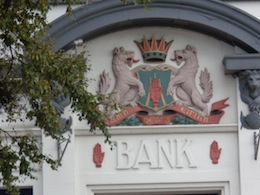
Bangor Bank, adorned above its doorway with three Red Hands of Ulster. (photo by Deborah Rubin Fields)
Today, however, the murals have expanded their scope to include conflicts from around the globe, such as the Israeli-Palestinian conflict. The pro-Israeli mural on Northumberland Street is dedicated to Lt.-Col. John Henry Patterson, a Christian Zionist who commanded the Jewish Legion in the First World War. The pro-Israel mural seems to receive less respect than the Palestinian and, this past summer, it was vandalized in a reported hate crime. Similarly, two years ago, an Ulster History Circle plaque erected at Israeli President Chaim Herzog’s Belfast birthplace was removed following defacement and building vandalism.
While on the subject of symbols of Northern Ireland, you may notice an open hand, often painted red, over building lintels. While it is hard to pinpoint the exact origin of what is known as the Red Hand of Ulster, it bears a similarity to Judaism’s “hand of God.” In Judaism, the “hand of God” has been a fairly common symbol, generally referring to God’s stepping into human affairs, but can be a subject in and of itself. Moreover, in both Judaism and Islam, the five-fingered hamsa is used as an amulet against the evil eye.
Belfast has a small assortment of sites with a link to Judaism, its texts or symbols. For example, in front of Customs House, there is a large stone water trough dedicated to Francis Calder, who founded the SPCA in Belfast. The trough contains a quote from Proverbs 12:10: “A righteous man regarded the life of his beast.” Close by is Albert Memorial Clock, dedicated to Queen Victoria’s husband. Undoubtedly better known for the way the tower leans, due to a sandy base, it has six-pointed stars carved into the stone.
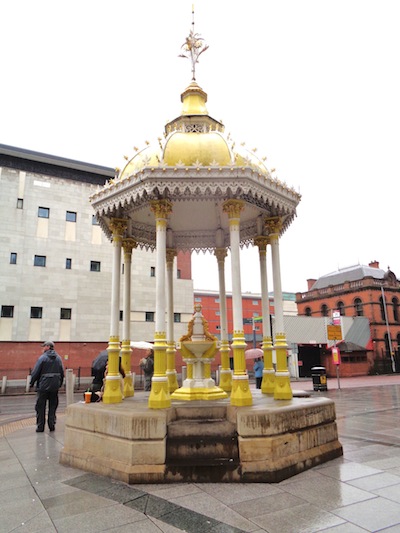
Jaffe Fountain in Belfast. (photo by Deborah Rubin Fields)
Not far from downtown’s Victoria Square shopping mall, there is a striking yellow fountain donated by Daniel Joseph Jaffe (1809–1871), the founder of the Jewish community. Jaffe’s son, Sir Otto, was the mayor of Belfast twice (1899 and 1904). Sadly, his German birth led to his leaving Northern Ireland. During the First World War, when the Germans torpedoed the Lusitania near Cork in May 1915, anti-German sentiment rose to the point where, even as a leading industrialist, philanthropist and naturalized U.K. citizen, Jaffe was accused of being a German spy. He left Northern Ireland in 1916 for London, England.
The most known Jewish and Canadian connection to Northern Ireland is a tragic one. On April 2, 1912, the Titanic left its Belfast shipyard. At its Southampton launching, it carried an unidentified number of Jewish passengers, some wealthy, established Jews, but many poor Jews seeking a better life in the United States. When the Titanic sank around Newfoundland on April 15, 1912, a small number of unidentified Jewish deceased were buried at Baron de Hirsch Cemetery in Halifax, N.S.
If you plan to travel to Northern Ireland, read This Man’s Wee Boy: A Childhood Memoir of Peace and Trouble in Derry by Tony Doherty and Reading in the Dark: A Novel by Seamus Deane, and listen to Tommy Sands’ “There Were Roses.” Seek in-person and/or virtual assistance from the attentive staff at Discover Northern Ireland, Northern Ireland’s tourist facilities (discovernorthernireland.com) and visit the small Belfast Jewish community’s website (belfastjewishcommunity.org.uk) and its lively Facebook page. While you’re in the country, you can attend Shabbat morning study sessions and services.
Deborah Rubin Fieldsis an Israel-based features writer. She is also the author of Take a Peek Inside: A Child’s Guide to Radiology Exams, published in English, Hebrew and Arabic.
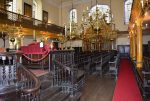
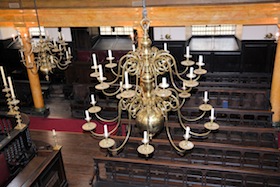
The interior of Bevis Marks Synagogue looking towards the ark and with the bima in the left foreground. The ark is made of oak, but painted to look like Italian marble, as are the supports to the ladies gallery. (photo by Edgar Asher)
Britain’s oldest synagogue, Bevis Marks, was built in 1701. Now situated in the heart of London’s Square Mile business district, the synagogue has been in continuous use since its foundation.
In 1655, Rabbi Menasseh ben Israel arrived in London from Holland with a petition to Oliver Cromwell asking that Jews be allowed to once again to settle and live in England and begin to trade – they had been banned from the country some 366 years earlier. In 1656, Cromwell agreed, despite opposition from London merchants.
Jews had been living in England since Roman and Anglo-Saxon times. In 1066, William the Conqueror encouraged Jewish craftsmen and merchants to move to England from northern France. However, in 1290, Jews were banished altogether from England.
Bevis Marks Synagogue was, from its very beginning, an Orthodox congregation set up to serve the Sephardi Jews in the area. The need to build the synagogue came about because of the increase in the Jewish population of the neighborhood and the lack of other synagogues in the area.
The central candelabrum, one of seven that hang in Bevis Marks, was a gift from the community of Amsterdam at the time of its original construction. (photo by Edgar Asher)
In early 1698, a committee was set up, consisting of the leading Sephardi leaders in the neighborhood to look into the possibility of building a new synagogue to cope with the influx of Jews moving into this part of London. In February 1699, a contract was signed for the building of a new, larger synagogue and, in September 1701, Bevis Marks Synagogue was dedicated. The interior décor, layout and furnishing were based on the design of the main Sephardi synagogue in Amsterdam, which had been completed in 1675. The central candelabrum, one of seven that hang in Bevis Marks, was a gift from the community of Amsterdam at the time of its original construction.
The prominent Renaissance-style ark was painted to look as though it is made of colored Italian marble; in fact, it is surprisingly made entirely of oak. The 12 pillars, representing the 12 tribes of Israel, which support the ladies gallery, are also made of oak and painted to look like Italian marble.
Bevis Marks became the centre of the English Spanish and Portuguese Jewish community and was also the home of the community’s chief rabbis.
Bevis Marks has always been intimately associated with London, so much so that on the eight occasions when a Jewish lord mayor has been elected, Bevis Marks has been the destination of the new lord mayor’s first official duty. It has made no difference if the mayor followed the Sephardi or Ashkenazi rite. Many notable Jews have had association with Bevis Marks, including Moses Montefiore, who was also a big benefactor of the synagogue; prime minister Benjamin Disraeli’s father Isaac; and Daniel Mendoza, who was an English boxing champion in the late 18th century.
Several seats in the synagogue, even today, are roped off with a red cord to be reserved for notable people who have been associated with Bevis Marks. One seat in particular was the reserved seat of Montefiore. Now, this seat is a seat of honor reserved for a distinguished visitor, such as a Jewish lord mayor. In 2001, Prince Charles occupied the seat during the synagogue’s 300th-year commemoration ceremony. In 2006, prime minister Tony Blair was guest of honor at the synagogue during the ceremony marking the 350th anniversary of the resettlement of Jews in England.
London, from a Jewish standpoint, has undergone many changes. Over the years, Bevis Marks, apart from being the flagship synagogue of the Sephardi community in Britain, has had a large catchment area around London’s Square Mile. Two things happened to affect the attendance at the synagogue, however. First, many Jews who had become more affluent moved to other parts of London and, second, the city itself and its financial district were redeveloped from being primarily residential to large office blocks.
Nonetheless, Bevis Marks still managed to hold regular but less well-attended services. At one point, the once proud centre of the Spanish and Portuguese Jews looked like it might become an historic landmark, rather than remain a vital house of prayer. After all, the community itself designated Lauderdale Road Synagogue in northwest London as the community’s administrative headquarters. In addition, the number of British Jews claiming affiliation with any Jewish community organizations fell precipitously over a span of 50 years. Many British synagogues were on the verge of closing down or amalgamating with other synagogues in the same district.
In 1955, there were an estimated 410,000 Jews in the United Kingdom; by the time of the national census in 2001, this figure was down to only 270,000. The question on the census form asked, What denomination do you consider yourself to belong to?
Bevis Marks still attracts many visitors from all over the world, both Jewish and non-Jewish. With a few exceptions, its interior is exactly how it looked some 315 years ago. When all is said and done, the building remains a place to offer up prayer, despite some trouble, in recent times, to gather a minyan of 10 men to hold a prayer service. However, the rebuilding of London’s Square Mile and its surrounding neighborhood has brought new blood to Bevis Marks, as the developments have included up-market expensive homes, particularly in the nearby dockland areas. Young Jewish businesspeople are once again making use of the synagogue and Bevis Marks is secure in its future both as a unique architectural building and an active synagogue.
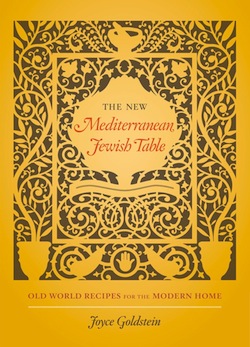
Joyce Goldstein was chef and owner of Square One restaurant in San Francisco; prior to that, she was chef at Chez Panisse café. Today, she is a cooking teacher, restaurant consultant and cookbook author. Her bibliography lists 60 cookbooks, the most recent being The New Mediterranean Jewish Table (University of California Press, 2016).
The introductory essays are very informative – “Jews in America,” “Mediterranean Jewish Communities” and “Old World Food in a New World Kitchen.” Goldstein reminds us that “not all Jewish cooking traditions come from Eastern Europe,” and that the delicious and varied cuisines of North African and Mediterranean Jews “have been nearly unknown until recently.”
She writes, “This Mediterranean Jewish cookbook for the modern kitchen will build and expand on carefully selected recipes from many of my cookbooks.” The recipes are from the cultures of the Sephardim (those expelled from the Iberian Peninsula), the Maghrebi (those from Morocco, Tunisia, Algeria, Libya and Egypt) and Mizrachi (Jews from Muslim lands since biblical times).
After an explanation about kosher laws and the food of Jewish holidays, there are 11 cookbook chapters covering appetizers, spreads and salads (49 recipes), savory pastries (21 recipes), eggs and fritters (24 recipes), soups (29 recipes), rice, pasta and grains (31 recipes), vegetables (48 recipes), fish (46 recipes), poultry (23 recipes), meat (49 recipes), condiments and preserves (24 recipes) and desserts (51 recipes). There are a whopping 395 recipes in all.
Each chapter has an explanatory essay, in addition to a list of ingredients and instructions. The volume is so large: recipes go from page to page.
The publisher calls this “an authoritative guide … a treasury filled with vibrant, seasonal recipes … the story of how Jewish cooks successfully brought the local ingredients, techniques and traditions of their new homelands into their kitchens.”
Just reading about the origins of each recipe is a wonderful learning experience, but here are two recipes to try.
ARTICHOKE SOUP (CREMA DI CARCIOFI) (serves six to eight)
juice of one lemon 12 artichokes 3 tbsp unsalted butter 2 cloves minced garlic 12 ounces russet potatoes, peeled and diced or 1/2 cup white rice 3 cups vegetable broth plus more for thinning as needed salt and freshly ground black pepper chopped toasted hazelnuts or pine nuts or chopped fresh flat-leaf parsley or mint for garnish milk or heavy cream as needed for thinning (optional)
Have ready a large bowl of water to which you have added the lemon juice.
Working with one artichoke at a time, trim the stem to two inches if it is tender, then peel away the dark green fibrous outer layer. If the stem is tough, trim it off flush with the bottom. Pull off and discard all of the leaves. Pare away the dark green areas from the base. Cut the artichoke in half lengthwise and carefully remove the choke from each half with a small pointed spoon or a paring knife, then cut each half lengthwise into quarter-inch slices and slip them into the lemon water.
Melt the butter in a large saucepan over medium heat. Drain the artichokes, add to the pan and sauté for a few minutes.
Add the garlic, potatoes and about 1.5 cups of the broth or enough just to cover the artichokes. Cover the pan and simmer over medium heat until the artichokes are very tender and almost falling apart, 25 to 30 minutes.
Remove from the heat and cool slightly. In batches, transfer to a food processor and purée until smooth, then return the purée to the saucepan.
Add the remaining 1.5 cups broth and reheat, adding more broth if needed to achieve a consistency you like. You can also add a little cream or milk if you prefer a richer soup.
Season with salt and pepper.
To intensify the artichoke flavor, make the soup a few hours or a day ahead and reheat at serving time. To serve, ladle into soup bowls and garnish with hazelnuts, pine nuts, parsley or mint.
TURKISH HAZELNUT TEA CAKES (GATEAUX DES NOISETTES) (makes 24 small cakes)
1 vanilla bean, cut into small pieces 3/4 cup granulated sugar 1 3/4 cups all-purpose flour 2 tsp baking powder 1 1/2 tsp ground cinnamon 1/4 tsp ground cloves 1/4 tsp salt 1/4 freshly ground black pepper 6 eggs 1 cup plus 3 tbsp unsalted butter, room temperature 1/2 cup confectioners sugar grated zest of 2 lemons or 1 lemon and 1 orange 1 1/3 cups toasted, peeled and ground hazelnuts
Butter 24 muffin pan cups, dust with flour and tap out the excess.
In a spice mill or food processor, grind the vanilla bean with the sugar until the bean is ground to a powder.
In a small bowl, sift together flour, baking powder, cinnamon, cloves, salt and pepper.
In a separate bowl, beat together butter, confectioners sugar and vanilla sugar until creamy and pale. Add eggs and lemon zest and beat until incorporated. Fold in nuts and flour mixture until combined.
Spoon batter into muffin cups, two-thirds full. Let rest for one hour.
Preheat oven to 400°F. Bake until a toothpick inserted into the centre emerges dry, about 15 minutes. Remove from oven and turn on to racks. Let cool completely.
Sybil Kaplanis a journalist, foreign correspondent, lecturer, food writer and book reviewer who lives in Jerusalem. She also does the restaurant features for janglo.net and leads walks in English in Jerusalem’s market.
Steven Rothfeld is a travel photographer with an emphasis on culinary cuisine. He has written more than 10 books of photography and lives in Napa Valley, Calif. His cookbook Israel Eats (Gibbs Smith Publishers) came out earlier this year.
In the introduction, Rothfeld describes how he met an Israeli on a train in Italy in 1984. The fellow passenger asked Rothfeld why he hadn’t been to Israel. Twenty-five years later, reading Amos Oz’s memoir, Rothfeld’s imagination started working. In 2010, he finally made the trip.
“I encountered a world I had never imagined existed in Israel,” he writes, referring in large part to the vibrant cuisine.
He had worked on three books previously with chef Nancy Silverton so, when he conceived of Israel Eats, he asked her to join him.
Silverton is a chef, baker and author of eight cookbooks. She won the James Beard Foundation’s outstanding chef award of 2014 and lives in Los Angeles. She had been intrigued by Yotam Ottolenghi and Sami Tamimi’s cookbook Jerusalem and, in Israel, she discovered that “the cuisine of Israel is an extraordinary layering of flavors.”
And, writes Rothfeld, “Contemporary Israeli cuisine reflects a global consciousness rooted in a vast, mind-boggling array of cultural influences and traditions.”
Rothfeld and Silverton’s enthusiasm infuses this book.
After Haaretz journalist Ronit Vered explains the history of Israel’s cuisine from the 1950s to today, Rothfeld and Silverton embark on a tour of Israel – Tel Aviv-Jaffa, the north, the centre, the south, Jerusalem and the Judean hills, concluding with the “ecosystem of Israel Eats,” meaning the people who contributed to the book.
Each “chapter” has an introduction, with accounts of places Rothfeld and Silverton visited and people they met, and is followed by the recipes, each with its own introduction, source and beautiful color photographs.
Some of the recipes are from restaurants and chefs, others are from individuals and some are by Silverton. This is not a kosher cookbook but only five recipes are strictly non-kosher and most of those could be adapted by leaving out one ingredient that would not change the tone of the recipe; only one recipe is not adaptable. There are 90 recipes in total, and here are a couple.
HALLOUMI CHEESE FLOWER (two servings: “A single flower will only make you crave a bouquet.”)
3 tbsp olive oil 1 ripe, medium-size tomato, halved and thinly sliced 3 to 4 ounces halloumi or mozzarella cheese, thinly sliced salt and freshly ground pepper 3 large garlic cloves, thinly sliced 1 small fresh green chili, thinly sliced 10 cilantro sprigs
Heat oil in a heavy eight-inch skillet over medium heat. Arrange tomato slices in the skillet in the shape of a circle. Top the tomato slices with cheese slices. Sprinkle with salt and pepper. Arrange the garlic and chili slices atop the cheese. Bunch the cilantro sprigs in the centre of the skillet. Continue cooking until cheese is soft but not totally melted. Serve immediately.
VANILLA ICE CREAM WITH CHERRY TOMATO JAM (four to six servings: “an excellent and surprisingly tasty marriage”)
1 pound cherry tomatoes 1 2/3 cups sugar 2 tbsp water 1 tbsp black peppercorns 2 pints vanilla ice cream chopped fresh mint leaves
Combine the tomatoes, sugar, water and peppercorns in a medium-size heavy pot and bring to a boil. Reduce heat and simmer, stirring occasionally until the mixture is thick and syrupy and reduced by half, about one hour.
Divide the ice cream among bowls. Spoon the tomato jam over the ice cream. Garnish with mint.
Sybil Kaplanis a journalist, foreign correspondent, lecturer, food writer and book reviewer who lives in Jerusalem. She also does the restaurant features for janglo.net and leads walks in English in Jerusalem’s market.
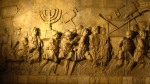
When the Second Temple was destroyed, its menorah was said to have been taken to Rome. This is depicted, with the menorah being carried by Jewish slaves, in a carving on the inside of the Arch of Titus. (photo by Steerpike via Wikimedia Commons)
In the Temple of Jerusalem stood a seven-branched candelabrum or menorah, which was lit each day by the high priest. There were also other candelabra for ornamental purposes. When Antiochus removed the Temple menorah, Judah Maccabee had a duplicate built – called a candlestick with lamps upon it, in one Apocrypha translation – and he lit it, although there is no mention of oil to light it.
When the Second Temple was destroyed, its menorah was said to have been taken to Rome. This is depicted, with the menorah being carried by Jewish slaves, in a carving on the inside of the Arch of Titus.
Lighting a chanukiyah, or eight-branched candelabrum with one to serve as the shamash (one who lights the others), is a popular Chanukah custom. Originally, eight individual ceramic or stone lamps with wicks were lit with olive oil. Jews from Yemen and Morocco also used rough stone lamps with scooped-out places for the wicks and the higher one for the shamash.
At some point, people began the custom of hanging their lamps on the left side of the door, opposite the mezuzah, because Jews were commanded to affirm the miracle in public. When it became dangerous to display the chanukiyah out of doors, people began lighting them inside the house, frequently placing them by a window.
A wide variety of those chanukiyot, in diverse decorative styles and materials, have been preserved throughout the years.
As early as the 12th century, replicas of the Chanukah menorah, with the two additional branches, were found in synagogues, so that poor people and strangers could still benefit from lighting. Eventually, this design was used for home chanukiyot, but some people criticized the custom of lighting in the home. As well, discussions ensued about on which wall to place the synagogue chanukiyah – by the 16th century, lighting the candelabra in the synagogue became established as an addition to lighting one at home.
According to Michael Kaniel in A Guide to Jewish Art, in Morocco in the 11th century, the chanukiyah was the most widely used ritual object. They were made with a wide variety of materials: gold, silver, brass, bronze, iron, lead, glass, wood, glazed ceramics, terra cotta, bone, pomegranate shells, walnut shells and bark. Then, the brass style became popular, with North African Arab designs of flowers, foliage, fruits and animals. Those from Iraq often used the hamsa, the open hand symbol against the evil eye.
Chanukiyot dating back to 13th-century Spain and southern France display a straight row of holders with a back plate. One can also find chanukiyot made of bronze from the time of the Renaissance (14th century), depicting Judith with the head of Holofernes, who she killed, thereby saving her people, but that’s a story for another time.
European chanukiyot, mostly after the 17th century, were made in brass with animals symbolic of Jewish folk art. Later on, they appear in silver and were commissioned from silversmiths; European artisans often created chanukiyot from silver, using plant designs.
An 18th-century lamp from Germany depicts the prayers for lighting the candles. A 19th-century lamp, either from Libya or Morocco, is made of ceramics. Twentieth-century designs in Morocco were of silver and used animals and plants in the design.
Originally, wicks and oil were used, but, in the 18th and 19th centuries, many people replaced these with candles. Traditional Jews, particularly in Jerusalem, still use wicks and oil and hang the chanukiyah outside the house in a glass-enclosed container.
Electric chanukiyot atop public buildings are also customary in Israel as are home-style chanukiyot of all varieties, displayed in stores, offices and public places.
The primary rule for a “kosher” chanukiyah is that all eight holders should be at the same level, with the shamash placed higher than the others.
Sybil Kaplanis a journalist, foreign correspondent, lecturer, food writer and book reviewer who lives in Jerusalem. She also does the restaurant features for janglo.net and leads walks in English in Jerusalem’s market.
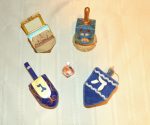
Dreidels from the author’s dreidel collection. Clockwise from the top left: a hand-painted dreidel with an open top; a hand-painted dreidel on a base; a felt dreidel; a hand-painted dreidel; and, in the centre, a tiny hand-painted glass dreidel. (photo by Barry Kaplan)
Dreidel is the most popular game for Chanukah. In Hanukkah: Eight Nights, Eight Lights, Malka Drucker writes that it evolved 2,000 years ago when the Chanukah story took place, at a time when Antiochus ruled over Judea in ancient Israel. “Groups of boys who had memorized the entire Torah would secretly study together until they heard the footsteps of the Syrian soldiers. Then they would quickly pull out spinning tops … and pretend to be playing games,” she writes.
Whether this is true or not, we do know that, by the Middle Ages, the game became more complicated, as rules were borrowed from a German gambling game. According to Encyclopedia Judaica, during the long nights of Chanukah, while the lights were burning, it became customary to pass the time by spinning tops and playing the ancient “put and take” game. This was in fulfilment of the commandment that the Chanukah lights should not be used for any utilitarian purpose – “they are only to be seen.”
While playing cards and other games has been prohibited by the rabbis over the years, as the games were considered frivolous because they took away from Torah study, the custom continued.
In medieval Germany, dice were used for the game, and they were inscribed with N, G, H and S. N stood for nichts, nothing; G stood for ganz, all; H was for halb, half; and S meant stell ein, put in. All players would hold an equal number of nuts, raisins or coins. Each player would put one in the middle, and the first player would spin the dice. Each letter stood for a move in the game – putting in or taking out nuts, raisins or coins, according to where the dice landed.
Later, boys carved tops or dreidels out of wood or poured hot lead into a form to make a spinning top. The letters were then changed to Hebrew and said to stand for the Hebrew letters nun, gimmel, hey and shin. The rabbis were less reluctant for boys to play with these tops because the letters were interpreted to stand for the phrase, “Nes gadol hayah sham,” “A great miracle happened there.”
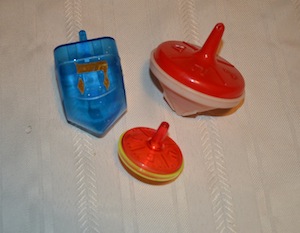
An assortment of plastic dreidels. The two larger tops have removable lids. (photo by Barry Kaplan)
In modern Israel, the Hebrew letter shin is replaced by a peh, standing for poh, meaning here – “A great miracle happened here.”
The rabbis felt even more comfortable about the game when it was also realized that, when the Hebrew letters, which have numerical value, are added together, they total 358, the same number of letters as the word for Messiah. (Nun is 50, gimmel is three, hey is five and shin is 300.) The letters of the word Messiah or Mashiach in Hebrew are mem, which is 40, shin which is 300, yud which is 10 and chet which is eight. Since the Jews are still waiting for the Messiah, this would show the way for a miracle.
Another mystical interpretation of the Hebrew letters is described by Philip Goodman in The Hanukkah Anthology. He writes that nun stood for nefesh (Hebrew for soul); gimmel stood for guf (body); shin stood for sechal (mind); and hey stood for hakol (all), implying all the characteristics of humankind.
Among the most-sung Chanukah songs are those about the spinning top – dreidel, in Yiddish, and s’vivon, in Hebrew.
The origin of the song “I Have a Little Dreidel” – “I have a little dreidel, I made it out of clay, and when it’s dry and ready, then dreidel I shall play!” – was the subject of an interesting article by Melanie Mitzman a few years ago in Hadassah Magazine. She wrote that Joshua Jacobson, a professor of music and Jewish studies at Northeastern University, explained that the song was originally in Yiddish and the opening line was “I made it out of lead.”
Samuel Goldfarb is said to have penned the English lyrics, and Goldfarb, a Jewish liturgical composer employed by the Bureau of Jewish Education of New York between 1925 and 1929, wrote the melody for the English version. Goldfarb’s granddaughter, Susan Wolfe, recalls telling her public school class that her grandfather had written “The Dreidel Song,” but they did not believe her.
The popular Hebrew song for this game is “S’vivon”: “S’vivon, sov, sov, sov.Chanukah hu chag tov,” “Spinning top, turn, turn, turn. Chanukah is a good holiday.”
As for dreidel games, here are the rules for three.
Put and take
On the sides of the dreidel are the four letters described above. To play the game, each player puts in one or more nuts or coins as agreed. A player spins the dreidel. If it falls on N, the player does nothing. If it falls on G, the player gets all. If it falls on H, the player takes half. If it falls on S, the player takes the whole pot. The next player takes their turn after each player once again contributes to the pot.
Endurance
All players spin the dreidel at a given signal. The player whose dreidel spins the longest is the winner.
Play for score or time
This game uses the fact that each Hebrew letter of the dreidel has a numerical value: N = 50, G = 3, H = 5 and S = 300. Players agree on a specific score to reach or time in which to play. Each player spins the dreidel. The scorekeeper credits each player with the numerical value of the letter on which his or her dreidel falls. The game continues until a player reaches the agreed-upon score or until the allotted time has passed, in which case the player with the most points wins.
Sybil Kaplanis a journalist, foreign correspondent, lecturer, food writer and book reviewer who lives in Jerusalem. She also does the restaurant features for janglo.net and leads walks in English in Jerusalem’s market.


 The engineers also had to lower the risk of the system getting blocked. They realized that water pipes that ran along the side of a mountain would be hard to clean. Thus, they designed special water filters. These filters made it easy to trap and remove rocks or silt. If there were particles, they would settle in the reservoirs, not in the pipes. The engineers’ design was practical. It functioned throughout the year and, importantly, provided for a lot of water storage. It included crisscrossing water pipelines, channels, dams, tunnels, reservoirs and cisterns (totaling some 200 surface and underground units).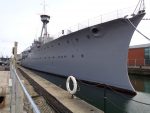
 After an explanation about kosher laws and the food of Jewish holidays, there are 11 cookbook chapters covering appetizers, spreads and salads (49 recipes), savory pastries (21 recipes), eggs and fritters (24 recipes), soups (29 recipes), rice, pasta and grains (31 recipes), vegetables (48 recipes), fish (46 recipes), poultry (23 recipes), meat (49 recipes), condiments and preserves (24 recipes) and desserts (51 recipes). There are a whopping 395 recipes in all.
 After Haaretz journalist Ronit Vered explains the history of Israel’s cuisine from the 1950s to today, Rothfeld and Silverton embark on a tour of Israel – Tel Aviv-Jaffa, the north, the centre, the south, Jerusalem and the Judean hills, concluding with the “ecosystem of Israel Eats,” meaning the people who contributed to the book.