Kolot Mayim Reform Temple welcomes Dr. Joshua Grayson to speak on In Search of Lost Roots: How One Researcher Traced His Family Across Three-and-a-Half Centuries. The lecture will be presented on Zoom Nov. 5, 11 a.m., launching a new season of the Building Bridges speaker series on the theme of “L’dor V’dor: From Generation to Generation.”
Grayson has always been fascinated by family history and, thanks to research skills honed in a doctoral degree at the University of Southern California, as well as fluency in five foreign languages, he was able to trace one branch of his family history back to approximately 1660, and many other branches to the early 1700s. Through his research, he learned about the many contributions his family made in fields as diverse as science, art, medicine, feminism and Zionism. His efforts also led him to reconnecting with living relatives he never knew he had.
Grayson founded Lost Roots Family History, which is a website (lostrootsfamilyhistory.com), virtual museum and research service devoted to helping other Jewish families reconnect with their roots, discover their past, engage with the present and preserve their heritage for the future. On the theme of From Generation to Generation, he observed, “No matter how much things may change, something of the achievements of those who came before us – some piece of what they have built – will live on forever to inspire and educate future generations.”
Kolot Mayim’s Rabbi Lynn Greenhough added, “Many of us participate in what we call ‘Jewish geography,’ trying to establish long-lost connections with each other through familial ties. Some of us who have chosen Judaism can sometimes feel outside these geographical memories, but the information we receive from all our collective ancestors can inspire all of us to treasure what we hold today.”
Grayson’s online lecture will offer insights into the resources available for Jewish genealogical research, including archival records, immigration documents, letters, oral histories and digital databases. As well, he will provide guidance on how to navigate these resources, overcome obstacles and piece together the intricate stories of Jewish ancestry.
L’dor v’dor generally emphasizes the passing on of knowledge and experience from older to younger generations. This year’s Building Bridges series will expand the concept of l’dor v’dor as a reciprocal relationship, where learning can also be passed from younger generations to elders. Speakers will highlight the Jewish experience of resilience, survival and renewal across generations.
The 13th annual Shira Herzog Symposium, hosted by New Israel Fund of Canada, took place on Oct. 15. Originally intended to be a discussion about the challenges facing Israeli democracy, the topic was changed to Celebrating Defiance, in light of the Oct. 7 Hamas attacks on Israel.
NIFC president Linda Hershkovitz said the new focus was an opportunity “to comfort each other, to grieve and to hear how our community in Israel is responding to this moment.”
She said, “Today, we still gather to celebrate defiance – defiance against terror and extremism, against giving up hope, and against allowing violence to drive Jews and Arabs further apart.”
Opening remarks underscored that among the more than 200 hostages taken by Hamas was ivian Silver, a 74-year-old Canadian-Israeli activist for peace and women’s rights, known to many of those in the audience.
The main speakers at the symposium were Orly Erez-Likhovski, director of the Israel Religious Action Centre (IRAC); Eran Nissan, a peace activist and executive director of Mehazkim, a progressive digital group in Israel; and Amal Oraby, a Palestinian lawyer, human rights activist and member of the board of directors of Amnesty International Israel. Journalist Andrew Cohen was the moderator.
“I stand before you with a lot of fear, a fear that our lives will never be the same and a fear for the safety of my family, my friends in Gaza, Tel Aviv and Jerusalem. In Israel, there is no room for voices who seek to see the reality with open eyes and acknowledge the occupation, and to refuse making the same mistake and expecting different results,” said Oraby, who serves as NIF’s Arabic media coordinator and has written extensively for the Israeli media.
Nissan, who was a combat soldier in the special forces canine unit, said every time there is a flare-up of violence, it represents a setback for both Israeli and Palestinian societies which will, in turn, drive more anger, animosity and distrust.
“In the days since Oct. 7, we identified narratives that we needed to push through our social media platforms,” Nissan said when asked what his organization did immediately following the attacks. “We understood that the first days after such an event are a crucial time when the heroes and the villains are being chosen.”
The Israeli government, he said, was framing the narrative as a struggle between Jews and Arabs. His counter-narrative is to highlight stories of shared experiences and heroism, such as Bedouin truck drivers who risked their lives to rescue Jews from the Hamas attacks and paramedics in the Negev fighting to save lives while under fire.
“This not a popular time to talk about a shared society or about empathy,” said Nissan. “Civil society organizations have been under attack. The amount of hatred and incitement we see is horrific. What we are trying to do is boost our capacity to tackle the challenges that we have right now.”
“We are very concerned about the rise in racism and violence,” said Erez-Likhovski, whose organization aims to defend equality, social justice and religious pluralism in Israel and serves as the public advocacy arm of the Reform movement.
“It’s important to talk about the current feeling in Israel,” she added. “People feel they have been abandoned by the government and by the state. The feeling is that the state system is not functioning. It’s a direct result of this government bringing in incompetent people to any post possible. And it’s taken its toll over the past year.”
Since the attacks, IRAC has worked to help the people who were evacuated, assisting with food and clothing, and helping with pastoral care, among other services.
Oraby was not optimistic about the latest change in the Israeli cabinet: bringing in opposition leader Benny Gantz. He views it as a “war government,” not an “emergency government,” and pointed to a strong civil society as the way to deescalate the situation. “Where Israeli and Palestinian leadership have failed, the civil society is succeeding,” he said.
Nissan agreed that the current cabinet is only setting military objectives, adding that it is not considering what will happen following the conflict.
Erez-Likhovski also commented that the new coalition was not presenting any long-term vision of how to solve the conflict.
At the end of the discussion, Nissan acknowledged the gravity of what occurred on Oct. 7 in terms of Israeli history and its effects on the national psyche. His hope, he said, is that a new story for Israel can be written out of the pain, and the crisis the country is confronting.
The event was co-presented with ARZA Canada, Canadian Friends of Peace Now and JSpaceCanada. It was held at the Toronto Reference Library and on Zoom.
Sam Margolishas written for the Globe and Mail, the National Post, UPI and MSNBC.
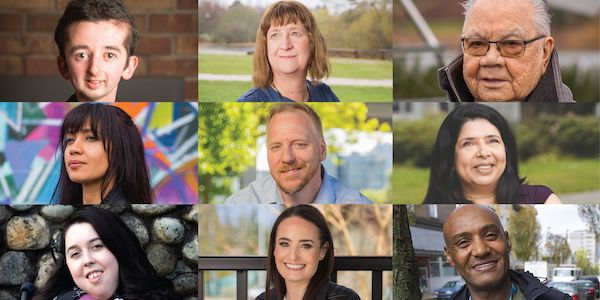
Past recipients of a Courage to Come Back Award. (image from Coast Mental Health)
Nominations are open for the 2024 Courage to Come Back Awards, presented by Wheaton Precious Metals.
The purpose of the awards is to pay tribute to those who have overcome overwhelming challenges and now give back to their community. They are the hidden everyday heroes that deserve to be recognized and celebrated for their contributions to our communities.
This recognition goes a long way to encouraging these individuals to continue their efforts to inspire those around them. It also gives them a platform to further promote the causes or issues that are important to them.
They are our role models.
People like Rachel Goldman, who has faced a lifetime of chronic illness and pain with great courage and strength. She is an accomplished TV and radio producer, and has always volunteered within her community. Goldman hopes that, by sharing her story, her struggle can be a force for hope for others. (See jewishindependent.ca/beautiful-life-despite-illness.)
People like Dr. Barney Jr. Williams, a residential school survivor and person recovering from alcoholism. Williams has made it his life’s mission to help others overcome alcoholism and addiction.
Like Alex Sangha, who is gay, lives with a mental illness, and is from a South Asian community where stigma persists. Today, he has become an inspirational creator of safe spaces for the LGBTQ+ community.
Or Jodi Gray, a transwoman who overcame poverty, abuse, suicidal ideation and depression. She changed the narrative to create better solutions and systems of care.
The Courage to Come Back Awards not only recognize the lives of five remarkable people, but ensure that Coast Mental Health can continue to provide compassionate, meaningful support for anyone with the courage to come back from mental illness.
Coast Mental Health is one of the largest providers of community-based services for people living with mental illness in British Columbia. Each year, it provides essential services to 5,000 clients so they can find a meaningful place in their communities – a place to live, a place to connect and a place to work. To find out more about the programs and services offered, visit coastmentalhealth.com.
The Courage to Come Back Awards are given in five categories: addiction, medical, mental health, physical rehabilitation and youth. Award recipients will be recognized in person in front of more than 1,400 people at the Vancouver Convention Centre on May 23, 2024. They will receive media coverage and their stories will be shared on social media.
“As chair of the Courage to Come Back Awards, reading through the hundreds of nominations we receive every year is a moment I look forward to with great anticipation,” said Lorne Segal, president of Kingswood Properties Ltd. “All of them are true journeys of bravery, resilience and strength in the face of adversity. I am grateful to those that have the courage to share their stories with us.”
The deadline for nominations is Friday, Jan. 19, 2024. To nominate someone and find out more about the process, visit couragetocomeback.ca/nominations.
As an artist herself, Yvonne Singer can well appreciate the esthetic merits of the open-air monument to Swedish Second World War hero Raoul Wallenberg that was unveiled last June at Churchill Park in Hamilton, Ont., in a ceremony attended by those whose families owed their survival to Wallenberg.
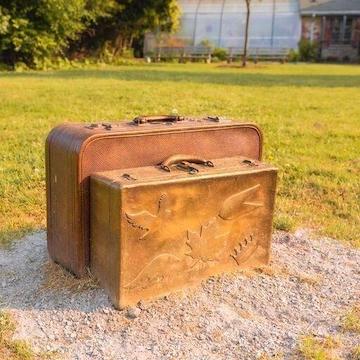
Though she has not personally viewed the installation, called “Be:longings,” Singer spoke admiringly of the 10 bronze-cast suitcases dispersed along a gravel path adjacent to the Hamilton aviary. She knows Simon Frank, one of the project’s three creators, and is aware that suitcases are a potent symbol of the Holocaust.
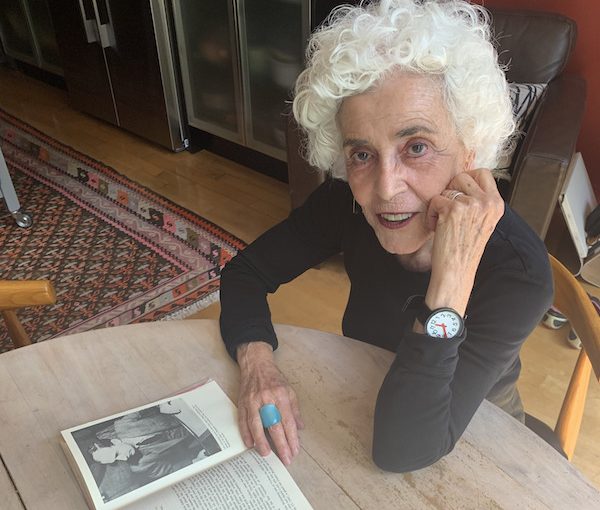
“I like the fact that the suitcases are scattered,” Singer, a well-established visual artist and teacher in Toronto, said in an interview over lemon tea in her sun-drenched kitchen. “I think the imagery and symbolism are very effective in conveying the idea of displacement and emigration.”
The old-timey valises evoke not just Wallenberg, Singer noted, but all victims and survivors of that terror-stricken era. The outdoor project is also “minimal, which I like. I don’t like public sculptures that scream at you or are clichéd.”
Part of the “Be:longings” monument in Hamilton’s Churchill Park to Second World War hero Raoul Wallenberg. (photo from Hamilton Jewish Federation via Hamilton Jewish News)
Singer connects to the installation on a whole other level. The 78-year-old resident of Toronto’s trendy Cabbagetown neighbourhood is Wallenberg’s goddaughter. She was born on his bed.
It’s a Hollywood-worthy tale that evolved over time, in a series of eye-popping twists, turns and coincidences – all amid Singer’s own personal voyage of self-discovery.
The backstory is its own blockbuster: The non-Jewish scion of a wealthy Swedish industrial and banking family, Wallenberg, then just 32, was recruited by the US War Refugee Board and dispatched to Budapest to assist and rescue as many Jews in the Nazi-occupied Hungarian capital as possible. He arrived in July 1944, just as the Nazis had finished shipping some 440,000 Jews from the countryside to Auschwitz. They and their Hungarian collaborators, the Arrow Cross militia, now set their sights on the Jews of Budapest.
Accorded diplomatic status, Wallenberg famously set off on a frenetic pace. He designed, printed and distributed thousands of the famous “Schutzpass” – an official-looking document that placed the holder under the protection of the neutral Swedish Crown. He also scoured the city for buildings to rent, finding 32, and crammed in as many souls as possible. The “safe houses” flew the yellow-and-blue Swedish flag and were declared protected by diplomatic immunity.
Known for his bluster and bravado (and for bribes using American cash), his greatest coup came when he reportedly persuaded Nazi commanders to call off the liquidation of Budapest’s Jewish ghetto, with its 70,000 inhabitants.
The number of Jews Wallenberg is said to have rescued peaks at 100,000. He is credited with saving more Jewish lives during the war than any single government.
By January 1945, the Red Army was laying siege to Budapest, and Wallenberg was taken into custody on allegations he was a US spy. He promptly vanished into the massive gulag system. A Soviet report in 1956 dryly noted he had died in July 1947 of a heart attack in Moscow’s notorious Lubyanka prison, but supposed eyewitness sightings and stories of contact with him from former inmates continued well into the 1970s.
A nine-year joint Swedish-Russian investigation, ending in 2001, came to opposing conclusions, with Moscow sticking to its story about Wallenberg’s 1947 death, and Stockholm stating that absent any proof, it was impossible to reach a conclusion about his fate.
In 2012, the diaries of a former head of the KGB, discovered stuffed into the walls of his Moscow home, stated there was “no doubt” that Wallenberg was “liquidated” in 1947.
But back to Singer.
On the night of Nov. 3, 1944, a desperate Tibor Vandor, who worked for Wallenberg as a courier and liaison to the underground, needed help for his wife, Agnes. She was in labour and had been turned away from Budapest’s hospitals, which barred Jews. Wallenberg allowed the couple to use his own room, while he slept in the corridor using his coat as covers.
The next morning, he was called in to see a dark-haired newborn girl. Asked by the grateful parents to name her, Wallenberg chose Nina Maria Ava (Nina was his half-sister’s name, Maria his mother’s). The couple changed the first name to Yvonne, and Wallenberg agreed to be the child’s godfather.
Singer knew nothing of this until she was 34 years old.
It was October 1979 when she read an article in the Toronto Star, reprinted from a US newspaper, about Wallenberg’s plight. The story included a reference to Singer’s unusual birth, taken from a Hungarian book on the Swedish hero written after the war. The baby with the Toronto connection, the parents, the godfather, were all there, mentioned by name.
When she read the piece, “I burst out crying,” she told the Star after contacting the paper. Her story spilled forth a week later in a large Saturday article headlined “Swedish hero saved my life: Metro woman.”
Singer is still struck by “the incredible coincidence of it all. Here I am in Toronto in 1979, reading the paper … it boggles the mind. I could have easily gone through life not knowing the story. Suddenly, I had a connection to this man, who sounds like he was fascinating.”
Her parents had not told her the story. And there was another missing piece of the puzzle: their Jewishness.
At war’s end, the Vandors went to Switzerland and Holland before settling in Montreal in 1949, where they shed their Jewish identities, doubtless seeking to blot out the legacy that had caused them so much pain. Tibor Vandor even became an elder in the United Church (Yvonne attended church until she was about 14).
Her parents never revealed being Jews. “I always pressed them for more information, and they always refused,” even following the revelations in the Toronto Star, Singer recalled. “They told me very, very little.” Their silence encompassed “anything to do with the war.”
Singer graduated from McGill University and went on to teach high school English and French. She married her husband, Ron Singer, a theatre director and educator, in 1966 and, because her Jewishness was unknown to her, converted to Judaism.
A few years later, a cousin in England recalled being a flower-girl at Yvonne’s parents’ wedding, which she said took place in a synagogue. The parents denied it, but Yvonne believed it.
Singer’s feelings of alienation as an immigrant child would evaporate on discovering that she had been born Jewish, whether the knowledge came from a cousin or the Toronto Star. “I felt like I’d come home, part of a history that goes back thousands of years. I no longer felt rootless,” she said.
The Singers moved to Toronto in 1971, where Yvonne later began a prolific art career in various media and teaching visual arts at York University. Raising three daughters and a busy life meant there was little time to get involved in the Wallenberg file, though she was pleased when he became Canada’s first Honorary Citizen in 1985 and when Canada Post issued a stamp commemorating Wallenberg a decade ago.
In 1997, even Queen Elizabeth heard Singer’s remarkable story. The artist was among the dignitaries in London when a bronze statue of Wallenberg was unveiled by the Queen. The two were introduced.
“The Queen listened attentively and I was told she was very interested in my story,” Singer said at the time. “It was a highlight of my life.”
It’s no surprise that Singer’s art has explored themes of identity, history and memory. The outsider status she felt in her early life “is what made me think about ways of expressing that, either through language or visual imagery. So, you go to what you know when you’re an artist.”
In 2016, the Swedish government declared Wallenberg officially dead, but, to Singer, that offered no finality. “From what I learned, the Swedish government is not exempt from blame for trying to get Wallenberg out. I cannot reconcile the fact that [Wallenberg’s family] could not exert any kind of leverage over the Russians to find out what happened to him.”
The title of godparent in Judaism is largely honorary, and Singer considers the godfather connection to Wallenberg an honour. “But I’m also very sad that I never met him,” she said. “I think he would have been a fascinating person to talk to. The story is just very, very tragic.”
The grandmother of nine sighed. Over the decades, the story for her was very personal, obviously, “and I was still processing it. Maybe I’m still processing it, for a long, long time.”
A version of this article originally appeared in the Hamilton Jewish News. It is reprinted with the author’s permission.
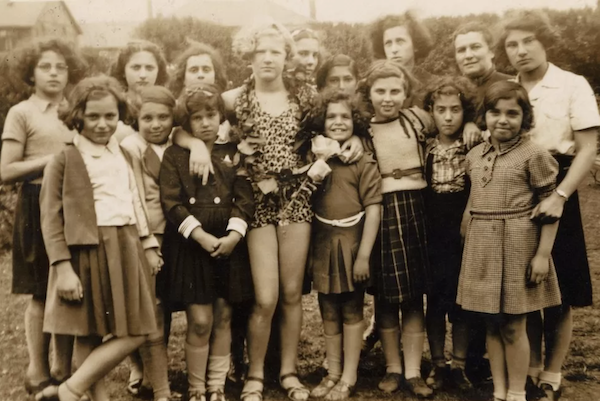
More than 20 girls were rescued from Nazi persecution and brought to Tynemouth (photo from Summerfield family via BBC)
On Jan. 26, 2023, a blue plaque at a house in Tynemouth, a coastal town in northeast England near Newcastle, was unveiled. The marker recognizes the efforts of David Summerfield, the grandfather of Victoria, BC’s Henry Summerfield, to help rescue Jewish children before the Second World War.
David Summerfield’s undertaking was part of the Kindertransport, which, from late 1938, after Kristallnacht, to the declaration of war in September 1939, brought Jewish children to the United Kingdom.
“My grandfather ran a jewelry store in Newcastle. He was very well known and well thought of inside and outside of the Jewish community,” Henry Summerfield told the Independent. “He got a committee together and they raised funds and got a house in Tynemouth. In those days, they would not have boys and girls in the same house. Thus, they decided girls were more vulnerable and they would take them in.”
The house at 55 Percy Park provided lodging for 24 Jewish girls, aged 3 to 15, from Germany, Austria and Czechoslovakia. In total, nearly 10,000 children were brought into the United Kingdom during the nine months of the rescue operation.
“It was a terrible ordeal for the children because they were in a strange country and they were going to a city they had never heard of. They were not accompanied by any adults who could guide them,” said Summerfield. “A girl from Czechoslovakia was the worst off because did not speak either German or English.”
The local Jewish community in Newcastle needed people to care for the girls after they arrived, Summerfield said, and they managed to find two Jewish widows from Vienna who had fled to London: Paula Sieber, who had owned a cinema, and Alice Urbach, a well-known chef who also operated a cooking school.
Prior to the war, Urbach had written a popular cookbook, Cooking the Viennese Way, under a false name, because, as a Jew, she was not able to publish using her real name. In 2022, her granddaughter, historian Karina Urbach, published Alice’s Book: How the Nazis Stole My Grandmother’s Cookbook, which explored Alice Urbach’s story and the Nazi appropriation of her intellectual property.
“Because attempts to avert a war failed, the parents were never able to join their children,” said Summerfield. “Instead, Newcastle and the nearby area became a war zone subject to heavy bombing and out of bounds to enemy aliens, so the girls were moved across the country to a house at Windermere in England’s Lake District. There they remained under the care of the two matrons till the end of the war. They were educated in local schools.”
As reports started to come out about the death camps, the matrons tried to be strict about keeping the girls away from the cinemas, where newsreels were shown. One girl managed to sneak out, saw the news and returned to the house in hysterics. Most of the girls’ parents died during the Holocaust.
As the years passed, the girls finished their schooling and got training for various jobs. The whole enterprise was successful – the girls grew up, had careers and raised families. Some stayed in England, while others moved to Israel, the United States, Australia and New Zealand.
The BBC recently learned of the endeavour and broadcast a report about a reunion of the refugees, now elderly, and their lives. The reunion was attended by David Summerfield’s granddaughter, Judith Summerfield, and great-granddaughter, Alison Moore. There were previous reunions, in 1988 and 1999.
A six-episode BBC podcast was released earlier in the year, The Girls: The Holocaust Safe House, detailing the stories of those who lived at 55 Percy Park. The current owners of the house, who purchased the property in 2017, hadn’t known the historical significance of the address as a Kindertransport hostel.
The newly unveiled plaque at 55 Percy Park reads: “In 1939, this house was home to more than 20 girls fleeing Nazi persecution. They came here via the Kindertransport rescue effort and were cared for by the Newcastle Jewish Refugee Committee, as well as the wider community of Tyneside. Most of those housed here lost their parents during the Holocaust. The committee funded their care for over seven years.”
Below that inscription is a quote from Talmud: “Whoever destroys a soul, it is considered as if he destroyed an entire world. And whoever saves a life, it is considered as if he saved an entire world.”
A posthumous honour for David Summerfield has been proposed. His jewelry store, started in 1914, is still in operation.
Sam Margolishas written for the Globe and Mail, the National Post, UPI and MSNBC.
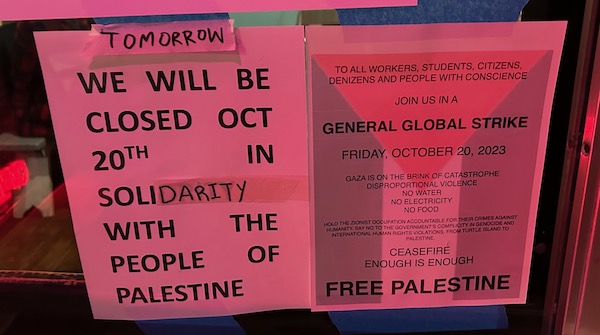
A restaurant in Vancouver closed for a day, calling for people “to hold the Zionist occupation accountable” for the war in Gaza. Writer Loolwa Khazzoom notes, “When terrorists blow up Israelis, there is often an undertone of accusation: it’s Israel’s fault, the narrative goes, that these tragedies happen…. But who truly was responsible for creating Palestinian desperation, and who is accountable for remedying it?” (photo by Larry Barzelai)
On 9/11, I was 20 blocks away from Ground Zero, sleeping in the living room of a friend when she woke me up, screaming hysterically – something about terrorists and an airplane crashing into one of the Twin Towers. As I tried to comprehend what was happening, my friend turned on the television and, right then, the second plane crashed into the second tower, as we watched in horror.
My thoughts came in this order: Now they’ll understand what it feels like to live in Israel. Watch them blame this on Israel. OMG we’re going to die.
Two decades later, on the morning of Oct. 7 – in the wake of what some are calling Israel’s equivalent of 9/11 – I felt the pain of collective Jewish agony, and promptly reached out to my friends and family in Israel, including those living close to the Gaza border.
Unbeknownst to many, those in the border towns, such as Sderot, are predominantly working-class Mizrahim and Sephardim – children and grandchildren of the 900,000 Jewish refugees from throughout the Middle East and North Africa. They are the ones predominantly getting pummeled by Hamas rocket fire, as the world yells about “white European colonist settler Israelis.”
So, it’s no surprise that, after the initial feelings of shock and outrage, grief and concern, I once again thought, “Watch them blame this on Israel.” And they did, within hours – with a BBC News interview going so far as to compare the Hamas attack to the Warsaw Ghetto Uprising.
It’s nothing new, of course. When terrorists blow up Israelis, there is often an undertone of accusation: it’s Israel’s fault, the narrative goes, that these tragedies happen. By creating Palestinian desperation, Israel has created Palestinian terrorism. But who truly was responsible for creating Palestinian desperation, and who is accountable for remedying it?
The Arab world is called just that for a reason. Beginning in the Arabian Peninsula about 1,300 years ago, Arab Muslims launched a brutal campaign of invasion and conquest, taking over lands across the Middle East and North Africa. Throughout the region, Kurds, Persians, Berbers, Copts and Jews were forced to convert to Islam under the threat of death and in the name of Allah.
Jews were one of the few indigenous Middle Eastern peoples to resist conversion to Islam, the result being they were given the status of dhimmi – legally second-class, inferior people. Jews were spared death, but forced to endure an onslaught of humiliating legal restrictions – forced into ghettos, prohibited from owning land, prevented from entering numerous professions and forbidden from doing anything to physically or symbolically demonstrate equality with Arab Muslims.
When dhimmi laws were lax and Jews were allowed to participate to a greater degree in their society, the Jewish community would flourish, both socially and economically. On numerous occasions, however, the response to that success was a wave of harassment or massacre of Jews instigated by the government or the masses. This dynamic meant that the Jews lived in a basic state of subservience: they could participate in the society around them; they could enjoy a certain degree of wealth and status; and they could befriend their Arab Muslim neighbors. But they always had to know their place.
The Arab-Israel relationship and the current crisis occur in the greater context of a history in which Arab Muslims have oppressed Jews for 1,300 years. Most recently, anti-Jewish riots erupted throughout the Arab world in the 1930s and 1940s. Jews were assaulted, tortured, murdered and forced to flee from their homes of thousands of years. Throughout the region, Jewish property was confiscated and nationalized, collectively worth hundreds of millions of dollars at the time.
Yet the world has never witnessed Middle Eastern and North African Jews blowing themselves up and taking scores of Arab innocents with them out of anger or desperation for what Arab states did to the Jewish people. Despite the fact that there were 900,000 Jewish refugees from throughout the Middle East and North Africa, we do not even hear about a Middle Eastern/North African Jewish refugee problem today, because Israel absorbed most of the refugees. For decades, they and their children have been the majority of Israel’s Jewish population, with numbers as high as 70%.
To the contrary, Arab states did not absorb refugees from the war against Israel in 1948. Instead, they built squalid camps in the West Bank and Gaza – at the time controlled by Jordan and Egypt – and dumped the refugees in them, Arabs doomed to become pawns in a political war against Israel. Countries such as Syria, Iraq, Saudi Arabia, Libya and Lebanon funded assaults against Israeli citizens instead of funding basic medical, educational and housing needs of Palestinian refugee families.
In 1967, Israel inherited the Palestinian refugee problem through a defensive war. When Israel tried to build housing for the refugees in Gaza, Arab states led votes against it in United Nations resolutions, because absorption would change the status of the refugees. But wasn’t that the moral objective?
Israel went on to give more money to the Palestinian refugees than all but three of the Arab states combined, prior to transferring responsibility of the territories to the Palestinian Authority in the mid-1990s. Israel built hospitals and educational institutions for Palestinians in the territories. Israel trained the Palestinian police force. And yet, the 22 Arab states dominate both the land and the wealth of the region. So, who is responsible for creating Palestinian desperation?
Tragically, the Arab propaganda war against Israel has been a brilliant success, laying on Israel all the blame for the Palestinian refugee problem. By refusing to hold Arab states accountable for their own actions, by feeling sympathy for Palestinian terrorists instead of outrage at the Arab propaganda creating this phenomenon, the so-called “progressive” movement continues to feed the never-ending cycle of violence in the Middle East.
Loolwa Khazzoom (khazzoom.com) is the frontwoman for the band Iraqis in Pajamas (iraqisinpajamas.com) and editor of The Flying Camel: Essays on Identity by Women of North African and Middle Eastern Jewish Heritage (theflyingcamelbook.com). She has been a pioneering Jewish multicultural educator since 1990, and her writing has been featured in the Washington Post, Marie Claire, Rolling Stone and other top media worldwide. This article was originally published in the Times of Israel.
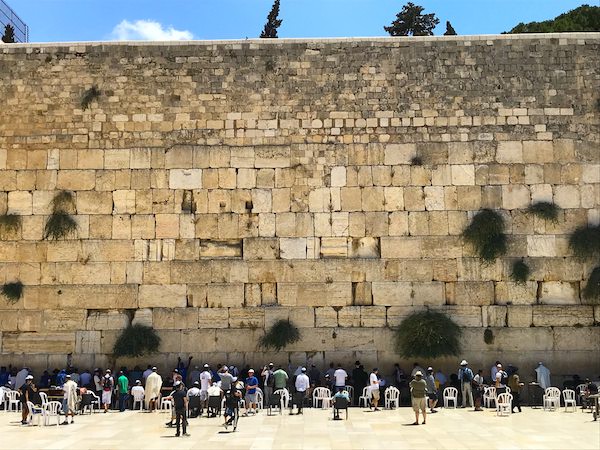
The Kotel (Western Wall) in Jerusalem (photo by James Blake Wiener)
Two weeks ago, 34 student organizations published a letter blaming Israel for the violent attacks that occurred on Oct. 7, on the holiday of Simchat Torah, that killed hundreds of Israelis in a brutal fashion. The letter claimed that Israel is entirely responsible for all unfolding violence and further claimed, “today’s events did not occur in a vacuum, for the last two decades, millions of Palestinians in Gaza have been forced to live in an open-air prison,” according to ABC News.
On the Stanford campus, an instructor in a civil, liberal and global education course asked Jewish students to take their belongings and stand in a corner, saying, “This is what Israel does to the Palestinians.” According to the Forward, the teacher then asked, “How many people died in the Holocaust?” The students answered, “six million”; the response from the instructor was, “Colonizers killed more than six million. Israel is a colonizer.”
Those of us who grew up in the West in the ’60s, ’70s and ’80s always thought Hitler was the embodiment of all evil and the Nazis were the greatest evil known to mankind. The merging of pure hatred and technology created an evil unmatched because of its scale and virulence. However, in today’s world there appears to be a sin worse than that of being a Nazi, that is to be a “colonizer.”
The theory of (Western racial colonizing) was made famous by a professor in whose class I studied, Edward Said. The New Yorker several years ago reflected that Said’s most famous book, Orientalism, “proved to be perhaps the most influential scholarly book of the late 20th century; its arguments helped expand the fields of anti-colonial and post-colonial studies.” The crimes of colonialism cannot be ignored … including many tragedies such as the Trail of Tears, residential schools, the partitioning of India and more.
The reflexive hatred of Israel, even as its citizens are being slaughtered and taken hostage, stems from those who believe the Jewish presence in Israel is among the last vestiges of colonialism. Such rationalization theorizes that civilians are really a military asset because they advance the aims of the conquering nation and, as such, civilians are a legitimate target.
Hamas uses a similar thought model for its theory of mind for the Israeli population. Haviv Rettig Gur, a columnist for the Times of Israel, wrote the following: “Arab opponents of Israel speak of it often as an artificial, rootless construct doomed to collapse in the face of Palestinian faith and resilience. It is at heart, they say, a colonialist project that for all its outward power lacks the inner authenticity and conviction to survive.”
That interpretation of Israel isn’t just a put-down; it’s a call for action, including especially the kind of sustained terrorism and cruelty that pushed other colonialist projects out, from the French in Algeria to the British in Kenya. This interpretation of Israel is the basic logic behind Palestinian suicide bombings, rocket fire and the whole slew of terrorist tactics employed by Hamas on Oct. 7.
One thousand years ago, as the Crusaders were first launching the military campaign to recapture the Holy Land from the infidels, Rashi was musing about land rights as well. Rashi wanted to explain why a lawbook, the Torah, does not begin with laws, but rather with the story of Creation. Rashi says that the nations of the world will ultimately call the Jews thieves, or colonizers in a more (contemporary) flexible translation. The Torah, therefore, begins with the story of creation to establish that all the land belongs to G-d and G-d gave title to the Children of Israel. Nachmanides, another great medieval scholar, argues that Rashi’s explanation ignores the important stories of Abraham, Isaac and Jacob. The land of Israel is the land of their stories, of Moriah, Beit El, Chevron, Be’er Sheva. This is where our ancestors are buried.
Did the tribe of Reuven ever cede its land to Aram? Did Ephraim ever cede its land to Ashur?
If you were to walk the archeological sites in the land of Israel and look at the graves, the etchings on the walls, the seals from sites dated between 3,000 and 2,500 years ago – this is the Iron II period, from 1000 to 586 BCE, between the time of Solomon and the fall of Jerusalem to Babylon – what names would you find? The vast majority of those names carved into stones and pottery are names that end with YHU or YH’L these are Hebrew names for G-d: names like Yishayahu/Isaiah, Uriah and Or Samuel, respectively. (Journal of the American Oriental Society, Vol. 134, No. 4, October-December 2014; pp. 621-642) The stones speak the names of tribes that never willingly gave up their land to their conquerors.
The Judeans also did not cede land to the Romans. When Omar ibn Khattab conquered Jerusalem from the Romans in 638, he did not establish a treaty with the Jews, he did not trade high-value consumer durables for the land. He conquered it and, in 717, less than 100 years later, his successor Omar II forbade the Jews from praying in Jerusalem’s Temple Mount, a policy that was to last through Muslim rule of Jerusalem.
When Omar conquered, he brought Arabic into Israel for the first time. Hebrew inscriptions in Israel were already 1,500 years old when Arabic first arrived in Israel with the conqueror’s sword. Compared to the thousands of Hebrew inscriptions from the time of Solomon, there is only one find of an ancient dialect of Arabic, likely from a traveler.
We Jews are not colonizers, we are the people from the unceded lands of Judah and Benjamin, Naftali and Ephraim, Dan and Zevulun. Our language has always been Hebrew.
Prof. Yeshayahu Gafni of Hebrew University notes that, if you want to read a letter written by a Jew 2,000 years ago, you need to know Hebrew. Jews have always spoken, read and written Hebrew. If you want to write a letter to those who will be your descendants 2,000 years from now, you should write it in Hebrew.
We Jews have to make sure there is no daylight between our identity now, and the identities of our ancestors whose graves and etchings can be found from Tel Dan to Be’er Sheva. We need to embrace our language. There is no reason not to know it; it is ours.
Furthermore, we need to know the story of who we are, of the land and the people in it. We need to know who is Yeshayahu, who is Yehoshaphat, and Yoav, and Chizkiyahu, and Uziyah, and Abigail, and Jezebel and Atalyah. And we need to know how an Ephrati pronounces Shibbolet. These names figure prominently in the story of our people and our land. We need to embody the identity that holds their story true.
When we carry that identity together, we do not allow them to call us imperialists and colonizers. We are the people of the unceded lands of Judah and Benjamin. We must embrace that identity.
Rabbi Andrew Rosenblatt is senior rabbi at Congregation Schara Tzedeck. This article was originally published on the synagogue’s special Israel page at scharatzedeck.com.
There are no words. I’m doom-scrolling, praying and worrying, reaching out to family and friends, but nothing prepares us for seeing more than a thousand Israelis murdered and hundreds kidnapped. The images are so graphic, so many bodies desecrated. On my social media feed, the images haven’t stopped coming.
Yet, in the first days of the war, there was a silence. I realized that others weren’t seeing what I was seeing in my Instagram feed. The North American media felt sanitized, distant from the reality that was depicted on Israeli TV and media. The first day or two back at school after the Simchat Torah/Thanksgiving weekend, my kids were stunned when others asked them why they were sombre. Until this year, they attended a Hebrew/English bilingual public elementary school. With their transition to junior high, they didn’t have nearly the same number of classmates who understood the situation.
At their International Baccalaureate middle school, there are curriculum additions, such as a special lunchtime club that meets to make a difference in the world. The resource teacher advises the club. She was sensitive to the needs of the kids affected by the war in Israel and Gaza, and mine came home with fundraising brainstorms. I wrote to thank the teacher for showing support during this hard time.
Then, she asked – do you have ideas for what else we can do? It took me awhile to make a list. I thought about what mattered most for me, far from the war but also very affected by it. The hardest parts of the list are long-term things that teachers should do: teach about misinformation, and definitions of things like terrorism, “rules of engagement” and more. The easiest parts, perhaps the most meaningful ones? Conducting a kindness campaign. Asking how others are doing and listening to their responses. Active listening would help everyone, Israelis, Canadians who are Jewish or Palestinian, and concerned bystanders. So many innocent lives have been lost. We need to talk about it.
I suggested to the teacher that another way of reaching out positively would be to do cards of support. The next day, my son joined other kids from the middle school who walked to the bilingual elementary school to deliver the cards. It was on Friday, Oct. 13, the day that Hamas suggested be a global day of harm for Jews. On a positive note, my son got to share his elementary school and his Hebrew skills by translating for a non-Jewish friend. He was proud. On the other hand, most of the kids in the bilingual program were absent due to the threat. Those who did come to school, from grades 1 through 6, filled just one classroom, according to my kid. He visited with beloved grade school teachers and ate challah at the Shabbat party – but the threat was real.
Outside the school, my kid saw both an unmarked police car and a marked cruiser. My heart flooded with gratitude when I heard this, but the school is in a huge field, accessible from multiple directions. One police car? Two? I felt the fear all over again. How many police would be “safe enough”?
Meanwhile, I heard that Jewish homes in one Winnipeg neighbourhood were egged, and the police were called. A potentially violent rally in support of Palestine, using words like “genocide,” was scheduled within easy walking distance of my home.
Even though we’re far from the fighting, it’s hard to gain traction on work while feeling so emotionally undone. Massive numbers of Palestinians were asked to move and large swaths of Israelis evacuated from both the north and south regions of the country, while so many have been called up to reserve army service. For those Canadians who have lost a family member, the pain is constant. For those who have kidnapped loved ones, like Vivian Silver’s family in Winnipeg and Israel, the families work to publicize their losses and wait in dread to hear what has happened.
Twice, I felt able to rise above this emotional turmoil and felt joy. Both times, it was because of a bar mitzvah.
The first instance that stunned me took place last week, when the cantor who tutors my twins asked them to chant together for their lesson. Their lesson was short, as there was an Israel solidarity rally that she was leaving to attend. I lurked in the next room. Usually, my kids jostle for position but, during that lesson, their voices rang out together, making the rote practice of Torah and Haftorah blessings become so powerful. “Wow,” I heard the cantor say, continuing with something like, “I’m glad I didn’t cancel your lesson. Thank you for gifting me with those brachot.” An almost holy silence hung in the air afterwards.
A few days later, we attended a Chabad bar mitzvah for a kid my twins knew in preschool. Even behind a mechitzah (the barrier between the mens’ and women’s sections), the bar mitzvah boy’s voice rang out sure and strong as he absolutely shone. It was something to see: his big personality, confidence and knowledge. I was achingly proud of our Judaism, in all its diversity and strength.
Writing to deadline, I imagine what might be relevant in a few days, but the things that have helped me will still help later. I am following my own advice. Each day, I am taking time to write emails or texts to friends and reach out. How are they? Are their families safe? Do they need anything? I try to take time to pause, hear what everyone says, and listen for the moments of Jewish joy that we can create – in synagogue or at our homes, when we’re alone or together.
Many ask, “How are you doing?” I pause and say, “Well, it’s been a rough time.” I’m also trying to maintain hope for the future. One hears it – through the generational continuity of every child becoming b’nai mitzvah, through Hatikvah and one other phrase – Am Yisrael chai, the Jewish people lives. It will be my prayer as we get through the days ahead. Amen.
Joanne Seiffhas written regularly for CBC Manitoba and various Jewish publications. She is the author of three books, including From the Outside In: Jewish Post Columns 2015-2016, a collection of essays available for digital download or as a paperback from Amazon. Check her out on Instagram @yrnspinner or at joanneseiff.blogspot.com.
Incorporating charitable giving into our lives is not just a philanthropic act; it’s a value deeply ingrained in Jewish tradition. With recent events underscoring the importance of such contributions, it is prudent to explore various giving strategies available in Canada.
Cash Donations
One of the most common ways to give is through cash donations. This straightforward method allows organizations to use the funds to further their operations, while offering valuable tax savings to donors.
Cash donations to registered charities provide a tax credit both provincially and federally. The tax benefits of the donation are based on the donation amount and the marginal tax rate. To keep things simple, Table 1 shows two examples based on living in British Columbia.
In-Kind Donations
Non-cash donations are equally essential for charities, depending on the services and programs they offer. These contributions encompass tangible goods or services, such as clothing, food, furniture, books and medical supplies. Much like cash donations, in-kind donations can make donors eligible for a tax deduction. The value is determined based on the fair market value of the donated goods and services.
In-kind donations in the form of securities or stocks offer a popular and tax-advantageous way to contribute to charitable causes. To qualify for these favourable tax benefits, the donated securities must be listed on a designated stock exchange in Canada. Generally, publicly traded stocks and certain mutual funds meet this eligibility criterion.
The value of the donation is determined by the fair market value of the securities at the time of the donation. An important feature of this method is that the donation itself is exempt from capital gains tax on any accrued capital gains. This means that, if your securities have appreciated in value since you acquired them, you can donate them without incurring capital gains tax on the increase in value.
There is a limitation to consider: you can claim donations of securities for up to 75% of your net income in the year you make the donation. However, any donations exceeding this limit can be carried forward for up to five years. This flexibility allows you to maximize the tax benefits over time, ensuring that your charitable giving aligns with your financial situation.
Donor-Advised Funds
One powerful strategy for charitable giving that warrants further exploration is the use of donor-advised funds through a CRA-registered foundation such as the ZLC Foundation or the Jewish Community Foundation. These funds provide a structured and effective approach to managing and maximizing your philanthropic endeavours, making them an excellent choice for those interested in creating an endowment. By establishing a donor-advised fund, you can exercise a greater level of control and intentionality in your charitable contributions, ensuring that your giving aligns with your values and long-term goals.
Life Insurance
Using life insurance policies to contribute to a charitable organization offers a meaningful way to leave a legacy. While this method differs from the others discussed here, it provides a substantial, long-term benefit. Life insurance policies can be set up to benefit a charity in several ways:
Donating a policy. You designate the charity as the beneficiary while continuing to pay the premiums. Upon your passing, the charity receives the death benefit, and your estate may be eligible for a charitable donation tax credit.
Purchasing a new policy. The charity becomes the revocable beneficiary, receiving the same benefits as in the previous option. You can also transfer ownership to the charity, allowing premium payments to receive tax benefits while you’re alive.
Donating dividends and interest. For whole life policies, you can redirect dividends to cash, which can then be donated to the charity of your choice.
Canada Life My Par Gift. Canada Life recently introduced an innovative participating life insurance product designed for charitable giving. Here’s how it works:
A one-time premium payment by the donor.
The charity owns and is the beneficiary of the policy, issuing a tax receipt to the donor for the premium paid.
This policy, unique to participating life insurance, offers potential dividends, flexibility in dividend options, and cash value growth without tax implications.
In the event of the insured’s passing, the charity directly receives the payout. Canada Life My Par Gift policies are exclusively owned by registered Canadian charities, providing a simplified and impactful way to make a significant charitable contribution.
This array of giving strategies not only empowers individuals and organizations to make a difference but also reinforces the values that are central to Judaism. The power of giving back is one of our most enduring strengths, allowing us to face challenges with compassion and purpose.
Philip Levinson, CPA, CA, and Brent Davis are associates at ZLC Financial, a boutique financial services firm that has served the Vancouver community for more than 70 years. Each individual’s needs are unique and warrant a customized solution. Should you have any questions about the information in this article, visit zlc.net or call 604-688-7208.
Disclaimer: This information is not to be construed as investment, legal, taxation or account advice, nor as an offer to sell or the solicitation of an offer to buy any securities. It is designed only to educate and inform you of strategies and products currently available. The views expressed in this commentary are those of the authors alone and are not necessarily those of ZLC Financial or Monarch Wealth Corp. As each situation is different, please seek advice based on your specific circumstance.
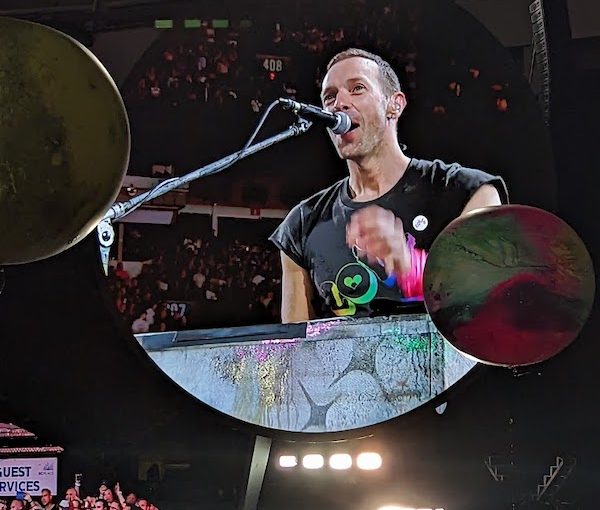
למעלה ממאה אלף איש צפו בשתי הופעות של הלהקה הבריטית המצליחה קולדפליי, שנערכו בסוף חודש ספטמבר
(צילומ של רוני רחמני)
למעלה ממאה אלף איש צפו בשתי הופעות של הלהקה הבריטית המצליחה קולדפליי, שנערכו בסוף חודש ספטמבר. ההופעות התקיימו באצטדיון בי.סי פלייס בדאון טאון ונקובר שהיה מלא לחלוטין
קולדפליי הוקמה על ידי הסולן כריס מרטין בלונדון לפני כעשרים ושש שנים. הלהקה זכתה לחשיפה גדולה עת הוציאה את הסינגל שלה צהוב. בשנות פעילותה הלהקה זכתה בעשרות פרסים, מכרה לא פחות ממאה מיליון תקליטים ומיליוני צופים הגיעו להופעות שלה בכל רחבי העולם. לפי סקר של מגזין המוזיקה האמריקאי הידוע הרולינג סטון קולדפליי נכנסה למקום הרביעי והמכובד של רשימת האמנים הטובים ביותר בעולם בתקופה של שנות האלפיים
כמו אמנים רבים אחרים בתחום הבידור גם קולדפליי נקלעה לסכסוך משפטי חריף. זאת לאחרונה עם מנהל הלהקה מאז הוקמה דייב הולמס. חוזה הניהול שלו הסתיים בסוף שנה שעברה והלהקה החליטה שלא לחדשו מסיבות לא ידועות בשלב זה. לאור כך הולמס תבע את הלהקה בבית המשפט העליון באנגליה. עתה תביעתו נמצא בטיפול משפטי בין הצדדים הניצים. הולמס טוען שהוא ניהל את קולדפליי בהצלחה מרובה כידוע במשך למעלה מעשרים ושתיים שנים. בכתב תביעתו נגדה הוא טוען שקולדפליי הפכה לאחת הלהקות הטובות ביותר בעולם. ההל לשעבר תובע את קולדפליי בסכום גבוה מאוד הנאמד בשניים עשר מיליון דולר. בכתב התביעה שלו נאמר עוד מדובר באחוזים שמגיעים לו כמנהל הלהקה לשעבר על אלבומים עתידיים שעדיין לא יצאו לאור. הכוונה לאלבומים העשירי והאחד עשר שטרם יצאו לאור על ידי קולדפליי. הולמס טוען שקולדפליי קיבלה כבר מקדמות בגובה שמונים ושניים מיליון דולר מחברת התקליטים ולו מגיעים כשניים עשר אחוזים מהסכום הגבוה זה
אנו חזינו בהופעה הראשונה של קולדפליי בבי.סי פלייס של ונקובר ומאוד מאוד נהנינו. ממש חוויה מוזיקלית מהמדרגה הראשונה. כרטיס מרטין שר את מרבית להיטי הלהקה בלויי שלושת חבריה הגיטריסט ג’ון באקלנד, הבסיסט גאי ברימן והמתופף ויל צ’מפיון
הסאונד היה מדהים, התאורה מעניינת ובלונים גדולים עפו להם בכל רחבי האצטדיון הענק. אלפי הצופים שרו בהנאה ובקול רב את השירים הידועים שהביאו את קולדפליי לפסגה העולמית של המוזיקה
הלהקה יצאה אשתקד לסיבוב עולמי שימשך כשנתיים וחצי ויכלול מדינות רבות. זאת כולל ארה”ב קנדה, ומדינות באירופה ואסיה. מחירי הכרטיסים הגבוהים לא מונעים את רכישתם המהירה ובדרך כלל כולם נמכרים להופעות של הלהקה הבריטית מראש. מדובר בסיבוב ההופעות השמיני של הלהקה והוא מכניס כסף רב לקופתה השמנה גם כך
קולדפליי שרה בסגנון רוק אלטרנטיבי ופוסט-בריטפופ. שנה לאחר הקמתה (באלף תשע מאות תשעים ושמונה) הלהקה החלה לקרוא לעצמה קולדפליי, ומאז היא לא מפסיקה להצליח. למרות ההצלחה ולזכותה, הלהקה מעורבת במספר גדול של פרויקטים חברתיים של אמנסטי ועוד. כרטיס מרטין עצמו תומך בגן בוסתן אברהם בעיר תל אביב שהוא גן ילדים יהודי-ערבי ומדוברות בו השפות עברית וערבית. לאור פרוייקט זה מרטין הגיע לביקורים פרטיים בישראל
קולדפליי עדיין לא הופיעה בישראל ולפיכך לפי הערכות כחמישים אלף ישראלים נוסעים מדי חודש לראות הופעות של הלהקה הבריטית בערים שונות באירופה. קולדפליי הופיעה בירדן הסמוכה לישראל. כריס מרטין מוכן שהלהקה תופיע גם בישראל בתנאי שההופעה תהיה משותפת לישראלים ופלסטינים
הסולן של הלהקה הודיע בעבר כי קולדפליי תפסיק להוציא תקליטים בעוד שנתיים ובסך הכל יצאו לאור עוד שלושה אלבומים בלבד. לדבריו הלהקה לא תתפרק אלה תמשיך לבצע הופעות חיות בלבד ברחבי העולם