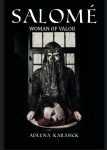
For the past five years, Jewish community member Adeena Karasick has been working with Grammy Award-winning composer/trumpeter Frank London on Salomé: Woman of Valor, a total art experience, groundbreaking in its interplay of poetry, music, dance and film.
Karasick’s libretto, which she will perform live, is a mix of historical, pop cultural, midrashic and kabbalistic references. The score blends Arabic, klezmer, jazz and Bhangra musics by the recently knighted (for his contribution to world music) London; performed with Indian percussionist virtuoso Deep Singh and Middle Eastern keyboard player Shai Bachar; dance created and performed by two dancers on the New York scene, (fellow Jewish community member) Rebecca Margolick and Jesse Zaritt; video by Elizabeth Mak, which deconstructs Charles Bryant’s 1923 silent film Salomé; and directed by Alex Aron, co-creator of A Night in the Old Marketplace.
After years of research, learning there was no basis for the way Salomé has been historically represented, Karasick wanted to re-insert Salomé back into her rightful place in history as a powerful revolutionary. She refutes Oscar Wilde’s misogynist and antisemitic interpretation, and has translated the myth to (no surprise!) one of female empowerment, socio-political, erotic and esthetic transgression.
Creating a work of this scope is an enormous undertaking, and the creative team has launched a Kickstarter campaign to raise money for the production’s world première at Vancouver’s Chutzpah! Festival, and then to take Salomé: Woman of Valor on tour internationally. The total project budget is more than $40,000 and the team needs to raise at least $20,000 to make its vision a reality. Each $180 gets the creative team an additional hour of time in the studio.
There has been nothing quite like this – poetry as a spoken word opera of exceptional scale and scope. Salomé: Woman of Valor offers new ways of seeing, reminding us how there is never one story or perspective to be told and allowing the unvoiced be celebrated and heard.
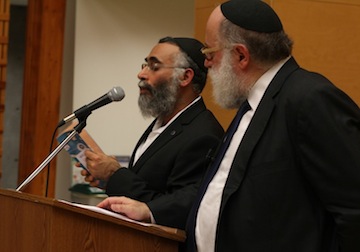
Rabbi Simon Jacobson gives a lecture during a recent Kollel Shabbaton. (photo from Kollel)
In an effort to direct Vancouver’s Jewish consciousness from an “I” culture to a “we” culture, Ohel Ya’akov Community Kollel has launched WeLearn, expanding the Kollel’s centre of learning and celebration.
“We want to spark lifelong learning within the community,” said Rabbi Shmulik Yeshayahu, director of Kollel. “We’ve become a society that over-values individuality and separateness, to the detriment of our personal growth.
“We encourage people to move away from isolation, and experience the richness of community learning,” he added.
Rabbi Simon Jacobson, right, with Rabbi Shmulik Yeshayahu. (photo from Kollel)
WeLearn recently kicked off with a Shabbaton Nov. 30-Dec. 2, attended by more than 400 Jews from across the Lower Mainland. The Shabbaton featured Rabbi Simon Jacobson, author of Toward a Meaningful Life and founder of the Meaningful Life Centre; Shimona Tzukernik, “the Kabbalah Coach”; and Audi Gozlan, the founder of Kabalah Yoga.
The Shabbaton started off with Tzukernik, one of the foremost female authorities on kabbalah as it applies to daily life. Her talk – Joy is an Inside Job – highlighted the importance of developing internal joy, which results in achieving personal understanding and humility. Her claim that “pain is inevitable, but suffering is a choice,” appeared to resonate with the audience. She also shared inspiring personal stories, and emphasized that beauty and joy exist from the inside out.
Jacobson engaged the audience next, with a lecture called Is your Self-Worth Defined by Your Net-Worth? He focused on the intrinsic value of tzedakah, and the family legacy of giving that was started by Abraham, the father of the Jewish people. Jacobson remarked how Abraham educated his own children in the path of justice and charity, and left this legacy for all Jews to follow.
The rabbi followed this with a story about Moses Montefiore, a wealthy, philanthropic 19th-century Jew. When questioned by Queen Victoria about the exact amount of his personal wealth, Montefiore is said to have replied that his real worth was what he gave away to others, because its benefit would live on. In short, Jacobson’s message was that our self-worth is defined by what we give, not what we have.
Gozlan, who founded Kabalah Yoga (also called Aleph Bet Yoga), spoke about the daily struggles between the body and soul, and the need to tap into our internal joy. Gozlan explained how yoga and conscious breathing can connect us to ancient Chabad Chassidic philosophy. He went on to describe how we can elevate our body and soul to become a holy spark and a source of light.
“At Kollel, we celebrate education, community and Jewish continuity, and this Shabbaton was a perfect example of this,” said Yeshayahu. “Hundreds of Jews joined us over the course of four days, in friendship and openness to learn and be inspired. It was a truly unforgettable weekend.”
The Kollel distributed brochures outlining their upcoming classes for the winter and spring. Among the classes being offered are sessions on medical ethics, business ethics, prayer, the weekly parashah, kabbalah, Tanya, Genesis and creation, and more. In addition to Yeshayahu, Rabbi Avraham Feigelstock, Shifra Feigelstock, Dan Friedmann, Karen Levitt, Rivki Yeshayahu, Asaf Cohen and other guest lecturers will provide a variety of perspectives and teaching styles to enhance the Kollel’s education centre.
Josh Epstein raises a glass to toast lyubov (love) in recognition of the theme of the hit play Onegin, in which he plays a jealous lover. In a rare opportunity, theatre-goers are actually encouraged to bring their drinks with them into the auditorium in order to join the cast when they toast. Onegin, which is a musical with comedic overtones, has been brought back to the Arts Club after a successful showing in 2016 and runs until Dec. 31 at the Granville Island stage. For tickets and more information, visit artsclub.com.
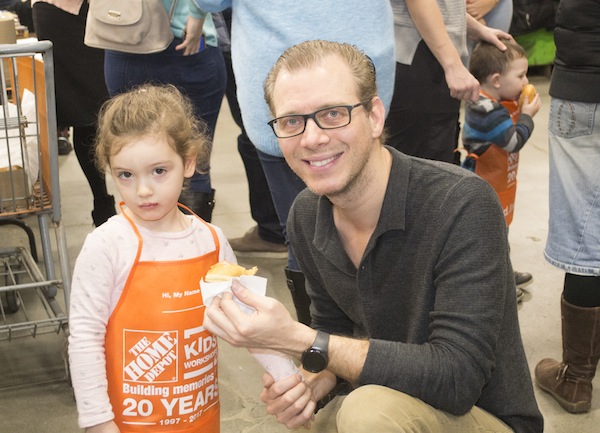
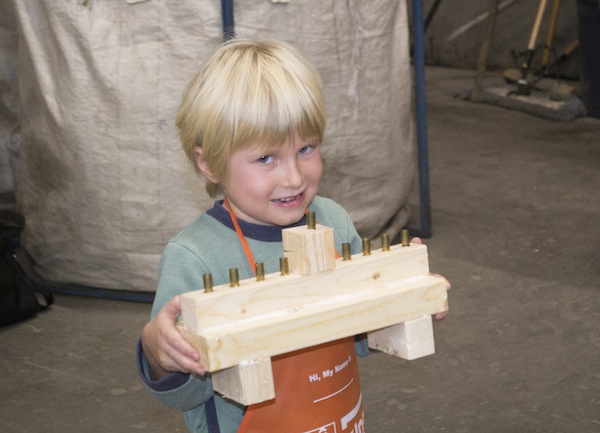
Approximately 300 people showed up to a menorah-making event at the Home Depot in Richmond on Sunday, Dec. 3. Families could come and make menorot out of wood, glue and nails supplied by Home Depot. Chabad of Richmond also supplied bullet shell casings to hold the candles on the menorah, symbolic of turning weapons of war into a source of light and life.
Mayaan and her dad Amir. (photo by Sarah Aginsky)Liam with his menorah. (photo by Sarah Aginsky)Levi and Rabbi Nuta Yisrael Shurack. (photo by Sarah Aginsky)
Camp allows youth to learn meet new people. (photo from campmiriam.org)
There is something special about camps. Transporting kids out of their customary environments into something that is at least somewhat foreign is a great stimulus to change. New people and new situations over a few-week period force more rapid adaptations than would normally be required. Camp offers an environment for kids and youth to have fun and learn new skills, but also to consider who they are as individuals, without the close observation of their parents.
Some kids bloom in surprising ways at camp. They get a chance to use and develop aspects about themselves that they either never realized were there, or haven’t had a chance to exercise. For better or worse, the regime of mom and/or dad is challenged. Different rules apply, and often they are enforced with a consistency not found at home. There is no one immediately there to intervene in one’s interaction with bunkmates, for example. Kids have to work issues out between themselves as they temporarily share their world.
This is what it is like in the real world, and we learn lessons at camp that we might not learn if we just stayed home. And we get to measure ourselves against others. We get pushed to compete, to strive, to be better, because everyone else is doing that. This allows us the chance to grow in self-confidence. It’s not just family encouraging us, it’s the approval (or disapproval) we gain from those around us – strangers who can become our friends.
Camp allows youth to learn new skills. (photo from camphatikvah.com)
Camp offers so many things: the chance to escape the city, to learn to swim and do other sporting activities, to be creative with arts and crafts, and to be self-sufficient in less inhabited areas. The list goes on. What about the songs and dances that we join in with others, which make us feel good, and a part of something larger than ourselves? What about the friends we make, some of whom will be there for us throughout our life? What about the chance to develop and exercise leadership and initiative?
The most delicious thing about this recipe for growing kids into grown-ups is that it’s all about fun. This isn’t about “a little bit of sugar to help the medicine go down.” It’s sugar pops all the way. And a side benefit accrues to parents, who get a little respite when they ship their kids off to camp.
Being a part of the camping experience opens up a universe of possibilities for those who are fortunate enough to have a chance at entry into that world.
Max Roytenbergis a Vancouver-based poet, writer and blogger. His book Hero in My Own Eyes: Tripping a Life Fantastic is available from Amazon and other online booksellers.
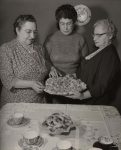
Na’amat Women’s tea, 1955. (photo from JWB fonds, JMABC L.12592)
If you know someone in this photo, please help the JI fill the gaps of its predecessor’s (the Jewish Western Bulletin’s) collection at the Jewish Museum and Archives of B.C. by contacting archives@jewishmuseum.ca or 604-257-5199. To find out who has been identified in the photos, visit jewishmuseum.ca/blog.
קשה להאמין שאדית ומייקל סימס בעלי הקפה המיתולגי צ’יזקייק הלכו לעולמם. (צילום: רוני רחמני)
בתאריך ה-17פברואר 2005 עזבתי את תל אביב ועברתי לגור בוונקובר. לפני שעזבתי מסר לי אבי טלפון של זוג מבוגרים מוונקובר שהוא ואימי הכירו באמצעות חברים. הוא אמר לי שקוראים להם אדית ומייקל סימס, שיש להם קפה שנקרא צ’יזקייק אצטרה. וכן שמייקל מנגן בקפה בפסנתר והוא ואדית שרים יחדיו. נשמע לי מוזר.
ממש בימים הראשונים לשהותי בעיר כשעוד שכרתי חדר במלון ליד אינגליש ביי בשכונת הווסט אנד השקטה, ולא היה לי הרבה מה לעשות, החלטתי לבקר את הזוג סימס. הרמתי טלפון והצגתי את עצמי וקבענו להיפגש בקפה שלהם. הם היו בעצם האנשים הראשונים שפגשתי בוונקובר, בנוסף לחבר אחד שעוד הכרתי מישראל (קובי אשכנזי).
אני זוכר היטב את ההליכה בלילה הקר והרטוב מהמלון אל הקפה של אדית ומייקל. אז עוד לא הייתי מורגל בהליכות ארוכות והדרך נראתה לי ארוכה ולא נגמרת. כשהגעתי לקפה הופתעתי לדעת שאכן קוראים לו צ’יזקייק אצטרה. ואכן מייקל ישב על יד הפסנתר מנגן ושר, ובחלק מהשירים אדית הצטרפה אליו בשירה. כל מה שאבי אמר היה נכון.
מייד נוצר קשר חם ביננו והוא נשמר לאורך כמעט שלוש עשרה שנים ברציפות. רק מותם הפתאומי של אדית ומייקל שהחליטו ללכת יחדיו מעולמנו לעולמם של המתים (אדית בת 77 ומייקל בן 79), ביום שני ה-27 בנובמבר, קטע אותו. בחיים כמו במותם השניים תמיד היו ביחד. אני זוכר כי תמיד כשראיתי אחד, ידעתי שכעבור דקות בודדות גם השני יופיע. הם גרו ביחד, עבדו ביחד, טיילו ביחד, נפשו ביחד, נפגשו עם חברים ביחד, שהו עם המשפחה ביחד, הופיעו כמעט לכל אירוע ביחד, החזיקו במחשב אחד, באימייל אחד ובמכשיר סלולר אחד.
הידיעה על מותם של אדית ומייקל הדהים אותי. ישבתי בביתי צפון בתוך עצמי והרגשתי ממש בהלם. עצור, עצוב ומרגיש כאחד שהתייתם מזוג כל כך נעים הליכות, צנוע ושמח. מי יכול להגיד משהו רע עליהם? לא ימצא אחד כזה. פשוט לא. ולראייה עשרות הגיבו באינטרנט לאור פרסום הידיעה על מותם של אדית ומייקל. כולם כאחד אמרו רק דברים טובים והביעו צער עמוק על הפרידה הקשה מהזוג.
צ’יזקייק הזכיר לי בית קפה בצרפת בשל האווירה הרומנטית, האורות הנמוכים, התמונות בשחור לבן מסביב, הקירות הצבועים באדום והנעימות ששררה במקום. זאת ממש כמו עידית ומייקל שהצליחו להעביר למקום אווירה מיוחדת, משהו מעצמם, אולי בעצם הרבה מעצמם. מייקל כל פעם שהגעתי לצ’יזקייק ניגן נפלא ואהבתי בעיקר את הקטעים כשהוא מאלתר ג’אז, בסגנון ניו יורקי. ואילו אדית הייתה בעלת קול זהב ועדין שהזכיר לי מאוד את קולה של הזמרת הצרפתית אדית פיאף.
השניים היו יהודים: אדית ילידת סקוטלנד שגדלה בטורונטו ואילו מייקל היה אמריקני יליד בוסטון. הם הכירו דווקא בישראל בשנת 1961 (עת הייתי בן שנתיים). מייקל שימש באותה עת נגן קלידים של הזמר שמעון ישראלי, בתוכניתו המיתולוגית ‘סתם יום של חול’. אדית ומייקל שמבט ראשון התאהבו אחד בשני, החליטו שלא להישאר בישראל ועברו לבוסטון. לאחר שנה (1962) התחתנו. אחרי שנולד בנם יחידם דן, הוצאות המחייה האמירו ובעיקר הטפולים הרפואיים בילד היו יקרים מאוד, בזמן שלזוג סימס לא היה כלל כסף. לכן הם החליטו לחצות את הגבול לקנדה ולעבור לוונקובר. הם התאהבו מייד בעיר היפה הזו שהפכה לביתם במשך כארבעים השנים האחרונות.
Cutting the ribbon at the official opening of Storeys on Dec. 1. (photo from Shelley Karrel)
“Those involved in Storeys feel like a family,” said Brenda Plant, executive director of Turning Point Housing Society, speaking at the opening gala of the rental housing development in Richmond on Dec. 1. “We’ve been working on this together for eight years now.”
Storeys, on Granville Avenue, provides 129 units of affordable rentals, which have on-site supportive services. The project is managed by five nonprofits. The Jewish community’s Tikva Housing Society has three floors of housing for low-income families: 18 units in total with rents at 30% of a household’s income – known as the Diamond Residences at Storeys. The other organizations involved are Coast Mental Health, providing units for low-income clients who need mental health supports; SUCCESS, which provides units for low-income seniors; Pathways Clubhouse Society of Richmond, which provides supportive environments for individuals working towards mental wellness; and Turning Point Housing Society, which provides units for individuals in recovery from addiction.
Richmond Mayor Malcolm Brodie spoke of the importance of the new building, pointing out that the City of Richmond contributed $19.4 million to the project, or one-third of the construction funding. “Some of you here may remember this site as a former KFC and a small office building,” he noted. “Eight years later, here we stand.”
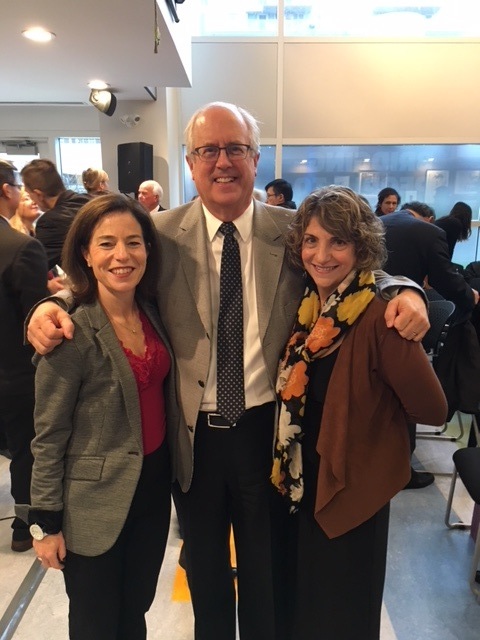
Left to right, MLA Selina Robinson, Richmond Mayor Malcolm Brodie and Shelley Karrel. (photo by Matthew Gindin)
“The housing units provided in this unique project will make such a difference in the lives of those who benefit from them,” said Selina Robinson, B.C. minister of municipal affairs and housing, during her address. To the nonprofits who made it happen, she said, “You guys rock.”
The event also featured remarks by MP Joe Peschisolido (Steveston-Richmond East); Kathleen Kennedy-Strath, chair of the board of Coast Mental Health; Jessica Berglund, president of the board of Pathways Clubhouse; Queenie Choo, chief executive officer of SUCCESS; Gord Argue, board chair of Turning Point Housing; and Shelley Karrel, co-chair of Tikva Housing.
The provincial and federal governments contributed just over $5 million and donors almost $2 million. BC Housing was key in assisting with providing the construction loan and will help organizations in securing their long-term mortgages at favourable rates.
Tikva’s involvement in Storeys was initiated under the leadership of Susana Cogan, who passed away before it was completed, and Linda Thomas, executive director of Tikva Housing, attended the opening with the society’s administrator, Anat Gogo, who led the Independent and others on a tour of the building. The suites are modern and well-designed, many with great views.
Tikva is supported by the Jewish Federation of Greater Vancouver and worked with Jewish Family Services to place the tenants. The Diamond Foundation gave Tikva the equity to be able to be at the table with the other Storeys project partners. Tikva’s 18 units are now home to families and individuals, from children through seniors.
“What has happened is that we have created a real community within a community,” explained Tikva Housing’s Karrel of the Diamond Residences at Storeys. “At one point, when the elevator wasn’t working because of a power outage, one of the tenants offered to go check on everyone to make sure they were OK. We hope to have communal Shabbat dinners and holiday events for the tenants,” she told the Independent.
Storeys is located near Garden City Bakery, Brighouse Park, Richmond Public Library, and many other resources. The Bayit’s Rabbi Levi Varnai recently visited to put mezuzot on the doors of the Jewish homes.
“In order to honour everyone’s commitment, I have a little present,” said Turning Point’s Plant midway through her presentation. She then handed out Staples’ “that was easy” buttons – “because I want you all to know that we’re going to do this again.”
Matthew Gindin is a freelance journalist, writer and lecturer. He writes regularly for the Forward and All That Is Interesting, and has been published in Religion Dispatches, Situate Magazine, Tikkun and elsewhere. He can be found on Medium and Twitter.
Learn more about the treasure that is the B.C. Jewish community newspaper … in just 3 minutes, 36 seconds. Click here to enjoy The Jewish Independent: 88 Years … and Counting!, a video by Heirloom Films.
Please help us keep the conversation going. Please support the JI.
When we decided to have a celebration marking 18 years since the beginning of the latest chapter of the Jewish Independent’s nearly-nine-decade history, it made perfect sense to focus on the future as much as the past.
The centrepoint of the JI Chai Celebration is the JI’s 18 Under 36 Awards. The day’s headlines might be cause for dejection, but anyone who works with, or spends any time with, members of this community’s younger generations knows that the future is bright.
This truly is reason to celebrate.
I am amazed to think I’ve owned the newspaper for longer than some of our awardees have been alive. I don’t feel that old. On the other hand, it does seem like another lifetime when Kyle Berger, Pat Johnson and I bought the Independent’s predecessor, the Jewish Western Bulletin, from publishers Sam and Mona Kaplan. Kyle was 24, Pat was 34 and I was 29 – we all would have qualified for the JI’s 18 Under 36 Awards, and I’d like to think we might have offered some tough competition.
I would say to younger audiences, as both a promise and a warning: beware of how way leads on to way. Sometimes wonderful things happen and the mission of your life presents itself without you even realizing what’s happening.
My roots are not here. My immediate family has lived in Ontario for a long time now. And, when I came here about 25 years ago from Ottawa, I intended to spend a year in British Columbia, get my master’s in economics at Simon Fraser University, then return east and do a PhD in economics at University of Toronto.
But, I got a job in Vancouver as I was finishing my MA, and worked as an economist until, one day, I took a phone call from the then-publisher of the Jewish Western Bulletin. I’d never heard of him … or it. My involvement with the Vancouver Jewish community was through music – with the Vancouver Jewish Folk Choir, with whom I still sing today, and Beth Israel Choir. The paper was looking for someone to fill in writing editorials and I was looking for a change, so I agreed to take the job – for the summer.
As I mentioned, one thing leads to another, and the Kaplans, who had published and edited the JWB since 1960, wanted to retire. Pat and Kyle, my then-newfound friends and colleagues, suggested we put in a bid to buy the paper. I didn’t think the Kaplans would sell it to such a green team, as there were some other serious bidders with far more experience in business.
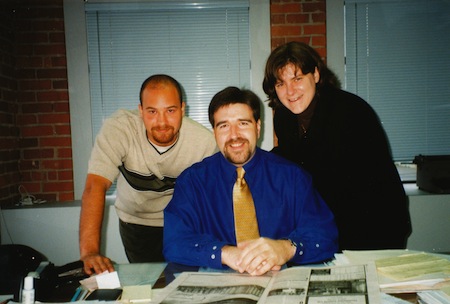
Kyle Berger, left, Pat Johnson and Cynthia Ramsay, in 1999. (photo by Baila Lazarus)
But the Kaplans saw something in the three of us that I certainly did not. They were Orthodox Jews, Zionists who brokered no criticism of Israel, and believed in advocacy journalism. We were secular, Zionists of a rather more open-minded variety, firm advocates of free speech and believed that journalism should be as objective as possible. Despite our obvious differences, I think the Kaplans recognized in us something of the inevitable future.
While Kyle and Pat have moved on to other endeavours, they thankfully remain involved in the paper and are there to help and offer advice, with Pat still doing much writing, as well as serving on the editorial board.
Looking back at the past 18 years, I can say that, while we’ve had challenges, we’ve overcome them and we’ve had many more successes. And this is one of the major reasons for the JI Chai Celebration. We want to celebrate the fact that, with the community’s help and the hard work and dedication of so many over the decades, the Jewish Independent, this community’s newspaper, is a vibrant and evolving enterprise.
Still … it is no secret that the newspaper industry is a tough one these days, to put it mildly. We must find a way to keep the Independent a sustainable and quality publication – not just for the coming months, but for the coming generations. The funds raised through the JI Chai Celebration will go, in part, toward a study of North American Jewish community newspapers and other examples of community journalism, which might direct us to best practices and models for the future of the JI.
The incredibly generous financial support of Joseph and Rosalie Segal and family, and the support of Mary-Louise Albert of the Rothstein Theatre and Chutzpah! Festival, laid the foundation for this celebration. The contributions of Gary Averbach, Shirley Barnett, David Bogoch, LKP Holdings (Tzipi Mann and family), JB Newall Memorials, Olive+Wild, Red Truck Beer, Vancouver Learning Centre, Web exPress, Yosef Wosk and so many others made it all possible. Led by talented event manager Bonnie Nish, all of this came together in three months.
Everyone performing here today is donating their time, as is the bartender and the volunteers you’ve seen on tickets, at the auction tables, ushering, all about. And about that auction table – thank you so much to all the donors to the auction and those who contributed the prizes for tonight, including the gift packages for the 18 awardees.
In addition to funding a study that can set the course of the paper’s future, revenue from this event will help stabilize the Independent and let us continue the important role we play as a mirror to and a voice of this community.
To ensure that independent Jewish journalism survives and thrives in this city and province, though, it ultimately depends on you. I ask you to support this newspaper by reading, sharing, subscribing, advertising or donating.
If you still wonder why and for whom we need to continue building this community and strengthening the media that shares its stories, look only to the 18 individuals being honoured tonight and to the future that they represent.