There were fears that, if Donald Trump lost the election last week, his supporters would riot. Fewer people thought the opposite would happen – either that Trump would win or that those who opposed him would riot.
Nightly protest marches after the election were largely peaceful, but some were not, notably in Portland, Ore. It would be informative to learn if any participants in these street rallies were among the 45% of Americans of voting age who didn’t bother to cast a ballot. It would be galling in the extreme to find that people who couldn’t take a few minutes to vote on Nov. 8 were spending hours on the following days marching against the results of an election in which they didn’t think it necessary to vote.
But something more predictable has happened as well. Given the tenor of Trump’s campaign, and the glee with which his victory was met by such groups as the Ku Klux Klan, other white supremacists and those who go by the neologism alt-right, the Republican victory seems to have unleashed among some Americans a spurt of acting out. There have been countless recorded incidents of antisemitic, anti-black, anti-Muslim and anti-gay slurs, graffiti and even physical attacks. It was predictable that Trump’s hateful rhetoric would have an impact regardless of the election’s outcome, but the validation he received from more than 50 million Americans appears to have legitimized, or at the very least, inspired, some people to act out in antisocial, racist and violent ways.
In response, online articles, videos and infographics have been created demonstrating how to intervene and de-escalate a point of conflict. Also, a movement has emerged in which individuals demonstrate solidarity with individuals and groups who feel threatened.
A safety pin. A simple safety pin affixed to a garment is a new signal for people who may feel threatened in a situation – on a subway, in a classroom, at the mall, anywhere – that the person wearing a safety pin is a person who can be relied on for support.
It’s a small thing, but it isn’t. For an individual feeling threatened because they are identified as a target because of their ethnicity, religion or sexual orientation, a tiny signal of solidarity, support and refuge could be a lifeline.
We are in Canada, of course, not in the United States. But we would be naïve to think that what happens there doesn’t impact the social fabric here. There is racism, antisemitism, anti-Muslim bias, homophobia and other forms of bigotry under and at the surface here. The idea that we could provide a place of safety for individuals feeling threatened – or indeed that we could find ourselves looking for such a place – is as realistic for Canadians as it is for Americans.
Now that Remembrance Day has passed, we will remove our poppies, the symbol of respect for those who fought and died in the past for democratic and civil rights. Some of us, if we feel inclined, will replace it with a safety pin, evidence that we are committed to upholding these values today and in the future in whatever small but meaningful way we can.
A trove of letters between Jewish children and their parents separated by the Second World War and the Holocaust gives insight into the way families communicate in times of crisis.
Debórah Dwork, Rose Professor of Holocaust History and director of the Strassler Centre for Holocaust and Genocide Studies at Clark University in Massachusetts, has been studying the letters. On Nov. 1, she delivered the Kristallnacht Commemorative Lecture, an annual event presented by the Vancouver Holocaust Education Centre in partnership with Congregation Beth Israel.
During the Second World War, postal service between belligerent or occupied countries ceased, but an individual in neutral Switzerland could convey messages between people in countries on either side of the conflict. Largely by happenstance, Elisabeth Luz, a Swiss woman living outside Zurich, helped many Jewish families maintain contact. After Luz, an unmarried woman who became known to many as “Tante Elisabeth,” had forwarded messages for a few families, word of mouth led to unsolicited requests from children who had been sent to presumed safety in France, Belgium, the Netherlands and Britain.
“News about the aunt who forwarded letters spread quickly and Tante Elisabeth gained many nieces and nephews,” said Dwork. “She soon became their counselor and confidant, although nearly none ever met her.”
“Please pardon us that we write you without having permission to do so,” wrote Robert Hess and his brother. “Adolf is 12 years old and I am 14 years. We live in an OSE [Jewish philanthropic organization] home and have been selected for immigration to America. We write to you because we would like to write to our mother and have no other possibility. Please write our mother that she can write us via you. We must ask our mother permission to travel to America.… Can you also send us a photo of her?” The boys provided their address, their mother’s address in Vienna and a photograph of themselves.
“She did not disappoint,” Dwork said of Luz, “and they were included in that transport to America.”
Although she was poor, Luz sent writing paper, envelopes, international reply coupons and reply-paid postcards to the children and parents. She transcribed each letter, believing this would reduce the likelihood of attracting the attention of wartime postal censors, and kept the original. After Luz passed away in 1971, the original letters were discovered by her nephew, who passed them along several years later to Dwork, who has written about children’s experiences in the Holocaust.
At the Kristallnacht commemoration, Dwork shared stories and correspondence of several families, including Wilhelm and Adele Halberstam. In 1939, their daughter Kathe and son-in-law Heinrich Hepner obtained visas for themselves and their three children and eventually made their way to Chile.
“Wilhelm and Adele decided not to emigrate,” Dwork said. “They stayed in Amsterdam with their son Albert. Thus began the parents’ long-distance relationship with their daughter and grandchildren, which depended upon letters.… They sought to weave a web of letters, to hold each other tightly and to assure each other that, notwithstanding the pressures of their radically changed circumstances, their relationships endured.”
Adele Halberstam wrote to her daughter: “I really live from letter to letter.”
As the occupation continued, the parents grew increasingly silent about developments at home, mentioning nothing of the expanding repression they were experiencing, including the imposition of the requirement to wear the yellow star.
“Out of consideration for you, I will not allow my pen to overflow with what fills my heart,” the mother wrote her daughter. “Why should you become as sad as I am?”
Regular mail service between Europe and Chile took longer and longer, then eventually ceased. The family came to rely on the Red Cross, which conveyed messages of 25 words or less. This limited means of communication continued after the Halberstams were deported from Amsterdam to the Dutch transit camp of Westerbork.
“The pattern of Adele’s messages remained consistent,” said Dwork. “Little discussion of the hardship, humiliation or fear and always an emphasis on family ties, love and longing.”
Eventually, some truths could not be withheld. An abrupt Red Cross message told the Hepners of Wilhelm Halberstam’s death by heart attack. Adele and Albert were deported to Auschwitz on Nov. 16, 1943. Adele was murdered on arrival. Albert survived until March 1944.
In another case, a son shared with Luz his fears for his parents’ survival, but did not convey that fear in the letter to his parents. In reply, the mother, writing from the Warsaw ghetto, wrote only of her yearning for her children and not of the horrors she was experiencing.
“Her last letter, written in November 1942, said not a word about the mass deportations to Treblinka that the Germans had just unleashed on the ghetto,” said Dwork.
Luz also helped Hanna Ruth Klopstock, another of the children in the care of OSE, correspond with her mother Frieda and brother Werner in Germany. When the girl had not heard from them in some time, she wrote to Luz expressing her fears.
“Every day I tell myself, today I must certainly get a letter from Mutti. And still nothing. I do not know what to think about this silence,” she wrote. “Maybe the letters have been lost. I hope so.”
The girl’s fears were well-founded, said Dwork. By the end of 1942, Werner had been sent to a forced labor camp in Germany, detailed to heavy agricultural work. The mother wrote to Luz: “I foresee nothing good and must hold myself together.” In the letter, Frieda Klopstock thanks Luz for everything she had done and makes a final request that Luz help and console Hanna Ruth when the inevitable occurs.
“Frieda was deported to Auschwitz six weeks later,” said Dwork. Luz and Hanna Ruth learned this news in a letter from Werner, who himself would follow his mother to the death camp a month later. Luz assumed the worst when a letter to Werner in the labor camp was returned with the address crossed out and the words “Zuruck” and “retour, parti” – return to sender, addressee departed – written on the envelope.
In a shocking twist though, Dwork added: “Remarkably, this is not the last sign of life from Werner.”
A postcard from Werner came some time later.
“Written in block letters,” Dwork said, “his message ran, ‘Dear Tante Elisabeth and dear Hanna Ruth, I inform you today that I am healthy and remain here for the future. Sadly, I have no news from you but I hope you are well. For today, very hearty greetings from Werner.’”
The message was just six lines, Dwork noted, not the full 10 permitted.
“What we know now is that the Nazis, too, recognized the importance of letters,” she said.
In his Nuremberg testimony, a Nazi official described the letter program of the Reich Security Main Office. Jews brought to extermination camps were forced, prior to being murdered, to write postcards that were then mailed at long intervals, in order to make it appear as though these senders were still alive. “And thus,” said Dwork, “letters that seemed a sign of life served as markers of death.”
Dwork’s remarks were preceded by a candlelight procession of survivors of the Holocaust. Cantor Yaacov Orzech chanted El Maleh Rachamim, a memorial prayer for the martyrs. Heather Deal, deputy mayor of Vancouver, read a proclamation from the city. Nina Krieger, executive director of the Vancouver Holocaust Education Centre, introduced Deal and the keynote speaker. Beth Israel’s Rabbi Jonathan Infeld thanked Dwork and reflected on his own grandparents’ history of relying on letters from Europe to learn the fate of family left behind.
In his opening remarks to the program, Prof. Chris Friedrichs compared the situation of refugees today, who are fortunate, in many cases, to have access to technology that allows instant communication with loved ones left behind, while also acknowledging parallels across time.
“Nothing we say or do can bring back to life the six million Jews who perished, along with so many millions of others, during the darkest six years of the 20th century,” Friedrichs said. “But now, in the 21st century, the world is still full of desperate human beings longing for rescue or hope. There are things we can do to help bring families together, or to help build bridges of contact and connection. What we learn from the past must ever be our guide for the present and the future.”
Pat Johnsonis a communications and development consultant for the Vancouver Holocaust Education Centre.
Gyda Chud of Jewish Seniors Alliance with forum speaker Dan Levitt of Tabor Village. (photo by Binny Goldman)
On Sunday, Nov. 6, 175 people gathered at the Peretz Centre for Secular Jewish Culture for the Jewish Seniors Alliance of Greater Vancouver’s fall symposium, featuring Dan Levitt and his unique approach to residential living.
Ken Levitt, president of JSA, spoke briefly about the seniors organization, after which Gyda Chud, co-convener, greeted the crowd and introduced the Three Amigos, Yom Shamash, Ian St. Martin and Steve Glass, a musical trio who urged attendees to join in as they sang and played songs which included “Bei Mir Bistu Sheyn” – and Chud thanked the musicians with “bei undz bistu sheyn,” “in our eyes you are nice.”
Shanie Levin introduced Levitt.
“In continuing the theme of our Empowerment Series, ‘Thriving until 120,’ we have invited Dan Levitt, executive director of Tabor Village, an elder-care facility affiliated with Fraser Health Authority,” she said. “Levitt is also an adjunct professor in the gerontology department at Simon Fraser University, whose insights and leadership on seniors’ care are sought after in Canada, the U.S., Europe and Asia.”
Levitt challenges societal attitudes towards aging by introducing new approaches to residential living. The goal of his talk – Rethinking Aging: Not the Traditional Nursing Home Grandma Lives In – was to start a conversation that reframes elderhood as an exciting stage in human growth and development.
Levitt would like people to discard the stereotypes of aging that have been emphasized by the media. He wants people to remove the word “still” when praising someone who looks good at 75, to refrain from showing surprise at the ability of someone to work at 80, and for people to maintain high expectations as they age.
He cited an experiment in which each of the residents on the first floor of a seniors residence were given an African violet to water, while second-floor residents were told of a doll that was left in the care of the staff and that, together, they had to make sure it didn’t get lost. On follow up, it was discovered that those who were given the individual responsibility to care for the plants thrived, requiring less medication, and their moods were uplifted, whereas those with the collective responsibility did not fare as well.
Levitt said the idea of individual responsibility has been introduced at Tabor Village and the residents are flourishing, as they expect more of themselves and feel increased self-worth. Levitt mentioned one occasion, where a resident remembered her recipe for pancakes and proceeded to make pancakes from scratch for 20 diners. She then approached Levitt, saying: “You didn’t think I could do it, right?” He had to agree, as he looked around the spotless kitchen. She had not only cooked and served the food, she had cleaned up afterwards.
Statistics show that an average of nine medications are given to seniors in British Columbia. Some of these are chemical restraints – anti-psychotic medications – just to alter behavior and make the residents easier for staff to deal with.
One alternative method that has proven effective is music therapy, said Levitt. This therapy enables non-verbal residents to sing their thoughts when speech has failed.
Alive Inside is an experiment by Dan Cohen, which introduced iPods into a seniors home. Listening to the music, each with their own earphones, non-verbal residents experienced an unprecedented improvement. They readily responded to familiar music, singing along. Some were even able to hold a conversation afterward, saying the music gave them hope and happiness inside. Subsequently, a program called Music and Memory was instituted.
In addition, many residences have introduced computer classes, which benefit many residents.
Breaking old policies is indeed difficult but must be strived for, said Levitt. There are many books, videos and films on the subject of dementia and the stigma that is often associated with it. Still Alice and Glen Campbell: I’ll Be Me are two examples.
Levitt listed off some “super seniors”: one who had climbed Mount Kilimanjaro at age 90; another who golfed and had come close to beating the pros at age 90; and Olga Kotelko, who ran races, breaking records and winning medals into her 90s (she died in 2014).
There are many experimental and successful programs being carried out, said Levitt. One is Hogeweyk in Amsterdam, a village built and devoted to seniors with dementia. A small Ontario town, Penetanguishene, has recreated a village similar to Hogeweyk and relatives of the residents are reportedly pleased with how happy those living in this community are; residents are able to shop and walk to the market, for instance. In Florida, Miami Jewish Health Systems is seeking to create a similar program – Green House Project focuses on helping companies and individuals convert or build residential homes where every room would have a shower. These residences, which exist in several states in the United States, can provide a high level of care for those who do not wish to be in a nursing home.
Levitt ended his talk with a quote from Margaret Mead: “Never doubt that a small group of thoughtful, committed citizens can change the world. It is the only thing that ever has.”
Chud thanked Levitt for teaching the audience to think differently, and noted that the success of the event was made possible by the dedicated help of JSA’s office staff. A video taken by Karon and Stan Shear can be found at jsalliance.org.
Binny Goldmanis a member of the Jewish Seniors Alliance of Greater Vancouver board.
For the last three years, I have been researching, interviewing and writing articles for Senior Line, the magazine published three times a year by Jewish Seniors Alliance of Greater Vancouver. In that capacity, I read everything I can about dementia, especially Alzheimer’s disease, medical care for seniors and residential facilities for seniors.
A year ago, I succumbed and started paying for a digital subscription to the New York Times. Using their “alerts” system, my inbox is filled with relevant, current articles on these topics. I scour the media (Vancouver Sun, Zoomer Magazine, Jewish Independent, CBC News Network, CNN, documentary channels, movies portraying Alzheimer’s disease, and online newsletters from organizations such as CARP and COSCO) searching out information about these senior issues. I also began visiting the Louis Brier Home and Hospital regularly, interacting with people with dementia (with the assistance of Davka, my Standard Poodle).
Why was I obsessed with Alzheimer’s disease? The truth is that I was swimming in a turbulent sea of fear, dread and panic – analyzing every forgetful moment and constantly measuring my intellectual capacities, to be sure that I wasn’t “losing it.” This had been going on for the past five years.
My feelings and thought processes began to evolve as I gained knowledge and understanding of the causes, the progression of this condition and, of utmost importance, the changes in attitude towards the management of seniors residences and the programs offered to seniors with dementia. Most surprisingly, among the gloom and doom scenarios of “the grey tsunami” and “the stark demographic shift,” I began to understand that there is actually good news about dementia and Alzheimer’s disease. Yes, you heard me: good news!
Today, reaching the age of 100 is no longer shocking. I personally know three people who have reached that age. Seniors of my generation, and the Boomers and Zoomers, are living longer. Within this large cohort, dementia is a product of the natural aging process. The longer we live, the higher the probability of dementia. Is there anyone among you who wants to die at 65 or 71 (the risk of Alzheimer’s begins to increase dramatically at the age of 65)? Wouldn’t you rather live to 86 or 94? Of course! Well then, your chances of having dementia will increase.
At 77, I am more active and more productive than I have ever been. I know that, at any time, I may begin to deteriorate. The influence of genes is crucial: one grandmother had dementia, the other did not. My aunt has Alzheimer’s and, recently, a close relative was diagnosed with the early signs of the disease. I am shocked and saddened, but now I am able to accept the possibility, putting it in the context of the result of aging well and living longer.
What have I learned? Maria Shriver, in her Feb. 25 article on WebMD “We can handle the truth: the facts on Alzheimer’s,” writes “try to put your denial impulse aside and take a hard look at the truth about Alzheimer’s. Because the fear that causes you to deny things – like our risk of getting this mind-blowing disease – can actually be the motivator you need to stop ignoring the facts….” We know the risks and the consequences, but we are in denial and unprepared to deal with it – personally, financially and as a society. It seems that by pushing through my ignorance and my fear, I have come to a place of harsh reality and hope.
The intense desire for the discovery of a cure for dementia, or a preventive strategy for Alzheimer’s disease, is universal. Exciting research is happening in labs across the globe but, until a “miracle cure” is found, let us not refuse to act because there is no cure. Denial is the enemy of hope.
How much do you want to know about your risk of getting the disease? Here is a list of ways to learn more:
Review your family history with your doctor.
Review lifestyle factors like diet and exercise with your doctor.
Review your medical history with your doctor, including questions about brain trauma.
Take a genetic test to determine whether you have genes that raise your odds of getting the disease.
Get a brain scan to spot signs of the disease.
But, if you are like 41% of the people in the survey “Insight into Alzheimer’s Attitudes and Behaviors,” you have not – or are not willing to – take any of the proposed steps, according to a Feb. 25 article by Ashley Hayes on WebMD. Another 46% say they aren’t worried about getting Alzheimer’s in the future, mainly because they take care of their health and also because they can’t do anything about it. Thirty-four percent of respondents say they’re concerned about getting the disease in the future and, of those, 69% say they’re concerned because they don’t want to become a burden to their family, with 60% concerned because there’s no cure.
Michael Smith, MD, WebMD’s chief medical editor, states, “There is great concern about the impact of this disease, but denial, fear or other unknown factors seem to be preventing us from taking the necessary steps to prepare.”
People do not seem to realize that they can lower their risk. A few suggestions are offered: stay mentally or intellectually active, eat a healthy diet, take vitamins or supplements, exercise at least three times a week and stay socially active.
There is a positive link between physical exercise and brain health. There is a relationship between the foods, drugs, alcohol and nicotine we ingest and their impact on the brain. Hopefully, more informed, more realistic children will notice when a parent’s mental capacities are diminishing (if you haven’t), and they will get us to the physician or gerontologist early, wasting no time; perhaps to participate in a clinical trial or to get a new drug that could slow its progression. Plans must be made, contingency scenarios must be worked out. The best way to break through denial is to challenge it.
The good news
Dementia rates have been plunging. It took a few reports and more than a decade before many people believed it, but data from the United States and Europe are becoming hard to wave off. The latest report finds a 20% decline in dementia incidence per decade, starting in 1977.
A recent American study, for example, reports that the incidence among people over age 60 was 3.6 per 100 in the years 1986-1991 but, by the years 2004-2008, it had fallen to 2.0 per 100 over age 60. With more older people in the population every year, there may be more cases in total, but an individual’s chance of getting dementia has gotten lower and lower, as Gina Kolata reported in a July 8 New York Times article.
The psychological definition of “denial” is an unconscious defence mechanism characterized by refusal to acknowledge painful realities, thoughts or feelings. My anxiety, fear and dread have disappeared. I have faced the dreaded monster, I have embraced the enemy. I now visit with people suffering from Alzheimer’s. I have spoken to my children frankly about my wishes if I should become incapable of handling my affairs. I have decided where I wish to live if I must move into a seniors residence to receive care. I am aware of the newer approaches to residential care and housing arrangements. I have informed myself of the resources that my community can offer me.
Now, every day is an invitation to excel, to learn and to enjoy. I have become ambitious, physically stronger and more committed than ever to appreciate my good health and sense of well-being.
Dolores Luber, a retired psychotherapist and psychology teacher, is editor of Jewish Seniors Alliance’s Senior Line magazine and website (jsalliance.org). She blogs for yossilinks.com and write movie reviews for the Isaac Waldman Jewish Public Library website.
When my father died in 2014, I was already familiar with the notion that mourning progresses in stages. These include denial, anger, grief, bargaining and, finally, acceptance, and they are widely recognized by the therapeutic professions.
Two years after my father died, however, I could make an argument for one more item in this neat list. This item is: paperwork. Paperwork that can take months or years to complete while other tasks are shelved, children get older and family relationships unravel.
And so it was that I didn’t really start grieving for my father until two years after his passing. This was the point at which I was finally able to look through my father’s archive. He had a wealth of his professional writing, as well as mementoes from his life in Israel – things I had never seen, never heard about, photos of people I didn’t recognize. Here, now, was another kind of loss: his memories, the languages he spoke, the cultural narrative of the Egyptian Jew who became the halutz (pioneer), the farmer and a soldier.
My grief was further complicated by my father himself: complex, secretive, angry, hard to fathom and even harder to love. But, as hard as it was to love him, it has been just as hard to let go of this contradictory, loving, gifted and extraordinary man, who spoke nonchalantly about his life being “nothing special,” while simultaneously and relentlessly craving recognition for his life’s work.
How was I to experience my grief, work through it in the tidy way suggested by the literature, without feeling like a hypocrite? Every time the sadness bubbled to the surface, another voice cried out, yes, but…. And yet, and yet, and yet.
My father loved trees. He loved the smell of them in Egypt. He loved planting them in Israel, shortly after its independence. After immigrating to England, he started a conservation charity to encourage children to do the same. He spoke fondly of his favorite plants, naming them with relish, acer palmatum, acacia, copper beech, pyracantha, weeping willow, honeysuckle. He talked about them the way other people talk about their friends, and his belongings reflected this after his death. One of his books was called Meetings with Remarkable Trees. It suited him. His meetings with remarkable trees had started when he was still a youngster.
It was also appropriate because, as straightforward as his relationship was with trees, his relationships with other people were confusing and painful. He was seldom content, often angry, and his brain was constantly besieged by business ideas, political observations and diatribes about the state of world affairs. I never saw him make a new friend. He called nobody from his old life and nobody called him. A staunch Zionist, he regarded orthodoxy with disdain. He refused to join the Jewish community and kept us apart from it, too.
But, when he was nurturing his plants, he was in touch with something sacred; this was his worship, his peace and his prayer. He could stand perfectly still, just watching the arc of the water landing on the dry earth, listening to the birds and the wind in the willow tree, utterly alone and completely at peace.
At other times, I tried to look after him. I tried to be his caregiver, his protector. So, with him gone, I felt myself to be – even with a multitude of other responsibilities – rather redundant.
By the spring of this year, I found an uncomplicated way that I could commune with my father: I nurtured my own garden. I thought of him as I watered, listening to the wind in the trees and watching the droplets creating rainbows. The water trickled down the spines of the squash leaves, pooling at the roots. I listened to the birds, felt the sun on my back, remembering the ice-cold glasses of water we’d enjoy together in the summer, the way he taught me to transplant trees, how I was always surprised by how much water he’d use. “Do you really need that much?” I’d ask.
He would collect seeds with a strange sort of compulsion, from public gardens, with no particular method – he would never store them properly or label them but there they were, stuffed in the bottoms of his pockets. Like me, now, collecting foxglove, chive, kale and garlic seeds for next year. Always thinking of the next harvest, another step toward self-sufficiency. “We made the desert bloom. We grew watermelons there.”
When I went to visit my mother this summer, I noticed that her own honeysuckle plant was growing wildly out of control. It had become so heavy that the lattice was falling off the wall of the house and it was beginning to encroach on other plants. The flowers were beautiful and the aroma intoxicating but, according to my mother, the vine was basically a weed. I offered to prune it back for her and was startled when she showed me how much could come off. Like a cautious hairdresser, I asked her, “Are you quite sure?” And she was. Besides, she told me, it would grow back in no time.
As I started to cut the branches, I realized that a good part of this monster was already dead. The branches overhead broke apart in my hands, dropping dry leaves in my hair. It was more than 30 degrees outside and, with older tools and a ladder pitching on the gravel, it was slow-going. I tried to avoid cutting live stems but soon grew too tired for mercy. I hacked at the convoluted, weedy vine and snapped the brittle trunk as perspiration ran into my eyes. As I did so, it occurred to me that something about the honeysuckle felt very familiar. In short, this tangled, complicated plant was very much like my father – extravagantly beautiful, complicated and with no respect for boundaries. One might almost say, parasitic.
And then I noticed what looked like a bundle of dry leaves tucked in the back. On closer inspection, I realized that it was an abandoned bird’s nest, carefully woven from the tiniest twigs with only the smallest space left to hold a few eggs. Right in the middle of that tangled mass of dead foliage, there was a sanctuary. Like our relationship – painful and nearly impossible to navigate but, at its heart, like that nest, there was something to treasure.
In the end, grief is not so much affixed to the image of the parent we have lost, or even the relationship we had. We are not grieving the relationship we could have had, either: we are acknowledging the gifts they did pass on.
My father, teaching me to cut and paste magazines; to write business letters with punchy opening lines; to edit my work, to edit it mercilessly until it was taut like a tightrope, without a single unnecessary word. Sure, he was a merciless critic, but this quality has served me well. Even as I revisit each sentence of this essay, it is an act of memory, a gesture of thanks to my father that I am so particular, so careful with my words and so determined that they should fall in, militarily, if possible, with my meaning.
In the end, this is how we find grace in grief when our relationship with the dead was challenging – toxic, even. We can choose how we remember, how we grieve and, ultimately, how we live, once our beloved relative is gone.
It is not simply an act of respect, this mourning. It is an act of gratitude, as we thank our lost ones for what they did give us, as we visit all of the unconditional love we can muster for that ancient connection, between parent and child.
Shula Klingeris an author, illustrator and journalist living in North Vancouver. Find out more at niftyscissors.com.
Dr. Mark Freedman, left, and Dr. Harold Atkins. (photo from Ottawa Hospital)
A Canadian research team led by Dr. Mark Freedman and Dr. Harold Atkins at Ottawa Hospital has managed to reverse severe multiple sclerosis (MS) using a patient’s own stem cells.
Freedman is a professor of neurology at the University of Ottawa, a senior scientist at the Ottawa Hospital Research Institute and the director of the Multiple Sclerosis Research Clinic.
“Considering the fact that, when I got into this business, no one even knew what MS was, then, following that, they didn’t know what to do with it, there were certainly no treatments available,” Freedman told the Independent. “So, we had to gain an understanding of some of the processes involved…. We’ve since come up with therapies that have been very effective in dealing with the disease.”
According to Freedman, “MS is a condition that refers to very specific immune system irregularity where, instead of being the defence of the body, the body mistakenly believes that the lining (called myelin), the insulation of the wires of the central nervous system, contains something foreign and proceeds to reject it. This rejection is going to live as long as the body believes the myelin is foreign or that foreign parts exist in it … which means, it’s a lifelong disease, as the immune system will continue to attack the myelin.”
Freedman went on to describe the immune system as an army in our body that is both there to protect us from foreign bodies, like viruses and cell mutations, such as cancer, and is also there to help us heal.
The problem is, in cases where the immune system turns on healthy body cells, Freedman said, “If you can’t identify who the bad guys are in the army – that’s been the attempt in the last 20 to 30 years – then you have to decide whether or not to hold back the entire army. If you do that, you take away protection from the body.
“We’ve always been caught between a rock and a hard place by allowing the army to function, [but] trying to at least curb its function when it comes to attacking the brain. All the therapies that have been developed, more or less, try to handcuff the army a little bit and prevent it from attacking the central nervous system.”
In trying to distinguish the good guys from the bad, researchers have found that each individual’s MS presents unique good guys and bad guys; not only different ones but at different times.
Freedman and his team wanted to find a way to eliminate the entire immune system with a mix of chemotherapy drugs, enabling them to start fresh, using a patient’s stem cells. “What if we flushed out the entire army and built in a brand new one?” he proposed. “This, theoretically, would not have the same mistakes, where it believes the central nervous system myelin is foreign and will attack.
“What we found out was, in fact, that, regardless of the genetic makeup of the individual, the disease ceased once we replaced the entire immune system. The trick was to do what no one else had done.”
The treatment starts by extracting stem cells from the patient and cleaning them, ensuring there is nothing remaining with the same cell mixture that may carry over the disease once the stem cells are replanted.
After killing off the entire immune system, which, Freedman pointed out, “of course has some dangers associated with it,” he said, “technology allows us to do that with success. After that, very quickly, patients settled down. They no longer had MS attacks and, over many years, their body started to heal.”
In a sense, Freedman and the team created a reset button for the immune system.
“Having a competent immune system that no longer attacks the central nervous system and can actually heal, we saw that, in our patients, it wasn’t just a short-term phenomenon,” he said. “We followed them for more than a decade.”
Freedman believes that anyone with MS can benefit from the procedure, with the important cautionary caveat that, as the procedure is complex and has risks, someone with a mild case of MS who can be treated with currently available therapies might not want to have it done.
“For some people, the risk is not necessary,” said Freedman. “But, for other patients who have disease that is quite aggressive and not easily amenable to treatment, these are the patients who should probably go this route.”
Freedman and his team are continually looking for ways to reduce the toxicity of the treatment, while also looking for ways to determine which patients are more likely to recover well. “In the meantime, we continue to use the treatments for patients who we deem early enough to respond to the treatment, at a stage that it will offer them some help,” he said.
“Unfortunately, everyone with MS comes out of the woodwork when you say you’ve got something … people who have been in wheelchairs for 25 years wanting to be signed up, as they feel they have nothing to lose. Well, you have your life. You could lose that. We aren’t ready to jump on such patients, as it could be inappropriate.”
Freedman advised that patients first speak with their neurologist, who hopefully understands their disease and can advise them whether or not this is a treatment they should consider.
“It’s not something that a patient can decide on their own,” said Freedman. “This isn’t a treatment that’s for sale. We want to help people who can be helped. We apply treatments to people who are likely to benefit and who are unlikely to be harmed.”
Assistant Professor Avi Schroeder of the Technion faculty of chemical engineering and the Technion Integrated Cancer Centre. (photo by Ashernet)
Technion researchers in Haifa have developed a new technology for determining the suitability of specific anticancer drugs to a specific patient – before treatment begins. The study, just published in Nature Communications, was led by Assistant Professor Avi Schroeder of the Technion faculty of chemical engineering and the Technion Integrated Cancer Centre. The researchers packed miniscule quantities of anticancer drugs, as well as placebo packages (which contained no drugs), inside dedicated nanoparticles they developed, which have the ability to flow in the bloodstream to the tumor. Attached synthetic DNA sequences served as barcode readers of the activity in the cancer cells. After 48 hours, a biopsy was taken and the anticancer drugs were found mainly in dead cancer cells – that is, they had killed them – while the placebos were found mainly in live cells – that is, they had not killed the cells. A comparison between various anticancer drugs also found differences in effectiveness.
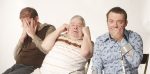
Left to right, Aaron Roderick, Paul Beckett and Adam Grant Warren in Creeps, which is being mounted at the Cultch by Realwheels Theatre, Dec. 1-10. (photo by Tim Matheson)
David E. Freeman’s Creeps premièred in Toronto in 1971. Forty-five years later, it could still be considered radical, and most certainly remains relevant.
The 75-minute one-act play takes place in the washroom of a sheltered workshop, where the main characters – four men with disabilities – take refuge. Freeman, “who lived with cerebral palsy, was one of the first writers to put his own voice – a Canadian voice – on the stage in the early ’70s,” reads the description by Realwheels Theatre, which is mounting the production at the Cultch Dec. 1-10. “Tired of the way they’ve been treated, [the men] rebel and barricade themselves in the washroom. The brutality and hilarity of Freeman’s uncompromising and sardonic dialogue drives the show and expresses the tension of the oppressed with a raw ferocity and clarity.”
Realwheels’ mandate includes providing “respectful and accurate representation of disability, with a vision for full integration of people with disabilities in the performing arts.”
“We’ve cast three fabulous actors who live with disability in Creeps,” producer/dramaturg Rena Cohen told the Independent in an email interview. “They’re working alongside four of Vancouver’s top professional, able-bodied actors. To accommodate the stamina of the PwD [people with disabilities] cast members, we’re extending the rehearsal period to six weeks of part-time (four-hour) days – rehearsal duration for a professional show typically runs three weeks, full-time.
“As happens virtually anytime accommodations are made for accessibility, everyone in the company is loving and benefiting from this accommodation. The creative, interpretive process is given more time to germinate, allowing ideas to be explored and tested, and busy actors appreciate being able to take other gigs or auditions that come up during their free hours.”
The local production includes Jewish community members David A. Kaye and David Bloom.
Kaye plays four characters: Michael, Puffo the Clown, a chef and a carnival barker.
“Michael is a young man with cerebral palsy, which presents in him as both a physical and cognitive disability,” Kaye explained. “Michael works at a sheltered workshop, what the characters refer to as the ‘Spastic Club,’ a place where people with disabilities used to go to perform mundane tasks for pennies a day. For Michael, I’m doing a lot of textual sleuthing, because there’s more information about Michael between the lines than in the lines themselves.
“My preparation for Michael has taught me about the many ways that CP can present,” he continued. “Each case is unique, like a fingerprint. To prepare for Michael, I’ve interviewed and observed people who live with CP, watched documentaries and then, in rehearsal, I’m responsive to the other actors who are also making their way through the interpretive process. We’re also all learning about the history of sheltered workshops for people with disabilities.”
As for the characters of the clown and the chef, Kaye said they “live in a heightened reality that engages with the perceptions of people with disabilities through an ableist perspective,” whereas the barker “provides an ironic commentary, almost an infomercial or sales pitch for the worst-case scenario option for people with disabilities.”
Bloom plays what could be called the bad guy.
“I play Carson, the guy responsible for the facility,” said Bloom. “He doesn’t appear until the end, but he is talked about a lot before he arrives, mostly with disdain.
Carson is a representation of the patronizing, suffocating ‘support’ these guys receive at the hands of the institution they’re stuck in. During rehearsals, I’m learning a lot about my own lazy thinking about people with disabilities.”
Bloom has known of Realwheels’ work for many years and of Cohen’s involvement in the company, but only met her on the first day of rehearsals. Kaye became connected to Realwheels through Creeps’ director Brian Cochrane, with whom he has worked before.
”When Brian told me he was working with Rena and Realwheels, I was excited to come on board,” said Kaye. “It’s a unique experience! I can’t wait for audiences to witness the late, great David Freeman’s exposé on the lives of this fascinating group of guys.”
For her part, Cohen joined Realwheels in 2009, she said, after meeting its founder, James Sanders.
“James – along with two other Vancouver-based theatre artists, Bob Frazer and Kevin Kerr – had created and produced Skydive, one of the most successful productions to ever come out of Vancouver,” she said. “You couldn’t help but be struck by its technical innovation (in which a person with quadriplegia flies!), plus it had considerable impact on perceptions of disability. I’d been working in arts management and as a speech/presentations coach when James invited me to discuss the company’s next steps.
“Skydive’s remarkable triumph had been supported by a fairly rudimentary start-up company infrastructure. James needed help, and I saw an opportunity to bridge Realwheels’ early success to a more stable future.
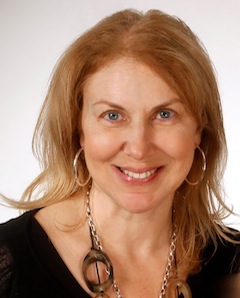
Realwheels Theatre managing artistic director Rena Cohen. (photo from Realwheels Theatre)
“I was also drawn to the opportunities that come through greater insight into the lived experience of disability. Through James – who lives with quadriplegia – and his considerable network, I was exposed to the vitality and dynamism of the disability demographics. It didn’t take long for me to become passionate about Realwheels’ mandate: ‘to create and produce performances that deepen understanding of disability.’
“We’ve since mounted three more amazing professional shows, and built up our community practice – under the Wheel Voices banner. Our most recent community project was SexyVoices, an exploration of sexuality from a disability perspective. SexyVoices was created with and by the community participants, working with acclaimed director Rachel Peake. It offered incredibly funny, daring and moving performances, received national attention, and sold out its three-evening run!”
Last year, noted Cohen, Realwheels received the City of Vancouver Award of Excellence.
Though technically a part-time position, as with many who work in the nonprofit sector, the professional and volunteer lines blur and Cohen’s “efforts in any week are often significantly greater than a full-time job.”
“Embedded into my professional capacity at Realwheels is the need to authentically reflect the values of disability culture, and to serve as a liaison between the disability community and the theatre community,” she explained. “After James took leave of Realwheels due to medical reasons, I assumed responsibility for both management and artistic direction. I challenge myself to understand and to internalize the diverse voices of the disability community, and to convey those voices through the decisions and choices that we make with regard to projects, casting, mentorships, etc.
“My pure volunteer life in Vancouver has almost completely been centred upon Temple Sholom. I served as board president during the leadership transition planning years (2010-12), and before that I oversaw Temple’s strategic planning process. I’d co-chaired the religious school committee and, earlier, I served on Temple’s security committee, which was formed after 9/11. These days, I’m chairing the communications committee for the Syrian Refugee Resettlement Project, and otherwise just enjoying our Temple community.”
Of what she has learned from her years at Realwheels, Cohen said, “The PwD experience is the human experience. By that I mean that the state of ‘disability’ is not binary with a simple on/off. There is a scale or a ‘continuum’ of sorts. We are all challenged on some level and the human experience is defined by how we manage those challenges and how we optimize as a broader community to ensure everyone has the opportunity to self-actualize. I’ve learned that attitudinal barriers are far more challenging for PwD than physical barriers.
We need to challenge both, but attitudes and preconceptions about disability are the hardest to modify. I’m certainly continuing to work on challenging my own ableist privilege.
“I’ve learned that whenever accommodations are made to serve PwD, everyone benefits. One of my proudest achievements as board president at Temple Sholom was the Accessibility and Inclusion Project, which resulted in the installation of an interior ramp to the bimah. Overall, I think Temple has become safer, more inclusive and more accommodating to the diverse range of ages and abilities of all people who participate in Temple life. As I’ve said, I believe that disability exists across the broad spectrum of society, and that most of us are actually TAB (temporarily able-bodied).
“I’m continually learning about the tremendous diversity in the disability sector,” she added. “I attended the Cripping the Arts Symposium in Toronto a few months ago. One PwD artist there insisted, ‘I can’t possibly explain what [having a disability is] like, but I can show you through my artwork, and maybe you’ll get a better understanding of the struggle for survival.’ Yet another expressed: ‘How we experience the world is all based on who you are as a human being, not about being a PwD.’ Those are two nearly opposing positions.
“I’ve learned that, in Canada, the Charter of Rights and Freedoms recognized equality for those who live with disability in 1982, but there is still a great deal of work needed. The U.S., through the Americans with Disabilities Act (1990), is far more advanced than we are. The U.K. by far leads the way in terms of disability arts practices and inclusion.”
In addition to her involvement with the Temple Sholom community, Judaism and Jewish culture have influenced Cohen’s outlook on life and the work she pursues in other ways as well.
“My Jewish upbringing exposed me to critical thinking, to appreciation for the individual and for community, and provided me with exposure to the arts and theatre,” she said. “We have a rich storytelling tradition in Judaism, and a particular way of using humor to cope with life’s challenges. Exposure to that, combined with having a large, extended Jewish family when I was growing up in Montreal, definitely informed my worldview.
“The aching stories of the Holocaust, and the enormous victory of the establishment of Israel, also feel very personal to me. My parents (z”l) would tell you that, from the time I was little, I was a champion of the underdog, always ready to speak truth to power. I’m not so brave today, but I do feel very strong moral imperatives, whether about equality for PwD, or standing up to BDS [boycott, divestment and sanction] bullies, who are either misinformed about Israel or covertly antisemitic.
“My Jewish education also involved a lot of text analysis, including as a student at parochial school in Montreal. The shift to analyzing scripts was a natural segue for me.”
Cohen encourages people to join Realwheels “for an evening of savage wit and uncompromising truth-telling as we present Creeps, the award-winning dark comedy by David E. Freeman that changed Canadian theatre forever!”
And Bloom echoed her sentiments, “I feel very lucky to be part of this show,” he said. “Not only is it a seminal Canadian classic, but I’m working with a great company and an ensemble with real integrity.”
Tickets for Creeps, which previews Nov. 30 before its 10-day run, are $18-$40 from 604-251-1363 or thecultch.com/tickets. Tickets are only two for $20 on Dec. 3, which includes a post-show reception in recognition of International Day of People with Disabilities. There are also post-show discussions Dec. 4 and 6, and ASL and audio description on Dec. 4. Warning: mature content and offensive language.
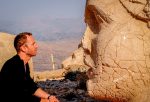
Robin Esrock contemplating ancient wonders in Turkey. (photo by Paul Vance/EWM)
Read about Robin Esrock’s visit to a fountain of youth in Colombia, his rail journey across Siberia, his diving lessons in Papua New Guinea. Esrock has traveled to more than 100 countries and, as he writes in the introduction to The Great Global Bucket List, the hybrid guidebook and essay collection “draws together the best of these adventures.” What’s more, Esrock hopes that you won’t just read about his exploits, but make plans for your own.
Esrock is one of the many writers participating in this year’s Cherie Smith JCC Jewish Book Festival, which runs Nov. 27-Dec. 1. The local author and journalist has not only been featured in the Jewish Independent before – for The Great Canadian Bucket List, among other things – but has written for the paper as well, so it was nice to catch up with him in anticipation of his Nov. 27, 5 p.m., presentation at the Jewish Community Centre of Greater Vancouver, appropriately called Travel Dreams.
While his career as an intrepid traveler only started after a bike accident – from which he received a broken kneecap and, eventually, a $20,000 insurance settlement that was “just enough,” he writes, “if used sparingly, to book a solo one-year adventure around the world” – he had traveled before.
“My first trip overseas was to Israel when I was 11, on a discovery tour, with my family and grandparents,” he told the Independent. “It was a hop-on, hop-off bus trip to tick off Israel’s greatest hits. I did a European bus tour after high school, memorable in that I can’t remember much of it, a two-month stint to a kibbutz, and then backpacked up East Africa to Zanzibar. I didn’t get malaria, but I did get the travel bug. I lived in London for a couple years and used that as a base to visit various odd spots in Europe, but the idea of traveling around the world always seemed like an impossible dream. Once it finally manifested, the result of a modest insurance settlement for my accident, I couldn’t believe I’d waited so long.”
The accident occurred as Esrock was approaching his 30th birthday. On that first yearlong trip, he visited 24 countries and was “published in newspapers on five continents.”
He writes, “A year later, my Hail-Mary pitch for a TV show landed on the right desk at the right time and, seven months later, I found myself as a co-host, writer and producer for a 40-part adventure series filmed in 36 countries. Funded by television networks, I was tasked with seeking out experiences that conformed to my bucket list criteria: Is this destination or activity unique? Is it something I will never forget? Will it make a great story? Is it something everyone can actually do?
“Tick off all those subjective items, and the journey began.”
These were the same criteria Esrock used to compile his shortlist for The Great Global Bucket List. Then, he said, “I had to cut 27 chapters for size in my book, but, fortunately, I have a Bucket List blog (globalbucketlist.com) to find them a home, and add new experiences. In my book, you’ll find far-flung adventures (Antarctica! the Galapagos! the Azores! the Amazon!) but you won’t find the Eiffel Tower or Tower of Pisa. This is a book of inspiring stories and photographs, not a guide to popular tourist traps.”
In addition to experiencing many a far-flung adventure over the last decade or so, Esrock has also found the time to start a family. How has that changed his travel plans?
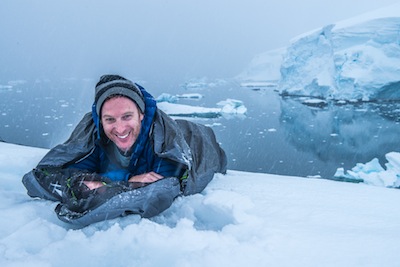
Robin Esrock camping in Antarctica. (photo by Jeff Topham)
“There seems to be a subtle flow in the career of travel writers: you start with hardcore budget travel, transition into hard adventure, then soft adventure, romance, family, cruise, food, wine, spa, and end up in golf!” he said. “I don’t take the risks I once did, or have the energy to sleep in roach hotels. People have become more important than ever and, since I’ve managed to tick off so much, I’m very drawn to unique experiences. My kids are a little young (3 and 3 months) to start ticking off a family bucket list, but I’d love to take them to countries like India, Cambodia, Israel and Turkey, where locals embrace children. Disneyland can wait.”
And his own bucket list?
“Write a novel that explains, in an entertaining way, everything I have learned on my journey. Raise my kids to be curious and up for anything, so they can join me on future adventures. And I’d love to get to the five ’Stans on the Silk Road in Central Asia, which has a rich history, few tourists, and is undergoing a fascinating modern transformation.”
Esrock added, “There’s too much bad news out there. The 24/7 news cycle dictates that bad news must be happening somewhere, all the time. The goal with my bucket lists, and with my career in general, is to provide some much-needed good news. In all my journeys, I’ve never been robbed, attacked, violently ill or had my organs harvested (at least to my knowledge!). The world is far more welcoming, reasonable, peaceful and beautiful than you’d imagine.
“Some people see bucket lists as a silly, ultimately harmful pastime that creates unrealistic goals. I see them as a mechanism for positive inspiration. You don’t have to go sandboarding on a volcano in Nicaragua or cage swim with crocodiles. You just have to do that thing you’ve always wanted to do, even if it’s just fixing the garden. We don’t have nearly as much time as we think we do. Every chapter in my book concludes with ‘Start Here,’ and an online link to practical info for readers to follow in my footsteps. More important, I think, is to start now.”
The idea behind a bucket list is that life is finite and, if there are things we would like to do, we should do them while we can. The Cherie Smith JCC Jewish Book Festival opens the night of Nov. 27 with San Francisco-based writer and psychiatrist Dr. Irvin D. Yalom in conversation with Vancouver psychotherapist Larry Green. The title of Yalom’s most recent book, Creatures of a Day, comes from Marcus Aurelius’ The Meditations, to which Yalom refers more than once in his writings, and from which he quotes at the beginning of his latest book: “All of us are creatures of a day; the rememberer and the remembered alike. All is ephemeral – both memory and the object of memory. The time is at hand when you will have forgotten everything; and the time is at hand when all will have forgotten you. Always reflect that soon you will be no one, and nowhere.” Creatures of a Day is a collection of 10 stories based on his patients’ experiences with loss and illness, and their – and Yalom’s – efforts to live a life of both meaning and pleasure.



 Esrock is one of the many writers participating in this year’s Cherie Smith JCC Jewish Book Festival, which runs Nov. 27-Dec. 1. The local author and journalist has not only been featured in the Jewish Independent before – for The Great Canadian Bucket List, among other things – but has written for the paper as well, so it was nice to catch up with him in anticipation of his Nov. 27, 5 p.m., presentation at the Jewish Community Centre of Greater Vancouver, appropriately called Travel Dreams.