The gift of innocence?

The Innocence Treatment by Ari Goelman is a psychological thriller set in 2031 America. 

Looking for a smart, tense, psychological thriller for your teenage reader? Ari Goelman’s The Innocence Treatment (Roaring Brook Press, 2017) would fit the bill. Though, if you’re unsure, you can ask the author himself. Goelman will be doing a reading and book-signing on Nov. 21, 7 p.m., at Book Warehouse on Main Street. He will also be at the Cherie Smith JCC Jewish Book Festival on Nov. 27, 6:30 p.m.

Goelman is originally from Philadelphia. “I moved around the U.S. a bunch before ending up in Vancouver, living mostly in New York City and Boston before I came here,” he told the Independent. “I came to Vancouver gradually, a few months here (1995), a few years here (1997-1999), until finally settling here in 2006. I wanted to make sure I waited until I definitely couldn’t afford to buy a house in the city. As for why, I had family in Vancouver, so, when I was looking into grad schools, I knew it was a fun (and back then) affordable place to live.”

The Innocence Treatment is Goelman’s second book. His first, The Path of Names, for middle-grade readers, received many literary awards and nominations. He also writes short stories and is on the faculty of Kwantlen Polytechnic University. His undergraduate degree in economics is from New College of Florida, he has an MSc in planning from University of British Columbia and a PhD in urban studies from Massachusetts Institute of Technology.
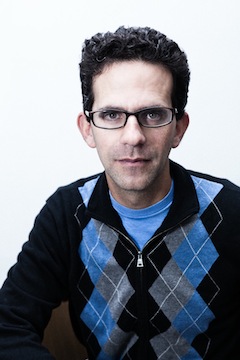
photo - Ari Goelman
Ari Goelman (photo by John Goldsmith Photography)

“One of the first bits of paid writing I ever did was for this very newspaper, when I first came to Vancouver in 1995,” he shared. “True story. A once-off article about Kidsbooks.” True, indeed. The story, “No kidding around,” was published on Sept. 29, 1995, in the Jewish Western Bulletin, the Independent’s predecessor. But back to the present … well, the future.

Goelman sets The Innocence Treatment in his home country in 2031, when “the United States was still enjoying the lull between the first and second uprisings. A drought was drying out the last of the great western forests, but it would be another two years before the massive wildfires that left millions homeless and sparked the second uprising.”

His main character, 16-year-old Lauren was once so innocent that she had to be watched at all times so that no harm would come to her. At first, she is “super-excited” to be undergoing a medical procedure to “fix” her, because then she “won’t be stupid anymore.” But, afterward, she discovers that understanding people and their motivations doesn’t necessarily lead to happier or better outcomes and, more than once, the “new” Lauren must use her ample self-defence skills and literally kick some butts.

“Lauren’s kick-ass qualities naturally emerged from her character,” said Goelman about his strong female lead. “I started with the idea of a character who had spent her whole life very naive and very protected, and I imagined she’d be furious once the veil was lifted and she started to experience the world as it really was. I figured, as well, that after spending her whole life being unavoidably passive, she would be thrilled by her new ability to act and would make the most of those abilities.”

The problem becomes one of self-restraint, which Goelman explicitly explores in a chapter involving an experiment while Lauren is in custody, which I personally found somewhat out of place, or forced.

“What I was trying to do in that chapter was to show Lauren’s inability to control herself, even when she genuinely wants to, both for her own self-interest and to spite Dr. Corbin,” explained Goelman. “That’s what Corbin is really measuring – not Lauren’s fighting ability, but her paranoia and anger. It was a fun chapter to write, because it’s from Lauren’s perspective and she’s aware of the challenge that she’s failing, even as she fails it.”

Overall, The Innocence Treatment is a fun book to read. To use an apt cliché, it is a page-turner. It is also a little scary in its seeming prescience, having been written before the election of Donald Trump and the apparent descent of America.

“Yes, The Innocence Treatment does feel a bit unfortunately prescient at this point,” agreed Goelman. “I’m glad it was published this year, or it would have started seeming less like a near future world and more like the past.”

As for what he thinks the future might hold in reality, Goelman said, “I think the most we can hope for is to slow climate change and deal with its consequences in a fair way that limits human suffering. I’m not real optimistic about our near-term prospects, as I think that nothing good will happen as long as so much of the world’s resources are controlled by so few individuals and families.

“The world of The Innocence Treatment is very much formed by the combination of climate change disaster and the unequal distribution of wealth. And,” said Goelman, “while the election of Donald Trump in the U.S. is the latest and maybe the best example of how these two trends come together, we don’t have to look so far from home. The B.C. Liberals ran this province for 16 years, defunding public education and subsidizing the fossil fuel industry, at the behest of their very wealthy (and largely unregulated) donors.

“On the upside,” he said, “it’s not like the solutions are so complicated – if we get money out of politics, I believe humans can be really brilliant at solving problems collaboratively. So, while I’m pretty pessimistic about any major improvement in the near term, I think it’s very possible to change things for the better – it just requires the political will. There’s a part of The Innocence Treatment where Lauren’s older sister describes the family’s life right after the ‘Emergency’ era permanently reshaped the U.S., and one of the things she remembers is it wasn’t so bad being without power, as people came together to help each other. I think there’s a lot of truth to that. Given the chance, humans are really good at working together. They’re also really good at struggling for dominance and to monopolize scarce resources. It’s anyone’s guess which direction we’re going.”

For the full schedule of the Jewish Book Festival, which runs Nov. 25-30, visit jewishbookfestival.ca.


America’s UNESCO exit

The United States and Israel will withdraw from UNESCO. The United Nations Educational, Scientific and Cultural Organization is one of the most impressive and vital global agencies addressing international cooperation on this range of human endeavours. Unfortunately, like the United Nations itself, which exemplifies unfulfilled promise, it has been coopted into the service of Israel-hating forces.

UNESCO does vitally important work advancing education as a basic human right, fostering cultural diversity and dialogue, and promoting heritage as “a bridge between generations and peoples.” It is also committed to “full freedom of expression; the basis of democracy, development and human dignity.”

The irony here is that, by succumbing to the influence of Israel-bashers, UNESCO is in cahoots with countries that betray the most basic concepts of free expression and democracy.

The U.S. State Department announced last week that it would quit UNESCO and, while insisting that Israel was unaware of the impending announcement and that the decision was uncoordinated between the two countries, Israel’s Prime Minister Binyamin Netanyahu announced that Israel would follow its ally and also leave the agency.

Coincidentally or deliberately, UNESCO elected its first Jewish director general just days after the United States’ announcement. France’s former minister of culture, Audrey Azoulay, was elected to the leadership role, outpolling the Qatari perceived frontrunner, in a vote by UNESCO’s executive last Friday.

The United States was in arrears to UNESCO to the tune of $550 million and even a U.S. State Department spokesperson didn’t deny that money figured into the calculation. The United States stopped paying its dues to UNESCO in 2011, when the agency admitted “Palestine” as a full member state.

In July, UNESCO declared Hebron an endangered World Heritage site, diminishing the Jewish people’s ancient and contemporary connections to the city, home to the tombs of the Patriarchs and Matriarchs.

UNESCO has also adopted resolutions that call Jerusalem “occupied” territory, acknowledge Muslim but not Jewish historical connections to the Temple Mount area and repeatedly reinforced a common Palestinian position that Jews have little or no historical connection to the land of Israel.

The question is, do you stay and fight or give up and decamp in protest? A similar paradox occurred at the United Nations-sponsored World Conference Against Racism, in Durban, South Africa, in 2001. When it became clear that the event had been commandeered not only by anti-Zionist elements, but by some of the most antisemitic forces in the world, the United States and Israel walked out. Canada stayed. The Liberal government of the time justified the decision by saying they could remain as a voice of critical reason. There are legitimate cases to be made for both positions.

In choosing to leave the organization as a member but remain as an observer state, the United States found the right balance. They can continue to make their opposition to UNESCO excesses heard, without countenancing them morally or financially.

At least, that is how it would work in a world in which Donald Trump was not president of the United States. In this, as in so much, Trump changes everything. While the administration’s decision on UNESCO may be a decent one, in context with other decisions of the Trump administration, it becomes part of a retraction of American influence in and engagement with the world. Trump is motivated by spite, not by principle. While another president could have made the same move and explained it as a principled defence of the country’s most important ally in the Middle East, this president’s lack of principle and surfeit of malevolence relocates even defensible positions into a constellation of petty pique. Despite its manipulation by anti-Zionist ideologues, UNESCO remains an invaluable institution, doing much good work in the world. Even while maintaining observer status, the U.S. decision is likely to be read by critics not as a repudiation of what UNESCO does wrong, but as part of an ongoing American trend against all that is good in culture, science and education.

Context matters. Like Richard Nixon in China – OK, perhaps not really like that, but at least in the respect that a president with some credibility in areas relevant to UNESCO could get away with repudiating it – a president Hillary Clinton (or Bill Clinton, or Barack Obama) could have withdrawn from UNESCO and not made their country look like a collection of petty Philistines. When a president who has little demonstrated respect for culture, education or science withdraws from a global organization dedicated to these pursuits, it probably legitimizes UNESCO more than it delegitimizes it.

Worse for Jews, this tight friendship between Trump and Netanyahu reinforces perceptions of the Jewish people – or, at the very least, the Jewish state – as ideologically entwined with a figure who seems destined to go down as the most ineffectual and destructive president in American history. Not an enviable place to find oneself.

Trump-Bibi bromance

Israeli Prime Minister Binyamin Netanyahu, left, with U.S. President Donald Trump in New York. (photo from Israel’s Government Press Office via Ashernet)

A great deal of diplomacy depends on intangibles like whether the parties involved like or dislike each other. Israeli Prime Minister Binyamin Netanyahu made little effort to hide his frustration with Barack Obama, the former U.S. president. The feeling was blatantly mutual, as even the most obtuse reader of body language could interpret from photographs of the two men together. Netanyahu and the current resident of the White House … this is whole new meeting of minds.

There are similarities and differences of style and substance between Bibi and Donald Trump. One thing worth noting is that each has their core of stalwart domestic supporters and another, possibly even more virulent, bloc of detesters.

Seeing the two leaders together in New York this week, present for the annual United Nations General Assembly, was a reminder of how big a role mutual affection or irritation between two leaders can affect international relations.

The Israeli prime minister engaged in a Trump-like tweetstorm Monday morning, including this one: “Under your leadership, @realDonaldTrump, the alliance between the United States and Israel has never been stronger.”

This may not be true – the relationship has always been extremely tight – but it is certainly true that the alliance between the two countries’ leaders is strong.

It’s always wise for Israeli leaders to seek good relations with the American president, but this particular relationship is double-edged. A recent poll indicated that 21% of American Jews view Trump favourably, while 77% view him unfavourably. This puts Netanyahu in a difficult position of his own choosing – hitching his wagon to a politician who is deeply distrusted by the largest population of Diaspora Jews.

There is also something odd about Netanyahu’s interpretation of the Israel-U.S. relationship. Just a couple of years ago, at the depths of the Netanyahu-Obama snit, commentators wondered if the bilateral relationship had ever been lower. (Calmer heads insisted that, despite the childishness at the top, on every issue of bilateral substance, everything remained tickety-boo.) Now, just 10 months into a new administration, the Israeli leader alleges that the alliance has never been better. Was a change in the White House all it took for things to go from bad to super-awesome? If so, upon what kind of a foundation does this relationship rest? And, what are the metrics?

The reality is that, for reasons pragmatic and ideological, the Israeli-American bond is strong and indivisible. What Netanyahu did in New York this week is simply the flip side of the coin he tossed when Obama was in office. Then, he betrayed diplomatic processes to accept an invitation from U.S. congressional leaders. Now he’s got a man he likes in the White House and he’s throwing bouquets at him. In both instances, he is crudely poking around in the internal politics of the United States, a strategy that has (in ordinary times) about a 50-50 chance of blowing up in a foreign leader’s face. And these are not ordinary times. Trump is a divisive and potentially dangerous figure who is supported by the worst elements in American society, including racists and antisemites. By wrapping himself in Trump’s flag, Netanyahu is playing a risky game.

Even so, coming just hours after the Emmy awards, the Donald and Bibi show had its fleeting moments of humour, if unintentional. To wit, Trump lent his inimitable erudition to the promise of Mideast peace.

“Most people would say there’s no chance whatsoever. I actually think with the capability of Bibi and frankly the other side, I really think we have a chance,” Trump said. “I think Israel would like to see it and I think the Palestinians would like to see it. And I can tell you that the Trump administration would like to see it.”

Apparently we’d all like to see it. Yet every administration since Truman has tried, to one extent or another, to facilitate peace between the Israelis and their neighbours. The best and brightest among the presidents have proved incapable of the task. Is it possible that this one will counterintuitively succeed? The definition of insanity is said to be doing the same thing again and again and anticipating a different outcome. President after president has taken a similar approach to this problem and failed. No one can accuse Trump of doing things the conventional way. And, he’s put his best man on the job – son-in-law Jared Kushner – whose qualifications appear to be, well, mostly matrimonial.

Trump, the self-proclaimed great deal-maker, has repeatedly failed to find any common ground with a House and Senate led by his own party and has so far been able to achieve none of his signature initiatives. A modest achievement like solving the Israeli-Arab conflict would be something worth bragging about. As Trump and Netanyahu plot that little rabbit trick, we will watch with interest or, if you’re a praying person, maybe do that.

האופציה הקנדית

בעידן טראמפ: האופציה הקנדית תופסת תאוצה אצל ישראלים ואמריקנים כאחד. (צילום: Cynthia Ramsay)

בעידן הנשיא האמריקני השערורייתי ביותר בתולדות המדינה, דונלד טראמפ, האופציה לעבור לקנדה תופסת תאוצה אצל אמריקנים וגם אצל ישראלים. כך מסתבר.

עיתונאית הארץ, נעמי דרום, שגרה עם משפחתה בקיימברידג’ מסצ’וסטס בשנתיים האחרונות, כותבת על האופציה הקנדית. הטור שלה שכותרתו “מתי קנדה נהיתה מגניבה בהרבה מאמריקה?” פורסם לאחרונה. דרום כותבת בכותרת המשנה כי “כמו הרבה ישראלים ולא מעט אמריקאים, גם אנחנו רואים בקנדה חוף מבטחים שאליו נוכל להיסחף כשהאפשרויות האחרות יאזלו. אבל איך קרה שאמריקה התחילה נושאת עיניים לחברה הצפונית אחרי שנים של זלזול?”

דרום אומרת כי עבור ישראלים רבים שגרים ביבשת, קנדה נמצאת שם כאופציה, פוטנציאל רומנטי בלתי ממומש. נראה שהכל שם הרבה יותר קל ושפוי: זכויות סוציאליות שזכאים אליהן כבר לאחר חודשים מועטים, ויזה קלת יחסית להשגה, קהילה יהודית נחמדה ועוזרת (היא מתכוונת לקהילה בטורונטו), הקנדים מדברים אנגלית, לא אוהבים רובים ולא אוחזים בטירוף באולטרה קפיטליזם של הדוד סם.

דרום מציינת כי מאז שטראמפ נבחר כמועמד המפלגה הרפובליקנית קנדה זוהרת כיהלום צפוני. מושב הסובלנות וביטוח הבריאות האוניברסלי, המקום שבו אוהבים מהגרים, מקבלים אותם, מאמצים פליטים סורים ומצטלמים איתם. עד הבחירות האחרונות משל בקנדה סטיב הרפר, פוליטיקאי שמרן, לא פופולרי ושנוי במחלוקת, בעוד ארצות הברית התגאתה בנשיא ליברלי, רהוט ורחום. אבל מאז התהפכו היוצרות וקנדה מתהדרת בטרודו הליברל, הפמיניסט והסובלני. האמריקנים לעומת זאת, נלכדו במערכת בחירות מכוערת

שהסתיימה בבחירתו של האיש שעוד לא פגש ניאו-נאצי שהוא לא מחבב. לאימתם גילו האמריקנים שהם פתאם פחות שווים מהשכנה המנומנמת שבה התרגלו לזלזל.

בתקופת הפריימריז לבחירות בארה”ב כותבת דרום, עיתונאי קנדי נסע לסקר את אספת הבחירות של ברני סנדרס, שהוא ותומכיו נחשבו לשמאלנים קיצוניים בין השאר בשל תמיכתם בביטוח הבריאות הציבורי. “אנחנו בסך הכל רוצים מה שיש לכם”, אמרו תומכי סנדרס לעיתונאי הקנדי, “מה כל כך קיצוני בזה?”.

אם פרסום התוצאות לבחירות בארה”ב יותר ויותר אנשים הכניסו לגוגל את המשפט “איך מהגרים לקנדה”, יותר מאשר אי פעם מאז נוסד מנוע החיפוש. בחדש שעבר פורסם כי מספר שיא של מהגרים בעיקר מהאיטי, התייאשו מארצות הברית ועברו את הגבול לקנדה.

הניו יורקר פרסם כתבה לפני מספר חודשים תחת הכותרת “הייינו יכולים להיות קנדה”. הכותב אדם גופניק, שגדל בשתי המדינות כתב בין היתר כי אמריקה תייחל, תרצה להיות קנדה, תקנא בקנדה, תכה על חטא ועוד על המהפכה האמריקנית, ערש הדמוקרטיה המודרנית?

דרום מסבירה כי גם היא ומשפחתה שקלו בשלבים מסויימים לוותר על סיבוכי הוויזה האמריקאיים ולהגר צפונה. היתרונות ידועים. אך מה אנו יודעים על קנדה? מה יש לנו בקנדה שלא גדלנו עליה, לא ראינו בטלוויזיה סדרות שלה, לא צרכנו סרטים קנדיים. מה אנו יודעים על הפוליטיקה שם? בעוד שאמריקה זורמת בעורקינו, קנדה היא טריטוריה זרה ומושלגת.

על הביקור בטורונטו היא אומרת: האנשים מנומסים אבל לא באופן מוגזם. טורונטו נראית נחמדה והחברים שלנו שגרים בה מרוצים מהחיים בה.

בין תגובות הקוראים של הרשימה: “קנדה נעימה מארה”ב, שלווה מארה”ב, אינה מושחתת כמו ארה”ב ויקרה ממנה. זו מדינה ענקית ומגוונת וכן יותר אירופאית, פחות רודפת בצע, מסודרת יותר. מס הכנסה גבוה יותר אך ביטוח הבריאות זול בהרבה. בקנדה האווירה רגועה יותר, פחות חומרנית. ארה”ב היא מדינה לעשירים ועם טראמפ הפער בין עשירים לעניים ילך ויגדל”.

Charlottesville a turning point?

(photo by Ryan M. Kelly via cbc.ca)

Last weekend, in Charlottesville, Va., hundreds of white supremacists, Ku Klux Klanners, neo-Nazis and other racists and antisemites rallied and brought violence to the hometown of Thomas Jefferson.

The images that emerged are bone-chilling. Men (mostly) carrying torches, swastikas and Confederate flags, screaming the ugliest epithets imaginable against African-Americans, gays and Jews. When the city of Charlottesville eventually ordered the racists to disperse (the racists were authorized to rally until things got violent), one of them got in his car and rammed it through a crowd of counter-demonstrators, killing one young woman and injuring many. The violence could have been infinitely worse, it should be noted, as scores of racists in battle fatigues were seen carrying combat weapons on their way to the rally, as is their Second Amendment right in that open-carry state.

Anyone who spent any time on social media or watching cable news in the succeeding days knows that the events and the issues raised by the rally and the preceding march through the University of Virginia have been assessed from multiple angles. The delayed and impotent response of President Donald Trump has been singled out as among the more worrying aspects.

The president of the United States responded by blaming “many sides” for the violence, an appalling equivocation that diminishes the office even further than the depths to which he has debased it in the past eight months. Items of Trump paraphernalia, notably “Make America great again” caps, were prominent among the racist ralliers and some commentators think the president’s remarks were tempered so as not to upset a political base that includes the very worst elements in American society.

David Duke, the former head hood of the KKK, said the rally was a step toward fulfilling Trump’s promises and, after Trump’s bland statement on events, Duke crowed that, essentially, his guy is in the White House. Meanwhile, Maxine Waters, an African-American congresswoman and outspoken critic of Trump, dubbed it the White Supremacists’ House.

The American Civil Liberties Union advocated for the right of the racists to express themselves and, while Canada has different laws and customs around this, we would not contest the idea of racists expressing themselves peacefully, primarily because suppression can metastasize bad ideas the way mold grows in darkness. The answer to bad speech, we have been arguing in this space for decades, is not no speech, but more speech. Indeed, many Americans and others have been motivated by their revulsion at events in Charlottesville to recognize the racial and cultural problems it represents, and have engaged in the civil discourse on the side of good.

We admit, though, that free speech works best when decent people are in leadership. So, for instance, when white supremacists and neo-Nazis rally and murder, a U.S. president should arouse the country’s best instincts as the leading voice for unity in diversity and basic human decency. That didn’t happen after Charlottesville.

Also, police preparations may have been inadequate. When African-Americans have peacefully marched in recent years, militaristic counter-measures have been put in place, as in Ferguson, Mo., after the shooting death of Michael Brown. In Charlottesville, gun-swinging, fatigue-festooned, swastika-waving white people were met with limited police presence, to the extent that they were permitted to physically attack counter-protesters.

An additional factor – perhaps the only one not adequately hashed over – is the subdued reaction to the antisemitism permeating the event. The poster for the rally featured a Magen David about to be smashed by a sledgehammer. A recurring chant at the rally, premised on the idea of white culture being subsumed, was “You will not replace us … Jew will not replace us!” Seig heil salutes and chants of “blood and soil,” a Nazi slogan, were part of the show.

The president notwithstanding, most American leaders have condemned the racism of the event, but condemnations of antisemitism in particular have been far less prominent in the aftermath. Hopefully, people feel that their statements against bigotry encompass antisemitism; less optimistically, perhaps there is a feeling that, while other forms of hatred are anathema to American ideals, displays of antisemitism are less surprising and, therefore, less requiring of explicit denunciation. This is something that needs further consideration and discussion.

If, as former president Barack Obama was fond of saying (quoting Dr. Martin Luther King, Jr.), “the arc of the moral universe is long but it bends toward justice,” Charlottesville may turn out to be a positive turning point in a long and tragic history of racism, antisemitism and xenophobia in America. Optimists among us hope that the political awareness of erstwhile apathetic Americans will be awakened by the sight of torch-wielding Nazis in American streets – and spurred to action by the fact that this reality doesn’t elicit swift and strong condemnation from the most powerful person in the country and, indeed, in the world.

As Canadians, we have our own shameful history of racism and antisemitism to reckon with and should not allow ourselves any smugness when assessing our neighbour’s current spasm of hate. The passing of German-Canadian Holocaust-denier and Nazi-sympathizer Ernst Zundel this month in Germany – to which he was extradited in 2005 and convicted for inciting racial hatred – and a scan of Canadian web commenters around these subjects remind us that we remain far from some bigotry-free beacon to the world.

Still, it is only when these things are out in the open that they can be challenged and debunked. So, as debilitating as it may be to see and hear these ugly ideas and actions, it gives us the opportunity to counter them – if, unlike the president of the United States, we choose to do so sincerely.

How to slow climate change

President Donald Trump has received well-deserved condemnation from, among others, leaders of many nations, many governors, mayors, environmentalists, corporate chief executive officers and Jewish and other religious organizations for withdrawing the United States from the 2015 Paris climate change pact that was agreed to by all the 195 nations that attended, including Israel, Canada and the United States. How should Jews respond to the U.S. withdrawal?

First, Jews should become very familiar with the issues involved. Ten important climate-related factors are:

  1. Science academies worldwide, 97% of climate scientists and 99.9% of peer-reviewed papers on the issue in respected scientific journals argue that climate change is real, is largely caused by human activities and poses great threats to humanity. All 195 nations at the December 2015 Paris climate change conference agreed that immediate steps must be taken to combat climate change.
  2. Every decade since the 1970s has been warmer than the previous decade and all of the 17 warmest years since temperature records were first kept in 1880 have been since 1998. The year 2016 was the warmest globally since 1880, breaking the record held before by 2015 and previously by 2014, meaning we now have had three consecutive years of record temperatures.
  3. Polar icecaps and glaciers worldwide have been melting rapidly, faster than scientific projections. This has caused an increase of elevation in oceans worldwide, with the potential for major flooding.
  4. There has been an increase in the number and severity of droughts, wildfires, storms and floods.
  5. California has been subjected to so many severe climate events (heat waves, droughts, wildfires and mudslides when heavy rains occur) recently that its governor, Jerry Brown, stated, “Humanity is on a collision course with nature.” California serves as an example of how climate change can wreak havoc.
  6. Many climates experts believe that we are close to a tipping point due to feedback loops, when climate change will spiral out of control, with disastrous consequences, unless major positive changes soon occur.
  7. While many climate scientists think that 350 parts per million (ppm) of atmospheric CO2 is a threshold value for climate stability, the world reached 400 ppm in 2014 and the amount is increasing by two to three parts per million per year.
  8. While climate scientists hope that temperature increases can be limited to two degrees Celsius (3.6 degrees Fahrenheit), largely because that is the best that can be hoped for with current trends and momentum, the world is now on track for an average increase of four to six degrees Celsius, which would result in great human suffering and significant threats to human civilization.
  9. The Pentagon and other military groups think that climate change will increase the potential for instability, terrorism and war by reducing access to food and clean water and by causing tens of millions of refugees fleeing from droughts, wildfire, floods, storms and other effects of climate change.
  10. The group ConservAmerica, formerly known as Republicans for Environmental Protection, is very concerned about climate change threats. They are working to end the denial about climate threats by the vast majority of Republicans, but so far with very limited success.

Second, Jews should consider Judaism’s powerful teachings that can be applied to environmental sustainability. These include:

  • “In the hour when the Holy One, Blessed be He, created the first man, he took him and let him pass before all the trees in the Garden of Eden and said to him: ‘See my works, how fine and excellent they are. Now, all that I created, I created for your benefit. Think upon this and do not corrupt or destroy my world. For, if you destroy it, there is no one to restore it after you.” (Midrash: Ecclesiastes Rabbah 7:28)
  • Genesis 2:15 indicates that the human role is to work the land but also to guard and preserve it. Jews are mandated to be shomrei ha’adama, guardians of the earth, co-workers with God in working for tikkun olam, healing and repairing the world.
  • Judaism teaches: “Who is the wise person? The one who considers the future consequences of his or her actions.”
  • The Jewish sages expand Deuteronomy 20:19-20, prohibiting the destruction of fruit trees in wartime to build battery rams to overcome an enemy fortification, to make a general prohibition against unnecessarily destroying anything of value.

Jews should be on the forefront of efforts to help avert a climate catastrophe. We should try to significantly reduce our individual carbon footprints by recycling, using efficient light bulbs and other items, eating less meat, reducing our use of automobiles by walking, biking, sharing rides and using mass transit, when appropriate, and in other ways. We should support efforts to increase efficiencies of automobiles and other items, shift to renewable sources of energy and make societal steps that reduce greenhouse emissions.

We should try to arrange programs on climate change at synagogues, Jewish centres and other Jewish venues, write letters to editors, speak to family members, friends, neighbours and co-workers, and take other steps to increase awareness of the seriousness of climate threats and how applying Jewish values can help reduce them. We should do everything possible to reduce climate change and to help shift our imperiled planet onto a sustainable path.

Richard H. Schwartz, PhD, is professor emeritus, College of Staten Island, president emeritus of Jewish Veg and president of the Society of Ethical and Religious Vegetarians. He is the author of several books, including Judaism and Vegetarianism and Who Stole My Religion? Revitalizing Judaism and Applying Jewish Values to Help Heal Our Imperiled Planet, and more than 250 articles at jewishveg.org/schwartz. He was associate producer of the documentary A Sacred Duty: Applying Jewish Values to Help Heal the World.

When peace comes

Speaking at the Israel Museum in Jerusalem Tuesday, U.S. President Donald Trump quoted Theodor Herzl. “Whatever we attempt there for our own benefit will redound mightily and beneficially to the good of all mankind,” Herzl said.

This is not Herzl’s most famous quote, but the words were well chosen. In seven decades, Israel has contributed such an immense amount to the knowledge and culture of the world that Herzl himself could probably not have foreseen it in his wildest imagination – and he had a wild imagination.

The only barrier to the great redounding of which Herzl spoke has been the rejection of Israeli people, knowledge, technology and existence, first by those who would have benefited most – the country’s nearest neighbours in the Middle East – and latterly by many around the world, from the United Nations to college campuses across the West, where boycotting all things Israeli has become almost a rite of passage.

Trump also said Tuesday: “I had a great meeting this morning with President Mahmoud Abbas and I can tell you that he is ready to reach a peace deal.”

The president’s reputation is founded on his deal-making abilities and this is perhaps why he made it his first order of foreign business to travel to the Middle East, site of the world’s most elusive deal. But, telling an audience of Israelis, and global observers who have far deeper knowledge of the situation than Trump does, that Abbas is ready to reach a peace deal displays a degree of naiveté, to say the least.

Herzl’s vision of Israel as an oasis of excellence sharing its knowledge and advancements with neighbours was unquestionably imbued with the colonial attitudes of his era. But it was also founded on assumptions of enlightened self-interest.

“Israel is a thriving nation,” Trump said, “and has not only uplifted this region, but the entire world.” True enough, but it could have done so much more uplifting if others in the region had not rejected most of what the state has had to offer.

When the Arab Spring had its limited expression, it seemed that the peoples of the region might finally be rising up against not just the leaders who oppressed them, but the very scapegoating ideologies and miseducation that kept them down. One by one, most of the oppressors regained the upper hand and the greatest hope for Israeli-Arab peace – that the people and leaders would see coexistence as synonymous with self-interest – faded again.

If Trump thinks he has the magic beans to succeed where so many have failed, may he go from strength to strength.

This week in Israel … May 26/17

U.S. President Donald Trump and First Lady Melania Trump lay a wreath during a visit to Yad Vashem, the World Holocaust Remembrance Centre, on May 23. (photo from IGPO via Ashernet)

photo - On May 21, Israel celebrated 50 years since the reunification of Jerusalem. The images projected on the Old City Wall were part of the festivities
On May 21, Israel celebrated 50 years since the reunification of Jerusalem. The images projected on the Old City Wall were part of the festivities. (photo from Ashernet)
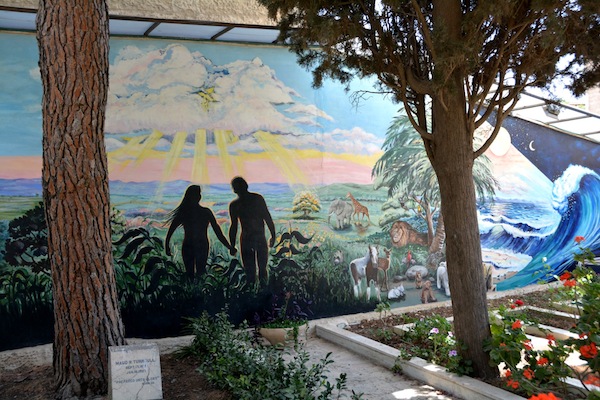
photo - A mural by Patricia Solveson depicting the Garden of Eden adorns the wall of the Alliance Church International Cemetery in Jerusalem’s Emek Refaim neighbourhood, also known as the German Colony because, in the latter part of the 19th century, many German Templers lived in this part of the city
A mural by Patricia Solveson depicting the Garden of Eden adorns the wall of the Alliance Church International Cemetery in Jerusalem’s Emek Refaim neighbourhood, also known as the German Colony because, in the latter part of the 19th century, many German Templers lived in this part of the city. (photo from Ashernet)

Trump supporters meet

Left to right, Larry Elder, Dennis Prager and Hugh Hewitt at the Unite Inland Empire Conservative Conference on April 30. (photo by Dave Gordon)

Eight hundred supporters of U.S. President Donald Trump gathered in a Los Angeles-area venue recently – before the controversy this week over Trump’s sharing of classified information with Russia – to hear four major U.S. media figures discuss why, in their opinion, the president had thus far made impressive executive choices.

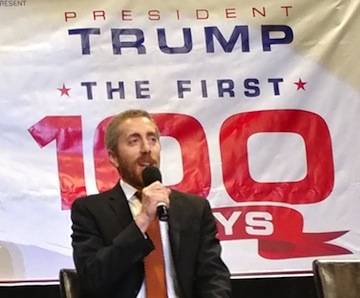
The April 30 event – the fourth annual Unite Inland Empire Conservative Conference – was entitled Trump’s First 100 Days.

Panelists were talk radio hosts Larry Elder, Hugh Hewitt and Dennis Prager and senior editor-at-large of Breitbart News, Joel Pollak.

Trump was praised by all speakers for his Supreme Court choice of Neil Gorsuch, his strike on Syria, his efforts to overturn Obamacare and the newest Iran sanctions. The two Jewish speakers – Prager and Pollak – told the Independent that the president has, in a very short time, done much for Israel.

Appointing a U.S. ambassador to the United Nations who is critical of the world body’s treatment of the Jewish state should be seen as significant in itself, Prager said. “Why isn’t Nikki Haley enough for a Jew?” he asked.

The author of seven books, including the recently released Ten Commandments: Still the Best Moral Code, Prager said Trump should divest the United States entirely from the UN, however.

“It is a morally bad organization. It does more harm than good,” he said. “You can have aid agencies without the UN. Think we need UN peacekeepers? You can talk about Rwanda. What good has the Security Council done? It is the most anti-Jewish institution in the world. What more do you need to know? My whole life I have understood Jew-hatred as the barometer of the world’s health.”

In terms of reported rising Jew-hatred in the United States, Prager said some of it is fabricated and some is an imminent threat.

“All of the Jewish centres’ bomb threats – this was hysteria – all because of a black radical and a disturbed Jewish kid in Israel. It wasn’t 40 antisemitic incidents; but maybe one or two.”

To those who accuse the president of attracting those who bear ill will towards the Jews, Prager added, “It’s a world of lies that Trump has increased antisemitism and that he is an antisemite and that he has let antisemites in his administration.”

The true menace, he said, was “the transformation of the university to the most Israel-hating institution in America. Jews don’t want to acknowledge this because they adore the university.”

Antisemitism might be among the reasons Trump has waffled on his promise to move the U.S. embassy to Jerusalem, Prager said, adding, “I 100% excuse him on it.”

It is Prager’s belief that Israel may be reticent, at this point, to deal with the potential blowback.

“The Arab world is a passion-based, hate-filled world,” he said. “The hatred of Israel is the food of the Arab world. There’s no joy in saying this.”

However, it was important that Trump said that while campaigning, argued Prager. “I believe [the promise] didn’t say, ‘I am going to open an embassy in Israel.’ It said, ‘I care about Israel,’ unlike the previous president.”

photo - Joel Pollak, senior editor-at-large at Breitbart News, addresses the conference
Joel Pollak, senior editor-at-large at Breitbart News, addresses the conference. (photo by Dave Gordon)

Meanwhile, Pollak thinks that the president may follow through with moving the embassy to Jerusalem at some point in the future.

“I don’t see it as a back pedal,” said Pollak. “David Friedman [U.S. ambassador to Israel] is going to live in Jerusalem, even though the embassy is in Tel Aviv. It indicates which of the two cities the U.S. considers is Israel’s capital.”

In terms of the peace process, the new administration will not be mirroring that of Barack Obama, who “took the Palestinian side, and that was destabilizing,” said Pollak.

On the UN, Pollak said it was a forum for enemies to hash out their differences, but its Human Rights Council – where many dictatorships have representatives – should be dismantled.

In agreement with Prager, he said the pressing danger to U.S. Jews is the surge of university-based antisemitism.

“Students are being exposed to anti-Israel activities that they’re ill-equipped to counter,” said Pollak. “It has gotten so bad that now discrimination is happening on religion, not just for supporting Israel.”

Last year, U.S. campuses saw a 45% increase in anti-Jewish sentiments, according to Tel Aviv University researchers and the AMCHA Initiative, which investigates antisemitism on college campuses.

The issue will worsen, Pollak said, as more young people remain ignorant of the Holocaust – a tragedy all-too-often invoked and misused by those who compare the Final Solution to the Palestinian situation.

For attendee Evan Sayet, author of Kindergarten of Eden, the “single most important thing” for American Jews to do is to rebuke government-funded universities, “twisting the screws against the lies and antisemitism in the guise of academia.”

He said, “You might not think of American campuses, because it doesn’t seem like an existential threat. You might think academia is just a place of words. Obviously, this is the next generation who are infused with antisemitism. It bodes ill for the Jews. Antisemitism is an evil that is placated in the Arab world and, now, other places in the world, including Europe.”

Dave Gordon is a Toronto-based freelance writer whose work has appeared in more than 100 publications around the world.