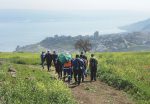
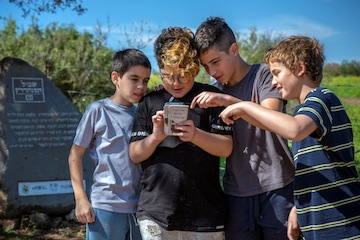
The trail crosses the Galilee from Beit She’arim to Tiberias. (photo by Israel Antiquities Authority from Ashernet)
Dozens of stone relay stations along the path transmit information and activities to hikers’ mobile telephones. (photo by IAA from Ashernet)
This year in the Galilee, thousands of students have been excavating and organizing the first “smart trail,” in which dozens of stone relay stations along the path transmit information and activities to hikers’ mobile telephones. The trail comprises part of the celebration of Israel’s 70th year of independence, and just opened. It extends 70 kilometres and is divided into sections, tracing the movements of the country’s greatest figures, the Sanhedrin sages, who rehabilitated the Jewish people following the Bar Kokhba Revolt. As did the Sanhedrin, the trail crosses the Galilee from Beit She’arim to Tiberias, passing through magnificent landscape, such as Nahal Zippori, Yodfat, Mount Arbel and Mount Atzmon.
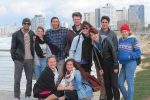
Itay Asaf, far left, with a group he led on a tour of Jaffa, where they visited the areas in which his dad grew up. This particular group was in Israel for eight days. (photo from Itay Asaf)
Esperanso is a recently established, socially responsible tourism company based in the United States that offers private tours to Israel. Created by Itay Asaf and his brother, Eyal, who are both are former kibbutzniks, the tours include a volunteering component.
“I led Birthright trips to Israel,” Itay Asaf told the Independent. “And I realized the trips are really nice and very fun for the students, but there was something missing for me, as an educator. I felt like the students are not really getting the true face of Israel, and they’re not really given the chance to give back.
“I wanted them to be very involved socially and to see sites they don’t usually get to see on trips. I found a social justice extension trip where I took the students, and I used tourism as a tool to empower local communities in south Tel Aviv, refugees and LGBTQ [for example]. And then I saw the impact and what it does for the students. Some even came back to Israel, and some are considering making aliyah.”
At that point, Eyal had a tourism company in Israel, so, together, the brothers built the concept for Esperanso. The name of the company reflects their family heritage – coming from Turkey and having a Spanish name – and it is a play on the word esperanza, meaning hope.
“One of the reasons I wanted to combine social work and social justice in everything I did, is my aunt,” said Itay. “She grew up in a village for people with special needs, Kfar Tikva. My brother and I wanted to take the experience we had with tourism and growing up with my aunt, and I saw the potential of the tourists that already come to Israel. We approach [them] and we say, ‘We welcome everyone. We accept groups. We accept youth. We invite people to celebrate bar mitzvahs.’ But, what we add is, ‘When you travel with us, you are actually empowering communities.’
“We took social organizations that we were personally connected to and we combined them into the itineraries with each of our trips,” he explained. “Not only do you support them by the activities during your trip, we also promise the organizations that five percent of the cost of your trip will go to one of them; that we will donate, based on your choice. This way, we ensure those organizations are empowered, socially and economically. We can take any trip you desire to do in Israel and make it into a socially responsible one.”
Esperanso connects with the various organizations ahead of time, with the goal of having participants get an inside view. The Asafs’ hope is that some visitors will make a deeper connection with the organizations and create partnerships, or set up longer-term volunteering with them.
“There are a variety of organizations just waiting for tourists to come and see what they do and support them,” said Itay. “That’s our pleasure – connecting and introducing you to those organizations.
“When I started,” he said, “I had a student who, two months after the trip, came to me and said she is going back to Israel to volunteer for a year. I almost cried I was so happy. This is what I wanted. It’s amazing to see. She was attached to it and she saw what she could do.”
The groups Esperanso leads vary in size, but, most important for Itay is connecting with interesting people and finding ways to create the trip they want together. So far, he has been on all the trips as the guide, but that might change. Depending on volume and availability, his brother might step in and guide some tours. As his brother lives in Israel, Eyal is the one taking care of everything on the ground until Itay lands with the group.
“We are very competitive cost-wise in the market,” said Itay. “We are aware that part of what we are making is going to these organizations, and we are completely, honestly, OK with that, happy with that.
“I’d say, if someone wants to go to Israel and do the journey with the hotels, the bus and everything, I think we are offering a very competitive package. They can just contact us, come to Israel and have everything ready for them in a socially responsible approach.”
The Asafs see Esperanso as something more than just a tourism company. For them, it is part of the future, of the new economy.
“I think we should support companies and organizations that care about the surroundings,” said Itay. “I think that, if everyone would care a little bit more, we could find ways to also profit the communities around us. If we make the right connections, we can change the world…. I urge everyone to look for ways to direct your money just a little bit to help people in need.”
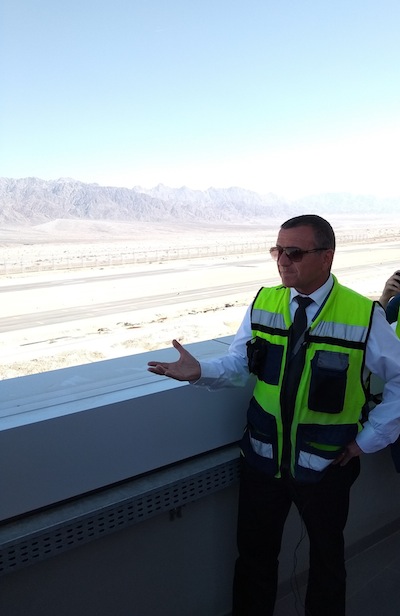
Ramon International Airport in Eilat will begin service on Oct. 28. (photo by Gil Zohar)
With Ramon International Airport beginning service on Oct. 28, officials hope that the state-of-the-art facility will boost tourism to the once-sleepy Red Sea resort of Eilat. But will a gleaming airport bring the crowds?
Perched on the 50-metre-high control tower during a March 19 media tour of the site, airport manager Hanan Moscovitz explained that the facility will replace Eilat’s Yaakov Hozman Airport, named after the founder of Arkia Airlines. While the current airport’s location is convenient for prop planes from Tel Aviv, it causes noise pollution and cuts off the city from its hotel district.
The new airport is named after aviation heroes Ilan and Asaf Ramon. The former was Israel’s first astronaut; he perished in 2003, when the Columbia Space Shuttle exploded while reentering earth’s atmosphere. His son, Asaf, also an Israeli Air Force F-16 fighter pilot, was killed six years later in a jet crash.
The Israel Airport Authority hired 160 construction workers from Moldova to build Ramon Airport. The total cost of the facility will be NIS 1.7 billion (more than $614 million Cdn). That investment will be partly recouped by the sale of the municipal airport’s land for hotels, condominiums and a convention centre.
But why build an international airport for a city of only 60,000 people? “There’s no de-icing,” Moscovitz quipped. Blessed with 330 days of sunshine annually, Eilat makes an ideal winter holiday destination.
Ramon International Airport manager Hanan Moscovitz at a March 19 media tour of the new facility. (photo by Gil Zohar)
A popular tourist stop in the 1990s, the city foundered after the Second Intifada broke out in 2000. As well, Eilat’s 12,000 hotel rooms couldn’t compete with the 100,000 budget rooms in the nearby Sinai’s luxurious resorts. But foreign visitors to Eilat have been on an upswing in recent years, Moscovitz explained, thanks to the Open Skies agreement with the European Union that was ratified in 2013.
Boosting airplane arrivals to Eilat – which should reach 55 flights weekly this winter – will be nothing less than a revolution, according to Eilat Hotel Association director Shabi Shai. While only 60,000 foreign tourists arrived in 2015, that number more than doubled to 130,000 in 2016, and then rose to 210,000 last year. In 2017, Israel as a whole had a record year for tourism, with 3.6 million visitors.
Some 400,000 people, the majority from Russia, are expected in the 2018/19 winter season, said Shai. In the past, many of those sun worshippers had preferred Egypt. But, on Oct. 31, 2015, a bomb smuggled onboard a charter en route to Saint Petersburg from Sharm El Sheikh exploded over Sinai. All 224 passengers and crew were killed.
The 32,000-square-metre Ramon Airport terminal was designed by Tel Aviv’s Mann Shinar Architects, and Moshe Zur Architects. The building will initially handle up to two million passengers annually, and the airport’s control tower is equipped with an instrument landing system for the rare day the airport is fogged in. A drainage ditch will keep the runway dry, even in a once-in-70-years flash flood.
Because of security concerns, the 3,600-metre-long tarmac will accommodate the largest commercial jumbo jets. During the 2014 Gaza conflict, known as Operation Protective Edge, a rocket fired from a Hamas-controlled coastal enclave toward Tel Aviv landed in Yehud, five kilometres from Ben-Gurion Airport. In response, the U.S. Federal Aviation Administration barred American carriers from landing at Ben-Gurion for nearly 48 hours. When foreign airlines followed suit, the Jewish state was effectively cut off because, with Ben-Gurion shuttered, Israel had no other airport with international capacity. To prevent this situation from happening again, Transportation Minister Israel Katz had Ramon Airport’s runway lengthened and increased the apron parking.
Located alongside the Jordanian border, Ramon Airport has special security needs of its own. The facility’s exposed eastern flank is girded with both a fence and a 30-metre-high, 4.5-kilometre-long electronic barrier. The high-tech hurdle features sensors and detection technology to protect incoming and departing planes from shoulder-launched RPGs (rocket-propelled grenades) and other unnamed threats.
For Tourism Minister Yariv Levin, Ramon Airport will support the continued revitalization of Israel’s southern city. “Incoming tourism to Eilat is breaking all records, and we are witnessing an extraordinary momentum of airlines opening new direct routes into the city,” he said.
Shai, however, acknowledged that tourists don’t go to an airport but a destination. All the carefully prepared tourism plans could unravel if war broke out, he cautioned. But everyone in Israel, including in Eilat, is hoping that doesn’t happen.
The Upper Galilee’s Mizpe Hayamim is a beautiful place. (photo by Karen Ginsberg)
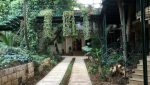
Unless you are one of the lucky Canadians who lives in the Okanagan Valley or the Niagara Peninsula, chances are that most of the “fresh food” that you buy – particularly fruits and vegetables – travels some distance before it reaches your table. On a recent trip to Israel, my husband and I experienced how very splendid it would be to live adjacent to a 35-acre organic farm that produces everything from its own olive oil and soaps to bountiful dairy products, as well as every fruit, vegetable, grain and herb one could imagine. We enjoyed all of this at Mizpe Hayamim Spa Hotel, located on Mount Canaan, near the town of Rosh Pina, in Israel’s Upper Galilee.
Mizpe Hayamim Spa Hotel, located on Mount Canaan, near the town of Rosh Pina, is adjacent to a 35-acre organic farm. (photo from Isrotel)
The history of the 96-room hotel dates back to 1921, when a German internist, Dr. Erich Yaroslovsky (later shortened to Yaros), bought the acreage now known as Mizpe Hayamim. Yaros’ vision was to build a convalescent home based on a vegetarian diet and natural treatment methods, which he felt would best serve the rehabilitation needs of his patients. The doctor was particularly drawn to the quality of the air and the tranquility of the setting. The land was originally owned by Baron de Rothschild, who had also been captivated by the beauty and tranquility of the area.
Before realizing his dream, Yaros encountered a series of setbacks, including receiving only a modest water allotment from the town of Rosh Pina, which was developing rapidly; the need to return to Germany for several years to support aging parents; the failure of promised positions as a physician in nearby communities to materialize; and a stint in Tel Aviv serving as its only homeopathic doctor. There was also a construction prohibition order from the British army, which was then planning fortifications in the area to protect against possible Nazi invasion through Lebanon.
Notwithstanding the long series of delays, by 1968, Yaros had the building authorities, financing and his personal determination to develop Mizpe Hayamim, albeit on a more limited scale. He built his first home at the location where the current Mizpe Hayamim now stands. It included a dining room, kitchen, bedrooms for his family and 12 guest rooms for the first of his patients. In later years, he was able to expand.
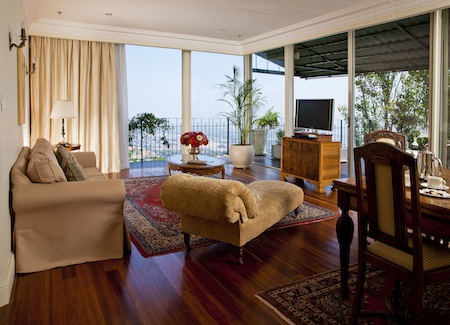
(photo from Isrotel)
In English, mizpe hayamim means a view between two bodies of water, in this case, the Sea of Galilee and the lakes of the Hula Valley. The view from the highest and most expansive terrace at the hotel includes the town of Rosh Pina just below and to the left, an Israeli military base in the middle and the tip of the Sea of Galilee to the right. Small Jordanian villages dot the horizon and were barely visible in the mist of an October morning. At the time of our visit, the “mizpe” was only partially green. We were told that, with each teef, toof (bit of winter rain), the surrounding lands would become greener and that, before long, the whole of the Upper Galilee would be lush and vibrant.
A year before he died, in 1984, Yaros sold Mizpe Hayamim to Sammy Chazzan, an Israeli who shared Yaros’s commitment to the healing powers of organic food and tranquil surroundings. For more than 35 years, Chazzan led every dimension of the development of Mizpe Hayamim – hotel and farm – until 2016, when he sold the hotel portion to the Israeli chain Isrotel. He retained stewardship of the farm.
The organic farm was the first-of-its-kind in Israel and employs nine workers. From the time he was 14, Chazzan has had an interest in organic farming – a rather unusual passion for a young man but a passion he has sustained. Until the recent sale to Isrotel, Chazzan’s daily schedule started at 4 a.m., when he would draft the day’s orders for the hotel staff and then walk over to the adjacent farm to work at whatever needed to be done there. At 8 a.m., he would return to manage the hotel and then finish the day with a few more hours spent on the farm.
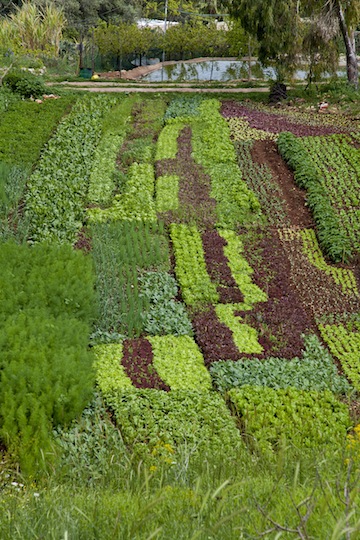
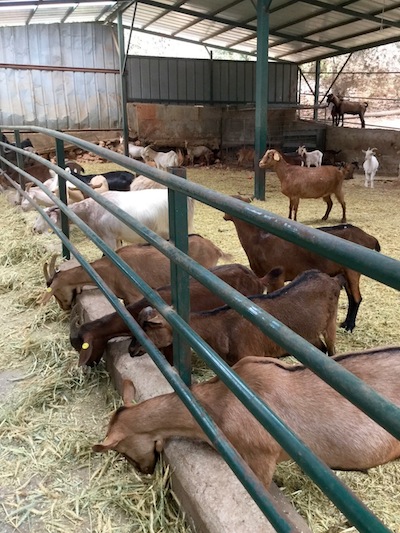
The achievements of his 35 years of agricultural experimentation are truly remarkable. The farm now includes nine large vegetable, herb and flower gardens, a herd of dairy cows and goats whose milk helps create about 40 individual dairy products – milk, yogurts, ice cream and cheeses. The animals are cared for in the most pristine of settings, feeding on grasses and able to roam about freely. Should they fall ill, they are cared for by a holistic veterinarian practitioner.
(photo by Karen Ginsberg)
Manure is recycled to fertilize the gardens, and the fruit and nut trees and flowers grow in abundance. Years of trial and error have helped establish which flowers or herbs planted alongside which vegetables reduce insect infestations, eliminating the need for pesticides of any kind. Several times a day, ripened produce is brought to the Mizpe Hayamim kitchen and finds its way to the dinner or breakfast buffets with the sort of haste that most Canadians can hardly fathom. Natural soaps are made on the farm for sale and for use in the hotel. In addition, there is a bakery and small retail outlet that sells some of the produce to guests and members of the public.
At the hotel, there is a full range of spa services for guests. Our casual conversations with other guests suggest that many Israelis come here, seeking a reprieve – nourishment and rest – from the tensions and high activity levels of city life. Guests can enjoy a coffee and tea bar all day long, with many of the farm’s fresh herbs – lemongrass, hyssop, chamomile, spearmint – available to enrich their beverages. Daily exercise classes, an art studio and evening entertainment are optional for guests and help sustain the goal of total relaxation and rejuvenation.
Isrotel plans to refurbish and update some of the hotel rooms but the essential philosophy underpinning this unique endeavour will remain the same. And Chazzan intends to continue his life’s work of building a knowledge base about organic farming and its impacts, through small-scale experimentation.
Long after their visit, guests fortunate enough to enjoy some time at Mizpe Hayamim will continue to benefit from the tranquility and beauty of the area, the organic vegetarian diet, as well as the various spa treatments on offer. For more information, contact Liad Nudelman, reception manager at Mizpe Hayamim, at liadn@isrotel.co.il, or visit isrotel.com.
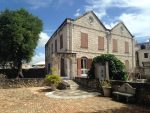
Nidhe Israel Synagogue is a UNESCO World Heritage Site. (photo by Tasha Nathanson)
One of the oldest synagogues in the Western Hemisphere is in Barbados. I was living in Barbados, working on a Canadian agricultural development project, when I tripped over this unexpected fact. I knew that the real estate agent who helped me find housing – and who, not coincidentally, became my neighbour – was Jewish, but I had assumed he was an anomaly here, in the most eastern island of the Caribbean. This was not the place I had anticipated a Jewish story to unfold.
The neighbour, Steven Altman, is reasonably well known in this small place where everyone seems to know most everyone. But many of the islanders I met inserted the comment, “he’s Jewish” into any mention of him, which reinforced my impression that being Jewish was unusual here. The Barbados I encountered in the seven months I lived there is a place that runs according to racial categories and everyone seems to be categorized according to skin colour and place of origin. Even though I’m half-Jewish, I was the white Canadian woman at work.
Curiosity prompted me to board a crazy ZR van headed into Bridgetown one day to find out more about Nidhe Israel Synagogue. ZR vans are semi-unregulated transport vehicles built to seat about 10 passengers, though I’ve been in them packed with more than 20 fellow travelers. People squish in, pressing up against each other with infinite stony-faced endurance. The soca music is generally blaring and often the driver has the flag of some neighbouring island pinned to the front, indicating where he lived before ending up in Barbados driving the public bus route in a private vehicle. The cost is always exactly two Barbadian dollars to ride and the experience is totally worth it.
The Synagogue Historic District is a UNESCO World Heritage Site in the Barbados capital city of Bridgetown. Originally built around 1654, it was destroyed by an 1831 hurricane, rebuilt in 1833 and restored from 1987 through 2017. Constructed by Sephardi Jews fleeing Recife, Brazil, after that colony passed from Dutch to Portuguese hands, these arrivals sought the relative safety of British-controled territory. The Jewish community was able to practise their faith openly here even before they regained that right in England.
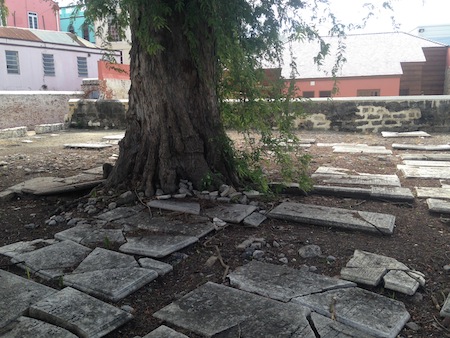
The synagogue grounds include a cemetery. (photo by Tasha Nathanson)
The refugees settled into housing on Jew Street (now Swan Street) and brought with them knowledge and experience of the sugar cane industry. For this, I raise a glass of fine Barbadian rum, as this accident of history resulted in a terrific local finished product. By the mid-1700s, the Jewish community was 800 strong, which was the peak of Jewish settlement.
The hurricane in 1831 was a disaster that destroyed more than just the synagogue, resulting in an exodus to the United Kingdom and the United States. By the 1920s, only one Jewish resident, Edmund Baeza, remained, holding the keys to the building. When he, too, left, the synagogue was sold and deconsecrated.
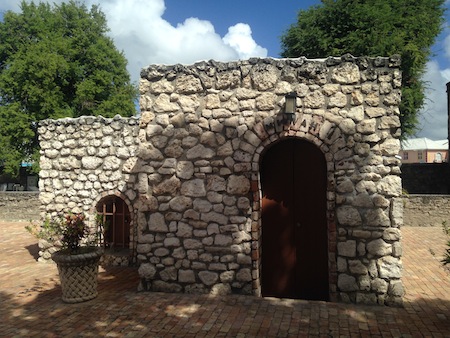
The mikvah wasn’t open to the public, but the inside could be seen from the window. (photo by Tasha Nathanson)
By the 1980s, the building was dilapidated, in use as a warehouse and destined for demolition, when a renewed Jewish community stepped in to begin the process of restoration. The synagogue officially reopened in April 2017, and it is a gorgeous, tranquil and instructive space.
When my neighbour Steven boasted that it was his family that was responsible for the resurgent Jewish community in Barbados, I filed away his comment with a few of his other questionable statements, such as when he had appealed for my company on the basis of needing someone to wash his laundry. Steven wasn’t even aware that I might take offence. Standards of male expression and behaviour are one of the more dubious cultural differences for a Canadian woman living temporarily in Barbados.
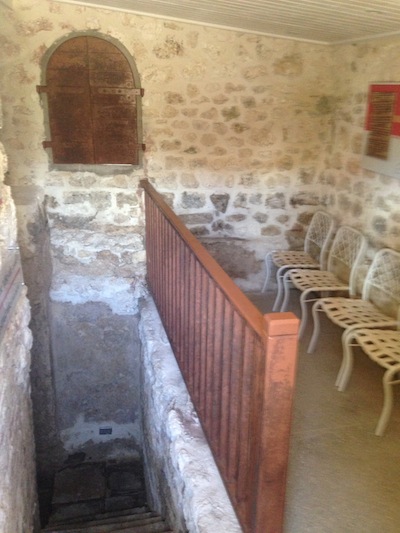
The inside of the mikvah. (photo by Tasha Nathanson)
Despite my skepticism, however, the Altmans were indeed a primary element of the reconstruction effort and are longstanding pillars of the community, according to the plaques at the synagogue. Steven, when asked, wistfully described the tight-knit community of his childhood, drawn together to play games, fundraise for charity and visit each other’s homes, in addition to worshipping together. I grew to enjoy hearing Steven’s voice trailing out the windows of his home and through the tropical evening heat when he practised the prayers for services; it became a pleasant part of my experience of Barbados.
The second wave of Jewish Barbadians was Ashkenazi, mainly fleeing Europe, starting to arrive shortly after Baeza’s departure. My tour guide at the synagogue museum, curator Celso H. Brewster, described desperately seasick travelers bound for South America with skeins of cloth and other mercantile goods to start anew, stumbling out onto the solid ground of Barbados and refusing to go any farther. They set up shop in Bridgetown instead of continuing their journey.
As for Celso himself, he informed me that he was Baha’i but that he did have some Jewish roots as well. Those roots travel through his family line via a version of what was once a Jewish name, bestowed on a born-out-of-wedlock ancestor via a certain plantation holder with, shall we say, quite liberal application of his affections. I’ve heard various versions of this story from other Barbadians. Jews were not only merchants, but there were some Jewish pirates and, sadly, Jewish slave owners.
Nidhe Israel Synagogue and its grounds – which include the original mikvah, which was uncovered in 2008 to reveal a still-flowing spring; an extensive cemetery, as well as a museum – is a beautiful oasis for thoughtful reflection and learning.
The Synagogue Historic District is located on Synagogue Lane, Bridgetown, Saint Michael’s, Barbados. The museum is open weekdays, 9 a.m. to 4 p.m. It is free to enter the courtyard to look around; the entrance fee to the museum is $25 BDS (about $16 Cdn). To find out more, visit synagoguehistoricdistrict.com. Better yet, visit the synagogue.
Tasha Nathanson recently returned from a stint in the eastern Caribbean as gender equality and youth empowerment advisor on a World University Service of Canada project.
The view of Camelback Mountain from Mountain Shadows resort. (photo by Masada Siegel)
On a late Thursday afternoon in August, my husband arrived home from work and excitedly said, “You have to come out front and see the double rainbow – it’s stunning!” I picked up our little boy and rushed outside to see the mystical wonder that glittered through the raindrops of the Arizona sky.
When I turned to go back inside, I noticed an Orthodox Jewish man on a cellphone standing outside our neighbour’s house, which is an Airbnb. Every few days, a new group of people arrives, but this time I walked over and introduced myself. He told me that 10 yeshivah boys from all over the United States and Canada were staying in the house for two weeks on a summer trip to see Scottsdale and explore Arizona. I told him I was a travel writer and would be happy to help with any suggestions on what to see, where to go, where the kosher restaurants were located and about the local synagogues.
They had chosen the home because it was in walking distance of Ahavas Torah, an Orthodox synagogue, where the community warmly welcomed them. I laughed and said, “There is actually another shul in walking distance, Beth Tefillah, which is led by Rabbi Allouche, who is an amazing leader who gives incredibly insightful sermons, and someone also to check out.”
The conversation then turned to kosher restaurants that are nearby. One is Milk and Honey, located inside the Jewish community centre, which boasts food like chipotle salmon wraps, kale tacos and shakshuka. The other kosher restaurant is Kitchen 18, which has an eclectic menu, from Israeli food to Chinese to sushi.
My new neighbours had done their research and had also koshered their kitchen, so they were ready to explore their beautiful new surroundings that I call home.
Chaim, who was from Toronto, was the ringleader, otherwise known as the organizer of the group, so he told me about some of their travel plans. Every other night or so, we got a report about their activities as we bumped into them outside their home of the next two weeks.
Butterfly Wonderland offers wonders you can touch. (photo by Masada Siegel)
Scottsdale is known for its outdoor activities and one fun hike is Camelback Mountain, where the views are phenomenal. There are two trails, one is shorter and more vigorous, and the other is longer but not as steep. After a few-hour walk, locals and tourists alike often head to downtown Scottsdale to indulge at one of the many breakfast places, as well as to stroll around. The Scottsdale Civic Centre is a park filled with fountains and is close to the Scottsdale Centre for the Performing Arts, which has a great gift store. Pop into the library, too, just to see the architecture, buy a book or have a coffee in their café.
Nearby is one of my favourite casual restaurants, called AZ88. Often in the winter months, there are international festivals in the park across the way.
Scottsdale has the most gorgeous winter weather and also provides engaging activities for families. A perfect place for a picnic, especially with young kids, is McCormick-Stillman Railroad Park. Visitors can ride the 1950s-vintage Allan Herschell carousel and then jump on the mini-train and ride around the park. There is also a 10,000-square-foot model railroad building where trains zip around. Check out the museum, which houses the Roald Amundsen Pullman Car, best known for being used by every president from Herbert Hoover through Dwight Eisenhower.
For more active adventure, iFLY allows you to experience skydiving without actually jumping out of a plane at 12,000 feet. I call it “reverse skydiving” because you don’t jump down, you start standing as opposed to falling. The new facility is state-of-the-art and it has activities for the whole family.
For the tamer at heart, all in one complex are Butterfly Wonderland, OdySea Aquarium and Dolphinaris, where people can swim with dolphins.
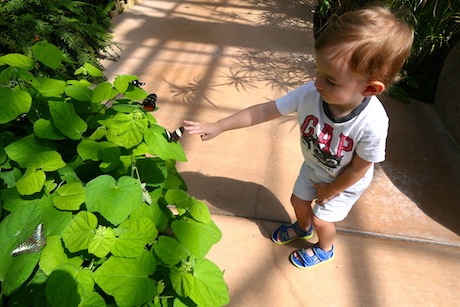
Butterfly Wonderland is the largest indoor butterfly pavilion in the United States and is home to thousands of butterflies from all over the world. Prior to entering the pavilion, visitors also can see the emergence gallery, where the little creatures are in various states of life, many in metamorphosis.
OdySea is the largest aquarium in the southwest. (photo by Masada Siegel)
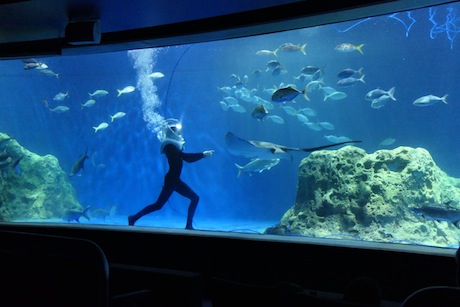
And OdySea is the largest aquarium in the southwest. It features more than 30,000 animals, 50 exhibits and an aquatic presentation, where guests sit in a theatre and rotate around an enormous tank filled with sharks, sea turtles, seals and sea lions.
A must-see while in Arizona is the Musical Instruments Museum, which displays more than 6,000 instruments and is the world’s only global instrument museum, with items from 200 countries and territories. The museum is an award-winning Smithsonian Affiliate and guests can see and hear the instruments, as well as watch them being played.
Scottsdale has many public parks, such as Cactus Park and McDowell Mountain Ranch Park, where visitors pay a mere $3 per person to be able to use the Olympic-size swimming pools and gym facilities.
While being my next-door neighbour is optimal, if you want a personalized tour, the house is often rented, but there are several resorts in the area.
Mountain Shadows provides views of Camelback Mountain, offers gym facilities with myriad classes and has an award-winning chef. The hotel restaurant, Hearth 61, an open kitchen concept, has excellent meals, a friendly and helpful wait staff and incredible views. And guests can sign up for a class with photographer Erik Merkow.
While Mountain Shadows is a modern resort, it was completely rebuilt from the ground up, and takes the place of a hotel with a Hollywood past, welcoming such stars as Bob Hope and Lucille Ball.
Another accommodation option is the Scottsdale Resort, which has a relaxed, charming atmosphere, comfortable rooms, swimming pools and Kitchen West Restaurant, where every meal is delicious. The hotel also has lots of open spaces to walk around and explore, and is a perfect place for a family with kids.
The Shabbat before our temporary neighbours returned home, they invited us to come over and spend some time with them. They marveled at Scottsdale and a few of them said they were definitely coming back, as the community had welcomed them with open arms. It was nice to see my hometown through their appreciative eyes, as often we forget to notice in our own community the beauty that surrounds us and the people who lovingly embrace us.
We need such reminders every so often. And, sometimes, it’s as simple as rushing out of your house to see a double rainbow and getting a double surprise, making new friends as well.
Masada Siegelis a writer living in Scottsdale. Follow her on Twitter @masadasiegel.
BirthWrong participants in Calanques de Morgiou. (photo courtesy Jewdas)
Marseille, a lively port city sloping down toward the Mediterranean Sea, has a long, rich history of immigration and multiculturalism – including a Jewish presence dating back 1,000 years. Today, France’s second-largest city is home to about 80,000 Jews, or almost 10% of its population, with both newer and centuries-old Sephardi and Ashkenazi communities.
Recently, a group of 30 self-identifying Jews and allies from Europe, North America, South Africa and Israel gathered in Marseille for the second edition of BirthWrong, an initiative started by the London-based collective Jewdas to explore and celebrate Diaspora histories and cultures. (The inaugural BirthWrong took place in Seville, Spain, in 2015.) We spent four days exploring the city and surrounding nature, meeting with locals and partaking in Jewish life, and found plenty to do for visitors.
The city’s Old Port is the classic starting point, with a spacious plaza, boat-filled marina and daily cruises shuttling visitors along the Calanques, a 20-kilometre series of fjord-like inlets surrounded by steep limestone cliffs. With a compact city centre, Marseille is easy and enjoyable to explore on foot; there are also trams, buses and subways. As in Vancouver, there are beaches in the heart of the city (Plage des Catalans, west of the Old Port) and near the centre (Malmousque, Plage du Prophète, Plages du Prado and Pointe Rouge).
In a city of 40 synagogues, the oldest and grandest is aptly called the Grande Synagogue de Marseille. Opened in 1864, it’s a three-storey Sephardi synagogue (with a basement Ashkenazi chapel) that hosts Shabbat services on Saturdays, followed by Provençal-style kiddush including green olives, anchovies and pastis, which is a local anise-based liqueur. The small congregation is predominantly Algerian-French Jews, and the impressive sanctuary – with the men’s section on the ground floor and women on the second floor – has shining marble floors, chandeliers, Romanesque arches and jewel-toned stained-glass windows. To attend services, be prepared to bring ID and have your bag searched, and women are asked to wear a dress or skirt.
A plaque outside commemorates that, in 1943, Jews were deported from the synagogue to Nazi death camps. In Marseille, 23,000 Jews were deported – with French police aiding the Nazis – and about 1,800 were killed in camps.
Prewar Jewish history in Provence dates back to the first century, with a more documented presence starting in the sixth century. After the Inquisition, Sephardi communities arrived from nearby Spain and Portugal and, in the Middle Ages, when the Vatican controlled the Avignon-Carpentras area, the Juifs du Pape (Jews of the Pope) acted as its financiers. At the time, Jews were banned in most other parts of present-day France.
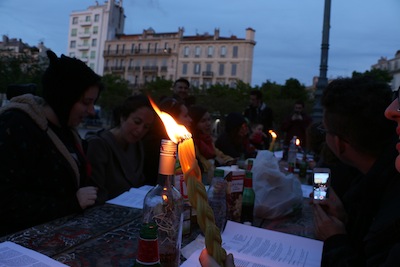
BirthWrong participants take part in Havdalah. (photo courtesy Jewdas)
Today, much of the Jewish community in Marseille came from Tunisia, Algeria and Morocco in the late 1950s and early 1960s, following the countries’ independence from France. The city is also home to large Italian, Armenian and North African communities (resulting in delicious cuisines to choose from).
A local guide, Lou Marin, gave us a custom walking tour of the city centre focused on 1939-1945, and has encyclopedic knowledge of Marseille’s history. He leads hours-long or multi-day walking tours with flexible rates. (Contact loumarin.mrs@immerda.ch or 33-486-954576 to inquire about a tour.)
Just outside the city, Calanques National Park offers more than 85-square kilometres of stunning coastal walks through pine forests, which were planted by the Romans, and ridges above the cliffs, with bushes of wild rosemary and thyme dotting the landscape. Our group did a four-hour hike with local guide Felix Altgeld (provenceapied.wordpress.com), who offers customized walks and has extensive knowledge of the local flora and geography.
Food-wise, Marseille is an affordable city within France, with ample fresh produce coming from sunny Provence and varied cuisines to relish, including North African kebab shops, Lebanese delis and 30 kosher eateries (including the pizza food truck L’imprévu). On Tuesday, Thursday and Saturday mornings, look out for the market in La Plaine plaza, a community institution with independent food stalls and other shopping. The neighbourhood, which holds an annual carnival and is filled with colourful street art, is fiercely resisting gentrification, and maintains an inspiring multicultural, multi-class spirit day and night.
We got the sense that many non-Jewish Marseillais are aware of Jewish history and culture. At the annual May Day rally, multiple locals (both Jewish and non-Jewish) approached our group to ask about our trip and the Yiddish songs we were singing. Both Marin and the local historian Alessi Dell’Umbria, who spoke to us about Marseille’s history, knew a lot about Marseille’s Jewish history and culture through both their work and their personal lives.
Given France’s culture of secularism – where religious identity isn’t generally part of public life – the local Jewish activists who hosted us found it refreshing and unusual to meet Jews who bring our religious identity to politics, wear Stars of David and kippot and are openly Jewish in public. We, in turn, were fascinated to visit a bustling but laid-back city with a rich left-wing history, near-constant sun and diverse communities carving out an inclusive collective identity.
Marseille is just over three hours from Paris by high-speed train (visit sncf.com/en).
Tamara Micneris a playwright and journalist from Vancouver who lives in London, England. Her work has appeared in the Globe and Mail, Wall Street Journal and London Review of Books.
Salt print of Adolphe Crémieux, December 1856, by Nadar (1820-1910), from the J. Paul Getty Museum. (photo from Wikimedia Commons)
While Jerusalem’s French connection thankfully lacks the violence and crime of the 1971 movie by the same name, both the film and real-life “French” Jerusalem have one thing in common: both expose us to off-the-beaten-track sites. Take a look at what you’ll find in Jerusalem.
The Israel Museum (11 Ruppin Blvd.) has amazingly reassembled an original 18th-century French salon called the Rothschild Room. (All that’s missing is the fancily dressed smart-set listening to a book or music recital.) It also has an impressive collection of French impressionist and post- impressionist painters, such as Pierre-Auguste Renoir, Camille Pissarro, Edgar Degas,
Alfred Sisley, Claude Monet, Paul Cézanne, Paul Gauguin and Henri de Toulouse-Lautrec, as well as works by earlier French artists such as François Boucher.
Speaking of paintings, 120 years ago, Count Marie Paul Amédée de Piellat painted Crusader-related images on the wall of what is today known as Jerusalem’s French Hospice, a non-denominational facility for the terminally ill. Painted in fresco-style, they were recently uncovered during a routine repair.
First built some 130 years ago as St. Louis Hospital – after the same King Louis IX who was responsible for broadening the Inquisition and burning Talmuds – it stands at 2 Shivtei Yisrael St. Around the corner from the hospice is the Romain Gary French Institute of Jerusalem, which promotes French culture by means of French-language courses, a French-language library and a media and entertainment space.
Romain Gary was a Second World War pilot, French diplomat and filmmaker, but was best known for his prolific writing. He won literary prizes using various pen names. Born to Jewish parents, his mother had him baptized a Catholic. Oddly, he had a large menorah at the foot of his bed when he shot himself dead.
Jerusalem’s Ratisbonne Monastery – built in the late 1880s, in Rehavia, 26 Shmuel HaNagid St. – is named after two French Jewish brothers who converted to Catholicism and made it their mission to have Jewish children follow in their “way.” Just before Israel declared statehood, 60 children from Kfar Etzion were safely evacuated to the monastery before the kibbutz fell. Most of the kibbutz defenders, however, were killed in the fighting. During the period in which the Jordanians blocked Hebrew University’s Mt. Scopus campus, the Ratisbonne Monastery served as the school’s law faculty.
Today, the monastery is an international theological school for those studying for the Catholic priesthood.
Several Jerusalem streets are named after French personalities who were either themselves Jewish or had connections to Jews. Centrally located Emile Botta Street is named after the French consul in Jerusalem during the Ottoman rule. The 90-year-old Pontifical Biblical Institute stands on this street. This facility has been in the news lately, as an Egyptian mummy belonging to the institute is currently on exhibit at the Israel Museum.
Emile Zola Street in the German Colony honors the outspoken journalist who defended Captain Alfred Dreyfus’ innocence. In a Jan. 13, 1898, letter (J’accuse!) to the French president, Zola publicly charged the French government and army with suppressing the true story behind Dreyfus’ arrest. Zola himself paid a high price for his bravery; he fled to Britain to avoid prison, only to die there suddenly and suspiciously from carbon monoxide poisoning.
Located near Emile Zola Street is Adolphe Crémieux Street. Crémieux was a Jewish lawyer, statesman, staunch defender of human rights (both of Jews and slaves) and the founder, in 1860, of the Alliance Israélite Universelle; four years later, he served as its president. Unfortunately, the Alliance vocational school no longer stands, but you can still see approximately where the gate was on Jaffa Road, in front of the site’s successor, the Clal Building.
Crémieux did much to better the conditions of the Jews in France. In 1827, he advocated the repeal of the Oath More Judaico, a piece of stigmatizing legislation left over from pre-revolutionary France. Crémieux apparently brought about the abolition of the oath when he defended Rabbi Lazard Isidor. The rabbi – who went on to become France’s chief rabbi – had refused to take the antisemitic oath and was charged with contempt of court. Crémieux got him acquitted. On March 3, 1846, the French Supreme Court finally declared the oath illegal.
Crémieux was likewise involved in defending Saratov (Russia) Jews facing charges of blood libel. For his instrumental assistance in bringing about the end to slavery in the French colonies, Crémieux was nicknamed the “French Abraham Lincoln.”
In recent years, Crémieux Street drew significant attention when police investigated former prime minister Ehud Olmert for the suggested favorable terms he received on the purchase of a home on this street, in exchange for help rendered to the contractor who sold it to him. The National Fraud Unit ultimately advised that there was not enough evidence to proceed with criminal charges against Olmert in the “Crémieux Street affair.”
Frederic Chopin Street is named for the well-known, Polish-born, French composer and pianist. Probably not coincidentally, this Talbiya street is the site of the Jerusalem Centre for the Performing Arts. Six halls serve as regular venues for music and dance concerts, dramatic performances and films.
Located in an ultra-Orthodox neighborhood, Estori Haparhi Street is named after the first topographer of the land of Israel. Haparhi’s family lived in Provence, but was expelled from France, along with the rest of the medieval Jewish population. Following this expulsion, he made aliyah and frequently preached the necessity of settling in the Holy Land. While making his living as a doctor, he wrote a book citing the biblical and halachic borders of Israel. He claimed that the Arabic names of numerous towns and villages reflected their Jewish textual names.
Speaking of medieval France, the Jerusalem municipality named three Mekor Baruch neighborhood streets after medieval Jewish scholars, Rashi and his two grandsons, the Rashbam and Rabenu Tam.
Neve Yaakov’s Gamzon Street recognizes the French resistance work of Robert Gamzon. In wartorn France, he set up an underground for issuing false identities to children and young adults. With these papers, they were able to escape France. Gamzon went on to fight in Israel’s War of Independence and to do research at the Weizmann Institute.
Talpiot’s Marie-Pierre Koenig Street commemorates the bravery and leadership of the French general who headed the Free France forces in the Second World War and took part in the D-Day landing. During the war, Koenig let members of the Jewish Brigade fly the blue and white flag, in defiance of British orders banning such action. Even after becoming the French minister of defence, Koenig remained an advocate of the new state of Israel.
For a general understanding of how the Holocaust affected French Jewry – including the critical assistance provided by French Jewish underground workers – plan a physical, or at least a virtual, visit to Yad Vashem (yadvashem.org). France’s recognition of Jewish defence was short-lived, however. Following the Six Day War, France embargoed its Mirage fighter jet. This forced Israel to develop the Kfir jet, and a street named HaKfir reflects Israel’s decision to go blue and white.
Deborah Rubin Fieldsis an Israel-based features writer. She is also the author of Take a Peek Inside: A Child’s Guide to Radiology Exams, published in English, Hebrew and Arabic.
קנדה נמצאת במקום העשירי והמכובד ואילו ישראל מדורגת רק במקום ה-71 והלא מכובד, במדד התחרות העולמי לתיירות ונסיעות. (צילום: reports.weforum.org)
קנדה נמצאת במקום העשירי והמכובד ואילו ישראל מדורגת רק במקום ה-71 והלא מכובד, במדד התחרות העולמי לתיירות ונסיעות. כך עולה מהדוח לשנת 2015 שכולל 141 מדינות. הדוח של הפורום העולמי מתפרסם אחת לשנתיים. עם זאת יש מקום לציין שקנדה נמצאת הרחק מאחור לגבי סוגיית המיסים הגבוהים הנגבים בשדות התעופה המקומיים, שמרביתם בבעלות הממשלה הפדרלית. העלויות הגבוהות כרוכות בדמי שכירות גבוהים והארנונה גבוהה. שדה התעופה היקר ביותר בקנדה הוא זה שבמונטריאול. ירידת מחירי הדלק וחולשתו של הדולר הקנדי משפיעים לטובה על ענף התעופה הקנדי, אך המיסים והיטלים גבוהים מצד הממשלה מונעים מחברות התעופה המקומיות, לעמוד בתחרות מול החברות הזרות. הנוסע הקנדי הוא זה שבסופו של דבר שמשלם את המחיר. מניסיוני האישי אני יכול לספר כי כרטיס מוונקובר לטורונטו וניו יורק היה זול בכ-200 דולר קנדי, לעומת כרטיס מוונקובר לטורונטו ומונטריאול.
עשר המדינות הראשונות במדד התחרות לתיירות ונסיעות העולמי הן: ספרד, צרפת, גרמניה, ארצות הברית, בריטניה, שווייץ, אוסטרליה, איטליה, יפן וכאמור קנדה עשירית. חמש המדינות האחרונות בדירוג העולמי הן: מאוריטניה, תימן, אנגולה, גינאה ובמקום ה-141 והאחרון צ’אד. בחלוקה לפי אזורים גיאוגרפים קנדה נמצאת במקום השני בצפון אמריקה והקריביים לאחר ארצות הברית. אחרונה באזור זה שכולל שש עשרה מדינות היא האיטי. במזרח התיכון מתוך שש עשרה מדינות מדינות ישראל שוב יוצאת רע, כיוון שהיא ממוקמת רק במקום השביעי. שש הראשונות לפניה: איחוד האמירויות הערביות, בחריין, מרוקו, ערב הסעודית ועומאן. במקום האחרון במזרח התיכון נמצאת תימן.
מחברי הדוח מציינים כי ב-2015 נרשם גדול תיירות ונסיעות למרות ההאטה הכלכלית בחלק ממדינות העולם. ענף הנסיעות והתיירות מהווה תשעה אחוזים מהתל”ג העולמי ועומד על שבעה טריליון דולר. לפי מחברי הדוח הגידול בענף התיירות והנסיעות עומד על כארבעה אחוזים מדי שנה.
הדוח מתחלק למספר תחומים בענף התיירות והנסיעות. אווירה עיסקית: סינגפור במקום הראשון, קנדה במקום ה-16, ישראל במקום ה-51 וונצואלה במקום האחרון. ביטחון ובטיחות: פינלנד במקום הראשון, קנדה במקום ה-21, ישראל במקום ה-99 וניגריה במקום האחרון, בריאות והגיינה: אוסטריה במקום הראשון, ישראל במקום ה-36, קנדה רק במקום ה-58 ומוזמביק במקום האחרון. משאבי אנוש ושוק העבודה: שווייץ במקום הראשון, קנדה במקום השביעי, ישראל במקום ה-39 ומאוריטניה במקום האחרון. מוכנות: פינלד במקום הראשון, קנדה במקום ה-27, ישראל במקום ה-32 וצ’אד במקום האחרון. מתן עדיפות לתיירות ונסיעות: מלטה במקום הראשון, קנדה במקום ה-36, ישראל במקום ה-64 ובורונדי מקום האחרון. פתיחות בינלאומית: סינגפור במקום הראשון, קנדה רק במקום ה-66, ישראל רק במקום ה-99 ואנגולה במקום האחרון. מחיר תחרותי: במקום הראשון והמפתיע איראן, קנדה הרחק מאחור במקום ה-124, ישראל במקום עוד יותר גרוע -136 ובמקום האחרון שווייץ. קיימות סביבתית: שווייץ במקום הראשון, קנדה במקום ה-26, ישראל רק במקום ה-101 ובמקום האחרון פקיסטן. תשתיות לתחבורה תעופתית: קנדה במקום הראשון, ישראל במקום ה-50 וצ’אד במקום האחרון. תשתיות לנמלים ותחבורה קרקעית: הונג קונג במקום הראשון, קנדה רק במקום ה-46, ישראל במקום ה-52 ומאוריטניה במקום האחרון. תשתיות לשירותי תיירות: אוסטריה במקום הראשון, קנדה במקום ה-14, ישראל במקום ה-72 ובורונדי במקום האחרון. משאבים טבעיים: ברזיל במקום הראשון, קנדה במקום העשירי, ישראל במקום ה-99 ובמקום האחרון האיטי. משאבי תרבות ותיירות עסקית: ספרד במקום הראשון, קנדה במקום ה-15, ישראל רק במקום ה-52 ולסוטו במקום האחרון.
Temple Mount Western Wall on Shabbat. (photo by David Shankbone via en.wikipedia.org)
Robin and Jon Sirkin prepared to celebrate their son Eitan’s bar mitzvah in Jerusalem last weekend. There was a Dr. Who theme and an ice-cream bar planned for the reception at the synagogue after the services. As part of the celebrations, Robin Sirkin’s brother, sister, aunt and cousin were planning to make their first trip to Israel. She booked a trip to southern Israel and a meal at one of Jerusalem’s most expensive restaurants for 15 people.
Four weeks ago, just after the ceasefire was declared between Israel and Hamas, which controls the Gaza Strip, they all canceled their trips. Sirkin, who moved to Israel from Cleveland three years ago with their four children, said she tried to convince her relatives that the ceasefire would hold, but to no avail.
“It’s devastating and heartbreaking and feels unsupportive,” Sirkin told the Media Line. “I think they’re overreacting, but we have a different sense of security here.
She said they held off telling their son that his relatives had canceled, hoping that as the big day he approached he would be more excited about the ceremony and the party, and less disappointed.
“He was a little sad, but he’s trying not to focus on that,” she said.
The Sirkins are not alone. Mark Feldman, CEO of Ziontours, said that the seven weeks of fighting between Israel and Hamas over the summer has devastated tourism for the rest of the year, except for the Jewish holidays this month, and Christmas. Feldman said they lost about 2,000 bookings, and most of the time waived the cancellation fees.
“Tourism for the rest of 2014 simply doesn’t exist,” Feldman said. “Now we’re looking toward 2015, and hoping the government will begin to lay the seeds to allow tourism to begin to come back.”