


BirthWrong participants in Calanques de Morgiou. (photo courtesy Jewdas)
Marseille, a lively port city sloping down toward the Mediterranean Sea, has a long, rich history of immigration and multiculturalism – including a Jewish presence dating back 1,000 years. Today, France’s second-largest city is home to about 80,000 Jews, or almost 10% of its population, with both newer and centuries-old Sephardi and Ashkenazi communities.
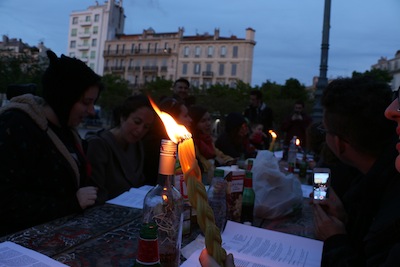
Recently, a group of 30 self-identifying Jews and allies from Europe, North America, South Africa and Israel gathered in Marseille for the second edition of BirthWrong, an initiative started by the London-based collective Jewdas to explore and celebrate Diaspora histories and cultures. (The inaugural BirthWrong took place in Seville, Spain, in 2015.) We spent four days exploring the city and surrounding nature, meeting with locals and partaking in Jewish life, and found plenty to do for visitors.
The city’s Old Port is the classic starting point, with a spacious plaza, boat-filled marina and daily cruises shuttling visitors along the Calanques, a 20-kilometre series of fjord-like inlets surrounded by steep limestone cliffs. With a compact city centre, Marseille is easy and enjoyable to explore on foot; there are also trams, buses and subways. As in Vancouver, there are beaches in the heart of the city (Plage des Catalans, west of the Old Port) and near the centre (Malmousque, Plage du Prophète, Plages du Prado and Pointe Rouge).
In a city of 40 synagogues, the oldest and grandest is aptly called the Grande Synagogue de Marseille. Opened in 1864, it’s a three-storey Sephardi synagogue (with a basement Ashkenazi chapel) that hosts Shabbat services on Saturdays, followed by Provençal-style kiddush including green olives, anchovies and pastis, which is a local anise-based liqueur. The small congregation is predominantly Algerian-French Jews, and the impressive sanctuary – with the men’s section on the ground floor and women on the second floor – has shining marble floors, chandeliers, Romanesque arches and jewel-toned stained-glass windows. To attend services, be prepared to bring ID and have your bag searched, and women are asked to wear a dress or skirt.
A plaque outside commemorates that, in 1943, Jews were deported from the synagogue to Nazi death camps. In Marseille, 23,000 Jews were deported – with French police aiding the Nazis – and about 1,800 were killed in camps.
Prewar Jewish history in Provence dates back to the first century, with a more documented presence starting in the sixth century. After the Inquisition, Sephardi communities arrived from nearby Spain and Portugal and, in the Middle Ages, when the Vatican controlled the Avignon-Carpentras area, the Juifs du Pape (Jews of the Pope) acted as its financiers. At the time, Jews were banned in most other parts of present-day France.
Today, much of the Jewish community in Marseille came from Tunisia, Algeria and Morocco in the late 1950s and early 1960s, following the countries’ independence from France. The city is also home to large Italian, Armenian and North African communities (resulting in delicious cuisines to choose from).
A local guide, Lou Marin, gave us a custom walking tour of the city centre focused on 1939-1945, and has encyclopedic knowledge of Marseille’s history. He leads hours-long or multi-day walking tours with flexible rates. (Contact loumarin.mrs@immerda.ch or 33-486-954576 to inquire about a tour.)
Just outside the city, Calanques National Park offers more than 85-square kilometres of stunning coastal walks through pine forests, which were planted by the Romans, and ridges above the cliffs, with bushes of wild rosemary and thyme dotting the landscape. Our group did a four-hour hike with local guide Felix Altgeld (provenceapied.wordpress.com), who offers customized walks and has extensive knowledge of the local flora and geography.
Food-wise, Marseille is an affordable city within France, with ample fresh produce coming from sunny Provence and varied cuisines to relish, including North African kebab shops, Lebanese delis and 30 kosher eateries (including the pizza food truck L’imprévu). On Tuesday, Thursday and Saturday mornings, look out for the market in La Plaine plaza, a community institution with independent food stalls and other shopping. The neighbourhood, which holds an annual carnival and is filled with colourful street art, is fiercely resisting gentrification, and maintains an inspiring multicultural, multi-class spirit day and night.
We got the sense that many non-Jewish Marseillais are aware of Jewish history and culture. At the annual May Day rally, multiple locals (both Jewish and non-Jewish) approached our group to ask about our trip and the Yiddish songs we were singing. Both Marin and the local historian Alessi Dell’Umbria, who spoke to us about Marseille’s history, knew a lot about Marseille’s Jewish history and culture through both their work and their personal lives.
Given France’s culture of secularism – where religious identity isn’t generally part of public life – the local Jewish activists who hosted us found it refreshing and unusual to meet Jews who bring our religious identity to politics, wear Stars of David and kippot and are openly Jewish in public. We, in turn, were fascinated to visit a bustling but laid-back city with a rich left-wing history, near-constant sun and diverse communities carving out an inclusive collective identity.
Marseille is just over three hours from Paris by high-speed train (visit sncf.com/en).
Tamara Micner is a playwright and journalist from Vancouver who lives in London, England. Her work has appeared in the Globe and Mail, Wall Street Journal and London Review of Books.



