Skip to content
  • Home
  • Subscribe / donate
  • Events calendar
  • News
    • Local
    • National
    • Israel
    • World
    • עניין בחדשות
      A roundup of news in Canada and further afield, in Hebrew.
  • Opinion
    • From the JI
    • Op-Ed
  • Arts & Culture
    • Performing Arts
    • Music
    • Books
    • Visual Arts
    • TV & Film
  • Life
    • Celebrating the Holidays
    • Travel
    • The Daily Snooze
      Cartoons by Jacob Samuel
    • Mystery Photo
      Help the JI and JMABC fill in the gaps in our archives.
  • Community Links
    • Organizations, Etc.
    • Other News Sources & Blogs
    • Business Directory
  • FAQ
  • JI Chai Celebration
  • JI@88! video

Recent Posts

  • Sharing her testimony
  • Fall fight takes leap forward
  • The balancing of rights
  • Multiple Tony n’ Tina roles
  • Stories of trauma, resilience
  • Celebrate our culture
  • A responsibility to help
  • What wellness means at JCC
  • Together in mourning
  • Downhill after Trump?
  • Birth control even easier now
  • Eco-Sisters mentorship
  • Unexpected discoveries
  • Study’s results hopeful
  • Bad behaviour affects us all
  • Thankful for the police
  • UBC needs a wake-up call
  • Recalling a shining star
  • Sleep well …
  • BGU fosters startup culture
  • Photography and glass
  • Is it the end of an era?
  • Taking life a step at a time
  • Nakba exhibit biased
  • Film festival starts next week
  • Musical with heart and soul
  • Rabbi marks 13 years
  • Keeper of VTT’s history
  • Gala fêtes Infeld’s 20th
  • Building JWest together
  • Challah Mom comes to Vancouver
  • What to do about media bias
  • Education offers hope
  • Remembrance – a moral act
  • What makes us human
  • המלחמות של נתניהו וטראמפ

Archives

Follow @JewishIndie
image - The CJN - Visit Us Banner - 300x600 - 101625

Tag: Second World War

Writing Lives project

This fall, a select number of Langara College students embarked on a project to write the memoirs of local Holocaust survivors, capturing personal stories from the Second World War. The project is called Writing Lives: the Holocaust Survivor Memoir Project.

Writing Lives is an eight-month collaboration between Langara’s English and history departments, the Vancouver Holocaust Education Centre (VHEC) and the Azrieli Foundation. In the first half, students learn about the history and impact of the Holocaust. In the second half, students are paired with local Holocaust survivors associated with the VHEC.

“Writing Lives provides an opportunity for students to immerse themselves in the history of the Holocaust beyond physical textbooks,” said Rachel Mines, Langara English instructor, and project coordinator. For example, on Nov. 9, students commemorated Kristallnacht (The Night of Broken Glass) by lighting candles in memory of the violent anti-Jewish events that took place on Nov. 9 and 10, 1938. The course also regularly features a series of guest speakers from different organizations giving their perspective on the events surrounding the Holocaust.

“I feel grateful for the opportunity to investigate the events and prejudices that served as a catalyst for the Holocaust. With the help of survivors, professors, librarians and fellow students, I am learning that individuals, communities and organizations all have agency when it comes to fighting racism, and how we can work together to prevent such tragedies in the future,” said Lucille Welburn, a peace and conflict studies student who is taking the course.

Robin Macqueen, a Langara instructor and chair of the health sciences division, is auditing the course out of personal interest. He said: “This is a fantastic opportunity to engage with and honor people who survived a time of unimaginable prejudice. I’m getting a lot out of the course, and enjoy being a student again.”

For the VHEC, survivor testimonies are seen as a useful and powerful method for teaching about the Holocaust.

“Holocaust testimony provides a connection with people, culture, persecution and survival,” said Ilona Shulman Sparr, education director for the VHEC. “Eyewitness testimonies have proven to be a powerful and effective teaching tool, which affords a personal connection to the events of the Holocaust as we hear survivors’ accounts of their experiences. Testimonies provide a way for students to connect with survivors’ stories and gain an understanding of events that other sources can’t give them.”

This spring, students will be matched with Holocaust survivors to write their memoirs. The memoirs will be archived at the Azrieli Foundation and the VHEC, with a possibility of being published for public awareness.

Posted on December 9, 2016December 7, 2016Author Langara CollegeCategories LocalTags history, Holocaust, memoir, Second World War, VHEC
The aftermath of war

The aftermath of war

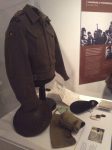
One of the displays in the exhibit Canada Responds to the Holocaust, 1944-1945, at the Vancouver Holocaust Education Centre until March 31. (photo by Cynthia Ramsay)

Canada Responds to the Holocaust, 1944-1945, opened on Oct. 16. The exhibit, said Nina Krieger, executive director of the Vancouver Holocaust Education Centre, at the event, “is the first major project of its kind, examining the encounters between Canadians and survivors of the Holocaust and the evidence of Nazi crimes at the end of the Second World War and its immediate aftermath.”

The VHEC commissioned the original research and writing under the direction of Prof. Richard Menkis and Ronnie Tessler, which includes a companion school program. “Students and other visitors will engage with a number of media elements in the exhibit,” said Krieger, giving the example of a tablet with survivor testimony, various interviews and other audio and video material.

The centre also commissioned a comic book by Colin Upton to accompany the exhibition, called Kicking at the Darkness, which will be given to every student participating in the school program, and is available to others for a suggested donation of $5.

Krieger thanked contributors and funders of the exhibition. She then introduced Menkis, an associate professor in the department of history at the University of British Columbia, and Tessler, a documentary photographer and a project consultant and editor for cultural arts groups, who also happened to be the first executive director of the VHEC, in 1990.

“Canada Responds to the Holocaust is a challenging exhibition,” began Menkis. “And it’s challenging, I think, for two reasons. First of all, because liberation is a complex phenomenon. Superficially, one might think, with liberation, of being free and being happy but, in fact, in the words of one of the Dutch survivors, it was, ‘not an undiluted joy’; to be free but then to be trying to look for family and the like. This exhibition very much tries to convey how complex liberation is.

“It is a complex phenomenon for three reasons,” he said. It is complex because, as the liberators (the soldiers) were in Europe, they were moving through new locations and coming up with new experiences. As well, liberation is the interaction between groups, each with their own assumptions and lived realties. And, finally, liberation is complex because of the disbelief at what had happened, and the difficulty in communicating what had been witnessed.

In addition to the voices of some of the survivors, the exhibit follows a number of different Canadians across Europe, including army chaplains, notably Samuel Cass. It also follows the First Canadian Army.

“Only three of the Western Allies had field armies on D-Day: the Americans, the British and the Canadians,” said Menkis. “The First Canadian Army was comprised of two corps,” he explained, but, also, “within the Canadian Army, as was the case with other armies, there were a variety of groups, such as Polish units as part of the Canadian Army, and there were Canadian units who were in, for example, the British army, which is why they are going to figure in Bergen-Belsen.”

The exhibit follows journalists, especially Matthew Halton, but also other CBC and Radio Canada journalists. “Moreover, we look at and follow the reactions of official war artists, official photographers and film crews and, finally, for the postwar period, we look at international agencies, such as the United Nations relief organization and the American Joint Distribution Committee,” said Menkis.

Using maps, archival photographs, news footage and video clips of interviews, Menkis touched on the highlights of the exhibit. He spoke of survivors coming out of hiding, of Canadians’ arrival at Vught, in the Netherlands, a camp that had been abandoned – the cover of Upton’s comic book is of this encounter – and Canadians’ reactions at Westerbork transit camp, also in the Netherlands. While outwardly appearing more well than other survivors, the 900 prisoners at Westerbork had experienced continual fear of being on one of the weekly deportations to an extermination camp.

A number of Canadian soldiers had been at Bergen-Belsen before they arrived at Westerbork, explained Menkis. “The effect of Bergen-Belsen was searing, and it affected, in some complicated ways, how the soldiers and others would view Westerbork,” he said, before sharing a quote from survivors Walter and Sara Lenz: “Shortly after the Canadians arrived it became clear that something was bothering them. They asked a number of questions that made little sense to us at the time, Why were we so well fed? Why were we not sickly, on the verge of death?

“In fact, as cruel as it may sound now, I had the feeling that our liberators were in a sense let down, for as we soon learned, they had steeled themselves for … another Bergen-Belsen.”

Noting that this was not just a view expressed years later, Menkis presented an excerpt of a letter Cass wrote to his wife on April 24, 1945: “I spent a good part of the day with our people [Canadians] at Camp Westerbork.… Everything looks so good on the surface…. With the papers full of the cannibalism of Belsen, it is almost a shock to find a camp where the survivors are all well and the physical surroundings good. But you can’t see the fear that people lived through every moment of their existence, nor can you see the 110,000 Jews who were herded like cattle on the transports.…”

While some people believed that things could return to the way they were before the war, that was not possible. A number of Jews felt they could not stay in Europe; they saw it as a graveyard, with no future. Many Jews looked to Palestine, but not everyone agreed with that. Menkis gave the example of Vancouver aid worker Lottie Levinson, who saw nationalism as the cause of what had happened and couldn’t understand why others would see Zionism as the resolution of the issue. “So, different approaches to what Jewish life would be,” said Menkis.

In the last part of his presentation, Menkis screened a video clip from an interview with war artist Alex Colville, which included some of the images he had drawn at Bergen-Belsen. Menkis also played an audio clip of an interview with Maj.-Gen. Georges Vanier, who went to Buchenwald shortly after its liberation with a group of U.S. congressmen. In his remarks, Vanier – one of the few Canadians who advocated for the acceptance of refugees before the war broke out – specifically referenced Jews as being victims, whereas most reports did not.

Rather than simplify this complex story, Menkis said that he and Tessler “chose to keep as many voices and perspectives as possible. Some of them may be uncomfortable to hear or see, but we wanted to do justice to the bewildering and poignant encounters of the time.”

When Tessler took to the podium, she explained, “The inspiration for Canada Responds to the Holocaust, 1944-1945, dates back to 2005, the 60th anniversary year of V-E Day, Victory in Europe Day. For that commemoration, Richard and I developed a CD for the Vancouver Holocaust Education Centre that teachers could use in one classroom session. Compact and tightly constructed, the themes were presented in short, crisp slides characteristic of PowerPoint presentations.

“The CD was a multi-media production – which the exhibition has retained. Along with text in point form, we included photographs, excerpts of articles, newsreels, eyewitness testimonies and art by Canada’s official war artists. Since that time, the 70th anniversary of the Second World War has passed and new research has been published, allowing us to expand and enrich the information that was in the PowerPoint.”

Many steps were required to “keep this complex story coherent,” said Tessler.

“The exhibition began with a year of research in archives across Canada, the Netherlands, Israel, the United States and Britain, and with locating the support material,” she said. “We were fortunate in this phase to have a good working relationship with several researchers and archives in the Netherlands. On the home front, we had access to the VHEC collections, and the assistance of a student intern.

“The next step was to arrange this mass of material into an easily readable and chronological narrative. In whittling down the accumulated information, it was essential not to lose sight of the historical overview. By including testimonies and other media, we could add individual, and sometimes opposing, perspectives on the events being portrayed. By adding photographs, the viewer gains a sense of place and time.

“The exhibition format also allowed us to display material objects,” she said. “For example, the Shalom Branch of the Royal Canadian Legion loaned the V-E Day edition of the Maple Leaf, a newspaper printed for the Canadian Forces, with the word ‘Kaput’ covering the front page. Dr. E.J. Sheppard of Victoria, one of the first soldiers through the gates of Westerbork transit camp in the Netherlands, loaned his battle uniform, pocket diary and a topographical map he carried in his tank that day.

“One of the most symbolic and touching objects in the exhibition is the yellow Jood star a newly liberated Jewish prisoner insisted on giving Sheppard in gratitude.

Another moment that gives pause is witnessing the large number of letters reproduced on a pillar in the gallery. Written by individuals and organizations seeking friends and relatives, they are but a smattering of the letters existing in just one archive in Montreal.”

The exhibit also includes “an antisemitic pamphlet printed in the Netherlands, and a 1943 poster ordering those with Jewish blood where, and when, to register with the authorities in The Hague … one of the most haunting objects in the exhibition is a facsimile notebook containing the weekly lists of deportees from Westerbork in the Netherlands to extermination camps in Poland: 100,657 people between July 1942 and September 1944 were, in most cases, sent to their deaths.”

Tessler thanked the many people who helped bring the exhibition to fruition, including Upton, who created the 24-page Kicking at the Darkness with the input of students in Menkis’ UBC course on Jewish identities in graphic narratives, and Canadian war historian Mark Celinscak, on whose research the section on the liberation of Bergen-Belsen concentration camp was based. She also thanked all the VHEC staff and Public, the design studio that designed the exhibition.

Canada Responds to the Holocaust, 1944-45, is at the VHEC until March 31.

Format ImagePosted on November 4, 2016November 4, 2016Author Cynthia RamsayCategories LocalTags Bergen-Belsen, Canadian Army, Holocaust, Second World War, VHEC, Westerbork
Part of Operation Overlord

Part of Operation Overlord

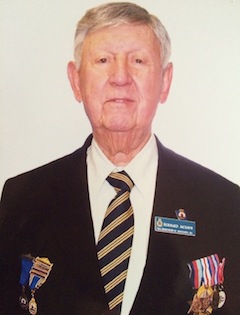
Bernard Jackson joined the British Royal Air Force Volunteer Reserve in 1941, and landed on a Normandy beach on “D-Day plus one”: June 7, 1944. (photo by Shula Klinger)

Bernard Jackson joined the British Royal Air Force Volunteer Reserve in 1941. The Second World War was in its second year and the Luftwaffe was bombing the centre of London. With Erwin Rommel’s army on the march toward Alexandria, Jackson was equipped and trained for desert warfare in North Africa. The RAF’s plans changed, however, and Jackson was sent to Portsmouth to board a ship bound for France, as part of Operation Overlord. He landed on a Normandy beach on “D-Day plus one,” he said: June 7, 1944. Seventy years after the end of the war, in 2015, Jackson was awarded France’s Légion d’Honneur.

Jackson took an active role in the war, right from the first bombings during the Blitz. “Young as I was,” he said, he was a firewatcher on the rooftops near his workplace in Charing Cross, in central London. Gazing at the sky, a teenage Jackson observed “the RAF and the Germans fighting overhead. It was very interesting.”

With battle raging in the skies, below ground was a different story. “Most people went down into the subway. Everyone was friendly, they found things to do,” he said.

Jackson’s youthful fascination with the tools of the trade is still apparent. “We used stirrup pumps to put fires out, with water from a bucket. They were so ingenious. I often wondered what happened to those stirrup pumps.” He offered a useful tip: sand is actually more effective than water at putting out fires.

Jackson described civilian office workers picking their way through the flames, broken glass and shattered buildings after another nighttime bombing raid. Londoners must have been shocked, going to bed with an intact city and getting up amidst smoking ruins. “People get used to anything,” he said, speaking with the wisdom of experience.

Jackson’s vignettes of wartime military life are varied. Prior to D-Day, he was attached to the Navy for combined operations training, on a destroyer. He spoke enthusiastically about this 10-day period off the coast of England. He also served in the RAF Regiment, guarding airfields and anti-aircraft guns, in the event of enemy fire.

Recalling his June 7 arrival at Arromanches, Jackson described a “choppy” crossing. He saw “German soldiers, British wounded…. As far as the eye could see, there were tanks, landing craft, ships and battleships, and they’re firing over our heads. An incredible scene.”

Obstacles had been cleared from the beach by that point – the enemy had littered the beach with mines and “hedgehogs” (large constructions of iron and concrete) to slow down Allied progress, but the psychological impact of the battle was all too obvious in the men. They were “all grey and bent over, all weary – they were knocked out,” said Jackson. He describes reaching a pillbox (bunker) above the beach, “surrounded by dead German soldiers.” By the end of the landings, 156,000 men had been brought across the Channel. After one day of fighting, there were 10,000 casualties and 2,500 dead.

Raised in an observant Jewish home, Jackson became a bar mitzvah at a synagogue on Menetti Street, near Charing Cross. He was glad to find two other Jewish boys in his unit of more than 100 men. His stories, which are peppered with local details, often refer to their “mischief.”

Bernard Jackson (photo from Bernard Jackson)

Jackson recalled with a laugh, “never mind [Bernard] Montgomery [who forbade fraternization with locals], we’re living eight to a tent! I said to two or three of the boys, ‘France is known for its cheese, let’s see if we can get a decent meal.’” Off they went to the village of Arromanches, where they found a café managed by “Madame, on a high chair like a throne.” Having explained in “doggerel French” that they were hungry, the boys were served an omelette with crunchy bread, a delicious treat that was paid for with scrip, the money printed for servicemen to use overseas.

Having managed to wangle the use of a truck once a week, the lads went on excursions together, said Jackson. “Being the boys that we were, we wanted to go and look at a château, and we found one! So, we were walking up the path to the château and saw a big horse in a field. It was the summer, and it was an apple orchard. There’d been fighting through the orchard, so the apples were on the ground; it was awful, there was a plague of flies. We saw the horse go into the forest. It trod on a land mine. Blew itself up. We turned around and went back.”

Jackson also described the accommodations made by troops, who slept in muddy ditches, with no bathing facilities. They used dissected gasoline cans as washbasins; the water was contaminated with arsenic, which gave the men impetigo. Even with proper medical care, this condition is extremely painful – and these boys had no antibiotics.

In spite of the immense hunger and hardship, Jackson spoke of the warm hospitality of locals in the months after the war. While his unit was stationed in Louvain, just outside Brussels, they were “parked in a field for a good while.” He recalled an impromptu but hectic social scene, which led to numerous interesting conversations.

“Us three Jewish boys managed to pal up with a husband and wife who owned an apartment block. They rented out rooms. This Belgian couple had hidden in their rooftop attic a Jewish couple, husband and wife, for two years. Quite a few air force fellas used to go there.”

The end of the story is bittersweet. “There was also a Jewish doctor and his wife, they had a beautiful girl, 18 or 20, who’d been in a concentration camp,” he said. “One of the boys proposed to this girl and they were going to marry, but she died very suddenly. She had picked up something in the camp.”

Jackson spoke animatedly of the war machinery that made the landing possible. In particular, he recounted how temporary “Mulberry Harbors” allowed Allied troops and vehicles to land in occupied France when all of the ports were held by enemy forces. When he drove back to the scene in his brand new Austin 10, one year later, he was dismayed to find the pride of British engineering “in bits, laying all over the beach. It’s buried in the sand, all rusty. It’s a disgrace.”

The trip was worth it nonetheless, he qualified. He and his pals attended a French celebration to mark the end of the war, which he described as “marvelous, marvelous.”

It’s clear from Jackson’s stories that – in his words – he “left home a boy and came back a man.” In any conversation with a storyteller of his calibre, there are many golden moments. It’s as if the air almost crackles with the immediacy of his memories, the descriptions of the grey-faced survivors of the D-Day landing, or his helpful instructions on how to boil water in a discarded German helmet. Quite apart from his resilient spirit and natural leadership, his candor is impressive. Speaking about such events – even 70 years later – can be difficult for many war veterans, not to mention that he actually went back only a year later.

“It’s a traumatic experience in many cases,” he said of why many people do not like to talk about their experiences in the war, or go back to where it took place. “I never talked about it to my children because, you see, my generation came out of the war saying there’ll never be another war after this one.” In other words, the information may have seemed redundant. But, Jackson added, “Look where we are today. It’s something in the human psyche. It’s greed. It’s power politics.”

Speaking to Jackson is a tremendous privilege; his vignettes of wartime – and postwar – Europe reveal a society in turmoil, where looting was common. He offered accounts of Russian dancing and vodka, gunfire and generosity, stolen yachts and black market cigarettes, hardship and hospitality.

Jackson is an astute observer of humankind and its many failings. But, as well as the stark and troubling stories, he has tales of compassion, generosity and the universal nature of the human experience. “People forget,” he said, “how the French suffered, on top of being occupied. They were short of food, coffee was unheard of, they hadn’t seen it in a long time – they used grass with acorns to give it body. They had no clothes; they stripped the dead for their clothes, even German soldiers, they just stripped off the epaulettes.”

Speaking of the Russian prisoners of war who insisted on sharing their meagre, greasy meals with Jackson and his comrades, he said, “They put dances on for us, someone played the accordion and they did these Russian dances.”

From peasants who could neither read nor write to highly educated ballet dancers or leading aircraft men like himself, Jackson said he realized, “they’re just like you, just like everyone else.”

Shula Klinger is an author, illustrator and journalist living in North Vancouver. Find out more at niftyscissors.com.

Format ImagePosted on November 4, 2016November 3, 2016Author Shula KlingerCategories LocalTags British army, D-Day, Second World War

Poland’s wartime contradictions

In August, Poland’s right-wing cabinet approved a bill that would criminalize using the phrase “Polish death camp” or “Polish concentration camp,” with punishments including fines or imprisonment.

The bill raises questions about Poland’s role in the Holocaust. It echoes the country’s communist-era stance on the Second World War – that Poland was a victim and heroically saved Jews.

Growing up, I was told the opposite by my family, my Jewish day school and the broader community – that Poland was antisemitic and complicit in the Holocaust.

But recently, I’ve come to believe that both narratives are true. As we approach the High Holy Days and Yizkor, I think it’s worth reflecting on whether we as a community can see Poland’s role in the Holocaust differently.

This summer, I visited Poland for the first time with my sister, and the trip was full of contradictions. For example, we learned that Christian Poles – including our local guide’s grandparents – were sent to concentration camps, too. The Nazis killed two to three million Christian Poles and three million Jewish Poles. In total, Poland lost one-fifth of its prewar population – more than any other European country. But, those numbers represent roughly 10% of the Christian Polish population and 90% of the Jewish Polish population.

At the POLIN Museum in Warsaw, I learned about Zegota, the Council to Aid Jews. The Polish government-in-exile created it to support and fund Jewish resistance in Poland, including the Warsaw Ghetto Uprising; it was the only such organization created by a European government.

At Yad Vashem, Poland has the most Righteous Among the Nations of any country. Yet, it also lost one of the highest percentages of Jews of all European countries.

We found that Holocaust memorials were also inconsistent, dependent on local policies rather than a unified national one. In our baba’s hometown of Wlodawa, the Jewish cemetery is now a park, without a Holocaust memorial, unlike the many memorials around Warsaw, Krakow and the preserved camps. This inconsistency seems to reflect the divisions within Polish society about whether, and how much, Poland took part in the Holocaust.

In our zeyda’s (z”l) hometown of Bilgoraj, we spoke with three people (through our guide) who live near his former house, which was recently torn down to build a shopping mall. One of them, who had the same build and attire as our zeyda, recognized our family name and said that our zeyda’s next-door neighbors were rumored to have hidden Jews (including, possibly, one of our zeyda’s younger sisters). Another neighbor said her mother hid a Jewish man for three days before he fled town, and that Jews and Christians lived in peace before the war. (Our grandparents never expressed that.)

Nearby, a new development claims to recreate the town shtetl, including Isaac Bashevis Singer’s house, a Belarusian-style (not a local-style) synagogue and luxury apartments. We called it “shtetl Disney.” We didn’t see any information on display about why the real shtetl disappeared, and I only hope that no one will want to live in a place that seeks to profit from nostalgia for a lost community. But that, too, depends on how people see their country’s role in that loss.

At the Krakow Jewish Culture Festival, we took a synagogue walking tour with a guide who, like a growing number of Poles, has discovered her own Jewish ancestry since communism ended. (She’s now a Yiddish lecturer at Columbia.) We learned that Polish-Jewish history dates back 1,000 years, since Jews fled the Crusades and got special protection, including freedom of religion, from a series of Polish kings. We also saw “Jewish-style” restaurants run by and for non-Jews, and “shtetl rabbi” statuettes being sold in the Old Town – we felt uncomfortable seeing people exoticize and capitalize on our culture.

We also saw a play, based on a true story, about a Jewish Torontonian with Polish roots who visits Poland for the first time, confronts the history and legacy of the Holocaust and witnesses the country’s “Jewish revival,” led by Jews and Christians. Seeing some of our experience reflected back at us emphasized, for me, that Polishness and Ashkenazi Jewishness are partly intertwined, whether or not we acknowledge it.

Realizing that our family is more Polish than we’d thought was both heartwarming and heartbreaking. On our way to Wlodawa, we bought fresh forest blueberries along a highway, and realized our grandparents would have grown up eating them, rather than discovering them in Vancouver as adults, as we’d assumed. In Wlodawa, the restaurant where we ate lunch could have been our baba’s dining room: the walls were peach, the curtains were lace and doilies covered the tables. In Lublin, flea-market stalls sold porcelain figurines just like the ones in her glass-doored cabinets. Were we in Poland, or at home?

Several times, I’ve wondered what to make of these contradictions.

The Jewish community, coming from collective trauma, can insist that Poland was a perpetrator; the Polish government, wanting to avoid collective reflection or partial responsibility, can insist it was a victim or martyr.

The truth is, some Christian Poles collaborated and killed Jews; some joined the partisans or hid Jews; most did nothing. The country was occupied and partitioned, and no one (Jewish or Christian) knew what was going to happen. There was a death penalty for resisting or hiding Jews. The truth is, societies are messy and heterogeneous, and we can’t make universal statements about them.

My question is, do Jews and Polish society want to perpetuate narratives that deny the differences within Polish society during the Second World War? Or do we want to heal?

If we want healing, I believe both communities need to accept that Poland was both perpetrator and victim, complicit and righteous – much as we may not want to, and much as that may feel difficult or even impossible. If we can accept this paradox, maybe then we can move from our respective pain to some kind of healing.

Tamara Micner is a playwright and journalist from Vancouver who lives in London, England. Her work has appeared in the Globe and Mail, Wall Street Journal and London Review of Books.

Posted on September 16, 2016September 15, 2016Author Tamara MicnerCategories Op-EdTags healing, history, Holocaust, Poland, Second World War
בלקברי עושה עלייה מובטחת

בלקברי עושה עלייה מובטחת

בפועל בלקברי רכשה את חברת הסטארט-אפ הישראלית וואצ’דוג. (צילום: Kārlis Dambrāns via wikimedia.org)

בלקברי עושה עלייה מובטחת: תיפתח לראשונה מרכז פיתוח בישראל

חברת הסמרטפונס הקנדית בלקברי (שהמטה שלה נמצא בווטרלו אונטריו) תיפתח לראשונה מרכז פיתוח בישראל. המרכז בפתח תקווה ויועסקו בו כמאה עובדים. זאת במסגרת הרחבת פעילותה ונסיונותיה לשפר את הטכנולוגיה ואבטחת המידע שלה, ולהגדיל את נתח השוק במגזר העסקי שבשוק הסמרטפונס.

בפועל בלקברי רכשה את חברת הסטארט-אפ הישראלית וואצ’דוג, לפיתוח טכנולוגיה לאבטחת מסמכים וקבצים. הגוף שמשתמש בטכנולוגיה שלה יכול לשלוט טוב יותר במידע ובקבצים שלו. הוא יכול לדעת היכן נמצאים הקבצים שלו בכל רגע נתון, ולהשמיד אותם מרחוק במקרה הצורך. בלקברי תצטרף את הטכנולוגיה של וואצ’דוג לשירותי הפורטפוליו שלה, למיגון מערכות ההפעלה.

עלות רכישת וואצ’דוג על ידי החברה הקנדית מוערכת בין מאה למאה וחמישים מיליון דולר. וואצ’דוג הוקמה ב-2008 ולצורך פעילותה גוייסו השקעות בסדר גודל של כ-30 מיליון דולר.

יו”ר ומנכ”ל בלקבריי, ג’ון צ’ן, הצליח לעצור את הידרדות החברה שכמעט והביאה לסגירתה. הוא פיטר עובדים, שיפר מערכות והתייעלות, והתמקד בתחום התוכנה הארגונית. תחת ניהולו יוצאים מכשירים שמעניינים את השוק לשם שינוי, בהם ‘פספורט’. 200 אלף מכשירי ‘פספורט’ נמכרו ביום אחד, עת הדגם יצא לשוק בספטמבר אשתקד. והמלאי הראשוני שלו אזל בתוך עשר שעות בלבד. בעיון בדוחו”ת הרבעוניים של בלקברי שפורסמו בסוף מרץ עולה כי החברה הצליחה לבלום את את הצניחה בהפסדיה, ורשמה לראשונה לאחר שנים רווח נקי (של 28 מיליון דולר).

בהודעה להוציא לעיתונות הסביר צ’ן מדוע בלקברי רכשה את וואצ’דוג: “בלקברי ממשיכה כל העת להגדיל את מעטפת אבטחת המידע, כך שהיא תוכל לאפשר שיתוף מידע יותר מאשר הגבלתו. רכישה זו היא צעד נוסף קדימה בהפיכתה של בלקברי לפלטפורמה המובילה לתקשורת סלולרית, תוכנה וישומים מאובטחים, התומכת בכל מכשיר ובכל מערכת. הודות לרכישת סקוסמרט אשתקד, השותפות שלנו עם סמסונג, מאמצעי הפיתוח שלנו והרכישה הזו של וואצ’דוג, אנו יכולים כעת לספק תקשורת מאובטחת מקצה לקצה הכוללת שיחות קוליות, הודעות טקסט, תקשורת נתונים וכעת גם שיתוף קבצים מסוכרן”.

ועוד חדשות בנוגע לבלקברי: הסכסוך עם טי-מובייל האמריקנית הסתיים לאחר כשנה, והאחרונה תחזור למכור מכשירים של בלקברי.

קסדה עם שני ראשים: חייל שאיבד אותה לפני 70 שנה ציווה להחזירה למי שמצא אותה

ג’ורדן צ’יאסון (21) מהעיר מונקטון שמזרח המדינה הוא אספן של ציוד צבאי ישן. לפני כשנה הוא רכש בחנות מקומית לציוד צבאי ישן קסדה ב-30 דולר. לאחר שבדק את הקסדה מקרוב מצא שחרוט עליה השם גו’רג’ ג’ונסטון ומספרו האישי. הוא חיפש מידע על ג’ונסטון ומצא שהוא עדיין חי ואפילו גר באותה עיר. צ’יאסון החליט להביא את הקסדה לג’ונסטון בן ה-93, והמפגש עימו ועם אשתו אנני היה מרגש ביותר. הזקן לא האמין שיתאחד מחדש עם הקסדה שלא ראה במשך עשרות שנים.

ג’ונסטון הצעיר לחם עם הכוחות הקנדיים במלחמת העולם השנייה בבלגיה, הולנד, צרפת ובריטניה. הוא השתמש בקסדה במשך שש שנים, לדבריו היא הצילה אותו לא פעם. עם סיום המלחמה ופתיחת החגיגות הגדולות הקסדה אבדה. ג’ונסטון חזר הביתה למונקטון ושכח ממנה.

ג’ונסטון נפטר לפני מספר שבועות בגיל 94 ולפני מותו ציווה להחזיר את הקסדה לצ’יאסון. אלמנתו מסבירה מדוע: “בשנת חייו האחרונה בעלי וצ’יאסון הפכו לחברים קרובים. בעלי חשב שרק צ’יאסון יוכל לשמור על הקסדה היקרה הזו”. צ’יאסון מוסיף: “עם סיום הלוויה משפחת ג’ונסטון ניגשה אליה ומסרה לי את הקסדה למשמרת. אני בכיתי וכולם בכו”.

Format ImagePosted on May 12, 2015Author Roni RachmaniCategories עניין בחדשותTags BlackBerry, George Johnston, helmet, Israel, John Chen, Jordan Chiasson, Second World War, WatchDox, בלקברי, ג'ון צ'ן, ג'ורדן צ'יאסון, גו'רג' ג'ונסטון, וואצ'דוג, ישראל, מלחמת העולם השנייה, קסדה
אוליב ביילי מדברת על משחק החיקוי

אוליב ביילי מדברת על משחק החיקוי

“‘משחק החיקוי’ הוא סרט טוב אך לא מתאר בדיוק את המציאות”, אומרת אוליב ביילי, שנמתה על היחידה שפיצחה את הקוד הנאצי

“‘משחק החיקוי’ הוא סרט טוב אך אינו מתאר בדיוק את מה שהתרחש אז במציאות, של מלחמת העולם השנייה”, אומרת אוליב ביילי, שנמנתה על היחידה הסודית של הבריטים, שניסתה לפצח את הקוד הנאצי. ביילי בת ה-94 היא אולי מהבודדים שנמנו על היחידה שהוקמה על ידי המודיעין הבריטי, ושעדיין נמצאים בחיים. ב-1951 היא ובעלה ד”ר נורמן ביילי עזבו את בריטניה ועברו להתגורר בקנדה. הם גרים כיום בעיר ויקטוריה שבמערב המדינה.

“משחק החיקוי” (בבימוי של מורטן טילדום) מועמד לזכייה בשמונה קטגוריות בטקס פרסי האוסקר, שיערך ביום ראשון הקרוב (ה-22 בחודש). הסרט עוסק בסיפורו של אלן טיורינג (בגילום השחקן בנדיקט קמברבאץ’), מתמטיקאי גאון שגוייס על ידי המודיעין הבריטי בתקופת המלחמה, והצליח לפצח את הקוד של “האניגמה” – מכונת ההצפנה של הנאצים, להעברת מסרים בין הכוחות השונים בשטח.

ביילי: “‘משחק החיקוי’ לא מתאר בדיוק את מה שהתרחש אז במציאות והסיפור במקור קצת שונה”. בעלה נורמן מוסיף: “הסיפור נכתב בצורה כזו עם הגזמות, כדי שימשוך את הצופים לקולנוע ואנחנו מבינים את זה”. ביילי אומרת עוד כי בסיכומו של דבר מדובר בסרט טוב, אך הוא לא הציג במדויק את טיורינג אותו היא הכירה מקרוב, שאישיותו הייתה מורכבת. “היה לו חוש הומור מאוד מפותח, הוא דיבר בצרורות, נראה מוזר בעיני רבים ולא כולם יכלו להבין אותו. אגב משחקו של קמברבאץ’ היה טוב מאוד”.

ביילי ספרת כי אז במלחמה כל מי שמלאו לו 15 גויוס לעזור לצבא או בתחומים אחרים של הממלכה. “ב-1940 הייתי בת 19 וגרתי בלונדון. סיימתי ללמוד באוניברסיטה ועבדתי במפעל ליצור פצצות, ועזרתי לחשוף מרגל. לכן גוייסתי ליחידה הסודית ע”י המודיעין. התפקיד שלי היה להעביר את הצופנים שהופענחו ע”י המחשב שטיורינג בנה, ולהעבירם למומחים שהבינו מה צריך לעשות עם המידע”.

במשך עשרות שנים ביילי שמרה לעצמה את חוויותיה מתקופת המלחמה, ונאסר עליה לדבר על מה שראתה. בחודשים האחרונים היא הרגישה שהגיע הזמן לפרסם את מה שהיא יודעת. ולכן החליטה להוציא לאור ספר בעזרת בעלה, שעוסק בתקופה וכולל מסמכים סודיים ששמרה ורשימות שהיא כתבה לעצמה, בזמן שעבדה ביחידה הסודית. לשאלתי מתי הספר יצא לאור, היא השיבה: “בשלב זה עדיין לא ברור לי. חזרתי עכשיו מחופשה ועד כמה שאני יודעת כבר כשני שלישים מהספר מוכנים”.

עקרב עם מזל: עקרב התחבא במזוודה והגיע בטיסה מאפריקה לקנדה

קנדית שחזרה לאחרונה מטיול בדרום אפריקה נדהמה לראות בפינת חדר האמבטיה שלה, עקרב קטן ושחור שהולך לו לאיטו. תחילה חשבה שמדובר במתיחה, כיוון שאיך יתכן שעקרב יגיע בכלל לביתה, שנמצא בסמוך לויניפג. לאחר שחשבה מספר דקות היא קלטה שהעקרב הוא בעצם נוסע סמוי, שהתחבא במזדווה שלה שהגיעה במטוס מדרום אפריקה לקנדה.

מומחה מגן החיות של ויניפג בדק את העקרב וקבע כי הוא אכן מדרום אפריקה. הוא ציין שהעקרב איננו מסוכן, אם כי נשיכה שלו יכולה לגרום לכאב קל ואדמומיות בעור.

הקנדית החליטה לקרוא לעקרב ‘הרולד’ על שם ‘הרולד ביי’, אזור בדרום אפריקה בו ביקרה, והיא שוקלת לאמצו. לדבריה אם הייתה רואה עקרב בדרום אפריקה, היא לא הייתה מהססת להרגו. אך לאחר שעשה דרך כה ארוכה ומייגעת והגיע לקנדה, שהיא ארץ של שלום ואפשרויות, היא תיתן ‘להרולד’ הזדמנות נאותה לחיות.

Format ImagePosted on February 17, 2015February 16, 2015Author Roni RachmaniCategories עניין בחדשותTags Academy Awards, Alan Turing, Imitation Game, Nazi code, Olive Bailey, scorpion, Second World War, אוליב ביילי, אלן טיורינג, האניגמה, טקס פרסי האוסקר, מלחמת העולם השנייה, משחק החיקוי, עקרב

Posts pagination

Previous page Page 1 Page 2 Page 3
Proudly powered by WordPress