Skip to content
  • Home
  • Subscribe / donate
  • Events calendar
  • News
    • Local
    • National
    • Israel
    • World
    • עניין בחדשות
      A roundup of news in Canada and further afield, in Hebrew.
  • Opinion
    • From the JI
    • Op-Ed
  • Arts & Culture
    • Performing Arts
    • Music
    • Books
    • Visual Arts
    • TV & Film
  • Life
    • Celebrating the Holidays
    • Travel
    • The Daily Snooze
      Cartoons by Jacob Samuel
    • Mystery Photo
      Help the JI and JMABC fill in the gaps in our archives.
  • Community Links
    • Organizations, Etc.
    • Other News Sources & Blogs
    • Business Directory
  • FAQ
  • JI Chai Celebration
  • JI@88! video

Recent Posts

  • האלימות בישראל מורגשת בהרבה מגזרים
  • טראמפ עוזר דווקא לנושא הפלסטיני
  • New rabbi settles into post
  • A light for the nations
  • Killed for being Jewish 
  • The complexities of identity
  • Jews in time of trauma
  • What should governments do?
  • Annie will warm your heart
  • Best of the film fest online
  • Guitar Night at Massey
  • Partners in the telling of stories
  • Four Peretz pillars honoured
  • History as a foundation
  • Music can comfort us
  • New chapter for JFS
  • The value(s) of Jewish camp
  • Chance led to great decision
  • From the JI archives … camp
  • עשרים ואחת שנים להגעתי לונקובר
  • Eby touts government record
  • Keep lighting candles
  • Facing a complex situation
  • Unique interview show a hit
  • See Annie at Gateway
  • Explorations of light
  • Help with the legal aspects
  • Stories create impact
  • Different faiths gather
  • Advocating for girls’ rights
  • An oral song tradition
  • Genealogy tools and tips
  • Jew-hatred is centuries old
  • Aiding medical research
  • Connecting Jews to Judaism
  • Beacon of light in heart of city

Archives

Follow @JewishIndie
image - The CJN - Visit Us Banner - 300x600 - 101625

Tag: Palestinians

רובטר פיסק בוונקובר חלק שני

רובטר פיסק בוונקובר חלק שני

בחודש שעבר הגיע לוונקובר העיתונאי האנגלי של “האינדיפנדנט“, רוברט פיסק, שנחשב למומחה בנושאי המזרח התיכון. הוא נתן הרצאה בפני אולם מלא פה לפה בכנסייה המאוחדת בדאון טאון. (צילום: Roni Rachmani)

חוסר הצדק והיעדר חינוך יצרו את המלחמות והפליטים הרבים

אם לתושבים במזרח התיכון היו מוענקים צדק, חופש וחינוך לא היו מלחמות, לא היו כובשים זרים ולא היה את דאעש. ממשלות המערב השקיעו כספים ומשאבים אדירים לאור הפחד מאל קאעידה או מדאעש, כדי שפעולות הטרור לא יגיעו אל המערב. אם הן היו משקיעות את המשאבים בחינוך והייתה מתקיימת חברה יציבה ועובדת, התושבים המקומיים היו יודעים שהמדינות שייכות להם, ולא לדיקטטורים, קבוצות דתיות או שלטון זר, אז לא היו תופעות כמו של שמונה מאות אלף פליטים ולא דאעש.

מי זה ארגון דאעש וכיצד הוא פועל?

הבעייה עם דאעש היא שאיננו מכירים בעצם את הארגון ולא יכולים לסקר מה קורה באזוריו, כי אם נגיע לשם חבריו יוציאו אותנו להורג. בשנה האחרונה אני מנסה ללמוד את דאעש, הקשבתי שפתם וכיצד הם מתבטאים, ולצערי נאלצתי לצפות בכל הקלטות הנוראיות שלהם. מדובר בדבר חדש במזרח התיכון שלא היה קיים עד כה. בפרוש לא מדובר בדת אלה בפולחן דתי. מדובר באנשים אכזריים, קרים, חסרי רגישות, רגשות ותשוקות, למעט דרישתם להקמת המדינה האיסלאמית. הם מפחידים וזו כוונתם המוצהרת, ופועלים כמו טילים או מכונות במלחמה. ביקרתי עם כוחות הצבא הסורי בכנסייה לאחר שאנשי דאעש היו במקום, ונדהמתי לראות כיצד הם גרמו להרס. הם חתכו תמונות שמן עתיקות באופן מחושב במכונה לחיתוך, ולא בצורה אמוציונלית עם כעס ושנאה תוך שימוש בסכינים. כאמור מדובר בתופעה חדשה במזרח התיכון ואין לי מושג מי עומד מאחורי הנשק הזה שנקרא דאעש, אם כי אי אפשר לשלול את הקשר האפשרי בין דאעש לערב הסעודית.

מה על קנדה לעשות כיום במשבר הנוכחי במזרח התיכון?

קנדה בשום פנים ואופן ללא צריכה להתערב במלחמה עם דאעש וזה לא מתפקידה. הקנדים צריכים לעשות חשיבה מחדש ולעזור לאו”ם בשליחת משקיפים לאזור ולפקח על מה שקורה בשטח. וכן לעזור לאלה שסובלים וכידוע יש רבים מאוד שסובלים.

כיצד מתנהלת המלחמה של המערב בדאעש?

אני לא שחושב כלל שהמלחמה מול דאעש מתנהלת כמו שאנו חושבים. לא נראה לי שמדינות המערב ממש נלחמות מול דאעש, אלה שהן מקיימות בסך הכל תרגילים צבאיים. אם ארה”ב, רוסיה ואיראן היו רוצות לפעול ביחד, הן היו פותרות את הבעייה בסוריה ביום אחד. אך עובדה שזה לא קורה. להערכתי ארה”ב פוזלת יותר ויותר לכיוון של איראן השיעית, ופחות ופחות לכיוון ערב הסעודית הסונית. וכנראה שבשיחות הגרעין הארוכות עם איראן, בחצי מהזמן האמריקנים דנו עימם במשבר בסוריה, ועל הפיכתה של איראן לשוטר של המזרח התיכון. אני מעריך עוד שתתרחש הפיכה גם בערב הסעודית אך היא לא תבוא מכיוון האוכלוסייה, אלא מתוך בית המלוכה על ידי חלק מהנסיכים שיבצעו אותה.

מה קורה עם הסכסוך הישראלי-פלסטיני?

לגבי הסכסוך הממושך בין ישראל לפלסטינים, יש לזכור שגם לשני צדדים אלה הובטחו הבטחות שווא שיקבלו מדינות גדולות. אני יכול לקבוע בצער כי מדינה פלסטינית לא תקום, כיוון שממשלות ישראל השונות בנו ובונות בשטחים הכבושים בצורה כזו, שלא יהיה רצף טריטוריאלי לפלסטינים וזו עובדה מוגמרת. כל עוד תתקיים תמיכה אמריקנית בישראל שום דבר לא ישתנה ואני צופה שזה יביא לאסון באזור.

Format ImagePosted on October 7, 2015October 14, 2015Author Roni RachmaniCategories עניין בחדשותTags al-Qaeda, ISIS, Israel, Middle East, Palestinians, Robert Fisk, Sykes-Picot, אל קאעידה, דאעש, ישראל, מזרח התיכון, סייקס-פיקו, פלסטינים, רוברט פיסק1 Comment on רובטר פיסק בוונקובר חלק שני

“Threat” term problematic

When it comes to Israel, many Diaspora Jews harbor a double standard. They want their own countries to embrace pluralism and multiculturalism, owing to the kind of fluid immigration that allowed their own grandparents and great-grandparents to build a better life in America and Canada and many other places across the West. But, when it comes to Israel, they are comfortable articulating their desire to maintain a Jewish majority. Israelis – even those on the left – have a term for this need: they openly refer to Palestinians (whether in the West Bank, whether refugees living abroad or whether Palestinian citizens of Israel itself) as a “demographic threat.”

Palestinian citizens of Israel are pouncing on this usage more than ever. Ayman Oudeh, head of the Joint List, has called it offensive. He wants Israeli citizens to view their Palestinian citizen brethren as partners in nation-building. Still, he is not looking for a melting-pot version of Israeli identity: he demands that Israel grant the Palestinian citizens “collective rights.” Since they already have their own school system, presumably, by collective rights he means at the very least equal funding for schools and towns, including removing the unequal bureaucratic barriers to gaining building permits, something I’ve written about at the Globe and Mail.

Yousef Munayyer is also distressed by the term “demographic threat,” and concludes that it is intrinsic to Zionism. Instead of having a demographic problem, Israel has a Zionism problem, he argued last March in The Nation. This, as Bibi was whipping up fear against the Arab minority on election day, claiming they were coming to the polls “in droves.”

The scope of the issue is more complex than these critiques – as important as they are – allow. There are at least three aspects at play.

First, strategy. There are reasons why a peace activist may choose to use the term “demographic threat” to sell the idea of withdrawal from the West Bank, for example. This kind of reasoning may appeal to those on the centre or even the right who, unfortunately, aren’t moved by human rights imperatives. When it comes to language and lobbying, we must not forget the game of persuasion.

This connects to the second aspect: emotions. Here, the question is this: without undermining democracy, can a majority population privately desire to maintain its majority status? And, in the event that these private desires are shared publicly – through art or literature, say – should the users be chastised as being anti-democratic?

Here, we need to recall what may be motivating these feelings. It may not be anti-democratic tendencies or racism or even a sense of national superiority. As a national liberation movement, Zionism was acutely concerned with Jewish self-determination, more than it was with undermining any other national group in its midst. And, along with the material gains of statehood has come the desire to sustain a modern Jewish national culture, most markedly in the form of Hebrew. To contemplate becoming a minority in one’s country is to consider the attrition of one’s national language, at the very least, if not the possibility of collective safety and self-determination. Even if the fears are unfounded, even, if, somehow, a post-Zionist Israel can engage in a project of radical multiculturalism such that Hebrew culture maintains its treasured place alongside Palestinian culture and Arabic language, the impulse is still understandable.

Finally, there are the public policies themselves. On this, there is clearly much room for improvement. Oudeh’s call for a high-profile “civics conference” in the tradition of other annual conferences in Israel on issues – including security, social issues and economics – is a good one. As is the urgent need to close the funding gap to Arab schools and towns, and to educate against casual racism, including some landlords not renting to Arabs and “social suitability” committees determining who can live where, the kind of practices outlined by Amjad Iraqi in +972 Magazine. These attitudes and the practices that stem from them are corrosive to democracy.

All this is to say that the creation and maintenance of national identity, particularly in a state as young as Israel, is an enormous project. Using the term “demographic threat” as a way of describing the actual collective emotions and preferences of some citizens is as useful as any analytic phrase. To censor it completely, therefore, would be anti-intellectual and anti-democratic. But, when it comes to policy advocacy, thoughtful Israelis should consider thinking twice about using these words. As citizens of democracies, we should at least strive to hear things as our fellow citizens hear them.

Mira Sucharov is an associate professor of political science at Carleton University. She blogs at Haaretz and the Jewish Daily Forward. A version of this article was originally published on haartez.com.

Posted on August 21, 2015August 19, 2015Author Mira SucharovCategories Op-EdTags Arab-Israeli conflct, democracy, Diaspora, Palestinians, Zionism

Gazan women in business


In the traditionally conservative Palestinian society of the densely populated Gaza Strip, women do not have many opportunities for entrepreneurship. Women usually marry young and raise large families. Yet, a small number of women in Gaza are opening their own businesses and serving as a model to young women throughout Gaza.

Maram Ganem began working at age 32 as an employee at a restaurant in Gaza. Five years later, she decided to start her own business. Today, she owns two restaurants in Gaza: a fast-food place and a fancy restaurant overlooking the Mediterranean Sea. She said that the first part of her dream came true when she rented a small space in a hotel in Gaza City in partnership with a local businessman. Shortly after that, she opened the first-ever fast-food restaurant in Gaza. The success of her projects led to the opening of the Roots restaurant, one of the most upscale restaurants in the city.

Ganem believes that determination and strong personality were the main reasons behind her success. She even represented Palestinians at economic conferences in Egypt. “If you have the will, you can do anything,” she told the Media Line. “I have met my goals despite the difficult political and economic conditions we face.”

She also credits her husband with contributing to her business success. “You need family support to survive in Gaza,” she said. “Men usually control most of the businesses here, and women are the workers or employees.”

Ganem was in Ramallah in recent weeks to attend the National Investment Conference, hosted by the Palestinian Ministry of Economy and Ministry of Tourism, which aims to increase international tourism to the West Bank and Gaza Strip. Representatives from more than 120 companies owned by Palestinians who live abroad came to the West Bank to discuss possible investment.

While unemployment in the West Bank has decreased slightly to just over 18%, in Gaza it is almost 40%. Unemployment is especially high among young Palestinians, including university graduates.

Read more at themedialine.org.

Posted on May 29, 2015May 27, 2015Author Fatema Mohamed TMLCategories WorldTags business, Gaza, Maram Ganem, Palestinians, Ramallah

Consider the maps we use

I always enjoy seeing my kids bring home assignments from Hebrew school, and last week was no exception. On a map of Israel were labeled five major cities whose names the students had to write in Hebrew. For my part, I delighted in reminding my son that we have relatives or friends in Jerusalem, Tel Aviv and Haifa, and near Be’er Sheva. There was only one problem with the map, I noticed. There was no Green Line. So, to the untrained eye, it looked like Israel’s borders span from the Mediterranean Sea to the Jordan River.

As I often do when I want to tease out a political conundrum, I took to social media. On my public Facebook page, I offered to donate $36 to charity for the first person who can show me a Green-Line-indicated map of Israel currently being used in any Jewish educational setting. Laurie MacDonald Brumberg wrote that a Washington, D.C., Jewish day school has a National Geographic map containing the Green Line hanging in the classroom. Karin Klein of Chicago showed me a Green Line map she said was used at a Schechter day school. And from Gabriel T. Erbs I learned that J Street U has launched an initiative to circulate Green Line maps to educational institutions. Apparently, URJ President Rabbi Rick Jacobs has agreed to champion this among URJ camps and Hebrew schools, according to a March 22 article published on JewSchool by David A.M. Wilensky. Gila Miriam Chait added that Yachad, a pro-Israel, pro-peace group in the United Kingdom, is following suit.

What is at stake in the mapping debate? We all know that Middle East maps are heavily invested with the symbolism of legitimacy and delegitimization. The Palestinians have long been accused of erasing Israel from their school maps of Palestine – both from the Palestinian Authority and from Hamas. An article in the current online Jewish virtual library makes precisely this point. It’s clearly ironic that we are doing the same thing we accuse our adversaries of doing.

Some might argue, however, that since the Green Line is an armistice line, not a border, that there is no need for Israel to include it. It is true that it is not a border, but neither does Israel’s international territory extend eastward from Jerusalem all the way to the Jordan River. The point is, the West Bank is under occupation – whether one sees the occupation as justified or not – and maps should reflect this geopolitical reality.

Now, beyond simply making more accurate and, therefore, educationally useful maps, what might a more politically informed Israel curriculum entail? From my kids, I have heard about the ingenious ways that Israel foiled the Egyptian invasion of 1948, including placing stones in irrigation pipes to create noise simulating artillery. My 8-year-old was impressed. I know that for Yom Ha’atzmaut, their Hebrew school served falafel, and I hoped and expected that my kids will learn some Israeli folk songs. Some folk dancing would be great, too. What I remain less certain about, however, is how much complexity about Israel’s future our kids’ schools are willing to impart. Will kids learn who the “Palestinians” are? I know that I am guilty of frequently muttering to them about “Israel and the Palestinians” without proper context. While narratives of inter-state war can be much simpler to impart, when it comes to the Palestinian civilian aspect of Israel’s founding, and the current military occupation over millions of Palestinians, it’s difficult to know where to begin.

When we learn about the past, it’s equally important to consider the future. In fact, no one knows more about the importance of historical memory in shaping today’s collective political outlook as the Jewish community. As Wilensky writes in the context of the maps, “it’s unpleasant for many to hear, but the final status of a two-state solution – if such a thing can ever be achieved – is going to rely heavily on the Green Line. Putting visual depictions of that reality before the eyes of American Jewry will go a long way toward showing them the somewhat unpleasant truths that will help build a more absolutely pleasant future.”

As for the J Street U’s map initiative, given that Jacobs has pledged to roll them out at Reform schools, I hope he will make Ottawa’s very own Reform Judaism supplementary school an early stop.

Mira Sucharov is an associate professor of political science at Carleton University. She blogs at Haaretz and the Jewish Daily Forward. This article was originally published in the Canadian Jewish News.

Posted on May 22, 2015May 21, 2015Author Mira SucharovCategories Op-EdTags education, Israel, maps, Palestinians

Envisioning a peaceful future

photo - Mira Sucharov spoke on March 2 as part of the University of Winnipeg’s Middle East Week
Mira Sucharov spoke on March 2 as part of the University of Winnipeg’s Middle East Week. (photo from Mira Sucharov)

As part of Middle East Week at the University of Winnipeg, Mira Sucharov, associate professor of political science at Carleton University in Ottawa, spoke on the topic of Power and Identity Across the Israeli-Palestinian Divide.

About 60 people came out March 2 to the university’s Convocation Hall to hear Sucharov, who is currently the country analyst for Israel and the Palestinian territories for Freedom House, as well as a blogger and writer whose work appears regularly in several publications around the world, including the Jewish Independent.

Sucharov sees relations between Palestinians and Israelis as more polarized now than at any other time since the peace process that began two decades ago. She said she was pleased to be part of U of W’s Middle East Week, as it promotes dialogue, in contrast to the situation on many North American campuses, where hardened opposing camps are choosing shouting over listening.

Describing herself as a liberal Zionist, Sucharov explained the term as referring to someone who “believes that there is legitimacy to Israel’s existence, and that nations deserve a state.” However, “liberal Zionists not only acknowledge the existence of Israel and support its existence, they are deeply troubled by its occupation.”

Sucharov said that, while some Israelis and Israel supporters prefer the term “disputed land” to the term “occupation,” Sucharov views “occupation” as “an important word.” She explained, “We’re not just talking about a geographic swap of land. We’re talking about a population of Palestinians who are not citizens of any country.

“The IDF, on a macro level and often on a micro level, is in charge of the area and the daily lives of Palestinians who have to pass through checkpoints to get to work, to farm their land…. We know about the Israeli security barrier or separation wall that has served to disrupt daily lives in many ways in the West Bank.

“So, liberal Zionists are troubled by this idea of occupation and seek to do what they can to end it. As a Canadian from Winnipeg, I feel that by engaging in constructive discussion, constantly being educated, I can help people at a global level think more deeply, critically, and in a more engaged way about issues of global concern.”

Sucharov said that there are financial incentives, as well as ideological motivations, for living in the West Bank. “There are many who’ve moved to the West Bank because it’s cheaper,” she noted. “Part of it, no doubt, was wanting to return to biblical Israel, a sense of having a greater Israel, of being/having religious/national identity fulfilled. There’s another important motivating factor, and that was the idea of Israel having a wider girth, more strategic depth.”

In Sucharov’s view, “the occupation” should not be permanent, and dialogue is needed to get governments together for peace talks. “The only way to end the occupation is if Israelis and Palestinians come together to discuss and negotiate an agreement,” she said.

As for what such an agreement may look like, Sucharov imagines “a city with two capitals: Jerusalem, a holy place for all religions to pray at their own places of worship. Refugees will probably be returned, free return to a Palestinian state. There will probably be some compensation package, [on a] humanitarian basis for some refugees … based on historical agreements.”

If the Geneva initiative does take place, said Sucharov, “Can Israel feel safe with such an agreement?

“It used to be called, ‘give an inch, they’ll take a mile,’” she continued. “Now, there is a concern about the fact that Palestinians in a recent poll have indicated that they would want to use a two-state agreement as the beginnings of full takeover.

“Palestinians, no doubt, would want all of Israel … many of them … and Israelis, no doubt, would want all of Palestine … many of them. The question is, even if some Palestinians were desirous of acquiring or launching terrorist missions with or without the consent of its governing authority, could Israel defend itself?”

If/when Israelis and Palestinians reach an agreement, she said, they would have to make sure that there were “security guarantees from the United States … [that] the U.S. will guarantee the security of Israel.

“Palestine would have to agree to be a de-militarized state. So, both sides will not have to necessarily trust each other … [they] would have to understand that there is a security guarantee in the form of a major global superpower.

“That’s the two-state solution. But, there certainly are those in the military establishment of any state who could stand to gain from an ongoing conflict…. We have to … make peace seem more attractive.”

As things stand, Sucharov said, “Palestinians and Israelis are almost mutually fearful of one another.… I think the biggest obstacle is the culture of mutual fear.”

And then there is the question of whether or not Iran, if there is the possibility of peace between Israelis and Palestinians, will “behave in a suicidal fashion,” said Sucharov. “That’s what, in international relations, [they] call the … idea of nuclear deterrence – the idea that more nukes make the world safer. I’d prefer less nukes, less proliferation, but there is a logic to the idea of stability of nuclear weapons.

“Once peace is achieved by the government, ideally, the next generation grows up in a culture in which the status quo exists.

“Regional threats would be diffused to make peace,” she continued. However, “the Israeli-Palestinian conflict is not the only conflict in the region and we’re not going to see peace on earth, but Iran and other enemies of Israel … Hamas … would have less wind in their sails. The status quo would be peace, so there would hopefully be less local support for their belligerent postures.”

Rebeca Kuropatwa is a Winnipeg freelance writer.

Posted on April 17, 2015April 16, 2015Author Rebeca KuropatwaCategories NationalTags Israeli-Palestinian conflict, Israelis, Mira Sucharov, Palestinians, peace, two-state solution
Halper talks across Canada

Halper talks across Canada

Dr. Jeff Halper speaks at the University of Manitoba on Feb. 9. (photo by Rebeca Kuropatwa)

Dr. Jeff Halper, an Israeli anthropologist and Nobel Peace Prize nominee, spoke on four different occasions in Winnipeg over two days, Feb. 8 and 9, as part of a cross-Canada speaking tour, which also brought him to Vancouver Feb. 10-12. He is the head of the Israeli Committee Against House Demolitions (ICAHD), an organization self-described as “dedicated to ending the Israeli occupation and [that] advocates for a just peace between Israel and the Palestinian people.”

The first of Halper’s Winnipeg talks was An Israeli in Palestine, and it was held at Crescent Fort Rouge United Church. He then spoke at the University of Manitoba on Academic Freedom and the Israeli-Palestinian Conflict, reprised An Israeli in Palestine at the University of Winnipeg and, finally, did an interview with Jewish Post & News editor Bernie Bellan at the Free Press News Café (which can be found at icahd.org/node/568).

The U of M lecture on Feb. 9 was sponsored by the department of history, the Centre for Professional and Applied Ethics, and the Global Political Economy program. Halper began this talk by saying that “the side” most people are aware of is the one that “only demolishes houses of terrorists and that is trying really hard to make a fair peace with the Palestinians.” But, he said, people are not very aware of the side that is “building settlements in the West Bank and refusing to issue building permits to Palestinians in the West Bank.”

According to Halper, Israel has been working for years to physically eliminate the proposition of a two-state solution by creating in the West Bank a Palestinian territory that is so fragmented with Israeli settlements that such an option is no longer viable. “A solution that the Israeli peace camp, including myself, supported for many years … the solution accepted by the international community … U.S., Canada, the UN, the Palestinians and every Arab country, is gone,” he said.

Halper believes that the two-state solution is “tremendously pro-Israeli.” He said, “If Israel in fact wants peace and security, it could have had that 27 years ago. And, it could have kept 78 percent of the country. This two-state solution was adopted unanimously by the Arab League. Every Arab country said that if Israel relinquishes the occupation, we will not only make peace with Israel, we’ll integrate Israel into the region. There was even talk of Israel joining the Arab League.”

In Halper’s view, “Israel has always said no and never seriously considered a two-state solution…. In 1993, there were 200,000 settlers. By the year 2000, after seven years of negotiation, there were 400,000 settlers. Today, there are 600,000 settlers. In four years from now, there will be a million Israelis living in the occupied territory.

“What Israel has done to ensure its permanent control, to ensure that the Palestinians are imprisoned in areas, is not a bi-national state … heaven forbid, because it has to be a Jewish state…. There’s no chance Israel will be forced out of the occupied territory. Israel has laid over the West Bank what I call ‘a matrix of control.’”

Halper argued, “There is no more West Bank: it’s gone. There are today more Israelis living in east Jerusalem than there are Palestinians. And whether it’s east Jerusalem or the West Bank, Palestinian territory is completely fragmented.

“Also, out of the 600 checkpoints in the West Bank, only 17 are actually between the West Bank and Israel. All the others are inside the West Bank, preventing Palestinian movement, confining them to these islands.

“How will a Palestinian state emerge from this?” he asked. “The whole idea of the two-state solution was based on a north/south axis, here’s Israel and, alongside, it’s a Palestinian state.”

Halper sees Israel as “working to force Palestinians out of homes located in the ‘wrong’ place, largely through house demolition. None of those homes had anything to do with security.”

As an example, Halper used the house of ICAHD member Salim Shawamreh. To date, said Halper, that home has been demolished and rebuilt by the ICAHD six times. “They bought a small plot of land in the town of Anata, which is right next to Jerusalem,” said Halper. “The land is registered. When they went to apply for a building permit, the answer was ‘no.’ Israel has zoned the entire West Bank as agricultural land so, when a Palestinian comes to build a home on land he owns, the answer is ‘Sorry, but this is agricultural land.’ It applies to Jews and Arabs.”

Beside Anata is the Israeli town of Ma’ale Adumim, which, Halper said, is built on the same agricultural land with a permit. “You have 50,000 Israelis living in government-built cities on the same land,” said Halper. “If you want to rezone from agricultural to residential, it takes a second.”

Many families build without a permit, said Halper, and Shawamreh “decided to build his house without a permit and the Israeli authority sent a demolition order with a dozen solders. They aren’t coming to arrest him. They’re coming to demolish his home…. Salim resisted and was taken out by force. His wife, Arabiya, managed to lock the door and stayed inside with the children. So, the soldiers broke the windows and threw in tear gas to flush the family out. Arabiya was taken out unconscious, the kids running and screaming in every direction. We get into the act if we can. She managed to call us … [and] we resist the demolition of homes.

“We rebuild homes as political acts of resistance,” he continued. “We’ve rebuilt 587 homes over the last 14 years or so … 587 joint acts of resistance. We refuse to be enemies. That’s one of our slogans.”

Halper’s tour, organized by United Network for Justice and Peace in Palestine/Israel and Independent Jewish Voices-Canada, as well as various local groups, fundraised for ICAHD’s building of a house for a Palestinian family whose home was demolished. Admission to events was free, though donations were welcomed.

Rebeca Kuropatwa is a Winnipeg freelance writer.

Format ImagePosted on February 27, 2015February 26, 2015Author Rebeca KuropatwaCategories NationalTags ICAHD, Israel, Israeli-Palestinian conflict, Jeff Halper, Palestinians, Salim Shawamreh

An accord for the ages

Here’s a scenario to consider: What if Prime Minister Binyamin Netanyahu came to the Knesset with a peace accord, approved by all its neighbors, that provided for the cessation of war, the recognition of the state of Israel, land swaps to create coherent borders and the dismantling of settlements?

What if Netanyahu said the final decision on the agreement would be up to the Knesset and he would remain on the sidelines, campaigning neither for nor against the agreement? Would the Knesset endorse the deal?

At first blush, such a scenario sounds farfetched, it could never happen. But, 35 years ago, that is exactly what occurred.

Former prime minister Menachem Begin came to the Knesset with a peace agreement with Egypt. He was reluctant to abandon settlements in the Sinai, but he let members of the Knesset vote on the agreement and did not campaign against it. They endorsed the deal.

The 1979 Camp David Accords proved to be more durable than many expected, surviving the assassination of Egyptian president Anwar Sadat, the Lebanon war, the Gaza conflicts and the Arab Spring. Also, the accord laid the foundation for an agreement with Jordan that is now marking its 20th anniversary.
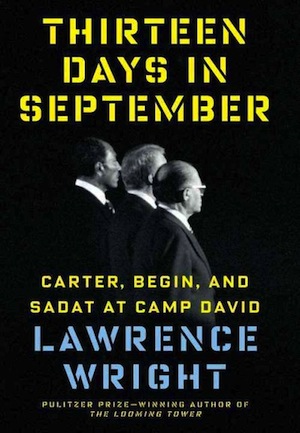
image - Thirteen Days in September book coverIn Thirteen Days in September: Carter, Begin and Sadat at Camp David (Alfred A. Knopf, 2014), New Yorker staff writer and Pulitzer Prize-winner Lawrence Wright goes back to the difficult negotiations in September 1978 that led to the reluctant handshake between Sadat and Begin, and the signing of the accord on the White House lawn in March 1979.

U.S. president Jimmy Carter brought the Egyptian president and the Israeli prime minister together after Sadat took the first courageous step toward peace – a visit to Jerusalem in 1977. The three leaders and some of their most senior aides met at Camp David, a secluded country retreat about 100 kilometres outside Washington, D.C. They stayed for almost two weeks, stepping away from the whirlwind of day-to-day events to focus exclusively on a framework for peace.

A playwright and screenwriter, Wright effectively recreates the moments of high drama during the talks, weaving personal histories, sacred mythologies and past events into a detailed account of the bare-knuckle bargaining session. He also fleshes out the secondary characters, the members of the Israeli, Egyptian and U.S. bargaining teams who played a role in reaching an agreement. In the acknowledgements, Wright says he initially wrote a play about the negotiation, but he could not squeeze all the interesting characters into a 90-minute play.

The evocative portrayal of Moshe Dayan – the Israeli-born warrior who came to personify the country’s most spectacular military accomplishment in 1967 as well as its most significant loss in 1973 – is especially memorable. Dayan is described alternately as a cold-blooded, calculating fighter and the government’s most creative thinker in pursuit of peace.

The book offers a rare glimpse inside the world of high-pressure international negotiations and sheds light on the difficult relationship that Carter continues to have with Israel. That alone would make the book worthwhile. Yet Thirteen Days is more than just an historical account. Delving into how the Camp David Accords were reached inevitably fires up the imagination to think about what is possible.

Could these achievements ever be repeated again?

Wright shines a spotlight on some extraordinary aspects of the negotiations. The U.S. president, who was prepared to dedicate an inordinate amount of time to grappling with the competing interests in the Middle East, had come to the table with little more than a biblical understanding of the issues and virtually no experience in foreign policy. Yet, he shared with the Egyptian president a similar upbringing, religious devotion and commitment to service in the military. An easy rapport evolved between the two men.

Carter had a more difficult time finding a personal connection with Begin, who was scarred by the Holocaust and hardened by his experiences fighting British authorities in Palestine before the establishment of the state.

The isolation of Camp David allowed negotiators to work creatively and take risks that might not have been ventured in the public eye, Wright writes. But being forced together also had negative consequences. The intimacy at times fed hostility, rather than creating trust, and almost torpedoed the talks.

The process of negotiating, ridded with cultural misunderstandings and political miscalculations, was particularly challenging. Sadat and Begin had significantly different approaches to the talks. Sadat came with an agenda of unrealistic demands, but was willing to compromise. Begin came to listen and react. For several days, he adamantly refused to concede anything.

In his naïveté, Carter expected the two warring sides to reach an accord on their own. His opening gambit was to just bring the two sides together and step back. He assumed they would resolve their historic differences once they met and shared their history, their suffering and their dreams. How wrong he was.

Their response at critical moments was a study in contrasts. Where Sadat, a visionary, would become emotional when his idealism was challenged, Begin would become colder and more analytical. Begin kept his eye on details, meticulously dissecting every nuance in anticipation of what could be lurking around the corner. “Both desired peace,” recalled Ezer Weizman, who was Israel’s defence minister at the time. “But Sadat wanted to take it by storm and Begin preferred to creep forward inch by inch.”

Carter eventually realized he had to take the lead. But it was not until the sixth day of negotiations that he introduced a framework for peace that was to be the springboard for negotiated compromises and a final deal.

Despite the hurdles, somewhere there was magic. They reached an agreement.

Wright suggests that domestic political considerations played a significant role. The political cost for all three leaders increased as the negotiations stretched on. Carter, who staked his reputation on bringing the conflict to an end, threatened to break relations with Sadat or Begin if either leader walked away. The threats kept the two wily politicians at the table, despite their personal animosities.

Another pivotal issue was how the three leaders responded to matters related to the Palestinians. Sadat was their self-appointed representative at the talks. But, at a crucial moment, he pushed their interests aside. It was a decision that cost him his life. At the time, however, the prospect of regaining full sovereignty over the Sinai Peninsula was just too tantalizing; leaving the Palestinians on the sidelines enabled the accords to be signed.

Wright observes that there has not been a single violation of the terms of agreement, but he leaves the impression that the Camp David Accords offer little to guide those now searching for more peace. The accords have saved lives and defused tensions in a volatile neighborhood, but the agreement appears to be a unique set of circumstances in history at a time of powerful personalities that probably will not be replicated in our times.

Media consultant Robert Matas, a former Globe and Mail journalist, still reads books. Thirteen Days in September is available at the Isaac Waldman Jewish Public Library. To reserve it, or any other book, call 604-257-5181 or email [email protected]. To view the catalogue, visit jccgv.com and click on Isaac Waldman Library.

Posted on February 6, 2015February 5, 2015Author Robert MatasCategories BooksTags Anwar Sadat, Camp David Accords, Israel, Jimmy Carter, Lawrence Wright, Menachem Begin, Palestinians, peace

UNRWA needs reform

Bassem Eid, a Palestinian human rights activist, has launched a campaign against the United Nations Relief and Works Agency (UNRWA), tasked with providing “assistance and protection” for five million Palestinian refugees around the world. In Palestinian refugee camps in the West Bank, Gaza Strip, Lebanon, Syria and Jordan, UNRWA provides food, other aid and runs schools.

Eid said a recent study by well-known Palestinian pollster Khalil Shikaki shows that 70 percent of Palestinian refugees are seeking financial compensation rather than the “right of return” to their former homes in what is today Israel. He said that UNRWA, however, has an interest in perpetuating the right of return, in part, to justify its large budgets. These assertions are part of Eid’s blistering attack on UNRWA, which operates with a $1.2 billion budget from donor countries, including the United States.

“Palestinians in refugee camps are suffering, while UNRWA is gaining power and money,” Eid, who grew up in the Shuafat refugee camp in Jerusalem, told a small group of journalists. “In Gaza, you hear more and more voices saying that UNRWA is responsible for delaying the reconstruction of Gaza” after the heavy fighting between Israel and Hamas in Gaza last summer.

In an article in the Jerusalem Post earlier this month, Eid called for a five-point program to reform UNRWA including a call for an audit of all funds allocated to UNRWA and a demand that the organization dismiss employees affiliated with Hamas, which controls Gaza.

“Hamas has never denied that the majority of UNRWA employees are affiliated with Hamas and coordinate with the organization,” Eid said.

During the past summer’s fighting in Gaza, Israel accused UNRWA of allowing Hamas to use its schools to fire rockets at southern Israel, a charge UNRWA denied. Later, UNRWA found rockets in two empty schools and issued a strong condemnation.

Read more at themedialine.org.


Posted on December 19, 2014December 17, 2014Author Linda Gradstein TMLCategories WorldTags Bassem Eid, Gaza, Palestinians, refugees, United Nations Relief and Works Agency, UNRWA
Word choice matters

Word choice matters

The Jordan River is “the only river on planet earth that on its good days is a few feet wide, and people claim that it has a bank 40 miles wide.” (photo from Beivushtang via Wikimedia Commons)

Settlements or Jewish communities? West Bank or Judea and Samaria? East Jerusalem or eastern Jerusalem? Those are some of the language choices that journalists covering the Israeli-Palestinian conflict are faced with each day – and those choices should not be taken lightly, experts say.

“It’s the terminology that actually defines the conflict and defines what you think about the conflict,” said Ari Briggs, director of Regavim, an Israeli nongovernmental organization that works on legal land-use issues. “Whereas journalists’ job, I believe, is to present the news, as soon as you use certain terminology, you’re presenting an opinion and not the news anymore.”

“Accuracy requires precision; ideology employs euphemism,” said Eric Rozenman, Washington director of the Committee for Accuracy in Middle East Reporting in America (CAMERA).

At the conclusion of his essay, “Politics and the English Language,” George Orwell argues that writers have the power to “send some worn-out and useless phrase … into the dustbin, where it belongs.” Many Jewish leaders, organizations and analysts wish to do just that with the following terms, which are commonly used by the mainstream media in coverage of Israel.

West Bank: Dani Dayan believes the “funniest” term of all that is used in mainstream coverage of Israel is West Bank. Dayan is the chief foreign envoy of the Yesha Council, an umbrella organization representing the municipal councils of Jewish communities in an area that the Israeli government calls Judea and Samaria, in line with the region’s biblical roots. Yet, media most often use West Bank to describe the area in reference to the bank of the river situated on its eastern border.

“[The Jordan River] is the only river on planet earth that on its good days is a few feet wide, and people claim that it has a bank 40 miles wide [spanning across Judea and Samaria],” Dayan told this reporter. “There is no other example of such a thing in the geography of planet earth. That proves that West Bank is the politicized terminology, and not Judea and Samaria, as people claim.”

Member of Knesset Danny Danon (Likud) has said it’s “ridiculous” that West Bank – a geographic term that once described half of the Mandate of Palestine – has “taken on a political meaning that attempts to supersede thousands of years of Jewish tradition.”

“The correct name of the heartland of the Land of Israel is obviously Judea and Samaria,” he said.

Rozenman, the former editor of the Washington Jewish Week and B’nai B’rith Magazine, draws a distinction between the context of Palestinian and Jewish communities in the area. “If I’m referring to Palestinian Arab usage or demands, I use West Bank,” he said. “If I’m referring to Israeli usage or Jewish history and religion, etc., I use Judea and Samaria. Israeli prime ministers from 1967 on, if not before, used and [now] use Yehuda and Shomron, the Hebrew from which the Romans latinized Judea and Samaria.”

West Bank is fair to use, “so long as it’s noted that Jordan adopted that usage in the early 1950s to try to legitimate its illegal occupation, as the result of aggression, of what was commonly known as Judea and Samaria by British Mandatory authorities,” added Rozenman.

Dayan, meanwhile, prefers to call Palestinian communities in Judea and Samaria exactly that. “The area is Judea and Samaria and, in Judea and Samaria, there are indeed Palestinian population centres, and that’s perfectly OK,” he said. “We cannot neglect that fact, that yes, we [Jews] are living together with Palestinians. And, in Judea and Samaria, there is ample room for many Jews, for many Palestinians, and for peaceful coexistence between them if the will exists.”

Settlements: Judea and Samaria’s Jewish communities are often called settlements, a term that can depict modern-day residents of the area as primitive.

Settlements “once referred in a positive manner to all communities in the Land of Israel, but at some point was misappropriated as a negative term specifically against those Jews who settled in Judea and Samaria,” Danon said. “I prefer to use ‘Jewish communities in Judea and Samaria’ when discussing the brave modern-day Zionistic pioneers.”

Dayan said that “settlements” is not pejorative, but still inaccurate. “It’s a politically driven labeling in order to target those [Israeli] communities,” he said. “Most communities in Judea and Samaria are not different from any suburban or even urban community in Europe, in the United States, in Israel itself, or elsewhere.”

Read more at jns.org.

Format ImagePosted on December 5, 2014December 3, 2014Author Jacob Kamaras JNS.ORGCategories IsraelTags Green Line, Haram al-Sharif, Israel, Jerusalem, Palestine, Palestinians, settlements, West Bank

The Klinghoffer controversy

Even if you’re not a fan of opera, you may have heard about the worldwide dust-up over the recent staging by the New York Metropolitan Opera of The Death of Klinghoffer by John Adams, an eminent American composer. (The opera closed Nov. 15.)

The opera is based on the 1985 hijacking of a Mediterranean cruise ship, the Achille Lauro, by Palestinian terrorists demanding the release of their allies from Israeli jails. Tragically, one of the passengers, a retired Jewish American named Leon Klinghoffer, was murdered and tossed overboard, along with his wheelchair.

Since its debut in 1991, the opera has aroused condemnation by some who claim that the opera merely glorifies antisemitism and Palestinian terrorism. On Oct. 20, a few hundred people protested outside the Met, led by politicians such as Rudy Giuliani, a former New York mayor. One Jewish leader spoke of protesting “until the set is burned to the ground.” Under censorship pressure, performances of The Death of Klinghoffer have been relatively rare since 1991, and the Met decided to cancel its usual cinecast to movie theatres.

The Klinghoffers’ daughters continue to condemn the opera, as they believe it “rationalizes, romanticizes and legitimizes the terrorist murder of our father…. Terrorism cannot be rationalized. It cannot be understood.”

What’s the cause of the condemnation? The opera begins with a chorus of exiled Palestinians that acknowledges the forcible eviction of Palestinian Arabs in 1948: “Of that house not a wall was left to stand / Israel laid all to waste.” (This is followed, though, by a chorus of exiled Jews, which acknowledges Jewish suffering in the Holocaust, and the great sense of hope accompanying a return to the Holy Land.) Later, one of the hijackers briefly mouths antisemitic comments about Jews getting fat off poor people, and criticizes both British and American society: “America is one big Jew.”

However, Adams’ opera (with a libretto by Alice Goodman, who was raised a Reform Jew) has been widely hailed as a fine work of art. For example, on Oct. 21, Anthony Tommasini, the respected New York Times music reviewer, called Adams’ opera “a searching, spiritual and humane work.”

… those who consider this opera as an opinion-editorial or a speech are missing the point of a work of art that has despair, solitude and love at its core….

I am in sympathy with Tommasini. I’ve carefully watched the London Symphony Orchestra production on DVD, winner of the Prix Italia, and found the opera to be powerful, spiritual, lyric – and not a screed against Jews or Israel. There’s an attempt at balance in recalling the background of the conflict that on the whole succeeds, and a rather profound exploration of the roots of a common sense of exile, despair and misery in the Mideast. Adams himself has noted that the “situation … is much too complex to fall into one easy answer or another.” In any case, those who consider this opera as an opinion-editorial or a speech are missing the point of a work of art that has despair, solitude and love at its core – like most operas, “a song of love and death,” in the words of Peter Conrad, an opera scholar.

It seems to me there are three key points, above and beyond the obvious one that censorship of art is virtually always wrong, and is a familiar tactic of totalitarian states.

First, the opera does not romanticize or legitimize the hijackers. While there are some fleeting complexities attributed to one or two of them, which is to the credit of the work, they are portrayed as brutal, hysterical thugs on the boat – “punks” as Mrs. Klinghoffer calls them. When the ship’s captain suggests to the most articulate hijacker that he speak to his enemies of his misery, the hijacker demurs and posits death as the only outcome. Palestinian activists assault and pour acid on the face of a young Arab woman who is deemed too Western.

Certainly, the boat’s bystanders are not the mortal core. One Swiss grandmother with her grandson in tow comments with satisfaction, “At least we are not Jews.”

Actually, the moral core of the opera – the heroes, if one can use that term – is the Klinghoffers. Leon delivers a brave, outspoken speech against terrorism to one of the hijackers, condemning those who would throw gasoline around a loaded bus and burn it. His wife’s eloquent lament that ends the opera is a tribute to the love and resistance to evil of ordinary people.

Second, as with other art works, the portrayal of a character’s attitudes, declarations or motivations is not an endorsement of these. In Ulysses by James Joyce, for example, a repugnant Irish nationalist is given outrageous lines against Jews, but Joyce obviously meant these words to express his disgust with such bigotry. Joyce’s Jew Leopold Bloom rather abashedly follows with his condemnation of hate and injustice.

Third, the idea that “terrorism … cannot be understood” leaves me uneasy. For example, to analyze and to understand Nazism is not to condone or accept it. Our understanding of bigotry and evil has come a long way since the early 1960s with the thousands of works by scholars on Nazism and the Holocaust. In the words of two Holocaust scholars, “We must look into the abyss to look beyond it” (Robert Lifton); “Explaining is not excusing; understanding is not forgiving” (Christopher Browning). If people come away from the opera with insights into what Adams calls the complexities, all the better.

In the end, the opera shows us that in a sense we are all in the same boat, whether it be the Achille Lauro or a larger craft. We share a pervasive sense of isolation, exile and despair that perhaps can be mitigated by the humble love of which Mrs. Klinghoffer sings.

Goodman’s libretto includes the point that “Islamic fundamentalism flourishes in a climate of despair.” She has the captain of the ship observe the “comprehensive solitude” of the characters on the boat. “Evil grows exponentially…. Violence speaks a single long sentence inflicted and endured in hell by those who have despaired.” Given the two solitudes, sadly, there’s more than enough despair to go around among the many peoples of the Middle East.

Gene Homel teaches liberal studies at the B.C. Institute of Technology, including a course on the Holocaust. He holds a PhD from the University of Toronto, and has published numerous articles on history, politics and culture.

Posted on November 21, 2014November 19, 2014Author Gene HomelCategories Op-EdTags Alice Goodman, Death of Klinghoffer, John Adams, Metropolitan Opera, Palestinians, terrorism

Posts pagination

Previous page Page 1 … Page 3 Page 4 Page 5 Page 6 Next page
Proudly powered by WordPress