Skip to content
  • Home
  • Subscribe / donate
  • Events calendar
  • News
    • Local
    • National
    • Israel
    • World
    • עניין בחדשות
      A roundup of news in Canada and further afield, in Hebrew.
  • Opinion
    • From the JI
    • Op-Ed
  • Arts & Culture
    • Performing Arts
    • Music
    • Books
    • Visual Arts
    • TV & Film
  • Life
    • Celebrating the Holidays
    • Travel
    • The Daily Snooze
      Cartoons by Jacob Samuel
    • Mystery Photo
      Help the JI and JMABC fill in the gaps in our archives.
  • Community Links
    • Organizations, Etc.
    • Other News Sources & Blogs
    • Business Directory
  • FAQ
  • JI Chai Celebration
  • JI@88! video

Recent Posts

  • Eby touts government record
  • Keep lighting candles
  • Facing a complex situation
  • Unique interview show a hit
  • See Annie at Gateway
  • Explorations of light
  • Help with the legal aspects
  • Stories create impact
  • Different faiths gather
  • Advocating for girls’ rights
  • An oral song tradition
  • Genealogy tools and tips
  • Jew-hatred is centuries old
  • Aiding medical research
  • Connecting Jews to Judaism
  • Beacon of light in heart of city
  • Drag & Dreidel: A Queer Jewish Hanukkah Celebration
  • An emotional reunion
  • Post-tumble, lights still shine
  • Visit to cradle of Ashkenaz
  • Unique, memorable travels
  • Family memoir a work of art
  • A little holiday romance
  • The Maccabees, old and new
  • My Hanukkah miracle
  • After the rededication … a Hanukkah cartoon
  • Improving the holiday table
  • Vive la différence!
  • Fresh, healthy comfort foods
  • From the archives … Hanukkah
  • תגובתי לכתבה על ישראלים שרצו להגר לקנדה ולא קיבלו אותם עם שטיח אדום
  • Lessons in Mamdani’s win
  • West Van Story at the York
  • Words hold much power
  • Plenty of hopefulness
  • Lessons from past for today

Archives

Follow @JewishIndie
image - The CJN - Visit Us Banner - 300x600 - 101625

Tag: Palestinians

Building a society together

Building a society together

Hand in Hand was started in 1997, with the goal of creating integrated schools wherein both Arab and Jewish kids could study together in a bilingual (Hebrew and Arabic) framework within the public school system. (photo from Hand in Hand)

Starting with just two classes in 1998 – a kindergarten and a Grade 1 class – Hand in Hand now has five schools throughout Israel, serving 1,200 students.

Hand in Hand is the brainchild of Lee Gordon and Amin Kalaf. Gordon grew up in Portland, Ore., before making aliyah; he lived in Israel for 20 years, returning to the United States a few years ago. Kalaf grew up in a small village near Afula and now lives in Jerusalem. They founded Hand in Hand in 1997, with the goal of creating integrated schools wherein both Arab and Jewish kids could study together in a bilingual (Hebrew and Arabic) framework within the public school system. The concept involves both improving the quality of education and being a model for partnership between Jewish and Arab citizens, as well as the public and private sectors.

“We have mayors in the various towns supporting our projects and giving us buildings to use and some funding … so, it’s a public-private partnership,” said Gordon. “There is public funding from Israel and also a lot of private philanthropic support [from] around the world,” he said, referring to the United States, Canada, Europe and, of course, Israel. When Gordon moved back to the United States, he created (and heads) American Friends of Hand in Hand, a nonprofit fundraising organization.

Kalaf’s oldest child graduated from Hand in Hand’s first class of Grade 12 graduates. “We’ve had four high school graduating classes now at our only high school in Jerusalem,” said Gordon. “That’s our biggest school, with 600 students from pre-k to 12th grade.”

Two years ago, Hand in Hand added another component to the organization. “We’ve been doing a community initiative, which we call Shared Communities, in which we’re working to build relationships between Jewish and Arab adults, not just kids,” said Gordon.

Today, there is a whole range of programs for adults, including language classes, holiday celebrations, discussion groups and a men’s basketball team. “We probably have about 3,000 adults in programs around each of our schools,” said Gordon. “Sometimes, the programs are at the schools in the evenings, or in other places.

“They really stood out this past summer when there was all the violence – the kidnappings, the revenge murder of the Palestinian teen, and the two-month-long war in Gaza.”

Shared Communities was active throughout Operation Protective Edge. Despite the tensions and differing views, participants found common ground. One example of this was the program organizing Jerusalem adults and kids going on evening walks together, wearing T-shirts that read, “We refuse to be enemies.”

“They weren’t really protests, but they were saying not everything about Jews and Arabs is about war and conflict,” said Gordon. “Here, we are working together in our school … and, in a little town, people came out onto the side of the roads with signs that read, ‘We are neighbors in peace,’ which is more than just saying, ‘We are peaceful neighbors.’”
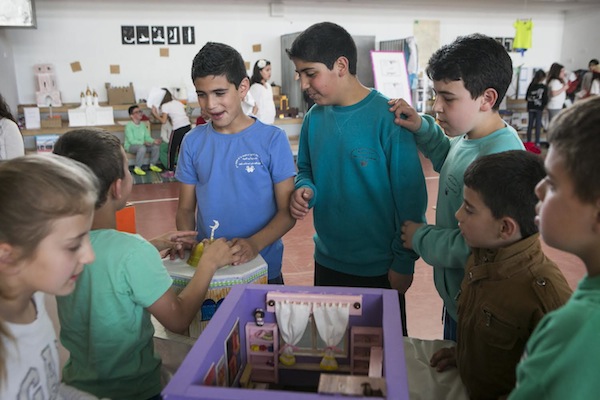
photo - Today, there is a whole range of programs for adults, including language classes, holiday celebrations, discussion groups and a men’s basketball team
Today, there is a whole range of programs for adults, including language classes, holiday celebrations, discussion groups and a men’s basketball team. (photo from Hand in Hand)

At the schools, Hand in Hand works toward keeping the numbers balanced between Arabs and Jews, and between boys and girls.

“These are the main prerequisites,” said Gordon. “Earlier on, we had more Arabs than Jews. Now, we have waiting lists on both sides, though there’s a larger waiting list on the Arab side.

“Most importantly, they are growing fast. For example, in the new school in Tel Aviv (which is a preschool and kindergarten for now), last year, we had one class of 30 students. This year, we have three classes with 100 students in total. And, there was enough interest that we could’ve had 150 kids if we’d have had enough room.”

Gordon added, “There are great teachers and a wonderful curriculum. It looks at multiculturalism, backgrounds and narratives of different religions, because we have Christians, Muslims, Arabs and Jews…. In the younger grades, they have two full-time teachers in each class, one Arab and one Jewish.”

Gordon spoke of the schools’ broad reach.

“You can have an Arab friend the same way you can have a Jewish friend,” he said. “It can help you in the workplace, academia or your social life, and I think that’s a direct impact of Hand in Hand…. From the very beginning, when a Jewish child was invited to an Arab’s home for a birthday party, this involved the parents taking that child in and they’d meet each other. So, there are a lot of friendships happening beyond the walls of the schools … and sometimes the parents’ friendships were long-lasting, even if the children changed friends…. And the families aren’t just the parents. They are uncles, aunts, sister, brothers, cousins…. People hear about it and are impacted.

“We want to be visible because we want the rest of Israel to know about this and to be an example, as an alternative. Things can be different. Jews and Arabs can get along.”

Canadians can make a tax-deductible donation to Hand in Hand via the Jerusalem Foundation of Canada, with which it has a partnership.

“Our goal is to bring this model to as many places as there is interest and to work with populations to help them build a model school in the community,” said Gordon.

For more information, visit handinhandk12.org.

Rebeca Kuropatwa is a Winnipeg freelance writer.
Format ImagePosted on November 21, 2014November 19, 2014Author Rebeca KuropatwaCategories IsraelTags Amin Kalaf, Arabs, Hand in Hand, Israelis, Jerusalem Foundation, Lee Gordon, Palestinians
Facts: A well-crafted crafted play

Facts: A well-crafted crafted play

Left to right, Jerry Wasserman, James Gill and Mehdi Darvish star in United Players’ production of Facts. (photo by Doug Williams)

United Players is set to present Canadian Jewish playwright Arthur Milner’s provocative political drama Facts, loosely based on the true story of the 1992 murder of an American archeologist in the West Bank and the joint Israeli/Palestinian police investigation that followed.

The play has been produced in Ontario and the United Kingdom and was translated into Arabic for a tour of various West Bank cities in 2012. The United Players’ production marks the play’s Western Canadian première, with Jerry Wasserman as Yossi, the hot-headed Israeli detective; Mehdi Darvish as Khalid, Yossi’s Palestinian counterpart; and James Gill as Danny, the fervent settler accused of the murder. Adam Henderson helms this production as it navigates its way through some rough waters, exploring not only the Israeli-Palestinian conflict but also the religious-secular divide between Jews within Israel. The action takes place in a cramped, hot interrogation room in the West Bank and, as the story unfolds, it is revealed that the archeologist was unearthing facts that brought into question some accepted historical beliefs fundamental to Judaism.

The Jewish Independent sat down with Wasserman, Henderson and Darvish one morning before a rehearsal.

Wasserman – who is also a theatre critic and head of the theatre and film department at the University of British Columbia – described himself as an American Jew brought up by liberal Jewish thinkers. He said his research and immersion into this play angered him, but made him see the Middle East conflict in a new light. “This play really presses a lot of emotional buttons for me,” he said. “It digs down through layers into very specific details of [the] lives of people and, through this complexity, we see things more clearly.”

As to his character, Wasserman said, “Yossi’s father was a Zionist who had a dream of a state which has been compromised by the new wave of radical settlers who he sees as having a medieval way of thinking…. This has changed the state of Israel that Yossi loves. The real conflict in this story is not between Yossi and Khalid, but between Yossi and Danny.

“Because Yossi operates at a high emotional temperature, I had to find the proper rhythms and the right places to come up and go down so that I did not peak too early. There were many challenges, but it was infinitely fascinating. You don’t get too many chances to play a role like this.”

The heart of the story is the investigation, as the two detectives sift through various pieces of evidence and theories on the murder.

“I have acted in over 100 police dramas, both television and cinema, and I have to say that this, by far, is the most complex, sophisticated and confusing ones I have ever been involved in,” said Wasserman. “The research has been very detailed and the play is very accurate, re: police investigation and techniques. It is a tremendous intellectual puzzle. The evidence is circumstantial and we never find the smoking gun. The dialogue is an emotional mine field that we, as actors, all have to move through.”

Police dramas often feature a good cop/bad cop relationship. As to whether or not audiences will get to see that dynamic, Wasserman said, “Yossi tries to act the good cop but he is the bad cop by nature. He has lots of emotional buttons to press. The great thing about this play is that everyone’s buttons get pressed. Everyone has a turn to make impassioned monologues and everyone gets to lay his emotional/political cards on the table.”

Gill finds his role of Danny an interesting challenge. “While so much of his absolutist approach to his faith and his politics is antithetical to my own liberalism, nonetheless, being a Jew gives me an empathy for where his faith and politics are grounded,” he said in an email. “That gives me a starting point from which I can start to encompass the character.”

He sees the essence of the play as “the way in which these three men both conform to and transcend their stereotypes. We start with the ‘facts’ of an Israeli, a Palestinian and a settler and, on one level, each of these men is true to those simplistic profiles, but we discover that each of them is much more complicated.”

For Darvish, his involvement in the play also gave him new insights into the conflict. “I came to understand the Israeli position from an emotional perspective better as a result of working on this play,” he said, “but I also see more deeply the Palestinian position. I see the characters often acting like children throwing tantrums instead of sitting down and logically dealing with the situation. It saddens me because right now I do not see a resolution to the dilemma.”

Henderson said he enjoys working with a small cast and a modern-day setting, which contains no idiosyncrasies as to period or language. With an all-male cast, the action is testosterone driven and reflective of the politics of the Middle East, he said.

Henderson expressed surprise that more Canadians do not know about Milner, whose work he has come to appreciate more during the course of his research and preparation for this production.

“Milner has taken a very sensitive subject and effected meticulous research to create a platform to encourage serious dialogue,” he said. “His position is Socratic – he wants to encourage discussion versus making a point and this is brought home by his equivocal ending.”

Henderson acknowledged that the play is likely to be controversial but stressed that, “the key to theatre is that it is a thought experiment where we can do dangerous things with no consequences except people might have their perspectives broadened. If that is what happens in this play, then we will have accomplished something.”

He added, “As the news media move toward ‘infotainment,’ and the sound bites become faster and shallower, the longer form of theatre allows us to look a little deeper at things. For me, it is critical to protect ourselves from merely having our prejudices reinforced. Theatre was invented as a public forum, and we need to gather, to discuss, now more than ever.”

As to why Vancouverites should see the play, Henderson said, “It is an unusually well-crafted play. It is funny, witty, challenging and surprising, and you won’t find anything like it on television. Also, this is a great opportunity to dress up, go out and mingle with community and exercise the soul. Parking is easy and you come out after the show by the beautiful Jericho Beach with something new to talk about.”

Facts is at Jericho Arts Centre from Nov. 7-30. As an added feature, there will be a reading of Masada, Milner’s companion piece to Facts, after every Friday performance. Milner will be in Vancouver the week of Nov. 11 and will be attending performances during that time. For tickets and more information, visit unitedplayers.com.

Tova Kornfeld is a Vancouver freelance writer and lawyer.

Format ImagePosted on October 31, 2014November 6, 2014Author Tova KornfeldCategories Performing ArtsTags Arthur Milner, Israel, James Gill, Jerry Wasserman, Mehdi Darvish, Palestinians, United Players, Zionism

Reasons to protest Klinghoffer

One of the most controversial operas in recent memory, The Death of Klinghoffer, debuted Oct. 20 at New York’s Metropolitan Opera. The Met has scheduled seven more performances through November. The first staging did not occur without protest, as about 400 demonstrators – including Jewish communal and nationally recognized leaders – came to Lincoln Centre to denounce the anti-Jewish and anti-Israel opera.

Klinghoffer, the creation of composer John Adams and librettist Alice Goodman, premièred in 1991, with few additional stagings. The opera is based on the 1985 murder of a 69-year-old American Jew, Leon Klinghoffer, on an Italian cruise ship. Klinghoffer, confined to a wheelchair, was shot in the head by Palestinian Arab terrorists who had hijacked the ship. They dumped his body into the Mediterranean Sea.

The opera repeatedly defames Jews and Israelis as representatives of religious/ethnic or national groups. Nowhere does it similarly criticize Arabs/Muslims as a group. The Met’s intransigent insistence that Klinghoffer must be staged has become an organizational calamity.

Adams and Goodman make up an aptly matched pair. Their Jewish problem seems to include an obsession with what they imagine to be Jewish guilt. This should not be surprising on the part of Goodman, perhaps, since, during the writing of Klinghoffer, she rejected her American Jewish heritage and joined the Anglican Church. The church’s leadership has been known in recent years for its hostility toward Israel. Goodman is now a parish priest in England.

But is Klinghoffer the only Adams/Goodman opera that contains elements of antiemitism, including the stereotypical notion of Jewish guilt?

Consider the Adams/Goodman opera Nixon in China (world première 1987, Met première 2011). It offered relatively humane depictions of President Richard M. Nixon and Chinese leader Mao Zedong – a mass murderer on the scale of a Hitler or Stalin – but not a similarly sympathetic picture of U.S. Secretary of State Henry Kissinger, a Jew. In a 1988 review of the opera, Pulitzer Prize-winning critic Tim Page wrote that Kissinger is depicted as “a venal, jabbering, opportunistic buffoon.” Others remarked that Kissinger is portrayed as cruel and cunning.

A bizarre, memorable scene involving Kissinger occurs in the second act. In a propagandistic ballet staged by Madame Mao for the Nixon entourage, First Lady Pat Nixon thinks she sees Kissinger playing an evil landlord savagely whipping a poor village girl. Not seeing Kissinger in the audience or at the Nixon family table, Mrs. Nixon points to the landlord while whispering to her husband, “Doesn’t that look like you-know-who?” Indeed, the singer who plays the role of Kissinger also plays the role of the evil landlord.

Then there is the Adams opera Doctor Atomic (world première 2005, Met première 2008). Its storyline centres on Jewish American scientist J. Robert Oppenheimer, often called the “father of the atomic bomb” for leading the Manhattan Project during the Second World War. The project developed the nuclear weapons that incinerated Hiroshima and Nagasaki, killing more than 100,000 people and causing Japan to surrender to the United States, thus ending the war earlier than would have otherwise been the case. The earlier end potentially saved hundreds of thousands, if not millions, of other lives on both sides.

Adams and librettists Goodman and Peter Sellars depict Oppenheimer as consumed with guilt and torn with remorse. Did they exaggerate here? According to a 1967 New York Times report, Oppenheimer was “beset by the moral consequences of the bomb, which, he told fellow physicists, had ‘dramatized so mercilessly the inhumanity and evil of modern war’ … [but] in later years, he seemed to indicate that the ‘sin’ was not to be taken personally. ‘I carry no weight on my conscience,’ he said in 1961 in reference to the atomic bombing of Hiroshima and Nagasaki.”

Defenders of The Death of Klinghoffer seem either unaware or unconcerned about any of the several instances of the opera’s anti-Jewish and inflammatory lyrics. Some of these were cited by the Committee for Accuracy in Middle East Reporting in America in an open letter to Met general manager Peter Gelb on May 29, 2014. The letter helped spark initial protests against staging Klinghoffer and resulted in the cancellation of a Nov. 15 large-screen simulcast of the opera that would have been viewed live by hundreds of thousands of people in theaters in 70 countries.

Klinghoffer defenders treat the libretto – the text sung and spoken in the opera – as proving nothing. Instead, they seem to either misunderstand, or misuse as camouflage, the concept of “artistic freedom.” It is possible to defend Klinghoffer on artistic grounds, but the art involved is the low variety of the propagandist, not the high art of worthwhile opera. The defenders act as if neither the libretto nor the music matters much. In fact, while the lyrics recycle some of the worst antisemitic canards, the music is mediocre and unremarkable except for the propagandistic way it is used by Adams to underscore words of the Palestinian hijackers. This was pointed out by eminent American musicologist Richard Taruskin in a December 2001 New York Times article strongly condemning the Adams opera, headlined “Music’s dangers and the case for control.”

The Death of Klinghoffer is a vehicle for tendentious reiteration of antisemitic and anti-Zionist slurs. But this opera, when considered together with the other two Adams/Goodman opera collaborations mentioned here, represents something more – a prejudicial obsession with Jews.

Myron Kaplan is a senior research analyst for the Boston-based, 65,000-member Committee for Accuracy in Middle East Reporting in America. This article was originally published by jns.org.

Posted on October 24, 2014October 23, 2014Author Myron Kaplan JNS.ORGCategories Op-EdTags Alice Goodman, Death of Klinghoffer, John Adams, Metropolitan Opera, Palestinians, terrorism, The Met

“Temporary” occupation

It’s a question that defines the debate over Israel’s policies and the state’s grand strategy: do Israeli human rights organizations monitoring the occupation merely serve as a fig leaf, adding an ethical patina to what is a fundamentally immoral situation?

Four months into his new position as head of B’Tselem, having come from the Association for Civil Rights in Israel, Hagai El-Ad and I spoke by phone recently about this and other issues. [To read the JI’s interview with El-Ad, click here.]

Given that the Israeli occupation of the West Bank and Gaza was supposed to be “temporary,” El-Ad is well aware that “at some point the term loses its meaning.” So, as he took the helm of B’Tselem last May, the organization issued a position paper provocatively named 47 Years of Temporary Occupation. As El-Ad put it, B’Tselem is shifting its focus from “fighting against human rights violations under occupation to a strategy [emphasizing] that the occupation will forever violate the human rights of Palestinians.” To this end, B’Tselem is now trying to end the occupation – not just help manage it.

It’s a laudable goal. But how achievable is it?

B’Tselem is starting with some concrete steps, however limited. For one, they have recently announced that they will not cooperate with Israel Defence Forces military investigations around Operation Protective Edge. Calling it “theatre of the absurd,” El-Ad believes that the military investigation system is one intended to “always result in impunity.” And this protected military violence is a necessary “lifeline of the occupation.” Hence, the need to squelch it.

As far as the bigger picture goes, El-Ad was cautiously optimistic: probably a necessary blend for anyone in human rights work in the Israel/Palestine morass. He takes comfort from what he sees as B’Tselem’s mission being fundamentally buttressed by the very human rights discourse extant in Israel. That the concept of human rights is a “relevant currency” in Israeli politics gives the organization an important starting point by which to leverage societal consensus. Though without the clout or mandate to engage in electoral lobbying efforts, working to end the occupation must be done very much at arm’s length from the policy sphere. Still, it’s a start.

El-Ad adds that he invites others to see what they can do “in their own communities” to disrupt the idea of the occupation as “business as usual.”

OK, so most of us can agree that the occupation is an undesirable situation, but what about the argument, issued frequently by Israel’s most strident defenders, that the status quo is a security imperative? If Hamas didn’t launch rockets, the thinking goes, the war in Gaza wouldn’t have been necessary. And, if West Bank Palestinians didn’t seek to blow up Israelis, the checkpoints and night raids and (the various) separate roads could be dismantled. And we all know about the apartheid, uh, separation, ahem, security wall.

Trading off between security on one hand, and human rights and ending occupation on the other, is a false dichotomy, El-Ad explained. In Gaza, “we’ve encountered time and again the theory that using more and more force will provide the desired outcome. But that’s not really working.” When it comes to day-to-day military policing in the West Bank to ensure the safety of Israeli citizens, we all know the chicken-egg argument: the internal checkpoints would be unnecessary were there not settlements (illegal under international law) to protect, hence, B’Tselem’s claim, in its 47 Years of Temporary Occupation document, that settlements are “the heart of the matter.”

Now that the fighting in Gaza has died down, B’Tselem is reflecting on its work compiling data on casualties, monitoring international humanitarian law violations – including by Hamas – and collecting first-person testimonies, attempting to put a face to the Palestinians in Gaza. El-Ad is quick to note that the media coverage in Israel tended to be one-sided, with little coverage of the war experience for Gazans. As an antidote, B’Tselem relied heavily on social media and web coverage to get additional information disseminated, despite a hacking attempt that left their website site crippled for a few days.

After talking to El-Ad, I’m left with a strange combination of hope and cynicism. As someone who cares deeply about seeing an end to the occupation, I’m buoyed by the fact that the head of Israel’s most important human rights organization has this broader goal top of mind. At the same time, absent the apparent political will in the top echelons of the Israeli government, I can’t escape the belief that intelligent, passionate and committed Israeli change-makers like El-Ad are too often left clapping with one hand.

Mira Sucharov is an associate professor of political science at Carleton University. She blogs at Haaretz and the Jewish Daily Forward. A version of this article was originally published on haartez.com.

Posted on October 17, 2014October 17, 2014Author Mira SucharovCategories Op-EdTags B’Tselem, Gaza, Hagai El-Ad, IDF, Israel, Israel Defence Forces, Palestinians, West Bank

Netanyahu at UN: danger, opportunity ahead

Last week at the United Nations, Palestinian President Mahmoud Abbas once again accused Israel of heinous crimes, including “genocide.” And, once again, the global community demonstrated its collective gullibility. It was left to Israeli Prime Minister Binyamin Netanyahu Monday to stand at the same lectern before the UN General Assembly and deliver what has become an annual rebuttal to the most preposterous allegations against the Jewish state.

It was not a cheery speech, but nor was it all doom and gloom. In that half-empty assembly hall – many delegates, apparently, cannot even bear to listen to the words of an Israeli leader – Netanyahu took on one accusation after another.

“I’ve come here to expose the brazen lies spoken from this very podium against my country and against the brave soldiers who defend it,” he said, holding up the Israel Defence Forces as representative of “the highest moral values of any army in the world” and insisting that “Israel’s soldiers deserve not condemnation, but admiration … from decent people everywhere.”

He slammed the UN’s Human Rights Council, which he declared an oxymoron.

“By investigating Israel, rather than Hamas, for war crimes, the UN Human Rights Council has betrayed its noble mission to protect the innocent,” the prime minister said. “In fact, what it’s doing is to turn the laws of war upside-down. Israel, which took unprecedented steps to minimize civilian casualties – Israel is condemned. Hamas, which both targeted and hid behind civilians – that, a double war crime – Hamas is given a pass. The Human Rights Council is thus sending a clear message to terrorists everywhere: use civilians as human shields. Use them again and again and again. And you know why? Because, sadly, it works.”

Then he turned his sights toward Iran’s nuclear ambitions. He warned that, while Iran may have softened its tone, its aim is the same as that of ISIS, Hamas and other militant Islamists – world domination.

These common dangers – “a nuclear-armed Iran and militant Islamist movements gaining ground” – provide an opening for peace between Israel and its neighbors. And not only militarily, but also in terms of regional development.

“Together we can strengthen regional security,” said Netanyahu. “We can advance projects in water, agriculture, in transportation, in health, in energy, in so many fields.

“I believe the partnership between us can also help facilitate peace between Israel and the Palestinians. Many have long assumed that an Israeli-Palestinian peace can help facilitate a broader rapprochement between Israel and the Arab world. But, these days, I think it may work the other way around: namely, that a broader rapprochement between Israel and the Arab world may help facilitate an Israeli-Palestinian peace.”

If Israel’s prime minister can talk about the potential for “new opportunities” in the Middle East alongside the dangers, and of “the indispensable role of Arab states in advancing peace with the Palestinians,” perhaps it’s not so naïve to remain hopeful.

Posted on October 3, 2014October 1, 2014Author The Editorial BoardCategories From the JITags Binyamin Netanyahu, Israel, Mahmoud Abbas, Palestinians, UN, United Nations
Israel-Hamas talks necessary to rebuild Gaza

Israel-Hamas talks necessary to rebuild Gaza

Gazan civilians on the roof of a building that had been used for terror activity. (photo from idfblog.com)

As Palestinians begin to discuss the reconstruction of the Gaza Strip after seven weeks of fighting with Israel, Israeli, Palestinian and international officials warn of the risk of another round of fighting unless there is a diplomatic agreement between the two sides as well as an agreement to rebuild Gaza.

Hamas senior official Musa Abu Marzook said that indirect talks with Israel would resume in Cairo later this month. He hinted that Hamas would be prepared to negotiate directly with Israel, saying that there is no obstacle in Muslim religious law to negotiations with Israel.

Israel, for its part, says that Hamas is a terrorist organization, and it will not negotiate either directly with Hamas or with any government that includes Hamas. This could complicate efforts for a new unity government of technocrats from Hamas and Fatah.

European Union Ambassador Lars Faaborg-Andersen warned last week that without a long-term political solution that would see Palestinian Authority President Mahmoud Abbas in charge of Gaza, violence could start anew. Israel and Hamas agreed to an Egyptian-brokered ceasefire on Aug. 26, and were expected to restart negotiations on long-term issues within a month. These expected talks come amid growing tensions between Abbas’ Fatah movement and Hamas, which is far more popular in Gaza now than it was before the war.

The issues on the table for the Cairo talks include an airport or sea port for Gaza, which Israel is expected to oppose, rebuilding Gaza, which is estimated to cost $7.8 billion, and demilitarizing the Strip, which Hamas has opposed. Cairo is also expected to host an international donors conference in October.

In the short term, the Palestinian Authority has appealed for more than $550 million in emergency aid for Gaza. Tens of thousands of Palestinians are still homeless after the fighting.

Palestinian Deputy Prime Minister Mohammed Mustafa said, “Reconstruction is the ultimate goal, but our government won’t accept a return to the status quo. We are getting to a limit that can no more be accepted. Never again, never again.”

Israeli officials said they would support the PA having control over a demilitarized Gaza Strip.

Read more at themedialine.org.

Format ImagePosted on September 19, 2014September 18, 2014Author Abdullah H. Erakat and Linda Gradstein TMLCategories WorldTags Gaza, Hamas, Israel, Palestinians
Haifa’s Rambam practises medicine without borders

Haifa’s Rambam practises medicine without borders

The parking lot at the Rambam Health Care Campus is a dual-purpose facility capable of converting into a fortified 2,000-bed underground hospital in times of conflict. (photo from Rambam Health Care Campus)

Not unexpectedly, southern Israel suffered more than other areas of the Jewish state during this summer’s conflict with Hamas. Yet up in northern Israel, 30 doctors from the Haifa-based Rambam Health Care Campus (RHCC) were drafted into the Israel Defence Forces (IDF).

“Israel is a small country, so everything affects you whether you are in the conflict or not,” Prof. Rafael (Rafi) Beyar, a renowned cardiologist and the director general of RHCC, told this reporter.

Now, in the aftermath of the 50-day summer war, RHCC is proving that medicine has “no borders,” in Beyar’s words. The week of this interview, doctors at the hospital conducted a successful kidney transplant on a 14-year-old boy from Gaza.

photo - The robotic catheterization system allows the doctor to open heart blockages and implant stents in patients remotely
The robotic catheterization system allows the doctor to open heart blockages and implant stents in patients remotely. (photo from Rambam Health Care Campus)

The largest hospital in northern Israel, RHCC serves more than two million residents and functions as the primary medical facility for the Northern Command of the IDF. In addition to treating Gazan patients and training Palestinian physicians, the hospital is receiving wounded Syrian refugees.

Many of RHCC’s Gazan patients are children facing cancer and kidney diseases.

“These kids don’t have any other solutions,” Beyar said.

While suffering from kidney failure, the Gaza boy treated this week also had a blood condition that obstructed some of his blood vessels. Doctors first needed to check for useable blood vessels, and only then could they transplant his sister’s kidney into his body. When it became clear that the boy’s functioning blood vessels could not sustain the new kidney, doctors implanted a synthetic connector that saved his life.

On the Syrian front, RHCC has received nearly 100 wounded refugees over the past few months. IDF soldiers provide the necessary immediate treatment for injured refugees at the Israel-Syria border in the Golan Heights, and then bring them to the hospital. Most of the Syrian patients have sustained injuries from shock, bombs and other blasts. When they are treated and recover, most return to Syria, but some don’t want to go back, said Beyar.

Like the patients from Syria, most of the Gazan patients are thankful for the treatment they receive from RHCC. Although Beyar doesn’t know what happens to the patients once they return to Gaza, he said, “Someone who is treated and whose life is saved knows how to appreciate that.” Beyar added that he believes Israeli medical treatment of Gazans “has a long-term impact” on how Palestinian civilians view Israel.

Read more at jns.org.

Format ImagePosted on September 19, 2014September 18, 2014Author Alina Dain Sharon JNS.ORGCategories WorldTags Gaza, Palestinians, Rafael Beyar, Rafi Beyar, Rambam Health Care Campus, RHCC, Syria

Christianity stands accused

The Catholic Church did not initiate diplomatic relations with the state of Israel until 1993 and, according to the Italian writer Giulio Meotti, things haven’t been all rainbows since then either.

image - J'Accuse coverThe creation of a thriving Jewish state creates a theological conundrum for the Catholic Church, Meotti writes in The Vatican Against Israel: J’Accuse (Mantua Books, 2013), because it is a refutation of the theological view that Judaism should wither and die in the shadow of a successor religion, Christianity. The theological imperative of Jewish disappearance is now accompanied, he writes, by a geopolitical imperative that Israel should vanish.

“Replacement theology stated that Christians had inherited the covenant and replaced the Jews as the Chosen People. The concept of replacement geography similarly replaces the historical connection of one people to the land with a connection between another people and the land,” Meotti writes. “The existence of a restored Israel in the land of the Bible, proof that the Jewish people is not annihilated, assimilated and withering away, is the living refutation of the Christian myth about the Jewish end in the historical process.”

The necessity of rejecting Zionism and, in its time, Israel, bested even the liberalizing influence of the Second Vatican Council, the near-revolutionary reconsideration that took place within Catholicism in the early 1960s. This period, which saw the Church recognize Judaism and Christianity as familial theologies and renounce the millennia-old deicide charge against the Jews, nevertheless has a stream that abhors Zionism. Meotti writes that two conflicting Vatican tendencies developed at that time and still dominate: “theological dialogue with Judaism, and political support for the Arabs.” (The gushing lamentation offered by the Vatican on the death of Yasser Arafat is particularly striking.)

Meotti contends that this process has involved the Catholic Church differentiating between “good” and “docile” Jews of the Diaspora and the “bad” and “arrogant” Jews of Israel.

The book is a litany of indictments. The Church had relations with the PLO before it had relations with Israel. Top Church leaders have repeatedly accused Israel of behaving like Nazis. They routinely use crucifixion motifs in the Israeli-Palestinian context, with Jews playing the Romans and Palestinians, of course, playing the beatific victim. Israel, said one archbishop, was imposing “the sufferings of the passion of Jesus on the Arab Christians.” Another, at the time of the Palestinians’ seizure of the Church of the Nativity in Bethlehem, declared: “Our Palestinian people in Bethlehem died like a crucified martyr.” Arafat himself jumped on the bandwagon, declaring: “Jesus Christ was the first Palestinian fedayeen who carried his sword along the road on which today the Palestinians carry their cross.”

The first translation into Arabic of the Protocols of the Elders of Zion was courtesy of the Catholic Church. One archbishop was convicted of using his immunity to smuggle explosives to Palestinian terrorists and served just four years of his 12-year term after intervention by the Pope and a promise to make no more trouble. (He turned up again in 2010 on the fatal “Freedom Flotilla” that sought to bring aid to Hamas terrorists and has goaded Palestinian Christians to violence, insisting it is the only thing that will move Israelis.) Today, Catholic-affiliated nongovernmental organizations are among the leaders in the anti-Israel boycott, divestment and sanctions movement.

The Vatican’s relationship to the Holocaust is particularly dissolute. Pope John Paul II, in 1979, spoke at Auschwitz, noting that “six million Poles lost their lives during the Second World War, one-fifth of the nation,” failing to note that these were almost all Jews. Instead, he called Auschwitz “the Golgotha of the contemporary world,” Golgotha being the place in Jerusalem where Jesus is said to have been crucified.

More perversely, after visiting Mauthausen, the Pope said that the Jews “enriched the world by their suffering,” He seemed to be echoing the thoughts of John Cardinal O’Connor, then archbishop of New York, who a year earlier had visited Yad Vashem, Israel’s Holocaust museum, and asserted that “the Holocaust is an enormous gift that Judaism has given to the world.”

John Paul also infuriated Jews, among others, by conferring a papal knighthood on Kurt Waldheim, the former Austrian president, United Nations secretary-general and Nazi war criminal.

When Jews objected to a proposal to build a Carmelite convent at Auschwitz, the mother superior of the order asked: “Why do the Jews want special treatment in Auschwitz only for themselves? Do they still consider themselves the Chosen People?”

The “J’Accuse” part, which channels the moral outrage of Emile Zola, is fair enough, but this book is only partly about the Vatican. Meotti dredges up equally egregious affronts perpetrated by countless other Christian denominations.

The book is a searing indictment of the Catholic Church, but it is also deeply flawed. At the least, the title is deceptive. The “J’Accuse” part, which channels the moral outrage of Emile Zola, is fair enough, but this book is only partly about the Vatican. Meotti dredges up equally egregious affronts perpetrated by countless other Christian denominations. By no means is Meotti’s condemnation limited to the Vatican, and it is difficult to discern why the title should suggest it is.

Meotti frequently puts uncited statements in quotations. For example, during the 1967 war, when Israel faced annihilation from the Arab states, Meotti claims the Vatican gave the order: “Cheer for the other side.” The quote marks suggest someone literally said this, but whom? On another occasion, he attributes, in quotes, the statement “Jerusalem must be Judenrein.” But who is alleged to have said it? One can also frequently sense comments being stretched out of context to fit the thesis.

Too many times to count, Meotti declares one Christian assertion or another “a blood libel.” The term’s over-usage diminishes whatever power the accusation carries. And nowhere is his over-usage more disturbing than in his casual, often flippant invocation of Nazism.

He writes, “Like Hitlerism, Palestinianism is not a national identity, but a criminal ideological construct…. Worse, the Netanya Passover bombing that killed 30 is a “mini Holocaust.” And, “The dark irony is that the Europeans who are supporting the Palestinians’ ‘right of return’ are living in homes stolen from Jews they helped to gas.”

Meotti’s book has the potential to make an important case against Christian antisemitism and anti-Zionism. While it doesn’t fail completely – the evidence being compendious – the charge to the jury is so overwrought that one feels resentful at being manipulated. The facts would speak for themselves if the author would step back a bit.

Pat Johnson is a Vancouver writer and principal in PRsuasiveMedia.com.

Posted on September 19, 2014January 13, 2015Author Pat JohnsonCategories BooksTags antisemitism, Giulio Meotti, Holocaust, Israel, Nazism, Palestinians
Mideast future bleak

Mideast future bleak

Prof. Shlomo Hasson of the Hebrew University of Jerusalem speaks with audience member Marvin Weintraub after his presentation on Israel’s geopolitical situation. (photo by Cynthia Ramsay)

While Prof. Shlomo Hasson of the Hebrew University of Jerusalem offered some hope that Israel will one day live in peace, he did not offer many reasons to be optimistic about the future of the Middle East.

Speaking to more than 150 people at the Jewish Community Centre of Greater Vancouver on Sept. 4, Hasson put the current geopolitical situation of Israel into context, and discussed four possible futures for the Middle East in general, and for Israel in particular. These scenarios were derived at HU’s Shasha Centre for Strategic Studies, which Hasson heads.

Hasson, who is also a professor in HU’s department of geography, School of Public Policy, and the Leon Safdie Chair at the Institute of Urban and Regional Studies, began by sharing his belief, as a strategist, that, “In every crisis, there is also embedded an opportunity.”

The main issues, he explained, are Israel’s identity as a Jewish and democratic state and its security within recognized (legitimate) borders, the conflict with Hamas and the regional upheaval. The question is which map(s) and policy(ies) can best deal with all these issues (demography, democracy, legitimacy and geography) and what are the driving forces (internal, regional and global) shaping this map.

The dilemma is not new, said Hasson. “We have always asked ourselves, ‘How can we sustain Israel as a Jewish and democratic state with secure and legitimate borders?’” What is new, however, is the context.

According to Hasson, the new aspects of Israel’s dilemma include that the United States doesn’t have a comprehensive Middle East strategy; the cold war in the region (states fighting each other indirectly using proxies, such as extremist groups); the region’s instability (failed states, non-state actors); the increase in criticism of Israel (even by allies) and antisemitism; and the indeterminate results of Operation Protective Edge.

About the war with Hamas over the summer, Hasson divided the results into achievements and failures. Achievements included the devastation Israel inflicted on Hamas, the tunnels it destroyed and the top commanders it killed, the effectiveness of the Iron Dome, the isolation of Hamas, the resilience within Israel and Israelis’ support of the war. On the negative side, he said, Israel did not manage to defeat Hamas; the Israeli government exhibited reactive policy, a lack of creativity and an absence of strategy during the conflict; there were rifts with the United States; the recognition of Hamas as a political actor; and, within Israel, there was bitterness and political division. Hasson questioned whether the war had achieved greater security or served as deterrence.

Hasson went through four predominant opinions on Israel’s possible future, ranging from the Greater Land of Israel to no Jewish state. One of the reasons that progress in achieving agreement is hard, he said, is because people approach it with their own “inevitability assumptions” about such things as to where Israel’s borders should lie: for example, the 1967 borders are inevitable because they stem from moral/progress imperatives, or the Greater Land of Israel borders are inevitable because of a divine promise.

Israel’s decisions and border preferences are not the only ones that will influence its future. Other forces are at work: the super powers (United States, China, Russia, European Union), regional powers (Turkey, Iran, Israel, Saudi Arabia/Egypt), developments in the Arab world, relations between Israel and the Palestinian Authority, as well as developments within the PA.

Hasson highlighted the importance of the Sunni versus Shi’a conflict, explaining some of the possible regional outcomes: national-religious states, democracy, the prevalence of moderate autocrats or the rise of extremists. He said that Israel cannot only focus on its relations with the Palestinians, but must take a broader view, including in its strategizing the Arab world, non-state actors, regional rivalries, and global competition over resources and positions.

He described four scenarios and hypothesized their likelihood.

“Pax Americana,” in which the United States returns to the region as a major actor, the Arab nations engage in democratization and Israel returns to the 1967 borders was one of them. Hasson said, “If you ask me, what are the chances, or the probabilities, of this scenario, I would say … very slim. So, when people talk about the ’67 borders, I share their expectation and I have the highest respect for the people who believe in a two-state solution … unfortunately, the leading driving forces are not taking us in this direction….”

Hasson described both the regional hegemony of Sunnite moderate parties (“a moderate Hamas” may prevail in this scenario) and “clash of civilizations” (between Islamic and non-Islamic forces, but also within Islam, where the extremists will take over) as having a moderate chance of occurring, and the potential for anarchy (with even the superpowers fighting each other) as high.

The Middle East will be unstable for a long time and a two-state solution cannot come to fruition, at least in the short term, he concluded. While a bi-national state might be possible, it is not desirable from Israel’s perspective, he said, and there is a need for another approach.

Hasson recommended that Israel recognize a Palestinian state without recognizing its borders, continue to engage in negotiations with the Palestinians and work toward international legitimacy. If negotiations fail, he said Israel has “to consider the possibility of unilateral withdrawal to defensible borders because we shouldn’t give the Palestinians a veto right over Israel’s existence as a Jewish and democratic state…. So, Israel must ensure its security and international legitimacy but also its demography.”

Hasson, referring to the Shasha Centre scenarios he outlined, predicted that Israel in 2020 will have defensible borders, and that the future will involve unilateral acts by the Palestinians (turning to the United Nations, for example) and Israel (more settlement building, for example) – “there will be mutual adaptation and, from time to time, we will have a cycle of violence in the Middle East. But, currently, we don’t see any prospect of getting to the ’67 borders.”

Dina Wachtel, executive director of the local Canadian Friends of the Hebrew University, welcomed the audience, and CFHU board member Dr. Sam Bugis introduced Hasson.

Format ImagePosted on September 12, 2014September 10, 2014Author Cynthia RamsayCategories WorldTags CFHU, Hebrew University, Israel, Palestinians, Shasha Centre

U.S. has many other priorities

It turns out Fidel Castro is still alive and making as much sense as ever. In an article in Cuban state media a few days ago, the former president ranted against the United States, Israel and NATO, the latter of which he equated with the Nazi SS. Even stranger, Castro believes that U.S. Senator John McCain and Israel’s intelligence agency the Mossad, created ISIS, the nihilistic terror entity sweeping Iraq and Syria.

Back on planet Earth, more serious commentators are wringing their hands over the state of U.S.-Israel relations. While it may not be exactly the Cuban missile crisis, relations between the United States and Israel are arguably at their lowest ebb ever. Part of this, of course, is a mere clash of personalities between their countries’ respective leaders. That’s old news and everybody by now accepts the fact that Binyamin Netanyahu and Barack Obama are not what constitute “great friends,” whatever that oft-used term means in the context of world leaders.

The Times of Israel is reporting that, during Operation Protective Edge, the United States put together a deal with Turkish and Qatari representatives in Paris that was intended to be a draft agenda for ceasefire talks in Cairo. When Netanyahu saw the document, he rejected it out of hand, seeing it as a putting the interests of Hamas ahead of those of Israel.

The United States, further according to the Times of Israel, was unwilling to put pressure on Qatar, an ally, perversely, of both the United States and Hamas, to “squeeze Hamas politically and financially.”

The United States is said to have come away from the experience shocked at Israel’s undiplomatic response, while Israel walked away distrustful of American intentions, says the Times.

Enmity will only grow with Israel’s latest announcement of more West Bank settlements.

But even that salt in the wound should be eclipsed by news that the blood-soaked regime of Bashar al-Assad has lost control of the part of what is left of the Syrian nation that abuts Israel at the Golan Heights. While no one is quite sure of the exact makeup of Assad’s opposition, it is the black flag of al-Qaeda that is flying over the checkpoint adjacent to Israel’s border with (erstwhile) Syria.

With explosive events also taking place daily in Ukraine, Iraq and so many other places in the world, American leadership sometimes seems to be the only hope for people under threat. Even the Baltic states of Latvia, Lithuania and Estonia are getting nervous as they watch the expansionist fantasies of Russia’s Vladimir Putin.

The American people have given a great deal of their financial and human resources to overseas conflicts in the past decade and it is understandable that they might be hesitant to reengage in the Middle East or to engage in Europe. America is exhausted.

Of course, what is taking place in the world today are precisely the types of things that the United Nations was envisioned to prevent or ameliorate. The tragedy of that organization is that it is now held captive by leaders who are more sympathetic to the objectives of ISIS, Hamas, Hezbollah and Putin than they are to the democratic states of the United States, Israel, Canada and western Europe.

The people and leaders of western Europe are also hesitant to get involved in Middle Eastern affairs, perhaps reasonably, given the potential they might have for trouble far closer to home if the Russian bear is not put back in its cage. Putin might have alleviated some international concern had he indicated that eastern Ukraine was the extent of his territorial ambitions, but he has done nothing of the sort.

For Obama’s part, it often seems as though he wishes Israel and Palestine would just disappear. Certainly, every president before him going back decades has tried and failed to resolve the problem and he is probably fully aware that he is not going to solve it either. With everything else happening in the world, this conflict may seem more like a nuisance than a crisis.

As much as Obama’s disengagement from this issue rankles many people, here’s a different take. For weeks, months, even years, people like us have been calling for the world to devote more of its attention to catastrophes that exponentially exceed the comparatively minor conflict between Israelis and Palestinians. Say what you will about Obama, but that seems to be exactly what he’s doing.

Posted on September 5, 2014September 3, 2014Author The Editorial BoardCategories From the JITags Israel, Israeli-Palestinian conflict, Palestinians

Posts pagination

Previous page Page 1 … Page 4 Page 5 Page 6 Next page
Proudly powered by WordPress