Travel along Incense Route

A sculpture of camels traversing the Incense Route in Avdat National Park. (photo by Kate Giryes/Shutterstock.com)

Close your eyes and travel back in time 2,000 years. You’re riding on the back of a camel laden with frankincense and myrrh from faraway Yemen, navigating 100 kilometres across the harsh, hilly Negev Desert to get your precious cargo to the Mediterranean ports.

For 700 years, from the third-century BCE until the second-century CE, this was the hazardous but hugely profitable task of the nomadic Nabatean people. Today, the small Israeli portion of the 2,000-kilometre Incense Route – a UNESCO World Heritage Site – is a fascinating trail filled with beautiful desert vistas and archeological discoveries.

The route includes the remains of the Nabatean towns of Halutza, Mamshit, Avdat, Shivta and Nitzana (another, Rehovot-Ruhaibe, is hidden by sand dunes), four fortresses (Katzra, Nekarot, Mahmal and Grafon) and two khans (Moa and Saharonim). You can see evidence of surprisingly sophisticated watering holes, agriculture and viniculture that the Nabateans innovated.

“The Roman and Greek empires controlled a lot of cities around the Mediterranean shores and, in all these cities, there were pagan shrines where they sacrificed animals. The smell was terrible, so the Nabateans brought incense for those shrines to cover the smell of the slaughter,” explained tour guide Atar Zehavi, whose Israeli Wild tours specialize in off-the-beaten-track jeeping, cycling, hiking and camel-back trips like the Incense Route.
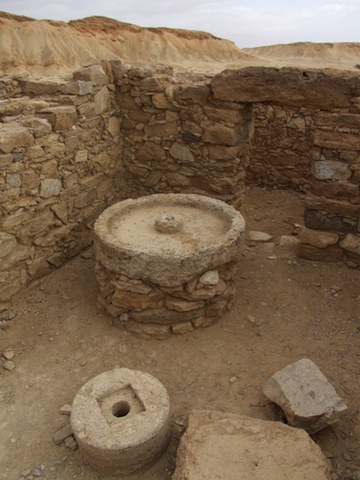
photo - At Moa, you can see an original pressing stone for olive oil
At Moa, you can see an original pressing stone for olive oil. (photo by Atar Zehavi)

“The route is surprisingly difficult because there were easier ways to go across the Negev. But the Nabateans wanted to stay hidden from other Arab tribes that might ambush the caravans, and they wanted to avoid being discovered by the Romans so they could keep their independence,” Zehavi said. “They knew how to harness the harsh desert conditions to their advantage, building water holes and strongholds others would not find. The Romans conquered Judea pretty easily but it took them another 150 years to conquer the Nabateans.”

Zehavi recommends a two-day “jeeping and sleeping” excursion along the Incense Route, also called the Spice Route. Start in the east, at Moa in the Arava Valley, site of an ancient khan (desert inn). From there, ascend the Katzra mountaintop, a stronghold overlooking the whole region. This will give you an appreciation for how hard it was to lead a caravan of camels up a steep slope.

“They’d travel 30 kilometres a day between khans. One camel carried 350 kilos of incense and only needed to drink once every 10 days or so,” said Zehavi, who has a master’s degree in environmental studies.

Even back then, camels wouldn’t have had much to drink at the third stop, the Nekarot River, a dry riverbed that once flowed through the Arif mountain range and northern Arava. The Nekarot is part of the Israel National Trail and boasts spectacular landscapes.

This leads you past Saharonim to the fourth stop, the town of Mitzpeh Ramon with its world-famous Ramon Crater (Makhtesh Ramon), which still has visible Nabatean milestones among its abundant flora and fauna, including the Nubian ibex. Ramon is the world’s largest erosion crater, stretching 40 kilometres and descending to a depth of 400 metres. It has unique geological structures, such as the Hamansera (Prism) of crystallized sandstones and the Ammonite rock wall embedded with fossils.

photo - An ibex at the Ramon Crater
An ibex at the Ramon Crater. (photo from PikiWiki Israel)

Camp out overnight in the crater, if weather and traveler preferences permit. A variety of hotels, from desert lodge to hostel to luxury, are also in the crater area. While in Mitzpeh Ramon, you may want to include the visitors centre and a nighttime stargazing tour.

The next morning, you’ll have a choice of trails for walking, jeeping or biking in the crater. A guided jeep tour is always a good option.

Getting back on the Incense Route, you go up Mahmal Ascent on the northern rim of the crater, a 250-to-300-metre climb to the Mahmal Fortress. Proceed northwest from there to Avdat National Park, site of a once-flourishing Nabatean city, where you can see shrines that were later turned into Byzantine churches.

Zehavi explained that, after the Roman Empire transitioned into Byzantine Christianity around 324 CE, incense was no longer needed, so the Nabateans started producing wine and desert agriculture, as well as raising Arabian horses.

“It’s amazing to see the way the harsh desert was colonized for agriculture through the use of highly sophisticated irrigation systems,” said Zehavi.

End your tour of the Incense Route at Avdat or go northwest to Shivta National Park and Halutza, or northeast to Mashit National Park near Dimona.

Israel21c is a nonprofit educational foundation with a mission to focus media and public attention on the 21st-century Israel that exists beyond the conflict. For more, or to donate, visit israel21c.org.


Help celebrate Israel’s 69th

Jane Bordeaux – Amir Zeevi, left, Doron Talmon and Mati Gilad – perform at the Chan Centre on May 1. (photo from Jewish Federation of Greater Vancouver)

What better way to bring folks together in song and celebration of Israel’s 69th birthday than with folk music. And what better band to unite Diaspora Jews than one that writes and performs American-style country-folk songs in Hebrew!

Tel Aviv-based Jane Bordeaux – Doron Talmon, Amir Zeevi and Mati Gilad – will headline this year’s community Yom Ha’atzmaut concert at the Chan Centre on May 1, 7:30 p.m. The trio regularly plays to sell-out crowds.

Their debut album was well-received, with songs such as “Eich Efshar” (“How is it Possible”) and “Whisky” radio favourites, and the video of their song “Ma’agalim” (“Circles”) went viral. A second album is nearing completion and is expected to be released in June.

Talmon and Gilad met in 2012 at Rimon School of Jazz and Contemporary Music in Ramat Hasharon, Israel. It was in a contest of original songs. “The idea was to perform some of my songs, and get some practical experience of a band format – you know, finding musicians, getting a name for the band and that sort of thing,” Talmon told the Jerusalem Post in a 2016 interview.

“We kept on playing after that one,” Talmon recently told the Independent, “and, when we needed a new guitar player, Amir, who’d been serving with Mati in the military band, had just returned from the U.S., and joined the band.”

Though the band has only been together five years ago, they have all been performing for much longer than that.

“I’ve been singing since I was a little child, always had the attraction to writing songs and singing them,” said Talmon. “After I returned from a long trip in South America, I decided to go and study music professionally, so I went to Rimon school for three years, learning music, songwriting and how to form a band, eventually.”

“I’ve been playing since I was 5, piano and then bass guitar,” said Gilad. “When I went to Thelma-Yellin arts high school in the jazz department, I started also playing the double bass. After high school, I served in the military in an army band and simultaneously studied at the Tel Aviv music conservatory. After the army, I started learning in Rimon school and was there for a year learning both classical, jazz and pop music.”

As for Zeevi, he has been playing the guitar for as long as he can remember. “My high school in Holon had a music major, that’s when I started taking the guitar more seriously, meeting great players and teachers,” he said. “In the army, I’ve played in the air force band and, after my release, I decided to go and learn music in the New School university in New York City, learning both jazz and country music.”

Usually, it is Talmon who comes up with the idea for a song, both the lyrics and melody, then the group starts playing with it, sometimes changing its harmony or structure, and building the arrangement. “Since we perform a lot,” they said, “we often try these new songs in shows, to get the feeling of what it is like to perform with them onstage and how does the crowd react, and each time improving and adjusting the song till it feels complete.”

In true country music fashion, many of Jane Bordeaux’s songs have to do with love and loss – ol’ American hurtin’ songs with a modern, Israeli twist.

“American folk-country, the way we see it, is storytelling, about the dark and the bright sides of life, wrapped in beautiful harmonies and joyful rhythm,” the band members agreed. “How can you not get excited from it? Also, we are addicted to the banjo’s sound and it’s going to feature a lot in our new album.”

“The songs are inspired from life, of course, mine and my friends,’” explained Talmon. “Sometimes, a song may be very close to a personal experience or feeling I had and, sometimes, it can be an idea I borrowed from a book I read or a movie I’ve seen, even a sentence I’ve heard.”

“Ma’agalim” is a bittersweet song about life: “It’s not me that’s progressing / It’s just the time that’s moving on.” The video features a wooden doll in a penny arcade. As the cylinder turns, she walks along her track, bundled up in a coat and scarf, passing people in various stages of life, from cradle to grave. Produced by Israeli animators Uri Lotan and Yoav Shtibelman, it really is a must-see (vimeo.com/ 162052542).

“The minute Uri and Yoav, the creators of the clip, showed it to us,” said the band, “we were so amazed by the beauty and sensibility of the video they made, so we can’t really say we were surprised that it went viral – we never had seen such animation before. We feel that there’s a unique connection between the music and the visuals that’s very moving, so people get excited by it, even without understanding the lyrics.”

No doubt a similar connection will be formed between the band and their audience in Vancouver, where they will sing in both Hebrew and English.

“It’s not going to be the same as in Haifa or Tel Aviv,” they said about the Yom Ha’atzmaut concert. “We love adjusting our set to best fit the place we are going to perform. Since the show date is Israel’s Independence Day, and we guess some of the crowd is English-speaking, in addition to our originals, we’re going to play some English covers and Hebrew all-time favourites – and even some special surprises for the Canadian crowd that obviously we can’t tell in here!”

The group starts their tour in Vancouver, then they have a few shows in North America, including one in Toronto.

“We are super-excited about the show in Vancouver,” they told the Independent. “It’s going to be the first show of our first tour outside of Israel and we’ve got a lot of great stuff planned specially for it, so we’re hoping to see you there!”

Tickets for the May 1 community celebration ($18) can be purchased at jewishvancouver.com/yh2017. In addition to this year’s co-sponsors – Canadian Friends of Hebrew University, Consulate General of Israel in Toronto, Georgian Court Hotel, the Jewish Independent and Jewish National Fund – the Jewish Federation of Greater Vancouver event is supported by 46 other community organizations.

MLA seeks out positive solutions

George Heyman is the member of the B.C. legislative assembly for Vancouver-Fairview. (photo from George Heyman)

George Heyman is one of numerous British Columbia residents who owe their lives to the Japanese diplomat Chiune Sugihara. Though born after the Second World War, Heyman is the son of a Polish Jewish couple who were among the estimated 6,000 Jews aided in fleeing Nazi Europe by the acts of Sugihara, who was the vice-consul for the Empire of Japan in Lithuania.

“That’s a story my parents didn’t spend a lot of time telling me about, which I’ve since found out is actually very common – parents don’t tell their story,” Heyman told the Independent. “But I learned much about it in recent years and it has been well-documented with a number of exhibits telling the story in Vancouver and the United States and other parts of Canada and in Japan.”

Sugihara risked his career – and his life – issuing transit visas to Jews. An estimated 40,000 descendants of “Sugihara Jews” are alive today because of his actions.

Once they had escaped Europe, Heyman’s parents were sponsored by family in Vancouver.

“Canada was certainly not falling over to welcome Jewish refugees,” said Heyman. “But they had distant relatives who were from Austria, who had already established here before the war started, seeing the writing on the wall. They sponsored them. My dad enlisted in the reserves, worked as a machinist in a boiler factory – even though he had an engineering degree – until he could get his credentials recognized in Canada, and eventually went on to work in the profession in which he had been trained.”

Heyman was born at Vancouver General Hospital, in the riding he now represents in the B.C. legislature, Vancouver-Fairview. The New Democrat says his family’s experience – and his own experience with casual antisemitism – helped shape his approach to the world and politics.

“I think, as a young child growing up in Canada, I just wanted to be what most children wanted, which was to be accepted,” he said. “I remember the normalization of what we would now recognize as clearly antisemitic jokes or comments or generalizations or characterizations. As a young boy, I had a hard time speaking up against it. It took a lot of courage to say, ‘you can’t talk about Jews that way’ or ‘why are you using the term Jew, my religion, in that way that is clearly not a good one?’”

These experiences, Heyman said, helped him recognize injustice and learn to value other people regardless of their economic class, ethnicity or religion, “to embrace people, not categorize them or shun them.”

“As part of that, I was also learning to stand up for who I was,” he said. “Like many young Jews, I was torn between looking for my identity and wanting to fit in. It’s been a lifelong journey.”

These experiences also helped lead him to careers in the labour movement and public office. Heyman served as head of the B.C. Government and Service Employees Union, then executive director of the Sierra Club of British Columbia, before being elected to the B.C. legislature in the 2013 election.

One of the reasons he has taken the opportunity over the years to speak up about his own experiences, Heyman said, has been “to try to deepen understanding and let people know what casual and thoughtless racist comments do to people who are the recipients of them.”

Antisemitic rhetoric and threats in North America and the murder of six Muslims in a Quebec mosque have had a range of unintended consequences, he said. They have ensured that people do not take security for granted and they have caused a coming together of disparate religious and ethnic groups.

“When Muslims at prayer in a mosque in Quebec are murdered, members of the Jewish community stood with Vancouver Muslims at the mosque and expressed their own solidarity as well as horror at the actions,” he said. “And Muslims have come to the [Vancouver Jewish Community] Centre for peace circles, to express their solidarity.… What makes us strong is when we work together, understand each other, support each other, build institutions together; not when we live in isolation or fear, because then we just give encouragement to those people who thrive on creating fear and hatred because it’s the only answer they have for what’s missing in their lives. I’d rather find a positive, constructive answer to those things that are missing in people’s lives, whether it’s spirituality, faith or some measure of economic equality, and build community solidarity that way.”

Heyman said he and the rest of the NDP caucus want to see the recommendations of the Truth and Reconciliation Commission report implemented, including educational components about the history of First Nations.

“The commission talked about ensuring that there is a healthy education component in schools, right from the earliest stages, about the history, what was wrong with it, how we can grow beyond it and heal,” he said. “The same is true of the racist laws that existed in Canada that impacted Chinese, South Asian, Japanese and other immigrants, who actually did the hard labour, in many cases, of building this country that other people weren’t willing to do. The same is true of understanding the history of the Holocaust that happened in Europe, which obviously was overwhelmingly targeted to Jews, but not only. How that connects to other aspects of racism, hatred and genocide, [and to] recognize the genocides that have happened in other parts of the world, as Jewish speakers at Holocaust memorials in the legislature have consistently done.

“We need to educate young people, both about the horror of the past and what it leads to, about the impact of thoughtless words or actions that promote or embody racist thought, but also about the benefits to us all when we live and work together and appreciate each other and embrace each other.… Government has the resources and the authority to both legislate against hatred and racism, but also to animate the actions that can ultimately, if not wipe it out, shrink it to the minimum amount that we would hope.”

On the Israel-Palestinian conflict, Heyman said he supports a two-state solution and does not support the boycott, divestment and sanctions (BDS) movement.

“I’ve never chosen to personally support or even quietly implement on my own behalf a boycott of Israeli products,” he said. “I also think it’s important in this context that we distinguish between tactics that some people choose to make a political point and whether or not that tactic is synonymous with antisemitism. I think, for instance, there are antisemites who express their views through a variety of mechanisms, and I also think there are Jews and other people who are legitimately concerned about government actions and want to find a two-state solution and peace that brings an end to the conflict and brings security to both Palestinians and Israelis who may support that tactic without being antisemitic. Personally, while I support a two-state solution, I very much want to see the hatred and conflict in the Middle East solved and that means, for me, opposing terrorism as well as opposing actions that block the road to peace.”

He added: “I think it’s important for people to recognize that those who call for a just peace and a two-state solution may be calling for justice for Palestinians and justice for Jews and Israelis, and they are not incompatible.”

As voters prepare for the May 9 election, Heyman said there are plenty of topics on the agenda.

“There are issues of affordability, issues of fairness and services for communities, for people needing healthcare, for seniors, for children, for working families, issues of housing and very important issues of, how do we build a modern, diversified economy that doesn’t threaten our children and grandchildren with an unliveable future due to climate change?” he said. “We can’t put off the choices of transitioning to a supportive society, a society that takes care of seniors and kids, as well as a society and economy that employs people productively while respecting and protecting the environment – those are the choices we need to make today.”

The Jewish Independent’s provincial election coverage continues with interviews with other candidates in future issues.

A healthy relationship

An interesting exchange occurred last week between four members of Israel’s Knesset and a Diaspora Jew who warned them that Israel risks losing the support of people like her.

In a forum in Boston, an audience member said Israel had responded disproportionately during the 2014 Operation Protective Edge.

“You are losing me and you are losing many, many, many people in the Jewish community,” the audience member warned. “I want to know what you are doing to make peace with the Palestinians.”

Amir Ohana, a Likud MK, made clear where he stood. “War is horrible. I lost friends, I lost family,” but the audience member was ignoring the thousands of rockets sent from Gaza to Israel, he said. “Each and every one of them [was] targeted to kill us. And if I will have to choose between losing more lives of Israelis, whether they are civilians or soldiers, or losing you, I will sadly, sorrily, rather lose you.”

Rachel Azaria, an MK belonging to the Kulanu party, was similarly critical of the American’s approach. “One of the challenges is that when you’re thousands of miles away, it looks simple,” she said. “To think that we enjoy living in terror and living with our rifles, we hate it. We all hate it. But we can’t seem to find a solution that will keep us strong and sheltered.… If it would be easy, we would be there … I wish reality would be easier, God knows I wish, unfortunately it’s not. And that’s something we need to live with every day of our lives in Israel.”

So, who is right? The alienated Diaspora Jew, or the members of Israel’s parliament? Unsatisfyingly, but perhaps appropriate Jewishly, they all are.

Israel has to make decisions based on the security of Israel, not on the emotional well-being or political ease of Diaspora Jews. Likewise, Jews everywhere have an obligation to stand up when they perceive injustice.

These two positions may seem antithetical, but they are not necessarily. Israelis and Diaspora Jews have always had a deep connection. Both in the state of Israel and in the Diaspora, political ideologies span the gamut. But particular issues and events, like the 2014 war, can exacerbate conflicts in the relationship. Ultimately, though, if we consider Israel and the Diaspora not as two entities but as Klal Yisrael, these disagreements are part of a dynamic discourse that is not only unavoidable, but necessary.

Diaspora Jews frequently criticize Israel and sometimes Israelis act as though these voices are not welcome. Yet the Diaspora provides financial and political support to Israel and, more importantly, the Law of Return means that every Diaspora Jew is a potential citizen. This means something.

And, while Azaria is correct that sometimes things can look overly simple from a distance of tens of thousands of kilometres, it is conversely true that distance can give perspective. Israelis and Diaspora Jews should listen to one another, not reject alternative voices.

Still, as at least one MK noted, it is not the children of Diaspora Jews who are conscripted into the Israel Defence Forces. It must certainly confound some Israeli parents to hear their North American or European cousins complaining about this or that Israeli policy while their own children are on the frontlines of the latest conflagration with Hamas, or are patrolling dangerous neighbourhoods in the West Bank.

Just as politics in Israel is combative and engaging, so it is – and it should be – in the Diaspora. We do not need to agree on everything, but some syntheses should develop that allow for dialogue and progress.

While we fret about the state of Israel-Diaspora relations, though, we should perhaps be more concerned about a different development. We may be heading for a schism that makes our past differences pale.

A new generation of Jews coming up in the Diaspora is much more critical of Israel and tends to be more dovish than their parents or grandparents. There are exceptions, of course, but the young Jews who blockaded the AIPAC conference recently represented a growing cohort, not a diminishing one. Some of their critics say these young people have been taken in by the anti-Israel propaganda on campuses and lack the courage to stand up to it. This may be true in some cases but, by and large, this is a dismissive and insulting suggestion. The different perspectives of young Jews are a real phenomenon and something that leaders – in Israel and around the world – need to respect and respond to.

Above all, we should not fear dissenting voices, but welcome them as part of the Zionist discourse. It is heartening to remember that the degree of passion expressed on all sides of this debate is a symptom of intense engagement. Disinterest would be a far greater threat to Jewish and Israeli life.

International partners

Left to right: Larry Fisher (Lark Group), David Berson (Canadian Associates of Ben-Gurion University of the Negev), Daniel Blumenthal (Centre for Digital Innovation Negev), Dianne Watts (South Surrey-White Rock MP) and Rowena Rizzotti (Health and Technology District). (photo by Yvonne Chiang)

The Health and Technology District in Surrey and the Centre for Digital Innovation in Israel have formalized a number of collaborations on health-related technologies, creating an international network between partners to support health-tech innovations in Israel and across North America.

The Centre for Digital Innovation (CDI) is located in the Advanced Technology Park in Be’er Sheba, Israel, the growing “Silicon Valley” of the Middle East. CDI is a nonprofit created through the collaborative efforts of Israeli entrepreneurs and Ben-Gurion University of the Negev. CDI operates in the areas of digital healthcare, healthy aging, education and smart cities, and brings together experienced entrepreneurs, start-up companies, innovators, researchers, industry leaders, academics, the public sector and investors to generate a high return on innovation for the challenges of the 21st century, such as the cost of healthcare and chronic diseases.

“Both CDI and Surrey’s Health and Technology District [HTD] have aggressive goals to drive innovation across the health sector and Canada stands to deeply benefit from the mentorship and leadership that Israel can bring to our innovation agenda here in Canada,” said Rowena Rizzotti, vice-president of health and innovations for HTD.

The memorandum of understanding between HTD and CDI will co-create and share respective solutions to global healthcare challenges by expediting the implementation of innovations in critical healthcare improvements for both countries.

“It’s great to see that Canada and Israel have parallel visions and focus in developing high-level innovations,” said Ziv Ofek, CDI founder and chief executive officer. “We are excited about this partnership with Canada and with the Health and Technology District and we look forward to collaborating and working together to create technologies that will benefit the world in which we live.”

The partnership was finalized during a recent trade mission organized by the Conference Board of Canada, where participants studied the culture and key success factors that have led to Israel’s groundbreaking developments in innovation and commercialization.

“Israel is a hotbed of high-tech innovations and boasts world-class skills and capabilities with universities and forward-thinking organizations developing some of the world’s latest technology breakthroughs,” said Paul Preston, Conference Board of Canada. “It’s hugely beneficial for Canadians to learn from this success and assist us in developing the talent and capacity to lead a culture in innovation in Canada.”

Every year, the Centre for Israel and Jewish Affairs (CIJA) brings more than 100 Canadians to visit and learn firsthand from the “start-up nation,” and has facilitated trips in recent years for the City of Surrey, the Government of British Columbia and the Conference Board of Canada.

“This exciting partnership is a prime example of how, in bringing the best Canadian and Israeli minds together, we can achieve remarkable things for both countries,” said Jason Z. Murray, CIJA Pacific Region chair.

HTD held a celebratory reception on March 23 with CDI and special guests Dianne Watts, member of Parliament for South Surrey-White Rock, Ofek and members of CIJA.

Developed by the Lark Group, a Canadian-based company, HTD is a series of high-tech buildings located immediately adjacent to Surrey Memorial Hospital, creating an ecosystem for clinicians and health-care providers to work alongside innovators, entrepreneurs and tech companies.

Recalling Six Day War

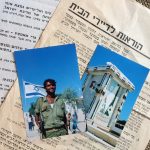
Posters from the Six Day War, explaining how to remain safe and be good citizens; the soldier shown is at El Arish, Sinai, in late June or early July 1967. (photo by Shula Klinger )

This year marks the 50th anniversary of the Six Day War. While the conflict may have only lasted a few days, its impact was tremendous. Not only did it lead to the redrawing of Israel’s borders, it sent a powerful message to the rest of the world. Within 20 years of its establishment, Israel had become a strong, united country. Israelis – and Jews around the world – were jubilant.

In addition to the Israelis who walked away from their daily lives to fight in the war, many other recruits flew in from overseas. Keeping Israel safe – and Jewish – was their only purpose.

This year, a group of young Israelis is making a documentary to explore this phenomenon. With funding from Jewish Federation of Greater Vancouver, the production team is filming veterans of the Six Day War as they recall their time at the front. Lior Noyman, who is also a photographer, is the documentary’s editor. He observes that, without fail, “every one of them remembers exactly where they were when the announcement came about the war.”

Dan Gadassi, who worked in television production for 17 years in Israel, before moving to Canada, is fascinated by the impact of the 1967 war on these individuals and their communities.

To get a full picture of what it was like in Israel as the war ended, the local group has interviewed a wide range of veterans: Sephardi and Ashkenazi, secular and religious. “A Canadian woman, a volunteer; South Africans; a former Israeli soldier who liberated the Western Wall; two people who went to Israel to fight,” said Gadassi. Most of these individuals are retired now.

The documentary is not a recapping of the military actions that brought Israel to victory. It seeks to portray the atmosphere in Israel, as experienced by individuals, through “memories, beautiful stories about what happened when it ended.” Their narratives include the story of a young woman “hearing the sirens in Jerusalem … and what it was like approaching the wall after two thousand years,” said Gadassi.

In addition to the oral histories, the film will show archival materials from the Jewish Independent and artifacts from community members. Gadassi described “beautiful old videos, amazing photos of Israel 50 years ago.”

Some of the photos to be shown in the film have only recently come to light, as older relatives have passed on. They depict scenes from the battleground at El Arish in Sinai, shortly after the war ended. Sparsely captioned, these starkly beautiful images are of desert scenes, soldiers and the debris of war. They show the tremendous relief felt by a nation, said Gadassi, “whose survival was assured.”

No war story is uncomplicated, of course, and the situation in the region remains complicated. As Noyman observed, “They thought it would be the last war.”

The filmmakers look forward to taking viewers on a visual journey back to 1967, “on an emotional level,” said Gadassi. “We want to conjure up the atmosphere of the time.” Asked to sum up that atmosphere in a few words, he said, “We are here and we are staying.”

If you have a story to share or any archival materials, contact Noyman (lior.more@gmail.com), Ayelet Cohen (israel@jccgv.bc.ca) or Gadassi (dangadassi@gmail.com). The screening and a display will be held on June 5, 7:30 p.m., at the Jewish Community Centre of Greater Vancouver. The entire community is invited to attend.

Shula Klinger is an author, illustrator and journalist living in North Vancouver. Find out more at niftyscissors.com.

Note: This article has been edited to reflect that the screening date changed.

Using film school as therapy

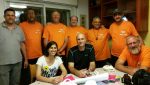
From Ma’aleh School of Television, Film and Art, standing, from left to right, are Asher Lemann, David Cohen, Chanan Ariel, Ofir Shaer, Yosef Baruch Kalangel and Nachum Lemkus. Sitting, from the left, are Keren Hakak, Menachem Assaraf and Shalom Sarel. (photo from Ma’aleh)

When a major donor came to Neta Ariel, director of Ma’aleh School of Television, Film and Art, with an offer to provide scholarships as long as the students give back to the community, Ariel accepted the challenge.

“Ma’aleh is located in the centre of Jerusalem and, unfortunately, there are a lot of social issues,” Ariel told the Jewish Independent. “For example, lots of high school-age teens walk the streets or, during the night, use drugs and live on the streets. So, my students tried to help them – we knew a few of them, and we invited them to come to the school once a week for two hours in the afternoon to learn about film.”

The students at Ma’aleh became mentors, encouraging the teens to bring their own stories to life through the materials. Another group – comprised of immigrants from Ethiopia – also works with the students.

“Tell your story,” said Ariel of the most important aspect of the program.

“At the end of the year,” she said, “when we screened the movie for the group, teacher, friends … it was an amazing thing. They [had] left high school, or the family didn’t want them; they felt like they’re losers and didn’t have self-confidence. When we had the screening and their family or friends came, they really appreciated them. And the film gave them hope. We thought, the making of the film was not only fun, it was a teaching tool to uplift them and our students.”

Through learning how to film, from making personal connections and from telling their stories – which often included trauma or conflict, from rape, violence and negative treatment to gender or sexual orientation issues – they began to heal.

For most participants, it was their first encounter with therapy.

“Most of the time, at the end of the day, after the project was done, they shared with us that this is the first time they’d dealt with this,” said Ariel. “This was their way to tell the society, family or friends that this is their story and what I suffer from.”

From these beginnings, the school developed a curriculum for the program and, with each passing year, it has grown. Now, the school offers two such programs, focusing on how to use film as therapy and how to work together.

“You have a group of social workers and filmmakers,” explained Ariel. “Every week, they meet and work on the exercises we give them, and they work together to find a balance. It works well, the partnership. It’s amazing how the psychologist becomes a filmmaker and the filmmaker comes to understand psychology.”

Months after Operation Protective Edge, the school decided to host a group of bereaved mothers from the conflict, to determine if there was a way they could help.

They found ways of incorporating filmmaking into the process of mourning. At each meeting, they studied and focused on one aspect of filmmaking – lighting, filming, music, and so on. Once taught, participants were given an exercise to practise the skill. Then, they were given a camera and asked to practise filming.

“They didn’t tell them to make a movie about something specific,” said Ariel. “They gave them a task about something emotional. Most chose an aspect connected to the son they lost a few months ago.

“Then, we teach them how to write the script, how to do voiceovers, how to incorporate music. Automatically, most would think about their son or themselves and their fears. So, part of the meeting was talking about what we go through, and a lot of it was about creating things.

“At the end of the year, everyone together made a film called Saba. The main character in the movie is the grandfather, as all of them had mentioned their grandfathers, from time to time.”

Last year, the school opened a bereaved fathers group and found that, while they seemed to barely communicate in the classroom, they collaborated well outside of class. They put together what Ariel described as an “amazing movie” about their surviving kids.

“This is something the fathers said – that the kids at home blamed the parents, saying that, at home, they give a lot of time, attention and energy to something dedicated to the dead son … and [are] not taking care of them,” said Ariel. “Regardless of the age of the kids, in every house, they found it was the same situation. And, it was just amazing.

“Now, we are trying to open a group for grandparents … but, most of them, they can’t come, too hard for them, very far. So, I hope that … we’ll open another group for bereaved mothers … those who couldn’t come last time.”

While the main objective of Ma’aleh stems from a Jewish perspective, Ariel travels the world to introduce filmmaking and therapy to schools.

“Most of our students come from a Jewish Orthodox background … not all, but a lot of them,” said Ariel. “And, a lot of the subjects we touch on are connected to Jewish identity and our roots.”

At the time of her interview with the Independent, Ariel had just returned from the United States, where one of her stops was at a Christian school, where she spoke about how to best relay religious differences through film.

Apart from teaching, Ariel uses these trips to fundraise for the school and to keep in touch with filmmakers, mostly in Los Angeles.

“When they come to Israel, they help us, come to give a workshop at our school,” said Ariel. “We do projects together. Most importantly, we’re sharing our graduate movies with the world. A lot of institutions in Israel and America use them as education tools, cultural tools, and even, from time to time, to promote Israel.

“My goal is that this tool will be used for all kinds of populations. Many different kinds of groups can take care of themselves using this process.”

For more information, visit maale.co.il. The bereaved fathers’ short film can be seen at youtube.com/watch?v=uoNiQVSqhOw&feature=youtu.be.

Rebeca Kuropatwa is a Winnipeg freelance writer.

B.C. NDP leader talks with JI

B.C. NDP leader John Horgan (photo from B.C. NDP)

Horgan says he likes how British Columbians have come together across racial and religious differences during recent times of strife. In a wide-ranging interview with the Independent, the New Democratic party leader also promised to restore the B.C. Human Rights Commission, said he would like to see religious studies in the school curriculum, expressed opposition to boycotts against Israel and said ethnocultural groups play an important role in the delivery of social services.

Horgan, the provincial opposition leader who hopes to be premier of British Columbia after the May 9 election, said that public reactions to antisemitic and anti-Muslim incidents recently have been encouraging.

“What I’ve been seeing … is an unprecedented coming together of diverse groups – ethnic and people of faith – to support each other, whether it be [after] the horrific shootings in Quebec City or the threats of bombings here in the Lower Mainland,” he said. “I’ve seen people crossing traditional faith boundaries to embrace one another and that gives me great hope and optimism for the future here in B.C. When I look south of the border to the rise of hatred, antisemitism, Islamophobia – and without it being brought into check by the leadership, at least the executive branch of the United States – I’m absolutely concerned about that. But I think the advantage for us here in Canada and in B.C. is it gives us an opportunity to reaffirm our tolerance. I’ve been quite moved by it.”

Leaders, he said, have a role not only in legislating but in expressing attitudes that should exemplify the values of the community they serve. “The broader public often criticize politicians for participating in ethnic celebrations or ceremonies,” he said. But he believes it sends a crucial message about respect for multicultural and faith communities, so he attends Chanukah menorah lightings at the legislature and Kristallnacht commemorations, as well as events of many other communities.

Horgan said there must be a means for people who believe their human rights have been violated to seek redress and a body to spearhead education about human rights. An NDP government, he said, would re-establish the Human Rights Commission that the B.C. Liberals dismantled in 2002.

“Every other jurisdiction in the country has a commission for educational purposes, for bringing forward examples of human rights abuses, and I don’t know why British Columbia wouldn’t have that opportunity,” he said.

Also on the education front, Horgan said he would like to discuss with stakeholders the potential for adding religious studies to the B.C. school curriculum.

“I’m a student of history, I have a master’s degree in history and I look back as much as I look forward in terms of shaping my personal views,” he said. “I would see some benefit to having part of the curriculum have a religious studies component in the middle school or high school curriculum.” It might not be a mandatory course and he would seek consultation with school boards, teachers, parent advisory committees and others, but, he said, the idea has come up repeatedly in conversations with members of different religious communities.

Governments partner with community agencies to ensure culturally sensitive and appropriate delivery of services such as addiction, settlement and immigration and seniors’ programs, and this is something Horgan strongly favours.

“It’s not just ethnocultural and faith-based organizations,” he said, “it’s community organizations. In my world, the role of government is to try to unite and bring people together whenever possible and foster understanding and tolerance. You don’t do that by not having discussions or relationships with various organizations, you do that by stimulating that participation.”

Providing culturally appropriate foods for patients in the medical system is a small example of accommodation, Horgan said, but one that has been made more difficult by the outsourcing of food services in the health-care system.

On the security front, Horgan supports the $100,000 the province recently announced in funding for Jewish community security, though he would have done it differently had he been premier, he said.

“Anytime we can improve security for any community, I would support that,” he said. “I don’t want to take shots of the government in this interview but, for me, I would have reached across the floor and said to my counterparts, were I in the premier’s office, this is something that we’re going to do, can we have a resolution of the legislature to make this cross partisan lines, rather than making it a statement of, ‘the Liberals are doing this and the NDP or Greens or Conservatives are not.’ But, beyond that, I support it, absolutely.”

Horgan said he personally opposes the anti-Israel boycott, divestment and sanctions (BDS) movement, but he’ll let party members have their own opinions.

“On these issues, as a provincial leader, what I try to do is allow people to have their point of view. I don’t necessarily have to agree with them,” he said, adding that foreign affairs is a federal matter. “I hold fast to the hope that our federal government, which has diplomatic responsibility for these issues, will show leadership that divestment and sanctions are not a solution.”

He added: “I believe in a two-state solution to the challenges in the Middle East and that’s a personal view and I’ll share that with anyone who asks me. But I try in my interactions with various community members to focus on how do we provide unity here in British Columbia. I look at, just as an example, the sanctions on Cuba. They’re not comparable, I appreciate that, but it is an attempt to have a state outcome in another jurisdiction based on economic pressure, and all that’s happened as a result of that is increased poverty and a lack of understanding. I think we want to reduce poverty wherever possible and increase understanding and, by cutting ties, severing relationships, you’re never going to achieve that. My approach, personally, is always to engage rather than disengage, so I think the BDS movement is not something I support, but people have their own personal will. They can choose to invest their resources wherever they want to.… My own personal view … is that reducing interactions never leads to a better understanding, it leads to less understanding.”

Horgan noted he has met with several organizations in the Jewish community on issues around economic cooperation and trade with Israel.

“I’m excited about the prospects of increasing our ability in British Columbia to take advantage of the cultural linkages we have to grow stronger economic linkages,” he said.

As British Columbians ponder their electoral choices, Horgan said he wants Jewish voters to know that “what they want for themselves and their community I want for them as well.”

“That’s a tenet of social democracy,” he said, paraphrasing J.S. Woodsworth, an early leader of the Canadian left, who said, “What we desire for ourselves, we wish for all.”

“That is a tenet of the Jewish faith and that is something that I think those who have not looked to the NDP in the past may want to do so in the coming election campaign,” he said. “I want growth and prosperity for our communities, I want tolerance and peace and understanding – and those are the issues that I think most British Columbians want, regardless of their faith. I believe that if we focus on the mainstream values that unite us, rather than the issues that divide us, we’ll all be better off here.… My answer is to lead by example and to highlight always tolerance and welcoming and cooperation over intolerance, hate and division.”

The Jewish Independent’s provincial election coverage continues with interviews with other candidates in future issues.

Note: This article has been edited to reflect that the B.C. government allocated $100,000 for security measures in the Jewish community.

Young Judaea at 100

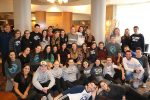
Canadian Young Judaea’s National Leadership Conference in February, which had participants from Vancouver, Montreal, Toronto and Halifax. (photo from CYJ)

Many of Metro Vancouver’s residents are from other parts of Canada. It is no surprise, therefore, that many members of Vancouver’s Jewish community are familiar with Canadian Young Judaea (CYJ). But the memories of CYJ date back even further than most anyone can recall because CYJ is celebrating its 100th anniversary.

Started by 11-year-old Dov Joseph in 1910 in Montreal as a Zionist club, CYJ was officially proclaimed at the 15th Zionist Convention in Winnipeg in 1917. Within eight years, there were 75 clubs across Canada and, by 1935, national membership reached 5,000. Jews in small towns like Timmins, Ont., and Melville, Sask., formed groups and organized activities.

“There was a ken (group) in every city that had a Jewish population,” said CYJ national director Risa Epstein about the organization at its peak. “In Ontario alone, CYJ was active in Niagara Falls, St. Catharines, Sarnia/Petrolia, North Bay, Sudbury, Peterborough, to name a few. In the West, you could find CYJ in Vancouver, Edmonton, Calgary, Winnipeg, Saskatoon, Moose Jaw, Regina and many smaller communities and, of course, it was in every small town in the Atlantic region.”

In the beginning, the appeal of CYJ was its purpose, its focus on Zionism at a time when antisemitism was rampant throughout Europe and in Canada (and elsewhere) as well. The Zionist dream was that of young Jews taking control of their fate, according to acclaimed Canadian poet A.M. Klein, who served as the editor of The Judaean from 1928-32. Klein wrote in 1931, “Jewish life, as at present constituted, with barrenness and emptiness, its utter meaninglessness, its haphazard activity, stands as an imperious challenge to Canadian Jewish youth.”

Epstein described the nature of CYJ in less fiery terms. “It was born out of the desire of young Jews in Montreal to have a group to come to and discuss and dream about a Jewish homeland,” she said. “It later grew from a city-based organization to summer camps and Israel programs.”

The camps were established as early as 1942 in Quebec, followed by Camp Kadima in Nova Scotia in 1943. Ontario, Manitoba, Saskatchewan and Alberta also had CYJ-affiliated camps. British Columbia was the last to add a camp, in 1956, known originally as Camp Hatikvah-Massada in Oyama.

After the establishment of the state of Israel in 1948, the Zionist dream was realized and CYJ took steps to affiliate with youth group Hanoar Hatzioni in Israel. As a result of the newfound excitement about making aliyah, a number of Young Judaeans went to study in Israel. In the 1950s, camps were established across the country that simulated the kibbutz experience.

Today, according to Epstein, CYJ has more than 2,000 members (7 to 18 years old) from across Canada. As the concentration of the Jewish population has shifted, so have the active centres for CYJ activities. They are now active in the major centres of Toronto, Montreal and Vancouver and are still operating in Halifax. Their summer programming engages close to 750 staff (18 to 22 years old), many of whom are alumni of CYJ camps.

Programming during the non-summer months is organized by age groups. The offerings include leadership-training opportunities, which often parlay into jobs at summer camps. CYJ also provides some programs for parents, alumni events and special training for program directors of the camps.

Every city where CYJ has a presence has JOLT (Jewish Outreach Leadership Training). “It consists of two meetings a month,” explained Epstein. “The first is an educational session and the second is an outreach related to the topic of the first. An example is learning about Jewish veterans in Canada and a bake sale to raise money for the veterans.” She mentioned that participation in JOLT is growing in Vancouver and elsewhere.

CYJ has an historic link with another uniquely Canadian grassroots Zionist organization: Canadian Hadassah-WIZO (CHW). CYJ is and has always been the youth arm of CHW. Epstein said the Biluim Israel trip raises funds for CHW daycares in Israel and includes a day spent volunteering at one of those daycares. In turn, CHW provides funding for some CYJ activities.

Along with this year’s regular programming, including camps and trips to Israel with Biluim Israel, national CYJ is planning a centennial celebration on Aug. 27 at Camp Shalom in Gravenhurst, Ont. The event will run from 11 a.m.-4 p.m and is intended for families. “There will be food, camp-like activities, displays, shira [singing] and rikud [dancing]. It will be an amazing event and we are hoping that there will be over 400 people,” said Epstein.

All Young Judaeans are invited to the celebration. For more information, contact the national CYJ office at 416-781-5156 or e-mail Epstein at risa@youngjudeaea.ca.

Michelle Dodek is a freelance writer living in Vancouver.

Team Israel’s fairytale run

Josh Zeid during the game against Japan. (photo from worldbaseballclassic.com)

Team Israel had a great run at the World Baseball Classic tournament. The ballplayers with a David vs. Goliath approach came out swinging hard and stunned the world with four consecutive wins in the preliminary and second rounds. But two losses in a row – an 8-3 loss to Japan March 15 and a 12-2 clobbering by the Netherlands on March 13 – made advancing to the finals a dream for the next global tournament.

The March 15 game started with five scoreless innings, but Japan blew open a lead in the sixth with five runs and added three more for good measure in the eighth. Israel scored all its runs in the top of the ninth.

The World Baseball Classic is a tournament in which the best baseball players in the world compete. Team Israel had bookers betting against it even making the main event, but the blue-and-white uniformed ballplayers, who were ranked 41st going into the Classic, not only made it to the preliminary rounds but won an astounding four in a row at the tournament.

Dubbed the Cinderella team of the contest, Team Israel stunned Cuba 4-1 in the first WBC quarterfinal game at the Tokyo Dome and, before that, swept the first round of games by beating South Korea, Taiwan and the Netherlands.

Only three of Team Israel’s 28 players are Israeli; the rest are Jewish Americans. According to WBC rules, anyone eligible to hold citizenship in a country can play for its national team. There are other teams with players who do not hold passports for the country for which they’re playing.

“The players love playing for Israel,” Israel Association of Baseball president Peter Kurz told Israel21c. “A lot of them want to come and visit after the tournament or after they retire.”

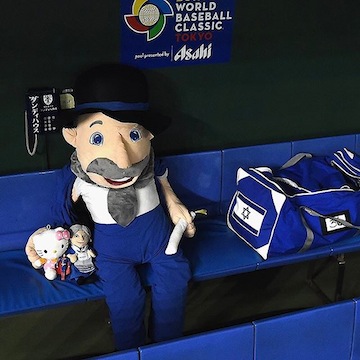
photo - Mensch on a Bench – the Israeli team’s mascot – waits for the game to begin
Mensch on a Bench – the Israeli team’s mascot – waits for the game to begin. (photo from worldbaseballclassic.com)

For fans, that the ballplayers are proud to wear “Israel” on their uniforms and represent the country is more than enough.

“I am a lifelong baseball fan, and it’s thrilling to see Israel competing on a world stage. But Israel’s participation in the World Baseball Classic is about so much more than baseball,” said Elie Klein, an associate partner at Finn Partners Israel who calls himself a “rabid New York Mets fan.”

“While baseball fans around the globe have taken notice of Team Israel due to their surprising athletic prowess, Jews around the world – many of whom have never watched a single inning of baseball – are drawn to Team Israel out of deep Jewish pride. Not because they are Israelis, but because they aren’t – they are largely American Jews who have decided to wear uniforms emblazoned with the Jewish star and don kippot during Hatikvah, to identify as Jews in such a public way,” said Klein.

American rapper Kosha Dillz (Rami Matan Even-Esh) even made up a song about Team Israel. And Team Israel will also be remembered for its mascot, Mensch on a Bench, a stuffed doll that was the Jewish answer to the popular Christmas toy and story Elf on the Shelf.

On March 22, the United States team beat Team Puerto Rico to win the championship.

Israel21c is a nonprofit educational foundation with a mission to focus media and public attention on the 21st-century Israel that exists beyond the conflict. For more, or to donate, visit israel21c.org.