Skip to content
  • Home
  • Subscribe / donate
  • Events calendar
  • News
    • Local
    • National
    • Israel
    • World
    • עניין בחדשות
      A roundup of news in Canada and further afield, in Hebrew.
  • Opinion
    • From the JI
    • Op-Ed
  • Arts & Culture
    • Performing Arts
    • Music
    • Books
    • Visual Arts
    • TV & Film
  • Life
    • Celebrating the Holidays
    • Travel
    • The Daily Snooze
      Cartoons by Jacob Samuel
    • Mystery Photo
      Help the JI and JMABC fill in the gaps in our archives.
  • Community Links
    • Organizations, Etc.
    • Other News Sources & Blogs
    • Business Directory
  • FAQ
  • JI Chai Celebration
  • JI@88! video

Recent Posts

  • Sharing her testimony
  • Fall fight takes leap forward
  • The balancing of rights
  • Multiple Tony n’ Tina roles
  • Stories of trauma, resilience
  • Celebrate our culture
  • A responsibility to help
  • What wellness means at JCC
  • Together in mourning
  • Downhill after Trump?
  • Birth control even easier now
  • Eco-Sisters mentorship
  • Unexpected discoveries
  • Study’s results hopeful
  • Bad behaviour affects us all
  • Thankful for the police
  • UBC needs a wake-up call
  • Recalling a shining star
  • Sleep well …
  • BGU fosters startup culture
  • Photography and glass
  • Is it the end of an era?
  • Taking life a step at a time
  • Nakba exhibit biased
  • Film festival starts next week
  • Musical with heart and soul
  • Rabbi marks 13 years
  • Keeper of VTT’s history
  • Gala fêtes Infeld’s 20th
  • Building JWest together
  • Challah Mom comes to Vancouver
  • What to do about media bias
  • Education offers hope
  • Remembrance – a moral act
  • What makes us human
  • המלחמות של נתניהו וטראמפ

Archives

Follow @JewishIndie
image - The CJN - Visit Us Banner - 300x600 - 101625

Tag: history

A tour with extra pep

A tour with extra pep

Elana Wenner (with folder) leads the Jewish Museum and Archives of British Columbia walking tour of Jewish Strathcona. (photo from JMABC)

Having taken the Jewish Museum and Archives of British Columbia’s tour of Jewish Strathcona, I know firsthand how interesting and worthwhile it is. This summer, there will be a little more swing to the July 27 tour – Kol Halev Performance Society will once again take part, but in an expanded role.

“Kol Halev has created a script for theatrical additions to the tour, along with musical components. Actors in full period costume will accompany the group and act out key scenes from the stories told along the way,” Elana Wenner, director of programming and development at the museum, told the Independent. “A full musical dance number is included as well, along with a reenactment of a wedding that mirrors cultural traditions from the past.”

Wenner got in touch with Sue Cohene, co-founder and current president of Kol Halev, after having taken some theatrical tours produced by other museums in the city and elsewhere.

“In the past,” said Wenner, “Kol Halev has put on productions based on BC Jewish history in conjunction with JMABC, before I worked here.”

“Kol Halev has been involved with the Jewish Museum since 2006, performing at their various galas and special events over the years,” Cohene explained. “In 2017, the museum created a photographic exhibit, shown alongside Kol Halev’s historically based play, Two Views from the Sylvia, which was presented at the Waterfront Theatre.

“Kol Halev Performance Society and the Jewish Museum and Archives have a long-standing collaboration and we update the museum on a regular basis about our shows, community teachings and future plans.”

A couple of years ago, said Cohene, Marcy Babins, interim executive director of the museum, suggested that she meet with Wenner, then the newly appointed director of programming and development, to discuss possible joint ventures.

“Connecting with Elana has been like carrying on a family tradition,” said Cohene. “Elana’s grandmother, Irene Dodek, was instrumental, along with Dr. Rabbi Yosef Wosk, in bringing Kol Halev on board to provide entertainment and theatrical historical education for Jewish Museum projects. Elana’s mother, Dr. Gail Wenner, has danced with Kol Halev and continues to share her creativity by creating historically influenced hats for our performers.”

Last summer, Kol Halev added a Yiddish dance performance to complement one of Wenner’s Jewish Strathcona walking tours. This summer, actors from the performance group will portray early Jewish community leaders during the tour, in addition to weaving in some traditional dance pieces.

Cathy Moss, one of Kol Halev’s main writers since the group was established, worked with the research provided by Wenner to create a script.

“Elana shared the tour route and basic information about Strathcona historical community leaders from the early 1900s to the 1940s,” said Cohene. “She kindly led Kol Halev on the tour, where we all looked at locations that could accommodate acting and dancing.”

“Elana did a great job compiling the research on the area,” said Moss. “Once I took the tour, it was easy to see what a compelling cast of characters inhabited Strathcona in the early days. It was fun to write dialogue for such interesting and lively folks.”

Moss relied on the museum’s material for each location along the tour, writing the dialogue for the characters based on the biographical details and context Wenner provided.

“The tour is great and informative on its own,” said Moss. “I would add that inviting Kol Halev to be part of it was an excellent idea. It adds another dimension that makes the experience that much more enjoyable. The wedding dance in particular will be appreciated by the tour-takers. It’s very entertaining.”

photo - Kol Halev rehearses the Patsh dance, choreographed by Santa Aloi. The group will dance and act in the July 27 JMABC Strathcona walking tour
Kol Halev rehearses the Patsh dance, choreographed by Santa Aloi. The group will dance and act in the July 27 JMABC Strathcona walking tour. (photo by Adam Abrams)

Kol Halev has several on-site rehearsals planned before the shows in which they’re participating – the July 27 public tour and a private tour in late June – “particularly to familiarize dancers and actors who were not involved last year,” said Cohene.

“We will have between eight and 10 dancers this summer and a few actors,” she said. “It’s a small working production that has room to grow.”

Cohene will be part of the performances.

“I’ll be playing a mother-in-law role in the 1940s wedding dance, which was choreographed by Tamara Thompson Levi,” she said. “I’ll also tap dance in the Yiddish Patsh dance choreographed by Santa Aloi.”

Wenner leads the Strathcona walking tours.

“This tour is a journey through the footsteps and choices made by the first community leaders in Vancouver,” she said. “It follows in the footsteps of community-building, highlighting the institutions and people who laid the groundwork for today’s thriving Jewish Vancouver institutions. Along the way, we see buildings that held components of the first Jewish community organizations, as well as the homes of some of the first leaders. We also explore the ideas of what Jewish community requires in general, and what it was like to live as a Jew in this part of the world at the turn of the last century. The tour is a synthesis of past and present, weaving together the origins and future of Vancouver’s Jewish community.”

The Jewish Museum has four different walking tours on offer this summer. In addition to the Strathcona neighbourhood tours led by Wenner on July 13 and 27, Aug. 10 and 24, Daniella Givon leads tours of the Mountain View Jewish Cemetery on July 6 and Aug. 10. In Victoria, Amber Woods leads both the Downtown (July 6 and Aug. 10) and Jewish cemetery (July 20 and Aug. 24) tours. All the walks start at 10:30 a.m. For tickets, visit jewishmuseum.ca, email [email protected] or call 604-257-5199. 

Format ImagePosted on June 13, 2025June 12, 2025Author Cynthia RamsayCategories LocalTags acting, Cathy Moss, dance, Elana Wenner, history, Jewish Museum and Archives of BC, JMABC, Kol Halev, Strathcona, Sue Cohene
Sunny Heritage day

Sunny Heritage day

Hastings Mill Store was part of this year’s Heritage Discovery Day. (photo by Cynthia Ramsay)

This year’s Heritage Discovery Day – which has been hosted by Vancouver Heritage Foundation since 2003 – featured nine sites in Kitsilano, highlighting, but not confined to, the Craftsman style of house, which, according to the self-guided tour book, “is characterized by decorative brackets, exposed rafter ends, mock trusses in the gable ends, expansive low-pitched gable roofs and a rich variety of finishing materials and textures.” Saturday, June 7, was an ideal day for the event and this year’s Summer cover features photos taken throughout the neighbourhood, while going house to house. Driving home along Cornwall Avenue, the number of people enjoying Kits Beach was incredible. When it’s sunny here, the people emerge!

photo - City Farmer Garden's Cob shed, made with clay from Haida artist Bill Reid
City Farmer Garden’s Cob shed, made with clay from Haida artist Bill Reid. (photo by Cynthia Ramsay)
photo - One of the heritage homes on the tour
One of the heritage homes on the tour. (photo by Cynthia Ramsay)
photo - Kits Beach on June 7
Kits Beach on June 7. (photo by Cynthia Ramsay)
photo - Kits directional post
Kits directional post. (photo by Cynthia Ramsay)
photo - A cyclist amid the flowers
A cyclist amid the flowers. (photo by Cynthia Ramsay)
Format ImagePosted on June 13, 2025June 12, 2025Author Cynthia RamsayCategories LocalTags Heritage Discovery Day, history, houses, Kits Beach, Kitsilano, Vancouver Heritage Foundation
The prevalence of birds

The prevalence of birds

Pelicans and cranes gather at Hula Lake in Israel. (photo from commons.wikimedia.org)

Beginning with the Book of Genesis, we read about the raven and especially about the dove: “After 40 days, Noah opened a window he had made in the ark and sent out a raven, and it kept flying back and forth until the water had dried up from the earth. Then, he sent out a dove to see if the water had receded from the surface of the ground. But the dove could find nowhere to perch because there was water all over the surface of the earth; so, it returned to Noah in the ark. He reached out his hand and took the dove and brought it back to himself in the ark.

“He waited seven more days and again sent out the dove from the ark. When the dove returned to him in the evening, there, in its beak, was a freshly plucked olive leaf! Then Noah knew that the water had receded from the earth. He waited seven more days and sent the dove out again, but this time it did not return to him.”

In Deuteronomy 32, we read that God Himself is compared to a bird: “Like an eagle who rouses its nestlings / Gliding down to its young / So did [God] spread wings and take them / Bear them along on pinions.”

Eagles are so important to our culture that Israel’s 1949/50 rescue of 46,000 Yemenite Jews was named Operation on the Wings of Eagles. 

Jews had lived in Yemen for millennia, experiencing both relatively good and more oppressive times. In the 20th century, especially following the United Nations Partition Plan of 1947, conditions worsened. Arab rioters in Aden – then a British protectorate on the southern tip of Yemen – killed at least 82 Jews and, in early 1948, accusations that Jews murdered two Muslim Yemeni girls led to further violence and looting of Jewish homes and businesses.

When news of the young state of Israel’s planned evacuation reached Yemeni Jews, they walked and walked, some from hundreds of miles away, to a refugee camp in Aden. Few of them had seen an airplane before and, to convince them to go aboard, someone painted an eagle with outstretched wings over the door of each craft, reflecting Isaiah’s prophesy: “They shall mount up with wings as eagles.”

Despite the attempt to keep the evacuation secret, the planes going from Yemen to Israel were routinely fired on by Egyptian forces. Pilots were warned that, if they were forced to land in enemy territory, the passengers and perhaps the crew risked being executed. Luckily, this never happened.

Di goldene pave, or the golden peacock, refers to a mythical bird that is a common symbol in Yiddish poetry. For Itzik Manger, the golden peacock symbolized Jewish resilience and optimism, and Israeli singer Chava Alberstein sings a song about the golden peacock, which you can listen to on YouTube.

There is a legend that King Solomon gave the hoopoe – Israel’s national bird – a gold crown, after the bird spreads its wings to protect the king from the sun’s rays. But then people began hunting the hoopoe for its crown. When the bird told this to the king, the king replaced the crown with a crest of feathers.

Although there are several negative comments about the raven and the ostrich in Jewish texts, there are also some positive statements made about them. For instance, the raven brought Elijah bread and meat in the morning and bread and meat in the evening. (I Kings 17:7)

In his prophecy, Micah (1:8) uses the ostrich to show what will become of the faithless. But, while the ostrich generally receives a “bum rap” in Scripture, there is no mention in any sacred Jewish writing of ostriches hiding their heads in the sand. When a threat does appear, the ostrich flattens itself on the ground. With its colouring, it is often able to camouflage itself. Furthermore, when an ostrich senses the danger is too close, it can rapidly run away. 

photo - A section of the Bird Mosaic, a large mosaic floor that was apparently part of a Byzantine villa
A section of the Bird Mosaic, a large mosaic floor that was apparently part of a Byzantine villa. (photo from commons.wikimedia.org)

Storks are mentioned in Psalms 104:16-17 and in Jeremiah 8:7 for their beauty, grace and devoted parenting: “Storks in the sky know their seasons; swallows and cranes their migration times; but my people do not know the rulings of Adonai!” 

Further, the stork appears on decorative Torah wimpels, long strips of fabric used to bind the scroll when it’s not in use. Once, they were made from the swaddling clothes of a newborn baby. (This custom began in the second half of the 16th century and lasted for a few hundred years.) After the circumcision ceremony, the fabric was cut into segments that were sewn together to form a long sash, which was embellished with painted or embroidered inscriptions and images and donated to the synagogue.

Most storks use Israel just as a stopping off point on their way to and from Europe to Africa. Sadly, according to Israeli wildlife veterinarian Dr. Rona Nadler Valency, many migrating storks are killed or injured along their journey. She blames Israeli electric and wind turbine companies, which, she claims, do not invest in measures to protect the birds.

Although the type of bird is not mentioned, it is said that birds guided the Jewish people and kept watch over their crossing during the splitting of the Reed Sea.

Psalms 84 mentions the sparrow and the swallow: “Even the sparrow has found a home / and the swallow a nest for herself / where she may have her young….”

According to Uzi Paz, author of The Birds of Israel, there are about 470 bird species in Israel today. There are three main reasons for why Israel is a haven for birds. First, for European and West Asian birds, Israel is located on a main migration route to and from Africa; these birds stay in Africa during the European winter and return to Europe when spring comes in Europe. Second, Israel provides a range of habitats. And, third, Israel stands at the crossroads of three continents and assorted climate zones.

When you visit Israel, stop near Caesarea to see the remains of a large mosaic floor that was apparently part of a Byzantine villa. It is called the Bird Mosaic because the centre part of the floor features 120 medallions, each of which contains a bird. 

Deborah Rubin Fields is an Israel-based features writer. She is also the author of Take a Peek Inside: A Child’s Guide to Radiology Exams, published in English, Hebrew and Arabic.

Format ImagePosted on June 13, 2025June 12, 2025Author Deborah Rubin FieldCategories IsraelTags birds, Caesarea, Hebrew Bible, history, Israel, Torah

Kind of a miracle

King Charles was in Canada this week, delivering the Speech from the Throne. It was a monumental moment in many ways, not least because it was the first official visit by the monarch since he ascended to the throne. For those of us whose entire lives have been lived under the reign of Queen Elizabeth II, it remains a fascinating and jarring challenge to the tongue to hear the phrase “the King of Canada.”

Paging through back issues of the Jewish Western Bulletin, which preceded the Jewish Independent, one of many striking things is the efforts that Jewish individuals, businesses and other advertisers have taken, over the decades, to express loyalty to king (or queen, as the case more commonly has been) and country.

Knowing what we know of antisemitic tropes, we suspect that this had more than a little to do with the stereotype of “dual loyalty.” Throughout history, Jews have been accused of being more loyal to their “tribe” than to their countries of domicile. Since 1948, this antisemitic idea has been applied to Israel, whose interests Jews today are often accused of prioritizing above the interests of their own countries, like Canada.

The sort of hyper-patriotic and monarchist messages we saw in the pages of this paper in decades past have largely disappeared. The trope of dual loyalty is not the most prevalent or dangerous threat to Jewish security in Canada or most other Western countries at the moment. Put succinctly, those who want to take offence with Jewish Canadians are less likely to go the extra step and accuse us of dual loyalty. They just cut to the chase and contend that any support for Israel at all is evidence of ill-will or immorality.

As we have turned the pages of the past in preparing for this special anniversary issue, that is just one small example of social change reflected from issue to issue in 95 years as an institution in this community.

As much as things have changed, so a great deal has remained the same. It is amusing, heartening and sometimes frustrating to see the repetitive nature of (we suppose) humankind in general and Jewishkind in particular across 10 decades. So many of the same discussions and arguments that our people were engaged in locally and globally 60 or 70 years ago remain on our lips today. More encouragingly, the leaders, activists and influencers (we certainly didn’t use that latter word until far more recent issues) of our community have often shared the same surnames, from the 1930s through to today, and so many new surnames – Jews from myriad different backgrounds – have joined the list of community contributors. The continuity combined with the growth in number and diversity is reassuring.

So much has changed in 95 years, such that the originators of the newspaper you hold in your hands (or, by a previously unimaginable magic of futuristic wonder, are reading on some whirring space-age illuminated rectangle) could not have foreseen.

These are not easy days for print media or, really, legacy media of any variety. We believe, and we hope you share our certainty, that the product we put out, as the latest iteration of a 95-year commitment to informing and reflecting our community, has value today, as it has across most of the past century.

As attention spans have shortened and the media landscape has refracted, keeping eyes on these pages is a challenge. At times, we content ourselves with the belief that the stories we write today will only increase in value as, at some unimaginable future time, and perhaps using some heretofore unimagined technological phenomenon, researchers or people with an avocational curiosity about the past, will finger through what we have written to understand better who we were and, therefore, how the Jewish community of the future became what it is, just as a review of our archives helps us understand how we came to be who we are today.

That a small, plucky newspaper operating on a shoestring at the remote edges of the Jewish universe could survive, and occasionally thrive, across 95 years is, even in the context of the much longer, always extraordinary, history of the Jews, something of a miracle.

This is a moment for us to thank everyone who made this possible, many of whose names have appeared in these pages across the years and many who have not. As a reader and supporter of the Jewish Independent, you are now part of that long legacy of people who have made this moment happen. Thank you for making this milestone possible. More importantly, thank you for making possible our present and our future. 

Posted on May 30, 2025May 28, 2025Author The Editorial BoardCategories From the JITags history, Jewish Independent, Jewish journalism, Jewish Western Bulletin, journalism, reflections
Sharing a special anniversary

Sharing a special anniversary

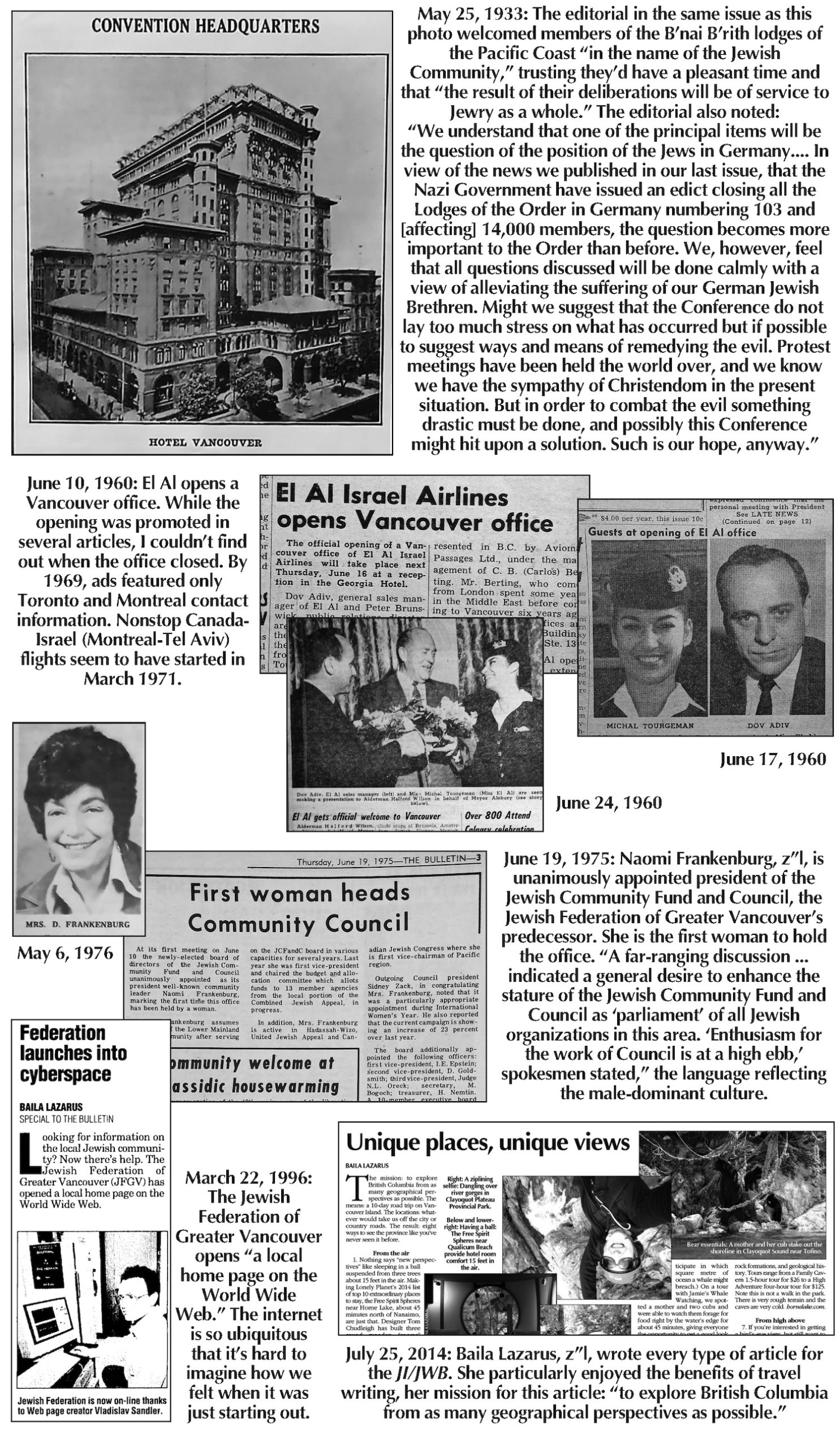
When does something begin? I’ve been thinking about that as I go through 95 years’ worth of Jewish Independents. Well, 20 years of JIs and 75 years of its predecessor, the Jewish Western Bulletin. The JWB also had its predecessors – mimeos and letter-sized versions. The paper’s founders started counting on Oct. 9, 1930, the official first tabloid edition, when they could have started July 15, 1925, “the natal issue of the Vancouver Jewish Bulletin.” Or maybe earlier. Who knows when the idea that brought into existence what would become, through thousands of issues, the paper you today hold in your hands or read on your computer.

image - Making the cover of this special issue, where six stories jump to the inside and the rest of the stories are blurbs that direct readers to pages on the inside, was an organizational challenge. There was no way I could replicate the brevity of the 1930s articles, but I could mimic the style.
Making the cover of this special issue, where six stories jump to the inside and the rest of the stories are blurbs that direct readers to pages on the inside, was an organizational challenge. There was no way I could replicate the brevity of the 1930s articles, but I could mimic the style.

I know I’ve mentioned this fact in previous anniversary issues, that the JI could be considered five years older than the age we have deemed it to be. In looking through so many beginnings – and endings – throughout the years, it struck me again. So many organizations have multiple possibilities for the equivalent of their first edition. For example, the Louis Brier Home and Hospital was organized in 1945, but the idea for it probably came even earlier and the home didn’t open until 1946.

I share this as a caveat because, as I went through the paper’s archives, looking for other community organizations that are celebrating a significant anniversary this year, I no doubt have missed some. But my intent was good – I wanted to share the JI’s “special day” with others.

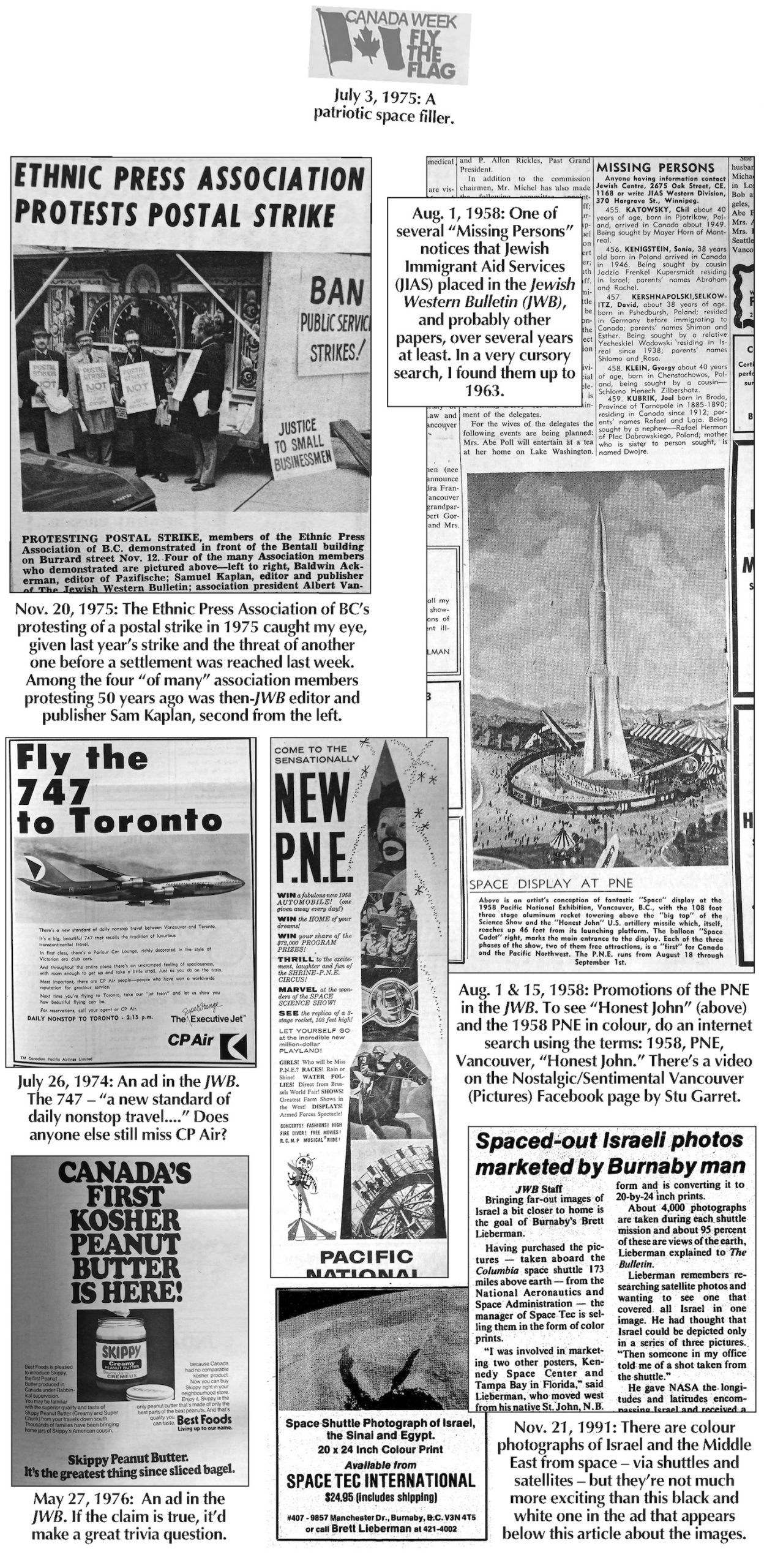
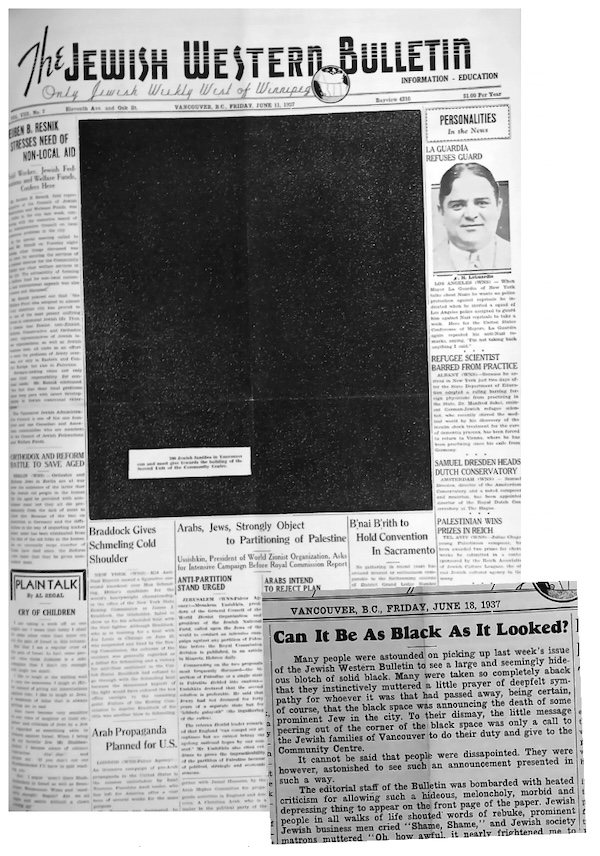
Unfortunately, I was hampered in my goal because the search function of the online Jewish Western Bulletin archives (newspapers.lib.sfu.ca/jwb-collection) is basically dysfunctional. If I had a 95th birthday wish, it would be to have the funding to have all the newspapers back to 1925 re-digitized and re-indexed, so that this priceless resource could be more accessible. In the meantime, I hope readers can embrace the random smattering of “clippings” that represent my attempt to show how the newspaper has grown with the community – our success being directly attributable to our collective success.

image - I continue to wish that the founders of the newspaper had started counting in 1925, when the “natal issue of the Vancouver Jewish Bulletin” was published.
I continue to wish that the founders of the newspaper had started counting in 1925, when the “natal issue of the Vancouver Jewish Bulletin” was published.

Going through the pages of the newspaper over 95 years is both an inspiring experience and a sobering one. Countless people, organizations, businesses and events no longer exist, but there are always new people coming into the world, coming into the community; new groups being created, new businesses popping up, new ideas being discussed, new events being organized. If the size of the Community Calendar is any indication, there is more happening in the community today than there has ever been.

During my 26 years as publisher – or, one of my other beginnings, 27 years since I was hired by the paper – there have been recessions, wars, a global pandemic, and seemingly inexhaustible antisemitism, which has increased greatly since Hamas’s terror attacks on Israel on Oct. 7, 2023. I am still processing that massacre, the ensuing war and all the other violent conflicts happening in the world, the hate and the anger that threaten to overwhelm. It never ceases to amaze and sadden me, humanity’s ability to be as destructive and cruel as we can be creative and compassionate. I won’t dwell on the negative here.

In running the newspaper, I have tried to maintain a middle ground, to be inclusive but also respect my own boundaries. I think there are concerns that should be played out in public, and others that should be dealt with privately. The JI is not a gossip rag, it is not sensationalist or alarmist. That is a decision I have made, and that our editorial board (Pat Johnson, Basya Laye and me) considers every issue.

While not ignoring the hurtful, the divisions, the controversies in our community or the larger universe, we try to cover stories in a way that doesn’t depress and paralyze action, but rather opens the door for solutions or at least positive attempts at change. We don’t want readers to put down the newspaper in despair, but rather to think about what they can do to contribute to a better world, whatever that means to them. One ad in this paper heralds the JI for being the bearer of good news – it makes me happy that people think that, even as we report the news that’s not so good.

image - JI's new owners, article from 1999The Jewish Independent has survived so long because of one thing: community support.

In 95 years, there has been much to mourn, that is true, but there also has been so much to celebrate. Personally, during my tenure as publisher, I have benefited from many kindnesses, from generous landlords and donors to loyal subscribers and the people who support the paper through purchasing ads.

I have met, worked with and/or become friends with some truly amazing people. I consider myself lucky to have joined the paper early enough to have met in person several of the visionaries who built the organizational foundations of this community, not to mention those of the province, even of Canada, in some instances. There are afternoon teas, lunches and gala dinners I’ll remember forever, if the mind stays healthy.

images - 1st Jewish Independent, 2005, and JI Chai Celebration, 2017The people I work with are smart, talented, dedicated and should be earning a lot more than they are. I might own the paper, but by no means do I run it alone. The people whose names you see on the masthead every issue are integral to publishing the paper. And all the people who have been on that masthead over the years – and the many more who have not been recognized in print – have helped keep the paper going, from its first days to today. I thank you all.

I am not a journalist per se, nor an entrepreneur. I’m trained as an economist, and still make myself chuckle when I think of the most uneconomical choice I have made in my life – to buy this newspaper. But it has kept me clothed and fed, with a roof above my head. It has taught me so many things and, though I’ve not always been a willing student, I am better for the lessons.

images - other anniversary issues of the JIMost importantly, I am better for all the people I have encountered on this journey. I have made many friends and acquaintances. Not all my encounters have been pleasant or easy, but I have come to appreciate more as I’ve gotten older that, behind the organizations serving the community are simply people. Maybe people I don’t always agree with, but people who are undeniably committed. They are people who believe in community so much that they give of their time, either as volunteers or staff or both, working in one place, volunteering in others. Or they give of their financial resources, funding causes in which they believe, choosing to give away some of their money rather than letting it sit in the bank or using it for personal wants and needs.

It is a privilege to do what I do for a living. I am proud to be part of this extraordinary community. Kol hakavod to us all. May we go from strength to strength…. 

Now let’s party. Happy anniversary to all the other Jewish organizations celebrating a milestone this year! 

image of birthday clippings for Victoria’s Jewish Cemetery , Vancouver Chevra Kadisha, Hebrew Free Loan Association of Vancouverimages - birthday clippings for Na’amat Canada , Peretz Centreimages - birthday clippings for Camp BB Riback, L'Chaim Centre and Har El Hebrew Schoolimages - birthday greetings for Kollel, Chabad Downtown and KDHS

Format ImagePosted on May 30, 2025May 28, 2025Author Cynthia RamsayCategories Op-EdTags archives, history, Jewish Independent, Jewish journalism, Jewish Western Bulletin, memoir, reflections
Klezcadia set to return

Klezcadia set to return

Bay Area klezmer trio Veretski Pass returns to Klezcadia, which runs in-person and online June 10-15. (photo from Klezcadia)

Klezcadia, a festival of klezmer music and Yiddish culture, is back for a second year. The June 10-15 event can be experienced in-person in Victoria or virtually from around the world.

The 2025 festival, free for all who register, features author and playwright Michael Wex, who will be offering a two-part webinar titled Jews, Germans and Jive: Yiddish as a Language of Resistance.

Wex, the author of the bestseller Born to Kvetch and Just Say Nu, will be delivering the talks from his home in Toronto. No stranger to Vancouver audiences, his play, The Last Night at the Cabaret Yitesh (Di Letste Nakht Baym Yitesh), in which he also performed, closed the 2024 Chutzpah! Festival.

Laura Rosenberg, the director and driving force behind Klezcadia, said Wex “is arguably the most famous person to interpret the public impact of the Yiddish language on the English language.”

She told the Independent that the festival’s mission, operating principles and format will be the same as they were in its inaugural season. “The performance and workshop content, on the other hand, will be completely new for 2025, though obviously within the same klezmer music and Yiddish culture arena as last year, and involving many of the same artists and faculty members,” she said.

Between in-person and virtual attendees, Klezcadia had more than 500 participants from 21 countries in 2024 and the 2025 registration looks to be at least on par with those data, according to Rosenberg.

“Everything from concerts to workshops to open rehearsals is designed to equalize as much as possible the experience of in-person and virtual participants,” she said. “And, thanks to our generous donors, registration is once again free.”

Other notable appearances this year include returning Bay Area klezmer trio Veretski Pass, who will appear on both the concert and workshop rosters. Members Cookie Segelstein (violin), Joshua Horowitz (19th-century button accordion) and Stuart Brotman (bass) play a wide variety of East European numbers. This year, they will offer “band-to-band master classes” with two Victoria-based klezmer ensembles. 

Vancouver singer/songwriter Geoff Berner, joined by Segelstein, will perform songs from his upcoming album – Berner’s first to be completely in Yiddish. Over the past 25 years, Berner has toured in 17 countries, opened for rock stars in stadiums and, the Klezcadia notes state, “played nearly every dirty little café bar in Western Europe.”

Klezcadia 2025 will see the Victoria debut of Jordan Wax, a rising star on the Yiddish singer/songwriter scene, who will share music from his newly released album, The Heart Deciphers, on the Borscht Beat label. The New Mexico musician blends many influences, from the Missouri Ozarks to the Indo-Hispanic world and the entire Ashkenazic diaspora.

Christina Crowder, director of the Klezmer Institute, based in Yonkers, NY, will be on hand to perform century-old music rediscovered in Ukraine’s Vernadsky Library, which recently was published for global use via the Kiselgof-Makonovetsky Digital Manuscript Project.

As it did in 2024, this year’s festival will conclude with the entire Klezcadia cohort performing a finale concert at the Stage in the Park (Cameron Bandshell) in Victoria’s Beacon Hill Park. 

Billing itself as “A Safer Shtetl,” Klezcadia’s hybrid environment prioritizes the safe experience of immunocompromised and high-risk participants, for the performers, crew and volunteers, and for attendees. Indoor activities feature the use of protective protocols such as supplemental air purification, required masking and daily onsite COVID testing. 

“We learned from our inaugural-season experience that our fully hybrid format was extremely valuable, both to our immunocompromised and high-risk participants, but also to a vast number of people who, for geographic or financial reasons, were unable to attend in person,” Rosenberg said.

Rosenberg gives credit to other members of the Klezcadia team for helping with the various technical tools needed to put together a hybrid festival. She said some of the evolving challenges faced in viral safety and communal safety, and the current cross-border political situation, have provided added appreciation to how much a hybrid design can be adapted at short notice, if needed.

People who were not able to attend a live event in 2024 have expressed their thanks to Rosenberg in the lead-up to this year’s festival.

“One of my greatest delights in the intervening year since our inaugural season has been hearing what a difference Klezcadia made to our immunocompromised and high-risk attendees,” she said. “Whether local or halfway across the world, many of these people have felt shut out of their communities, including their Jewish cultural communities, and they expressed in heartfelt terms how life-changing it was for them to be able to participate in a cultural festival that prioritized their safety but was open to everyone.”

All Klezcadia events will take place within a 10-minute drive from downtown Victoria. Specific venue information will be provided only after registration, and only to in-person participants. For more information, visit klezcadia.org. 

Sam Margolis has written for the Globe and Mail, the National Post, UPI and MSNBC.

Format ImagePosted on May 30, 2025May 29, 2025Author Sam MargolisCategories LocalTags concerts, education, festivals, history, inclusion, Klezcadia, klezmer, Laura Rosenberg, workshops, Yiddish
Concert fêtes Peretz 80th

Concert fêtes Peretz 80th

The Vancouver Jewish Folk Choir has its spring concert on June 15, at the Peretz Centre for Secular Jewish Culture. (photo from VJFC)

The Vancouver Jewish Folk Choir’s spring concert this year celebrates the Peretz Centre for Secular Jewish Culture’s 80th anniversary.

Since it was established in 1979, the choir has been recovering, preserving and singing traditional and contemporary Jewish folk music. This year’s concert – on June 15, 7 p.m., at the Peretz Centre – features “Ikh bin a yid,” a cantata by Vladimir Heifetz (1894-1970), based on the poem by Itzik Feffer (1900-1952). Feffer was a Soviet Yiddish poet and member of the Jewish Anti-Fascist Committee who was executed on the Night of the Murdered Poets. The poem emphasizes how, through courage and creativity, the Jewish people have survived centuries of adversity.

The choir also will perform “Sankt besht,” a poem by Itsik Manger set to music by Vancouver Jewish Folk Choir director David Millard. In the poem, the Baal Shem Tov (the 18th-century Jewish mystic and founder of the Hasidic movement) is awakened from sleep and meditates on grief, joy and dreams.

On the program, as well, is a selection of songs arranged by choir founder Searle Friedman, including “Doyres Zingen” (“Generations Sing”), based on a poem by Ben Chud, first principal of the Peretz Shule.

For concert tickets, visit peretz-centre.org. General admission is $36, but, until May 31, people can get tickets for $12 each. However, no one turned away for lack of funds – there is a “pay as you can” option. 

– Courtesy Vancouver Jewish Folk Choir

Format ImagePosted on May 30, 2025May 29, 2025Author Vancouver Jewish Folk ChoirCategories MusicTags concerts, history, milestones, Peretz Centre, Vancouver Jewish Folk Choir, Yiddish
Oslo not a failure: Aharoni

Oslo not a failure: Aharoni

Dina Wachtel of Canadian Friends of the Hebrew University, and Ido Aharoni, a former top Israeli diplomat who now teaches at various universities. (photo by Pat Johnson)

Zionism is as popular now as it has ever been on North American campuses, according to a former top Israeli diplomat who now teaches at multiple American universities.

The bad news, he added, is that Zionism was never a hit on North American campuses.

“Zionism was never popular in academia,” said Ido Aharoni, speaking with the Independent during a trip to Vancouver as a guest of Canadian Friends of the Hebrew University. “In fact, I would argue that … we’ve never had so many Zionists in North America as we have today.”

Protests on campuses and reports of professors inculcating anti-Israel ideas are disturbing, he said, but it’s not new. 

“The people that are at the front of the effort, that spearhead the effort, are different,” he said, arguing that the vanguard now is comprised of foreign students and descendants of immigrants from societies where antisemitism is endemic. “But it’s the same thing, the same messaging that was designed by the Soviet Union.”

Aharoni is a 25-year veteran of Israel’s foreign service, a public diplomacy specialist, and founder of the Brand Israel program, which, since 2002, has sought to reposition Israel in the public mind globally. He served in the Israeli consulate in Los Angeles in the 1990s and was consul general of Israel in New York and the Tri-State Area from 2010 to 2016.  

Since retiring from government in 2016, Aharoni has lectured and spoken at academic institutions including Harvard, Yale, Princeton, Wharton and Berkeley on topics such as Israel’s foreign relations, mass media, the information revolution, public marketing, and nation branding. He has served as a professor of business at Touro University, as a professor of international relations at New York University and is the Murray Galinson Professor of International Relations at University of California in San Diego and San Diego State University’s business school. 

In addition to teaching and lecturing, Aharoni provides advice to international companies to access Israeli innovation. He also helps businesses and agencies communicate with governments. His third focus is strategy and planning, particularly helping clients tell their story. 

Aharoni contests widely held assumptions, including that Israel is unpopular in Western countries. Opinion polls say large majorities of respondents side with the Jewish state, he said. That does not necessarily translate, however, into family vacations in Israel or investments in Israeli enterprises. Changing that mindset could include convincing non-Israelis to consider differently the challenges the country faces.

“Think of terrorism the same way you think of crime in any major urban centre in North America,” he said. “If you only focus on attempts to carry out criminal acts, or the number of criminal acts carried out, then the picture can be very scary.”

If all anyone heard about Vancouver was crime statistics, he said, they might be reluctant to visit or invest. “That’s what happened in Israel,” said Aharoni. “We communicated our problems to the world. At one point, it became the only thing we communicated to the world. As a result, the world doesn’t see us beyond those problems.”

It’s hard to alter a narrative once it is set, he said. And yet, he added, Israel is no more dangerous a place to visit – and far more stable a place to invest – than many other spots in the world. 

“You know how many inflammations of violence we have right now in the world taking place?” he asked. “People are talking about Israelis and Palestinians as if it’s the only conflict in the world and I think there’s something wrong about that.”

Early in his career, Aharoni was involved in the beginnings of the Oslo Peace Process. He was the policy assistant to Uri Savir, director-general of the Israeli foreign ministry under then-foreign minister Shimon Peres. “I was part of a very small group of people that knew about the secret negotiations and my job was mostly to prepare him for meetings,” he said. 

Aharoni rejects the narrative that the entire process is a story of failure. What did fail was the assumption by Israelis and the broader diplomatic world that Yasser Arafat would confront the extremists on his side, get Hamas in hand, end incitement against Israelis and prepare his people to live in peaceful coexistence.

The Palestinians faced their Altalena moment, he said, citing a pivotal incident in the earliest Israeli history, when the prime minister, David Ben-Gurion, ordered the nascent Israel Defence Forces to attack the Irgun ship Altalena, effectively ensuring there would be a single, unified military force in the country.

“If you ask me, this was the biggest mistake: the assumption that Arafat was of that calibre. But the truth is that Arafat was no Ben-Gurion,” said Aharoni. “Arafat was not of that calibre. He was in it way over his head. He didn’t have the skill or the character – nor the desire. To have the desire, you have to have some knowledge of history, you have to have some depth. He had none of that. He was in love with the position of a rebel, of a revolutionary. He thought he was Che Guevara and that was his historical reference. If you ask me, that was the biggest failure.

“Other than that,” he argued, “Oslo was a big success.”

Before Oslo, he noted, Israel did not recognize the existence of the Palestinians and vice versa. The recognition and direct contact between the two sides, for whatever shortcomings that dialogue has had, allows Israel to coordinate anti-terror efforts with the Palestinian Authority.

“A lot of people don’t know that,” he said, “but the Palestinian Authority, which is the creation of the Oslo Accords … they have been very instrumental helping Israelis curb terrorism coming out of the West Bank.”

Oct. 7, 2023, or “10/7,” changed everything, he said.

“Before 10/7, there was this expectation on the part of Israelis that, somehow, we will be able to introduce peace in its full conceptual meaning.… I think, after 10/7, it’s very difficult for people to imagine that kind of peace.”

The best hope now, probably, is what Aharoni calls “a livable arrangement,” which would protect Israel’s security needs and deliver maximal Palestinian civil self-rule, while limiting the Palestinians’ military capabilities. Eliminating the antisemitism and genocidal incitement in the Palestinian and broader Arab education systems is another priority, he added.

Aharoni forcefully rejects the idea that support for Israel has become a partisan wedge issue in the United States, noting that a vote on an Israeli aid package passed the US Congress after 10/7 with 366 in favour, 58 against and seven abstentions.

“It’s true that we pay a lot of attention to the fringes,” he said, citing vocally anti-Israel representatives Ilhan Omar and Rashida Tlaib, who, he said, “represent a very marginalized and very narrow agenda.”

Aharoni was in Vancouver to meet with local supporters of Canadian Friends of the Hebrew University. CFHU will host a public event next month, in which the mayor of Jerusalem, Moshe Lion, will be in conversation with Rabbi Jonathan Infeld. The event, titled Diversity as Strength During Challenging Times, takes place June 9, at 7:30 p.m. Register at cfhu.org/moshe-lion.

Format ImagePosted on May 30, 2025May 29, 2025Author Pat JohnsonCategories LocalTags Canadian Friends of the Hebrew University, CFHU, diplomacy, history, Ido Aharoni, Israel, Israeli-Palestinian conflict, Moshe Lion, Oct. 7, Oslo Accords, peace, politics, Zionism
New archive launched

New archive launched

The Jewpanese Project Archives was launched online earlier this month.

I grew up in a mixed Jewish and Japanese Canadian family. My Jewish grandparents were Holocaust survivors from Poland and what is now Belarus, and my Japanese Canadian grandparents were survivors of the New Denver internment camp here in British Columbia.

Earlier this month – which is Asian Heritage Month and Jewish Heritage Month – I launched on my website the Jewpanese Project Archives, which highlights a selection of 35 US-based interviews, which were collected between May 2022 and April 2025. (See carmeltanaka.ca/jewpanese-project-archives.)

The collection phase of the interviews was funded by my year-long fellowship with the Anti-Defamation League – the Collaborative for Change Fellowship – and the aggregation of data from the US-based interviews was funded by a Jews of Colour Initiative research grant.

Each profile in the Jewpanese Project Archives contains the name of the interviewee and a photo of them; the place and date of their interview; their Jewpanese connection and birthplace; a link to a short video and a written paragraph on being Jewpanese; a link to the full audio and written interview; a link to the Instagram writeup with pictures; and archive notes.

The Jewpanese Project evolved organically. In my early 30s, I started to learn about what happened to my families (as I didn’t know much) and, then, the opportunity fell into my lap to find and interview fellow Jewpanese in Canada, the United States, Japan and Israel. Originally intended to be a 20-interview endeavour, it turned into an 85-plus interview community archive.

The project also has grown into a comic about a kimono heirloom in my Jewish family, an animated film about my journey to Białystok, and a play about being Jewpanese, for which I received an artist grant from the Japanese Canadian Legacies Society (JCLS). I also received an intergenerational wellness grant from JCLS to record the forgotten Japanese Canadian history of the Okanagan Landing Station House in Vernon, BC, which is also available on my website, carmeltanaka.ca.

Growing up, I thought it was just my sister and me who had Japanese and Jewish heritage. Never in my wildest dreams did I think I would be connected to 230-plus Jewpanese community members worldwide. And there must be more, which is an exciting thought. Many of us in North America hadn’t met another Jewpanese person – other than our siblings – until this project, which was birthed out of our monthly community Zoom calls during the pandemic.

While you peruse the archives, I welcome you to listen and read through the interviews and Instagram highlights to learn about the experiences of being mixed in Japanese and Jewish communities in the United States, which are comparable to those in Canada. Whether it’s language, culture, rituals, identity or traditions, Jewpanese people have a wide spectrum of lived experiences, but one thing is pretty constant – our love of food. We have a number of Jewpanese fusion recipes!

One of the questions I ask in the interviews is whether or not participants have done “roots trips,” going to their ancestral homelands. Many of us haven’t, and many of our parents (including mine) haven’t either, especially here in North America. My first trip to Japan was last year, at the age of 37, as part of this project, and it was life-changing. Even though the collection phase funding has ended, I have used my Avion points to go to Europe to retrace the steps of my Jewish family – and that’s where I am now. I experienced firsthand how healing my Japan trip was for me and for my dad, whom I dragged along virtually, as his health is declining, so I am doing the same for my mom, whose health is also deteriorating.

My journey to Japan inspired a number of Jewpanese and Nikkei people to seek out family members there through a process to obtain one’s koseki (family register document), and I hope that my journey to Poland also will motivate my Jewpanese and Jewish communities to do the same. It can be inspiring to know our history and where we come from.

Many Jewpanese families are asking when the rest of the interviews (all the non-US-based interviews) will be processed, and my answer is “when I get funding.” I never expected this project to blossom as it has. It’s been the project of a lifetime and deeply personal. If you are in a position to support it, please do reach out. It would be wonderful to have the Canadian, Israeli and Japanese interviews processed for the archives, as well. 

If you are a Jewpanese person, couple or family and would like to participate in this project, I am still accepting written interviews. Please contact me for an interview package. 

Todarigato! (Toda + arigato, “thank you” in Hebrew and Japanese!) 

Carmel Tanaka is the founder and executive director of JQT Vancouver, and curator of the B.C. Jewish Queer & Trans Oral History Project (jqtvancouver.ca/jqt-oral-history-bc) and the Jewpanese Oral History Project (Instagram: @JewpaneseProject). A version of this article was published in the Victoria Nikkei Forum.

Format ImagePosted on May 30, 2025May 29, 2025Author Carmel TanakaCategories WorldTags archives, Asian Heritage Month, culture, history, Jewpanese Project, online archives, oral history
Chim’s photos at the Zack

Chim’s photos at the Zack

A photograph by David Seymour (Chim) of children in Normandy, in 1947. Part of the exhibit Chim’s Photojournalism: From War to Hope, at the Zack Gallery until June 15. (photo from Ben Shneiderman)

The new show at the Zack Gallery, Chim’s Photojournalism: From War to Hope, features one of the most influential photographers of the 20th century – David Seymour (known as Chim). Chim was killed in 1956, a few days before his 45th birthday, while photographing the Suez Crisis in Egypt, but his legacy lives on even now, almost 70 years after his tragic death. 

Gallery manager Sarah Dobbs told the Independent that Ben Shneiderman, Chim’s nephew and the manager of his estate, approached her about the show.

“I was immediately intrigued,” she said. “I met with him and asked if we could host the exhibition. I recognized its importance to the community at the JCC and also to the city of Vancouver. It is a rare opportunity to showcase such an amazing photojournalist. It made sense to host it during the Festival of Jewish Culture in May. I met with the art committee here, and they agreed.… This is the first time these works will be shown together in Canada.” 

According to Dobbs, the exhibit was initiated by Cynthia Young, a curator at the New York International Centre of Photography, using vintage prints in their collection.

“Then, the Illinois Holocaust Museum & Education Centre produced the 51 modern prints for their showing,” Dobbs said. “Later, they were presented in Portland, Ore., at their Jewish museum and Holocaust education centre. I flew down to Portland to see the exhibition while it was there and chatted with the curators.”

To package and ship the display to Vancouver, Dobbs needed funds. “I applied for grants and approached individuals,” she said. “In addition to the shipping cost, we also had a special wall built inside the gallery. It will serve us for other exhibitions, moving forward.” 

The show preview on April 22 was a joyful event, presided by Shneiderman, who shared with guests his intimate knowledge of his uncle’s work and life. 

David Seymour was born in 1911 in Warsaw. His father, Benjamin Szymin, was a respected publisher of Yiddish and Hebrew books. As a young man, Seymour studied printing in Leipzig and, later, chemistry and science in Paris. He wanted to become a scientist. Meanwhile, photography fascinated him. He started taking photographs and selling them to support himself financially, and unexpectedly found a passion for humanitarian photojournalism. His first credited photographs appeared in the French magazine Regards in 1934. 

Interested in social issues, Seymour photographed labourers and political rallies, famous actors and street scenes. At that time, he adopted his professional name, Chim, a simplification of his last name, Szymin.    

Between 1936 and 1938, as a photojournalist, Chim documented the Spanish Civil War and other international political events. Twenty-five of his Spanish stories were published in Regards. Several of those photos are included in the Zack show. One of them, a close-up of a nursing mother looking up, obviously troubled (1936), is well known. Shneiderman said several history scholars studied this photograph and concluded that it was one of the inspirations of Picasso’s 1937 masterpiece, “Guernica.” Chim’s photo of Picasso in front of “Guernica” positions the painting’s detail of a woman looking up at the falling bombs, right behind the artist. 

In 1939, Chim escaped the unfolding war in Europe for Mexico and, later, the United States. As a multilingual and Sorbonne-educated journalist, he served in the US military intelligence as a photo-interpreter. After the war, he resumed his photojournalism career. 

In 1947, he and a group of his friends, like-minded photographers, founded Magnum Photos, a cooperative run by photographers. Chim served as Magnum president from 1954 until his death. 

Chim’s postwar photographic stories are a blend of anguish and hope. Many of the images are on display at the Zack, divided into several distinct sections. The biggest section is “The Children of Europe.”

In 1948, Chim took a UNESCO assignment to report on the plight of the 11 million European children displaced by the war. He visited Italy, Greece, Hungary, Austria and other European countries. He photographed children who were maimed and orphaned, children playing beside ruins or working in print shops or begging in the streets.

“When LIFE magazine published a spread of those pictures,” Shneiderman said, “together with a list of organizations that accepted donations on behalf of those children, the pouring in of donations was unprecedented.”  

Another series of photographs focused on postwar Germany. One of the most poignant ones in this series shows a section of a beach divided by barbed wire – the border between West and East Germany. A couple of boys lounge on the sand. A young woman in a swimming suit runs towards the water. In the foreground, a border guard in uniform stands grim and watchful with his guard dog and his rifle. Tension thrums through the image, underlined by questions and uncertainties.          

On the other hand, Chim’s Israeli photographs of the early 1950s are infused with hope. A man lifts his baby to the sky in elation – the first baby born in his village. A wedding is celebrated under the chuppah, its makeshift poles including a gun and a pitchfork. An Independence Day parade rolls through Tel Aviv. A team of fishers proudly display their catch of the day to the photographer. 

photo - A photograph by David Seymour (Chim) of a wedding in Israel, in 1952
A photograph by David Seymour (Chim) of a wedding in Israel, in 1952. (photo from Ben Shneiderman)

In all his visual stories, Chim is always there with his subjects. They are his co-authors. 

“It is that emotional connection that made many celebrities willing to pose for him,” said Shneiderman.

Chim photographed Ingrid Bergman and Audrey Hepburn, Sophia Loren and Picasso, and many others. These photographs are not included in the show, but, together with those that are included, they portray their creator as a man of courage, integrity and vision, one of the best photographic artists of the 20th century.    

“Is photojournalism art?” Dobbs mused. “Yes, I think so. Photojournalists capture a moment, an interaction at a specific time. Contemporary art is a mirror of our times. It reflects the societal changes, cultural shifts and significant events that shape our world. It is what the best photojournalists, like Chim, do.” 

Dobbs is certain that Chim’s work is still relevant.

“It continues to inspire and draw attention. It teaches photographers to get close to their subjects,” she said. “His images remind us of the past, of the destruction of war, but also of the humanity that transcends it, and of peoples’ resilience.” 

Chim’s Photojournalism: From War to Hope is on display until June 15. It is sponsored by the Averbach Foundation, Esther Chetner, the Yosef Wosk Family Foundation and the Government of Canada, in partnership with Shneiderman, Magnum Photos, the International Centre of Photography in New York, the Jewish Community Centre of Greater Vancouver and the Jewish Federation of Greater Vancouver.

For more information and to see a selection of photos, visit davidseymour.com. 

Olga Livshin is a Vancouver freelance writer. She can be reached at [email protected].

Format ImagePosted on May 9, 2025May 8, 2025Author Olga LivshinCategories Visual ArtsTags Ben Shneiderman, children, Chim, David Seymour, history, Israel, photography, photojournalism, Sarah Dobbs, war, Zack Gallery

Posts pagination

Previous page Page 1 … Page 6 Page 7 Page 8 … Page 57 Next page
Proudly powered by WordPress