Importance of rite of passage

Our son, Nissim Shalom, recently became a bar mitzvah, and it is a living reminder for us of our family’s remarkable and ancient history. According to Jewish law, a Jewish boy reaching the age of 13 becomes a bar mitzvah and is responsible for assuming the mitzvot of Jewish adulthood. (A girl becomes a bat mitzvah at the age of 12.) Once a bar mitzvah, a person may be counted in a minyan (prayer quorum) and may lead religious services in the family and the community.

The bar mitzvah age was selected because it roughly coincides with physical puberty (Talmud Niddah, 45b). Prior to a child becoming a bar mitzvah, the child’s parents are responsible for the child’s actions, but b’nai mitzvah bear responsibility for their own actions with respect to Jewish ritual law, ethics and tradition and are able to participate in all areas of Jewish community life.

Upon a boy’s becoming a bar mitzvah, a celebration is made in his honour. The current scale of celebrations is much greater than it used to be in the mellah, or shtetl, of the old countries. In the past, this rite of passage was a joyous matter of course for every Jewish child without exception. In more recent times, however, this milestone is unfortunately not as absolute as it once was. Hence, we celebrate the occasion with more ostentation to highlight the cherished continuity of our heritage.

In the Moroccan community, we have many unique customs.

On the eve of the celebration, the bar mitzvah gets a haircut in the presence of his family and, as in every Moroccan celebration, traditional henna is put on his hand. On the celebratory day, it is customary for the family to help the bar mitzvah boy don tallit and tefillin, thereby showing him how dear this mitzvah is.

Many in the Moroccan community had the custom of taking the boy to a mikvah, stressing the idea of purity and holiness. Some had the custom of snatching the tefillin from the boy, so that the father would be obliged to redeem them with money, thereby demonstrating their importance.

When the bar mitzvah is called to the Torah, it is customary for the women to ululate “lulululu.” This custom originates from a kabbalistic source stating that, in every holy and happy occasion, the evil inclination (yetzer harah) is challenged to act. Thus, the women scream out in order to confuse and to chase away the yetzer harah.

It is hardly an exaggeration to say that the future of the Jewish people depends in large measure upon the bar (and bat) mitzvah event. Education, and particularly education of our young, has been and remains the means by which we continue to thrive, to exist, to ensure the future of Klal Israel. Is it any wonder that we celebrate with such gusto, as families and communities, this uniquely Jewish simchah by which we renew ourselves and our time in Jewish history?

Rabbi Ilan Acoca is a veteran rabbi and educator. He is the rabbi emeritus of Vancouver’s Congregation Beth Hamidrash and currently serves as the rabbi of the Sephardic Congregation of Fort Lee-Bet Yosef, in Fort Lee, N.J., and rav beit hasefer of Yeshivat Ben Porat Yosef, in Paramus, N.J. He is the writer of the book The Sephardic Book of Why and has written hundreds of articles on various topics for different publications.
Growing pains at KDHS

King David High School has a wait pool for its Grade 8 program. (photo from facebook.com/kdhsvancouver)

King David High School has more applicants for Grade 8 this fall than they have spaces available, and some parents are upset with the way the school is handling the matter.

On Jan. 28, parents of 52 potential Grade 8 students received a message that their children had been accepted – and that $1,000 was required by Jan. 31 to confirm acceptance.

“The normal course is that King David and the independent and mini schools all release about the same time their acceptance letters,” said a parent whose child was accepted. “They’ll send out the first acceptance letters and then parents will either accept or not and then they’ll send out the second set a day or two later. That way they don’t really have a wait list and the process is relatively painless and takes place over a few days.”

The parent requested anonymity for fear that speaking out could affect their child’s future at the school and the Independent agreed to withhold the name.

“What King David has done suddenly is say we’re moving our process up about a month and to hold that spot now you need another thousand dollars, nonrefundable,” the parent said. The $1,000 deposit is on top of a $500 application fee, which increased this year from $100. Many families apply to more than one school, some of them independent and some of them Vancouver School Board specialty schools, such as mini schools, international baccalaureate or outdoor education programs. Those schools mostly send out acceptance letters in February.

“If they want to fundraise, that’s one thing,” said the parent. “But this seems to be a negative option fundraising scheme. They didn’t tell the families that they were going to do this when they applied originally and gave their deposit of $500. They didn’t tell them they were going to change the rules.”

But Russ Klein, King David’s head of school, said the intention was to alleviate stress for the families with children who are not among the 52 who received acceptance letters. He contests the idea that the $1,000 is to “hold the position.”

“We are not thinking of it as holding,” he said. “We’re thinking of it as accepting.”

He recognizes that many families hedge their bets by applying to several schools.

“They are frustrated, which I can understand, because they’re going to need to pay a deposit. That’s where they’re using the language ‘hold the spot.’ But we have families out there who are on our wait pool who are desperate to get into King David because they are not applying anywhere else. They are very frustrated at some of their peers who are holding spots that they don’t want,” said Klein. “We’re not their first choice. They’d rather get into another school and we don’t judge that. We’d just like the students who would like to be here to get the opportunity to be here.”

The school is using the term “wait pool” as opposed to “wait list” because it does not reflect an order.

“What schools are really trying to do is pick the best cohort for their group,” he said. “If, for example, a male student leaves and you’re trying to balance by gender, then we would try to get another male student in.” A wait pool implies that learning needs, particular talents and other factors that applicants bring to the cohort are weighed, rather than ranking applicants numerically.

Klein acknowledged that the process is new and has been difficult, because the school has never had so many applicants, a factor due simply to the coincidence of a population bubble in the community. Looking at this year’s Grade 6 classes at Jewish elementary schools and in the community, he said, King David expects far fewer Grade 8 applications next year. This year’s Grade 8 cohort has just 35 students.

“This is our first time through this type of challenge and we are learning a lot,” he said. The school has 26 regular Grade 8 positions and 26 accelerated positions, in which Grade 8 students complete Math 8, Science 8, Math 9 and Science 9 in a single year.

The school isn’t releasing exact numbers of how many students are in the wait pool, saying only that it is “more than 10.”

In all, the school now has well over 200 students, said Klein, and, while that presents growing pains, he hopes the demand indicates to the community that the school is successful, and said KDHS may seek to expand in the future.

RJDS students help Variety

The goal of the Richmond Jewish Day School student council committee this year was to help purchase a Sunshine Coach for Variety Club. From left to right are Rachel Marliss, Shai Rubin, teacher Reesa Pawer and Nate Brown. (photo from RJDS)

The Richmond Jewish Day School student council started three years ago. While there used to be elections, as of this year, any Grade 6 or 7 student can join, and we’re now called the student council committee. From its very beginning, the committee has done fundraisers for charities, such as the Richmond Animal Protection Society, the Jewish Food Bank and Variety – The Children’s Charity.

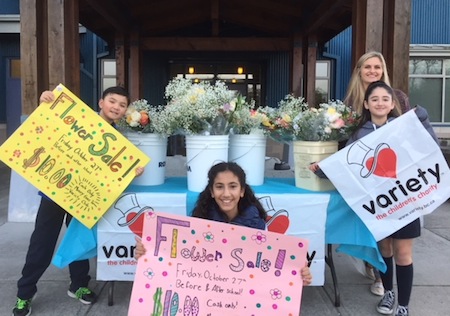
photo - Among other initiatives, RJDS students sold flowers to raise money for Variety. Pictured here are, left to right, Jonathan Estok, Noa Ben-David and Hannah Karasently-Saltoun with teacher Dara Nelson (in the back)
Among other initiatives, RJDS students sold flowers to raise money for Variety. Pictured here are, left to right, Jonathan Estok, Noa Ben-David and Hannah Karasently-Saltoun with teacher Dara Nelson (in the back). (photo from RJDS)

Many of the students at RJDS agree that giving and helping means the world to us, and a lot of students at our school, including members of our committee, have given to various causes.

In past years, we have done bake sales, non-uniform days and flower sales in support of charities. Most recently, we did a highly successful flower sale in front of our school – we sold every single bouquet, and we were interviewed by Global TV. Our goal was to raise $1,049 in support of Variety to help purchase a Sunshine Coach, and the goal was surpassed fairly quickly.

We wanted to raise money for Variety because of what they do for children who are less fortunate and need medical attention. Our fundraising will hopefully make a difference to these kids, and put smiles on the faces of some of those in need.

Shai Rubin is a Grade 7 student at Richmond Jewish Day School. Because of their efforts, RJDS students will appear on the Variety telethon Feb. 11, between 1:30 and 2:30 p.m. The telethon is a daylong broadcast on Global BC.

Hatikvah bursting at seams

Land-based activities at Camp Hatikvah form a large part of the summer experience. (photo from camphatikvah.com)

Like most everything, camp enrolment goes in cycles. And, for the past few years, Camp Hatikvah has had a waiting list for its first session, a full second session and has closed off the summers with the highly popular Family Camp experience that sells out within hours of registration opening in October the year prior. With the largest-ever single age group of campers rising through the ranks, Hatikvah is looking to expand its facilities to accommodate these campers as they move toward the counselor-in-training program.

Camp Hatikvah has a formula that seems to be working well. In order to fill every bunk, current board president Joanna Wasel worked closely with camp director Liza Rozen-Delman to make some changes in programming. In addition, they have brought the concept of camper care front and centre, and the programming is more flexible than the camp experience of yesteryear. As but one example, Hatikvah has been bringing in specialist instructors for activities such as tennis or mountain biking to run weekly sessions, and such initiatives are drawing campers. Once their interest is piqued, the kids tend to come back year after year.

“Liza does an excellent job ensuring that the campers are well cared for, safe and happy,” said Wasel. “I believe her reputation of providing exceptional camper care is the primary reason we are seeing the success we are today.”

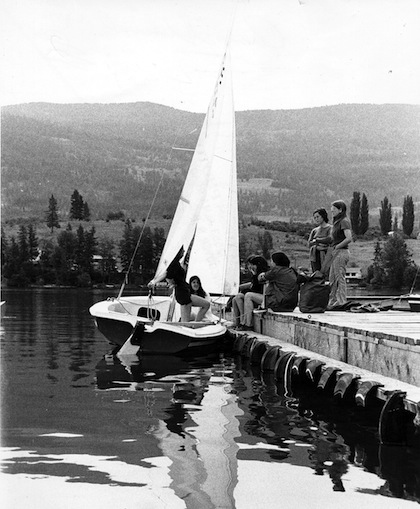
photo - Camp Hatikvah, 1972. Sailing was one of the writer’s favourite camp activities
Camp Hatikvah, 1972. Sailing was one of the writer’s favourite camp activities. (photo from Jewish Western Bulletin fonds, Jewish Museum and Archives of BC L.09596)

While Camp Hatikvah has been known for years as a watersport camp, the land-based activities have been overhauled during Wasel’s tenure as president. “We are now able to offer expert instruction from professionals in a plethora of land activities including tennis, football, basketball, fitness, yoga, dance and more,” she told the Independent. “The change has been dramatic and campers are now equally engaged on land and water.”

Those who remember their own experiences of the “good old days” of camp continue the tradition, and send their children, according to Rozen-Delman. “Many of our campers are second- or third-generation participants,” she said. “Our camp is rich in traditions and many of the programs we offer our campers today are based on programs their grandparents participated in during the ’50s and ’60s and their parents did in the ’70s and ’80s. We are very proud of this dedication to our roots and traditions and believe this makes our camp experience even more meaningful.”

The list of former campers reads a bit like a who’s who of the local Jewish community, something that shows the link between camp attendance and Jewish community involvement. Many of the children from Camp Hatikvah are already well ensconced within the community; many are students at Vancouver Talmud Torah. Rozen-Delman noted that campers also come from Alberta, Ontario, Washington and California. Hatikvah has combined a number of initiatives to draw a diverse group of campers, some of whom have no other connection with the Jewish community.

The effort to diversify and attract unaffiliated Jews this year has been aided by the Laskin Outreach Fund. This initiative, created and entirely funded by Elliot and Megan Laskin, provides $1,800 (almost the full fee) to first-time campers from British Columbia with little or no Jewish communal engagement to try Camp Hatikvah in its second summer session.

Both Wasel and Rozen-Delman stress that the programming at Camp Hatikvah is oriented toward helping children develop as members of the community. As a pluralistic camp, children from all sorts of Jewish backgrounds are introduced to and experience the camp’s motto: “Leadership by example.”

Although the programming for younger campers is focused on fun and socializing, with some Zionist and Jewish learning, it is the staff-in-training (SIT) program that begins the leadership training in earnest.

“This program is designed specifically to enhance the leadership abilities and traits of our campers. Participants engage in almost daily hadracha (leadership) sessions or discussions where they learn the importance of leadership, citizenship and community,” said Rozen-Delman of SIT.

Both Wasel and Rozen-Delman are alumna of Camp Hatikvah, with Wasel starting as a camper in 1988 and Rozen-Delman in 1979. Both have worked and volunteered within the Jewish community, in addition to their work at Camp Hatikvah.

While local Jewish life is part of the formula, Hatikvah’s Zionist roots are as strong as ever. Last summer, there were 14 Israeli schlichim (emissaries) on staff.

This year’s camp sessions are both looking like they will be full, said Rozen-Delman. For more information on the camp, subsidies to attend or the Laskin Outreach initiative, call the camp office at 604-263-1200.

Michelle Dodek is a freelance writer who spent one summer at Camp Hatikvah a long time ago and loved the sailing program.

An education legacy

In October, our community lost one of its most devoted supporters, Leon Glassman, z”l. Leon will be remembered for generations to come for his commitment to Jewish education and its central role in Jewish identity and continuity. Through the Jewish Community Foundation, Leon created a legacy that reflects his lifelong passion in these areas. Together with his wife Rose Marie, they made an indelible impact on our community – an impact that will ensure his memory lives on.

Leon and Rose Marie’s commitment to Jewish education goes back decades to their life as young parents in Regina. Their move to Vancouver was motivated in part because here they would be able to provide their children with a Jewish education, which they saw as an integral aspect of helping them develop strong Jewish identities.

Leon and Rose Marie recognized that the high cost of living in the Lower Mainland today has reduced the ability of many families to enrol their children in Jewish day schools and Jewish educational programs. They wanted to find a way not just to help families and children, but to strengthen Jewish continuity for the community as a whole.

In April 2016, Leon and Rose Marie made a million-dollar gift to create the Leon Glassman Fund for Jewish Continuity through Education endowment fund. The response from community members who share their passion, as well as from the day school community that understands so clearly the impact this endowment will make, was tremendous, and it inspired Leon and Rose Marie to make a second million-dollar gift to the fund.

The fund will provide a steady source of support for tuition assistance, so more children can reap the benefits of a Jewish day school education. This endowment will support an area of need that was close to Leon’s heart, enriching our community in perpetuity.

According to executive director Marcie Flom, the Jewish Community Foundation was “privileged to work with the Glassmans to create Leon’s legacy for the Jewish community.” She said, “Leon’s philanthropy reflected his life’s passion and his commitment to Jewish education in a way that perpetuates his memory for his children and grandchildren.”

Like Leon and Rose Marie, there are many community members who support causes that reflect their interests and their values. If you are among them, then you, too, can create a legacy at the Jewish Community Foundation that reflects your passions. To make a contribution to the Glassman Fund or for more information on how to create a legacy, visit jewishcommunityfoundation.com.

Let’s hear it for camp!

(photo from teenlife.com/summer-program/urj-camp-kalsman)

Going to camp was a rite of passage when I was growing up. Everybody went to camp. In my day, it was the B’nai B’rith camp that all Jewish kids went to, in Sandy Hook, past Winnipeg Beach.

I don’t recall much detail of my really young days as a camper, but we never missed a summer. As small kids, we went with our mothers. It all had to do with getting away from the oppressive summer heat and time at the beach, wading and swimming, sunning on a blanket, playing the games on the boardwalk. I would have an ice cream cone every day, even though, back then, all you could get were vanilla and strawberry flavours. There may have been chocolate, too.

I enrolled in Young Judaea in my early teens. In the heady days leading up to and after Israel declared its independence, movements of every political stripe in Israel had a youth group and camps in Canada and in the United States.

At camp, we built our Jewish consciousness and reinforced our Jewish identity. We were part of larger society, of course, but the one that was becoming central to our lives was the Jewish one, and the camp experience strengthened all that. Everything around our activities focused on our life as Jews, intellectually and emotionally, in our developing teen years. It was easy to pick out the future leaders – assertive, confident, basing their arguments on material accepted as fact. That was the stuff we brought forward into our adult years, colouring what we would become and the messages we would transmit to our children.

Aliyah to Israel was an enormous focus of the Zionist camps I associated with. This possibility, went the argument, was why we had to study our history, our customs, our holidays. We were building a new kind of Jew, unapologetic for his striving nature, determined to never again be a victim. History’s lessons were clear and we had to take heed and take our future into our own hands. The camps I attended were the educational vehicle.

In those days, we pretended we were chalutzim (pioneers), so we went out into the bush and made like we were going to live off the land. We built lean-tos to sleep under, chopped down trees, built things, learned how to make a campfire even without matches, and engaged in marches, canoeing, the whole megillah.

The years I spent as a camper – learning to be a scout, learning to create things with my hands, to develop myself physically, to compete for excellence – we were modeling the new Jew. We were not content with just being students, we knew we could do that – we were going to be doers. We were building pride in ourselves and in our accomplishments.

In turn, I became one of the leaders trying to transmit the messages I had absorbed to others. The young people I grew up with at camp worked in their own communities in the same way. All across the country and across the United States, we were a network fighting assimilation, building loyalty to Israel and a consciousness of being Jewish and the values it represented.

One of the best experiences I had was when I was invited to be a Camp Shalom program director in Gravenhurst, Ont. I spent six months preparing programs and then threw them all out on my second day on the job. I spent the next two months preparing different programs on the fly, built around Jewish holidays or events in Jewish history. We organized camper teams, choosing names, uniforms and cheers, and had athletic competitions, colour wars, talent competition skits, swimming competitions or just fun at the beach. I don’t know about the campers, but I had a great time exploring my creative capacities. We set up a pattern that was followed for years at that camp.

Some of us became community leaders. A few of us even got to Israel, at least for a time. Many of the associations we made have withstood the test of time. Some of the best friendships I have today are ones I made in those years. A good number of marriages came out of those experiences, including one of my own.

What a wonderful institution camps are, whatever their nature! Bringing kids into a healthful environment with responsible supervision, living lives completely different from what they are accustomed to, meeting people they would not normally meet, exposing them to alternative behavioural norms, has to be good. And getting away from the city into a natural environment, who has to be convinced that that is a good thing? Let’s hear it for camp days. Rah, rah, rah!

Max Roytenberg is a Vancouver-based poet, writer and blogger. His book Hero in My Own Eyes: Tripping a Life Fantastic is available from Amazon and other online booksellers.

Camp fosters independence

At Camp Shomria, it’s all “about equality and giving the power to the youth,” says one parent. (photo from Camp Shomria)

In Ontario, Camp Shomria was established based on the principals of Hashomer Hatzair (The Young Guard), with its Zionist and socialist principles, including that building a strong community is just as important as building strong individuals.

Camp director Uri Ron Amit is an Israeli who runs the only chapter of Hashomer Hatzair in Canada, which is based in Toronto. He comes from a background of working as an educator in international development and community management.

“The kids are from Grade 2 (7-year-olds) all the way up to Grade 11 (17-year-olds),” said Amit. “By Grade 12, they become first-year youth counselors in the movement. And then, later on, they can continue working to make an impact in the camp, either as youth counselors, as head of camping or as head of programs.”

Most families involved at the camp are from the Toronto area but some campers also come from the United States and a fairly large number come all the way from Israel. The camp is situated an approximately four-hour drive northeast of Toronto, and about an hour and a half southwest of Ottawa.

“Starting in Grade 2, the kids spend a week away from home at camp,” said Amit. “Grades 3 and higher stay at the camp for at least two weeks at a time, and sometimes for five weeks. Having young kids sent by their parents to be away from home … brings both opportunities and challenges. The further away you are, the more remote [it is, and] it can create a sense of independence and a different world for the kids and youth counselors.”

Hashomer Hatzair was established more than 100 years ago, he explained, “with the idea of having youth of different ages develop an independent youth community that stands for the ideals of humanistic Judaism and Zionism. The main difference in sending your kid to experience camp away from home is the added layer of independence – a level of ownership over the community … self-reflection and personality development.

“I think the main reason parents send their kids away from home for a couple of weeks with minimal communication with them is because they want them to go through a meaningful learning process that can help them pick up a strong group dynamic in the youth community.”

Amit described one particular child who came to the camp. This child had never been to a sleepaway camp before, and was dependent on his parents for almost everything. “After a couple days, this child became a star,” said Amit. “He became independent and took to different stages of sharing feelings and emotions…. We gave him the opportunity to lead discussions … with group members. His parents said it was a life-changing experience.”

Camper Zoe Friedman, 13, who lives in Toronto, started attending the camp last summer, choosing to do so after she learned that some of her friends from Israel go there.

“It’s a camp that really builds character,” she said. “And it gives you time to expand on things … expands character, responsibility and social skills. Every morning, we have something called toranuyot (chores), where we get split into groups and go clean up the camp…. So, we might clean the washroom, pick up trash, or something else that helps everybody. The theme of Shomria is socialism. We all do everything together and support each other. It’s a really good vibe.”

As for being away from her parents and home, Zoe said she felt it was sometimes very difficult, as, at night, it is extremely dark and you feel very far away from it all. But, at other times, she said, it is tremendously fun.

“It was really fun to disconnect from the outside world and focus on what’s in front of you,” she explained. “It’s just interesting to see how such a big group of kids can just disconnect from technology and focus more on social skills, responsibilities, and just on having a good time, without focusing on technology.”

Zoe and her family – mom Eilat Bakerman, dad David Friedman and younger sister Gaia, 9 – have been living in Toronto for the past 12 years, and are very involved in the local Jewish community. Bakerman heard about Shomria from friends and decided to send both Zoe and Gaia there.

“They thought it really helped to build kids’ character, and they support the values of what the camp aims for … about giving the power to the youth,” said Bakerman. “The camp is run by youth and they are leading other youth, a bit younger kids, in whatever they do. The only adults they have there are the operational staff – cooks, doctors, nurse, drivers, and so on. It highlights what you’d imagine a kibbutz life was like when it first started.”

According to Bakerman, one example of the unusual way in which the camp is run is how, when the kids first arrive at the camp, any money parents send with the kids is pooled together and everyone is given back an equal share. “Nobody feels they have more than others,” she said.

“When they go to Perth, which is the closest city,” said Bakerman, “everybody gets the same share of money – no matter how much they each may have brought into the camp – and that’s what they have for spending money.

“No matter if you came from a wealthy home, where you don’t need to do any chores, or not, at camp, in the morning, the kids decide what kind of chores they’ll do and everybody in the group does it,” she added. “Everybody is eating the same food. It’s about equality and giving the power to the youth.”

Bakerman also regularly sends her daughters to stay with family in Israel while she stays to work in Canada. The location of the sleepaway camp was not a deterrent.

“I think the kids are so engaged, it really doesn’t matter – the distance,” said Bakerman. “The distance is neither a barrier nor an excuse to come home or to call home. To me, it was about character and values…. The camp gave them independence and they have something to aspire to become. They’re really looking forward to next year.”

Rebeca Kuropatwa is a Winnipeg freelance writer.

Immersed in Hebrew

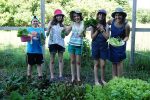
Friends at Camp Shomria show off the fresh vegetables they picked in the camp’s garden. The produce was used to make a salad for one of the meals. (photo from Camp Shomria)

It is said that there is no better way to learn something than by immersing yourself in it. And for kids who want to learn Hebrew in Canada, camp is one of the best and most accessible ways of doing that. But, while there are many Jewish camps in Canada that promote Hebrew language, Camp Massad in Manitoba is the only camp where all the activities and programming are carried out in Hebrew.

“They are not allowed to speak English outside the cabin,” said Danial Sprintz, the camp’s executive director. “Inside the cabin, they speak in whatever languages they want to. But, if they are outside, they are not allowed to speak in English to each other. The kids are all trying to speak Hebrew. So, when everybody’s doing it, you fall in line. Our camp is run completely in Hebrew and there isn’t any other camp that is doing that.

“Not all the kids that come to the camp can speak Hebrew when they arrive. About 50% of the kids don’t go to Hebrew day school, so they are learning Hebrew at camp. We don’t sit them down in a classroom, but we teach them the essentials they need to ask the basic questions. We teach Hebrew through song.”

With repetition, and everyone being together for three meals a day and programming, the kids start picking up the ability to communicate with each other as they go.

Most of the staff has grown up going to the camp and, each year, there are also a number of staff who come in from Israel.

The camp also prides itself on being 100% inclusive. No matter what a child’s situation – if they are autistic, use a wheelchair or are developmentally delayed, or if they are completely secular or ultra-Orthodox in Jewish observance – Sprintz said the camp is dedicated to finding a way to make the experience work for all campers.

Sprintz was executive director of Congregation Emanu-El in Victoria for a number of years, when he and his wife were going to school in British Columbia, before returning to Winnipeg and taking on his role at Camp Massad.

“When I arrived in Victoria, the rabbi was on sabbatical in Israel,” said Sprintz. “I approached the board about helping them with the programming while he was away, and then just stayed on after.”

This experience helped Sprintz develop ways of introducing the children at Camp Massad to Judaism. “We make it fun,” he said. “And we make it something the kids look forward to, as we make the tunes and the process of it all fun. We have tefillin club in the morning for kids who want to try something out, and for kids who need to. But, when it comes down to it, we provide all the religious and traditional cultural components that kids would need to come to camp, to a certain point – we don’t want to separate boys and girls, as we want everybody to be together.”

Camp Massad encourages the children to write their own songs and to put on plays for others in the camp – all in Hebrew.

Winnipeg’s Aviva Tabac has been sending her two daughters, Chaya, 15, and Sara, 13, to Camp Massad for the last three years.

“I didn’t go to camp growing up,” said Tabac. “My parents took us on a summer vacation each year, and the rest of the time was spent at the beach with family and friends. Since I didn’t grow up going to summer camp, I felt it would be a good idea for the girls to try it. Just from my immediate circle of friends who all went to Massad, there’s a special bond they have with one another that carries over into adulthood. All my friends still talk about their fond Massad days and I wanted to give the girls the chance to experience that for themselves.”

Both Chaya and Sara attend public school, so they do not get a lot of other opportunities to speak Hebrew. Tabac said, “When my girls return from camp, they continue to speak in Hebrew, sing Hebrew songs and reminisce. They hang onto their Massad memories and feelings for as long as they can.

“The Hebrew is a big component,” she continued, “but, more so, the celebration of Shabbat, day-to-day celebration of Jewish culture and being proud of being Jewish. The lov[ing], understanding and caring staff and councilors [are] amazing. My girls feel at home when they’re at Massad. They come back rejuvenated, independent and confident. I know that, when they’re there, I have nothing to worry about because they’re in good hands.”

Meanwhile, Lilach Golan moved with her family to Vancouver last fall. She has been sending her four daughters to Camp Shomria in Ontario for years, and plans to continue doing so. She does it with the hope of them picking up some of the values that she grew up with on kibbutz in Israel, including Hebrew.

“For us, the Hebrew language and culture were extremely important and it was very difficult to speak in Hebrew at home all the time … because, when children live in English, they want to speak English and want to be part of the culture around them,” said Golan.

While Camp Shomria operates in English, Hebrew is everywhere at the camp, and the different areas in the camp have Hebrew names, like the chof (beach), cheder ochel (dining room) and moadon tarbut (culture club). Hebrew is also spoken during many of the activities, which include singing and dancing, and at different presentations.

“They do have a lot of Israelis and people who speak Hebrew,” said Golan. “And that’s a big push for the Hebrew – kids love to talk Hebrew with them and the Israelis come every summer. And the songs they sing, there is a lot of language happening there.”

Sharon, 14, is Golan’s youngest daughter. For her, the best part of camp is getting to spend time with her kvutza (group).

“We use Hebrew terminology in contexts where they make sense to me and I can use them meaningfully,” said Sharon. “I also remember better what they mean when I’m not at camp anymore because I can remember the context in which we used them. Hebrew constructs a lot of what and how we do things at Camp Shomria and it’s that culture, atmosphere and values that make me want to come back.

“Even if the Hebrew we use at camp is not new to me,” she said, “it adds so much value to the camp environment and my experience of it. It helps me develop the connection to the three pillars of Hashomer Hatzair [The Young Guard, the Zionist-socialist youth movement] and the core values we share.”

Rebeca Kuropatwa is a Winnipeg freelance writer.

School bars Chanukah

The chair of Vancouver Board of Education (VBE) and even the provincial minister of education waded in after Jewish students at a Vancouver elementary school went public with concerns that they were being made to feel excluded by exclusively Christian holiday symbolism.

Students Maya Sontz and Rebecca Weinberg went public last week after asking the principal of General Gordon Elementary, Hope Sterling, to add some Chanukah decorations to the Christmas trees, wreaths and other Christmas decorations up around the school. The girls said they were rebuffed by the principal, who claimed the Christmas decorations were not religious symbols, while a chanukiyah or other Chanukah items would be. The holiday concert was to include songs about Santa, reindeer and trees, which the principal defended as being “cultural” symbols, not religious ones.

The principal’s position drew rebukes over the weekend from Janet Fraser, chairperson of the board of education. “The VBE sincerely regrets any practices at General Gordon Elementary that have negatively impacted a sense of inclusion and representation for students and parents within our school community,” she wrote. “As chairperson, I apologize on behalf of the board to the students and their families who did not feel welcomed and included at their school. We acknowledge that, in the interpretation and implementation of our policies, there has been confusion about what is permitted as part of upcoming winter celebrations, including Chanukah. The board chairperson and school district staff will be meeting with members of the families … to ensure that their children, as well as all others, are included and represented in their school.”

In response to Fraser’s statement, Rob Fleming, B.C. minister of education tweeted: “ALL children, regardless of ethnicity, religion or gender should feel and be welcome to celebrate who they are in every single one of our #bced schools.… Thank you for your leadership upholding inclusive schools @VSB39 and @janetrfraser.… Let’s #celebrate diversity this year!”

Administrators were to meet with school officials, parents and students Monday to address the issue.

“It is called a public school, so, if you’re going to invite everybody, you’ve sort of got to include everybody,” 11-year-old Maya Sontz told CTV news.

Kollel launches WeLearn

Rabbi Simon Jacobson gives a lecture during a recent Kollel Shabbaton. (photo from Kollel)

In an effort to direct Vancouver’s Jewish consciousness from an “I” culture to a “we” culture, Ohel Ya’akov Community Kollel has launched WeLearn, expanding the Kollel’s centre of learning and celebration.

“We want to spark lifelong learning within the community,” said Rabbi Shmulik Yeshayahu, director of Kollel. “We’ve become a society that over-values individuality and separateness, to the detriment of our personal growth.

“We encourage people to move away from isolation, and experience the richness of community learning,” he added.

photo - Rabbi Simon Jacobson, right, with Rabbi Shmulik Yeshayahu
Rabbi Simon Jacobson, right, with Rabbi Shmulik Yeshayahu. (photo from Kollel)

WeLearn recently kicked off with a Shabbaton Nov. 30-Dec. 2, attended by more than 400 Jews from across the Lower Mainland. The Shabbaton featured Rabbi Simon Jacobson, author of Toward a Meaningful Life and founder of the Meaningful Life Centre; Shimona Tzukernik, “the Kabbalah Coach”; and Audi Gozlan, the founder of Kabalah Yoga.

The Shabbaton started off with Tzukernik, one of the foremost female authorities on kabbalah as it applies to daily life. Her talk – Joy is an Inside Job – highlighted the importance of developing internal joy, which results in achieving personal understanding and humility. Her claim that “pain is inevitable, but suffering is a choice,” appeared to resonate with the audience. She also shared inspiring personal stories, and emphasized that beauty and joy exist from the inside out.

Jacobson engaged the audience next, with a lecture called Is your Self-Worth Defined by Your Net-Worth? He focused on the intrinsic value of tzedakah, and the family legacy of giving that was started by Abraham, the father of the Jewish people. Jacobson remarked how Abraham educated his own children in the path of justice and charity, and left this legacy for all Jews to follow.

The rabbi followed this with a story about Moses Montefiore, a wealthy, philanthropic 19th-century Jew. When questioned by Queen Victoria about the exact amount of his personal wealth, Montefiore is said to have replied that his real worth was what he gave away to others, because its benefit would live on. In short, Jacobson’s message was that our self-worth is defined by what we give, not what we have.

Gozlan, who founded Kabalah Yoga (also called Aleph Bet Yoga), spoke about the daily struggles between the body and soul, and the need to tap into our internal joy. Gozlan explained how yoga and conscious breathing can connect us to ancient Chabad Chassidic philosophy. He went on to describe how we can elevate our body and soul to become a holy spark and a source of light.

“At Kollel, we celebrate education, community and Jewish continuity, and this Shabbaton was a perfect example of this,” said Yeshayahu. “Hundreds of Jews joined us over the course of four days, in friendship and openness to learn and be inspired. It was a truly unforgettable weekend.”

The Kollel distributed brochures outlining their upcoming classes for the winter and spring. Among the classes being offered are sessions on medical ethics, business ethics, prayer, the weekly parashah, kabbalah, Tanya, Genesis and creation, and more. In addition to Yeshayahu, Rabbi Avraham Feigelstock, Shifra Feigelstock, Dan Friedmann, Karen Levitt, Rivki Yeshayahu, Asaf Cohen and other guest lecturers will provide a variety of perspectives and teaching styles to enhance the Kollel’s education centre.