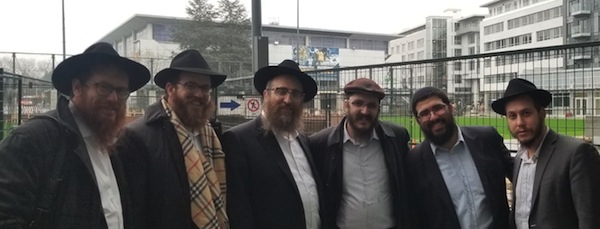
Left to right: Rabbis Chaim Boyarsky, Moshe Goldman, Mordechai Silberberg, Chanoch Rosenfeld, Chalom Loeub and Zalman Zaltzman. (photo from Chabad UBC)
A delegation of rabbis who direct Chabad centres across Canada came to Vancouver last month, on Dec. 10. The purpose of the visit was to get a firsthand understanding of the day-to-day operations of the Chabad Jewish Student Centre at the University of British Columbia, which was established in 2013 by Rabbi Chalom and Esti Loeub.
The delegation included Rabbi Mordechai Silberberg, director of Chabad at University of Western Ontario; Rabbi Chanoch Rosenfeld, director of Chabad at McMaster University; Rabbi Moshe Goldman, director of Chabad of Wilfrid Laurier University and University of Waterloo; Rabbi Zalman Zaltzman, director of Chabad at Brock University; and Rabbi Chaim Boyarsky, director of the Chabad Student Network, which caters to Carleton University and University of Ottawa.
The rabbis direct their respective Chabad centres together with their wives, who are equally responsible for all of their operations. While each Chabad centre caters to the needs of its specific university students, there are some signature programs that all of them run. Weekly home-cooked Shabbat dinners free of charge, the Sinai Scholars Society, and holiday meals and services are some examples. Chabad of Western University, which was established in 1999, hosts hundreds of students every Friday night for Shabbat dinners, many of them Vancouver natives.
The rabbis began their visit at Café FortyOne, where they met with Rabbi Yitzchak Wineberg, executive director of Chabad Lubavitch of British Columbia. Wineberg briefed them on the history of Chabad Lubavitch of Western Canada and his early days in Vancouver.
The group then headed to the AMS Student Nest at UBC, where they met and had lunch with the UBC Chabad student board, and heard about some of the activities that have been taking place on campus. At the Chabad Jewish Student Centre, they met with the Loeubs to discuss the operations and offer feedback. The day concluded with dinner at the Maple Grill followed by a farbrengen (Chassidic gathering).
“It meant a lot to us to have our colleagues fly across the country to visit us,” said Rabbi Loeub. “As we are one of the more recent Chabad on Campus centres to open in Canada, it was very helpful to hear words of advice and inspiration from these veteran directors.”
For more information about the programs offered at Chabad Jewish Student Centre-Vancouver, visit chabadubc.com or call Rabbi Loeub at 778-712-7703. For information on Chabad centres on national campuses and worldwide, visit chabadoncampus.org/directory.
Sue Silvermanis a volunteer with Chabad Jewish Student Centre-Vancouver.
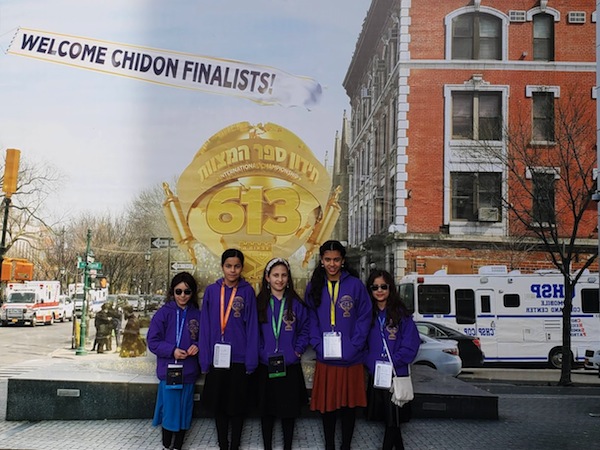
Left to right: Chana Rivka Bitton, Miriam Feigelstock, Baila Shapiro, Shira Oirechman and Ora Yeshayahu. The biggest event of the Tzivos Hashem year is a Shabbaton in New York, the highlight of which is an international competition called Chidon Sefer Hamitzvos, where kids from around the world compete in their knowledge and understanding of the 613 mitzvot of the Torah, as codified by Maimonides. (photo from Tzivos Hashem)
Walking into the Lubavitch Centre at 41st and Oak Street a couple of months ago, I witnessed a hub of activity so vibrant with excitement it was practically humming. Every available space was brimming with excited children, from little ones to newly minted teenagers. Engaged in drawing, listening intently, and engrossed in a whole variety of activities, I knew these kids had to be connected to Chayolei Tzivos Hashem.
Make no mistake – Chayolei Tzivos Hashem (CTH or Tzivos Hashem, for short) is serious business. According to Tzivos Hashem Vancouver coordinator Riki Oirechman, it’s an educational program for Jewish children ages 3-13, founded in 1980 in New York by the Lubavitcher Rebbe, Menachem Mendel Schneerson. Tzivos Hashem focuses on teaching about kindness, good deeds and refining our character to become better people and more effective influencers in our community. The program aims to increase Jewish identity and provide children with Chassidic Jewish learning through informal activities and songs.
Tzivos Hashem Vancouver was established several years ago by Rabbi Shmulik Yeshayahu, Rabbi Dovid Rosenfeld and Rabbi Schneur Wineberg and, since then, it has grown in size. Today, they count 50 children registered in the local program, and have plans to expand its hours. Currently, it is being held every Sunday at the Lubavitch Centre, from 10:30 a.m. to noon, in groups divided by age.
“It’s incredible to see how much the kids learn every week, and how much they enjoy coming,” said Oirechman. Parents even relate that their kids consider it the “highlight of their week.”
The Vancouver chapter of Tzivos Hashem was able to run the first two years thanks to a grant from the Phyliss and Irving Snider Foundation. This helped lay the foundation for the program. Since then, it is partially self-funded and relies on tuition fees for each student.
“The program is designed to give young children a sense of pride and belonging, a feeling of connectedness to other Jews,” said the Lubavitch Centre’s Rosenfeld. “It’s meant to instil in them an appreciation for what they do and inspire them to do even more.”
When asked what they learn, Rosenfeld said the curriculum includes things like a deeper insight into the Jewish holidays and following examples of role models from our ancient and recent history. The older kids learn Mishnah and Talmud. All of the learning is illustrated according to Chassidic theory, as taught by the Lubavitcher Rebbe.
“We encourage the children to advance their knowledge, not just maintain it,” said Rosenfeld. “Constant review and reinforcement of the different concepts allows the kids to build on the knowledge they gain each week. Moreover, we try to channel the kids’ studies into the practical realm, having them translate their knowledge into action. Whether through class activities, such as visiting the Louis Brier Home with cards and hamantashen before Purim, or with doughnuts before Chanukah, the kids can keep track of their mitzvot (good deeds) through an online logging system.”
“The Sunday program,” added Oirechman, “teaches kids in a fun, highly interactive and hands-on way. Our lessons incorporate creative team challenges, unique arts and crafts, educational games, Tanya (the foundational work of the Chabad movement) and mishnayot (the oldest authoritative post-biblical collection and codification of Jewish oral laws), memorization, weekly missions, songs and much more. In the short time we have each Sunday, we instil and teach the kids important values.”
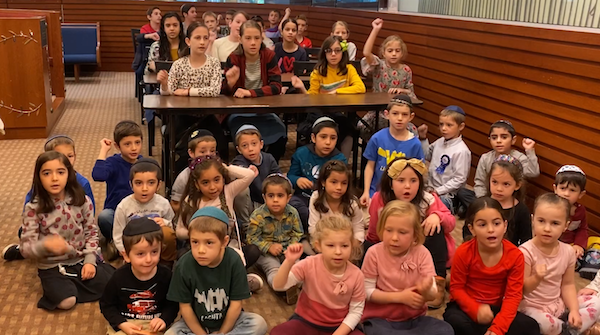
A group of Tzivos Hashem learners. (photo from Tzivos Hashem)
Tzivos Hashem is based on the Rebbe’s style of teaching, and offers children badges for missions based on things they accomplish in their daily Jewish lives – for instance, saying Modei Ani every morning, washing their hands before meals, giving tzedakah, saying Tehillim (Psalms), etc. Using the army and its ranks as a metaphor for how Tzivos Hashem is structured, the program enables children to learn at their own pace and get rewarded for it. Each student starts out as a private, but, as they do more good deeds and complete missions, they earn mitzvah badges. After collecting enough badges, they are awarded medals. When they get enough medals, they are promoted in rank. Think of it like a Chassidic Airmiles loyalty program; when the children complete missions every week and behave during the Sunday programs, they’re rewarded with mileage points.
A few times throughout the year, there is a prize store, where the students can use the points they earned to buy prizes online. The global headquarters of Chayolei Tzivos Hashem hosts monthly raffles, where children who have completed missions can have a chance to earn more prizes. There are monthly international webcast rallies, where recognition and honour are given to students who have gone up in rank. The physical prizes act as incentives to learn and do more but, in reality, the incentives are inherent, or self-generated: love of Hashem and commitment to Torah values and Yiddishkeit.
The biggest event of the year is a Shabbaton in New York, the highlight of which is an international competition called Chidon Sefer Hamitzvos, where kids from around the world compete, on stage, in their knowledge and understanding of the 613 mitzvot of the Torah, as codified by Maimonides. The competition motivates the children to review the mitzvot and commit them to memory.
Oirechman said the Tzivos Hashem program is adding to both to the quality and quantity of learning opportunities and resources available in Vancouver for Jewish children. For more information about the Vancouver Tzivos Hashem program, email tzivoshashemvancouver@gmail.com or visit their website, thvancouver.ca.
With the goal of living Torah-observant lives, kids in the program are steered to become “lamplighters” – igniting and spreading light wherever they go, through good deeds, acts of kindness and Torah study. Light is something that can be shared infinitely and it only takes a bit of light to extinguish darkness. And while, from my outsider’s point of view, the army metaphor sounds rather harsh, it actually reflects a message that couldn’t be gentler and more caring: to love and help your fellow Jew.
Shelley Civkin is a happily retired librarian and communications officer. For 17 years, she wrote a weekly book review column for the Richmond Review. She’s currently a freelance writer and volunteer, including with Chabad Richmond.
Starting Nov. 20, Rabbi Yechiel Baitelman of Chabad Richmond will be leading Worrier to Warrior, a new six-session course offered by the Rohr Jewish Learning Institute (JLI), to help people deal with life’s challenges by accepting themselves and finding meaning in adversity.
Participants will examine factors that prevent us from achieving a more positive outlook – guilt, shame and fear of inauthenticity – in light of the notion that a purposeful life provides the key to well-being. Like all JLI programs, this course is designed for people at all levels of knowledge, including those without any prior experience or background in Jewish learning. All JLI courses are open to the public.
“Everyone faces personal challenges in life, whether physical, emotional, professional, familial, social or otherwise,” said Baitelman. “How we deal with these issues is crucial for our ability to achieve lasting satisfaction in life. By finding meaning in personal challenges – that is, seeing them as opportunities – we come to accept ourselves and are emboldened to move forward.”
Worrier to Warrior combines positive psychology with Jewish wisdom to explore questions such as, Is there a meaning to life that makes even our difficulties purposeful? Am I just what happens to me or do I have a deeper core? How can I get off the “hedonism treadmill” and the sense that even life’s successes ring hollow?
“All too often people are thrown off their path in life by hardships that sink them into negative emotions or anxiety,” explained Rabbi Naftali Silberberg of JLI’s Brooklyn headquarters. “In this course, we learn to face our challenges by understanding our lives in a deeper context.”
Prof. Steven M. Southwick, MD, of the department of psychiatry at the Yale University School of Medicine has endorsed this course, saying, “It is well known that positive emotions rest at the heart of overall well-being and happiness, but how to effectively enhance positive emotion remains challenging. Worrier to Warrior approaches this challenge from an insightful perspective grounded in contemporary psychology and Jewish literature.” Worrier to Warrior is accredited in British Columbia for mental health professionals seeking to fulfil their continuing education requirements.
The course starts Wednesday, Nov. 20, 7:30 p.m., at Chabad Richmond. To register and for more information, call 604-277-6427. The cost is $95/person or $160/couple and includes textbook. Classes are 1.5 hours long.
Worrier to Warrior course is also being offered at the Lubavitch Centre (604-266-1313) in Vancouver, beginning Nov. 13, 7:30 p.m., and at Chabad of Nanaimo (250-797-7877), starting Nov. 12, 7 p.m.
Registration for all of these courses is possible at myjli.com.
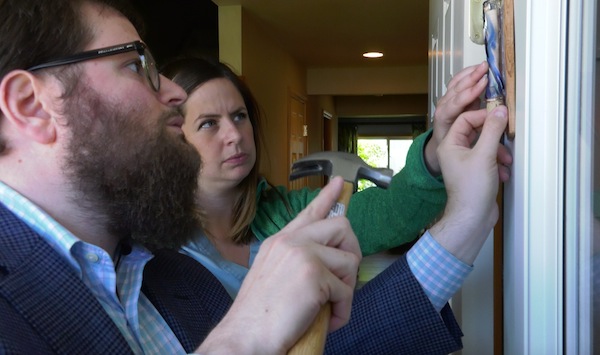
A still from The Rabbi Goes West: one of Chabad-Lubavitch Rabbi Chaim Bruk’s goals is to see a mezuzah on the door of every Jewish home in Montana.
In their documentary The Rabbi Goes West, filmmakers Gerald Peary and Amy Geller have succeeded in a difficult task – providing a balanced, respectful and entertaining glimpse into what happens in a state with a small, minimally affiliated Jewish community when Chabad-Lubavitch arrives.
A branch of Chassidism, Chabad-Lubavitch was started some 250 years ago in White Russia, in what is now Belarus. After the Holocaust, the movement began its outreach in earnest, trying to reach non-religious and unaffiliated Jews almost literally everywhere in the world. There are now approximately 5,000 Chabad emissaries in more than 90 countries.
While emissaries may receive some seed funding to start a new centre, they must raise their own funds to stay active. In 2006, Chabad Rabbi Chaim Bruk ventured from Brooklyn, N.Y. – Chabad headquarters is in Crown Heights – to Bozeman, Mont., to scout it out. Encouraged by the growing population and the amount of tourism, Bruk returned to Crown Heights to get the OK to set up a centre there. Given the green light, he and his wife Chavie did just that in 2007. The rabbi’s goal? To ensure that every one of Montana’s 2,000 Jewish families has a mezuzah on their door. One of the ways in which he makes headway on this task is by traveling all over the state, asking safe-looking strangers (who are the vast majority, he says) whether there are any Jews in the area and then, when he finds them, boldly introducing himself and his purpose.
As charming and open as Bruk seems, his presence, the ultra-Orthodox Judaism to which Chabad adheres and the movement’s expansionist mission – two more Chabad centres have opened since the Bruks arrived – are not universally welcomed by the Montana Jewish community. The Rabbi Goes West includes interviews with fellow rabbis Francine Roston (the first Conservative woman rabbi to lead a large congregation), who came to Montana from New Jersey in 2014; Allen Secher (co-founder of Chicago’s first Jewish Renewal congregation), who came to Montana after he retired in 2000 but retook the bimah when he found out he was the only rabbi in the state at the time; and Ed Stafman (a former trial lawyer), who came to the state from Florida. The film also includes commentary from local Jews from all four congregations.
While Bruk has limited involvement with the other congregations and rarely, if ever, joins their events – he contends that most of them violate some aspect of Judaism, such as the laws of kashrut, for example – the Jewish community does unite, along with other religious and secular groups and individuals in the state, when faced with neo-Nazi threats and cyberattacks.
The Rabbi Goes West is a documentary well worth seeing, both for its content and the way in which that content is presented. Sponsored by the Vancouver Jewish Film Centre, it screens at the Vancouver International Film Festival Oct. 7, 6:30 p.m., at Cinémathèque, and Oct. 8, 11:30 a.m., at International Village 10. For the full festival lineup, visit viff.org.
There is a world of difference, needless to say, between the murder of a congregant in a California synagogue and the publication of an overtly antisemitic cartoon. But, while the incidents are incomparable in magnitude, they both implore us to action.
Lori Gilbert Kaye was killed Saturday morning during Shabbat services on the last day of Passover at Chabad of Poway, north of San Diego. Eight-year-old Noya Dahan was hospitalized with shrapnel wounds, as was her uncle, 32-year-old Almog Peretz, who was shot in the leg. Peretz was visiting family for the holiday from his home in Sderot, Israel, a city adjacent to Gaza that is under constant threat of bombardment and attack.
In the instant terror struck, heroism abounded. Kaye reportedly died intervening to protect the rabbi from the shooter. Rabbi Yisroel Goldstein, although shot in both hands, immediately teamed with Peretz, who was also wounded, to shepherd the children in the synagogue to safety. Army veteran Oscar Stewart chased the assailant out of the synagogue and Jonathan Morales, an off-duty border patrol agent, shot at the getaway car as the perpetrator fled.
The alleged perpetrator had posted on social media that he was willing to give up his life for the cause of white supremacy. He blamed “international Jewry” for a litany of perceived “crimes” and said that Jews “deserve nothing but hell. I will send them there.”
This shooting is the latest in a terrible string of attacks on religious institutions and the people within them, including the Easter attack that killed more than 300 in Sri Lanka and the mass murder of Muslims in a mosque in New Zealand, among many other attacks on people and institutions worldwide that do not make the front pages. While such incidents in the United States are partly a result of that society’s dysfunctional relationship with guns, the propensity to murder people in places of worship – like the endless stream of mass killings in schools – represents a particular manifestation of evil.
Six months to the day before the Poway attack, 11 people were murdered in the Tree of Life synagogue in Pittsburgh. Given that horrific number, it is understandable that human nature would react to the latest news with an unconscious sense of relief that the death toll in California was not higher. But this reaction, however natural, must be resisted. The invasion of a religious sanctuary represents an assault on the most basic human instincts for goodness and stands apart from other crimes in its deliberateness and in the calculated impact it will have on the victimized community’s sense of security and belonging. Such attacks – no matter how frequently they seem to come – must never be responded to routinely. Each attack is cause for a fresh sense of revulsion.
While the situations are clearly not analogous, there was another episode recently that demands vigilance. The New York Times international edition last week ran a cartoon of Donald Trump as a blind man with dark glasses and a black kippah, being led by an elongated dachshund with the head of Binyamin Netanyahu wearing a Star of David around his neck. The cartoon exists as part of a long history of motifs that portray Jews manipulating guileless, gullible non-Jews to serve Jews’ devious ends. The New York Times apologized and blamed a lack of oversight.
If the editors of Der Stürmer were still among us, they could justifiably claim plagiarism, as numerous comparative memes on social media have indicated. Such images are extremely common on the internet, where there is no oversight. When they make their way into print in one of the English-speaking world’s most august media outlets, this is a new challenge.
Commentators have observed that the dachshund is a breed that rarely, if ever, serves as a seeing-eye dog. The choice by the cartoonist to use that breed was clearly deliberate. For at least a century, since the First World War, cartoonists have used a dachshund to represent Germany. In this way, the artist was adding insult to injury by equating Israel with the perpetrator of the gravest attack on Jews in human history.
The point of addressing the violent attack in San Diego together with a grievous but far less tangible affront in the pages of the New York Times is to make the case that vigilance should not be let down by the routinization of either violence or terrible imagery. These incidents seem to fly at us with such regularity that it is understandable that we as individuals and a community would have limited resources to respond to each case with the gravity it deserves. The memes and lies may become routinized, but our responses to them must never fall short.
Jewish tradition says that it is better to light a candle than to curse the darkness. The heroes of the Poway tragedy have done that. While we cannot predict how each of us would respond in such a crisis, we can promote small acts of light within our circles of influence, by advocating for understanding and peace and by supporting organizations that do good work. More immediately, we can take the advice of Rabbi Goldstein and do good in the world whenever and wherever possible. In a world with evil and intolerance, acts of goodness and understanding are their own type of heroism.
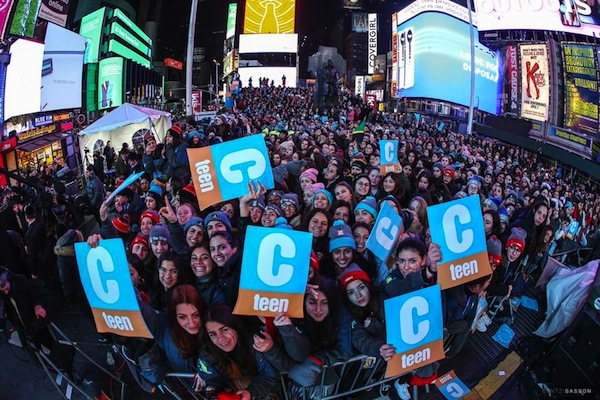
A contingent from Richmond Chabad CTeen joined the 11th annual CTeen International Shabbaton that took place in New York last month. (photo from Chabad Richmond)
Teens from around the world celebrated Jewish unity, heritage and pride at the 11th annual CTeen (Chabad Teen Network) International Shabbaton. The convention, which took place Feb. 22-24, drew more than 2,600 participants. From world-class speakers to a closing ceremony with a surprise appearance by WeWork founder Adam Neumann, the Shabbaton left the teens exhilarated and ready to share their Jewish pride with others.
The weekend included a traditional Shabbat experience in the heart of Crown Heights, the Chassidic neighbourhood of Brooklyn, hands-on workshops and lectures about Judaism, and the Times Square takeover, featuring Jewish pop star Yaakov Shwekey.
(photo from Chabad Richmond)
The theme of the Shabbaton was I-Matter. The theme was meant to empower teens to recognize and use their inherent, true value, which is not dependent on achievements or status. It’s a message that has resonated with many teens, who have found their voices and personal missions through their involvement in CTeen.
“The highlight of the CTeen International Shabbaton was getting to know fellow Jewish teens from around the world, and learning about their Jewish communities and what it’s like to be a Jew in their area. It was an experience of a lifetime and I can’t wait until next year,” shared Richmond teen Sarah Aginsky, Grade 10.
“The most meaningful part of my experience at the Shabbaton would be when we spent Saturday night in Times Square,” said fellow Richmond teen Aidan Wessels, also in Grade 10. “It really makes you feel at home, being surrounded by Jewish people, and you don’t have to be ashamed or anything to be who you really are. It really touched my heart when we were introduced, via video, to Rabbi Yitzy Horowitz, who has been diagnosed with ALS and chose to live with such a disease and still try to look on the bright side of everything.”
“The CTeen International Shabbaton was so meaningful to me,” added Jordan Wessels, Grade 12. “This is because we all have such a great Jewish experience, and meeting Jewish teens from all over the world. The amount of energy of so many people like you is truly amazing.”
(photo from Chabad Richmond)
Over the weekend, 15 teen speakers shared personal stories of struggle, triumph and strength in the face of adversity. The stories ranged from students who fought for Jewish rights at school, to those who dealt with alopecia (spot baldness) and subsequent bullying, to teens who lost family members to drug addiction.
Priest-turned-rabbi Yaakov Parisi shared his inspiration for living a Jewish life with teens in an animated story during Shabbat dinner. Prof. Binyamin Abrams, who lectures on chemistry at Boston University, answered questions about Torah and science, and ecouraged teens to seek knowledge while living Jewishly.
“The secret of my life and success is keeping Shabbat,” declared Neumann during the closing. “Disconnecting from the world for 25 hours and connecting to something greater than myself makes me who I am. There has never been a more relevant time in history to celebrate being Jewish. If you come away with one thing today, I hope it’s that you disconnect to connect.”
“You may find yourself alone, the only Jew in your public school, or you may feel like a minority, but remember: there is no such thing as a small Jew,” said Rabbi Moshe Kotlarsky, chair of CTeen. “I hope you take the energy you gained this weekend and carry it into every aspect of your lives back at home.”
“Our intrinsic worth is not based on achievements,” said Chabad Richmond’s Rabbi Yechiel Baitelman. “Every individual can connect to G-d, no matter the circumstances. It is because of this connection that every individual, in any situation, can make a significant difference. That is what CTeen is all about.”
With more than 500 chapters in 23 countries, CTeen Network’s mission is to empower tomorrow’s generation of leaders through Jewish education and by providing a strong Jewish network across the globe. Teens develop awareness and confidence, while connecting with individuals who share similar experiences and beliefs. They become an integral part of a group that focuses on building core values and stresses positive character development. CTeen is open to Jewish teens regardless of affiliation.
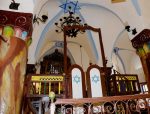
The bimah of Ari Ashkenazi Synagogue in Tzfat (Safed) was part of the Land and the Spirit tour, which is organized by the Rohr Jewish Learning Institute. (photo by Roy Lindman)
My husband and I excitedly counted down the days until the Land and the Spirit Israel experience in March. Having met with Chabad Richmond’s Rabbi Yechiel Baitelman and his wife Chanie, who accompanied our group on this trip, we learned that the touring days would be long, but that the sights we’d see and the people we’d meet would more than offset the intensity factor. The Land and the Spirit tour is organized by the Rohr Jewish Learning Institute, the adult educational arm of Chabad.
The tour took place March 4-13 and drew approximately 800 Jews (and a handful of non-Jews) from across North America. Knowing that we’d hit the ground running, my husband and I decided to arrive in Israel a few days ahead of the tour, to get acclimated. We also spent an additional two weeks after the tour exploring Israel on our own. This was my sixth trip to Israel and my husband Harvey’s third.
The tour was, in some ways, like an Israel 101 course, supplemented by in-person meet-and-greets with high-level people from all walks of life – we had special access to soldiers, politicians, religious leaders and other VIPs. On some levels, it was geared to people who’ve never been to Israel before, and they got an overview of the highlights Israel has to offer. Yet, even for those of us who had been to Israel, it was a chance to discover places we’d never seen.
Participants had the freedom to choose from a variety of “tracks,” including: “In the Footsteps of the Bible,” “Classic,” “Borders and Security,” “Israel Encounters,” “Israel in Depth” and “Food and Wine.” Presumably, participants would get a glimpse of Israel that sparked their desire to return again. The flip side of this is that there was not a lot of in-depth learning, and we didn’t get a chance to spend a great deal of time in any one place. It was primarily surface introductions and more of a visit-the-sights kind of trip, rather than an intense learning experience, like the National Jewish Retreat.
There were way more things to see and do than each of us had time for, hence the need to choose “tracks” each day. Highlights for my husband and me included Caesarea, with its fascinating historical ruins and stunning location, overlooking the Mediterranean. We also found Silicon Wadi fascinating. It’s the area in Israel where scientists, techies and businesspeople work in shared spaces to develop groundbreaking technologies. When we were there, we toured a WeWork site, where young technology whizzes were producing 3D and other objects inspired by their sky’s-the-limit imagination.
Kfar Chabad was another high point of our trip. This Chabad-Lubavitch village is not far from Lod, and has a life-size replica of 770 Eastern Parkway, Chabad’s Brooklyn headquarters. More than 6,000 Chabad live in the village, and the site is home to an etrog orchard. Our tour included a shmurah matzah bakery, where they make Passover matzah by hand.
The highlight by far, though, was the Ohr Simcha Children’s Home, where 300 high-risk boys from troubled environments live with their adoptive Chabad families. Ohr Simcha was established in partnership with the Israeli government, to help some of the most socially challenged children gain a sense of security. Seeing the kind of patient, loving care it takes to sustain these kids, to give them a real home of their own, was inspiring and emotional. True chesed in action.
The ancient mystical city of Tzfat (Safed), “the City of Kabbalah,” with its narrow streets and beautiful tiny synagogues, was magnificent. We went to Ari Sephardic Synagogue, where the famous Jewish mystic Rabbi Yitzchak Luria (known as the Ari) prayed. We also went to the Ari Ashkenazic Synagogue. Guest speakers explained the detailed history and designs of the synagogues. Unfortunately, we didn’t squeeze as much spirituality out of Tzfat as we would have liked, because time was limited. But it left a lasting impression.
It bears mentioning that all the tour guides on our buses were incredibly knowledgeable and made the places we visited come to life.
The Latrun Tank Museum was yet another highlight on the tour. There, we got to meet Israel Defence Forces soldiers and hear firsthand their inspiring personal stories. Live music, dancing and delicious food topped off the evening.
We spent a moving Kabbalat Shabbat at the Kotel (Western Wall). Having never visited the Kotel at night, much less experienced Shabbat at that holy site, we felt like Israel had wrapped its arms around us. Shabbat day was quiet and gave us the opportunity to walk the empty streets of Jerusalem in peace.
The second to last day of the tour was super-charged, and saw us traveling from Jerusalem to Masada, to the Dead Sea, where we schmeared mud on ourselves and bobbed around like human corks in the salt-laden water. After a long day, we showered off the Dead Sea water, got dressed in our finest and went to a gala banquet, where music, speakers and other entertainment were on the menu.
The final day was spectacular. First, we boarded a bulletproof bus that took us to our Matriarch Rachel’s Tomb, in Bethlehem. This was a particularly emotional experience, to see so many people praying so fervently. But it only got better, as we got on the bus and traveled to historic Hebron, where we visited the Cave of the Patriarchs (the Cave of Machpelah), one of the holiest places for the Jewish people. There, all 800 of us walked through Hebron carrying a Torah scroll that had been saved from the Nazis. This was followed by a spectacular light show, fireworks and a lively dinner.
On the whole, the tour was phenomenal, albeit arduous, especially for those of us in our 60s and older. Early morning starts, long stretches on the bus, shlepping and climbing, eating and touring. Repeat. For eight days. Was it worth it? You bet! The entire trip was spiritually nourishing, and fed our desire to start planning when we would next return to our home away from home.
Shelley Civkinis a happily retired librarian and communications officer. For 17 years, she wrote a weekly book review column for the Richmond Review, and currently writes a bi-weekly column about retirement for the Richmond News.
When A.J. Edelman was training in Whistler, he was the guest cantor for Chabad of the North Shore’s Yom Kippur services. (photo from A.J. Edelman)
Chabad of the North Shore community members had a more personal reason to cheer on A.J. Edelman at the 2018 Winter Olympics in PyeongChang, South Korea. Israel’s only skeleton athlete to have made it to the Games, Edelman was training in Whistler around the High Holidays last year. While there, he participated in community life, stepping in as guest cantor on Yom Kippur.
“Although he [Edelman] could have attended services at a larger synagogue in Vancouver, he was committed to spending Yom Kippur where he could be useful and have an impact,” said Rabbi Mendy Mochkin, spiritual leader of Chabad of the North Shore. “We had a cantor during Rosh Hashanah, but not for Yom Kippur.
“It worked out great. Our community was very excited to learn that a skeleton athlete representing Israel was training locally and was very touched that he chose to join us. They were very moved by his … melodies and heartfelt prayers. We all prayed together with him that he should attain his dream to be an ambassador for Am Yisrael. Our prayers were answered!”
Edelman was born and raised in Boston, in a Modern Orthodox, Zionist family, and he attended an Orthodox Jewish day school. When he was 2, his parents strapped a pair of skates onto his feet. By 22, he was a good hockey player, but not good enough to become a professional.
“I decided that, if I wanted to continue doing sports, it had to be on a high, elite level that could really give a platform to whatever I would choose to do afterward,” Edelman told the Independent. “So, I decided to represent Israel, because it was going to be the only way I was going to do it. As it happened, as I was thinking about this, skeleton appeared on the TV for the team trials for the United States for Sochi. And I thought it looked like a terrific sport – eye-catching.”
For some athletes, they become good at a sport and then look for a country that will let them compete under its flag. In Edelman’s case, he was mainly spurred by the idea of representing Israel. Then, he began searching for a sport.
“It could certainly help me achieve my goal of inspiriting people,” said Edelman. “I didn’t know how difficult it was or how painful it was. I didn’t know how bad, at first, I would be at it. But, I did dive full on into it.”
Edelman had to go from zero to 100, so to speak, in less than four years. While many along the way tried to tell him his goal was unattainable, the naysayers only fueled his resolve to succeed.
“It’s not like swimming or other sports where you have to hit a time relative to previous Olympics times, you have to hit an absolute performance standard of world ranking in that specific year. It’s a quota system,” explained Edelman of skeleton.
Edelman had to become one of the top 30 skeleton athletes in the world in about 48 months. His last year of training was focused – with help from the other athletes on the Israeli skeleton team – on maximizing his point collection at competitions.
“Positioning Israel to be the beneficiary of one of 10 single-sled nations through points I accumulated through specifics results and races was important – and it involved a lot of mathematical calculation,” said Edelman.
Edelman finished 28 out of 30 at the Winter Olympics.
A.J. Edelman was Israel’s only skeleton athlete to make it to the 2018 Winter Olympics in PyeongChang, South Korea. (photo by Joern Rohde)
“Making the Games was an insane accomplishment in that we were the only ones who did it without any coaching,” said Edelman. “We had absolute zero coaching for the first two years of my journey…. It took a huge physical toll and mental toll, and a massive financial toll. So, yes, 28 out of 30, I was very pleased.”
Edelman learned the sport from YouTube videos, and fundraised the money he needed to participate in competitions, buy equipment, and cover hotel stays and training facility fees. As far as trying to compete at the next Olympics, Edelman said, while he’d like to do that, it’s just not feasible.
“The financial strain is insane – $40,000 a year,” he said. “And only about 40% of it was covered from over the last four years by sponsors, family, friends – and complete random strangers. Doing it for another cycle would be too much of a financial strain. And I think I’ve accomplished what I was looking to accomplish, and am able to remain involved in Israel’s sports and help the next generation achieve their goals. I now have that platform.”
Although Edelman was at the Games – or maybe because he was at the Games – he said he felt disconnected from the Olympics as a whole.
“I only saw my own thing,” he said. “Otherwise, the experience at the end, or during the competition, of representing Israel, it was an honour unparalleled to anything in my life. There were a few moments I felt like I could cherish forever – the thoughts and feeling that this is what it’s like to represent a country and how it feels to be that individual. It was absolutely terrific.”
Edelman said he is not sure about what might come next for him, but that he is aiming big. For now, he is focused on transitioning from being a full-time athlete back into normal life. But life will never be the same for him, now that he has proven his potential to himself.
“If you apply yourself so completely and fully, and you just dedicate yourself the most you can, a lot can be accomplished,” he said. “But, not everything … I am never going to be able to make the NBA.
“I don’t usually tell people anything is possible. I tell them what I learned in the streets – that no one can tell you what you can’t do, and that you shouldn’t let others’ opinions dictate what you can do.”
As far as his experience with the Jewish community while training in Whistler, Edelman said, “My Jewish heritage is everything to me. It’s the entire reason why I did this. This journey was terribly difficult – it was the Jewish heritage aspect of it that kept me going.
“I cannot tell you how many times I wanted to give up, quit or just take days off,” he admitted. “But, then I’d remember I was representing the entire Jewish and Israeli community. Every night before I went to bed, I’d thank God for allowing me to be what’s called a Kiddush Hashem [sanctifying God’s name by living by example, in a holy way]. This means being a positive role model for my community and that means everything to me.”
Edelman connects with Jewish communities wherever he goes, seeing himself as an ambassador of the Jewish state. So, for him, joining the North Shore Jewish community when he was training in Whistler was a foregone conclusion.
The 2019 World Championship will be held in Whistler and, although Edelman has retired from athletic life, he wants to attend.
“When I tried out,” recalled Edelman of his first skeleton trial, “the Israel scouting report said that if I could just get down the track, that would be it … that I wouldn’t make it to the Games no matter how hard I tried. I think everybody can have that kind of moment … when they think they can’t do something or are told they can’t do something – but they should absolutely try and expect success.”
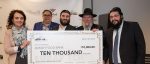
Chabad Lubavitch BC’s 40th Annual Gold Plate Celebration raised $10,000 for the Jewish Food Bank. (photo courtesy)
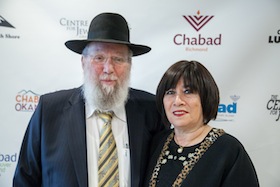
Chabad Lubavitch BC director Rabbi Yitzchak Wineberg and his wife, Henia. (photo courtesy)
Lubavitch BC held its 40th Annual Gold Plate Celebration on March 15, 2018. The dinner celebrated 43 years of Chabad Lubavitch service to British Columbia.
Instead of having a sit-down affair this year, Chabad Lubavitch BC had a cocktail reception and donated the money raised (the costs saved by not having a sit-down dinner) – $10,000 – to the JFS Vancouver Jewish Food Bank to help those in need.
There was also a raffle for the grand cash prize of $18,000.
Left to right, Rabbi Yerachmiel Benjaminson, executive director of Tzivos Hashem, philanthropist George Rohr, Grade 7 gold trophy winner Mendel Bitton and his father, Rabbi Binyomin Bitton. (photo courtesy)
Out of some 4,000 kids from 96 schools worldwide, four B.C. students qualified to attend this year’s Chidon Sefer Hamitzvos Shabbaton two weeks ago in New York: Mendel Bitton (Grade 7) and Levi Bitton (Grade 5), Sholom Baitelman (Grade 5) and Mendel Kaplan (Grade 5). All of the boys did well, receiving plaques and medals, and Mendel Bitton took home the gold trophy for Grade 7, one of only 15 trophies awarded.
Students from the 96 schools competed over several months, roughly from September to February. During these months of study, they took three major tests. Based on the results, 853 qualified to attend the Shabbaton weekend and the grand finale in New York. These 853 students from grades 4 through 8 competed in the individual competition, where there were gold, silver and bronze winners in each grade.
“The competition was inspired by the Rebbe’s request to unite Yidden through the study of the 613 mitzvos of the Torah. The Rebbe repeatedly emphasized that this effort will hasten the coming of Moshiach,” explains chabad.org about the tournament.