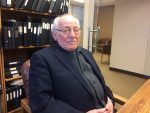
Skip to content
  • Home
  • Subscribe / donate
  • Events calendar
  • News
    • Local
    • National
    • Israel
    • World
    • עניין בחדשות
      A roundup of news in Canada and further afield, in Hebrew.
  • Opinion
    • From the JI
    • Op-Ed
  • Arts & Culture
    • Performing Arts
    • Music
    • Books
    • Visual Arts
    • TV & Film
  • Life
    • Celebrating the Holidays
    • Travel
    • The Daily Snooze
      Cartoons by Jacob Samuel
    • Mystery Photo
      Help the JI and JMABC fill in the gaps in our archives.
  • Community Links
    • Organizations, Etc.
    • Other News Sources & Blogs
    • Business Directory
  • FAQ
  • JI Chai Celebration
  • JI@88! video

Recent Posts

  • Eby touts government record
  • Keep lighting candles
  • Facing a complex situation
  • Unique interview show a hit
  • See Annie at Gateway
  • Explorations of light
  • Help with the legal aspects
  • Stories create impact
  • Different faiths gather
  • Advocating for girls’ rights
  • An oral song tradition
  • Genealogy tools and tips
  • Jew-hatred is centuries old
  • Aiding medical research
  • Connecting Jews to Judaism
  • Beacon of light in heart of city
  • Drag & Dreidel: A Queer Jewish Hanukkah Celebration
  • An emotional reunion
  • Post-tumble, lights still shine
  • Visit to cradle of Ashkenaz
  • Unique, memorable travels
  • Family memoir a work of art
  • A little holiday romance
  • The Maccabees, old and new
  • My Hanukkah miracle
  • After the rededication … a Hanukkah cartoon
  • Improving the holiday table
  • Vive la différence!
  • Fresh, healthy comfort foods
  • From the archives … Hanukkah
  • תגובתי לכתבה על ישראלים שרצו להגר לקנדה ולא קיבלו אותם עם שטיח אדום
  • Lessons in Mamdani’s win
  • West Van Story at the York
  • Words hold much power
  • Plenty of hopefulness
  • Lessons from past for today

Archives

Follow @JewishIndie
image - The CJN - Visit Us Banner - 300x600 - 101625

A life playing the bassoon

A life playing the bassoon

George Zukerman, who retired his bassoon in 2012, will be honoured on April 27 with a tribute concert at Bell Performing Arts Centre. (photo by Lauren Kramer)

George Zukerman well remembers the day he was first introduced to the bassoon. It was 77 years ago, and he was a new arrival from London, England, attending New York’s High School of Music and Art.

“One day they told us, ‘Boys and girls, you’re becoming an orchestra!’” he recalls. “All the pushy kids grabbed the instruments they recognized and I picked up this anonymous black box, the only thing that was left. I said, ‘Excuse me sir, what is this?’ Our teacher replied, ‘Oh, you’re our bassoonist!’ And I never looked back.”

That moment launched Zukerman, 90, on a lifelong journey wherein he became an international bassoon virtuoso. He conducted 40 world tours and was frequently the first bassoon soloist ever invited to tour with the national symphony orchestras in which he played.

But Zukerman is nothing if not extremely modest. Of his musical ability before he picked up the bassoon, he declares during an interview in his White Rock home, “I played a little piano but I wasn’t really musically talented.”

He didn’t even take to the bassoon at first, he says, “until I decided to practise. Then I got work because it was a time of war and other bassoonists were getting drafted for the war, which meant I had some amazing opportunities. Four or five years later, I didn’t know how to do anything else, so I decided to become a musician.”

Vancouver left a deep impression on Zukerman’s life when he first visited in 1950. The Vancouver Symphony’s bassoon player was unwell and Zukerman received a desperate call from a conductor he knew, asking him to come and play. Just 23, he flew into the city to perform for six weeks. During that time, he met Abe Arnold, then editor of the Jewish Western Bulletin (the Independent’s predecessor).

Arnold introduced Zukerman to a social worker at the Jewish Community Centre of Greater Vancouver who encouraged Zukerman to audition for the Israel Philharmonic Orchestra. He recalls practising for the audition at Carnegie Hall, alone in a room. No one arrived to hear him and he was about to leave when Leonard Bernstein entered. “You’ve got the job,” Bernstein informed him. “I’ve been listening to you practise for the past half hour!”

Zukerman spent 18 months with the Israel Philharmonic in the early 1950s, when the Jewish state was still brand new. “Back then, members of the orchestra were admired as some of the most prestigious people in the country!” he recalls. By 1953, he had accepted a position with the Vancouver Symphony Orchestra and relocated to Vancouver.

It was a bittersweet time for a performer in the small city of 300,000, he says. “Musically, whatever one did in 1953 in Vancouver was being done for the first time, so I was able to have an influence on musical activity and life around here. But, the orchestra was half amateur, poorly financed and not well-supported, so it performed a season of alternate concerts.”

In his spare time, Zukerman formed a concert service called Overture Concerts, with the goal of arranging performances by other artists in small communities throughout Canada. He knew ticket sales would be an impossible way for the concerts to stay afloat, so his idea was to sell subscriptions.

“Basically, we ran a membership campaign, raised the money and then figured out who we could afford to bring in. It worked wonderfully in small towns and it became very successful, with up to 500 performances in 74 towns across the country,” he explains.

Zukerman was fascinated by life in small towns and was thrilled to bring high-quality musicians to their halls. “We sent tenor Ben Heppner to Swift Current, Sask., the Canadian Opera Company to Nelson, B.C., tenor Richard Margison to Prince George, and pianist Anton Kuerti to Merritt, B.C., and Medicine Hat, Alta. Almost any small community would have enjoyed concerts by major Canadian and non-Canadian artists.”

The artists didn’t just perform – they also talked to their audiences about themselves and their music. “It gave a humanity to the concerts and it’s one of the reasons we could succeed at this,” says Zukerman.

His career with the VSO came to a close in 1963 after he led a strike campaigning for more work. “The symphony was running on 23 weeks of pay and we wanted at least 35 weeks, so we were asking for more opportunities to play,” he says. The VSO board refused the demand, settled with the other musicians and did not renew his contract. But, looking back, it was all for the best, he says.

“I became a soloist and, because I had my little business operation with Overture Concerts, I had the potential to get some engagements for myself,” he notes. “I suddenly found myself with the chance to play repertoire that no one knew existed, and I became known as ‘the High Priest of the Bassoon’!”

It would be years before Zukerman would begin to understand the extent of his influence on others. In 2007, while on tour in South Africa, he met several young bassoonists with the symphony of that country and was gratified to learn they’d taken up their instruments after listening to recordings of him performing.

White Rock Concerts was one of Overture Concerts’ first ventures and it flourishes to this day. It was founded on two principles, Zukerman says. “The first is quality attractions, and the second is a refusal to sell tickets, only subscriptions.”

The subscription policy is key, he explains. “The minute you sell tickets, you’re obligated to cater to the common denominator, and classical music is not geared for the common denominator. Good music survives because it’s an elite enjoyment and pleasure, and thank goodness for that!”

While Zukerman retired his bassoon in 2012, he remains active and instrumental in the world of classical music. This spring, his efforts are focused on bringing classical concerts to Parksville, Port Alberni and Agassiz. He’s toying with the idea of writing a book and is excited about an upcoming tribute concert in his honour at the Bell Performing Arts Centre April 27.

If he has one regret, it’s that he never became a father. “I traveled so much I never felt able or willing to have children,” he says sadly. “It’s one of the failures in my life. But, in a way, as a result of the influence I was able to have on a new generation of bassoon players, I’ve had thousands of children.”

White Rock Concerts’ Tribute to George Zukerman is on April 27, 8 p.m., at Bell Performing Arts Centre, and will feature the Elmer Iseler Singers, the Borealis String Quartet, clarinetist James Campbell and the Bergmann Piano Duo. For tickets ($30), visit bpac.stage.digitalshift.ca/event/a-tribute-to-george-zukerman-w or call 604-507-6355.

Lauren Kramer, an award-winning writer and editor, lives in Richmond. To read her work online, visit laurenkramer.net.

Format ImagePosted on April 7, 2017April 13, 2017Author Lauren KramerCategories MusicTags George Zukerman, White Rock Concerts
Recalling Six Day War

Recalling Six Day War

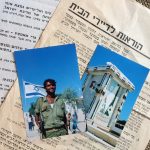
Posters from the Six Day War, explaining how to remain safe and be good citizens; the soldier shown is at El Arish, Sinai, in late June or early July 1967. (photo by Shula Klinger )

This year marks the 50th anniversary of the Six Day War. While the conflict may have only lasted a few days, its impact was tremendous. Not only did it lead to the redrawing of Israel’s borders, it sent a powerful message to the rest of the world. Within 20 years of its establishment, Israel had become a strong, united country. Israelis – and Jews around the world – were jubilant.

In addition to the Israelis who walked away from their daily lives to fight in the war, many other recruits flew in from overseas. Keeping Israel safe – and Jewish – was their only purpose.

This year, a group of young Israelis is making a documentary to explore this phenomenon. With funding from Jewish Federation of Greater Vancouver, the production team is filming veterans of the Six Day War as they recall their time at the front. Lior Noyman, who is also a photographer, is the documentary’s editor. He observes that, without fail, “every one of them remembers exactly where they were when the announcement came about the war.”

Dan Gadassi, who worked in television production for 17 years in Israel, before moving to Canada, is fascinated by the impact of the 1967 war on these individuals and their communities.

To get a full picture of what it was like in Israel as the war ended, the local group has interviewed a wide range of veterans: Sephardi and Ashkenazi, secular and religious. “A Canadian woman, a volunteer; South Africans; a former Israeli soldier who liberated the Western Wall; two people who went to Israel to fight,” said Gadassi. Most of these individuals are retired now.

The documentary is not a recapping of the military actions that brought Israel to victory. It seeks to portray the atmosphere in Israel, as experienced by individuals, through “memories, beautiful stories about what happened when it ended.” Their narratives include the story of a young woman “hearing the sirens in Jerusalem … and what it was like approaching the wall after two thousand years,” said Gadassi.

In addition to the oral histories, the film will show archival materials from the Jewish Independent and artifacts from community members. Gadassi described “beautiful old videos, amazing photos of Israel 50 years ago.”

Some of the photos to be shown in the film have only recently come to light, as older relatives have passed on. They depict scenes from the battleground at El Arish in Sinai, shortly after the war ended. Sparsely captioned, these starkly beautiful images are of desert scenes, soldiers and the debris of war. They show the tremendous relief felt by a nation, said Gadassi, “whose survival was assured.”

No war story is uncomplicated, of course, and the situation in the region remains complicated. As Noyman observed, “They thought it would be the last war.”

The filmmakers look forward to taking viewers on a visual journey back to 1967, “on an emotional level,” said Gadassi. “We want to conjure up the atmosphere of the time.” Asked to sum up that atmosphere in a few words, he said, “We are here and we are staying.”

If you have a story to share or any archival materials, contact Noyman ([email protected]), Ayelet Cohen ([email protected]) or Gadassi ([email protected]). The screening and a display will be held on June 5, 7:30 p.m., at the Jewish Community Centre of Greater Vancouver. The entire community is invited to attend.

Shula Klinger is an author, illustrator and journalist living in North Vancouver. Find out more at niftyscissors.com.

Note: This article has been edited to reflect that the screening date changed.

Format ImagePosted on April 7, 2017May 24, 2017Author Shula KlingerCategories TV & FilmTags Israel, Six Day War
Transforming the landscape

Transforming the landscape

A photograph of Deadvlei in Namibia, by Judi Angel, is part of the exhibit Eye Lines, at Zack Gallery until April 30.

Five years ago at Zack Gallery, Judi Angel had a solo show of photographs from her time as a volunteer in Asia and Africa. Most of her work from that period was portraits of people she met during her travels. By contrast, her new solo exhibit, also the product of her travels, features no people – instead, her latest works transform landscapes into geometry, into lines, colours and shapes. The title of the new Zack show, Eye Lines, reflects the artist’s new approach.

“Each photo in this show has a leading line,” Angel said in an interview with the Jewish Independent. “That line attracts the viewer’s gaze, builds a narrative. It takes your imagination on a journey. You look at the image and you ask questions. Where are we? Where are we going? How do we get there? What is beyond the frame?”

Her fascination with lines started in recent years. “I took a photography class on developing your own style,” she said. “I hadn’t noticed how much I use lines in my images until I went back over my photos, thousands of them. Then the lines emerged as something important, so I decided to exploit that direction and enjoy what comes of it.”

She doesn’t consider herself a professional photographer, despite the artistic quality of her photos. “Photography is a serious hobby for me. I’m not trying to make a living with it,” she said. “I want it to be fun and challenging. I’m looking for new ways to express my vision of the world.”

photo - Judi Angel
Judi Angel (photo from Judi Angel)

Awhile ago, she began experimenting with her craft. Layering, double exposure, conceptual photography and a new medium for her images – sublimation printing on aluminum – are only some of the new things she has played with recently. But finding unusual images and original angles are still her primary goals.

“Five years ago, when my husband and I volunteered in impoverished countries, my photos were like a documentary. Now, I want to experiment more,” she said. “We still travel, but the trips are shorter. We don’t want to leave home for long periods of time; we have eight grandchildren. But we often travel specifically to places I want to photograph, like Africa – it is a visual feast for a photographer.”

Earlier this year, she and her husband traveled to Namibia. “We went there particularly for photography,” she explained. A few photos in the exhibit come from one of the major Namibian tourist attractions, a ghost town, called Kolmanskop, in the Namib Desert. According to Angel, Kolmanskop was a mining town founded in the earlier 1900s by German settlers to mine diamonds. The miners built their town in their homeland’s style.

“It had all the amenities: a hospital, a casino, a school, even a ballroom,” she said. “Unfortunately, by the middle of the 20th century, the mine’s diamond production petered out and the town was abandoned.”

Today, only sand and tourists move among the empty buildings, and Angel’s photographs demonstrate the power of both. The desert irrevocably reclaims its own, encroaching on the former human dwellings, creeping in through broken windows and open doors. The rippling sand dunes inside the houses look eerie, almost alien beneath the pastel-coloured walls.

A different alien landscape meets the travelers outside, in the desert. Angel’s photos of the desert reflect the stark contrast of blue sky and yellow sand. The colours are blinding. “There is a new railway there, in the desert, but the sand always moves. It covers the rails every day and has to be constantly cleared,” she said. Her photograph of a sand dune a couple of metres high, piling across the straight line of rails, is awe-inspiring and achingly beautiful.

Another unique desert photograph sports three colours instead of two. A grove of dead trees stretch their long-dry branches upward, adding dark brown to the blue-and-yellow combination of the desert. “The trees have been there for 600 years,” said Angel. “The dryness of the desert preserves the wood from rotting and crumbling, so they just stand there.”

Most other pictures in the exhibit reveal architectural elements, as seen through the artist’s lens. Several of them are in the monochrome palette, while all the desert pictures use colour. “I like colour, especially the warm yellows, reds and blues, but sometimes, black-and-white is the only option,” she explained. “In my geometrical photos, black-and-white emphasize lines, while colours would be distracting.”

Her architectural photos are not precise copies of real life but rather an enhanced fantasy, a capriccio on an urban theme. One of her favourite image-manipulation programs is Photoshop. “Some photographers say that using Photoshop means cheating, but I don’t think so,” she said. “Photoshop is my tool, like paintbrushes for an artist. It has so many creative possibilities, and I experiment with them.”

Angel’s experimentations led her to join the Capture Photography Festival, and the current show at the Zack is part of the festival. Launched in 2013, this year’s festival presents photography at more than 70 galleries and community spaces throughout Vancouver.

“I like visiting their shows – so many outstanding artists,” said Angel, noting, “They have judges to ensure that every participating photographer and every exhibition are on a decent level.”

Eye Lines opened at the Zack on March 30 and will continue until April 30. To learn more about Angel’s work, visit judiangel.com.

Olga Livshin is a Vancouver freelance writer. She can be reached at [email protected].

Format ImagePosted on April 7, 2017April 4, 2017Author Olga LivshinCategories Visual ArtsTags Judi Angel, photography, Zack Gallery
“Tough kid” still shines

“Tough kid” still shines

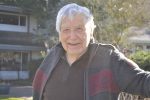
Chaim Kornfeld (photo by Shula Klinger)

In February, the Louis Brier Jewish Aged Foundation and Louis Brier Home and Hospital honoured Chaim Kornfeld. And they did so in the place he has especially dedicated his time over the last four decades: the Louis Brier synagogue.

Chaim was born in Hungary in 1926. His upbringing and education were Orthodox and, for the first part of the Second World War, his family were untouched. From the start of his education at Yiddish cheder, at age 3, he was a good student. Community life continued much as it had for centuries.

Outside the home, Chaim’s memories describe a tense separation between Jew and non-Jew. “My father always used to say, ‘When you see a Shaygetz, cross the street. Go on the other side.’”

Needless to say, young Chaim did not always do as he was told. “I took the beating instead – but I fought back, too.” He adds, “Especially at Easter time, they’d call you dirty Jew.”

It’s not hard to imagine a young Chaim’s spirited response. Even at 90, he is energetic and expressive in conversation. “I was a tough kid,” he says. His daughter Tova adds with pride, “He gave as good as he got!”

In 1944, Chaim was preparing to go to Franz Josef National Rabbinical Seminary of Hungary in Budapest. Then, not long before his 17th birthday, his family was moved to a ghetto with the other Jews of their town. Then came the trains.

Chaim, his parents and one of his sisters were sent to Auschwitz. On the journey, Chaim was permitted to fill a bucket of water for the passengers to have occasional drinks. He also took the dead out of the car.

On arriving at the concentration camp, Chaim jumped out. Greeted with ordinary scenes – “children playing, laundry drying” – Chaim’s mother figured she could work in the camp laundry.

Chaim relates how “an old man came up and asked, ‘Do you speak Yiddish?’ I said, ‘Yes, of course.’” The man pointed to a German official. “He’s going to ask you two questions. When he asks how old you are, you say you’re 18. When he asks you what you do, say you’re a farmer.”

Young Chaim approached the man with his usual confidence. Josef Mengele asked him his age and profession. Chaim answered as he’d been told. Mengele told him to go to the right. His parents were sent to the left. Before they were separated, Chaim’s father made a final request: “Bleib a Yid.” (“Remain a Jew.”) Afterwards, Chaim heard others say, “You see that smoke? That’s your parents.”

At Auschwitz, the Nazis stripped the prisoners of their belongings and identity, shaving off Chaim’s hair. He smiles ruefully. “I had lovely peyis, nice and curly.” Having only spent two weeks in Auschwitz before being transferred to Mauthausen in Austria, Chaim wasn’t at the camp long enough to get a number tattooed on his arm. He has not forgotten his number, though, and barks out “67655!” at an impressive volume, but not in English, or even Yiddish. It’s in Polish, as he heard it at Auschwitz.

Asked how he managed to maintain his sanity while facing death every day, he quotes Robert Frost: “I had promises to keep and many miles to go before I sleep.” But there’s more to it. Chaim describes how he kept his promise to his father, in spite of malnutrition and brutal treatment. “I always said, I’ll get out of here.”

He speaks with gritted teeth. “I never gave up. Even when I worked in a tunnel underground, I was mumbling a prayer. I prayed all the time to make time go faster. I knew the prayers by heart from a very young age. All kinds.”

Chaim describes a life of hard labour, misery and oppression. There were about 600 steps up the quarry. We “carried rocks on our shoulders, every day. There were dogs barking, soldiers pointing guns at us.” There was a pond at the bottom. If a prisoner fell down, he says, they would be pushed in.

Chaim found that he was the only one who remembered long tracts of the Torah. He led Kol Nidre in the camp, “all the others stood around me. I knew it by heart. I got a good education.” To lead a service in such appalling circumstances takes more than just education, however. It speaks to a capacity for leadership and clarity in a situation that is baffling in its cruelty.

When the prisoners were forced on a death march, Chaim was recuperating from an abscessed ankle. Although barely able to stand, he followed the advice of a fellow prisoner, who told him that if he didn’t leave the camp upright, he’d never leave at all. Limping in extreme pain, Chaim made it out but collapsed afterwards. When an SS officer raised his gun to shoot him, Chaim spoke up with his characteristic blend of optimism and boldness. Having been reminded of what a good worker this young Jew was, the officer permitted Chaim to hitch a ride on a passing wagon.

Until this year, Chaim was active in Holocaust education. In spite of the many letters from kids, thanking him for his work, these letters can be “painful,” he says. “The reminder is not always pleasant.” One might think that even a “tough kid” could tire of telling this harrowing story again and again, but Chaim isn’t flagging. “As long as there’s someone to listen, I’ll tell.”

After liberation, Chaim lived at the “internat” (boarding school) maintained by the rabbinical college in Budapest. Completing two years of high school in one under the instruction of one Dr. Kolben, Chaim still speaks admiringly of his teacher. “She was quite a lady. Very smart,” he says.

Kolben also taught them about the culture of Budapest. It gave the boys a chance to revive their appreciation of the arts, to leave them with images of beauty, after the horrors of the war. These included trips to the theatre in Budapest, to see Shakespeare’s plays. Their influence lives on today in Chaim’s memory. “To be or not to be, that is the question, whether it is nobler.…” He pauses to let me finish the quote. After staring, dazed, for an instant, I am relieved to find “the slings and arrows of outrageous fortune” bubble up in my mind.

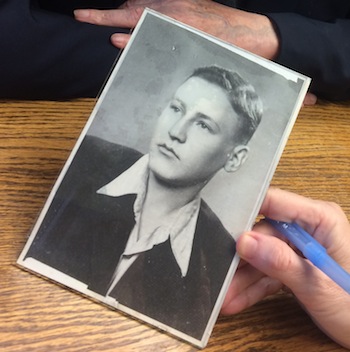
photo - Chaim Kornfeld in his younger days
Chaim Kornfeld in his younger days. (photo by Shula Klinger)

Chaim ended up in a displaced persons camp, in Bari, Italy. The hungry residents were frustrated to find that the food stores were locked away. “He led an uprising and they opened the locker,” Tova says. “He gave an impassioned speech.”

After the DP camp came aliyah. “Someone came from the JDC [Joint Distribution Committee] to take people to Palestine.” Chaim arrived in 1949, right after independence, and joined the air force immediately. “I was in charge of a platoon of women. That was fun,” he laughs. “I told them, during the day, I am in charge. In the evening, you are in charge!”

Asked about his career, he describes being “a lawyer for 55 years; prosecuting, judging, the lot!” Indeed, Chaim was appointed to the bench. Having developed a habit of quoting the Talmud in his judgments, he earned the nickname “The Bible Judge.” He would make “off the bench decisions,” which were popular with the courts, Tova recalls.

Chaim had originally planned to go to engineering school but his English was not fluent enough. “It was so hard, so technical,” he says. At the end of his first year, his essay about George Bernard Shaw’s Candida got him a C-. “People who were born and raised in Canada failed that exam!” he says proudly of his grade.

His optimistic attitude was evident in his approach to work as well. As a lawyer, he was known for handing out treats at the courthouse. Known as “Candy Man,” he would move up lines of people waiting for their paperwork, greeted by out-stretched hands.

At the Feb. 25 Louis Brier tribute, Chaim was honoured with a special Shabbat service in his name. With more than 150 people in attendance, Chaim read Haftorah. As Tova, says, “like a bar mitzvah boy, beautiful.” Thanked by many for his work, he was given a Torah cover for one of Louis Brier’s volumes. Says Tova, “It was really lovely.”

Reflecting back on his survival, Chaim credits his Judaism for keeping him afloat. This is living proof of Viktor Frankl’s assertion that, to survive, one needed to seek a meaning to one’s existence, even in the camps. “I didn’t feel that G-d abandoned me,” says Chaim. “I never lost my faith.”

Indeed, he has kept a kosher home for all of his adult life. But survival takes resilience and a good deal of ingenuity, as well as faith. “We took empty burlap bags and stuffed them into our pyjamas, to stay warm,” he says. When he was starving, he ate coal. “I was my own doctor,” he says.

One might think these experiences would define him, but, when presented with the term “survivor,” he shrugs and grimaces. “Rachmanut saneiti,” he adds. “I hate pity.”

One cannot help but see the sense in Chaim’s attitude. Simply referring to this man as a Holocaust survivor would be reductive. He recently celebrated six decades of marriage to his wife, Aliza, and their four adult children all have successful careers. Still active at 90, he has built a reputation as a mensch: generous, respectful, with a buoyant spirit and a talent for relationship-building. And, even now, one sees the tough kid – the keeper of promises, the kid who took a beating rather than tolerate bigotry. And, the same kid who jumped off the train in 1944, ready to meet the eye of the man who held – and toyed with, tortured and destroyed – the lives of his contemporaries.

Chaim has only just retired. He still reads the Tanach in his office and attends shul on Saturdays and Sundays. He talks of keeping up with his hobbies: “Swimming at the JCC every day. Making my wife happy.”

Shula Klinger is an author, illustrator and journalist living in North Vancouver. Find out more at niftyscissors.com.

Format ImagePosted on April 7, 2017April 4, 2017Author Shula KlingerCategories LocalTags Chaim Kornfeld, Holocaust, Judaism, legal, Louis Brier Home and Hospital, survivors
Mosaics change our views

Mosaics change our views

Dr. Ra’anan Boustan of Princeton University delivers the Itta and Eliezer Zeisler Memorial Lecture at the University of British Columbia on March 23. (photo by Gregg Gardner)

A mosaic from Late Antiquity has lessons for Jewish communities today. According to Dr. Ra’anan Boustan of Princeton University, “Jewish identity, historically, was broader, more porous, and integrated more non-Jewish elements than we might think, and, likewise today, we should not hasten to essentialize or rigidly define Jewish identity or culture.”

Boustan offered this insight when delivering the Itta and Eliezer Zeisler Memorial Lecture at the University of British Columbia on March 23. Called Greek Kings and Judaean Priests in the Late Antique Synagogue: The Newly Discovered “Elephant Mosaic,” Boustan’s visit was presented by the Archeological Institute of America, Vancouver Society, and co-sponsored by the UBC Diamond Chair in Jewish Law and Ethics, and the department of classical, Near Eastern and religious studies (CNERS).

A 2011 dig led by archeologist Jodi Magness excavated several sections at the site of a former village, Huqoq, near the Sea of Galilee. Among the items uncovered was a mosaic that is said to have adorned the floor of an elaborate 1,600-year-old synagogue.

“The discovery of the mosaic was a major find,” Prof. Gregg Gardner of CNERS told the Jewish Independent. “There are very few mosaics from the ancient world that depict biblical scenes.”

The mosaics’ scenes include Samson fighting the Philistines, Noah and the flood, the destruction of the Egyptian army in the Red Sea, and others. A particularly noteworthy element is that the mosaics also show images from Greek history and mythology. “This confluence of biblical and Greek imagery was quite surprising,” said Gardner.

Boustan was in Vancouver to talk about the “Elephant Panel,” which depicts a battle between unknown actors. Although some have argued that the panel represents Alexander the Great, Boustan interprets the mosaic as the depiction of a Seleucid attack on Jerusalem led by King Antiochus VII in 132 BC. “It shows they had a sense of historical connection to predecessors in a more robust way than we might have expected, and wanted to have that memorialized in synagogue art. This shows a historical consciousness, not just the timeless world of rabbis and scriptural interpretation developing in the Talmud of the same period.”

Boustan is a specialist in Judaism in Late Antiquity (circa 200-700 CE) who has focused particularly on understanding “extra-rabbinic culture,” the Judaism that existed outside of what was preserved in the narratives of the rabbis. “The rabbinic writings – the Talmud, the Midrash – preserve the world through their eyes, what they thought was important and how they wanted things to be viewed. The rabbis did not represent all Jews or all Judaism, and the wider Jewish world may have had different viewpoints and priorities.”

Boustan has focused on studying the piyyutim (hymns) written and preserved outside the rabbinic canon and containing some unusual theological ideas, as well as on apocalyptic and mystical literature, which flourished on the fertile edge between Jewish and non-Jewish cultures.

“The mosaic is important for understanding the history of Jews and Judaism and gives us something to think about in terms of Jews living in the Western world today,” he said, noting the broader and more porous nature of Jewish identity in those times, and how we shouldn’t be in a hurry to “rigidly define Jewish identity or culture.”

For example, Boustan explained, “The figural art we are finding at Huqoq and elsewhere upends some of our assumptions that, classically, Jews didn’t do that. In fact, we’ve found many small villages of one to two thousand habitants who built very expensive buildings containing a mixture of folk art and world-class art. In Huqoq, the art is imperial-quality work, which would not be surprising to find in a major landowner’s villa in Antioch. Yet, there it is, being commissioned, paid for and used by a farming village of maybe 2,000 people. That tells us we have a lot more to learn about the Jews of Late Antiquity.”

He noted, “In addition, the synagogue art contains a zodiac wheel with a figure of the sun god, Helios, in the centre. What’s going on there? Is it just a decoration? Was it actually part of religious worship in the synagogue? Was it seen allegorically as a poetic representation of God?

“Helios imagery was adopted by Christians in the third century, along with many other Greek religious symbols,” he said. “As the Greco-Roman world Christianized, however, they distanced themselves from ‘pagan’ imagery. By the late fourth to seventh [century], Jews are the only ones actively cultivating zodiacal and Helios imagery. Ironically, if you find a building with Helios imagery from that period, it’s almost definitely a synagogue.”

The mosaics can be viewed in detail at nationalgeographic.org/news/huqoq-excavation-project.

Matthew Gindin is a freelance journalist, writer and lecturer. He writes regularly for the Forward and All That Is Interesting, and has been published in Religion Dispatches, Situate Magazine, Tikkun and elsewhere. He can be found on Medium and Twitter.

Format ImagePosted on April 7, 2017April 4, 2017Author Matthew GindinCategories Visual ArtsTags archeology, Elephant Panel, history, mosaics, National Geographic, Ra’anan Boustan, UBC, Zeisler Lecture
Overview of the Pale

Overview of the Pale

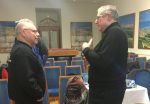
Jewish Genealogical Society of British Columbia member Danny Gelmon, left, speaks with Hal Bookbinder. (photo Stephen Falk)

Why Did Our Ancestors Leave a Nice Place Like the Pale? That was the title of Hal Bookbinder’s March 14 talk at Temple Sholom.

Bookbinder was hosted in Vancouver by the Jewish Genealogical Society of British Columbia (JGenBC). He is involved with JewishGen, JewishGen Ukraine and the Jewish Genealogical Society of Los Angeles. He has published numerous articles on research techniques, Jewish history, and border changes; the latter a matter of particular import to Ashkenazi Jews researching their families’ histories in Eastern Europe. A former president of the International Association of Jewish Genealogical Societies, Bookbinder was honoured in 2010 with the association’s Lifetime Achievement Award.

On March 14, Bookbinder gave a detailed and insightful presentation, all without using notes. “Pale comes from the Latin palus for a stake, the stakes which were used to mark off an area.” he explained. “It was also used for the English Pale, a territory within Ireland controlled by the English. The Pale of Jewish Settlement in western Russia was a territory within the borders of Czarist Russia where Jews were allowed to live.”

Bookbinder said, “Limits on the area in which Jews could live came into being when Russia attempted to integrate Jews into the expanding country, from which Jews had been excluded since the end of the 15th century.” From 1791 until 1915, he said, the majority of Jews living in Eastern Europe were confined by the czars of Russia within the “Pale of Settlement.”

Bookbinder broke up the history of the Pale into six periods, each approximately 25 years long: creation, confinement, oppression, enlightenment, pogroms and chaos. The first era, that of creation, arose from Russia’s westward march to seize new territories in Belarus, Poland and Ukraine, he explained. Russia didn’t want Jews within its borders, but, as it expanded its empire westward, it came to be responsible for millions of them, creating a “Jewish question” for itself.

Catherine the Great (who reigned 1762-1796) responded by ruling that Jews should stay in the Pale. The confinement era intensified efforts to keep the Jews in the Pale, so as not to “infect our good Eastern Orthodox brethren,” explained Bookbinder. During this era, Catherine the Great’s son, Paul I, initiated a new program aimed at assimilating Jews into Christian culture by making their lives so miserable they would rather convert than remain as they were.

This led to the period of the cantonists, during which Jewish boys were drafted into the Russian army. Some did convert, though most did not. Large numbers died from mistreatment, neglect and malnourishment. The military schools provided army training as well as a rudimentary education. Discipline was maintained by the threat of starvation and corporal punishment. At the age of 18, pupils were drafted to regular army units, where they served for 25 years. Enlistment for the cantonist institutions, which originated in the 17th century, was most rigorously enforced during the reigns of Paul I’s son Alexander I (reigned 1801–1825) and Nicholas I (reigned 1825–1855), said Bookbinder. It is estimated that around 40,000 Jewish children were stolen from their families during this period. The practice was abolished in 1856 under Alexander II (reigned 1855-1881).

Czar Alexander II took a more “enlightened” approach, continuing to seek the conversion and assimilation of Jews through gentler methods. Czar Alexander III, a rabid antisemite like his grandfather, initiated the era of pogroms after he came to power in 1881.

Starting in 1905, with the ascension of Nicholas II, the chaos period began. “Russia was in ferment,” said Bookbinder, “and it was the era of assassination attempts, the Bolsheviks, fighting between the Red Army and the White Army, the Cossacks – creating a situation that was so unpleasant that it prompted many of our ancestors to leave.”

But, Bookbinder asked, “Why did they leave then? They had lived through so many horrors, and this was far from the worst they had seen. I think it is because, during the more enlightened era of Czar Alexander II, our ancestors got a taste of a more dignified, more secure existence and took courage. When things descended again into chaos, they had had enough, and many escaped Russia.”

Matthew Gindin is a freelance journalist, writer and lecturer. He writes regularly for the Forward and All That Is Interesting, and has been published in Religion Dispatches, Situate Magazine, Tikkun and elsewhere. He can be found on Medium and Twitter.

Format ImagePosted on April 7, 2017April 4, 2017Author Matthew GindinCategories LocalTags genealogy, Hal Bookbinder, history, Russia
Using film school as therapy

Using film school as therapy

From Ma’aleh School of Television, Film and Art, standing, from left to right, are Asher Lemann, David Cohen, Chanan Ariel, Ofir Shaer, Yosef Baruch Kalangel and Nachum Lemkus. Sitting, from the left, are Keren Hakak, Menachem Assaraf and Shalom Sarel. (photo from Ma’aleh)

When a major donor came to Neta Ariel, director of Ma’aleh School of Television, Film and Art, with an offer to provide scholarships as long as the students give back to the community, Ariel accepted the challenge.

“Ma’aleh is located in the centre of Jerusalem and, unfortunately, there are a lot of social issues,” Ariel told the Jewish Independent. “For example, lots of high school-age teens walk the streets or, during the night, use drugs and live on the streets. So, my students tried to help them – we knew a few of them, and we invited them to come to the school once a week for two hours in the afternoon to learn about film.”

The students at Ma’aleh became mentors, encouraging the teens to bring their own stories to life through the materials. Another group – comprised of immigrants from Ethiopia – also works with the students.

“Tell your story,” said Ariel of the most important aspect of the program.

“At the end of the year,” she said, “when we screened the movie for the group, teacher, friends … it was an amazing thing. They [had] left high school, or the family didn’t want them; they felt like they’re losers and didn’t have self-confidence. When we had the screening and their family or friends came, they really appreciated them. And the film gave them hope. We thought, the making of the film was not only fun, it was a teaching tool to uplift them and our students.”

Through learning how to film, from making personal connections and from telling their stories – which often included trauma or conflict, from rape, violence and negative treatment to gender or sexual orientation issues – they began to heal.

For most participants, it was their first encounter with therapy.

“Most of the time, at the end of the day, after the project was done, they shared with us that this is the first time they’d dealt with this,” said Ariel. “This was their way to tell the society, family or friends that this is their story and what I suffer from.”

From these beginnings, the school developed a curriculum for the program and, with each passing year, it has grown. Now, the school offers two such programs, focusing on how to use film as therapy and how to work together.

“You have a group of social workers and filmmakers,” explained Ariel. “Every week, they meet and work on the exercises we give them, and they work together to find a balance. It works well, the partnership. It’s amazing how the psychologist becomes a filmmaker and the filmmaker comes to understand psychology.”

Months after Operation Protective Edge, the school decided to host a group of bereaved mothers from the conflict, to determine if there was a way they could help.

They found ways of incorporating filmmaking into the process of mourning. At each meeting, they studied and focused on one aspect of filmmaking – lighting, filming, music, and so on. Once taught, participants were given an exercise to practise the skill. Then, they were given a camera and asked to practise filming.

“They didn’t tell them to make a movie about something specific,” said Ariel. “They gave them a task about something emotional. Most chose an aspect connected to the son they lost a few months ago.

“Then, we teach them how to write the script, how to do voiceovers, how to incorporate music. Automatically, most would think about their son or themselves and their fears. So, part of the meeting was talking about what we go through, and a lot of it was about creating things.

“At the end of the year, everyone together made a film called Saba. The main character in the movie is the grandfather, as all of them had mentioned their grandfathers, from time to time.”

Last year, the school opened a bereaved fathers group and found that, while they seemed to barely communicate in the classroom, they collaborated well outside of class. They put together what Ariel described as an “amazing movie” about their surviving kids.

“This is something the fathers said – that the kids at home blamed the parents, saying that, at home, they give a lot of time, attention and energy to something dedicated to the dead son … and [are] not taking care of them,” said Ariel. “Regardless of the age of the kids, in every house, they found it was the same situation. And, it was just amazing.

“Now, we are trying to open a group for grandparents … but, most of them, they can’t come, too hard for them, very far. So, I hope that … we’ll open another group for bereaved mothers … those who couldn’t come last time.”

While the main objective of Ma’aleh stems from a Jewish perspective, Ariel travels the world to introduce filmmaking and therapy to schools.

“Most of our students come from a Jewish Orthodox background … not all, but a lot of them,” said Ariel. “And, a lot of the subjects we touch on are connected to Jewish identity and our roots.”

At the time of her interview with the Independent, Ariel had just returned from the United States, where one of her stops was at a Christian school, where she spoke about how to best relay religious differences through film.

Apart from teaching, Ariel uses these trips to fundraise for the school and to keep in touch with filmmakers, mostly in Los Angeles.

“When they come to Israel, they help us, come to give a workshop at our school,” said Ariel. “We do projects together. Most importantly, we’re sharing our graduate movies with the world. A lot of institutions in Israel and America use them as education tools, cultural tools, and even, from time to time, to promote Israel.

“My goal is that this tool will be used for all kinds of populations. Many different kinds of groups can take care of themselves using this process.”

For more information, visit maale.co.il. The bereaved fathers’ short film can be seen at youtube.com/watch?v=uoNiQVSqhOw&feature=youtu.be.

Rebeca Kuropatwa is a Winnipeg freelance writer.

Format ImagePosted on April 7, 2017April 4, 2017Author Rebeca KuropatwaCategories IsraelTags film, Israel, Judaism, therapy, tikkun olam
Bonding over backgammon

Bonding over backgammon

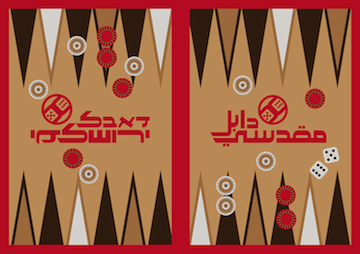
Jerusalem Double tournament at Machane Yehuda market, Jerusalem. (photo from Jerusalem Double via israel21c.org)

On a winter night inside the Mayer Davidov Garage in the Talpiot industrial area of Jerusalem, some 500 university students, mechanics, high-techies and senior citizens – wearing kippot, kaffiyehs and everything in between – played or cheered on contestants in a backgammon championship accompanied by live Arabic music.

Backgammon (shesh-besh in this part of the world) is thousands of years old and remains a popular pastime among Arabs and Jews. And, in Jerusalem, a surprising number of them are playing the board game together since the spring 2016 launch of Jerusalem Double, a project of the nonprofit organization Kulna Yerushalayim (We Are All Jerusalem).

“Backgammon is played throughout the Middle East, so we have this game in common. It’s fun, down-to-earth, accessible and inclusive,” said Zaki Djemal, one of the founders of Jerusalem Double along with Dror Amedi, Mahmoud Schade, Hiday Goldsmith, Kamel Jabarin, Mahmoud Jamal Al-Rifai, Matan Hayat, Noa Tal-El and Shir Hoory.

“Games have an amazing power to reduce tension and create empathy,” said Djemal, 29, also the cofounder and managing partner of fresh.fund, the first student-run venture capital fund in Israel.

Often, players discover other cultural commonalities through the medium of the game. “Shaike, a Jew who runs a car-parts shop, is playing with Munzir, a Palestinian originally from Bethlehem, and they’re speaking in Arabic. Shaike pulls out his oud and Munzir starts singing,” Djemal pointed out to Israel21c.

Djemal, a Harvard graduate born in London and raised in Jerusalem, explained the origins of Jerusalem Double in his recently filmed TEDxWhiteCity talk titled Game Changer: How Backgammon Will Bring Peace to the Middle East.

“I was sitting together with Jewish and Arabs friends at Hiday’s house in Jerusalem,” he said. “We were discussing a project we’d been working on to bring Jews and Arabs together around a shared love for Middle Eastern music, but we couldn’t agree on anything, and very quickly our discussion deteriorated into a heated debate. Then, in the middle of all of it, my good friend Dror said, ‘Guys, why don’t we take a break? Let’s play something. How about backgammon?’… In six short minutes, this game had completely defused all tension.… We thought to ourselves: ‘Why not organize a backgammon tournament for Jews and Arabs … to meet beyond the daily grind of buses, supermarket checkout lines, hospitals? And we wanted there to be crossover between neighbourhoods that for years have been completely segregated.”

Some 150 people showed up for the first Jerusalem Double tournament in Beit Hanina, a Palestinian neighbourhood in East Jerusalem. “A third of them were from West Jerusalem, and it wasn’t easy convincing them to come,” said Djemal.

One of Djemal’s friends, a religious Jew in high-tech, was afraid of coming to Beit Hanina. “He thought it would be dangerous, but we insisted. And he ended up winning the tournament that night. For us, the real victory is that he’s attended every one of the events since and that’s, in a nutshell, what a project like this can accomplish.”

Mahmoud Al-Rifai, 53, was the one who offered to host the event on his home turf. “I didn’t even know how to play shesh-besh, but I went along with it because I met these young people who were trying to do something important and looking for a place to make it happen,” he told Israel21c. “I like to work with people who do things, not just talk about things. And I knew it would work because I’ve done some joint events in Beit Hanina since 2004. To me, it was an attempt to break the stereotype that it’s dangerous here.”

photo - Jerusalem Double, in Hebrew and Arabic
Jerusalem Double, in Hebrew and Arabic. (photo from Jerusalem Double via israel21c.org)

The stereotype-breaking went both ways. Some local teens known to be wary of Jewish Israelis encountered them in a new light at the Jerusalem Double event.

“They were dancing and hugging Jews, playing shesh-besh with them, exchanging phone numbers,” marveled Al-Rifai, whose nonprofit organization, Jerusalem Consortium for Research and Development, holds interfaith meetings and other mixed events. He also is a Sufi master and runs a computer business and a social jewelry-making business for women in cooperation with the municipality.

“It was beautiful and we can’t just stop here,” said Al-Rifai, a self-described diehard realist.

Djemal agreed: “Our plan is to organize an international backgammon championship in Jerusalem with delegations from Turkey, Morocco, Jordan and Egypt all playing backgammon,” he said.

The crowd that came to the fourth Jerusalem Double event, in Talpiot, included Deputy Mayor Ofer Berkovitch and supermarket king-politician-philanthropist Rami Levy. Djemal said 64 people played “and the rest just come for the party. We have a good following and are getting new participants all the time because we’ve created a way for people to interact.”

Jerusalem Double won $35,000 in the Jerusalem Foundation’s 2016 Social Innovation Challenge. The project is also supported by the Pratt Foundation and Jerusalem municipality.

“It’s pretty amazing to see this happening,” said Djemal, whose long resumé includes entrepreneurial ventures, beekeeping, journalism, mentoring and humanitarian work with Israeli organizations IsraAID and Tevel b’Tzedek. The Jerusalem Double cofounders previously started Simply Sing, a series of popular public sing-alongs in Hebrew and Arabic, which they are now reviving.

Djemal said he returned to Jerusalem after five years in the United States because “I thrive on being close to where it’s all happening and being confronted with so many issues that need to be solved. I didn’t want to come back and be complacent. I see a lot of opportunity in the city.”

Israel21c is a nonprofit educational foundation with a mission to focus media and public attention on the 21st-century Israel that exists beyond the conflict. For more, or to donate, visit israel21c.org.

Format ImagePosted on April 7, 2017April 4, 2017Author Abigail Klein Leichman ISRAEL21CCategories IsraelTags backgammon, Israeli-Palestinian conflict, peace
Forgetting our fright?

Forgetting our fright?

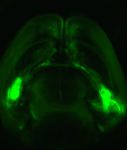
An entire mouse brain viewed from above: neuronal extensions connect the two amygdalas (brightest spots on both sides of the brain) with the prefrontal cortex (top). (photo from wis-wander.weizmann.ac.il)

Erasing unwanted memories is still the stuff of science fiction, but Weizmann Institute scientists have now managed to erase one type of memory in mice. In a study reported in Nature Neuroscience, they succeeded in shutting down a neuronal mechanism by which memories of fear are formed in the mouse brain. After the procedure, the mice resumed their earlier fearless behavior, “forgetting” they had previously been frightened.

This research may one day help extinguish traumatic memories in humans – for example, in people with post-traumatic stress disorder, or PTSD.

“The brain is good at creating new memories when these are associated with strong emotional experiences, such as intense pleasure or fear,” said team leader Dr. Ofer Yizhar. “That’s why it’s easier to remember things you care about, be they good or bad; but it’s also the reason that memories of traumatic experiences are often extremely long-lasting, predisposing people to PTSD.”

In the study, postdoctoral fellows Dr. Oded Klavir (now an investigator at the University of Haifa) and Dr. Matthias Prigge, both from Yizhar’s lab in the neurobiology department, together with departmental colleague Prof. Rony Paz and graduate student Ayelet Sarel, examined the communication between two brain regions: the amygdala and the prefrontal cortex. The amygdala plays a central role in controling emotions, whereas the prefrontal cortex is mostly responsible for cognitive functions and storing long-term memories. Previous studies had suggested that the interactions between these two brain regions contribute to the formation and storage of aversive memories, and that these interactions are compromised in PTSD, but the exact mechanisms behind these processes were unknown.

In the new study, the researchers first used a genetically engineered virus to mark those amygdala neurons that communicate with the prefrontal cortex. Next, using another virus, they inserted a gene encoding a light-sensitive protein into these neurons. When they shone a light on the brain, only the neurons containing the light-sensitive proteins became activated. These manipulations, belonging to optogenetics – a technique extensively studied in Yizhar’s lab – enabled the researchers to activate only those amygdala neurons that interact with the cortex, and then to map out the cortical neurons that receive input from these light-sensitive neurons.

Once they had achieved this precise control over the cellular interactions in the brain, they turned to exploring behaviour: mice that are less fearful are more likely to venture farther than others. They found that when the mice were exposed to fear-inducing stimuli, a powerful line of communication was activated between the amygdala and the cortex. The mice whose brains displayed such communication were more likely to retain a memory of the fear, acting frightened every time they heard the sound that had previously been accompanied by the fear-inducing stimuli.

Finally, to clarify how this line of communication contributes to the formation and stability of memory, the scientists developed an optogenetic technique for weakening the connection between the amygdala and the cortex, using a series of repeated light pulses. Indeed, once the connection was weakened, the mice no longer displayed fear upon hearing the sound. Evidently, “tuning down” the input from the amygdala to the cortex had destabilized or perhaps even destroyed their memory of fear.

“Our research,” said Yizhar, “has focused on a fundamental question in neuroscience: How does the brain integrate emotion into memory? But, one day, our findings may help develop better therapies targeting the connections between the amygdala and the prefrontal cortex, in order to alleviate the symptoms of fear and anxiety disorders.”

For more about the research being done at the Weizmann Institute, visit wis-wander.weizmann.ac.il.

Format ImagePosted on April 7, 2017April 4, 2017Author Weizmann InstituteCategories IsraelTags memory, science
הגבוה ביותר עד כה

הגבוה ביותר עד כה

הפדרציה היהודית של אזור מטרו ונקובר ממשיכה להגדיל את היקף התרומות לקמפיין השנתי שלה, שהוא מקור ההכנסה המרכזי של הארגון ו-35 ארגונים היהודים הקשורים בה. בקמפיין של 2016 היקף התרומות עמד על 8.5 מיליון דולר. אשתקד הפדרציה היהודית גייסה תרומות בהיקף 8.3 מיליון דולר לקמפיין השנתי ואילו בשנת 2014 היקף התרומות עמד על 8 מיליון דולר.

כפי שכבר פורסם מתוך ה-8.5 מיליון דולר 300 אלף דולר יוקצו לטובת אמצעי ביטחון לשמירה על מוסדות ואירועים של הקהילה היהודית באזור ונקובר. זאת כולל השכרת מאבטחים לאירועים מיוחדים וקיום הערכות בטיחוניות בעת הצורך. לאור הגברת האנטישמיות ברחבי העולם והגידול באיומי הטרור, היה סביר להניח שהפדרציה תקצה משאבים אף גדולים יותר לטובת תחום הביטחון. בנושא האבטחה אומר יו”ר הקמפיין השנתי, אלכס קריסטל: “הקשבנו לחששות בנוגע לביטחון הקהילה, כפי שהובאו על ידי הארגונים היהודים השותפים שלנו, התורמים וחברי הקהילה. הפכנו את הביטחון בקהילה לנושא המרכזי של הקמפיין ופיתחנו תוכנית מיוחדת לתורמים נדיבים בתחום זה”.

כספי התרומות מהקמפיין השנתי מיועדים מדי שנה לתמיכה בארגונים היהודים המקומיים, בפעילויות ושירותים שהם מעניקים בתחומים חברה, החינוך, התרבות והאמנות. וכן עזרה לקהלי יעד חלשים יתר בעיקרם קשישים ונוער. חלק מהכספים יוקצו כרגיל ליטפול בפרוייקטים מיוחדים בישראל, במסגרת מתן החסות הקבועה של הפדרציה, שכוללת הענקת משאבים לשירותים חברתיים לאוכלוסיית נוער בסיכון בצפון הארץ.

קריסטל מוסיף כי היקף הכספים שגוייסו הפעם הוא הגבוה ביותר עד כה. יו”ר הקמפיין: “הכספים מבטיחים כי נמשיך לתמוך בארגונים השותפים שלנו שיוכלו להמשיך ולספק מגוון של שירותים ותוכניות שכל כך חיוניים לקהילה היהודית המקומית. ואילו יו”ר מועצת המנהלים של הפדרציה היהודית, סטיבן גרבר אומר: “יש לנו מספר אתגרים כקהילה כולל הנושאים הכפולים של אפשרויות ונגישות, מעורבות צעירים ובני משפחות צעירות, מענה לצרכים של אוכלוסיית הקשישים הגדלה שלנו, ופיתוח תוכניות עבור כמעט ממחצית מהקהילה שלנו אשר חייה כיום באזורים רחוקים בפריפרייה, שלא מטופלים על ידי שום ארגון. התוצאה של הקמפיין תאפשר לפדרציה היהודית ולארגונים השותפים שלנו להתמודד עם אתגרים אלה לטובת הקהילה”.

ללשכת הסטטיסטקה הקנדית אין נתונים מעודכנים לגבי פשעי השינאה במדינה. העידכון האחרון מתייחס לשנת 2014. אז המשטרה קיבלה מידע על 429 מקרים של פשעי שינאה בכול קנדה, בהם 213 הקשורים בקהילה היהודית. בוונקובר התרחשו בסך הכל באותה שנה 47 מקרים של פשעי שינאה.

ריו דה ז’ניירו וונקובר זכו באולימפיאדת ההכנסות ממיסחור

אולימפיאדת הקיץ ה-31 שנערכה בריזו זה ז’ניירו אשתקד ואולימפיאדת החורף ה-21 שנערכה בוונקובר בשנת 2010 הן המכניסות ביותר, מבחינת מכירת מוצרים ממוסחרים. כך עולה מנתוני דוח השיווק של הוועד האולימפי הבינלאומי שפורסמו בימים האחרונים.

על פי דוח השיווק של הוועד ההכנסות של האולימפיאדה בריו זה ז’ניירו ממוצרים ממוסחרים שברו את כל השיאים, והגיעו לכשלוש מאות ועשרים מיליון דולר. תקציב האולימפיאדה בריו זה ז’ניירו נאמד ב-11.9 מיליארד דולר. אולימפיאדת הקיץ בבייג’נג שנערכה בשנת 2008 הכניסה “רק” מאה ושישים מיליון דולר ממסחור. ואילו שאר אולימפיאדות הקיץ נמצאות הרחק מאחור.

האולמפיאדה של ונקובר הכניסה יותר מכל אולימפיאדת חורף בתחום מכירת המוצרים הממוסחרים, ופועל מדובר על סכום של חמישים ואחד מיליון דולר. תקציב האולימפיאדה בוונקובר נאמד בעשרה מיליארד דולר. הרחק מאחוריה אולימפיאדת החורף של סוצ’י שנערכה בשנת 2014 והכניסה שלושים וחמישה מיליון דולר ממוצרי מיסחור.

Format ImagePosted on April 5, 2017April 2, 2017Author Roni RachmaniCategories עניין בחדשותTags annual campaign, Jewish Federation, Olympics, security, אולימפיאדת, ביטחון, הפדרציה היהודית, קמפיין השנתי

Posts pagination

Previous page Page 1 … Page 433 Page 434 Page 435 … Page 650 Next page
Proudly powered by WordPress