Skip to content
  • Home
  • Subscribe / donate
  • Events calendar
  • News
    • Local
    • National
    • Israel
    • World
    • עניין בחדשות
      A roundup of news in Canada and further afield, in Hebrew.
  • Opinion
    • From the JI
    • Op-Ed
  • Arts & Culture
    • Performing Arts
    • Music
    • Books
    • Visual Arts
    • TV & Film
  • Life
    • Celebrating the Holidays
    • Travel
    • The Daily Snooze
      Cartoons by Jacob Samuel
    • Mystery Photo
      Help the JI and JMABC fill in the gaps in our archives.
  • Community Links
    • Organizations, Etc.
    • Other News Sources & Blogs
    • Business Directory
  • FAQ
  • JI Chai Celebration
  • JI@88! video

Recent Posts

  • Zionism wins big in Vegas
  • Different but connected
  • Survival not passive
  • Musical celebration of Israel
  • Shoppe celebrates 25 years
  • Human “book” event
  • Reclaiming Jewish stories
  • Bema presents Perseverance
  • CSS honours Bellas z”l
  • Sheba Promise here May 7
  • Reflections from Be’eri
  • New law a desecration
  • Resilient joy in tough times
  • Rescue dog brings joy
  • Art chosen for new museum
  • Reminder of hope, resilience
  • The national food of Israel?
  • Story of Israel’s north
  • Sheltering in train stations
  • Teach critical thinking
  • Learning to bridge divides
  • Supporting Iranian community
  • Art dismantles systems
  • Beth Tikvah celebrates 50th
  • What is Jewish music?
  • Celebrate joy of music
  • Women share experiences 
  • Raising funds for Survivors
  • Call for digital literacy
  • The hidden hand of hate
  • Tarot as spiritual ritual
  • Students create fancy meal
  • Encouraging young voices
  • Rose’s Angels delivers
  • Living life to its fullest
  • Drawing on his roots

Archives

Follow @JewishIndie
image - The CJN - Visit Us Banner - 300x600 - 101625

Category: News

Expanding the financial field

Expanding the financial field

Michael Susser, left, and Murray Palay of Quadrant Asset Management. (photo from QAM)

The first-ever Quadrant Asset Management Investment Conference was held on Oct. 2 at the University of Manitoba’s James W. Burns Executive Education Centre in downtown Winnipeg. It will be a recurring event, happening at least once every two years, according to Murray Palay of Quadrant Asset Management, which has committed to five conferences in the next 10 years.

Even though the conference was their idea, Palay and business partner Michael Susser were taken aback by how quickly the idea was accepted and how speedily it has taken form – a year ahead of schedule.

Both graduates of the U of M, Palay and Susser wanted to support the Asper School of Business in its desire to hold a conference on behavioral finances.

“We felt it was appropriate to give back, particularly in the area of finance,” said Palay about the decision to support the conference. “But really what we wanted was more academic…. We wanted a program that we could kick-start and that would build over the years.”

Quadrant covers 60% of the cost, with the remaining amount covered by partners in the industry, Tetrem Capital Management and CI Investments. Michael Benarroch, dean of the Asper School, and Dr. Gady Jacoby, the Bryce Douglas Professor in Finance, were involved, and U of M assistant professor of finance Chi Liao organized the conference.

Behavioral economics, or finance, incorporates other factors, such as psychology and emotion, into conventional economic theory – which assumes that people always behave rationally, in a way that maximizes their wealth – in an effort to explain why people often make decisions, or behave in ways, that seem unpredictable or irrational. It does so not just to understand individual behaviors, but their effect on the market at large.

About that general definition, Liao said, “I’m not sure if I agree with the term ‘irrational.’ It may be more measured to say that behavioral finance uses psychology to understand how human behavior influences financial decisions.”

A major question the conference examined is whether or not people make decisions based on emotions as well as financial considerations.

“I had the liberty of choosing the speakers, so I chose people who I thought had very cutting-edge, very talk-able research topics – researchers like Dr. Hersh Shefrin of Santa Clara University, the conference’s keynote speaker,” said Liao. “He was an obvious choice, as he really pioneers the field of behavioral finance.”

Shefrin’s 1999 book Beyond Greed and Fear: Understanding Behavioral Finance and the Psychology of Investing has become a standard text used around the world in behavioral finance courses, as well as being part of the CFA Institute curriculum source material, among others. As it happens, Shefrin is a former Winnipegger and a U of M graduate.

Other conference presenters included Amos Nedler of the University of Western Ontario, who spoke about The Bull of Wall Street: Experimental Analysis of Testosterone and Asset Trading; Rawley Haimer of the Federal Reserve Bank of Cleveland on YOLO: Mortality Beliefs and Household Finance Puzzles; Jawad Addoun of the University of Miami, who discussed Local Bankruptcy and Geographic Contagion in Loan Characteristics; and Vicki Bogan of Cornell University on the Importance of Mental Health and Retirement Savings: Confounding Issues with Compounding Interest. Capping off the conference were speakers Scott Hsu of the University of Arkansas, who spoke about Beauty is Wealth: CEO Appearance and Shareholder Value; and Lisa Kramer of the University of Toronto, who discussed Examining the Effect of Social Distance on Financial Decision Making.

“Martin Wayngarten, who heads our investment management group, could have listened to Dr. Shefrin all day,” said Palay. “His explanation of the behavioral aspects, how sentiment and emotions factor in, and how they correlate or don’t to rational investors, this is all stuff that we live and breathe.

“Being on the front lines, we recognize that behavioral issues, such as sentiment and emotion, are very much a part of what we have to deal with. It’s just not all numbers.”

Palay felt some of the other speakers’ topics were a bit more esoteric, such as those discussing testosterone in traders, but still very interesting.

One major takeaway for Palay from the conference was a newfound understanding of the nature and depth academics go through to prove their theories through clinical studies.

“We would have never really seen this kind of a presentation if not for Jacoby and Liao,” said Palay. “The presentations you would get industry-wide would be a lot more practically oriented and more numbers-oriented.”

In addition to what he learned at the conference, Palay was also glad to have had the opportunity to spend time with his son, who is a student in Liao’s class, as the whole class came to the conference.

“I should mention, by the way, the bias I have in terms of how good Dr. Shefrin was,” said Palay, noting that Shefrin is his wife’s second cousin. Palay learned of this connection shortly before the conference, when sharing some information with his wife, Ivy Kopstein (of Winnipeg’s Jewish Child and Family Service), about the then-upcoming conference and the keynote speaker. Kopstein said Palay must invite Shefrin home over for dinner.

Rebeca Kuropatwa is a Winnipeg freelance writer.

Format ImagePosted on October 23, 2015October 22, 2015Author Rebeca KuropatwaCategories NationalTags Asper School of Business, behavioral finance, Chi Liao, Murray Palay, QAM, Quadrant Asset Management
First-ever official visit

First-ever official visit

Prime Minister Binyamin Netanyahu, left, welcomes President Pranab Mukherjee to the Knesset. (photo from Israeli Prime Minister’s Office via jns.org)

In the first-ever official visit by an Indian head of state to Israel, President Pranab Mukherjee arrived in Jerusalem last week to discuss a wide range of issues including the negotiation of an extensive free-trade agreement, bilateral cooperation in agricultural and other technologies, and expanded counter-terrorism coordination.

“India attaches high importance to its relationship with Israel, a relationship which has taken great strides in the last few years,” said Mukherjee.

Israeli President Reuven Rivlin described the visit as deepening “the friendship between our states in the fields of economy, science, medicine and agriculture.”

Relations between India and Israel have recently undergone a major shift. In 1947, India voted against Israel joining the United Nations and did not establish official relations with Israel until 1991. This was mainly out of concern over how this would affect India’s diplomatic relations with Muslim countries, as well as India itself hosting “the world’s second-largest Muslim population in raw numbers,” according to a 2013 report by the Pew Research Centre.

Nevertheless, this recent development demonstrates how ties between the two countries have expanded considerably since then. The most recent example of a warming of relations between the countries came when India decided to abstain from the UN Human Rights Council vote condemning Israel during the 2014 Gaza conflict. This was a significant policy change, since India for decades was a leading force for nations that automatically voted against Israel in all international forums.

At the same time, the Press Trust of India recently quoted Mukherjee as saying, “India’s traditional support to the Palestinian cause remains steadfast and unwavering while we pursue strong relations with Israel. Our bilateral relations [with Israel] are independent of our relations with Palestine.”

During Mukherjee’s visit, India and Israel signed a double taxation avoidance pact as well as a number of accords promoting cultural and technological exchange between the two nations. Mukherjee and his delegation reserved 70 rooms in Jerusalem’s King David Hotel and another 30 rooms in the nearby Dan Panorama. Celebrity chef Reena Pushkarna was hired by the King David Hotel to prepare Indian dishes for the delegation and some 300 members of Israel’s Indian community.

Israeli Prime Minister Binyamin Netanyahu shares a very warm relationship with Indian Prime Minister Narendra Modi, and referred to him as his friend multiple times when hosting Mukherjee at the Knesset. The prime ministers earlier this year congratulated each other on their respective electoral victories, with Modi making a point of doing so in Hebrew and Netanyahu expressing his good wishes in Hindi. Mukherjee extended an invitation to Netanyahu to become the second Israeli prime minister to visit India, the first being former prime minister Ariel Sharon, who visited India in 2003.

Further illustrating the growing ties between the two countries, Israel is India’s second-largest arms supplier after Russia. But relations are not limited to military ties and a mutual commitment to fight terrorism. Vijeta Uniyal, founder of Indian Friends of Israel, described how Israel’s commitment to developing the desert “extends to the Thar Desert, Gangetic Plain and Wetlands of Bengal.”

Bilateral trade between Israel and India grew from $200 million in 1992 to $4.39 billion in 2013, with both countries importing and exporting precious stones, metals, machinery, minerals, plastics, chemical products, textiles, agricultural products, and transport equipment.

Ties between the two countries are expected to strengthen considerably as a result of Mukherjee’s visit, signifying the solidification of a strong alliance between India and Israel.

Bradley Martin is a fellow for the Salomon Centre for American Jewish Thought and research assistant for the Canadian Institute for Jewish Research.

Format ImagePosted on October 23, 2015October 22, 2015Author Bradley Martin JNS.ORGCategories IsraelTags India, Israel, Pranab Mukherjee, trade
Eatery’s unique offer

Eatery’s unique offer

Recent visitors to the Hummus Bar at the M Mall in Kfar Vitkin, near Netanya. The eatery is offering a 50% deal on its hummus for Jews and Arabs who share a table and eat together. (photo from facebook.com/Mhumusbar)

An Israeli eatery is making headlines across the globe for its latest menu deal: 50% off any hummus dishes served to tables seating Jews and Arabs together.

Breaking bread together throughout history has always been an act of sharing and reconciliation. So, in response to the latest wave of terror attacks and incitement in Israel, Hummus Bar at the M Mall in Kfar Vitkin, near the coastal city of Netanya, posted a Facebook call for customers to share pita and hummus together – and pay less if they do.

The Oct. 13 post reads: “Scared of Arabs? Scared of Jews? At our place, we don’t have Arabs! But we also don’t have Jews … we’ve got human beings! And genuine, excellent Arab hummus! And great Jewish falafel! And a free refill for every serving of hummus, whether you’re Arab, Jewish, Christian, Indian, etc.”

Speaking to local media, manager Kobi Tzafrir said there were a number of people taking up the offer from his restaurant, which is famous for its chickpea spread. But, he added, the short post also fueled interest from around Israel and the world.

Hummus eateries are countless in Israel, yet Tzafrir reported that visitors have come from around the country to show support for the Hummus Bar’s message of tolerance and camaraderie.

“If there’s anything that can bring together these peoples, it’s hummus,” Tzafrir told the Times of Israel.

Hummus Bar’s Facebook page continues to garner positive posts from abroad, as well.

“Love the idea of bringing people together with food! Love and food conquers all!!” writes Urbian Fitz-James from the Netherlands.

“I think it is amazing what you guys are doing to unite people!” posts Josh Friesen from Canada.

“Thank you. This is marvelous,” writes Samir Kanoun from Turkey.

There are other messages of support – including from the United Kingdom, the United States and Japan – on the eatery’s Facebook page.

Hummus, of course, is a national dish in Israel, from the point of view of both Muslim and Jewish communities in the country. The International Day of Hummus even began here.

And it’s not just hummus that brings tolerance and coexistence. There are also Arab-Jewish owned eateries serving up coexistence, including Maxim restaurant in Haifa and Bouza ice cream in Tarshiha.

Viva Sarah Press reports on the creativity, innovation and ingenuity taking place in Israel. Her work has been published by international media outlets including Israel Television, CNN, Reuters, Time Out and the Jerusalem Post. Israel21C is a nonprofit educational foundation with a mission to focus media and public attention on the 21st-century Israel that exists beyond the conflict. For more, or to donate, visit israel21c.org.

Format ImagePosted on October 23, 2015October 22, 2015Author Viva Sarah Press ISRAEL21CCategories IsraelTags Arab-Israeli conflct, hummus, Israel, Israeli-Palestinian conflict, Kobi Tzafrir, peace
יש לנו תיש שמסרב לעזוב

יש לנו תיש שמסרב לעזוב

עובדי טים הורטונס למשטרה: יש לנו תיש שמסרב לעזוב את המסעדה. (צילום: CTV News Saskatoon)

בחירות 2015: לא ברור למי היהודים הצביעו

בניגוד לבחירות הקודמות לא ברור למי היהודים הצביעו הפעם בבחירות שהתקיימו ביום שני. כך מדווח העיתון גלוב אנד מייל. לדברי העיתון בבחירות הקודמות מרבית הקהילה היהודית עמדה מאחורי ראש הממשלה, סטיבן הרפר, בעיקר לאור תמיכתו החד משמעית בישראל. בבחירות אלה ג’סטין טרודו מהמפלגה הלברלית ותום מולקייר מהמפלגה הדמוקרטת החדשה הודיעו אף הם על תמיכתם בישראל. ההמשך יבוא.

משטרת אבוטספורד לעבריינים: “תכננו את עתידכם ולא את הלוויותיכם”

העיר אבוטספורד נחשבת לבירת הפשע של המדינה. תחנת המשטרה המקומית בשיתוף העירייה מחפשים כל הזמן דרכים להקטין את הפשע. תחנת המשטרה מצאה לאחרונה דרך יוצאת דופן להילחם בפשע. נהג של המשטרה מסתובב ברחבי העיר עם ג’יפ האמר מפואר, שהוחרם במסגרת פעילות משטרתית. על הג’יפ מודבקים שני סלוגנים “חינוכיים” ויוצאי דופן שנועדו להרתיע את העבריינים. הראשון הוא: “כסף קל יכול לעשות לכם חיים קשים”, ואילו השני הוא: “תכננו את עתידכם ולא את הלוויותיכם”. על שמשת הרכב המוזר מודבקת בנוסף גם תמונה של צעיר כלוא מאחורי סוגרים, ומתחתיה כתוב בגדול כי ג’יפ זה הוחרם ע”י כוחו אכיפת החוק לאחר שעבריינים השתמשו בו להברחת סמים.

במשטרת אבוטספורד מקווים שהסלוגנים מאירי העיניים שעל הג’יפ החינוכי, יגרמו לעבריינים מקרב חבורות הפשע שפועלות בעיר, להתחיל ולעשות חושבים בטרם ימשיכו בפעילותם הפלילית האין סופית. ראש עיריית אבוטספורד, הנרי בראון, אמר לאמצעי התקשורת: “פעילות הפשע בעיר שגורמת לקורבנות רבים צריכה להיפסק והיא תופסק. יש לנו כוח משטרה מצויין בעיר וביחד אנחנו כולנו נטפל בבעייה חמורה זו”.

עובדי טים הורטונס למשטרה: יש לנו תיש שמסרב לעזוב את המסעדה

“שלום. אנו מתקשרים מסניף של טים הורטונוס בססקצ’ואן וזקוקים לעזרכתם. מישהו מסרב לעזוב את המסעדה לצערנו. הראנו לו את הדרך החוצה מספר פעמים והוא כל הזמן חוזר אל המסעדה בעקשנות באמצעות הדלתות האוטומטיות. אגב העקשן הסרבן הזה הוא תיש”. בתחנת המשטרה הפדרלית (האר. סי.אם. פי) של ססקצ’ואן הופתעו לקבל שיחת טלפון ברוח דומה מאחד העובדים של טים הורטונס, על תיש עקשן שמסרב לעזוב את המקום, וחוזר אליו שוב ושוב.

לדברי מומחים לבעלי חיים שנדרשו לדון בסוגיה המוזרה הזות התיש כנראה היה עייף ורעב ואולי אף היה לו קר, ולכן הוא החליט להתמקם לא פחות מאשר במסעדה המוגנת. ידוע גם שתיישים הם בעלי חיים עקשניים והנה לכם המתכון לסיפור המוזר הזה. כאמור לאחר שהעובדים במסעדה הבחינו בתיש שנכנס למקום, הם פתחו את הדלת והורו לו לצאת. הוא יצא ולאחר מספר דקות מצא את הדרך בחזרה למסעדה, תוך הוא נכנס דרך הדלתות האוטומיות שמותקנות במקום. התרחיש הזה חזר על עצמו מספר פעמים והתיש לא נואש, אלא שדווקא העובדים התייעפו ממנו. לכן הם קראו לשוטרים שהגיעו למקום.

לאחר שבדקו שהסיפור המוזר אכן נכון לא הייתה לשוטרים ברירה אלה לעצור את התיש העקשן, ולהובילו לאחר כבוד לתחנת המשטרה. לאחר ברור קצר הוחלט שלא להשאיר את התיש במעצר כיוון שהוא לא נראה שמח במיוחד ממעצרו, והיה ברור שאינו ממש מסוכן לציבור הרחב. אחד השוטרים לקח אותו לביתו ולמחרת הועבר העציר היוצא דופן למקלט לבעלי חיים. במשך שמונה ימים ניסו במשטרה לאתר את הבעלים של התיש תוך הם מתקשרים לכל החוות שבאזור מחוז ססקצ’ואן. לבסוף נמצא הבעלים שלו וזה התייחד מחדש עם התיש שבעקשנותו שיגע את כל העיר והמשטרה.

Format ImagePosted on October 21, 2015Author Roni RachmaniCategories עניין בחדשותTags Abbotsford police, goat, Henry Braun, Hummer, Tim Hortons, ג'יפ האמר, הנרי בראון, טים הורטונס, משטרת אבוטספורד, תיש
Mulcair talks about choices

Mulcair talks about choices

New Democratic Party of Canada leader Tom Mulcair. (photo from Tom Mulcair’s office)

“I think the values of the community that you’re writing for are very similar to the social values of the NDP historically, and I think that’s a strong connection that we have,” New Democratic Party of Canada leader Tom Mulcair told the Independent in a phone interview last week.

He added that his wife Catherine’s “family connection means that I’m the only person in this race who has a deep understanding of the Jewish community and of its history, and I’ll always be a strong stalwart based on that understanding.”

Even before the election campaign started, Mulcair always has been clear in his support for Israel.

“My position is very comfortable within the NDP,” he said, “because the party’s position has, for a long time, been in favor of a two-state solution. Essentially, we believe we have to be working with partners in the Middle East, in particular, in Israel and Palestine, within a framework of respect for UN resolutions and international law, that’s important. And, we always talk about working towards peace in the region, starting from a base where it has to be mutually agreed borders and, frankly, everyone free from attack of any kind: peace and security, in other words, within established and negotiated borders.”

He defended his strict enforcement of this view, which has included the dismissal of candidates who hold alternate opinions.

“I’ve tightened the reins in making sure people respect our position, and I think that that’s the key thing,” said Mulcair, adding that the NDP is “still the only party political party in Ottawa to have ever had a Jewish leader, in David Lewis [federally] and, of course, in Ontario, Stephen, Lewis’ son. And I’ve had a chance to visit Israel a couple of times and look forward to going back. I daresay that I’m the only leader in this campaign … who can count family in Israel, as well.”

“I think that free trade with a democracy is a good thing. We also backed the trade agreement with Jordan because we know that it’s also a very strong voice for stability and peace in a very tough region with a lot of problems.”

With respect to the expansion of the Canada-Israel Free Trade Agreement earlier this year, Mulcair said, “I think that free trade with a democracy is a good thing. We also backed the trade agreement with Jordan because we know that it’s also a very strong voice for stability and peace in a very tough region with a lot of problems.

“As you know, the NDP takes a pretty strong view that free-trade agreements have to represent dealings with countries that have values similar to ours, and that’s why in both cases we had no problem with it.”

The NDP also has no problem with the P5+1 (China, France, Russia, the United Kingdom, the United States and Germany) nuclear deal with Iran.

“I think that the P5+1 deal shows that diplomacy can achieve real results even after decades of hostility,” said Mulcair, who described himself as “very clear-eyed about the Iranians,” noting that the antisemitism there “is at a level rarely seen in the world today.”

He said, “I don’t have any illusions about what I’m dealing with … no Israeli government can ignore the threat of a nuclear Iran…. At the same time … as long as it is enforced rigorously, the deal shows the possibility of making sure that Iran’s nuclear ambitions are hemmed in.”

About security closer to home, and specifically Bill C-51, Mulcair said, “I think that it’s a question of approach and priorities. Don’t forget Mr. [Stephen] Harper’s approach is always about stark, false choices. He would have you believe, for example, that a government has to choose between the economy and the environment. Of course, that’s a false choice; you have to do both. He would have you believe that you either keep your communities safe or you respect your rights or freedoms. Well, the prime minister’s job is to do both: respect Canadians’ rights and freedoms, and keep communities safe. So, C-51 is a breach with that.”

Offering an example from the party’s history in balancing security and freedoms, Mulcair noted, “The NDP, you might recall, is the party that had the courage politically to stand up in 1970 against the imposition of the War Measures Act that put hundreds of Canadians in jail without trial, without accusation, and the NDP had the courage to stand up against that.

“When Mr. Harper came in with Bill C-51, I was told that I was being foolhardy to oppose it, that the vast majority of Canadians were in favor of it. Well, you know what? I don’t take that as the starting point in these issues. I am more than willing to stand up to Stephen Harper when he’s compromising Canadians’ rights and freedoms, and we did that. We did that with an articulate stance that explained to Canadians why it was a mistake, and you know what? At the end of that process, most Canadians agreed with us, so I’m proud of that.

“There are things that can be done here in Canada to help fight some of the situation there,” he said, referring to the conflict in Syria, as well as others in the region. “There are a couple of concrete things that I think Canada can and should be doing.

“First of all, Canada is the only country in NATO not to have signed the Arms Trade Treaty. Well, that’s something that’s easy to fix, and that can help stop the flow of arms to some of those conflicts right now.

“Deradicalization is entirely absent from Bill C-51 and that is, again, a mistake. Most of our partners in the world who are dealing with these issues realize that the flow of foreign fighters into those regions is one of the biggest problems and, instead of coming to grips with that, Mr. Harper completely ignores the problem.”

“There’s also an important element of deradicalization. And, again, Mr. Harper just doesn’t know how to get this right. For example, he doesn’t talk about going into houses of worship, as you hear President [Barack] Obama talk about. What Mr. Harper will talk about, specifically, are mosques. Now, of course, in that case, he’s finger-pointing a single community. That’s a mistake. Deradicalization is entirely absent from Bill C-51 and that is, again, a mistake. Most of our partners in the world who are dealing with these issues realize that the flow of foreign fighters into those regions is one of the biggest problems and, instead of coming to grips with that, Mr. Harper completely ignores the problem.”

Other problems that Harper has ignored, or about which he has been mistaken, according to Mulcair, concern the budget and jobs. The NDP’s approach to these issues, including its focus on the middle-class, has drawn some criticism that the NDP has strayed from its roots – a point with which Mulcair disagrees.

“We’ve been really clear all along, especially under my leadership, that Canada wants a government that knows how to deal with the big issues of the day in the interest of the population,” he said. “When we [the NDP] were in power in Saskatchewan, we ran 17 consecutive balanced budgets because we had taken over a province that was bankrupt after years of Liberal rule…. After those balanced budgets, we were able to bring in free, universal, public medical care – that was an NDP priority.

“This time around, I’m talking about the importance of bringing in quality, affordable, maximum-$15-a-day child care, and we’re going to do that on the basis of a balanced budget. There are some who would say, well, that’s not a very social-democratic thing, but if you look at the history of the NDP, we have a history of being very prudent public administrators. We know that we have that burden on us – that we’re always going to have to be the ones who have to be the most prudent because, if we’re not, people will judge us more harshly than the others.

“Some of the other parties are taking a different approach,” he continued. “Mr. Harper talked a good game but ran up $150 billion in new debt while he was in power. Mr. [Justin] Trudeau is promising to spend at least $10 billion a year more than what he takes in and, in the fourth year, he’s going to start cutting with, quote, everything will be on the table, in terms of cuts – that was the exact quote from Mr. [John] McCallum when he was asked how he was going to be able to cut $6.5 billion in the fourth year of his budget. So, that’s where the Liberals are, that’s where the Conservatives are.”

“Economically, we’re talking about balanced budgets, but we also want to create opportunities for good-paying jobs. There were 400,000 manufacturing jobs lost on Mr. Harper’s watch, and he wants to kill off tens of thousands more with this recent trade deal.”

Mulcair said the NDP are prudent administrators in other areas, as well. “I have a strong personal track record as a former environment minister as a strong enforcer of environmental legislation and I’m strong on principle on those things,” he said. “Economically, we’re talking about balanced budgets, but we also want to create opportunities for good-paying jobs. There were 400,000 manufacturing jobs lost on Mr. Harper’s watch, and he wants to kill off tens of thousands more with this recent trade deal,” meaning the Trans-Pacific Partnership. On Oct. 5, the 12 countries involved, including Canada, reached an agreement, which still has to be ratified by each country’s parliament.

“On the environment, on the economic issues, on social issues, we’re very different from the other two parties who, more often than not, are of one mind,” Mulcair said, giving three examples.

“Mr. Trudeau and Mr. Harper agreed with tens of billions of dollars of tax reductions for Canada’s richest corporations – we disagree, we’re going to start making them pay their fair share.

“We disagree with the Keystone XL Pipeline. We think that you don’t export your natural resources raw. Mr. Harper and Mr. Trudeau are of one mind, they think that it’s a good idea to send 40,000 Canadian jobs to the U.S. – we disagree.

“We’ve had a different approach on C-51. Mr. Trudeau was afraid of Mr. Harper. He said at the University of British Columbia that he was too afraid of Mr. Harper to stand up for what he thought was the right thing to do in that case. Well, I think that that’s sad, and I think that Mr. Trudeau has shown a lack of leadership and, frankly, a lack of experience.”

While the NDP would increase the corporate tax rate, its platform includes “supporting innovation and investment in companies.” When asked if this was not just a different way of subsidizing business, Mulcair responded, “No. For example, the Conservatives have continued to subsidize companies in the oil patch. We will remove subsidies. What we will do is bring back certain innovation tax credits because we know that the manufacturing sector is, and can be, a hub for innovation and technological jobs in the future that will be knowledge-based.

“We’ll also propose a small-business tax cut, so we’ll bring their taxes down from 11[%] to nine, which we think is a smart way of stimulating the creation of jobs by job creators because small- and medium-sized businesses in Canada create more new jobs. We don’t shy away from saying that government can play an active role in creating the conditions for the private sector to create jobs.”

“This is the first time in Canadian history that we actually have a choice. For 148 years, we’ve been told we have no choice but to alternate. When we get tired of the Liberals and the sponsorship scandal, we’re supposed to go back to the Conservatives. We get tired of the Conservatives and the Senate scandal, we’re supposed to go back. This time, the first time, there is a choice.”

Looking ahead to the last days of the campaign, Mulcair said, “This is the first time in Canadian history that we actually have a choice. For 148 years, we’ve been told we have no choice but to alternate.” For example, “When we get tired of the Liberals and the sponsorship scandal, we’re supposed to go back to the Conservatives. We get tired of the Conservatives and the Senate scandal, we’re supposed to go back. This time, the first time, there is a choice.

“For the first time in Canadian history, the NDP is forming the Official Opposition, we’re seen as a government-in-waiting. We’re doing great across the country but we’ve got very strong support in certain regions that are going to allow us to form a government, and we know that.

“B.C. is a good example of a province where we’re doing super well,” he said. “I just had an event there yesterday morning that showed me that the energy and the strength of the team and the campaign that we’re running are resonating … so we’re going keep that going.”

The Independent has interviewed Liberal leader Justin Trudeau (July 31), Minister of National Defence and Minister for Multiculturalism Jason Kenney (Sept. 18) and Green party leader Elizabeth May (Oct. 9). The federal election is on Oct. 19.

Format ImagePosted on October 16, 2015October 14, 2015Author Cynthia RamsayCategories NationalTags elections, Iran, Israel, NDP, New Democrat, Thomas Mulcair
Korczak’s legacy now

Korczak’s legacy now

Left to right, keynote speaker Irwin Elman and panelists Rachel Malek, James Copping and Jess Boon. (photo by Cynthia Ramsay)

“Children are not the people of tomorrow but are people of today. They have a right to be taken seriously, and to be treated with tenderness and respect. They should be allowed to grow into whoever they are meant to be.”

Polish doctor, educator, writer and orphanage director Janusz Korczak’s philosophy and writing laid the foundation for the United Nations Convention on the Rights of the Child (UNCRC). Murdered in 1942 at Treblinka with the almost 200 children in his care, Korczak’s work and life remain relevant to this day.

Jerry Nussbaum, president of the Janusz Korczak Association of Canada (JKAC), was one of the many speakers on Sept. 29 to remind the approximately 70 people in attendance of this fact. “We hold this lecture series in his honor,” said Nussbaum, “because we seek to follow his example of respecting children and honoring the whole child.”

“How to Love a Child”: The Janusz Korczak Lecture Series is co-organized by the JKAC and the faculty of education at the University of British Columbia, with contributions from other faculties, universities, activists and advocates. The first of six lectures was called Keeping our Promise to Children: The Relevance of Korczak’s Legacy for Children Today. It featured as keynote speaker Irwin Elman, provincial advocate for children and youth of Ontario, and president of the Canadian Council of Child and Youth Advocates.

Other speakers included moderator Dr. Charles Ungerleider, director of research and managing partner of Directions Evidence and Policy Research Group, LLP; Marni Point, who welcomed attendees to the traditional and unceded Musqueam territory; Dr. Krzysztof Olendhi, ambassador titulaire, consul general of the Republic of Poland in Vancouver; and. Dr. Blye Frank, dean and professor, UBC faculty of education. The most poignant tribute came from child survivor Lillian Boraks-Nemetz, board member of JKAC, author and UBC instructor.

“Korczak has been my hero all my life,” she said. Both she and Korczak were among those held in the Warsaw Ghetto. She spoke of going to school secretly until one day two Nazis came in and pushed the teachers around (they were sent to prison) – “we children sat there frozen in fear for quite some time, then the teachers sent us home. The next day, the school was boarded up. And that is what I remember, clutching my father’s hand ever so tightly while looking into the cellar through a little window at the now-empty grey room, where once there was life, color and learning. I had lost my right to education.”

Her father took her to Korczak’s orphanage. Even though the doctor was not in, they were welcomed, and she saw the children reading and doing artwork, seemingly happy “inside this space, as if the horror of the ghetto and the threat of the always-impending danger didn’t exist. This was Dr. Korczak’s world…. I had the impression that the doctor also tried to raise the children’s spirits during the terrible times in which they lived.”

She described the deportations; she, her mother and little sister narrowly missing the transport cars to Treblinka when a commotion distracted the guards and her father managed to save them out of the line. “We were lucky, not so Dr. Korczak and his children, who were destined to walk along the same route.”

On Aug. 5, 1942, the Nazis came for the children of the orphanage. While he was offered a reprieve, “Korczak refused, saying I hate desertion and besides, my children need me.

“Father often spoke of that day and how Korczak’s 200 orphans were ordered out of the building and made to march through the Warsaw Ghetto with Korczak at the helm, holding a small child in his arms and one little one by the hand. They were carrying the green banner of King Matthew, the character in his [Korczak’s] popular book for children about a child king who fought for children’s rights…. No survivor who was there at that time can forget the long procession. Many wrote about it.”

Boraks-Nemetz said her father often spoke about Korczak and taught her his principles, principles she followed in raising her own children. She concluded her remarks with the poem “And Still They March” by Yala Korwin, before presenting the first JKAC scholarship award to UBC PhD student Matthew Lee for his work on children’s social and emotional development.

When Elman began his keynote address, he admitted that he only learned about Korczak about 15 years ago, on a trip to Japan, where he was invited to “help them learn about children’s rights and to help teach them to elevate the voice of children.” When visiting a children’s home – an institution that can have as many as 200 children living in it – a staff member mentioned Korczak and was amazed when Elman, a Jewish educator who had worked with children for 20 years at that point, did not know the name.

Elman has since learned enough to know that Korczak’s work and life are relevant. “In Canada today, there are approximately 350,000 children connected to care in one way or another…. Some say that there are as many as two million former Crown wards … in this country.”

Speaking of his home province, he said there were 23,000 kids in Ontario living in some form of care, 8,000-10,000 permanently (ie. Crown wards, which, in British Columbia, are called continued custody orders) – and they are not doing well. Of those, more than 18% are aboriginal; in British Columbia, it’s 60-65%; in other provinces even higher. “It’s not hard to understand and listen to and hear the echoes of the Truth and Reconciliation Commission’s report, and the need to address this over-representation of First Nations children across the country in our systems of care.”

In Ontario, he said, children can only come into care if a social worker (or somebody in such a capacity) has deemed the child in need of protection – from abuse or neglect – and a court has agreed. The children have not done anything wrong.

When the state takes children into care, said Elman, “You’re making a promise to them. The first thing, obviously, is, you’re protected now. The second thing is … if you’re permanently in our care, we’re going to take care of you … we’re going to ensure that you’re going to live to your full potential. And, when that child is brought into care, what do they hear? Maybe we don’t say it, but they hear, we’re going to love you, it’s OK now.”

But, he said, only 40% of children in care in Ontario graduate from high school, and that percentage doesn’t vary much between provinces; 43% of the homeless population of Canada have had an in-care experience. Young people connected to care are over-represented in the justice and mental health systems.

Elman shared many stories of his work as the province’s advocate. When somebody steps up for a child, he said – whether it be a community, foster parents, a group home, adoptive parents, anyone – “the government needs to say thank you, we’ve got your back, what do you need? We’ll do whatever is necessary, because we owe our children a home in which they are nurtured and loved…. That takes a whole different way of thinking about child welfare.”

He has been told, “We can’t legislate love.” His response is, “I don’t think you can legislate love, but I do think you can create conditions in which love can flourish. The government should be all over that… And, to do that, they need to ask young people and they need to ask children and they need to ask their caregivers in whatever form that is…. We owe that to children.”

If we took that approach, he said, if children in care were listened to, they would feel in charge of their own lives. If they knew what was in their files and had a say in what was written there, they would contribute to making policy, they would have a say in where they lived. Social and child-care workers would be trained differently, including respecting all the different cultures from which children in care come. “Many practical, revolutionary things … would happen in the way in which the system is run if children felt listened to.”

Panelists Rachel Malek, Jess Boon and James Copping – all members of the Federation of B.C. Youth in Care Networks – joined Elman on stage for a 35-minute Q&A. Questioners wanted to know more about the criteria for a child going into care, how to create a sense of belonging for a child and ensure their safety, how to reduce the number of children in care, the impact of poverty, and which programs in Canada reflect Korczak’s philosophy.

As the final question, the consul general asked the young panelists, all of whom had experienced the care system, “What does it mean to you to love a child?” Boon spoke of commitment, being there for the serious and fun times but also investing in your own education to give back to the community. Copping mentioned consistency in home, support for school, having someone on whom to rely through thick and thin. For Malek, it is to be vulnerable – to open your heart, to recognize that it’s a two-way street, to be willing to go the extra mile for a child.

The next lecture in the Korczak series takes place Oct. 29, 7 p.m., at UBC Robert H. Lee Alumni Centre. Registration is required via jklectures.educ.ubc.ca.

Format ImagePosted on October 16, 2015October 14, 2015Author Cynthia RamsayCategories LocalTags children's rights, education, Holocaust, Irwin Elman, Janusz Korczak, JKAC, Lillian Boraks-Nemetz
Housing woes in Vancouver

Housing woes in Vancouver

As housing prices in Vancouver continue to rise, people will have to be creative about, and flexible in, their living arrangements. (photo by Cynthia Ramsay)

Until recently, Naava Smolash was living in a collective house in East Vancouver with five roommates. The combined monthly rent for the 100-year-old character house, with high ceilings, fir floors and stained glass windows, was $2,700 and, though the inhabitants have changed over the past decade, Smolash has been a constant since she moved from Montreal 10 years ago.

What’s a collective house? “It’s people sharing spaces,” she explained. “We cook together, share our food and have a house bank account to which we all contribute money. It’s a small urban commune but the difference is that the members tend to be older, with families and professionals living together.”

Smolash’s fellow roomies, all in their 30s, included a scientist, a lawyer, an artist and a law student, while Smolash herself is a professor of English literature at Douglas College. In her spare time, she manages the Vancouver Collective House Network’s Facebook page. She estimates hers was one of 50 collective houses in the city, and that the residents of at least 10 of them are being evicted. Hers included.

Things changed this past summer when her house on Victoria Drive was sold for more than $2 million. A young family will be moving in and Smolash is stuck for a place to live. “There isn’t anywhere else we can afford,” she said. “This neighborhood is changing so quickly that only wealthy people can afford to live here, and I don’t think that’s what we want.”

She’s been talking with the Waterfront Consumers’ Cooperative, which suggested she and her roommates put in proposals for buying a house. “The problem is the co-op can’t buy a million dollar house and, even if they could, the mortgage would be $5,000 a month, which would make it unaffordable,” she said.

Smolash is feeling the panic. “We’re older, we can’t just keep moving,” she lamented. “And co-op houses tend to be rented to families, while a collective home has changing inhabitants.

“What we need is more cooperatively owned collective houses. We’re hoping that people who bought houses in the 1970s or 1980s will step up and sell it to the co-op for an amount the organization can afford. In so doing, they could create a legacy of affordable collective housing that’s cooperatively owned in East Vancouver.”

Michael Geller, a Vancouver architect, planner and developer, is sympathetic to her plight. “I think there’s a need for collective housing, and there’s a real problem here. But maybe this group should look at that $5,000 per month mortgage payment as a good way to go. While we’d like to think there’s some benevolent person in the community who might be willing to donate or reduce the price of a property, it’s been very difficult to achieve that in the past.”

Susana Cogan, housing development director at Tikva Housing Society, has a budget of $75,000 this year (down from $90,000 last year) to help subsidize the rent of those in the community who need it. “Right now, we’re helping 46 Jewish people,” she said. “Being Jewish is not a condition – we house low-income people, giving preference to Jews, so if there are two families with the same need and one is Jewish, we’d subsidize the Jewish family first.”

In February 2014, Adam M (not his real name), 57, and his wife moved to Vancouver from Montreal and the two, both shomer Shabbat, struggled to find jobs and affordable rental accommodation near the Jewish centre. Eventually, they found a one-bedroom apartment near Oak and 17th for $1,200. Tikva Housing is helping subsidize 38% of the monthly rent.

“People don’t like to ask for help,” Cogan said. “But, due to circumstances, they sometimes end up having to take it. Most of the needs arise because of unforeseen things – an illness, a divorce.”

In Adam’s case, the couple had arrived in Vancouver with some resources but depleted them before they were able to find affordable accommodation.

“Our rent subsidy program is supposed to help people for the short term, while they bridge their problems,” Cogan said, adding that each case is different, but one to one-and-a-half years is the average period of assistance.

Adam is grateful for help from the Jewish community in Vancouver but said more resources from donors are necessary. “I know a lot of religious people that would want to come and live in Vancouver with their families because of the lifestyle out west. The problem is, living close to the Jewish community is too expensive.”

Cogan said we definitely should not be encouraging people to come and live in Vancouver if they cannot afford it. Subsidies are scarce, she stressed. “We can’t assist everyone who comes here and we turn a lot of people away, only assisting those who have the most need.”

Right now, there are at least 50 people waiting for Tikva Housing’s help.

“Maybe next year we’ll have even less resources,” Cogan speculated. “But our goal is that if people come here and run out of resources, we don’t want them to be living on the street. We’ll help them find affordable accommodation.”

Lauren Kramer, an award-winning writer and editor, lives in Richmond, B.C. To read her work online, visit laurenkramer.net.

Format ImagePosted on October 16, 2015May 16, 2019Author Lauren KramerCategories LocalTags affordability, housing, Michael Geller, rent subsidy, Susana Cogan, Tikva Housing Society

Focusing on students

There’s a new Jewish kid on campus – one who is confident about her rights, able to educate others who might try to intimidate and bully her, and willing to express her Judaism proudly, while helping to combat the rising antisemitism and anti-Israelism around her.

photo - Vera Held, president of the Centre for Jewish Culture and Education
Vera Held, president of the Centre for Jewish Culture and Education. (photo from Vera Held)

This kid is no kid though, she’s a new community startup called the Centre for Jewish Culture and Education (CJCE). Founded by president Vera Held and executive director Lisa Cohen, the Toronto-based organization, which has applied for charitable status, is focused on helping Jewish young people become more confident emotionally, intellectually, spiritually and physically, about expressing their Judaism and their human rights in school settings. “With the overt resurgence of worldwide antisemitism, helping youth in this way is a must more than ever,” said Held.

This summer, the Simon Wiesenthal Centre released the report Antisemitism on Campus: A Clear and Present Danger. It explains that Israel is the subject of multi-pronged campaigns of delegitimization on campuses across North America, and that virulent anti-Zionism is often a thinly veiled disguise for virulent antisemitism. Testimonials from students indicate that young people are afraid to express themselves as Jews or to be pro-Israel, for fear of being bullied, threatened or discriminated against – both by their peers and by educators.

photo - Lisa Cohen, CJCE executive director
Lisa Cohen, CJCE executive director. (photo from Lisa Cohen)

In response to these reports, CJCE plans to provide workshops, literature, webinars and other tools to help students challenge antisemitic issues on campus, and to advocate for their rights. According to Cohen, who studied at York University in 2002, “In 13 short years, the tide has totally changed at York. I can’t even process how unwelcoming to Jews it’s become. We are supposed to move forward – it’s 2015. But, on campuses, it seems like we’re moving backwards in terms of antisemitism.”

CJCE is beginning its outreach with speaking engagements to community groups, Jewish societies and schools, and through continuing education at synagogues. “We want to appeal to and engage all generations,” said Held.

Held and Cohen are both full-time working professionals who came together for this cause due to their matched values. They met through the group Canadians for Israel and realized they had complementary skills. Held, with more than 30 years in communications, education and fundraising, and Cohen, with extensive experience on campuses via counseling and psychology, are working with a group of volunteers, mainly parents with high school- and university-aged children. Through information sessions and focus groups with their target audience, they are seeing an incredible amount of ignorance from students about their basic human rights, but they have also learned how frightened kids are and how upsetting their experiences with antisemitism have been.

CJCE’s volunteers each bring a different expertise to the organization, where they are researching university policies on human rights, making connections with professors and developing partnerships with like-minded advocates around the world to assist with communication, education and fundraising.

Held and Cohen are also trying to build alliances with groups across Ontario, and they hope to extend their work across Canada. They are currently in the midst of developing an education protocol and, soon, the curriculum will be available on the CJCE website (cjce.ca).

High school students – including those who feel the animosity and tension all around them – are being trained to be on-site liaisons at 20 Ontario universities. “We are developing professionals for the future,” said Cohen. “At university, you start defining your role as an adult. We want to make sure that Jewish students feel safe to be who they are, and are able to educate others. We want to give them the tools to make the best decisions, whether it’s dealing with the BDS [boycott, divestment and sanctions] movement or with antisemitic professors. If we don’t start with these kids now, they are going to think it’s normal to be afraid of being Jewish and expressing themselves as Jews. We have to work on preventing a time where there are signs reading ‘No Jews allowed.’ The ‘other’ side has resources and people working on making that happen. If we don’t do something now, I predict, in 15 years, we are going to be seeing those signs again. That’s why empowering the next generation is so important. Our work is critical.”

Shayla Gunter-Goldstein is a freelance writer and editor, living in Thornhill, Ont. Her articles have appeared in the Canadian Jewish News, Lilith and Parents Canada. This article originally was published in the CJN.

Posted on October 16, 2015October 14, 2015Author Shayla Gunter-GoldsteinCategories NationalTags antisemitism, CJCE, Lisa Cohen, the Centre for Jewish Culture and Education, Vera Held
Survivors living in squalor

Survivors living in squalor

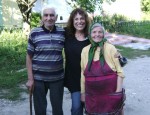
Survivor Mitzvah Project’s Zane Buzby, centre, in 2012 with Abramas and Malka Dikhtyar, the last two Jews in Bazaliya, Ukraine, the birthplace of Buzby’s grandfather. (photo from Survivor Mitzvah Project)

It is officially autumn and British Columbians are nesting, settling in for the cozier, slower season to come. For impoverished Holocaust survivors living in shocking squalor in eastern Europe, the impending winter is a time of danger and scarcity.

Like most people, Zane Buzby initially had no idea that there were thousands of destitute, aged survivors of the Holocaust living in subhuman conditions across the former Soviet Union. After she first encountered some of the poorest of the poor, she returned to her California home and searched for organizations that help them.

“I thought a lot of them must be doing this, even the big organizations that have Holocaust survivor programs,” she recalled recently. “I called every single one of them, [asking] specifically what are you doing? It’s nothing. They’re not helping people financially. No one was doing with this.”

The Claims Conference, which was created by the German government to aid survivors of the Holocaust, has proven useless to most of these individuals.

photo - Survivors Isak and Galina in hospital
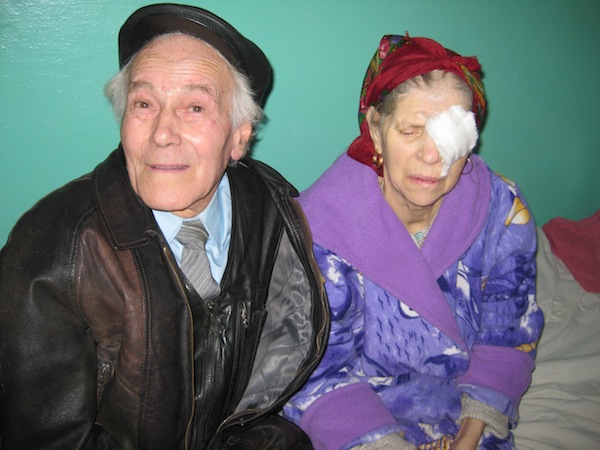
Survivors Isak and Galina in hospital. (photo from Survivor Mitzvah Project)

“If you were in a concentration camp – and the Germans kept really good records – if you survived Auschwitz, they have your name … [even so], most people have to hire an attorney,” Buzby said. The survivors she helps don’t have records, partly because the Holocaust in the east was typified by on-the-spot mass murder by Einsatzgruppen killing squads rather than concentration camps. And the few survivors in eastern Europe today do not have the resources to apply.

“They don’t have computers, they don’t have people advocating for them, there’s no lawyers out there,” said Buzby.

photo - Survivors Isak and Galina in their younger days
Survivors Isak and Galina in their younger days. (photo from Survivor Mitzvah Project)

In many cases, they also don’t have the money to pay for heating fuel, let alone medications or doctors. Some may have a pension of $10 a month, others have no income whatsoever. Food can be very scarce and many of the survivors are the last, or among the last, Jews in their villages, making their final years bleak and lonely.

Buzby took it upon herself to help. She formed the Survivor Mitzvah Project in 2001 and has helped thousands of the most desperate, destitute survivors. (See also jewishindependent.ca/oldsite/archives/may08/archives08may02-01.html.)

“This is the last generation of Holocaust survivors and we are the last generation who can say that we helped,” she said. “Everyone turned their back in 1939 but today we can do something to help them and we should.”

The Survivor Mitzvah Project (SMP) doesn’t try to create the infrastructure of social services or initiate major projects. The goal is simple. Get some money into the hands of the most destitute Holocaust survivors as quickly as possible.

“We try to give them between $100 and $150 a month to get food, heat and medication, so it comes out between $1,800 and $2,000 a year per survivor,” she said. “Of course, we don’t have the money, we don’t bring in enough money, we don’t have enough donors to help everyone every month and that’s the sad part. That’s why this is really a call to action. There is no tomorrow for these people. They need money now.”

Buzby, an actor and TV director before she became obsessed with helping destitute survivors, finds recipients through word of mouth, traveling to villages and asking around for Jews or looking for signs of Jewish life. Often, she said, survivors lead her to others. She recalled a particular example.

photo - Some survivors are living in huts – “no running water, no heat, broken windows.”
Some survivors are living in huts – “no running water, no heat, broken windows.” (photo from Survivor Mitzvah Project)

“When I went there, to this little village, it was in such poverty, it was unimaginable, unbelievable poverty. No bathroom, no running water, no heat, broken windows,” she said. “A lot of these people made the huts they live in themselves out of mud and straw bricks after the war. It needs to be refurbished every year but now in their old age they can’t do it, so ceilings fall in. I gave [a woman] $800 and, on the way out, she pulls on my jacket and says to me through a translator, ‘Can I split this was someone?’ And I said, ‘Who are you going to split it with?’ ‘There is a woman down the road who is much worse off than I am.’ And I thought, how could anybody be worse off than you are, so I said come with us and take us to this woman. So we went to see the second woman and she was very bad off, so she was put on the list, and that’s how it goes.”

The Jews in these villages are often surrounded by non-Jews who are also destitute, said Buzby.

“There’s always poor people to help, God knows,” she said. “But for the Jewish people who survived the Holocaust, not only were their families decimated and murdered, their communities were obliterated, especially if they were in the east, they were burned to the ground. There’s no community, there is no rabbi, there’s no Jewish community, there is no shul, there’s no sister, brother and uncle, there is no support system. So, these [non-Jewish] villagers, even though they are also poor, they have large families, they have maybe a church, they have community. These [survivors] have no community. There is absolutely nothing supporting them.”

photo - Basya Kreyn with her prewar photo, Belarus
Basya Kreyn with her prewar photo, Belarus. (photo from Survivor Mitzvah Project)

Holocaust survivors in eastern Europe have one thing in abundance, Buzby clarified. Antisemitism.

“Rampant. Terrible,” she said. “There’s more antisemitism now than there’s ever been.”

In places, neo-Nazis march openly on the streets. Fascistic parties are gaining strength across eastern Europe. In Vilnius, Lithuania, kids dress up as “Jews” in masks with exaggerated features that are perceived as Jewish and trick-or-treat, demanding money. War-era Nazi collaborators are being rehabilitated as national heroes, she said.

The relationships between the few surviving Jews and their neighbors is additionally fraught because of the high levels of collaboration between the Nazi invaders and the native populations in the east. The almost complete destruction of the Jewish communities of Lithuania – an estimated 95% of the Jews there were killed – is credited to the assistance of Lithuanians. The Simon Wiesenthal Centre has said that Ukraine, for example, has never initiated any investigation into collaboration or prosecuted a perpetrator.

The Survivor Mitzvah Project gets almost no institutional help. Buzby said she routinely contacts major foundations but they demur, saying they support various organizations that assist survivors. But the survivors Buzby has tracked down have fallen through the cracks of whatever institutionalized assistance might be available.

What they do get is support from some of Buzby’s show biz colleagues. Buzby’s acting career includes turns in some of the classic comedies of the 1970s and ’80s, including Up in Smoke, National Lampoon’s Class Reunion and This is Spinal Tap. As a director, she worked on sitcoms including The Dick Van Dyke Show, Golden Girls, Newhart and Blossom. She has brought entertainment figures together for emotional events in which luminaries including Valerie Harper, Ed Asner, Frances Fisher, Elliott Gould, Lainie Kazan and Chris Noth read letters from survivors SMP has helped, who speak about their hardships and the difference the assistance has made in their lives. A powerful video of one of the events is online at survivormitzvah.org.

SMP has hit the $1 million a year mark, but Buzby estimates she needs $2.5 million to meet demand.

“This is an opportunity for people to change the course of history for the survivors,” she said. “Everybody has monuments and raises money for and builds museums for remembrance of those that perished, which is absolutely as it should be. But what about those that survived?”

The coming of the cold winter adds urgency to Buzby’s work. So does the obvious march of time, she said, as the remaining survivors near the end of their lives.

“It’s a time that’s never going to come again,” she said.

For more information or to donate, visit survivormitzvah.org or canadahelps.org.

Format ImagePosted on October 16, 2015October 19, 2015Author Pat JohnsonCategories WorldTags Holocaust, SMP, Survivor Mitzvah Project, survivors, Zane Buzby
Commenting with cartoons

Commenting with cartoons

Attendees at the opening of the Avrom Yanovsky exhibit in Winnipeg in September. (photo by Stan Carbone)

The Jewish Heritage Centre of Western Canada (JHCWC) and the United Jewish People’s Order (UJPO) are co-hosts of an exhibit in Winnipeg of the political cartoons of Avrom Yanovsky (1911-1979).

photo - Anna Yanovsky, the cartoonist’s widow, speaks at the exhibit opening
Anna Yanovsky, the cartoonist’s widow, speaks at the exhibit opening. (photo by Stan Carbone)

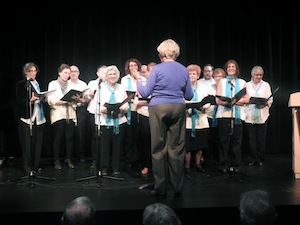
The exhibit opening took place Sept. 17 at the Asper Jewish Community Campus with guest speakers Ester Reiter, associate professor, School of Women’s Studies, York University; and Anna Yanovsky, the artist’s widow. The evening concluded with a performance by the North End Jewish Folk Choir.

With the event, Stan Carbone, director of programs and exhibits at JHCWC, said, “we attempted to provide a composite picture of Avrom Yanovsky placed within an historical and cultural milieu in which his Winnipeg years were critical in shaping and defining his intellectual development and his passion and commitment for social justice.”

According to a 2006 article by David Abramowitz in Outlook Magazine, Yanovsky was born in Ukraine “and came to Canada at the age of 2 with his widowed mother, her parents and his infant brother. They settled in Winnipeg, where Avrom attended the I.L. Peretz Shule. His 1925 graduating class included the late Nechama Gemeril, who later became his wife. The school provided an excellent grounding in the Yiddish classics and revolutionary politics, which stayed with Avrom throughout his life. His mother, a seamstress, and an active Bundist in the Old Country, became a labor Zionist and emigrated to Palestine with Avrom’s brother in 1931.”

Yanovsky was part of a generation of Jews arriving in Canada in the first decades of this century. He was old enough to remember the 1919 Winnipeg General Strike. He lived through and saw the suffering during the Depression, he witnessed the repressive government of the day in Canada, the rise of Hitler and rampant antisemitism.

Reiter said, “Those who knew him commented that had he just a bit of the capitalist in him, his enormous talents would have made him a very rich man … [he was] a rich man, but not in dollars.”

For a time, Yanovsky served as art director for a Yiddish children’s magazine, called Yungvarg (Youngsters), published in New York; for each issue, he did a cartoon story of one of the many Yiddish writers of the late 19th and early 20th centuries. In the late 1930s, Yanovsky began exhibiting with the Canadian Society of Graphic Artists, at the Art Gallery of Toronto, and was president of that organization for a number of years. His editorial cartoons appeared in many English and Yiddish publications, including the Vokhnblat, Canadian Tribune and Outlook.

“One of the cartoons you’ll see is that of the premier of Quebec, [Maurice] Duplessis [1890-1959], with a big padlock representing the padlock law,” said Reiter. “That enabled any person or organization deemed subversive [undefined] to have their house or building padlocked for a year.”

At one point, she said, Yanovsky was hired by a pest-control factory to create a mural. Even this, Yanovsky managed to politicize, using the theme to apply not just to the animal but to the human pests.

“He commented through his art on all aspects of the world, from labor to Canada’s increasing subservience to the United States, the struggle to make ends meet, and the concern for peace and human rights,” said Reiter.

“He targeted not only fat capitalists, but the CIA, the Mounties, antisemites, racists, fascists, fascist sympathizers, and most of Canada’s prime ministers.”

Reiter said, “Avrom was known to be a man of integrity and principle. He lived his politics, sharing his talents for not very much monetary gain. His art was tied to the life and daily experience of working Canadians. He made us laugh in his drawings and in real life.”

The exhibit now on display in Winnipeg was first shown at York University and originally curated by Dr. Anna Hudson of York with the title Free Discussion is the Key to Peace – The Political Cartoons of Avrom Yanovksy. It was remounted at Toronto’s Ashkenaz Festival and then at the Varley Art Gallery in Markham, Ont., together with his mural honoring Dr. Norman Bethune (1890-1939). It was hosted in Vancouver by the local UJPO in 2013.

“The exhibit is of his later cartoons, from 1950 to 1972,” explained Reiter. “And you can see … for him, his art and his politics were really one in the same. He used his art to express his politics. The cartoons that you’ll see, those particular cartoons, don’t give a sense of his profound commitment to Yiddish stuff, which he was profoundly committed to. His stuff was related to labor, to politics, to peace, stuff like that.”

photo - The opening concluded with music from the North End Jewish Folk Choir
The opening concluded with music from the North End Jewish Folk Choir. (photo by Stan Carbone)

Reiter was asked to speak at the event, as she is writing a book on the history of the Jewish left in Canada, which should be out in the spring. She wanted to be involved in the showings of his art because of her interest in history and the left. “He was so famous, certainly among the left,” she said. “People spoke adoringly of his work.”

While Hudson went through some of Yanovsky’s work with Anna Yanovsky for the exhibits, Reiter provided the context.

“The ink drawings on display here, with their collaged and corrected compositions, are just to give an idea of the range of Avrom’s work,” said Reiter. Quoting from Hudson’s notes from a previous exhibit, she pointed out, “You will recognize ‘a cast of easily recognizable characters: the moneybag, the banker, the capitalist and the politician,’ with his sidekick, the police or military. ‘We can laugh at the tragedy of economic inequity because Avrom speaks to us personally to remind us of our humanity, our common ground, and our collective strength.’”

Said Reiter, “He was a communist and he was a Jew with a deep love and respect for Yiddish language and culture.”

Rebeca Kuropatwa is a Winnipeg freelance writer.

Format ImagePosted on October 16, 2015October 14, 2015Author Rebeca KuropatwaCategories NationalTags Avrom Yanovsky, cartoons, Ester Reiter, JHCWC, politics, UJPO, York University

Posts pagination

Previous page Page 1 … Page 276 Page 277 Page 278 … Page 323 Next page
Proudly powered by WordPress