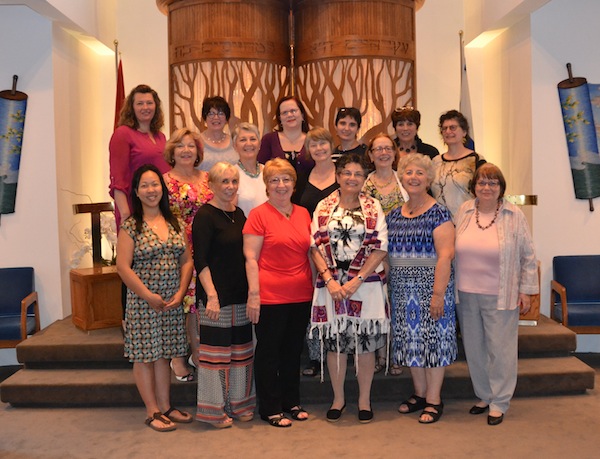
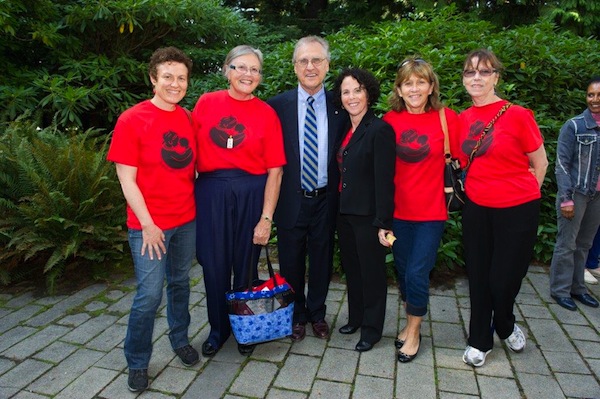
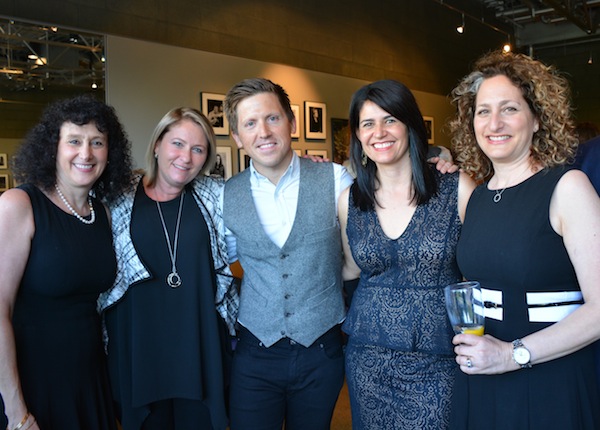
At FEDtalks, the campaign opening event, left to right: Ezra Shanken, Jewish Federation of Greater Vancouver chief executive officer; Neil Pollock, general chair, 2015 Federation annual campaign; Lisa Pullan, chair, women’s philanthropy, 2015 campaign; Stephen Gaerber, Federation board chair; Alex Cristall, co-chair, major gifts, 2015 campaign; and Andrew Merkur, co-chair, major gifts, 2015 campaign. (photo from Jewish Federation of Greater Vancouver)
For the second year in a row, the Jewish Federation of Greater Vancouver annual campaign has closed with a record achievement, this time totaling $8.3 million. This represents an increase of approximately $300,000 from the previous year. Funds will support programs and services on which thousands of community members rely.
“The true power of this record result goes well beyond the impressive numbers. We can make incredible changes in this world when we give from our hearts, and that’s just what our thousands of donors and hundreds of volunteer canvassers have done. I am truly moved by their incredible acts of chesed (kindness) and tzedakah (justice, charity),” said general chair of the campaign Neil Pollock.
“I have witnessed firsthand the challenges in our community and the profound reach of the Federation annual campaign,” said Stephen Gaerber, Federation’s board chair. “The high cost of living in Vancouver has made it difficult for many community members to connect with Jewish life, either because they cannot afford to live centrally or because they cannot afford to participate. The Federation annual campaign addresses issues like these, builds connections between our community and our partnership region in Israel, and helps Jews in need around the world. This record campaign result will provide the support we and our partners need to touch more lives than ever before.”
The face-to-face incentive was one of the keys to this year’s success. It encouraged donors to meet in person with their volunteer canvassers. The 608 face-to-face meetings that took place were an opportunity to have meaningful conversations about shared values and commitment to community.
Federation welcomed 75 new volunteer canvassers as well as 225 new donors to the campaign this year. And Federation chief executive officer Ezra Shanken listed several other statistics in his weekly email message Feb. 19:
1,007 donors increased their gifts
292 volunteer canvassers
1,459 community members attended campaign events
409 campaign volunteers
64 local programs and services supported
17 Israel and overseas programs and services supported
Governor General of Canada David Johnston, left, with Chief Scientist of the State of Israel Avi Hasson. (photo by Sgt. Ronald Duchesne, Rideau Hall)
On March 1, Governor General of Canada David Johnston met Chief Scientist of the State of Israel Avi Hasson to discuss innovation and how Canada and Israel can enhance cooperation in this field. During Hasson’s visit, the Canada-Israel Industrial Research and Development Foundation released its latest impact report.
Established in 1994 under a formal mandate from the Government of Canada and the State of Israel, CIIRDF-funded projects cross many scientific disciplines, technologies and industrial sectors. These include biotechnology, agriculture, information and communications technologies, automotive, natural resource management, public safety and aerospace.
With base funding of $1 million per year from each of the governments of Canada and Israel, CIIRDF stimulates collaborative research and development between companies in both countries, with a focus on the commercialization of new technologies; pools Canadian and Israeli know-how to provide both countries with improved market access, sustainable competitive advantage and long-term market opportunity in global economies; strengthens ties between Canada and Israel, and delivers economic benefits to both countries; and leverages additional regional and sector-based funding that is matched by the government of Israel.
CIIRDF has engaged more than 1,000 participants in partnership development activities, including more than 400 industry leaders who actively contributed to R&D collaboration discussions. It has processed more than 230 bilateral R&D applications and funded 110 projects engaging more than 200 companies from Canada and Israel.
These alliances have enabled the joint development, marketing and sales of more than 50 technologically improved new products for global markets; generated $60 million in initial sales, and $300 to $500 million in additional economic value to collaborating companies; and created hundreds of jobs in both countries.
A commercial gutter installation. (photo by Ethoseo via commons.wikimedia.org)
As the season transitions from winter to spring, it’s time to attend to some household maintenance tasks.
Exterior areas. Trim trees and remove vegetation from the siding and roofline. Have gutters and drains cleaned by a roofing contractor, add downspout extensions where needed, repair all damaged, disconnected or leaking gutters. Consider having the perimeter drains scoped by a drain tile specialist. Inspect, clean and repair all dirty vents. Take note of all exterior repairs, caulking and painting that will need to be done over the summer.
Decks and balconies. Remove all debris and clean any mildew from the floor surface, clear drains, check the function of sliding doors and screens, test guardrails for stability. Does anything need painting?
Roof and flashings. Have the roof properly inspected for damage, holes, loose flashing materials, outdated shingles, pooling, etc. Remove all debris and moss to prevent moisture issues.
Air conditioner. Have it serviced and the heat pump cleaned.
Furnace. Check the filter and replace or clean it.
Smoke detectors. If you have not done so in the last six months, test all smoke detectors. Replace them if they are older than 10 years. Instal carbon monoxide detectors in areas by gas-burning appliances and check them as well. Also, all smoke detectors should be interconnected and hardwired throughout the home. If one goes off in the basement, they should be heard on the top levels as well.
Electrical outlets. Make sure they are safe and grounded. Replace all broken cover plates, tighten loose ones. Test the GFCI (ground fault circuit interrupter) outlets and replace expired or damaged ones, both inside and out.
Washing machine. Inspect hose connections. These hoses are always under pressure, so replace rubber hoses with steel-braided ones to help prevent leaks.
Clothes dryer. Check that the vent duct is made from a smooth, rigid metal. Replace corrugated plastic or foil ducts, as they pose a fire hazard.
Attic. Check for signs of poor ventilation, pests, insulation issues, damaged sheathing, mold, duct connections and leaks. Repair all problems with the help of an attic contractor.
Spring cleaning. Purge or sell all items you don’t need. Check for other random tasks: replace light bulbs, do minor repairs to ceilings doors, windows, walls, etc.
Sean Mossis a professional home inspector with his company Sean Moss Home and Mold Inspections, homeinspectorsean.com.
Singlecue recognizes hand motions for remote control. (photo from Singlecue via Israel21c.org)
Bezeq, Israel’s largest telecom, set up in late 2015 a model “smart home” at its Tel Aviv headquarters and in the IKEA store in Netanya to demonstrate its Bhome subscription service – a package of wifi-enabled sensors and monitors to help keep out intruders and save energy. But you don’t necessarily have to live in Israel to take advantage of Israeli smart-home technologies. Here are some of the many options available now or coming soon.
SwitchBee is a Netanya-based startup that provides a platform including programmable switches, a central control unit, a smartphone/tablet application and cloud-based data services. The plug-and-play devices, featured in the Bhome model home, are designed to embed in existing outlets quickly and wirelessly. The company says you can convert a light switch into a smart switch in less than two minutes, or turn your whole house into a smart home in less than 90 minutes. Using the app’s secure dashboard, the user can program custom preferences for each SwitchBee-enabled light or device including on/off and fine adjustments.
Singlecue is made by eyeSight Technologies, a Herzliya company whose machine-vision systems have been built into devices made by OPPO, Lenovo, Toshiba, Hisense, Phillips and other manufacturers since 2005. It is a standalone device that lets you use touch-free gestures to control infrared- and wifi-enabled media and smart-home devices in its range of sight. You can do everything from lowering the thermostat to lowering the TV volume to lowering the blinds.
Ramat Gan digital health company EarlySense has released myEarlySense, an under-mattress automatic sleep-monitoring system designed to integrate with smart-home solutions. Users can adapt their home environment based on the sleep-cycle data collected from the myEarlySense sensor – for example, arming and disarming home security systems, turning off the TV, turning on the coffeemaker and adjusting the thermostat. The myEarlySense technology is built into Samsung’s new SleepSense IoT (Internet of Things) device.
GreenIQ’s Smart Garden Hub allows you to adjust irrigation based on past, current and forecasted weather. (photo from GreenIQ via Israel21c.org)
Launched at Home Depot stores across the United States and also sold online, GreenIQ’s Smart Garden Hub allows you to adjust irrigation based on past, current and forecasted weather – without stepping outside – yielding water savings of up to 50%. The device connects to the internet via wifi or cellular connection and is controlled from an iOS or Android app. The Petah Tikva-based company’s app can also adjust outdoor lighting and can connect to a Netatmo weather station and rain gauge or a water-flow sensor for leak detection.
Sensibo’s tagline is “Give your old air conditioner a brain.” The system includes a pod that sticks onto your A/C and heating unit, and an intuitive app that lets you monitor and modify your settings from any smartphone, tablet or computer. If you’ve got a Samsung in the living room, an LG in the bedroom and a Friedrich in the study, Sensibo will control all of them with one interface. A new public API for developers will enable integration of a Sensibo device with other home appliances as well.
SmarTap’s digital shower system, currently available in Israel and the United Kingdom and next year in the United States, was chosen for Bezeq’s Bhome demo to show how the product can reduce water and energy use by enabling precise control of flow and temperature. An app lets users program actions such as preheating the shower, setting a maximum temperature and flow rate, and specifying how high to fill the bath. The Nesher-based company will be adding functions such as automatic leak detection, opening cold-water pipes to prevent freezing and monitoring usage patterns; the software will be upgraded remotely with each new feature. IBM Research in Haifa is now researching how SmarTap can help reduce water and energy use in commercial buildings.
Anything plugged into a power source can be connected to PointGrab’s PointSwitch product to enable gesture-controlled adjustments and on/off actions up to 17 feet away, even in full darkness. This Israeli gesture-control technology is already powering tens of millions of devices made by Fujitsu, Acer, Asus, Lenovo, Samsung, TLC and Skyworth. The company is based in Hod Hasharon.
ENTR is a battery-operated smart lock from Mul-T-Lock in Yavneh. It is designed to be retrofitted into existing doors and lets users control entry from a smartphone, tablet or other Bluetooth-enabled device. You can create or disable virtual keys immediately, lock or unlock the door at pre-programmed times and monitor the system remotely. The underlying algorithms were developed at the Israeli research and development facility of American chipmaker Freescale.
Evoz turns an iOS device into a virtual baby monitor. Its technology is built inside the Belkin-Evoz WeMo monitor (which stores and graphs baby’s cries and analyzes the information to provide parenting tips) and in British Telecom’s next-generation home video devices. Evoz also can be used for monitoring housebound seniors, detecting and sending alerts about safety and security, and evaluating electricity usage.
WeR@Home by Essence, a Herzliya-based company, is a cloud-administered wireless system that lets users manage and communicate with a large variety of third-party-connected home devices, such as lighting, thermostats and door locks.
BwareIT’s SmartH2O home water meter makes it easy to watch water usage on any faucet. (photo from BwareIT via Israel21c.org)
Attach BwareIT’s SmartH2O home water meter to your sink or shower tap or your garden hose, download the app and you can see exactly how much water your household is using, how long the water is running and at what temperature, and how much it’s costing you. Now being incubated in Startup Scaleup, the European Commission’s IoT accelerator, the device could be on the market within a year to give conservation-oriented users an unprecedented awareness of water consumption. The app will also inform you of any leaks, and show how your water usage compares with the average in your region or country. If you’re proud of how you stack up to your neighbors, you can share your rating on social media.
Last but not least, Mybitat, an IoT company headquartered in Herzliya, is partnering with Samsung to develop a smart-home solution aimed at helping the elderly remain in their own homes longer and enhancing their quality of life. The technology combines advanced sensors, cloud-based software and behavior analytics to monitor an individual’s daily routine and wellness. If it detects changes in behavior or health, the system will send alerts to preselected family members or caregivers.
Israel21Cis a nonprofit educational foundation with a mission to focus media and public attention on the 21st-century Israel that exists beyond the conflict. For more, or to donate, visit israel21c.org.
אפשר למות רק מההמתנה: חולה ממתינה “רק” עשר שנים לניתוח אורטופדי
הביורוקרטיה ואוזלת היד של מערכת הבריאות הקנדית שהיא דבר לא חדש גרמה לקטי ברנאפ בת החמישים ושש, להמתין כבר עשר שנים לניתוח אורטופדי. הניתוח המסובך אמור לאחות שני דיסקים בצווארה וכן לאחות את האגן הפגוע שלה. ברנאפ שסובלת מכאבים עזים שנים על גבי שנים, “מבלה” מזה כעשור במיטתה כשכסד כרוך סביב צווארה. כל תקופת ההמתנה הארוכה הזו היא בולעת כמות אדירה של משככי כאבים. הניתוח המיוחל יבוצע בה רק בעוד למעלה משנה. ברנאפ אומרת בתסכול רב: “אני פשוט מבזבזת את כל חיי בלעשות כלום. יכלתי כבר מזמן להיות במקום אחר. מערכת הבריאות נכשלה בטיפול בי”.
לברנאפ שגרה לא רחוק מאדמונטון במחוז אלברטה בעיות אורטופדיות קשות עוד מתקופת הילדות, שנובעות מעקמת ודלקת פרקים ניוונית כרונית. היא נשלחה בשנות השבעים למספר ניתוחים במיניאפוליס שבארצות הברית. ב-1982 היא נפצעה בתאונת דרכים ושוב נשלחה לניתוח בארה”ב. בעשר השנים האחרונות מצבה הבריאותי החמיר מאוד והיא נאלצה להפסיק לעבוד. מאז הוקפצה למספר בדיקות בין רופאים שונים באדמונטון ומיניאפוליס אך לא קיבלה אישור לניתוח. בסוף 2010 הוחלט סוף סוף שתעבור את הניתוח דווקא בוונקובר, אך כיוון שרשימת הממתינים כידוע ארוכה מאוד כאן, המועד נקבע ל-2013. מאז חודש מרץ 2013 הרופא המנתח מוונקובר מחפש את מספר הטלפון של ברנאפ ללא הצלחה. רק בהתערבות עיתונאית שראיינה את ברנאפ לכתבת תחקיר לרשת החדשות של סי.בי.סי, הוא קיבל את הטלפון שלה לאחרונה. ברנאפ צריכה להמתין עדיין בין שנה עד שנה וחצי לניתוח. שר הבריאות של אלברטה פתח בחקירה מואצת לברר מדוע התרחשו כשלים כה רבים וחמורים במערכת, שגרמו לברנאפ להמתין לניתוח כבר למעלה מעשור. זה פשוט בזיון אומרים במערכת הבריאות.
נכנסה וודקה יצאו מים: המשטרה חוקרת מי מילא בקבוקי וודקה במים
מאמן ההוקי הוותיק ריק קרומפטון בן השישים ושתיים מטורונטו רכש בקבוק וודקה מסוג סמירנוף, תוך כוונה לשתות ממנו ביחד עם אשתו מרלין קרומפטון בת החמישים ושש. זאת, בשבת בערב בשעה שהם צופים כרגיל בטלוויזיה. קרומפטון פתח את בקבוק הפלסתיק של הסמירנוף במטבח, ומזג ממנו את המשקה לשתי כוסות וערבב אותו עם תפוזים וסודה. הוא התיישב בנחת מול המסך הדלוק ולקח לגימה מהכוס אך הופתע מאוד מהטעם המוזר. מרלין נכנסה לסלון ובעלה ביקש ממנה לטעום מהמשקה שהכין. ואכן גם היא טענה שלוודקה יש טעם “לא רגיל”. מרלין התעשתה מהר ונכנסה למטבח בבהילות והריחה את המשקה שבבקבוק הפלסתיק, והבינה מייד שהוא חסר ריח כיוון שמדובר פשוט במים. למזלם של בני הזוג הבקבוק לא היה מלא ברעל.
קרומפטון חזר למחרת לחנות המשקאות הממשלתית בה רכש את הסמירנוף והחזיר את בקבוק הוודקה שהכיל מים. הוא קיבל במקום החזר כספי מלא והודיע כי איננו מעוניין להגיש תביעה נגד החנות. הנהלת החנות הזדרזה והורידה מהמדפים את כל בקבוקי הוודקה סמירנוף מפלסתיק. לאחר בדיקה מואצת התברר שאלמוני החזיר את בקבוק הוודקה שקרומפטון רכש. המשטרה נקראה לחקור את הפרשה המוזרה, ומצאה שאותו אלמוני החזיר בקבוקי וודקה נוספים מלאים במים לחנויות משקאות ממשלתיות אחרות שבאזור. עתה מנסים במשטרה לאתר את החשוד במעשה החמור ולהבין את מניעיו. מכל מקום במשטרה מודים שזו חקירה מאוד לא שגרתית והם שמחים לציין שלמזלם של כל הנוגעים בדבר, אף אחד לא נפגע משתיית המים.
Left to right, Anna Karatchun, Malka Pischanitzkaya and Jenya Friedman at the N’Shei Chabad Unity Event on Feb. 22. (photo by Esti Loeub)
On Feb. 22, Chabad Lubavitch of Vancouver hosted the N’Shei Chabad Women’s Unity Event. Introduced by Henia Wineberg, it was organized to coincide with similar gatherings taking place in 50 cities in 15 countries on six continents in honor of Hakhel, a year of gatherings.
Left to right: Shula Klinger, Pamela Shapiro, Miki Mochkin with Anya, and Genny Krikler (photo by Esti Loeb)
The local dinner and lecture was attended by more than 120 women. The meal, prepared by Menajem Peretz of FortyOne Catering, was followed by the talk given by Freidy Yanover.
Yanover spoke about joy in the days leading up to Purim. Given that we have two months of Adar this year – being a Jewish leap year – we have two opportunities to consider what it means to live with joy, she explained. Her talk was illustrated with reference to the Torah and her own anecdotes and personal stories. It was followed by live music by Adina Selfinger and her singers.
Every seat came with a party bag containing pamphlets from mikvahcampaigns.org about Shabbat candles and the role of the mikvah. To illustrate the scale of the event, each table carried a globe with stickers showing where the events were taking place.
The atmosphere was relaxed and light-hearted, with diners being encouraged to mingle with new acquaintances. Introductions were helped along by a Connect 4 game provided at each seat, along with conversation starters, such as “Talk to someone who bakes challah” or “Talk to someone from out of town.”
Shula Klingeris an author, illustrator and journalist living in North Vancouver.
Jenna and Gil Lewinsky with Israeli Ambassador to Canada Rafael Barak, who is holding one of the Lewinskys’ Jacob sheep. (photo from Friends of the Jacob Sheep)
Israeli Ambassador to Canada Rafael Barak was recently hosted by Friends of the Jacob Sheep, a Jewish organization in Abbotsford whose mandate is to conserve the endangered four-horned heirloom Jacob sheep and to send them to a future heritage park for their conservation in the Golan Heights. Barak visited the sheep barn on Feb. 16.
Barak came to give an endorsement of the Jacob sheep project – led by Gil and Jenna Lewinsky – and offered to continue to help facilitate the sheep’s return to Israel.
“The first thing I did when I heard of this [project] from Jenna, was I opened the Bible to see if this is a true story … and, behold, the story was there. It is real,” said the ambassador. “Our hope is found in our national anthem, a strong hope of 2,000 years. And then we heard about the Jacob sheep. We have been helping Jenna [and Gil] with connecting with the agricultural ministry … it is right for the Israeli culture to give the green light for this and to help it.”
The Israeli embassy in Ottawa further commented: “We follow the project and do our best to help more than a year after the Lewinskys contacted us. Now there has been great progress in bringing the sheep and it is evident that the ministry of agriculture is trying to help the issue. We hope that all the bureaucratic procedures required to bring the sheep will be completed soon and will be brought to the ground.”
U.S. Senator Bernie Sanders speaking at a town meeting at the Phoenix Convention Centre in Arizona in July 2015. While a Jewish American president would be a first, many other countries have had Jewish leaders. (photo from Flickr user Gage Skidmore via commons.wikimedia.org)
U.S. presidential candidate Bernie Sanders is the first Jew to win a presidential primary and, given that he is only one of two Democratic hopefuls in the race, there is the possibility of a Jewish president after this fall’s election.
But this milestone isn’t such a milestone when one looks around the world, and the United States – with its approximately seven-million-strong Jewish population (including children) – could be considered behind the curve. After all, Italy, France, New Zealand, Panama, Peru and Russia all have had multiple Jewish heads of state or heads of government in the past century or so. Such places as El Salvador, Honduras, Guyana, the Dominican Republic and Norway, with relatively few Jews, have all had Jewish heads of state.
We know some of the stories of antiquity, with Jewish leaders of lands other than Israel. The most famous are Joseph, as viceroy of Egypt; Moses, the prince of Egypt; and, in the fifth-century BCE, Queen Esther in Persia. Among others are:
In the early first century, Queen Julia Bernice II, married the Cilician king, Polemon II of Pontus.
Queen Shushandukht ruled Persia (and some of Mesopotamia) in the fifth century.
Beginning around the fourth century, Jewish kings and queens reigned in Ethiopia for about a millennia.
King Abu Karib ruled Yemen in the fifth century and, a hundred years later, King Dhu Nowas.
Queen Dahiya Kahina reigned in Algeria in the early eighth century.
In modernity, there are/were dozens of Jewish prime ministers, presidents and vice-presidents outside of Israel. As best as we can figure, with some latitude for converts, those born Jewish but raised in another religion, high-ranking officials that were a heartbeat (or two) from becoming head of state, and those who came close, there have been roughly three dozen Jewish leaders outside Israel, with about a dozen “almosts.”
Great Britain/United Kingdom
Benjamin Disraeli, prime minister in 1868 and 1874-80 (converted to Anglicanism)
Rufus Isaacs, 1st Marquess of Reading, viceroy of India, 1921-26
Almost: Ed Miliband, opposition leader of Great Britain, 2010-15; and Prime Minister David Cameron, elected in 2010, who in a speech to the Knesset, said his great-great-grandfather was a German Jew
Switzerland
Ruth Dreifuss, president, 1999
France
Leon Blum, prime minister, 1936-37, 1938, 1946-47
René Mayer, prime minister, 1953
Pierre Mendès France, prime minister, 1954-55
Michel Debré, prime minister, 1959-62 (convert to Catholicism)
Laurent Fabius, prime minister, 1984-86 (raised Roman Catholic)
Nicolas Sarkozy, president, 2007-12 (born to a Jewish father)
Spain
Juan Álvarez Mendizábal, prime minister, 1835-36 (raised Roman Catholic)
Italy
Alessandro Fortis, prime minister, 1905-06
Sidney Sonnino, prime minister, in 1906 and 1909-10 (raised Anglican)
Luigi Luzzatti, prime minister, 1910-11
Eastern Europe
Kurt Eisner, president of Bavaria, 1918-19
Paul Hirsch, president of Prussia, 1918-20
Zigfrids Anna Meierovics, prime minister of Latvia, 1921-24
Petre Roman, prime minister of Romania, 1989-91 (raised Romanian Orthodox)
Jan Fischer, prime minister of Czech Republic, 2009-10
Scandinavia
Jo Benkow, president of Norway, 1985-93
Dorrit Moussaieff, first lady of Iceland since she married President Ólafur Ragnar Grímsson in 2003
Russia
Yevgeny Primakov, prime minister of Russia, 1999
Mikhail Fradkov, prime minister, 2004-07 (Russian Orthodox)
New Zealand
Sir Julius Vogel, premier, 1873-76
Sir Francis Bell, prime minister, 1925 (raised Anglican)
John Key, prime minister since 2008
Africa
Sir Roy Welensky, prime minister of the Federation of Rhodesia and Nyasaland (Zimbabwe), 1956-63 (raised Anglican)
Central/South America (one-offs)
Francisco Henríquez y Carvajal, president of the Dominican Republic, 1916
Janet Jagan, president of Guyana, 1997-99
Mike Eman, prime minister of Aruba since 2009
Nicolás Maduro, president of Venezuela (raised Roman Catholic) since 2013
Honduras
Juan Lindo y Zelaya, president of El Salvador, 1841-42; and president of Honduras, 1847-52 (raised Roman Catholic)
Ricardo Maduro, president of Honduras, 2002-06 (raised Roman Catholic)
Panama
Max Delvalle, president, for one week in April 1967, because the National Guard General did not approve of his succeeding his predecessor
Eric Arturo Delvalle, president, 1985-88 (in 1988, he attempted to remove Manuel Noriega as the de facto military dictator, but instead Noriega overthrew him; Delvalle fled to the United States and died in Cleveland at age 78)
Peru
Efraín Goldenberg Schreiber, prime minister, 1994-95
Yehude Simon Munaro, prime minister, 2008-09
Salomón Lerner Ghitis, prime minister, 2011
Costa Rica (almosts)
Rebeca Grynspan Mayufis, vice-president of Costa Rica, 1994-98
Saul Weisleder, president of Costa Rica’s Legislative Assembly, 1997-98
Luis Liberman Ginsburg, vice-president of Costa Rica, 2010-14 (the grandson of the first mohel of Costa Rica’s Jewish community)
North America (almosts)
Barry Goldwater, GOP presidential candidate, 1964 (Jewish father)
Henry Kissinger, as secretary of state (fourth in line of succession), 1973-77
Madeleine Albright, as secretary of state, 1997-2001
Joe Lieberman, 257 votes away from U.S. vice-president in 2000
Eric Cantor, former speaker of the House (third in line to the presidency), 2011-14
Herb Gray, deputy prime minister of Canada, 1997-2002 (Canada’s first Jewish federal cabinet minister, one of only a few conferred the title “right honorable” who were not prime ministers, and the longest continuously serving member of Parliament in Canadian history)
Dave Gordonis a Toronto-based freelance writer whose work can be found in more than 100 publications globally. His is managing editor of landmarkreport.com.
Deborah French’s children – Henry, Elisheva, Amariah and Rafaella – about to enjoy the fruits of their labor, having made their first chocolate cake. French published The Cookbook for Children with Special Needs in 2015. (photo from Deborah French)
Deborah French’s rollercoaster ride began on June 14, 2004, when she gave birth to her second child, Amariah, who unexpectedly had Down syndrome. “Up until that point, we had absolutely no experience with special needs and never considered we ever would,” said French.
Growing up in northwest London, French made aliyah with her husband Johnny and their first two children in 2007. French chose to become a stay-at-home mom with the birth of Amariah. A year later, the couple’s eldest child, Henry, who was 2 years old at the time, was diagnosed with high-functioning autism.
“We felt incredibly alone and found those years extremely difficult,” French told the Independent.
Once a meticulous planner, these days, French finds that if she thinks too far ahead, she gets filled with anxiety and concern about how they will manage and how their children will fare in the future. “I don’t have the answers, so we don’t have expectations,” said French. “We take everything day by day, one step at a time…. We both only want our children to be happy and fulfilled.”
Going against the advice of many experts who said Henry could not concentrate on a single task for longer than five minutes and that he had poor motor skills, French set about baking cookies with her son one day when he was 4 years old.
“In the kitchen, his fine motor skills were excellent,” she said. “Henry worked solidly for an hour and, as freshly baked cookies with recognizable shapes came out the oven, I knew I was on to something. Being in the kitchen calmed Henry, channeled his energy and gave him a huge confidence boost, as he was able to provide food for others.”
French was asked if she would consider taking other kids into her kitchen. This paved the way for her cooking classes and, eventually, led to her compiling a comprehensive cooking course for children with special needs.
French, who is now the mother of five, has become an expert via life experience.
“After bringing my children into the kitchen, I saw firsthand the effect cooking had on their self-esteem and confidence,” she said. “I believe that any child suffering with learning or emotional difficulties will improve and develop their abilities at a faster rate if they are relaxed and participating in an activity that does not feel like therapy. This type of environment allows them to give of themselves to others and stimulates their creativity, giving them more chance to overcome their challenges.”
French is an advocate for families and their children with special needs in Israel. As well, she and her husband co-created the Chai on Life organization, which provides opportunities for such families to participate in regular activities while educating the wider community about children with special needs.
“We believe that education breaks down barriers and paves the way for acceptance and inclusion – a concept that benefits all children,” said French. “Our Mazal Le Chaim program takes children from mainstream to special needs schools to activities and events to encourage integration, teaching them to confront their fear of the unknown and embrace it.”
French’s first foray into writing was a memoir, A Brief Moment in Time (ASD Publishing, 2013), which won honorary mentions at Paris and New York book festivals. Her most recent publication is The Cookbook for Children with Special Needs (Jessica Kingsley Publishers, 2015).
French’s greatest pleasure comes from seeing how much Henry enjoys helping others who are struggling. “Many children with special needs are very in tune with the feelings of those around them,” she said. “And it is a wonderful feeling when my son notices that I’m tired and he responds by declaring, ‘Don’t worry, Mommy, I’m making lunch for everyone today. You sit down.’ Being able to help me in that situation gives him great satisfaction.”
Her cookbook is 200 pages and is geared toward children and young adults with special needs, their parents, caregivers and guardians. In essence, it is a cooking course to be followed from levels 1 through 3, with each level introducing additional foods, techniques and recipes.
Within each of the three levels, there are 10 recipes, seven of which are savoury and three of which are sweet. “The focus on savoury dishes reinforces the importance of moderation in our diet, ensuring that our primary foods are healthy ones, but that our indulgent foods are exactly that,” said French.
In the cookbook, she writes: “I was angst-ridden the day I allowed Henry to use a kitchen knife. After a month of continuously baking cookies, I took a giant leap of faith and watched as Henry followed my careful instruction and prepared a salad. There was not a chopped finger in sight! Henry sliced cucumbers, pepper and tomatoes. He was calm and attentive throughout. It was so exciting to see his elation after preparing the final dish. We ate salad for weeks after that day whether we wanted to or not!”
Said French, “Learning how to cook is an essential life skill that boosts self-confidence and develops individuality and creativity in all who try it. Those with special needs are no exception and proficiency in the kitchen will play a key role in their independence as adults.”
At Zemer Hazayit, a Modern Orthodox congregation in Efrat, when the Torah reading is finished, the scroll is passed from the men’s side to a woman who takes it through the women’s side. (photo from David Bollag)
Ten years ago, a group of people in a Modern Orthodox congregation in Efrat, a Gush Etzion settlement, decided they wanted women to be more involved in their synagogue services. The majority of the congregation was reluctant, however, so they set out to form a community of their own.
They consulted with Efrat’s chief rabbi, Shlomo Riskin, about the idea and, he said, “Listen, I don’t think it should be the only reason why you would start a new community – the position of women. Why don’t you also make it special in terms of prayer and make it kind of a song?” So, they named the community Zemer Hazayit (Song of the Olive). “There was strong contact with the head rabbi from the very beginning,” said Rabbi David Bollag, spiritual leader of Zemer Hazayit.
Bollag, originally from Switzerland, made aliyah 25 years ago. He has been with the community for the past eight years. He still flies home eight times a year to teach at two Swiss universities, the University of Zurich and the University of Lucerne.
“My field is Jewish philosophy, but I also teach some Jewish history, Bible, whatever they need in the institutes,” he said.
“Our congregation is Modern Orthodox. In Modern Orthodoxy, in almost every aspect of life, women are fully integrated and emancipated, and have almost the same role as men – socially, professionally, in politics and at home. They have the same rights, almost the same education possibilities.”
Ever since Zemer Hazayit opened its doors, the community has been growing. It has some 200 community members today. While this community is new to Efrat, there are many like it elsewhere.
“The process that is taking place is a slow development,” said Bollag. “More and more, laymen and rabbis realize the difference between normal life and religious life isn’t sitting well with most people.” While women are intellectually engaged at schools, workplaces and in politics, he said, “when it comes to religious life, they’re treated like second-class citizens, and they are just going to leave religion or consider it something primitive. For that reason, changes have to take place.”
While people see the need, they also understand that change takes time to be accepted. “That’s why the process is very slow, sometimes very painful – there’s a lot of opposition,” said Bollag.
The tensions and discussions are not only between their community and the rest of Efrat’s Modern Orthodox communities, but within Zemer Hazayit, as well.
“We definitely have people who are more progressive, who are interested in more changes, and others who are much less,” said Bollag. “Not only do we have to find the right balance between introducing new things and making sure we remain within the limits of Modern Orthodoxy, we also have to make sure we find the right balance that’s OK for everybody in our community.”
When Bollag was asked to be the community’s rabbi, one of the first things he wanted was to have an official meeting with members of other neighborhood synagogues. “I wanted to make sure to explain to them what we’re interested in doing, to make sure they would fully accept us,” he said. “They don’t have to agree with us, but I would like them to be accepting.”
Women at Zemer Hazayit return the Torah scroll to the ark. (photo from David Bollag)
Zemer Hazayit first gets Riskin’s blessing before implementing any proposed changes. So far, these changes have included splitting the prayer room in the middle from front to back, giving women equal access to the ark and, when the Torah reading is finished, the scroll is passed from the men’s side to a woman who takes it through the women’s side and then places it back in the ark.
“One of the main issues being discussed at the moment is whether or how women can read from the Torah,” said Bollag. “So, we have, about once in two months, a reading of the Torah by women, but just among women.”
At the moment, the opinion is that they cannot have women reading for men. “So, we separate for that reading – the women are in one place and the men in another,” said Bollag. “Women read for women. We usually also do that when there’s a bat mitzvah, as most of the girls are interested in reading Torah.
“Also, women say Kaddish – that goes without saying in our community – even if there is just a woman and no man.”
According to Bollag, the ordination of women in Reform synagogues has influenced Modern Orthodox congregations, as well, noting that these communities now will hire a woman as part of the discussion, including as a rabbi/spiritual leader.
“When they approached me about being the rabbi of this community, we made it very clear that it isn’t just me, but also my wife who will be very involved in leading our community,” said Bollag. “We also put a lot of emphasis on integrating children into the services as much as we can.”
Zemer Hazayit is currently raising funds to build a synagogue, as they have outgrown the room they have been using in a local school. For more information, visit buildzemerhazayit.org.