Skip to content
  • Home
  • Subscribe / donate
  • Events calendar
  • News
    • Local
    • National
    • Israel
    • World
    • עניין בחדשות
      A roundup of news in Canada and further afield, in Hebrew.
  • Opinion
    • From the JI
    • Op-Ed
  • Arts & Culture
    • Performing Arts
    • Music
    • Books
    • Visual Arts
    • TV & Film
  • Life
    • Celebrating the Holidays
    • Travel
    • The Daily Snooze
      Cartoons by Jacob Samuel
    • Mystery Photo
      Help the JI and JMABC fill in the gaps in our archives.
  • Community Links
    • Organizations, Etc.
    • Other News Sources & Blogs
    • Business Directory
  • FAQ
  • JI Chai Celebration
  • JI@88! video

Recent Posts

  • New rabbi settles into post
  • A light for the nations
  • Killed for being Jewish 
  • The complexities of identity
  • Jews in time of trauma
  • What should governments do?
  • Annie will warm your heart
  • Best of the film fest online
  • Guitar Night at Massey
  • Partners in the telling of stories
  • Four Peretz pillars honoured
  • History as a foundation
  • Music can comfort us
  • New chapter for JFS
  • The value(s) of Jewish camp
  • Chance led to great decision
  • From the JI archives … camp
  • עשרים ואחת שנים להגעתי לונקובר
  • Eby touts government record
  • Keep lighting candles
  • Facing a complex situation
  • Unique interview show a hit
  • See Annie at Gateway
  • Explorations of light
  • Help with the legal aspects
  • Stories create impact
  • Different faiths gather
  • Advocating for girls’ rights
  • An oral song tradition
  • Genealogy tools and tips
  • Jew-hatred is centuries old
  • Aiding medical research
  • Connecting Jews to Judaism
  • Beacon of light in heart of city
  • Drag & Dreidel: A Queer Jewish Hanukkah Celebration
  • An emotional reunion

Archives

Follow @JewishIndie
image - The CJN - Visit Us Banner - 300x600 - 101625

Category: Arts & Culture

New book is first Jacob Dinezon work in English

Jacob Dinezon (1856-1919) was a Yiddish novelist and short-story writer, as famous during his lifetime as were his contemporaries, the three pillars of late-19th- and early-20th-century Yiddish literature, Mendele Mocher Sforim, Y.L. Peretz and Sholem Aleichem. All of these masters knew and were impressed with Dinezon’s work.

During his period of literary activity in the latter half of the 19th century, Dinezon at times even outshadowed the three founding fathers because his books touched thousands of readers and were more widely sold. In fact, one of his novels sold more than 200,000 copies, an unheard of success in Yiddish literature. Dinezon achieved fame at the age of 20 with the publication of his first novel and remained famous until the day he died. He was so well known and beloved that every major figure of Yiddish literature came to his funeral in 1919.

Even encyclopedias in English recognized him. The early 20th-century Jewish Encyclopedia lists Dinezon as an important Yiddish writer (like other classical Yiddish writers, he also established a reputation as a Hebrew author), praise that is echoed in the contemporary Encyclopedia Judaica.

Sometimes mazel plays a role in literary fame but, in Dinezon’s case, it seemed to express itself in income and not in posthumous regard. And now that the worldwide Yiddish-reading community is vanishing, a writer’s lot can be determined by translation, which can bring fame, and to discovery, which in turn can prompt translation. If a writer doesn’t find his translator/editor in another language, he suffers the misfortune of neglect, which is what happened with Dinezon. If you ask any knowledgeable reader familiar with Aleichem and other famous Yiddish writers if he has ever heard of Dinezon, the answer would probably be no.
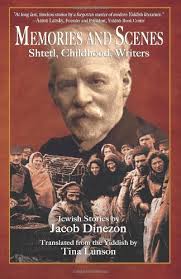
image - Memories and Scenes: Shtetl, Childhood, Writers book coverUntil now, we have not had any work by Dinezon in English. But this lacuna has been successfully filled with the wonderful book of 11 Dinezon stories, beautifully translated by Tina Lunson and edited by Scott Davis, who has also provided an illuminating introduction: Memories and Scenes: Shtetl, Childhood, Writers (Jewish Storyteller Press, 2014).

Dinezon was a social realist, accurately depicting small-town (shtetl) Jewish life. With a cinematic eye, he zeroes in on his characters, deftly telling fascinating stories while at the same time giving an accurate portrait of the mores, attitudes, speech and foibles of the men, women and children whom he depicts.

Like Dickens, Denizon wrote about the downtrodden and about poorly treated students in Hebrew schools with such realism that he actually brought about reforms. A cross section of Jewish society in Poland lives in his pages: the young and old, Chassidim and enlightened Jews, simple workingmen and rich householders. Every single one of his stories breathes with life and verisimilitude.

In this book of 11 stories, a collection published after Dinezon’s death in 1919, we have finely crafted tales – so in keeping with Jewish short-story writing at the turn of the 20th century – that recall vividly portrayed shtetl characters from Dinezon’s childhood years and memories of such literary figures as Mendele Mocher Sforim (Mendele the Bookseller, aka Sholem Abramovich), Peretz, and the playwright Avrom Goldfaden.

Dinezon also played an important historical role in the development of Yiddish as a literary language. In fact, he mentored, advised and befriended almost every major Jewish writer of his day. The list reads like a who’s who of late-19th- and early-20th-century modern Yiddish literature, including the writers mentioned above, as well as S. Ansky, David Frishman, Shimon Frug, Sholem Asch, David Pinski and Abraham Reisen.

In one of the superb stories, Mayer Yeke, we see how a boy’s great fear of the shtetl’s most righteous Jew, Mayer Yeke, turns to love and respect after he witnesses Mayer’s mitzvah assisting the town drunk. Sholem Yoyne Flask depicts a mild-mannered tailor transformed by the liquor in his flask into a fiery defender of the town’s poor folk – then something happens when a surprising discovery is made about his flask. With Motl Farber, Purimshpieler, we are introduced to a housepainter who languishes during the winter when he cannot work, but at Purim, he becomes the leader of a band of Purim players. When the troupe is arrested by the new Russian police chief, an unlikely “Esther” comes to their rescue.

A story that achieves the psychological depth of a Dostoevsky tale is Yosl Algebrenik and His Student. It tells the story of Yosl, an outstanding Talmud scholar, a genius some said, destined to become a great rabbi, who has a passion for mathematics. At age 30, for reasons no one remembers, he tosses away the Talmud and its commentaries for the study of algebra and algebraic logic. From then on, he spends all his time studying algebra, except for the few hours a week he devotes to tutoring children to eke out a living.

Another moving and profound story is called Borekh, after the name of the hero, a poor orphan living in the yeshivah. He doesn’t do well in talmudic studies but he has a talent for woodcarving, making dreidls, Purim groggers and toy animals for the children of the town. One day, he decides to leave the yeshivah and start anew, with hopes of making a great holy ark, “one that people have never seen before.” When he achieves that, he will send it to his friend in the yeshivah, who he knows will become a great scholar. He leaves without saying goodbye.

Some of Dinezon’s autobiographical sketches are as engaging as his fiction. In My First Work, he relates the childhood experience of reading his first Yiddish novel, a Jewish version of Robinson Crusoe. He is so taken by the book, he writes his own adventure story. In Sholem Yankev Abramovich, Dinezon tells how his debut novel, The Dark Young Man, was published and how he acquired his first copy in Moscow. At the same time, he learns that the Yiddish writer Mendele Mocher Sforim and the Hebrew author Sholem Abramovich are actually the same person.

It is not often that we are privileged to make a literary discovery of our own. With this book by Dinezon, the first in English, we happily encounter a master writer who deserves to be ranked with the great Yiddish writers whom he befriended and who admired him.

Curt Leviant’s most recent book is the short story collection Zix Zexy Ztories.

Posted on July 18, 2014July 17, 2014Author Curt LeviantCategories BooksTags Abraham Reisen, Avrom Goldfaden, David Frishman, David Pinski, Jacob Dinezon, Jewish Storyteller Press, Memories and Scenes, Mendele Mocher Sforim, S. Ansky, Shimon Frug, Sholem Aleichem, Sholem Asch, Y.L. Peretz, Yiddish

According to halachah, women’s role can be broad

While I have a very good Jewish background, enhanced by the hundreds of books I have reviewed over the years, I am, by no means, a scholar. However, when I heard about The Status of Women in Jewish Law: Responsa by Rabbi David Golinkin (Centre for Women in Jewish Law at the Schechter Institute of Jewish Studies, 2012), I wanted to read and review it because there are a number of issues – that appear both in the news and in other books I’ve read – that are expounded and discussed by Golinkin.

When I read Rashi’s Daughters, for example, I was intrigued by the author, Maggie Anton, writing that the daughters laid tefillin, studied Talmud and commented on their father’s responsa. The violent, aggressive behavior of certain Orthodox men and women toward the Women of the Wall, who have tried for more than 25 years to have a respectful minyan on Rosh Chodesh each month, observing their personal traditions, further motivated my reading of this book.

Rabbi Reuven Hammer, former president of the International Rabbinical Assembly, in one of his columns last year in the Jerusalem Post, wrote: “I cannot help but wonder what the problem is with the desire of some women to wear tallitot, tefillin and read from the Torah at the Western Wall. I am further amazed at the extreme statements made by the rabbi in charge of the site and by other leaders of the Charedi (ultra-Orthodox) community calling on their followers to come out and protest, as well as by the silence of moderate Orthodox authorities on this issue. I cannot believe that they really think that what these women are doing is in violation of Jewish law.

“Surely they know as well as anyone else that all of this is permitted.

“Women may not be required to do these things within traditional halachah [Jewish law], but nowhere are they prohibited from doing them, any more than they are prohibited from sitting in a sukkah!”

Hammer continued: “My only conclusion is that this … has nothing to do with Jewish law and nothing to do with the sanctity of the Wall and nothing to do with offending others, and everything to do with protecting an insular way of life…. These groups have every right to want to live that way…. But they have absolutely no right to force their practices upon others and to make the totally false claim that what they say represents the official position of traditional Judaism. It simply does not.”

He noted, “The sages in the second century CE exempted [women] from certain mitzvot, but did not prohibit them from performing them. There is no excuse for us, nearly 2,000 years later, forbidding what neither the Torah nor the sages forbade. Let us put an end to all this fuss and support the right of women to perform these mitzvot within the framework of traditional Judaism.”

image - The Status of Women in Jewish Law: Responsa  book coverIn Golinkin’s book, we learn that, while there are Orthodox rabbis who have made innovations for women, many Orthodox rabbis ignore not only non-Orthodox rulings on women in Judaism but also Orthodox rulings. We also learn that change isn’t a linear process between or within denominations.

In the book’s introduction, “The Participation of Jewish Women in Public Rituals and Torah Study,” Golinkin surveys 41 events between 1845 and 2010, regarding women in Judaism. He finds that changes did not necessarily move from Reform to Conservative to Orthodox. For example, the bat mitzvah ceremony, credited to Conservative Rabbi Mordecai Kaplan in 1922, was preceded by rabbis in Italy, France and Baghdad and by Reform Rabbi Yechezkel Karo in 1902. Women have been ordained by the Reform movement in the United States since 1972, but Regina Jonas, who could not be called Reform, was ordained as a rabbi in Germany in 1935. Women have had aliyot since 1893, including Henrietta Szold in 1922, but it was not until 1995 that 88 percent of Conservative synagogues allowed aliyot for women. Orthodox rabbis began to allow separate women’s prayer groups in the 1970s but some Conservative rabbis had done so since 1949. In broad strokes, main efforts to change women’s roles in Reform Judaism lasted from 1846 to 1972; Conservative, from 1874 to 2001; and Orthodox, from 1978 to 2010.

Golinkin writes, “The tension between halachah and modernity has caused, is causing and will continue to cause division and disagreement within the Jewish people.”

He also notes, “The status of women in halachah has begun to cause division between Modern Orthodox and the Charedi (ultra-Orthodox) camp in Israel and abroad.”

He then lists nine approaches to changing halachah: 1) those who oppose any change in Judaism; 2) opposition specifically to changes in the synagogue; 3) acknowledging equal status between men and women, expressing it through different roles and mitzvot; 4) willingness to accept certain changes so as to not drive women from Judaism; 5) change within the framework of traditional halachah; 6) adjusting discriminatory halachot according to contemporary times; 7) changing halachah with equality for women; 8) feeling halachah is not binding, and men and women are equal in Judaism; and 9) suggesting a halachic revolution.

The remaining 15 chapters of The Status of Women in Jewish Law consist of responsa to critical questions. In each case, Golinkin surveys the rabbis who wrote responsa on a particular issue – for and against – and then concludes with what he terms “practical halachah.” There is a complete bibliography after each responsa’s conclusion. In brief, they are:

Responsa 1: women and tefillin. In Golinkin’s view, the responsa show “ample halachic justification” for allowing women to wear tefillin, as long as they are worn with “the same devotion and halachic requirements which apply to men.”

Responsa 2: women and singing. Golinkin writes, “… there is no general prohibition against women singing in classic Jewish law based on the Talmud and subsequent codes and commentaries until the early 19th century.” And there is “no halachic justification for anyone walking out when women sing … it is forbidden to walk out, in order not to insult the female performers.”

Responsa 3: women in the minyan and as shlichot tzibbur (prayer leaders). Golinkin concludes that women may be counted in the minyan for shacharit, minchah, ma’ariv, musaf and ne’ilah, and may serve as shlichot tzibbur in all of these services.

Responsa 4: adding the Imahot (Sarah, Rivka, Rachel, Leah) to the Amidah (central prayer of the prayer book). Golinkin writes that the correct and traditional way is to compose a short piyyut (liturgical poem) recited in the middle of the Amidah blessings.

Responsa 5: reciting Baruch Sheptarani (the Parents’ Blessing) at a bat mitzvah. Golinkin writes that this blessing, traditionally said by the father to mark his son’s turning 13, can be recited by both parents for their daughter.

Responsa 6: aliyot for women and hearing Torah read in public. Golinkin determines that women are obligated to hear the Torah read in public and can be called for an aliyah.

Responsa 7: women reading the Megillah. Golinkin believes that women are obligated to read the Megillah in public and be counted in the minyan for the reading.

Responsa 8: reciting verses honoring Esther during the Megillah reading. Golinkin writes that this is permissible.

Responsa 9: women as mohalot (circumcisers). Golinkin believes that this is permissible.

Responsa 10: participation of women in funerals. Golinkin writes that there is no need for the separation of men and women during a eulogy, and that women should be encouraged to participate in the eulogy, funeral procession and burial, as well as the escort to the cemetery.

Responsa 11: women reciting the Mourner’s Kaddish. Golinkin finds no halachic reason to prohibit women from reciting this prayer.

Responsa 12: women participating in a marriage ceremony and the Sheva Brachot (Seven Blessings). Golinkin says that women may hold the chuppah poles, sing, read the ketubah (marriage contract), give a drash (explanation or sermon), recite the betrothal blessing and Sheva Brachot, and be counted as a “new face,” according to wishes of those involved.

Responsa 13: women on a law committee, rendering halachic decisions and writing responsa. Golinkin concludes that women may render halachic decisions, they may study halachah, teach and discuss halachah and write responsa.

Responsa 14: having a mechitza (partition dividing men and women in synagogue). Golinkin writes that it is permissible to abolish this custom.

Responsa 15: ordination of women as rabbis, holding public office, studying Torah, serving as witness. Golinkin writes that women may be ordained as rabbis “on condition that … they undertake upon themselves all PTBC (positive time-bound commandments) and to refrain from participating in batei din [rabbinical courts] for conversion or to serve as witnesses at marriages and divorces.” According to Golinkin, women are permitted “to study and teach Torah and all subjects related to the Torah” and “it is permissible for a woman to serve in public office.”

For anyone interested in the sources and issues regarding the role of women in Judaism, this book is an informative, absorbing and remarkable read. It concludes with a collection of eulogies delivered by Golinkin and a glossary.

Sybil Kaplan is a foreign correspondent, lecturer, book reviewer and food writer in Jerusalem. She has compiled nine kosher cookbooks. She leads weekly walks in English in the Jewish produce market, Machaneh Yehudah, and writes the restaurant features for Janglo, the oldest, largest website in Israel for English-speakers.

Posted on July 18, 2014July 17, 2014Author Sybil KaplanCategories BooksTags Centre for Women in Jewish Law, David Golinkin, Rabbi Reuven Hammer, Schechter Institute of Jewish Studies, The Status of Women in Jewish Law
Ventanas to play at Folk Fest

Ventanas to play at Folk Fest

Tamar Ilana, centre right, and the Ventanas will perform at the Vancouver Folk Music Festival, which takes place July 18-20. (photo from the Ventanas)

It is no wonder that the music of Tamar Ilana and the Ventanas is eclectic, with influences from around the world. Ilana has not only traveled the world, studying in both Canada and Spain, but performs with a group of talented musicians whose expertise and interests are as wide-ranging as her own. When she and the Ventanas play at the Vancouver Folk Music Festival next weekend, July 18-20, they will offer, as their name suggests, “windows into other lands and cultures.” And, they will have you up dancing.

Born in Toronto, Ilana lived in the heart of the city with her mother, Dr. Judith R. Cohen, an ethnomusicologist and performer specializing in Judeo-Spanish (Ladino) songs. She studied French and graduated high school with a bilingual diploma. “However,” she told the Independent, “I also feel like I grew up in Spain.”

Explained Ilana, “I began accompanying my mother on her field trips when I was 4 (my first trip was to Israel), and then Spain when I was 5. I have had a few homes in Spain over the years. First, Ribadavia, Galicia, where I would roam the castle grounds (now closed to the public) and contemplate the small length of the old graves there, and how short people must have been. Then Hervás, Cáceres, which will forever be ‘mi pueblo.’ When I was 12, I met a family there who took me in as their own and, when my mom would romp all over the peninsula, studying, researching and traveling, I would often stay in Hervás with my ‘family’ there, and join up with my mom for shows. It is in Hervás that I really feel I learned Spanish, grew up a lot, and became a lot of who I am today.”

At 14, Ilana went to Ibiza with her mother, who “was retracing Alan Lomax’s footsteps from 50 years previous.” Since then, Ilana has spent many summers there, she did her third year of university in Barcelona, and studied flamenco in Seville for a year. “So, really, Spain is my other home,” she said.

“My father is part Native Canadian (Cree-Saulteaux), part Romanian and part Scottish. I have not lived with him since I was a baby, but we are close and he has always been a big part of my life. He came to visit me in Barcelona and Seville both times I lived there. He is not a musician but he is a huge supporter of the arts and my life. He says he is my No. 2 fan (my mother being No. 1, hahaha). Both my parents definitely support me as a performer.”

“Science, although I do love it as well, was almost just a form of rebellion from music! But I have now accepted music as who I am.”

Despite being surrounded by music, and performing from a young age, Ilana graduated from University of Toronto with a B.Sc. in biology and worked in the field briefly. “Science, although I do love it as well, was almost just a form of rebellion from music!” she said. “But I have now accepted music as who I am.”

The list of countries to which Ilana has traveled is long. “I used to complain a lot about traveling and performing … and I said that, when I grew up, I wanted to be ‘normal,’ with a house, a car, a 9-5 job. But, I guess, deep down, I always enjoyed the actual singing part. Now, singing, performing and traveling are just so much a part of me that even when I tried to change myself with my biology degree and then working 9-5 for two years in renewable energy, I felt like an imposter. Now, I feel like myself.”

Ilana began her study of flamenco when she was 8, captivated by a performance by Esmeralda Enrique (in Toronto): “I said to my mom, ‘I want to do that,’ and she said, ‘So go talk to her.’ I did, and I began studying dance with her that same year. I have been immersed in the flamenco world ever since.”

When studying in Barcelona in 2007, Ilana did a workshop with Montse Cortés, and “fell in love with flamenco singing.” She said she felt like all the parts of her life were being pulled together.

“Flamenco is everything,” said Ilana. “It is sorrow, it is happiness, it is love, it is death. It is every emotion you could possibly feel all together. It is also technically difficult, which is a good challenge. Flamenco is amazing in that if you speak ‘flamenco,’ you can get on stage with anyone else who speaks ‘flamenco’ and do a whole show without ever speaking to each other in any common tongue.”

Ilana continues to study with Enrique, and sings with her company. She also teaches dancing and singing out of Enrique’s studio, the Academy of Spanish Dance in Toronto.

Though she was working with fantastic people, her mind and soul were on her music and dancing, “what I was going to sing, what I was going to wear, who would be doing the show with me, how to promote it.” So, she left her job, sold her car, left everything she had dreamed of having as a child, and went to Seville.

The path has required courage on more than one occasion. After graduating U of T, she worked as co-campaign coordinator of the Green Energy Act Alliance. Once the act was passed, she was offered a promotion by the nonprofit with which she was working, “but it did not feel right,” said Ilana. Though she was working with fantastic people, her mind and soul were on her music and dancing, “what I was going to sing, what I was going to wear, who would be doing the show with me, how to promote it.” So, she left her job, sold her car, left everything she had dreamed of having as a child, and went to Seville.

“I felt like I was singing flamenco but, really, I felt like I did not know what I was doing, and the only way to know what I was doing would be to go immerse myself in that culture for an extended period of time,” she explained. “It was difficult. The first day at the Fundación Cristina Heeren Escuela de Arte Flamenco was hard – the other singers were so good! Up until then, I had felt like I was a good singer, but that day I felt like I had never sung before in my life! I came home crying. I cried many times at that school – sometimes I was even told I would never be able to sing flamenco because I was not from there! But those hard words actually contributed to the power of flamenco singing, and I began to sing stronger and with more confidence and more knowledge.

“My singing and my understanding of flamenco changed drastically that year (2010-2011), and I returned in 2013 with a Chalmer’s Professional Development Grant to study for another three months. My goal when I first went to Seville was to learn a cante libre (form with no rhythm) and I learned many, which I still sing today, such as ‘Granaína.’”

Although Ashkenazi, Ilana grew up surrounded by Sephardi music and culture, it being her mother’s specialty. “She is a preserver of many old songs that almost no one sings anymore,” said Ilana. “To her, these precious songs are treasures to be guarded dearly.

“I did not grow up religious,” she added, “but we always celebrated the High Holidays with my extended family, and sometimes went to shul. My mother likes going to the synagogue of the Indian Jews here in Toronto sometimes because she is ever interested in different musical cultures and how different communities celebrate, sing and dance according to their customs.

“We often lit candles and sang the prayers on Shabbat, and we traveled to Israel many times as I was growing up…. I recently returned to Israel after many years, this time with Taglit Birthright, and I stayed to visit my cousin and also to play some flamenco in Tel Aviv with friends I had met in Seville.

“Although I am not religious, I feel like the Jewish people are my family, and that there is a common understanding somehow between us all, no matter where we are from in the world. I find this feeling difficult to explain to non-Jews sometimes, but it is a deep feeling I have.”

“Although I am not religious, I feel like the Jewish people are my family, and that there is a common understanding somehow between us all, no matter where we are from in the world. I find this feeling difficult to explain to non-Jews sometimes, but it is a deep feeling I have.”

Before she went to Seville, Ilana was performing with various groups in different projects – a glimpse of her website shows that she still has a host of projects on the go – and, while she was away, these musicians “formed a collective dubbed Fedora Upside-Down (based on the fact that many are buskers, and the idea was to bring folk and world music to the streets to make it more accessible to the general public). It truly felt as though all my worlds had collided, and everyone was just waiting for me to come home and fit right in. And I did!”

From a flamenco rehearsal with Dennis Duffin, Ilana was connected with Mark Marzcyk, leader of Lemon Bucket Orkestra (LBO). The trio was joined by LBO percussionist Jaash Singh and, said Ilana, “We jammed all of summer 2011, in the heart of Fedora Upside-Down, our community and best friends and colleagues. By the time the fall came around, we started being invited to play shows and we called ourselves Ventanas, which means ‘Windows’ in Spanish, after the idea that we are a series of windows into other lands and cultures.”

The only part missing, she said, was an oud player. Singh suggested his friend Demetrios Petsalakis. “He appeared in my kitchen and it was as though he had been there all along!” said Ilana. “We invited him out to our weekend gig … and he showed up and played all the tunes with no charts and barely a rehearsal, just picking them up on the fly. And so, our original quintet was formed.”

Though Ilana dances on some of the pieces, the transition between dancing and singing can be hard, so Ilana invited Ilse Gudiño to join the group, and LBO dancer Stephania Woloshyn also was a guest performer many times. “These are the seven members on our debut self-titled EP,” noted Ilana.

Alexandra Talbot joined when Gudiño had a baby, and now tours with them, and “violinist, composer, friend and Fedora Upside-Down colleague Jessica Hana Deutsch” is also on this tour, as is percussionist Derek Gray.

“Our creative process is always changing,” explained Ilana. “Basically, I am the leader and can make the final call on things. But, since I play with such talented musicians and each one of them knows their styles and cultures so incredibly well, I really just trust their judgment on most things. Mark has a gifted ear for arranging, so especially at the beginning, we would follow his suggestions. Demetrios has a certain ability to compose music that sounds as if it is an old, traditional song, and

Dennis always adds a flamenco feel to it with his voicings and rhythmic changes. Everyone really brings their musical lives to the table and we take it from there. Anyone can suggest a song, teach it, and everyone’s input is heavily taken into consideration before anything is set in stone. Basically, everything is a group decision, and it works surprisingly smoothly.”

The Ventanas’ appearance at the Vancouver Folk Fest is part of a cross-Canada tour and, said Ilana, “Right now, I am planning on going to WOMEX in October to make some important connections and also meet with a few friends there to plan our first European tour. We plan on performing in Spain, Portugal, France, Italy and Germany in the next year. We might even make it to Greece. WOMEX is in Galicia this year, which will bring me right back to when I was 10 years old and traveling there a lot.”

While Ilana has never been a member of LBO, she has been their guest in various shows, and she has “shared many stages with them, traveled and performed with them.” As it happens, LBO will also be at the Vancouver Folk Fest and, said Ilana, “Ventanas and Lemon Bucket will join forces at VFMF. Come and see how!”

For more about the Ventanas, visit ventanasmusic.com. For the full lineup of Folk Fest performers and other information, visit thefestival.bc.ca.

Format ImagePosted on July 11, 2014February 8, 2015Author Cynthia RamsayCategories Arts & CultureTags Judeo-Spanish, Judith R. Cohen, Ladino, Lemon Bucket Orkestra, Tamar Ilana, Tamar Ilana and the Ventanas, Vancouver Folk Music Festival
The Normal Heart comes to Jericho Arts Centre

The Normal Heart comes to Jericho Arts Centre

Daniel Meron co-stars in The Normal Heart, which runs July 18-Aug. 16. (photo by Javier R. Sotres)

Larry Kramer is an incendiary activist who was among the first – and most irate – to raise alarms about a new disease that began killing gay men three decades ago. Kramer was at the forefront of the movement to direct public – and, notably, government – attention to what would become known as AIDS.

Kramer’s play, The Normal Heart, is a polemical cri de coeur written at the North American height of an epidemic that has become the world’s leading infectious killer and the cause of 36 million deaths to date. That is a number almost equivalent to the number of people currently living with HIV, the virus that causes AIDS. And, while extraordinary scientific advances have been made in controlling the symptoms of the disease, most of those treatments remain out of reach for the vast majority now fighting the virus, who are in the developing world.

While the severity of the health crisis has now become clear to most people, Kramer was writing in a time when almost no government resources were allocated to the virus and few in the power structure – from media and medicine to the president of the United States – seemed to care or even acknowledge that gay men were dying in exponentially increasing numbers.

A Jewish playwright, Kramer drew parallels to the world’s reaction to the first reports of the Holocaust. A later book by Kramer, in 1989, would be titled Reports from the Holocaust: The Story of an AIDS Activist.

The Normal Heart opened on Broadway in 1985. Its power remains, with an HBO drama broadcast in May of this year, starring Mark Ruffalo, indicating that social sensitivities to the issue have progressed perhaps as much as the retroviral medical advancements that have made the virus something closer to a manageable disease than the certain death sentence it meant as recently as a decade ago.

The play is now being staged in Vancouver. In it, Daniel Meron, who received a bachelor of fine arts degree in acting from the University of British Columbia, plays Felix Turner, the closeted lover of the main character, Ned Weeks, a stand-in for the playwright Kramer in this barely concealed autobiographical play.

It is a script trembling with rage and Meron sees the topic in a continuum of Jewish activism.

“There is definitely a strong sense of social justice in the Jewish tradition and, like Kramer, I find myself fighting for those who can’t stand up for themselves,” said Meron, who was active in Hillel and the Jewish fraternity Alpha Epsilon Pi during his time at UBC.

“The thing that stands out to me from doing this show was how the U.S. government, the gay community, and the entire world wanted to turn a blind eye to the entire situation,” he said. “As Ned [Kramer’s character] mentions numerous times in the play, the events that took place are eerily similar to the Holocaust.”

Meron, who was born in 1987, said he was struck by the impact The Normal Heart had among gay men who lived through that period.

“Before starting the journey of this play, I wasn’t aware how important The Normal Heart was to so many people,” he said. “It reminds me of speaking to Holocaust survivors. I feel so fortunate to play such an integral part of this story. The greatest thing for me would be to do justice to the story of all the men and women who fought and continue to fight for LGBTQ rights.”

The Normal Heart previews July 14, opens July 18 and runs in repertory until Aug. 16 at Jericho Arts Centre with two other plays as part of the Ensemble Theatre Company Summer Festival. Details and tickets are available at ensembletheatrecompany.ca.

Pat Johnson is a Vancouver writer and principal in PRsuasiveMedia.com.

Format ImagePosted on July 11, 2014November 3, 2014Author Pat JohnsonCategories Arts & CultureTags AIDS, Daniel Meron, Ensemble Theatre Company, Jericho Arts Centre, Larry Kramer, The Normal Heart
Through blues to happiness with Jill Newman

Through blues to happiness with Jill Newman

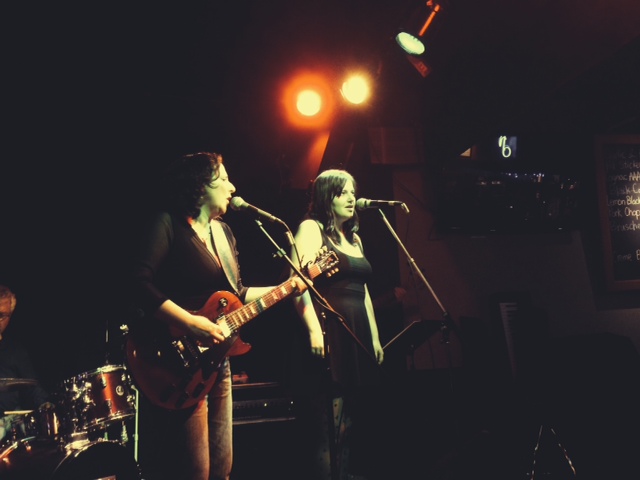
Jill Newman at Cottage Bistro May 9 singing from her new CD, Lovestruck Blues. (photo by John Endo Greenaway)

Happiness. Perhaps ironically, Jill Newman’s performance at the release party for her latest CD, Lovestruck Blues, exuded happiness. The May 9 show at Cottage Bistro featured bright vocals, skilful (and electric) electric-guitar playing, cheerful interactions with the audience and a playlist of well-written, original songs, many about finding love, but also about losing it – even these, though, exhibit optimism, finding the courage and strength to be on one’s own and true to one’s heart.

Newman’s talents as a songwriter and musician were obvious in her debut recording, Fragile Walls, in 2004. The review in the Independent (“A garden of musical delights,” April 22, 2005) ended with the comment, “It’s been a long road for Newman to reach this creative milestone. Hopefully, it’s the first of many.” A decade later, Lovestruck Blues is another welcome milestone – and there’s nothing fragile about it. It exhibits the confidence and contentment of someone who has, so to speak, come out the other side. As Newman writes in the CD booklet, “It is the story of my journey – of turning my world upside down, taking some risks and being blissfully happy for having done so.”

image - Lovestruck Blues CD cover
Lovestruck Blues is Jill Newman’s second CD.

During the period between releases, Newman told the Independent, a lot changed for her personally and musically. “My first CD was the culmination of many years of dreaming of making my own recordings,” she explained. “I was going through a difficult time in my life, including a breakup, so the songs were really all about loss and heartbreak. I had a great producer who took care of almost everything for me, from arranging the songs to organizing and directing the entire recording process.

“Today, I’m in a much better place personally, having just gotten married a few years ago and feeling happy. That does present some challenges for writing the blues – as lately I’ve been writing happy blues songs. I produced Lovestruck Blues myself with support from my engineer, Marc L’Esperance. I made all the final decisions in terms of how I wanted the recording to sound and directed the recording sessions in Seattle and Vancouver. I was not going for a retro sound, but that’s really what comes out. I’ve played in everything from country, punk, blues and even an all-female Led Zeppelin tribute band, so I’m quite eclectic in my approach to music. I’m often told that my music should be in soundtracks for Quentin Tarantino’s films, the less happy songs, that is.

“I’m most at home in front of a live audience rather than in the studio, as I really enjoy the energy and the interaction between the audience and the band,” she added. “I’ve been doing lots of performances and my live shows are definitely stronger than they were 10 years ago. I’ve also been doing quite a bit of vocal work over the past few years. Songwriting is always a challenge, with lots of hours spent struggling with lyrics – I still tend to write the music first or jointly with the words and then fine tune the lyrics.”

Lovestruck Blues includes 10 original songs, one of which – “Too Hard to Handle” – was co-written with Vancouver actor, artist, director, playwright and songwriter Lynna Goldhar Smith.

“I’m originally from Wisconsin, but immigrated to Vancouver Island with my family as a teen. I spent about 25 years living in the Vancouver area, with some brief stints in Washington,” said Newman about her community connections. “I was raised in a secular Jewish household with no religious upbringing, but I identify culturally as Jewish. My most valued connection to the Jewish community was my past involvement with the Peretz Centre for Secular Jewish Culture. My daughter, Michelle, participated as a young teen in the b’nai mitzvah program, which was a great experience for both of us. I also enjoyed singing in the Jewish Folk Choir and participating in the Peretz programming.

“I’ve worked for Jewish Family Service Agency in Vancouver and in Seattle and participated in advocacy to address poverty in the Jewish community in Vancouver. I combine my work as a professional guitarist, singer and songwriter with my part-time work as a therapist with teens who are struggling with mental health issues. When I have spare time, I enjoy being in the outdoors kayaking or sailing.”

photo - Jill Newman and her daughter, Michelle Baynton, at the Lovestruck Blues CD release
Jill Newman and her daughter, Michelle Baynton, at the Lovestruck Blues CD release. (photo by John Endo Greenaway)

A woman with many abilities and interests, Newman’s musical path also started somewhere other than where it led.

“I started in music playing classical flute at age 9 and got involved in community symphony and jazz combos as I got older, with a stint studying jazz in college,” she told the Independent. “My first stringed instrument was the banjo, followed by the acoustic guitar and pedal steel [guitar], but when I first plugged in an electric guitar (Stratocaster copy) at age 15, I was totally hooked. I loved the sound and the power of the electric guitar, especially turned up loud with distortion. A friend who’d been in rock bands taught me how to bend the strings properly and I began specializing in playing lead guitar – something very few girls were doing when I was a teen.

“I played constantly and learned everything I could figure out by Heart, Aerosmith, Yes and Led Zeppelin, but I also started writing my own songs and performing in coffeehouses. By my early 20s, I was making a living as a full-time professional guitarist and, other than recovering from a hand injury, I’ve never stopped playing. I feel strongly that we need more female electric guitarist role models and I volunteered as a guitar instructor for Vancouver Girls Rock Camp in 2012.”

And what draws Newman to the blues? “It’s the raw emotion and the simplicity of the music that grabs me,” she said, reiterating, “I’ve had a longstanding love of the electric guitar and, when I first began listening to blues players like Freddie King and Eric Clapton, I was blown away by the expressiveness of their playing. In recent years, I’ve been focusing a lot on slide guitar, which has a range of expression that emulates the human voice and beyond. There’s nothing more soulful than Roy Rogers playing slide guitar on Elmore James’ song ‘The Sky is Crying,’ or almost anything by Ry Cooder or Derek Trucks.”

Part of the fun of the Cottage Bistro CD release party – in which she was accompanied on stage by Loren Etkin on drums and Brian Scott on bass – was the seemingly spontaneous invitation by

Newman for her daughter, Michelle Baynton, and Cecile Larochelle to join her in a couple of the songs they each performed with Newman on Lovestruck Blues.

“One of the things that was the most special about making this new CD,” Newman admitted, “was getting a chance to record with my daughter, Michelle. She’s just finishing her opera degree at UBC and, despite my doing a very different style of music, we get a lovely vocal blend together. Michelle sang background vocals on my songs, ‘Everything Will Change’ and ‘Without You.’”

Newman, along with Etkin and Cameron Hood (bass), will perform next on July 14, 9 p.m., at Guilt & Co., 1 Alexander St., in Vancouver. For other upcoming performances, keep an eye on jillnewman.net, sign up to receive email updates or like the Jill Newman Blues Facebook page.

Format ImagePosted on July 4, 2014July 2, 2014Author Cynthia RamsayCategories MusicTags Brian Scott, Cameron Hood, Cecile Larochelle, Fragile Walls, Guilt & Co., Jill Newman, Loren Etkin, Lovestruck Blues, Lynna Goldhar Smith, Michelle Baynton

Stotland plays Carlebach – in Yiddish!

“Montreal Jewgrass” musician Adam Stotland channeled one of his musical gods since childhood – Rabbi Shlomo Carlebach – in his acting debut last month.

Stotland, who has Vancouver family connections, landed the title role in the musical Soul Doctor: The Journey of a Rock Star Rabbi, which made its world première in Yiddish at the Segal Centre for Performing Arts in Montreal, with a June 8-29 run.

photo - Adam Stotland
Adam Stotland (photo from cnjews.com)

Stotland, 37, is not a rabbi or exactly a rock star, but he is a cantor and singer-guitarist known for his brand of music that blends klezmer and other Jewish folk music with the sounds of bluegrass. He is a huge fan of Carlebach, the charismatic, yet controversial, voice of the Jewish revival movement of the 1950s through ’70s. But, as Stotland pointed out to the Segal team when they invited him to audition, he had never acted before – and didn’t know Yiddish.

He also wasn’t sure if he could find the time between his duties as cantor, for the past two years, at Shaare Zion Congregation and his busy performing schedule. He and his wife also have a young child and are expecting another.

Besides, as always, the actors and singers in Dora Wasserman Yiddish Theatre productions are highly talented, but unpaid.

But the Segal insisted he would be ideal.

Stotland headed a cast of 30, which included Mark Bassel, Aron Gonshor, Burney Lieberman and Sam Stein. Co-directors were Bryna Wasserman, artistic director of New York’s Folksbiene Theatre, who convinced the Segal they had to do this show, and Rachelle Glait.

Written by Daniel S. Wise with lyrics by David Shechter, Soul Doctor had its Broadway debut in English last summer. It was hailed by the New York Times as “a joyous, leaping roar” and “unabashedly celebratory show.” The Montreal show featured English and French supertitles.

More than 30 of Carlebach’s greatest hits over his 40-year career are featured, backed by a live band. “He had the ability to compose simple tunes that touched you,” Stotland said.

There is a storyline, and Stotland spent “hours and hours” learning the dialogue. His knowledge of Yiddish had been limited to a few affectionate and sometimes colorful phrases he knew from his bubbie. “Having a musical ear, however, has helped me get the meter, the lilting melody of the language,” he said.

Soul Doctor recounts Carlebach’s life from his childhood escape from Nazi Germany and his early rabbinical career, to his discovery of gospel and soul music after meeting acclaimed jazz singer Nina Simone in 1957. An unlikely collaboration and friendship blossomed from there.

He moved away from his strict Orthodox upbringing, but brought the Chassidic love of song to mainstream Jews. He developed a signature sound that combined folk, pop and soul with traditional Jewish music and liturgy, and his popularity grew well beyond Jewish fans. He performed with the likes of Bob Dylan, Jefferson Airplane and the Grateful Dead.

But stardom had its price and Carlebach, who died 20 years ago, struggled with personal demons that strained his family life and shook his faith.

“The music and journey of Rabbi Carlebach is one that will resonate strongly with our community,” said Wasserman prior to the opening, adding that the production “captures the spiritual essence of his songwriting.”

– For more national Jewish news, visit cjnews.com.


Posted on July 4, 2014July 2, 2014Author Janice Arnold CJNCategories Performing ArtsTags Adam Stotland, Dora Wasserman Yiddish Theatre, Shlomo Carlebach, Soul Doctor
Melanie Fogell’s paintings inspire imagination

Melanie Fogell’s paintings inspire imagination

Melanie Fogell’s paintings inspired the story told here. (photo by Olga Livshin)

The solo show Illuminated Forests by Melanie Fogell is on display at the Sidney and Gertrude Zack Gallery until July 27. As I wandered through the gallery, surrounded by Fogell’s paintings, I felt as if I were in a varicolored forest, alive with stories. Stories grew between the majestic trees, flitted among the rustling leaves and dozed under the evergreens.

***

Tia guided her wheelchair into the park. The dappled leaves whispered above her head, green and pink and pretty, smelling of sunlight. She resented them. Nothing should be that beautiful, while she was stuck in this ugly chair. After a single brief glance around, she stared sullenly ahead, into the shimmering, fragrant air. She found it oppressive. An hour outside, as the doctor prescribed, and she would head back home, into her room, where no beautiful things waited.

A gasp to her left caused her finger to jerk on the control stick, and her chair lurched forward. No matter how she detested the forest’s loveliness, she didn’t want to run anyone down. When she stopped and looked for the source of the noise, she saw an old woman in a wheelchair. The woman’s silver hair surrounded a pale wrinkled face like snowy lace.

“Hi,” the woman said. “You startled me, dear. How romantic. Two wheelchairs meeting in a park. Almost a love story.” She smiled.

“Nothing romantic,” Tia blurted. “And nothing to smile about. Definitely not a love story.” Tears sprang up, despite her attempt to suppress them. “Stupid,” she muttered, her fingers tightening on the controller.

“Don’t go,” the woman said. “It’s lonely here. Would you tell me about yourself? Was it an accident? I’m Alice.”

“I’m Tia.” Tia nodded stiffly. Alice looked truly interested. Why not? She had to kill the next hour anyway. She started talking. She was in a car, with her friend driving, and a drunk driver rammed his van into them.

Both her friend and the drunken jerk ended up dead, leaving her alive to deal with mangled legs.

“They are broken in a gazillion places.” She kept a sob inside by sheer willpower. “I was a dancer. Now, I’m … a cripple. The doctor said I might walk again, eventually, after another surgery. I’ll probably always limp. No dancing for sure.” This time, a sob escaped.

“So, you got lucky,” Alice said calmly. “You survived.”

“Lucky, ha!” Tia swore loudly, daring Alice to disapprove. She would never have said anything so rude before her accident, but now, she didn’t care. Rudeness even made a perverted sense. It helped her not to cry.

Alice nodded. “Good idea.” Then, she too swore, very creatively. “The trees absorb our anger and hurts,” she said. “They heal us. With obscenities, we pour out our pain, bury it. It’s like verbal manure.”

Surprised, Tia laughed. “You think so?”

“Yes. Now, inhale the sweet air. Take in the goodness.” Alice looked expectant, waiting.

Tia shrugged. Inhaled. Alice was right, the forest smelled good. It smelled of living things, of dreams.

“Now swear again,” Alice said. “Repeat after me.” The following string of descriptive verbal abuse made Tia laugh aloud for the first time since the accident. She dutifully repeated the words, wincing only a little.

“Well, dear. Do you feel better? I have to go back now, so I’ll have to turn here, at this intersection, but we’ll meet again, right?” She reversed her chair and met Tia’s eyes. “I hope you’ll walk soon. Bye, Tia.” Alice brushed her thin fingers across Tia’s hand, and then rolled away into the gold and green mosaic of the foliage, vanishing behind a bend in the greenery. The lower branches swayed in her wake, a bird trilled overhead.

“Bye, Alice,” Tia said. She did feel better. Only later, after returning home, she realized that she didn’t even thank Alice.

She visited the park every day afterwards, watching the trees and the light change with the season, feeling her pain draining away. She never met Alice again. The next surgery went well, and she healed quickly. After a couple months of grueling physiotherapy, she started limping on her own feet. The doctor said the limp would fade in time. No dancing, of course, but walking felt good. She would find Alice and say thank you.

The autumn forest overflowed with color, reds and greens and yellows of every shade. The fallen leaves bounced under her shoes. Alice would love it, she thought. But when Tia entered the nursing home on the other side of the park, Alice wasn’t there.

“She died in the spring,” said the receptionist. “Are you Tia?”

“Yes,” Tia breathed.

“She left something for you. She was an artist.”

It was a small painting, a forest in spring: leaves and sunlight embracing each other in a quiet melody of green and amber and peach, singing of hope.

Olga Livshin is a Vancouver freelance writer. She can be reached at [email protected].

Format ImagePosted on July 4, 2014July 2, 2014Author Olga LivshinCategories Visual ArtsTags Illuminated Forests, Melanie Fogell
Meghan Goodman finds adventure in dance

Meghan Goodman finds adventure in dance

Meghan Goodman will perform next with Dusk Dances at Dancing on the Edge July 4-6. (photo by Dan Cento)

Meghan Goodman, a Vancouver dancer and yoga teacher, has always been daring. “Since I was a kid, I’ve had a big sense of adventure,” she said in an interview with the Independent. “I loved biking fast, doing interesting things.”

Her predilection for adventure frequently informs her choices, even now. At school, she was torn between the arts and sciences. At university, she majored in dance and minored in math, but eventually dancing as a career won out. “Dancing is exciting and challenging, and it has a nice community of people doing it,” she said.

Dancing also offers a variety of jobs and the ability to schedule her professional life. And, it feeds her desire for perpetual learning.

“The more I dance, the more I learn. There is always something new to learn. Never a dull moment. I noticed that mature dancers can do more, maybe not physically, but they have more inner richness, know how to channel emotions. Dancing has been an interesting and educational journey for me. I would probably be bored with a regular job. I like that my every day is different; I like the fluctuations. There are busy times and free times. Some days, I have three jobs a day, but there are periods when I don’t have anything scheduled. Then, I can rest or travel.”

Her craving for new and stimulating experiences led her to Aeriosa Dance Society, a company that performs dancing in the air, or rather on walls of tall buildings and other vertical surfaces.

“I’ve been a member of Aeriosa for about five years,” said Goodman. “I had seen them perform … and thought it was amazing. When, before the Olympics, their director asked me if I wanted to join – of course, I said yes.”

She revels in aerial dancing. “I love it. I have six or seven contracts with Aeriosa every year, about one-third of all my jobs…. My highest performance with them was about two years ago in Toronto – we performed at the level of the 33rd storey. But, more often, it’s eight- or 10-storey buildings, like the Vancouver Public Library. Or sometimes it’s the trees. It takes a special type of person to perform in the air and lots of training. It needs a different technique than dancing on the floor, because of gravity. When we dance on a vertical surface, we use different muscles.”

Goodman also has her own company, which is an adventure in itself, like any small business. In 2008, she co-founded Body Narrative Collective (BNC) with two friends, one of whom left the company soon after. Julia Carr and Goodman still keep it running.

“We don’t even remember how we first met, Julia and I,” Goodman said, laughing. “Maybe we had classes together or performed together. Now, we have BNC together. A collective needs three people, so we always bring at least one other person for every project, maybe a composer or an artist, usually more than one. Our latest project, Dark Room, had over 20 people.”

She explained that BNC has an interdisciplinary focus, viewing various artistic disciplines through the lens of dance. “Julia is interested in photography, and Dark Room was a collaboration between photography and dance. We explored different photographic techniques by integrating dance and huge, blown-up images. The show premièred in December 2013.”

Another aspect of Goodman’s life is teaching yoga. She began practising yoga in 1998 and received her first teaching certificate in 2006. Seeking ways of working with a wider range of students, she began studying Iyengar yoga. In 2013, she completed the Iyengar Intro 2 teaching certification.

“Iyengar yoga is suitable for all ages,” she said. “It’s good for people who like precision, science and math, like me. We use lots of props – ropes, straps, blocks – and slow, careful movements, so everyone could benefit from a pose, study it. This kind of yoga is excellent for those recovering from injuries and surgeries.”

For Goodman, Iyengar yoga has become a path to stability. “It’s good for settling myself after the excitement of a dance or aerial performance. It feels still and calm, brings me into a quiet space, provides a balance for my dancing and my busy life.”

She teaches predominantly adult students. “When I was younger, I often taught kids – first tutoring at school, later dancing lessons. I like teaching but now I prefer teaching adults. It requires a different level of passing information. Mostly, I teach yoga but I still teach dance once in awhile, usually in specialized workshops. I taught a workshop of contemporary dance to figure skaters. They discovered that they compete better with some dancing training.”

“Dancing is always extra – extra income and extra joy.”

Goodman sees teaching yoga as her future. “Dancing doesn’t last forever, but yoga teachers get better with age, improve. I can practise and teach yoga in my eighties,” she said cheerfully. “Right now, teaching yoga adds security to my life. It pays the bills. Dancing is always extra – extra income and extra joy.”

Goodman’s next performance will be with Dusk Dances, a Toronto company specializing in dancing in parks and other outdoor spaces. Part of this year’s Dancing on the Edge festival, the free shows will take place in Portside Park from July 4-6, 7 p.m. For more information, visit meghangoodman.wordpress.com or dancingontheedge.org.

Olga Livshin is a Vancouver freelance writer. She can be reached at [email protected].

Format ImagePosted on June 27, 2014June 25, 2014Author Olga LivshinCategories Performing ArtsTags Aeriosa Dance Society, Body Narrative Collective, Dancing on the Edge, Dusk Dances, Julia Carr, Meghan Goodman
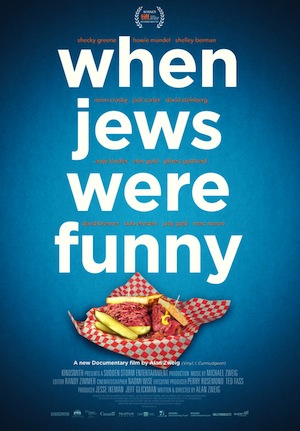
When Jews Were Funny promises less and more than it delivers

When Jews Were Funny promises less and more than it delivers

Director Alan Zweig, right, and Marc Maron. (photo from Sudden Storm Entertainment)

When Jews Were Funny is a seemingly straightforward title that promises both less and more than Alan Zweig’s unexpectedly provocative documentary delivers.

The Toronto filmmaker’s stab at closing the book on American Jews’ enormous contribution to 20th-century comedy is funny ha ha, all right, but the laughs are more of the chuckle variety than outright guffaws. At the same time, the film is also a tad funny-weird, shot through with a personal streak that’s disarming and discomfiting in equal measure.

Yet, when all is said and said – there’s no doing in this film, only talking – When Jews Were Funny is oddly satisfying. Zweig may be seeking answers but, instead of a mood of finality, his film has a catalytic effect. It invites every Jewish viewer to weigh in – personally and anecdotally, emotionally and sociologically – on the sources and state of Jewish humor on the long road from immigration to assimilation.

Zweig achieves this unusual level of reflection by structuring When Jews Were Funny so that it feels like its viewers are party to a succession of conversations. Instead of buffeting the viewer with punchy sound bites delivered via rapid-fire cutting between interviewees, he serves up chunks of real-time interaction.

It would normally be the smooch of death for a talking-head documentary to linger at length on the faces of its interviewees. But when they include Shecky Greene, Ed Crasnick, Howie Mandel, David Steinberg, Judy Gold, Gilbert Gottfried, Bob Epstein and Stewie Stone, we await with anticipation the next insight, witticism or off-the-wall remark.

image - When Jews Were Funny posterParadoxically, and somewhat perversely, Zweig doesn’t lead with his best material. To the contrary, he makes the risky and self-effacing choice of opening with Shelley Berman, who’s baffled into near-silence by Zweig’s earnest questions.

A legendary figure, Berman saw himself as a comedian who had to appeal to everyone – he didn’t do “Jewish” material. So, while it’s factually accurate to call him a Jewish comic and he takes pride in being Jewish, he doesn’t see himself as a purveyor of Jewish humor. So, he asks, what does Zweig want from him?

At first, it seems that Zweig is on a quixotic quest to identify and define the qualities of Jewish humor, and Berman represents an awkward, inauspicious beginning, but we’re intrigued by a filmmaker who showcases his own pratfall – in the crucial opening minutes, no less – rather than leaving it on the editing room floor.

Things improve for Zweig (and the audience) from here, and we’re treated to a variety of incisive analyses, off-the-cuff musings and entertaining meanderings from comics who span three generations. They pinpoint various characteristics of Jewish humor, from clever wordplay to an off-centre worldview to droll melancholia (which, depending on your perspective and the joke in question, might express defiance or fatalism).

The bottom line? “Jews own comedy,” declares Steinberg, speaking more directly and less diplomatically than most of his peers. “I’m proud to say that’s true.”

As a form of proof, and for classic straight-ahead laughs, Zweig intersperses brief, delectable clips of Alan King, Rodney Dangerfield, Harvey Stone, Henny Youngman and Jackie Mason performing on The Ed Sullivan Show in the mid-1960s. This was the golden age of Jewish stand-up, when Borscht Belt vets found mainstream success, and it coincided with Jews across America transitioning from outsiders to insiders.

The viewer gradually realizes, however, listening to Zweig question and interact with his subjects, that he is propelled less by ethnographic interest than by some nagging personal dilemma. Almost imperceptibly, When Jews Were Funny begins to feel like a first-person documentary in which we continually hear but never see the protagonist (that is, the filmmaker).

Zweig desires reassurance that the bittersweet experience and restless personality that drove so many wonderful Jewish comedians is not disappearing.

It’s not giving too much away to say that Zweig remembers the joy of growing up with extremely funny uncles (never aunts) and grandparents, and frets that his young daughter will never know “old Jews.” He desires reassurance that the bittersweet experience and restless personality that drove so many wonderful Jewish comedians is not disappearing.

A few interviewees call Zweig on his not-so-hidden agenda, pointing out good-humoredly that even his angst-fueled inquiry is uniquely Jewish.

“Look at you,” says the New York stand-up comedian Modi. “We got a camera crew to discuss your Judaism. It’s so self-obsessive. What goy, what Christian in the world is running around now with a camera crew, ‘Talk to me about being Christian!?’ No one cares.”

When Jews Were Funny taps into a large reservoir of affection and tenderness, which is not the first thing you’d expect to encounter with urban Jewish performers. Perhaps the film’s generous heart explains its award for best Canadian documentary at the Toronto International Film Festival last fall, since there’s nothing innovative or especially adroit about the filmmaking.

That generosity extends to the audience. Zweig’s implicit concerns about the future of Jewish identity evoke, and include, our own. And what could be more Jewish than a large plate of jokes with a side order of gnawing doubt?

JI readers can get $1 off the digital download of the film, which screened last fall in both the Vancouver International and Vancouver Jewish Film Festivals, at whenjewswerefunny.com by using the discount code JEWISH.

Michael Fox is a San Francisco film critic and journalist.

Format ImagePosted on June 27, 2014August 27, 2014Author Michael FoxCategories TV & FilmTags Alan Zweig, When Jews Were Funny

Leiren-Young first literary laureate

In 2013, the Cherie Smith JCC Jewish Book Festival in partnership with the Isaac Waldman Jewish Public Library announced a new initiative: the Jewish literary laureate project.

“It is a vision of Yosef Wosk,” said book festival director Nicole Nozick in an interview with the Independent. “He came to me at the end of last year, and we talked about it. The City of Vancouver has its poet laureate, Evelyn Lau. It’s a similar concept, only belonging to our Jewish community. The post is a two-year position, selected by our laureate committee, to be a literary ambassador to the community, spread love of the written word, raise the profile of Jewish writers, encourage reading and writing and promote multicultural exchange.”

Wosk described how he came up with the idea. “I remember hearing about England’s poet laureate when I was in high school. I was intrigued by the idea of poetry playing such an important role in society. A few years ago, I was privileged to be able to endow the position of poet laureate for the City of Vancouver. This helped to champion the place of poetry in our midst. Poetry presents us with a surprising rhythm that moves and inspires us in many ways. Poetry also has the power to condense a great deal of information and emotion into a few well-chosen and often surprising words.

“Once we witnessed the success of the Vancouver poet laureate initiative, I thought it was a natural extension to also stimulate poetry in more particular communities, such as the Greek, Chinese, Jewish, Italian, Korean and so on. Although poetry was my initial inspiration for this program, we concluded this was an opportunity to extend the program to include all forms of literature, such as non-fiction and fiction prose, plays, theatre, etc. Working with the Isaac Waldman Jewish Public Library and the Jewish Book Festival, we have taken the first step towards modeling a literary laureate program for one particular community. If this is successful, it can be replicated in other communities.”

Wosk discussed this project in relation to the current state of the publishing industry.

“Poetry partakes of the eternal,” he said. “In some ways, poetry is an antidote to a plethora of electronic media. Whether reading in the privacy of your home, in a café or in a gathering of poets, we are transported to surprising realms of mind and matter, emotion and spirit. Other forms of literature, like a family of diverse relatives, compliment poetry…. Today, more is being published than ever before. It doesn’t matter whether text is handwritten, printed or electronically mediated: they are all related forms of communication. It still serves the same purpose of transmitting information in one of several forms.”

The benefits of this program are manifold. “Certainly the laureates themselves will benefit by being able to share their creativity with the community,” said Wosk. “They will also receive an honorarium in recognition of their work and appreciation for their time. The community, from school students to other published poets, will be stimulated by the encounter with the literary laureate, who … we hope might act as a catalyst for writing in the community.”

Nozick emphasized that, despite the growth of digital media, people are still reading. “We want our laureate program to take reading to the next level, inspire more participation,” she said. “The particular activities are up to the laureate himself. Each laureate will bring his or her own unique strength and interests to the project. He will have a permanent office at the Waldman Library and work in collaboration with the library and the Jewish Book Festival. Our inaugural laureate is Mark Leiren-Young.”

photo - Mark Leiren-Young is the Jewish community's first literary laureate
Mark Leiren-Young is the Jewish community’s first literary laureate. (photo from Mark Leiren-Young)

The committee came together last year and brainstormed who would be the best writer for the position, she explained. “We selected Mark because he is a gifted, award-winning writer. He has experience writing across different genres, including playwriting, memoirs, documentaries, humor, and he is also good with people, able to connect with different generations.”

Leiren-Young commented on how important the position of laureate is to him. “For someone who grew up in Vancouver – and the JCC – it’s a completely unexpected and very cool honor. Yosef Wosk has launched several amazing programs, and I hope I can do justice to his vision for this one. The timing was amazing too. My latest book, Free Magic Secrets Revealed, actually starts at the Jewish Community Centre, and many of the key scenes take place in the JCC.”

Leiren-Young’s pilot laureate initiative is the Multi-Generational Media Lab Storytelling Project. It pairs King David High School students with seniors to share and hone their storytelling in a digital format.

“I recently served as the writer-in-residence for Vancouver Community College,” said Leiren-Young. “While I was there, I spent a bit of time with the oldest student on campus. I think he was in his mid-seventies. From the moment I met him – my first week at VCC – I kept asking if he had any stories he wanted to share. He kept telling me he didn’t have anything.

“Naturally, in my last week, he finally handed me a story about growing up in a small town. He had all these rich, detailed memories about his childhood, so after my residency was over, I contacted the community archive for the town Trail, B.C., so they could have access to and share his stories. But I kept thinking that if I’d known he was willing to tell his stories, I could have set him up with a student who could have interviewed him.”

The multi-media project is in the planning stage now. “Over the summer, we’ll be recruiting seniors, and I’ll work with them to focus on specific stories they want to share,” said Leiren-Young. “In September, when the school year begins, the high school students will be introduced to the project and will prepare their interview questions. The final presentation will take place during the Jewish Book Festival week in November.”

Olga Livshin is a Vancouver freelance writer. She can be reached at [email protected].

Posted on June 27, 2014June 25, 2014Author Olga LivshinCategories Arts & CultureTags Jewish Book Festival, literary laureate, Mark Leiren-Young, Nicole Nozick, Waldman Library, Yosef Wosk

Posts pagination

Previous page Page 1 … Page 153 Page 154 Page 155 … Page 160 Next page
Proudly powered by WordPress