Skip to content
  • Home
  • Subscribe / donate
  • Events calendar
  • News
    • Local
    • National
    • Israel
    • World
    • עניין בחדשות
      A roundup of news in Canada and further afield, in Hebrew.
  • Opinion
    • From the JI
    • Op-Ed
  • Arts & Culture
    • Performing Arts
    • Music
    • Books
    • Visual Arts
    • TV & Film
  • Life
    • Celebrating the Holidays
    • Travel
    • The Daily Snooze
      Cartoons by Jacob Samuel
    • Mystery Photo
      Help the JI and JMABC fill in the gaps in our archives.
  • Community Links
    • Organizations, Etc.
    • Other News Sources & Blogs
    • Business Directory
  • FAQ
  • JI Chai Celebration
  • JI@88! video

Recent Posts

  • New rabbi settles into post
  • A light for the nations
  • Killed for being Jewish 
  • The complexities of identity
  • Jews in time of trauma
  • What should governments do?
  • Annie will warm your heart
  • Best of the film fest online
  • Guitar Night at Massey
  • Partners in the telling of stories
  • Four Peretz pillars honoured
  • History as a foundation
  • Music can comfort us
  • New chapter for JFS
  • The value(s) of Jewish camp
  • Chance led to great decision
  • From the JI archives … camp
  • עשרים ואחת שנים להגעתי לונקובר
  • Eby touts government record
  • Keep lighting candles
  • Facing a complex situation
  • Unique interview show a hit
  • See Annie at Gateway
  • Explorations of light
  • Help with the legal aspects
  • Stories create impact
  • Different faiths gather
  • Advocating for girls’ rights
  • An oral song tradition
  • Genealogy tools and tips
  • Jew-hatred is centuries old
  • Aiding medical research
  • Connecting Jews to Judaism
  • Beacon of light in heart of city
  • Drag & Dreidel: A Queer Jewish Hanukkah Celebration
  • An emotional reunion

Archives

Follow @JewishIndie
image - The CJN - Visit Us Banner - 300x600 - 101625

Category: Arts & Culture

All ages, abilities welcome at Draw Down event

All ages, abilities welcome at Draw Down event

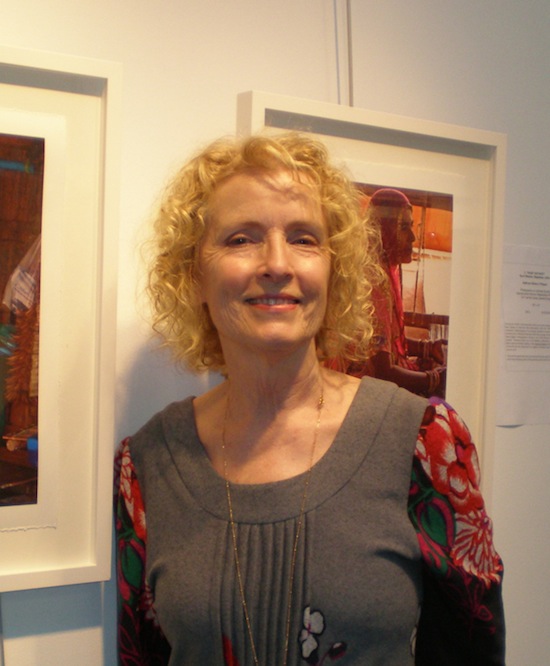
Artist Jody Kramer will be leading one of Draw Down’s many free workshops. (photo by Olga Livshin)

Vancouver Draw Down, a city-wide festival of drawing, is turning five this summer. In 2010, it started as a collaboration between the Roundhouse Community Centre, the Museum of Anthropology at University of British Columbia and the Vancouver Art Gallery, but its roots are found in the United Kingdom and its charitable Big Draw campaign. Their motto reads: “Drawing helps us to understand our world and to interpret and communicate ideas. We campaign to improve visual literacy. The campaign has one aim – to get everyone drawing!”

Marie Lopes, a Roundhouse programmer of arts, culture and environment and one of the founding members of the event in Vancouver, said, “The name Draw Down was inspired by our goal to help people get over the idea that drawing is a precious, frightening activity only practised by artists who have some kind of a mystical talent. Many people who do not think of themselves as artists see drawing as a dividing line between artists and non-artists. We hope to inspire people to get over their performance anxiety and just throw down and draw. We seek to reveal that drawing is a way to think, to dream, to plan and explain, to map, to share ideas and stories, to spend time together, to laugh. It’s intensely satisfying and a lot of fun.”

According to Lopes, in the first year, the Draw Down hosted free workshops at the Roundhouse, MOA, VAG and four community centres, with about a dozen artists participating. “In the four years since we started, we have grown to [more than] 43 free workshops, happening in all 23 Park Board community centres and 20 arts partner venues as diverse as Satellite Gallery and Mountainview Cemetery. We’re hoping to see over 5,000 ‘drawers’ coming out on the Draw Down day,” which will be June 14.

One of the artists who will be leading a workshop, called Dragon Ball, at Strathcona Community Centre is Jody Kramer, a local artist and animation filmmaker. In an interview with the Independent, Kramer said that this will be her second time participating in the event.

“Last year, Marie Lopes called me and asked if I would lead a workshop. I agreed. My workshop was stationed under the Main Street Poodle on Main and 17th. Of course, our theme was a poodle. Over 100 people came to my station to draw during the three hours of my time block. This year, I’ll be leading a workshop at Strathcona. We’ll be drawing basketball players and turning them into dragons.”

The theme isn’t mandatory for participants, just a prompt for those who don’t know where to start. “Anyone who comes to draw with us will have lots of creative freedom,” assured Kramer. “It’s about exploration, making your mark on the world. You don’t have to be an artist to draw. You just have to be brave.”
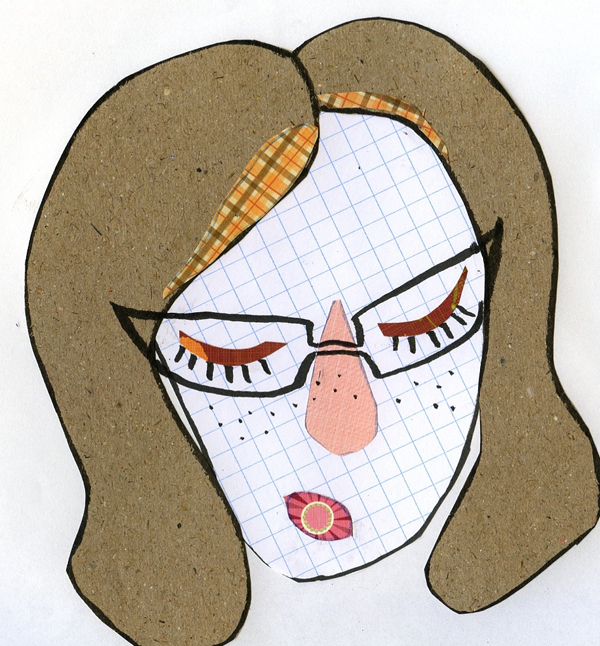
image - Jody Kramer, a self-portrait by the artist
Jody Kramer, a self-portrait by the artist.

Kramer said people of all ages came to her drawing session under the poodle: toddlers with parents and senior citizens, art students and neighbors. “Children always draw; they are curious and not afraid. Adults often think that there is only one way to draw, the legitimate way, so they stand aside and let professionals do the job, but artists have been challenging such assumptions for generations, breaking with rules. Anyone can draw. There is no right way.”

Her goal is to see everyone who comes to her workshop drawing and happy, “to see their eyes light up with their own ideas,” although she is always ready to answer questions and provide guidance. “I like to give people confidence,” she said. “Let’s take away the idea of beautiful, high art. Let’s simplify art. You don’t have to be Emily Carr. You can draw a map and still make your mark.”

Kramer herself has always liked art but she didn’t consider herself a professional artist until she was in her 20s. “I always doodled, made up stories in pictures, but I didn’t know any professional artists. I thought I would be a writer or a teacher. After university, I worked in an office and I finally met people my age from Emily Carr. Then, I knew. I listened to them talk and I understood them. So, I went back to school, to Emily Carr, to study animation and I loved it. Still do. It makes me feel alive.”

To date, Kramer has created several animated shorts, quirky and expressive visual narratives that make people smile. She produces them in the old-fashioned way – by drawing. “Each film takes about two or three reams of paper [a ream is 500 sheets] for five minutes of film time, 12 pictures per second,” she explained.

She also has taught art, but pointed out that she doesn’t like a classroom setting. “I like teaching in a public environment. I worked as an educator for the Vancouver Art Gallery, conducted school tours and kids activities. I also worked for the R2R Film Festival, where children watch movies and make movies.”

Creating art in any form and shape makes her happy, and she will try to instil the same delight in everyone who comes to her drawing station on June 14. To learn more about Kramer’s art, visit jukimuseum.com; for more information on Drawn Down, visit vancouverdrawdown.com.

Olga Livshin is a Vancouver freelance writer. She can be reached at [email protected].
Format ImagePosted on June 6, 2014June 6, 2014Author Olga LivshinCategories Visual ArtsTags Draw Down, Jody Kramer, Marie Lopes
Mishelle Cuttler’s music and sounds infuse Concessions

Mishelle Cuttler’s music and sounds infuse Concessions

Jillian Fargey, back, and Emma Slipp in The Concessions. (photo by Emily Cooper)

Sitting outside an East Vancouver rehearsal hall in the bright sunshine of an early spring day, Mishelle Cuttler is philosophical about going unnoticed. The 26-year-old sound designer and music composer, currently working on the play The Concessions for Touchstone Theatre, mused of her field, “I think it is a discipline that is often unnoticed. It’s kind of like lighting in the way that if you don’t notice it, it probably means that it’s done well.”

Cuttler’s sound design and music may not draw attention to themselves, she said, but they can have a profound effect on an audience. “Music,” she pointed out, “kind of bypasses your brain and goes straight to your emotional centre. Sound in general does that.”

Some of the work that will go unnoticed in The Concessions, then, includes complex sound effects and an original musical score. She will provide the production with digital recordings of animal sounds and rainstorms. She will compose and orchestrate music for scene changes and to underscore some of the action.

The Concessions, by Briana Brown, is the story of a shocking murder in a small Ontario town. Fear pervades the community, as the killer remains at large. Suspects are everywhere, safety nowhere, and the supernatural makes an appearance. The production is part of Touchstone Theatre’s Flying Start program that showcases work by new playwrights. It runs from June 6 to 14 at the Firehall Arts Centre.

The first time she reads any play, said Cuttler, “I keep my eye out for anything audible.” To her, The Concessions has a lot of noise in it, much of it coming from the outdoors. “This play is really about its environment. It’s about this town and there’s a lot of reference to the weather and these storms that are happening,” she said. “There’s the lake and then there’s this forest where this tragedy happens. I think the fact that this place is rural and in nature is very important to the script.”

She said her “number one” task is to create the weather. “It comes up all the time,” she said. “Raining and thunder and wind, there are also some animals referenced in the script that might come out. There’s water … and there’s a lot of silence.”

Knowing when to be quiet is also part of her job. “As a sound designer, I have to be constantly reminding myself that silence can be very important, and sometimes it’s better,” she said.

Touchstone artistic director Katrina Dunn, the director of The Concessions, said one of Cuttler’s greatest challenges is to create the important radio broadcasts that occur throughout the play. Speaking by phone, Dunn said the play has a “whole through-line” that involves the radio. “The local radio station is the conduit through which we feel the larger city,” she said. The play contains an element of magic and, during one five-minute radio broadcast, “the radio goes crazy and goes into another realm. That’s an interesting thing for a sound designer to get to do.”

“I’ve always found composing comes much easier to me when it’s for a purpose, when I’m trying to do something to further a story.”

Cuttler is also writing and orchestrating the play’s original musical score. “In this show, it seems like there will be some pretty complex and interesting scene changes, which is always the most important moment for me,” said Cuttler, whose music will cover the scene changes and underscore some of the action. On a show like this, she has only weeks to compose and, during rehearsal, it’s a matter of days. “I’ve always found composing comes much easier to me when it’s for a purpose, when I’m trying to do something to further a story,” she said.

Cuttler’s work continued through the rehearsal period. As The Concessions took shape, the music and sound design changed. “The music is the stuff that takes the most massaging and figuring out because it’s really tailored to the script specifically,” she explained. That meant composing on the fly, which, she said, is just part of working on a new play. The script “can be very fluid up until the last minute.”

The busy designer, actor and musician will spend the summer playing accordion for Caravan Theatre in the Okanagan. She has a sound design job lined up for next season, and her original musical, Stationary, will be produced at the Cultch in April 2015. “I think that I always dreamed of a life where I was doing lots of different things and I’m fortunate that I’ve sort of achieved that,” she said.

Cuttler was recently nominated for a Jessie Richardson Theatre Award for her sound design on Itsazoo’s April production of Killer Joe. Winners will be announced at the June 23 ceremony.

Tickets to The Concessions can be found at firehallartscentre.ca.

Michael Groberman is a Vancouver freelance writer.

Format ImagePosted on June 6, 2014August 27, 2014Author Michael GrobermanCategories Performing ArtsTags Firehall Arts Centre, Katrina Dunn, Mishelle Cuttler, The Concessions, Touchstone Theatre
Robin Atlas’ Lashon Hara exhibit at the Zack offers artistic midrash

Robin Atlas’ Lashon Hara exhibit at the Zack offers artistic midrash

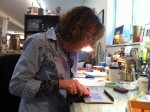
Artist Robin Atlas in studio. (photo from Robin Atlas)

Midrash has been an integral part of Jewish culture for centuries, mainly in literary form. It also branches into the visual arts, however, and there exists a vibrant, international alliance of artists investigating the sacred texts through their paintings and sculpture, fibre art and theatre. Robin Atlas, a Seattle-based mixed-media artist, is part of the movement, and she considers it a personal challenge to raise the awareness of visual midrash in the Jewish community and beyond.

Atlas has been exploring visual midrash for the past four years. Her new show at the Zack Gallery, Lashon Hara, A Narrative on the Consequences of Evil Speech, highlights some of the results of her exploration.

“I turned to this theme after I suffered from an evil tongue myself,” she shared in an interview with the Independent. “Someone gossiped about me. She said very unpleasant things behind my back and then to my face. I was very upset. I talked to my rabbi’s wife, and she sensed my disquiet. She asked me what happened. When I told her, she said, ‘What lashon hara!’ I asked her what that meant, and she told me. It means ‘evil speech’ or ‘evil tongue.’ I started thinking about it. I felt it was a powerful subject to explore through art. Lashon hara creates pain and darkness. How do we turn this darkness into light? What could I, as an artist, say about it? Our community needed such a conversation.”

The exhibition is Atlas’ contemplation on the topic, its different approaches and consequences. Through the use of textile art, she examines how lashon hara impacts the spiritual realm and the physical world. The show consists of 20 small, framed canvas squares decorated with various materials: beads, appliqués, strings, paint and so on. Each piece is imbued with its own symbolism, and the artist’s explanations of her vision are handwritten on the attached labels.

“I started this project by researching the subject for several months,” she said. “I began with seven titles and then created the pieces to match them. But I felt that seven wasn’t enough, so I thought of 13 more titles and the related art pieces.”

One piece in particular, “Feather Pillow,” encompasses the idea behind the show. It might be seen as an illustration to a story. “It’s a Jewish folk story. I heard it first when I was a young girl,” Atlas recalled. “I did something bad, gossiped about someone, and my grandmother told me that story. When I started investigating lashon hara, I remembered the story again, and it became the foundation for one of the pieces.”

A small panel with the full text of that story hangs next to the artwork. The story compares gossip to a feather. Once on the air, flying away, it can’t be caught and retracted, and those who spread the gossip commit three murders: they kill the souls of the speaker, the listener and the one about whom they gossip. “Three Murders,” another piece in the show, illustrates the point.

Several pieces reflect the artist’s personal way of dealing with gossip, converting its darkness into light. One is called “Bomb,” but Atlas’ depiction is not a weapon: the beautiful, sparkling-with-golden-beads image depicts an unusual bomb, a bomb of kindness. “It’s a retaliation of love,” Atlas said. “We have to stop the circle of evil speech. It’s about that woman who spoke evil of me.”

Although she used the vehicle of the Torah to convey her introspections, lashon hara is not confined to the Torah or the Jewish community, of course. There are examples of “evil tongue” everywhere, in our personal and work lives, in the public sphere. In this respect, the show is both timely and timeless, resonating with everyone of every nation or culture, and age.

The show also has an interactive aspect. “We invite the public to write down small notes: how lashon hara affected them, whether it was something they said or something said about them. The notes are anonymous,” Atlas explained. “Anyone can pin his or her note about their experience of lashon hara to a special board. We provide the papers, the pencils and the pins. At the end of the show, we’ll collect all the notes, shred them and turn them into mulch, to be used for a plant at the JCC. We will, this way, symbolically turn the darkness of lashon hara into light.”

During the opening reception on May 29, Rabbi Carey Brown of Temple Sholom joined Atlas for the Artist’s Beit Midrash, a discussion of lashon hara. The exhibit runs until June 22.

Olga Livshin is a Vancouver freelance writer. She can be reached at [email protected].
Format ImagePosted on June 6, 2014June 6, 2014Author Olga LivshinCategories Visual ArtsTags lashon hara, Robin Atlas, Zack Gallery
Fading Gigolo’s Jewish notes

Fading Gigolo’s Jewish notes

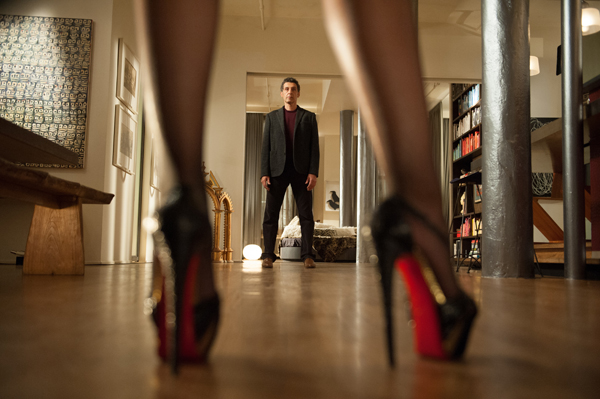
Woody Allen, left, and John Turturro in Fading Gigolo. (photo from Millennium Entertainment)

“My big thing was to not have him wear khaki pants and an army coat,” said John Turturro with a broad smile. “And I got him out of that. I said, ‘That’s not in my color scheme. I’m an Italian director.’”

This dash of bravado might sound pretentious, or even ludicrous, on paper. But when it comes from a tall, impeccably groomed man in an elegant blue velvet suit (double-breasted, blue shirt buttoned to the top, no tie), it seems perfectly reasonable.

For his fifth feature behind the camera, Fading Gigolo, the renowned actor and filmmaker solicited ongoing (and ruthless) feedback from another New York icon, Woody Allen, during the lengthy screenwriting process. Allen accepted a rare acting assignment in the film, hence the discussion of his costume.

Allen plays a newly retired Manhattan bookstore owner who, in need of money, convinces his friend, floral arranger Fioravante (Turturro), to provide sexual services to affluent women. Murray claims a fee for arranging the liaisons, which take Fioravante in an unexpected and ultimately poignant direction.

photo - John Turturro in Fading Gigolo.
John Turturro in Fading Gigolo. (photo from Millennium Entertainment)

Fading Gigolo starts out as a slightly absurd sex comedy and deepens into a mature, empathetic study of big-city loneliness against a backdrop of cross-cultural and ethnic identity. The crucial relationship in the film is between Fioravante and Avigal (French actress Vanessa Paradis), an astute mother of six and the widow of a Chassidic rabbi. Sex isn’t part of the equation, but Dovi, a protective and covetous neighborhood Satmar watchman (a touching Liev Schreiber), can’t know that.

“I met all these people who’ve left the [Satmar] community” in the course of his research, Turturro said in a recent interview at a San Francisco hotel. “They’re like the strays of the community. They gather in this place, people who left and people who hadn’t left who just went there to see what was going on.”

Paradis got to know one woman in particular who had left the Satmar community and explained the various directives, such as keeping her hair concealed under a wig.

“All these things are made up by men,” Turturro declared. “Women didn’t make these rules. And, to me, that says it all.”

Fading Gigolo is unambiguously respectful toward observant Jewish practice, while inviting us to empathize with a woman trying to reconcile autonomy and conformity.

“Avigal’s not looking to escape,” Turturro explained. “She’s just looking to receive.”

Fading Gigolo climaxes with a religious trial where Murray is confronted with the query, “Are you proud to be a Jew?” It’s the question we’ve long wanted Allen to answer onscreen and, at that moment, it’s difficult not to conflate the character and the actor.

Turturro’s experience of Judaism goes well beyond growing up in New York and now living in the Park Slope neighborhood of Brooklyn. His wife is Jewish and his son went to Hebrew school, and Turturro confides that he’s spent a fair amount of time in Reform synagogues. He has played several Jewish characters onscreen, most famously in the Coen Brothers’ Miller’s Crossing and Barton Fink, and immersed himself in the life of Primo Levi to portray the Italian-Jewish Holocaust survivor in Francesco Rosi’s The Truce.

“If you’re raised a Catholic, you realize there’s not a debate that goes on,” Turturro said. “And, if you’re raised a Jew, there’s a debate that goes on. And I really like that. Therein lies one of the greatnesses of Judaism.”

At Allen’s behest, Turturro brushed up on Isaac Bashevis Singer’s short stories while he wrote the Fading Gigolo screenplay. But, after all his various and diligent research, certain things came down to intuition – and style.

“I only chose Satmar because I liked the hats the best,” Turturro said. “I don’t want the Borsalino. I’m Italian. It’s an esthetic choice, understand. That’s how it goes with me. The hat dictates. That’s it.”

Fading Gigolo is playing at Fifth Avenue Cinemas. It’s rated R for some sexual content, language and brief nudity.

Michael Fox is a writer and film critic living in San Francisco.

Format ImagePosted on June 6, 2014August 27, 2014Author Michael FoxCategories TV & FilmTags Fading Gigolo, John Turturro, Satmar, Woody Allen
Inhabiting his father’s world

Inhabiting his father’s world

Bob Bossin (photo by Suzanne Kimpan)

Bob Bossin, a well-known Canadian folk musician, recently released a book about his father, Davy the Punk: A Story of Bookies, Toronto the Good, the Mob and My Dad. The book is a compilation of true-life stories about the author’s father, David, a legendary figure in the underground gambling scene in Toronto in the 1920s, ’30s and ’40s, but it’s much more than that. It is also a social commentary on Canadian life off the lawful path in the first half of the 20th century.

Simultaneously with the release of the book, on which it is based, Bossin is touring with his new one-man musical, Songs and Stories of Davy the Punk: The Very Jewish Story of My Father’s Life in the Gambling Business. He brings it to Havana Theatre June 3-7, and recently talked to the JI about both projects.

JI: How and when did you come up with the idea for this book?

BB: My father died when I was young, just 17, but I heard many stories about him. One afternoon in the early 1970s, I stopped for lunch at the United Bakers Restaurant on Spadina Avenue. It had been in Toronto since 1912 and it had a counter man as old as Methuselah. I sat at the counter and started kibitzing with him. I asked him how long he had lived in Toronto.

“Longer than my teeth,” he said in Yiddish. So I asked him if he knew the Bossins.

“Sure,” he said, “I knew the Bossins. I knew Hye, Celia, Sady, Bessie, Davy….”

“Davy was my father,” I told him.

“Sure, I knew Davy. We used to call him Davy the Punk.”

“Davy the Punk? Why Davy the Punk?”

“Because he was a punk kid. He was a gangster.”

After that, I became very interested in my father and, as it turned out, the police had felt the same way. While my father was not a man who wrote things down, the police wrote a lot about him. So I started to haunt the archives and newspaper morgues. I tracked down old bookies, old cops and old judges and, over the years, I pieced together my father’s story.

JI: Did you use your imagination to fill the gaps or when memory was fuzzy?

BB: Of course, the imagination is very much involved, even as you are trying to stay as close to the facts as possible. People live lives, not stories. Turning a life into a story is an imaginative act.

JI: Could you tell us something about the research you did for the book?

BB: Calling this book a memoir was the publisher’s idea. Fair enough: books have to be categorized, and “storybook” wasn’t one of the options. But that is how I think of it. This is the story I might tell you on a summer night, if I really got wound up. I suppose it is a memoir of sorts, but my father died when I was a teen, so my personal memories of him end early. Of necessity, I have reconstructed much of Davy the Punk from what others told me, and from the documents my father had nothing to do with.

I did get some of the story straight from my father, Davy Bossin. Among friends and family, Davy was not secretive about his past, and I liked nothing better than listening in when he told his stories. I only wish that I had asked him more questions, and that I had a better memory than I do. Of course, in the end, our fathers’ lives always remain a mystery, and mine no less, despite my best efforts to snoop.

Over the years, I have learned a lot about what Davy did, but how he did it, I can only guess. For instance, I know that he went to New York around 1950 to tell Frank Costello he was quitting the gambling business. But how did he feel boarding the train? Worried? Confident? Nonchalant?

Or there is Bill Gold’s story of Davy happily kibitzing with the murderous Fischetti brothers in a Cleveland gambling club in 1948. Was Davy really as relaxed as his friend remembered a half-century later, when he was 92? I decided to take Gold’s word and reported the story that way. The book is peppered with choices like that … as I kept after Davy the Punk through all the obstacles and dead-ends inherent in chasing a man with a 50-year headstart.

My mother was another important source… After her and my father, I am, in a way, most indebted to Alex Haley, the author of Roots. Sometime in the late 1970s, Haley called everyone to go out with a tape recorder and tape their family elders’ stories. I thought that was a terrific idea…. I recorded interviews with a dozen aunts, uncles and cousins, filling many a cassette. I always asked them about Davy.

JI: You talked to people, searched in archives and libraries. What else?

BB: The internet. Suddenly every paper ever published by the Toronto Star or the Globe and Mail was online and searchable. When I searched 1940, up came Gordon Sinclair’s live coverage of the raid on the Canadian Turf and Sports Bulletin, my father’s business. Overall, the books, articles and theses I read number in the hundreds.

JI: How long did it take to write the book?

BB: It took five or six years. I do lots and lots of re-writing.

JI: How and when did the book get turned into a show?

BB: That was my idea from the get-go. Performing, telling stories on stage, both as songs and prose, that’s what I have done for a living all my life. The show premièred at the Ashkenaz Festival in Toronto two years ago, as a sort of one-act musical reading. It has come a long way since then. I developed it through a few other preview performances that fall, and then put it aside. I’ve just started performing the full version. So far, it’s been four shows.

JI: How much of the book went into the show?

BB: The show is maybe one-tenth of the length of the book. They each have their own tone. The book goes much deeper into the history of my father’s world, particularly of the gambling business, the mob, the behind-the-scenes workings of the authorities, the antisemitism of the times. But the show has the magic of a live theatrical experience and, of course, it has the music.

JI: You’re the author as well as the performer. Do you change the show depending on public reaction?

BB: So far, yes. There’s nothing like getting it in front of an audience to see how it connects. There is a scene in the show now that wasn’t there until very recently. It was a piece I did at a couple book launches. People reacted to it so strongly I thought maybe it should be in the show. Once I put it in, it suggested other changes. It’s made for a significantly better show, I think. Eventually, I discover the best way to tell the story, and then it stays pretty much as scripted.

For a review of Bob Bossin’s Davy the Punk: A Story of Bookies, Toronto the Good, the Mob and My Dad, see page “A family underworld” by Robert Matas in this week’s issue. For more on the one-man show, visit the website davythepunk.com.

Olga Livshin is a Vancouver freelance writer. She can be reached at [email protected].

Format ImagePosted on May 30, 2014Author Olga LivshinCategories Performing ArtsTags Bob Bossin, Davy Bossin, Davy the Punk, Havana Theatre
Naomi Steinberg’s Storytelling Festival is fast approaching

Naomi Steinberg’s Storytelling Festival is fast approaching

Naomi Steinberg (photo by Diane Smithers)

Clearly, creativity and community involvement run in the Steinberg family. In the April 25 issue of the JI, readers heard from Myriam Steinberg, artistic director of the upcoming In the House Festival. This week, her sister Naomi Steinberg talks to the JI about her work as the executive director of the Vancouver Society of Storytelling, which is hosting its 20th Storytelling Festival June 13-15 at various venues around the city.

The Storytelling Festival presents tellers and stories from across the spectrum of custom and culture and this year’s theme, A Cabinet of Curiosities, is in keeping with the festival’s mandate of multiculturalism and education. Close to 30 storytellers will be highlighted over the course of three days. There will be First Nations stories, a Persian epic called “The Shahnameh,” family time stories and a panel discussion on storytelling for social change.

Storytelling is the oldest form of social communication, the oral tradition of passing down fables, legends, fairy tales and myths from generation to generation. It makes us aware of our history, provides an environment to share experiences and can be an effective tool for education and change. Steinberg is passionate about her craft, which she emphasized involves being able to listen, as much as being able to tell.

“A teller is a visual artist who paints with words and carves air with her/his tongue.”

“I do not want to denigrate digital storytelling, but the oral format is its own high art form. A teller is a visual artist who paints with words and carves air with her/his tongue.” As far as the local Society of Storytelling is concerned, she said, there are two aspects to storytelling, the actual telling, the entertainment piece, and then its application in the community setting to encourage social change, the educational piece. “We run the biannual festival and then in the in-between years we focus on a community project,” Steinberg explained. “We are also committed to bringing storytelling into schools.”

Last year, the society was involved with the St. George Rainway Project, a community-driven initiative to recall an historic waterway in Mount Pleasant. Last fall, 13 student stewards were selected from Mount Pleasant Elementary School to guide the community through the area and tell the story of the lost stream within the street right of way along St. George Street from Kingsway to East 13th Avenue. Part of the project was to build a storyteller’s bench at the headwaters of the creek – to leave a legacy to the neighborhood. “It was a day of community engagement and learning and showed what green redesign of a block could bring,” Steinberg said. “It encouraged dialogue and debate amongst the residents of the area. It was a great success.”

Another project was based on the five elements: air, earth, fire, metal and water. “We worked in five different communities, each focusing on exploring one of the elements through storytelling and community participation,” she explained. “We ended with a bike/bus tour to each of the five areas to view the projects. It was a unique way of highlighting the outreach possibilities of storytelling.”

Storytelling is also about preserving one’s culture. Yet different cultures can put a different spin on the same story, an example of that, Steinberg noted, is the story of the North Shore Twin Peaks – known as the Lions. “In the 1880s, British immigrants, who constituted the majority of British Columbia residents, commemorated their colonial roots by naming the two peaks after the famous crouching Lions of London’s Trafalgar Square. However, even before one British foot touched West Coast soil, the aboriginal peoples had their own mythology of the ‘Twin Sisters,’ who helped save their tribe from extinction by making peace with a warring neighbor tribe and, for this deed, were immortalized and set forever in a high place as the two peaks.”

There was very little “the Wandering Jew” could carry with him to preserve his memory as he was forced out of his home in various countries, so he took his stories, with their wisdom, humor and pathos.

Storytelling knows no ethnic or cultural boundaries; every culture has its folklore. Judaism is no exception. There was very little “the Wandering Jew” could carry with him to preserve his memory as he was forced out of his home in various countries, so he took his stories, with their wisdom, humor and pathos.

The position of a storyteller was often revered in a society. Steinberg laughed as she talked about the night she told her grandparents that she was a storyteller, in response to a query about what she was doing for a living.

“I was afraid to tell them and was very surprised when they congratulated me for being part of an honorable tradition, that of a maggid. This was an endorsement at the highest level for me.”

Steinberg has traveled around the world telling stories and presenting workshops. Of all the stories she has told, her favorite is based on an Iraqi-Kurdish Jewish fairytale called “The Wonderful Healing Leaves” from a book of Jewish folklore edited by Howard Schwartz.

After four years with the society, Steinberg said she is leaving for a year and a half abroad to gather material for her upcoming Fringe Festival production that explores the French roots of her maternal grandmother.

About why people should come to the festival, Steinberg said, “They will get a deepened appreciation of Vancouver, its landscapes, its indigenous population and its various cultural communities. They will be entertained and they will see that storytelling is fun, educational and simple, you don’t need a lot of props to participate.”

As to the future of oral storytelling, Steinberg was emphatic, “Nothing replaces heart-to-heart, face-to-face, breath-to-breath interactions. Even when you are just listening to a story, you are using more than your ears, it is an emotional experience that involves your heart and soul. The digital world is not going to take over this form of communication, ever.”

For more information and a list of the festival’s storytellers and venues, visit the website vancouverstorytelling.org.

Tova Kornfeld is a Vancouver freelance writer and lawyer.

Format ImagePosted on May 30, 2014May 30, 2014Author Tova KornfeldCategories Performing ArtsTags A Cabinet of Curiosities, Fringe Festival, Howard Schwartz, Mount Pleasant Elementary, Naomi Steinberg, St. George Rainway Project, The Storytelling Festival

A family underworld – Bossin and Lansky

Children rarely pay much attention to what their parents are doing. Children of parents on the wrong side of the law are no different. They may overhear conversations around the house, they may see headlines in the media but they do not really connect the dots. Two books this spring offer portraits from the criminal world: years after their fathers died, the daughter of notorious New York mobster Meyer Lansky and the son of Toronto bookie Davy Bossin look back with fondness for their dads.

Both men were in illegal gambling. In fact, stories about some characters mentioned in one of these books are fleshed out in the other. However, the families led extremely different lives. Lansky, who organized “organized crime,” lived in unbound luxury, while Bossin, a bookie who worked for people who were Lansky associates, had a more modest life. Yet both fathers were sons of Jewish immigrant families who came to North America in the early 20th century. Born three years apart, their Jewish roots were never far from the surface, regardless of what else they did.

Canadian folksinger Bob Bossin tells the story of his father in Davy the Punk: A Story of Bookies, Toronto the Good, the Mob and My Dad (Porcupine’s Quill). Bossin was 17 years old when his father died in 1963. He searches to understand what his father did, piecing together an image from recollections of family and friends, newspaper clippings and official government records. With his talent for storytelling and sense of wry humor, Bossin provides a cinematically rich narrative that allows readers to feel they are eavesdropping on conversations among close friends who are not such bad guys. It’s easy to picture the circle of seasoned Jewish men sitting around a coffee-stained table, telling tales.

book cover - Davy the Punk
Bob Bossin tells the story of his father in Davy the Punk.

Bossin frankly admits that some of the anecdotes he recounts may be not completely true. He comes from a family of storytellers who, he says, quoting U.S. journalist A.J. Liebling, diverge from recorded history “only to improve upon it.” In this world, a good story trumps just about anything else.

Bossin begins at a Toronto ballpark, Maple Leaf Stadium, where his father’s cronies swap stories, argue politics and only incidentally watch baseball. They talk about Benny the Shoykhet, who was a bookie and kept a few kosher chickens in case of a police raid, and Arnie “the Shnook” Schneider, who was busted for bookmaking 67 times but was never sent to jail. Mysteriously, the court lost records of previous incidents and considered each arrest as a first offence.

With stories about his grandparents, Bossin places his family inside the historical moments of a generation of Jews who emigrated to North America from Eastern Europe in the early 20th century. Davy was born a few months later, in 1905, on a ship taking his grandmother to reunite with his grandfather in Toronto.

The Bossins remained poor and continued to feel the sting of antisemitism in Canada – Eaton’s and other stores would not hire Jews, for example. But, in Canada, there were no pogroms. The Bossins, like other Jews, were left alone to live their lives.

Bossin believes that his father quickly abandoned his Judaism in the New World, but a small spark remained. Every week, his father went back to his parents’ home for Shabbat dinner.

The family finally escaped poverty and prejudice through horses. Bossin cautions that his account may not be exactly true but, if it is, his father was 11 years old when legendary racetrack owner Abram Orpen brought him into the gambling business. By the age of 17, his father was a “tout,” who hung around the racetrack offering tips to betters. Eventually, he became “a lay-off artist.” Bossin explains that bookies spread their risk of unexpected losses by laying off bets, similar to re-insurance in the insurance industry. Arnold Rothstein, a powerful U.S. gangster best known as the man who fixed the 1919 World Series, developed the system for bookies across North America.

As “a bookie’s bookie,” his father avoided run-ins with the law for almost 20 years. His father was also involved in broadcasting horse-race results for bookmakers from tracks across the country. He ran the Toronto operation for U.S. gangsters, eventually having more than 50 phones in his home. Police repeatedly tried to close him down, beginning in 1939, but the only penalty he ever paid was a $10 fine for running a business out of his home.

Every incident mentioned in the book leads to another engaging story about his father’s circle of friends, punters, gangsters or the occasional crackdown on gambling. Bossin’s father, who is lovingly portrayed as a quiet, generous man, moved from horses to nightclubs in the early 1950s, running Theatrical Attractions, a talent agency that booked stars such as Sammy Davis Jr. and Ella Fitzgerald. He managed the Crew Cuts before they had big hits. Davy died at the age of 58.

Excellent storyteller that he is, Bossin saves one of his best stories for the closing. He discovers his mother had an affair shortly before he was born. Was Davy really his father? He decides, yes. “It was on Davy’s knee, or beside him at Maple Leaf Stadium, or tucked between him and his cronies at a delicatessen, that I learned that nothing beats a good story. No question about it, I am Davy’s son.”

***

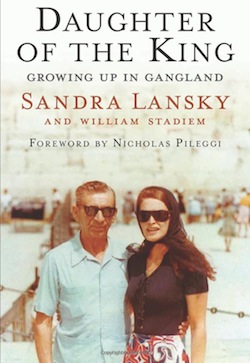
In Daughter of the King: Growing Up in Gangland (Weinstein Books), Sandra Lansky, assisted by writer William Stadiem, writes mostly about her own life. Along the way, she offers a complimentary portrait of her father.

Meyer Lansky got his start in booze and illegal gambling during Prohibition. Once liquor became legal, he became a nightclub impresario. At the front of the house, he had A-list entertainers; at the back, he ran glamorous but illegal gambling dens. He operated clubs with partners across the country. He was accused, but never convicted, of establishing his businesses through a network of associates who relied on graft, bribery and murder.

book cover - Daughter of the King
Similar to Bob Bossin, Sandra Lansky was also unaware of her father’s activities as she was growing up.

In the late 1950s, shortly before the Cuban Revolution, Lansky opened a luxurious casino in Havana. The good life evaporated after Fidel Castro shut down the casino in 1960. Once Lansky returned to Miami, Robert Kennedy and the FBI launched an aggressive crackdown on organized crime, with Lansky clearly a target. However, when he was finally brought to trial in 1973, he was acquitted.

Similar to Bossin, Lansky was also unaware of her father’s activities as she was growing up. She was a teenager before she heard anything about his reputation, and she never confronted him to find out if the accusations were true. A loyal and loving daughter, she portrays government efforts to stop gangland murders and illegal gambling as unwarranted campaigns against a hardworking businessman. For her, gangsters Frank Costello and Bugsy Siegel were uncles, not the kingpins of criminal networks.

Although she knew many of the mobsters, she includes no new revelations about the mob. Instead, she offers Oprah-type admissions about her upbringing as a spoiled rich kid, her torrid affairs with Dean Martin and others, her disastrous marriage and her drug addiction. With its irritatingly sassy tone and sordid tales of decadence, the book makes it difficult to like, or even be sympathetic, to any of the people in her life.

Her father moved much further away from his Jewish heritage than did Davy Bossin, so far that his daughter did not realize she was Jewish until she was a teenager. She writes that her parents did not see themselves as Jewish. But she relates that she found out her father in the late 1930s used his muscle men to break up Nazi rallies on the Upper East Side and helped mobilize dockworkers to root out Nazi sympathizers during the war. He also provided arms and money to Israel in 1948.

When authorities came after him in the 1950s, he responded viscerally to the barely concealed antisemitic and anti-immigrant bigotry of the crusaders. “I will not let you prosecute me because I am a Jew,” he defiantly told them. In the 1970s, he tried – unsuccessfully – to escape U.S. crime busters by claiming citizenship in Israel, where his grandparents were buried.

Meyer Lansky died of lung cancer at 81. Forbes had estimated his net worth at $300 million. But where was the money? The family never found it. At least, that’s what his daughter says.

Media consultant Robert Matas, a former Globe and Mail journalist, still reads books. Both of the books reviewed here are available at the Isaac Waldman Jewish Public Library. To reserve them, or any other, call 604-257-5181 or email [email protected]. To view the catalogue, visit jccgv.com and click on Isaac Waldman Library.

Posted on May 30, 2014May 30, 2014Author Robert MatasCategories BooksTags Bob Bossin, Daughter of the King, Davy Bossin, Davy the Punk, Meyer Lansky, Sandra Lansky
A Vancouver Jew in Camelot

A Vancouver Jew in Camelot

The cast of Spamalot, with Josh Epstein at centre, on one knee. (photo by David Cooper)

In any great adventure,
that you don’t want to lose,
victory depends upon the people that you choose.
So, listen, Arthur darling, closely to this news:
We won’t succeed on Broadway,
If you don’t have any Jews.

– Sir Robin, Spamalot

Of all the Monty Python films, perhaps none has deposited as many “Pythonisms” as Monty Python and the Holy Grail. Who can forget the airspeed of an African swallow, horse hoofs portrayed by empty coconut halves, the knights who say “ni,” the killer rabbit and, that old chestnut, “It’s only a flesh wound.”

Produced in 1975, Holy Grail was the second in a string of five successful Python films that included And Now for Something Completely Different (1971), Life of Brian (1979), Live at the Hollywood Bowl (1982) and The Meaning of Life (1983).

Funny thing is, although I’ve seen Holy Grail perhaps a dozen times over the years, I don’t recall the presence of a giant Magen David dangling in a spotlight as the cast sings, “You haven’t got a clue if you don’t have a Jew.” Call me crazy but I don’t think that was in the original.

But then Spamalot does not suggest that it’s anything other than a rip off (albeit lovingly done), so, although it’s based on the movie, be prepared for the use of monumental artistic licence. And yet, what better piece for physical comedian/actor/musical theatre devotee Josh Epstein to sing as he prances around the stage in one of the funniest performances you’ll see this year.

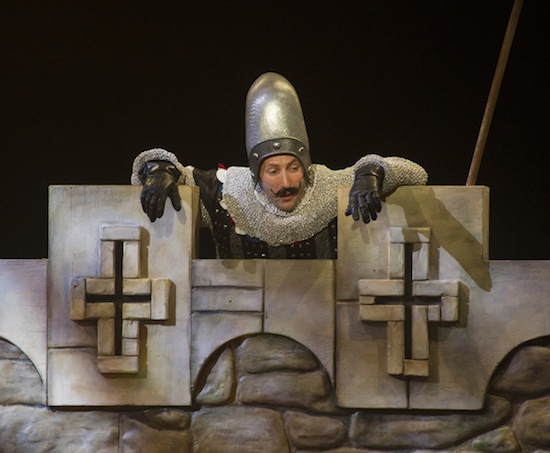
photo - Josh Epstein, as the taunting Frenchman in Spamalot
Josh Epstein, as the taunting Frenchman in Spamalot. (photo by David Cooper)

Epstein has already proven his prowess in memorable productions such as The Producers in 2008 and The 25th Annual Putnam County Spelling Bee in 2010. But seeing him frolic in chain mail, bedecked with Orlando Bloom hair, or hurling brilliant insults as a French soldier wearing the equivalent of a Conehead helmet, is gut-wrenchingly hysterical.

For those not familiar with the story, the plot centres on King Arthur’s attempt to round up some knights (or “ke-nicts” as Epstein mispronounces in his French “aksant”) to search for the grail. On his path, he encounters challenges of outrageous (in size and humor) proportions. He can’t even convince the local serfs that he deserves their respect as a king after relating how he acquired the title from the Lady of the Lake. “Strange women lying in ponds distributing swords is a bad way to choose a government,” he is told.

The hapless Arthur (David Marr) continues undaunted, however, eventually rounding up four knights – the Homicidally Brave Sir Lancelot (Jay Hindle); Sir Robin, the Not-Quite-So-Brave-as-Sir-Lancelot (Epstein); Sir Galahad, the Dashingly Handsome (Jonathan Winsby); and Sir Bedevere, the Strangely Flatulent (Ashley O’Connell). His biggest challenge comes when he is told by the knights who say “ni” that he can only continue his quest if he puts on a successful Broadway musical.

“Can it be done?” he asks Sir Robin. Yes, he responds, but only if you have Jews in the production. After all, “It’s a very small percentile who want to see a dancing gentile.”

Enter the Magen David, a menorah on a piano and four knights and one king who suddenly transform into Chassidic Yiddim.

As it turns out, Arthur’s sidekick Patsy is a member of the tribe, but has been keeping it a secret.

“It’s not the sort of thing you say to a heavily armed Christian,” he responds to Arthur when asked why he was not forthcoming.

Beyond the brilliant writing, kudos have to be given to choreographer Lisa Stevens and costume coordinator Rebekka Sorensen-Kjelstrup. The look, the sound and the dancing all elevate the production into stratospheric entertainment.

Monty Python’s Spamalot, with book and lyrics by Eric Idle, runs until June 29 at the Arts Club’s Stanley Industrial Alliance Stage, artsclub.com. Warning: profane language.

Baila Lazarus is a freelance writer, editor and photographer. Her work can be seen at orchiddesigns.net.

Format ImagePosted on May 23, 2014May 22, 2014Author Baila LazarusCategories Performing ArtsTags Josh Epstein, Monty Python, Spamalot
Amber Funk Barton premières piece with lululemon tie-in

Amber Funk Barton premières piece with lululemon tie-in

The Art of Stealing grew from Barton’s desire to explore what’s considered right and wrong in a post-apocalyptic world. (photo by Chris Barton)

When Amber Funk Barton was constantly dancing around her house at the age of 4, she didn’t realize that one day she would become a professional dancer and choreographer. But the Vancouver-born artist, now 33, is living her dream. Her latest production, The Art of Stealing, created by her choreography company, the response, premières on May 28 at the Firehall Arts Centre.

“I didn’t think I had a future as a professional dancer, I thought choreography was one way I could still be involved in dance,” said Barton. “My dream was to have my own company and to choreograph.”

The Art of Stealing grew from Barton’s desire to explore a dark theme, what she describes as a “post-apocalyptic world” and the difficulties in understanding what’s right and wrong in this haunted, mysterious future.

“The small picture is the obvious thing – the obvious literal act of stealing, that’s physical, taking something physical without consent,” she said. “I found it very interesting in this post-apocalyptic world that all of sudden it’s OK to steal – and if you don’t steal, you’re gonna die. It’s related to survival. On the bigger level, I started really thinking about it – the stealing that we can’t control at all – our time, our energy, our youth. Essentially to me, death is the ultimate thief in life.”

The 60-minute piece is the third full-length work that the response has created. Established in 2008, the company’s two previous pieces, RISK (2008) and Portraits and Scenes of Female Creatures (2011), also premièred at the Firehall.

photo - choreographer and dancer Amber Funk Barton
Choreographer and dancer Amber Funk Barton. (photo by Chris Barton)

Although Barton said she had been dancing since she was a little girl, she only started dancing professional at 21. Perhaps her maiden name, “Funk,” was a glimpse of the career trajectory her life would take.

But Barton isn’t just making her mark in the dance world. While creating the piece, she teamed up with active-wear clothing line lululemon’s innovation hub, called lululemon lab. “The lab is very inspired by different groups in the community and works with them to make functional fashion for people specifically in our community,” said Barton. She was introduced to Jean Okada, team director at lululemon lab, who was impressed by Barton’s creative piece.

“She came up with the idea that she would like to pitch what the lab calls a capsule collection. So they essentially designed our costumes,” said Barton. In addition to designing the dancers’ costumes, they created a collaborative clothing line, which launched last week, on May 16. “They’re selling it in stores and we’re wearing [that] same clothing on stage. It’s a really beautiful exchange,” Funk said. The clothing is in line with the dance piece’s theme – it’s dark and edgy and promotes Barton’s unique ideas about the struggle for survival in a dark world. The limited edition capsule collection produced three pieces for women and three for men and will be available only until the items are sold out.

“First of all, having a line designed is beyond what I was imaging in the first place. It was amazing. They had such respect for what we were doing as artists. They asked dancers thorough questions, what our needs are. I was able to share images and whatever I had collected in terms of inspiration. They actually took what I wanted and integrated it into the line. I was part of fittings. It was beyond what I was hoping for,” said Barton.

Reflecting on her beginnings and how far she’s come, Barton said, “I started dancing probably around 4 years old and it was with ballet and I had some kind of alignment issues. I had weak mobility in my legs so the doctor recommended ice skating or dance to strengthen the alignment of my legs. My mom noticed I was dancing around the house all the time anyways and she also didn’t want to sit in an ice rink at 5 a.m., so she enrolled me in ballet classes and that’s basically how it all started.”

Now, she wants to focus on choreography and creating more unique pieces, as she embarks on what she calls her “mid-career artist years.”

“I feel very fortunate and very grateful,” she said. “My company is a small, project-based company. It’s like a little home where I can make what I’m interested in and make my art. Sometimes I just pinch myself.”

The Art of Stealing is on stage May 28-31 at the Firehall Arts Centre. There is an artist talk back after the performance on Thursday, May 29. For tickets, contact the Firehall at 604-689-0926 or visit firehallartscentre.ca.

Vicky Tobianah is a freelance writer and editor based in Toronto. Connect with her on Twitter, @vicktob, or at [email protected].

Format ImagePosted on May 23, 2014May 22, 2014Author Vicky TobianahCategories Performing ArtsTags Amber Funk Barton, Firehall Arts Centre, lululemon, The Art of Stealing, the response
Reenvisioning women at the Zack

Reenvisioning women at the Zack

The centrepieces of the show, two large paintings by Jazmin Sasky, are both based on Anita Diamant’s novel The Red Tent. (photo by Olga Livshin)

Across centuries, artists in different countries have depicted women in their multiple incarnations – among them, mother, muse, beloved, temptress. The new show at the Sidney and Gertrude Zack Gallery, called Envisioning Women, brings a new slant to the theme: how 21st-century Canadian artists see women.

The centrepieces of the show, two large paintings by Jazmin Sasky, are both based on Anita Diamant’s novel The Red Tent and, therefore, on the Torah. The women in the paintings could be just as easily from biblical or contemporary times, friends going on a camping trip or visiting a spa. The paintings’ festive red palette with its multiple nuances communicates the women’s contentment at being together, sharing the space. While the red tent in the novel refers to a place reserved for the females of the tribe, a place where they find mutual support and encouragement, in the paintings, the space alludes to a wider interpretation.

“I explored the sisterhood of women,” said Sasky. “It’s as relevant today as it was then, although in the biblical times, they all lived together. No secrets were possible, unlike us. We are much more private, but it was interesting to imagine those women, their lives.”

Her women don’t belong exclusively to the ancient tribe. They also live in the here and now, share our workspace and our holidays, walk along the same streets and into the same buildings. They are not afraid of change, of bursting out of the artificial confines of the “red tent” and into life.

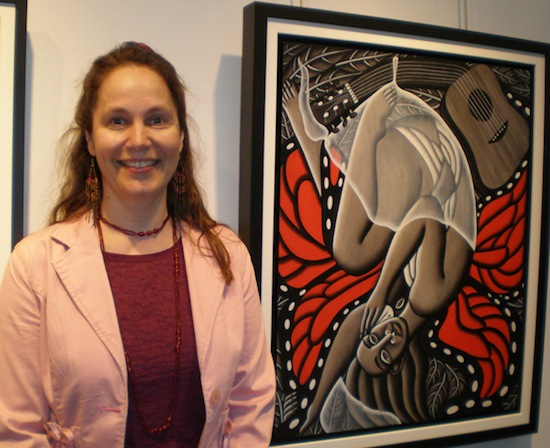
photo - In Lori-Ann Latremouille’s “Emerging,” a woman transforms out of her restrictive silken shroud into wings and the world
In Lori-Ann Latremouille’s “Emerging,” a woman transforms out of her restrictive silken shroud into wings and the world. (photo by Olga Livshin)

This courage and strength resonates in many other works in the show. The women in them assert their place in history and are willing to rebel, if necessary.

Nancy Henderson’s painting with the title “Sk8r grrl one” is one example of such a rebellion. It depicts a young female hockey player in a ridiculous costume of the beginning of the 20th century. The artist’s fiery words about her work read as a tribute to every Canadian woman: “I salute women of every generation who have defied everything from societal disapproval to outright bullying in order to get into every game, including the great frozen one.”

Carly Belzberg’s “Eve” doesn’t look like a traditional Eve of old either. This Eve participates; she gets into games. In her shorts and a tank top, sitting in a meditation pose, perhaps doing yoga, she is not afraid of the world unfolding around her, and her quiet courage transmits to everyone who comes into the gallery.

Life is changing, and we’re changing with it, coming out of our traditional cocoon of domesticity, where women were confined (by choice and not) for generations – that seems to be the message of the show.

Lori-Ann Latremouille’s painting “Emerging” embodies this idea. Her woman is transforming out of her restrictive silken shroud into wings and the world. She will fly and sing, and the guitar incorporated into the image signifies the connection between music and freedom. “Rebirth after dormancy,” commented the artist. Not surprisingly, she is a professional musician herself, and her painting is a story of metamorphosis. “It’s a new painting technique for me, too. I used to do drawings,” she said.

photo - In her photography, Kathryn Gibson O’Regan tries to “find what unites women of all times and cultures”
In her photography, Kathryn Gibson O’Regan tries to “find what unites women of all times and cultures.” (photo by Olga Livshin)

The line of timelessness, of connectivity, continues in Kathryn Gibson O’Regan’s serene photographs. “I travel a lot and always try to find what unites women of all times and cultures. Creativity is common: weaving and spinning and making textiles, from the Bible to our times. I visited villages in many countries in Asia.” Her photos of the weavers in India and Thailand emanate peacefulness, their deep colors soft and bright simultaneously.

In contrast, there is little that is peaceful in Linda Lewis’ display of pottery cups. Each one has a face painted on it, or rather a hint of a face, the eyes. They are called collectively “Hints.” About two dozen of the cups are arranged in two glass cases in the middle of the gallery, similar in shape and size, but varied in their facial expression. Some cups stand in groups, like friends gossiping. Others are alone, in pain or pleasure. Still others resemble family clans, with love and antipathy intermixed. The whimsical complexity of women’s lives in pottery is fresh and unexpected.

It’s impossible in a short article to tell about each of the 15 artists participating in the exhibit – all of them add their unique perspective to the image of “contemporary woman,” and readers are encouraged to visit the gallery. Unfortunately, they won’t be able to experience one aspect of the show – the JCC Shalom Dancers. As the exhibit is in collaboration with Festival Ha’Rikud, its opening night featured a group of young dancers, led by Marla Simcoff and Jessica Bradbury, who presented a short but beautiful routine, a teaser of their full-length performance. Six young women in long black dresses, trimmed with red and yellow, with large red fans, danced in the atrium of the community centre, bringing dramatic energy and gladness to gallery patrons. They were the real-life embodiment of the paintings, women of the 21st century.

Envisioning Women will be on display until May 25.

Olga Livshin is a Vancouver freelance writer. She can be reached at [email protected].
 

Format ImagePosted on May 16, 2014May 14, 2014Author Olga LivshinCategories Visual ArtsTags Carly Belzberg, Envisioning Women, Festival Ha’Rikud, Jazmin Sasky, JCC Shalom Dancers, Jessica Bradbury, Kathryn Gibson O’Regan, Lori-Ann Latremouille, Marla Simcoff, Nancy Henderson, Zack Gallery

Posts pagination

Previous page Page 1 … Page 154 Page 155 Page 156 … Page 160 Next page
Proudly powered by WordPress