Skip to content
  • Home
  • Subscribe / donate
  • Events calendar
  • News
    • Local
    • National
    • Israel
    • World
    • עניין בחדשות
      A roundup of news in Canada and further afield, in Hebrew.
  • Opinion
    • From the JI
    • Op-Ed
  • Arts & Culture
    • Performing Arts
    • Music
    • Books
    • Visual Arts
    • TV & Film
  • Life
    • Celebrating the Holidays
    • Travel
    • The Daily Snooze
      Cartoons by Jacob Samuel
    • Mystery Photo
      Help the JI and JMABC fill in the gaps in our archives.
  • Community Links
    • Organizations, Etc.
    • Other News Sources & Blogs
    • Business Directory
  • FAQ
  • JI Chai Celebration
  • JI@88! video

Recent Posts

  • Sharing her testimony
  • Fall fight takes leap forward
  • The balancing of rights
  • Multiple Tony n’ Tina roles
  • Stories of trauma, resilience
  • Celebrate our culture
  • A responsibility to help
  • What wellness means at JCC
  • Together in mourning
  • Downhill after Trump?
  • Birth control even easier now
  • Eco-Sisters mentorship
  • Unexpected discoveries
  • Study’s results hopeful
  • Bad behaviour affects us all
  • Thankful for the police
  • UBC needs a wake-up call
  • Recalling a shining star
  • Sleep well …
  • BGU fosters startup culture
  • Photography and glass
  • Is it the end of an era?
  • Taking life a step at a time
  • Nakba exhibit biased
  • Film festival starts next week
  • Musical with heart and soul
  • Rabbi marks 13 years
  • Keeper of VTT’s history
  • Gala fêtes Infeld’s 20th
  • Building JWest together
  • Challah Mom comes to Vancouver
  • What to do about media bias
  • Education offers hope
  • Remembrance – a moral act
  • What makes us human
  • המלחמות של נתניהו וטראמפ

Archives

Follow @JewishIndie
image - The CJN - Visit Us Banner - 300x600 - 101625

Byline: The Editorial Board

Pragmatic, dirty choices

Franklin Roosevelt famously replied to his secretary of state’s assessment of the Nicaraguan strongman Anastasio Somoza Debayle – “Somoza’s a bastard!” – with the rejoinder “Yes, but he’s our bastard.”

Politics makes strange bedfellows. International relations perhaps even more so. The world today is an intricate puzzle of interlocking and disparate pieces. It was, frankly, cleaner and clearer in the days of FDR, when there was just “us” and “them.” Let it not be overlooked though, that when “them” meant the Nazis, Stalin was among those counted as “us.” Stalin was evil, but he helped defeat Nazism. Is the Western world soiled by our partnership with him? Certainly. Would we choose an alternative history had we the chance? What alternative?

The Liberal government of Prime Minister Justin Trudeau inherited from the Conservative government of Stephen Harper (among other things) a hot potato in the form of an arms deal with Saudi Arabia.

The previous Conservative government facilitated what is the largest single Canadian manufacturing-export deal ever. General Dynamics Land Systems of London, Ont., will provide light armored vehicles to the Saudi military – a military that helped crush Arab Spring-related uprisings in neighboring Bahrain and in the Shiite areas of eastern Saudi Arabia. The Saudis are also accused of indiscriminate killings in Yemen, where they are fighting Iran-backed Islamists.

It deserves to be said that Saudi Arabia relies on trade with customers like Canada because, despite being the world’s second largest oil-producing nation, the Saudis have failed to parlay that windfall into anything lasting. Canada still exports too many raw materials that could be processed at home and sold abroad at added value but, compared with Saudi Arabia, we are the model of a diversified economy. Since the Saudi oil boom began, the country has invested nearly nothing in anything else, unless exporting Wahhabism is a tertiary industry, which, actually, it seems to be.

Famous for publicly scything off the heads of political dissidents, adulterers and others who in the West would be described as next-door neighbors, Saudi Arabia is now pushing to step up executions of gay people because social media is “making too many homosexuals.”

Despite the cuckoo United Nations logic that says Israel is the world’s top human rights violator, Saudi Arabia is actually a perpetrator of some of the world’s most atrocious abuses of human rights, from the extreme (public beheadings) to the mundane (if you consider the right of women to drive cars or show their faces in public mundane).

Paraphrasing FDR, Saudi Arabia is a bastard.

This seems to be the general consensus and helps explain why the (comparatively) new Liberal government is awkward in its defence of the $15 billion arms deal.

Trudeau has said that annulling the deal would hurt Canada’s reputation and, indeed, a democratic government that reneges on the deals made by its predecessors is treading on ice. Future potential customers could well think twice if Canada had a reputation for backing out of major trade deals when the government changes.

On this side of the pragmatic divide, the deal also means about 3,000 jobs for 15 years in southwestern Ontario. So, the Liberal government has made little defence of its decision other than relying on economics and the decency of sticking with a signed deal.

In the National Post last week, Lawrence Solomon made a different case – a moral case – for sticking with the deal. He argues that Saudi Arabia, however repugnant its internal policies may be, is on the frontlines of combating terror in the form of ISIS, Iran and associated menaces and, therefore, deserves our support.

This is a comparatively novel idea. The Canadian government is taking refuge in excuses that the previous government made a deal, that Canadian jobs are at stake and that it has no option. A cartoon in the Toronto Star depicted Trudeau declaring, “My hands are tied” next to a blindfolded victim being led to his beheading, saying, “I know how you feel.”

Yet maybe Trudeau’s argument should have been more along the lines of Solomon’s. It is not impossible, using some creative logic as Solomon did, to make the case that selling military equipment to the Saudis is in our national interest. Do we wish it were not so? In an ideal world, all our allies would be righteous and all our enemies defeated. But, in a real world as fractured and dangerous as ours, choosing to support unsavory allies to defeat unsavory enemies may be something we need to learn to swallow.

The legendary FDR quote is held up as a model of foreign policy pragmatism, if not ruthlessness. Canadians – especially this lily-white new government – like to think of ourselves as above such sullying choices. If we want to have the impact in the world that Trudeau seemed to be referencing with his “Canada is back” sloganeering, he may have to admit that sometimes we need to get our hands dirty.

At the very least, tough choices should be confronted, not shirked. If it is immoral and wrong to sell military equipment to the Saudis, we shouldn’t do it, and damn the consequences. If it is justifiable on the grounds that the enemy of my enemy is my friend, then we should trade with the Saudis and make our moral case clearly. But we should not try to have it both ways, slapping down the Saudis with one hand while taking their money with the other.


Posted on April 8, 2016April 6, 2016Author The Editorial BoardCategories From the JITags arms deal, FDR, Lawrence Solomon, Roosevelt, Saudi Arabia, Trudeau

In the UN, on campus

Canada’s foreign minister has called on the United Nations Human Rights Council to review the appointment of Canadian law professor Michael Lynk as its special rapporteur on human rights in Palestine.

Last week, Stéphane Dion tweeted (because that is how diplomacy happens these days): “We call on @UN_HRC President to review this appointment & ensure Special Rapporteur has track record that can advance peace in region #HRC.”

The Centre for Israel and Jewish Affairs has denounced the appointment of the University of Western Ontario academic, who has been associated with anti-Israel activities in Canada. Lynk has said that Israel should be prosecuted for “war crimes,” he accused Israel of “ethnic cleansing,” has spoken at conferences that reject a two-state solution and serves as a leader in a group that promotes Israel Apartheid Week.

While Dion questioned the wisdom of appointing Lynk, CIJA went further, arguing that the position itself is illegitimate.

“It is ludicrous that this is the UN’s only special rapporteur focused on the human rights of a particular community,” said Shimon Koffler Fogel, CIJA’s chief executive officer. “It is likewise shameful that the special rapporteur refuses to investigate the abuse of Palestinian rights by the Palestinian leadership, particularly Hamas in Gaza. In so doing, the special rapporteur obscures genuine human rights violations in the Middle East and the underlying obstacles to Israeli-Palestinian peace.”

A related conflict blew up in academia last week. Just as the appointment of an avowed anti-Zionist as UN rapporteur surely will not advance peace between Israelis and Palestinians, the complete disavowal of the existence of antisemitism on campuses will not promote intellectual discourse or peace.

In the wake of ongoing efforts by the BDS movement to boycott Israeli academics and force universities to divest from Israeli holdings, while occasionally nastily intimidating Jewish students on campuses across North America, the University of California board of regents recently passed a statement condemning antisemitism, along with 10 principles against intolerance as a whole. It is the result of several months’ research and consultation.

The statement that introduces the principles is an amended version of an earlier expression that would have condemned anti-Zionism. Instead, it condemns “antisemitic forms of anti-Zionism.” If the only state in the world targeted for elimination is the only Jewish one, it should be an uphill battle to continue the charade that anti-Zionism is not equivalent to antisemitism, or at least driven by it to a large degree. Nevertheless, the regents’ statement is a starting point for increased civility on campuses that have seen, they note, “an increase in incidents reflecting antisemitism…. These reported incidents included vandalism targeting property associated with Jewish people or Judaism; challenges to the candidacies of Jewish students seeking to assume representative positions within student government; political, intellectual and social dialogue that is antisemitic; and social exclusion and stereotyping.”

Some critics say the statement is designed to stifle opposition to Israeli policies. Others say it could harm free speech. Yet others say it didn’t go far enough, in that it didn’t condemn bigotry against other specific groups.

None of these objections holds water. While the working group’s report might have been initiated by concerns over antisemitism, the document speaks to many other forms of intolerance: “University policy prohibits discrimination based on race, color, national origin, religion, sex, gender, gender expression, gender identity, pregnancy, physical or mental disability, medical condition (cancer-related or genetic characteristics), genetic information (including family medical history), ancestry, marital status, age, sexual orientation, citizenship, service in the uniformed services, or the intersection of any of these factors.”

As for free speech, including, presumably, that about Israel, the document stresses the importance of freedom of expression and of inquiry: “The university will vigorously defend the principles of the First Amendment and academic freedom against any efforts to subvert or abridge them.” And, it notes: “Each member of the university community is entitled to speak, to be heard and to be engaged based on the merits of their views, and unburdened by historical biases, stereotypes and prejudices.”

But: “Regardless of whether one has a legal right to speak in a manner that reflects bias, stereotypes, prejudice and intolerance, each member of the university community is expected to consider his or her responsibilities as well as his or her rights … mutual respect and civility within debate and dialogue advance the mission of the university, advance each of us as learners and teachers, and advance a democratic society.”

The UN – and many others – could learn a thing or two from UC’s regents.

Posted on April 1, 2016March 31, 2016Author The Editorial BoardCategories From the JITags antisemitism, BDS, boycott, CIJA, free speech, Israel, Koffler, racism, United Nations
Trump at what cost?

Trump at what cost?

“I didn’t come here tonight to pander to you about Israel,” Donald Trump told the AIPAC conference Monday evening, before proceeding to do exactly that.

In his unique rhetorical way, Trump ticked off every box on the AIPAC agenda, and then some. He also ticked off a number of rabbis and other delegates who condemned and protested his presence at the event. Trump’s history of making statements that are sexist and racist, his sluggishness at disavowing the support of neo-Nazis and Ku Klux Klanners, his making fun of a disabled reporter and a litany of other offences convinced some AIPAC attendees that Trump should be either disinvited or boycotted.

They were wrong, because this was an opportunity for Trump to clarify or otherwise explain his behaviors. Of course, he didn’t, which was an opportunity missed. Trump came on – uncharacteristically – with a prepared text distributed in advance to media. What he read was a fulsome reversal of his statement just days earlier that he would be neutral between Israel and the Palestinians.

Trump’s repeated invocation of the term “believe me” is almost a verbal tic and it belies a tendency to express the unbelievable.

“Nobody respects women more than I do,” Trump told CNN Monday night. If we were to believe him, women would be among the only people Trump seems to respect. When any individual criticizes him, Trump lashes out with the most juvenile, personal and insulting terms, not least repeatedly referring to his fellow Republicans Cruz and Rubio as “Lying Ted” and “Little Marco.”

Within days, Trump pivoted from “neutrality” to a no-holds-barred defence of Israel that would make Binyamin Netanyahu (whom Trump calls “Bibby”) blush. The response he received from the AIPAC crowd verged on enthusiastic. Yet his conversion to Zionism may reflect little more than some good advice, a comparatively competent speechwriter and the ability to unabashedly pander.

Trump promised to dismantle the nuclear deal with Iran and he trashed the United Nations. “When I’m president, believe me, I will veto any attempt by the UN to impose its will on the Jewish state,” he said.

He condemned the Palestinian incitement of children to hate Israel and Jews. “In Palestinian textbooks and mosques, you’ve got a culture of hatred that has been fomenting there for years,” he said.

He promised to move the American embassy to Jerusalem.

In what amounted to his first significant expression of foreign policy, Trump waded in deep. He wants to reduce American commitments to NATO, specifically citing NATO’s obligation to defend Ukraine. What he doesn’t understand or doesn’t care about is that the United States and Britain made a deal with Ukraine – then the world’s third-largest nuclear power – to eliminate its arsenal in exchange for a promise of protection. Global reaction to Russian aggression betrayed that promise and Trump wants to rub salt in the wound.

This is an example of Trump’s lack of awareness on international affairs. Yet it is unlikely to hurt him with supporters, who forgive his every error and offence and who sometimes seem to idealize a world free of non-Americans.

On CNN after the speech, Trump was asked about the expressions of support he has received from neo-Nazis, Ku Klux Klanners and antisemites. “I don’t want their support,” he said, adding: “I don’t need their support.”

Trump is indeed creaming his opponents in the primaries, and it may be a minor rhetorical thing, but would he take their support if he did need it?

Asked by Wolf Blitzer whether he would condemn violence by his supporters, Trump replied, “Of course I would, 100%, but … I have no control over the people.” Then he went on to note that “these people” have been disenfranchised – they lost their jobs and earn less money now than they did 12 years ago, as though this justified violence.

Had Trump’s AIPAC speech occurred in a vacuum – if he had just landed from the proverbial Mars and not for months been spouting hatred toward Muslims, Mexicans, women and anyone who opposes him – the speech might have deserved the applause it received.

Instead, his words were diametrically opposed to what he has said in the past and, even if they weren’t, they are coming from an individual who has done egregious harm to social relations and human decency in public discourse. Even if Trump said everything Jewish people and other friends of Israel wanted to hear, this would not detract from the other things he has said and the other people – including every Muslim in the world – he has deliberately and maliciously affronted.

“I’m going to be great for Israel,” Trump declared, and maybe he would be. But at what cost to the social fabric of his country and the place of the United States in the world?

“When I say something, I mean it, I mean it,” he crowed, despite his blatant reversals. “Believe me, believe me.”

Format ImagePosted on March 25, 2016March 24, 2016Author The Editorial BoardCategories From the JITags AIPAC, elections, Israel, Trump

Must confront issues

Angela Merkel’s Christian Democratic Union suffered dramatically in state elections in Germany last weekend. The German chancellor’s party received a brutal admonishment from voters, who concurrently gave startlingly strong support to a far-right, anti-immigrant party that is almost brand new to the scene.

The election was a referendum, to a large extent, on Merkel’s liberal approach to refugees from the Middle East. Last year, 1.1 million refugees streamed into Germany after often perilous journeys from the eastern Mediterranean. At the current rate, this year could see even more arrive unless, as some even in Merkel’s own coalition argue, border controls are imposed.

Still, there is no question that Germans – and everyone else on the continent – are confounded by the challenges created by refugees flowing in from Syria, Iraq and elsewhere in the Middle East. Merkel is in the process of negotiating with Turkey a cash deal that would see Turkey offer an alternative destination for those set on Europe. Yet even that would not allay all the concerns among Europeans and others in the West.

Are there potential terrorists among the millions of people on the move? It would be a foolhardy terror leader who would miss the opportunity to plant some agents in the West when an opportunity so ripe as the current porous borders presents itself, so almost certainly. But terrorists will find their marks even if it is not so convenient – and many of the perpetrators of European terror in recent years have legitimately been in the countries they attacked. Some were even citizens. The seriousness of this potential should not be diminished, but neither should we lull ourselves into believing that stanching the refugee flow would eliminate the terror problem.

As we have noted previously, more prevalent dangers may come in the form of some refugees’ attitudes and approaches to women and minorities. Violence (most notably a huge number of sexual assaults on New Year’s Eve) and other anti-social behaviors being reported suggest that there will be a serious challenge integrating some refugees into societies where expectations of women’s and men’s behaviors are radically different than in Syria and Iraq.

Then there are the economic realities, which have been remarkably glossed over. Before 9/11, opponents of admitting immigrants and refugees could be depended upon to raise fears of unemployment and abuse of social services. Thanks to the real or inflated threat of Islamist terror, economics seems to have been eclipsed. Even Donald Trump, whose campaign plays on every imaginable fear of difference or diversity, has limited his hate-fueled anti-Muslim rhetoric almost exclusively to the terror motif. In his mind, evidently, Mexicans take jobs, Muslims are terrorists.

Yet neither Trump’s xenophobia nor Merkel’s open-handedness will solve the underlying problems of war and despair that drive people to risk their lives to reach Europe or the Americas. And even if that crisis were to be solved which, despite U.S. Secretary of State John Kerry’s efforts, seems remote, we need to remind ourselves of a larger issue still.

We are one world. A country may once have been able to close its borders and seal itself off from the rest of humankind. The 20th-century fate of the Jews of Europe is the most memorable reminder that this was once true. But no more. We can set policies and even build walls, but we are part of an irrevocably interconnected and interdependent world. Efforts to stop the advance of this reality will ultimately be futile, even if they were desirable.

We need to find a way to get along. There could hardly be a more simplistic statement, but it is nonetheless true. We need to find ways to coexist inter-culturally and intra-culturally. With those who are coming to Europe and North America, we need to engage in a deep and committed dialogue to find common ground and we must not be afraid, as Canadians so often are, of confronting cultural differences, because ignoring them will cause problems, not solve them.

Posted on March 18, 2016March 16, 2016Author The Editorial BoardCategories From the JITags Angela Merkel, antisemitism, elections, Germany, racism, refugees

Proudly in the middle

Slovakia’s elections on the weekend ushered into parliament for the first time a far-right neo-Nazi party of the sort that have made inroads in various parts of Europe over recent years. About the same time this was making news, Donald Trump urged supporters at a rally in Florida to raise their right hands in a pledge to vote. The ensuing scene was – as any sensible person would have foreseen – eerily redolent of a Nazi rally.

Since the collapse of the bipolar Cold War-era status quo, global politics has been unstable. Common enemies make for strange bedfellows and temporary alliances have been the pragmatic responses to regional brushfires, such as the alignment of Shia and Sunni Muslim factions with, respectively, Russian and Western powers. Some Sunni Muslim powers have even been making pleasant noises toward Israel, seeing it as an ally, however unlikely, against the Iranian menace.

These tactical alliances are taking place at a molecular level, too, if we can put it that way. Not only are strange alliances forming between nation-states (and, in some cases, non-state players like Iranian-backed Hezbollah and the Western-backed Free Syrian Army), but ideologies are merging at the edges. The far-right and the far-left, in some instances, are almost indistinguishable.

In their historical forms, communism and fascism in the form of Stalinism and Hitlerism, were the most adamant of enemies. Until they weren’t, thanks to a non-aggression pact, and then they were again, thanks to Hitler’s abrogation of the pact. For the great majority of people in the West who are democrats (whether liberal, conservative, libertarian, social democratic or whatever) the two ends of the political spectrum can look very similar. Both have been responsible for genocides causing millions of deaths and neither respects the human being’s right to individual freedoms.

From a Canadian perspective, we have been blessedly free of anything more than weak startup movements of the far-left and the far-right. The communist party, under different names, had minimal electoral success in the 1930s and 1940s. When the antisemitic far-right permeated the Social Credit movement and later the Reform party, they were fairly successfully shut down. Canada is a place of moderation, a trait we bear smugly (and, therefore, without our alleged national humility) while watching the machinations of American politics today.

Today’s far-left and far-right, which are more recognizable in their traditional forms in Europe, nevertheless have traded off some characteristics. In some instances, European far-right parties, who are almost unanimously anti-immigrant and anti-Muslim, have adopted a convenient philosemitism and pro-Zionism, seeing Israel as a bulwark against radical Islam. At the same time, we are witnessing a growth of not only anti-Zionism but overt antisemitism among components of the left. Notably, the Labor Club at Oxford University, the campus arm of Britain’s second-largest political party, has been recently criticized. According to reports, Oxford Laborites mocked Jewish victims of the Paris terror attacks, made light of Auschwitz, expressed solidarity with Hamas and defended the killing of Israeli civilians, routinely employ the term “Zio,” a slang for Zionist that is usually found only on the most extreme websites, and a former co-chair of the club has said that “most accusations of antisemitism are just the Zionists crying wolf.” It is little solace that the antisemitism seems to have emanated from the Momentum movement, a hard-left stream within the Labor party headed by Jeremy Corbyn, the party leader.

The Oxford debacle is among the most public of countless incidents of Jew-baiting and Jew-hating on the left, but there is much cross-pollination between groups like those who hold Israel Apartheid Weeks and other groups that proudly march under the “progressive” standard.

Antisemitism, it is so often said, is an early symptom of a societal sickness, the first sign of crazy. This is a bit simplistic, though, because antisemitism is so unique, so capable of metastasizing into whatever form of scapegoat a society requires, so ubiquitous and yet still so fundamentally not understood, that blanket statements about it are a fool’s game.

Perhaps it is safe to say this: antisemitism exists in many places, but it is now and has perhaps always been most prevalent at the fringes of the political spectrum. No one should be surprised that it is a dominant characteristic of the far-right as well as the far-left, particularly when those terms themselves seem to have more overlap, or at least more fluidity, than perhaps ever before.

Extremists exist in Canada, as they do elsewhere in the world, and so, too, do inequality and other social issues that have the ability to polarize us, if we let them. But, extremism does not seem to be intrinsic to our land. This good fortune is something we must not take for granted. While people may joke – an example, Why did the Canadian cross the road? To get in the middle! – we have a lot of which to be proud, and something valuable worth protecting. We also, perhaps, have something to teach the world about tolerance and moderation.

Posted on March 11, 2016March 10, 2016Author The Editorial BoardCategories From the JITags antisemitism, Canada, communism, extremism, fascism, Oxford

BDS condemned

The House of Commons this month voted overwhelmingly to condemn BDS, the movement that aims to boycott, divest from and sanction Israel.

The motion, put forward by Conservative members of Parliament Tony Clement and Michelle Rempel, reads fairly simply: “That, given Canada and Israel share a long history of friendship as well as economic and diplomatic relations, the House reject the BDS movement, which promotes the demonization and delegitimization of the state of Israel, and call upon the government to condemn any and all attempts by Canadian organizations, groups or individuals to promote the BDS movement, both here at home and abroad.”

The Liberal government backed the motion while the New Democrats and Bloc Quebecois opposed it, leading to a lopsided 229-51 victory.

A handful of Liberal MPs abstained and two voted against, but the vast majority of government members backed the Conservative motion. Two NDP MPs abstained from their party’s otherwise monolithic opposition to the motion. Both are Vancouver-area MPs – Vancouver Kingsway’s Don Davies and Port Moody-Coquitlam’s Fin Donnelly.

Supporters of the motion expressed views that have been prominent in these pages in recent weeks: that BDS unfairly targets one side in a conflict, that it is counterproductive and possibly based on bigotry. Opponents of the motion took a more novel approach.

NDP leader Thomas Mulcair said, “This goes against the freedom of expression we hold so dear in our society … to call upon the government to condemn someone for having that opinion, that’s unheard of.” He said the motion “makes it a thought crime to express an opinion” and contended that it is fair to disagree with BDS and still debate its arguments.

We like to think that you would be hard-pressed to find a more thoroughgoing defence of free expression than has appeared in this space over the past 20 years, and even longer. We have routinely taken a stand for open expression when some readers and community leaders urged variations on censorship. Yet the NDP leader’s defence of free expression is confused at best.

The motion does not make it illegal to support BDS. If it did, we would be out with our figurative pitchforks and torches opposing it. What the motion does is condemn a despicable idea. And here is where so many people who claim to support free expression in principle actually screw it up in the execution.

Mulcair argued that we should be able to debate BDS. That is precisely what Parliament did through this motion. He argued that his party does not support BDS, merely free speech. Leaving aside that several unions that support the NDP also support BDS, and that the NDP is the natural home in Canadian politics for anyone else who believes in BDS, his circumlocution on our sacred freedoms provides a tidy cover for avoiding the real issue that could paint his party into a corner: some – a few? a lot? a majority? – of his party members and MPs do, in fact, support the BDS movement. So, to avoid condemning BDS and perhaps alienating party members and supporters, he cloaked himself in a non sequitur of free expression, debasing the very value he claimed to be defending.

Too often, when unpopular views are expressed, those who might be counted upon to contest them abdicate that responsibility, defaulting to the argument that bad ideas are protected by our values of free expression. Indeed, they are. But so, too, are good ideas!

Supporters of BDS absolutely have a right to express their views. And, although it seems difficult for Mulcair to comprehend, so do its opponents. Every Canadian has a right to express their opinion within limitations around which our society has largely developed a consensus. Elected officials not only have a right, but an obligation to do so. A parliamentary motion condemning a terrible idea does not detract from anyone’s right to express and support that bad idea. In fact, it is the embodiment of free speech in action.

Posted on March 4, 2016March 3, 2016Author The Editorial BoardCategories From the JITags antisemitism, BDS, boycott, free speech, Israel, Mulcair, NDP
Let’s talk about Nini …

Let’s talk about Nini …

Screenshot of Noa’s official website, where she shows that she retains a sense of humor towards the press: “Believe half of what you hear and nothing of what you read! :)”

Internationally known, award-winning Israeli singer and songwriter Achinoam Nini – who has served in the Israel Defence Forces, who has been a goodwill ambassador for Israel and who has been honored for her peace work – has been invited to headline the Vancouver Jewish community’s Yom Ha’atzmaut celebrations this year. Apparently, this is a controversial choice for some in our community.

Nini (widely known as Noa) is clear about her political views and, so far, her critics have come up with the following to explain their upset at her invitation. She hates – a strong word, but it applies in this case from what we’ve read – Israeli Prime Minister Binyamin Netanyahu. She rejected an award from one artists organization and resigned from another because they honored someone she thought was too right-wing. She may have written in a since-deleted Facebook post that she supported B’Tselem, Breaking the Silence and New Israel Fund for their work supporting peace. In 2012, she expressed hope that Palestinian leader Mahmoud Abbas could help bring peace to the region. Also in 2012, she took part in an alternative Remembrance Day event organized by Combatants for Peace, which describes itself as “a group of Palestinians and Israelis who have taken an active part in the cycle of violence in our region: Israeli soldiers serving in the IDF and Palestinians as combatants fighting to free their country, Palestine, from the Israeli occupation.” The ceremony mourned Palestinians and Israelis who had been killed in the conflict.

One of her critics has compiled a curious mix of her posts to supposedly show why she is an inappropriate choice to perform, including: “We believe in two states for two peoples, Israel and Palestine, living side by side, supporting, protecting and nurturing each other…. We believe in three simple steps: recognize each other, apologize to each other and share the little we have.” We, too, believe in two states for two peoples, and in reconciliation.

With plenty of Vancouverites apparently scouring the internet for “evidence” against her, there may be more to come. Nini’s political views are not above criticism. Nobody’s are. But she stands behind her opinions, acts on her beliefs, and is very clear about who she supports – some people might be surprised that B’Tselem and Breaking the Silence are not among those listed on her website as groups she endorses – and who she doesn’t support. Unlike some of her local critics, who are hiding behind the anonymity of social media and don’t put their names and reputations behind their opinions, Nini owns her views. Whether or not you agree with her, that’s worth respect.

Should we be inviting someone with whom we don’t all agree to headline our Yom Ha’atzmaut ceremonies? What about someone who criticizes the Israeli government?

We who love and support Israel understand that holding a large community-wide celebration once a year feels good and offers a sense of solidarity. But what kind of Jewish community is it that doesn’t brook differences in opinion? Such uniformity certainly does not reflect one of Israel’s – and Judaism’s – greatest attributes and secrets to continuity: openness to debate and discussion.

Skipping over what Judaism says about character assassination, the harm that can be done with words, the fact that lashon hara is worse than theft because money can be repaid but the destruction of a person’s reputation can never be completely mended, is there a line that shouldn’t be crossed when making out a Yom Ha’atzmaut invitation list?

As we argued in this space last week, it is our view that boycott, divestment and sanction (BDS) is a movement steeped in racism (though not everyone who supports BDS is an antisemite, of course). Rightly, Canada, the United Kingdom and other democratic countries formally condemn BDS. If we were to draw a red line not to be crossed, support for BDS might qualify as a deciding factor in whether or not to bring an artist to perform at a Yom Ha’atzmaut – or any – event. It also might not.

Despite what the emails in your inbox might say, Nini has explicitly said that she is against BDS. At most, she might associate with groups that might have supporters that also support BDS – groups that are legal in Israel and part of the vital discourse there.

In a democracy, all voices that don’t incite hatred against an identifiable group are to be, if not welcomed, at least tolerated. This includes those who believe that Nini should not sing for Vancouverites on Yom Ha’atzmaut this year. However, the right to speak is not predicated on being right. This applies to Nini as well as her detractors.

Some people are demanding that the invitation for Nini to perform at our Yom Ha’atzmaut celebrations be rescinded. If successful, it won’t matter much to Israel’s future, or to Nini’s. We should not overinflate our self-importance. But such an act – a boycott of Nini – would certainly affect our community’s future. It would be a signal of intolerance, of closed-mindedness and an unwillingness to brook the very presence of a Jew, an Israeli, a veteran of the IDF and a great singer, simply because some disagree with her politics – and, worse, that we rely on innuendo and rumor to make our decisions. How solid a foundation is that upon which to build our community? What lesson would that teach our children? This is what we talk about when we talk about Achinoam Nini.

Format ImagePosted on February 22, 2016February 22, 2016Author The Editorial BoardCategories From the JITags Achinoam Nini, Jewish Federation of Greater Vancouver, Noa, Yom Ha'atzmaut

Racism at the root of BDS?

The Canadian Union of Postal Workers is again attacking Israel and urging its members to support the campaign to boycott, divest from and sanction the Jewish state. Last week, the union’s national president, Mike Palecek, sent a communiqué to members packed with boilerplate calls for attacking Israel economically and politically, including a call to end the Canada-Israel Free Trade Agreement.

The BDS movement lays bare a stark moral dissonance among so-called “progressives.” In confronting almost every other conflict and issue, these are people who urge discussion, negotiation, compromise, dialogue, conciliation. Except when it comes to Israel.

Why is Israel treated differently in this, as it is in so many other realms?

Obviously, Israel is held to a higher standard, as so many critics have noted, because it is a democracy, it prides itself on human rights and rule of law. However, the standards to which the world holds Israel are impossible ones that no country could measure up to when faced with the continual threats and violence that the country has endured for nearly seven decades.

The Jewish country – given the Bible, the Holocaust, the principles upon which it was founded – is expected to be the quintessence of morality and humanity. Which it might have been capable of, were it not for the fact that those who seek its destruction recognize no parallel standards of morality or humanity.

BDSers and other extreme critics of Israel shield themselves in a blanket rejection of the idea that their ideology could in any way be influenced by negative perceptions of Jews. Be that as it may, Donald Trump, of all people, may have illustrated the situation perfectly while speaking with Jewish Republicans last December.

“Look, I’m a negotiator like you folks; we’re negotiators.… This room negotiates perhaps more than any room I’ve spoken to, maybe more,” he said.

To Trump, being an expert negotiator is a compliment, though compliments often have double edges.

The stereotype of Jews as unconquerable negotiators is a driving force behind BDS. It is so universal a stereotype that Trump didn’t even realize it might be offensive, just as so many BDSers are blind to the bigotry inherent in their worldview.

Consider Sept. 28, 2000. The Israeli-Palestinian peace process was proceeding and an independent Palestinian state was in reach. Then Yasser Arafat left the negotiating table and began the Second Intifada. A decade and a half of continued statelessness for Palestinians has followed, as well as endless violence and thousands more deaths. World reaction should have been to rear up against Arafat’s rejection of negotiation and his return to violence. It wasn’t. Despite all reason, the world nearly unanimously empathized with Arafat’s actions. Why? Because many in the world, consciously or not, hold to ideas that let them believe the Palestinians were never going to get a fair shake. Despite all evidence suggesting that negotiation was leading to a two-state solution, violence was completely understandable because, you know, no one bests the Jews at negotiating.

Of course, there is the other factor – that Arafat seems to never have wanted a two-state solution, but this does not explain the reaction of erstwhile progressives and peace-seekers around the world.

Other stereotypes of Jews also drive the tactics of BDS. Note the two primary targets of the movement. First, it’s about attacking Israel economically. Secondly, it’s about academic boycotts. First, hit them where it hurts: in the pocketbook. Then sock it to them in the intellect.

It is hard not to draw the conclusion that, at its root, BDS is a movement steeped in racism.

Posted on February 19, 2016February 18, 2016Author The Editorial BoardCategories From the JITags antisemitism, BDS, boycott, Canadian Union of Postal Workers, CUPW, Donald Trump, racism, stereotypes
Paint away complexity

Paint away complexity

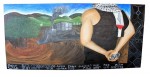
“Palestinian Roots” by Ahmad Al Abid. (photo from cjnews.com)

Anyone visiting the student centre at York University in Toronto has been confronted since 2013 with a mural that some say incites violence and makes York a less welcoming place for Jewish students. The piece features a young man, pictured from behind, wearing a keffiyah with a map that includes an undivided Israel and Palestine and holding two rocks. Below him is a bulldozer, presumably Israeli and presumably preparing to overturn a farmer’s tree.

Recently, the mural has led one philanthropist to pull his support for the university and it has been taken up as a cause by Jewish and Zionist organizations.

The mural makes a not very subtle point. Israel is an aggressor, wantonly destroying Palestinian livelihoods for no reason. Palestinians are helpless Davids in the face of this Goliath, reduced to that most primitive of weapons, the stone. Beneath the image are the words “Peace” and “Justice” in several languages.

A picture, they say, is worth a thousand words and this is probably why the mural upsets so many people. With one glance, the viewer understands the anti-Israel narrative in all its simplicity. Israel is powerful; Palestinians are weak. Israel is aggressive; Palestinians are defensive. The map on the keffiyah, which erases Israel, is understood as a statement that the Jews stole this land from indigenous Arabs, whereas the same map, if employed for Zionist ends, would elicit cries of racism and genocide. Even the symbol of violence – the stones – can somehow be perceived as tools for “peace” and “justice,” given the nature of the enemy.

Since the mural was painted, the weapon of choice for the Palestinian lone wolf – if we can call someone incited to murder by their government and official media a lone wolf – has morphed from stones to knives. Videos and infographics teach Palestinians how to stab Jews most effectively.

Never mind all that. The world has an idée fixe, an unshakeable certainty, that Jews are powerful and, therefore, the Palestinians must be victims; they cannot be perpetrators or instigators. A new poll of French people says nearly 60% blame Jews to some extent for antisemitism. Antisemitism is uniquely identified as brought about by its victims, not its perpetrators. We wouldn’t have to be antisemitic, it seems, if only you would be less Jewish. Even the secretary-general of the United Nations is standing by his statement that Palestinians stabbing Jews is simple “human nature” in response to “occupation.”

The same poll also affirmed the view of Jews as powerful – and the attitudes of the French in this regard are probably not substantively different from those of other Europeans and some North Americans, varying more by degrees than by kind perhaps. Today, that power is measured in perceived wealth and access to political and cultural elites. When Jews were historically powerless in those conventional senses, they were attributed with supernatural abilities. Antisemitism adapts magnificently as required.

The perception of Jews as powerful is not only at the root of antisemitism but doubles as an impervious shield against challenging it. Consider: if Jews are powerful, then coming to their aid is an act of siding with the powerful against the oppressed. This belief is, at root, the very essence of the anti-Israel narrative now dominating much of the West, especially on the political left.

As always, this incarnation of antisemitism is a form of scapegoating, the projection of sins onto an empty vessel. As we are now almost congenitally conditioned to do, we acknowledge that Israel is not above criticism. No country is. Yet the proportion of global attention, the level of vitriol and the hyperbolic accusations against Israel are clear to anyone with a sense of proportion that this has limited relation to Israeli policies or anything else rational. The nature of the beast is that there have always been “good” reasons to attack Jews. Today’s reason is Israel.

Israel, of course, is a very powerful state, with a massive military for a population its size. If it wasn’t, its population would be dead or dispersed. Yet this still feeds the narrative of Jewish power and Palestinian weakness. If this is a battle between rocks and bulldozers, well, then, who wouldn’t side with the folks holding the rocks? This, in the end, is what the mural at York is telling its viewers. It is, actually, a magnificent synopsis of the mindlessness of the anti-Israel narrative, which strips all context from the conflict and ignores the fact that the perpetuation of violence is mainly a product of Arab maximalism and refusal to live in peace with a Jewish state. That’s a picture that is a little more complicated to paint.

Format ImagePosted on February 12, 2016February 11, 2016Author The Editorial BoardCategories From the JITags Ahmad Al Abid, Israeli-Palestinian conflict, terrorism, York University

Foreign policy of fools

There was a tempest recently when National Public Radio, the listener-funded American radio network, published a map on their website that erased Israel and called the region between the Mediterranean and the Jordan River “Palestine.”

There were other errors on the map – Turkey and Cyprus were also omitted as part of the Middle East and Afghanistan and Pakistan were included, despite not being considered part of Middle East. The map was removed from the website after complaints from HonestReporting.

It is good that watchdogs like HonestReporting exist and that media outlets that make errors – or deliberate misrepresentations – respond when challenged. However, there is a degree of irony in the fact that more attention is given to erasing Israel from the map on a relatively irrelevant webpage than there is to the near-universal erasure of Israel from the curricula and foreign policies of almost every country in the region.

In textbooks, including some funded by the United Nations, Israel is omitted from maps that teach children geography, replaced, as in the NPR case, with the word Palestine. This is by far the bigger concern.

The reality is that, from the foreign-policy perspective of most Arab and Muslim-majority countries, Israel doesn’t exist and never has. Foreign policy toward Israel among members of the Arab League is one of aggressive denial, in which Israel is referred to obliquely as “the Zionist entity,” or worse. In Iran, there is less denial that Israel exists and more overt determination to literally wipe it from the map.

Yet, all of these facts are effectively ignored by Western European foreign policies, like that of France recently. French Foreign Minister Laurent Fabius has called for a peace conference “to preserve and achieve the two-state solution.” Fabius said that, if his plan for a negotiated settlement did not break the status quo, his government would unilaterally recognize a Palestinian state, as Sweden did in 2014.

Rightly, Israeli Prime Minister Binyamin Netanyahu rejected the idea on Sunday. The French proposal, he correctly noted, provides the Palestinians with a disincentive to negotiate in good faith. Failure of a negotiated settlement is pretty much guaranteed by promises like that of France. Historically, the Palestinian leadership has rarely been willing to compromise, confident, correctly, that their Western allies would endorse their position without it – there has been no need to recognize Israel’s right to exist, to negotiate borders or other outstanding issues. From far too few countries has there been recognition that there are actually two legitimate sides with competing claims.

Aside from being a foreign policy of fools, the French proposal reflects the false narrative that is dominant in Western circles, one that sees Israel as the only obstacle to peace. If Israel does put roadblocks in the way of European proposals for a negotiated settlement, it is because European countries have shown too little concern, if any, to the very legitimate concerns Israel has about its security and indeed its continued existence with the very real potential for a terrorist state immediately abutting its tiny territory. If governments run by Hamas and Fatah are not worrisome enough, their stability in the face of threats from even worse terrorist organizations, namely ISIS, may be of no concern to the French, but it is a very serious concern for Israelis and those who care whether they live or die.

Alleged Israeli obstructionism, exemplified by the admittedly unhelpful expansion of settlements, is held up in the West as the main obstacle to peace, while the genocidal incitement that is rampant among Palestinians and in other parts of the region is dismissed as a temporary by-product of Israeli policies. In other words, as so often in history, Jews are blamed for bringing catastrophe upon themselves.

It is not a good thing that a news organization like NPR would redraw the boundaries of Israel and Palestine. Of far more concern should be efforts by the government of France and other Western powers to force such reconfigurations on a region they clearly do not understand.

Posted on February 5, 2016February 4, 2016Author The Editorial BoardCategories From the JITags antisemitism, Binyamin Netanyahu, HonestReporting, Israel, Laurent Fabius, NPR

Posts pagination

Previous page Page 1 … Page 37 Page 38 Page 39 … Page 49 Next page
Proudly powered by WordPress