Chefs compete, party

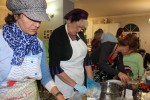
Chefs compete at the Centre for Judaism in the Lower Fraser Valley of British Columbia’s Iron Chef Chanukah Competition II. (photo from Centre for Judaism)

Last month, after the lighting of the menorah, dancing and refreshments, the Centre for Judaism in the Lower Fraser Valley of British Columbia turned into the Iron Chef Chanukah Stadium for Iron Chef Chanukah Competition II.

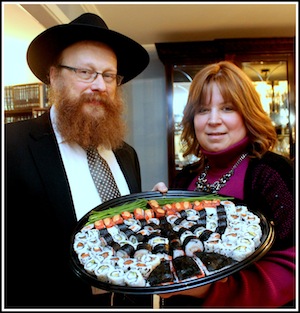
photo - Rabbi Falik and Rebbetzin Simie Schtroks hosted Iron Chef Chanukah Competition II at the Centre for Judaism in the Lower Fraser Valley of British Columbia. (photos from Centre for Judaism)
Rabbi Falik and Rebbetzin Simie Schtroks hosted Iron Chef Chanukah Competition II. (photo from Centre for Judaism)

Simie Schtroks, shlucha and co-director of the Centre for Judaism, presented the teams and spectators with three secret ingredients and a variety of foods and spices that were to be used in creating the competing three dishes. During the busy hour, Chanukah songs were led by Avi Amrani, Ben Roling and Yaakov Dar together with Rabbi Falik Schtroks. Interviews of the chefs and their teams were conducted, and Ethan Dreyshner helped keep time. Spectators were able to participate in the judging based on the prominence of the secret ingredient, appearance and creativity, and judges Abraham Amrani, chef Aaron Gehrman, Ben Roling and Naomi Nelson took into account taste and originality, as well.

Chef Marat Dreyshner and Ella Dreyshner of ikosherbake.com emerged as the Iron Chefs once again. Winners won a gourmet dinner for four catered by Simie Schtroks. All participants were given a book called Seeds of Wisdom. There was great teamwork on both teams.

The Centre for Judaism thanks captain Rae Sank, Esther Roubini, Rita Roling, Joanne Yaakov, Penina Amrani, Debbie Cossever, Lev Titiafsky and Anna Kushelman, as well as Nava’s Creative Kosher for the sushi.

To be a contender, sponsor or team participant next Chanukah, contact Simie Schtroks at 604-440-7411.

Research into access issues at Jewish overnight camps

The field of Jewish camp has become increasingly aware of and responsive to the numbers of children with special needs and physical disabilities in recent years. As a first step towards initiating field-wide changes in this arena, Foundation for Jewish Camp (FJC) is engaged in a research project mapping current, potential and desired services available to children with emotional, intellectual and physical disabilities at nonprofit Jewish overnight camps across North America.

Laszlo Strategies recently delivered the results of the research (conducted in early 2013), the first of its kind in the Jewish community. The survey garnered results from 170 camp staff members (from 124 camps), 262 parents and 141 campers.

FJC is pleased to share that the majority of those involved in camp – including staff, campers and parents – care about this issue and agree that every Jewish child, regardless of a disability or special need, should be able to attend a Jewish camp. Most involved prefer an inclusion model, with clear recognition that not every camp is able to serve every need and that, in some cases, a separate program might be preferable.

While the field is making progress in the types and amounts of services offered, there is still more to be done. Below are the highlights from the survey. The full findings are available at jewishcamp.org/research.

About the campers served

  • The field of Jewish camp is serving 2,340-2,590 children with special needs – more than originally estimated.
  • The majority of the special needs population in Jewish camp have neurological disabilities. Few camps are equipped at this time to properly serve children with more significant/complicated disabilities.
  • 43 percent attend public school, four percent of these children attend Jewish day school, and 24 percent attend a specialty school for children with disabilities. Forty-three percent attend a synagogue-based religious school and 47 percent had attended a Jewish day camp.
  • 93 percent of parents were satisfied/extremely satisfied with their child’s experience at Jewish overnight camp.

About camp staff and programming

  • 36 percent of camps offer special programs for this population.
  • 55 percent of camps have a designated staff member (part-time or full-time) to oversee campers with special needs. This staffer engages with the family during the intake process, selects and trains camp staff, acts as a support during crisis situations, communicates with parents and other outside supports, creates and evaluates individual camper plans.
  • Inclusion camp staffs appear to want the non-inclusion staff and campers to have a better understanding of their population.
  • Parents of special needs campers are extremely satisfied with the way camps are infusing Jewish values/learning for this population of campers.

Barriers and perceptions

  • The biggest barriers to serving more children with specials needs are not attitudes or wheelchair ramps – rather lack of training and knowledge followed by funding.
  • 47 percent of parents report the cost of overnight camp as a barrier.
  • It is not as important as previously thought that siblings attend the same camp. Forty-three percent of parents report, “it would be nice, but it is more important that they go to the camp that best serves their individual needs.”
  • Parents report that the biggest factors in choosing a camp for a child with special needs are that the camp offers good supports and accommodations for children with a disability like my child (43 percent), and it is a Jewish camp, where my child can connect to our heritage and community (34 percent).
  • More camps are serving children with disabilities/special needs than are advertising it to the public through their websites and marketing materials.

Next steps

FJC is currently creating a plan of action to advance the field of Jewish camp in this arena. Sound research and solid data are required in order to make the informed decisions that will move FJC closer to achieving its goal: increasing the number of children attending nonprofit Jewish overnight camp.

FJC commissions its own research, and also draws on the wealth of knowledge that Jewish sociologists and researchers have contributed toward the understanding of camp and its long-term effects. All FJC-commissioned research and a selection of external studies are available for download at FJC’s website.


Aliyah: a 10-year high

According to initial end-of-year figures released by the Jewish Agency for Israel and the Ministry of Aliyah and Immigrant Absorption, aliyah hit a 10-year high in 2014, with the arrival of some 26,500 new immigrants. This marks a 32 percent increase over 2013.

For the first time, France tops the list of countries of origin for immigrants to Israel, with nearly 7,000 new immigrants in 2014, double the 3,400 who came the year before.

Some 5,840 new immigrants came from Ukraine, compared to some 2,020 in 2013. This dramatic 190 percent increase is due primarily to the ongoing instability in the eastern part of the country.

Aliyah from western Europe is up 88 percent, with the arrival of some 8,640 immigrants. Some 620 came to Israel from the United Kingdom, a 20 percent increase over 2013. The number from Italy doubled to some 340. Aliyah from Belgium saw a modest decrease, to 240. German aliyah remained stable, at approximately 120.

Aliyah from the former Soviet Union was up 50 percent, with the arrival of some 11,430 immigrants, with 4,830 from Russia, Belarus and the Baltic states, 300 from the Caucasus and 390 from Central Asia.

Aliyah from Latin America remained stable, with the arrival of some 1,070 immigrants. Aliyah from Brazil saw a 45 percent increase, with 300 immigrants, and approximately 297 came from Argentina, 76 from Mexico, 70 from Venezuela, 62 from Colombia, 58 from Uruguay and 52 from Chile.

Aliyah from North America increased modestly, with the arrival of some 3,870 immigrants compared to 3,600 in 2013. Approximately 3,470 immigrants came from the United States and 400 immigrants came from Canada, compared to 384 the year before.

Eastern Europe saw 232 people make aliyah, compared to approximately 270 in 2013. Approximately 126 came from Hungary, 32 from Poland, 24 from Romania and 24 from Bulgaria.

Some 190 immigrants came to Israel from South Africa, roughly the same as 2013, while 200 came from Australia and New Zealand, a slight decrease from the year before.

More than half of the immigrants who came to Israel in 2014 were under the age of 35. The eldest immigrant was born in 1910 and made aliyah from France at the age of 104. The youngest came from the United States and was only several weeks old. Tel Aviv led the chart of cities receiving new immigrants, with approximately 3,000 new Tel Avivians. The coastal city of Netanya came second and Jerusalem came in third.

Oil spill heightens urgency

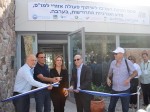
A ribbon-cutting ceremony to inaugurate the new Regional Collaboration Centre for Research and Development and Renewable Energy near Eilat. (photo from Jewish National Fund via jns.org)

The worst oil spill in Israel’s history was the unplanned backdrop for a recent international conference on green energy held in Eilat, the country’s southernmost city. A busy port and popular resort city located at the northern tip of the Red Sea, Eilat is at the epicentre of the Jewish state’s renewable energy industry.

The Eilat-Eilot Green Energy Sixth International Conference and Exhibition, held Dec. 7-9, was the culmination of six events that comprised Israel Energy Week and offered participants from around the globe a concentrated encounter with the emerging world of alternative energy in Israel. The conference focused on challenges facing the renewable energy industry, including storage and supply of electricity, development of methods to manage electricity flow and financing to advance projects.

It also focused on the key role renewable energy plays in the southern Arava, a stretch of Negev Desert from the Dead Sea to the Gulf of Aqaba in which Eilat and the Hevel Eilot Regional Council are located. This arid, sun-drenched area is Israel’s main locale for sustainable development and functions as an international showcase for Israeli innovation in the field of green energy.

“Renewable energy, with an emphasis on solar, is a major focus of our municipal activity and plays a key role in the region as a whole,” Meir Yitzhak Halevi, the mayor of Eilat, told conference attendees. “The city of Eilat and the Hevel Eilot Regional Council, which together account for 13 percent of Israel’s land area but less than one percent of the country’s population, have recognized the potential offered by the sunlight and open space that exist here in such abundance, and are concentrating on renewable energy as a catalyst for regional growth.”

According to Udi Gat, head of the Hevel Eilot Regional Council, the area has already reached nearly 60 percent daytime energy independence and in eight months will generate nearly 100 percent of the energy consumed each day in the southern Arava. By 2020, the municipality and regional council anticipate that the area will be completely energy-independent and free of fossil fuel and carbon emissions.

“We want to generate more electricity, even beyond the needs of Eilat and the regional council. We want to help the country produce electricity from an inexpensive source – the sun – and to be Israel’s electricity storehouse or ‘bank,’” Gat said.

The importance of achieving energy independence was conveyed to the conference in a dramatic way when, four days prior to the start of the gathering, an oil pipeline ruptured during maintenance work at a construction site about 12 miles north of Eilat. Five million litres of crude oil spilled out and fouled an estimated 250 acres of scenic desert, including a nature reserve. Delicate coral reefs beyond the nearby shoreline were also threatened.

Read more at jns.org.

Time to make 2015 EPIC!

It’s now early January 2015.

That means right about now millions of New Year resolutions are kicking into high gear! (Isn’t it exciting!?) This will most likely peak around the 12th of the month due to those who don’t think a resolution kicks in until their hangover recovers, fading like a cheap pair of Old Navy jeans by around the 18th.

By Feb 1 everyone will be talking about how they don’t believe in New Year resolutions again.

I have never been a strong believer of waiting for set dates to take action toward any positive change. I believe that if someone wants to see a change enough to make it happen they have no need to wait for January 1st to get started.

That said, a new year does allow us sort of a mental re-set. Even if less than 10% actually stick to that new-year resolve, that’s more change than we’d likely see on the first day of any other month, right?

new-year-resolutions

My resolve to make meaningful change in my life has been more of a progressive development than a sudden change that kicked off a few years ago.

Led by a successful diet adjustment that helped rid my body of extra weight I carried for years; I found success in an area I had previously written off as “not likely to ever happen” for my adult life. I parlayed the momentum of that accomplishment, considering what other aspects of my life could also be re-approached. I found many other successes and adventures I certainly wouldn’t have predicted three years ago, leaving a world of closed doors well behind me.

Now it is 2015. And in 2015 this guy turns 40!

While many fear the “big 4-0” and all that beginning-of-the-end anxiety that typically comes with it, I can’t wait to hit 40 in stride! I can’t think of a better time to take it all to a whole new level!

In 2015 I will continue to learn new skills, discover new talents, and experience new adventures.

I will make the world around me a better place and I will share it all with as many people as I can (starting with the pages of this blog!).

The question is, what will it all look like? What does this exciting, inspiring future hold? And who wants to join me for any of it?

I have some ideas of my own that we will explore here. But I’d like to hear your ideas as well. Give me your suggestions. Maybe you have an opportunity to share with others. Perhaps you are looking for help with your own unique journey.

Let’s make 2015 – and every year after that – EPIC!

You can connect with me at: kyle@bergerwithfries.comwww.twitter.com/kberger16

In the meantime, here are a couple things coming up to get your year started right:

  1. The Recharge Conference, Jan 11.www.sparkenergizeempower.com
  2. ManTalks – Jan 12. www.mantalks.ca
  3. Read “The 4-Hour Work Week” by Tim Ferriss.

New-Years-Resolution-2012

סניף ונקובר של קק”ל מברך את פרושאור

image - interesting in the news Jan 1 - Ron Prosor to Vancouver, bitcoin, Tim Hortons snake incident

Look up to art

Sharon Tenenbaum’s work can be seen on billboards above highways in Vancouver, Toronto and Montreal. (photo by Sharon Tenenbaum)

Sharon Tenenbaum discovered her love of photography in 2006 on a trip to South East Asia. In 2014, only eight years later, she is a nationally recognized photographer. From Dec. 15 to Jan. 15, four of her photographs will be displayed on billboards along Canadian highways and bridges as part of Paint the City (paintthecity.org), an international initiative to promote arts in unexpected places.

Tenenbaum talked to the Independent about her transformation from an engineer dissatisfied with her career to a successful artist.

“Last year, I participated in a RAW Artists (rawartists.org) competition,” she said, explaining how her images found their way to the billboards. “RAW is an art organization supporting artists in the first 10 years of their career. I became a finalist, together with another artist. Then, the organizer called me and said she nominated us for the Paint the City project. I didn’t even know about them.”

According to Tenenbaum, Paint the City selected the winner through social media. They stipulated that the one who got more “Likes” on Facebook and Twitter would win. “I had to recruit all my friends and even my family in Israel, and my family and friends in turn incited everyone they knew to login and vote for me. I won. I guess I have more friends,” she joked.

In reality, it was a long road from her first travel photos to her sophisticated billboard images displayed on the highways of Vancouver, Toronto and Montreal.

“At first, many people discouraged me. They would say: ‘She discovered a camera, so what?’ But I can’t see myself doing anything else. I didn’t care what anyone said. I have confidence in myself.”

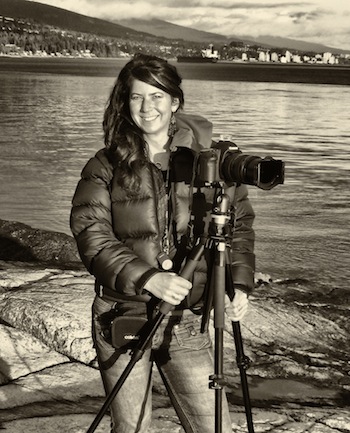
photo - Sharon Tenenbaum: “A color photo doesn’t have to be as good as black and white."
Sharon Tenenbaum: “A color photo doesn’t have to be as good as black and white.” (photo from Sharon Tenenbaum)

In the beginning, what she did was photojournalism, documenting everyday life, she said. “In Asia, I took photos of buildings and people, but when I returned to Vancouver, I couldn’t photograph people here. It requires legal permissions, so I started photographing architecture, rediscovering Vancouver. I wasn’t just documenting anymore; it was my interpretation of what I saw.”

Out of her engineering background sprouted her passion for photographing things constructed by human beings. “I have a talent to see how elements of the whole work in harmony, how shapes and lines come together. I like modern architecture with its clean lines. The approach is artistic. The image has to speak to the heart.”

Her stark black and white images that won their places on billboards speak to people’s hearts. They show the artist’s unerring sense of light and shadows, her flair for the dramatic. Her quest for visual tension resulted in her unique series of bridges, all of them spectacular black and white instants in time and space. Some of them are Vancouver bridges, others she took during her travels.

“When you travel,” she explained, “you see everything with new eyes. It’s harder to achieve at home. I traveled a lot at first. Now I only travel to specific locations. If I want to photograph a certain bridge, I research it, then go there to take pictures.”

Most of her photographs are black and white. “When you use color in a photo, it steals the show,” she said. “A color photo doesn’t have to be as good as black and white. Sometimes, if you take color out of the image, it has no merit otherwise. Black and white photos are more challenging. The image must stand on its own. In many cases, color feels like cheating. I use color in my photos only when it’s essential, when color is what it’s all about. Color is an emotion. When I need to convey that emotion, I leave the colors intact. The same image seems to tell different stories when it’s in color or in black and white.”

Recently, she turned to a new technique, new stories infused with color. She started painting on top of her photographs. She applied this development not to the man-made structures but to something created by nature: trees.

“I started with one image of a tree, a photo from Portugal. There is a maple tree outside my window; it’s gorgeous in the fall. It inspired me. I wanted to convey such beauty with my image too, so I painted on top. Then I participated in Culture Crawl, and this painting was very successful. I started doing more.”

Like every artist, she strives to evolve, constantly finding fresh dimensions in her art. “I want to keep changing. I don’t want to have one style associated with me. Every artist needs to grow. After awhile, you get bored with the old stuff. Look at Picasso. He had five distinctive stages, each one unrecognizable from the others. Same with me. I have to keep reinventing myself.”

She also helps others reinvent themselves: she teaches, offering workshops in photo skills, as well as creativity. “I love teaching, love sharing what I know. Sometimes, when I teach, it clarifies the concept for me as well. I teach people how to be artists. Creativity has different phases. I teach my students how to get into each one, how to recognize and be receptive to new ideas. But then, each idea needs a follow up, lots of hard work. That’s also part of creativity.”

For more on her work, visit sharontenenbaum.com.

Olga Livshin is a Vancouver freelance writer. She can be reached at olgagodim@gmail.com.

UNRWA needs reform

Bassem Eid, a Palestinian human rights activist, has launched a campaign against the United Nations Relief and Works Agency (UNRWA), tasked with providing “assistance and protection” for five million Palestinian refugees around the world. In Palestinian refugee camps in the West Bank, Gaza Strip, Lebanon, Syria and Jordan, UNRWA provides food, other aid and runs schools.

Eid said a recent study by well-known Palestinian pollster Khalil Shikaki shows that 70 percent of Palestinian refugees are seeking financial compensation rather than the “right of return” to their former homes in what is today Israel. He said that UNRWA, however, has an interest in perpetuating the right of return, in part, to justify its large budgets. These assertions are part of Eid’s blistering attack on UNRWA, which operates with a $1.2 billion budget from donor countries, including the United States.

“Palestinians in refugee camps are suffering, while UNRWA is gaining power and money,” Eid, who grew up in the Shuafat refugee camp in Jerusalem, told a small group of journalists. “In Gaza, you hear more and more voices saying that UNRWA is responsible for delaying the reconstruction of Gaza” after the heavy fighting between Israel and Hamas in Gaza last summer.

In an article in the Jerusalem Post earlier this month, Eid called for a five-point program to reform UNRWA including a call for an audit of all funds allocated to UNRWA and a demand that the organization dismiss employees affiliated with Hamas, which controls Gaza.

“Hamas has never denied that the majority of UNRWA employees are affiliated with Hamas and coordinate with the organization,” Eid said.

During the past summer’s fighting in Gaza, Israel accused UNRWA of allowing Hamas to use its schools to fire rockets at southern Israel, a charge UNRWA denied. Later, UNRWA found rockets in two empty schools and issued a strong condemnation.

Read more at themedialine.org.


Providing an all-access pass

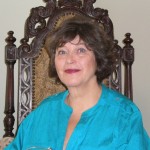
Elka Yarlowe is president and CEO of Access to Music Foundation. (photo by Olga Livshin)

Elka Yarlowe’s love affair with music started when she was very young. “I always listened to music or sang,” she remembered. “When I was four or five, I had my tonsils taken out in a hospital. My mom told me I was a very brave girl and asked me what I wanted as a reward. I said I wanted a piano.”

She got her piano, and her childhood in New York was steeped in notes and melodies. Her mother took her to see musical shows. Her relatives sang in a Yiddish theatre. She studied piano with a private teacher and participated in a school choir. “I was lucky. We had an exceptional musical program in my public school. In Grade 8, I knew I wanted to pursue music professionally,” she told the Independent.

She fulfilled her childhood dream and had a decades-long, successful career as an opera singer. Now, she wants to give an equal opportunity to local children, so they also can pursue a musical career if they choose. As president and chief executive officer of Access to Music Foundation, Yarlowe does what she can to make opportunities available to as many children as possible.

Since 2006, she has been a board member of the Music B.C. Industry Association. “In 2007, the Vancouver School Board made the first of many subsequent budget cuts to music programs,” she said. “In response, we started a charity and funded a music program in one Vancouver school. It wasn’t enough. More cuts followed in 2009. In 2010, I decided to leave the board and concentrate on the charity for music only. We called it Music B.C. Charitable Foundation. Last year, we changed the name to Access to Music.”

Currently, Access to Music funds programs in 20 provincial public schools and three aboriginal schools. “Our main goal is to fund instrument purchases for schools,” said Yarlowe. “Most instruments in the school system are over 20 years old, not fit for proper learning. If you start a hockey team at a school, you can’t have the children play hockey in 25-year-old skates. The same goes for musical instruments.”

According to Yarlowe, music education is a necessity: “Statistics show that children who play a musical instrument usually score 25 percent higher in any other discipline than children who don’t. Music is integral to our understanding of math and science. Any child in a school orchestra gets a fundamental sense of communication and cooperation, discipline and self-respect. Music develops both left and right sides of the brain. It is both science and art.”

Yarlowe lamented the fact that in this province, music programs often get cut first. “Last April, the school board wanted to cut all elementary school music programs. We fought that decision and won. The cut was postponed for one more year. We have a new battle ahead of us,” she said.

She explained that schools in the least economically advantaged areas of the province are affected most by these cuts. “Wealthier schools will continue to fund music through the parents’ efforts. That will create a disparity between poor and rich; deepen the divide. That’s why we fund the poor schools. We’re trying to level the playing field for all schoolchildren, to give all students equal access to musical education. Music is a catalyst for personal and social change. It’s part of organic education. Everyone needs it.”

Access to Music also offers mentorship programs, scholarships and intensive music clinics, and works with LGBTQ, at-risk and street-involved youth. “We offered our songwriting program to kids who face multiple barriers,” she said. “Some of them struggle with addiction. Others were victims of abuse or ran away from home. Many told me that music keeps them together, away from crime or suicide…. One gay boy wrote on his Facebook that participating in our song competition changed his life. Another street kid entered the Capilano jazz program, even though he still lives on the street. We try to provide barrier-free access to music for as many as we can. Today, about 8,000 children benefit from our programs. In the last several years, we purchased instruments for over $100,000. The need in this province is great.”

Many local organizations support the foundation with monetary donations or time, including Vancouver Symphony Orchestra. Next April, 100 music students from Surrey and Burnaby will have “a day of play” with the VSO. “All day long, the kids will have intensive sessions with the VSO musicians,” Yarlowe explained. “Then they will meet Maestro [Bramwell] Tovey. And, in the evening, they will have a treat – they will see a live show at the Orpheum. For many of them, it will be their first live classical music performance and the first visit to the Orpheum. When I was at school, our music teacher arranged for us to go to the Lincoln Centre once a year for a music show or an opera. We want to give such an opportunity to [more] local students. We want to be able to reproduce the event with the VSO every year, and maybe have similar events in Victoria, Okanagan [and] Prince George.”

Passionate about the foundation, Yarlowe insisted, “Music is not a frill or icing on a cake. It’s a necessity. Everyone who ever played an instrument or sang a song enjoyed it. Everyone has a personal connection to his music, no matter if it’s classical, rock or jazz. If you put an instrument into someone’s hands, chances are high those hands would never pick up a gun.”

The recent city initiative Keys to the Streets, which encountered an enthusiastic response in the majority of Vancouverites, disappointed her. “I went crazy when I learned about it. I know it’s good to give anyone a chance to play on the street, but to think of all these pianos [potentially] ruined in the rain. I’d put them in schools around the province instead. For the cost of just moving those pianos to and from locations, I could probably buy 20 clarinets for 20 school orchestras.”

One of her duties as foundation president is asking for money. “People spend lots of dollars so their kids could learn hockey. Why not to learn music? There is a much better chance that a child could make music his profession, make a living from it than from hockey. Much lower chance of injuries or concussions, too.”

Access to Music has become Yarlowe’s personal crusade, her tikkun olam. “There is a proverb: ‘You’re not required to finish the work but you’re not allowed to turn your back on it.’ That’s my guideline. I have three great passions in my life: my family, my faith and my music. I may not be able to fund all the schools for all the music programs they need, but it doesn’t give me, any of us, permission to stop the efforts. I feel like all my life was a build up for my work with the foundation.”

To learn more about the foundation, visit accesstomusic.ca.

Olga Livshin is a Vancouver freelance writer. She can be reached at olgagodim@gmail.com.