Camp’s decision misguided

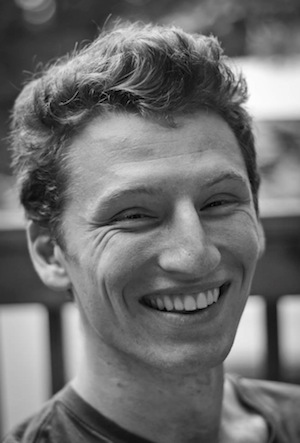
In March, Young Judaea’s Camp Solelim made headlines for turning away a prospective camper because he’s not Jewish. Before having made their final decision, I wish they would have spoken to Aaron Ingram. A Winnipeg-based real estate and corporate commercial lawyer, Aaron is by all accounts a leader in the Jewish community. He sits on the board of directors of Camp Massad of Manitoba as well as the Shalom Residences; he is a member of the Jewish Federation’s Community Relations Committee, he is a Jewish Federation donor and, as he describes it, is “a longtime supporter of the Jewish community and the state of Israel.”

Did I mention that Aaron is not Jewish?

Let’s back up to when Aaron was a chubby-cheeked, blond 5-year-old in 1989. That summer, he accompanied his mom who had taken a job as the head cook at Camp Massad in Winnipeg Beach, the Hebrew immersion camp that I also attended. Fast forward 18 years, and Aaron had logged 10 years as a camper and eight summers as a counselor, including two as assistant director. (His mom, Marilyn, is still head cook.)

A very agreeable kid with a big personality, as a youngster Aaron quickly landed leads in the camp plays. With no formal Hebrew background, his lines were transliterated for him. Soon enough, he acquired the services of a Hebrew tutor during the school year. By the time Grade 5 rolled around, he was enrolled in one of Winnipeg’s half-day Hebrew-immersion schools. In grades 7 and 8, he attended Joseph Wolinsky Collegiate, the Jewish high school, where he earned a spot in the highest Hebrew level. He recalls being able to finally read the camp play scripts in Hebrew letters as a “big moment” for him.

“As a child growing up in the disadvantaged North End of Winnipeg,” Aaron told me in an e-mail interview, “my experiences in the Winnipeg Jewish community, being immersed in the wonderful environment that is Camp Massad, a world of creativity and intelligence, and the lifelong friendships that I have developed … have heavily influenced me.”

I asked Aaron whether he feels Jewish. Not religiously, he tells me; he is an atheist. (That there are Jewish atheists is admittedly a bit of complexity we didn’t get into.) But he considers himself culturally Jewish, and certainly a part of the Jewish community. “I have cried tears of despair in the death camps in Poland,” he tells me, “and have cried tears of joy upon my arrival in Israel.”

And were he to meet and marry a Jewish woman who wanted him to convert, he says he would do so “without hesitation.”

Aaron recalls his early experiences with daily and Shabbat prayers at Massad. “When I was a young camper, participating in the daily prayers and Shabbat tefillah, it felt like being handed the keys to a secret world that was welcoming me. I loved singing the prayers. I still know most, if not all, by heart.”

For his part, Aaron thinks Solelim’s decision to bar access to Tyler Weir is seriously misguided. As a board member at Camp Massad, he personally extended Tyler an invitation to join the Camp Massad community and offered to personally fundraise to offset the cost of airfare from Toronto to Winnipeg.

It’s clear that there’s a value clash between the particularist and insular dimensions of Jewish programming, and especially Jewish camp – fueled, no doubt, by the fear of intermarriage. On one hand is the need to inculcate culturally rich and rigorous experiences in our youth. On the other is the desire to fit in with Canadian multicultural values of openness and pluralism. Even there, though, multiculturalism relies on robust transmission of cultural identity, something that can most easily be achieved in a culturally homogeneous context, some would argue.

Yet, people like Aaron – and I join him in this sentiment – would claim that opening the windows a crack to those who might have their own reasons for wanting to partake of our rich communal traditions may yield unexpected benefits not only for them, but also for the communities of which they may seek to be a part.

Mira Sucharov is an associate professor of political science at Carleton University. She blogs at Haaretz and the Jewish Daily Forward. This article was originally published in the Canadian Jewish News.

Cooperation in space

MacDonald, Dettwiler and Associates-designed RADARSAT-2 features state-of-the-art synthetic aperture radar technology and supports all the existing RADARSAT-1 beam modes, while offering many new capabilities, including the ability to acquire images to the left and right of the satellite. In partnership with Israel Aerospace Industries Ltd., MDA will study the feasibility of an advanced payload for a potential future mission that would enhance the flexibility of the next generation of satellite communications. (photo from MacDonald, Dettwiler and Associates Ltd.)

On May 26, the Hon. James Moore, minister of industry, announced that two Canadian space firms will be conducting concept studies for potential Canada-Israel space missions. The Canadian Space Agency (CSA) and the Israel Space Agency (ISA) seek to develop advanced applications in satellite communications and position both the Canadian and Israeli space sector to play a significant role in this growing global market.

MacDonald, Dettwiler and Associates Ltd. will study the feasibility of an advanced payload for a potential future mission that would enhance the flexibility of next-generation satellite communications. The firm will conduct this study in partnership with Israel Aerospace Industries Ltd. (IAI).

COM DEV International Ltd., with exactEarth, will evaluate the feasibility of a potential Israel-Canada advanced radio and thermal-location µ (micro) satellite (ICARUS) mission. ICARUS would demonstrate a new, low-cost nano-satellite constellation that would use a combination of receivers to locate maritime vessels, thus improving maritime awareness, safety and security. The potential ICARUS mission would be undertaken in collaboration with IAI and Elbit Systems Electro-Optics Elop Ltd.

A memorandum of understanding between CSA and ISA, signed in 2005 and amended in 2014, allows the agencies, private sectors and academia in both countries to cooperate in joint projects or research activities. Each Canadian firm will receive $300,000 to undertake their concept study.

המונדיאל לנשים יוצא לדרך בסוף השבוע

 הנשיא המתפטר של פיפ”א ג’זף ספ בלאטר, שאף אחד לא עצוב על שהוא עוזב. (צילום: Agência Brasil via commons.wikimedia.org)

  בצל האירועים החמורים בפיפ”א והתפטרותו של הנשיא בלאטר: המונדיאל לנשים יוצא לדרך בסוף השבוע בקנדה

בתקופה הגרועה ביותר בתולדות פיפ”א כשבכירה נחקרים בפרשת שחיתות גדולה, והנשיא המיתולוגי ג’זף ספ בלאטר, נבחר בפעם החמישית לתקופת כהונה נוספת ומייד התפטר לאור הביקורת העצומה נגדו, יפתחו בסוף השבוע בקנדה משחקי המונדיאל לנשים בכדורגל. מדובר בטורניר החשוב והגדול ביותר לנשים וצפוים לחזות בו יותר צופים מי פעם, באצטדיונים ומול מסכי הטלוויזיה.

משחקי גביע העולם לנשים השביעי במספר יחלו ביום שבת הקרוב עם המשחק בין קנדה לסין (באדמונטון), ויימשכו שלושה שבועות. חצאי הגמר יערכו ב-30 ביוני (מונטריאול) וב-1 ביולי (אדמונטון), ואילו הגמר יערך ב-5 ביולי (ונקובר).

עשרים וארבע הנבחרות המשתתפות במונדיאל שובצו בשישה בתים: בית א’: קנדה, סין, ניו זילנד והולנד (החזקות: קנדה מודרגת במקום השמיני בעולם והולנד מדורגת 12). בית ב’: גרמניה, חוף השנהב, נורבגיה ותאילנד (גרמניה מדורגת ראשונה בעולם ונורבגיה 11). בית ג’: יפן, שווייץ, קמרון ואקוודור (יפן מדורגת רביעית בעולם ושוויץ 19). בית ד’ שנחשב “לבית המוות”: ארה”ב, אוסטרליה, שבדיה וניגריה (ארה”ב מדורגת שנייה בעולם, שבדיה חמישית ואוסטרליה עשירית). בית ה’: ברזיל, דרום קוריאה, ספרד וקוסטה ריקה (ברזיל מדורגת במקום השביעי בעולם וספרד 14). ובית ו’: צרפת, אנגליה, קולומביה ומקסיקו (צרפת מדורגת במקום השלישי בעולם ואנגליה שישית).

52 המשחקים יתקיימו (בדרך בכלל לפנות בוקר לפי שעון ישראל) בשישה אצטדיונים בערים הבאות (ממזרח למערב): מונקטון (10,000 מקומות ישיבה), מונטריאול (66,000), אוטווה (24,000), ויניפג (33,000) אדמונטון (56,000) וונקובר (55,000). למעלה ממליון כרטיסים נמכרו למשחקים ובקרב המארגנים מקווים להצליח ולמכור בסה”כ 1.5 מליון כרטיסים, ובכך לשבור את שיא הצפייה במונדיאל לנשים שעמד 1.2 מיליון, בטורניר שנערך בארה”ב ב-1999. קנדה ידועה כמדינה שמכורה להוקי שנחשב כמעט לדת, ולמרות זאת המונדיאל מעורר עניין די גדול כאן בקרב הציבור ובתקשורת.

קנדה שהגיעה למקום האחרון והמבייש במונדיאל הקודם שנערך בגרמניה ב-2011, מדורגת כיום במקום השמיני בעולם, ויש לה מטרה ברורה אחת בטורניר הנוכחי: לזכות בגביע מול קהל ביתי חם ואוהד. אחת הנבחרות הטובות בעולם שלא תשתתף במונדיאל היא צפון קוריאה (מדורגת במקום התשיעי בעולם), כיוון שחלק מהשחקניות שלה נכשלו בבדיקת סמים בטורניר הקודם בגרמניה. יפן זכתה בגביע בגרמניה לאחר שניצחה בגמר את ארה”ב בקרב פנדלים. בהתאם לדרישות פיפ”א כדי למנוע מבוכות כמו בטורנירים קודמים, על השחקניות לעבור בדיקות לקביעת מינן, כדי שחלילה לא יסתתנו לנבחרות גברים שמחופשים לנשים.

בהתאחדות הכדורגל הקנדית לא אוהבים את בלאטר בלשון של המעטה, וכמו בארה”ב ובמדינות רבות באירופה שמחים שיסיים את תפקידו, כך שיתאפשר לפתוח תקופה חדשה בפיפ”א. לנשיא המתפטר אין יחסים טובים עם הכדורגל לנשים, הוא השמיע לא פעם הערות סרקסטיות כלפי שחקניות, והוא אפילו למכיר את הכוכבות של הכדורגל הנשי. למנגינת ליבן של השחקניות רבות שישתתפו במונדיאל בקנדה, בלאטר והנהלת פיפ”א קבעו שהמשחקים יערכו על דשא מלאכותי ולא על דשא טבעי, כמו במשחקי המונדיאל לגברים. השחקניות שטענו שפיפ”א מפלה אותן לרעה ותבעו אותה (התביעה בוטלה בשל קוצר הזמן עד לתחילת המשחקים). לטענתן משחקים על דשא סיננטי מתנהלים בצורה שונה לעומת דשא טבעי, ומספר הפציעות גדול יותר.

לאחר המשחקים בקנדה המונדיאל יחזור לאירופה, וצרפת נבחרה לארח את הטורניר הבא והשמייני מספר שיערך בקיץ של 2019.

נבחרת הנשים של ישראל שנכשלה במוקדמות אליפות העולם, תשתתף בטורניר מוקדמות היורו לנשים בכדורגל שיתקיים בספטמבר. ישראל הוגרלה לבית השמיני עם נורבגיה החזקה, אוסטריה, וויילס וקזחסטן.

Champion of Jewish folklore

Janie Respitz’s fascination with Yiddish, its history and its role in Jewish culture grew naturally. “My grandparents spoke Yiddish at home,” she said in an interview with the Independent from her home in Montreal. “I knew Yiddish songs and expressions. I went to a Jewish school through elementary and high school and the more I learned about Yiddish, the more I loved it. By university, I took it quite seriously.”

photo - Janie Respitz
Janie Respitz (photo from Janie Respitz)

She immersed herself in the language, digging out the stories and songs, their roots and their creators. After finishing a master’s in Jewish studies, she dedicated her life to teaching others what she loves best: aspects of Jewish culture, including Yiddish literature and traditional music.

Like Yiddish, the musical part of her identity grew organically, from a hobby to a second career. “I always liked music,” she said. “I never set out to be a professional singer but I liked to sing and play my guitar. When I was a teenager, my grandma once invited me to sing some Yiddish songs for a group of her friends. They liked it. Some of them invited me to sing for their friends and so on. It just happened.”

Forty years have passed since that modest beginning. Now, Respitz performs professionally, and people enjoy her concerts across Canada and abroad. “I never look for engagements,” she said. “They find me. I performed in New York, South America, Israel and, of course, everywhere in Canada.”

Yiddish language, Jewish culture and traditional music go hand in hand in all her presentations, encompassing academia and stage. She is a champion of Jewish folklore.

Any venue is good, as long as there is interest, she said, be it an auditorium at McGill University or a seniors seminar at a small community centre. She often incorporates songs into her lectures and workshops and sometimes even brings her guitar to her university classes. “I would come to give a lecture, and then people would ask me to sing,” she explained.

“I like teaching culture and history through songs. For example, if I give a lecture about a Jewish lifecycle, there are songs for every occasion, for weddings and babies, joyful and sad. You don’t have to understand every word in Yiddish to appreciate these songs.”

She said she realizes that Yiddish and the cultural milieu associated with it are things of the past, like Latin, but that doesn’t diminish her enthusiasm. “Of course, Yiddish will never become a spoken tongue again. It was a language of Eastern European Jews for hundreds of years, but that era ended with the Holocaust. Now, it serves those who want to know about our heritage.”

The revival of interest in Yiddish has been going on in Europe and America for awhile. “Among my students are people of all ages and demographics,” she said of the public’s interest in the language. “People want to learn Yiddish for various reasons: out of curiosity, to preserve the memory of their grandparents, to learn history. Some non-Jewish people also want to learn it. And why not? Some Jewish people want to study Chinese. Why not the opposite? I know one Japanese man who wants to translate Sholem Aleichem into Japanese; he studied Yiddish. Students from such diverse backgrounds make for a dynamic learning environment.”

Respitz endeavors to make every lecture and new course as engaging as possible for students, no matter their background. Spurred by her inquisitive nature, she conducts research about Jewish traditions, the history of people and places and, of course, Yiddish songs. “I try to find out who wrote them, when, why, where. The biographies of the poets and musicians. Who survived? Who perished in the Holocaust? If we don’t preserve those songs and poems now, they might disappear forever.”

At times, an entirely new course springs from her research. “I have a course on Russian Yiddish culture after the revolution. They had so many wonderful poets there.” She even speaks a bit of Russian. “To study Eastern European Jews, you almost have to know Russian.” Her sprinkling of Russian helped her when she traveled to Russia in 1981 on a trip organized by Canadian Jewish Congress.

“A group of us went to help the Russian Jewish refuseniks,” she recalled. “We talked to them about everything Jewish, celebrated Rosh Hashana together, sang and danced. Some of them knew English, others could speak Yiddish or Hebrew, which they learned secretly. It was forbidden by their government then. I know Yiddish and Hebrew, English, of course, plus my rudimentary Russian. We could communicate very well. It was such fun. Unfortunately, we had to cut our trip short. There were some troubles with the KGB, so we had to return home a few days earlier than expected.”

Even though she never visited Russia again, she often helps Russian Jewish immigrants in Montreal. “I introduce them to the Jewish culture through the community centre, and it’s very gratifying. They want to know everything – from holidays to traditional food – and it wasn’t always possible in Russia.”

Another country with deep Jewish roots is Poland, and Respitz recently returned from a journey there. “I went to Poland as an educator with a mission from Montreal’s CJA. My role was to bring the elements of 1,000 years of Jewish history in Poland to life.”

She visited several cities during the trip. “It was a thrill to stand in front of ohel Peretz [the tomb of Yitskhok Leybush Peretz, known as I.L. Peretz] at the Okapowa Cemetery in Warsaw and talk about this great writer and tell one of his stories. Playing my guitar and singing, while our group danced in the historic, beautifully restored Lancut Synagogue, was a true testament to the fact that we are still here. Particularly moving for me was to stand in front of the home of great Yiddish folk poet Mordecai Gebirtig in Krakow and sing his songs. It was truly an unforgettable experience.”

As she is an ardent partisan of everything Jewish, it’s no surprise she participates in KlezKanada, the Montreal annual festival of Jewish arts and music. KlezKanada’s goal is “to foster Jewish cultural and artistic creativity worldwide as both an ethnic heritage and a constantly evolving contemporary culture and identity.” Respitz’s songs and her magnetic presentations fit perfectly into such an atmosphere.

Vancouver Jewish community member Celia Brauer met Respitz at KlezKanada and was impressed. Brauer told the Independent, “Every year, for the last five years, I’ve gone to KlezKanada. I grew up in Montreal, speaking Yiddish. Yiddish is a rich language from our past. It gives us a taste of what was, a glimpse into the world that existed before. The trips to the festival felt like good shots of my ancestral culture. In the last two years, Janie taught a workshop there. I went to her workshops. She is very charismatic, has great knowledge of Yiddish and Jewish culture, music, writers. Nothing like that has ever been presented in Vancouver, and I thought that many people from our community might be interested in her stories. I wanted to bring her here.”

Brauer contacted the Peretz Centre for Secular Jewish Culture and the Jewish Community Centre of Greater Vancouver and, together, they made Respitz’s visit possible.

Respitz will be in Vancouver on June 4, 5 and 7 with presentations at the Peretz Centre and the JCCGV. For tickets, visit janierespitz.wordpress.com.

Olga Livshin is a Vancouver freelance writer. She can be reached at olgagodim@gmail.com.

Drought stress takes toll

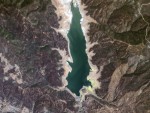
A July 2014 Planet Labs satellite image of a reservoir in California’s Lake County that supplies water to nearby Yolo County. In a non-drought year, according to Planet Labs, the visible water would cover roughly twice the area as it does in this picture. (photo from Planet Labs via Wikimedia Commons)

California headlines this month scream “water shortage” – but the shortage is not limited to the western United States. According to a recent report by the U.S. Environmental Protection Agency, while the demand for freshwater resources is increasing, the supply remains constant and many regions are starting to feel the pressure. The report states that water managers in 40 of 50 states expect water shortages in some portion of their states within the next 10 years.

Amid this grave prognosis, a new Israeli research project might make the Jewish state an important part of the solution.

In what is arguably one of the most innovative water research consortiums to date, researchers from Ben-Gurion University of the Negev (BGU), Technion-Israel Institute of Technology, Hebrew University of Jerusalem and Australia’s Monash University are working to develop “water-sensitive cities.” The description for the project, which is funded by the Jewish National Fund (JNF), says that water-sensitive cities adopt and combine decentralized and centralized water management solutions to deliver water security. The data gathered from the project may be used to support development of urban master plans in cities in Israel and around the world.

Researchers are grouped into teams, each focusing on a different aspect of creating water-sensitive cities.

Eran Friedler, senior research fellow and head of the Water Forum Project at Technion, leads a team whose objective is to develop a holistic vision for water-sensitive cities in Israel encompassing scientific, economic and societal aspects, and accounting for the potential effects of global warming on temperatures and rainfall regimes. The analysis seeks to quantify the effect of urbanization and changing urban texture on storm water harvesting potential.

Evyatar Erell, a professor in the Bona Terra Department of Man in the Desert at BGU, is responsible for water-sensitive urban planning and design. He explained that his role is to examine conventional hydrological planning of cities and to see how it can be improved. This means reducing impermeable surfaces (sidewalks, parking lots, driveways, etc.) in favor of more permeable surfaces, sometimes innovative ones, such as green roofs or the infusion of small bits of garden along footpaths.

“We are trying to determine how to use water as effectively as possible, to maximize its benefits to pedestrians, reduce energy consumption by our buildings, and ensure environmental sustainability,” said Erell.

Read more at jns.org.

Conserving, restoring, sharing Dead Sea Scrolls

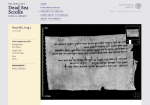
On the website deadseascrolls.org.il, visitors can explore the texts of the Dead Sea Scrolls. (screenshot)

Have you ever taped up a torn page? In our household, taping has saved many a book and article from falling apart. Seems like a practical solution, right?

Wrong! While it might do the job on faulty binding or read-it-again storybooks, it hasn’t worked well on extremely old, organic (mostly animal skin) materials, such as the Dead Sea Scrolls. Curator Pnina Shor, who heads up the Israel Antiquities Authority’s Department for the Treatment and Conservation of Artifacts, recently discussed this sticky mess.

photo - Qumran in the West Bank
Qumran in the West Bank. (photo by Effi Schweizer via commons.wikimedia.org)

According to Shor, for some 2,000 years, the Dead Sea Scrolls had been stored in 11 dark caves below sea level in a steady climate of hot/dry days and cold/dry nights. Beginning with their first discovery in the late 1940s, archeologists transferred the scrolls from the Qumran area to open rooms at Jerusalem’s Rockefeller Museum, some 800 metres above sea level. As anyone who has ever visited Jerusalem and the Dead Sea knows, these places are geographically close, but climatically quite far apart.

At the time, archeologists eagerly wanted to piece together the enormous puzzle of 15,000 (biblical and non-biblical) fragments now at their disposal. Most manuscripts date from the first century BCE to the first century CE, the periods of the Hasmonean and Herodian rule. The archeologists did not know the risks involved in handling such fragile, ancient pieces. So, for example, they touched the parchment with their bare hands, leaving skin oil on the surfaces. They drank their tea and ate their lunch over the texts. (Like the rest of us, researchers are guilty of leaving crumbs and spills.)

In the early second half of the 20th century, archeologists were unaware of the negative consequences of taping torn texts and fragments. They did not realize that the glass panes sandwiching the pieces would put additional weight on the delicate remains.

So, what happened? Sadly, the tape’s adhesive congealed. Some of the texts (especially evident along the edges of the texts) darkened to the point where they became indecipherable to the naked eye.

Measures to contain or reverse the damage began in the 1960s. Unfortunately, this treatment inadvertently resulted in further damage. Until the 1990s, when there was consultation with U.S. preservation experts, it was not understood that the safest environment for the scrolls was a replication of their original storage conditions. Since that time, however, the scrolls have been stored in a climate-controlled laboratory, and exhibited in like conditions for extremely limited periods of time.

Between 1990-2009, the Dead Sea Scrolls Publication Project put out 32 volumes, entitled Discoveries in the Judean Desert. These reports are based on the original infrared photography conducted from the 1950s-60s. The infrared negatives are referred to as PAM (Palestine Archeological Museum).

Four full-time conservationists work on the scrolls. The specialists repair each piece separately, depending on the condition of the leather or papyrus. If you have ever tried removing Scotch tape, you have a sense of what it can do to the material underneath.

The aging adhesive is painstaking removed using a water-based adhesive. Staff members lift stains using a kind of dry poultice. The writings are then placed on acid-free cardboard, lightly covered by Japanese tissue paper. They are housed in solander boxes.

Over the past several years, the IAA has come to feel responsible for sharing these ancient finds, not just with the professional world of archeologists, biblical researchers and historians, but with the public at large. So, on the one hand, some of the scrolls are lent to foreign museums for temporary exhibition. (Currently, the Los Angeles-based California Science Centre has a show.) The more compelling outcome of the new IAA policy, however, has been the mounting of the scrolls to the internet. This undertaking goes by the name of the Leon Levy Dead Sea Scrolls Digital Library project, which has brought experts from far afield.

NASA’s Dr. Gregory Bearman was among those who served as a consultant for imaging technologies. With the assistance of various outside experts, a spectral imaging protocol was established, and it applies to the copying of all the writing:

  1. Displaying the “raw” image alongside the full, enhanced version so others can see both the beginning and end point of the work that has been done.
  2. Documenting the imaging procedure so another scholar, employing basically the same image and tools, can replicate the procedure. In that way, the investigator can better judge the degree of subjectivity involved in a given set of image manipulators.
  3. Labeling aggressively enhanced images as electronic reconstructions, that is, the scholar’s best judgment of what s/he thinks should be there, as opposed to what really is there.

The operating philosophy is to cause no [irreversible] harm. Bearman explained some of the benefits of applying spectral photography, namely that it can “determine the amount of water present in the parchment from which the scrolls are made. Data such as this has added value for conservation and preservation issues. If, for example, we discover that the parchments are too dry, it will be necessary to modify the conditions in which they are maintained.”

In his grey-walled photo lab, Shai Halevi spoke about how he photographs and stores the fragments using multi-spectral photography. Working with Google Research, he photographs the fragments using colors both visible (there are seven bands in this range) and invisible (there are five bands in this range) to the naked eye. Thus, letters that had been illegible are now digitally readable using infrared wavelengths in combination with spectroscopy. You have to see it to believe it:

[vsw id=”HMS_NYEvt_A” source=”youtube” width=”425″ height=”344″ autoplay=”no”]

Halevi described how he copies the fragment from a variety of angles, altering the resolution so that we (the viewing public) will be able to navigate around any part of a scanned image and magnify or reduce any section. Using different filters, Halevi allows us, for example, to see parchment folds appear and disappear at will.

He saves the images in a databank maintained by Google. For each fragment, there are 28 frontal images (referred to as “recto”), 28 back images (“verso”) and two extra color images, which the spectral imaging creates. The internet goal is twofold: first, to have all the fragments uploaded for open viewing and, second, to eventually add transcriptions and translations for all the text.

Recently, perhaps with a gesture toward Shavuot, which celebrates our receiving of the Ten Commandments, Shor brought out an ancient manuscript containing the Decalogue. This inscription is part of a very small scroll (its width is only 2.56 inches, or 6.5 centimetres) containing excerpts from the Book of Deuteronomy. It lists two reasons for keeping the Sabbath: what we know as the Masoretic text of Deuteronomy 5:15, the commemoration of the Exodus, that is, with a strong hand and outstretched arm, G-d took our ancestors from Egypt; and what we know as the Masoretic text of Exodus 20:11, the commemoration of Creation, that is, G-d created the world in six days and rested on the seventh.

This and other texts are within easy reach on the website of the Leon Levy Dead Sea Scrolls Digital Library (deadseascrolls.org.il).

Deborah Rubin Fields is an Israel-based features writer. She is also the author of Take a Peek Inside: A Child’s Guide to Radiology Exams, published in English, Hebrew and Arabic.

B.C. Achievement honor for Krell

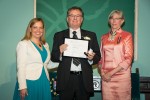
Dr. Robert Krell with the Hon. Coralee Oakes (left), minister of community, sport and cultural development, and the Hon. Judith Guichon, OBC, lieutenant governor of British Columbia. (photo from B.C. Achievement Foundation)

On April 24, 2015, Dr. Robert Krell was among those honored at the 12th Annual British Columbia Community Achievement Awards ceremony held at Government House in Victoria, where he received a B.C. Community Achievement Award medallion and certificate.

“These honorees exemplify what it is to go above and beyond; to do what needs to be done and to give without question their time and energy for the betterment of their communities,” said Keith Mitchell QC, representing the British Columbia Achievement Foundation.

In a personal letter received from the premier of British Columbia, Christy Clark, Krell was honored for his “many years of commitment to developing anti-racism, antisemitism and Holocaust education programs for people of all ages. By establishing the Vancouver Holocaust Education Centre in 1994 and documenting Holocaust survivors’ testimonials, you have ensured that no one will ever forget what Jewish people went through during the war. Your work with child survivor groups is further testament to your dedication to helping people gather together, talk to one another and know they are not alone in dealing with the aftermath of what they and their families experienced.”

Hidden as a child in the Netherlands during the Holocaust, child and family psychiatrist and University of British Columbia professor emeritus, Krell understands the necessity of Holocaust remembrance: learning from its lessons, providing education, supporting survivors and ensuring their stories are not lost. In addition to founding the VHEC, he also founded a group for child survivors, giving voice to their experience.

Funds raised for Nepal

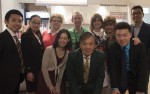
Left to right, back row: Mark Suzuki, Ai Nakano, Marie Doduck, Eppy Rappaport, Ruth Erlichman, Elena Steele and a representative from the Nepalese community. Front row: Casey Suzuki, Dickson Tsang and Andy Sui. (photo by Belinda Co)

On the evening of May 14, members of the Jewish community joined with members of the Japanese, Russian and Chinese communities to raise funds for earthquake relief efforts in Nepal. Held at Omnitsky Kosher Delicatessen, the restaurant’s proprietor, Eppy Rappaport, donated a percentage of profits of that evening’s sales, and attendees made individual contributions throughout the evening.

The evening was organized by Ruth Erlichman and Dickson Tsang, two longtime Vancouver realtors who have know each other for more than 15 years. The two have “done quite a few deals together,” Erlichman said, “during which time Dickson got to know a little bit more about Jews, kosher food, keeping Shabbos, etc. He has been involved in many fundraisers in the past and wanted to do one together … bridging the two cultures and adding our Japanese and Russian friends to the pot.”

The theme of the evening was giving and practising compassion, as “stated in the Torah in parashat Shemini,” Erlichman added. “Making sure we have emunah [faith] that Hashem will help when we personally, G-d forbid, encounter hardship. When it comes to other people’s hardship, we take out our chequebook – we don’t tell them to have emunah; that comes later.”

photo - Ruth Erlichman, left, with Ai Nakano, make origami cranes to be sold at another fundraiser
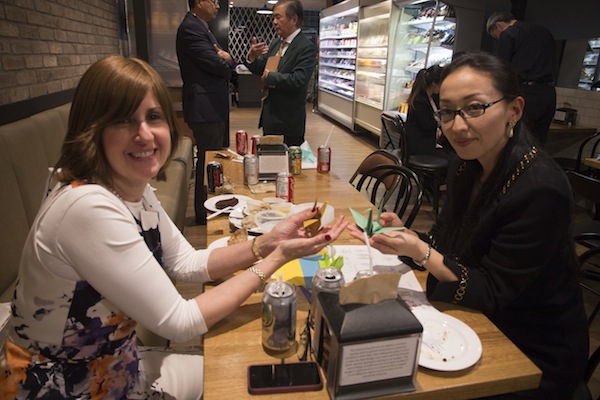
Ruth Erlichman, left, with Ai Nakano, make origami cranes to be sold at another fundraiser. (photo by Belinda Co)

About 30 people attended, including a representative from the Nepalese community who updated the group on the situation on the ground in Nepal. A strong aftershock had occurred just two days prior and the Canadian government had pledged to match dollar for dollar the money raised until May 25. The funds raised at Omnitsky are being donated through the Red Cross.

“Our Japanese friends showed us how to make paper origami cranes,” Erlichman shared. These were sold at a much larger fundraiser held at the River Rock Casino soon after the Omnitsky gathering.

Born and raised in Kobe, Japan, Erlichman said she is “very familiar with earthquakes. Many of us from the Jewish community here held a fundraiser for the Jan. 17, 1995, Kobe earthquake, at the Tama Sushi Lounge on West Broadway, co-owned by the late Mr. Leon Kahn. Funds were sent through the Joint [Distribution Committee] to the Ohel Shlomo Synagogue in Kobe, which incurred exterior damage.”

Young talent gives all

Growing up going to Hebrew school at a Conservative synagogue in Vancouver’s North Shore was a good start for Leo Robinovitch.

While Congregation Har El initiated his exploration into his Jewish identity and connection to Israel, it was a year after Robinovitch’s bar mitzvah that he really delved deeply into Judaism.

“It was then that I started attending Camp Miriam, a progressive, labor-Zionist summer camp affiliated with the youth movement Habonim Dror,” said Robinovitch, who will be returning to Israel this summer.

photo - Leo Robinovich
Leo Robinovitch will be joining Birthright Excel this summer. (photo from Leo Robinovitch)

“Habonim Dror machanot (summer camps) provide children ages 8-17 with a unique camping experience,” the movement’s description reads on its website. “Based on the model of a kibbutz, each machaneh (camp) creates a close-knit community based on Jewish ideals of collective responsibility, respect, equality and friendship…. Campers grow physically, emotionally and intellectually in a creative, open and caring environment. Habonim Dror has been providing a machaneh experience since 1932.”

In the summer of 2009, Robinovitch spent five weeks with Habonim Dror in Israel and later participated in Habonim Dror’s gap year program (from 2011 through to 2012), living in the north of Israel and teaching English in largely Arab cities in the region.

Camp Miriam and Habonim Dror personalized and solidified Robinovitch’s “connection to the Jewish people and our shared fate surrounding Israel, as well as prioritized the formation of a just, equitable, and democratic Israel over all else.”

Robinovitch has always been a technology and engineering enthusiast, an apple that definitely did not fall far from the tree with his father working as a biomedical engineering professor at the University of British Columbia.

“My sixth birthday party was engineering themed,” recalled Robinovitch. “My dad helped me set up a pulley and created a bunch of ping pong ball catapults, much to my own and my tiny friends’ delight.

“I’ve known that I would complete a degree in engineering from a very early age. And, now that I’m more than halfway through my mechanical engineering degree at UBC, I remain passionate about the future of technology and its connection to society, politics and the economy.”

On his most recent trip to Israel this past December, Robinovitch heard about a Birthright Israel Excel program through a few folks he met on the trip. “They were Excel alumni from a couple years ago,” said Robinovitch. “They were all extremely bright, motivated people who I shared many passions with.”

The alumni encouraged Robinovitch to apply for the program, as it had helped focus their careers and exposed them to a world of intelligent, hard-working people.

After looking further into the program, Robinovitch found it to be the perfect way to combine his commitment to Israel with his passion for technology, as well as gain necessary entrepreneurial skills for technology-related business endeavors he envisioned for himself in the future.

For 10 weeks this summer, Robinovitch will be working at a high-profile company in Tel Aviv, living with around 40 peers from across North America interested in commerce, finance, technology, medicine and venture capital (VC).

“I’ve spoken with the Excel staff extensively about my interests, and I’ll be finding out my placement in the coming weeks,” said Robinovitch. Possible internships include R&D for Microsoft, market analysis for General Motors, high-profile VC firms (such as Innovation Endeavors) and cyber-security firms.

During his stay in Israel, Robinovitch will also be traveling through the country and speaking with a number of prominent Israeli leaders over the summer, interacting with a number of Israeli peers with similar interests, and broadly experiencing Tel Aviv life.

Robinovitch is looking forward to further experiencing Israel and contributing to its affairs. “It’s very important for me to connect my passions for technology and Israel, and I look forward to doing so for the first time this summer,” he said.

Robinovitch anticipates that this Excel experience will help him decide which industry he wants to pursue, as well as build a diverse array of Israeli and North American partners with whom he will work well into the future.

While Robinovitch’s previous time in Israel was centred on social justice work and education, he is eager to play a larger role this time around in creating change.

“While this work [social justice and education] is still important to me – unquestionably some of the most important work to be done in Israel – I highly value this opportunity to experience Israel’s thriving tech and startup scene,” said Robinovitch. “It’s a side of Israel I’ve never been able to experience before and I believe that I will be able to tie in this summer’s experience with social justice projects in the future.”

As a student at UBC, Robinovitch has experienced some negative social justice campaigns aimed at Israel, like the recent BDS referendum (boycott, divest and sanction Israeli firms and products) and he is aware of how hot button an issue it has been this year at his university – in particular among the Jewish and Palestinian communities on campus.

“While I feel strongly that the Palestinian people deserve their own land in which to actualize themselves politically, culturally, religiously, etc., I cannot support the BDS movement because of its ultimate goal of the destruction of the Jewish state,” said Robinovitch. “Voting ‘no’ on the referendum, however, seems highly insubstantial compared to the work I will be doing this summer and in the future to contribute to a better Israel.”

Robinovitch encourages those invested in Israel at UBC and further afield “to take action beyond shooting down the BDS movement in order to strengthen Israel and create a more just reality for Palestinians.

“Additionally, I feel strongly that more Jewish youth should experience Israel and Judaism. I have been extremely lucky to be able to explore Jewish peoplehood through the opportunities that I’ve had the privilege of experiencing.”

For those in the community interested in discussing opportunities to experience Israel and Judaism through specialized programming, Robinovitch would be happy to help and can be contacted via e-mail at leorobinovitch@gmail.com.

Rebeca Kuropatwa is a Winnipeg freelance writer.