

For more cartoons, visit thedailysnooze.com.
Author: Jacob Samuel
Kids4Peace keeps growing
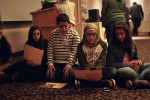
Kids4Peace youth present religious items to friends at an interfaith session. (photo from Kids4Peace)
Kids4Peace (K4P) started in 2002 as a two-week summer retreat/camp in the United States for 12 kids: four Muslim, four Christian and four Jewish. It is now a global movement that works year-round to “break down stereotypes and foster supportive, mature friendships rooted in spiritual values of equality and respect.”
K4P was the brainchild of a Vermont Christian, Dr. Henry R. Carse, who, at 18, left the United States, not wanting to be drafted into the Vietnam War. He moved to Israel and became a citizen. Having done his mandatory service in the Israel Defence Forces (IDF), he served in the IDF during the First Intifada (1987-1993). By the time of the Second Intifada (2000), he had been in Israel for about 30 years, was married and had four children. He wanted things to change so, with the help of some American friends, he created K4P, and the first camp took place in the States though Carse lived in Israel.
In 2004, Yakir Englander joined the organization as a volunteer. He did so for a few reasons.
A student at the time, Englander had grown up in Israel’s Bnei Brak area in a modern, Chassidic family. However, he left the Orthodox community at the age of 22.
“I decided to leave my community with a lot of love … some criticism, but mostly with love, and a huge desire to find more ways to be connected to spirituality and the divine,” he said.
When he left orthodoxy, he was drafted into the IDF, serving in an educational capacity, later spending most of his reserve time in a unit that had to identify dead bodies.
In his first month of studies at Hebrew University, in Jerusalem, in 2002, a bomb exploded and he found himself carrying the bodies of students, some of whom were American. He said that he felt lost, as did “many other Israelis,” feeling that the way toward change was through meeting with Palestinians.
“I went to a few meetings with different organizations,” he told the Independent, “but what I felt was that there’s this huge criticism of Israel in words and language that blames me. Yet, I didn’t have an opinion…. I didn’t know. It wasn’t just because I was Orthodox in the past. At the end of the day, there are many things we don’t know and also life is much more complicated.
“Another thing is that religion is always blamed as the reason for the conflict. For me, my religion was a source of love, a source that gave me energy, a source that gave me courage to go meet with Palestinians.”
When Englander heard about K4P, he joined as a Jewish advisor, and then later as a director until 2012.
Englander found it intriguing that two-thirds of K4P participants are Palestinians, both Muslim and Christian. “The fact that they are the majority in K4P, in a way, gives them the first opportunity to be in the majority,” said Englander. “This created new sets of power of dynamics, which are very interesting.”
About K4P’s goal, he said, “I think, today, when we hear the word ‘Islam,’ some people hear ‘ISIS.’ When some hear the word ‘Judaism,’ some people think ‘settlements.’ We want to change that.”
The transition is difficult, however, said Englander. He said some of the kids lose their bearings after the experience. “They no longer knew what to do or how to act, as they no longer hated Israelis or Palestinians,” he said.
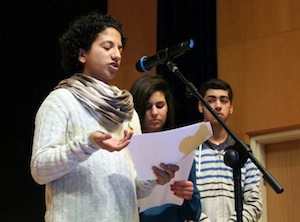
In 2006, K4P changed to a year-round model. Throughout his time there, Englander continued his studies, culminating with a PhD in gender studies, sexuality and Jewish theology. His schooling led him to Northwestern University. He became a Fulbright scholar, and spent a year as a visiting professor at Harvard Divinity School.
“During these years, I served as a vice-president for K4P International, working a lot on creating connections with many moms, rabbis, priests, government people, and doing a lot of lectures all over North America, including Canada,” said Englander.
Last year, Englander, together with the board, decided to end his term as vice-president to instead lead K4P graduates. Englander created a new program for 18-to-25-year-olds, working with them to shift from a dialogue-only model to a dialogue-to-action one.
“The idea with the kids and teenagers is we do a lot of dialogue and volunteering and other things in between, but we can’t put them at risk,” said Englander. “But, if you really want to create change, you must take some risk. So, dialogue-to-action is an answer for these needs.”
Children join K4P in Grade 6 for a six-year program with summer camps along the way. “It’s amazing to have two weeks together, but they work all through the year for six years, so it’s a very long process,” said Englander. “Because of this, it lets us dig deeper with them, step by step, in the conflict.”
For now, the program in Israel only operates in Jerusalem, due to financial constraints.
“Last year, the U.S. Institute for Peace gave us a very nice amount of money, so we have enough now for all the families who join K4P,” said Englander. “When the kids have a meeting, the parents, too, must come.
“We now have chapters in eight or nine cities around the world, with some [others] in the process of establishing chapters. Each one has two therapists, Israeli and Palestinian, who do the full journey with the parents and kids. So far, Toronto is the only Canadian chapter, but we also have [groups] in Houston, Seattle, New Hampshire, Vermont, Atlanta and a new one in Lyon, France.”
The Israeli chapter currently has about 150 kids, with the capacity to add another 65 new kids and their families this year.
“Hopefully, by next year, we’ll grow by 80 new families,” said Englander. “But, we also need to take into account that we are building a new program for 18-to-25-year-olds, with 15 amazing, serious young people. Some of them are graduates from K4P and some have parents who would never [have] consider[ed] sending them for K4P – settlers who grow up in settlements – [but] something very deep broke in them last year.
“It’s important for us that people will see Palestinians and Israelis together, hand in hand, helping in hospitals. But now, with the young adults, we want to take it further.”
Englander said that, in today’s situation, Israelis and Palestinians do not generally mix in public places. But, on Feb. 29, he said, K4P challenged that reality, having these young adults meet in a public space in Jerusalem.
“So, this group of people with a lot of courage decided they [were] going to do it,” said Englander. “Half of the meetings are going to happen in public spaces … that we choose very carefully … spaces where normal people from east Jerusalem and west Jerusalem are going to see them in their public space – Palestinians and Israelis together, body next to body, and dealing with the crucial, most important questions.
“We are planning to record and share these meetings,” he continued. “It’s very important to bring the voices and pictures to the world, to see how Muslims are opening themselves, how Jews are opening themselves – so they can see that it’s not just shalom/salaam, they care about their Jewish identities, their Muslim identities, their Christian identities … though they struggle with that, they still decide to work for peace.
“It’s a huge responsibility,” he said, “And, I will be honest and say that we feel a failure sometimes, thinking why didn’t we reach out to all the kids of Jerusalem and offer them this opportunity.”
Rebeca Kuropatwa is a Winnipeg freelance writer.

Finding joy in food and art
Talia Syrie (photo from Talia Syrie)
In 1999, Israeli-born longtime Winnipegger Talia Syrie spent her summer working as a tree planter in British Columbia. Trained as a heavy diesel mechanic, she was tree planting to pay off her student loans. A month into the summer, Syrie stepped on some broken glass and injured herself. Not yet ready to leave, however, she found work in the kitchen, helping feed 90 planting staff.
“I kind of endeared myself to the kitchen staff and they let me stay on,” said Syrie. “I realized, doing that, that I really enjoyed it, really liked cooking. I came back to Winnipeg and did that for the next year or two.
“I really liked the bush-camp cooking experience, when you’re out in the middle of nowhere and you don’t have the resources available to you that a regular kitchen provides. I liked that challenge.”
With this newfound passion, Syrie started working in the catering world. Then, a friend suggested that she open her own catering business.
With that, Syrie began searching for a commercial kitchen from which to work, eventually finding a small one at a downtown hotel. The owner offered her the kitchen, as long as she also agreed to open a restaurant at the hotel.
“There wasn’t anything like that in the neighborhood, on Main and Logan,” said Syrie. “It’s now the Red Road Lodge, but it used to be the Occidental Hotel. I had grown up in the North End, where my grandfather on my father’s side had a business. Today, too, I live quite close to there (in North Point Douglas).
“It felt nice to be working in that neighborhood, I was happy to do it. I didn’t really think that anyone would come into the restaurant. I thought it was going to be mostly for show and then we’d run the catering company and have this ‘fake’ restaurant.”
When Syrie first opened the Tallest Poppy, they only had three or four tables. As it turned out, these tables were always occupied, so they had to add more. In no time, the restaurant was so busy that Syrie did not have much time for catering.
“It was very challenging at the beginning, the restaurant industry,” she said. “Having little to no restaurant experience, there was a pretty steep learning curve. It was exciting and there was a lot of fun and a lot of things were great, but, in a lot of ways, it was pretty messy.
“I always say that I’m really grateful that we started out where we did. The North End is pretty forgiving, pretty gentle with us, so we were able to make mistakes and learn things.”
After a few years, Syrie found enough time to start developing the catering part of her business, doing office lunches, barbeques and small parties. “We also cater a lot of funerals,” she said.
“I love making party sandwiches,” added Syrie. “If I could do anything, I’d probably just make party sandwiches. That would be my dream job. I like the practical nature of a lot of catering. You have a whole bunch of people and they have to eat, people working that have to be fed.”
Syrie said her primal drive to feed people has its roots in her Jewish upbringing, being taught at an early age that the only way to really show someone you care is by feeding them.
“That’s the only way that really counts,” she said. “You buy somebody a car, it doesn’t matter. If you make them soup when they’re sick, that’s how they know you actually love them.”
About three years ago, a new community marketplace, Neechi Commons, opened in the neighborhood. The owners asked Syrie for help setting up their restaurant. She agreed, as she was happy to help a worthwhile project in her neighborhood. She ran both places for awhile and, later, decided to close the Tallest Poppy.
Once the Neechi Commons restaurant Come ’n Eat was up and running, Syrie opted to move on. She returned to British Columbia to do some consulting work for a friend and then returned to Winnipeg to find a new location to reopen the Tallest Poppy.
“I was walking down Sherbrook Street with a friend one day,” said Syrie, “and, as we were passing by the Sherbrook Hotel, he said, ‘I think that’s a restaurant … I think you should check that place out.’ All the blinds were shut. My friend said it used to be a Chinese food restaurant, but that there is nothing in there now…. I called and made an appointment to come down and take a look. The rest is history, as they say.”
Syrie reopened the Tallest Poppy in its new location last September. Not knowing the neighborhood well, she did not know if her concept would be a good fit, but she has found the people to be very welcoming, generous and kind.
Wanting to give space to the arts community, Syrie has offered her restaurant walls to local artists.
“I don’t know if I support the artists or they support me,” she said. “It’s important to me to have art around me all the time. It makes me feel better. It’s kind of selfish. The Winnipeg arts scene is so exciting. I work a lot and I’m stuck in my restaurant a lot of the time. I can’t always get out to gallery openings or go to shows. It’s really convenient for me to have them come do it right at my place.”
Syrie has formed a connection with a local company that displays art in public places, called Synonym Art Consultation, and the company organizes and programs all the restaurant’s art-related happenings. This includes a residency project that brings in an artist once a month to the restaurant to create art in the restaurant, while also interacting with clientele. “They are these super people doing this wonderful work,” said Syrie. “We sort of ride on their coattails. I’m very privileged and honored that they’re willing to work with us.”
The artists are varied, and some are performers.
“They come for two to three days, generally on the weekends, and people are able to engage them, which is a lot of fun,” said Syrie. “So, regular people having breakfast can come and talk to the artist about the work they’re doing.
“The artist has an opportunity to engage a lot of people they may not normally have access to. Their work is shown in the restaurant for a month, whatever it was that they built or did.”
The Tallest Poppy also hosts an after party on the first Friday of every month for people who go from gallery opening to gallery opening, including food and an arts presentation with DJs.
“A lot of things about Winnipeg make it really hospitable for independent business,” she said. “Our economy is pretty stable and there’s a bunch of hardworking people who are generally pretty down with jumping on board if you have a good idea. If I was going to do something else, this is the only place that makes sense for me to do it.”
Rebeca Kuropatwa is a Winnipeg freelance writer.

Making healthy eating cool
Adam Segal at Indigo Richmond Hill in Ontario last fall. (photo from adammichaelsegal.com)
Every parent knows how difficult it can be to cajole their children to eat their vegetables. Author Adam Michael Segal has come up with a tool he hopes will make it easier for parents – inspiring children to eat healthy, and combating the obesity epidemic.
The Toronto-based health communications expert and former elementary school teacher has penned Fartzee Shmartzee’s Fabulous Food Fest, a fun and whimsical book for children ages 4 to 7. The main character, Fartzee, is a quirky child with multicolored spiky hair on a quest to persuade his family to eat nutritious food. Through a series of hatched plans, a food festival and a sticker game, he succeeds in showing everyone in town that eating right can be fun.
The book is made more visually appealing with drawings by 20th Century Fox illustrator and animator Daniel Abramovici.
“This is an entertaining and imaginative story that educates children about healthy eating practices and behaviors,” said Dr. Samantha Witt, a pediatrician based in Maple, Ont.
Part of the inspiration for writing it, Segal told the Independent, included the lack of books specifically directed towards young children to teach them, in a fun way, about eating well.
According to the U.S. Centres for Disease Control and Prevention, obesity rates in Canada have nearly tripled in the past 40 years, with close to a third of children considered either overweight or obese. Diabetes, heart disease, stroke and some cancers are among the many issues that can arise from obesity.
“For generations, kids have been led to think of junk food as cool and fun, which has contributed significantly to the prevalence of childhood obesity,” said Segal. “With Fartzee, I am trying to completely shift the paradigm to obesity prevention, empowering kids to discover that nutritious food is cool, fun and delicious.”
Segal said he flipped through scores of children’s books to get a feel for what his target age group would find compelling. This is one reason why, in his book, “food is all over the place; it’s kind of messy but fun.”
For some parents, the main character’s name might sound too coarse for a child, but Segal said, so far, parents and educators haven’t had any problems.
“I was a little concerned and nervous,” he admitted, when initially sending out the book to a Grade 2 teacher, a librarian and a parent. “Not a single one had an issue with it. They said that there are already books, at least 10 others, with a character that did farts. It’s not anything unusual or out of the norm. Even someone from the ministry of education reviewed the manuscript and didn’t flinch at it, and they were a teacher for 30 years.”
The book has been read to more than 5,000 students at 15 schools across the Toronto area thus far, according to Segal. He’s finding that kids aren’t as resistant to eating right as we might have thought.
“I ask them why we eat healthy food, and they really get it. Even a 6-year-old will say it gives energy, helps you grow, it’s good for your body and brain,” he said. “At a young age, they actually understand a lot more about the benefits of nutrition than I would have thought when I wrote it.”
Fartzee Shmartzee’s Fabulous Food Fest is available through adammichaelsegal.com or amazon.com.
Dave Gordon is a Toronto-based freelance writer and the managing editor of landmarkreport.com.
Restoring ritual of tea
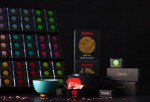
“The mini cube is our modern interpretation of the traditional ceremonies of ancient cultures,” say Cérémonie Tea’s Elli and Efrat Schorr. (photo from Cérémonie Tea)
From the professions of law and psychology, Elli and Efrat Schorr turned to tea. And, from the Israeli market, they are expanding worldwide. Cérémonie Tea can be bought in several locations in the Lower Mainland, for instance, but the Schorrs’ connections to Vancouver are deeper.
“Efrat’s enduring memory of Vancouver is of the hospitality and openness that she and her family experienced in their time in B.C.,” Elli told the Independent. “For me, Cérémonie Tea is an opportunity to return the warmth to the
Vancouver community, sending the best flavors that Israel has to offer back home, along with our friendship.”
Elli was born in Washington, D.C., and Efrat was born in New York. She lived out east for her earliest years, but then the family moved to the West Coast, living in Vancouver for two years and then in Richmond for another two years. Her father, Rabbi William Altshul, was the principal of Vancouver Talmud Torah from 1979-83 and Efrat worked at VTT, with kindergarteners through Grade 3s. Her father helped found Richmond’s Eitz Chaim Congregation.
From Vancouver, Efrat’s family moved to D.C., which is where she met Elli. They were high school sweethearts, marrying in 1995. Raised in strong Zionist homes and inspired by their experiences in post-high school yeshivah programs in Israel, they made aliyah in 2005 after they completed their graduate studies.
Elli was a lawyer, graduating from Georgetown University, and Efrat has a PhD in developmental psychology from the University of Maryland, College Park. After working in their respective fields for several years, they decided to go into business in 2012.
“After sharing 20 years of marriage and five children,” reads Cérémonie’s website, “these childhood sweethearts decided to look for their next adventure together.” They bought Cérémonie Tea from the founders in February 2013.
“We were looking for a business opportunity and explored coffee, even visiting Ethiopia, the birthplace of coffee,” Elli told the Independent. “Along the way, we encountered Cérémonie Tea, with its striking design and delicious products and fell in love. We worked in partnership with the founders for about a year and then purchased the company from them, undertaking management of the company since then.”
The company is based in Migdal Haemek in the northern part of Israel. The Schorrs live in Gush Etzion, in the town of Alon Shevut, which is about a two-hour commute. “We are enjoying the learning experience of working in a different environment, far away from our English-speaking bubble!” said Elli.
Established in 2003, the Schorrs have expanded the company’s reach internationally since taking over, beginning in Italy in 2014 and the Netherlands in 2015. The ingredients – whole tea leaves, along with spices, herbs and flowers – come from around the world, and the tea bag material is imported from Japan. “Presently,” said Elli, “we are not using compostable materials, but are exploring such options for the future.”
Cérémonie Tea offers a range of products, including mini cubes, pyramid tea bags and loose tea blends.
Bringing “their American style of customer service and entrepreneurial spirit to the traditional world of tea,” the Schorrs are trying to return people to the “ritual of serving tea.”
“The mini cube is our modern interpretation of the traditional ceremonies of ancient cultures,” explains their website, “innovative in our style of serving but classic and timeless in our taste.”
Currently, Cérémonie Tea can be found in Richmond at Save-On-Foods at Ironwood Plaza, Loblaws City Market and Superstore, as well as at Superstore in Vancouver on Marine Drive and Save-On-Foods South Point in Surrey. There is always the option of buying online, of course, at ceremonietea.com.

Revenge story with humor
Before you get to the fifth page of text, it will become apparent that you haven’t yet encountered a period. Don’t be put off by that. Curt Leviant’s King of Yiddish (Livingston Press, 2015) is a page-turner. It is a comedic tour de force, interspersed with a detective story that will have you following Shmulik Gafni through Poland in an obsessive pursuit. He is hunting the man he witnessed murdering his father and uncle in Kielce, Poland, a pogrom that occurred 14 months after the end of the Second World War.
Shmulik is described as an “overlyfull professor” of Yiddish at the fictional University of Israel in Jerusalem. The pogrom in Kielce is a well-known tragedy that did occur, but Leviant’s fertile imagination weaves an original tapestry from that terrible time and place.
So, where’s the comedy? The humor centres around a basic human failing: men will be men, and Shmulik falls under the spell of Malina, a Polish Catholic linguist determined to become proficient in Yiddish. She also happens to be half Shmulik’s age and is unbelievably beautiful and well built. Malina is his second obsession.
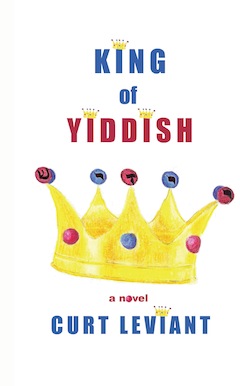 The two stories, solving his father’s murder and getting to the bottom (and the top) of Malina, are interspersed narratives that keep you guessing and entertained. Along the way, the reader encounters a Chassidic un-kosher kidnapping that goes awry (imagine the Marx brothers in black hats) and a bris (kosher or not depending on whether you are Orthodox or Reform) that are grist for Leviant’s mill of linguistic tomfoolery. You meet other academics, letting you in on university rivalries and gossip. Believe it or not, but a cookie with an incredible miniature topping in a Vienna café is an important character in the plot development that might have been written by Kafka, Borges or Nabokov, but it is pure Leviant, plying his considerable art as a fabulist.
Leviant also steps outside the narrative and talks to the reader. At one point, the author says you can skip a chapter. Take my advice: keep reading. As you join Gafni in his quest for justice, you will also find allusions to previous works by Leviant. These, he jokingly attributes to famous Hebrew and Yiddish writers, telling us that other colleagues translated those books. One of these is the Icelandic writer, C. Urtl Eviant, a self-referential invention who also plays a role in King of Yiddish.
Considering all the word play in English, Yiddish and Hebrew, my favorite occurs when a colleague of Shmulik’s is calling 911. He tells the operator he is a linguist with the City University of New York. Propriety in a family publication requires you figure it out for yourself. Revealing any of the other plot twists would spoil the fun.
If you have read Leviant’s other critically acclaimed fiction, you will catch many of the references here. If you haven’t, you may want to back up and read some of his earlier novels. The Yemenite Girl, The Man Who Thought He Was Messiah and Diary of an Adulterous Woman are good places to start. He has produced a body of work that has been widely translated throughout Europe.
John Irving has written that he always composes the last few sentences of his novels before he begins page one. Leviant must have done this with his novel. For those of you who like to look at the end of a book before you begin … please resist. King of Yiddish is a gripping narrative that will fascinate you from the opening paragraph to its surprising last.
Sidney Kessler is a freelance writer in Glen Allen, Va. His most recent articles have appeared in the Wall Street Journal and the Richmond Times-Dispatch.
From nonsense, knowledge
To help readers remember what they learn, Hilarious Hebrew uses silly sentences and illustrations. (all images from Hilarious Hebrew)
“The poor monkey has a cough.” “If you’re feeling sleepy, let the lights dim, yawn and let your imagination run free.”
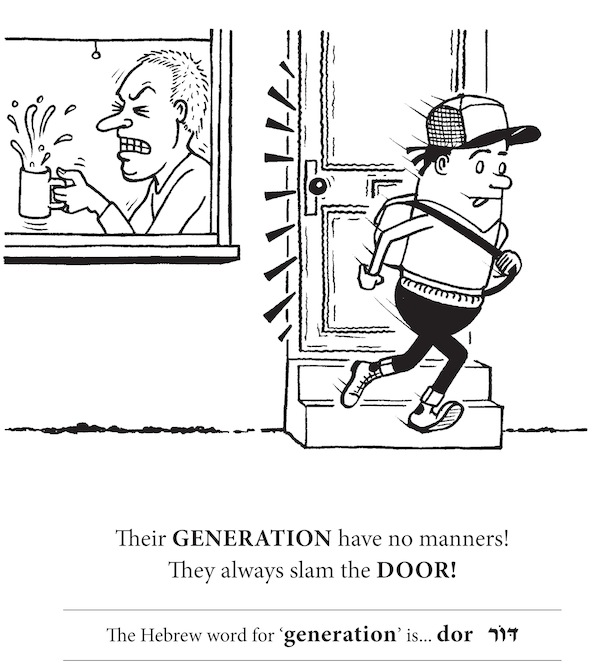
Through such silly sentences, readers of Hilarious Hebrew: The Fun and Fast Way to Learn the Language (Pitango Publishing) learn that, in Hebrew, the word for monkey is kof (pronounced similarly to cough) and that imagination is dim’yon (pronounced dim, yawn). If the context of the sentences isn’t enough, the illustrations should ensure you remember.
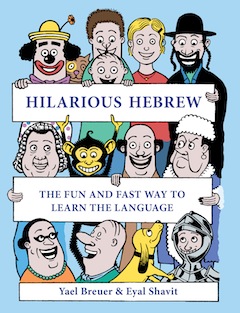 “The method in Hilarious Hebrew is aimed at teaching vocabulary rather than whole sentences because the whole point of it is to teach a Hebrew word in the context of a sentence in English that would convey the pronunciation and the meaning of the new word (in Hebrew) through a familiar, easy context (in English),” explained Hebrew teacher Yael Breuer, who co-authored the book with musician Eyal Shavit.
The writing duo is continually coming up with new teaching phrases, which they often post on the book’s Facebook page, Instagram and Twitter accounts, said Breuer.
“I’ve used the method over the years with my Hebrew students and classes and knew that the method worked well – the words stuck in the students’ minds! – and that it added an element of fun to the lessons.”
And her testing ground has been extensive. The longtime teacher has worked with a wide variety of students: “people with family members in Israel, people who planned to visit Israel, partners of Israelis who want to learn some Hebrew, people converting to Judaism, a vicar, nuns – a real interesting mix,” she said.
About the book’s origins, Breuer said she shared a list of 20 to 30 sentences that she used regularly in teaching with Shavit, who is also an Israeli expat living in Brighton, England.
“Eyal loved the idea so much and started making up new sentences and texting them to me to make me laugh. I started reciprocating with new sentences that I would make up and, for awhile, we were just making up sentences for our own amusement. A few months down the line, however, when I realized that there were about 300 sentences that taught a variety of Hebrew words from various fields and at all levels, I suggested to Eyal that we share the resource – and that’s how the idea of the book came about.
“It took us about a year from conception to publication,” she continued. “We did not approach a publisher, as we knew how we wanted the book to look and feel. It was a long and rather hard process at times, and we would regularly spend hours rewriting one sentence so that it taught the Hebrew word in the best possible way. We also had to liaise with designers, find the right illustrator, choose the right printers and make many decisions, but we completed the process, are getting fantastic feedback and are very pleased with the result!”
An important part of the book’s appeal is the drawings by cartoonist, writer and illustrator Aubrey Smith, who has contributed his art to several books and also has written How to Build a Robot with Your Dad and Screw It, both published by Michael O’Mara Books.
 In addition to teaching Modern Hebrew, Breuer writes for the Jewish Chronicle; she also has had her articles on British culture published in Israeli newspapers Haaretz and Maariv. From Rehovot, Breuer moved to Brighton 27 years ago, she said. “My husband, David, is English and, although he is originally from London, he already lived in Brighton when I met him.”
Shavit, who is from Kibbutz Kfar Szold in northern Israel, has been in Brighton for nine years. “He was working elsewhere in the U.K. but someone recommended Brighton as a vibrant and arty place where he could pursue his music career, so he came here and stayed,” said Breuer. “He studied music in Brighton and has been making a living as a musician (plays the guitar and sings) ever since.”
The two friends met fellow Brightoner Smith, who is English, “by pure chance through my neighbor, Dave,” explained Breuer. “As soon as we saw his wonderful, humorous style, we knew that he was the one. Aubrey has never had a connection to Judaism or Hebrew but, through illustrating the book, he himself learned some Hebrew words and would sometimes use them in his emails to us, which was another proof that the method works!”
The Jewish community in Brighton is a few thousand strong, said Breuer, with “four active synagogues – two Orthodox, a Reform and a Progressive, and a Chabad branch, too. There is a small community of a few dozen Israelis but it is a vibrant one – we meet regularly in a pub in Brighton, celebrate festivals together and keep in touch. Many of the Israelis here and their English-speaking partners or children have been our ‘guinea pigs’ when writing the book and their feedback helped us tremendously.”
Hilarious Hebrew is available at hilarioushebrew.com, some bookshops and gift stores and also on Amazon.
Supportive of Shalva
A 6-year-old Shai Gross with his family in 1976, after the successful Entebbe Operation. (photo from Shalva)
Seeing is believing. At first, it sounds like another cliché, another pat answer to brush off an unwanted question. But, sometimes in life, we are put in situations where our power to overcome must be seen to be believed. Last month, guests at the Shalva 26th anniversary dinner in Israel were able to see for themselves how the human spirit can overcome unbelievable odds.
The youngest of the hostages in the 1976 Entebbe Operation, Shai Gross, stood before the guests at the dinner. His presence itself was a testament to the power of human beings to do the unbelievable.
“When I was 6, my parents and I were among the hostages,” he said. “For a full week, we sat, captives in Entebbe, with pistols and grenades threatening our lives. The terrorists separated the children into business class [on the captured plane] to avoid parents acting up in defence of their children. My mother, however, was able to hide me under her seat. I was only 6 yet I remember asking her, ‘Does dying hurt?’”
The Entebbe Operation is forever marked in the collective Jewish consciousness. On June 27, 1976, four terrorists hijacked Flight 139 en route from Tel Aviv to Paris. They were armed with pistols and a grenade with the pin removed, which they held as insurance against being attacked by the passengers. The flight was diverted to Entebbe, Uganda, where the government supported the hijackers. All non-Jewish passengers were released while more than 100 Jewish passengers were held, fearing for their lives.
The horrifying ordeal came to an end on July 4, when the Israel Defence Forces launched a rescue mission. In what is still considered by many to be the most daring hostage rescue mission of all time, a group of Israeli commandos stormed the complex.
Gross recounted the last few moments before they were rescued, “All we heard were gun shots. I was paralyzed with fear. At the time, the only possible explanation to the insanity was that they were coming to finally end our lives. How could it even enter anyone’s mind that the IDF had made it all the way to distant Entebbe?!”
The rescue that was underway seemed totally unbelievable until Gross saw it with his own eyes. “After a few moments, we realized that we were being rescued by the IDF. That dramatic rush from desperation to salvation … that is a joy I will never forget.”
Nonetheless, Gross acknowledged, “This traumatic experience left its mark on me. I was emotionally disabled.”
Having personally experienced how a child can overcome challenges that would try an adult, he has added empathy for the children of Shalva, where he volunteers. He contributes to Shalva in an effort to give back to Israel, and in memory of the soldiers who gave their lives to save his.
The moment when the unbelievable happens before your very eyes, when the darkness is suddenly transformed to light, is a familiar occurrence in the Shalva centre in Jerusalem. For 26 years, Shalva has been helping children with special needs move beyond their limitations. Shalva programs and services are designed to provide individual treatment for the child while also strengthening the fabric of the family. Providing services for more than 500 infants, children and young adults, Shalva accompanies each child from birth to adulthood. Individually tailored programs are designed to help participants reach their full potential and integrate into the community.
As a volunteer, Gross sees how Shalva’s approach helps kids meet their challenges. “Shalva doesn’t see children with disabilities,” he said. “No. They see superheroes that just need to conquer some challenges. After volunteering at Shalva myself, I have come to realize that we’re all the same: potential heroes trying to overcome our struggles.”
Gross has moved past the scars of his experience in Entebbe. He married and is the father of four children. He named his youngest son Yoni in memory of Yoni Netanyahu, the rescue team’s commander and the older brother of Prime Minister Binyamin Netanyahu, who was killed in the raid.
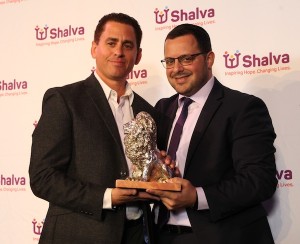
At the Shalva dinner, Gross was awarded with the Shalva Spirit of Hope Award in recognition of how he has met his personal challenges and used that experience to help others.
To learn more about the work of Shalva, visit shalva.org.

Tax reminders for students
Canada Revenue Agency has tax credits, deductions and benefits to help students. (photo from CRA)
The Canada Revenue Agency (CRA) has tax credits, deductions and benefits to help students, and here are some tips to ensure students get them. First, of course, is to file on time.
Most Canadian income tax and benefit returns for 2015 are due on April 30. However, since this date is a Saturday, CRA will consider your return as filed on time and your payment made on time if it receives your submission or it is postmarked by midnight on May 2, 2016. Self-employed individuals and their spouses or common-law partners have until June 15, 2016, to file their income tax and benefit returns, but any balance owing is still due no later than May 2, 2016.
Claim eligible tuition fees. You should have received an official tax receipt or a Tuition, Education and Textbook Amounts certificate from your educational institution with the total eligible fees paid for the tax year.
Claim the education amount. If you are a full-time student (or a part-time student who can claim the disability amount or has a certified mental or physical impairment), you can claim $400 for each month you were enrolled in an educational institution. If you are a part-time student, you can claim $120 for each month you were enrolled.
Claim the textbook amount. If you are entitled to claim the education amount, you can claim $65 for each month you qualify for the full-time education amount or $20 for each month you qualify for the part-time education amount.
Claim the interest paid on student loans. You may be able to claim an amount for the interest paid on your loan in 2015 for post-secondary education. You can also claim interest paid over the last five years if you haven’t already claimed it. Only interest paid on loans received under the Canada Student Loans Act, the Canada Student Financial Assistance Act, the Canada Apprentice Loans Act or similar provincial or territorial legislation for post-secondary education can be claimed.
Claim the public transit amount. If you use public transit, you may be able to reduce your taxes owing by claiming the cost of your transit passes (cra.gc.ca/transitpass). Keep your transit passes for local buses, streetcars, subways, commuter trains or buses and local ferries, and enter your total public transit amount on line 364 of Schedule 1, Federal Tax.
Claim eligible moving expenses. If you moved for your post-secondary studies and you are a full-time student, you may be able to claim moving expenses. However, you can only deduct these expenses from the part of your scholarships, fellowships, bursaries, certain prizes and research grants that has to be included in your income. If you moved to work (including summer employment) or to run a business, you can also claim moving expenses. However, you can only deduct these expenses from the net income you earned at the new work location. To qualify, your new home must be at least 40 kilometres closer to your new school or work location.
Claim the GST/HST credit. If you have low or modest income, you are a resident of Canada and 19 years of age or older, you may be eligible for the goods and services tax/harmonized sales tax credit. You do not have to apply for this credit – the CRA will determine your eligibility when you file your return and send you a credit notice if you qualify for it.
Claim child-care expenses. If you have to pay someone to look after your child so you can go to school, you may be able to deduct child-care expenses.
If you need help filing your return, and you have a modest income and a simple tax situation, volunteers from the Community Volunteer Income Tax Program may be able to prepare and submit your return for you. To find a free volunteer tax preparation clinic near you, go to cra.gc.ca/volunteer.
CRA’s secure My Account service is a one-stop shop for managing your tax and benefit information. Using My Account, you can track your return status, change your address, check your RRSP and TFSA limits, register for online mail, print proof of income, and so much more. When you register for online mail, CRA will no longer print and mail you eligible correspondence. Instead, CRA will send you an email when you have mail to view in My Account. You can also securely access your information with the MyCRA app (cra.gc.ca/mobileapps), which uses the same login information as My Account.
You can get your income tax refund and your credit and benefit payments directly paid into your account at a financial institution in Canada (cra.gc.ca/directdeposit). And, new this year, the CRA’s Auto-fill My Return service (cra.gc.ca/auto-fill) is available through some certified tax preparation software. This secure service automatically fills in certain parts of your income tax and benefit return.
If you are an international student studying in Canada, you first have to determine your residency status at cra.gc.ca/internationalstudents. You may owe taxes to the Canadian government and may qualify for GST/HST credit payments. If you have questions, call the CRA’s international tax and non-resident enquiries line at 1-800-959-8281.
For more information, go to cra.gc.ca/students.
Life legacies in writing
“I am now face to face with dying, but I am not finished with living,” writes Oliver Sacks as the dedication to Gratitude (Knopf Canada, 2015), a collection of four essays that were written in the two years preceding his death last August.
“I have given much of my life to the Jewish world, and I wish I had many more years to serve this noble calling,” writes Edgar Bronfman in concluding his book Why Be Jewish? A Testament (Signal, 2016), which he completed mere weeks before his death in December 2013.
Bronfman continues, “But everything has its natural end, and so now, as my time on earth draws to a close, I would thank my stars even more if you would choose to stand at Sinai; if you would choose, as I did so many years ago, to join this remarkable people who generation after generation held fast to the dream that through our individual and collective efforts we could transform the troubled world we share into a more perfect, more humane, more civilized place.”
Even though he became intrigued with Judaism late in life, Bronfman still defined himself as secular, “not comfortable” calling himself an atheist “in the face of the complexity of the universe.” He had a connection to Judaism through his grandfather, but it was weak. “My parents,” he writes, “for whatever reason, failed to instil much-needed Jewish pride in their children.”
Sacks was a self-described atheist. For him, it was his mother’s strongly negative reaction to the news of his homosexuality that pushed him away from belief: “The matter was never mentioned again, but her harsh words made me hate religion’s capacity for bigotry and cruelty,” he writes.
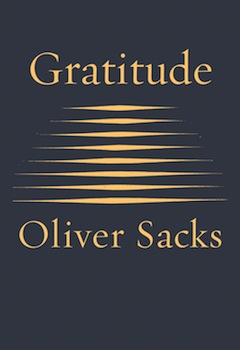 However, the final essay in Sacks’ Gratitude is called “Sabbath.” In it, he recalls his parents’ observance of Shabbat, a day that “was entirely different from the rest of the week.” He recalls how the family would mark the day, how he became bar mitzvah, his break with his family and community in England after he qualified as a doctor and moved to Los Angeles, his “near-suicidal addiction to amphetamines,” his recovery and how he “became a storyteller at a time when medical narrative was almost extinct.” In addition to being a neurologist, most readers know, Sacks was an author – he wrote more than a dozen books, including Awakenings, The Man Who Mistook His Wife for a Hat and other Clinical Tales and An Anthropologist on Mars.
Sacks comes to appreciate Shabbat: “And now, weak, short of breath, my once-firm muscles melted away by cancer, I find my thoughts, increasingly, not on the supernatural or spiritual but on what is meant by living a good and worthwhile life – achieving a sense of peace within oneself. I find my thoughts drifting to the Sabbath, the day of rest, the seventh day of the week, and perhaps the seventh day of one’s life as well, when one can feel that one’s work is done, and one may, in good conscience, rest.”
Gratitude is a short but powerful collection. It is masterfully written and nearly impossible to get through without crying. All of the essays have been published before, but having them together for re-reading, rethinking and re-feeling is more than worthwhile. Every read will be a cathartic experience.
The first essay, “Mercury,” was written just before Sacks’ 80th birthday in July 2013. In it, he talks about what it feels like to be turning 80, some of his regrets, but mostly how much he has left to do, “freed from the factitious urgencies of earlier days, free to explore whatever I wish, and to bind the thoughts and feelings of a lifetime together.”
“My Own Life” is named after the autobiography of one of Sacks’ favorite philosophers, David Hume. Sacks shares a couple of paragraphs from that 1776 work, using it to lead into a discussion of his own state of mind. “My generation is on the way out, and each death I have felt as an abruption, a tearing away of part of myself.” While not without fear, he writes, “my predominant feeling is one of gratitude. I have loved and been loved; I have been given much and I have given something in return; I have read and traveled and thought and written.”
In the third of the four essays, “My Periodic Table,” Sacks talks of his love of the physical sciences and how, since “death is no longer an abstract concept, but a presence,” he is surrounding himself again, as he did when he was a boy, “with metals and minerals, little emblems of eternity.” On his writing table is a gift from friends for his 81st birthday, thallium, as well as lead, for his recently celebrated 82nd birthday. After discussing the treatment of his cancer, he expresses his skepticism about reaching 83, his bismuth birthday. He did, indeed, pass away at 82.
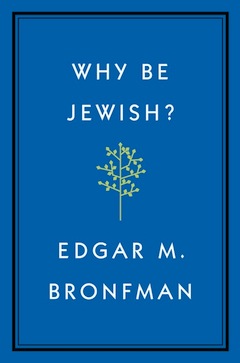 Bronfman died at 84. It is particularly fitting to be discussing his book Why Be Jewish? as Passover nears. Two of the nine chapters are directly related to the holiday: Chapter 8 is about its rituals, the story, the symbolic aspects, its importance, while Chapter 9 presents the principles and practices of leadership as demonstrated by Moses – not Moses the manager, but rather, “Moses the man who, as flawed as he was, executed brilliant strategies that ultimately transformed much of the world. These principles are also relevant to everyday leadership, from parenting to day-to-day responsibilities at work.”
There are many lessons Bronfman derives from Moses and the Exodus story. Good leadership involves standing up for something, perseverance, vision, pragmatism, courage, celebration of accomplishment, allowing opinions (even complaints, perhaps especially complaints), awareness of one’s strengths and shortcomings, adherence to a moral code, the duty to pass the mantle. He doesn’t believe that Moses’ non-admittance into the Promised Land was a punishment – instead, from Mount Nebo, Moses is permitted to see the entire Promised Land, “God is showing Moses the future that is really what most leaders want: they want to know that their dreams and vision will live on.”
Bronfman notes about the Torah’s last word, Israel: “It seems to me that we are being told that the commitment to Israel – the people – must be the focus, not Moses. And since ‘Israel’ means wrestling with God, the Torah also seems to charge the Jewish people with the task of ‘wrestling,’ a term I take to mean a commitment to struggling with that which we find difficult to embrace and not letting go until we find the truths we seek.”
In another chapter – on the rest of the Jewish holidays – Bronfman writes that he “would like to see the institution of Yom Ha’atzmaut Circles in synagogues and communities where Jews of multiple views could come together to discuss books that put forth different ideas on Israel’s situation, from Alan Dershowitz’s The Case for Israel to David Grossman’s novel To the End of the Land.”
He also talks of Shabbat, referring to the group Reboot, “a network of young, creative Jews who have sought ways to grapple with questions of Jewish identity and community in terms that will be meaningful to their generation….” He gives examples of other youth who are engaged in a meaningful Jewish life and the book’s foreword is written by Angela Warnick Buchdahl, who was a Bronfman Fellow in Israel in 1989. The program for high school juniors was founded by Bronfman, former chief executive officer of Seagram Co. Ltd., who also was chair of the board of governors of Hillel International and president of World Jewish Congress. Bronfman has written other books, including The Bronfman Haggadah with his wife, artist Jan Aronson.
The goal of Why Be Jewish? is to encourage nonreligious Jews – especially the younger generation – to practise the elements of Judaism that speak to them, and it is written to that audience. He touches upon all the basics of Judaism from the perspective that, “Judaism does not demand belief. Instead, it asks us to practise intense behaviors whose purpose is to perfect ourselves and the world.”
Bronfman’s approach is appealing in many ways, and he offers practical advice for the non-observant on how to connect with Judaism’s tenets and traditions. Even for the somewhat-observant Jew, many of his ideas will be interesting. His outlook is positive and well conceived. It is also inclusive.
He writes, “My own feeling is that Judaism is a big family of individuals with a common bond that has stayed strong through a long history and much hardship. Those who want to become part of this story are Jews, too. I believe the tent should be open and welcoming to anyone who wishes to join.
“For younger Jews today, choosing a particular ethnicity or culture may seem too narrow a form of self-identification. But I do not see Judaism as a form of tribalism that divides rather than unites. The Jewish people are one of the many vibrant patches on the richly diverse quilt of humanity. Each patch has its own design and, together, they make a beautiful whole. Embracing your heritage deepens your understanding of who you are and where you come from and brings you into a more meaningful relationship with the multicultural world.”