Blessings during COVID-19

It’s far too easy to think of all the hardships and sacrifices that have come with COVID-19. They’re ubiquitous and abundant. They’re in our face the second we step outside our front door, turn on the TV or go online. A barrage of bad news. A surfeit of sadness. A plethora of pathogens. A deluge of disease. Stop me anytime.

It’s getting to be too much. But that’s beside the point. As Prime Minister Justin Trudeau keeps telling us, “moistly,” and with practised gravitas, “We are all in this together.” Sadly, that is no consolation. There is one thing that does help though: making a habit of feeling grateful. While some of you will shut me down right now as being a cliché, that’s where I’m coming from.

Every day or two, when I go for a short walk in my neighbourhood, I look around and wonder when spring happened. How is it that I missed seeing the nascent buds on the magnolia trees, which are now strutting their huge pink flowers like botanical catcher’s mitts? When did the hydrangeas arrive at the party? And when did everyone start walking around the local park in facemasks and latex gloves?

Nothing I have experienced in my 64 years comes close to this COVID-19 pandemic. Same goes for most of us, I’m sure. There is nothing to compare it to, thank G-d. I am at a loss for synonyms. Only antonyms hit the mark: normal, regular, run-of-the-mill. We will likely never return to what we knew as normal ever again. At least not the same variety. But that’s not necessarily a bad thing. Perhaps we will come to redefine normal in an even better light. I know one thing: most people have become kinder, more thoughtful, more aware. This is huge.

In the face of the overwhelming upheaval, illness and sadness we’ve been witness to, I choose to feel grateful. Because there are always gems among the dross, moments of pure beauty and holiness. I assure you, I’m not some Pollyanna who views life through rose-coloured glasses all the time. However, challenged by what’s going on around us, I need to believe that there is still much to be thankful for in this COVID-19 world. For my part, that includes my health, my husband, my family. As well as these sunny days. The last remnants of snow on our pristine mountains. Less traffic. Clear skies. A shocking dearth of commerce. My pension. Food in the freezer and enough pasta to last until I’m 90. I feel luckier than most.

I can’t begin to comprehend the suffering that’s going on around me. Not only the illness and death that’s affecting families and communities all over the world, but the sheer panic and anxiety from loss of jobs, loss of homes, not enough to eat, wondering what’s next. But I’m shored up knowing that there are still people out there who are putting themselves at risk to help others, by delivering food, picking up medications and, of course, all those frontline workers who turn up every day.

For now, I take comfort in the little things, which, I’m realizing have become the big things. Like a walk in fresh air, and hearing good news of any sort. It doesn’t take much. The drugstore has facemasks and latex gloves in stock – woo hoo! I can finally buy Lysol wipes again – victory! Oh, how perception has shifted. If I’ve learned one thing, it’s that this pandemic has taught us to reevaluate our priorities.

Time and a sense of accomplishment are a whole other story. At the beginning of the pandemic, the pattern of my days rotated around things instead of ideas and concepts. Back then, I thought a productive day was accomplishing this:

  • Buying a box of disposable facemasks at Canadian Tire.
  • Spending two hours and successfully finding a store that sells alcohol swabs.
  • Making fried matzah with cinnamon and honey bananas for my husband.
  • Ironing our laundry.
  • Dusting (two rooms).
  • Successfully (or not?) diagnosing myself with eczema from constant and somewhat obsessive handwashing.

Not much, but at least I did things instead of sitting around binge-watching Netflix all day. As the weeks passed, I began to tip the scales by attending online seminars throughout the day; some from the Rohr Jewish Learning Institute, some from Chabad, and others.

Between running around doing, and sitting and learning, I struggle to distinguish between wasted time and purpose. It seems almost counterintuitive, even ridiculous, to call anything purposeful right now. I mean, how much purpose can we have during a pandemic? Who can we influence for the good? What kind of mitzvot can we do?

Believe me – or don’t – but the answers to those questions are: lots, many, and endless. It takes scant energy to say hello to a stranger on your daily walk and ask how they’re doing. People just need to experience or see one good deed to carry it forward. There are countless ways to do a mitzvah – phone an elderly relative or friend; buy a few extra groceries and give them to someone in need; make a meal for your neighbour and deliver it to their doorstep. Simple. Simple. And simple. Just get outside yourself.

The world, and we humans, are not that complicated. It doesn’t take Herculean effort or huge sums of money to pull someone out of an emotional hole. It simply takes an open heart. We spend countless hours building our bodies so they can withstand the weight of the world. Now it’s time to build our hearts. In fact, there is no better time than right now. So go forth and be your best self – for yourself, and for others.

Shelley Civkin is a happily retired librarian and communications officer. For 17 years, she wrote a weekly book review column for the Richmond Review. She’s currently a freelance writer and volunteer.
 

Clearing the decks

In every grouping of humans, there is a leadership structure. That’s the way it works for humans. That’s the way it works for animals, too, when they organize in groups.

Generally, for animals, it’s a combination of smarts and strength that wins the day, with physical strength often being an important part of the equation. The same must have been true for humans in our primitive days, and still is to an extent. In some periods of human history, there were those who were able to establish dynasties, where successive generations achieved leadership by right of birth, sometimes sanctioned by what was called “divine right.” The deity was called in to account for the continuing rule by a family in tribal or national context.

In more recent times, leadership has often been gifted to those who exhibited merit, rather than pure might. Those who were successful at their life tasks were called upon to serve in leadership roles to the benefit of those for whom they took responsibility. Therefore, many in leadership positions are more advanced in age, except in the most competitive arenas.

Well, guess what? There is suddenly a new selector in town! Coronavirus!

Some people are forecasting that we will see as much as three-quarters of the world’s population infected by COVID-19. Try as we might, and even as we may be successful in flattening the curve, most of us will eventually have to face the test of living through an infection by the virus. If we can find a vaccine, that will alleviate the losses. But, for the next year-and-a-half, at least, many of us will have to face the test. If our healthcare systems can sustain themselves under the onslaught, again, the losses will be fewer. If not, the choices will favour the younger and those more likely to survive. What this all means is that those who are older, those who are more likely to be among those in leadership, will be more likely to be among the fallen. Fate has taken a hand in our succession planning.

I am among the somewhat longer in the tooth, facing my 86th birthday. It is apparent that, in the current environment, this epistle may turn out to be my eulogy. Not many in my situation have the opportunity to deliver this kind of message ahead of time.

I have had meaningful work and the satisfaction of making, in my own mind, a worthwhile contribution to the lives of others, of my fellows. I feel my parents would have been proud of me. I had the joy of fathering children who have turned out to be good human beings. I have had the joy of finding and living with the love of my life. Flawed as I am, I am content. I am among the fortunate in this world. I am not abandoning the race but I am prepared for whatever the future holds. I wish the same for all my fellows.

This event we are living through is a feature of any life on any planet in our cosmos. A meteor struck our globe millennia ago, causing a global winter, which doomed the dinosaurs and permitted a mammalian ascendancy. Homo sapiens has prospered. We have survived plagues and influenzas. We have conquered many communicable diseases. We have managed to increase our food production capabilities so we did not starve when our numbers on this planet increased so much that our wise men believed we were doomed. We have continued to consume that arable land for our structures at a rapid pace and yet survive.

We are facing a crisis in the way we pollute our air and our waters, one we have yet to come to terms with. Rising temperatures on our globe may yet reach a point of no return. The pandemic we are facing, as other life forms on our planet seek their place in the sun, may turn out to be the least of the problems we will have to cope with.

In the meantime, this pandemic is clearing the decks of those in the age range I share. I don’t know about you, but it has captured my full attention – I can feel the target on my back. Keep your physical distance, please!

Max Roytenberg is a Vancouver-based poet, writer and blogger. His book Hero in My Own Eyes: Tripping a Life Fantastic is available from Amazon and other online booksellers.

Feeding the body and mind

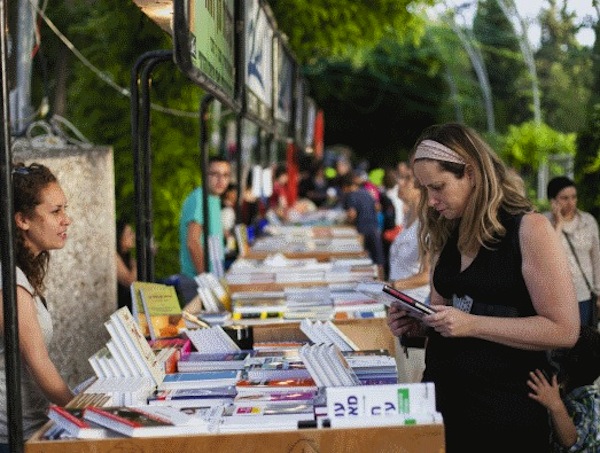
National Hebrew Book Week has taken place every year in June. Its fate for this year, in light of the COVID-19 pandemic, is unclear. (photo from gojerusalem.com)

In Israel, you know Shavuot is approaching when you see the grocery stores setting up displays of pasta and spaghetti sauce. The pandemic shouldn’t change that.

Israelis are obsessed with the thought of eating non-meat meals on Shavuot. I suspect that at the heart of this obsession is the feeling that, even today, many people still consider eating a non-meat meal equivalent to eating less than a full meal. Hence, the worry that there really will be a satisfying meal to appropriately celebrate the holiday.

While there are many lovely explanations about why we eat dairy on Shavuot, they seem to be secondary to some practical considerations. As Rabbi Prof. David Golinkin points out, in the late spring, young calves, lambs and kids are weaned. Thus, historically at this time in Europe, there was an abundance of milk. Bear in mind that refrigeration is a fairly new process and that, prior to refrigeration, farmers needed to move fast with perishable milk. They made cheese and butter, which, likewise, needed to be consumed relatively fast. This dairy excess may have motivated some Jews to eat dairy on Shavuot. (See the article “Why do Jews Eat Milk and Dairy Products on Shavuot?” on the Schechter Institutes’ website, schechter.edu.)

But, eating a non-meat meal on Shavuot is not restricted to the customs of European Jewry. As Jewish food expert Claudia Roden notes in The Book of Jewish Food: An Odyssey from Samarkand to New York, Sephardi Jews in Syria made cheese pies called sambousak bi jibn, Tunisian Jews had a special dairy couscous recipe and, in places like Turkey and the Balkans, Jews prepared a milk pudding called sutlage for Shavuot. (If you don’t want to eat animal-based foods, you don’t need to feel left out. The United Kingdom’s Jewish Vegetarian Society helps you enjoy a variety of traditional, but vegan, cheesecake recipes.)

So from where did all this dairy focus originate? One appealing explanation reminds us of what was supposed to have happened on Shavuot, namely that the Jewish people received the Torah. In Gematria, the Hebrew word for milk (chalav) adds up to 40, the number of days on which Moses stayed on Mount Sinai in order to receive the Torah.

Significantly, studying the Torah and other Jewish texts on Shavuot eve has become a major trend in Israel, as well as in the Diaspora. The big Israeli cities offer any number of options for participating in a tikkun leil Shavuot. These free learning sessions welcome the participation of all of Israeli society, from the religious to the secular, and everyone in between. Those living in smaller towns and on kibbutzim and moshavim likewise hold study sessions on the night of the holiday.

The idea of all-night studying originates with the kabbalists. The earliest members of this group apparently studied with Rabbi Shimon bar Yochai, the author of the Zohar, who lived in the second-century CE. It was this scholar (also known by his initials, as Rashbi) who stated: “G-d forbid that the Torah shall ever be forgotten!” (See the Babylonian Talmud Tractate Shabbat 138b.) By the Middle Ages, the kabbalistic all-night Shavuot study had really picked up steam in places such as Safed.

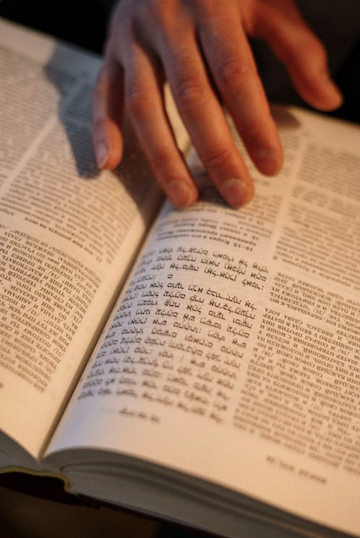
photo - Studying the Torah and other Jewish texts on Shavuot eve has become a major trend in Israel, as well as in the Diaspora
Studying the Torah and other Jewish texts on Shavuot eve has become a major trend in Israel, as well as in the Diaspora. (photo from pexels.com)

Some claim the reason for studying during the night is found in the midrash stating that it was a way to correct for the Children of Israel’s mistake of oversleeping on the morning they were meant to receive the Torah. Others claim, however, that the Hebrew word tikkun should not be translated as correction, but rather as adorning or decorating the bride. The bride in this instance is the people of Israel and the groom is either G-d and/or the Torah.

According to a late 17th-century Libyan tradition, Shavuot symbolizes the wedding day between the people of Israel and the Torah. According to this tradition, the Torah is the bride, which explains the title of the Libyan Shavuot text entitled Tikkun Kallah. Accordingly, those who read this tikkun are likened to bridal attendants.

The importance of studying on Shavuot is bolstered by the fact that Israel’s Hebrew Book Week (or, in some places, Book Month) begins right after Shavuot. I do not believe this occurrence is coincidental, but rather links us to the idea that we are still the People of the Book and a people of books.

The Israeli book fair has been running for many years. This year, 2020, would mark the 59th annual celebration of Hebrew Book Week and the fair’s age is all the more impressive when you recall how shaky was the Israeli state’s start as an independent entity. Recent years’ events have included Israeli authors appearing in coffee houses, story hours and plays for children, guided walks in Israel’s National Library, the more traditional book signings and, of course, the possibility of thumbing through thousands of Hebrew books.

In brief, our spring holiday offers opportunities for both spiritual and physical nourishment.

Deborah Rubin Fields is an Israel-based features writer. She is also the author of Take a Peek Inside: A Child’s Guide to Radiology Exams, published in English, Hebrew and Arabic.

Jewish papercutting art

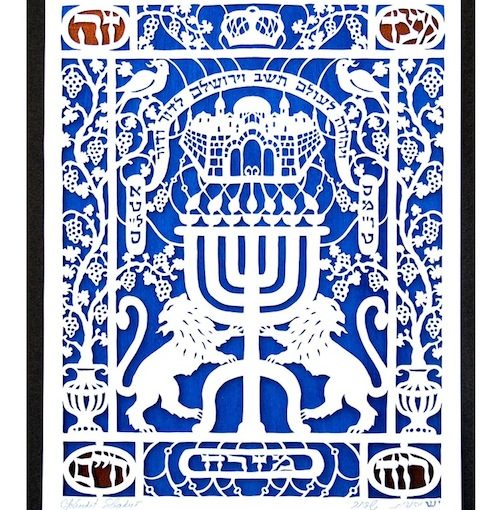
The paper cut “Jerusalem Mizrah” by Yehudit Shadur (1928-2011). (photo from shadurarts.com)

Papercuts are created by taking a folded sheet of paper and drawing a design on one side. The folded sheet is then fastened to a wooden board and the design is cut out with a sharp knife. When the paper is unfolded, a symmetrical work of art appears.

Papercutting dates back to the fourth-century CE in China. It appeared in Western Asia by about the eighth century; in Europe by the 13th century and in Turkey, Switzerland and Germany by the 16th century. Papercutting has been a common Jewish folk art since the Middle Ages and, by the 17th century, it was popular for Shavuot.

Shevuoslekh (little Shavuots) and roysele (rosettes or flowers) were used to decorate windows on Shavuot. They were made of white paper, usually, and frequently displayed the phrase, “Chag haShavuot hazeh” – “this holiday of Shavuot.”

According to an article by Sara Horowitz in the recently defunct Canadian Jewish News a couple of years ago, “for Ashkenazi Jews, there was a particular link between papercutting and Shavuot, which stems from an old practice of decorating homes and synagogues with flowers, branches, boughs and trees. In shtetl culture, cut flowers were a luxury – pricey and perishable. And Jewish culture was deeply literate, so paper, especially used paper – was always around and available for artistic repurposing. Some sources cite the objection of 18th-scholar Vilna Gaon to the Shavuot greening as another reason for the development of a Shavuot papercutting tradition. Because church décor involved cut flowers and pagan practices involved trees, the Vilna Gaon viewed such customs as inherently non-Jewish.”

An acquaintance of mine from many years ago, Yehudit Shadur (1928-2011), and her husband, Joseph, wrote a history of the last three centuries of Jewish papercutting, called Traditional Jewish Papercuts: An Inner World of Art and Symbol. The book won a 1994 National Jewish Book Council Award.

Yehudit Shadur was considered to be the one who pioneered the contemporary revival of the Jewish papercutting tradition. Her works are represented in major museum collections. She also had museum exhibits in Israel, England and the United States.

Shadur’s website offers many quotes from the artist, including one from a 1996 exhibit catalogue, in which she states, “What at first seemed a simple craft proved to be an artistic medium of endless possibilities and variations – not only in the arrangement of time-honoured Jewish symbols imbued with deep and often complex significance, but also in the challenges of colour, composition and texture. Eventually, the subject matter of my papercuts went beyond traditional forms and content to express my personal vision as a contemporary artist….”

Some typical symbols in Shadur’s Jewish papercuts – and in those of others – are menorot, crowns (keter Torah, the crown of Torah), columns representing the Temple in Jerusalem, plants or trees (the Tree of Life, the Torah), and grapevines, lions and gazelles (all representing the people of Israel).

For an in-depth article on the history of Jewish papercutting, visit myjewishlearning.com/article/jewish-papercutting.

If you’re looking for an activity to do with your children, PJ Library (pjlibrary.org) offers the book The Art Lesson: A Shavuot Story written by Allison and Wayne Marks and illustrated by Annie Wilkinson, in which “Grandma Jacobs teaches Shoshana how to make traditional papercuts,” and readers also learn to make a papercut. For anyone interested, there are various websites that have papercutting tutorials for kids and adults alike.

Chag sameach!

Sybil Kaplan is a journalist, lecturer, book reviewer and food writer in Jerusalem. She created and leads the weekly English-language Shuk Walks in Machane Yehuda, she has compiled and edited nine kosher cookbooks, and is the author of Witness to History: Ten Years as a Woman Journalist in Israel.

נאסר באופן על קניית ומכירת רובי סער ברחבי קנדה

לאור מסע הירי הקטלני בתולדות קנדה: ממשלת טרודו החליטה לאסור מיידית את שימוש ברובי סער.
(uk.news.yahoo.com)

ראש מממשלת קנדה, ג’סטין טרודו הודיע שממשלתו החליטה לאסור מיידית קנייה, מכירה, שינוע, ייבוא או שימוש של כאלף וחמש מאות דגמים של כלי נשק צבאיים. ההחלטה שניכנסה כבר לתוקף כבר לפני חמישה ימים (בראשון במאי) נובעת בעיקר לאור רצח עשרים ושניים אזרחים (בהם שוטרת) על ידי גבריאל וורטמן, שנחשב למסע הירי הקטלני ביותר בתולדותיה של קנדה. האירוע הנוראי החל בישוב כפרי קטן ומרוחק פורטפיק, במפרץ קובקוויד, שבמרחק כמאה ק”מ מהליפקס – עיר הבירה של מחוז נובה סקוטיה. וורטמן ובת זוגתו שהו במסיבה אצל השכנים. במהלך האירוע נתגלע סכסוך בין וורטמן לבת הזוג שהלך והסלים. השניים עזבו את המסיבה והוא היכה את זוגתו וקשר אותה. לאחר מכן עזב את המקום ויצא למסע הרצח. בת הזוג שהצליחה להימלט הסתתרה ביער. יש לציין שראש ממשלת קנדה הבטיח להקשיח את חוקי הנשק עוד בקמפיין הבחירות שלו לפני כחמש שנים.

לפי החלטת ממשלת טרודו, נאסר באופן גורף על קניית ומכירת רובי סער ברחבי קנדה כולה. “כלי הנשק האלה יוצרו למטרה אחת בלבד: להרוג כמה שיותר בני אדם ובזמן המהיר ביותר. החל מרגע זה אסור לרכוש, למכור, להעביר, לייבא או להשתמש בכל נשק צבאיים במדינה זו”. החלטה של טרודו שנכנסה לתוקף באופן מיידי, מונעת החזקת כאלף וחמש מאות כלי נשק מסוגים שונים. טרודו הבטיח בקמפיין הבחירות השני שלו למנוע את מכירת כלי הנשק האלה, אך הנושא נדחה לאור משבר הקורונה.

הרוצח מנובה סקוטיה, וורטמן, לפי הערכתה של המשטרה הפדרלית מהמחוז, השתמש בשני רובים חצי-אוטומטיים ומספר אקדחים במסע המטורף שלו. את כלי הנשק השיג בצורה לא חוקית כנראה מארה”ב. כך עולה מחקירת האירוע המסובך על ידי המשטרה, שכולל שש עשרה זירות רצח שונות, לאורח של יותר ממאה ק”מ (בהן חמישה בתים שרופים ושתי מכוניות). קרוב לוודאי שהאיסור על שימוש ברובי סער של ממשלת טרודו, לא היה מונע מוורטמן להשיג את הנשק ולהרוג עשרים ושניים איש.

ראש הממשלה הקנדית הודיע עוד כי ממשלתו תעניק “תקופת חנינה” בת שנתיים, החל מהראשון במאי, שבה בעלי כלי נשק השונים יוכלו לערוך את ההתאמות הנדרשות על מנת לעמוד בדרישות החוק החדש.

בקנדה יש כשלושים וחמישה כלי נשק למאה בני אדם ומדובר בשיעור מהגבוהים בעולם. עם זאת, היא עדיין ניצבת רחוק מאחורי שכנתה מדרום ארה”ב – שבה יש מאה ועשרים כלי נשק למאה בני אדם.

כאמור בקמפיין הבחירות הראשון שלו לפני כחמש שנים, הבטיח ג’סטין טרודו להקשיח את הפיקוח על נשק. הדבר לא יצא אל הפועל ובקמפיין הבחירות השני שלו בחודש ספטמבר, הוא הודיע שיקדם חוק שיאסור באופן גורף על מכירת על רובי סער. זאת כמובן אם שוב ייבחר לתפקיד ראש הממשלה. טרודו אמר בקמפיין הבחירות האחרון: “כל עוד אזרחי קנדה מאבדים את קרובי משפחתם בגלל כלי נשק, יש עוד מה לעשות בנושא הזה”.

כצפוי נציגי האופוזיציה מטעם המפלגה השמרנית יצאו נגד החלטת ממשלת טרודו. מנהיג המפלגה השמרנית המתפטר, אנדרו שיר, אמר: “ג’סטין טרודו משתמש במגפת הקורונה ובמתקפה המזעזעת בנובה סקוטיה כדי לקדם את האידיאולוגיה הליברלית שלו ולשנות את חוקי הנשק. לקחת כלי נשק מידיהם של אזרחים שומרי חוק לא עושה כלום כדי להתמודד עם הבעיה האמיתית: אנשים מסוכנים שמשיגים נשק באופן בלתי חוקי”.