Skip to content
  • Home
  • Subscribe / donate
  • Events calendar
  • News
    • Local
    • National
    • Israel
    • World
    • עניין בחדשות
      A roundup of news in Canada and further afield, in Hebrew.
  • Opinion
    • From the JI
    • Op-Ed
  • Arts & Culture
    • Performing Arts
    • Music
    • Books
    • Visual Arts
    • TV & Film
  • Life
    • Celebrating the Holidays
    • Travel
    • The Daily Snooze
      Cartoons by Jacob Samuel
    • Mystery Photo
      Help the JI and JMABC fill in the gaps in our archives.
  • Community Links
    • Organizations, Etc.
    • Other News Sources & Blogs
    • Business Directory
  • FAQ
  • JI Chai Celebration
  • JI@88! video

Recent Posts

  • Story of Israel’s north
  • Sheltering in train stations
  • Teach critical thinking
  • Learning to bridge divides
  • Supporting Iranian community
  • Art dismantles systems
  • Beth Tikvah celebrates 50th
  • What is Jewish music?
  • Celebrate joy of music
  • Women share experiences 
  • Raising funds for Survivors
  • Call for digital literacy
  • The hidden hand of hate
  • Tarot as spiritual ritual
  • Students create fancy meal
  • Encouraging young voices
  • Rose’s Angels delivers
  • Living life to its fullest
  • Drawing on his roots
  • Panama City welcoming
  • Pesach cleaning
  • On the wings of griffon vultures
  • Vast recipe & story collection
  • A word, please …
  • מארק קרני לא ממתין לטראמפ
  • On war and antisemitism
  • Jews shine in Canucks colours
  • Moment of opportunity
  • Shooting response
  • BC budget fails seniors
  • Ritual is what makes life holy
  • Dogs help war veterans live again
  • Remain vital and outspoken
  • An urgent play to see
  • Pop-up exhibit popular
  • An invite to join JWest

Archives

Follow @JewishIndie
image - The CJN - Visit Us Banner - 300x600 - 101625

Month: May 2016

Sarcophagi returned to Egypt

Sarcophagi returned to Egypt

(photo from Israel Antiquities Authority)

One of two Egyptian sarcophagi covers – one dating to between the 10th and 8th centuries BCE (Iron Age) and the other to between the 16th and 14th centuries BCE (the late Bronze Age) – that were seized by Israel Antiquities Authority (IAA) inspectors four years ago while checking shops in the market of Jerusalem’s Old City. In a short ceremony on May 22, they were returned to Egypt. Egyptian ambassador Hazem Khairat expressed Egypt’s appreciation for all the efforts made by the Israeli authorities to return these smuggled antiquities to their country of origin.


Format ImagePosted on May 27, 2016May 25, 2016Author Edgar AsherCategories IsraelTags Egypt, Israel, Israel Antiquities Authority, Khairat, sarcophagi
Stop negotiating, says Pipes

Stop negotiating, says Pipes

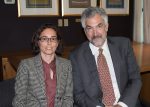
Gina Faigen, daughter of the late Dr. Morris H. Faigen, who founded the annual Faigen Family Lecture Series, with this year’s speaker Daniel Pipes. (photo by Jocelyne Hallé)

Israel should stop trying to find a negotiated solution that provides a mutually agreeable resolution to the conflict with Palestinians, says Daniel Pipes, and instead declare victory and force the Palestinians into the realization that they have been defeated.

Pipes, a commentator and historian who is president of the Philadelphia-based Middle East Forum, made the comments in Vancouver May 9 at the fifth annual Faigen Family Lecture.

The idea of land for peace, in which Israel gives up concrete real estate for the “ephemeral idea” of peace, has failed, he said.

“We can all agree that the Israelis do not have more peace for giving up Gaza and parts of the West Bank,” said Pipes. “It’s not working.” Instead, he said, Palestinians view Israeli concessions as a sign of weakness and this has led not to increased peace, but to increased hostility.

“Rather than mediation and compromise and painful concessions, such has been the case, how about something different?” Pipes asked. “How about Israel wins and the Palestinians lose? How about Israeli victory?

“Victory is not a term you hear much,” he continued. “People talk about a peace process, negotiations, but this is a conflict, this is a war. It’s been a war for a century. And an end comes to a war when one side acknowledges that it’s lost, that the gig is up, that it cannot win.”

Germany lost the First World War, Pipes said, but they didn’t feel defeated. They wanted another round and they got it in 1939. After 1945, the Allies realized they had to demilitarize Germany and Japan, to demonstrate that they had been conclusively defeated.

“Defeat is sanitary,” said Pipes. “Defeat allows you to move on.… I think that’s what the Palestinians need. Not only for Israel’s sake – obviously for Israel’s sake – but also for the Palestinians’ sake. Only by being defeated can the Palestinians stop obsessing over harming Israel and instead start building their own polity, culture, society. It’s good for everyone, Palestinians as well.”

Pipes clarified: “I’m not calling for killing Palestinians.” The idea is to impose on Palestinians the sense that they have lost.

“There’s no point in getting into the details,” he added.

He would like to see Western governments adopt policies that would urge the Israelis to win the conflict.

“We don’t go to the negotiating table. It doesn’t work. We need to win,” he said. “Let’s give up on this failed, decades-old effort to have the Israelis give more and the Palestinians take more and give nothing in return.”

Questioned by an audience member on what victory would look like, Pipes said: “You’ll know that Israel has won when the Jews of Hebron have no more need for security than the Arabs of Nazareth … when an irate Palestinian writes a strongly worded letter to the editor.”

Pressed on how such a victory would be achieved, Pipes at first demurred.

“I did not talk about how to get there because I would encourage you to see things this way,” he said, before giving some examples.

“The other day there was shooting out of Gaza. The Israelis replied with shooting back into Gaza,” he said. “Wouldn’t it be more effective to cut off the water and electricity for a day? The next time two days? Wouldn’t that send a signal? Why don’t the Israelis do that? Because they don’t have a plan for victory.”

Until 1993, Pipes said, Israel strove for victory.

With the Oslo process that began in 1993, and after, Pipes said, Israel adopted a policy of appeasement. When that failed in about 2000, they adopted a policy of unilateral withdrawal from Lebanon and Gaza.

“And, since about 2006, there’s been no policy at all,” he said. “I think we should return – it’s not my idea – return to the old ways.”

Palestinians need to realize that their strategy isn’t working, he said.

“They’re engaging in suicide stabbings and other atrocities because they think this will help the Palestinians win,” he said. “If you can convince them there’s no chance of this working, why would a sane individual – and these are, they’re perfectly normal – why would they give up their lives? They believe that they are on a path to victory. Convince them that they are not on the path to victory and I think they will be less likely to engage in this kind of violence.”

Pipes acknowledged that people say the Palestinians will never accept defeat.

“But I say, the Germans did, the Japanese did,” said Pipes. An audience member noted that the Palestinians have an international support network that the Germans and Japanese did not.

“They do,” Pipes responded. “All those professors of English.… In the end, what really counts is, for example, water and electricity.”

While Israelis and Americans are trying to find creative ideas to hasten peace, “Palestinians aren’t playing around with creative ideas,” he said. “They’re killing.”

If the Palestinians can be convinced to give up the fight against Israel, Pipes believes that the rest of the Arab and Muslim world will similarly give up. He called Palestinians “the tip of the spear,” saying it’s hard to be more anti-Zionist than the Palestinians.

Though Pipes believes Arab and Muslim states may be tiring of losing to Israel, “I don’t see any fatigue at all” among leftists who are rallying against the Jewish state.

About the United States, Pipes said President Barack Obama seems to think that U.S. foreign policy before him has been a force for ill rather than for good in the world. Obama is making overtures to the traditional enemies of the United States, including Cuba and Iran, and paying less attention to allies, such as Egypt and Saudi Arabia, said Pipes.

Were Donald Trump to find himself president of the United States, Pipes worries that the “consummate dealmaker” would, like all his predecessors, fail at facilitating an agreement between the Palestinians and the Israelis.

“He would call them in, he would give them his instructions, they would reject him and he would blame guess who?” Pipes speculated. “I suspect he would turn against Israel.”

The Faigen Family Lecture Series – which is held in partnership with Vancouver Hebrew Academy – was founded by the late Dr. Morris H. Faigen, who passed away in 2012. The evening was introduced by his daughter, Gina, who said her father wanted a forum for conservative perspectives on Israel but also one where people with a more liberal perspective, like her, could engage.

Format ImagePosted on May 20, 2016May 18, 2016Author Pat JohnsonCategories IsraelTags Faigen Lecture, Israel, Palestinians, peace
First book of trilogy now out

First book of trilogy now out

Michael Seidelman is donating 10% of novel profits this month to the Cystic Fibrosis Foundation. (photo from Michael Seidelman)

May is Cystic Fibrosis Awareness Month, so author Michael Seidelman will be donating 10% of the profits from this month’s book sales to the Cystic Fibrosis Foundation to help find a cure.

The connection? The heroine of his Garden of Syn young adult series suffers from CF.

“When I was 10 years old, I watched a TV movie called Alex: The Life of a Child, the true story of an 8-year-old girl who died from CF. Seeing that a child could lose her life so young had a profound impact on me then and continues to do so all these years later,” he explained.

Having his protagonist suffer from CF “could potentially raise awareness about the devastating illness,” he said. “I learned a lot about CF while researching for the book and I’m sure anyone who reads it will as well.”

But, while an integral part of her character and of the plot, CF does not define Syn, though it does offer her challenges most people do not have to face, and has made her more responsible and mature than her years. But so have several other factors.


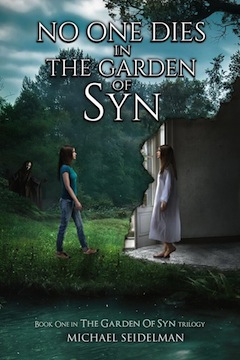
book cover - No One Dies in the Garden of SynThe first book of the trilogy – No One Dies in the Garden of Syn, which was released last month – introduces us to Syn. Right away, we find out that her parents went missing when she was 5 years old and her aunt has looked after her ever since. In addition to dealing with her illness, Syn has regular teenage problems with friendships, boyfriends and school, and exhibits that brand of cynicism so often found in kids of that age.



“Syn,” she notes. “Short for Synthia. I don’t know why my parents spelled my name with an ‘S’ but if I could ask them anything, that would be my last question. Aunt Ruth tells me it’s likely because I was special and deserving of a unique spelling. I highly doubt that’s it.”

Syn is a formidable and likable hero for whom readers will root. And the constant action will keep readers turning the pages. Along her accidental journey, she must face situations and enemies that are potentially more threatening than her illness.

“Young adult novels are usually geared towards an audience of 12 years and up,” said Seidelman when asked whether he was concerned with how young readers might react. “While it does contain some dark themes, I think kids in that age group are familiar with the topics that are explored. I also think that this book is more appropriate for younger readers than many other books in the young adult category. I probably wouldn’t recommend the Hunger Games or Twilight for a 12-year-old reader. While No One Dies in the Garden of Syn may be a bit scary towards the book’s climax, any kid who is comfortable reading the Harry Potter series should be more than fine reading this.”

His own creative journey was sparked by books he read as a kid.

“My favorite stories growing up were about secrets worlds, like Alice in Wonderland and The Lion, the Witch and the Wardrobe. Since I was in high school, I had wanted to write my own book about a secret world. It took me many years before I came up with the right story – one that is inspired by the tales of Lewis Carroll, L. Frank Baum and C.S. Lewis, but at the same time is very different and geared towards an older audience.

“The ideas that triggered the story I ended up telling came to me when I immersed myself in nature and let the ideas flow. I jotted down notes for a few months and made many changes to the story and characters before I sat down in April of 2014 and plotted out each chapter in detail. That took about a month and then it took another four months to write the novel. But that was only the beginning, as there were many rewrites and edits that followed.”

No One Dies in the Garden of Syn is Seidelman’s first published novel. But, as much as he enjoyed writing it, he said, it was not an easy task.

“The rewriting and editing process probably took six times the effort that writing the initial manuscript did, if not more,” he said. “Every single word is immensely important, as are continuity and proper tenses. But, for the second book in the Garden of Syn series, which I am currently working on, I think that part of the process will be smoother. Having now done this once, I now know what works and what doesn’t.

“For anyone wishing to self-publish a book,” he advised, “I cannot emphasize enough the importance of paying for a professional editor. You also need a professional-looking cover that will stand out as people really do judge a book by its cover. Having it professionally formatted for the physical copy and ebook readers is also important. With over 3,000 books published every single day, you need to do everything in your power to make yours the best it can possibly be.

“And then, when it is published, your journey has just begun. You need to use every avenue available to let people know about your book and encourage them to read it. The internet offers many wonderful tools to help do this but you really need to put in the time to market it. As I write my second book, at least 25% of my time goes to marketing the first one.”

The next book in the trilogy will be out next year, and the conclusion in 2018. The first novel is available in paperback and as an ebook from online sellers, including via michaelseidelman.com.

Format ImagePosted on May 20, 2016May 18, 2016Author Cynthia RamsayCategories BooksTags cystic fibrosis, Seidelman, Syn
Making healthy connections

Making healthy connections

High-tech entrepreneur Galya Westler is at TEDxStanleyPark on May 28. (photo from Galya Westler)

The social media available to help us connect with one another are ever-increasing, but they are not always effective. In fact, they often have the opposite effect – when we realize the relations they engender are illusory, we experience feelings of loneliness and inadequacy. So says Galya Westler, a local high-tech entrepreneur, who is creating a simpler, more intimate solution to connect people with their respective communities.

In keeping with the theme of “Ideas to Action,” Westler – along with 14 other local thought leaders – will take the stage at the third annual TEDxStanleyPark on May 28 at the Queen Elizabeth Theatre. She will deliver a talk entitled Social Media Obesity and Loneliness. She will discuss the growing phenomenon of social media addiction, recount her personal experiences in trying to connect with others during a particularly traumatic period in her life and explore how to use technology to overcome a social media addiction.

According to Westler, too many people suffer from what she terms “social media obesity,” or an addiction to social media, and are “pigging out on selfies of attention.” Moreover, in their effort to be noticed, social media addicts often lose appreciation of how they act in the online world – and exaggerations serve only to enhance the gap between online personas and reality. The ultimate consequence: feelings of inadequacy, disappointment, depression and loneliness.

Westler examines the subject from the point of view of a social media developer with a decade of experience in creating or enhancing online communities. This summer, she will launch Plazus Mobile Social App Builder, her most ambitious social media application platform to date.

Born in Montreal, Westler grew up in Ra’anana after her Israeli parents returned home upon her father’s completion of his PhD at the University of Montreal.

She served as a commander of a radar post in the Gaza Strip during her mandatory military service with the Israel Defence Forces. She describes her experience as “amazing” and “life-changing.” Introverted and lacking confidence in high school, she said her army service – carried out in a male-dominated environment – enabled her to blossom into an outgoing and hardworking soldier who rose to challenges. She would carry this learned lesson with her as she pursued higher education.

Despite an affinity for the humanities, Westler enrolled in Shenkar College’s four-year software engineering program. She had been counseled to do so by her father, a senior high-tech professional in Israel, who told her: “If you study software engineering, the doors will open for you.”

The program was challenging and Westler struggled – not only with the material, but also with the pressure from those around her who suggested she give up and drop out. This discouragement only strengthened her resolve and she persevered to finish the program. Of the 40 students who had enrolled with her, only 11 completed their studies. Westler was the only female graduate.

After a year of working in Israel’s high-tech industry, Westler decided to move back to Canada, settling in British Columbia. She worked for a number of tech companies before opting to incorporate her own, giving her the independence she sought. “I did the corporate-ladder thing, but never quite fit in,” she said.

Since incorporating her first company, 2Galvanize Ltd., in 2008, Westler has built close to 100 websites, mobile applications and backend systems for different companies, including the Yellow Pages. She specializes in creating private social “ecosystems,” or networks, that enable people to communicate on an “authentic” level, unlike other social media sites that she describes as too big and overwhelming to navigate and digest. Her mission is to create systems that support efforts that enable people to communicate in a manner emblematic of times past: “more intimate, more humbly and, very importantly, in small groups.” This led to her involvement with Bazinga, an app that connects building residents to their strata councils, and Wag Around, an app that connects dog owners and facilitates interactions offline.

Simplifying genuine communication between people and their respective communities is what motivates Westler to develop new tools. “The reason I do the work I do is because I truly want to connect people, and the best way to do that is to give them an excuse to connect based on common interests,” she explained.

Westler’s newest commercial development, Plazus Mobile Social App Builder, applies the principle of connecting people in the business realm as a means of facilitating dialogue or enhancing brand. The name combines the words “plaza” and “us,” a tongue-in-cheek homage to more traditional ways of communicating.

Set to launch at the end of June, Plazus is a B2B (business to business) social media tool that will provide a company or organization with an easy, structured and relatively inexpensive way to connect with their customers and communities in their own social ecosystems. It seeks to do this functionally, interactively and in an esthetically appealing manner.

Westler is filled with anticipation as her two seed investors, a team of 10 techies and more than 60 early-adopter customers, eagerly await the launch of Plazus Technologies’ beta product.

Westler credits many of her entrepreneurial successes in Canada to her Israeli chutzpah. Although she misses Israel, particularly Tel Aviv’s culture and lifestyle, and acknowledges that research and development thrives in Israel because of wonderful talent, she said that her seven years in Vancouver have been “amazing … it’s paradise.”

Westler’s goal is to continue to grow her business and open offices in both Vancouver and Tel Aviv, which would enable her to travel regularly between the two places in the world she loves most.

She said it is important for her to stay connected to Israel for both personal and professional reasons, and she has spoken in Israel about her work and her entrepreneurial path on more than one occasion, including to a women’s Lean In Circle at Google’s office in Tel Aviv and at StarTAU, Tel Aviv University’s Entrepreneurship Centre.

True to her commitment to connect individuals with like-minded community members, Westler herself is involved in a number of different groups and causes. She serves as president of the Vancouver Entrepreneurs Toastmasters Club and is active in several other local business organizations.

For more information about TEDxStanleyPark, visit tedxstanleypark.com or email [email protected].

Alexis Pavlich is a Vancouver-based freelance writer.

Format ImagePosted on May 20, 2016May 20, 2016Author Alexis PavlichCategories LocalTags app, entrepreneur, high-tech, Plazus, TEDxStanleyPark, Westler
Noa concert sells out

Noa concert sells out

Achinoam Nini performs for a full house at the Chan Centre on Yom Ha’atzmaut, May 11. (photo from cjnews.com)

Despite the controversy in the months leading up to her Yom Ha’atzmaut performance at the Chan Centre for the Performing Arts on May 11, Noa’s concert attracted a full house and every one of the 1,185 seats was sold.

“After all the harrowing events leading up to this concert, I am so thrilled to be here and truly grateful to the Jewish Federation [of Greater Vancouver] for not folding and the Israeli ambassador for supporting!” the Israeli singer, whose full name is Achinoam Nini, posted on her Facebook page soon after she touched down in the city.

Performing barefoot throughout, the singer thanked the audience, Federation staff and the Vancouver Jewish community repeatedly during her show “for sticking up for me.”

In February, the Jewish National Fund of Canada, an annual sponsor of Vancouver’s community Yom Ha’atzmaut concerts, withdrew its support, saying it would take a one-year hiatus “due to the views of the entertainment booked for this year’s celebration.”

The organization’s chief executive officer, Josh Cooper, said “the entertainer that has been hired does not reflect nor correspond to the mandate and values of JNF of Canada.” Its decision followed an article in the Jerusalem Post, later retracted, that claimed Vancouver Jews were “outraged” over Nini’s performance and alleged that she supports the boycott, divest and sanctions (BDS) movement against Israel. She has repeatedly denied the allegation.

After JNF Canada withdrew, the Israeli embassy and the Consulate General of Israel in Toronto stepped in as sponsors. Irit Stopper, deputy consul general in Toronto, represented the state of Israel at the event. It was also attended by Linda Kislowicz, president and CEO of Jewish Federations of Canada-UIA, Vancouver City Councilor Geoff Meggs and Burnaby-Lougheed NDP MLA Jane Shin.

Outside the Chan Centre, Michael Brosgart, president of the Jewish Defence League in British Columbia, stood with a handful of supporters and a few placards declaring “Terrorists are obstacles to peace; Biblical Zionists are not.”

A folding table held pictures of an Israeli couple murdered by Palestinian terrorists, and Brosgart distributed material to bystanders. The pages contained excerpts from letters expressing objections to Nini’s performance from community member Frances Belzberg and Israel Defence Forces Lt.-Col. Eyal Platek, as well as links to articles about the singer.

“Noa is supporting the most divisive groups in Israel – B’tselem, Breaking the Silence, BDS and JStreet,” Brosgart said. “Unfortunately, Jewish Federation and the Israeli embassy, because they’re funding this, are supporting her. We think this is rotting the Jewish community.”

On JDL’s Facebook page Brosgart elaborated. “This performance will be extremely divisive, distasteful, disrespectful and does not represent the views and interests of the community. Especially at the time we need unity the most. This is not about free speech. Nini can sing her sh—y songs anywhere she wants. However, this is Israel’s Independence Day. To bring an anti-Israel, terror-sympathizing, enemy-strengthening performer on this day is to spit in the face of all who have lost loved ones defending the nation of Israel.”

One Israeli who attended the concert but asked not to be named said she disliked that Nini “does not separate her political views from her artistry. I’m sorry the selection committee didn’t do more research before they chose her, but I think they learned a lesson,” the woman said.

After seeing the Facebook responses of Israelis in Vancouver opposed to the performance, she decided to attend nevertheless. She added that, once Nini was invited to Vancouver, “I think it was the best thing to keep her here instead of canceling the performance.”

The kosher restaurant Shuk Eat & Play hosted an alternative Yom Ha’atzmaut celebration dinner for 110 attendees the same night.

“I heard Noa’s political sayings and I didn’t appreciate it,” said Shuk owner Alon Volodarsky. “So, some people who didn’t like her suggested we hold this dinner for those community members who still wanted to celebrate Yom Ha’atzmaut but didn’t want to attend the concert.”

Lauren Kramer, an award-winning writer and editor, lives in Richmond. To read her work online, visit laurenkramer.net. This article was originally published in the Canadian Jewish News.

Format ImagePosted on May 20, 2016May 18, 2016Author Lauren KramerCategories LocalTags Brosgart, Federation, Israel, JDL, Jewish Defence League, Nini, Noa, Shuk, Yom Ha'atzmaut
Learning about other faiths

Learning about other faiths

Grade 6 students from Vancouver Talmud Torah – Sophie Chelin, Ava Abramowich, Sayde Shuster, Ruth Nahmad and Rachel Seguin – do the blessing over the candles at an interfaith Shabbat dinner on May 6. (photo by Jennifer Shecter-Balin)

The joy of learning, the excitement of meeting new people, the comfort of community, the satisfaction of a job well done. All of these energies filled the room at Congregation Beth Israel on May 6. And, while that Shabbat dinner marked the culmination of Vancouver Talmud Torah’s Grade 6 Term 2 Tikkun Olam course, it seemed like a beginning as well.

With the knowledge and relationships gained and curiosity and compassion further engrained, these students now have an even more solid foundation from which to carry on their interfaith connections and broaden their experiences beyond the Belief project.

The initiative of Jennifer Shecter-Balin, director of admissions and communications at VTT, who guided the students with Grade 6 humanities and tikkun olam teacher Meghan Davey, the project was inspired by Oprah Winfrey’s seven-part Belief series.

Every week, students watched an episode of the series, explained Shecter-Balin in an email to the Independent. They then “completed related assignments and activities to both deepen their own connection to Judaism and broaden their understanding of other world religions and belief systems.”

“Each week, we journeyed across the globe to learn about different streams of Judaism, Christianity, Islam, Hinduism, Sikhism and other non-traditional beliefs systems,” she explained to those gathered on May 6. “In addition to gaining further grounding in their Judaism, our students expanded their perspectives and worldviews through learning about myriad different spiritual practices, rituals and beliefs.”

“Throughout the term,” added Davey, “we broadened our vocabulary and learned terms such as monotheism, agnosticism and atheism…. We debated the merits of arranged marriages; we compared the divinely inspired versus the scientific; and we discussed the concept of miracles and what constitutes one. But most satisfying was the fact that the students all agreed that being alive and having one’s health is indeed miraculous.”

Davey also noted that, “They have learned to identify similarities across the religions – the importance of water for purification in so many traditions, for example – as well as significant differences between the major world faiths.”

For the course’s final assignment, students had to interview someone of a faith other than Judaism and then write about that person’s beliefs and influences.

“For many students, this was their first time ever interviewing an adult and someone of a considerably different background to them,” said Shecter-Balin.

The result is a nicely designed spiral-bound book of essays on the 40 interviews conducted. A copy of the book was placed at every Shabbat table and Shecter-Balin invited guests – the students’ families and many of the interviewees – to read through it.

“Like us,” she said, “you’ll learn about a host of beliefs, practices and unique life experiences, and you’ll read our students’ enthusiastic reflections about this assignment. Most importantly, their hearts and minds have further opened without compromising the integrity of who they are or where they’re from. In fact, we believe it will only serve to strengthen their identity.”

For many of the guests, the dinner was their first time in a synagogue and their first time attending a Shabbat dinner. Sharing this experience and more about Judaism, said Shecter-Balin, is a way to continue to build bridges of understanding. “This, we believe, is tikkun olam, or the Jewish commandment to repair the world,” she said.

Davey thanked all the parent volunteers who helped prepare the meal with Shlomo and Hagar Yekutieli; VTT head of school Cathy Lowenstein and assistant head of school Jessica Neville “for their support with this initiative and trusting us to think a bit outside the box”; Ellen Wiesenthal, VTT’s director of curriculum and programming, who led everyone in a few Shabbat songs after the blessings; and Beth Israel’s Gaynor Levin, for her help in planning and organizing the dinner.

Lowenstein said a few thanks of her own, including to Beth Israel Rabbi Jonathan Infeld for being so welcoming. She also introduced Rabbi Marc Kasten and his family, who came to Vancouver for the weekend. Kasten – who is currently at Temple Beth Am Day School in Miami – will start in August as VTT’s new school rabbi and director of Jewish life and learning. He spoke about some of the Shabbat rituals before they were fulfilled, mainly by the students: the singing of L’Cha Dodi, the candlelighting, the blessing of the children by their parents, the Kiddush and Hamotzi.

The next step in the project, Shecter-Balin said, is “to send a copy of the book to Oprah along with notes from the students sharing their personal reflections of watching the video series.”

Format ImagePosted on May 20, 2016May 24, 2016Author Cynthia RamsayCategories LocalTags Davey, Oprah, Shecter-Balin, tikkun olam, Vancouver Talmud Torah, VTT
A tapestry at the Zack

A tapestry at the Zack

Valeri Sokolovski’s work forms part of A Tapestry of Cultures, the group art exhibit now on display at the Zack Gallery. (photo by Olga Livshin)

A Tapestry of Cultures opened last week at the Zack Gallery. Run in conjunction with Festival Ha’Rikud, which took place May 12-15, the group show also commemorates the birthday of Israel. As such, I expected it to reflect the blend of cultures that together make the multicultural tapestry of Israeli society, but the exhibit was much more global in scope.

With the exception of a few identifiably Israel-focused pieces – mostly photos by Avie Estrin – the rest of the artwork on display could have been created in any country, by an artist from any part of the world.

The Tel Aviv apartment building in Nancy Stern’s photograph wouldn’t be out of place in Vancouver or Prague. The sandals in a large painting by Rina Lederer-Vizer could have been lying on a beach in Spain or hiding under a park bench in San Francisco. The flapper dress from a small piece by Vladimira Fillion Wackenreuther could have been on sale in any fashion store from Moscow to Tokyo.

The exhibition as a whole announces that we all belong to one nation, cosmopolitan in the best sense, regardless of our country of citizenship or our mailing address. We live on the same planet and share similar values.

photo - Valeri Sokolovski’s work forms part of A Tapestry of Cultures, the group art exhibit now on display at the Zack GalleryThe theme of music and musicians appears in paintings by several artists in the show. Eternal and borderless, music wanders where it will, crossing barriers, especially now with the internet. Valeri Sokolovski’s images illustrate the concept perfectly. One could encounter his musicians almost anywhere. Their ethnicity is vague, but their passion soars in his paintings. Sokolovski’s musicians play with such intensity, the viewer can almost hear the notes, the syncopated beats and the soulful melodies.
In between his blue players, Karen Hollowell’s trumpeter introduces a much mellower tune, sunny yellow and flowing. The painting has a romantic quality. Her musician is not here on a street corner, but is somewhere else, behind the veil of imagination.

Not so with Iza Radinsky’s dancers. They strive to twirl off the wall and into the room, their skirts flashing, their feet performing to a jolly rhythm. The artist’s brushstrokes are blurry, but the dancers’ joy is crystal clear, and it transmits outside the frame, sprinkling everyone who passes the gallery.

In contrast to Radinsky’s dancers, Lauren Morris’ image is abstract and colorful, echoing the charm of dreams. Colors splash on the canvas in fanciful profusion and the viewer wonders, Is it a choir singing hymns? Is it a flock of birds on a wire, lost in their lofty trills? Or maybe it’s a flowerbed of exotic orchids, each one a song?

Meanwhile, a crowd of musicians populates David Akselrod’s “Gathering.” The painting is almost a metaphor of the show itself, gleeful and whimsical. The musicians are as cheerful and diverse as the artists who gathered for the exhibit’s opening. They play different instruments and have different skin colors, but they congregate in the same place, they mingle and laugh, and they share the delight of their art with each other and with the viewers.

The motif of unity – of all of us sharing, depending on each other – underlies Orly Ashkenazy’s “The Butterfly Effect.”

“It’s about the 12 tribes of Israel,” said the artist. She even inserted the names of the tribes in Hebrew into the painting. They intertwine with each other like a faint pattern of gold arabesques on a butterfly’s wing, a design mirroring real life, underscoring our own interconnections and effects on each other and the world around us.

It is impossible to mention all of the artists participating in the show in one short article, but all their creations complement and enhance one another.

“In my opinion, the calibre of work in this show is particularly high,” said Linda Lando, the gallery director.

A Tapestry of Cultures is on until May 29.

Olga Livshin is a Vancouver freelance writer. She can be reached at [email protected].

Format ImagePosted on May 20, 2016May 18, 2016Author Olga LivshinCategories Visual ArtsTags Festival Ha’Rikud, Israel, Zack Gallery

A healthy community

There are more than 26,000 Jews who live in Metro Vancouver. There is no possible way that a weekly newspaper can cover every event that happens, every milestone that is celebrated and every challenge that we face. But each week that we publish, we can provide a glimpse into the state of our community. And what we see is heartening.

Last week, for instance, our community hosted both Daniel Pipes and Achinoam Nini, two people firm and outspoken in their political beliefs. One could safely argue they represent near-opposite ends of the spectrum in this regard, and yet they both have a place and an audience in our community. This is healthy.

As well, while Nini’s Yom Ha’atzmaut concert sold out, there were some who chose not to attend because they disagreed with her politics. A handful of them protested peacefully outside of the concert; others chose to hold their own Israel Independence Day gathering. Our community can accommodate varied interests and opinions without coming apart at the seams. This is positive.

Currently on display at the Zack Gallery is a group exhibit inspired by Festival Ha’Rikud. The festival brought together dancers from Metro Vancouver, Miami and Kiryat Shmona to perform folk dances with elements from places such as Russia, Yemen, Georgia, Greece and Morocco. And the art exhibit, A Tapestry of Cultures, also celebrates “the diversity as well as commonality of the social groups and micro-societies that make up Israeli culture.” This is enriching.

With a strong understanding of their own culture and religion as their foundation, Vancouver Talmud Torah Grade 6 students have been exploring other faiths and spiritual practices. The students identified similarities and differences across the religions, and their essays show the breadth of what they’ve learned and the enthusiasm with which they have learned it. This is inspiring.

Tikkun olam even finds its way into the publication of a new novel for young adults, with the author donating 10% of the proceeds from sales to charity. And a high-tech entrepreneur is trying to save us from ourselves, and allow us to really – not just virtually – connect with each other via social media. These acts are motivating.

And these stories don’t even touch the surface. We are busy, engaging in the world around us, trying to make it a better place. When we do disagree, it is usually because we care so passionately about the same things. It’s worth stepping back now and then to acknowledge we are part of a community of which we should be deeply proud.

Posted on May 20, 2016May 18, 2016Author The Editorial BoardCategories From the JITags community, Festival Ha’Rikud, Noa, tikkun olam, tzedekah, Vancouver Talmud Torah, Yom Ha'atzmaut
Revealing psychiatry

Revealing psychiatry

Dr. David Goldbloom (photo by Ksenija Ho)

It was not that long ago that seeing a psychiatrist meant that people saw you as unstable or abnormal in some way. While societal views on many things have broadened, the stigma of mental illness remains. So, how do we go about changing these perceptions? According to Dr. David Goldbloom, a psychiatrist at the Centre for Addiction and Mental Health in Toronto, this is something achievable in baby steps. And a step he has taken is to publish a book that not only looks at his patients’ experiences, but his own.

Goldbloom originally hails from Montreal.

“I come from a long line of pediatricians. If heredity was going to play any kind of role or environmental influence, you might think I would have ended up in that field.”

But Goldbloom’s father-in-law was Nate Epstein – a well-known figure in Canadian psychiatry. Epstein was formerly the chief of psychiatry at the Jewish General Hospital and, later, the founding chair of the department of psychiatry at McMaster University. “My exposure to him at close range was a formidable influence in terms of my ultimate career decision,” said Goldbloom.

The complexity of psychiatric illness in terms of its biological, psychological, social and cultural aspects, which requires one to think broadly about solutions to sufferers’ problems, drew Goldbloom to the field. And, during his career, he has written many books targeted to medical professionals, but only recently did he choose to write a book explicitly geared to non-professionals.

“It’s a very different kind of writing,” he said. “I would say it’s much tougher than writing a textbook. I wrote it with Dr. Pier Bryden. She and I cooked up the idea together.

“It was driven by a wish that we shared to make psychiatry better understood by the general public – not reducing it to some cartoonish stereotype. People who have mental illness themselves or those who treat them, we always thought there was a measure of curiosity in the general public about what the reality is versus the Hollywood or TV depiction.”

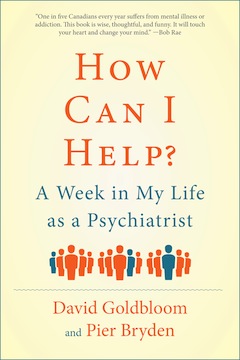
book cover - How Can I Help? A Week in My Life as a Psychiatrist How Can I Help? A Week in My Life as a Psychiatrist uses, as its title says, one week in Goldbloom’s professional life as its narrative framework. While Bryden is also a psychiatrist, she does not feature in the book.

In How Can I Help?, Goldbloom and Bryden explore the world of psychiatry, and talk about how it intersects with Goldbloom’s personal life, as they know that people are curious about how health professionals deal with the inevitable sorrows and joys of working in the field.

The book “contains some very real stories of real patients with their real names used with their real permission,” he said. Other patients described in the book are fictional composites, “masterfully disguised.”

Goldbloom himself is more revealed. “We felt, if these individuals were going to be candid and courageous enough to talk about their own experience, then I had better match them in terms of talking about my own reactions, including my reaction to the very real suicide of one of my patients.”

While Goldbloom said this was not the only time in his 30 years of practice that he has experienced a patient’s death, both he and Bryden felt that this one instance was particularly poignant. They also took the opportunity to write in more general terms about the impact of suicide on physicians.

“One of the other things the book does is use the events of the week to springboard into some of the larger issues within psychiatry,” said Goldbloom. “It’s not just a narrative, but it looks at some of the historical [elements], controversies, stuff like that.

“Whereas most people think of a psychiatric practice as being set in a secluded, private office, with somebody coming in Tuesdays at four to talk about themselves in a manner interminable, the reality of acute psychiatric care in a modern hospital is very different.”

According to Goldbloom, possibly the first thing a reader might be struck by is the variety of different settings in which they find him. He consults in his office, of course, but also through videoconferencing to reach distant areas, in emergency rooms and acute care units, as well as out in the community.

Readers will be able to learn of the varied roles psychiatrists in Canada play, and Goldbloom hopes the book will highlight the breadth of experiences – the professionals’ as well as the patients’.

When asked if another book project is on his radar, Goldbloom said, “I have to wait and see how the first book does. It’s encouraging that it was on the bestseller list, within a week of its publication, in the Globe and Mail and the Toronto Star … but, you know, it’s early days yet.”

How Can I Help? is available in most major bookstores, as well online via Amazon and Indigo.

Rebeca Kuropatwa is a Winnipeg freelance writer.

Format ImagePosted on May 20, 2016May 18, 2016Author Rebeca KuropatwaCategories BooksTags Bryden, Goldbloom, mental health, psychiatry
Expert on sundowning

Expert on sundowning

Dr. Brian Goldman (photo from Brian Goldman)

While most people have heard of dementia, many of us won’t have heard the term sundowning before.

According to Dr. Brian Goldman, emergency physician at Mount Sinai Hospital in Toronto, sundowning is generally part and parcel with dementia of various kinds.

“Sundowning refers to a person who is sleepy during the day and very active at night,” he explained. “Almost as soon as the sun goes down, that’s when they become active. The activity can be not just when awake and walking about in an agitated or restless state.… For sundowning to have its maximum impact on the patient and others – the caregivers and care providers – you have to have dementia [as well].

“A person who is cognitively intact, who is simply sleeping during the day and being up all night, would have the cognitive reserve to be able to handle that. They might feel they have a problem, need to see a doctor, or they might rearrange their lives because, when everyone’s sleeping, they’re up, [but] they’d be able to cognitively make sense of it.”

Goldman explained dementia as “a chronic disorder caused by a brain disease or injury. It is characterized or marked by impaired cognition or thinking, memory and personality changes.”

Goldman – who grew up in Toronto’s North York, the heart of the Jewish community – said he is seeing more elderly people with dementia. Often he is one of the first people to notice the symptoms.

“As an emergency physician,” he said, “I would say that an increasing percentage of the patients I see in the emergency department are frail seniors. When I started out in the 1980s, we would see an occasional patient over the age 90, but now it’s commonplace.

“I have professional experience, but I also have personal experience. Both my parents have passed away in the last two years and they both reached frail senior years. My mother had dementia. My father did not.”

Why some dementia patients also suffer from sundowning while others do not, Goldman said, remains a mystery. As well, the number of people who suffer from this newly defined condition of sundowning is also unknown, with estimates ranging from as low as two to three percent of people with dementia up to more than 60%.

“It has been said that sundowning tends to occur when the person is in unfamiliar surroundings, though it can also occur in the home,” said Goldman. “It’s well known that some people with dementia have damage to the pathways to their brain that recognize light coming in through their eyes and stimulating a part of the brain called the pineal gland. The pineal gland secretes the hormone melatonin.”

Melatonin is secreted somewhere around 2 or 3 a.m. every morning. It resets your body’s circadian rhythm. If that pathway is disrupted, it makes sense that your sleep-wake cycles would be seriously disrupted.

Another theory is that people who sundown are dreaming vividly. They are flipping between the awake and dreaming states quickly and frequently. And, again, because they don’t have the cognitive reserve, they do not know if they are dreaming or awake.

There is not yet a lot known about sundowning and another phenomenon known as delirium.

According to Goldman, delirium is confusion associated with the activation of the fight or flight response along with symptoms that include tremors, shaking, a fast heart rate, sweating and dilated pupils. These symptoms are sometimes also referred to as “toxic delirium.” People with toxic delirium have a rapid, traumatic change in their demeanor. Triggers of toxic delirium are often fever, urinary infection, pneumonia, flu, or even a heart attack.

“You recognize it if you see a sudden change from what the person was doing a week ago,” explained Goldman. “They look sick, sweaty … something seriously wrong … and there is an underlying cause. Treat the cause and the toxic delirium goes away.

“Sundowning is a more chronic pattern that can go on for months. There is no vast dramatic change. The only change in pattern you might notice, wherein dad or mom wander off at night once a month, then it becomes once a week, then every night. It’s a gradual pattern.”

Ways to help this condition, according Goldman, include regularizing a sundowner’s routine: having meals at set times, a set time for exercise (but not at night), set times for bathing and toileting (like washing in the morning or before bed), and the like.

“The experts say that caffeine should be avoided,” he added. “You want people to walk. Walking is good for them. Visitors are good, but probably not close to the time they’re going to bed. Also, reduce noise from TVs and radios and address the lighting in the room, ensuring you don’t have harsh lighting that could cast disturbing shadows on the wall.”

Besides these steps and before turning to sleep medication, Goldman advised exploring some other preventive approaches. Light therapy has shown some promise, he said, affecting patients in a similar way as those with seasonal affective disorder. This involves getting special light-generating therapy units, which are available without a prescription and come with instructions on use.

When it comes to lost brain pathways, Goldman sees the technique as especially helpful when approached in a “use it or lose it” fashion. “If you want to build up a reserve, this might be a way of doing that, with year-round light therapy,” he said.

“Certainly, making them busier during the day with exercise and other stimulation is the way to go. Somebody with dementia wants adventures in the same way that everyone wants adventures, something new. Keeping to the same routine everyday is helpful for structure, but the novelty factor can be helpful as well.”

Goldman said these practices can offer some relief of the effects of dementia, including Alzheimer’s, the most common cause and form of dementia.

Rebeca Kuropatwa is a Winnipeg freelance writer.

Format ImagePosted on May 20, 2016May 18, 2016Author Rebeca KuropatwaCategories NationalTags aging, Alzheimer's, dementia, mental health, sundowning

Posts pagination

Previous page Page 1 Page 2 Page 3 … Page 6 Next page
Proudly powered by WordPress