Returning “home” with Sar-El

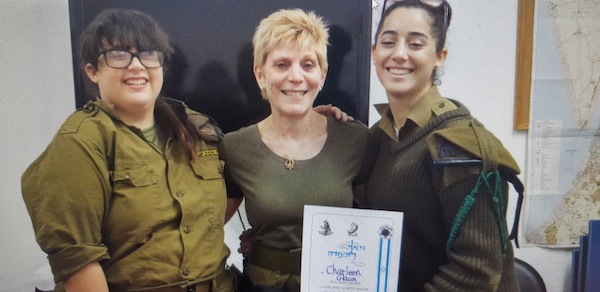
Charleen Glaun, centre, receives her certificate of service from Sar-El from madrichot Inbar, left, and Carmel. Glaun hopes to volunteer with Sar-El annually from here on out. (photo from Charleen Glaun)

At last, I was on the plane to Israel. Was this really happening? I had waited so long for this day and, here I was, after 32 years, finally returning.

Arriving at Ben-Gurion Airport, I proceeded through the security check-in. The first question asked of me was, “What is the purpose of your trip?”

“I’m coming on Sar-El,” I replied.

“What is Sar-El?” the security person asked.

“Volunteers for Israel,” I said, a little surprised he did not know about Sar-El.

I waited for his reaction, but there was silence. I blurted out, “I’ve been away for 32 years and this is my first trip back.”

He looked up from examining my passport and said, “What took you so long? Welcome back!”

I smiled and said to myself, “This is going to be the best adventure of my life! Thank you, G-d, for getting me here safely.”

Once I had my luggage, I found the sunglass stand where volunteers typically meet, and found Sar-El’s facilitator, Pam Lazarus, an expat who made aliyah 17 years ago. Since its founding in 1987 by General Aharon Davidi, volunteers come from around the globe for one- to three-week stints on an army base. Qualifications include a love of Israel, being of sound mind, having a clean bill of health, being physically fit and able to carry your own luggage. You do not have to be Jewish. There is a registration fee and the volunteer is responsible for the cost of the flight to Israel. While on the base, each person is assigned a room, which they will typically share with one or more people, and is given three meals a day. Some bases will even organize a free day trip to somewhere of interest, but individuals must fill their own weekends.

I was assigned to a medical supply base near Tel Aviv. This base does not have soldiers on it but rather reservists and full-time employees.

When I arrived at the base, I was given my army uniform. The correct size is not high on the priority list, I discovered. I spent the next three weeks in a very roomy pair of pants, which I held up with a belt, a khaki T-shirt and shirt, and an army jacket. I felt so proud wearing this uniform!

Army-issue clothing in hand, it was time to see where I was going to live for the next while. I had a roommate for my first four days, but had the space to myself for the remainder of my stay. Women are housed on the upper level of a two-storey building. Both floors have a washing machine. (Apparently, this is quite a luxury and not the norm.) All rooms have an air-conditioning/heating system and basic storage units. Three shower stalls delivered hot water at all times. I was at the Hilton of army bases! (I found out from my representative in Toronto that the living quarters on the base were newly renovated.)

A typical day is as follows. Breakfast in the main dining room is at 7:15 a.m. At 7:45 a.m., we meet up with our 19-year-old madrichot (supervisors) in the courtyard for the raising of the flag and the singing of the national anthem, and we get news from within Israel and abroad. Then, it is off to work until midday, when we make our way to the dining hall for lunch.

This base is the main military medical base in Israel and also the primary depot. Every 18 months, medical military units drop off complete medical supplies. They then pick up new and replenished supplies for the next 18 months, which are divided between bases. Medical supplies with expiry dates between six and 18 months are used first in hospitals and emergency rooms, while supplies with a six-month expiry date are used for training purposes and donations to developing countries. Medical kits are made up for many applications, such as atomic and biological chemical kits, combat doctors, and combat medics.
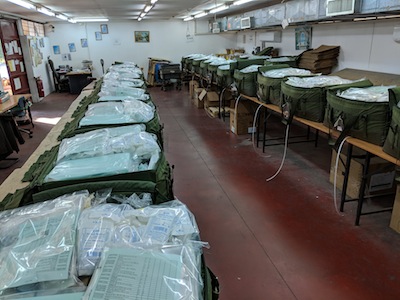
photo - Sar-El volunteers at a medical supply base near Tel Aviv make up medical kits
Sar-El volunteers at a medical supply base near Tel Aviv make up medical kits. (photo by Vadim Bendebury)

I had a great boss, Israel, who patiently explained exactly how to do things. Israel is a Bukharian Jew, a first-generation Sabra. He never stopped thanking us for our service, as did many Israelis I met off the base. They are grateful for the volunteers’ service. This, in turn, was so gratifying for us, knowing we were making a difference by giving back just a little to the country. It was an even better feeling when medical backpacks were returned to us with medical supplies unused.

The workday ends at 4 p.m., when volunteers are free to do whatever they like within the confines of the base. They are not at liberty to leave it, other than at the end of the workweek. Dinners are eaten early. Thereafter, the madrichot hold discussion groups or show movies. By 9 p.m., most people are ready for bed.

Weekends, volunteers may go anywhere in Israel, as long as we are at Tel Aviv’s main train station on the Sunday morning at 9:30, when we are taken back to our base. At present, there is a hostel in Tel Aviv specifically for Sar-El volunteers’ weekend stays. Accommodation is free, with meals included. This is a great alternative for those who are on a tight budget. It is not fancy, but it is near Tel Aviv’s hub and the beach.

One tends to forget that one is in a country in a constant state of war. The zest for life is unbelievable, which I noticed on my weekends in Tel Aviv. The bustling traffic; people sitting at coffee shops and in restaurants, or shopping at the Carmel Market; youngsters speeding down busy main intersections on their electric scooters; hip-looking men and women walking along the beautiful promenade with their dogs; beachgoers laughing and listening to music; picnickers on lawns with little children frolicking nearby; buskers entertaining the passing throng. What a beautiful, perfect picture it painted in an imperfect world.

Three weeks went by in a flash and soon it was time to return to Toronto. I looked for any reason that would enable me to stay, but, as the saying goes, all good things must come to an end. But it doesn’t have to end permanently. I will return to Israel. In fact, I am already looking at calendar dates.

I would highly recommend Sar-El for anyone who loves Israel and wants to do something worthwhile. Israel will welcome you with open arms and she will thank you.

To learn more about how you can experience your own “do good, feel good” adventure of a lifetime, email toronto@sarelcanada.org.

Charleen Glaun is a receptionist/caterer for an oil company in Toronto. She made aliyah in 1975 and spent the next 13 years traveling between Israel and South Africa, where she was born. Though aware of Sar-El since 1986, she did not have an opportunity to return to Israel until her December 2018 trip with the organization. Her heart has always been in Israel so, for her, the 2018 trip was “going home,” and she plans on returning with Sar-El before the end of this year, and each year going forward.
Volunteering’s benefits

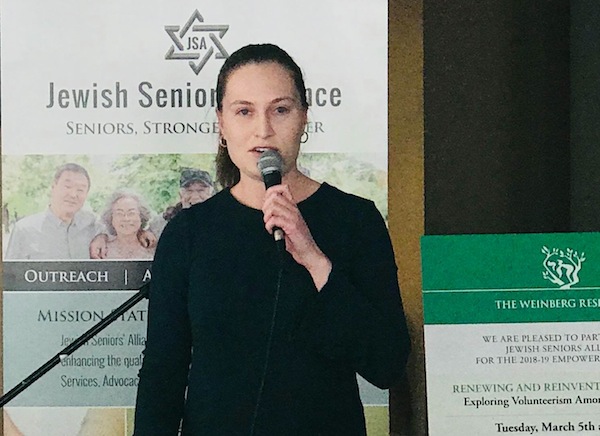
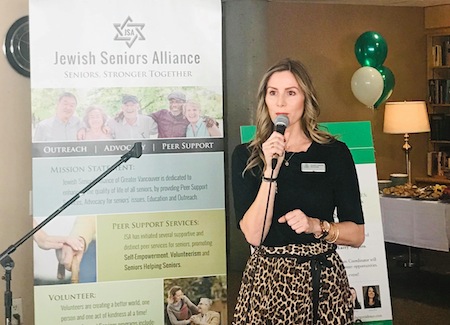
Eireann O’Dea speaks at the March 5 session of the Jewish Seniors Alliance Empowerment Series. (photo from JSA)

The following talk was delivered March 5 at the third session of the 2018/19 Jewish Seniors Alliance Empowerment Series, which took place at the Weinberg Residence. Speakers also included Larry Shapiro, JSA’s second vice-president; Jessica Bruce, volunteer coordinator for the Weinberg and the Louis Brier Home and Hospital; and Vanessa Trester, manager of the Weinberg.

It is relatively common knowledge that volunteering provides tremendous benefits to individuals and to the community at large. Volunteers have the opportunity to bring an increased sense of meaning and purpose to their lives, expand their social network, exercise unique skills and hobbies and, of course, help others in need. The presence of volunteers within a community increases social cohesion, builds trust and creates a “social infrastructure” of support, reciprocity and concern for others.

But what do volunteer roles really mean to those who participate in them? How does one start volunteering, and why do they continue? The Jewish community is exemplary in its provision of services and volunteer opportunities for children, youth, adults in mid- to late life, and the elderly. Yet the personal experiences of those who volunteer in the community, from a research standpoint, are largely unknown. This fact, along with my own experiences of working and volunteering within the community, inspired my master’s thesis, titled, An Exploration of Pathways, Motivations and Experiences Among Older Jewish Volunteers in Vancouver. The findings reflect interviews with 21 volunteers.

The majority of participants have volunteered for most of their lives. They described having parents who were community-minded, as well as adolescent experiences of being a part of Jewish youth organizations or women’s groups dedicated to community service. The expectation from others to volunteer was also discussed. Often, participants were asked to volunteer by their peers, rather than having sought out opportunities themselves. Over the years, this allowed them to experience multiple volunteer roles, as they would often be exposed to another role as a result of their status as a volunteer in the community.

photo - Vanessa Trester, manager of the Weinberg Residence. The Weinberg hosted the March 5 JSA Empowerment event
Vanessa Trester, manager of the Weinberg Residence. The Weinberg hosted the March 5 JSA Empowerment event. (photo from JSA)

Participants found volunteering to be personally rewarding, describing how their roles made them feel better about themselves, kept them busy and productive, as well as mentally fit. Participants were also motivated to volunteer for generative reasons; that is, to help the next generation and the community at large. The desire to pass on Jewish culture was evident, with many describing their efforts and desire to serve organizations that preserved historical documents, worked to support Jewish infrastructure and educate children in the community. They felt that volunteering represented an important part of Jewish life and cited the importance of helping others within Jewish culture and religion. Tzedakah, a Hebrew phrase meaning justice or righteousness, was frequently referenced.

Participants described the connections formed with their fellow volunteers and to the community. Friendships were maintained both within and outside of the context of the volunteer role. Caring for seniors was another common experience among participants. Many took on roles that involved working with older adults, whether it was making home visits to isolated older adults, or assisting with recreational programs. It was also found that participants gravitated towards leadership roles within volunteer organizations and, in some cases, had founded their own initiatives. Participants also found their volunteer roles to be an opportunity to engage in personal interests and hobbies, as well as a chance to use skills they learned during their professional careers.

Volunteering is a highly productive way for older adults to increase their level of activity, foster their interests, help others and continue to be social and connected to their communities. As Canada continues to diversify in terms of ethnic composition, it is essential that volunteer opportunities be made accessible to and inclusive of older adults from all backgrounds. To achieve this, it is imperative that future research in this area encompasses the experiences and stories of older adults themselves.

Eireann O’Dea is a PhD student in gerontology at Simon Fraser University. Her research interests are related to community engagement among older adults, ethno-gerontology and environmental accessibility. She wrote her master’s thesis on senior volunteers in the Jewish community and has recently joined the board of Jewish Seniors Alliance.

Barbecue for JSA volunteers

Jewish Seniors Alliance board member Pam Ottem, who is chair of JSA’s peer support program, with Baruch Azeroual at the JSA volunteer barbecue. (photo from JSA)

On Aug. 22, Jewish Seniors Alliance held its now-annual barbecue for peer support services volunteers, in appreciation of their work with seniors. This year’s celebration, attended by about 50 people, was a joyous affair, with food and musical entertainment, and speeches from volunteers.

Most of the attendees at the barbecue were volunteers or staff of the peer support services program, and a number of JSA board members also joined in the festivities. The food for the meal was contributed by the volunteers.

Charles Leibovitch, JSA peer support coordinator, and Grace Hann, JSA peer support volunteer trainer and supervisor, spoke and welcomed everyone before introducing JSA president Ken Levitt, who thanked everyone for their hard work and mentioned some of the issues for which JSA is advocating, such as a universal pharmacare program.

After Levitt spoke, Leibovitch called on Serge Haber, president emeritus and founder of JSA, to say a few words. Haber spoke about the needs of seniors and how JSA is trying to advocate for and fill some of those needs.

Hann explained about a crowdshare in which some of the volunteers had participated – a listening program that takes place every second Monday, 5-6 p.m., on Bute Street at Davie. Hann also thanked everyone who helped set up the event, including JSA coordinator Liz Azeroual and Azeroual’s husband, Baruch, who did the barbecuing.

The musical trio of Dave and Julie Ivaz and their son, Harrison, provided a wide-ranging performance. They played guitar and sang many songs familiar to the audience.

For more information on JSA, its peer support services, the listening and other programs, visit jsalliance.org.

Shanie Levin, MSW, worked for many years in the field of child welfare. During that time, she was active in the union. As well, she participated in amateur dramatics. She has served on the board of the Jewish Federation of Greater Vancouver and is presently on the executive of JSA and a member of the editorial committee.

Purpose is to help others

“It’s not for me.” “I’m too busy.” “I’ll volunteer when I’m retired.” All of these responses (excuses?) are familiar to me. Because, at one time or another, I hid behind each one of them.

I never felt I was good at time management, so how could I possibly take on volunteering when I was working full-time? Sure, I could multitask at work, because I had to. But did I enjoy working that way? Not even a little.

To me, time management meant working eight hours a day, worrying about work for the next eight hours, sleeping and dreaming about work for the following six hours, spending the next two hours showering, eating breakfast and reading the newspaper, then repeating the process. For decades, I functioned – notice I didn’t say lived – this way. I had tunnel vision of the worst variety.

Then I retired.

The novelty of not having to rise at a particular hour is intoxicating. Not that I indulge myself very often. After all, I had 34 years of 6 a.m. alarm clock reminders that had trained my body to get up with the sun. I confess that now, after two years of retirement, I occasionally sleep till 8:30 or even 9 a.m. But then, of course, I feel guilty. I’m Jewish after all.

Not long after I retired, I got an email from Rabbi Yechiel Baitelman of Chabad Richmond notifying me about an upcoming six-week Jewish Learning Institute course. I think it was called The Jewish Course of Why. Since I’m an inveterate question-asker and perpetually curious, I took the bait. And I was hooked.

Somewhere between the questions and the answers, the good rabbi saw an opportunity to recruit me for some volunteering. I may have casually mentioned that I’d just taught myself to bake challah using YouTube. Next thing I know, I get a call from Grace Jampolsky (“the Challah Whisperer,” as I call her), asking if I’d like to help bake challah for the bi-weekly Light of Shabbat meals that Chabad Richmond delivers to the elderly in Richmond. Sounded like a good thing to do. And who doesn’t love the smell of freshly baked bread?

From there, I volunteered to help pack the Light of Shabbat boxes and occasionally deliver them. This gave me the opportunity to visit and shmooze with some seniors, some of whom I already knew through my parents. We talked about family and books, everything and anything. It was a blessing for both of us.

About six months into retirement, I realized I still had way too much free time on my hands, and needed to do something useful. Something outside myself. So, I contacted B.C. Children’s Hospital, hoping to volunteer as a “baby cuddler,” not realizing that there’s a long waitlist to do that. But, as soon as the hospital’s volunteer coordinator saw my resumé, she offered me a volunteer position in the Family Support and Resource Centre. After all, what else would a librarian want to do in retirement, but jump right back into working in a library! Naively, I didn’t think to mention in my interview that I’d like anything but a library position. Nevertheless, I gave them the year’s commitment that they asked for and then resigned. Being an infrequently used part of the hospital, the centre didn’t provide the stimulation I was hoping for. I wanted to make more of an impact in my volunteering.

Soon after, Rabbi Baitelman asked if I’d be interested in volunteering with Chabad Richmond’s Israel Connect program, in which local retirees tutor Israeli high school students in English once a week, via Skype. It sounded like fun, so naturally I said yes. If memory serves me correctly, it was about two-and-a-half minutes later that he asked me if I would consider coordinating the Israel Connect program in Richmond. He had me at “Would you be interested….”

The rabbi knows that I have a background in writing and editing, so it wasn’t long before he asked for my help writing press releases and marketing pieces for Chabad Richmond. Writing is my happy place, so I was delighted to pitch in. It has only snowballed since then, and I’m thrilled to report that I love my volunteer activities, and I’m always open to considering new ones.

All of this is to say that there is life after retirement – volunteering has been enormously rewarding.

At its essence, volunteering is about saying yes to what you want to do, and saying no to the rest. And the yes, well, it’s just so darn sweet! Knowing that Jewish seniors are enjoying the challah I bake, and that the short visits we have might be the only human interaction they encounter in a week – that’s why my heart is drawn to do these things. Believe me, as a volunteer, working with people, you get way more than you give.

And Israel Connect? It’s the best spent 30 to 45 minutes of my week. Helping an Israeli teen improve their English so they can get into university or pursue a career that requires English proficiency – that makes my heart sing. And, we have fun. With each different student (all girls, so far), I’ve managed to make a connection and form a bond. After each week’s official tutoring is finished, we talk: about their hobbies, plans for the future, our families, travel, everything. From week to week, I notice not only improvements in their English, but a relaxation that comes from forming a real intergenerational friendship. I hope to visit my students when we travel to Israel soon.

I’d be remiss if I didn’t include the bits and pieces of volunteering I did while I was still working full-time as a librarian and communications officer at Richmond Public Library. I did manage to squeeze in some fundraising and communications work to help promote the Crohn’s and Colitis Foundation of Canada’s annual Gutsy Walk fundraiser.

In a much more humbling capacity, I was also part of a program about eight years ago, called Feed the Hungry, in which a bunch of volunteers from Ahavat Olam made and served lunch to Downtown Eastside (DTES) residents on a regular basis. And, for several years, I volunteered, along with my husband, brother-in-law and/or friends, serving Christmas lunch at the Salvation Army Harbour Light Mission in the DTES.

For a couple of years, I was a volunteer board member with the Isaac Waldman Jewish Public Library, as well as being the B.C. Library Association representative for the West Coast Book Award Prize Society. All of them together were growing and learning experiences of the highest order.

We guard our free time so rabidly, we forget that part of why we’re put on this earth is to help others. The satisfaction and joy that comes from doing something outside ourselves, something for a higher purpose, is indescribable. Believing is seeing. But don’t just take my word for it.

Shelley Civkin is a happily retired librarian and communications officer. For 17 years, she wrote a weekly book review column for the Richmond Review, and currently writes a bi-weekly column about retirement for the Richmond News.

Angels share warmth and love

More than 70 volunteers came out Feb. 11 to help Rose’s Angels pack care bundles. (photo by Lianne Cohen)

The fifth annual Rose’s Angels was a success by every measure. This year, project co-founders Courtney Cohen and Lynne Fader facilitated multiple donors of goods in-kind and financial, led six months of collecting items and gathered more than 70 volunteers to pack more than 1,100 care bundles, plus additional bulk packages for Richmond-based outreach agencies.

photo - Some of the care packages were specifically for children in need
Some of the care packages were specifically for children in need. (photo by Lianne Cohen)

Seventeen Richmond agencies – as well as Jewish Family Services’ Jewish Food Bank and Salvation Army’s Deborah’s Gate, both Vancouver-based programs – received these bundles. Each bag contained warm clothing items, hygiene products and food, among other things, to make a recipient’s day a little easier, and each was created to be specifically for men, women or children. The bags included a special note from the Rose’s Angels family, expressing hope that the items bring some enjoyment and a smile.

Agency recipients also included Touchstone Family Association, Chimo Community Services, Richmond High’s Colt Young Parent Program, Tikva Housing Society’s Storeys residence, Heart of Richmond AIDS Society, Richmond Mental Health, SUCCESS, Richmond Food Bank, Turning Point Recovery Society, Richmond Family Place, Pathways Clubhouse, Chabad Richmond’s Light of Shabbat Meals program and Gilmore Park Community Meal.

Cohen, who sits on the Kehila Society’s board of directors in the outreach position, and Fader, Kehila’s co-executive director, created Rose’s Angels to honour the memories and spirits of Cohen’s grandmothers, Rose Lewin and Babs Cohen. The note included with the bundles, said, “We share with you the long-lasting love and warmth these ladies conveyed.”

For those wishing to make a donation to Rose’s Angels or to get involved with the Kehila Society, contact the society office at 604-241-9270.

NCJW pays tribute to Poliakoff

Left to right: former National Council of Jewish Women Vancouver section president Shirley Hyman; Gloria Hendin, tribute committee chair; Barbara Heller, longtime supporter of council; Marion Poliakoff, the guest of honour; Bonnie Gertsman, former Vancouver section president; Anne Melul, former Vancouver section membership chair; and Debby Altow, past president, Vancouver section. (photo by Joanne Emerman)

National Council of Jewish Women hosted a tea at Temple Sholom on Jan. 9 to celebrate Marion Poliakoff, a true Renaissance woman. At 94 years young, she continues to be an inspiration to council members past and present.

Poliakoff’s career and her personal life demonstrate the principles of NCJW: fostering multiculturalism, alleviating poverty among women and children, supporting family counseling in Israel through ALUMA, and cherishing music and family. Her commitment to clear and convincing communication has been a boon to many newsletter writers – and she continues to edit us closely.

Gloria Hendin, who chaired the event committee, welcomed everyone. Shelagh Stoller bought the gift for Poliakoff, which Shirley Hyman presented. Barbara Heller managed all the banner decorations, Bonnie Gertsman and Anne Melul organized the food, and Judy Stern greeted guests as they arrived. The entertainment came courtesy of Poliakoff’s daughter, Amy Poliakoff, who brought her flute from Boston. I delivered the tribute speech, which I share below.

Vancouver section president Catherine Stoller set the tone for the annual general meeting that followed the celebration. “Looking backward, we recall our ancestry. Looking forward, we confront our destiny,” she said. The board of directors was installed by Shanie Levin with those words ringing in their ears!

In preparing my remarks, I read Melul’s biographical notes on Poliakoff, Carol Weinstock’s article on NCJW in the Jewish Museum and Archives of British Columbia’s journal, The Scribe, and the book More Than Just Mrs.: Jewish Women’s Organizations in B.C., as well as the council’s cookbook. Of course, I also spoke with many council members who worked with Poliakoff, and reflected on my own personal experiences with her. With some minor editing, to reflect their publication after the event, my remarks follow.

Marion was born in the United States. Holding a bachelor’s from Simmons College in Massachusetts and a master’s in journalism from New York’s Columbia University, she married Mel Poliakoff in 1949, adopting Mel’s son Merrill at the same time. Although at first they were unable to live in Tenafly, N.J., because, as Jews, they could not buy a house there, nevertheless they did move there a few years later. She became the first Jew elected to public office, serving on the board of education.

In 1972, she moved to West Vancouver with her husband and their daughters Amy and Nan. They loved tennis, skiing and sailing. Sadly, Merrill and Nan are gone, but many of Marion’s family were able to join the council’s tribute.

When Marion met Bess Narod – Bess is from Ottawa; I knew her family back home – they went to an NCJW meeting, and that was the start of Marion’s connection with council. The first big item she worked on, the hearing screening project in schools, demonstrated council’s mission: identify a need, pilot a response, make it a success and turn it over to government. The Vancouver health department now runs it.

Marion also met Rita Weintraub, who became a lifelong friend. Together, they have worked to support the Isaac Waldman Jewish Public Library at the Jewish Community Centre of Greater Vancouver.

Meanwhile, Marion got another master’s degree – from the University of British Columbia’s School of Social Work – and, through a field placement at Britannia Community Centre, became interested in multicultural issues. Always the consummate writer, she contributed the Multicultural Corner column to the monthly newsletter of the B.C. Association of Social Workers; another column went into the Britannia newsletter, which was translated into Italian and Chinese.

The City of Vancouver grabbed Marion and she ran parenting groups for mothers in three community centres – using translators for Farsi, Chinese and Italian participants. In 1981, she received the Social Worker of the Year Award from the B.C. Association of Social Workers for her multicultural work.

I met her when I was the director of communications for the Canadian Cancer Society and she was a social worker at the B.C. Cancer Agency. I was working on breast cancer issues, with multicultural projects for Chinese and South Asian women. We found we had much in common.

Marion was also the one who called me every year to pay my NCJW dues, even though I was not an active volunteer in those years. She recruited me after I retired to join the board and, 13 years later, I’m still on it in one capacity or another.

In 1991, HIPPY (Home Instruction for Parents of Preschool Youngsters) was brought to Canada from Israel as a council initiative by Carol Slater. Ever alert to new connections, Marion linked Britannia, along with Simon Fraser University, to council as our community partners to launch the HIPPY project. She was intimately involved in establishing its work with immigrant mothers and their families. While its name has changed to the Mothers Matter Centre, HIPPY remains one of council’s programs, and Wazi Kapenda, its Western director, was in attendance at the tribute.

Marion’s volunteering extended to driving people to services at Congregation Har El, eventually donating her beloved baby grand piano to the shul, fundraising for the synagogue, and cooking and serving food weekly to needy and homeless people at Harvest House.

Later, she joined the North Shore Osteoporosis Society, organizing monthly speakers. I spoke at one gathering and there were more than 100 people attending – a not uncommon number!

Her commitment to ALUMA (formerly the Israel Family Counseling Agency) was, and continues to be, an inspiration. She fought for support for ALUMA in council, because the organization was dedicated to supporting people in Israel who could not afford professional counseling but who desperately needed it. And Judy Stern could always count on Marion to canvass for Friends and Angels, council’s only annual fundraiser.

Marion’s was a home where music was loved and valued, even after the piano was gone. She supported the Vancouver Symphony, the Vancouver Chamber Music Society and Music in the Morning. Music continues to be a tree of life for many of her family members. Her close friend Shirley Lecker is part of that tradition.

Do you see a thread unspooling here – with HIPPY, with anti-poverty issues, with a commitment to Jewish values, with a passion for family, with a professional eye for communication, with an abiding love of music? When I said Renaissance woman, the label is legitimate.

It is such an honour to acknowledge Marion for her work with council – and with many of us personally. It is beyond words. To simply say thank you is really inadequate. But, from the bottom of my heart, and from all of us, thank you, Marion.

Volunteering connects

Karen James, board chair of the Jewish Federation of Greater Vancouver. (photo from JFGV)

Volunteers are integral to almost every nonprofit organization, and Jewish Federation of Greater Vancouver is no exception. With this year’s annual campaign well underway, the Jewish Independent spoke with Karen James, who became Federation’s new board chair earlier this year.

Jewish Independent: You’ve been involved with various organizations over the years, such as the Jewish Family Service Agency and the Canadian Jewish Political Affairs Committee. With which organizations are you currently volunteering?

Karen James: When I took on the role of chair of Federation, I let go or passed on most of the other things I was doing. I had been on the board of JFSA and chaired for the past year, but have passed that on. I am still representing Vancouver on the Jewish Agency for Israel board of governors meetings but that is the only other thing I am doing. That still connects to Federation, as we support the agency and Vancouver now has a stronger voice with the agency. I still support CJPAC and JFSA in any way I can.

JI: How do you balance volunteering with working? Is it a challenge?

KJ: I am very fortunate to have a business that does not demand too much time of me right now. Mostly, the balance is between volunteering and time for myself and time for a social life.

The board chair is a significant role. There is no question that I would not be able to do much else. There are many different and moving parts to Federation and this role. I couldn’t imagine having a full-time job and doing this. I want to learn and support everything going on in our community but there are limits to my time and energy sometimes.

JI: How and when did you become involved in Federation, and in what capacities to date?

KJ: I first became involved at Federation in 2007 when I came back from a Federation-led mission to Israel. I took on the role of vice-chair for community and sat at the campaign table. After that, I was women’s philanthropy chair, then chair of financial resource development and then, in 2013, chaired the Israel and overseas affairs committee for four years before stepping into the board chair role…. Because of my involvement over the past 10 years, I can see the full picture of what Federation does and what is happening in the community.

JI: What motivated you to take on the role of Federation board chair?

KJ: I like working with people and the move to chair of the board did seem like a natural progression. I also know that Federation is looking at longer-term succession and was looking at me possibly filling the role, so it wasn’t a surprise…. I want to give back. I have the time and energy to give to my community. Community means everything to me. I was disengaged and, when I moved back to Vancouver, I said I wanted to be part of community, that it was missing from my life. We can be there for each other in times of need and in times of celebration and naches.

JI: In what ways have you witnessed Federation evolving with the community and its needs?

KJ: The 2020 Strategic Priorities. As we developed [it], we sought input from a wide cross-section of community stakeholders, partner agencies, etc. – 2020 is a commitment to more flexible funding models and more grassroots.

I have witnessed that we all [are affected by] the affordability issues in our city. We not only need to address this within our community in the city but also in the suburbs of Vancouver, where our Jewish population is moving to. Over half of our community now lives outside of Vancouver. How can we address their needs, because, if we don’t, we run the risk of losing them entirely? We will need to provide services and programs closer to where this population is living.

It’s also expensive being involved in community life in the city. Housing payments, food, transportation, these are all issues that affect our community members. And then, the cost of Jewish day school, synagogue membership, JCC membership. It all adds up. We have to be able to support these families and individuals, too.

JI: What excites you most about this year’s campaign?

KJ: Incentive and the opportunity it represents to grow the base of support. If we’re going to help everyone, we need everyone. Everyone has a role to play. Tzedakah is a mitzvah you have to do yourself.

Sense of urgency: the community is at a turning point. If we can connect people – either by bringing programs and services to where they live or by keeping the programs and services affordable and offering subsidies – then we can keep them connected to community. Otherwise, we’ll lose them. We only have so much time to make a real difference.

JI: What, if any, of the 2020 priority items speak to you personally, or most?

KJ: Food security and affordability, but especially regional communities and reaching out them. I lived in White Rock/South Surrey for almost 30 years and was there when the WRSS JCC got started. There was nothing out there when I was raising my children and it was a long drive into Vancouver. I know how important it is to provide Jewish [options] outside of Vancouver…. The affordability issues are driving them out there, now we have to take care of them.

JI: When you’re talking to people about the campaign, what do you say to them about the benefits of contributing or volunteering?

KJ: I get more than I give. It is rewarding to me and I feel so lucky to be able to volunteer and give of my time and my resources. The rewards for being involved, for giving and helping are the connections to my Jewish family/community.

JI: If there is anything else you’d like to add, please do.

KJ: I know what it feels like to be disconnected from community, and it has been so valuable for me to connect. I barely knew anybody and, by getting involved, I’ve learned what community is all about.

One of the incentives to which Karen James was referring is that annual campaign chair Alex Cristall and his family will donate an additional $250 to the campaign for each gift from a donor who missed last year’s campaign or who is making a first-time gift. For more information on this initiative, the campaign in general and the types of programs and services Federation supports, visit jewishvancouver.com.

A time to socialize and lunch

Most of the volunteers have been with the JFSA Seniors Lunch program for up to 15 years. (photo from Jewish Family Service Agency)

The Jewish Family Service Agency Seniors Lunch program held its annual volunteer appreciation event on Aug. 8. The volunteers were treated to lunch catered by Omnitsky and had the chance to share why they are involved in the program.

Most of the volunteers have been with this weekly event for up to 15 years. A close bond has formed among the volunteers and the warmth and camaraderie is what contributes to the success all around. They spoke movingly about how important it is for them to be involved in it, to give their time to it, week in and week out. They said they believe so strongly in what JFSA does and, therefore, want to be involved in some way.

When asked why they are so committed to this program in particular, the volunteers said they loved the seniors, that it felt so good being with them and that their own week went better when they were giving to others. Their longtime involvement is a testament to the importance of the lunch program – they want to help make sure that it continues to flourish.

The JFSA Seniors Lunch is completely volunteer-driven. It is a full-course, sit-down kosher lunch held every Tuesday at noon. It is held twice a month at Temple Sholom, once a month at Beth Israel and, the last Tuesday of the month, a movie is shown in cooperation with the Vancouver Jewish Film Centre at the Peretz Centre.

Seniors enjoy being with old and new friends from the Jewish community. Socialization and good nutrition are two primary determinants in healthy aging and the lunch program addresses both of these issues. For more information and reservations, please call JFSA at 604-558- 5709.


A call to community seniors

Recently, I met an old friend. During our conversation over coffee, he asked if I was still involved with the Jewish Seniors Alliance of Greater Vancouver. “Of course,” I said. With a funny look on his face, he said, “You are putting a lot of time into this work.”

His remark and the look irritated me quite a bit, and I said, “Joe, you are probably 10 years younger than I am, you have your wife and children near you, you are a lucky man. You are also financially independent. It may be possible that you are not aware and possibly don’t care about what is happening around you – you are complacent.”

Let me bring Joe – and you – up to date.

There are several hundred elders in our community who are poor, lonely, marginalized or abused. JSA is making every possible effort to find these isolated individuals in order to help them.

In its outreach and advocacy programs, JSA is contributing to the well-being of countless elders with our educational programs. We reach out to these people through our two forums and four Empowerment Series sessions yearly; through our Senior Line magazine, which is published three times a year and contains current, relevant and well-research articles; and by means of our website, which not only informs but entertains.

And Joe, why should your indifferent attitude change? You are OK and you believe that JSA has nothing to offer you. But, there are hundreds of seniors giving of their time and wisdom to help other seniors. Something else you should know Joe – sooner or later, almost every senior needs help.

At our annual general meeting in September, JSA will be honoring a few individuals selected by their organizations for their extensive volunteer work for Vancouver’s seniors. And Joe, please note that JSA’s events are cost-free and are not fundraisers. Our outreach programs have a preventive focus, so that people like us remain functioning and enjoying a healthy life for as long as possible.

And Joe, if you think that this is all, let me tell you about our Peer Support Program, which JSA started almost four years ago.

Our two professionals have trained more than 100 senior volunteers to be peer counselors: to give emotional support, to conduct weekly visits at seniors’ homes and to make weekly phone calls. The peer counselor takes a 55-hour training course, and the callers and visitors take a 17.5-hour training course.

These trained volunteers come from every walk of life and different cultural backgrounds, and they speak many languages. They have a clean police record and they sign a confidentiality agreement. Their commitment to JSA is for at least one year. To date, we have more than 50 volunteers servicing more than 150 families.

JSA also provides referrals to seniors and their families, enabling them to access benefits and services offered by the municipal, provincial and federal governments. JSA’s bereavement support program helps seniors, either individually or in a group setting.

Last year, JSA trained 11 seniors to be ambassadors for creating awareness of senior abuse in homes and institutions. They talk to individuals or groups of seniors, and more than 300 seniors have benefited so far from this program.

Frankly, Joe, I shudder at the thought of what would happen if JSA were unable to provide these unique services in our community. We are in contact with 5,000 seniors, and we are doing our best to inform, educate and entertain them.

Seniors have the untapped power to help themselves politically. Unfortunately, this power is being wasted by either disinterest or failing to act. Only 650 to 700 seniors have chosen to be members of JSA, although it costs a mere $18 a year.

JSA must exist, grow and be able, with the support of the community, to provide these services. However, community involvement and financial support and interest are crucial. Without volunteers, nothing would be possible!

How about you Joe? You are not involved in anything right now – perhaps it is about time to start giving of yourself to our community?

Serge Haber is president emeritus of Jewish Seniors Alliance of Greater Vancouver. A version of this article was originally published in the June issue of the organization’s magazine, Senior Line.

Why should we volunteer?

Why do we volunteer? As a volunteer myself, I never gave this topic much thought until the editorial committee of Senior Line determined to feature volunteering in an upcoming edition.

A volunteer is someone who offers their service of their own free will or without being asked. Most people who volunteer do so because they are making a contribution to society or to a selected part of society. Some volunteer because of values that have been instilled in them or are part of their heritage, or because of the examples that others have set.

Volunteers are the backbone of every not-for-profit organization that exists. They run the gamut of everything that an organization does: sit on boards of directors, raise funds for the operation of the organization, plan and chart the future of the organization, visit seniors who are shut-ins or visit the sick and infirm. These are but some of the ways that volunteers make an enormous contribution.

My interest in volunteering likely came from observing my parents while growing up in what was considered rural Surrey in the late 1940s and 1950s. Both were involved in the Royal Canadian Legion and the Newton Athletic Club. I became involved in a number of organizations that included the B.C. Association of Social Workers, Habonim Dror Camp Miriam, the Performing Arts Lodge, Congregation Beth Israel and, more recently, Jewish Seniors Alliance. My motivation? To use my experience in supervision, management and organizational development. What could I do to make a difference? It was important for me to believe in the purpose and direction of the organization and how I could fit in. I have never wanted to be a spectator but an active contributor to the positive evolution of an organization and, of course, to the services they provide.

Norman Franks represents the quintessential volunteer. Franks is a native Vancouverite whose family has a long history in the city. During his student days at the University of British Columbia, he served as president of Hillel House. At the invitation of brothers Jeffrey and Peter Barnett, who helped pioneer the establishment of Variety Club in Vancouver, Franks became a member. He agreed with the purpose of Variety and, perhaps more important, identified with them because of being the parent of a severely challenged child.

Franks also has been involved with State of Israel Bonds, as executive director and as volunteer, he was involved with Project Isaiah, the Louis Brier Jewish Aged Foundation, Vancouver Talmud Torah and the Mountain View Cemetery Restoration Committee. He has served on the board of Beth Israel and, for the past nine years, has served as parnass, helping with the administration of the congregation. Franks works for the personal satisfaction he gets from the task at hand. In his own words, “I feel blessed and volunteering is my way of showing gratitude.”

Courtney Cohen, 27, sets the standard for younger people who demonstrate a passion for volunteering. In 2013, while brainstorming with Lynne Fader, co-executive director of the Kehila Society of Richmond, Rose’s Angels was born. Cohen’s inspiration comes from her late grandmother, Rose Lewin, who she describes as “the most compassionate and selfless person I have ever known.”

Rose’s Angels is a yearly event that provides a special package to assist people who live in poverty. Agencies that received packages this year included the Jewish Food Bank, Chimo Outreach, Richmond Family Place, Turning Point Recovery and many others. The decision of what to include in the packages was based on what the agencies’ clientele needed, such as non-perishable food, toiletry items and warm socks, toques, gloves and scarves. Donations came primarily from individuals and, on Feb. 14, more than 40 volunteers recruited by Cohen gathered at Richmond Jewish Day School to assemble and deliver a total of 400 care packages and 750 warmth bundles. Cohen said she measures success by “knowing others are benefiting from our care packages and the satisfaction felt by all volunteers and donors.”

Elayne Shapray, z’l, represented a special class of volunteers for her courage and for her convictions. She was a registered nurse by profession and graduated from the Jewish General Hospital in Montreal. In her own words, “Volunteering was always in my blood and I had the luxury of not having to work. I wanted to give back to the community. I got more from volunteering.” Shapray had an enviable record for the volunteering she undertook: Planned Parenthood, palliative care at Vancouver General Hospital, helped start L’Chaim Adult Day Centre, UBC Women’s Resources, served on the boards of Jewish Family Service Agency and Beth Israel – it was Shapray who initiated the annual coat drive at BI 22 years ago.

At age 39, she was diagnosed with multiple sclerosis, but she never disclosed her malady to the organizations she volunteered with so she would not receive any special treatment. Her days as an active volunteer ended about two years ago. Her most recent diagnosis was progressive secondary MS and, from 2011, she had been in the media about the “right to choose,” physician-assisted dying. She will be remembered for her caring, involvements and beliefs.

Larry Shapiro is a “wild and crazy guy.” He is energetic, entertaining and fun to hang out with. He and his wife, Dianne, moved to Vancouver from Montreal more than two years ago to be closer to family. In Montreal, he was involved with civil

defence, Zionist causes and his Masonic lodge. He became an advocate for his very independent late mother’s well-being, ensuring all her needs were being met.

As a new Vancouverite, it was important for him to meet new friends and to become involved. Initially, he joined Oakridge Seniors’ Centre, where he now sits on the board of directors. Shortly thereafter, he met Serge Haber, the founder of JSA, who invited him to volunteer as a peer counselor. After meeting the program’s trainer, Grace Hann, Shapiro entered the 55-hour training program. Today, he has five seniors with whom he is in regular face-to-face contact, and he is now on the executive committee of JSA.

Shapiro has some thoughtful insights about seniors who may feel isolated, lonely and possibly depressed, and believes that interaction with seniors in need requires more than mere physical care. He noted, “Listening is important and it is something not all of us do well. People have a story to tell and they want to relive their lives through storytelling even if it’s repetitive. I have seen the positive effects that peer counseling can make. It is often an instantaneous and spontaneous return to normalcy because it involves another person who listens and cares unconditionally.”

Do volunteers make a difference? Re-read this article and you will know the answer.

Ken Levitt is a vice-president of the Jewish Seniors Alliance of Greater Vancouver and a former chief executive officer of Louis Brier Home and Hospital. A longer version of this article will be printed in a forthcoming Senior Line.