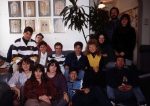
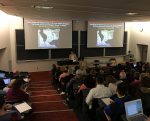
Group at Hillel House, University of British Columbia, 1988. (photo from JWB fonds, JMABC L.11124)
If you know someone in this photo, please help the JI fill the gaps of its predecessor’s (the Jewish Western Bulletin’s) collection at the Jewish Museum and Archives of B.C. by contacting archives@jewishmuseum.ca or 604-257-5199. To find out who has been identified in the photos, visit jewishmuseum.ca/blog.
On Remembrance Day, pro-Nazi posters were discovered at War Memorial Gym on the University of British Columbia campus. The posters depicted Nazi soldiers with the words “Lest we forget / The true heroes of WWII.”
This incident followed the discovery earlier in the week of antisemitic drawings on a chalkboard in the forestry faculty. Rabbi Philip Bregman, executive director of Hillel BC, sent an email to the community thanking the Forestry Undergraduate Society for making a clear statement of solidarity. While this is the good news, he wrote, there is also bad news. Students are reporting that the latest incidents are a “tip of the iceberg” of similar expressions and depictions that go unreported.
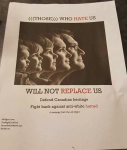
Earlier this month, white supremacist and antisemitic posters also appeared at the University of Victoria. “(((Those))) who hate us / Will not replace us,” read a poster. The use of triple parentheses is a method used online to identify Jews. The fear of white people being “replaced” by non-white people is a recurring theme in the white supremacist movement.
These incidents are local iterations of a larger and obviously deeply troubling phenomenon occurring worldwide. In part a response to the movement of refugees from Syria and elsewhere in the Middle East and North Africa, far-right groups in Europe have grown significantly in recent years. This is evident in the horrifying rally of an estimated 60,000 neo-Nazis, hyper-nationalists and racists in Warsaw, Poland, last weekend. And it is underscored by the neutrality or even affirming noises from those in positions of power at the sight of ralliers carrying signs urging “Clean blood,” “Pray for an Islamic holocaust” and “Jews out of Poland.”
Poland’s governing Law and Justice Party has informal connections with some of the extremist groups that organized Saturday’s rally. Poland’s foreign ministry, on the one hand, condemned the xenophobic, antisemitic and racist messaging, but, on the other hand, called the event “a great celebration of Poles.” The country’s interior minister called the rallying extremists “a beautiful sight.”
This sort of equivocation from leaders is perhaps as worrying, or more so, than the rallying mobs themselves. While the past year has seen numerous European far-right parties fail to live up to expectations in elections, their strength is nevertheless very concerning.
On the subject of elections … off-year elections in the United States last week delivered a strong rebuke to the U.S. president. Although polls indicate that 36% of American voters would vote for him again, no president in the history of polling has been this unpopular this early in his mandate. This is, perhaps, a sign that most Americans are turning against the divisiveness and xenophobia that this president advances.
Encouraging as that may be, possibly (wishfully) portending his defeat in 2020, the damage he is doing to the civil fabric of the country is incalculable. It is saddening to see the president of the United States overtly promote racism against Mexicans and people from Muslim-majority countries, threatening one group with a wall and the other with a travel ban that has been repeatedly deemed unconstitutional by the courts. Among his supporters are openly racist and white supremacist activists.
All of this is to say that the world is experiencing a time of extremism. Rather than throw up our hands in despair, this is a time to rededicate ourselves to the values that motivate us, the values for which Canadian and other Allied soldiers fought.
The posters at B.C. universities should be enough to sweep away any complacency we may have about our shores being free from this sort of racist ideology. This is a good thing. Canadians have a right to be proud of our comparatively decent record of multicultural harmony, but smugness is a blinder that can allow us to ignore very real undercurrents. We must be vigilant in calling out evil ideology when we see it at home and abroad.
On Nov. 9, the anniversary of Kristallnacht, a swastika and “Heil Hitler” were found written on a hallway blackboard in the University of British Columbia Forest Sciences Centre. The antisemitic graffiti was first reported to Hillel BC, who then contacted security.
This was one of several racist incidents that have occurred on B.C. campuses and across Canada in recent months, including pro-Nazi posters found at UBC on Remembrance Day. On Halloween night and in the days following, posters reading, “It’s okay to be white,” appeared on several Canadian university campuses, apparently based on instructions from a post which Vice Canada traced to the anonymous online forum 4Chan, a hub for the alt-right.
During the same week, antisemitic posters found at the University of Victoria read, “Those who hate us will not replace us. Defend Canadian heritage. Fight back against anti-white hatred. A message from the alt-right.” The word “those” was placed in triple parenthesis, a way of identifying Jews. When the posters were taken down, moderators of Anti-racist Action UVic Facebook page and others reportedly received a backlash of hateful messages online.
The election of Donald Trump one year ago this month is widely perceived as a triumph for the tangle of white supremacists, antisemites, misogynists, racists and ethno-nationalists who have come to be called the “alt-right.” In Kill All Normies, a book about the genesis of the group, journalist Angela Nagle describes an online world where cynicism, irony and absurd in-joke humour have combined with racism and misogyny to produce a “taboo-breaking anti-PC style” that has come to characterize the alt-right. Since then, the movement has tapped into latent racism and xenophobia, bolstered by the rise of people like Richard Spencer and Milo Yiannopoulos.
Not everyone is happy with the use of the term “alt-right.” Given their white supremacist beliefs, “alt-right” is somewhat innocuous. The Associated Press avoids the term because its editors think it downplays the movement’s racist goals.
Long before the 2016 election, the alt-right was gathering strength and allies. Trump granted the racists among his supporters visibility, lowering the social costs of bigotry and inspiring these supporters with a hope that their vision of “white identitarianism” could come to rule America once again. This has emboldened them and brought them out of the shadows.
In the days following the election of Trump, Canada saw a spate of vandalism, hate speech and pamphleteering directed against Jews and other minorities. As in the United States, this did not come to Canada overnight. In 2015, the CBC temporarily closed all online comments on stories featuring First Nations people because of the “staggering number of hateful and vitriolic comments” posted. In August 2016, the premier of Saskatchewan was forced to issue a plea for an end to hate speech following the second-degree murder of an aboriginal man on a farm. As a result, his own Facebook page was flooded with racist messages.
The posters at UVic were discovered by an anti-racist group on campus organized by Tyson Strandlund, who said the increasing activities of the alt-right in the public sphere are what led to his group’s creation in September. Strandlund said there has been heightened concern on campus since last summer, when an art installation meant to inspire conversations about resistance to racism was instead extensively defaced with racist slurs and had to be dismantled. He mentioned a meeting that was to take place in the Student Union Building on Nov. 15, for students and others to discuss anti-racist strategies.
David Blades, president of the Jewish Federation of Victoria and Vancouver Island, said they are “keeping close tabs” on the alt-right movement. “We have a good sense of who these people are,” he told the Independent. “What’s increasing is their public activity, not their numbers, which have remained pretty stable for years.
“Nevertheless,” he warned, “we have to be vigilant because they are also recruiting. There is no question that there is latent racism in Canadian society and it can be tapped into. My concern is that this was not isolated to the University of Victoria, this also happened at the University of Alberta and elsewhere. It was a coordinated national event. That’s my concern as Federation president. This is a shift in the overall organization of this group.”
Blades said he is “really happy with the response of UVic” and that there are plans in the works for “five days of activism against racism.”
“In some ways,” he said, “these incidents have been more effective at inspiring the opposite of what they intended: an increase in anti-racist activism.”
Matthew Gindin is a freelance journalist, writer and lecturer. He writes regularly for the Forward and All That Is Interesting, and has been published in Religion Dispatches, Situate Magazine, Tikkun and elsewhere. He can be found on Medium and Twitter.
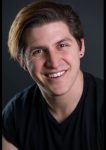
Jed Weiss plays Mr. Gibson in UBC theatre’s production of Wives and Daughters. (photo from UBC theatre)
University of British Columbia’s theatre program has a tradition of presenting historical plays. The current production, Wives and Daughters, based on an 1860s serial novel by Elizabeth Gaskell, was adapted by Jacqueline Firkins and directed by Courtenay Dobbie. It promises to be “a charming romp of love convoluted by hidden desires and expectations.”
One of the actors in Wives and Daughters is Jewish community member Jed Weiss. In his final year at UBC, Weiss will graduate in May 2018 with a dual degree in psychology and acting. A transplant from California, he moved to Vancouver in 2013.
“I first moved here to go to UBC,” he told the Jewish Independent. “And I would definitely like to continue living here for awhile after graduating. I’ll always go back to Northern California to visit, but Vancouver is a second home to me. Part of what made UBC so attractive was the tuition price. I was able to finesse a dual citizenship a month before I applied here, thanks to my awesome mom, who kept her Canadian citizenship after moving to the States.”
Since his arrival, he has been very busy with work and study. Among other activities, he was a radio host for several years. “Between 2013 and 2016, I was hosting my radio show called Crescendo on the UBC radio station CITR 101.9. It went live for one hour every Sunday night. The program played eclectic music, starting with chill and down tempo, and building in intensity through the hour. I also used the time on the show to interview local bands, which was a really fun time. It was a live show, which was later podcasted, and some of the shows are archived on the website. Sadly, during the last couple years, I’ve gotten increasingly busy with acting and music and had to let go of the show, but I still drop by to support the station.”
He also donated his time to the nonprofit organization Generocksity.
“Generocksity is a nonprofit organization that originated at UBC and has since spread internationally,” he explained. “Its purpose is to create philanthropic opportunities, increase philanthropic culture, and throw live events featuring local musicians, with every dollar made from those events benefitting a local charity. A few years back, I worked as a talent coordinator, so I spent time reaching out to Vancouver comedians and musicians to volunteer their time to perform at our events to benefit local charities. At this point, I can only help out when I’m not too busy. I almost feel like Generocksity’s dead-beat stepdad, but I’d encourage everyone to look into them.”
When asked about acting, and what attraction it holds for him, Weiss said, “As an actor, you get to be whoever you want. You get to lose yourself in the escapism while simultaneously chasing this high of complete connection with an audience. It didn’t occur to me as a viable option until my ninth grade drama class and, since then, it’s been step by step. In 10th grade, I had to inform both my wrestling coaches that I was quitting mid-season to join the cast of my high school’s production of Beauty and the Beast, which were two very ‘fun’ conversations. After high school, I began working with the UBC Players Club and other campus productions. Eventually, a close friend of mine pushed me to audition for the UBC BFA program, and the rest is history.”
Weiss enjoys both of his areas of study. “If I can make enough money from acting to feed, house and at least partially clothe myself, I’d be set! That being said, I would honestly feel that something was missing if I didn’t spend some time continuing to study psychology. I wouldn’t even mind Frasier-ing it and landing a radio or podcast psychology advice show that would utilize both of those fields,” he said, referring to the main character’s jobs on the television comedy Frasier, which ran from 1993 to 2004.
Weiss said that psychology is a useful skill for an actor, and that the opposite is also true. “There has been a rise in the implementation of theatre into therapy,” he explained. “There is significant power in using theatre and performance in clinical settings, so it’s great to see theatre being recognized for how therapeutic it can be.”
As for UBC’s current production, Weiss said Wives and Daughters “is based in a small English town in the 1830s, centred on a determined girl, Molly, who is reaching for adulthood. It’s a very period-specific piece, but it does a great job of relating to the universal human experience of family dynamics. Our crew and production team have done a phenomenal job of helping create this universe through the use of costuming, lighting, sound and stagecraft.”
Weiss plays Molly’s father.
“I play Mr. Gibson, the town doctor and Molly’s widowed father,” said Weiss. “I read the novel and also watched the BBC adaption, then researched what medical knowledge was available to doctors in the early Victorian England. You need the research to fuel the technique but you can’t play any of the research during the actual performance. You play the wants of this person filtered through his age and the time period. Mr. Gibson may want to tell someone else to get lost, but with his 1830s gentility, he would word it in the kindest and most astute way possible.”
Weiss is passionate about theatre. He likes everything about it: researching, rehearsing, performing. And, of course, the audience response. “Nothing beats the visceral elation of connecting with an audience,” he said. “A group of people connected to the story you are telling and [the] feedback of connecting with that focus is an incomparable high.”
In addition to all of these pursuits, Weiss is part of a local band, Cheap Flavor. So, what does he want to be?
“I want to be freakin’ everything!” he said. “The hardest part of growing up for me has been acknowledging that I can’t do everything. I’ve been able to trim it down to acting, school and music only, and forcing myself to focus on those areas, but it’s always a work in progress. In the future, I would like to keep up with psychology, acting and music equally, and, when it comes time to let one of those fields go, I’ll have to make peace with that sacrifice.”
Wives and Daughters runs until Nov. 25 at Frederic Wood Theatre, UBC. For tickets and more information, visit theatrefilm.ubc.ca.
Olga Livshinis a Vancouver freelance writer. She can be reached at olgagodim@gmail.com.
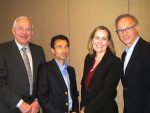
Left to right: Mitchell Gropper, QC; Prof. Guy Pessach, Hebrew University; Prof. Catherine Dauvergne, dean of the Peter A. Allard School of Law, University of British Columbia; and Randy Milner, Vancouver chapter president, Canadian Friends of the Hebrew University. (photo from Canadian Friends of the Hebrew University, Vancouver)
What happens to the archival materials of a Jewish community when that community no longer has the capacity to maintain itself can be complicated and messy. A 2013 Supreme Court decision in Israel provided a solution but also raised important questions about identity, collective memory and the relationship between Israel and the Diaspora.
On March 17, Prof. Guy Pessach of Hebrew University of Jerusalem presented a lecture as part of the Mitchell H. Gropper, QC, Law Faculty Exchange Program. An initiative of Hebrew U and University of British Columbia, the program’s UBC webpage notes that, since the program began in 2010, each law faculty “has hosted three visiting professors from the other university.”
Pessach’s topic was Who Owns the Past? – Law, the Politics of Memory and the Israeli Supreme Court. He discussed two cases but focused primarily on a lawsuit involving the Vienna Jewish community and the Central Archives for the History of the Jewish People, which is in Jerusalem. He said decisions made by the Israeli Supreme Court reflected a propensity for Israel to regard itself as the international arbiter of Jewish cultural property and collective memory.
According to Pessach, Vienna was the second-largest Jewish community in Europe in the early 20th century. The nearly 200,000 Jews in the 1930s were reduced to fewer than 9,000 after the Holocaust. In the early days of Israel’s statehood, the Central Archives actively collected materials from Jewish communities in Europe to safeguard the rich Jewish history of these disappeared communities.
Although the Viennese community continues to decline in population, he said, in the 21st century, it sufficiently reorganized to request the return of its archival materials from the Central Archives. When the archives refused, claiming that the material was given on “indefinite loan,” Vienna’s Jews launched a lawsuit.
According to a January 2013 article in Haaretz, “The collection includes thousands of papers stored in 200 containers, documenting 300 years of the Vienna community from the 17th century up to 1945. After the Holocaust, community leaders decided to transfer the archive to Jerusalem, fearing it would not be stored properly in Vienna, and they continued to add documents to the collection. Yet the Viennese community insists it sent the documents – in four shipments in 1952, 1966, 1971 and 1978 – with the explicit agreement, time after time, that the documents were only on loan and remained the property of the community.”
Vienna lost its case. At the time, Israeli state archivist Yaacov Lozowick, stated, according to Haaretz, that “the depositors felt they were strengthening the cultural importance of the young state of Israel as the centre of the Jewish people; they were proud about their contribution; and they had no intention of the collection ever returning.”
In the case, said Pessach, Israel asserted its place in the Jewish world as protector of Jewish identity and history. He explained the ins and outs of the court’s decision and discussed the issues of cultural property law and restitution. He said restitution is not just the physical return of culturally and historically significant items but also symbolic justice for a community. He noted that similar situations continue to play out in Jewish communities, in the form of art stolen by the Nazis, and that Canadian First Nations and many other groups are also currently seeking restitution for cultural property stolen during colonial times.
For more information on the Mitchell H. Gropper, QC, Law Faculty Exchange Program, call the Canadian Friends of the Hebrew University office at 604-257-5133 or email vanc@cfhu.org.
Votes were tallied late Friday, April 7, for the referendum on the University of British Columbia campus, wherein students were asked if they supported their union in a BDS campaign – and the answer was no. The “no” vote numbered 1,513 while 1,396 students voted “yes” to “boycotting products and divesting from companies that support Israeli war crimes, illegal occupation and the oppression of Palestinians.”
It was the second time in two years that a BDS referendum on campus was defeated and Rabbi Philip Bregman, executive director of Hillel BC, said he was thrilled. “In all honesty, this referendum is nothing more than a call for the elimination of the state of Israel,” he noted. “We had students from all over the university, Jewish and non-Jewish, join in the fight against this, and what’s important is that this was a clearly made statement.”
Bregman said the “yes” side had started out with 1,000 votes in their pocket because they had needed 1,000 signatures to make the referendum possible in the first place. “In the final analysis, they didn’t have enough votes, and they didn’t make quorum because only 5.5% of the students voted. In order for the referendum to pass, they needed votes from eight percent of the student body, over 4,300 votes in their favour, and they had to beat the ‘no’ side,” he explained. “They got neither.”
Stephen Gaerber, board chair of Jewish Federation of Greater Vancouver, praised the work of Hillel BC, the Centre for Israel and Jewish Affairs and StandWithUs Canada. “Kol hakavod to the students and student leaders who worked so hard to make the truth evident to the student body and achieve this positive outcome,” he said in a press release issued April 9. “Their efforts were instrumental in helping maintain a welcoming and inclusive campus environment for everyone.”
Lauren Kramer, an award-winning writer and editor, lives in Richmond. To read her work online, visit laurenkramer.net. This article was originally published by CJN.
Last week, the B.C. Supreme Court rejected a petition to stop the University of British Columbia’s Alma Mater Society from holding a referendum April 3-7. The question being posed in the referendum is the same one the AMS asked of students in 2015: “Do you support your student union (AMS) in boycotting products and divesting from companies that support Israeli war crimes, illegal occupation and the oppression of Palestinians?”
The question was brought to the AMS by the UBC branch of the Solidarity for Palestinian Human Rights (SPHR), which collected the required number of signatures to have a referendum that was initially scheduled to take place in March. It was postponed when UBC third-year commerce student Logan Presch filed a petition against it. He and his legal representation secured a court order that resulted in the referendum’s delay.
Presch’s petition stated the proposed question “is divisive, creates a toxic atmosphere for students supportive of the state of Israel, and is destructive of open and respectful debate on an important issue.” It also raised safety concerns, he said, noting the 2015 referendum “drove a wedge between religious groups on campus who had previously enjoyed interfaith outreach and collaboration. Students outwardly opposed to the [referendum] encountered a hostile reaction and there were reported acts of antisemitism on campus.”
In an affidavit, Rabbi Philip Bregman, executive director of Hillel BC, recalled that, at that time, anti-BDS lawn signs at UBC were pulled down. He also cited a climate of “a lack of personal security that many Jewish students experience on campus that is exacerbated by referenda such as the proposed question. There is an important line between robust political discourse and circumstances where I am compelled to deal with the personal security of students who study and live on campus who feel threatened by the consequences of this type of proposed question, which I believe foments the antisemitism and hostility I have described…. I believe that these students’ concerns for their personal safety are justified, as acts of violence have often followed hostility to Jews.”
While not Jewish, Presch is a member of the Jewish Students Association and the historically Jewish Alpha Epsilon Pi fraternity. He declined requests to comment but, in an affidavit filed with his lawyer, Howard Mickelson, Presch recalled that the first referendum created a “toxic environment on campus.” He said the question being posed by the AMS was contrary to its mission statement, which is to “cultivate unity and goodwill among its members” and to “encourage free and open debate as well as respect for differing views.” Presch also noted that the AMS code of procedure requires referendum questions to be capable of a “yes” or “no” answer, but that this question is “so loaded with assumptions (which are themselves highly controversial), that it will not be clear what a yes or no vote by my student colleagues will actually mean.”
Mickelson said the court recognized that the question was loaded and that the intention of a “yes” vote could be unclear for the AMS to act on, but denied the petition because the court determined “the society’s bylaws do not require that a question be fair as long as it can be answered yes or no. The standard for a qualifying question is a low one.”
Mickelson said the court recognized the “concerns for student safety” and acknowledged “the responsibility of the AMS and UBC to ensure student safety and respectful debate by all means necessary.”
“Although this case involves the political hot potato issue of the Israeli-Palestinian conflict and the role of BDS on campus, we argued that this was about the interpretation of this society’s bylaws,” said Mickelson, who represented Presch’s petition pro bono. “One of the arguments made by proponents of the question was that, in the context of a referendum, one party that is ‘funded’ or has ‘connections’ may be able to shut down the question against those that may not have the same level of funding…. I thought it was important for the court to understand that I was doing this pro bono.”
Though “disappointed” about the ruling, Bregman said “we really won the battles because the judge didn’t disagree with any of our arguments. We lost because the judge felt he was bound by a very poorly written bylaw by the AMS. So, we go forward fighting this nefarious referendum aimed at marginalizing and demonizing not only Israel but, by extension, those who support Israel.”
Bregman recalled that, in the spring 2015 referendum, UBC had the largest “no” vote ever seen in Canada at that time. “We’re ready to fight the referendum,” he said, adding, “But really, what we’re all about is dialogue and this is something that the SPHR has never taken us up on. Whereas we have dialogue with all sorts of groups on campus, the SPHR has rebuffed all of our efforts.”
The referendum question was to be directed at students starting Monday, as the Jewish Independent was preparing to go to press.
Lauren Kramer, an award-winning writer and editor, lives in Richmond. To read her work online, visit laurenkramer.net. This article was originally published by CJN.
Dr. Ra’anan Boustan of Princeton University delivers the Itta and Eliezer Zeisler Memorial Lecture at the University of British Columbia on March 23. (photo by Gregg Gardner)
A mosaic from Late Antiquity has lessons for Jewish communities today. According to Dr. Ra’anan Boustan of Princeton University, “Jewish identity, historically, was broader, more porous, and integrated more non-Jewish elements than we might think, and, likewise today, we should not hasten to essentialize or rigidly define Jewish identity or culture.”
Boustan offered this insight when delivering the Itta and Eliezer Zeisler Memorial Lecture at the University of British Columbia on March 23. Called Greek Kings and Judaean Priests in the Late Antique Synagogue: The Newly Discovered “Elephant Mosaic,” Boustan’s visit was presented by the Archeological Institute of America, Vancouver Society, and co-sponsored by the UBC Diamond Chair in Jewish Law and Ethics, and the department of classical, Near Eastern and religious studies (CNERS).
A 2011 dig led by archeologist Jodi Magness excavated several sections at the site of a former village, Huqoq, near the Sea of Galilee. Among the items uncovered was a mosaic that is said to have adorned the floor of an elaborate 1,600-year-old synagogue.
“The discovery of the mosaic was a major find,” Prof. Gregg Gardner of CNERS told the Jewish Independent. “There are very few mosaics from the ancient world that depict biblical scenes.”
The mosaics’ scenes include Samson fighting the Philistines, Noah and the flood, the destruction of the Egyptian army in the Red Sea, and others. A particularly noteworthy element is that the mosaics also show images from Greek history and mythology. “This confluence of biblical and Greek imagery was quite surprising,” said Gardner.
Boustan was in Vancouver to talk about the “Elephant Panel,” which depicts a battle between unknown actors. Although some have argued that the panel represents Alexander the Great, Boustan interprets the mosaic as the depiction of a Seleucid attack on Jerusalem led by King Antiochus VII in 132 BC. “It shows they had a sense of historical connection to predecessors in a more robust way than we might have expected, and wanted to have that memorialized in synagogue art. This shows a historical consciousness, not just the timeless world of rabbis and scriptural interpretation developing in the Talmud of the same period.”
Boustan is a specialist in Judaism in Late Antiquity (circa 200-700 CE) who has focused particularly on understanding “extra-rabbinic culture,” the Judaism that existed outside of what was preserved in the narratives of the rabbis. “The rabbinic writings – the Talmud, the Midrash – preserve the world through their eyes, what they thought was important and how they wanted things to be viewed. The rabbis did not represent all Jews or all Judaism, and the wider Jewish world may have had different viewpoints and priorities.”
Boustan has focused on studying the piyyutim (hymns) written and preserved outside the rabbinic canon and containing some unusual theological ideas, as well as on apocalyptic and mystical literature, which flourished on the fertile edge between Jewish and non-Jewish cultures.
“The mosaic is important for understanding the history of Jews and Judaism and gives us something to think about in terms of Jews living in the Western world today,” he said, noting the broader and more porous nature of Jewish identity in those times, and how we shouldn’t be in a hurry to “rigidly define Jewish identity or culture.”
For example, Boustan explained, “The figural art we are finding at Huqoq and elsewhere upends some of our assumptions that, classically, Jews didn’t do that. In fact, we’ve found many small villages of one to two thousand habitants who built very expensive buildings containing a mixture of folk art and world-class art. In Huqoq, the art is imperial-quality work, which would not be surprising to find in a major landowner’s villa in Antioch. Yet, there it is, being commissioned, paid for and used by a farming village of maybe 2,000 people. That tells us we have a lot more to learn about the Jews of Late Antiquity.”
He noted, “In addition, the synagogue art contains a zodiac wheel with a figure of the sun god, Helios, in the centre. What’s going on there? Is it just a decoration? Was it actually part of religious worship in the synagogue? Was it seen allegorically as a poetic representation of God?
“Helios imagery was adopted by Christians in the third century, along with many other Greek religious symbols,” he said. “As the Greco-Roman world Christianized, however, they distanced themselves from ‘pagan’ imagery. By the late fourth to seventh [century], Jews are the only ones actively cultivating zodiacal and Helios imagery. Ironically, if you find a building with Helios imagery from that period, it’s almost definitely a synagogue.”
Matthew Gindinis a freelance journalist, writer and lecturer. He writes regularly for the Forward and All That Is Interesting, and has been published in Religion Dispatches, Situate Magazine, Tikkun and elsewhere. He can be found on Medium and Twitter.
The Peace Factory founders Joana Osman and Ronny Edry spoke at the University of British Columbia on Feb. 6. (photo by Zach Sagorin)
“Israel loves Iran,” “Palestine loves Israel,” “Israel loves Palestine,” “Iran loves Israel & Palestine.” The Peace Factory uses social media to connect people in the Middle East, to build relationships and see one another as human beings with visions of peace.
“People may not like the idea of inclusion, the idea of welcoming everyone, but that’s why we are here – to invite those people to learn about the various cultures and faiths that are around us,” said Shem Arce when introducing the Active Community Dialogue (ACD) event Make a Friend, Make Peace. “With some dialogue and understanding we can create a community for everyone – no matter their religion, culture or ethnic background.”
Arce, a University of British Columbia film studies student from Mexico, recently began ACD with the goal of combating discrimination through meaningful, respectful dialogue and interactions.
ACD’s Make a Friend, Make Peace event on Feb. 6 featured a presentation from the founders of the Peace Factory: Ronny Edry, an Israeli graphic designer living in Tel Aviv, and Joana Osman, a Palestinian living in Munich. The pair also spoke at King David High School.
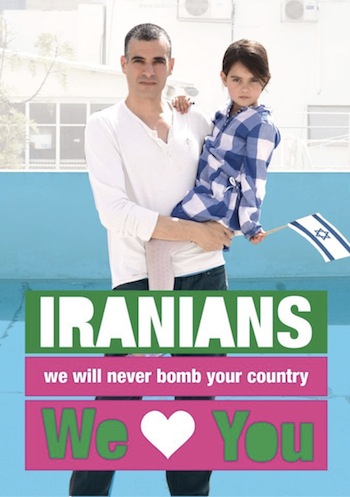
Israeli graphic designer Ronny Edry sent this poster out in 2012, when Israel was considering a preemptive strike against Iran.
The UBC event drew dozens of people, and Edry showed the crowd a poster he uploaded to Facebook in 2012, when Israeli Prime Minister Binyamin Netanyahu “was calling for preemptive strike on Iran,” when “it was quite stressing.”
The graphic designer decided to send something else to Iran. He designed a brightly coloured poster with a photo of him holding his daughter and bold text declaring, “Iranians / we will never bomb your country / We ♥ You.” Edry told the audience that the “five first comments were ‘delete it’” but, after leaving the poster online, he was surprised to find that “Iranians were commenting on the picture” and a line of communication was created.
“If something works, do it again,” said Edry. Soon, he added, “a lot of Iranians and Israelis started having a conversation.”
Interestingly, the security guard of the ACD event, an Iranian-Canadian man, had participated in the Peace Factory movement.
“When you don’t know someone and you close your eyes and think of the enemy, you end up thinking of some kind of monster,” said Edry. In Israel, “most of the time on the TV, they won’t show you the nice people of Iran.”
But, after starting the “Israel loves Iran” campaign, Edry received pictures from Iranians wanting to join. The movement has enabled many Iranians and Israelis to connect and build friendships online. And it continues to grow, with more than 121,000 likes and more than one million unique visitors each week to the “Israel loves Iran” Facebook page and more than two million views of Edry’s Ted Talk. The movement is continuing, with “both sides sharing stories and pictures of themselves,” said Edry.
With the success of “Israel loves Iran,” Edry said people were “coming up to me and saying, ‘Why don’t you do the same campaign with the Palestinians?’”
Soon after, Osman founded the group “Palestine loves Israel” to create a platform for Palestinians and Israelis to get to know one another through social media.
Together, Edry and Osman created the Peace Factory to “try to rehumanize the [other side] and give them a face and a story.”
Osman said building these connections “changes everything because, once you make a friend on the other side, everything changes for you.”
Osman said she asked herself, “As one person what can you do?” Her answer was, “You can be part of the change and you start communicating … if you can change one person’s mind, that may be enough.”
She added, “The enemy is nothing like you have in your mind … and, when you get to see his face and you see nice people,” you realize “they are not that bad.”
The Peace Factory’s vision is of a free and democratic Middle East, and they intend to build bridges and friendships to connect people with the same vision.
“It is not that we deny there is a conflict,” Osman said. “We have to pay attention to it, but I strongly believe that the solution can’t come from politics, it comes from people, real people connecting to each other…. Once you understand the other side is a real people with real pain … you come to the conclusion we are one people, one human race, with one goal to live in peace.”
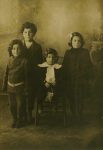
Left to right, Harry, Joseph, Benjamin and Rachel Seidelman, in approximately 1906. (photo from JMABC L.25670)
The following is an edited version of remarks presented at the Jewish Museum and Archives of British Columbia (JMABC) Intersections speakers series on Dec. 15 about the museum’s online exhibit Letters Home.
Recently, my wife Shelley and I were on a tour of Italy that stopped at the Cassino War Cemetery for soldiers killed during the Battle of Monte Cassino, a battle which resulted in 55,000 Allied casualties. In the 15 minutes we were there, we found two headstones with a Magen David, for soldiers from British Columbia who were killed in this Second World War battle. These headstones commemorate just two of many soldiers who have died in the fight for democracy but whose bodies are interred far away from family. My Uncle Joe was even less fortunate. Since his body was never found, there is no grave and, therefore, no headstone.
The First World War claimed the lives of 38 million civilians and soldiers alike. Approximately 2,700 Canadian Jews served in the Canadian Expeditionary Force, with about 1,200 seeing combat. Of those, an estimated 123 died in battle.
In late 1917, Gen. Douglas Haig, commander of the British Expeditionary Force, insisted that the key to victory on the Western Front was capturing the area around the village of Passchendaele, near Ypres in Belgium. Even though bad weather had turned the battlefield into a quagmire, Haig was determined to proceed.
At Passchendaele, on Oct. 26, 1917, 15,654 Canadian soldiers were killed. Among those who paid the terrible price for this hopeless decision was Pte. (Edward) Joseph Seidelman, 20, of Vancouver. His father, William, was a Hungarian Jewish immigrant who, after living in Kansas and Seattle, had settled in Vancouver in the 1890s. There, he met Esther Pearlman from Winnipeg. The two were married in 1896. Joseph was born a year later, followed by four more children during the next decade. Their father unfortunately died in 1907, leaving Joseph, Rachel, Harry and Ben; William was born after his father died and was named after him.
In 1916, Joseph was a student at the University of British Columbia. He would have graduated in 1918, the final year of the university’s transition from being an annex of McGill University to being a fully independent UBC.
Yearbooks are meant to celebrate successes at the institution but the 1918 edition also records the experiences of students who went to fight in the war and returned home, and it laments those students who went to war and did not return. One section is entitled “Military” and includes a copy of the Roll of Honour in Memoriam plaque that hangs in the foyer of the UBC War Memorial Gymnasium. It also contains brief biographies of those who were killed in action, including Joseph. Seventy-eight UBC students lost their lives during the war, and are commemorated on plaques in the War Memorial Gymnasium.
Compelled to do his patriotic duty, Joseph enlisted in the Western Universities 196th Battalion, which was made up of more than 150 students from universities in Manitoba, Saskatchewan, Alberta and British Columbia. Joseph was in England by November 1916. Early in 1917, he was sent to northern France and found himself in the muddy trenches of the Western Front.
So, how much do we know about someone who lived and died so long ago? Well, because of the letters featured in the JMABC online exhibit Letters Home, we have come to know Edward Joseph Seidelman better. In addition, in the 1918 yearbook, there is also a short mention of Joseph in a message from Prof. Lemuel Robertson, the first chair of the classics department at UBC. “Do you remember those little talks on socialism with Coughlan, or when Norman Hughes came into class the day after a dance, in the hope that he wouldn’t be asked anything? And Seidelman, too?” There are only three words but they give us a clue into his personality, that perhaps he liked to party.
In the letters Joseph wrote to his sister Rachel over nine months, he discussed family business and Vancouver affairs – in one letter, he expressed surprise at being a candidate for a Rhodes scholarship – and stated his hope that the war might end soon, though his optimism about the war varied. Even though he was in the centre of the action, he seems, in retrospect, to have been somewhat ignorant of how the war was actually proceeding.
The following letters are only examples drawn from the 87 he wrote. The letters from May 7, 1917, and are part of the JMABC online exhibit.
Camp Hughes, Man., Oct. 2, 1916: “I am going to Brandon again on Thursday afternoon and will stay over Friday, the 6th of October and also Saturday. I stayed with a Jewish family named Kisner and they were glad indeed to have me. Five or six decent-looking Jewish families wanted me to stay with them but Kisners had me first. Mrs. Kisner is only about 30 years old and she comes from the same city in Russia where mamma comes from, Novgorod. Mrs. Kisner introduced me to her 18-year-old sister….”
Dec. 24, 1916: “I knew Mr. Gibson’s son who was reported killed. Mamma has no reason to worry about me. It looks as though Germany will surrender to the Entente Allies…. I read in a London newspaper to-day called Lloyd’s Weekly News that a very high official of the German government … has confessed that Germany is starving and will give to England all that England demands even surrendering the Kaiser himself if necessary. It is quite possible, therefore, that the war may stop within a month or two by Germany’s sudden and complete surrender.”
Joseph stated that he applied for a transfer to the Royal Flying Corps but they were not taking any more applicants at that time. Instead, he was taking a lieutenant’s course and would perhaps go to a military training school later.
Feb. 17, 1917: “Two large Trans Atlantic liners carrying about 12,000 sacks of mail were reported torpedoed and sunk by German submarines and so let me tell you once again not to send anything valuable, for a German submarine might put an end to it.”
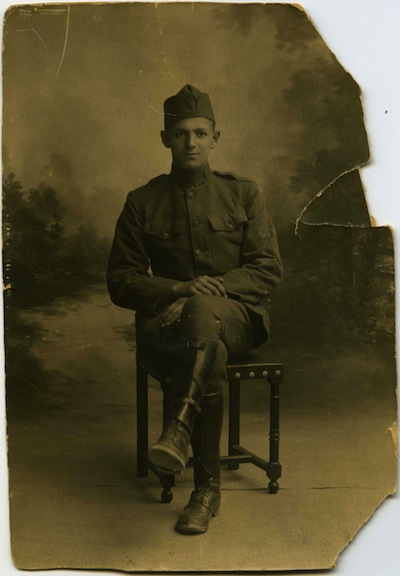
Joseph Seidelman in uniform. (photo from JMABC L.25664)
Feb. 27, 1917: “No doubt there are still many fellows hanging around in Vancouver who should be in the Army. I cannot understand their state of mind unless they have no self-respect or sense of honour. Let them go their ways while there is no conscription but I certainly am glad I am not in those times in civilian clothes. The B.C. University will have to wait until the end of the war for me at least.”
March 4, 1917: “France is certainly a muddy place. You ought to hear our artillery guns hurl death and destruction into the rank of the Huns [Germans]. The artillery makes most of the noise at night and then, when you wake up, you hear the terrific reports of each shot as quickly as the pat-pat-pat of a typewriter.”
March 11, 1917: “Things are somewhat interesting around this part of the world. British aeroplanes fly over us about as thickly as birds. To-day the Huns were firing at our aeroplanes and the puffs of smoke from the enemy’s shells bursting around the aeroplanes could easily be seen. It is very regrettable though that one of the enemy’s shells must have pierced the petrol tank of one of our aeroplanes, for it came down a mass of flames with a thick black column of smoke shooting out behind it. I never saw a single German aeroplane since I came to France. No doubt they have their wits scared out of them.”
April 7, 1917: “The chances of peace do not … look as rosy as I thought but the Huns will be defeated ultimately.”
April 17, 1917: “To-day after returning with a party from a certain part of France where the Germans were once expelled from and the ground all cut and plowed up with trenches, I found waiting for me a parcel containing a broken biscuit tin with some of mamma’s home-made confectionary (including many crumbs) and a tin of strawberries and coffee.”
May 7, 1917, datelined “some other place in France this time”: “I suppose it must have been reported to you that I was very slightly wounded by two very small pieces of shrapnel and, as I feel that you folks at home are very anxious to hear particulars, I want to assure you that there is absolutely nothing whatever for you to worry about. The two wounds I got are on the outer side of my right leg, one above the knee about the centre and the other below the knee about the centre. Although each wound has the appearance of nothing more than a [scratch?] on the skin, nevertheless I had to come to the hospital, where it is a pleasure to be for a change. One of the attendants told me that the leg will be alright again in about 5 days. So tell mamma to be happy and cheerful at home.
“I received three letters from you while I was in the firing line. I was much surprised to hear of the murder of Chief of Police McLennan. I guess Vancouver was shocked at the time almost as badly as a war event.”
On May 22, 1917, from “somewhere in France,” Joseph writes that he still has not rejoined his battalion after his leg injury, as another shrapnel piece was found in his leg, and required more medical attention at the hospital. Joseph tells Rachel that the shrapnel was found with the aid of an X-ray, and the doctor let him keep the shrapnel as a souvenir.
On July 3, 1917, again from “somewhere in France,” Joseph has returned to his battalion. In this letter, he tells Rachel that, on the night of May 5, 1917, when he received his leg wound, he still made the effort to help out a wounded officer. A telegram indicating Joseph’s return to the battalion from the hospital was sent to Joseph’s mother, Esther, on July 5, 1917.
On Oct. 14, 1917, still “somewhere in France,” Joseph reports “nothing to write about.” It is the last letter he writes home.
Joseph fought and survived the Battle for Vimy Ridge, was wounded in the leg in another battle and spent several weeks in an army hospital before being sent back to the front. On Oct. 26, the first day Canadian soldiers fought at Passchendaele, he was killed. Joseph was the first Canadian Jewish soldier from Vancouver to die fighting in the war.
UBC Remembrance Day Ceremonies have been held since 1951, when the War Memorial Gymnasium was opened. Since that time, I have attended nearly every ceremony. At first, I went with my brother and our father, Harry, who was too young to be part of the First World War and too old to be part of the Second World War. In the early years, my father would speak with veterans who knew Joseph. Over time, they all have passed away, but I have continued to attend the memorial ceremony with various members of my family as a way to remember my Uncle Joe, who is lying somewhere in France with no grave or headstone; our own kever avot (tradition of visiting the graves of our fathers).
Perry Seidelmanis, among other things, president of the board of the Jewish Museum and Archives of British Columbia.