Providing meals, warmth

Several years ago, Chabad Richmond launched the Light of Shabbat program with the purpose of helping Richmond Jewish seniors celebrate Shabbat and feel connected. At first, the program involved making and delivering a free, homemade, kosher kugel and challah to six or seven Jewish seniors in the community every other week. As the program has grown, more people are receiving Shabbat meals, which now include soup, salad, a main dish, vegetables, dessert, Shabbat candles and grape juice.

Because of the COVID-19 crisis, the Light of Shabbat has expanded, and now approximately 140 meals are delivered every week to people in Richmond and beyond – an increase of more than 80%. And that number continues to grow. Now, not only seniors, but younger individuals, families and those in need can receive a Light of Shabbat meal weekly. Chabad Richmond hopes to expand the program even more.

A program like this doesn’t happen in a vacuum. More than 44 Light of Shabbat volunteers do everything from shopping, to food preparation, cooking, baking, packing and delivering the meals. Every volunteer plays an integral role.

Reaching out to help those in need is a core Jewish value. As we all know, the pandemic has resulted in people self-isolating, and many have little or no access to stores. Some have difficulty cooking, and others are simply feeling the desperation of social disconnection.

Supported through individual donations and foundation funding, Chabad Richmond’s year-round partner for the Light of Shabbat program is the Kehila Society. During the COVID-19 crisis, the Jewish Federation of Greater Vancouver has stepped forward and been supportive. In addition, Chabad Richmond has received donations of goods from Urist Cosmetics (hand sanitizer) and Real Canadian Superstore, Dan-D-Pak (food items), and a donor who wishes to remain anonymous provided facemasks.

Several of the Light of Shabbat volunteers were recently interviewed. When asked about their personal experiences volunteering, many said they deliver the Shabbat meals. The volunteers deliver not only to seniors (some of whom have mobility issues), but also to people who have lost their jobs, people struggling with physical and mental health issues, and those who are grieving alone. As one volunteer said: “You just don’t know what people are going through right now.”

Several volunteers have gotten to know Light of Shabbat recipients quite well, have become part of their lives and have forged strong connections with them. A number of volunteers say they feel like a lifeline for the people they deliver to.

One volunteer started doing deliveries with his son before his son’s bar mitzvah a few years ago. Acknowledging that his own family is fortunate, he said: “It’s a way to show my son the importance of helping others, and expose him to a wide range of experiences.”

Every volunteer’s experience is different, but they all have one thing in common: they all enjoy volunteering and feel that they benefit as much if not more than those receiving the meals. “The socially distanced shmoozing and forming of new friendships is important to the people we deliver to,” said volunteer Jill Topp. “And to me, too.”

While the Light of Shabbat program is primarily for the Jewish community, volunteer Topp said that she delivers a weekly meal to a local Muslim family. The head of the family told her: “I don’t know what we would do without you.”

As for what motivates the volunteers, giving back to the community is key. One volunteer, who chose to remain anonymous, said she treasures celebrating Shabbat with her own family, and wants others to have that experience too, even if it’s only to eat a Shabbat meal.

Volunteer Michelle Zychlinski said, “Not only do the recipients appreciate the meal, but they really appreciate the social interaction,” even if it’s from a safe distance of two metres. “So, if I can help in some way, I’m happy to.”

Volunteer Yael Segal said, “I feel it’s my responsibility, as a part of this Jewish community, to help others. It’s my honour and privilege to do it.”

Yet another volunteer, Shannon Gorski, said she gets back tenfold what she puts into it and volunteer John Samuel said, “It’s so important that people have community support. They deserve to have a kosher meal on Shabbat and to feel connected.” Another volunteer said that this opportunity has “enlarged my life,” and she wants to do more.

The connections made between volunteers and recipients will likely last beyond the COVID-19 crisis, with quite a few volunteers saying that they definitely plan to visit with their newfound friends after it’s all over.

Segal said she rekindled an old friendship when she delivered the Shabbat meal to someone she hadn’t seen in years. “One of the Russian families I deliver to recognized me from when I first immigrated to Canada as a small child. I built a rapport with them and have a little visit each week. They really look forward to the visit and the Shabbat meal. Some of the people feel very isolated.”

In the end, it’s all about building relationships with members of the community. As one interviewee put it, “It’s so important for people in the community to know that they are not forgotten about. And it’s good to know that I’m making a difference. The Light of Shabbat program is a great means to connect with secular members of the community, too, and demonstrate that Chabad cares about them.”

Topp added, “I encourage anybody to volunteer – it’s a great thing for everyone involved.”

If you know someone who could benefit from the Light of Shabbat program, contact Chabad Richmond at 604-277-6427. If you would like to get involved as a volunteer with the program, go to chabadrichmond.com/lightofshabbat.

PORCHpics Project

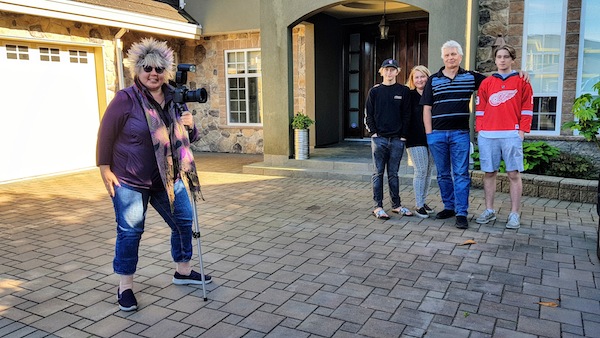
Lianne Cohen prepares to take a “PORCHtrait” of the Gorski family. (photo from Kehila Society)

As a fundraiser for Kehila Society of Richmond and/or Pathways Clubhouse, professional photographers Lianne Cohen, Jocelyne Hallé and Adele Lewin are volunteering their time (in a safe way) to photograph your family in front of your home. Dress up, stay in your PJs, hold a sign, whatever you feel like – be creative, have fun! These photos are intended to be a positive memory, to serve as a reminder of all the time you got to spend with your families in quarantine. The photographs are by a suggested minimum donation of $54 to kehilasociety.org/content/make-donation-kehila-society-richmond or pathwaysclubhouse.com/donate. A full tax receipt will be provided, along with your photographs. Bookings are available until June 7. To register, email kehila@kehilasociety.org or call 604-241-9270.

Open letter to the community from the JI

Dear Reader,

I hope this letter finds you well, and that you are finding ways to cope with the new reality that COVID-19 has brought on all of us so suddenly. I’ll admit to moments of struggle in maintaining a positive outlook but, mostly, I am determined that, together, we will get through this crisis and return to some variation of normalcy.

For more than 20 years, I have owned and published the Jewish Independent, which started its life as the Jewish Western Bulletin in 1930. For nine decades, the paper has recorded our community’s stories, as well as news and commentary about the wider world. We have reported on the ordinary and the extraordinary, fleeting trends and paradigm shifts. We have covered happy and sad occasions, and promoted the work and activities of countless individuals and organizations. Past issues of the paper comprise a distinctive archive of our community in this place over time.

I am determined to continue this vital calling. Ensuring continuity and the thriving of Jewish life here in Canada and worldwide is no less urgent or relevant than it was in 1930. These are difficult times for many people, organizations and businesses and, among the many closures in recent days, the Canadian Jewish News ceased publication and Winnipeg’s Jewish Post & News suspended its print version indefinitely.

I firmly believe that the Jewish Independent is one of our community’s invaluable resources and that we have an important role to play during the pandemic, both in keeping the community up to date on one another’s events, initiatives and well-being, as well as offering some respite from the at-times overwhelming bad news.

For years, this publication has been a labour of love for me and a dedicated staff of a few employees and a cadre of freelance writers. As we face the coming weeks or months of increasingly dismal advertising revenues, I am making an unprecedented appeal for support from you, our readers.

I am proud to produce independent Jewish journalism that has been recognized internationally by scores of awards and accolades. I am proud that, on a very modest budget, we have managed to produce a regular publication that informs, inspires, engages, exasperates, amuses, entertains, provokes and reflects in ways that unite Jewish British Columbians across all religious, cultural, political and social divides.

You subscribe to this paper or pick it up for free at a local depot, I hope, because you see the value in this, which is why I am asking for your help through this deeply challenging time. Please consider supporting the paper through one or more of the following actions:

  1. Renew your subscription – or start subscribing. When you receive your annual subscription notice, please renew as quickly as you are able, as the fewer reminder notices I have to mail, the less expensive the process. If you pick up the JI at one of our many depots, please seriously think about subscribing or donating to help fund the creation, printing and distribution of the paper you now hold in your hands.
  2. Consider an esubscription instead of a traditional subscription. You’ll still receive the full contents of the paper, just in digital form. It saves you money and it’s more economical for us, too. (However, if you still like to hold the paper in your hands and pass it around the house, please continue to get the print edition!)
  3. Give a gift subscription. For generations, B.C. families have stayed connected to one another and our community through the pages of our newspaper. Keep the tradition alive with gift subscriptions to younger family members.
  4. Advertise with us. We know that your business or organization needs support, too. The most effective, affordable way to reach our community is through these pages, as it has been for 90 years.
  5. Send a greeting. You can send a message in any issue of the paper. Birthday, bar/bat mitzvah, wedding, anniversary, graduation greetings – any time is a good time to celebrate our loved ones. But now it is especially welcome. Something as affordable as a business card-size insertion is a fun way to mark a special occasion – and it sends a double message: you support thriving, independent Jewish journalism.
  6. Make a donation. This is the easiest and most immediate way you can help. It’s true, we’re not a charity. I can’t give you a tax receipt. But, as I’ve said, this has been a labour of love for a small group of dedicated individuals. We need you now more than ever.

You can subscribe or contribute online at jewishindependent.ca/support-the-ji via PayPal, by making an etransfer to editor@jewishindependent.ca or by calling the office at 604-689-1520.

On behalf of the staff and freelancers of the Jewish Independent, thank you to everyone who has reached out and helped the JI over the years, including recent weeks, and to all of you for taking the time to consider these words. Please stay safe and healthy.

Sincerely,

Cynthia Ramsay, Owner/Publisher
cramsay@jewishindependent.ca
PO Box 47100 RPO City Square, Vancouver, B.C. V5Z 4L6
604-689-1520 • jewishindependent.ca

Emanuel busy making music

Megan Emanuel of the band Hello Victim. She and bandmates Adam Wilson and Spencer Daley released the single “Out of It Alive” on April 2. (photo from Megan Emanuel)

Megan Emanuel released a new single this month with her band Hello Victim and, last month, she launched a bi-weekly virtual concert series with fellow Jewish Vancouverite Andy Schichter, co-owner of Park Sound Studio.

“The concerts benefit local artists who have lost their income due to COVID-19 gathering restrictions,” Emanuel wrote in an email to the Independent. “Our weekly goal is $1,000 to split amongst the artists … to cover things like groceries and basic bills. Anything over $1,000 is donated to the Greater Vancouver Food Bank.”

The next concert will be live on Instagram (@parksoundbc) on May 2.

“Of course, the money isn’t the only important thing,” Emanuel noted, “and some of our favourite feedback from audience members has been their appreciation of the ability to feel somewhat ‘normal’ for a couple of hours, like there’s still a vibrant arts culture in Vancouver.”

Schichter has co-owned Park Sound Studio in North Vancouver with Emanuel’s fiancé, Dan Ponich, since 2017.

“When the pandemic hit, it was immediately apparent that musicians were going to be hit extremely hard,” Emanuel told the Independent. “Many artists work service industry jobs in order to maintain a lifestyle that allows for gig work and touring, and the rug was just pulled right out from under them and there seemed to be a need for relief. I contacted Andy because he is an organizational phenom and pretty familiar with putting shows together since Park Sound was hosting monthly showcases prior to all of this. We pulled the first virtual concert off days after chatting about it and were able to raise $1,200 overnight. Things have taken off immensely since.”

In addition to helping others, Emanuel is working on her own musical career. Hello Victim – comprised of Emanuel, Adam Wilson and Spencer Daley – released the single “Out of It Alive” on April 2. Produced and mixed by Ben Kaplan of Fader Mountain Sound (Mother Mother, Five Alarm Funk, Ninjaspy), the song is described as “a dramatic anthem for survivors of abuse.”

“We’ve all met the person this song is about,” Emanuel says in the press release, “That person who gives you a creepy ‘something about this is very wrong’ feeling in your gut.”

Ultimately, the song has a positive message. She explains in the release: “For those of us who are unlucky enough to become entangled with these types of people, times can get pretty scary and that toxicity stays with you for some time, even after they’re gone from your life…. This song is kind of like the phoenix’s flight; it’s the catastrophic rebirth from that very dark place when you realize that none of us gets out of this life alive, and the only justice that is in our individual power to serve is choosing to reject toxicity, move on from these people, and stop letting them live rent-free in our heads.”

Emanuel told the Independent that she first met Wilson in February 2018, while on an early-days date with her now-fiancé. As co-owner of Park Sound Studio, Ponich had been hired to handle sound for a music event at Luppolo Brewery, she said. “He texted me at some point during the night because my place was about a 10-minute walk away and, when I got there, I was introduced to a couple of his friends, one of whom was Adam (who he was playing in a band with at the time). Serendipitously, I’d made a Facebook post a matter of days prior along the lines of ‘girl seeks guitar player to write tell-all album with.’ I had just gotten out of a less-than-ideal relationship and I was at this point where I was ready to pull an Adele and sing about it where everyone could hear…. It took about five months for us to start working on music together.”

Emanuel liked the electronic compositions Wilson was creating for his Instagram stories, so she asked him if she could write a vocal melody and some lyrics for his music and, she said, “it took off from there and we went on writing remotely for awhile, sending each other voice notes of ideas over WhatsApp. When we started writing our song ‘Feel Slow,’ which we released back in July of 2019, Adam suggested we talk to his other bandmate Spencer about helping us out with writing a bass line. After working with him on that one tune, it was pretty clear he belonged in the band.”

Soon after the trio had finished a few songs, they were offered a spot at the Railway Club, which they accepted. “That ended up being my first live performance in eight years!” said Emanuel of that early 2018 gig.

“I learned a little while ago that I suffer from severe generalized anxiety disorder, so jumping back into live shows was a massive hurdle I had to figure out how to jump quite quickly,” she said. She attributed some of her ability to overcome that hurdle to Wilson and Daley, who, she said, “are not only incredible musicians, but amazing human beings who consistently make me feel safe and confident on stage.”

Emanuel has been in music since she was a kid, “with piano and voice lessons beginning at around 9. Pat Covernton taught me piano and Wendy Stuart was my voice teacher – both taught me for about 10 years. I also spent many, many summers in Gotta Sing! Gotta Dance! at the JCC and participated in the Jewish Federation’s events for Yom Ha’atzmaut, Yom Hazikaron and Yom Hashoah.

“Since I can remember,” she said, “being a musician is literally the only thing I’ve ever been able to identify as my ‘dream.’… I started writing music when I was 14 and went on to play small venues throughout Vancouver. In my last year of high school, I participated in the JCC’s Battle of the Bands and became the first and only solo, non-rock artist to win first place.

“After high school, I began traveling – first to Israel, then New York, then Melbourne – which meant that I put performing my music on hold, but continued to write in the absence of an audience.”

Emanuel attended both Vancouver Hebrew Academy and King David High School.

“I think my Jewish day school upbringing shaped the questions I’m looking to answer when I write music,” she said. “I wouldn’t say that my music is religious in any sense, but there’s such a distinct method of thinking within the Jewish community that I think is probably the product of generations of Talmud study, and I often find myself hearing it most when I’m writing. What’s the truth? What’s the point? Why are we here? How can I connect?”

For more information on the band and to watch the video for “Out of It Alive,” visit facebook.com/hellovictimofficial. To find out about the next virtual Park Sound Studio concert, visit parksoundstudio.com.


Creation of now-iconic pant

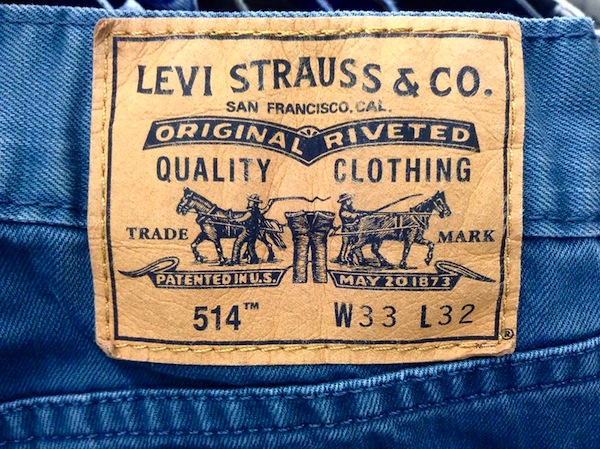
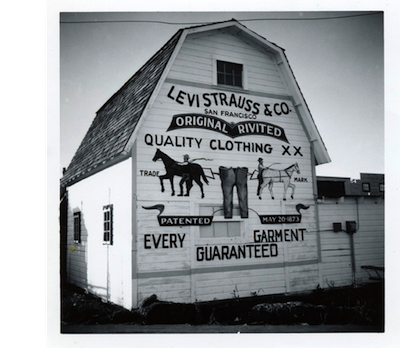
Jeans bearing the Levi Strauss & Co. trademark.

Nothing quite compares to the essential staple that almost all of us have in our closets, with styles including flare, skinny, low-rise, high-rise, boyfriend, ripped, the list goes on. If you haven’t guessed already, I’m referring to jeans. They epitomize fashion versatility, taking us from a city stroll in a pair of sneakers to our favourite restaurant in the evening with a boot or dress shoes. There are few fashion houses, from couture to street wear, that haven’t designed their own style. But, for the original jean, we have to thank Levi Strauss & Co.

Loeb Strauss, born 1829 in Bavaria, was the youngest of seven children. At age 16, after his father’s death and with increasingly harsh restrictions and discrimination towards Jews, he decided – with his mother and two of his three sisters – to move to New York. There, two of his brothers welcomed him into their dry goods business.

photo - Levi Strauss
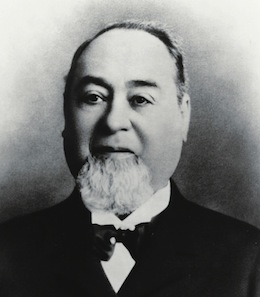
Levi Strauss. (photo from Wikipedia)

In the 1850s, in the midst of the gold rush, Strauss saw potential opportunities to set up shop in the West and he did so, opening a branch of the family business in San Francisco, where he changed his name from Loeb to Levi.

Levi Strauss & Co. became a rapid success, selling merchandise to local customers as well as to those in neighbouring cities. Strauss became a respected figure among the Jewish community, known to have a sharp business mind and a kind demeanour. He was also known for giving back to community, donating to both Jewish and non-Jewish charities.

The nature of the business – and the course of fashion worldwide – changed when Strauss was approached by Jacob W. Davis, a regular customer and acquaintance, who came to collect an order of canvas for his tailoring business. Davis made durable work wear, or “waist overalls,” as he called them, from special fabric that was primarily used to make tents. Having developed a system to prevent the overalls from ripping at the pockets by adding copper rivets at the corners (allowing them more longevity), he knew he discovered something big but, in order to proceed, he needed financial backing, primarily for the patent fee. Strauss became his business partner in 1873.

Levi Strauss & Co.’s jeans were produced largely for the labour workforce. However, over the years, they became a choice piece of clothing for women and men in any profession, at least when not working. Levi’s entered the world of film in 1938 when John Wayne wore a pair of Levi’s 501 jeans, transforming them into the American cowboy’s leading attire.

photo - According to the company’s website, the trademark depicting two horses attempting to pull apart a pair of Levi’s waist overalls, symbolizes “the strength of the clothing in the face of competition.” It was introduced in 1886
According to the company’s website, the trademark depicting two horses attempting to pull apart a pair of Levi’s waist overalls, symbolizes “the strength of the clothing in the face of competition.” It was introduced in 1886. (photo from levistrauss.com)

The financial success of Levi Strauss & Co. allowed Strauss to expand his business to many diverse industries, from banking to electricity. His philanthropy also expanded and he gave to many Jewish organizations, notably helping found and establish the Reform congregation Emanu-El in San Francisco.

While Strauss never married and had no children of his own, he had a strong relationship with his nephews. When he died, in 1902, Levi Strauss & Co. and most of his estate went to his four nephews and other family members; many charities were also beneficiaries named in his will.

Over six generations, Levi Strauss & Co. has remained a family-run business, manufacturing not only jeans but other casual wear, accessories and a children’s line. One of the largest brand apparel companies in history, the Levi Strauss name is universally recognized. Now run by the Haas family, decedents of Strauss, the family and business continue Strauss’s legacy in another important way – by being one of the most charitable families in the Bay Area.

Ariella Stein is a mother, wife and fashion maven. A Vancouverite, she has lived in both Turkey and Israel for the past 25 years.

Community planning critical

Alex Cristall, chair of the board of directors of the Jewish Federation of Greater Vancouver. (photo from JFGV)

Long active in the Jewish community, Alex Cristall started his current volunteer position as chair of the board of directors of the Jewish Federation of Greater Vancouver in June 2019. He spoke to the Jewish Independent about the role, and where he sees the organization as it enters a new decade.

JI: Could you go over your professional background and your work with Jewish organizations?

AC: I grew up in this community and was always surrounded by a culture of volunteerism. My professional background is in real estate investment, and my family’s values always drove our approach to business and to community involvement. From my grandparents to my parents to the way my wife Jodi and I are raising our children, giving back and getting involved with community has always been a priority, both in and out of the office. I started volunteering as a young adult and it’s grown from there.

JI: How did you become chair of Federation?

AC: Before taking on the role of board chair, I held a number of other leadership positions with Jewish Federation and with other organizations. At Federation, I served as chair of the 2016 and 2017 Federation annual campaigns, as chair of major donors, chair of men’s philanthropy and as a member of the board.

Anyone who knows me knows my love of sports, so my previous involvement with the JCC Maccabi Games and with Maccabi Canada came about very naturally. I also chaired the JCC Sports Dinner.

Serving as vice-president and then president of the JCC [Jewish Community Centre of Greater Vancouver] was instrumental in giving me a unique perspective that has been indispensable as chair of Jewish Federation. I got to see firsthand how important the partnerships between the organizations are, and how much partners rely on the community planning and fundraising expertise that Jewish Federation brings. At the time, Jewish Federation organized local missions, where we visited various partners, including the Jewish Food Bank and Tikva Housing Society, and learned about the range of needs in our community – and the range of responses.

It was very eye-opening, and that was when I got involved in men’s philanthropy at Jewish Federation and decided to learn more about the community. That ultimately led to a role on Jewish Federation’s allocations committee, where we were fully immersed in the entire breadth and depth of need – and opportunity for impact – in our community.

In my mid-30s, I was fortunate to travel to Ethiopia with members of Jewish Federation’s National Young Leadership Cabinet to see the work we were doing there with two of our international partners, the Joint Distribution Committee and the Jewish Agency for Israel. That was where I really began to understand the big picture of what we can accomplish for world Jewry in need.

More recently, I was able to visit our partnership region in Israel and learn about the particular challenges of living in the north, and the impact we’ve been able to make there as the result of a long-term strategic focus.

I’ve been in Israel many times, but, in terms of our partnership region and Beit Vancouver, this past spring was my first visit. It’s such a successful country overall, but I really saw the inequity that exists in the periphery. To see the contributions of our community and the future development plans of the region was inspiring, as was seeing what our Israel and overseas affairs committee, through annual campaign funds, and many local families are doing there with their investments…. It was very rewarding.

We need to continue to raise up that entire region…. Every mayor of our region came to greet us and that’s how you know how important our dollars are for youth. So many different things going on. When you see the respect that the different mayors have for the work we do and the people involved, it’s clear that our impact matters.

JI: What are your goals looking ahead?

AC: Our community is growing and changing all the time. As a Federation, we have been changing alongside it, which is positioning us to effect positive change in ways that can make an impact now and into the future.

We have a unique role in the community in terms of our planning function, and it’s a critically important piece that we bring to the table. We are focused on planning strategically to identify and prioritize needs locally, as well as in our partnership region in Israel. Our donors and fund-holders at the Jewish Community Foundation help us meet these needs. The partnerships we have developed over the decades are key to being able to get the work done in ways that are going to create lasting change.

We have made progress on every one of the areas of opportunity we identified in the strategic priorities, from affordability and accessibility, to seniors, engagement and, of course, community security. With big picture issues like these, the outlook is for the long term and so the work is ongoing.

At the end of the day, I would like people in our community to say that we made it easier for them to live Jewishly – whether that’s because we helped make a Jewish program more affordable, because we reached out to them where they live, because their aging parents were able to access a seniors’ program, or what have you.

JI: What challenges do you see before you?

AC: Our community is growing and its needs are constantly evolving, so there is always a lot of work to do, and that makes it exciting. I love a good challenge, and there are challenges everywhere we turn.

This community looks so different from when I was a child here. Even in the last decade it’s changed considerably. We’re more spread out and we’re more diverse.

More than half of our community is comprised of children, youth and young families, many of whom are really crunched by the high cost of living, and many of whom see their Jewish community engagement in ways that are very different from previous generations. At the same time, we have a growing population of Jewish seniors who need to stay connected and supported as they age. These are two of the big challenges facing our community right now. We also need to continue to meet our community’s needs through diverse revenue sources.

And last, of course, is the upcoming redevelopment of the JCC site into a true community hub. It’s still in the early stages, but Jewish Federation is poised to play an important role in this when the time comes. We’re proud to have entered into a memorandum of agreement with the JCC. [See jewishindependent.ca/historic-jcc-fed-agreement.]

JI: What excites you about the role?

AC: I feel very fortunate to work with an incredible group of volunteer leaders and professional staff, all of whom genuinely care about this community and about Israel.

From a personal perspective, some of the best lessons I’ve learned have come from volunteering with different community members and working with the Federation staff…. It’s very rewarding to meet with people in the community and see the reach and the impact of the good work we’re doing.

JI: What accomplishments are you most proud of thus far?

AC: One thing I am very proud of is how our donors have come to rely on Jewish Federation for our breadth of knowledge of community needs, our strategic approach and the strong relationships we’ve developed. Many of them trust us with all of their Jewish community philanthropy, and they come to us first when they have questions about where and how they want to make an impact.

I think we can be very proud of how we have taken a very strategic approach to growing the financial resources we generate, whether that’s through the annual campaign, through special project funding, or through legacy giving at the Jewish Community Foundation. As a result, our partners have more ways to access funding for the vital programs and services that align with high-priority community needs.

Community security is an area where we wish we didn’t have to focus our attention, but the reality is that we do. It was the first thing I really championed as chair of the annual campaign in 2016, and it was one of the first areas of strategic investment that we addressed from our 2020 Strategic Priorities [ourcommunity2020.jewishvancouver.com]. Since then, our community security advisory committee has taken an active role in addressing needs in this area and, on their advice, we hired a director of community security. Together, they are creating a culture of security consciousness.

Sam Margolis has written for the Globe and Mail, the National Post, UPI and MSNBC.