Skip to content
  • Home
  • Subscribe / donate
  • Events calendar
  • Business Directory
  • FAQ
  • News
    • Local
    • National
    • Israel
    • World
    • עניין בחדשות
      A roundup of news in Canada and further afield, in Hebrew.
  • Opinion
    • From the JI
    • Op-Ed
  • Arts & Culture
    • Performing Arts
    • Music
    • Books
    • Visual Arts
    • TV & Film
  • Life
    • Celebrating the Holidays
    • Travel
    • The Daily Snooze
      Cartoons by Jacob Samuel
    • Mystery Photo
      Help the JI and JMABC fill in the gaps in our archives.
  • Community Links
    • Organizations, Etc.
    • Other News Sources & Blogs
  • JI Chai Celebration
  • JI@88! video

Recent Posts

  • SFU honours Gloria Gutman
  • Lifting people’s spirits
  • Wedding a ray of light
  • Indigeneity and Zionism
  • Rule of law broken: councilor
  • Football and its roles
  • The burden of defence
  • Fish Café returns after fire
  • All right in what goes wrong
  • Nuns & mermaids at TUTS
  • Camp offers holiday retreat
  • Students and mentors inspire
  • Once-in-a-lifetime trip
  • 100 dancers, one heart
  • Money for the sciences
  • What “Jewish food” means
  • Have a cookie, schnitzel too
  • Federation now across BC
  • Israel fighting for its existence
  • Deal strengthens Iran
  • Patriotic belonging diminishes
  • A campaign to engage
  • Upstanders’ first live event
  • Responding to Carney
  • Having your own home
  • Music a family tradition
  • Musical to warm heart
  • Community milestones … June 2026
  • Sharing her passion for Israel
  • Or Shalom reopens its doors
  • JFS from past to future
  • Need holistic approach
  • Sharing stories, advice
  • Journalist shares fears
  • Skills to live together
  • Road to independence

Archives

Follow @JewishIndie
image - CJN box ad Rockowers 2026

Tag: painting

Share delight of letters

Share delight of letters

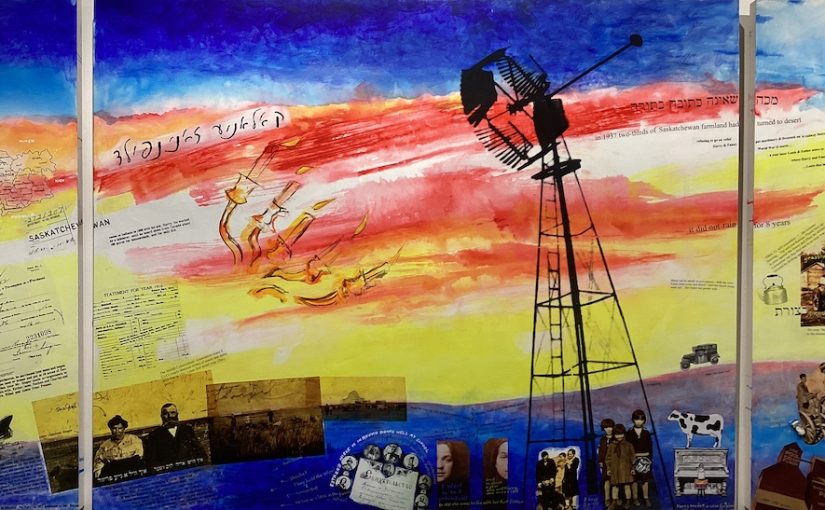
“Shabbat Saskatchewan,” by Esther Tennenhouse. Part of Otiyot (Letters), a joint exhibit with her son Joel Klassen, which is now at the Zack Gallery.

Colourful and playful, dark and ominous, Esther Tennenhouse’s artwork is engaging and thought-provoking, as she offers her take on Torah and midrash, immigration and language, orthodoxy and modernity. Otiyot (Letters), an exhibit she shares with her son Joel Klassen, opened at the Zack Gallery last week.

Tennenhouse’s sense of humour, curiosity, imagination and sincerity come through in the work on display, and in her responses to questions about the exhibit.

“Ot means ‘letter’ (of the alphabet) – it also means ‘sign’ and ‘signal,’” she told the Independent. “It was my first choice of name for the show: Ot – Starring the Letter Shin. Sounds like ‘ought,’ as in ‘thought.’ Ot was visually terse (and sounds adorable). That was why it was Ot in [the] JCC program book – I had to provide that bit before these pieces were made! Yikes! But it got changed to the longer plural in Hebrew and lost its zap. More truthful, though, as I have so many (too many) words of explanation on the wall beside each piece.”

All the works were made specifically for the exhibit, said Tennenhouse, “only for this place, for anyone who happens to walk into the JCC,” where the Zack Gallery is located.

“I was driven by my own relationship to the alef-bet: me, a quite secular, second-generation, Winnipeg-born Jew living in Vancouver, of prairie-born parents, who learned my aleph-bet as a child, quite long ago. I think many like me, with my sort of education, walk by these gallery doors, so I thought they might wander in and relate.”

Born and raised in Winnipeg, Tennenhouse went to Talmud Torah there from age 4 to 11, then to public school. She earned a bachelor’s in English and, while working at the Winnipeg Free Press, majored in sculpture at the University of Manitoba School of Art.

She moved to Aklavik, in the Inuvik region of the Northwest Territories, and then to Yellowknife, where she learned about ceramics at the Yellowknife Guild of Arts and Crafts. She later worked with translucent clays.

Moving with her family – husband Ron, son Joel and daughter Timmi – to Vancouver in 1995, Tennenhouse found a home at Or Shalom, participating in the Talmud and Torah study offered there, reengaging in Jewish education after a break of some 45 years.

Klassen also attends Or Shalom. His art background includes having drawn at home and working with painter Sylvia Oates – who he describes as a mentor – in her Parker Street studio. Klassen has had a one-man show in artist Noel Hodnett’s Parker Street studio, and he was in the Kickstart Disability Arts and Culture’s 2019 group show Nothing Without Us at the Cultch. For the past four years, he has attended the JCC’s Art Hive, which is facilitated by Kim Almond.

Klassen’s Hebrew letters and drawings are in five of the pieces at the Zack Gallery, said Tennenhouse.

“Making letters as individuals, each with their own character, was the most fun to do,” she said. “Jan Wilson, a friend and quilter, offered to help if I drew out the correctly sized letters backwards for transfer and picked the fabrics.”

The letters comprise eight of the works on display, and offer much to think – and smile – about. Klassen’s aleph is filled in with leopard print fabric, surrounded in black with a flowered border. The word “wild” comes to mind as one looks at it, not just the wildness of animals and nature, but of human beings. The piece is called “Aleph in the Garden.”
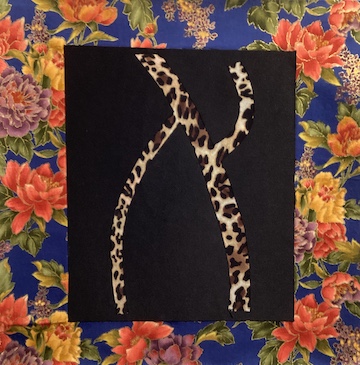
photo - “Aleph in the Garden” by Esther Tennenhouse, Joel Klassen and Jan Wilson
“Aleph in the Garden” by Esther Tennenhouse, Joel Klassen and Jan Wilson.

“I did not shy away from diversity,” said Tennenhouse. “It’s sort of an underlying element. I felt the show had to offer something to any individual, whatever their history with the alef-bet, and it deals with very well-trodden themes. I felt a need for an element of surprise, which is one reason why Joel’s aleph became a leopard in the garden (of Eden?).”

A last-minute addition to the depictions is one of the 12 new letters for gender-neutral word endings that were created by Israelis graphic designer Michal Shomer a few years ago.

“They appeared in welcome signs outside schools and on IDF buildings, etc., but the kabbalist idea of the power of the alphabet lives on – the new letters were vigorously rejected by religious factions,” said Tennenhouse. “‘Changing the letters removes any kedusha (sanctity) the words have or any ability the words have of channeling God’s energy into the world,’ said sofer Rabbi Abraham Itzkowitz. ‘This project essentially makes Hebrew like any other language.’ Some of the signs were taken down. Religious schools were forbidden to use them.”

That said, Tennenhouse told the Independent, “What first tickled me into this aleph-bet project was the poetry and passion of the ideas of the early mystics. They conceived of letters of the alef-bet existing even before the creation of the world – all 22 were vessels of the divine, all things were created by their combinations. Meditative/ecstatic kabbalah taught that individual letters were something to meditate upon, which led to ecstasy, one of the steps to sense of union with G-d. American calligrapher Ben Shahn, who titled one of his books Love and Joy About Letters, quotes the 13th-century Rabbi Abulafia, who said the delight in combining letters is like being carried away by notes of music.”

Tennenhouse and Klassen’s “Shir” (song, poetry, chant, in Hebrew) is truly delightful, like a page out of a children’s book. A multimedia piece, it depicts several animals and the sounds they make, both in Hebrew and in transliteration, though the giraffe just “hum[s] at night.”

Two other works are striking, both on their own and in contrast to each other: Sinai 1 and Sinai 2.
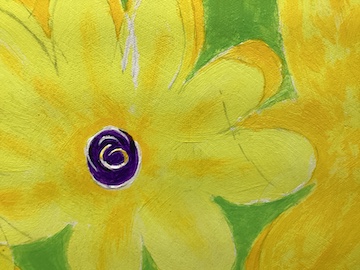
photo - Detail of "Sinai 2" by Esther Tennenhouse and Joel Klassen
Detail of “Sinai 2” by Esther Tennenhouse and Joel Klassen.

The latter features three bright yellow flowers, surrounded by green. “It is a triangle canvas which is about the mountain bursting into bloom when Moses came down with the Ten Commandments – this was a midrash from the 1500s. The triangle has flowers by Joel. I asked him to put flowers on it, envisioning little flowers here and there – he just went swoosh woosh on it.”

Sinai 2 is a vertical rectangle with whites, greys and blacks depicting a furious ball of activity on top of the mountain that includes the Hebrew letters.
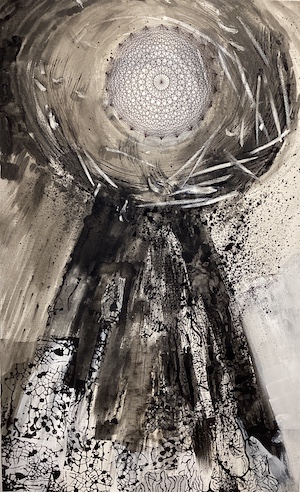
photo - "Sinai 1" by Esther Tennenhouse
“Sinai 1” by Esther Tennenhouse.

“The Torah tells of fear, awe, the shaking mountain, seeing sounds, lightning, Moses’ anger, the breaking tablets,” said Tennenhouse. “Looking back, I overburdened the canvas [with] anger, though laying on the 231 Gates – a diagram from the Sefer Yetzirah which shows each letter combining with each other letter of the alef-bet – because I see the story of the giving of the Torah as a sort of creation story for our intense embrace of literacy. The diagram relates to Rabbi Abulafia’s talk of combination of letters but distracts visually from the anger/violence, [the] mountain, fear.”

There is so much more in this exhibit.

“Cursive Handwriting: Kovno Testament” is a stark, unfinished work, featuring the words, written in his own hand, of Lithuanian writer Eliezer Heiman, who died in the Kovno ghetto during the Holocaust. It was to have three more samples of cursive, said Tennenhouse. “I left room for them before I put on the image of Heiman’s tablets. Those spaces stayed empty. Everything else edited themselves out because of what happened in Israel on Oct. 7.”

There is the multimedia triptych “Shabbat Saskatchewan,” which Tennenhouse said “is me trying to use real photos and documents to create some presence of my mother’s grandparents and parents.”

“It ended up being centred on great-grandmother Esther Dudelzak Singer, Baba Faige (Fanny) Singer and my mother with her sisters,” she said. “Yiddish was their mamaloshen (mother tongue) and the Sonnenfeld community was religiously observant.”

“The Owl and the Pussy Cat” adds colour and vibrancy to Edward Lear’s black and white drawing of his nonsense poem, the Yiddish translation of which – by the late Marie B. Jaffe – fills the two side panels of this triptych. Tennenhouse couldn’t find much information out about Jaffe, she said, “But, thanks to Eddie Pauls at the Jewish Public Library in Montreal, [I] learned she immigrated to New York in 1909 from Lithuania.”

Tennenhouse began to see the owl and the cat in their boat as sailors braving the rough seas, traveling around the world to find “Di Goldene Medine,” “the Golden Land,” America.

“You might say ‘Saskatchewan,’ too, is about leaving home, traveling across seas and finding a new place but keeping your language and culture,” said Tennenhouse.

Otiyot (Letters) is on display at Zack Gallery until Nov. 12.
Format ImagePosted on October 27, 2023October 26, 2023Author Cynthia RamsayCategories Visual ArtsTags art, Esther Tennenhouse, Joel Klassen, multimedia, Otiyot, painting, Zack Gallery
A land of contradictions

A land of contradictions

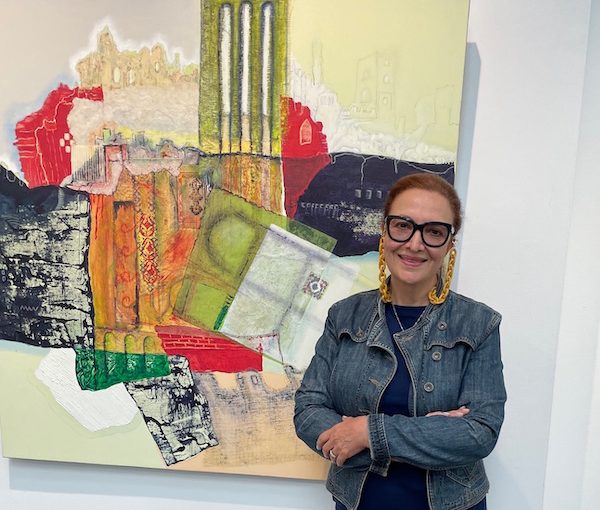
Sorour Abdollahi’s solo exhibit Intersecting Landscapes is now at Zack Gallery. (photo by Olga Livshin)

Over the years, Iranian-Canadian artist Sorour Abdollahi has participated in several group shows at Zack Gallery, but the current exhibition, Intersecting Landscapes, which opened on Sept. 7, is her first solo show here.

“Sorour is definitely not the first non-Jewish artist with a solo show at the Zack,” said gallery director Hope Forstenzer. For years, the mission of the Zack Gallery, which is in the Jewish Community Centre of Greater Vancouver, has been to showcase Jewish artists and art dedicated to Jewish themes, she said. Non-Jewish artists were not excluded, but they usually appeared in group shows.

“The big difference in the past few years,” said Forstenzer, “has been an expansion of the definition of a Jewish theme to include a wider variety of human universal experiences that reflect on Jewish cultural history and traditions.… Sorour’s work, while not as overtly Jewish as some, addresses the concept of diaspora and its impact on culture and memory. When we made the decision to show her work, it was based on the concept of a cultural nostalgia for home as an inherently Jewish theme. And the response to it, so far, has borne that out – it has had a very strong emotional impact on the community here at the JCC and has already engendered discussion of the Jewish diaspora.”

Abdollahi has been a professional artist all her life. “I’ve always painted, since I was a child,” she told the Independent.

She received her art education in Iran, and her first solo art show happened there in 1987. A successful artist, working in mixed media and acrylics, she regularly exhibited in Iran, participating in multiple group and solo shows in various cities, including Tehran and Isfahan. The only big gap in her exhibiting schedule occurred when she immigrated to Canada. “We came here in 2000,” she said. “We did it for the children.”

Like all immigrants, she struggled with the new language and new culture. “It was several years later, when my children grew older, that I enrolled in Emily Carr [University of Art + Design] part time,” she recalled. “I wanted to become familiar with the local art scene, with the educators and the artists. I wanted to become a part of the local artistic community. And it worked beautifully. My friendships with wonderful Vancouver artists Devora and Sidi Schaffer stem from those days.”

Five years after her immigration, Abdollahi felt immersed enough in the British Columbia art vista to open her own studio and gallery in Yaletown.

“People would pass my gallery on the street, and some would come in,” she said. “They asked questions. I felt that my art connected.”

That connection gave her the courage to join the Eastside Culture Crawl – the biggest visual art festival in Vancouver – 10 years ago.

Abdollahi’s current show at the Zack represents the scope of her art perfectly. It consists of old and new paintings from several different series. A blend of abstract and figurative art, her paintings are airy and bright. Most of them have vague architectural connotations and employ a predominantly blue and green palette reminiscent of spring and rebirth. The abstract forms, sometimes utterly modern, often reveal faint outlines of ruins, shimmering in the mist, in the background.

“I grew up in the land of contradictions, where a traditional way of living juxtaposed a modern, Western lifestyle,” she said. “Those contradictions manifested in the landscape surrounding me, the historical against the contemporary, with layers of change and transformation.”

Immigration to a new country profoundly impacts her imagery.

“In my paintings, I examine the relationship between memories and the external landscape,” she said. “My Iranian background and my Canadian experience have had an enormous influence on my works. They inspired a negotiation between the modern and the ancient, the old and the new, the West and the East. Ancient ruins and Persian architecture play a pivotal role, too. They have enabled me to express the conflict and the negotiation process that often exists between two different cultures or societies. While the ruins speak of a mysterious, pure and mystical past, they also illustrate the corrosive effect of time and modernity, the constant reconfiguration of a country’s landscape, architecture and culture. The dripping paint in many of my pictures also illuminates the process of renewal. The old slides down, while the new grows over it. My paintings attempt to form a bridge between the past and the present.”

Two of the paintings particularly stand out. “The Magical Carpet” is a collage, full of the whimsical patterns, warm hues and bright shapes of a traditional eastern bazaar, with the artist’s customary ruins in the background.

Another painting, “Letters from Beyond”, with its strong punch of red paint, uses fragments of writing that are wholly imaginary. “The language and the letters in that writing don’t belong to any nation,” Abdollahi said. “I created it because I believe that we are all the same people. We should have no borders and no different languages separating us. That’s why I wanted to have a show here, at the Jewish Community Centre. I feel like my art is a link that connects us all.”

Abdollahi’s works can be found in private collections in Canada, the United States, the United Kingdom, France, Australia, Saudi Arabia and Iran.

Intersecting Landscapes runs until Oct. 12. For more information, visit sorourart.wordpress.com.

Olga Livshin is a Vancouver freelance writer. She can be reached at [email protected].

Format ImagePosted on September 22, 2023September 21, 2023Author Olga LivshinCategories Visual ArtsTags exhibits, Hope Forstenzer, landscapes, painting, Sorour Abdollahi, Zak Gallery
Zack exhibit celebrates nature

Zack exhibit celebrates nature

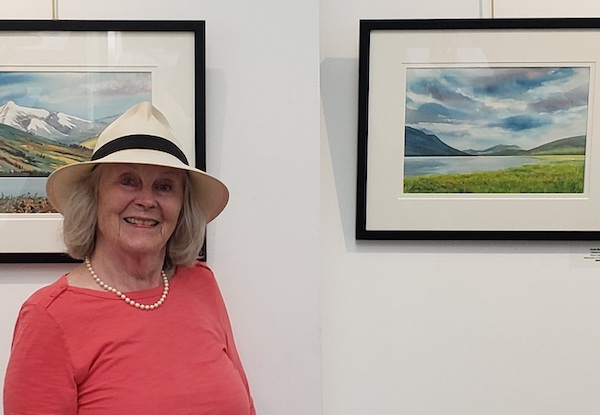
Enda Bardell (photo from Enda Bardell)

Creativity manifests itself in people’s lives in different ways and at different times. For Enda Bardell, various forms of art occupied her for decades, while Mike Cohene discovered woodcarving only a few years ago, on his way to retirement. Their double show, Artistry in Wood and Water, opened at the Zack Gallery on July 26.

Bardell told the Independent that she was born in Estonia. In 1944, when she was a young child, her family fled from Estonia, then occupied by the Nazis, to Sweden. Her mother worked at a paper factory there, and Bardell played with paper dolls she made herself. She also drew all the dolls’ colourful outfits. “I gave the dolls away to other girls, to make friends,” she recalled. “My first attempts at fashion design.”

A few years later, the family was forced to move again. The Russian communist government wanted the return of all the Estonians who had escaped the Nazis during the war, and Sweden was going to comply with that demand. But Bardell’s father didn’t want to live in communist Russia, so they became refugees again, this time ending up in Canada.

“In 1951, we came to Winnipeg,” said Bardell. “I went to school there and I desperately wanted to fit in. To belong. To be Canadian. I participated in many school clubs and activities. Entered an art class, too. My teacher praised me and recommended that I send one of my drawings to an interschool art competition. I did. And I won. I knew then that I was an artist.”

Interested in landscapes and abstracts, Bardell painted a lot as a teenager, but, after her high school graduation, she became deeply involved in fabric art. “I sold my batiks at craft fairs and house parties. People liked them, and someone suggested I should open my own store,” she said. “I did. I designed lots of different textile objects: skirts, pillowcases, aprons, etc. I felt that I needed a business course, in addition to my art education, so I took it. My store was very successful.”

But, as soon as the store achieved that success, running it lost its challenges. “I became bored,” said Bardell. “It was time for a change.”

She sold the store and did many other things in her professional life. “I always want to try something new, something I’ve never tried before. At one time or another, I was a lamp designer. I worked in banking. I was a realtor. I designed costumes for the Vancouver movie industry,” she said.

She also traveled a lot. “I have visited 38 countries. I like adventures, like it when I can’t speak the tongue. Then I have to express myself through body language. I have to be creative,” she said.

Art always shimmered on the periphery of her life, a constant creative supplement to her various commercial careers. First, abstract oils and acrylics, and, later, watercolours. Painting eventually metamorphosed into the focus of her existence. In the past two decades, she has participated in multiple solo and group exhibitions in Canada and abroad. In 2008, she even participated in an art show in her native Estonia, the Estonian Art in Exile exhibition at KUMU, the National Museum of Art in Tallinn. KUMU acquired one of her acrylic abstracts for their permanent collection; another of her paintings is in the Tartu Art Museum in Estonia. Her paintings are represented by many local galleries.

The current exhibition at the Zack is the result of a trip Bardell took to Yukon shortly before the COVID pandemic temporarily closed all travel. “My son lives in Yukon,” she said. At his prompting, she applied and was granted residency for one month at Ted Harrison Cabin in 2018. “We hired an RV and traveled there for two weeks,” she said. “Yukon was amazing: mountains, rivers, lakes. The place resonated with me. I took 1,400 photos during our travels. Based on the selection from those photos, I painted 40 watercolour pieces during my stay at the cabin. It was a privilege to stay in that wonderful place, especially because I had met Ted previously.”

Many of Bardell’s paintings in this series involve rivers and lakes. “I like water,” she said. “I have always lived on the water, except for one year in Winnipeg. I swim year-round here, summer and winter. Sometimes, I have seals swimming with me. It feels magical.”

When she submitted her Yukon series to the Zack Gallery, it was accepted, on the condition that it would be a double show, as gallery exhibitions must have a Jewish connection. Bardell’s Jewish connection became Mike Cohene, a local woodcarver. His colourful carved fish complement perfectly Bardell’s watercolours of Yukon’s rivers and lakes.

Unlike Bardell, Cohene didn’t do anything artistic until 2009. “I had a solid clothing business,” he said. “Awhile back, I started thinking about retiring and selling the business.”

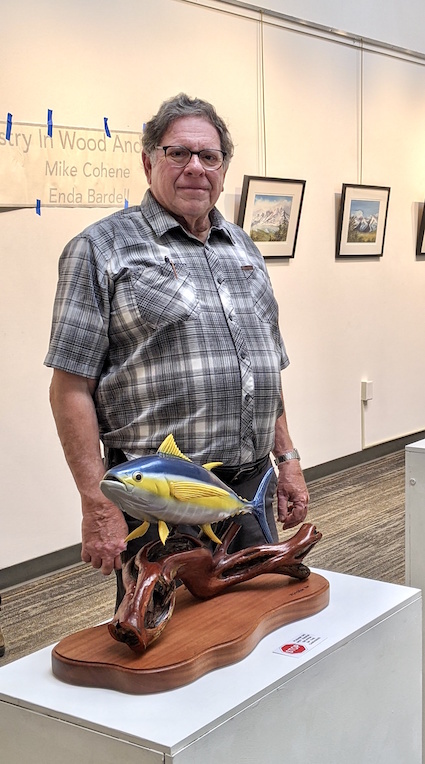
photo - Mike Cohene
Mike Cohene (photo by Linda Babins)

In the summer of 2009, Cohene visited Steveston Farmers Market. “They had a booth of the Richmond Carvers Society – I thought their works were outstanding,” he said. “I always whittled but I never considered myself artistic. I started talking to the man in the booth, expressing my admiration. He said anyone could learn to do it. He invited me to come to the club meeting in September. I went.”

Since that day, he has learned a lot about the artistry and the technique of woodcarving. His journey began with woodcarving classes at the society. Later, he took a course at Emily Carr University of Art + Design and enrolled in carving workshops.

“My first carving was a bear cub,” he said. “Then I made a dolphin. Then I started carving fish and birds…. I’ve always been a fisherman, but I never studied fish anatomy before. I caught a fish and tossed it into a bucket. Now, I catch a fish and study it: the fins, the tail, the scales, how the colours change. I look at fish from a new perspective.”

In 2017, Cohene participated in his first two-artist exhibition at the Zack Gallery, with photographer Joanne Emerman. Since then, his art has become even more refined. “I learned more sophisticated techniques and tools,” he said. “I got several residencies in B.C. and Oregon.” Three years ago, he began teaching woodcarving to other Richmond Carvers Society members.

To create his wooden creatures as life-like as possible, Cohene uses various reference materials. “Mostly I use my own photographs,” he said. “When other people photograph wildlife, they give it their own interpretation, but I want to follow my own vision.”

His statues of fish include rocks and corals, all carefully carved and painted in bright, realistic colours. “Sometimes, one statue takes up to 20 coats of paint – different wood parts absorb paint with different intensity,” he explained.

He also uses tree branches as mounting blocks – they are not carved, just sawed off, polished and lacquered. “I only use dead wood for my statues. I often walk along the beach and pick up interesting pieces of driftwood. I’ve never harmed even one living tree,” he said.

Recently, Cohene has started exploring First Nation carving. The motifs attract him, and he has several pieces on display at the gallery, including two decorative oars.

He also creates Judaica – mezuzot, chanukiyot and dreidels – some of which can be seen at the gallery. Cohene has been to Israel 34 times. “Once, I brought 12 kilograms of olive wood with me from Israel, and I make many of my Judaica pieces from the reclaimed Israeli wood,” he said. “Olive wood has such a beautiful texture. And dreidels are fun to make.”

Whatever he works on, Cohene always gives it his all. “For me,” he said, “woodcarving is a form of self-fulfillment.”

Artistry in Wood and Water runs until Sept. 5. To learn more, visit the artists’ websites: endabardell.com and mikecohene.com.

Olga Livshin is a Vancouver freelance writer. She can be reached at [email protected].

Format ImagePosted on August 18, 2023August 17, 2023Author Olga LivshinCategories Visual ArtsTags carving, Enda Bardell, environment, Judaica, Mike Cohene, painting, watercolour, Yukon, Zack Gallery
Chance to create

Chance to create

Esther Rausenberg, artistic and executive director of the Eastside Arts Society. (photo by Wendy D)

Eastside Arts Society (EAS) presents the return of its two-day summer art-making event, CREATE! Arts Festival, taking place at Strathcona Park on July 22 and at various Eastside Arts District studios on July 23.

A community initiative designed to welcome guests to explore, learn and create art together with local artists, CREATE! features a variety of accessible visual and performing arts workshops for adults and youth, including watercolour painting, needle felting, indigo dying, pottery, glass fusing, photography, ukulele, Salish singing and storytelling.

“In addition to a variety of art workshops, demonstrations and public participation art installations, we are also incredibly proud to introduce our brand new festival art shop, featuring a curated selection of arts and crafts all handmade by local artists,” said EAS artistic and executive director Esther Rausenberg, who is a member of the Jewish community.

On July 22, there will be a series of outdoor art-making workshops taught by more than 15 artists who live and/or work in the Eastside Arts District, many of whom will be participating in CREATE! Arts Festival for the first time. Adult and youth workshops will be hosted by Taaye Wong, Tanna Po, Suzan Marczak, Nima Nasiri, Naomi Yamamoto, Niki Holmes, Ross den Otter, Daphne Roubini, Russell Wallace, Jewish community member Naomi Steinberg, Nicole Caspillo, Nathaniel Marchand, Eri Ishii and Chantal Cardinal (FELT à la main with LOVE). A children and youth workshop will be hosted by Amberlie Perkin and an all-abilities workshop by Alternative Creations Studio.

Saturday festivities will also include a general admission CREATE! Art Zone. Art demonstrations include painting, pottery and glass beading from Francis Tiffany, Julia Chirka (summer skool) and members of Terminal City Glass Co-op. Public participation art projects include a life-size colouring mural with Serena Chu of Chu Chu, squeegee art with Joanne Probyn, and the building and performing of two giant crow puppets – in honour of EAS’s unofficial mascot – with Jacquie Rolston. Opus Art Supplies will have a hands-on block carving and printing activation: carve and pull a mini-block print, and contribute to a collaborative printmaking collage.

A selection of local handmade artworks and goods, curated by OH Studio Project, will be available at the festival shop. There will be a fully licensed beer garden, serving beer, cider and wine from Strange Fellows Brewing, as well as an assortment of food from a collection of food trucks, including Earnest Ice Cream, Wak Wak Burger, Mahshiko and Camion Café.

On July 22, the 8th Annual Art! Bike! Beer! Crawl Brewery Tour & Fundraiser will, for the first time, end at the festival grounds.

Activities will move indoors on July 23, connecting participants with art production spaces in neighbouring Eastside studios, with additional art workshops hosted by members of the Terminal City Glass Co-op, Richard Tetrault, Sonya Iwasiuk, Grace Lee (eikcam ceramics) and Naomi Yamamoto.

Workshops are $35 (plus GST) for youth/adults, with the exception of Perkin’s workshop for children/youth at $20 (plus GST); children under the age of 12 must be supervised by an adult. The general public can access festival activities at Strathcona Park for a $5 general admission fee (children under age 12 are free). For full festival details and workshop registration, visit createartsfestival.ca.

– Courtesy Eastside Arts Society

Format ImagePosted on July 7, 2023July 6, 2023Author Eastside Arts SocietyCategories Visual ArtsTags art, family, festivals, music, painting
Immerse yourself in artwork

Immerse yourself in artwork

Art House SF’s Max Khusid is one of several artists who will be at Art Vancouver May 4-7. (photo from Art House SF)

Once again, galleries and artists from across Canada and around the world will come together to exhibit their work at Art Vancouver, which takes place May 4-7 at the Vancouver Convention Centre West. At the annual fair, attendees can join the opening night party, purchase art, listen to various talks, take part in classes, and more.

Among the exhibiting artists are local Jewish community members Lauren Morris, Taisha Teal, Sky Lilah, Talin Wayrynen and Lisa Wolfin, who will also be teaching art classes during the fair. In addition to the stories you can find on jewishindependent.ca about these artists, visit their websites for more information: Morris (lmdesignsstudio.com), Teal (taishateal.com), Lilah (skylilah.com), Wayrynen (imtalin.com) and Wolfin (lisawolfin.com).

Other participating Jewish community members include Max Khusid of San Francisco gallery Art House SF (arthousesf.com) and a couple of the gallery’s artists, Tavalina (Rinat Kishony) and Max Blechman, who, with husband Kazu Umeki, comprises the duo BLECHMEKI (a portmanteau of their last names).

Khusid spent the first 20 years of his professional career in the world of technology, and plans to spend the next 20 years diving into the unknown and immeasurable world of art. He is inspired by the mystic art and adventurous life journey of Russian painter, explorer, archeologist and philosopher Nicholas Roerich (1874-1947).

Tavalina lives in Israel and her work “Jerusalem” was recently featured on the cover of a book by the late Amos Oz. A graduate of the Israel Institute of Technology with a bachelor of architecture, she worked in the field for several years. After a personal crisis in her 30th year, she began to paint, devoting herself to art. At the same time, she embarked on a journey of personal discovery and traveled many places, eventually returning to Israel, where she continues painting and presenting her work, as well as teaching art.

Blechman, originally from New York, lives in San Francisco. He and Umeki use mass-produced American pottery from the 1930s to 1980s to create photo tableaux. At first glance, the individual pieces of pottery appear identical, but closer inspection reveals variations both in form and colour. Indeed, the Japanese concept of wabi-sabi (appreciating beauty that is imperfect, impermanent and incomplete in nature) reverberates throughout their pottery.

For the full list of Art Vancouver artists and classes, as well as tickets for the fair, visit artvancouver.net.

– Courtesy Art Vancouver

Format ImagePosted on April 28, 2023April 26, 2023Author Art VancouverCategories Visual ArtsTags art, ceramics, lessons, painting
About this year’s Passover cover art

About this year’s Passover cover art

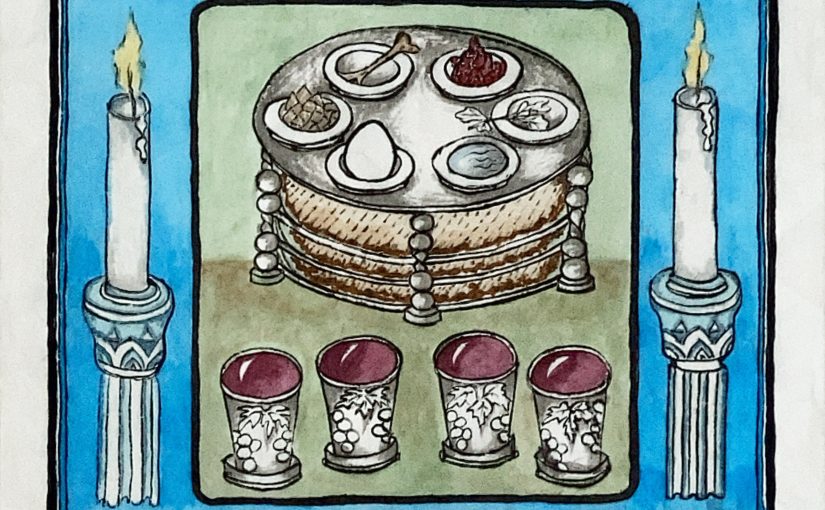
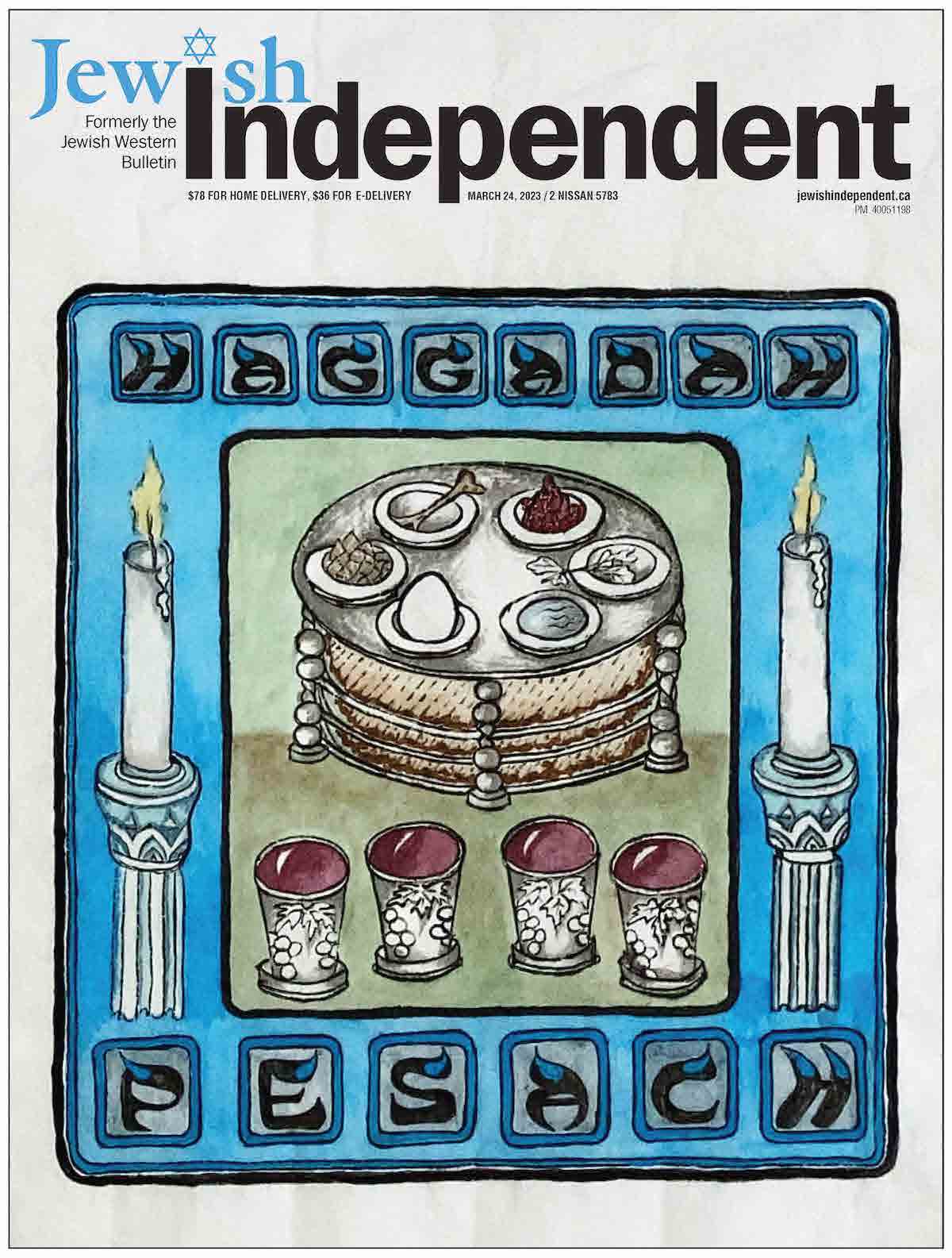
For theimage - Jewish Independent’s 2023 Passover cover by Merle Linde this year, Steveston, B.C., artist Merle Linde, chose to create a Haggadah cover that would look old and hand drawn. To achieve this authentic feeling, Linde used Taiwan linen paper, traditional Chinese watercolour paints and brushes.

The calligraphy letters in solid black Hebrew-like text feature peacock blue flashes, often seen in antique manuscripts. Yom Tov candles sit on candleholders that borrow their design from ancient Egyptian columns. The traditional Four Cups of Wine are inspired by a set of old silverware featuring raised grapevine leaves and grapes. And a silver seder plate holder has space for the three traditional shmura matzot, the shank bone, the burnt egg, haroset, bitter herbs, green vegetable and salt water for dipping.

Chag Pesach sameach.

Format ImagePosted on March 24, 2023March 22, 2023Author The Editorial BoardCategories From the JITags art, Haggadah, Merle Linde, painting, Passover, Pesach, seder, symbolism
Finding community in art

Finding community in art

“Nostalgia” by Lovena Galyide (photo by Olga Livshin)

Community Longing and Belonging, the fifth annual exhibition in celebration of Jewish Disability Awareness and Inclusion Month, is now on at the Zack Gallery.

Curated by Leamore Cohen, coordinator of Jewish Community Centre of Greater Vancouver’s Inclusion Services, the participating artists demonstrate a range of artistic levels, abilities and social affiliations, but they all strive to answer the same questions in their artwork: What does community longing look like? How to find a place to belong in our ever-changing world?

Cohen has been the driving force of this show for five years. For her, an unjuried exhibition is the best way to honour the commitment to remove barriers and celebrate community members’ creativity. If an artist wanted in, they were in, professional artist or amateur, Jewish or non-Jewish, young or old. Cohen stressed that inclusion is the basic principle, and participation is what counts most.

Many artists in the current show have participated in the Inclusion Services exhibit before. Although most of the works on display are paintings, there are also photographs and drawings. There are portraits and landscapes, figurative and abstract imagery. Some items are for sale, while others are not.

Many of the portraits are disturbing in their naked emotional anguish. The faces are jagged or crooked, angular or cubical. One of them is clearly inspired by Picasso, but all of them portray loneliness, a search for belonging.

Most of the abstract images are similarly angry or sad. Very little figurative recognition manifests, but the emotions explode out of the pictures, multiplied by dark colours and sharp lines. They depict the pain of isolation, the desire for acceptance.

Not every work is bleak. Clare Palmer’s photograph “Red Maple” is full of natural serenity, as if the photographer found her community in nature and recommends it to everyone.

Roi Alexander M. Sanchez’s painting with a long and winding title starting with Clean Environment shows a man and a woman cleaning the land, collecting garbage into sacks, together with their friends in the background. The cleaning they are doing is obviously a community event, and the artist emphasizes this with bright colours and cheerful composition. The painting radiates gladness, with a child-like flare. The author seems to say: we clean our home together.

Togetherness also seems to be the main meaning of Aileen Leong’s untitled piece, where two hearts are pierced by one arrow. Connected by this arrow of love, the hearts fly above the mountains on the golden wings of joy.

Lovena Galyide, on the other hand, doesn’t speak of love in either of her two paintings. Both are larger than most of the others in the exhibit. Both feature a single woman. In one, called “Say Yes to Your Open Door,” a girl lifts the curtain of night above her head, allowing in the light of the morning. She welcomes a new beginning and abolishes darkness. The painting thrums with hope. The girl is alone, with her back to viewers, but maybe the new day will bring her a new friend. Or a new love is waiting for her on the sunny side.

Another of Galyide’s paintings is “Nostalgia.” It is less exuberant than the first. The woman in this canvas stands in the rain outside the window of a flower shop. The viewers are “inside,” looking out. All they see is a blurry female silhouette under an umbrella. But, inside the shop, flowers bloom. Is that pensive, lonely woman going to enter? Buy flowers? Or is she just passing down the street? So many stories could start with this painting, all going in different directions. It is up to viewers to finish those stories.

Flowers are also the focus of Sandra Yuen’s “Bias.” This painting is large, and the close-up flowers are accordingly huge and gloriously pink, blooming in splendid isolation on the blue background. The painting is reminiscent of Georgia O’Keeffe’s gigantic flowers, capturing the beauty and vastness of nature.

Unlike Yuen’s exposition of colour, another large painting, by Rodrigo Perez Parra, seems composed mostly of melancholy, echoed by its subdued, earthen palette. Its title, “The Dance in the Dream,” reflects its subject: a woman standing thoughtfully beside an open door. Does she dream of a dance in her past? Does she hope to dance again? Where is her partner? Only a hat, hanging beside the door, reminds us about them. Are they coming back? Again, stories abound from this painting, some of which might even have a happy ending.

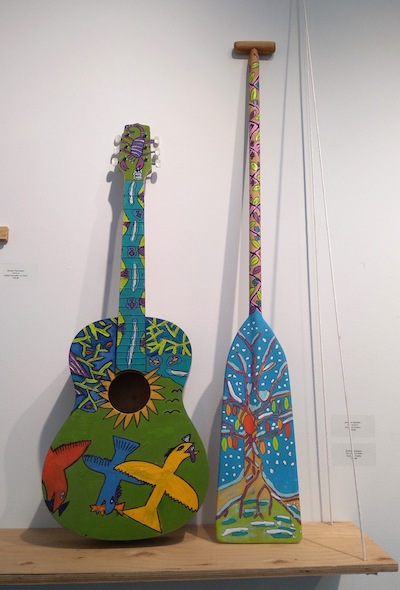
photo - “Folk Guitar” and “Tree of Life Paddle” by Andrew Jackson
“Folk Guitar” and “Tree of Life Paddle” by Andrew Jackson. (photo by Olga Livshin)

In the middle of all the images on the gallery walls, two 3-D exhibits stand out. Andrew Jackson’s “Folk Guitar” and “Tree of Life Paddle” are tongue-in-cheek, almost goofy. Both are real-life objects, painted in a distinctive folksy style. The guitar flaunts soaring gulls gobbling fish. The paddle is painted with the Tree of Life. Although the guitar lacks its strings, perhaps the artist considers music our inescapable community. Or sports (for the paddle)?

Another unique item on display is a small clay tablet called “The AHA Community.” The artists who created it belong to the Artists Helping Artists (AHA) collective. The plaque doesn’t list any names, but Cohen said each of the 11 little colourful figures placed on the tablet’s surface, all engaged in different artistic activities, were made by different members of the collective. They are merry self-portraits, making the tablet itself a representative of all the artists in this show.

According to their website, AHA is an art studio collective in Burnaby, where artists of all abilities and skill levels are encouraged to come together to make art – visual art, music, writing, anything goes. The studio provides space, affordable materials and the opportunity to pursue the individual artist’s aspirations. A large percentage of their membership is artists with complex needs.

Like the JCC Inclusion Services, AHA believes that art is a vital element in our lives, and that inclusion is mandatory. Their mandates are congruent – each invites people to share their feelings through art.

The Community Longing and Belonging exhibit runs at the Zack until March 28. To view the flipping book, visit online.flippingbook.com/view/836064016.

Olga Livshin is a Vancouver freelance writer. She can be reached at [email protected].

Format ImagePosted on March 10, 2023March 9, 2023Author Olga LivshinCategories Visual ArtsTags AHA, art, Artists Helping Artists, folk art, inclusion, JCC Inclusion Services, JDAIM, Jewish Disability Awareness and Inclusion Month, Longing and Belonging, painting, Zack Gallery
Reflecting on life of creativity

Reflecting on life of creativity

Earlier this year, Claire B. Cohen published a book of her 30-plus years as an artist. She made it for family and friends, as a record of her artistic legacy.

“Art is a powerful and a creative force of self-expression. To create art is to develop an ability to communicate visually what cannot be expressed in words.

“By creating the process of art, we change the way we see the world,” Claire B. Cohen told the Independent. “In understanding ourselves, we find areas where we feel limited. In understanding ourselves, we stand up for ourselves and can present ourselves authentically to others. An artist’s creation is unique and original to their work.”

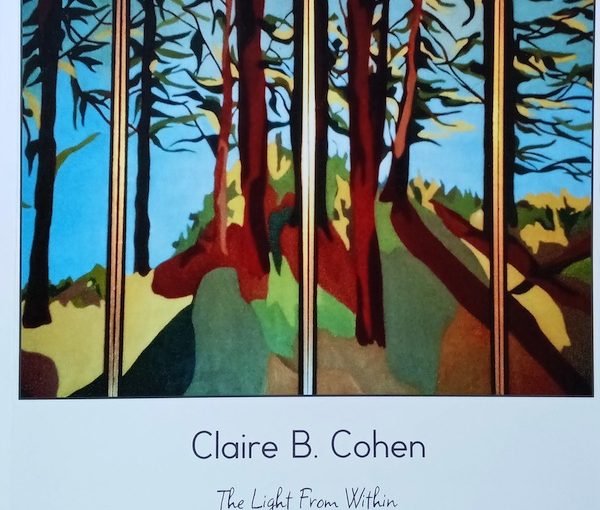
Earlier this year, Cohen published a slim volume, mainly with images that burst from the pages, outlining her 30-plus years creating art. We glimpse the range of her work – landscapes, portraits, semi-abstracts, flowers, multimedia collages and a compartmental series, in which colourful abstract canvases were “connected sequentially in a zigzag for using piano hinges.” Flow and fun describe this series, her portraits – both colour and black and white – capture the personalities of her subjects, her landscapes and collages are bold and full of movement but also balance. The book touches on her work as an art therapist.

Originally from Israel, Cohen came to Canada in 1964. She studied fine arts at York University in Toronto and the University of Ottawa, and later earned her master’s in art therapy and counseling from U of O in 1987. She had many solo exhibits and group shows in Ottawa, and elsewhere, over the years. The book takes readers to 2006, with an exhibit list to 2009. She moved to Vancouver in 2012.

“I continued to paint after moving to Ottawa, but my move to Vancouver changed my focus, since joining my family had taken much of my time, being richly involved with newborn grandchildren,” said Cohen. “However, I still continued painting and showing new work in Vancouver galleries, as well as donating paintings to different organizations in Vancouver, such as hospitals, Louis Brier [Home and Hospital], friends, and creating more collages and multimedia-based work. I participated in group art shows and sold some to the public.”

Cohen said her reason for producing the book “was to create a place to keep all of my art as a legacy to leave to my family in remembrance of my story. COVID times were affecting my spirit, my mood was down and … the idea came about to focus on creating the book for my family and friends.”

During the pandemic, Cohen said she started to lose her connection to creativity. 

“Friends cut off from each other, as much as children and family,” she said. “I slowly lost my energy and interest, as well as the need I once had to be close to my easel. The paints, the brushes, the colours all lost their meaning and the need I had to paint slowly deteriorated.”

She began to look back at her past, which, she said, “led me to wake up from my dormancy and questions such as ‘what is my meaning of life?’ I discovered my paintings in storage and wanted to create a book.

“I reflected further on my body of work and questioned: why did I dedicate my years to painting? Was there any purpose to it? The answer eventually arrived – yes. There are many purposes to be alive, and work as an artist, investing my life in art. In my case, most of it was to leave a memory to my next generation.”

Cohen’s most recent exhibit and sale was at Britannia Community Centre in 2021. Art can be cathartic, whether one is making it or experiencing it.

“The process of creating art has a great intensity and full force of emotions that lead to a freedom and release when the piece is complete,” she explained. “Looking at these pieces that I created many years ago leads to a sense of nostalgia and a softening of that intensity. These pieces have followed me through many moves and lives, and have a story of their own that has evolved with the emotions that once created them. The language of art cannot be explained in words, the language of these emotions is form, line, colour and brush strokes.”

This language can help heal, as Cohen well knows from her art therapy practice.

“The more we know about ourselves, the more we learn to grow and develop our abilities to stand our ground,” she said.

Describing art as “a powerful and unique way to explore our creative forces,” she explained that people who participate in art therapy use the “materials to express the self and communicate visually,” composing stories. In a group setting, they “collaborate and share with others … connect and integrate parts of his/her inner self, gain confidence and reduce stress in a supportive environment, with the aid of the instructor.”

It was both a dream and a need for Cohen to do art therapy and counseling.

“I realized that art is not just for selling and decorating homes, rather it was a way to find myself, to grow and see who I am, and to help others with their healing.”

To see Cohen’s body of work, go to clairebcohen.wixsite.com/portfolio/home.

Format ImagePosted on December 23, 2022December 22, 2022Author Cynthia RamsayCategories Books, Visual ArtsTags art, art therapy, Claire Cohen, family, health, memoir, painting
Artist advocates for nature

Artist advocates for nature

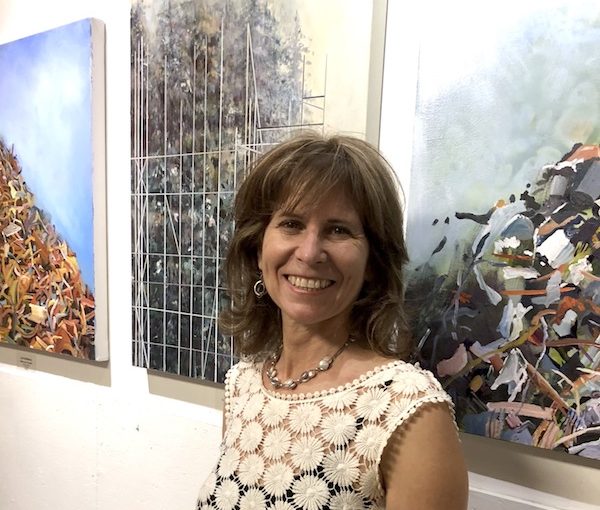
Lori Goldberg’s artwork reminds viewers that “that which we discard doesn’t disappear.” (photo from Lori Goldberg)

If you attend a performance at Queen Elizabeth Theatre, you will see the artwork of Lori Goldberg. She is one of the artists whose creations are at the theatre for another couple of weeks. The exhibit opened Oct. 29.

“Queen Elizabeth Theatre has a program for exhibiting artwork by local artists,” Goldberg told the Independent. “There was a call that was sent out a few years ago and I responded. I was accepted and the work was to be installed just when the pandemic began, so it was postponed until this year.

“It is an ideal venue,” she continued, “as thousands of people a week attend events at the Queen E.  My art has a message about climate change and it is important that it gets seen by as many people as possible. My pieces are on exhibit until Dec. 19, and people are only able to see it if they have a ticket to an event. Alternatively, I am available to take anyone interested on a private tour.”

The paintings in the exhibit come from three ongoing series: Plasticity, Poetics of the Discarded, and Reconstructing Nature.

“For many years, I have been investigating what happens when two opposing places – cities and nature – collide, connect and transform,” said Goldberg. “Through more awareness and experience firsthand, many of my works have ultimately been about the precarious relationship that we have with our natural world. Seeded in environmental advocacy, an animating factor in my practice has been reclaiming, recycling and reimagining refuse.”

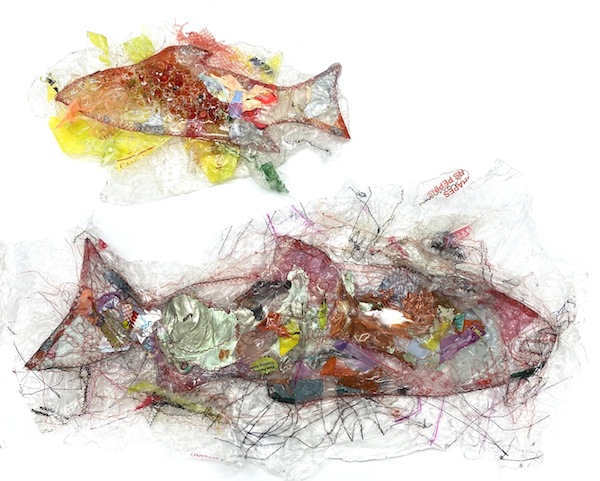
photo - “Rogue Fish” by Lori Goldberg
“Rogue Fish” by Lori Goldberg (photo from Lori Goldberg)

In the description of Plasticity on her website, Goldberg mentions her discovery that ink can be transferred from, say, a plastic bag, to canvas. Her creative process invites such discoveries.

“I am a diverse artist and my ideas dictate my art,” she explained. “My practice has primarily focused on painting, but I have had to explore other mediums to adequately express my concept.  Besides paint, I have explored photography, assemblage and sewing.  I have worked with clay, glass, so-called ‘trash’ from my studio, single-use plastic bags that I fuse on canvas, and I have stuffed lost socks with fabric remnants given to me by tailors.”

For Goldberg, the camera is her “sketchbook” and a photo is generally the starting point for her painting.

“My work references the physical world at one point in my creative process,” she said. “When I research and gather information, I look for source material that is usually filtered through my own photo documentation. Other photo images can come from friends, the internet or by random discovery. I also use memory, dreams – and always my imagination. I take parts of photos that resonate for me and incorporate that visual language – usually recontextualizing and altering it – in my work.”

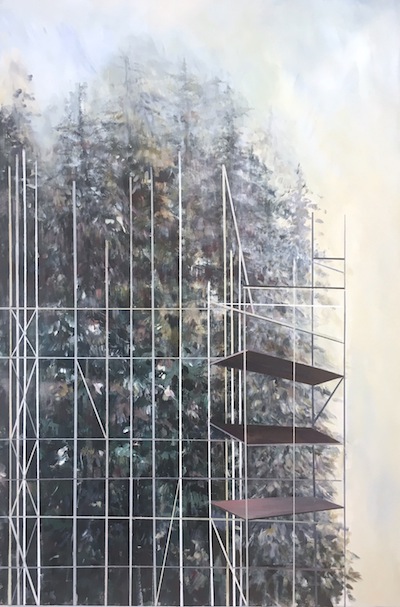
As an example, Goldberg spoke about the series Reconstructing Nature, which references nature/urban tensions found in Vancouver. “There is no lack of trees here and our city is in constant state of flux, with the demolishing of buildings and the construction of new ones, so I take photos of the nature that is all around me, but also of the scaffolding and cranes that are so prominent in the city as well,” she said. “In the Poetics of the Discarded series, I started by visiting a number of refuse sites, with an interest in memory and objects. Within the refuse, there were mounds and mounds of history: the detritus of days spent, life and death, business, conveniences used, sentimental things and so much more. I would photo-document these toppling heaps of refuse and re-contextualize and resurrect them as a visual reminder of the ongoing narrative between humans and their environment, reminding us quietly: that which we discard doesn’t disappear.”

photo - “Reconstructing Nature” by Lori Goldberg
“Reconstructing Nature” by Lori Goldberg (photo from Lori Goldberg)

While Goldberg does not paint on location often, she said, “My creative process is to go out into nature or the city, experience it, document it and return to my studio. Having said that, making work outdoors is becoming more interesting to me and it is a future direction that I plan to spend more time doing.”

With her art, Goldberg said, “I would like to think that I am creating work that is impactful to the viewer and especially the younger generation, that they will be empowered to take action towards making a difference as they engage with the world.

“The works are meant to be educational and I hope that they impart to the viewer a sense of personal responsibility – that they put to action what they feel and be one small ripple of change to create a better future for themselves.”

An educator for more than 30 years, Goldberg has taken her classroom outside and into the public arena, where, she said, “I create hands-on workshops using materials that address repairing the planet and healing ourselves. I created a project titled Lost Socks, where the public stuffed and sewed lost socks together to create a long tubular form that stood for connection, diversity and difference. Recently, I have used single-use plastic packaging to create wearable art. What I enjoy about these workshops is that they attract all ages and so it is intergenerational and accessible to all.

“Artists are essential in our communities,” she stressed. “Some of us choose to create work that challenges topics that are highly charged and sensitive, but, without venues in which to work and to exhibit, the messages cannot be passed on. I appreciate the exhibits I have had over my life at the JCC – I cannot imagine what would happen if we lost such a significant public space as the Sidney and Gertrude Zack Gallery. It is a venue for Jewish artists and Jewish content. It reinforces Jewish identity, conversations and connections. It is a gallery that has assisted me in my journey as an exhibiting artist and has given me opportunities to work with preschoolers, seniors and poets.”

Goldberg believes in giving back and donates her work frequently to different organizations, such as Big Brothers. “My recent donation was to Tikva Housing,” she said. “I gave them three paintings from my Judaica series. There is a satisfaction that is hard to explain, but it is a joy to be able to offer something of value to make others feel uplifted.”

Goldberg is currently applying for artist residencies in different parts of the world.

“I am interested in responding to the environment that I would be in and allowing it to dictate the direction of my work,” she said. “I want to contextualize my work in such a way that I am creating awareness about our healing of our planet but indirectly, through healing ourselves. Artist residencies offer opportunities for new perspectives and fewer distractions, so you can shed the restraints and discover what is there, but has been hidden.”

For more information, visit lorigoldberg.ca.

Format ImagePosted on December 9, 2022December 7, 2022Author Cynthia RamsayCategories Visual ArtsTags environment, Lori Goldberg, nature, painting, Queen Elizabeth Theatre
Art for wide variety of tastes

Art for wide variety of tastes

Margaux Wosk makes pins, magnets, necklaces and other items. (photo from the artist)

Last year’s Affordable Art Show at the Zack was such a success that the gallery is repeating it in 2022, just in time for the winter holidays. Gallery director Hope Forstenzer hopes it will become an annual tradition.

Everything in the show is less than $250, and the selection is wide enough to appeal to a variety of tastes. The participating artists are a mix of repeat appearances and newcomers. Some of the newcomers have exhibited in Zack group shows before. For the others, this is their first event at the gallery.

Margaux Wosk is one of the new artists. Their company, Retrophiliac, produces pins, magnets, necklaces and other items, many of which are priced below $20.

“I’m an autistic, self-taught artist, designer, writer, entrepreneur and disability advocate,” Wosk said. “I have been a ‘retrophiliac’ for a long time. I am inspired by retro and vintage styles, but I also want to celebrate neurodiversity.”

In addition to their company’s distinct merchandise, Wosk creates vibrant, retro-inspired paintings and mixed media work. “I hope to break down barriers and eliminate the stigma of neurodiversity,” they said. “With my art, I want to open a dialogue about what autistic and disabled people are capable of.”

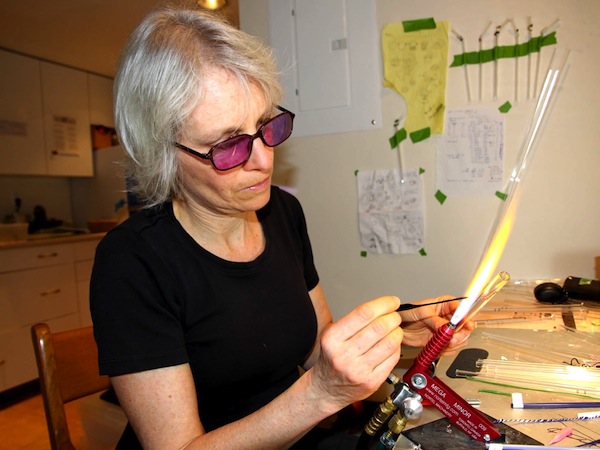
Aimee Promislow, another new artist, works with glass. Her company, Glass Sipper, produces reusable drinking straws. “I met Hope [Forstenzer] a number of years ago,” she told the Independent. “We were both members of the same glass co-op. When she joined the Zack Gallery, she began reaching out to me for various events and shows. Last year, I participated in the Hanukkah show here. I’m excited to be part of the Affordable Art Show this year.”

photo - Aimee Promislow works with glass, making reusable drinking straws
Aimee Promislow works with glass, making reusable drinking straws. (photo from the artist)

Promislow summed up her creative path and why she chose it. “I have always, since a young age, dabbled in art,” she said. “My mother is an artist, Nomi Kaplan. She had introduced me to various art forms. After high school, I tried pottery, then glass enamel, then I played with resin. Eventually, about 15 years ago, I started melting coloured glass. I love colour and I love watching things form in fire. Glass is hard when cold, but, once heated, it is malleable, and I love moving it around.”

At first, Promislow made glass beads and sculpted little animals out of glass: dogs, cats, turtles. “At the same time, our family enjoyed smoothies,” she said. “The kids wanted straws for their smoothies, but the only smoothie straws I could find were plastic ones.”

Concerned about the environment, she combined her passion for glass with her care for nature. “I had a ‘eureka’ moment,” she recalled. “I realized that, instead of making glass beads, I could make reusable glass drinking straws and decorate them with my tiny creatures. That night, Glass Sipper was born.”

She also makes glass mezuzot and yads (the pointers used to read Torah). “They are perfect gifts for bar and bat mitzvah,” she said. “And everything I make is under $100, ideally suitable for the Affordable Art Show.”

Another glass artist in the show is Sonya Labrie. Her company, SML Glassworks, produces vases and other elements of home décor, as well as jewelry. “I’ve always created pieces that could be in anyone’s home,” she said. “The idea that art is to be loved and available to everyone in our community is very important to me.”

With such a mindset, when Forstenzer invited her to participate in this show, Labrie’s answer was an unequivocal yes.

“I started working with glass in 2005,” she said. “The first glass class I attended was at Red Deer College in Red Deer, Alta. Then I went on to complete a three-year advanced diploma in craft and design at Sheridan College, majoring in glass. I’ve also had the opportunity to study glass at the renowned Pilchuck Glass School in northern Washington.”

photo - Glass artist Sonya Labrie creates vases and other elements of home décor
Glass artist Sonya Labrie creates vases and other elements of home décor. (photo from the artist)

Labrie said she can’t imagine her life without creating beautiful things out of glass. “My body of work includes blown glass, flamework and kilns-cast items,” she elaborated. “Glass has endless possibilities, it is a challenging medium, and I keep discovering new ways of working with it.”

She also teaches glasswork for the Vancouver School Board. “I teach students grades 8 to 12 and I teach continuing education workshops for adults at the Terminal City Glass co-op.”

Unlike these company-owning creators, fibre artist Deborah Zibrik doesn’t consider herself a full-time artist. Not yet.

“I am a registered dietitian,” she said. “I’m still working part time, finishing a career that started in 1975. I will retire soon, after a research project at the B.C. Children’s Hospital Research Institute is completed. Until then, I simply don’t have enough time each day to work as a full-time artist. However, I consistently carve out ‘me time’ every day to complete some stitching. Ideas are constantly percolating in my head. Typically, many pieces are framed up or in the sketchbook phase at any one time. Perhaps the best descriptor for me is a part-time artist.”

Zibrik makes elaborate embroidered pieces. Some of them are like miniature tapestries, landscapes emerging out of fabric and threads. Others are tiny blossoms, beetles and butterflies that could be used separately or together, each one a delightful surprise. She also does golden embroidery.

“Smaller pieces are often whimsical and stitched quickly, with a minimum of stitches. On the other hand, my gold work requires hours to complete, and the materials are much more costly.”

Zibrik started learning needlecraft when still very young. “Like many girls growing up in rural Canada, I was taught by my mother and grandmother. They wanted to make sure I had all the critical homemaker skills, from crocheting blankets to mending socks…. Later, after 10 years of part-time study at Gail Harker Creative Studio, I completed Level 2 Design (based on a City and Guilds of London Institute in the U.K. curriculum) and Level 4 Diploma for stitch. Luckily for me, the studio is located in La Connor, Wash. That made it possible for me to attend sessions in-person to complete the evidence-based curriculum.”

photo - Fibre artist Deborah Zibrik makes elaborate embroidered pieces
Fibre artist Deborah Zibrik makes elaborate embroidered pieces. (photo from the artist)

After receiving her diploma in 2015, Zibrik decided to share her skills with others. “Time permitting, I have been teaching workshops for specific needlework techniques,” she said. “Guild members are my usual students. There is currently a discussion among the guilds about the lost generations of children who haven’t learned any of the needle arts, including embroidery; they haven’t had the exposure. Because of that, membership in the guilds is declining, as members age. I am considering ways to fix that. Perhaps I could offer embroidery classes to youngsters, maybe at the community centre level, to teach basic skills and prime creativity to future artisans.”

When asked where they see themselves on the scale of art versus craft, artists’ replies varied.

“I’m an artist and a designer,” said Wosk.

Promislow said, “I am a craftsperson. I use my medium to make things that are functional and beautiful.”

“My work rides a fine line between both,” said Labrie. “There is a fluid movement in my practice.”

“My personal journey suggests that, especially for women, craft and art are inextricably linked,” offered Zibrik. “More, they have been connected for thousands of years. They are but different places on the same continuum. In that sense, I am privileged to say: I am an artist.”

The Affordable Art Show continues until Dec. 30. And, if you’re visiting the exhibit Dec. 5-7 or 12-14, check out the Jewish Community Centre of Greater Vancouver’s Chanukah Marketplace, which takes place in the centre’s atrium.

Olga Livshin is a Vancouver freelance writer. She can be reached at [email protected].

Format ImagePosted on November 25, 2022November 23, 2022Author Olga LivshinCategories Visual ArtsTags Affordable Art Show, Aimee Promislow, Deborah Zibrik, gift ideas, glass, Margaux Wosk, painting, Sonya Labrie, textiles, Zack Gallery

Posts pagination

Previous page Page 1 … Page 3 Page 4 Page 5 … Page 9 Next page
Proudly powered by WordPress