Skip to content
  • Home
  • Subscribe / donate
  • Events calendar
  • News
    • Local
    • National
    • Israel
    • World
    • עניין בחדשות
      A roundup of news in Canada and further afield, in Hebrew.
  • Opinion
    • From the JI
    • Op-Ed
  • Arts & Culture
    • Performing Arts
    • Music
    • Books
    • Visual Arts
    • TV & Film
  • Life
    • Celebrating the Holidays
    • Travel
    • The Daily Snooze
      Cartoons by Jacob Samuel
    • Mystery Photo
      Help the JI and JMABC fill in the gaps in our archives.
  • Community Links
    • Organizations, Etc.
    • Other News Sources & Blogs
    • Business Directory
  • FAQ
  • JI Chai Celebration
  • JI@88! video

Recent Posts

  • Eby touts government record
  • Keep lighting candles
  • Facing a complex situation
  • Unique interview show a hit
  • See Annie at Gateway
  • Explorations of light
  • Help with the legal aspects
  • Stories create impact
  • Different faiths gather
  • Advocating for girls’ rights
  • An oral song tradition
  • Genealogy tools and tips
  • Jew-hatred is centuries old
  • Aiding medical research
  • Connecting Jews to Judaism
  • Beacon of light in heart of city
  • Drag & Dreidel: A Queer Jewish Hanukkah Celebration
  • An emotional reunion
  • Post-tumble, lights still shine
  • Visit to cradle of Ashkenaz
  • Unique, memorable travels
  • Family memoir a work of art
  • A little holiday romance
  • The Maccabees, old and new
  • My Hanukkah miracle
  • After the rededication … a Hanukkah cartoon
  • Improving the holiday table
  • Vive la différence!
  • Fresh, healthy comfort foods
  • From the archives … Hanukkah
  • תגובתי לכתבה על ישראלים שרצו להגר לקנדה ולא קיבלו אותם עם שטיח אדום
  • Lessons in Mamdani’s win
  • West Van Story at the York
  • Words hold much power
  • Plenty of hopefulness
  • Lessons from past for today

Archives

Follow @JewishIndie
image - The CJN - Visit Us Banner - 300x600 - 101625

Tag: Liberal Party of Canada

Canada recognizes Palestine

On Sunday, Prime Minister Mark Carney issued a statement on Canada’s recognition of Palestine as a state.

“Recognizing the state of Palestine, led by the Palestinian Authority, empowers those who seek peaceful coexistence and the end of Hamas,” said Carney. “This in no way legitimizes terrorism, nor is it any reward for it. Furthermore, it in no way compromises Canada’s steadfast support for the state of Israel, its people and their security – security that can only ultimately be guaranteed through the achievement of a comprehensive two-state solution.”

photo - Prime Minister Mark Carney
Prime Minister Mark Carney announced on Sunday that Canada would recognize Palestine as a state. (photo from Office of the Prime Minister)

Carney noted: “Since 1947, it has been the policy of every Canadian government to support a two-state solution for lasting peace in the Middle East.” He said there was an “expectation that this outcome would be eventually achieved as part of a negotiated settlement,” but “this possibility has been steadily and gravely eroded” by several factors. 

In addition to other criticisms of both Hamas and Israel, Carney lists the “pervasive threat of Hamas terrorism to Israel and its people, culminating in the heinous terrorist attack of Oct. 7, 2023,” and Hamas’s rejection of Israel’s right to exist; “accelerated settlement building across the West Bank and East Jerusalem, while settler violence against Palestinians has soared”; “the E1 Settlement Plan and this year’s vote by the Knesset calling for the annexation of the West Bank”; and the “Israeli government’s contribution to the humanitarian disaster in Gaza, including by impeding access to food and other essential humanitarian supplies.”

Carney said the Palestinian Authority “has provided direct commitments to Canada and the international community on much-needed reforms, including to fundamentally reform its governance, to hold general elections in 2026 in which Hamas can play no part, and to demilitarize the Palestinian state.”

In reaction to the prime minister’s Sept. 21 statement, Noah Shack, chief executive officer of the Centre for Israel and Jewish Affairs, said, “Hamas is not an isolated phenomenon. It is a violent manifestation of the rejection of the right of the Jewish people to a state in our ancestral home – a rejection that runs deep within Palestinian society.

“As Prime Minister Carney himself has noted, a Palestinian state must be a Zionist state. Today’s announcement undermines that objective and gives Hamas and other Palestinian rejectionists a sense of victory. This will only make it harder to secure the release of hostages and build a better future for Israelis and Palestinians.”

Shack acknowledged that, while the “announcement does not come as a surprise, the details are important. The government has stated that, while it is extending recognition, normalization of relations with a ‘state of Palestine’ is an ongoing, long-term process…. We will argue that this must not proceed so long as hostages are in tunnels, Hamas remains in power and the Palestinian leadership rejects Israel’s existence as a Jewish state.

“And we will continue,” said Shack, “to make it clear that, with anti-Jewish hate escalating, our government must recognize the unintended effect foreign policy has on the climate in our own country.”

B’nai Brith Canada also issued a response to Carney’s statement.

“The PA has shown, time and again, that it cannot be trusted,” said Richard Robertson, director of research and advocacy for B’nai Brith Canada. “It is unable to govern the Palestinian Territories and has repeatedly demonstrated it is unwilling to deliver on the very commitments upon which Canada’s recognition is supposed to be predicated.

“The commitments include democratic reform, free and fair elections in 2026 without Hamas, and the full demilitarization of the Palestinian Territories.

“None of these conditions have been met. Hamas continues to arm itself, hold hostages and carry out terror attacks. Recognition under these circumstances does not bring us any closer to lasting peace, it only further compromises the prospect of a two-state solution.”

Robertson said the “government has chosen appeasement over principle.”

On Sunday, the United Kingdom, Australia and Portugal made similar announcements to that of Canada. Reaction from Israel was critical.

“After the atrocities of Oct. 7, while Hamas continues its campaign of terror, and while it continues to cruelly hold 48 hostages in the tunnels and dungeons of Gaza, the recognition of a Palestinian state by some nations today is, not surprisingly, cheered by Hamas,” wrote Israel’s President Isaac Herzog in an X post.

“It will not help one Palestinian, it won’t help free one hostage, and it will not help us reach any settlement between Israelis and Palestinians. It will only embolden the forces of darkness.

“This is a sad day for those who seek true peace,” he concluded.

Israel’s Prime Minister Binyamin Netanyahu said he will release a formal response after he returns from the United States. However, in a widely reported Hebrew-language video statement, he said, “I have a clear message to those leaders who recognize a Palestinian state after the horrific massacre on Oct. 7 – you are handing a huge reward to terror.

“It will not happen,” he added. “A Palestinian state will not be established west of the Jordan.”

According to various news reports, Hamas did indeed applaud the recognition announcements, as did the Palestinian Authority. 

Posted on September 26, 2025September 24, 2025Author Cynthia RamsayCategories NationalTags Binyamin Netanyahu, B’nai Brith Canada, Centre for Israel and Jewish Affairs, CIJA, Hamas, Isaac Herzog, Israel, Liberal Party of Canada, Mark Carney, Noah Shack, Palestine, Palestinian Authority, politics, Richard Robertson, terrorism

Don’t leave. Engage!

Anthony Housefather has decided to remain in the federal Liberal caucus. Housefather, member of Parliament for the Quebec riding of Mount Royal, is one of only two Liberals to have voted against the NDP motion last month that called for a ceasefire, an end to Canadian military trade with Israel, as well as other positions about Israel and the current conflict.

As discussed in this space last issue, the New Democratic Party motion had some of its rough edges sanded down in order to make it palatable to almost all Liberal MPs. The rest of the House of Commons voted predictably. Conservatives unanimously opposed the motion, which they viewed as biased against Israel. The Bloc Québecois and the Green party sided with the NDP.

The daylong negotiations over amendments to the motion were a face-saving effort by the Liberal government to avoid the embarrassment of a serious schism in their caucus over foreign policy. In the end, a less inflammatory motion was passed.

Housefather, who is Jewish and represents a riding that has one of the largest concentrations of Jewish voters in Canada, was joined on the government side in opposing the motion only by Ontario Liberal MP Marco Mendocino.

Housefather was open about his frustration. Anyone who has found themselves in a place where they do not feel welcomed, based on their core identity, can certainly appreciate his feelings of isolation. However, we are pleased that he has decided to remain in the Liberal caucus.

Crossing the floor and joining the Conservatives, which he had said he was considering, would not have been advantageous to Jewish and pro-Israel voters. Since the administration of former prime minister Stephen Harper, at the latest, the Conservative party has been perceived as overwhelmingly pro-Israel. This approach has been welcomed by many Jewish Canadians.

However, this reality means that, were Housefather to switch parties, he would become just another pro-Israel voice in the Conservative caucus. By staying where he is, he will be a necessary voice for Israel and the Jewish community in the governing party. In an announcement a week ago, he said the prime minister has asked him to lead the government’s efforts in fighting antisemitism. This effort needs as much multi-partisan support as possible.

Anyone who has had difficult conversations with friends or family in recent months understands the emotional burden of being a voice for Israel in this challenging time. This, however, makes Housefather’s presence in the Liberal party that much more important.

We face a similar challenge at the provincial level. With the firing of Selina Robinson from cabinet, and her subsequent withdrawal from the governing New Democratic Party caucus, the Jewish community’s most outspoken ally, liaison and voice is gone from the government side of the legislature. Neither Robinson, who now sits as an independent, nor George Heyman, the other Jewish New Democrat in Victoria, are seeking reelection. It is entirely possible that the Jewish community will not have any community members in the next legislature.

This is not to say we do not have friends there.

Michael Lee, the MLA for Vancouver-Langara, has been a steadfast ally of the Jewish community and a stalwart presence at the weekly Sunday rallies for the Israeli hostages. Recently, when he addressed that audience, he went to lengths to warn against making Israel a political football. A community that can be taken for granted by one party and written off by another will find itself unrepresented in the halls of power. Lee reassured Jewish British Columbians that they not only have friends on the opposition side of the house, but in the governing NDP as well.

We know that there are allies for Israel and the Jewish people in the provincial NDP. It is a symptom of a larger concern that some of these people feel constrained around expressing that solidarity fully because of segments of their own party who would almost certainly single them out for that support.

As Robinson herself told the Independent last issue, she has friends and supporters in the caucus – but she wouldn’t mention them by name for fear of putting a target on their backs. This is a serious problem, of course. But it is better to have quiet allies than no allies at all. Their presence can potentially moderate extreme elements in their party. Were they not there, restraining impulses might be minimized.

As we approach a provincial election this fall, and a federal election at some unpredictable date (remember, there is a minority government in Ottawa) Jewish Canadians and allies of Israel should not abandon the parties that include voices with alternative views. We should, like Housefather has chosen to do, make sure our voices are heard in all of Canada’s diverse political venues. 

Posted on April 12, 2024April 10, 2024Author The Editorial BoardCategories From the JITags allyship, Anthony Housefather, antisemitism, governance, House of Commons, Israel, Liberal Party of Canada, Michael Lee, NDP, politics
Trudeau talks with the JI

Trudeau talks with the JI

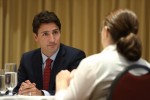
Liberal Party of Canada leader Justin Trudeau in an interview with Cynthia Ramsay of the Jewish Independent. (photo by Adam Scotti)

Justin Trudeau said he is cautiously optimistic about the Iran nuclear deal, insisted he is committed to fighting ISIS and reiterated his commitment to the environment and social fairness in an exclusive interview with the Jewish Independent.

The federal Liberal leader, who hopes to be prime minister after the Oct. 19 federal election, acknowledged the implications of Iran’s agreement with Western powers over its nuclear program, which the Tehran regime maintains is for energy purposes only.

“We all start from the same place on this – a nuclear-armed Iran is a threat not just to Israel, not just to the region, but to the entire world, and we have to make sure that Iran doesn’t achieve that,” Trudeau said.

There are only two ways to reach this objective, he said: direct military intervention on the ground against the Iranian regime or a diplomatic agreement. “We don’t have such a great record of military intervention in that part of the world,” he noted, stressing that the agreement is “not based on trust but on verification.”

“We are cautiously optimistic about the deal,” he said. “We’re not saying we should drop the sanctions today. Obviously, there are a lot of milestones to be addressed, but I think anything [is positive] that sets us down the path of both delaying the ability significantly of Iran to get the nuclear bomb and increases the ability of the Iranian people to put pressure on their regime to change – because we all know we can make a tremendous distinction between the Iranian citizens and their government that doesn’t represent them particularly well.”

Trudeau also advocated reopening diplomatic relations with Iran eventually. “I do feel that it would be very nice to hope to reopen that embassy at one point because you don’t have embassies with just your friends, you have your embassies with the people you disagree with,” he said. “However, on top of addressing the nuclear concerns, Iran has to do an awful lot to demonstrate that it’s no longer going to be a state sponsor of terrorism in the region, around the world, and they have to do an awful lot around human rights and repression of their own citizens and dissent within Iran before they can rejoin the community of nations. But I think we’re on a path that should be cause for at least a level of comfort that perhaps we’re in a positive direction now.”

In speaking with the JI after a speech to the Richmond Chamber of Commerce last Friday, Trudeau, in his second exclusive with the paper, clarified his stance around confronting ISIS.

“This is a great opportunity for me to spell out our position on this,” he said. “The Liberal party feels it is extremely important that Canada be a significant part in the effort against ISIS. We are absolutely supportive of being part of that coalition and, indeed, we feel there is a military role for Canada in the fight against ISIS that can make a very big difference. We disagree that bombing is the best way for Canada to do that. That’s why we voted against the mission and voted against the expansion of the mission into Syria, because it has a likely side effect of strengthening Bashar al-Assad’s grip on power and that we don’t necessarily want.”

“We are absolutely supportive of being part of that coalition and, indeed, we feel there is a military role for Canada in the fight against ISIS that can make a very big difference. We disagree that bombing is the best way for Canada to do that.”

What Trudeau would prefer, he said, is for Canada to provide more humanitarian aid, for example, and for this country’s military to provide the kind of role it does in Afghanistan. “We’ve developed tremendous expertise,” he said, “which is training the local troops to be able to take the fight more efficiently to ISIS. That would happen far from the frontlines because we don’t want Canadian troops to be involved [there] but also because we know that it is the local troops that are going to be effective at taking back their homes, their communities, and dropping in Western soldiers doesn’t make the situation better as, unfortunately, the Americans understood in Iraq awhile ago.”

He sees an opportunity for Canada to make an impact without being directly involved in the conflict. “We feel there’s a role for Canada to be a significant resource in training the local military, not in a direct combat role that Mr. Harper is proposing with the bombings,” he said.

Trudeau welcomed the opportunity to explain his support, with caveats, for the federal government’s anti-terrorism bill, C-51. “The Liberal party has always understood that we need to protect Canadian security and uphold our rights and freedoms – and you do them both together,” he said. “To our mind, Bill C-51, even though it has clear elements in it that increase the safety for Canadians – which is why we supported it – it doesn’t go far enough to uphold our rights and freedoms, which is why we’re committed to bringing in oversight, putting in a sunset and review clause onto our anti-terror legislation, and also narrowing and tightening some of the rules around what behavior CSIS [Canadian Security Intelligence Service] can have – warrantless searches and all those sorts of things.”

His political opponents, he said, go too far in each direction. “Mr. Harper thinks, ‘No, no, we don’t have to do anything more around rights and freedoms, we have enough, we’re just giving more power to our police,’” Trudeau said. “I think that’s a problem.

“Mr. Mulcair says, ‘No, we don’t need to do anything more on security. Even those things in C-51, we don’t need them, we’re fine the way it is.’” That is also a problem, according to Trudeau. “We have to do more,” he said. “But we have to do more on both sides.”

On other topics, the Liberal leader expressed support for increased trade with Israel. “We obviously support the latest announcement around Canada-Israel free trade,” he said. “I know it was a lot of agricultural stuff in this round, but it’s a very good thing. This was a deal that was signed by [Liberal prime minister] Jean Chrétien back in ’97 and the Liberal party believes in trade. We believe in free trade, and we’re happy to continue trade with Israel.”

Trudeau took the opportunity to reiterate his opposition to the movement to boycott, divest from and sanction (BDS) Israel.

“You can have all sorts of debates over positions, but when you’re engaged in demonization, delegitimization and double standards, that’s just not what we are as a country.”

“I think the BDS and anti-apartheid movement, as I’ve said many times, runs counter to Canadian values,” he said. “You can have all sorts of debates over positions, but when you’re engaged in demonization, delegitimization and double standards, that’s just not what we are as a country.”

The Independent also asked Trudeau about the Liberals’ approach to climate issues and social equality.

“At a very basic level, we get it, as Canadians, particularly here in B.C., that you cannot separate what’s good for the environment and what’s good for the economy anymore,” Trudeau said. “You have to do them both together, and you can’t get one without the other.

“You still have people saying, ‘Oh no, we have to work on the economy, so let’s forget about environmental oversight,’ or ‘We need to protect the environment, so, no, we can’t create jobs.’ Canadians know we need them both together,” he said. “One of the problems is we’ve had 10 years of such a lack of leadership on the environmental level that it’s hurting our economy. We need to get our resources to market in responsible, sustainable ways. We’re not able to do that right now because nobody trusts Mr. Harper to do it right. Restoring that sense of public trust, [so] that people know, we need jobs, we need economic growth … in a way that understands that it’s not just about governments granting permits, but about communities granting permission, as well.

“One of the things we’ve put forward in our environmental plan is that, in the 10 years of lack of leadership on the federal side, the provinces have moved forward,” Trudeau continued. “B.C. has a very successful carbon tax, Alberta put in a carbon levy-style tax, Ontario and Quebec are doing a cap-and-trade. What that means is that 86% of our economy has already put in a mechanism to put a price on carbon, so the federal government can’t suddenly say, ‘OK, we’re doing cap-and-trade. Sorry, B.C., you’re going to have to change your system,’ which would make no sense; or vice versa, ‘We’re doing a carbon tax.

Sorry, Ontario, you can’t do it.’ What we have to do is recognize that different jurisdictions will have different ways of reducing their emissions – the federal government has to be a partner, a supporter, an investor in our capacity to do that across the country, in order for us to reduce our emissions and be responsible about the environment.”

Trudeau acknowledged the solutions won’t be immediate. “We need to move beyond fossil fuels, but it’s not going to happen tomorrow,” he said. “Right now, a lot of people who are blocking and opposed to pipelines aren’t realizing that the alternative is a lot more oil by rail, which is really problematic – more expensive, more dangerous.” Under the circumstances, he said, people are just saying no: “No to everything, because we don’t trust the government in place.”

He said he hopes to form a government that addresses climate change, invests in clean technology, renewable resources and the kinds of jobs that advance beyond a fossil fuel economy. For now, “we have to make sure that our oil sands are developed going forward in a responsible, efficient way that doesn’t give us the black eye on the world stage and with our trading partners,” he said.

“The Liberal party believes in evidence-based policy and we believe in harm reduction. My own hometown, Montreal, is pushing hard to set up an Insite-type clinic. The Liberal party supports that. The Supreme Court supports that. This government, for ideological reasons, is pushing against it. I think that’s just wrong, and we’re happy to say that. ”

Vancouver has been the testing ground for new ways of dealing with addiction, particularly the Insite supervised drug injection clinic. “The Liberal party believes in evidence-based policy and we believe in harm reduction,” Trudeau said. “My own hometown, Montreal, is pushing hard to set up an Insite-type clinic. The Liberal party supports that. The Supreme Court supports that. This government, for ideological reasons, is pushing against it. I think that’s just wrong, and we’re happy to say that.”

In the same week that Canadian parents were receiving Universal Child Care Benefit [UCCB] cheques in the mail calibrated to the number of children in their home, Trudeau was promoting his party’s “fairness plan.”

“Mr. Harper’s child benefit, for example, goes to every family regardless of how wealthy they might be,” Trudeau said. “We, instead, decided, let’s make it means-tested so that people who need the help the most will get the best help. For a low-income family, it means up to $533 a month, tax-free, and then it grades down until someone making over $200,000 doesn’t get any child-care benefit at all. And the benefits that will go to the nine out of 10 Canadians will be tax-free, so the money you get is actually money you get to spend.”

The plan also proposes to lower the middle-class income bracket from 22 to 20.5, which will result in about $3 billion in lost revenue. “In order to get that $3 billion,” said Trudeau, “we’re bringing in a new tax bracket on the wealthiest Canadians, people who make over $200,000, to even things out. And it’s not just about redistribution, it’s also about growing the economy because we know, when middle-class families and the working poor have money in their pockets to spend, to grow, it stimulates the economy.

“Interestingly enough, the NDP is lined up with the Conservatives on those positions,” he added. “They support the Conservatives’ UCCB that gives big cheques, and they’re opposed to us bringing in a higher tax bracket for the wealthiest Canadians, which I don’t understand. They have their reasons for it but, for me, the NDP is supposed to be a party that stands up for the most vulnerable.”

Format ImagePosted on July 31, 2015July 28, 2015Author Pat Johnson and Cynthia RamsayCategories NationalTags BDS, Bill C-2, Bill C-51, CIFTA, CSIS, fairness plan, federal election, Insite, Iran, ISIS, Israel, Justin Trudeau, Liberal Party of Canada, nuclear deal, terrorism
Justin Trudeau meets community leaders, chats with JI

Justin Trudeau meets community leaders, chats with JI

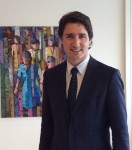
Justin Trudeau, leader of the Liberal Party of Canada, was in Vancouver on April 10, and addressed a roundtable lunch organized by CJPAC. (photo by Cynthia Ramsay)

The Canadian Jewish Political Affairs Committee (CJPAC) hosted a community roundtable lunch on Thursday, April 10, with Justin Trudeau, leader of the Liberal Party of Canada.

“CJPAC seeks to activate the Jewish community in the Canadian political process, and roundtables such as these provide opportunities to build relationships and engage with elected officials from all political parties,” explained Mark Waldman, CJPAC’s executive director, in an email after the event.

“CJPAC is a multi-partisan, national organization that has been active in Vancouver for many years,” he added. As an example of the organization’s work locally, he noted, “Recently in Vancouver, CJPAC hosted an event called Women in Politics, which was attended by more than 30 women. Participants engaged on a personal level with former and current female politicians from a number of political parties and levels of government.”

Thursday’s lunch meeting took place in a boardroom at Blake, Cassels and Graydon LLP downtown. It seemed like a couple of dozen community members were in attendance. As they were leaving, Trudeau spoke briefly with the Jewish Independent before heading to another appointment.

“… I’m glad to say that any government of Canada will be supportive of Israel, not for ideological or political or strategic reasons, but because the values Israel stands for are Canadian values of openness, of respect, of democracy, of equality, and we need more of that, particularly in the tough neighborhood that Israel is in.”

“It went great,” he said about how the roundtable went. “We talked about, obviously, Canada’s support of Israel, which is extremely important to me and the point I made is that I am an unequivocal supporter of Israel. We need a two-state solution of a Jewish state on one side and a Palestinian state. Where I take issue a little bit with the prime minister these days is just that he’s tended to make it a little more of a domestic football, with some people being more supporters of Israel than others, and I’m happy to say that I love the prime minister for his support of Israel and thank Mr. Mulcair for his personal support of Israel as well, and I’m glad to say that any government of Canada will be supportive of Israel, not for ideological or political or strategic reasons, but because the values Israel stands for are Canadian values of openness, of respect, of democracy, of equality, and we need more of that, particularly in the tough neighborhood that Israel is in.”

Domestically, there have been changes made or proposed at the federal level over the years that, in the opinion of some, challenge those very values of openness, respect, democracy and equality, a recent example being Bill C-23, or the Fair Elections Act. When asked to describe his vision of the role of a federal government, Trudeau responded, “First of all, we have to understand that Canada is a federation, not a unitary state, so how we engage with different levels of government as a federal government – partnership with provinces, partnership with municipalities – and understanding the work together that we do as different levels of government all serves the same citizens.

“Giving a government a majority doesn’t give them the capacity to perpetuate themselves indefinitely by tricking the rules; that’s what happens in developing countries, that’s not what’s supposed to happen in Canada.”

“But even within the way Parliament functions,” he continued, “I made a strong commitment last June towards open Parliament, which would mean less whipped votes; open nominations, which would mean no omnibus bills, no misuse of prorogation, a lot more openness, the transparency around online posting of our expenses. Actually, what we announced in June last year then triggered similar announcements from everyone and now all of Parliament is starting to post online, and that was something that we triggered. So, I think when you look at that, when you look at the partisan approach to the Fair Elections Act – which is a very unfair elections act – I’m certainly trying to get the message out to Canadians that we do not need elections to be fixed in advance in favor of the Conservatives, and that’s exactly what’s happening. Giving a government a majority doesn’t give them the capacity to perpetuate themselves indefinitely by tricking the rules; that’s what happens in developing countries, that’s not what’s supposed to happen in Canada.”

With the defeat of the Parti Quebecois on April 7, there is reason to believe that its proposed Charter of Values will also go by the wayside. However, at least some of the sentiment that allowed it to be proposed in the first place – fear over immigration – likely still exists and, over the last few years, more than one European government has called multiculturalism a failure. In light of this, the Independent asked Trudeau what he thought about the future of multiculturalism in Canada.

“Multiculturalism in Canada is about building a diverse, flourishing fabric of a country that is strong, not in spite of its differences, but because of those differences.

“The German model of multiculturalism failed because they brought over temporary workers from Turkey and never allowed them citizenship, didn’t treat them like Germans and, even a few generations in, they never became [citizens]. Multiculturalism in Canada is about building a diverse, flourishing fabric of a country that is strong, not in spite of its differences, but because of those differences.

“And, I’ll say two things on Quebec. First of all, I, as of last fall, spoke very strongly in a number of editorials to Canadians to not get overly worked up about this Charter of Values, to trust Quebecers because Quebecers were not going to accept this, and I was pleased to see them show that on Monday night, and show that very strongly.

“But the second element: it does demonstrate how politicians can twist perceptions, and a lot of Quebecers who initially expressed support for the idea of the charter did so thinking they were sticking up for equality; you know, ‘liberating people from the oppressive yoke of religion,’ because, of course, in Quebec, that’s what happened through the sixties with their Quiet Revolution. But, as soon as people explained to them, no, this is about people having to choose between their religion or their job, Quebecers said, well, that doesn’t work at all, and that’s exactly what we have.”

When asked if he had any final words before the interview ended, Trudeau said, “Just what a pleasure it is to be out here in Vancouver. I had a great conversation with a number of strong members of the Jewish community and, unfortunately, we didn’t have enough time, so I look forward to coming back and doing this again soon.”

Format ImagePosted on April 18, 2014April 16, 2014Author Cynthia RamsayCategories LocalTags Bill C-23, Canadian Jewish Political Affairs Committee, Charter of Values, CJPAC, Fair Elections Act, Justin Trudeau, Liberal Party of Canada, Mark Waldman, multiculturalism, Parti Quebecois, Quiet Revolution
Proudly powered by WordPress