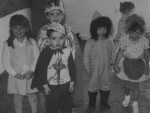
Eitz Chaim students enjoy the dressing-up festivities of Purim, 1989. (photo from JWB fonds, JMABC L.10948)
If you know someone in this photo, please help the JI fill the gaps of its predecessor’s (the Jewish Western Bulletin’s) collection at the Jewish Museum and Archives of B.C. by contacting archives@jewishmuseum.ca or 604-257-5199. To find out who has been identified in the photos, visit jewishmuseum.ca/blog.
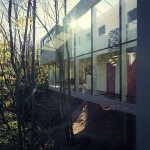
Oberlander Residence II, Vancouver. Peter Oberlander and Barry Downs, architects, 1969. Photograph by Selwyn Pullan, 1970. Courtesy of West Vancouver Museum.
New Ways of Living: Jewish Architects in Vancouver, 1955 to 1975, “focuses on two significant expressions of modernism in the practices of Jewish architects and landscape architects in Vancouver,” explained curator Chanel Blouin at the exhibit’s launch Jan. 28. “First, the integration of the West Coast Modern home into the natural landscape in a way that invites the outdoors in. And, second, in creating home designs that respond to the specific needs and living habits of the family within.”
For her research, Blouin interviewed architect Judah Shumiatcher; architects Kate and Erika Gerson, daughters of the late architect Wolfgang Gerson; University of British Columbia professors emeritus Andrew Gruft and Rhodri Windsor-Liscombe; Leslie van Duzer, head of UBC School of Architecture and Landscape Architecture (SALA) and author of House Shumiatcher; and landscape architect Cornelia Hahn Oberlander, whose late husband, architect Peter Oberlander, is featured in the exhibit, as well.
In addition to the interviews, Blouin traveled to the Canadian Centre for Architecture in Montreal to consult their collections, in particular that on Hahn Oberlander. A highlight of the online exhibit, which can be found at jewishmuseum.ca, is the photography of the houses featured, including photos by Michael Perlmutter, Selwyn Pullan and Fred Schiffer.
“Architecture and the design of cities have always been interests of mine, and I’ve known for awhile that there are and have been members of our community who are or were innovators in these fields,” said Michael Schwartz, coordinator of programs and development at the Jewish Museum and Archives of British Columbia, about the exhibit’s origins. “As we move from theme to theme in each of our exhibits and in each issue of The Scribe, it seemed fitting to turn the lens on this group. Chanel has a footing in architectural history, so when we hired her, this was the topic she was most drawn to. As she progressed through her research, it became clear what era and which individuals to focus on.”
Blouin was hired by the JMABC for the summer of 2015 with support from the Canadian Heritage program Young Canada Works. An extension to the grant allowed her contract to continue through January 2016, said Schwartz, “giving her time to dig much deeper into the topic and produce a more comprehensive result.”
Blouin, a master’s student in art history at UBC, will begin her PhD at University College London in September. “My current research was influenced by my work on New Ways of Living and considers the complex genealogy of the mid-century modern residential designs conceived by the Oberlanders and Wolfgang Gerson,” she told the Independent. “I want to examine how these figures’ exposure to Central European modern art and architecture of the Bauhaus and Werkbund in the Weimar period, as well as their exile and studies at the Architectural Association and the Harvard School of Design with Walter Gropius, influenced their practices in Vancouver.”
About 200 people attended the launch of the exhibit at Inform Interiors. There was a panel discussion between Blouin, Shumiatcher and Windsor-Liscombe; and Hahn Oberlander, the Gersons and van Duzer were in attendance. “There were also representatives from the Jewish Federation, the City of Vancouver and Canadian Heritage, all strong supporters of the JMABC,” said Schwartz.
In his opening remarks, Schwartz noted, “Not only are we very pleased to launch this new exhibit, New Ways of Living, but this week marks the 45th anniversary of the Jewish Museum and Archives of B.C.
“We have with us tonight our founder, Cyril Leonoff, who had the original vision of an organization that would preserve and celebrate the history of Jewish life in B.C…. With a small, dedicated corps of volunteers, Cyril collected documents and carried out oral history interviews with some of our community’s earliest pioneers – people who, in the 1960s, were already in their 80s and 90s.
“From this founding collection, our archives have since grown to comprise over 300,000 photographs, 750 oral history interviews and 300 metres of documents recounting all aspects of the rich 150-year history of our community.”
In the panel discussion, Blouin spoke about the process of developing and curating the exhibit. “I also provided an introduction to the major themes in the exhibit, such as the features of the West Coast style of architecture, site specificity and the important events that introduced Vancouverites to the modernist ethos in the postwar period,” she said. “Rhodri Windsor-Liscombe elaborated further on Jewish involvement in the development of the West Coast Modern home and considered questions of Jewish identity. Judah Shumiatcher shared the story of House Shumiatcher. He described the experience of designing his home and the challenges that the steep slope of the landscape posed as well as the property’s incredible views. We also had a lively Q&A period with many interesting questions from the audience.”
This interaction and excitement is why the JMABC does a launch event. While online exhibits are more cost-efficient and “have no expiry date,” said Schwartz, meaning that researchers around the world will be able to access this material years from now, “there is still value in creating an occasion for people to come together to learn about and celebrate our past. This is why events like the exhibit launch are so important; they give us the chance to dig deeper into the topic and share with our audience a glimpse into the exhibit creation process. This shared experience so essential to museums is generally missing from an online exhibit, hence the need to supplement the exhibit with public programs.”
Blouin said, “One of the most interesting ideas that I hope people will take away from this exhibit is the fact that Vancouver is home to an extraordinary regional style. Many iconic West Coast Modern homes are located in Point Grey and West Vancouver and it’s possible to visit some of them – the West Vancouver Museum provides annual tours. The West Coast style is complex and the Jewish architects who arrived to the city in the postwar period played a prominent role in its development. It’s a fascinating history!”
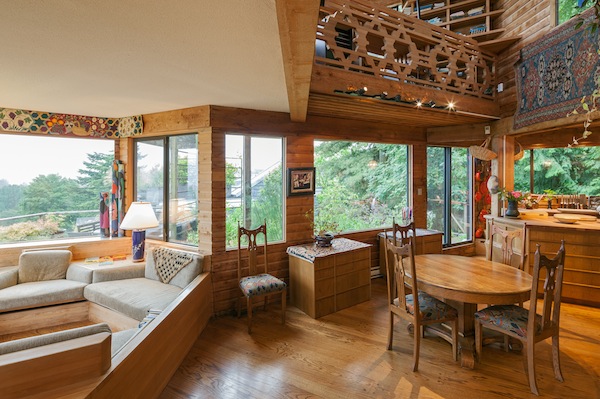
Interior of House Shumiatcher, 2013. Judah Shumiatcher, architect, 1974. Photo by Michael Perlmutter.
The exhibit online, the content of which Blouin wrote, explains that Vancouver “underwent a period of momentous transformation and modernization” after the Second World War. “Returning veterans and new immigrants alike prompted a need for more affordable housing, transportation systems, civic spaces and infrastructure. Between 1940 and 1970, Vancouver required 45,000 new housing units to accommodate the city’s growing population. The city’s expansion was informed by new thinking on improved civic living.”
Blouin explained, “The vibrant art and architecture community that converged around the newly founded School of Architecture at UBC introduced the modernist ethos in Vancouver through various means, including a series of Richard Neutra lectures. The first director of the school, Frederic Lasserre, and B.C. Binning promoted modern architecture in response to the shifting needs of the city.”
The regional domestic architecture of this period “was the post-and-beam house built of locally sourced cedar with wide overhangs and large horizontal windows. Regional West Coast innovations included an exposed timber frame, which allowed for open fluid spaces and immense freestanding ribbon windows oriented toward the picturesque views of the Pacific Northwest landscape.”
While parts of the modernist project will not carry into the future – Marine Gardens, for example, 70 family-sized units designed by Hahn Oberlander and Michael Katz in the 1970s, will be replaced by large residential towers comprising more than 500 units – it will leave a legacy, believes Blouin.
“I think the modernist project has and will continue to inform our thinking about sensitive architecture that responds to both the landscape and the people who inhabit their interiors,” she said. “I hope that New Ways of Living and similar projects, such as the UBC School of Architecture and Landscape Architecture (SALA) West Coast Modern homes book series, will raise awareness about the significance of the West Coast-style homes and the importance of preserving them as they become endangered by escalating land values.”
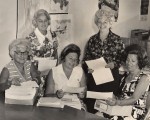
Pioneer Women meeting, circa 1960. Cissie Eppel is sitting second from left. (photo from JWB fonds, JMABC L.12598)
If you know someone in this photo, please help the JI fill the gaps of its predecessor’s (the Jewish Western Bulletin’s) collection at the Jewish Museum and Archives of B.C. by contacting archives@jewishmuseum.ca or 604-257-5199. To find out who has been identified in the photos, visit jewishmuseum.ca/blog.
Women organizing a mail-out for State of Israel Bonds, circa 1960. (photo from JWB fonds, JMABC L.14497)
If you know someone in this photo, please help the JI fill the gaps of its predecessor’s (the Jewish Western Bulletin’s) collection at the Jewish Museum and Archives of B.C. by contacting archives@jewishmuseum.ca or 604-257-5199. To find out who has been identified in the photos, visit jewishmuseum.ca/blog.
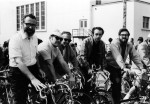
United Synagogue Youth Cycle-athon, Vancouver, 1971. (photo from JWB fonds, JMABC L.09839)
If you know someone in this photo, please help the JI fill the gaps of its predecessor’s (the Jewish Western Bulletin’s) collection at the Jewish Museum and Archives of B.C. by contacting archives@jewishmuseum.ca or 604-257-5199. To find out who has been identified in the photos, visit jewishmuseum.ca/blog.
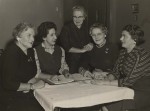
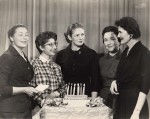
Women gathered around a table with a candled cake, National Council of Jewish Women, circa 1955. Leonore Freiman is in the middle. (photo from JWB fonds, JMABC L.13952)
If you know someone in this photo, please help the JI fill the gaps of its predecessor’s (the Jewish Western Bulletin’s) collection at the Jewish Museum and Archives of B.C. by contacting archives@jewishmuseum.ca or 604-257-5199. To find out who has been identified in the photos, visit jewishmuseum.ca/blog.
Group of B’nai B’rith men, circa 1960. (photo from JWB fonds, JMABC L.12156)
If you know someone in this photo, please help the JI fill the gaps of its predecessor’s (the Jewish Western Bulletin’s) collection at the Jewish Museum and Archives of B.C. by contacting archives@jewishmuseum.ca or 604-257-5199. To find out who has been identified in the photos, visit jewishmuseum.ca/blog.
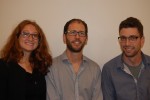
Kara Mintzberg (B.C. regional director of CJPAC), Ron Laufer, centre, and Michael Schwartz. (photo from Jewish Museum and Archives of British Columbia)
With Canada’s 2015 federal election so closely contested, Jewish community organizations continued to the dying days of the long campaign to try to encourage volunteerism and interest in the electoral process. One such point of community engagement was the talk Observing Democracy by Ron Laufer on Oct. 8 at the Jewish Museum and Archives of British Columbia. Presented in conjunction with the Canadian Jewish Political Affairs Committee (CJPAC), the evening was a chance for people to hear about the challenging conditions under which elections run in a variety of countries around the world.
Laufer works as an election observer and administrator. He has administered private elections locally, in the case of court-ordered elections of nonprofit organizations such as the Guru Nanak Sikh Temple, for example. His international experience includes primarily work for the Organization for Security and Cooperation in Europe (OSCE). He has acted as an election analyst, polling station advisor and deputy head of mission for many international elections. Some of these elections were not particularly democratic while others, although complex in their execution, were perhaps surprisingly democratic in their process.
The Afghan election in 2005 was an example of a logistically complicated election. Not only was the concept of democratic elections new, but also a large proportion of the population is both illiterate and isolated in places unreachable by motorized vehicle.
“We used hundreds of donkeys, camels and horses to transport election materials,” said Laufer. The ballots were sometimes seven broadsheet pages on which voters needed to cast seven votes, no more, no less, in order for the ballot to be valid.
Laufer worked on this election on the ground in Afghanistan for six months in order to help educate the population, organize the ballots and the voting, and assess the results afterward. From the slides he showed, another challenge was keeping the election observers safe. “One trip included two international observers, with about 18 others between the interpreters and the security staff.”
Just a sampling of the countries Laufer has visited to help in some fashion with their elections includes Turkmenistan, India, Nigeria, Iceland, Hungary, Kosovo, Uzbekistan, Ukraine, Austria, Tunisia, Malta and Albania. With the exception of Nigeria, these countries are all member states of OSCE. Much of his work as an observer has been for the OSCE, since all member states are required to have observers of their elections. There are 57 states who have signed on to the OSCE, so this keeps Laufer quite busy, considering the length of his missions can range from one week to observe an election day to a long-term mission of up to six months.
Membership in OSCE is, in some cases, a screen for undemocratic states, such as Turkmenistan, and countries like Hungary and Bulgaria, which are becoming increasingly less democratic, said Laufer.
While he offered many examples of countries in which elections are no more than a show put on by the ruling dynasty, he also gave examples of countries whose systems seem to be improving. His fairly recent trip to Sierra Leone was a bright spot. He said, “They went through hell and back and now it feels like they are moving forward. Their election was fairly smooth.” He acknowledged that elections are only a small part of democracy but said that, without properly run elections, democracy cannot be achieved.
After Laufer answered questions from the floor, Michael Schwartz, JMABC coordinator of programs and development, gave a short presentation that was followed by Kara Mintzberg, B.C. regional director of CJPAC, who spoke briefly on the ways in which Jewish Canadians can “punch above our weight” in an election.
As a community, she said, we represent only 1.1% of the Canadian population and are spread out all over the country; only five percent of all ridings in the federal election were potentially influenced by a concentration of Jewish population in those areas. In general,
CJPAC encourages members of the community to volunteer, and facilitates the introduction of a volunteer who signs up with CJPAC to the volunteer’s choice of campaign, thus alerting the candidate to the participation and interest of a Jewish volunteer. This knowledge, it is hoped, will make the candidates more aware of the Jewish and/or pro-Israel presence and support in his or her riding.
Among CJPAC’s activities leading up to the Oct. 19 federal election was an all-candidates meeting on Oct. 1 at Beth Israel Synagogue with more than 500 in attendance. CJPAC’s mission of fostering Jewish and pro-Israel political leadership is not limited to election time.
For more information on the JMABC, visit jewishmuseum.ca. To become involved in political advocacy through CJPAC, visit cpjac.ca.
Michelle Dodekis a freelance writer living in Vancouver.
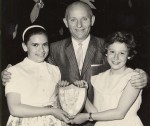
Man with two girls holding a plaque, Peretz School, circa 1965. (photo from JWB fonds, JMABC L.14084)
If you know someone in this photo, please help the JI fill the gaps of its predecessor’s (the Jewish Western Bulletin’s) collection at the Jewish Museum and Archives of B.C. by contacting archives@jewishmuseum.ca or 604-257-5199. To find out who has been identified in the photos, visit jewishmuseum.ca/blog.
The new Jewish Museum and Archives of British Columbia website, jewishmuseum.ca.
The Jewish Museum and Archives of British Columbia has launched its revamped website, unveiling a new look for the organization, simplifying navigation and making it easier for users to engage with the museum’s diverse programming and to access the holdings of the B.C. Jewish community archives.
The website, jewishmuseum.ca, features a contemporary design. Implementing the archives database system Access to Memory (AtoM), the new site gives researchers access to thousands of documents, photos, audio and video items documenting the 150-year history of Jews in British Columbia.
“For the first time in the history of the JMABC, we have the capability of providing online access to the treasures in the archives, while at the same time adhering to important archival standards,” said archivist Jennifer Yuhasz. “We are excited to join the vast community of professional archives already using AtoM, including UNESCO, World Bank Group Archives, Library and Archives Canada, and most of the provincial, municipal and university archives and libraries across B.C.”
Selections from this archival collection are presented in the form of online exhibits recounting specific themes and events in community history. Exhibits will be added each year.
The production of the new site was made possible through the support of the Betty Averbach Foundation, the Jewish Community Foundation of Greater Vancouver, numerous private donors and the more than 100 contributors to the JMABC’s 2014 Indiegogo campaign. Its launch follows the introduction of a new graphic identity for the museum and archives, designed by local graphic design firm Adria Consulting, which also redesigned the website.
Important elements of JMABC’s new look include a new wordmark, new typography, a palette of vibrant colors and a suite of facet shapes drawn from the Star of David. Together, these elements celebrate the diversity of B.C. Jewish history and the innovative spirit of JMABC, and they will be implemented throughout all of JMABC’s print and online materials, unifying the organization’s public presence as never before. The public were given their first taste of the new identity at the recent JMABC exhibit, Fred Schiffer: Lives in Photos, presented this spring as part of the Capture Photography Festival.
“Our new look reflects the exciting work we are doing, always seeking new ways to share our community’s rich history with everyone,” said Michael Schwartz, JMABC’s coordinator of programs and development. “Adria understood this immediately and devised an identity that boldly conveys our core principles.”
JMABC is dedicated to the collection and sharing of community memories of Jewish life in British Columbia. With 300 linear metres of textual records, 300,000 photographs and 725 oral history interviews, it chronicles all facets of the community’s history.