Skip to content
  • Home
  • Subscribe / donate
  • Events calendar
  • News
    • Local
    • National
    • Israel
    • World
    • עניין בחדשות
      A roundup of news in Canada and further afield, in Hebrew.
  • Opinion
    • From the JI
    • Op-Ed
  • Arts & Culture
    • Performing Arts
    • Music
    • Books
    • Visual Arts
    • TV & Film
  • Life
    • Celebrating the Holidays
    • Travel
    • The Daily Snooze
      Cartoons by Jacob Samuel
    • Mystery Photo
      Help the JI and JMABC fill in the gaps in our archives.
  • Community Links
    • Organizations, Etc.
    • Other News Sources & Blogs
    • Business Directory
  • FAQ
  • JI Chai Celebration
  • JI@88! video

Recent Posts

  • Sharing her testimony
  • Fall fight takes leap forward
  • The balancing of rights
  • Multiple Tony n’ Tina roles
  • Stories of trauma, resilience
  • Celebrate our culture
  • A responsibility to help
  • What wellness means at JCC
  • Together in mourning
  • Downhill after Trump?
  • Birth control even easier now
  • Eco-Sisters mentorship
  • Unexpected discoveries
  • Study’s results hopeful
  • Bad behaviour affects us all
  • Thankful for the police
  • UBC needs a wake-up call
  • Recalling a shining star
  • Sleep well …
  • BGU fosters startup culture
  • Photography and glass
  • Is it the end of an era?
  • Taking life a step at a time
  • Nakba exhibit biased
  • Film festival starts next week
  • Musical with heart and soul
  • Rabbi marks 13 years
  • Keeper of VTT’s history
  • Gala fêtes Infeld’s 20th
  • Building JWest together
  • Challah Mom comes to Vancouver
  • What to do about media bias
  • Education offers hope
  • Remembrance – a moral act
  • What makes us human
  • המלחמות של נתניהו וטראמפ

Archives

Follow @JewishIndie
image - The CJN - Visit Us Banner - 300x600 - 101625

Tag: Israel

Prize winners tour Canada

Prize winners tour Canada

Filmmakers Aleeza Chanowitz, above, and Prague Benbenisty will be in Vancouver for the Sir Jack Lyons Charitable Trust Film Prize and to help the Jerusalem Foundation celebrate its 50th anniversary. (photo from Vancouver Jewish Film Centre)

Two up-and-coming Israeli filmmakers are bringing their films – and themselves – to Vancouver this month.

The Sir Jack Lyons Charitable Trust Film Prize event, being presented on May 16 at the Rothstein Theatre by the Jerusalem Foundation of Canada with the Vancouver Jewish Film Centre and Chutzpah!PLUS, will feature a screening retrospective and the 2016 winning films, followed by a question-and-answer period with the Jerusalem filmmakers, Aleeza Chanowitz (Mushkie) and Prague Benbenisty (Blessed).

The Lyons Prize is awarded annually to two students from Jerusalem film schools. There is a monetary component to the prize and the jury-selected students are also invited to present their films at the Israeli Film Festival in Montreal and other festivals in Canada. “By traveling to Canada and being introduced to established film industry professionals,” reads the prize material, “the award winners are given an important stepping stone in their creative and professional development.”

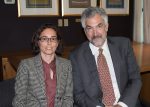
photo - Prague Benbenisty
Prague Benbenisty (photo from Vancouver Jewish Film Centre)

Chanowitz and Benbenisty have presented their films in Jerusalem, and Chanowitz’s Mushkie premièred at this year’s Berlin Film Festival. They started their time in Canada in Montreal, and also presented their work in Toronto. During their stay in Vancouver, the filmmakers will tour Emily Carr University’s 3-D film-capture and virtual reality projects, as well as visit studios.

“I’ve had a couple of face-to-face meetings, a ton of phone calls and emails with Nomi Yeshua since mid-November 2015,” said VJFC executive director Robert Albanese about planning the event. Yeshua, who grew up in Vancouver and made aliyah about 25 years ago, heads the Canada Desk of the Jerusalem Foundation. The May 16 event will also celebrate the foundation’s 50th anniversary.

“Nomi had the plan to bring the winning filmmakers to Canada and I was totally on board to make this happen,” said Albanese.

As for Chutzpah!PLUS, Mary-Louise Albert, who runs the annual Jewish performing arts festival, and Albanese have been running a cooperative series of films for the past two years, so she, too, was on board to co-present, he said.

“We’re looking forward to engaging the whole community, especially young adults,” said Albanese. There is no charge to attend the event. At the reception, Yeshua will make a brief introduction, and then attendees will move into the Rothstein.

“I’ll be making a selection of past year’s winning short films and screening those,” said Albanese, “then bringing up this year’s winners to the stage and, after some brief words, screening both of their films and bringing them back up to the stage for a talkback.”

Both Chanowitz and Benbenisty began their studies at the Sam Spiegel Film and Television School in 2012, and wrote and directed their respective films in their third year of study. Chanowitz, who was born in Brooklyn, made aliyah a couple of months after receiving her bachelor’s degree; Benbenisty was born in Tel Aviv. Their films are very different, in part because of their differing geographies.

Chanowitz’s Mushkie, which runs just over 12-and-a-half minutes, is a day (or two) in the life of two recent olim (immigrants) from the United States, best friends Mushkie and Sari. Chanowitz plays the title character, who is secretly exploring life outside of the boundaries of her religious upbringing, and gets into a little trouble while doing so. Chanowitz’s sense of humor shows not only in the film, but in the credits, where she thanks, among many others, her parents, who, she writes, “… I hope will continue to support me, but never see my work.” Given Mushkie’s sexual explicitness, the sentiment is understandable.

Benbenisty’s 15-minute Blessed offers viewers a glimpse into Sephardi – specifically Moroccan – culture in Israel. While in the biblical story, it is the younger Jacob who steals older brother Esau’s blessing from their father, in Blessed, it is the older, overlooked and unmarried sister, Zohara, who steals – at least initially – from her soon-to-be married younger sister the blessing that is given to all brides before their wedding day. The blessing gives Zohara the ability to see the love that has always been around her, and changes not only her relationship with her sister, but herself.

And there is more to this short film. In attempting to catch Zohara’s attentions, a shy but determined suitor recites to her a poem, “Zohra Al Fassiya,” by Erez Biton. Al Fassiya (1905-1994) was a well-known and popular Jewish Moroccan singer who, when she had to leave her home country, emigrated to Israel in 1962. She fell into anonymity and represents the negation of Sephardi culture by the Ashkenazi majority in Israel until recent years. That Blessed’s Zohara hears and is affected by this poem adds significant meaning to this short film.

The Sir Jack Lyons Charitable Trust Film Prize event starts at 7 p.m. on May 16 in the Zack Gallery.

Format ImagePosted on May 6, 2016May 5, 2016Author Cynthia RamsayCategories TV & FilmTags Benbenisty, Chanowitz, Chutzpah!Plus, Israel, Jerusalem Foundation, Vancouver Jewish Film Centre
Helping those at risk

Helping those at risk

Shai Lazer, chief executive officer of Youth Futures, an organization that aids Israel’s at-risk youth. (photo from Shai Lazer)

Earlier this year, Shai Lazer, chief executive officer of Youth Futures – a program supported by the Jewish Federation of Greater Vancouver’s annual campaign, among others – visited Vancouver.

A leader in the Israeli youth-outreach movement, Lazer describes himself modestly.

“I am 36 years old, married with three kids, living in Modiin,” he told the Independent. “My hobbies are reading, traveling around the country and sports. My military service was very meaningful, as was studying in university at the Mandel Institute.”

Lazer’s modesty is deceiving, as he presides over a national organization with outposts in 36 Israeli communities.

Youth Futures endeavors to help vulnerable children, their families and their communities cope with the painful and/or challenging aspects of their daily lives. Started in 2006, Youth Futures works with all demographics of Israeli society, including every manner of Jew, Arab, Bedouin and Druze. Working with more than 12,000 people throughout Israel, Youth Futures designates around 300 professional “mentors” to facilitate the majority of the organization’s outreach. Ultimately, Youth Futures’ mission is “to give every at-risk child in Israel’s geographic and social peripheries the confidence, opportunities and skills to realize their inherent potential.”

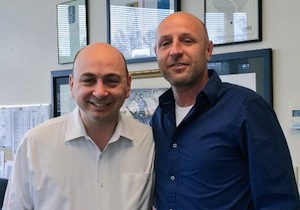
photo - Shai Lazer, right, with Jewish Federation of Greater Vancouver chief executive officer Ezra Shanken
Shai Lazer, right, with Jewish Federation of Greater Vancouver chief executive officer Ezra Shanken. (photo from JFGV)

But, as Lazer explained, the organization is continually expanding. On his mid-March visit to Vancouver, he spoke with his Canadian counterparts about the direction in which Youth Futures and similar organizations are heading.

“I was received incredibly well,” said Lazer. “I felt there was a real and honest dialogue about what’s currently happening in the field, future endeavors, and meaningful conversation in private and in groups. All in all, the main feeling was that of partnerships.”

Lazer is no stranger to partnerships. Under his direction, Youth Futures’ Kiryat Shmona branch currently benefits from Vancouver (22%), the Jewish Agency (35%), the Ministry of Education (38%) and the local municipality (5%) in partnerships and investment. The organization has grown dramatically since Lazer became director of the program in 2008, and even more since he became CEO. One of his achievements has been securing more government financial backing.

Lazer became a part of Youth Futures when he was in university.

“The program was just started while I was in the second year of my studies in Mandel Institute,” he said. “I was approached to join the staff. I remember thinking that it was an interesting educational concept, and was drawn to the newness – the opportunity to create something new and redefining our approach to helping at-risk children.”

Youth Futures uniquely uses the model of having a mentor reach out to the youth and families in their national outposts. Lazer believes that the idea of the mentor is the key to the success of the organization.

“I define a professional mentor by their ability to learn,” he said. “To be able to stop, have some personal reflection and increase their learning curve – that and passion. Youth Futures chooses this model because it’s the only thing that works.”

Youth Futures has the statistics to show its effectiveness. For example, 78% of the youth showed increased self-confidence and ability to cope and 74% showed improved social skills; its alumni have a negligible school drop-out rate and 84% of them have shown the higher motivation required to qualify for more elite army units or to perform civil service. Lazer maintains that such positive numbers are directly because of Youth Futures’ role in these children’s lives.

“I think it’s because someone believed in them,” he said. “When someone believes in you, your confidence grows and you want to become part of the community. It gives you a sense of responsibility over the world you live in.”

Lazer is adamant that his organization’s model could be used in other countries to help at-risk children and the families and societies that surround them. And Youth Futures is actively looking to expand into North America.

Building on his organization’s momentum, and the foundation of 10 years of solid community outreach, Lazer believes the next decade for Youth Futures will be busy and successful.

“Ten years from now, Youth Futures is still here, constantly expanding to more communities and to new populations – early childhood and high school,” he predicted. “We’re currently in the midst of planning the celebrations of 10 years of Youth Futures and launching the next decade. We’re working on a ‘journey book,’ which will include interviews and showcase all different localities, a film, a big national event to celebrate with our participants and their families, a professional seminar, a reception to be held at the General Assembly of the Jewish Federations of North America in November, and many more. We’re also launching two new initiatives, expanding into intervention with early childhood parents, as well as starting an organization to help our alumni. It’s an exciting time and we’re looking forward to many new things coming our way.”

Jonathan Dick is a freelance writer living in Toronto. His writing has appeared in the Canadian Jewish News, and various other publications in Canada and the United States.

Format ImagePosted on May 6, 2016May 5, 2016Author Jonathan DickCategories IsraelTags at-risk youth, Israel, Lazer, mentorship, tikkun olam, Youth Futures

Talking about Israel as a family

Sixty-eight years ago, when Israel was born and became the state of the Jewish people, a family was created. As with any other family that has a complex history, there is love and arguing, support and fallings out in the Israel mishpacha. To make things trickier, Israel is what we would call a blended family, whose members come from wildly varying geopolitical, socio-cultural, ethnic, religious and linguistic backgrounds.

This variety makes for a richness you would be hard-pressed to find elsewhere – the intensity and vigor of which those visiting or missing Israel so often speak. However, the blended Israeli family is fraught with tensions brought about by both the baggage each member has and the difficult neighborhood in which they live. Because Israel is the only Jewish state in the world – our only “family home” – each discussion about it feels of utmost consequence, even to Israel’s extended family of Diaspora Jews, who feel strongly about their connection to that familial home and the relatives living in it.

Not long ago, the announcement that singer Achinoam Nini (Noa) had been invited to perform at our community’s Yom Ha’atzmaut celebration on May 11 set in motion a heated debate about where we draw our red lines when it comes to criticizing Israel. The Jewish Federation of Greater Vancouver made a decision to welcome Noa despite the objections of individuals who disagree with the artist’s political views, and Ezra Shanken, JFGV’s chief executive officer, expressed his hope that our community would continue the Jewish tradition of welcoming diversity of opinion and embracing respectful debate. As we celebrate Israel’s 68th birthday, I think it would be worthwhile to take a look at how our blended family handles conflict and disagreements when they arise from within, and do a little cheshbon nefesh, soul searching, about how we each might be contributing both to the family’s well-being, as well as to internal friction and divisiveness.

With Israel, we so often focus on the external conflicts, sometimes at the expense of looking at what is happening in our own backyard, and this is something we cannot afford to do any longer. For our blended family to thrive and prosper, it is not enough anymore to stand united against enemies. The strength of a tight-knit family depends less on the extent to which its members agree on every issue, and more on how they communicate their disagreements and live with differing points of view under one roof. We all share a moral obligation to set an example for the children and youth in our community, and show them that the Israeli family of which they are a part is strong and confident enough to welcome and even encourage different opinions and points of view.

So, how do we have disagreements and important discussions without engaging in the kind of destructive behavior and accusations that tear at our familial fabric? Is it possible to have difficult conversations from a place of mutual respect, even when we don’t see eye to eye? I speak from experience when I say that, while not easy, it is, in fact, possible. I have friends from across the political, national and religious spectrums, and I cherish the ongoing, sometimes challenging, conversations I have with them about Israel. With those conversations in mind, I would like to offer a few points to consider and some basic strategies I have found helpful when discussing Israel.

We have something important in common. Whenever you engage in a discussion with a fellow member of the tribe who holds different opinions about Israel than you do, remember that you wouldn’t be having that difficult conversation if it weren’t for the fact that you both care enough about Israel to take the time and argue. If you are not sure this is the case, ask the person a simple question: Do you care about Israel? If they answer yes, then, as surprising as it may sound, you have some common ground – a starting point for a respectful exchange of ideas. It is not always comfortable to accept that someone who holds a political view we disagree with comes, as we do, from a place of caring about Israel. But that is a discomfort we should learn to lean into and work with if we want to help foster within our community the democratic value of free speech – the same value that sets Israel apart from other countries in the Middle East.

Respond rather than react. Yes, there is a difference between the two. When we react, we re-act specific lines, roles and dialogues, just as a well-rehearsed actor in a long-running play would do. Unsurprisingly, reaction-based discussions usually feel like rather irritating déjà vus. When we respond, we do so from a sense of responsibility (response-ability): we know that we are not merely actors with memorized lines, and that we have the freedom to improvise, to choose to keep an open mind in those conversations where our default mode is to be judgmental, get defensive or go on the offensive.

Next time someone says something about Israel that makes you want to yell at them, “You have no idea what you’re talking about!” or “How can you say something like that?!” ask instead “Can you tell me more about what you just said?” It won’t feel natural at first because improv moves us out of our comfort zone. Nevertheless, try it. Be curious. We all have a human need to be heard and we all know how unpleasant it feels when our words are ignored or dismissed. Really hearing someone out is a beautiful, positive way to practise what Rabbi Hillel believed to be the essence of the Torah: what is hateful to you, do not do unto your neighbor.

Respect the importance of our personal histories. So much of who we are, what and how we think and how we feel about any given issue is a result of our personal history. When and where we were born and raised, our family’s past, our religious background, the influential people and key experiences in our lives – all of these and more also contribute to how we relate to Israel. If we understand that each one of us has such a personal history that affects our worldviews and that these histories differ from person to person, we move a step closer to accepting that it is inevitable for a variety of opinions about Israel to exist within our community. Once we accept this truth, we can choose to find it in ourselves to treat with respect even those with whose opinions we disagree.

In Hebrew, the words kavod (respect), kibud (honoring/acknowledging) and koved (weight/difficulty) all stem from the same root. Truly respecting “the other” and acknowledging from where they come and their right to hold different opinions to ours can, indeed, feel difficult and burdensome at times. Yet, if we want to help create a strong community that honors the histories and diversity of all its members, we should view this effort to respect the other as a blessed weight that we choose to carry, like that of an unborn child.

If you are a regular reader of the Jewish Independent, it is safe to assume that you, too, care about Israel. As we celebrate Israel’s birthday this year, I invite you to envision the kind of legacy or family heirloom we want to leave for the next generations in our community. In my mind, I see a vibrant, warm, colorful, imperfect and unique patchwork quilt to which each of us can add a symbolic piece of ourselves as the dialogue about our beloved Israel continues to unfold. What is your vision? And what are you willing to do to make it a reality?

Pirkei Avot (Ethics of Our Fathers) teaches us that “it is not upon us to complete the work, but that neither are we free to desist from it.” Our work as fellow members of the extended and blended Israeli family is to do tikkun olam (repair of the world). And tikkun olam begins with us, at home and in our community. So, in our conversations about Israel, let us all commit to being a bit more curious and a little less judgmental. Let’s treat one another with kavod and remember that the strength of our family is directly proportionate to our ability to be kind to one another.

Yael Heffer is an educator who has been working with children and families in the Vancouver Jewish community for close to 10 years. She is currently completing her master’s in child and youth care, is involved in social emotional learning research and is training as a clinical counselor. She grew up in South America, Germany and Israel and is a strong advocate of nonviolent communication.

Posted on May 6, 2016May 5, 2016Author Yael HefferCategories Op-EdTags Diaspora, free speech, Israel, Noa, tikkun olam, Yom Ha'atzmaut

Increasing organ donations

Leading up to the provincial election in Manitoba in April, activists, family members of organ recipients and those waiting for organs pushed the topic of organ donation as an election issue. They reached out to many prominent people to help them spread their message, including Prof. Arthur Schafer, founding director of the Centre for Professional and Applied Ethics at the University of Manitoba.

The centre’s purpose is to promote research specifically in applied ethics across different professions, such as medicine, engineering, pharmacy and nursing. Schafer further described it as “ethics as it applies to controversial, moral, social and political issues in society.”

Organ donation, while supported by most segments of the population, has been an issue with which many countries struggle. As there is most often a gap between supply and demand, some countries are coming up with new ways to tackle the problem.

photo - Prof. Arthur Schafer
University of Manitoba’s Prof. Arthur Schafer. (photo from Arthur Schafer)

“Israel used to have just about the lowest organ donation rate of all the Western countries,” said Schafer. “So, historically, and rather embarrassingly, more people died waiting for an organ donation in Israel than anywhere else.”

According to Schafer, the lack stemmed from the common misconception that Jewish law prohibits organ donation.

“But, the very low donation rate in Israel changed after a new law was passed in 2008,” he said. “The new law gave priority [to certain people]. It was still true, after the new law was passed, that medical need was the most important criteria. Someone faced with imminent death would have priority over someone whose need was less urgent but, when patients had comparable need, the 2008 law gave priority to those who’d signed an organ donor card or whose family had donated an organ.”

The policy was nicknamed, “Don’t Give. Don’t Get.” Schafer said what this meant was that, if someone, for religious or other reasons, would not sign an organ donor card, they might end up dying themselves as a result of having a lower priority on the list of waiting patients.

“I suppose it’s the dual moral justification … first of all, a principle of justice or fairness,” said Schafer. “If you aren’t willing to give, you don’t deserve, you could argue, it’s not fair for you to take when you’re not willing to donate.

“Then, there’s also the principle of maximizing benefit, because this law seems to have resulted in saving many lives – which, according to Jewish law, is supposed to be of the highest priority. Jewish law says that saving a life is more important than anything else. Yet, many Orthodox Jews refuse to sign an organ donor card.”

Schafer said that, while the supply gap in Israel is still significant, it has narrowed dramatically since the passage of this new law.

Meanwhile, in Canada and its provinces, there is no priority given at present to those who sign an organ donor card.

As for the current local situation, the Province of Manitoba has passed a law – called Required Consideration – that requires physicians to consider whether someone dying or near death is a suitable candidate for organ donation, and to ask them or the family about donating.

Other provinces, like Ontario and British Columbia, have taken it a step further, passing a law known as Required Request. Doctors must discuss organ donation with dying patients. In both of these provinces, doctors can take themselves out of the process by alerting an organ donation coordinator to the situation.

“Many physicians are quite squeamish about the topic, by the way, especially when a younger person has died tragically in a car accident,” said Schafer. “Their organs might be a potential source of numerous healthy organs that could save lives but doctors feel, due to the severe family grief resulting from the death of a young person, that they don’t want to add to the burden by asking for an organ donation. That’s a fairly understandable reaction. But, I think it’s profoundly wrong. I think that, if your child has died in an accident or suffered from an untimely death, the family might welcome the opportunity to make something morally significant by agreeing to have other lives saved through organ donation. I think many people actually feel this way and that doctors who are reluctant to ask the families about it are depriving them of an opportunity.”

Schafer went on to say that, in many provinces, there is a big push to change the system of organ donation so that it would be a choice of opting out as opposed to one of opting in. The current situation is that, if you do not tick the box or tell your family you want to donate, your organs will not be harvested. Schafer contends that reversing the onus is a good option, as it still gives individuals a choice, but they have to choose not to do it rather than to do it.

“Many European countries have adopted opting-out systems, such as Spain,” he said. “Their donation rates have gone up considerably.”

Another option Schafer suggested is to tweak the compensation system for doctors, giving them further incentive to talk to people about organ donation when there is not the option of referring the matter to an organ coordinator.

“Many people die in community hospitals, nursing homes or in their own homes,” he said. “The family doctor, rural doctor or community hospital doctors are often unwilling to take the time filling out the forms to arrange for organ donation. I think the medical profession itself has been a big impediment to an increase in cadaveric organ donation.

“If you’re in a teaching hospital where transplant operations are occurring, you’re more likely to approach the family or individual and arrange organ donation,” he continued. “If you’re in a community hospital, it takes time. You have to fill out forms, you have to speak to people, and you’re not reimbursed. I think part of the solution to the dramatic gap between the supply and demand for organs requires a change in the medical profession itself or making it a requirement for doctors.”

The possible downside to a change in the compensation system for doctors, however, is to ensure that they still do all they can to save a patient.

For information on becoming an organ donor in British Columbia, visit transplant.bc.ca/be-donor.

Rebeca Kuropatwa is a Winnipeg freelance writer.

Posted on May 6, 2016May 5, 2016Author Rebeca KuropatwaCategories WorldTags Canada, halachah, Israel, Jewish law, organ donation, transplant

The story of Miriam Peretz

Those of us who live and work in Israel as journalists and book reviewers for international publications often have to wait until an Israeli bestseller is translated from Hebrew into English. I, for one, am very excited when this occurs, and especially for a biography like Miriam’s Song: The Story of Miriam Peretz (Gefen Publishing House, 2016) by Smadar Shir.

book cover - Miriam’s SongShirat Miriam was published in Israel in 2011 and became a bestseller, with more than 20,000 copies sold. It is Peretz’s story, as recounted to Shir, who is a prolific author and composer, as well as a senior journalist at the newspaper Yedioth Ahronoth.

Peretz was born in Casablanca, where her family lived until she was 10 years old. In 1963, they immigrated to Israel, initially living in an immigrant camp in Beersheva. After graduating high school, Peretz went to Ben-Gurion University and became a teacher.

When she was 21, she met Eliezer Peretz, who was 31, also Moroccan. They married, and he returned to his work in Sharm el-Sheikh. She eventually joined him there, until the city was evacuated. Meanwhile, she began teaching, and they started their family, ultimately having six children.

In November 1998, Uriel, their 22-year-old son, a Golani (special forces) officer was killed in Lebanon, while in the army. Peretz kept going.

“My husband was overcome with sadness and wouldn’t go to work, but I had no choice but to continue functioning,” she says.

Peretz got a master’s degree in educational administration. Her second son joined the army, while she and her husband continued processing their grief for Uriel. She began visiting schools and military bases to talk about her son.

In 2005, her husband died – only 56 years old. And then, in March 2010, her son, Eliraz, married with four children, was killed while in the army.

In December 2010, then-Israel Defence Forces Chief of General Staff Lt.-Col. Gabi Ashkenazi awarded her a medal of appreciation. He said: “Miriam’s ability to continue to express her deep pain and channel it into a contribution to the education and formation of future generations, serves as an example and model of inspiration for us all.”

The next chapters of Miriam’s Song are told by each of Peretz’s four surviving children.

Miriam left her principal position after 27 years to become a Jerusalem district supervisor with the education ministry. After Miriam’s Song was published in Hebrew, Peretz began to travel to the United States for the organization Friends of the Israel Defence Forces. In 2014, she was a torchbearer on Israel Independence Day.

For a feature on International Women’s Day this year in the Jerusalem Post, Peretz was interviewed and photographed along with two other mothers who had each lost a son. Journalist Tal Ariel Amir writes, “these three courageous women have risen from the ashes of their despair.”

People ask what it is like to live in Israel. Although Miriam’s Song is replete with courage, faith and commitment, it is also about tragedy and sacrifice. It is a book to read to understand what it means to be a woman, a wife, a mother in Israel today.

Sybil Kaplan is a journalist, foreign correspondent, lecturer, food writer and book reviewer who lives in Jerusalem. She also does the restaurant features for janglo.net and leads weekly walks in English in Jerusalem’s market.

Posted on May 6, 2016May 5, 2016Author Sybil KaplanCategories BooksTags army, conflict, IDF, Israel, Miriam's Song, Mother’s Day, Peretz, Smadar Shir
Anti-tunnel technology

Anti-tunnel technology

(screenshot of IDF Twitter page via israel21c.org)

Smugglers of drugs and illegal migrants using tunnels along the U.S.-Mexico border may want to keep an eye on Israel. The American government, after all, is co-sponsoring the tunnel-detection technology now being developed by Israeli engineers.

Described by the Hebrew media as the underground equivalent of Iron Dome anti-missile defence system, this latest innovation made world headlines upon the announcement that the Israel Defence Forces (IDF) uncovered a two-kilometre-long, concrete-lined tunnel on Israel’s Gaza border.

While the Israeli government has been funding its development for five years, few details about the new system have been reported until now. News reports say that up to 100 companies – including Iron Dome’s developers, Elbit Systems and Rafael Advanced Defence Systems – are involved in assembling the detection system. Military units, Shin Bet security agency officers, civilian engineering, infrastructure contractors and tunnel construction experts are also credited with helping.

“The search for tunnels is at the top of our priority list … and we will not spare any efforts,” said Defence Minister Moshe Ya’alon, following the IDF announcement that it found a tunnel extending from southern Gaza into Israeli territory.

The fine details about how the anti-tunnel technology works are still under wraps but, according to Yedioth Ahronoth, dozens of Israeli-developed sensors gather information from the field and transmit it to a control system for analysis using advanced algorithms. The system, says the report, can identify the length of the tunnel and its exact location without false alarms.

“We do whatever we can to find a technological solution,” Maj. Gen. Nitsan Alon, head of the IDF operations directorate, said at a briefing. “Dealing with the phenomenon of tunnels is very complex, and the state of Israel is a world leader in this field. This battle demands from us persistence, creativity, and also responsibility and good judgment.”

According to a report in Defence News, Israel’s Ministry of Defence has invested more than $60 million in anti-tunnel technologies. In February of this year, the Financial Times reported that the United States will provide $120 million over the next three years to help develop complementary technologies.

An Israel Today report says Israel is building a counter-tunnel barrier along its Gaza border that “will also feature a state-of-the-art fence, complete with sensors, observation balloons, see-shoot systems and intelligence gathering measures, as well as an underground wall.”

A video of the IDF discovering a Hamas tunnel in southern Israel can be found at youtube.com/watch?v=yETrQXh2FZU.

Israel21C is a nonprofit educational foundation with a mission to focus media and public attention on the 21st-century Israel that exists beyond the conflict. For more, or to donate, visit israel21c.org.

Format ImagePosted on May 6, 2016May 5, 2016Author Viva Sarah Press ISRAEL21CCategories WorldTags defence, IDF, Israel, security, smuggling, technology, tunnels
Jewish dating app fills gap

Jewish dating app fills gap

Shapira began piloting JFiix in Israel a couple of years ago and it was launched recently in the United States and Canada with an English version. (screenshot)

In 1996, at a time when not everyone had a home computer, Joe Shapira started a dating website – JDate. Today, very few people in the Jewish community have not heard of it. Since its inception, it has been embraced by Jews around the world.

“When I started in the online dating business, I was one of the pioneers of this business on the internet,” Shapira told the Independent. “And I never anticipated it would become such a big business.

“There were a few other dating sites when I started. I hired the programmer and we launched the very first dating site where you could define your preferences. We started marketing and it took off like a fire.”

Shapira was living in Los Angeles at the time. From a conversation with a friend about the difficulty of meeting other Jews in a place where the majority of people are not Jewish came the idea of JDate. Shapira wanted to help Jews meet other Jews, reduce the rate of intermarriage and help ensure Jewish continuity.

Born in Tel Aviv, Shapira went to a technical high school before serving in the army. After he finished his army service, he became an entrepreneur. Four years later, he moved to Los Angeles, where he stayed for some 30 years before moving back to Israel several years ago to spend more time with his kids.

“I think that people, in general, adapted well to the internet dating world,” said Shapira. “It’s a very highly used internet service. I think, in the Jewish community, the need was there. You live in a certain community and, pretty much by the time you’re 25, your connection – whether it’s your mother, grandmother or through mutual friends – we’re expected to meet a Jewish mate there. It’s ingrained in us. But, sometimes, you just exhaust your ability.

“The internet became more and more [popular and] … the style of work that most people do [changed]. You used to meet more people at work and talk to people on the phone. Now, you don’t even go out to the stores to a certain extent. Instead of telephones, we use email or texting. The lifestyle of people created less interaction with others and the Jewish community had a distinct need.”

Although, technically, Shapira launched JDate in Los Angeles, he was quick to point out that it has always been accessible around the world. In fact, the first marriage through a JDate interaction was in Caracas, Venezuela.

“If you are single and looking and you found JDate somehow, you’re going to tell your friends,” said Shapira. “We Jews are a close-knit community. I loved JDate, because of my concern for Jewish continuity, but I left the company in 2006, before smartphones and Facebook.”

Over the last few years, Shapira has been noticing a gap in communication that computer-based sites are still struggling with – that younger people do all their communication via smartphones, not on laptops or in front of computer screens.

“Millennials use the smartphone more than desktop computers,” said Shapira. “You go to work and you have a desktop computer. You work on your laptop at home. Unless you are in your 20s … then, you use your iPhone for everything.”

Internet dating is “a lifestyle thing,” he said. For someone in their 20s, “online dating is like emailing or texting – very natural. When I started JDate 20 years ago, it was not completely natural. In Israel, it took awhile before it caught on.”

Because Jewish online dating sites were not adapting well to mobile phones, Shapira found that millennial Jews were going to non-Jewish sites and this raised again his concern for Jewish continuity. Hence, he started JFiix.

“If you look at the landscape, you have Tinder on one end of the spectrum and the hookup app,” said Shapira. “And then you have apps like JDate or Match.com that are just a smaller [version] of a website.

“One of the big advantages of having an app is you’re always available. You remember JDate – if you wanted to contact someone, you sent them a message and then it took them two to five days to reply. With a mobile, if a woman contacts you, you decide in seconds.”

Shapira began piloting JFiix in Israel a couple of years ago and it now has about 250,000 users. It was launched only recently in the United States and Canada with an English version.

“We are at the stage of acquiring the user base and marketing,” said Shapira. “I think it will be another four months before [we reach] a critical mass of users.”

Shapira promises to wow users with the app’s complex technology, which includes a matchmaker feature. “The matches we select for you are based on the people that you’ve had good communication or chats with,” he said. “We also do a deep learning of photos you submit, so we know your type. People are usually attracted to the same type.”

With JFiix, no nudity or provocative clothing is allowed. The software monitors what people write in their profiles and analyzes the chats, removing any inappropriate content in a manner that is several notches above the competition.

“The purpose of this is to maintain a very positive community, a positive customer experience,” said Shapira. “We can’t prevent non-Jews from being a part of it, as it would be illegal to discriminate based on religion, just as a synagogue can’t prevent non-Jews from joining. However, we provide certain features, especially for women. For instance, women can define who can see them – age, distance, religion – as, when you register, one of the data collected is if you’re Jewish or not. A woman can say she wants only Jews.”

JFiix communities in Canada, so far, include Toronto and Montreal, with only a few individuals in Vancouver, a community he’d like to see grow to allow JFiix to work best.

“I think we provide a very good solution for millennial Jews,” said Shapira. “With the continuity of the Jewish community so important to the Jewish people, I hope I will be able to make a dent in intermarriage’s growing numbers. I think most Jews want to marry a Jew to continue the tradition. In saying that, I hope to, at the very least, help some Jews find Jewish soulmates.”

Rebeca Kuropatwa is a Winnipeg freelance writer.

Format ImagePosted on May 6, 2016May 5, 2016Author Rebeca KuropatwaCategories WorldTags dating, Israel, JDate, JFiix, Shapira, technology
Israel’s decade of austerity

Israel’s decade of austerity

Israeli ration cards, which were distributed to all citizens, had to be presented at the neighborhood grocery to which a person was registered. (photo from National Library of Israel)

If Rip Van Winkle – or his Jewish equivalent, Honi the Circle Drawer, a first-century BCE scholar who, according to rabbinic tradition, slept for 70 years – had fallen asleep in Israel of the early 1950s only to awaken today, he would be stunned by the consumerism that has taken over the country. Israel has quite literally gone from a country of tremendous shortages to one of plenty. While one should not overlook that a significant part of the population lives in poverty, as they do in other countries, the availability of products and the ability to purchase has radically changed since early statehood.

Shortly after Israel gained independence in 1948, thousands of destitute Jews from Europe and Africa began arriving. These people needed to be settled quickly, as hostilities continuously loomed on Israel’s borders. The new state had low foreign currency reserves, making it hard to acquire the materials necessary for “firing up industry.” To cope with the dual costs of absorption and defence, the financially strapped Israeli government initiated an austerity plan, referred to in Hebrew as mishtar ha-tzena. As hated as the British Mandate had been, according to Prof. Guy Seidman, the newly independent Israeli government chose an austerity plan remarkably similar to the one the British had run in pre-state Israel and in its other colonies.

The tzena officially lasted from mid-1949 until 1959. Israel’s then-socialist-oriented administration wanted all citizens (new and veteran) to have the same basic necessities, so the government instituted both price control and rationing. It gave ration coupons for food staples, furniture and clothing. The emphasis was on using local produce while building up foreign reserves.

Water, which in many places had been distributed by water trucks during the War of Independence, continued to be rationed. One poster from this period shows how, with a 10-litre water bucket, a person could quench their thirst, bathe, rinse fruits and vegetables, cook, wash dishes, mop floors, launder clothes and flush toilets. In maabarot (transitional housing facilities for new immigrants), water ran from central faucets, but it had to be boiled before drinking. Public showers and washrooms were generally inadequate and often broken.

All citizens had to register with a makolet (local grocer). Israelis shopped at their neighborhood store using their government-issued purchasing cards. Prices for all products were translated into a fixed points system.

The government set an average daily calorie allotment of 2,700-2,800 calories. Children and older people received a higher daily calorie allowance. Here is a sampling of an average person’s daily quantities of rationed dry staples: 360 grams bread, 60 grams corn flour, 60 grams white flour, 17 grams white rice and 58 grams white sugar. Monthly, individuals had this imposed ceiling on proteins: 750 grams meat, 12 grams eggs and 200 grams low-fat cheese. “Fillers” such as potatoes had a monthly limit of 3,500 grams.

To counter the shortages, many started their own small gardens or built chicken coops. During the first year of the program, Lilian Cornfeld’s cookbook Ani Mevashelet (I Am Cooking) appeared to guide people in preparing meals based on the allowed rations. (Born in Montreal, Cornfeld was one of the first Canadian women to move to Palestine, doing so in 1922.) Ironically, the eggplant recipe for making ersatz chopped liver has become a staple Israeli dish at catered affairs, eateries and take-out facilities. Back then, most Israelis did not have refrigerators and ovens – people cooked and even baked complete meals on gas burners using an aluminum pot, a sir peleh, or “wonder pot.”

photo - A poster from the austerity period: “End the black market, before it finishes you off”
A poster from the austerity period: “End the black market, before it finishes you off.” (photo from National Library of Israel)

In the first year of the program, Israelis as a whole agreed with the government’s approach to the emergency. But, by the second year, some citizens were finding it hard to cope with the food lines and the food points. A thriving black market appeared. In response, the government set up a special unit in 1950 to root out the black market. Hundreds of inspectors were enlisted and special courts judged arrested profiteers.

How did people dodge the restrictions? Zeev Galili, who served as Yedioth Ahronoth’s city editor and deputy chief editor, recalled how his father disobeyed the imposed food ban. His father took him to a relative’s Petah Tikva farmstead and they stashed into a suitcase carefully wrapped eggs, tomatoes, olives and carrots, covering everything with clothes. His father warned him not to reveal what was in the case. When they reached Tel Aviv and food inspectors stopped the bus, passengers fearfully descended, everyone tense about being caught red-handed breaking the law. As “luck” would have it, Galili’s father’s suitcase was at the bottom of the pile of bags strapped to the roof and the inspectors did not open his case.

Other children, however, objected to their parents’ illegal dealings. Media personality Yaron London recalled that his mother bought 10 eggs from a black marketeer who mysteriously appeared at their door. Young London threw the eggs into the garbage. For this, he said, his mother “smacked me across the face. Then she covered her face with her hands and wept. After that, she came to her senses and threw her arms around me. I hugged her back. It was a moment of great joy.”

The austerity plan led to public criticism and outright accusations. Avshalom Cohen, for example, composed a satirical song about the black market; the minister of rationing and supply and minister of agriculture, former Canadian Dov Yosef, was frequently vilified.

According to historian Dr. Mordechai Naor, while the Mapai coalition (National Religious, Sephardim and Progressives) supported the plan, both sides of the opposition objected to it. Leftist Mapam felt the plan did not consider laborers’ voices, especially as the government refused to increase workers’ salaries, while rightist General Zionists and Herut claimed the program interfered with both private initiative and the middle class.

Although Yosef felt the time was premature, beginning in 1952, then-prime minister David Ben-Gurion gradually repealed the austerity plan. By 1959, the program had ended.

According to Seidman, the results of Israel’s mishtar ha-tzena paralleled the outcome of the English austerity program: “an initial success in curbing price and demand during wartime, followed by gradual erosion in the policy’s effectiveness and public compliance, futile criminal measures carried out by the police and the court and, finally, the formal dissolution of the legal edifice of the austerity regime.” While not a huge success, the program did manage to provide its growing population with a modicum of food and other basic necessities.

Today’s Israel is vastly different from the Israel of the 1950s. In the 57 years that have passed since the tzena ended, Israel has changed radically, beginning with a seven percent increase in calorie consumption every 10 years. Rabbi Yaakov Litzman, Israel’s current minister of health, recently launched a program encouraging healthy eating and discouraging the intake of high-fat, high-sugar and salt-filled junk food.

On the one hand, Israel now exports goods and services, and has earned an international reputation as a start-up nation. On the other hand, with its open market policy, it has seen the rise of numerous shopping malls that offer imported products. Like other Westerners, Israelis have become big online shoppers.

Nonetheless, many Israelis have been “left behind,” unable to make ends meet. Hopefully, the still-young state will close the gap between the haves and the have-nots and continue to manage its economy well into the 21st century.

Deborah Rubin Fields is an Israel-based features writer. She is also the author of Take a Peek Inside: A Child’s Guide to Radiology Exams, published in English, Hebrew and Arabic.

Format ImagePosted on May 6, 2016May 5, 2016Author Deborah Rubin FieldsCategories IsraelTags austerity, black market, Israel, mishtar ha-tzena

UNESCO a mockery

There are those who envision a future without Israel in it. No one knows what the future holds, yet there are some who, in their enthusiasm for a future without a Jewish state, are reinventing the past.

Last week, UNESCO, the United Nations Educational, Scientific and Cultural Organization, passed a resolution that effectively negates millennia of Jewish history at the Temple Mount in Jerusalem.

The holiest site in Judaism and the physical centre of the Jewish world, is the place where the first and second temples stood. The remnants of the Second Temple, the Western Wall, is the place on earth toward which Jews have prayed for 2,000 years when they have not been able to pray at the Wall itself.

The land is contested because, in the eighth century, Al-Aqsa Mosque was constructed on the site of the temples’ ruins. To be generous, the Jews may have been there first, but it is nevertheless a holy site for Muslims as well. Tell that to UNESCO. According to the wildly ahistorical resolution last week, Jewish claims of ancient connection to the place are bogus.

The resolution, which repeatedly refers to Israel as the “Occupying Power,” includes a litany of offenses allegedly perpetrated by Israel and Israelis, including “storming of Al-Aqsa Mosque/Al-Haram Al-Sharif by the Israeli right-wing extremists and uniformed forces,” and accuses Israel of “planting Jewish fake graves.”

In addition to pages of condemnations of Israel, the resolution repeats familiar accusations that deny any Jewish connection to Judaism’s holiest site.

The resolution was submitted by Algeria, Egypt, Lebanon, Morocco, Oman, Qatar and Sudan, countries that each have their own unique challenges that nevertheless do not detract from their obsession with imagined Jewish slights against Islam.

But the resolution was supported by numerous ostensible allies of Israel, including France, Spain and Sweden, as well as Russia. The United States, Estonia, Germany, Lithuania, the Netherlands and the United Kingdom voted against. (Canada is not on UNESCO’s executive board.)

This sort of nonsense spewed up from agencies of the UN, to say nothing of the General Assembly, further undermines the legitimacy of what could be the world’s most valuable international forum and makes a mockery of the vision of the UN’s founders. None of this matters, of course, to the inmates who are running the asylum.

Posted on April 22, 2016April 20, 2016Author The Editorial BoardCategories From the JITags antisemitism, Israel, UNESCO, United Nations
Ballet BC dances Bill

Ballet BC dances Bill

Ballet BC dancer Gilbert Small is among those who will perform Program 3. (photo by Michael Slobodian)

Ballet BC finishes this season with Program 3, which features the remount of artistic director Emily Molnar’s 16+ a room and of Finnish-born choreographer Jorma Elo’s I and I am You – as well as the Canadian première of Israeli choreographer Sharon Eyal’s Bill.

Already in Vancouver setting Eyal’s work for Ballet BC is Osnat Kelner, who has been choreographing since 2001. In addition to her own creations, Kelner is an assistant choreographer for Eyal and American-Israel choreographer Barak Marshall.

“I met both Sharon and Barak for the first time when I was dancing in the ensemble Batsheva in 2000 and they created pieces for the company,” Kelner told the Independent.

“I started setting Sharon’s pieces in 2005 after working with her again, this time as the rehearsal director of ensemble Batsheva, where she created another piece.

“I started working with Barak as his assistant in 2008. A year earlier, I met him in Israel, after his long absence. He discussed the option of coming to create a new piece, said he still remembered how great it was to work with me, and that he’d like me on his team.”

Eyal, who is based in Tel Aviv, is former resident choreographer of the Batsheva Dance Company. She currently is artistic director of L-E-V, a company she and Gai Behar formed. For Bill, she again collaborated with Behar and musician, drummer and DJ Ori Lichtik. In the work, notes Ballet BC, “Eyal combines dance, music and design into an instantly recognizable whole of raw, unexpected beauty created with equal parts ebb and flow. Premièred by Batsheva Dance Company, Bill showcases Eyal’s trademark shifts from large group to smaller ensemble, which, in turn, morph into breathtaking solos.”

“In order to set another choreographer’s pieces,” explained Kelner about her role in the production, “you firstly need their trust, you need a really good memory, the ability to see the big picture and the smallest details, and a way with people. It means you are responsible for passing information to dancers who have never worked with this choreographer before, and you try to stay as honest to that person’s vision as you understand it.”

Kelner also has her creative vision, which she focuses on more than one artistic endeavor.

“As a freelancer,” she said, “I do many different things. I choreograph, I stage other choreographers’ pieces, I work as rehearsal director for independent projects, I make costumes for dance and theatre, I sometimes perform myself and I’m the mother of a 19-month-old boy. I can’t imagine it any other way. I love being involved in many different projects, in different roles, and sometimes at the same time. I only grow and learn from it, as an artist and a person.”

Audiences at Program 3 will also see Molnar’s 16+ a room, set to music by Dirk Haubrich and inspired by the work of writers Jeanette Winterson and Emily Dickinson. According to the press material, it “displays Molnar’s unique choreographic language through a complex study of time, transition and stillness, where the space between is as important as the space occupied, where one is left with the feeling of both liberty and disappearance.”

Finally, Elo’s I and I am You, first performed by Ballet BC in 2013, features “Elo’s signature virtuosic vocabulary and lightning-fast musicality interspersed with moments of enormous intimacy and tenderness.”

Program 3 is at Queen Elizabeth Theatre May 12-14, 8 p.m. Tickets, which range from $30 to $90, can be purchased at 1-855-985-2787 or ticketmaster.ca.

Format ImagePosted on April 22, 2016April 20, 2016Author Cynthia RamsayCategories Performing ArtsTags Ballet BC, Israel, Kelner, Sharon Eyal

Posts pagination

Previous page Page 1 … Page 90 Page 91 Page 92 … Page 111 Next page
Proudly powered by WordPress