Update from the Okanagan

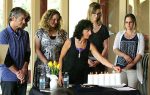
Left to right: Evan Orloff, Melina Moore, Barb Pullan lighting the candles, Rebecca Morlang and Hilla Shlomi. (photo by Roger Tepper)

The Okanagan Jewish Community has been busy over the last couple of months. They are also gearing up for their annual golf tournament, which takes place in July.

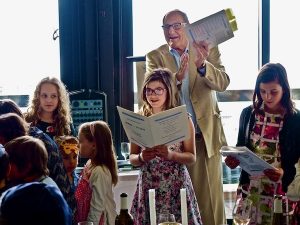
On April 22, the OJC hosted a Passover seder at Summerhill Winery. Led by Allan Holender, approximately 150 people attended, including 30 kids under 12. Dr. Jessica Strasberg organized the children’s crafts and activities, Ronit Little made the charoset for all the tables and Steven Finkleman helped with many of the food preparations and putting together the 18 seder plates; David Spevakow and Barb Druxerman volunteered a great deal of their time on preparations and planning. Steven Cipes and his family, of Summerhill Winery, hosted the event.

photo - Writer and consultant Allan Holender leads the Passover seder with some young help
Writer and consultant Allan Holender leads the Passover seder with some young help. (photo from Okanagan Jewish Community)

Also in April, Cantor Russell Jayne from Beth Tzedec in Calgary came to the Okanagan to lead services. On May 7, with special guests from the International Christian Embassy Jerusalem (ICEJ) in attendance, OJC member Evan Orloff led the services, after which there was a dairy potluck. A new rabbi has been contracted for the High Holidays this year and the OJC is looking forward to having Rabbi Lawrence Seidman and his wife Linda – who is also a rabbi – join them.

On May 15, Orloff and fellow OJC members Ed Aizen, Max and Peggy Mandelbaum, Barb Pullan, Hilla Shlomi and Seymour Zidle attended a Holocaust remembrance service held at the Lakers Clubhouse in Vernon hosted by the ICEJ. The event was put on because members of the ICEJ were greatly disturbed by the rising amount of antisemitism in the world. The ceremony included speeches, candlelighting and the presentation of a copy of the names on Schindler’s list encased in a replica suitcase which was accepted by Orloff on behalf of the OJC. Orloff is a retired teacher in Kelowna; he dedicated much of his career to educating students about the Holocaust and why it is imperative to remember. Melina Moore performed the theme song from Schindler’s List and sang Hatikvah. The service honored the lives of those who died in the Holocaust and the resilience and courage of survivors, as well as saying “never again” and “no” to antisemitism and prejudice in all its forms. The OJC is very grateful to the ICEJ, led by members Gail Mobbs and Daniel Morlang, for putting on such a touching ceremony.

During this past month, the OJC has had seven groups of students, ranging from 30 to 50 students per group from four middle and secondary schools in the area, participate in its Talks & Tours, hosted by OJC members Finkleman and Orloff. The students heard a presentation on Judaism and then enjoyed challah and grape juice with an explanation of the significance. Some of the schools attend the seminars annually, finding the presentations educational and interesting.

Last but not least, the 19th annual OJC Golf Tournament is being held on July 21. The money generated from the tournament each year enables the OJC to continue bringing in guest rabbis and cantors and to provide programming for the community; this year, part of the proceeds will also help Canadian Blood Services, a charity chosen in honor of the late Sid Segal. There is still room available for more golfers (and hole sponsors) so, if you are interested in participating in this day of golf, food, drinks and social interaction, visit ojcc.ca or contact Anne Zazuliak at the OJC office, 250-862-2305 or admin@ojcc.ca.

Museum tries to instil hope

Canadian Museum for Human Rights researcher and curator Dr. Jeremy Maron discussed some of the issues the museum faced in deciding what to exhibit. (photo by Rebeca Kuropatwa)

The Canadian Museum for Human Rights (CMHR) in Winnipeg is one of the newest museums on the block. Dr. Jeremy Maron, a CMHR researcher and curator, discussed some of the issues the museum faced in deciding what to exhibit. The March 4 brown-bag lunch meeting at the University of Manitoba was open to students and the general community.

Maron’s main work at the museum is on the fourth floor, an area dedicated to the Holocaust. Displays on three perimeter walls take a case study approach, emphasizing themes closely related to the Holocaust as well as universal human rights.

“The first theme we look at is the abuse of state power,” he said. “This wall explores how Nazis used and deployed instruments of state power, such as the police, judiciary, laws and regulations, and even education to undermine human rights … and acquiring total dictatorial control of German society, promoting their racist and antisemitic ideology, targeting Jews and other specific groups for social exclusion and persecution, ultimately culminating in genocide.”

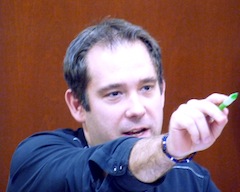
photo - Dr. Jeremy Maron makes a point at a March 4 meeting in Winnipeg
Dr. Jeremy Maron makes a point at a March 4 meeting in Winnipeg. (photo by Rebeca Kuropatwa)

Maron said the modern nation state, in its ideal sense, is supposed to be the guarantor of human rights. But, in reality, the centralized power of the modern state very often sets the stage for it to be the worst violator of human rights.

“The case of Nazi Germany is a good example of the centralized power and the capacity for it to be mobilized toward the violation of human rights, rather than protection,” he said. “There are many other stories in the museum in which state power is also being utilized in such a manner.

“The second thematic wall in this gallery … moves on to look at persecution and targeting of specific groups in Nazi Germany. This wall explores the increasing intensity of systematic oppression under the Nazis.”

According to Maron, the Allies did not fight the Second World War specifically because they were trying to save the Jews in Europe. However, their winning of the war ended the Nazi massacre of Jews, which continued nearly up until the day of the Germans’ surrender.

“Another exhibit, from which we try to draw human rights connections, is a large digital study table in our Breaking the Silence gallery, also on level four,” said Maron. “This gallery looks at breaking the silence specifically as a human rights act.”

Human rights violations are always accompanied by silence, distortion, justification, minimization and denial, he said. Perpetrators want to hide their crimes; victims who survive may feel scared for themselves or their families, or feel ashamed; witnesses and bystanders often look the other way, so the cycle continues.

The goal of the CMHR is to encourage people to speak out about these violations, to drag the violations out into the light of day and pursue justice, recovery and reconciliation, he said.

“This particular exhibit, Breaking the Silence … looks at a wide scale of human rights violations, putting an emphasis on how people have responded to them in order to break silence,” said Maron. “We tried to place the emphasis of the human rights response in this particular case. It’s a question of focus that tries to adopt a forward-looking perspective, rather than one that is trying to wholly examine the past in and of itself.”

While some visitors feel that the message and exhibit is too watered down, Maron said this was necessary to a certain degree, as the museum’s main focus is to educate and not to horrify or shock.

“It’s not just a sense of sensitivity we think about, it’s also a question of a fact,” said Maron. “Sometimes, when confronted with material that is explicitly horrific, even for someone like myself who has worked on this material extensively, it almost can shock you into silence as it overwhelms you. I think back to when I was doing my master’s in 2005. I went on a Holocaust commemoration tour [and] we toured Auschwitz. After you go through the gas chambers and you see the walls and the showerheads, you get back on that bus and you are just beaten down. You are sitting there and the guides are trying to debrief and talk, but no one wants to talk because they are beaten down.”

While the CMHR does not back away from the truth or gloss over troubling aspects, they choose to visualize these histories differently, he said. One of the concepts the museum is designed to highlight is that everyone’s actions are the result of choices, and that the consequences of these choices are not inevitable.

“That’s not to say that there are not constraints on choices,” said Maron. “If you’re in the midst of a particular human rights catastrophe and you do something like hide a potential victim in your attic, it’s very possible that you might be targeted as well. So, there are constraints on choices in certain historical circumstances. But, it’s still important to consider that these are choices and actions, and what happens isn’t inevitable. Some objects in the museum speak to some of the less obviously consequential choices that individuals might have made that allowed the Holocaust to be perpetrated on that scale.”

While Maron understands that it’s impossible to know for sure what a single individual could have done, with his display, he hopes to create a deep and meaningful reflection for CMHR visitors and, especially, students.

How to convey a history of conflicts accurately without reigniting tensions is another challenge the museum has taken into consideration, by using careful word choices and avoiding blanket statements. But, maybe the most important aspect and aspiration for the CMHR is ensuring that visitors leave with a sense of hope.

“This hope is not a naive hope that everything is going to be OK, but that … hope is possible as long as we promote the human rights of everyone, and the idea that hope is possible if people are willing to make hard choices and take action,” said Maron. “So, again, we hope our visitors leave with the idea that change is possible if people are willing to do something, while silence and acquiescence is the ally of rights violations.

“Until atrocities are recognized and acknowledged, until people believe action is possible, cycles of violations will continue. Such cycles, we hope, our museum, in some small part, can help improve by inspiring a lot of hard work and devotion by our visitors, who may become dedicated human rights advocates and defenders.”

Rebeca Kuropatwa is a Winnipeg freelance writer.

The stories of nine orphans

The Open Hearts, Closed Doors exhibit combines placards of mixed visual and textual material. (photo from Vancouver Holocaust Education Centre)

“One out of every 122 people alive currently is displaced. That means 60 million people,” says Phillipa Friedland, education coordinator at the Vancouver Holocaust Education Centre.

Friedland is explaining the idea behind the current exhibit at the VHEC, Open Hearts, Closed Doors: The War Orphans Project, which was originally mounted in 1997. According to the centre’s website, it is “being re-presented to provide opportunities for visitors to engage with Canadian immigration policies from a historical perspective, using case studies of Holocaust survivors from the local community.”

The exhibit – which runs to June 30 – serves as a testament and warning about the vulnerability of children in times of communal violence. It is also a memorial to the incredible resilience of so many of survivors. The words of survivor Regina Feldman are written above one of the displays: “People were saying that we were free. I didn’t know what freedom meant. Where do you go, what do you do, who will take you? I was 13 years old.”

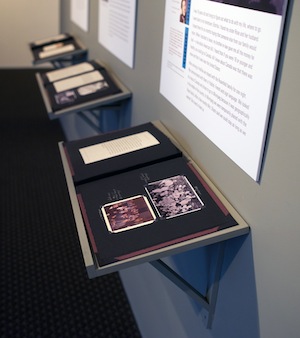
photo - Beautifully done recreations of photo albums tell the stories of the survivors featured
Beautifully done recreations of photo albums tell the stories of the survivors featured. (photo from Vancouver Holocaust Education Centre)

Open Hearts, Closed Doors reports the staggering statistic that of the 1.6 million Jewish children in Europe in 1938, only 100,000 survived. The exhibit combines general education about those who survived as orphans with a presentation of the experiences of nine war orphans – Esther Brandt, Marie Rozen Doduck, David Ehrlich, Regina Feldman, Bill Gluck, Celina Lieberman, Leo Lowy, Leslie Spiro and Robbie Waisman – who were among the 1,123 granted permission to enter Canada in 1947.

Permission for the orphans to come to Canada came through a special Order in Council, which bypassed Canada’s racist immigration policies of the time. These restrictive policies had been developed and enforced by then-director of Canada’s Immigration Branch Frederick Charles Blair. Canada had the worst record among destination countries for Jewish refugees: only 5,000 Jews were accepted as refugees between 1933 and 1939. Between 1945 and 1948, among the 65,000 refugees allowed into Canada, only 8,000 were Jews. Chaim Weizmann, Israel’s first president, remarked in 1938, “The world seemed divided into two parts: those places where the Jews could not live and those where they could not enter.”

The 1,123 orphans of 1947 were allowed into the country on the condition that Canadian Jews take full responsibility for them. Most of the orphans came through the port of Halifax at Pier 21 and boarded trains for 38 communities across the country. The majority of the orphans, more than 790 of them, settled in Montreal and Toronto; 38 settled in British Columbia, four of whom are still alive.

Most foster families were hoping for young children, preferably girls, but the majority of those who had managed to survive were older boys: 70% were adolescent boys and only 37 of the children were under 10 years of age. The orphans came from 15 different European countries, 783 from concentration camps and 229 who survived in hiding. The resettlement project was a massive undertaking practically and psychologically, for both the orphans and their new families. The success of that undertaking can be seen in the amazing lives that so many of the refugees lived.

“This entire exhibit is about resilience,” said Friedland. In the 1950s, psychiatrists who interviewed the surviving orphans offered a bleak prognosis: these were damaged people, their ability to adapt would be limited and they would likely not live long lives. Yet, as they aged, juvenile delinquency was practically nonexistent among them. Multilingual, they quickly picked up English. As the VHEC exhibit states, “Many became not only productive members of the community but its pillars.”

Open Hearts, Closed Doors combines placards of visual and textual material with beautifully done recreations of photo albums telling the stories of the nine survivors featured. A lone glass case contains a single child’s shoe taken from an innocent sent to the gas chambers.

True to its inspiration, the exhibit does not limit its focus to the past but looks to the present and future as well. A map on one wall of the exhibit shows regions throughout the world most at risk of genocide according to the Early Warning Project. These include Myanmar, Nigeria, Sudan and others.

Open Hearts, Closed Doors perfectly fulfils the mandate of a Holocaust exhibit: it remembers the horrors and heroism of the Shoah while pointing us towards the need to protect the vulnerable everywhere.

Matthew Gindin is a Vancouver freelance writer and journalist. He blogs on spirituality and social justice at seeking her voice (hashkata.com) and has been published in the Forward, Tikkun, Elephant Journal and elsewhere.

VHEC marks anniversaries

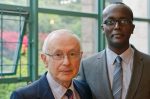
Robbie Waisman, left, and Éloge Butera will be the keynote speakers on May 26. (photo from Vancouver Holocaust Education Centre)

At a first-in-a-decade gala dinner this month, the Vancouver Holocaust Education Centre will mark three significant anniversaries.

“It’s more than 40 years since the first Holocaust symposium for high school students at the University of B.C.,” said Nina Krieger, VHEC’s executive director. “It is more than 30 years since survivors of the Holocaust formed the Vancouver Holocaust Centre Society for Remembrance and Education with the vision of creating a permanent legacy in the form of a teaching museum. And it is now just over 20 years since the doors to the Vancouver Holocaust Education Centre opened.”

Krieger said it seemed like an appropriate time to invite the community to celebrate the achievements of the past, learn about the diverse programs in which the centre is currently engaged and also the ambitious plans for the future. The event, titled Looking Back … Moving Forward, takes place May 26, 5:30 p.m., at Congregation Beth Israel.

“As an organization, we are at a turning point,” she said. “What started as a small Holocaust museum on the edge of the continent has grown into an institution that is renowned in its field for innovative, impactful pedagogy, exhibits, programs and collections.”

Thanks to a grant from Citizenship and Immigration Canada and a legacy gift from the estate of Edwina and Paul Heller, she said, the centre is digitizing its artifacts and archival collections, including one of the earliest extensive collections of audiovisual survivor testimonies.

“When Dr. Rob Krell began interviewing survivors on videotape in the 1970s, he was among the first to do so in North America,” Krieger said. “The collection now includes more than 200 testimonies, which have been shared with other archives, including Yale University’s Fortunoff Video Archive for Holocaust Testimonies, and are currently catalogued into a new VHEC system that will support access to these first-person accounts of the Holocaust.

“With these digitization projects, we are going to be able to reach exponentially more scholars, students and members of the general public in Vancouver, in Canada and around the world,” she continued. “The impact we can have on Holocaust studies will be enormously increased. More importantly, thousands more people will be able to access our impressive collections. Furthermore, thanks to a related project in which we are developing complementary pedagogical materials, educators worldwide will be able to access multimedia teaching resources at age-appropriate levels to share this history in impactful ways.”

Krieger said Looking Back … Moving Forward will introduce attendees to the power of firsthand eyewitness testimony. The keynote speakers will be Robbie Waisman, a survivor of the Holocaust, and Éloge Butera, a survivor of the Rwandan genocide. Their stories of survival are examples of the kinds of VHEC programs that reach more than 25,000 B.C. students annually.

The event is also intended as an opportunity for attendees to learn about the breadth of VHEC programming.

“People are often surprised at the diversity of the programs and services we deliver,” Krieger said.

Earlier this month, the 41st annual Symposium on the Holocaust at UBC brought about 1,000 students from across Metro Vancouver to the university for two days of meetings with Holocaust survivors and historians. In addition to this annual event, VHEC now delivers similar “satellite” programs in 10 school districts and sends outreach speakers to schools all year round. Teachers’ conferences, learning resources and hands-on Discovery Kits help teachers educate about the Holocaust at age-appropriate levels. School groups and the general public visit VHEC to experience locally and internationally developed exhibits. Survivors access services including financial, medical and social supports. Scholars and other researchers use Western Canada’s largest collections of Holocaust-related materials. Four annual commemorative events – International Holocaust Remembrance Day, Yom Hashoah, the High Holidays cemetery service and the Kristallnacht Commemorative Lecture – provide opportunities for both mourning and learning.

“We hope that attendees of Looking Back … Moving Forward will come away with a deeper appreciation of the work we are doing,” Krieger said. “And with our deep appreciation that everything we accomplish is due to the support of people who understand the value of what we are doing.”

The event is co-chaired by Mariette Doduck, Shoshana Lewis and Helen Heacock Rivers. Honorary chairs are the four past presidents of the organization: Waisman, Krell, Rita Akselrod and Jody Dales. For tickets, visit vhec.org.

Pat Johnson is communications and development consultant at Vancouver Holocaust Education Centre, as well as a member of the Independent’s editorial board.

A future he never imagined

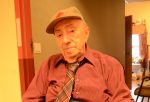
Sam Rozencwajg (photo by Drew Tapley)

Last year marked the 70th anniversary of the end of the Second World War. In a decade from now, there will be virtually no one alive with a living memory of this time in history.

Sam Rozencwajg not only lived through this time, but through the worst of it – being captured and imprisoned in various Nazi concentration camps of central Europe, including Auschwitz.

Rozencwajg, who lives in a long-term care community in Toronto, immigrated to Canada in 1952 and is very clear about what “The True North strong and free!” means to him.

“Canada is the best country in the world, where a Jew can live free and be respected,” he said, wearing a baseball hat with a red maple leaf on it.

The youngest of six siblings, Sam was born in Lodz, Poland, in 1926. He was 14 years old when German soldiers invaded his city in 1940, and his memory of the day he was taken from his home is vivid.

“When the Germans came, they put all the Jewish people in a ghetto. They didn’t tell us anything. We didn’t know where we were going. They just counted and counted us. I remember how my heart was pounding from being scared. Every Jew was scared.

“They called out to everyone to open their doors because they didn’t want to smash them in.”

One day, everyone in the ghetto was told to gather in a central location.

“They made us a lot of soup, with potatoes in it. Back then, potatoes were like diamonds because they were very hard to get. We were allowed to eat as much as we wanted because the Germans needed us to be quiet and satisfied so they wouldn’t have to fight us.

“When we were fed, they put us on trucks, which went straight to the train station. On each door of the train was a German soldier. We didn’t know where we were going.”

Sam was on the train by himself. The rest of his family was either in different carriages or different trains; and his parents were the first to be taken away.

“They took my mother and father in a truck, and I never saw them again. After the war, I looked for them, but I knew they didn’t survive.”

Sam’s twin sisters were separated. “Which probably saved their lives,” he said, “as they would likely have had medical experiments done on them.”

Both sisters survived the camps, and Sam was able to briefly see one of his three brothers again. But the reunion was bittersweet.

“I saw my oldest brother in Auschwitz, and he had a rash all over his face. I asked him what had happened, and he didn’t know what to tell me. I know he went to the gas chamber after that.”

Sam was transferred to different camps during the war. He doesn’t remember the names, but remembers them by their numbers – especially Dachau, which was divided into a series of smaller work camps with the explicit purpose of forced labor, brutality and systematic medical experiments. More than 30,000 people died there, and thousands were sick or dying when the camp was liberated in 1945.

“They didn’t know what to do with us. We were marched every day to do labor, two hours each way. The German soldiers were dressed in warm, thick coats and hats. The Jews were dressed in thin cotton pants and shirts with wooden clogs not meant for marching in.

“They made us do work just to punish us: digging holes, throwing in bodies. My father and mother could have been among the bodies. It was miserable to do those things.

“If one of the prisoners fainted, we had to carry them. They would count us out and back again to make sure no one escaped. If you managed to get away, the guards would contact the police and they would find you. It was obvious from our clothes that we came from a camp.”

During the winter, as he walked through snow and ice, the back of his clogs broke off and he came close to losing a foot to frostbite when his heel froze.

“There was a German civilian at the side of the road. I asked him, ‘Can I rest here? Look at my feet, I cannot walk.’ I spoke a little German, and showed him my foot, which was blue. He couldn’t believe it. A guard told me to move on, but the man insisted I be allowed to rest. He was a nice man. I’m not saying all the Germans were bad. Not all of them were Nazis.”

Sam said, “The buildings in the camp were built so that the Allies couldn’t see them from above. The one I was in was like a bunker with a green roof. There were maybe 20 or 25 people in one room, and I slept on wood and straw, with lice biting my body throughout the night.

“You could never speak to the guards…. Because I could understand German, I heard the words they sang about us as they marched. They hated Jewish people. They called us ‘Dirty Jew,’ but didn’t give us the facilities to wash. I remember one day I passed by a shower building and someone told me, ‘Do not be lured in there. They will tell you that you can have a shower, but instead of water they put gas.’”

Sam said that, while millions of Jews and other prisoners died in Nazi gas chambers, most of the prisoners in the camps he was held at died of either starvation or forced labor.

“We were so hungry and thought of food constantly,” he said. “I remember a little boy crying to the Germans, asking them to kill him. He couldn’t suffer anymore, and wanted them to take his life. But I was determined to stay alive and, to this day, I honestly don’t know how I did. You lived minute to minute.”

Sam was so delirious and emaciated by the time his camp was liberated that he retells it like something out of a dream.

“I woke up one day in a real bed with a white bed sheet and pillowcase. I couldn’t believe it.

Three blurred figures stood over me examining my body. Bright lights came from their bodies. I thought I had died and was in heaven.”

It was 1945, and these blurred figures were American soldiers with light reflecting off the buttons on their uniforms.

“I didn’t know that they were American at the time,” said Sam. “I had no knowledge of anything. They asked me, ‘Who did this to you?’ I was just skin and bone. Not a piece of flesh was on my body. I cannot imagine how I survived, and praise God day and night that I could live and build my own family.”

Sam was taken to a liberation camp, but was so sick that he couldn’t walk or digest food.

“I was given real food, but the next day, I had chronic diarrhea. My stomach couldn’t take good food. It happened to all of us like this.”

He soon discovered that his freedom meant there was no going back to the city and the home he once knew.

“We had no homes to go back to because Polish gentiles now occupied them. A nephew of mine went back to Poland, and I asked him to go to the house I used to live in. They had changed the locks and wouldn’t open the door to him. At the time, there was a program where you could go to a lawyer and make a claim to get your home back.”

After Sam gained more strength and weight, he was given passage to Karlstad, Sweden, with the Red Cross, where he lived with a family and was given a job pressing wedding gowns in a factory. He had mastered several languages at this point, which came in useful.

“They treated me like a son,” he said, referring to his adopted family in Sweden. “My wife worked across from me in that factory. I couldn’t stop looking at her, and thought to myself that I must take her out. We went dancing, and soon fell in love.”

Sam’s wife was from Hungary and came from a family of rabbis. They got married in Stockholm, and lived in Sweden for seven years before coming to Canada.

Like his imprisonment, liberation and evacuation to Sweden, the decision to immigrate to Canada was also something that came about suddenly when he found one of his sisters again in the street.

“We found each other, just like that; each thinking the other was dead. She was getting married and moving to Israel (then Palestine) with her new husband. At that time, Israel was calling out to the Jewish people to go and build it as a Jewish land.”

It was then that he discovered his other sister had settled in Canada, where there was a Jewish committee set up to welcome displaced Jews to work as tailors and seamstresses. He got in touch with her, and she arranged for him to come over by boat with his wife and son.

“I was glad to get out of Europe,” he said.

Sam worked in a clothing factory in downtown Toronto until he retired. He had two more sons, and has seven grandchildren.

“Lots of people came out of those camps in really poor health, and I developed a congestive heart condition that I’ve had to live with for the rest of my life,” he said. “The American authorities forced Germany to pay Jewish people restitution, and I still receive a monthly payment that goes a long way to paying for my expenses.”

Despite the hardships he endured, Sam maintains a positive outlook.

“You have to get used to this world to enjoy life,” he said. “I survived because my will was to survive. I didn’t think I would get married and have children, grandchildren and great-grandchildren, and I praise God for this. I have learned that every minute can change your life…. It is very important to me to explain my story. I’m not ashamed of it. Let Hitler be ashamed of it.”

Drew Tapley is a Toronto-based journalist.

The resilience of survivors

Peter Suedfeld and his mother. Taken at Vajdahunyad Castle, Budapest, Hungary, circa 1939/40. (photo from Peter Suedfeld)

Dr. Peter Suedfeld has devoted his life to the study of how human beings adapt to and cope with challenge, stress and danger. Yet it was many years into his work that he acknowledged his choice of academic pursuit may be related to his personal life history as a survivor of the Holocaust.

Suedfeld, professor emeritus of psychology at the University of British Columbia, will deliver the keynote address at the Vancouver Holocaust Education Centre’s community-wide Yom Hashoah commemoration at the Jewish Community Centre of Greater Vancouver on May 4.

Through the years, he has often been asked if his research was influenced by his family’s experience in the Holocaust.

His mother was murdered at Auschwitz; his father survived Mauthausen. Suedfeld was a hidden child in Budapest, living as a Christian in an orphanage run by the International Red Cross.

“My answer always used to be no,” he said, “because my research for a long, long time was fairly straightforward experimental psychology, cognition, perception, memory, things like that.”

But, when he was interviewed for the VHEC’s survivor testimony project, he “put it all together,” he said. “I started to think that maybe there really is a connection, because almost all of my research – not quite all, but most of it – has to do with how people adapt under unusual, extreme, challenging, sometimes traumatic environments and situations.”

His early work focused on sensory deprivation, looking at how removal of external stimuli affects things like cognition, studying astronauts, cosmonauts and people who work in polar research stations.

“I also started looking at people who were under stress because they had to make really important decisions in stressful circumstances, such as political and military leaders,” he said. “I realized that might have had something to do with my own experiences. How do people face unusual, extreme and sometimes dangerous environments – which people who have survived the Holocaust have had to do, including me? But, I want to emphasize that, at the time I was doing this research, I never thought this way. People asked me why I do all these things, and I said something interests me and I do research on it, that’s all, and I have a wide range of interests. But then, I thought maybe this does have something to do with my personal history.”

At the Yom Hashoah event, Suedfeld will reflect on his personal experience, discuss the Holocaust more broadly and then address the issue of the long-term adaptation of survivors of the Holocaust, a topic on which he has conducted a series of studies.

Suedfeld has reviewed the psychological reports written soon after the war about the long-term potential of survivors to survive and thrive.

“In general, what I found is that the early reports of psychologists and psychiatrists about how permanently damaged survivors are were, to put it bluntly, wrong,” he said. “Yes, of course, some people were permanently damaged and some people could never put their life back together again. But there are a lot of people who did put their lives together or build new ones, who were quite resilient and still are, did well in their occupation or in education if they were young when they came here, have family lives that are certainly no less happy than anybody else’s, are proud of their kids and grandkids if they have any, don’t think about the Holocaust all the time, don’t let it ruin their life.”

Many survivors, he said, have some post-traumatic stress, but not post-traumatic stress disorder. “Disorder means it really interferes with normal life,” he said. “And very few have that.”

Reviewing the early literature and knowing what he knows from personal experience and acquaintance with many survivors, Suedfeld is more surprised by the early negative prognoses than by the remarkable resilience of survivors.

“What did surprise me was the negativity of the scientific reports, which overlooked or ignored or never got to see any of the people who were so resilient,” he said. “There is now a substantial and rapidly growing literature showing not only resilience but post-traumatic growth and people’s strength instead of just emphasizing the weakness. And, again, that’s not to deny by any means that there are some people who were so terribly affected that they haven’t recovered, but that is not the norm.”

Suedfeld also cautioned that every experience of survivors is unique.

“We talk about the Shoah as though everybody had pretty much the same experience,” he said. “I want to bring home to people that that is also a mistaken idea, that people experienced very different things, all of which are lumped under the label of Holocaust or Shoah, but that’s an incredibly wide diversity of experiences to which an incredibly wide diversity of people responded in an incredibly wide, diverse way, so you cannot talk about survivors or victims as an undifferentiated lump. They’re not.”

Pat Johnson is a communications and development consultant to the Vancouver Holocaust Education Centre, as well as a member of the Independent’s editorial board. This article first appeared in the VHEC publication Zachor.

Recording testimony

As every year passes, more firsthand accounts of the Holocaust are lost. Carleton University has launched a new initiative to help preserve these important accounts for future generations.

Led by Mina Cohn, director of the Centre for Holocaust Education and Scholarship (CHES) within Carleton University’s Zelikovitz Centre for Jewish Studies, this initiative is hoping to raise $7,500 using Carleton’s Futurefunder crowdfunding platform to record and preserve the testimonies of Ottawa Holocaust survivors as oral histories.

The project will ensure the preservation of Ottawa Holocaust survivors’ accounts and their experiences before, during and after the Holocaust. These recorded testimonies will become a powerful pedagogical tool to be used in any educational institution or setting and will allow Carleton professors and students to explore online the unique power of survivors’ memoirs. The recordings and associated educational materials will form the basis of a special Ottawa-based Holocaust memorial project and will become a public resource freely accessible on the CHES website.

Each survivor has a unique and personal story to tell. These eyewitness accounts unite personal experience with the history of the period in a powerful way, creating a feeling of immediacy to the events, and there is an urgent need to record and preserve survivor accounts before it is too late. CHES is in contact with local Holocaust survivors and is already working with those interested in participating in this project.

The $7,500 to be raised will help cover the cost of producing, editing and arranging a public launch of the video testimonies of Ottawa Holocaust survivors. In the first round, CHES will record up to 10 different survivor testimonies, in a professional studio environment with the help of professional videographers. If sufficient funding is available, it will produce thematic videos on associated topics, such as life before the Holocaust in certain locations, camp experiences, child survivors, Jews in hiding, etc. Recording is scheduled to start in June 2016.

The unedited recording and videotapes will serve as resources for scholars, students, educators and the public, and provide glimpses into the individual lives during the Holocaust that cannot be obtained from documents or written records. Such testimonies are also an excellent resource for the development of anti-racism educational materials.

To learn more, visit futurefunder.carleton.ca/project/ottawa-holocaust-survivors-testimony.

There are lessons to learn

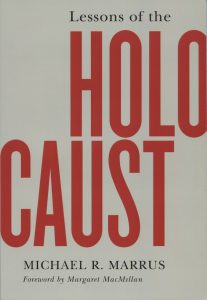
“My principal lesson of the Holocaust is … beware of lessons.” With this warning, renowned Canadian Holocaust scholar Michael R. Marrus, professor emeritus at the University of Toronto, has written an essential but also essentially frustrating book, claiming that there is nothing to be “learned” from the study of the Holocaust – Lessons of the Holocaust (University of Toronto Press, 2016).

All the mantras usually marshaled to justify Holocaust studies, such as “never again,” or “who does not learn from history is doomed to repeat it” or “evil will triumph when good people do nothing” are bogus, says Marrus. For “history does not speak to the present with … an admonitory voice”: historians are not moralists or mentors, and certainly not preceptors – their mandate is to “handle history with care” and to insist on “getting it right.”

But, if Holocaust studies have nothing to teach us, should we not ask to what end should Holocaust historians and educators “get it right”: and how does a Holocaust scholar’s commitment to “getting it right” differ from that of a botanist’s or a quantum physicist’s or, for that matter, an athlete’s or a bricklayer’s? It is the failure to answer this question that makes Marrus’ book so frustrating.

Marrus’ credentials in Holocaust studies are impeccable. His books on the Holocaust have received prestigious awards; he has served on some extremely important international committees designed to air out crucial Holocaust issues, and has met, and often argued publicly, with some of the world’s most prestigious Holocaust historians, including Raul Hilberg and Elie Wiesel, as well as Hannah Arendt, Emil Fackenheim and Daniel Jonah Goldhagen, all of whom he takes issue with in this book for suggesting that the Holocaust can offer lessons.

Marrus’ problem with regarding Holocaust history as a learning project is rooted in his historiography: what can one learn from history when history itself is so subjective? “If one looks hard enough at evidence,” says Marrus, “one can come up with the answer – or the lesson – that one wants.” And, again: history is “continually evolving,” its terrain endlessly “shifting,” exposing “new questions.” In other words, history is inevitably “a matter of interpretation.” (Marrus’ emphasis.) Thus, the lessons that one presumes to deduce from history will inevitably be the lessons that one preemptively wanted to find. As Marrus puts it, “lesson seeking often misshapes what we know about the event itself in order to fit particular causes or objectives.”

book cover - Lessons of the Holocaust

Fair enough, when it comes to comparing the Holocaust to “the rape of the environment [or] the harshness of bureaucracy,” but what about the larger, and more relevant, issues of social justice, of our moral duty to future generations, of our sacred duty to remember? Hitler saw carte blanche for his genocidal intentions by asking, “Who remembers the Armenians?” Surely it is crucial that no future Hitler be able to ask, “Who remembers the Jews?”

Marrus is on more solid, if more obvious, ground when he condemns the appropriating of Holocaust history by right-wing politicos in Israel, such as Menachem Begin and Binyamin Netanyahu, who he sees as using Holocaust references to manipulate opinion toward acceptance of their conservative policies. This political exploitation of Holocaust history has “crippled Israel’s capacities to respond imaginatively to questions of national identity and to seize new opportunities in a flawed global community.” Here, Marrus is probably right.

Marrus also condemns, again quite rightly, the enlisting of Holocaust precedents by special interest groups, such as advocates of gun control or those opposing bullying in schools, opponents of gay rights and animal abuse and so on – all anxious to further their causes by referencing the Holocaust and, in so doing, trivializing it.

Most pointedly, and again with some justification, Marrus attacks the thinking of those who would “universalize” the Holocaust, making Holocaust studies “a school for tolerance,” a warning against hate speech, against political apathy or against overly celebrating the actions of the pitifully few Nazi-fighting heroes, such as the leader of the Munich White Rose students,

Sophie Scholl, who was recently voted in Germany fourth among “the most important Germans of all time” – ahead of Bach, Goethe and Einstein. Again, this is an important point, and one that quite rightly occupies a lot of serious thinking in Holocaust studies.

Marrus’ final chapter, a brief 11 pages, is entitled “Lessons of the Holocaust,” and readers may be forgiven for thinking that Marrus is, finally, at the end of his book, going to take a stand.

Not at all. He says here, “we learn a great deal from the history of the Holocaust.” What, exactly? He doesn’t say. And, again, Holocaust studies are “intellectually enriching and facilitate our understanding of the world around us.” How so, and to what end? No answer. “We are wiser” for knowing Holocaust history. How so and, since there are no lessons in it, so what? In this final chapter, Marrus repeats over and over that Holocaust history “deepens appreciation of human reality” and “makes us more mature.” How so, since there’s nothing to be learned from it, on his own terms?

Holocaust educators will, I suspect, find Marrus’ position difficult to accept: they know exactly why they are teaching Holocaust studies – to impress upon (especially) young people the fragility of our human institutions and thereby to arm them against demagoguery. In other words, “never again.”

Demagoguery has been raising its head again in recent months in the United States. It would indeed be encouraging to all teachers of Holocaust studies if they could believe they’ve helped to effectively warn against it, a clear and inarguably important lesson to be learned from the dreadful past century.

Graham Forst, PhD, taught literature and philosophy at Capilano University until his retirement and now teaches in the continuing education department at Simon Fraser University. From 1975 to 2010, he co-chaired the symposium committee of the Vancouver Holocaust Education Centre.

Refugee policy evolves

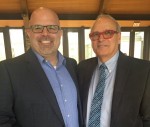
Rabbi Dan Moskovitz, left, and Dr. Harold Troper. (photo by David Berson)

The current refugee crisis – and Canada’s responses to past crises – was the topic of an interfaith panel recently, which raised issues especially relevant as Passover approaches.

Our Home and Native Land? A Multi-Faith Symposium on Refugee Settlement featured a keynote presentation by Dr. Harold Troper, co-author of None is Too Many: Canada and the Jews of Europe, 1933-1948. The event, on March 18, also included a panel discussion that featured Rabbi Dan Moskovitz of Temple Sholom. Catalina Parra brought a First Nations perspective, Imam Balal Khokhar spoke from a Muslim point of view and Rev. Dr. Richard Topping spoke as a Christian.

Troper recalled being part of a Canadian group that traveled to eastern Germany two decades ago, after the Berlin Wall fell. States in the east of the newly reunified Germany were seeing an upsurge in migration from countries further to the east. A group of Canadians was invited to listen and give advice on Canada’s experience integrating newcomers. At one point, a local official thanked Troper for his comments, but asked, “What do you do with your foreigners?”

Troper expounded on the concept of “new Canadians,” a formulation perhaps unknown in any other country, in which people arriving with the intent of making Canada their home are acknowledged not as foreigners or as migrants, but as people becoming part of our polyglot population already on a path to inclusion.

Of course, Troper acknowledged, this was not always so. None is Too Many, published in 1983, was a seminal book that has had lasting impacts on Canadian views of migration and refugees. The title comes from a quote from an anonymous Canadian immigration official who responded with these words to the question of how many post-Holocaust refugees to admit. The words have been attributed, in some tellings, to F.C. Blair, Canada’s then-director of immigration. However, while this is not provable, Blair’s actions were in line with the words.

Recounting this country’s exclusionary policies toward the desperate Jewish populations of Europe in the prewar period, but also a similar disregard after the war, the book has been held up as an object lesson in how not to respond to people in crisis. Troper said he didn’t know until years later the impact the book had had on one very significant episode in Canadian history.

In 1979, Troper and Abella sent an academic paper that preceded the book to Ron Atkey, Canada’s immigration minister. Atkey was a member of Joe Clark’s cabinet and, though that Progressive Conservative government lasted only nine months, it was during Clark’s term as prime minister that the decision was made to welcome 60,000 Vietnamese refugees, known as “boat people.” Troper said he found out later that the manuscript they sent played a role in the decision.

“We hope Canada will not be found wanting in this refugee crisis the way it was in the previous one,” the authors wrote in a note accompanying the manuscript. They expected no response and they received none. But, several years later, Troper said, Atkey told him that he had read it.

“He told us he was shocked and dismayed when he saw the political parallels between the Vietnamese and Jewish refugee crises,” Troper recalled. “Then and there, Atkey told us, he decided he was not going to go down as the F.C. Blair of the boat people.”

Already predisposed to encourage his cabinet colleagues to take a generous approach, the article stiffened his resolve to stand firm against ministers who disagreed. The government initiated a joint federal-private sponsorship program.

“It today serves as the prototype for Canada’s Syrian refugee program,” said Troper.

Now, as refugees are coming from North Africa, Asia and, most notably, the Middle East, fleeing civil war and ruin in Syria and Iraq, Troper sees parallels between the fears expressed now and those of seven decades ago.

“The fears are not only around the expenses of accommodating these refugees, but that the intake of a population of different race, religion and cultural assumptions and social expectations will destabilize destination countries,” he said.

Not dissimilar, he said, were fears that European Jews might bring socialism, communism, anarchism – even Nazism – with them.

“Foreshadowing the kind of anti-refugee arguments commonly heard today,” Troper said, “reports of persecution were dismissed as exaggerated if not bogus, fabrications designed to justify an end-run around Canadian immigration restrictions. And who were these refugees anyway? Were they really innocent victims? Surely they must have done something to turn their fellow citizens against them. Why make Europe’s problem our problem? And weren’t Jews in Canada already a pesky problem? Do we want more? And who’s to say that communists or even Nazis would not pose as refugees to infiltrate as subversives into Canada? Keeping Canada strong and united meant keeping Jews out.”

Another haunting parallel was the galvanizing photo of the 3-year-old Kurdish child who washed up on a Turkish beach and a photo Troper came across decades ago in his research for None is Too Many while going through archival boxes in the Toronto office of the Jewish Immigrant Aid Society. The boxes were filled with prewar letters from European Jewish parents who, knowing that entire families were unlikely to be granted admission to Canada, begged that their children might be taken in by a Canadian family. In each case, a terse response told the desperate parents that Canada was not admitting any Jews but that the request would be held on file in case something changed.

“Going through these files, I came across a letter that impacted me the way I imagine the photo of 3-year-old Alan Kurdi lying facedown in the sand of a Turkish beach impacted on all of us,” he said. “The letter was from a father begging for some shelter for his two daughters. A picture of two smiling children was attached. As I read this letter, my eyes began to tear; you see, I am also the father of two girls. At the time they were 3 and 5 years old. For a split moment, it was as if I was that desperate father, his children were my children and his fears were my fears.”

As part of the panel that followed, Moskovitz spoke of the bread of affliction.

“How inappropriate it might seem to hold up a matzah when we sit around a seder table filled with food, and to think that we are supposed to connect with this when we have so much,” the rabbi told the Independent after the event. “The point is to remind us that there was a time in our lives when we didn’t have so much.

“Each of the faith traditions,” he said, “spoke about that lens of empathy, of remembering historically that we once ate the bread of affliction, that we once didn’t have much and so we have to share with those who do.”

Religious perspectives are critical in this discussion, he added.

“Left to our own devices, society will often do what they think is in [their] own immediate best interest, which is often isolationism – we’re seeing that in the U.S. elections today – and fear of the other,” he said. “The role of religion is to compel us to do what is morally right and good, what is spiritually elevated, what is holy. It’s a religious foundation that is compelling us to love the stranger, because our political reality, especially in the wake of the terrorist attack in Brussels, is telling us to fear the stranger.”

For Jews, he said, the plight of refugees is not a momentary news story.

“This is not just a headline that has come and gone,” said Moskovitz. “Our Passover Haggadah makes it a headline for Jews every year, that we are reminded to see the world through the lens of a refugee every single year. It’s the most observed Jewish holiday in the Jewish calendar – that says something about how important the status of a refugee is in Jewish tradition.”

The multi-faith symposium was organized by the Inter-Religious Studies program at Vancouver School of Theology and facilitated by Rabbi Laura Duhan Kaplan, the program’s director.

Vilna, the place, its people

It is a master storyteller who can make you feel like you’ve met someone you never knew, visited a city to which you’ve never been, make you long for a people, place and culture you’ve never experienced but from a generation, location and language once, twice or thrice removed. Abraham Karpinowitz (1913-2004) is such a writer. And, thanks to local master storyteller and translator Helen Mintz, more of us can now visit Karpinowitz’s Vilna – a city full of colorful characters, both real and not, and share in a small part of their lives.

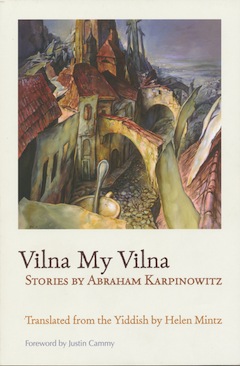
Vilna My Vilna (Syracuse University Press, 2016) is a collection of 13 short stories and two brief memoirs by Karpinowitz, translated from Yiddish into English by Mintz. For context and a better understanding of Karpinowitz and his work – notably one of the main “characters” in his writing, Vilna – there is a foreword by Justin Cammy, an associate professor of Jewish studies and comparative literature at Smith College in Massachusetts, and an introduction by Mintz. These two scholarly essays are invaluable, but if you’re completely unfamiliar with Karpinowitz, perhaps jump ahead and read a few of the stories before heading back to these parts of the book. It’s kind of a Catch-22, in that their insight enhances the enjoyment of the stories, but the stories enhance the understanding of the analysis and history.

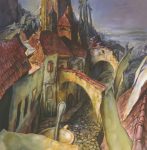
book cover - Vilna My VilnaRomantics will appreciate most the linked stories of “The Folklorist” and “Chana-Merka the Fishwife.” In the first tale, Rubinshteyn heads to the Vilna fish market to collect material for YIVO (the Yiddish Scientific Institute) because he knows that, if the “genuine language of the people” is not documented, “it would be a great loss for the culture.” Dedicated to his work, and a dedicated bachelor, he fails to notice that Chana-Merka has fallen in love with him and, once his research is complete, he stops visiting the fish market, much to her – and his – sadness. In the second tale, Chana-Merka heads to YIVO herself to make sure that Max Weinreich, its director, knows from whom all of Rubinshteyn’s material came: she makes lists of curses for Weinreich, such as “May you speak so beautifully that only cats understand you,” and “May you be lucky and go crazy in a more important city than Vilna.”

Weinreich is one of the real people who appear in this collection where fiction and non-fiction meld. Yoysef Giligitsh, a teacher at the Re’al Gymnasium, is another. Most readers will not be able to identify all of these people and, while there will be added realism for those who can, the characters stand on their own. Besides, these people are secondary to the protagonists, who are the fishwives, the prostitutes, the criminals, the poor.

Despite that everyone is trying to eke out an existence, even the criminals follow a moral code. For example, Karpinowitz notes, in “Vilna, Vilna, Our Native City” that the Golden Flag criminal organization’s constitution includes the admonition, “Our members should behave properly and not forget that even though we are who we are, we are still Jews,” and that “[t]here was a directive for the general treasury to provide dowries for poor brides.”

Karpinowitz pokes fun at communism, capitalism, politics in general. His descriptions put readers right into the scene, almost as if they’re standing on the opposite street corner watching events unfold. And he has some wonderful turns of phrase. In “Shibele’s Lottery Ticket,” for example, Sheyndel’s husband goes off to fill the water bucket and never returns: “Sheyndel missed her husband, the shiksa chaser, less than the bucket.”

Or, in one of the two memoirs, “The Tree Beside the Theatre,” Karpinowitz writes about his father’s choice to sell his print shop to run a theatre, “If he’d stayed in the print shop, he’d be a rich man. My mother reminded him of this every time she couldn’t cover expenses. But everything in the print shop, including the machines and the letters, was black, and everything in the theatre was colorful, even the poverty.”

Karpinowitz’s characters have self-dignity and hope. They are not passive, for the most part, but are actively trying to change their situation for the better or to help someone else. Not surprisingly, many of the stories have bleak endings, with the narratives going from charming and/or humorous to horrific, illustrating just how abruptly and brutally this world came to an end.

These stories that turn on a dime are so moving. They emphasize just how little people at the time understood that most of them would soon be murdered. As Karpinowitz writes in “Vilna, Vilna, Our Native City”: “For years, a Jew with blue spectacles stood on Daytshe Street begging, ‘Take me across to the other side.’ His plea was so heartrending that, rather than asking to be taken across the few cobblestones separating Gitke Toybe’s Lane from Yiddishe Street, he sounded like he needed to cross a deep and dangerous abyss. Maybe he was the first Jew in Vilna with a premonition about the Holocaust. Just the name of the street, Daytshe Gas, German Street, drove him from one side to the other. We could all see the little water pump and Yoshe’s kvass stall on the other side of the street, but through his dark spectacles, that Jew saw farther. Fate didn’t take him to the safer side. He ended up in the abyss at Ponar with everyone else.”

Karpinowitz survived the Holocaust in the Soviet Union, having left Vilna in 1937. He briefly returned in 1944 and then, after two years in a displaced persons camp in Cyprus, moved to Israel. Mintz notes that he wrote seven works of fiction, two biographies, a play and five short story collections. He was awarded the Manger Prize (1981), among several other honors.

In the stories of Vilna My Vilna, the geography of the city is integral, and the maps included are useful in situating the action. The glossary is also an essential part of the book: kvass, for example, is a “fermented beverage made from black or regular rye bread.”

Adding even more value to this collection are three illustrations by Yosl Bergner that were in the original 1967 Yiddish publication of Karpinowitz’s Baym Vilner durkhhoyf and the painting “Soutine Street” by Samuel Bak is the cover of Vilna My Vilna. Both artists (and the Pucker Gallery, in the case of Bak’s painting) gave permission for their work to be used at no charge, which is an indication of the translation’s import beyond entertainment.

Mintz’s acknowledgements are many, and that she accepted so much input into the book speaks volumes about her integrity and the quality of her work. “Translating these stories brought me great joy,” she writes. “While never swerving from the truth, Abraham Karpinowitz answered genocide with love: love for his characters and love for his craft as a writer.” With Vilna My Vilna, Mintz adds her love, and that of many others, to ensure that Vilna, its people and its stories will not be forgotten.