Uniquely B.C. baseball story

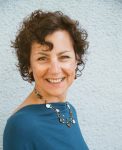
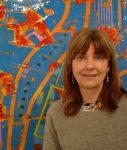
Ellen Schwartz (photo from Ellen Schwartz)

Historical fiction is a great way to learn about the past and, while aimed at younger readers, many an adult will enjoy and learn from Ellen Schwartz’s Heart of a Champion (Tundra Books).

For Schwartz, a TV documentary led to her novel about the fictional Sakamoto family, set in the very real time when Japanese Canadians were interned during the Second World War. It was in watching this documentary that Schwartz first found out about the Asahi baseball team.

In the author’s note, she explains that asahi means “morning sun.” The team was established in 1914, winning their first title in 1919, the Vancouver International League championship. They won the Pacific Northwest League championships every year from 1937 through 1941.

After Japan attacked Pearl Harbor on Dec. 7, 1941, and declared war on Canada, the United States and the United Kingdom, writes Schwartz, “In Canada, Japanese Canadians were branded ‘enemy aliens’ and quickly lost their rights. The government, fearing that they would be loyal to Japan and would share war secrets with the enemy, took away their fishing boats, cars, radios and cameras. The Japanese were subject to a dusk-to-dawn curfew.

“In the spring of 1942, the Canadian government began to remove Japanese Canadians from the west coast of British Columbia. Men between the ages of 18 and 45 were sent to road camps in the Interior to build roads. Women, children and older people were sent to internment camps, many in abandoned mining or logging ‘ghost towns.’ Small, primitive shacks were hastily built to house them. The people lost their homes, businesses and possessions, never to get them back.”

In her research for the novel, Schwartz told the Independent, “I learned so much. In addition to the Asahis, I delved into the history of the Japanese-Canadian community in Vancouver and then in the internment camps. I hadn’t realized how established and prosperous the Japanese-Canadian community was in the pre-World War II years. Although there was a lot of discrimination – for example, Japanese Canadians didn’t have the vote, they were paid less than Caucasians for the same work and they often suffered racial slurs – these were middle-class families who were integrated into Canadian society. That’s why it was such a shock when they were uprooted and sent to internment camps in the Interior.

“I had heard about the internment camps but I didn’t realize how awful they were until I went to the Nikkei Internment Memorial Centre in New Denver [on Slocan Lake in the Kootenay region] as part of my research. When I stepped inside the original 1942 shack that is preserved there, I was shocked at how primitive and barren it was. In that moment, the second half of the book came to me, as I experienced what it must have felt like for Kenny and his family.”

book cover - Heart of a Champion by Ellen SchwartzIn the novel, 10-year-old Kenny (Kenji in Japanese) aspires to be an Asahi like his older brother, star player Mickey (Mitsuo). However, Kenny has been diagnosed with a heart condition, which means he has to practise secretly, so as to not worry his parents. After the attack on Pearl Harbor, dreams of baseball are replaced with the nightmare of having to register as an enemy alien, of being subjected to a curfew, of having his father’s business closed, of his father being sent to a work camp and of being evacuated to an internment camp, only allowed to bring minimal belongings. In Kenny’s case, he, his mother, older brother and younger sister (Sally) are sent to New Denver, where Kenny and his mother manage to find the strength to inspire others in the camp to hope – and play baseball again.

The Sakamotos’ neighbors, and dear friends, are the Bernsteins, who have two daughters, Susana and Brigitte (aka Gittie). This allows Schwartz to draw parallels between the treatment of Jews in Europe leading to the Holocaust and Japanese in Canada during the war.

“I wanted to point out that the treatment of Japanese Canadians, although obviously not nearly as lethal or horrific, was comparable to that of Jews in Europe,” explained Schwartz. “In both cases, a minority was being persecuted simply because of their religion or nationality. Giving Kenny a Jewish best friend would make both characters sympathetic about this issue.

“The other reason I made Susana Kenny’s best friend is that, because of his heart defect, he would not have been able to keep up with other boys and might have had a girl as a best friend. Initially, Susana was a minor character, but I really liked her – she had chutzpah – so I gave her a bigger role in the story. It’s her courage and loyalty that give Kenny the impetus to find his own.”

Schwartz herself didn’t have a particularly religious childhood. “My mother was religious; my father wasn’t. We went to High Holiday services and that was about it,” she said. “But we lived with my grandparents when I was little, and my grandfather was observant and I adored him, so I grew up with a real fondness for Jewishness. I loved the family seders with everyone together and my grandfather chanting the Haggadah. I feel Jewish inside even though I’m not observant now.

“When I’m thinking of characters, I don’t set out to make them Jewish, but sometimes they emerge that way. Even if a character isn’t identified as Jewish, I know that that character is, and that gives the character an inner richness for me. For example, my first novel series was about a girl named Starshine Shapiro. I never mentioned that Starshine’s family was Jewish, but in my mind they were, and some of the humor in the books had a definite Jewish flavor.”

Schwartz hasn’t always been a writer.

“After I stopped teaching elementary school in the late ’70s, I started writing educational stories. That was my first foray into writing,” said Schwartz, who grew up in New Jersey and moved to Canada in 1972 with her husband, Bill. “I wrote stories for kids about energy conservation and the environment, which were important to me. I suppose I started with educational writing because I was comfortable ‘talking’ to and teaching kids. I sold the first educational story to the government of B.C. and the second one to the National Film Board. Then I decided to try to write a regular story, and that became my first book, Dusty.”

Schwartz teaches creative writing at Douglas College and she also works as a corporate and technical writer and editor, she said. “My husband and I own a small communications company called Polestar Communications. We do all kinds of writing and editing for public agencies and companies – reports, brochures, articles, educational material, technical material, web writing, etc. We also do marketing and organize events. That’s how I spend most of my writing time.

“I also write magazine articles, mainly for the Costco Connection, the magazine of the Costco corporation,” she added. “The editor usually assigns me stories about books and authors, which, of course, I love. I have interviewed and written about some great authors, including Ann-Marie MacDonald, Richard Wagamese, Linden MacIntyre and Alice Munro.”

On her website, Schwartz notes that she hasn’t even always wanted to be a writer.

“Dancing is my favorite thing,” she said, “and I often tell kids that if God tapped me on the shoulder and said, ‘You can be a professional dancer tomorrow if you give up writing,’ I wouldn’t hesitate for a minute. I take a jazz class once a week and love it.”

While her career path may have changed a few times, Schwartz said the process of getting an idea to publication hasn’t changed much since she published her first book more than 30 years ago.

“Essentially, it’s the same,” she said. “I get an idea, mull it over for awhile, make notes and then plunge in. Many drafts later, I send it to a publisher and hope for the best. Once a manuscript is accepted, I work with an editor (I love working with editors) and do another rewrite. Then the book goes into production, which I have very little to do with other than approving the cover. (I have no artistic talent – my abilities extend to stick figures – and don’t illustrate or do any book design.)

“Of course, now I can submit work electronically, and it’s a lot easier to bounce ideas back and forth with my publishers before I send them the story,” she continued. “And I do a lot of research on the internet rather than in the library, though, for most stories, I still read many print articles and books for background information.”

And she does more than that.

Linda Kawamoto Reid, research archivist at Nikkei National Museum in Burnaby, writes in the foreword of Heart of a Champion that Schwartz “thoroughly researched the times by talking extensively with members of the Japanese-Canadian community. She met Kaye Kaminishi, our last Asahi baseball player, who was a rookie in 1941, and sought out the facts by conducting interviews, reading books and watching films. The story has surprising elements of reality, from the food eaten to the description of events following the bombing of Pearl Harbor.”

Japanese Canadians were not allowed to return to the coast until 1949 and it wasn’t until 1988 that the Government of Canada formally apologized for the treatment of Japanese Canadians during the war. As for the Asahis, the team was inducted into the Canadian Baseball Hall of Fame in 2003 and into the B.C. Sports Hall of Fame in 2005; in 2008, the team was designated an Event of National Historical Significance.

So, is the country in which we’re now living less, more or similarly susceptible to the factors that allowed the refusal of Jewish refugees fleeing the Holocaust and the internment of the Japanese, as but two extreme examples of the racism of those decades?

“Call me a cockeyed optimist, but I think we’re less susceptible to that kind of racism and exclusion in Canada,” said Schwartz. “The recent acceptance of the Syrian refugees is a heartwarming example. When my kids were in school in Burnaby in the ’90s, there were kids of every color and nationality in their classes and no one thought anything of it. We can’t ever take tolerance for granted, but I think that Canada in 2016 is a pretty welcoming place.”

Ellen Schwartz will be at Word Vancouver on Sept. 25, at the Vancouver International Writers’ Festival Oct. 18-23 and at the Calgary Jewish Book Festival Dec. 4-11.
“We shall never forget”

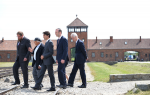
Prime Minister Justin Trudeau at the Auschwitz Memorial and Museum (photo from auschwitz.org)

On July 10, Prime Minister Justin Trudeau visited the Auschwitz Memorial and Museum. He was accompanied by, among others, Nate Leipciger, a former prisoner of Auschwitz born in 1928 in Chorzów, who emigrated to Canada in 1948 and has visited the memorial on more than one March of the Living; Canadian Minister for Foreign Affairs Stéphane Dion; and Rabbi Adam Scheier from Montreal, vice-president of the Council of Rabbis. The guests were welcomed by museum director Dr. Piotr M.A. Cywiński, who told them about the history of the camp and the contemporary challenges of the memorial.

Trudeau laid a wreath and held a minute’s silence in front of the Wall of Death in the courtyard of Block 11, where executions by shooting were held, as a commemoration of all victims of the German Nazi concentration and extermination camp.

The guests visited the vast portion of the museum’s exposition. They saw, among other places, Block 4, which was dedicated to the extermination of Jews and which contains German photographs documenting the arrival of the transport of Jews from Hungary, a model of gas chamber and crematorium II from Birkenau, Zyklon B canisters, as well as human hair taken from the murdered. There is also a display dedicated to the story of storage rooms for looted property which, in the jargon of the camp, were called “Kanada.” In Block 5, the visiting delegation saw personal objects of victims that were found in these storage rooms after the liberation of the camp, such as shoes, suitcases, glasses, brushes and kitchen utensils. The delegation also visited the building of the first gas chamber and crematorium in Auschwitz I.

In the second part of the visit, Trudeau walked through the former Auschwitz II-Birkenau camp. He walked along the rail ramp where the Germans conducted selection of the Jews, and also saw the ruins of the gas chamber and crematorium III, where the Jewish prayer for the dead, the Kaddish, was said. Candles were lit at the monument, commemorating all victims of the camp.

The prime minister also made an entry in the guest book of the museum. “Tolerance is never sufficient: humanity must learn to love our differences,” wrote Trudeau. “Today, we bear witness to humanity’s capacity for deliberate cruelty and evil. May we ever remember this painful truth about ourselves and may it strengthen our commitment to never again allow such darkness to prevail. We shall never forget. Nous nous souviendrons.”

Remembering Elie Wiesel …

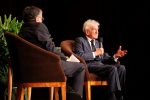
Dr. Robert Krell, left, listens to Prof. Elie Wiesel, as Wiesel addresses the capacity crowd that came to the Orpheum in 2012 to hear him speak (photo by Jennifer Houghton). Elie Wiesel passed away on July 2. May his memory be for a blessing.

The following article was originally published on Sept. 21, 2012, and initially reposted on July 2, 2016. The photographs were added with its republication in the newspaper and online July 15:

“The Jewish people is based on what is called in the Prophets, ‘Edim atem l’Hashem,’ ‘You are witnesses to God.’ Says the Talmud something horrible: the Talmud says God says, ‘If you are my witnesses, I am your God. If not, I am not your God.’… That is the importance of testimony.”

This was part of Nobel Peace Prize-winner Elie Wiesel’s response to a question about the role of March of the Living alumni. “You are now the witnesses,” he said. “Remember, to be a witness to the witness is as important as to be a witness.”

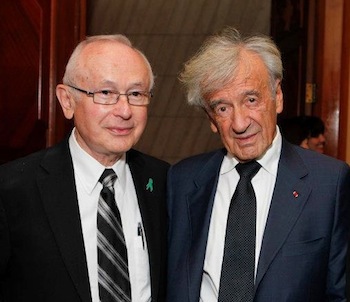
photo in Jewish Independent - Elie Wiesel with friend and fellow survivor Robbie Waisman
Elie Wiesel with friend and fellow survivor Robbie Waisman (photo by Jennifer Houghton)

Wiesel was in Vancouver to launch the Jewish Federation of Greater Vancouver’s annual campaign on Monday, Sept. 10. The event, which was held at the Orpheum, featured Wiesel in conversation with his friend, fellow survivor Dr. Robert Krell, as well as a presentation of another of Wiesel’s friends, Robbie Waisman, who accompanied this year’s March of the Living program to Poland and Israel. Participant Jenna Brewer read the account written by Monique de St. Croix of Waisman’s emotional return to his birthplace, after which Waisman himself addressed the nearly 2,700 people in attendance.

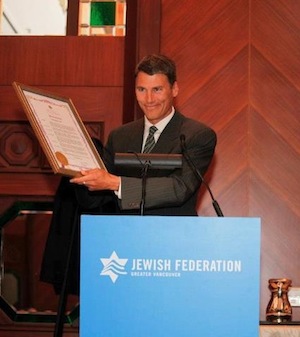
The campaign launch was the culmination of Wiesel’s day here, which included a proclamation from Vancouver Mayor Gregor Robertson declaring Sept. 10, 2012, Elie Wiesel Day.

Among Wiesel’s many activities was the receipt of an honorary degree from the University of British Columbia, where he spoke to university administrators, students and Holocaust survivors. A formal academic procession led Wiesel into the hall and a short panel discussion followed his remarks, involving the university’s president, Prof. Stephen Toope, Prof. Richard Menkis, a professor of modern Jewish history, and Barbara Schober, a graduate student. UBC Chancellor Sarah Morgan-Silvester presented Wiesel with the doctorate.

Also on Wiesel’s itinerary was a morning interview with the Jewish Independent; one of only two interviews he granted while here, the other being with the Vancouver Sun.

photo in Jewish Independent - Vancouver Mayor Gregor Robertson declares Sept. 10, 2012, Elie Wiesel Day
Vancouver Mayor Gregor Robertson declares Sept. 10, 2012, Elie Wiesel Day. (photo by Jennifer Houghton)

As editor Basya Laye and I introduced ourselves, Wiesel admitted his dependence on the New York Times, a copy of which he had not yet picked up that day. Once the “bible of journalism,” according to Wiesel, he lamented the Times’ decline in quality as the newspaper industry itself has declined. He wasn’t worried about the change to internet media, however.

“Our stories are not dominated by concern with the press, it’s person to person,” he said. “If you relied on the New York Times, the New York Times’ background, record in those years, is not the best, during the war.”

Wiesel recounted how, years ago, he complained to the Times about how little there was in the paper about the Holocaust while it was happening. Subsequently, he was invited to a luncheon, at which he gave them a piece of his mind. As a result, said Wiesel, in the paper’s offices, they have a plaque/letter saying, “We failed,” as a reminder to themselves.

Yet, admission of failure on the world level – that countries did not do enough to prevent the Holocaust – has not resulted in the prevention of other attempts at genocide.

“Can human nature change?” Wiesel said about that fact. “It’s society. Whatever the issue we have is, for instance, believe me that, I say, a sex story will have the front pages. Not what we try to say, but the sex story will have the front pages. It is our culture. We go with what is easy, what is cheap, and what is accepted as interesting by more people than before. And that goes everywhere, that’s in literature, that’s in the movies. I don’t know where we are heading.”

For his part, Wiesel has spent most of his life – as a witness, storyteller and teacher – trying to ensure that “never again” is a promise kept.

Born in Sighet, Romania (which was in Hungary during the war), Wiesel was 15 when he and his family were taken to Auschwitz. His mother and younger sister were killed there, his father died in Buchenwald, where Wiesel also was imprisoned when the war ended; his two older sisters survived. Wiesel’s book about his experiences in the camps, Night, was first published in 1956. It has since been translated into more than 30 languages, with millions of copies being sold.

A professor at Boston University since 1976, Wiesel was founding chair of the United States Holocaust Memorial Council, which created the U.S. Holocaust Memorial Museum, and, with his wife, Marion, he established the Elie Wiesel Foundation for Humanity soon after he received the Nobel. He has written more than 50 books, and his lengthy resumé continues.

When asked how he would categorize his body of work, Wiesel told the Independent, “Not enough.”

“What would you like to have been able to do?”

“More.”

“In terms of?”

“More,” he repeated. “Not enough. Look, look, on the surface, I’ve done a lot, published many books. Many books have been published about me, and so forth. I have approached presidents and kings, but all of that, somehow, it is not enough. Maybe, deep down, all of us who have survived have had a feeling, if we told the story, the world would change, and the world hasn’t changed. Does it mean that we did not tell the story? Or not well enough? Simply, we did not find the words to tell the story? Had we told the story well enough, maybe it would have changed the world? It hasn’t changed the world.”

“Do you feel like you have failed in some measure there?”

“Not failed,” Wiesel replied quickly. “I didn’t say fail. Failing, if I had not tried. Look, I know I tried. I still try.”

Complementing his activism for human rights, Wiesel is a dedicated student of Talmud and has a deep appreciation of Chassidic and biblical stories, which the Independent referred to as “old” in asking a question about such stories’ relevance today.

“They are not only old, they are immortal,” said Wiesel. As to specific lessons we could learn, he added, “It depends what area. If it’s the Bible, then the eternal truth, or at least the eternal quest for truth. The Talmud, it’s my passion – I grew up with the Talmud and, to this day, every day, I study – I love it. I love study.”

Wiesel explained, “There is so much beauty in all that. There is so much….” He paused. “Truth is a difficult word because my truth may be mine, but not yours, but learning, the quest for truth, is extraordinary. For me to teach those texts is so rewarding, so rewarding. And we take a theme, a talmudic theme or a biblical theme or a prophetic theme, and it can go on, it can last for us for hours and hours and hours in class.

“Come on, the beauty of an Isaiah, the tragic sense of a Jeremiah, and the immortal dimension of a Habakkuk. It is all these. They survived. The very fact that they survived, you know, how did they survive? These are texts conceived, written and spoken 3,000 years ago or so, 2,500, and they survived. What made them survive?”

The concept of truth came up again when the Independent asked Wiesel’s opinion – as a former journalist himself – about how much a newspaper should reflect extremes within the community it serves.

“I gave up journalism. Do you know why?” asked Wiesel. “I liked journalism at the beginning; I loved it. It was to be at the nerve centre of history, come on, I loved it. Then I realized, what, two things. Number one, I repeated myself – which means I changed the names, but the words remained the same.” He paused, then continued, “I am going to spend my life like that? Second, I realized the people that I loved and admired; occasionally, they had such an attitude of fear and respect for the journalist – I said, I don’t want that, I don’t want to inspire that. That’s when I moved to the academic. I gave up, for that reason.”

Hesitant to give advice, Wiesel eventually said, “Young lady, your truth is truth. Listen to it. It’s your truth that matters. Don’t accept somebody else’s truth. And, if you are a journalist, if you have the respect for your own words, that will be read by hundreds or thousands of people, who will read it and maybe be influenced by it – you, just you, don’t listen to [anyone,] not even to your editors. Don’t tell them, don’t even listen to that,” he said, looking at Basya as he made the comment, and laughing. “You decide. When you publish an article under your byline, it’s yours.”

Despite having wondered aloud as to the effectiveness of his efforts to change the world, Wiesel still gets up every morning to do just that. “What is the alternative?” he asked rhetorically. “What is the alternative? There is no alternative. True, I fought many battles and lost. So what? I’ll continue fighting. Look, my life is not a life of success or victory, much more of failures. I tried so many things and failed, you have no idea. Of course, so what? I’ll continue. The only area where I feel I must continue is, first of all, education. Whatever must be done in Jewish life, and in life in general – not only for Jews – education must be a priority. Not the only one, but the main priority, education. Let’s surely aim for that. And then, Israel, to me, of course is – the centrality of Israel in my life is here,” he said, putting his hand over his heart.

A few moments later in the conversation, Wiesel returned to the topic of journalism.

“You know, as a journalist, my love would be to interview, not for news, [but] to have the interview. And that’s really what I loved about it, to meet people, to have real conversations, I mean, real dialogues – not questions and answers, because I know now about you more than you think, simply by the questions that you ask. But that’s the journalist in me.”

“So, you obviously have faith in human nature … and you like to know more about people?”

“I do,” he said, with hesitation. “In spite of. It’s not because of, but in spite of.”


Mourning Elie Wiesel

Dr. Elie Wiesel was motivated by his experience as a survivor of the Holocaust to become one of the world’s foremost advocates for social justice and human rights. He was also a friend to members of the Vancouver Holocaust Education Centre community and we mourn his passing. In his writing and his activism, he gave voice to the experiences of survivors but, as he acknowledged, also saw it as his responsibility to represent those who did not survive.

Wiesel and Robbie Waisman, a past president of the VHEC, were among the 426 “Boys of Buchenwald” liberated on April 11, 1945, and began their post-Shoah lives together at a facility in France.

“We had a common bond,” Waisman said. “On the 11th of April, I usually go into my office and call some of the boys. Elie was part of it. There’s so much that I shared with him.

“The world lost an irreplaceable human being.”

Dr. Robert Krell – recipient of the Elie Wiesel Holocaust Remembrance Medal for his work in Holocaust education, psychiatric contributions to the care of Holocaust survivors, and his role as founding president of the VHEC, which Wiesel visited – became friends with Wiesel over several decades.

“He was the kindest, gentlest, wisest person in my life,” said Krell. “And he always made time for me, although he was also the busiest and most prevailed upon person imaginable.”

Wiesel once said: “There is much to be done, there is much that can be done.” And the Vancouver Holocaust Education Centre commits to continuing the work that defined his life’s mission.

The VHEC will honor the life and work of Elie Wiesel during our annual High Holidays Cemetery Service. The commemoration will take place at 11 a.m. on Sunday, Oct. 9, at Schara Tzedeck Cemetery, 2345 Marine Dr., New Westminster. Everyone is welcome.

The service, held annually on the Sunday between the High Holidays, affords participants the opportunity to mourn those who perished during the Holocaust at this symbolic gravesite.

לא שוכח

ביקור לרה”מ ג’סטין טרודו במחנה ההשמדה אושוויץ. (צילום: auschwitz.org)

ראש ממשלת קנדה, ג’סטין טרודו, לא שוכח את זכרם של קורבנות השואה והניצולים ממחנות ההשמדה. לאחר ועידת הפיסגה של חברי נאט”ו שנערכה בסוף שבוע שעבר בווארשה פולין, הגיע טרודו ביום ראשון כמתוכנן מראש לביקור ארוך באתר של מחנה ההשמדה אושוויץ- בירקנאו. את טרודו ליוו שר החוץ, סטפן דיון, השרה לשיתוף פעולה בינלאומי, כריסטינה פרילנד, ניצול מחנה אושוויץ, נייט לייפציגר, הרב אדם שאייר, המשמש חבר מועצת הרבנים של מונטריאול, ומנהל מוזיאון אושוויץ, פיוטר צ’יווינסקי. לייפציגר בן ה-88 נולד בצ’ורזו פולין ב-1927 ובגיל 11 הועבר למחנה אושוויץ עם משפחתו. שם איבד את אימו ואחותו שנשרפו בתאי הגזים. הוא ואביו ניצלו לאחר שהאב הצליח לשכנע קצין אס. אס להעבירו לקבוצה של הפועלים שעבדו במקום. לייפציגר היגר לטורונטו בשנת 1948 עם אביו עת היה בן 21. הוא הוציא תואר בהנדסה ושימש כל העת אחד מראשי הקהילה היהודית של טורונטו.

באמצעי התקשרת בקנדה פורסם בהרחבה דבר הביקור הראשון של טרודו באושוויץ, והביקור עצמו זכה לסיקור נרחב מאוד. טרודו ביקש לראות מקרוב את מה שנשאר מאחד הפרקים האפלים ביותר בתולדות האנושות. כמליון ומאתיים איש נרצחו באושוויץ- בירקנאו שבדרום מערב פולין ומרביתם היו יהודים.

טרודו ביקר בחלק גדול של התערוכה המוצגת במוזיאון הממלכתי, שכוללת צילומים של יהודים שהגיעו ברכבות מהונגריה, ציוד שנבזז מהיהודים ואת המבנה שאיחסן את תאי הגזים. לאחר מכן הוא צעד ליד מסילת הרכבת ונגע בקרונות שהובילו את הקורבנות למחנה. טרודו עם כיפה לראשו בחלק מהביקור עבר גם ליד הריסות תאי הגזים, בהן נהרגו אמו ואחותו של לייפציגר ושם לא יכל לעצור את דמעותיו. הוא אף קרא את תפילת יזכור באנגלית. טרודו הניח זר לזכר הקורבנות של הנאצים. ראש הממשלה הקנדי לא אמר מילה ורק דמע מספר פעמים, ובסוף הביקור חיבק את לייפציגר שנשק על לחייו. הביקור הארוך נמשך כמעט שלוש שעות. לאחריו כתב טרודו בספר האורחים של המוזיאון, את הדברים הבאים: “התרגשתי מאוד לבקר באושוויץ ובירקנאו. האנושות חייבת ללמוד לאהוב את ההבדלים בינינו. היום אנו עדים על היכולת האנושית בביצוע אכזריות מכוונת ורוע. נקווה שהיותנו עדים ליכולת של האנושות לבצע מעשים רעים שכאלה, רק תחזק את המחוייבות שלנו שלא לאפשר עוד לעולם לחשיכה שכזו לנצח. מדובר באחד הפרקים הגרועים ביותר בהיסטוריה האנושית ואנחנו לעולם לא נשכח זאת. זה המקום להזהיר בפני חוסר סובלנות ולהציע מסר של אהבה”.

לייפציגר אמר בראיון לאחר הביקור עם טרודו: “לא חשבתי שאשרוד את המחנה, שלא לדבר לראות את ראש ממשלת קנדה צועד כאן. לא הייתה שום דרך שיהיה לי עתיד. והיום אני חוזר לכאן לאחר 73 שנים עם ראש הממשלה של קנדה הנפלאה. טרודו הוא מנהיג רהוט שלוקח את קנדה לכיוון חדש. ניסיתי להראות לטרודו מה בני אדם עשו לבני אדם. השנאה הזו שהניעה קבוצה של אנשים לרצוח אנשים אחרים. שנאה כזו ממשיכה להתקיים בעולם גם כיום, ומיעוטים מופלים לרעה ונרצחים. טרודו קיבל את המסר שלו לזכור את העבר, תוך כדי עבודה להגיע לעתיד טוב יותר. הוא בכה איתי, הוא הזיל דמעות איתי. זה הביטוי הגדול ביותר של הבנה ורגשות שהוא היה יכול לעשות עבורי”.

טרודו הוא ראש הממשלה השלישי של קנדה שמבקר אושוויץ- בירקנאו. קדמו לו ז’אן קרטיין וסטיבן הרפר שטרודו החליפו.

We must keep trying

No reasonable people contend that the Holocaust did not occur. However, a great many assert that it has been considered enough, that it is time to put the past behind and effectively close the book on that era. Similarly, discussion today about the Holocaust is likely to elicit a sort of comparative or competitive response: “The Jews are not the only people who have suffered,” or something similar. While such assertions are almost tautological in their obviousness, they betray a different sort of exceptionalism around the Holocaust: the Jewish people are not the only group in history to have suffered, but they are the only ones today being told to buck up and shut up about it.

Somewhere between these two responses – outright denial and exasperated acknowledgement – is a large swath of indifference. A great many people in Canada and elsewhere are aware of the history of the Holocaust, express appropriate responses to it and may utter rote pieties about preventing history from repeating itself. As a civilization, though, all of these responses have so far led to an unsatisfactory status quo.

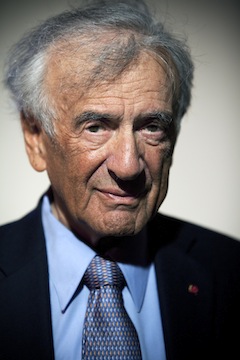
photo in Jewish Independent - Elie WieselElie Wiesel, who died Saturday, believed that understanding the Holocaust is key to the crucial need to understand human capabilities for evil and possibly to provide its antidote. If Wiesel’s formula is correct, the briefest glance at the headlines today is all the proof necessary to show we have thus far failed to consider and understand that terrible history.
For decades, Wiesel was not only a global voice for survivors, but a sort of moral compass for a world that has not learned the overarching lesson of the Shoah. Speaking out again and again on issues of contemporary injustice and genocide – though some advocates for Palestinians have contended that he wasn’t as vocal on that issue – Wiesel at the same time expressed regret that his interventions should be necessary.

In an interview with the Independent in 2012, Wiesel lamented that all his efforts and those of other survivors have failed to create the ideal world free of hatred and genocide.

“Maybe, deep down, all of us who have survived have had a feeling, if we told the story, the world would change, and the world hasn’t changed,” he said. “Does it mean that we did not tell the story? Or not well enough? Simply, we did not find the words to tell the story? Had we told the story well enough, maybe it would have changed the world? It hasn’t changed the world.”

The outpouring of grief over the passing of Wiesel is the appropriate response to the loss of a great individual. But it also reflects a larger lament; it is a reminder that the generation of eyewitnesses is diminishing. For many of us – and for the world – Wiesel was the face of the survivor, the voice of the Holocaust experience. His unflinching writing on the subject defined the discipline of the eyewitness Holocaust narrative. Not only was Wiesel able to articulate and validate the experiences of survivors who could not express themselves for various reasons, more importantly, as he himself acknowledged, he had an obligation to those who did not survive.

It is this same sense of obligation that motivates survivors to regularly make the emotionally exhausting effort to share their experiences with audiences, particularly young people. As Wiesel acknowledged, the world has not responded adequately. But, in the same interview, he said failure would have been to not try.

When Wiesel was recognized in 1986 with a Nobel Prize in literature, it was a recognition of his contribution, certainly, but it was also an affirmation for all survivors – indeed, for all of those whose identities attracted the Nazis’ genocidal hatred – that their experiences were valid, legitimate and incontestable.

When Wiesel’s book Night was published in English in 1960, it was at the start of a global conversation of the Holocaust and its meaning for humankind. Wiesel rightly hoped, but perhaps should not have expected, that a catastrophe of this magnitude would be adequately understood or its lessons assimilated in the comparatively short span of a human lifetime. He was correct that understanding the Holocaust is a key to humanity’s future. By their actions, Wiesel and all the survivors who share their lived experiences have helped to lay a foundation for a world in which the key to peace and a better future can emerge. As the eyewitness survivors pass that responsibility along to the rest of us, it is our ambitious mission to build on that foundation and to extend their calls of compassion, humanity and reflection to a world in great need of perfecting.

Why are you attached to Israel?

I was recently invited to speak to an Ottawa-based Israeli-Palestinian relations group on the topic of Canadian Jews and Israel. Unfortunately, there is a dearth of public opinion data available on Canadian Jewish attitudes. We have some broad strokes on identity issues, though. In addition to Conservative Judaism – rather than Reform – being our largest denomination, Canadian Jews, compared to American Jews, are one generation closer to the Holocaust, are more likely to speak Hebrew, educate their kids Jewishly, and to have visited Israel. Most central to my talk though, was how Canadian Jewish institutions are responding to attempts to challenge Israel as a Jewish state, including the boycott movement.

A lively Q&A followed, but there was one question that stopped me in my tracks. What is it about Israel, a man asked, that makes you feel attached to it? He seemed genuinely curious and rather puzzled, so puzzled that he asked it twice.

Being in the field that I am in, I have a ready answer, but I know I am not typical. My own attachment to Israel centres primarily on a deep passion for Hebrew and Israeli culture. I lived in Israel for three separate years in my 20s, I speak only Hebrew to my kids, I alternate my Netflix watching with Israeli dramas and I am as likely to binge listen to “The Last Waltz” as to Kaveret’s final concert album. My daughter’s d’var Torah at her bat mitzvah was the only one I’ve heard reference Arik Einstein lyrics. Of course, the attention I devote to Israel is partly a function of my profession, but I chose my area of study based on a great sense of attachment to the country and a desire to understand how the Israeli-Palestinian region can become a more just and humane place.

But what of my fellow Canadian Jews? Those of my parents’ generation, who grew up in the shadow of the Holocaust, might view Israel as an insurance policy in the event of the unthinkable. Religious Jews might feel a profound spiritual connection to the land. But what of the many less religious Canadian Jews of my generation (and younger), those for whom Canada, with its absolute commitment to freedom, tolerance and multiculturalism is as safe a haven as any they could imagine; those for whom particular stones on particular bits of territory are not understood to hold sacred meaning, and for whom Hebrew or Israeli contemporary culture is not something that pulls them?

What does Israel mean to these Jews who are unlike my parents, unlike religious Zionists and unlike me?

I encourage my fellow Canadian Jews to articulate their attachments. Doing so with nuance and open hearts may help uncover new political arrangements. Maybe it would point to two states, maybe a confederation system where everyone has access to all the land but possesses citizenship in only one state (as Dahlia Scheindlin and Dov Waxman have proposed), and maybe even a single state where both languages and cultures are carefully preserved. We should ask what threat, exactly, does refugee return pose, rather than leave it as an imaginary bugaboo. Being explicit about our emotional ties – while being open to hearing the emotional experiences of others – may bring us closer to supporting creative peace efforts.

A postscript. A survey of the Canadian Jewish community is currently being circulated by Jewish Federations of Canada-United Israel Appeal, and British Columbians can respond online via svy.mk/20qCWb7. The survey is being conducted by David Elcott and Stuart Himmelfarb, both of New York University’s Wagner Graduate School of Public Service. As I recall, there is only one question on Israel, which asks whether the respondent feels “attached” to the country. Attachment is associated with many different perspectives, and says nothing about one’s commitment to human rights for those under Israel’s control, for example. I hope that we may soon see more in-depth survey research on Canadian Jewish attitudes towards Israel and its policies.

Mira Sucharov is an associate professor of political science at Carleton University. She is a columnist for Canadian Jewish News and contributes to Haaretz and the Jewish Daily Forward, among other publications. This article was originally published in the CJN.


Honorary degree for Frimer

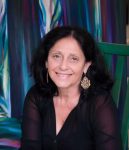
Linda Frimer was honored earlier this month by the University of the Fraser Valley for her artistic, humanitarian and philanthropic contributions and accomplishments. (photo from UFV)

For Linda Frimer, art is a form of reconciliation, and creativity a means of expressing the love within us all. The Vancouver artist has been sharing her art to heal, help worthy causes, and reconcile nature and culture for more than 35 years. In recognition of her artistic, humanitarian and philanthropic contributions and accomplishments, Frimer received an honorary doctor of letters degree from the University of the Fraser Valley at its June 2 afternoon convocation ceremony at the Abbotsford Centre.

Born in Wells, B.C., and raised in Prince George, Frimer connected with nature early on, and it informed her artistic development from the start. “I always had a pencil in hand and was allowed to roam the forest freely as a young girl,” she recalled.

Born a few years after the Second World War ended, she heard the adults in her family whispering about the devastation of the Holocaust. Even decades before the war, her family faced hatred and expulsion. Her grandfather fled Romania during the pogroms in the late 19th century, becoming one of the “footwalkers” roaming Europe, then following the Grand Trunk Railroad in Canada to its terminus in Prince George, where he became a merchant.

“I was too young to understand it all, but I knew something very bad had happened,” said Frimer. “I was a highly sensitive child, and absorbed the pain and anguish that others were carrying. I turned to nature for healing and reconciliation. I would enter the forest with a sense of awe and wonder. It’s what unites all people. When we suddenly see a magical tree or a sunset that leaves us breathless, that wonder belongs to everyone. I’ve always wanted to bring together the worlds of nature and culture. They are all connected, and recognizing that interconnectedness facilitates healing.”

Compelled by a desire to reflect the pain of her community and work towards healing, she created many works of art examining this theme. She co-founded the Gesher (Hebrew for Bridge) Project, a multidisciplinary group that helped Holocaust survivors and their children express their traumatic experiences through art, words and therapy.

Reflecting on the project during a talk she gave to the Canadian Counseling and Psychotherapy Association, she noted that creative expression is a critical component to healing. “I’ve done work that reflects my culture and my people and their plight, but I don’t want to get caught in the dark places. I want to share reverence between all cultures. I want to bring light and love to the forefront.”

From an early age, Frimer felt an affinity for the aboriginal people she grew up near in rural British Columbia. Her connection became more formalized when she befriended Cree artist George Littlechild (also a UFV honorary degree recipient). The two felt an immediate connection through their interest in incorporating family and history into their art and their use of vibrant colors. They have collaborated to produce art shows presented in venues such as the Canadian consulate in Los Angeles, and produced a book titled In Honor of Our Grandmothers.

“Both of our peoples have been through so much that we felt a real connection,” explained Frimer. “Growing up, I felt a real sense of ‘otherness’ and not fitting in. Many aboriginal people can relate to that, too.”

Frimer’s affinity to nature has led to her supporting many environmental causes. Her paintings for the Wilderness Committee, the Trans-Canada Trail, the Raincoast Environmental Foundation and other groups have raised funds for wilderness preservation, and also raised awareness of threatened forests and ecosystems.

“I love my environmental work because I know that’s where I can make a difference,” she said. “I am committed to helping to preserve endangered species and ecosystems, as well as helping people at risk or in crisis.”

Frimer spent her 20s raising her children and developing her artistic skills by finding mentors with whom to study. She didn’t begin her formal training until she was 33, when her last child started school. She then finished a four-year degree at Emily Carr in three years, receiving credit for her prior learning and artistic work.

More than three decades into her career, Frimer’s paintings and murals can be found in galleries, synagogues, churches, retirement centres, hospitals, hospices, schools, transition houses, corporate offices, and public and private collections. She has been very prolific but says it’s been easy to create so much art because she feels she is merely a vessel for a strong creative force. “It’s like joy coming through me, rather than me making it happen,” she said.

Frimer has received many accolades, honors and titles, but said her favorite title is “Grandma.” She and her husband Michael raised their blended family of eight children and now enjoy the company of nine grandchildren. “It’s profoundly important, especially for the Jewish people, who have lost so much, to rebuild the family we’ve lost and share reverence with others who have had similar losses,” she said.

Still, receiving an honorary doctorate is a special distinction for her. “My parents would have been extremely proud, and I know that my husband and children will be too,” she said before the convocation. “You can’t really declare yourself a successful artist – you need affirmation from the outside. I’m so grateful that my messages have been heard, and that the care that I’ve put into bringing more culture, nature, creativity, expression, healing and light into the world through the gift of art is being honored.”

For more about Frimer and her art, visit lindafrimer.ca.

Exploration of identity

Ira Hoffecker’s Berlin Identities is at Zack Gallery until July 3. (photo from Ira Hoffecker)

Rarely does the Sidney and Gertrude Zack Gallery at the Jewish Community Centre of Greater Vancouver present exclusively a non-Jewish artist. This month, however, the gallery features Ira Hoffecker’s solo exhibit Berlin Identities.

Born and raised in Germany, the horrible history of Nazism and the Holocaust are part of Hoffecker’s identity, the identity she explores in this exhibition and in the entirety of her art. She looks at the Holocaust from the perspective of a German born after the Second World War.

“Germany is rich in history. There are so many layers,” she said in an interview with the Independent. “But the history of WWII and Nazism is different. The previous generations – my parents and grandparents – didn’t want to talk about it. My mother was a child during the war, and all she and her parents wanted after the war was to forget. But we can’t forget. We can’t deny our responsibility. For years after the war, there was a leaden blanket over the Holocaust, over what Germany did. But you can only move on if you accept the past, even such a horrible past as the Holocaust. It’s easy to say: it wasn’t me, I wasn’t born yet, but it’s our heritage. We have to accept our guilt, to acknowledge it, before we can start to heal as a society.”

That’s what her art is about: trying to understand and accept the painful enormity of the Holocaust and the guilt Germany carries, trying to discover her own definition of self underneath those national memories.

Another theme in her art, intertwined with the first, has to do with urban identities. “My paintings are informed by the different identities cities assume over time,” she explained. “History transforms cities, changes the urban space.”

All of the paintings in Hoffecker’s current show reflect her search for personal and urban identities. They are interpretations of maps: colorful, stylized and multilayered.

The layers represent the passing of time, as demonstrated by several paintings of Scheunenviertel, the former Jewish quarter in Berlin. “Before the Nazis came to power, over 150,000 Jews lived there. By the end of the war, none remained,” said Hoffecker.

Accordingly, the main layer denotes what the district looked like right after the war, while the overlaying layer, mounted on Plexiglas, corresponds with the map as it is currently. “The layers are a metaphor – of forgetting, of suppressing the past,” she explained. “Of the inevitable change.”

Two of the paintings look even scarier. One is covered by steel mesh, like a concentration camp fence. Another is concealed under torn tissue paper, where only fragments of the original map are visible, the rest is hidden – perhaps by those who don’t wish to remember. However, “we must remember,” the artist insists, and she tries to stir the memories by her imagery.

As is true for geographical maps, color and geometry play huge roles in Hoffecker’s creations.

“I’m fascinated by colors and I love maps,” she said. “As a child, my favorite book was an atlas. I like studying maps. I have a huge collection at home. My husband calls me a human GPS. I never have trouble navigating in any city, but only cities. I’m an urban person; I don’t do well in the wild.”

With her love for maps, it’s not surprising that she likes traveling. “Every city I ever visited has its own identity, its own atmosphere. I have been in many: all over Europe, India, Egypt, Peru. I’ve moved 26 times, but I hope I’ve stopped at last. I live in Victoria now and I don’t intend to move again.”

Her road from Germany to Vancouver Island was somewhat out of the ordinary.

“I always liked art, but when I lived in Germany, I worked in marketing and publicity for the movie industry,” she said. “Then, my husband and I had our own movie marketing company in Hamburg. Fifteen years ago, we came to Vancouver Island for a vacation. My children were young. We rented a mobile home and traveled together. We loved British Columbia, but the movie producers kept calling us, even though we were on vacation. They could call in the middle of the night, and I thought, What am I doing in this rat race? We needed a change.”

In 2004, they acted on the need for change and moved to Canada, settling in Victoria. “My children went to school there, and I went to school, too,” she said. “I decided to follow my old dream and change careers. I wanted to become an artist. Since we moved to Canada, I’ve been a student of the arts, but the career change is not easy or fast. It’s like a circus salto mortale, almost a free fall. It’s scary.”

But she hasn’t let the fear stop her. She has become an internationally known artist. In the last few years, she has participated in a number of solo and group exhibitions in Canada, England and Germany. She is studying for her master’s degree, and her paintings have started gaining recognition in artistic circles and among private collectors.

“I’ve sold over 170 paintings,” she said. “Recently, I was nominated, together with 53 other artists, for the British John Moore Painting Prize 2016. Our paintings will be shown within the Liverpool Biennal. They were selected from over 4,000 submissions.”

Another big change is coming soon for Hoffecker.

“We are not Canadian citizens yet,” she said. “Until a couple years ago, Germany didn’t accept dual citizenship, and I couldn’t give up my German citizenship either; I’m German. Now that it is possible to have dual citizenship, my family will receive our Canadian citizenship. It will happen on July 1st, on Canada Day.”

Berlin Identities will be on display at the Zack until July 3.

Olga Livshin is a Vancouver freelance writer. She can be reached at olgagodim@gmail.com.


Healing one’s self, the earth

Born to Ukrainian Orthodox survivors of the Holocaust, Dr. Eva Pip knows all too well the long-lasting effects of war. Her parents were imprisoned in labor and concentration camps as punishment by the Nazis for harboring Jews on their farm.

“My mother was never a fully functional human being again,” said Pip. “She had a number tattooed on her arm that she was always trying to conceal. She felt that, if someone saw it, they’d think less of her. Her greatest fear was of being sent back.

“She had terrible nightmares for the rest of her life. At least once a week, she would scream in her sleep, as though she was being murdered. I’d have to run to wake her up. She had a lot of old injuries and scars, and an improperly healed collar bone and breast bone.”

photo - Dr. Eva Pip
Dr. Eva Pip (photo from Eva Pip)

Pip’s mother came to Winnipeg by train from Halifax. Her mother did not choose to come to Canada; it was simply where that week’s ship from Germany happened to have been bound. The previous week’s ship went to Australia.

Several years later, Pip’s mother was able to sponsor her husband to come to Canada. He could not get out of Germany when the war ended and the forced labor camp in which he was held was disbanded, as he was wounded and not yet medically fit to be cleared to come to Canada. He finally came in 1949.

Pip was born the next year though her parents never wanted a child. The war had taken the humanity and warmth from them and they found it difficult to cope with basic daily life.

“In many ways, both of my parents were like children,” said Pip. “They could not make decisions, they could not take proper control of their lives, they constantly lived in some past world before the war had happened.

“There must be thousands and thousands of these silent casualties that are not recorded or even recognized. This damage did not stop with the people who personally experienced war atrocities. It affected their children, too, such as myself, who grew up in essence without parents to love and nurture them, to teach them, to respect them as human beings that they have brought into the world.

“My parents never once hugged or kissed me. We had very little food to eat. Often, we ate out of garbage cans. My mother made my clothing out of scraps and bits because she could not afford to buy me anything. My father did not want to support us, although he lived with us.”

Pip’s father worked as a painter for a billboard company, Universal Signs, which was owned by Max Gardner – who was Jewish and who Pip said took pity on her family – until he retired at the age of 66.

“The Gardners were our benefactors,” said Pip. “They gave us their old furniture for our home and did many kind things to help us out. They almost adopted me.

“Our next door neighbors on Manitoba Avenue in Winnipeg’s North End happened to be the parents of Dr. Harry Medovy [a well-known pediatrician and academic]. Although he had already left home long before we arrived, his mother was very kind to us and often shared her home-made Jewish holiday food with us.”

Later on in life, Pip has, in turn, helped out with various Jewish women’s and seniors organizations.

Growing up in a home that did not encourage friendships, Pip developed a very rich interior life, and found empathy and compassion for other beings in her North End environment.

“I developed a passion for nature, for the earth, and felt incredible sadness at what was happening to our environment,” she said. “I felt the hardships of the creatures around me that had even less than I did. I could feel their voicelessness and powerlessness from those who could kill on a whim and who were unmoved by the suffering and injustice we inflict on the companion spirits God gave us to accompany us during our brief time on this earth.”

This view led Pip to her career choice. She wanted to speak for those who could not and to raise awareness of how damaging and destructive people’s actions are for our planet.

Regarding any desire to have a family of her own, Pip said, “You cannot miss something that you have not had. I have lived alone all my life. The advantage of this is that spiritual development becomes a much more important life path, without the distractions of family and its problems and demands.

“My work became my family. I obtained my PhD from the University of Manitoba in 1977. At that time, being a woman in science was hard. I was able to go to university only because the National Research Council supported me with scholarships. I worked very hard and got good grades.”

Pip taught at the U of M for three years before transferring over to the University of Winnipeg, where she has been teaching for 37 years. This year, Pip is retiring, though by no means does she intend to spend her days resting. She plans to continue writing and publishing pieces on the environment and working in her large rural garden.

Pip grows most of her own food because she knows it will be clean and free of chemicals.

“I’ve always loved tomatoes,” she said. “That interest has grown into my trying to preserve heritage varieties, as these are rapidly disappearing and are an irreplaceable part of our collective culture. I also grow heritage potatoes and heritage varieties of flowers, giving away much of what I cannot eat. I also harvest wild foods on my land.”

Instead of having a cottage, which Pip views as harmful for the environment, she buys land of ecological value and donates it to wildlife preservation institutions. She has donated most of her land to the Manitoba Habitat Heritage Corporation.

“I hope there is never such a monstrous exhibition of human cruelty and vice in our world again [as was the Second World War],” said Pip. “I hope we never again have millions of damaged human beings in the aftermath. I hope we can make peace with each other, that we can recognize that we are all equal, that we do not look down on each other and pretend we are better, that we do not rob each other of our right to life and right to God, and that we make peace with our Mother Earth.

“For these things to happen, human nature needs to change, our values and our dollar worship need to change. I fear that it will be too late by the time we and our leaders realize this. When it is time for me to hand in my dinner pail, I wish to face God and feel confident I have done a good day’s work.”

Rebeca Kuropatwa is a Winnipeg freelance writer.