Skip to content
  • Home
  • Subscribe / donate
  • Events calendar
  • Business Directory
  • FAQ
  • News
    • Local
    • National
    • Israel
    • World
    • עניין בחדשות
      A roundup of news in Canada and further afield, in Hebrew.
  • Opinion
    • From the JI
    • Op-Ed
  • Arts & Culture
    • Performing Arts
    • Music
    • Books
    • Visual Arts
    • TV & Film
  • Life
    • Celebrating the Holidays
    • Travel
    • The Daily Snooze
      Cartoons by Jacob Samuel
    • Mystery Photo
      Help the JI and JMABC fill in the gaps in our archives.
  • Community Links
    • Organizations, Etc.
    • Other News Sources & Blogs
  • JI Chai Celebration
  • JI@88! video

Recent Posts

  • Or Shalom reopens its doors
  • JFS from past to future
  • Need holistic approach
  • Sharing stories, advice
  • Journalist shares fears
  • Skills to live together
  • Road to independence
  • Cutting grass with scissors
  • Zionism as a solution
  • Deceit, desire & the divine
  • Reclaiming sacredness
  • Creative project ideas
  • Summer squares and cobbler
  • Thou shalt … summer commandments
  • Legal help for students
  • Revisiting myth of Lilith
  • Wrong person rebuked
  • Canada’s mixed messages
  • Questions for museum
  • Symposium on antizionism
  • Making soccer political
  • CJPAC lauds Pulver’s impact
  • City recognizes Vrba’s legacy  
  • Organ donation saves lives
  • Theodore’s March premiere
  • A healing Shabbaton
  • Supplying healthy food
  • A chime of metal tags
  • Yellowknife seder a first
  • Ishai energizes, unifies
  • A Lag b’Omer to remember
  • Expanding the healing
  • Hannah Senesh – a unique hero
  • Community milestones … May 2026
  • Sharing her testimony
  • Fall fight takes leap forward

Archives

Follow @JewishIndie
image - The CJN - Visit Us Banner - 300x600 - 101625

Tag: health

Understanding a teen’s brain

Understanding a teen’s brain

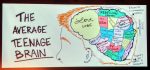
Dr. Mike Teschuk created this image to illustrate how a teen brain prioritizes.

“First thing you’ll notice is the largest lobe is the love lobe,” said Dr. Mike Teschuk, showing an image of how a teen brain prioritizes. “For teenagers, this is the capital lobe. ‘I love my new outfit. I love my girlfriend of two weeks, the latest YouTube video … but not necessarily my parents. Maybe they still do love their parents, but they don’t show it, for sure. You’ll notice, in the smallest corner, is the memory for chores and homework. That’s the smallest part of the teenage brain.”

Teschuk was speaking at a National Council of Jewish Women of Canada event on Feb. 6, held at the Rady JCC’s Berney Theatre in Winnipeg. It offered parents insights and suggestions as to how to best work with their (and other) teens.

Teschuk is a clinical psychologist at the University of Manitoba and with the Winnipeg Regional Health Authority. Besides having parented three adolescents who are now young adults, he has provided clinical services to children, adolescents and parents at the Health Sciences Centre in the department of clinical health psychology for the past 20 years.

According to Teschuk, while addiction to cellphones might be somewhat new, the way a teen brain is drawn to new and different things, and their contempt for authority, has always been present. Knowing this, he said, can help put teens’ odd and/or inconsistent behaviours into perspective for parents, and help them become more effective and empathetic caregivers. Changes that the teen brain goes through can be very intense and overwhelming.

“There is a great little analogy in Ron Clavier’s book Teen Brain, Teen Mind,” said Teschuk. He likens this new, more efficient brain that is emerging to getting a new computer. You get a new computer, it can do so much more than the old one. It takes awhile to get the hang of it, a new operating system. If you’re like me, it can be an intense learning process, sometimes frustrating. Sometimes, you’re overwhelmed. You long for the old computer, because it was more simple. Right? It was more predictable. I think we can feel more empathy for teenagers if we realize that this kind of stuff is happening in the brain.

“These changes create a sense of anxiety and stress. And, though they vacillate, they show signs of more maturity than regression backwards. They don’t want to be treated like a little kid anymore. You get this ambivalence.

“There are interesting studies that show that early to mid teens, when they have to process information and emotional tasks – when you look at the brain with more function and see what’s happening – you see they are using those temporal lobes, the middle of the brain, to process those emotions,” he said. “Eventually, what happens with age is they move into that later stage of adolescence [and] the frontal lobes take over.

“It’s what all parents are waiting for. As the frontal lobes develop, the individual can see into the future more, inhibit their impulsive behaviours, better plan, socialize and make decisions. But remember, this is a work in process,” he cautioned.

Teens become more able to consider hypothetical ideas and are more flexible in their thinking, he said. “You begin to see it by 12, 13, 14 years old – they can consider alternative possibilities. What if there is no God? What if I decide not to continue dance class or hockey … these activities my parents signed me up for when I was 5 years old?”
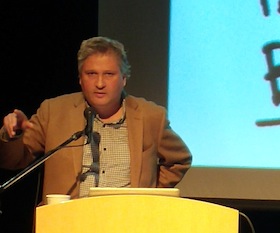
photo - Dr. Mike Teschuk spoke at a National Council of Jewish Women of Canada event on Feb. 6, held at the Rady JCC’s Berney Theatre in Winnipeg
Dr. Mike Teschuk spoke at a National Council of Jewish Women of Canada event on Feb. 6, held at the Rady JCC’s Berney Theatre in Winnipeg. (photo by Rebeca Kuropatwa)

Teschuk is a big proponent of looking at situations from the other person’s perspective. He said laying down the law and being confrontational does not work well with teens. He suggested instead to take the time to understand why they do things a certain way, and to find a way to work together to create a better outcome. This can be done by asking questions and listening, by dialogue.

“So, how do all these changes impact self-esteem?” he asked. “We know it has a big impact. Research says self-esteem often declines during early adolescence, and then improves again as they get a bit older. The idea is there can be discrepancies between who you are and who you think you should be. [Teens] start to reflect on how they are not the ideal person they want to be. At this stage, teens need a lot of reassurance from us. There is a symbolic kind of transition that has to happen. Like, in our family, the transition from the kids’ table to the grown-ups’ table. Going to the grown-up table is about also having your own views to express.”

According to Teschuk, at around 14 years of age, teens go through a “rejecting stage,” they don’t want to be with their parents at all. They want to pretend they don’t even have parents. But, Teschuk reassured the 100-person audience by way of personal example, his 23-year-old daughter, who went through this stage, now likes to go out for coffee with him – so, these things, too, shall pass. Your kids will not feel the same way at 23 as they did at 14, he said.

As parents, he said, we need to recognize that this is a normal stage of development. You don’t have to argue about it or be upset about it. Your teens will feel the need to reject a lot of the things they had until then taken for granted. They want to be independent, but it’s daunting for them.”

According to Teschuk, parent-to-adolescent connectedness is very important, especially when things are rough. Simply by hanging in there as a parent and showing how much you care has a large impact, he said, acknowledging that this is the most fundamental, yet hardest, thing to do when teens push back. “It’s easy to want to reject them, when someone is making your life very difficult,” said Teschuk. “It’s natural to feel that way, but, being able to hang in there is huge.

“Relationships with adults outside the family are important, too – with teachers, coaches, people in church or synagogue, extended family members – having other trusted adults. School connectedness is super-important, too. Schools offer so much more than academics,” he said. “If teens want to go to school because they’re on sports teams, in a play, or some other engaging activities … follow their lead and support them in those interests. Positive peer environments are important … but, of course, parents can have a role in creating those peer environments. Knowing your teenagers’ friends … and making your house a place where they want to hang out is a great strategy.”

Teschuk offered a couple of other tips. He suggested that parents, when driving their kids around, take the time to talk with their children and to connect with them. Also, he said, talking with them in this way gives the teens the chance to talk without being face-to-face, which can be uncomfortable and stress-inducing. Last but not least, Teschuk said family meals are also a great time to connect.

Rebeca Kuropatwa is a Winnipeg freelance writer.

Format ImagePosted on March 23, 2018March 23, 2018Author Rebeca KuropatwaCategories NationalTags family life, health, Mike Teschuk, science, teenagers
Demystifying nutrition

Demystifying nutrition

Cara Rosenbloom is trying to educate people about nutrition. In 2016, she co-authored the cookbook Nourish. (photo from Cara Rosenbloom)

When grocery shopping, how do you decide what to get when you are looking at items not familiar to you? Do you look at the ingredients? Are you drawn to packages that claim to be natural, whole food, organic?

Marketing and manipulation often go hand in hand. And it can be challenging to differentiate between products that actually offer added value and those that just say they do.

For the past 10 years, dietician Cara Rosenbloom has been running Words to Eat By, which provides nutrition education. For example, what does organic really mean in terms of food and nutrition?

When it comes to a product’s organic claims, Rosenbloom said, “I think the most important thing that people need to know about organic is that the word has nothing to do with health. An organic claim on a food does not mean it’s healthier for you. Organic is a method of farming.

“The use of the term ‘organic’ is regulated in Canada and has very clear guidelines about which foods can have that term stamped on it. It has to do with how that product – if it’s an animal, how it was raised … or, if a plant, how it was grown. But, once that organic product is used in a food product, the resulting food may not be a health food. Perfect examples are Kraft Dinner and Doritos. They now have organic versions. Those are not health foods.”

photo - Cara Rosenbloom
Cara Rosenbloom (photo courtesy)

Rosenbloom said claims that organically grown foods contain fewer chemicals are misleading. “Even foods that are grown organically still use pesticides and fertilizers. They’re just organic versions of it,” she said. “The word ‘chemical’ is not used appropriately in nutrition literature, in the way the media describes food. Many things are chemicals and aren’t bad for you. Water is a chemical! You need a degree in chemistry almost to understand how molecules are put together…. If you think organic food is just grown naturally in the sunshine, you’re wrong. Organic farmers use natural pesticides and herbicides. If you want to call those chemicals, too, then that’s fine.”

Rosenbloom writes a monthly column in the Washington Post, where she focuses on debunking myths and educating the readers about wellness, so people can make informed decisions about their nutrition.

In her interview with the Independent, she touched on how people get scared off by the “dirty dozen,” a list of fruits and vegetables believed to contain the highest amount of pesticides. In 2017, the Environmental Working Group’s dirty dozen were strawberries, spinach, nectarines, apples, peaches, celery, grapes, pears, cherries, tomatoes, sweet bell peppers and potatoes.

Rosenbloom explained that, too often, consumers avoid buying produce altogether if they can’t find organic versions. “That’s obviously the wrong message, and not what any dietician would recommend,” she said. “I wrote an article about how the dirty dozen list doesn’t hold weight in terms of pesticides. It’s a flawed list and has no scientific credibility. I educate people that organic is fine if you choose that, but not to fear fruits and veggies that are conventionally grown. The bottom line is that you need to eat fruits and veggies, whether you choose to eat organic or not, because they’re just a healthy thing in the diet.”

In that Jan. 18, 2017, Post article, Rosenbloom interviewed food toxicologist Carl K. Winter about the dirty dozen list, which, he said, “failed to consider the three most important factors used in authentic risk assessments – the amounts of pesticides found, the amounts of the foods consumed and the toxicity of the pesticides.” And, she notes, “Even the Environmental Working Group doesn’t recommend avoiding the items on its own dirty dozen list. Their website says ‘the health benefits of a diet rich in fruits and vegetables outweigh the risks of pesticide exposure. Eating conventionally grown produce is far better than skipping fruits and vegetables.’”

As for the claim that a product is natural, Rosenbloom explained that, while the organic label is closely regulated, the natural label is not. “Anything can be deemed natural,” she said. “So, it’s not something you want to count on. A lot of foods that are high in sugar, let’s say, can still say they are natural, because sugar comes from plants and that’s natural.

“The word natural doesn’t have a base definition that companies must satisfy in order to use that term on their foods,” she continued. “So, if you look at a product that says it’s natural, it doesn’t really tell you what that means. It lets you figure it out.

“We’re seeing more big companies that make processed food use the word natural – and misuse it. And this is leading to fewer consumers having any trust in the label natural.”

When it comes to vitamin supplements, Rosenbloom said more is not better. “There are certainly times when your body does need certain vitamins, but a lot of people are spending a lot of money on vitamins they just don’t need,” she said. “Then there are false promises made with things like vitamin IV drips and other popular myths.”

Rosenbloom has written about how to tell the difference between processed, ultra-processed and whole foods, as well as how to buy seafood that is produced in a safe, sustainable way, and much more. In 2016, she co-authored a cookbook with Chef Nettie Cronish, called Nourish: Whole Food Recipes Featuring Seeds, Nuts and Beans. It features 100 recipes, all of which are original and co-developed by the authors.

“We focused on beans, nuts and seeds in the book because these are nice sources of protein,” said Rosenbloom. “And nuts and seeds are healthy fats that are underutilized by most people in the diet, with most people relying mainly on animal-based foods for their protein. We wanted to explain that you can include seeds, nuts and beans in everyday recipes, and these 100 recipes show them how.

“It’s not solely a vegetarian cookbook,” she added. “It encourages people – wherever they are at, vegetarian or not, whoever wants to buy the book – to try out the recipes, which include meat, chicken, fish, seafood and vegetarian.

“The idea was to say, ‘Whatever you’re eating, here’s a way to add seeds, nuts and beans, to get more of those healthy ingredients into your diet.’ Take salmon, for example. It might be crusted with sesame seeds, or oatmeal might have some hemp seeds or flax seeds in it. So, we just enrich foods you eat anyway with the goodness of seeds, nuts and beans.”

Rosenbloom is on Facebook and Instagram (Words to Eat By) and her website is wordstoeatby.ca. For her latest Post articles, visit washingtonpost.com/lifestyle/wellness.

Rebeca Kuropatwa is a Winnipeg freelance writer.
Format ImagePosted on March 23, 2018March 23, 2018Author Rebeca KuropatwaCategories WorldTags Cara Rosenbloom, food, health, organic farming
Tranquility and restoration

Tranquility and restoration

The Upper Galilee’s Mizpe Hayamim is a beautiful place. (photo by Karen Ginsberg)

Unless you are one of the lucky Canadians who lives in the Okanagan Valley or the Niagara Peninsula, chances are that most of the “fresh food” that you buy – particularly fruits and vegetables – travels some distance before it reaches your table. On a recent trip to Israel, my husband and I experienced how very splendid it would be to live adjacent to a 35-acre organic farm that produces everything from its own olive oil and soaps to bountiful dairy products, as well as every fruit, vegetable, grain and herb one could imagine. We enjoyed all of this at Mizpe Hayamim Spa Hotel, located on Mount Canaan, near the town of Rosh Pina, in Israel’s Upper Galilee.

photo - Mizpe Hayamim Spa Hotel, located on Mount Canaan, near the town of Rosh Pina, is adjacent to a 35-acre organic farm
Mizpe Hayamim Spa Hotel, located on Mount Canaan, near the town of Rosh Pina, is adjacent to a 35-acre organic farm. (photo from Isrotel)

The history of the 96-room hotel dates back to 1921, when a German internist, Dr. Erich Yaroslovsky (later shortened to Yaros), bought the acreage now known as Mizpe Hayamim. Yaros’ vision was to build a convalescent home based on a vegetarian diet and natural treatment methods, which he felt would best serve the rehabilitation needs of his patients. The doctor was particularly drawn to the quality of the air and the tranquility of the setting. The land was originally owned by Baron de Rothschild, who had also been captivated by the beauty and tranquility of the area.

Before realizing his dream, Yaros encountered a series of setbacks, including receiving only a modest water allotment from the town of Rosh Pina, which was developing rapidly; the need to return to Germany for several years to support aging parents; the failure of promised positions as a physician in nearby communities to materialize; and a stint in Tel Aviv serving as its only homeopathic doctor. There was also a construction prohibition order from the British army, which was then planning fortifications in the area to protect against possible Nazi invasion through Lebanon.

Notwithstanding the long series of delays, by 1968, Yaros had the building authorities, financing and his personal determination to develop Mizpe Hayamim, albeit on a more limited scale. He built his first home at the location where the current Mizpe Hayamim now stands. It included a dining room, kitchen, bedrooms for his family and 12 guest rooms for the first of his patients. In later years, he was able to expand.

photo - view from a room at Mizpe Hayamim
(photo from Isrotel)

In English, mizpe hayamim means a view between two bodies of water, in this case, the Sea of Galilee and the lakes of the Hula Valley. The view from the highest and most expansive terrace at the hotel includes the town of Rosh Pina just below and to the left, an Israeli military base in the middle and the tip of the Sea of Galilee to the right. Small Jordanian villages dot the horizon and were barely visible in the mist of an October morning. At the time of our visit, the “mizpe” was only partially green. We were told that, with each teef, toof (bit of winter rain), the surrounding lands would become greener and that, before long, the whole of the Upper Galilee would be lush and vibrant.

A year before he died, in 1984, Yaros sold Mizpe Hayamim to Sammy Chazzan, an Israeli who shared Yaros’s commitment to the healing powers of organic food and tranquil surroundings. For more than 35 years, Chazzan led every dimension of the development of Mizpe Hayamim – hotel and farm – until 2016, when he sold the hotel portion to the Israeli chain Isrotel. He retained stewardship of the farm.

The organic farm was the first-of-its-kind in Israel and employs nine workers. From the time he was 14, Chazzan has had an interest in organic farming – a rather unusual passion for a young man but a passion he has sustained. Until the recent sale to Isrotel, Chazzan’s daily schedule started at 4 a.m., when he would draft the day’s orders for the hotel staff and then walk over to the adjacent farm to work at whatever needed to be done there. At 8 a.m., he would return to manage the hotel and then finish the day with a few more hours spent on the farm.

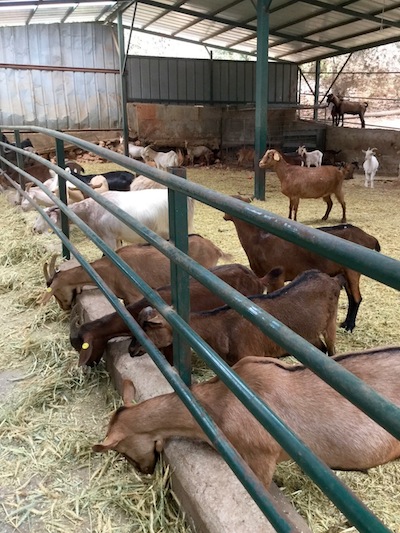
The achievements of his 35 years of agricultural experimentation are truly remarkable. The farm now includes nine large vegetable, herb and flower gardens, a herd of dairy cows and goats whose milk helps create about 40 individual dairy products – milk, yogurts, ice cream and cheeses. The animals are cared for in the most pristine of settings, feeding on grasses and able to roam about freely. Should they fall ill, they are cared for by a holistic veterinarian practitioner.

photo - Mizpe Hayamim goats
(photo by Karen Ginsberg)

Manure is recycled to fertilize the gardens, and the fruit and nut trees and flowers grow in abundance. Years of trial and error have helped establish which flowers or herbs planted alongside which vegetables reduce insect infestations, eliminating the need for pesticides of any kind. Several times a day, ripened produce is brought to the Mizpe Hayamim kitchen and finds its way to the dinner or breakfast buffets with the sort of haste that most Canadians can hardly fathom. Natural soaps are made on the farm for sale and for use in the hotel. In addition, there is a bakery and small retail outlet that sells some of the produce to guests and members of the public.

At the hotel, there is a full range of spa services for guests. Our casual conversations with other guests suggest that many Israelis come here, seeking a reprieve – nourishment and rest – from the tensions and high activity levels of city life. Guests can enjoy a coffee and tea bar all day long, with many of the farm’s fresh herbs – lemongrass, hyssop, chamomile, spearmint – available to enrich their beverages. Daily exercise classes, an art studio and evening entertainment are optional for guests and help sustain the goal of total relaxation and rejuvenation.

Isrotel plans to refurbish and update some of the hotel rooms but the essential philosophy underpinning this unique endeavour will remain the same. And Chazzan intends to continue his life’s work of building a knowledge base about organic farming and its impacts, through small-scale experimentation.

Long after their visit, guests fortunate enough to enjoy some time at Mizpe Hayamim will continue to benefit from the tranquility and beauty of the area, the organic vegetarian diet, as well as the various spa treatments on offer. For more information, contact Liad Nudelman, reception manager at Mizpe Hayamim, at [email protected], or visit isrotel.com.

Karen Ginsberg is an Ottawa based travel writer.

Format ImagePosted on March 23, 2018March 23, 2018Author Karen GinsbergCategories TravelTags health, history, Israel, Isrotel, Mizpe Hayamim, organic farming, tourism
Genetics or lifestyle?

Genetics or lifestyle?

Study brings hope for improving our health.

The question of nature versus nurture extends to our microbiome – the personal complement of mostly friendly bacteria we carry around with us. Study after study has found that our microbiome affects nearly every aspect of our health; and its microbial composition, which varies from individual to individual, may hold the key to everything from weight gain to moods.

Some microbiome researchers have suggested that this variation begins with differences in our genes, but a large-scale study conducted at the Weizmann Institute of Science challenges this idea and provides evidence that the connection between microbiome and health may be even more important than we thought.

Indeed, the working hypothesis has been that genetics plays a major role in determining microbiome variation among people. According to this view, our genes determine the environment our microbiome occupies, and each particular environment allows certain bacterial strains to thrive. However, the Weizmann researchers were surprised to discover that the host’s genetics play a very minor role in determining microbiome composition – only accounting for about two percent of the variation between populations.

The research was led by research students Daphna Rothschild, Dr. Omer Weissbrod and Dr. Elad Barkan from the lab of Prof. Eran Segal of the computer science and applied mathematics department, together with members of Prof. Eran Elinav’s group of the immunology department, all at the Weizmann Institute. Their findings, which were published last month in Nature, were based on a unique database of around 1,000 Israelis who had participated in a longitudinal study of personalized nutrition.

Israel has a highly diverse population, which presents an ideal experimental setting for investigating the effects of genetic differences. In addition to genetic data and microbiome composition, the information collected for each study participant included dietary habits, lifestyle, medications and additional measurements. The scientists analyzing this data concluded that diet and lifestyle are by far the most dominant factors shaping our microbiome composition.

If microbiome populations are not shaped by our genetics, how do they nonetheless interact with our genes to modify our health? The scientists investigated the connections between microbiome and the measurements in the database of cholesterol, weight, blood glucose levels and other clinical parameters. The study results were very surprising: for most of these clinical measures, the association with bacterial genomes was at least as strong as, and in some cases stronger than, the association with the host’s human genome.

According to the scientists, these findings provide solid evidence that understanding the factors that shape our microbiome may be key to understanding and treating many common health problems.

“We cannot change our genes,” said Segal, “but we now know that we can affect – and even reshape – the composition of the different kinds of bacteria we host in our bodies. So, the findings of our research are quite hopeful: they suggest that our microbiome could be a powerful means for improving our health.”

The field of microbiome research is relatively young; the database of 1,000 individuals collected at the Weizmann Institute is one of the most extensive in the world. Segal and Elinav believe that, over time, with the further addition of data to their study and those of others, these recent findings may be further validated, and the connection between our microbiome, our genetics and our health will become clearer.

Elinav’s research is supported by the Adelis Foundation; Andrew and Cynthia Adelson; the estate of Bernard Bishin; Valerie and Aaron Edelheit; the European Research Council; Jack N. Halpern; the Leona M. and Harry B. Helmsley Charitable Trust; the Bernard M. and Audrey Jaffe Foundation; the Else Kroener Fresenius Foundation; the Park Avenue Charitable Fund; the Lawrence and Sandra Post

Family Foundation; the Rising Tide Foundation; Vera and John Schwartz; Leesa Steinberg; and Yael and Rami Ungar. Elinav is the incumbent of the Sir Marc and Lady Tania Feldmann Professorial Chair.

Segal’s research is supported by the Adelis Foundation; Judith Benattar; the Carter Chapman Shreve Family Foundation; the Crown Human Genome Centre, which he heads; the European Research Council; Jack N. Halpern; the Else Kroener Fresenius Foundation; Donald and Susan Schwarz; and Leesa Steinberg.

For more on the work being done at the Weizmann Institute, visit wis-wander.weizmann.ac.il.

Format ImagePosted on March 23, 2018March 23, 2018Author Weizmann InstituteCategories IsraelTags genetics, health, microbiome
Jumping gene research

Jumping gene research

Dr. Gideon Rechavi, who founded Sheba Cancer Research Centre, was in Vancouver in January for an international conference at which he presented new findings on “jumping genes.” (photo from Sheba Cancer Research Centre)

Dr. Gideon Rechavi, who founded Sheba Cancer Research Centre, in Ramat Gan, Israel, was in Vancouver in January for an international conference on DNA and RNA methylation.*

“I described a new work we just published, regarding ‘jumping genes,’” he told the Independent about his presentation at the conference. “Forty-five percent of our genome, part of what people used to call ‘junk DNA,’ is composed of genes that can jump from one place to another.”

As far as what this means for the functioning of a body, he explained, “When they jump, they can activate genes and they can also inactivate genes, and it’s a random process. Actually, when I was PhD student in ’82 at the Weizmann Institute, I found the first example of such an event in mammals.” And, he added, “We were also the first to show the role of such events in cancer.”

Rechavi explained, “In cancer, there is a set of genes called oncogenes, genes that usually are normal genes in our genome but, when they are over-activated or activated in the wrong cell or at the wrong time, they can push the cell to proliferate and can cause cancer.”

Now, he said, many years later, using advanced technologies based on whole genome sequencing, they have found that, “in a variety of neurodevelopmental disorders, such as autism and Rett syndrome and similar diseases, there is a basic gene defect in the family or in the affected child. However, the clinical presentation can differ even between identical twins. Nobody understands why the same genome and the same genetic background will result in such a difference, one patient will be affected by epilepsy, the other one by autism or mental retardation.

“The mechanism that we show is that, in the brain, there is, normally, a constant level of jumping of such genes and, probably, it’s essential for diversity of neurons and brain plasticity and activity.”

This is happening all the time in neuronal stem cells, he said. “During the differentiation of neuronal stem cells … there is a very precise time window of 48 hours when such transposition events can take place. And, probably, it’s essential, because you find it in mice, in monkeys and in humans. However, in all the diseases that we are studying, there is over-activation of the mechanism, so you have many more jumping events.”

We have neuronal stem cells dividing in the brain our whole life, said Rechavi. “In the past, we used to think that all of the neurons are created during pregnancy or soon after, but now, in the last 20 years or so, we know there are also adult neuronal stem cells. When you do gymnastics or when you take Prozac, there are more neuronal stem cells. And, in these neuronal stem cells, these transposable elements – jumping genes – are jumping and probably contribute to brain function.”

The process seems to be quite regulated, he said. “The mechanism we suggest, we call it the ‘lightning rod’ mechanism or hypothesis.”

He explained, “The majority of jumping events occur in sequences in the genome where integration will not cause harm. So, in a normal level of jumping, we expect it will be beneficial, and the chance for damage is low. Although, if, in a variety of diseases, there is uncontrolled activation of this mechanism, so there are many more jumps, then it can saturate the lightning rod safeguard mechanism and then affect genes that are relevant to neuronal diseases, and we have a lot of examples where such things happened.”

To study this, said Rechavi, they sequenced the genomes of 100 samples, which included normal, diseased and control brain samples. “We were able to show that there is a particular normal level of transposition … and, then, over-activation, with many more transposition events, in the brains of disease-affected children.”

From these results, he said, we know that “the genes affected by such insertions from these transpositions, you see that many of them are relevant to neuronal functioning, neural development and a variety of neuronal disorders, such as autism and schizophrenia.”

By understanding the biochemical mechanism in these patients, what activates the jumping, “then you can intervene,” said Rechavi. For example, perhaps a drug could be developed that would decrease the level of transposition.

“This is the next step,” he said. “Now, we have several patients where we know the gene defect involved in the syndrome and, therefore, is involved in the enhanced transposition, so now we have to find a way to shut it off, to lower the activity.”

Rechavi said his lab is researching these jumping genes and their effects in both cancer and neuronal disorders, and that they are currently looking for funding to study the involvement of such genes in Alzheimer’s and in aging.

The purpose of the jumping genes is not certain. “What people suggest,” said Rechavi, “is that it has to do with diversity.” Recalling that it is a random process, he explained, “So, instead of having all the neurons in a particular part of the brain being identical, now you have diversity and probably the diversity increases the efficiency of the brain circuits, etc. It can also be relevant to plasticity. We know that specific brain regions can take over following damage or following a kind of environmental influence and change the activity and perform new activities. So, maybe the ability to create diversity in the brain is an advantage.

“A similar model has to do with the immune system,” he added. “With the immune system, we know that there are genetic mechanisms that increase diversity and, then, the cells of the immune system of an individual can respond to any virus and any bacteria.”

The main focus of his lab at Sheba Medical Centre, he said, is to find new genetic and epigenetic mechanisms, “and then to ask, what is their relevance to normal physiology and what’s their relevance to diseases. That’s how this story that started with cancer research turned out to be very relevant to neuronal disorders and psychiatric disorders.”

Rechavi said the phenomenon of jumping genes, or transposable elements, was first identified by American scientist Barbara McClintock (1902-1992) in experiments with maize. (She won the Nobel Prize in 1983 for this and other contributions to the study of genetics.) “She found it in maize,” he said. “We found it in mammals.”

Conferences like the one Rechavi was attending in Vancouver when he spoke to the Independent by phone Jan. 23 from his room at the Fairmont Hotel Vancouver, where the conference was being held, are useful for several reasons.

“Some people, after my talk, came and they wanted to collaborate, they want to learn the methodologies. Some people suggested samples we could analyze…. This is the basis for scientific collaboration, the main reason to do scientific meetings. You can read everything on the internet,” he said, “but when you discuss with people the findings and you drink coffee together and discuss the details, you can get new information, new non-published information, and also collaborations and friendships.”

Sheba Medical Centre doesn’t have many partnerships with Canadian institutions, said Rechavi. The centre’s main collaboration in Canada, he said, is with Toronto’s Hospital for Sick Children, especially in the field of brain tumours, because one of Rechavi’s former trainees, Dr. Uri Tabori, went to SickKids to study such tumours and stayed there.

Before obtaining his PhD at the Weizmann Institute of Science, in Rehovot, Rechavi earned his doctor of medicine at Tel Aviv University’s Sackler School of Medicine. He is a professor of hematology at Sackler School and heads the Cancer Research Centre at Sheba Medical Centre, the largest hospital in Israel, which serves as a university teaching hospital (affiliated with Sackler) and as a tertiary referral centre. He has published more than 450 scientific papers.

In addition to treating some 1.5 million patients annually, Sheba Medical Centre has 75 laboratories and more than 2,000 ongoing clinical trials; 30% of Israeli medical research is performed at Sheba, which files, on average, 15 biomedical patent applications per year.

In October 2017, Sheba Medical Centre inaugurated the Wohl Institute for Translational Medicine. The idea, said Rechavi, is to take the “findings emerging from basic research and try to translate it into taking care of patients; to better diagnose, to [develop] better treatments.”

* Methylation, explained Dr. Gideon Rechavi, “is the addition of a chemical group known as methyl on the four basic letters of the genetic material (DNA and RNA) to generate a new expanded ‘alphabet.’”

Format ImagePosted on February 16, 2018February 14, 2018Author Cynthia RamsayCategories IsraelTags aging, Alzheimer's, cancer, DNA, Gideon Rechavi, health, jumping genes, medicine, methylation, neurodevelopmental disorders, science, Sheba Medical Centre

At controversy’s centre – Louis Brier

Louis Brier Home and Hospital has accused Dr. Ellen Wiebe, who specializes in medically assisted dying, of wrongdoing, for providing a medically assisted death to 83-year-old resident Barry Hyman, without the consent or knowledge of the care facility.

The home accused Wiebe of “borderline unethical” behaviour and has filed a complaint with the College of Physicians and Surgeons, but Wiebe is adamant that her actions were not unprofessional.

“By far the most important thing is the patient,” Wiebe told the CJN. “The second is the family. Mr. Hyman’s wish was to die in his home. People have all kinds of wishes and desires, but dying wishes are held to a higher standard than other wishes.”

Asked about the family’s agreement to abide by Louis Brier’s policies, and the dispensation given by the B.C. Ministry of Health for institutions to refuse the provision of services that go against their religious beliefs, Wiebe said, “I’m not part of those agreements. My agreement is purely with my patient, not the facility, and since I don’t have visiting privileges at Louis Brier like I do at Vancouver General Hospital, I am not required to abide by the agreement between Louis Brier and the ministry.”

Wiebe was invited into the facility by Hyman’s daughter, Lola Hyman, and his other immediate family members, who wanted to honour Barry Hyman’s long-held wish to die on his own terms. Disabled by a stroke and diagnosed with lung cancer, Hyman had asked to die at the care facility, which had become his primary residence. Lola Hyman had broached the topic with David Keselman, the chief executive officer of Louis Brier, who told her it was against their policy, which is formulated according to Orthodox Jewish law.

Lola Hyman told the Globe and Mail that she wanted to honour her father’s wishes in a place that was comfortable for him, not somewhere that would be unfamiliar to him.

On the night of his death, she said, “the room was very quiet. We just held his hand and stared at him. My sister was sobbing, just sobbing. I was a stone. A complete stone. My heart was racing that someone would open the door.”

The Supreme Court of Canada struck down the Criminal Code prohibition on physician-assisted dying in 2015 and the federal government passed legislation legalizing it in 2016. The court recognized that doctors should not be coerced into performing the procedure against their will, but did not specify whether health-care organizations could refuse to comply.

In British Columbia, the Ministry of Health made an agreement that allows members of the Denominational Health Association (DHA), which includes the Louis Brier, to refuse to provide services that are inconsistent with their religious values.

“Anyone who comes here knows what our policy is and, if they don’t like the policy, they should go somewhere else,” Mark Rozenberg, the chair of the ethics committee of Louis Brier’s board, told the Globe and Mail.

Keselman declined the CJN’s request for comment, saying that the board was in meetings to decide how to respond to the media exposure. The home’s rabbi, Hillel Brody, said he was not permitted to discuss Louis Brier’s policies with the press.

Shanaaz Gokool, chief executive officer of Dying With Dignity Canada, told the CJN that organizations like Louis Brier are not being asked to take part in medically assisted dying, but simply not to obstruct residents from a medical service to which they have a right.

“The doctors bring in their own equipment. The health-care facility has no involvement in the procedure. By not allowing this, they are undermining the rights of the residents of Louis Brier who call it their home,” Gokool said.

It is not clear if institutions that refuse to allow medically assisted deaths on their premises enjoy the same Charter-protected religious freedoms as individuals who refuse to provide the service, because the issue has not yet been tested in court.

A joint statement issued by Dying With Dignity Canada and the Canadian Association of MAID Assessors and Providers said, “We support health-care professionals who, as a matter of conscience and compassion, help their patients overcome unfair barriers to access.… And we will defend clinicians who are attacked or punished for their participation in the lawful provision of MAID (medical assistance in dying). These courageous individuals should be applauded, not penalized, for putting their patients first.”

Louis Brier is one of a number of faith-based organizations that are in a quandary: although the centre is run in accordance with Orthodox Jewish law, not all residents are religious Jews, and it also has non-Jewish residents.

A 2014 Ipsos-Reid poll conducted on behalf of Dying With Dignity Canada showed that 84% of Canadians were in favour of allowing physicians to help someone die, if that person is suffering and wishes to die.

There is also the issue of public funding, as “67% of the Louis Brier’s funding is public,” said Gokool. “They are funded by taxpayers and should abide by Canadian law.”

Lola Hyman told the Globe that she was left feeling distressed, both at the possibility of Wiebe suffering on account of helping her father, and at having upset the front-line staff at Louis Brier, who were shocked by Barry Hyman’s sudden death. She said that all of this could have been avoided if British Columbia went the way of Quebec and stopped allowing publicly funded organizations to obstruct the rights of their residents.

“Everyone is entitled to their religious beliefs and traditions and customs,” Hyman told the Globe. “But, when it comes to somebody who is very sick and dying, we need to have a different approach.”

Matthew Gindin is a freelance journalist, writer and lecturer. He writes regularly for the Forward and All That Is Interesting, and has been published in Religion Dispatches, Situate Magazine, Tikkun and elsewhere. He can be found on Medium and Twitter. This article was originally published by the CJN, cjnews.com.

Posted on January 26, 2018January 24, 2018Author Matthew GindinCategories LocalTags Ellen Wiebe, health, Hyman, Louis Brier Home, medically assisted dying
Singing adds to health

Singing adds to health

Choir director and singer Earle Peach, seated at centre, with members of Highs and Lows Choir. (photo by Kathleen Yang)

For more than 20 years, Highs and Lows Choir has brought music back into the lives of its members. Established as a four-part choral group in the mid-1990s, its mission is the mutual support of singers, in a way that nurtures mental health and wellness. Auditions are not required for new members; musical activities and instruction are built into their weekly rehearsals. The main thing, according to choir director and singer Earle Peach, is “the desire to participate and the willingness to learn.”

Accompanied by pianist Elaine Joe, the choir of about 20 voices practises a wide repertoire of songs, which it performs at numerous venues around Vancouver. In December, the songs were festive and drew on a range of traditions – songs from Christmas in Victorian England, and a Chanukah song from Spain called “Ocho Kandelikas.” Between the seasonal items, the choir performed the satirical “Parking Lots and Strip Malls,” “Blue Moon” and, a favourite with swing bands, “Jump, Jive and Wail.”

“We’ll sing music from any place or time period, as long as it has beautiful harmony and isn’t too difficult,” said Peach of the set list.

The atmosphere at rehearsals is buoyant, even amid the hard work of managing tricky intervals and rhythms, as in, for example “A La Ru,” a Spanish lullaby. The choir sings in a range of languages, performing works in English, Latin, French, Swahili, Ladino and Haitian Creole. The music is “challenging but manageable,” according to Jewish community member Rachel Mayer, an alto singer who is also a member of the choir’s board.

In the break, members talk about upcoming events in the community. In December, the calendar was full of choral visits around town, including two events at Douglas Park Community Centre and a lunch at Carnegie Community Centre. At the end of January, the choir will be singing for the Suzuki Elders and, in February, they will join other choirs at the Home Ground Festival in Oppenheimer Park in the Downtown Eastside.

Bass singer Kevin Elwell has managed or co-managed Highs and Lows Choir since 2003, and has been a peer support worker and English-as-a-second-language instructor with Vancouver Coastal Health since 2006. He has seen firsthand the tremendous difference the choir has made in the lives of its members: a difference recognized by the Mayor’s Arts Award, which was given to Peach in the fall of 2017, for community-engaged art. A conductor for three other choirs in the area, Peach is also a performer, teacher, producer and recording artist.

Alaric Posey (bass) described the choir as “the highlight of my week.” Having sung in children’s choirs, he had been away from music for many years before joining Highs and Lows in 2003. This opened the door to a life full of music, as he is now the choir’s assistant conductor and co-manager. He also teaches music and performs with a number of other groups around Vancouver.

The singers explain that, while singing is good for you, the social element is equally important. “There’s more of an effect the more people you sing with. You’re a community with a common purpose,” said Posey.

Academic research confirms the views of the singers. A 2016 article on the neuroscience of singing reports that social singing evolved to serve the needs of early humans. By singing and dancing together, groups shared important information, forged strong social bonds and fended off enemies. While we may not need to scare away predators, our modern brains still benefit from the endorphins released into our bodies as we sing. These endorphins make us happier, healthier and more able to think creatively. Choir librarian Dale Sweet (tenor) sets a good example with his commitment to singing in seven different choirs around town.

While the choir was founded to nurture the mental health of its members, the lows are left at home during rehearsal. The choir is a place to be task-oriented while making music and laughing at the endless stream of bad puns emanating from the conductors. Still, the members always know that others have their backs. True to the choir’s name, soprano, chair of the choir board and Jewish community member Penny Goldsmith observed, “People look out for each other. If someone doesn’t show up, we call them.” Aptly named, the choir helps the spirits of its singers take flight.

The choir sings weekly every Tuesday from noon to 1:45 p.m. at the Unitarian Church at Oak and 49th in Vancouver. New members are always welcome. More information about the choir can be found at highsandlowschoir.ca.

Shula Klinger is an author and journalist living in North Vancouver. Find out more at shulaklinger.com.

Format ImagePosted on January 26, 2018January 24, 2018Author Shula KlingerCategories MusicTags choir, Earle Peach, health, Highs and Lows
NCJW pays tribute to Poliakoff

NCJW pays tribute to Poliakoff

Left to right: former National Council of Jewish Women Vancouver section president Shirley Hyman; Gloria Hendin, tribute committee chair; Barbara Heller, longtime supporter of council; Marion Poliakoff, the guest of honour; Bonnie Gertsman, former Vancouver section president; Anne Melul, former Vancouver section membership chair; and Debby Altow, past president, Vancouver section. (photo by Joanne Emerman)

National Council of Jewish Women hosted a tea at Temple Sholom on Jan. 9 to celebrate Marion Poliakoff, a true Renaissance woman. At 94 years young, she continues to be an inspiration to council members past and present.

Poliakoff’s career and her personal life demonstrate the principles of NCJW: fostering multiculturalism, alleviating poverty among women and children, supporting family counseling in Israel through ALUMA, and cherishing music and family. Her commitment to clear and convincing communication has been a boon to many newsletter writers – and she continues to edit us closely.

Gloria Hendin, who chaired the event committee, welcomed everyone. Shelagh Stoller bought the gift for Poliakoff, which Shirley Hyman presented. Barbara Heller managed all the banner decorations, Bonnie Gertsman and Anne Melul organized the food, and Judy Stern greeted guests as they arrived. The entertainment came courtesy of Poliakoff’s daughter, Amy Poliakoff, who brought her flute from Boston. I delivered the tribute speech, which I share below.

Vancouver section president Catherine Stoller set the tone for the annual general meeting that followed the celebration. “Looking backward, we recall our ancestry. Looking forward, we confront our destiny,” she said. The board of directors was installed by Shanie Levin with those words ringing in their ears!

In preparing my remarks, I read Melul’s biographical notes on Poliakoff, Carol Weinstock’s article on NCJW in the Jewish Museum and Archives of British Columbia’s journal, The Scribe, and the book More Than Just Mrs.: Jewish Women’s Organizations in B.C., as well as the council’s cookbook. Of course, I also spoke with many council members who worked with Poliakoff, and reflected on my own personal experiences with her. With some minor editing, to reflect their publication after the event, my remarks follow.

Marion was born in the United States. Holding a bachelor’s from Simmons College in Massachusetts and a master’s in journalism from New York’s Columbia University, she married Mel Poliakoff in 1949, adopting Mel’s son Merrill at the same time. Although at first they were unable to live in Tenafly, N.J., because, as Jews, they could not buy a house there, nevertheless they did move there a few years later. She became the first Jew elected to public office, serving on the board of education.

In 1972, she moved to West Vancouver with her husband and their daughters Amy and Nan. They loved tennis, skiing and sailing. Sadly, Merrill and Nan are gone, but many of Marion’s family were able to join the council’s tribute.

When Marion met Bess Narod – Bess is from Ottawa; I knew her family back home – they went to an NCJW meeting, and that was the start of Marion’s connection with council. The first big item she worked on, the hearing screening project in schools, demonstrated council’s mission: identify a need, pilot a response, make it a success and turn it over to government. The Vancouver health department now runs it.

Marion also met Rita Weintraub, who became a lifelong friend. Together, they have worked to support the Isaac Waldman Jewish Public Library at the Jewish Community Centre of Greater Vancouver.

Meanwhile, Marion got another master’s degree – from the University of British Columbia’s School of Social Work – and, through a field placement at Britannia Community Centre, became interested in multicultural issues. Always the consummate writer, she contributed the Multicultural Corner column to the monthly newsletter of the B.C. Association of Social Workers; another column went into the Britannia newsletter, which was translated into Italian and Chinese.

The City of Vancouver grabbed Marion and she ran parenting groups for mothers in three community centres – using translators for Farsi, Chinese and Italian participants. In 1981, she received the Social Worker of the Year Award from the B.C. Association of Social Workers for her multicultural work.

I met her when I was the director of communications for the Canadian Cancer Society and she was a social worker at the B.C. Cancer Agency. I was working on breast cancer issues, with multicultural projects for Chinese and South Asian women. We found we had much in common.

Marion was also the one who called me every year to pay my NCJW dues, even though I was not an active volunteer in those years. She recruited me after I retired to join the board and, 13 years later, I’m still on it in one capacity or another.

In 1991, HIPPY (Home Instruction for Parents of Preschool Youngsters) was brought to Canada from Israel as a council initiative by Carol Slater. Ever alert to new connections, Marion linked Britannia, along with Simon Fraser University, to council as our community partners to launch the HIPPY project. She was intimately involved in establishing its work with immigrant mothers and their families. While its name has changed to the Mothers Matter Centre, HIPPY remains one of council’s programs, and Wazi Kapenda, its Western director, was in attendance at the tribute.

Marion’s volunteering extended to driving people to services at Congregation Har El, eventually donating her beloved baby grand piano to the shul, fundraising for the synagogue, and cooking and serving food weekly to needy and homeless people at Harvest House.

Later, she joined the North Shore Osteoporosis Society, organizing monthly speakers. I spoke at one gathering and there were more than 100 people attending – a not uncommon number!

Her commitment to ALUMA (formerly the Israel Family Counseling Agency) was, and continues to be, an inspiration. She fought for support for ALUMA in council, because the organization was dedicated to supporting people in Israel who could not afford professional counseling but who desperately needed it. And Judy Stern could always count on Marion to canvass for Friends and Angels, council’s only annual fundraiser.

Marion’s was a home where music was loved and valued, even after the piano was gone. She supported the Vancouver Symphony, the Vancouver Chamber Music Society and Music in the Morning. Music continues to be a tree of life for many of her family members. Her close friend Shirley Lecker is part of that tradition.

Do you see a thread unspooling here – with HIPPY, with anti-poverty issues, with a commitment to Jewish values, with a passion for family, with a professional eye for communication, with an abiding love of music? When I said Renaissance woman, the label is legitimate.

It is such an honour to acknowledge Marion for her work with council – and with many of us personally. It is beyond words. To simply say thank you is really inadequate. But, from the bottom of my heart, and from all of us, thank you, Marion.

Format ImagePosted on January 19, 2018January 17, 2018Author Debby AltowCategories LocalTags health, HIPPY, Marion Poliakoff, NCJW, tikkun olam, volunteering, women
Life-giving practice

Life-giving practice

On Feb. 1, Sarah Peyton speaks at Or Shalom on the topic Why Love is Not Enough: Family Heartache and the Path of Repair. (photo from Or Shalom)

Have you ever longed for someone who would be able to listen to you without judgment, to every concern, fear, yearning or hurt you might have? Someone able to hold you in gentle understanding and with deep compassion all the time? Such a person does exist – within yourself. And you can find out how to meet them through the work of Sarah Peyton.

Peyton is a neuroscience educator and certified trainer of nonviolent communication, which was pioneered by American psychologist Marshall B. Rosenberg. She will introduce the latest understanding of neuroscience and the part it plays in building social and family relationships in her talk at Or Shalom on Feb. 1, called Why Love is Not Enough: Family Heartache and the Path of Repair. Peyton will show how deep, resonant empathy for oneself and the other can connect conflicting parties, even as the conflict resides within one’s own inner voice of criticism.

I met Peyton in the summer of 2015. My husband was assisting in a nonviolent communication retreat, and I had been asked to facilitate a writing session as a part of it. At the last minute, I painfully withdrew. My mother’s death, less than two years before, had left me paralyzed and in deep grief and mourning. I was not up to the task of supporting anyone, not even myself. Tearfully, I watched as my husband left for the weekend. Miraculously, my husband forgot something he needed and returned home to retrieve it. “Come back with me,” he urged. “Don’t facilitate. Just sit outside, swim, write under the trees. Get well.” I said, “Yes.”

That weekend changed my life. Peyton warmly guided a group of participants in her process of resonant language and connection. Peyton, I would come to learn, had lost her beloved son just the year before. Given that, how was it possible that she could contribute with such presence?

Over the next two years, I worked privately with her, learning about resonant language and how to live it. Last year, Norton Press published Peyton’s first book, Your Resonant Self: Guided Meditations and Exercises to Engage Your Brain’s Capacity for Healing. I interviewed her recently, in anticipation of her Vancouver talk.

DAS: What began your work with resonant language?

SP: I began this work when my 33-year-old adopted son was dying. His death took a long time, eight years. His dying began when he had a reawakening of the trauma in his family. I was desperate to save him. I began to learn and practise a way to share life and our experiences, a way to enhance life. We were all sustained by this practice, through his dying and afterwards, through our mourning. Relational language allowed us to find each other through the dark cloud of loss and death. It took me five years to write the book. I began writing it in the last year of my son’s life.

DAS: What is resonant language?

SP: Our brain has two hemispheres, and the structures of each side are different. The language centres of the left brain are instructional-based. They help us to take action, plan and strategize…. Our right brain creates a relational language where you and I are experienced together. Relational language is resonant and is the language of poetry, metaphor, visual imagery, longing, dreaming. Warmth is a way to navigate to this resonant relational right brain and create connection to ourselves and others.

A lot happens in family when we live in a world of doing in our caring for each other. A different way of being together happens in a world of relational language and resonance. This work is the work of awakening remembrance of what it’s like to reclaim our birthright, the birthright of being relational beings in a world of warmth.

What stops us from engaging in this relational right-brain language is fear. We have made, early on in our lives, promises in our hearts to prevent pain or disappointment in and for ourselves. When we recognize our own fear and the ways that we closed our hearts, we’ve taken the first steps to remember what we have forgotten. We will be reminded of what we know and have lost. We’re learning what the “garden” in our brains needs. It needs warmth.

DAS: What is your hope for your work and our world?

SP: We’re looking at a world that is split between doing and being. Brain by brain, we can change our world and change our planet. We will look at a world that is not split.

I hope that those who come to our evening will be able to discover a way to listen and know themselves differently, and to discover the pathway to their own warm, beating hearts.

* * *

Though I will always miss my mother, the terrible grey numbing grief has lifted. My heartache has become touchable, a renewal in the richness of my life lived with her. I have learned that being able to touch heartache in its many guises provides us with life-giving renewal in our relationships. Peyton’s relational emotional language is one that continually restores me to compassion and connection, with myself and others.

Dael Adams Segal is a writer and a mentor of writers. She writes midrash and prayer and facilitates women’s-centred Torah study at Or Shalom Synagogue, where she is a member.

Format ImagePosted on January 19, 2018January 17, 2018Author Dael Adams SegalCategories BooksTags communication, health, Or Shalom, Sarah Peyton
Beit Ruth supports at-risk girls

Beit Ruth supports at-risk girls

Beit Ruth Village (photo by Poole)

When boys are hurting, are at-risk or are vulnerable and abused, they act out. They join gangs, skip school and get into fights,” Danielle Burenstein, executive director of Beit Ruth, told the Independent. “But, when girls are hurt or abused, they disappear and become transparent; they hurt themselves. When the system identifies a girl who is at risk, it’s normally because she has disappeared from the school system, is living on the streets or tries to commit suicide.”

Beit Ruth, in the northern part of Israel, was founded by Susan and Michael Ashner, a philanthropic couple from New York who, in 2003, were in Israel to visit a project they were supporting – a program that was educating vulnerable boys. During this visit, Burenstein said, “Susan asked something that would change both of their lives forever: ‘What happens to their [the boys’] sisters? Where are the programs for the sisters?’ The answer, pretty much, was there is really no need for those programs for the girls, because we don’t have those issues with the girls.”

Nevertheless, said Burenstein, Susan Ashner researched more about the status of at-risk and vulnerable girls in Israel, and determined “that there was a need for programs and services in Israel for those girls.” Beit Ruth began as a hostel in Rishon LeZion in 2006, which housed 13 at-risk girls between the ages of 13 and 18. By 2014, a new location had started operating on the outskirts of Afula, in a gated village setting. Today, Beit Ruth Village in Afula houses 45 girls in three houses.

Recently, a new school building was completed. Next on the list of capital projects are two more homes that will allow the village to take in 30 more girls. Following this, the plan is to add five more homes, giving the village and school the capacity to help 150 girls.

“Beit Ruth is a long-term residential village for at-risk and vulnerable girls,” said Burenstein. “It is a learning, healing and caring community that embraces the whole child, emotionally, socially and academically. It gives girls who have been removed from their homes by the Ministry of Welfare – due to incidents of severe neglect or abuse … and, when I say abuse, I mean emotional, physical or sexual; in many cases, it is incest – it gives these girls a chance…. Most, for the first time in their lives, have the chance to receive therapy for this abuse.”

Beit Ruth also “gives them the chance to get a high school education and life skills, so they can be prepared for life outside the village.”

Walking into the village, she said, is “like walking into a gated community in Vancouver. There are homes, with between 12 to 15 girls living in each home. They are not dormitories. They are decorated like homes.”

photo - Lunchtime in one of the residential houses at Beit Ruth Village
Lunchtime in one of the residential houses at Beit Ruth Village. (photo by Meir Azoulay)

Each house has a kitchen with a dining room, where the girls cook together, eat together, and have chores and responsibilities, and a living room. They have a bedroom they share with three other girls, and they can decorate it however they wish.

“We’re recreating that security and foundation that any child needs to have in order to be a successful human being,” said Burenstein. “I mean, to be able to have trust and respect, communication skills and a desire to learn, like most kids have.

“When our girls come to us in the village, I can tell you that, if you were to visit as an outsider, you’d probably be able to point out which girls have just come to us … because they are a shell of what a child should look like at that age – withdrawn, many sitting in a corner. You can tell that they are scared. They won’t make eye contact with you. They speak in a low voice.

“In a matter of weeks or few short months, you’ll see them start to smile, hang out with the other girls, talk with staff, engage, listen … some will laugh out loud.”

The girls who come to Beit Ruth have to choose to do so themselves, and they can choose to leave at any time. The purpose of the village gate is to keep out unwanted visitors, not to lock the girls in.

“The girls need to commit to the hard work it takes to overcome their trauma, to face their trauma through therapy, to listen to the values we instil in the village, which are all about teamwork, respect and trust,” said Burenstein.

Something that makes Beit Ruth unique are its guiding principles, one of which is creating the atmosphere of a home life – the kind of support a family should give a young child. Another guiding principle is therapy, which helps each girl face her own personal trauma, with the goal of overcoming it.

There are also enrichment programs, such as therapeutic art or music, sports and physical activities, all of which are mindfully selected and designed to help a young girl find her voice, passions and skills, to forge communication skills, trust and respect.

Many girls come to Beit Ruth with big gaps in their education. Some don’t know how to read or write at 13 or 15 years of age.

“When you’re hungry, when you’re scared, or when you’re in an abusive situation, school is not what you’re focusing on,” said Burenstein. “So, our girls are given the opportunity to have a high school education and we help instil a love of learning and curiosity that most kids have.”

Once at the village, each girl gets the support she uniquely needs. Beit Ruth does not go with one-size-fits-all programs, as each child comes with her own trauma, past and capabilities.

Beit Ruth’s educational programs, which were developed for the village, are trickling down into use by Israel’s Ministry of Education, to other schools around the country, and into hospitals.

“Each girl has her own journey to take,” said Burenstein. “It’s really hands-on for each one of the girls. They know it’s a place they can call home. They know this is a place where they are safe. They know this is a place that, no matter what … and, trust me, they try to test us … they know that we’re here for them and that we’re not giving up on them. That comes across loud and clear.”

Rebeca Kuropatwa is a Winnipeg freelance writer.

Format ImagePosted on January 12, 2018January 10, 2018Author Rebeca KuropatwaCategories IsraelTags Beit Ruth, Danielle Burenstein, health, Israel

Posts pagination

Previous page Page 1 … Page 18 Page 19 Page 20 … Page 24 Next page
Proudly powered by WordPress