Mussar & tikkun olam

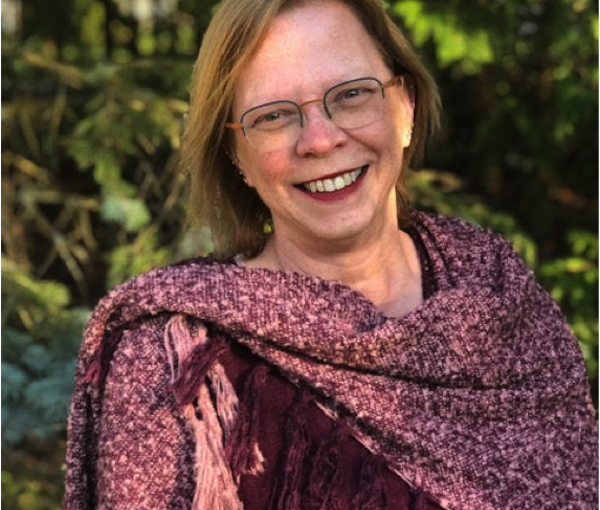
Dr. Rachael Turkienicz (photo from Kolot Mayim)

At a Jan. 3 Zoom lecture organized by Kolot Mayim Reform Temple in Victoria, Dr. Rachael Turkienicz spoke about mussar (Jewish ethics), tikkun olam (repairing the world) and whether there is a commandment to build bridges.

Turkienicz, founder and director of the Toronto-based Rachael’s Centre of Torah, Mussar and Ethics, began at the beginning, explaining why the Torah starts with creation and not with the patriarchs and matriarchs or the first commandment in Exodus.

“We start with Genesis because it is the ‘common’ that all human beings will have, and so Judaism will begin with what we all have in common,” she said. “No person can ever say to another person, ‘My father is greater than your father.’ And Father in this instance can be capitalized. One person creates the great equalizer. We should never fight with one another over this.”

She then showed how tikkun olam follows from creation, and raised the questions, When did the world break and how did it break? As man is finite and God is infinite, cracks will occur in the process of creation, and it is up to humanity to repair them, according to Turkienicz.

How do we repair? Through free will, she explained. “Free will is the most powerful thing next to God. It is so powerful that I can use my free will to deny God.”

The problem, however, is that “nowhere do we have a program that teaches us what free will is and how to use it,” she said.

In the course of daily routines, free will can take a less prominent role in our thinking, as many of us coast along “on automatic,” i.e., we function without making choices. As a result, nothing is being repaired and the world is continuing as it always does, she explained.

One example of being on automatic is when someone poses the question to an acquaintance passing by: “How are you?” The response is frequently: “I’m OK.” Neither the person asking nor the respondent delves deeply into the subject before moving on.

Being able to use free will is further compounded by the number of choices we have in an open society. Citing academic studies, Turkienicz contended that having a vast array of options available can actually hinder our ability to make use of the power of free will.

Enter mussar, a spiritual practice founded on offering a solid framework on living an ethical life. Mussar differs from kabbalah (Jewish mysticism). Whereas kabbalah is knowledge one receives, mussar moves from a person into the world, said Turkienicz.

Mussar stems from the concept that it is all well and good to know the commandments and recite Torah. However, such knowledge in itself does not make someone a mensch. “Mussar is learning to use my free will to repair the world. The commandments are the utensils, the goal is tikkun olam,” Turkienicz explained.

While mussar has been around for more than a millennium, it expanded in the 19th century to communities throughout Eastern Europe. Before the war, it was studied at the top continental yeshivot, but nearly all the leading exponents of mussar were murdered in the Holocaust. Recently, though, there has been a resurgence of the practice in both Orthodox and more liberal branches of Judaism.

Turkienicz compared mussar with other ethical philosophies, using the scenario of a person seated on a bus when an elderly person boards. Most of us are taught that we should give up our seat in such a situation. But what if the elderly person declines the offer? Ethics would say to sit back down, whereas mussar suggests that one should stay standing, because the issue is not about the elderly person but rather one’s own free will.

“Inside of me something said it is not appropriate for me to sit while an older person remains standing. Whether the elderly person sits down or not changes nothing,” she argued.

According to mussar, we are in control of the personal ingredients that comprise us, be they spirituality or patience. We all have the same ingredients, only the measurements are different, said Turkienicz. A person who does not see himself as spiritual still has a degree of spirituality. Likewise, someone who deems herself impatient has an allocation of patience within her. Our free will distributes the measurements.

“My free will chooses what is my perspective and where will I focus,” Turkienicz said.

As to whether there is a commandment to build bridges, she quoted Israel Salanter, a 19th-century rabbi and founder of the modern mussar movement, who said, “A good Jew is not one who worries about his fellow man’s soul and his own stomach, but about his fellow man’s stomach and his own soul.”

Turkienicz concluded that, while there is no commandment to build bridges, “everything else shows us we should do so, because, if we choose not to, we have lived where that leads us, and we don’t want to go there.”

To view the presentation in full, go to kolotmayimreformtemple.com and search “lectures.” Turkienicz’s talk was part of the synagogue’s Building Bridges series, the next instalment of which takes place March 7, featuring University of Calgary art professor Jennifer Eiserman on Canadian Jewish art. Click here for more information.

Sam Margolis has written for the Globe and Mail, the National Post, UPI and MSNBC.
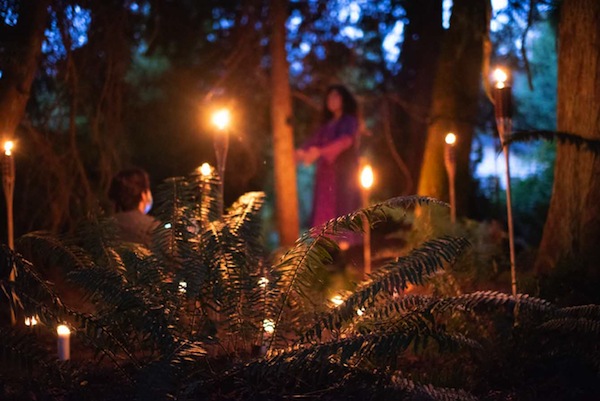
Video on healing, light

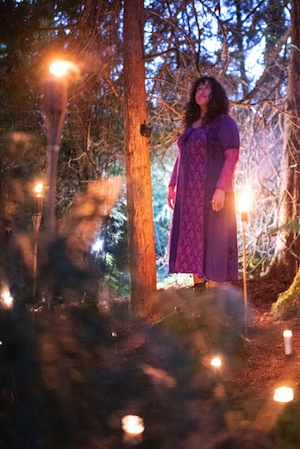
Loolwa Khazzoom in Iraqis in Pajamas’ video for their song “Cancer Is My Engine,” to be released on Chanukah. (photo by Ailisa Newhall)

With shared themes of finding light in the darkness, Seattle-area band Iraqis in Pajamas is releasing the video for their song “Cancer Is My Engine” on Chanukah.

Amid the global pandemic, volunteer cast and crew drove in from across Washington state, donning masks and practising social distancing, to film the music video against the backdrop of the Olympic Peninsula forest.

The video tells the story of front woman Loolwa Khazzoom’s choice to reject the conventional thyroidectomy treatment for thyroid cancer, despite medical and financial pressure. Khazzoom instead chose to approach the diagnosis as an opportunity for radically transforming her life, such as by going vegan and practising numerous forms of mind-body medicine. (See jewishindependent.ca/healing-powers-of-song.)

After cold-stopping the growth of the nodules for years, through these measures, Khazzoom moved to Washington state from California, returned to her lost love of music, and launched her band, which combines ancient Iraqi Jewish prayers with original alternative rock. Immediately following, the thyroid nodules began shrinking. Through magical realism and metaphor, the music video reveals how, by listening to her inner voice, Khazzoom self-healed through her actual voice, by singing – the ability to do which may have been destroyed by a thyroidectomy, given the proximity of the thyroid gland and vocal chords.

The video begins with Khazzoom standing at the edge of a cliff, singing the opening line of the song, “Cancer is my engine.” As she sings, a candle is lit by her voice. She is transported to a forest, where she is searching in the dark with the light of that candle. She comes across a stuffed bear – representing Khazzoom’s mother – and picks it up, then continues on her quest.

An insurance agent and doctor appear and begin chasing Khazzoom. As she runs from them, she comes to a fork in the road – with the doctor on one side and the insurance agent on the other. She pauses, then runs forward, where there is no path, heading toward the light. She keeps running until she comes to a cliff and jumps off it.

photo - Loolwa Khazzoom in the “Cancer Is My Engine” video
Loolwa Khazzoom in the “Cancer Is My Engine” video. (photo by Ailisa Newhall)

She lands in the middle of a drumming circle and starts dancing wildly. A few scenes later, she is drumming in the middle of the circle, and everyone else is dancing around her. Both circles represent the pivotal importance of music and dance in Khazzoom’s healing. The video then shifts from magical realism and metaphor to real-life shots, with the band playing music in a vegetable patch in Khazzoom’s garden, representing Khazzoom’s regimen of juicing daily and eating a whole-foods, plant-based diet. The video ends with Khazzoom standing on the edge of the cliff and singing the last words of the song, in the original a cappella Iraqi Jewish prayer that exalts the power of the Divine.

The video was sponsored by nonprofit Healing Journeys and funded by the Lloyd Symington Foundation, both of which offer programs for people living with and healing from cancer.

Studies on the healing possibilities of music are documented in books like The Power of Music by Elena Mannes and The Healing Power of Sound by oncologist Dr. Mitchell Gaynor, and the National Institutes of Health has launched a series of studies on the healing powers of music. Whether singing lullabies or sacred chants, mothers and religious leaders have known for millennia what scientists are only beginning to understand. Singing bypasses our mental process, both awakening and soothing us at the core. Among other benefits, we are able to access, release and heal from the experience of trauma, without having to recount and risk getting triggered by painful memories.

Khazzoom has had a career as an educator, activist, journalist, health coach, and more, all with the central organizing principle of individual and collective healing. Her work has been featured in media including the New York Times and Rolling Stone; she has presented at venues including Harvard University and the Simon Wiesenthal Centre; and she has published two books, which are taught at universities nationwide.

Iraqis in Pajamas comprises Khazzoom on both vocals and bass, Sean Sebastian on guitar and Robbie Morsehead on drums. The trio opens up audiences to contemplation about trauma, healing and transformation, whether addressing domestic violence, cancer, racism, mental illness, street harassment, family caregiving or national exile.


Song of healing is a hit

Israeli artists Yair Levi and Shai Sol sing Moses’s prayer to heal his sister Miriam of leprosy. The song, “Refa Na,” has resonated with people during the pandemic.

The song “Refa Na” (“Heal Her Now’”) by Israeli composer Yair Levi, together with vocalist Shai Sol, has become a global hit during the current COVID-19 pandemic.

Based on Moses’s prayer to heal his sister Miriam after she contracted leprosy, the song was released on Levi’s Facebook page April 6. The lyrics include the words, “O Lord, heal her now. O Lord, I beseech thee. Then we will be strengthened and healed” (Numbers 12:13) and Levi’s original is in multiple languages: Hebrew, as well as English, Spanish, French, German, Chinese, Arabic, Russian, Hindi and Swahili. The song has been picked up in dozens of covers, from Lebanon to Argentina.

When Levi’s grandmother fell ill, he composed a tune incorporating Moses’s prayer for his sister’s wellbeing. The song has resonated throughout the world during the current pandemic, garnering hundreds of thousands of views and shares.

“My grandmother had an illness unrelated to coronavirus, but the pandemic obviously affected everyone, myself included,” Levi, 31, told Ynet news portal. “Due to the epidemic, I received the names of people in need of prayer and a list of about 20 names accumulated on my fridge. Every day, I would say a prayer for the sick, and I searched for words and a tune related to medicine.”

Then Levi remembered the “Al na refa la” prayer in Numbers.

“I took my guitar and composed the music for it on the spot and, since I have a recording studio in my home, I recorded the song within a week.”

Levi then approached Sol, a vocalist with Miqedem, a band that composes and sings Psalms all around the world.

“In quarantine and with no way to actually meet, she recorded herself,” Levi said.

After posting the song on social media, he said, “It was amazing. We received many responses and translations. Immediately after we released the song, it was shared online by evangelist Christians, Jewish communities, and even the Friends of the IDF organization.”

But not only the obvious audiences were enthusiastic.

“We have received cover versions from all over the world, including from a Lebanese singer, and, on Saturday evening, I received three new covers from Namibia … India and a Brazilian singer, Fortunee Joyce Safdie, who performed the song live on her Instagram page,” he said.

“Getting so many messages from people all around the world is incredible,” he added. “If I have the privilege to spread prayer around the world, to me, it’s just crazy. When people from all over the world translate and sing a prayer for health, it feels like it is literally the End of Times.”

During his three-year service in the Israel Defence Forces, Levi – who grew up in Israel’s secular mainstream – became intrigued by traditional Judaism. A turning point in his life came on May 31, 2010. Serving as a naval commando, his elite unit stormed the MV Mavi Marmara, one of six ships in the Gaza Freedom Flotilla attempting to breach Israel’s blockade of the coastal enclave. Nine Turkish activists were killed in the incident, while 10 IDF soldiers from Levi’s unit were wounded. After the sea battle, Levi was determined to join an IDF officer course. But, at the age of 26, he decided to pursue a musical rather than military career.

“I spoke with my commander, who told me people often regret what they had not done,” Levi said. “It opened my eyes and I realized that the flotilla incident pushed me in the direction of the course, but my real dream was to make music and become a singer.”

Levi has released two albums, Breathing Again (2016) and Let Go (2017).

“People see me as a religious person but I don’t like labels,” he said of his oeuvre.

To hear more of Levi’s music, visit yairlevi.bandcamp.com/releases.

Gil Zohar is a writer and tour guide in Jerusalem.

Artworks on healing

Gail Dodek Wenner conceived the group exhibit Physician Heal Thyself … and Others, which is at Zack Gallery until June 25. (photo by Olga Livshin)

The new exhibition at Zack Gallery, Physician Heal Thyself … and Others, includes four artists, all of them local physicians near retiring or recently retired. Regular visitors to the gallery probably will be familiar with the work of two of them – Ian Penn and Carl Rothschild, who have exhibited at the gallery before – but maybe not that of Arturo Manes and Gail Dodek Wenner.

Rothschild’s contribution to the show is a selection of small, colourful paintings, which look like snapshots of his garden or a street around the corner. Each one is accompanied by a poem written by the artist. Together, they represent his impression of his home city and its healing potential.

photo - “Preventative Medicine” by Carl Rothschild
“Preventative Medicine” by Carl Rothschild. (photo by Olga Livshin)

Penn’s part of the show is more dramatic. It includes a video and several photographed pages from his journal, where he documented the before and after of his complicated spinal surgery in 2016. His display fits the theme of the show almost too perfectly for comfort.

Manes’ paintings – his method of spiritual healing – are based on Roman Vishniac’s book of black-and-white photographs, A Vanished World.

“The Shoah has been for me a defining event not only in Jewish history but human behaviour, which I’m trying to come to grips with,” Manes said in an email interview. “Black-and-white photographs in Vishniac’s book impressed me greatly…. I used those images of my people prior to the Holocaust as a template for my paintings. By adding colour and a free rendering, I hoped to express the feelings the photographs have evoked.”

He said Physician Heal Thyself is the first exhibit in which he has participated, although he has been painting since childhood. “I’m not an artist – I’m a physician who paints. I was honoured to be invited by Dr. Gail Wenner to be a part of this show.”

Dodek Wenner invited the other doctors to participate in the show, as well. It was she who came up with the theme.

“I always loved art, but I loved science, too,” she told the Independent. “I chose medicine as my career, but art has always been my hobby.”

As an artist, she is very versatile. At one point or another, she has tried various media: painting, ceramics, textiles, photography, Hebrew calligraphy. In practising medicine, however, she stayed true to one direction: mothers and babies. “In the past 26 years, I delivered 2,000 babies,” she said. “But I made the decision to stop delivering. It’s time for a change.”

One of the precursors of her decision was going back to school, to Emily Carr University. In 2009, she received a diploma in fine art technique.

photo - “Weaver” by Arturo Manes
“Weaver” by Arturo Manes. (photo by Olga Livshin)

“I took a class, Business of Art,” she recalled. “One of the assignments was to pitch an idea for a show to an art gallery. I chose a theme: healing, what it means to be a doctor and what Judaism says about healing. I chose the Zack Gallery, and I decided to invite several Jewish physicians to participate. All for a school assignment. I didn’t actually do it at that time. I did mention it to Yosef Wosk, who is a friend, and he said it was a great idea.”

A few years later, Wosk reminded her of the idea, and she finally contacted Zack Gallery director Linda Lando. “I pitched the idea to Linda in 2016,” Dodek Wenner said. “We brainstormed it and came up with a few names of Jewish physicians who were artists.”

That was the first step. The next step was to determine what she wanted to paint for the show. “I needed to explore what healing meant to me,” Dodek Wenner explained. “Personally, I always went to my parents’ beach house when I needed to do some healing. So, I thought, what was it about the ocean that healed me?”

After some contemplation, she came up with four steps of healing. “The first one is the acknowledgement: yes, there is a problem. There is a fear, and a doctor has to acknowledge that fear in her patient. Next comes compassion, which leads to the doctor assuring her patient: I can help you. The third one is wisdom. Doctors have a huge body of knowledge. They study for many years, and they share their knowledge with the patient, use what they know for healing. Last is comfort. Comforting the patient is very important at every stage of the healing process.”

After formulating these concepts in her head, she explored what Judaism says about healing. “I looked in the siddur, the Jewish prayer book, and found all four of those concepts of healing, both body and soul, in the first couple pages,” she said.

She knew she was on the right track but wasn’t sure how to showcase her ideas through art. “I went to the beach house again, walked along the shore, and I knew,” she said. “The ocean represents all four facets of healing, too.”

Her paintings, two distinct series of five paintings, are all different interpretations of the shoreline. The ocean is sometimes quiet, sometimes turbulent and the colours of the waves fluctuate from light blue to deep green. The foam, created with the use of medical gauze, plays in the sand among the shells. The shells are real, collected by the artist along the same beach she loves so much. “I scooped them with a cup,” she said.

“My paintings don’t show one particular place,” she added. “They are the essence of a shoreline. Each piece is different, but they all connect.”

Physician Heal Thyself opened on May 25 and continues until June 25.

Olga Livshin is a Vancouver freelance writer. She can be reached at olgagodim@gmail.com.

Poland’s wartime contradictions

In August, Poland’s right-wing cabinet approved a bill that would criminalize using the phrase “Polish death camp” or “Polish concentration camp,” with punishments including fines or imprisonment.

The bill raises questions about Poland’s role in the Holocaust. It echoes the country’s communist-era stance on the Second World War – that Poland was a victim and heroically saved Jews.

Growing up, I was told the opposite by my family, my Jewish day school and the broader community – that Poland was antisemitic and complicit in the Holocaust.

But recently, I’ve come to believe that both narratives are true. As we approach the High Holy Days and Yizkor, I think it’s worth reflecting on whether we as a community can see Poland’s role in the Holocaust differently.

This summer, I visited Poland for the first time with my sister, and the trip was full of contradictions. For example, we learned that Christian Poles – including our local guide’s grandparents – were sent to concentration camps, too. The Nazis killed two to three million Christian Poles and three million Jewish Poles. In total, Poland lost one-fifth of its prewar population – more than any other European country. But, those numbers represent roughly 10% of the Christian Polish population and 90% of the Jewish Polish population.

At the POLIN Museum in Warsaw, I learned about Zegota, the Council to Aid Jews. The Polish government-in-exile created it to support and fund Jewish resistance in Poland, including the Warsaw Ghetto Uprising; it was the only such organization created by a European government.

At Yad Vashem, Poland has the most Righteous Among the Nations of any country. Yet, it also lost one of the highest percentages of Jews of all European countries.

We found that Holocaust memorials were also inconsistent, dependent on local policies rather than a unified national one. In our baba’s hometown of Wlodawa, the Jewish cemetery is now a park, without a Holocaust memorial, unlike the many memorials around Warsaw, Krakow and the preserved camps. This inconsistency seems to reflect the divisions within Polish society about whether, and how much, Poland took part in the Holocaust.

In our zeyda’s (z”l) hometown of Bilgoraj, we spoke with three people (through our guide) who live near his former house, which was recently torn down to build a shopping mall. One of them, who had the same build and attire as our zeyda, recognized our family name and said that our zeyda’s next-door neighbors were rumored to have hidden Jews (including, possibly, one of our zeyda’s younger sisters). Another neighbor said her mother hid a Jewish man for three days before he fled town, and that Jews and Christians lived in peace before the war. (Our grandparents never expressed that.)

Nearby, a new development claims to recreate the town shtetl, including Isaac Bashevis Singer’s house, a Belarusian-style (not a local-style) synagogue and luxury apartments. We called it “shtetl Disney.” We didn’t see any information on display about why the real shtetl disappeared, and I only hope that no one will want to live in a place that seeks to profit from nostalgia for a lost community. But that, too, depends on how people see their country’s role in that loss.

At the Krakow Jewish Culture Festival, we took a synagogue walking tour with a guide who, like a growing number of Poles, has discovered her own Jewish ancestry since communism ended. (She’s now a Yiddish lecturer at Columbia.) We learned that Polish-Jewish history dates back 1,000 years, since Jews fled the Crusades and got special protection, including freedom of religion, from a series of Polish kings. We also saw “Jewish-style” restaurants run by and for non-Jews, and “shtetl rabbi” statuettes being sold in the Old Town – we felt uncomfortable seeing people exoticize and capitalize on our culture.

We also saw a play, based on a true story, about a Jewish Torontonian with Polish roots who visits Poland for the first time, confronts the history and legacy of the Holocaust and witnesses the country’s “Jewish revival,” led by Jews and Christians. Seeing some of our experience reflected back at us emphasized, for me, that Polishness and Ashkenazi Jewishness are partly intertwined, whether or not we acknowledge it.

Realizing that our family is more Polish than we’d thought was both heartwarming and heartbreaking. On our way to Wlodawa, we bought fresh forest blueberries along a highway, and realized our grandparents would have grown up eating them, rather than discovering them in Vancouver as adults, as we’d assumed. In Wlodawa, the restaurant where we ate lunch could have been our baba’s dining room: the walls were peach, the curtains were lace and doilies covered the tables. In Lublin, flea-market stalls sold porcelain figurines just like the ones in her glass-doored cabinets. Were we in Poland, or at home?

Several times, I’ve wondered what to make of these contradictions.

The Jewish community, coming from collective trauma, can insist that Poland was a perpetrator; the Polish government, wanting to avoid collective reflection or partial responsibility, can insist it was a victim or martyr.

The truth is, some Christian Poles collaborated and killed Jews; some joined the partisans or hid Jews; most did nothing. The country was occupied and partitioned, and no one (Jewish or Christian) knew what was going to happen. There was a death penalty for resisting or hiding Jews. The truth is, societies are messy and heterogeneous, and we can’t make universal statements about them.

My question is, do Jews and Polish society want to perpetuate narratives that deny the differences within Polish society during the Second World War? Or do we want to heal?

If we want healing, I believe both communities need to accept that Poland was both perpetrator and victim, complicit and righteous – much as we may not want to, and much as that may feel difficult or even impossible. If we can accept this paradox, maybe then we can move from our respective pain to some kind of healing.

Tamara Micner is a playwright and journalist from Vancouver who lives in London, England. Her work has appeared in the Globe and Mail, Wall Street Journal and London Review of Books.