Skip to content
  • Home
  • Subscribe / donate
  • Events calendar
  • Business Directory
  • FAQ
  • News
    • Local
    • National
    • Israel
    • World
    • עניין בחדשות
      A roundup of news in Canada and further afield, in Hebrew.
  • Opinion
    • From the JI
    • Op-Ed
  • Arts & Culture
    • Performing Arts
    • Music
    • Books
    • Visual Arts
    • TV & Film
  • Life
    • Celebrating the Holidays
    • Travel
    • The Daily Snooze
      Cartoons by Jacob Samuel
    • Mystery Photo
      Help the JI and JMABC fill in the gaps in our archives.
  • Community Links
    • Organizations, Etc.
    • Other News Sources & Blogs
  • JI Chai Celebration
  • JI@88! video

Recent Posts

  • SFU honours Gloria Gutman
  • Lifting people’s spirits
  • Wedding a ray of light
  • Indigeneity and Zionism
  • Rule of law broken: councilor
  • Football and its roles
  • The burden of defence
  • Fish Café returns after fire
  • All right in what goes wrong
  • Nuns & mermaids at TUTS
  • Camp offers holiday retreat
  • Students and mentors inspire
  • Once-in-a-lifetime trip
  • 100 dancers, one heart
  • Money for the sciences
  • What “Jewish food” means
  • Have a cookie, schnitzel too
  • Federation now across BC
  • Israel fighting for its existence
  • Deal strengthens Iran
  • Patriotic belonging diminishes
  • A campaign to engage
  • Upstanders’ first live event
  • Responding to Carney
  • Having your own home
  • Music a family tradition
  • Musical to warm heart
  • Community milestones … June 2026
  • Sharing her passion for Israel
  • Or Shalom reopens its doors
  • JFS from past to future
  • Need holistic approach
  • Sharing stories, advice
  • Journalist shares fears
  • Skills to live together
  • Road to independence

Archives

Follow @JewishIndie
image - CJN box ad Rockowers 2026

Tag: coronavirus

Katz makes difference

Katz makes difference

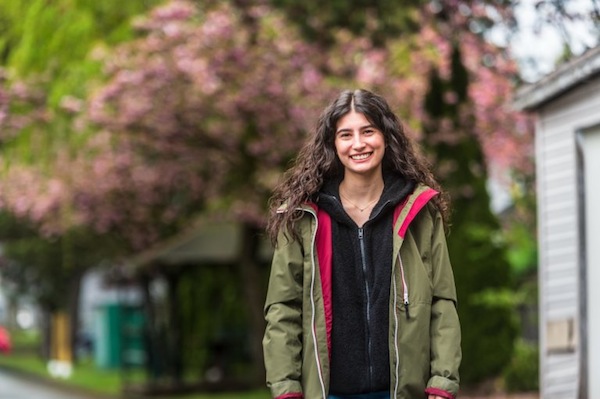
University of British Columbia student Ava Katz has been helping people with errands since the pandemic began. (photo by Paul Joseph/UBC)

First-year kinesiology student Ava Katz commutes to the University of British Columbia from Kerrisdale, where her housemates include her 91-year-old grandmother and a mother with a heart condition. In these extraordinary times, Katz doesn’t want her loved ones risking their health with unnecessary trips to the grocery store. So, in March, she began making those trips herself. As she was transporting groceries home from Save-On Foods, something occurred to her.

“It dawned on me that there are people in the community who don’t have family, who don’t have anyone else to go out for them,” said Katz.

Her final exams were just a couple of weeks away. It’s the time of year when most students’ instincts are telling them to clear their schedules of any distractions. Katz’s instincts were telling her to do something else.

She posted a public note on Facebook: “In wake of the spreading pandemic, I would like to offer my services to anyone who is compromised during this time. If you or someone you know is in need of groceries, household items, etc., please contact me directly and we can arrange for me to complete your needed errands free of charge.”

She indicated where she lived and her phone number, assuring people, “I will not enter your homes, only drop items off at the door. Priority goes to elders and individuals with compromised health. Please do not contact me to run errands for you if you are able and in good health.”

She asked readers to share the post. The calls came quickly. Just a couple at first, but more and more as her friends returned from school in the United States and overseas. They all had to self-isolate for 14 days, so they couldn’t do anything for their own grandparents who were shut in. Katz stepped in.

“That was just kind of a no-brainer for me,” she said. “I was happy to do those things, and still am.”

Katz has been shuttling to and from supermarkets and pharmacies all over Vancouver. Each outing brings her into the orbit of people who potentially carry the virus. Katz has heard the stories about the toll COVID-19 takes on its victims. She wears a mask and takes great care not to bring the virus to the people she’s helping.

She still makes the trips for her mom and grandmother, walks her two dogs, and also delivers food between two seniors homes twice a week as a volunteer for Congregation Beth Israel. It’s a lot to do, but, as far as Katz is concerned, it’s the least she can do.

“It definitely scares me that I could be exposing myself, but people need help,” she said. “I’d rather sacrifice myself than have a senior go into a grocery store and contract the virus instead.”

Many of the volunteers who were delivering food between the two seniors homes when COVID-19 arrived were older folks themselves. It was too risky for them to continue, so the congregation put out a call for new volunteers. Katz was among the first to step up, despite her busy exam schedule.

“Crisis brings out the best and the worst in people, and I think Ava is one of those examples of it bringing out the best,” said Krystine McInnes, volunteer coordinator for the synagogue. “The idea of selfless service and loving our neighbours as ourselves – she really embodies that.”

Helping people is in Katz’s blood. Her grandfather was a doctor for more than 60 years. She came to UBC thinking she would go into medicine eventually, too. Nothing during her first year has changed that. In fact, the COVID-19 outbreak has given her even more respect for the healthcare and support workers who keep our hospitals functioning every day.

“They are real heroes,” said Katz. “I have a huge respect for what it takes to provide care to so many people at a time like this and it reinforces my commitment to be a part of it.”
Format ImagePosted on May 15, 2020May 14, 2020Author Erik Rolfsen UBC Media RelationsCategories LocalTags Ava Katz, coronavirus, COVID-19, seniors, tikkun olam, UBC

Share your COVID story

The COVID-19 pandemic has impacted the lives of everyone in our local Jewish community, as it has impacted people around the world. Daily events like school, work, visiting with friends and family, as well as grocery shopping and other errands, have been transformed by public health recommendations.

The Jewish Museum and Archives of British Columbia has a responsibility to collect and document history as it happens – and needs your help to document this historic time. What are the important aspects of this moment that our community should recall years from now?

Each of us is experiencing this crisis in our own unique way, and the Jewish Museum and Archives wants to gather as many of those experiences as possible. Not sure what to say? The museum can help with that. The JMABC has recruited the assistance of Carly Belzberg, a specialist in guided autobiography, who will be helping community members put their experience into words.

The museum would like to know how daily routines around your house, including work, school and fitness have changed; how you’re staying in touch with family and friends; and what Jewish traditions look like for your family this year. For example, how did you celebrate Passover? How are you keeping Shabbat?

If you are interested in sharing your experiences, or simply would like to learn more about this project, contact JMABC archivist Alysa Routtenberg at [email protected].

Posted on May 15, 2020May 14, 2020Author JMABCCategories LocalTags archives, coronavirus, COVID-19, history, Jewish museum, memoir
Doctors talk about COVID

Doctors talk about COVID

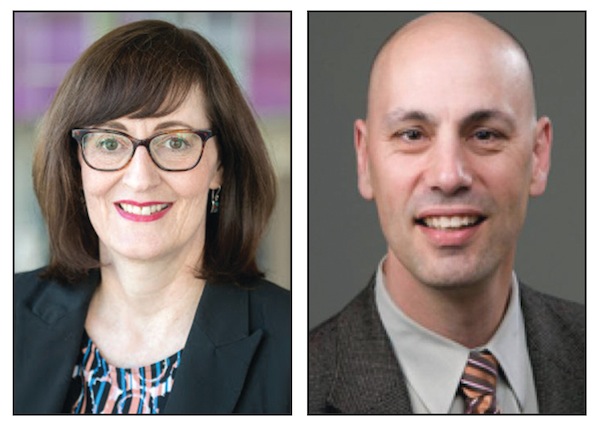
Dr. Patty Daly and Dr. Eric Grafstein were the featured speakers of Temple Sholom’s May 1 Let’s Talk About It webinar. (photos from Temple Sholom)

Temple Sholom began the first of a series of four (possibly five) webinars, called Let’s Talk About It, on May 1 with a public health forum that featured guest speakers Dr. Patty Daly, Vancouver Coastal Health’s chief medical officer, and Dr. Eric Grafstein, the regional head of emergency at VCH and Providence Health Care.

Together, the doctors provided a report from the medical frontlines in Vancouver, as the city responds to the COVID-19 pandemic. They later addressed several concerns raised by members of the community.

Grafstein offered reassuring remarks for those who may be apprehensive about visiting emergency departments. “Emergency departments are a safe place to go during a pandemic,” he said. “If you have things like chest pains or symptoms that you think may be a stroke, then you should be coming to the emergency department.”

Emergency visits declined sharply after a state of emergency was declared in British Columbia on March 18, dropping by half compared to last year, suggesting that people might be holding off from visiting the hospital, he said.

“When people come to a hospital with suspect cases, they are segregated. People who do not have COVID are not put at risk,” Grafstein said. As of the webinar date, about two people per 1,000 who had come to an emergency department in VCH had tested positive for COVID-19, he said.

Physical distancing in the emergency department is done through placing COVID patients in a different area than other patients. The risk of infection is further reduced by fewer people coming to EDs and creating more space in the hospital, he said.

Grafstein said the supply of personal protective equipment for medical workers is secure.

Though the first case of COVID-19 in British Columbia was identified on Jan. 15, the spread of the virus to the region came in early March, likely the result of traffic between British Columbia and the state of Washington, the first area in the United States to experience an outbreak. The number of reported cases in VCH peaked in mid-March and there has since been a decline.

Vancouver’s numbers have compared favourably to those of Toronto and Montreal, and the vast majority of cases here have been mild, said the doctors. The population most at risk is the elderly. Many of the deaths in the region have occurred at long-term-care facilities.

“We’ve done a very good job of flattening the curve – not only in our region but across B.C.,” Daly said. “Our modeling suggests that we can think about lifting some of the measures we have in place.”

Indeed, the province announced its Restart Plan last week. Outpatient services and elective surgeries are to be among the first medical activities to be resumed. An increase in the number of outdoor spaces that the public can access is also planned.

Some daycares – for the children of essential workers – have already reopened, and it is hoped that students will return to schools before the end of the academic year. Bars, restaurants and personal service businesses, such as hairdressers, could potentially reopen in the coming weeks as well, as long as measures, similar to those in grocery stores, are in place.

Universities may return to classes in the fall, though many classes will remain virtual.

There have been few cases of COVID-19 in the region among those under the age of 18, and day camps for children might take place this summer, said Daly.

Gatherings for groups of 50 or more people, such as weddings, funerals and religious services, will be among the last restrictions to be lifted.

“It will be done slowly and in a way that doesn’t lead to a dramatic increase in cases,” Daly said.

“The ultimate solution is a vaccine,” she said.

Neither doctor could predict when a vaccine would be ready, though some trials appear promising. Both doctors reinforced the messages that officials everywhere have been giving for months: stay home if you are sick, cough or sneeze into your elbow, don’t touch your face and wash your hands frequently.

“Anyone with the classic symptoms for COVID – fever, shortness of breath, cough, loss of sense of smell, nausea, diarrhea – should be tested,” Grafstein stressed.

Calling 811 will provide a person with the nearest testing facility. Every positive result is followed up and people who may have had close contact with that person are reached and advised to stay home for 14 days.

VCH covers a population of 1.25 million people, encompassing not just Vancouver but Richmond, the North Shore, the Sunshine Coast and some rural communities, such as Powell River. As of May 8, there had been 866 reported cases of COVID-19 within the VCH region; of those, 78 patients have died and 583 have recovered and discontinued isolation.

“As we open things up, we are doing everything we can to prevent a second wave. We need to also continue to help the most vulnerable,” Daly concluded.

Convened by Temple Sholom’s Rabbi Dan Moskovitz, the webinar was co-sponsored by the Jewish Federation of Greater Vancouver and was attended by more than 200 people. A video recording of the event can be found on Temple Sholom’s website and on YouTube.

Other talks in the Temple Sholom series have been discussions on financial planning and on effective parenting; a session on estate planning is scheduled for May 20.

Sam Margolis has written for the Globe and Mail, the National Post, UPI and MSNBC.

Format ImagePosted on May 15, 2020May 14, 2020Author Sam MargolisCategories LocalTags coronavirus, COVID-19, Eric Grafstein, health, Patty Daly, Temple Sholom, Vancouver Coastal Health

Uniting in significant times

For some, this pandemic has been lonely. For families with children, like mine, it’s a lot of togetherness and work. The offer to listen to deep thinkers from three religious traditions by myself for an hour was a rare chance. I’m busy – homeschooling, working, cooking and constantly being “in community” with my twin 8-year-olds. We’re missing our relatives, school and social gatherings, but I’m working constantly. During this pandemic, I’m almost never physically alone.

For an introvert like me, this has been hard. So, I jumped at the chance to cover a webinar with religious insights on the pandemic.

While we’re physically isolated, we’re also more connected by technology than ever before. This is how moderator Dr. Reinhard Krauss began a Zoom webinar, hosted by the American Jewish University, called “Muslims, Jews and Christians: Coming Together in Extraordinary Times.”

The three panelists were all distinguished educators who do interfaith dialogue. Each also offered their personal take on their religious traditions. Rabbi Dr. Elliot Dorff shared Jewish insights, Sister Deborah Lorentz, a member of Sisters of Social Justice, offered a Catholic perspective and Jihad Turk, the president and founder of Bayan Claremont Islamic Graduate School, spoke about Islam.

Much of the webinar highlighted our faith communities’ shared values, including strong support of science and medicine as a way forward. All three panelists, speaking from their faith traditions, pointed out the risky behaviour of extremists who have chosen to ignore medical advice around social distancing. Whether it’s ultra-Orthodox Charedim gathering illegally in Brooklyn or churches choosing to meet on Easter, the consensus was that these choices to disregard social distancing science were crazy. They were, according to Dorff, against Jewish law in terms of saving a life. Jewish teachings regarding social distancing, illness and separation go all the way back to Leviticus.

The need to stay put and social distance is in Islamic teachings, too. Turk quoted a 1,400-year-old hadith (saying of the prophet Mohammed) that said: “Usama b. Zaid said the Prophet said: ‘If you hear of a plague in a land do not enter it; and if it breaks out in the land where you stay, do not leave.’”

All three faith communities talked about the history of community and our traditional strengths in gathering together. Sister Deborah mentioned St. Benedict’s teachings about living in community together. This, she said, is a longstanding support system that we all need.

However, when we can’t gather, we must find other solutions. Catholics must look inward and find “the Jesus Christ within” to gain strength, she said.

Dorff talked about how, when we as Jews are isolated, we miss the most routine things, like going to a movie theatre or grocery store – and then we must innovate. He used a personal anecdote to explain a Jewish historic pattern, mentioning how, for the first time, he and his wife were using technology to chat virtually with all four of their adult children and their families at once. They’d replaced their usual Sunday afternoon movie outing with a virtual family gathering. This had never occurred to them before the pandemic. In isolation, they missed their routine and, therefore, innovated.

The most painful loss for many of us was not being able to gather physically for big holidays – Passover, Easter and, now, Ramadan. Ramadan is an intensely communal holiday, in which families join every evening for iftar to break their fast. Many Muslims also gather at mosques to break their daily fast, and to pray together. Yet, none of that can happen this year. Yes, there are virtual events, but it’s not the same as being together.

So, people must change their routines and pray at home. Turk spoke of “challenging people to work at home. Develop and refine the art of supplication, reaching out from your heart to G-d to what you are most in need of. Strengthen that muscle.”

All three panelists said almost in unison that things should not “return to normal” when it comes to our great societal inequities. Feeding, clothing and housing those in need were recurrent themes. Sister Deborah spoke about how, despite all the struggles that this experience might cause, it also might offer us great gifts. It’s up to us to do the work and find the gifts we’re being taught.

These reflections provided me with food for thought. I was struck by the notion that during this Ramadan, Muslims must work hard to pray at home and “strengthen that muscle when it comes to opening yourself up to G-d.” Often, when I pray in Jewish communities, we’re reciting the prayers but not doing that introspective work.

Sister Deborah’s notion that we must find the gifts in a challenging time was also a perspective that I struggled to find on my own. She encouraged everyone to use this to make change in the future – to envision the way we can take responsibility to right wrongs and inequities we all see in society.

The webinar ended with encouragements to show our love to our families, our friends and the world. We must return to society with, in Dorff’s words, “a greater appreciation for people who do service for us. Farmers, truckers, medical professionals, teachers – we need each other.”

The hour I spent alone listening to this panel discussion was precious. It’s rare indeed for parents to be alone at all during this pandemic! As a bonus, I also heard ideas common to all three faiths: science, work, social responsibility, community connection, and the need to love one another. All these are rooted in Jewish tradition. It’s well worth considering these common and important ideas as we face our lives in a new, post-pandemic landscape.

Joanne Seiff has written regularly for CBC Manitoba and various Jewish publications. She is the author of three books, including From the Outside In: Jewish Post Columns 2015-2016, a collection of essays available for digital download or as a paperback from Amazon. Check her out on Instagram @yrnspinner or at joanneseiff.blogspot.com.

Posted on May 15, 2020May 14, 2020Author Joanne SeiffCategories Op-EdTags American Jewish University, coronavirus, COVID-19, Deborah Lorentz, Elliot Dorff, interfaith, Jihad Turk, lifestyle, multiculturalism

Blessings during COVID-19

It’s far too easy to think of all the hardships and sacrifices that have come with COVID-19. They’re ubiquitous and abundant. They’re in our face the second we step outside our front door, turn on the TV or go online. A barrage of bad news. A surfeit of sadness. A plethora of pathogens. A deluge of disease. Stop me anytime.

It’s getting to be too much. But that’s beside the point. As Prime Minister Justin Trudeau keeps telling us, “moistly,” and with practised gravitas, “We are all in this together.” Sadly, that is no consolation. There is one thing that does help though: making a habit of feeling grateful. While some of you will shut me down right now as being a cliché, that’s where I’m coming from.

Every day or two, when I go for a short walk in my neighbourhood, I look around and wonder when spring happened. How is it that I missed seeing the nascent buds on the magnolia trees, which are now strutting their huge pink flowers like botanical catcher’s mitts? When did the hydrangeas arrive at the party? And when did everyone start walking around the local park in facemasks and latex gloves?

Nothing I have experienced in my 64 years comes close to this COVID-19 pandemic. Same goes for most of us, I’m sure. There is nothing to compare it to, thank G-d. I am at a loss for synonyms. Only antonyms hit the mark: normal, regular, run-of-the-mill. We will likely never return to what we knew as normal ever again. At least not the same variety. But that’s not necessarily a bad thing. Perhaps we will come to redefine normal in an even better light. I know one thing: most people have become kinder, more thoughtful, more aware. This is huge.

In the face of the overwhelming upheaval, illness and sadness we’ve been witness to, I choose to feel grateful. Because there are always gems among the dross, moments of pure beauty and holiness. I assure you, I’m not some Pollyanna who views life through rose-coloured glasses all the time. However, challenged by what’s going on around us, I need to believe that there is still much to be thankful for in this COVID-19 world. For my part, that includes my health, my husband, my family. As well as these sunny days. The last remnants of snow on our pristine mountains. Less traffic. Clear skies. A shocking dearth of commerce. My pension. Food in the freezer and enough pasta to last until I’m 90. I feel luckier than most.

I can’t begin to comprehend the suffering that’s going on around me. Not only the illness and death that’s affecting families and communities all over the world, but the sheer panic and anxiety from loss of jobs, loss of homes, not enough to eat, wondering what’s next. But I’m shored up knowing that there are still people out there who are putting themselves at risk to help others, by delivering food, picking up medications and, of course, all those frontline workers who turn up every day.

For now, I take comfort in the little things, which, I’m realizing have become the big things. Like a walk in fresh air, and hearing good news of any sort. It doesn’t take much. The drugstore has facemasks and latex gloves in stock – woo hoo! I can finally buy Lysol wipes again – victory! Oh, how perception has shifted. If I’ve learned one thing, it’s that this pandemic has taught us to reevaluate our priorities.

Time and a sense of accomplishment are a whole other story. At the beginning of the pandemic, the pattern of my days rotated around things instead of ideas and concepts. Back then, I thought a productive day was accomplishing this:

  • Buying a box of disposable facemasks at Canadian Tire.
  • Spending two hours and successfully finding a store that sells alcohol swabs.
  • Making fried matzah with cinnamon and honey bananas for my husband.
  • Ironing our laundry.
  • Dusting (two rooms).
  • Successfully (or not?) diagnosing myself with eczema from constant and somewhat obsessive handwashing.

Not much, but at least I did things instead of sitting around binge-watching Netflix all day. As the weeks passed, I began to tip the scales by attending online seminars throughout the day; some from the Rohr Jewish Learning Institute, some from Chabad, and others.

Between running around doing, and sitting and learning, I struggle to distinguish between wasted time and purpose. It seems almost counterintuitive, even ridiculous, to call anything purposeful right now. I mean, how much purpose can we have during a pandemic? Who can we influence for the good? What kind of mitzvot can we do?

Believe me – or don’t – but the answers to those questions are: lots, many, and endless. It takes scant energy to say hello to a stranger on your daily walk and ask how they’re doing. People just need to experience or see one good deed to carry it forward. There are countless ways to do a mitzvah – phone an elderly relative or friend; buy a few extra groceries and give them to someone in need; make a meal for your neighbour and deliver it to their doorstep. Simple. Simple. And simple. Just get outside yourself.

The world, and we humans, are not that complicated. It doesn’t take Herculean effort or huge sums of money to pull someone out of an emotional hole. It simply takes an open heart. We spend countless hours building our bodies so they can withstand the weight of the world. Now it’s time to build our hearts. In fact, there is no better time than right now. So go forth and be your best self – for yourself, and for others.

Shelley Civkin is a happily retired librarian and communications officer. For 17 years, she wrote a weekly book review column for the Richmond Review. She’s currently a freelance writer and volunteer.


Posted on May 15, 2020May 14, 2020Author Shelley CivkinCategories Op-EdTags coronavirus, COVID-19, gratitude, lifestyle

Clearing the decks

In every grouping of humans, there is a leadership structure. That’s the way it works for humans. That’s the way it works for animals, too, when they organize in groups.

Generally, for animals, it’s a combination of smarts and strength that wins the day, with physical strength often being an important part of the equation. The same must have been true for humans in our primitive days, and still is to an extent. In some periods of human history, there were those who were able to establish dynasties, where successive generations achieved leadership by right of birth, sometimes sanctioned by what was called “divine right.” The deity was called in to account for the continuing rule by a family in tribal or national context.

In more recent times, leadership has often been gifted to those who exhibited merit, rather than pure might. Those who were successful at their life tasks were called upon to serve in leadership roles to the benefit of those for whom they took responsibility. Therefore, many in leadership positions are more advanced in age, except in the most competitive arenas.

Well, guess what? There is suddenly a new selector in town! Coronavirus!

Some people are forecasting that we will see as much as three-quarters of the world’s population infected by COVID-19. Try as we might, and even as we may be successful in flattening the curve, most of us will eventually have to face the test of living through an infection by the virus. If we can find a vaccine, that will alleviate the losses. But, for the next year-and-a-half, at least, many of us will have to face the test. If our healthcare systems can sustain themselves under the onslaught, again, the losses will be fewer. If not, the choices will favour the younger and those more likely to survive. What this all means is that those who are older, those who are more likely to be among those in leadership, will be more likely to be among the fallen. Fate has taken a hand in our succession planning.

I am among the somewhat longer in the tooth, facing my 86th birthday. It is apparent that, in the current environment, this epistle may turn out to be my eulogy. Not many in my situation have the opportunity to deliver this kind of message ahead of time.

I have had meaningful work and the satisfaction of making, in my own mind, a worthwhile contribution to the lives of others, of my fellows. I feel my parents would have been proud of me. I had the joy of fathering children who have turned out to be good human beings. I have had the joy of finding and living with the love of my life. Flawed as I am, I am content. I am among the fortunate in this world. I am not abandoning the race but I am prepared for whatever the future holds. I wish the same for all my fellows.

This event we are living through is a feature of any life on any planet in our cosmos. A meteor struck our globe millennia ago, causing a global winter, which doomed the dinosaurs and permitted a mammalian ascendancy. Homo sapiens has prospered. We have survived plagues and influenzas. We have conquered many communicable diseases. We have managed to increase our food production capabilities so we did not starve when our numbers on this planet increased so much that our wise men believed we were doomed. We have continued to consume that arable land for our structures at a rapid pace and yet survive.

We are facing a crisis in the way we pollute our air and our waters, one we have yet to come to terms with. Rising temperatures on our globe may yet reach a point of no return. The pandemic we are facing, as other life forms on our planet seek their place in the sun, may turn out to be the least of the problems we will have to cope with.

In the meantime, this pandemic is clearing the decks of those in the age range I share. I don’t know about you, but it has captured my full attention – I can feel the target on my back. Keep your physical distance, please!

Max Roytenberg is a Vancouver-based poet, writer and blogger. His book Hero in My Own Eyes: Tripping a Life Fantastic is available from Amazon and other online booksellers.

Posted on May 15, 2020May 14, 2020Author Max RoytenbergCategories Op-EdTags aging, coronavirus, COVID-19, health, lifestyle

Choose to be and to do good

As Jews, we’re acutely aware of our core Jewish values: help others, perform mitzvot, respect human dignity and life, love your neighbour as yourself, act morally, save lives, repair the world. But do we actually do those things? As we’ve heard before, it’s the duty of every single person to leave the world better than he or she found it.

During this unprecedented time, when the world is reeling from the COVID-19 pandemic, now, more than ever we need to remind ourselves of Jewish morals and ethics. And be better Jews.

Exceptional times typically bring out both the worst and the best in people. I’m choosing to focus on the best, though. For instance, folks around the world going outside at a set time every day to make noise and show their gratitude for frontline workers – and not just the doctors, nurses and caregivers, but also grocery store cashiers, letter carriers, pharmacists, delivery people, tradespeople, chefs and taxi drivers. Anyone and everyone who puts themselves in harm’s way each day, to keep us safe, fed and healthy.

If we don’t, as a society, learn the value of showing gratitude and generosity in desperate times, we become a society without a soul. If we think only of ourselves, we become lacking in conscience and void of morality.

What I know for certain is this: if a Jew needs something, another Jew should always step up and help out. It’s what we are supposed do. It’s what we’ve always done, most of the time. It might even be embedded in our DNA. In fact, we’re commanded to do it. Here are some tips for being a better Jew during COVID-19 (and always):

  • Take care of yourself so that you can take care of others. This may sound trite and over-used, but it’s true: your health is everything. I have suffered a long and serious illness and it’s shown me that nothing is more important than having your health. Unless it’s faith.
  • Be an active participant in life – this is not just a long lunch break. There is more to life than Netflix and reading (says the retired librarian). There are meaningful things you can be doing with all your spare time now. Think about where you can be of service, and whom you can help.
  • Practise random acts of kindness, compassion and loving care for your fellow human being – remember the Golden Rule. It can be something as simple as thanking a healthcare worker or letter carrier you see walking on the street. It doesn’t take much to show someone that they’re needed and appreciated.
  • Practise generosity – share, don’t hoard. Surprise a family member or friend with a meal or small gift that might just make their day. It can be something as simple as an extra few rolls of toilet paper or a container of disinfectant wipes (COVID-19 gold). Something that lets them know you’re willing and happy to share. Just remember physical distancing! A friend of mine recently brought me some extra face masks she had on hand (again, coronavirus gold).
  • Offer to do errands (grocery shopping, picking up a prescription, walking a dog, etc.) for family, friends or acquaintances in need. Be someone’s hero. People won’t always be comfortable asking for help, so be proactive and offer, if you can.
  • Cultivate faith (emunah) and trust (bitachon) in G-d, that everything will be OK. Life is easier when you have a higher power on your side and understand that there are many things you can’t control.
  • Check in regularly with single friends and seniors, in particular. Isolation can be devastating, especially when it’s ongoing. Even if you can just wave to a friend or family member through a window, that might just be their only human connection all day (or all week). It costs nothing and it’s priceless. Small gestures can have big impacts. Help people feel part of their community.
  • Show gratitude every day, because there is always something for which to be grateful. Whether it’s big (your good health) or small (cherry blossoms on the trees), appreciate the abundance in your life. It’s everywhere you look. Just keep your eyes open. And get out there at 7 p.m. every day and clap your hands or bang your pots and pans, to show your thanks to all the frontline workers who turn up for us every single day to make our lives easier. We are one big family – show the love!
  • Keep in mind the social and economic impacts the COVID-19 pandemic is having on everyone. Be sensitive to the situations of those less fortunate than yours. If you can, offer financial help, food or any other kind of assistance when you see the need.
  • Volunteer your time delivering food or supplies to others if you’re healthy and able. Contact and get involved with your local synagogue, Jewish Family Services, the Kehila Society or any other organization, Jewish or non-Jewish, working to alleviate the many needs right now.
  • Stay positive – for yourself and others. Positivity is the best medicine during this stressful time.
  • Be your best self. Let your innate goodness shine through. Remember we each have a tiny piece of divine soul within us.
  • Do mitzvot – tip the scales for good.
  • Give tzedakah. You don’t have to be a millionaire to make a difference in someone’s life. Every little bit helps.
  • Study a bit of Torah or other spiritual texts, if you’re so inclined.
  • Recite Psalms, if you’re so inclined. (I have a copy that includes English commentary, and this makes it so much more meaningful when I read them. It started out slowly for me, but now I find huge comfort in reading Psalms. Why not give it a try?)
  • Participate in some online classes or listen to speakers via Zoom video presentations. There’s a lot of inspiration and new perspectives to be gleaned, and goodness knows we could all use some of that right now.
  • Keep busy by finding purpose in your life. This is so important, especially right now, when there is so little to distract us from the devastation of COVID-19. Try to look for the good in every situation – it will serve you well. I’ve been on both sides of that wall and believe me when I say that staying positive will make your life much easier.

Here are some simple rules to live by (unknown source): help others without being asked; help people who cannot help you; help without the expectation of return; help many people; do the right thing the right way.

Remember that, every second of every day, we make choices. Choose to be good and do good. You can’t go wrong with that.

Shelley Civkin is a happily retired librarian and communications officer. For 17 years, she wrote a weekly book review column for the Richmond Review. She’s currently a freelance writer and volunteer.


Posted on April 24, 2020April 24, 2020Author Shelley CivkinCategories Op-EdTags coronavirus, COVID-19, health, Judaism, lifestyle

Thank you to frontline

There are many new routines in this unusual time. Social media feeds suggest baking has become the comforting go-to for many of us. Binge-watching shows and finally getting to the books we’ve been meaning to read is another. Cleaning those closets that were filled with mismatched sheets sets and nearly empty rolls of birthday wrapping paper was a long-overdue task.

But, at 7 p.m. each night now for a couple of weeks, another, less solitary routine has emerged. Metro Vancouverites – and people further afield – take a step outside, onto their balconies or into their driveways, and make like it’s New Year’s Eve. Clanging pots and pans, applauding, shouting cheers and generally making as much noise as possible for a minute, the behaviour is not merely burning off steam by a people holed up and stir crazy. It is a heartfelt act of solidarity and gratitude for the frontline healthcare workers, first responders and others whose responsibilities to protect the public require them to remain at their posts. It is also a way for us to say hello to our neighbours, and to receive reassurance that, while the streets and stores may be almost empty, humanity has not been wiped out, just relegated to our homes.

The nightly event was given steam by Rory Richards, a member of the Jewish community who understands the meaning of the power of one. Several years ago, at the height of the refugee crisis in the Mediterranean, she traveled to Greece and helped welcome those fleeing their homelands, while mobilizing support for the effort back home via social media. In this time of need, she saw what others were doing in the world to express themselves, while staying in quarantine, and brought the practice to her West End neighbourhood. And it has resonated with many – so many that the Vancouver Park Board has decided to change the firing time of Stanley Park’s Nine O’Clock Gun to 7 p.m. until the end of April.

The noisemaking trend is still relatively new, but already we hear of the emotional impact it is having on exhausted and anxious frontline workers. As is the solidarity at 7 p.m. nightly of their fellow emergency workers – fire trucks, police cars and ambulances driving the streets around their local hospitals, flashing their lights and sounding their sirens.

Mostly unsung are other frontline workers, those whose jobs, until this crisis, were not considered dangerous or irreplaceable: grocery store workers, cashiers, fruit and vegetable store operators, bakers, letter carriers, parcel delivery personnel, bank tellers, people maintaining the internet, bus drivers, garbage and recycling collectors, city workers who are making sure the traffic lights and other essential services remain operational, employment insurance office staff and other bureaucrats who are rushing to put aid programs into place. The list goes on. These people are continuing their work of keeping the world functioning at the level it must, without the luxury of sheltering in place.

In the Jewish community, agencies and individuals are stepping up. Jewish Family Services continues to deliver its vital programs, knowing that the physical, emotional and economic toll this crisis is taking is not yet at its peak. Jewish Federation of Greater Vancouver has launched a fund to help the community address the crisis, with specific emphasis on food security, housing support and subsidies to ensure that the economic impacts of the pandemic do not prevent individuals and families from participating to the greatest extent possible in Jewish communal activities. The Centre for Israel and Jewish Affairs has mobilized, creating a COVID-19 resource guide that is a clearinghouse for related information nationally and in each province. And organizations such as the Canadian Council for Reform Judaism and Reform Rabbis – which sent a letter to the federal government last week – are working to ensure that relief efforts centre on the most vulnerable, “including those who are homeless or housing insecure, migrants or refugees, living in underserved indigenous communities, being held in detention facilities or at risk of domestic violence.”

Locally and internationally, synagogues, day schools and community organizations have turned on a dime to use online platforms as an alternative meeting space for virtual services and gatherings. Some senior Sephardi rabbis in Israel are releasing opinions that would allow observant Jews to leave Zoom running for Passover seders, so that separated families can join together to celebrate our Festival of Freedom.

How many of us, three weeks ago, had heard of Zoom? An old long-distance telephone ad declared, “It’s the next best thing to being there,” which is true of this new technology, but we can’t deny that the shmoozing before and after (and during) services and events isn’t quite the same. Humans are likely to take for granted anything we receive almost as soon as we have it, so it is worth taking a moment to consider the incredible good fortune that allows us to have technology that we could barely dream about 30 years ago to keep us virtually together when we are, most of us, actually apart.

There’s no question that the emotional toll of our separateness will be keenly felt next week as the seders that, for our entire lifetimes, have meant the coming together of extended families and close friends, will be massively different than in the past. There will be a seat at the table for Eliyahu, but many others also will be there only virtually, and they will be missed.

When we participate in the 7 p.m. clangfest, or even if we just watch it from our homes, let’s consider the clapping, hollering and pan-banging as a testament to our admiration for medical and other frontline personnel, including the people who never imagined that they would be so crucial a part of maintaining our society’s functioning but who are, irreplaceably, ensuring that many of us are able to shelter in place in relative privilege and comfort.

Posted on April 3, 2020April 1, 2020Author The Editorial BoardCategories From the JITags coronavirus, COVID-19, frontline workers, gratitude

Emergency services available in community

The Jewish Federation of Greater Vancouver has released $400,000 to address the immediate needs of its local partner agencies over the next month. The funds will address needs in the key areas of food security, to increase the capacity of the food bank and other food distribution programs in our community; housing support, subsidies for community members unable to make their rent payments; seniors services, to help them stay safe, healthy and connected to community while they are self-isolating in their homes; tuition support so that families with children in Jewish day schools can keep their children enrolled; subsidies for Jewish programs, daycare, summer camps and part-time educational programs; and support so that Jewish supplementary schools can provide alternatives to classroom learning and maintain uninterrupted delivery of Judaic studies to the children and families they serve.

For more on Federation’s response to the COVID-19 crisis, as well as what other community organizations are doing at this time, visit jewishvancouver.com/covid-19-updates.

***

With the support of Jewish Federation, Jewish Family Services (JFS) has launched the JFS Community Care Hotline as an emergency response resource. It is available from 9 a.m.-9 p.m., seven days a week and staffed by JFS to provide emergency essential services. Priority services include meal or food bank grocery delivery; counseling/emotional support; and friendly phone “visiting.”

There are three ways to contact JFS for help: call 604-558-5719, email [email protected] or complete the form at jfsvancouver.ca/jfs-cares.

If you know anyone who needs to lean on JFS at this time, please share this information via your social media networks and other forms of communication. JFS also has a volunteer registration page, as many people have offered to help.


Posted on April 3, 2020April 1, 2020Author The Editorial BoardCategories LocalTags coronav, coronavirus, COVID-19, Jewish Federation, JFS
Kind Café offers vegan food

Kind Café offers vegan food

Samantha Emerman opened Kind Café last year. While closed during the COVID-19 pandemic, they are operating a pickup service twice a week. (photo by Olga Livshin)

Kind Café is a warm, airy space, a place for friends to meet and eat together. Or, at least it will be a welcoming meeting place again, after the coronavirus pandemic is over. In the meantime, the restaurant is offering takeout service only.

Jewish community member Samantha Emerman, with her father, Marvin Emerman, opened the café in August 2019. The main idea behind it was threefold: no meat, no dairy, no waste.

“I became a vegan in 2013. I went to a nutritionist college here, in Vancouver. I learned where our meat and milk come from, so I stopped eating them,” Samantha Emerman told the Independent in a recent interview.

Initially, she opened an online business, ran some seminars on healthy eating habits and offered nutrition coaching. She supplemented her income by working at local restaurants and coffee shops.

“Do you know how much garbage Starbucks produces?” she said by way of but one of many possible examples. “In a busy location, they take out the garbage every hour. I wanted to create a space for people to enjoy their meals, while generating no garbage at all. It’s a much kinder way to feed people – kinder to the environment, to our planet.”

Emerman started doing research on what kind of restaurant she wanted. “There are other vegan restaurants in Vancouver. Being vegan has become trendy, but there is no other vegan café, except ours,” she said. “And no eating establishment in the city offers the ‘no waste’ policy, except ours.”

The next important decision was where to set up shop.

“I researched for a long time. We looked into downtown locations,” she said, “but most people in downtown rely heavily on their daily to-go coffee. We checked out the suburbs, like White Rock. In the end, we decided that the best location for our café would be Main Street, with its diverse people.”

And, last August, Kind Café opened its doors on Main Street.

“We offer a vegan menu and we don’t generate any garbage. We don’t even have a garbage can inside,” Emerman said proudly. “We don’t have any plastic or any single-use items here. Everything is reusable.”

The zero-waste initiative extends to all areas of eating, including the takeout aspect of the business. The café doesn’t have paper coffee cups or foam containers for to-go orders.

Before the coronavirus hit, Emerman said, “If people want[ed] takeout, they should come in with their own containers. It took awhile for the people to get used to that idea, but now, most of our customers who want a takeout come with their own containers.”

She called this policy BYOC (bring your own container). “We are passionate about BYOC,” she said. “When you dine inside, we have you covered with metal cutlery, ceramic plates, mugs and glasses. Otherwise, instead of the disposable plastic utensils, paper cups and single-use food containers that are polluting the environment, we kindly ask our customers to bring their own.”

Even with the COVID-19 restrictions, Emerman isn’t sacrificing her environmental beliefs. Instead, she is extending the practice of “renting” containers, which was in place before the virus. The café is temporarily suspending its BYOC policy and is now only offering customers food served in new glass containers for which there is a monetary deposit that will be returned to the customers at a later date, when they return the container so that it can be washed and reused.

“We’re trying to shift the focus away from the single-use mindset altogether,” she said. “Why use any product only once and throw it away? We are here to shake up the food industry, change people’s behaviour pattern, and to make BYOC the norm.”

The demographics of Kind Café are as diverse as the Main Street population. “About 60% of our customers are regulars who work or live in the area,” Emerman said. “Most of them are between 14 and 40, professionals and students. The rest are walk-ins. All kinds of people, really. And people are still discovering us.”

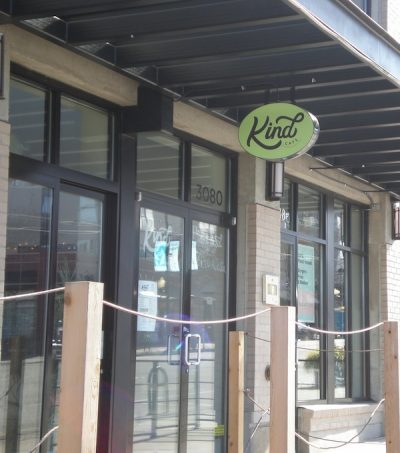
photo - Kind Café opened its doors on Main Street last August
Kind Café opened its doors on Main Street last August. (photo by Olga Livshin)

As a way for people to discover the new café, Emerman has been offering the space for events and seminars on healthy eating. One of the events that fit the café’s no-waste strategy was a clothing swap. “It’s the same principle,” she said. “You don’t want this sweater, but someone else might want it. No throwing away anything.”

The no-waste guidelines apply to the restaurant’s suppliers as well.

“We don’t accept the products in plastic bags. We have our own large containers for the supplies we use,” said Emerman. “The only bags we do accept are paper and reusable. But it took some time to find suppliers who share our beliefs. That’s why we have 11 suppliers for different products, not two or three, like Starbucks.”

The café is a family business. “My father is my partner and mentor,” Emerman said. “He taught me a lot. Most of the recipes are our family recipes or my own, although now that we hired a chef, he contributes, too. My sister is the office admin. My mom does everything that needs to be done. We are a very close family.”

Of course, they have some hired staff, all of whom happen to be, like the Emermans, vegan. “It is not a requirement for working here,” she stressed, “but our staff want to work for us. There are not too many vegan places in the city.”

The majority of work falls to Emerman herself. “Owning this café is the hardest thing I’ve ever done. I do everything. I bake. I manage front and back. I look for suppliers. I do advertising on social media – Facebook and Instagram. It’s a 24/7 job and the most rewarding I’ve ever done.”

To order takeout and for more information on the café, visit kindcafe.ca. The website notes, “We know that getting your hands on certain groceries, specifically vegan food, during this time can be challenging. Although we do not currently have a delivery service, we will be open for a small window, of three hours, twice a week, for you to come pick up orders!”

They request that customers preorder by Friday, 10 a.m., for Saturday pickup and Monday, 10 a.m., for Tuesday pickup. There is an online form to fill out, and an invoice will be provided once your order is confirmed.

Olga Livshin is a Vancouver freelance writer. She can be reached at [email protected].

Format ImagePosted on April 3, 2020April 1, 2020Author Olga LivshinCategories LocalTags coronavirus, COVID-19, Kind Cafe, restaurants, Samantha Emerman, takeout, vegan

Posts pagination

Previous page Page 1 … Page 14 Page 15 Page 16 Next page
Proudly powered by WordPress