
Skip to content
  • Home
  • Subscribe / donate
  • Events calendar
  • News
    • Local
    • National
    • Israel
    • World
    • עניין בחדשות
      A roundup of news in Canada and further afield, in Hebrew.
  • Opinion
    • From the JI
    • Op-Ed
  • Arts & Culture
    • Performing Arts
    • Music
    • Books
    • Visual Arts
    • TV & Film
  • Life
    • Celebrating the Holidays
    • Travel
    • The Daily Snooze
      Cartoons by Jacob Samuel
    • Mystery Photo
      Help the JI and JMABC fill in the gaps in our archives.
  • Community Links
    • Organizations, Etc.
    • Other News Sources & Blogs
    • Business Directory
  • FAQ
  • JI Chai Celebration
  • JI@88! video

Recent Posts

  • עשרים ואחת שנים בוונקובר
  • Supporting the Iranian people
  • The power of photography
  • A good place to start
  • When boundaries have shifted
  • Guitar virtuosos play
  • Different concepts of home
  • Broadway’s Jewish storylines
  • Sesame’s breadth and depth
  • Dylan Akira Adler part of JFL festival
  • Mortality learning series
  • A new strategy to brighten up BC
  • Sharing latkes and light
  • Johnson awarded for human rights work
  • Cherished tradition ensured … Silber Family Agam Menorah
  • Nothing as lovely as a tree
  • Camp welcomes new director
  • Popular family camp expands
  • A life-changing experience
  • Benefits of being a counselor
  • Camper to counselor
  • האלימות בישראל מורגשת בהרבה מגזרים
  • טראמפ עוזר דווקא לנושא הפלסטיני
  • New rabbi settles into post
  • A light for the nations
  • Killed for being Jewish 
  • The complexities of identity
  • Jews in time of trauma
  • What should governments do?
  • Annie will warm your heart
  • Best of the film fest online
  • Guitar Night at Massey
  • Partners in the telling of stories
  • Four Peretz pillars honoured
  • History as a foundation
  • Music can comfort us

Archives

Follow @JewishIndie
image - The CJN - Visit Us Banner - 300x600 - 101625

Tag: community

Contemplating the JI – on the occasion of the JI’s 85th

Contemplating the JI – on the occasion of the JI’s 85th

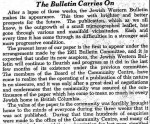
Editorial in the Jewish Independent’s predecessor, the Jewish Western Bulletin, March 20, 1931.

The JI spoke with four friends of the newspaper from longtime Vancouver Jewish community families about the value and future of a Jewish community newspaper: Gary Averbach, Shirley Barnett, Bernie Simpson and Yosef Wosk. We asked each the same four questions and they replied by email. Their responses are printed below.
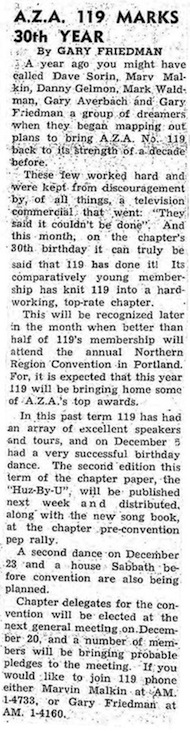
image - Not only are the community members interviewed here longtime Vancouverites but they have been involved in communal life for decades. The announcement on the right is from 1959, and comments on how a group of youth including Gary Averbach brought “AZA No. 119 back to its strength of a decade before.”
Not only are the community members interviewed here longtime Vancouverites but they have been involved in communal life for decades. The announcement on the right is from 1959, and comments on how a group of youth including Gary Averbach brought “AZA No. 119 back to its strength of a decade before.”

GARY AVERBACH

1. Is it important to have a Jewish community newspaper? If so, what are some of the reasons?

It’s difficult to answer this question because it seems so obvious that having a community newspaper is vitally important. We need a forum and a notice board for opinions and events in the community and, if there was not a publication dedicated to providing that forum and bulletin board, our community would suffer an irreplaceable loss.

2. What do you think the JI/JWB specifically has contributed (contributes) to the community?

For the most part, the JI/JWB has always been a bulletin board for the Jewish community, informing us about major – and minor – events and happenings. Whether they be reports on events that have occurred in the community – including the greater Canadian and worldwide Jewish community – or just informing us of births and deaths, b’nai mitzvahs and weddings, or local upcoming happenings. If not the JI/JWB, where would this come from?

3. In what ways, if any, is having a print version of value, versus only having an online publication?

For the next decade at least there will be a demand – albeit likely a decreasing one – for a printed version of the JI. That isn’t so much to provide for the very few people who still don’t or can’t use a computer, but to those of us who still prefer to hold a newspaper in their hands

4. Do you think that a Jewish community paper will be relevant for your grandkids’ kids?

I don’t even know what my grandchildren will be using to access their news in 10 years’ time, never mind what my great-grandchildren will prefer. But I’m fairly certain it won’t be print media as we now understand it. However, that in no way diminishes the need for a community forum and bulletin board giving a Jewish viewpoint on matters of local, national and international events – specifically items that directly involve Jews and, of course, Israel. So, whether it’s an online version, as we now know it, or some further refinement that we can barely imagine now, there will still be a need to inform our local Jewish community by the JI or some similar outlet.

SHIRLEY BARNETT

1. Is it important to have a Jewish community newspaper? If so, what are some of the reasons?
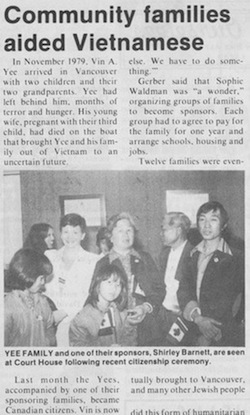
image - Among Shirley Barnett’s many community involvements is helping Vietnamese refugees come to Vancouver. This article is from June 1984.
Among Shirley Barnett’s many community involvements is helping Vietnamese refugees come to Vancouver. This article is from June 1984.

Yes, for sure. I would like more reporting of issues in the community rather than just of events.

2. What do you think the JI/JWB specifically has contributed (contributes) to the community?

Exactly that – a sense of community and interaction.

3. In what ways, if any, is having a print version of value, versus only having an online publication?

For me, for sure. I like to read it over a morning coffee, and still cut and clip.

4. Do you think that a Jewish community paper will be relevant for your grandkids’ kids?

Probably not.

BERNIE SIMPSON

1. Is it important to have a Jewish community newspaper? If so, what are some of the reasons?

It is extremely important for the Jewish community, which is spread throughout the province, particularly the Lower Mainland, to have a Jewish community newspaper. There is no question that the viability of printed media has been affected by easy access to online papers, however, it is noted that just about every ethnic community in British Columbia still has printed media, which is read primarily by the older generation.
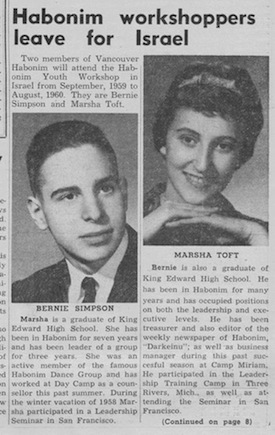
image - This article from 1959 is but one of many recording Bernie Simpson’s participation in Habonim and other community organizations, including the Jewish Western Bulletin.
This article from 1959 is but one of many recording Bernie Simpson’s participation in Habonim and other community organizations, including the Jewish Western Bulletin.

For example, in the Indo-Canadian community there are at least one dozen papers, half of which are in Punjabi. However, two of the most prominent papers, the Voice and the Link, have been in existence for more than 30 years, and are able to attract substantial advertising and are thriving within the community.

The Korean community has at least six papers, primarily in Korean. The Vietnamese community has at least four papers. The Chinese community has a countless number of newspapers, which attracts readers from the various regions from where the Chinese community has come, including Taiwan, Mainland China and Hong Kong.

Admittedly, however, those communities have far more significant numbers than the Vancouver Jewish community, and that may be the reason why those papers are more economically viable.

The Jewish community newspaper, by definition, helps promote a community by giving news as to various events that are happening, not only in Vancouver but in outlying areas.

It is also a vehicle to announce important fundraising activities and to give proper recognition to those who are honored in the community.

The reporting of international news particularly as it relates to Israel is important, and also the editorial content. I believe that we are fortunate in having editorial content that is objective. The letters to the editor, by and large, are articulate and represent, on occasion, a different view than the mainstream Jewish community may have, particularly with regards to Israel, and this view should be welcomed as it serves as a catalyst for thoughtful thinking on sensitive subjects.

The stature of the Jewish community would be diminished considerably in the eyes of the non-Jewish community if there was not a Jewish community paper. There is still the view that the Jewish community is well organized, speaks with one voice on contentious issues, is socially active in liberal causes and even responds to tragedies throughout the world, and I would think that the image of the community will be tarnished considerably if a community paper did not exist.

2. What do you think the JI/JWB specifically has contributed (contributes) to the community?

To a certain extent this question is partially answered by my response to Question 1.

I believe that this paper helps keep the community focused and together, and it takes into consideration all aspects of the political spectrum as it relates to the three levels of government and objectively reports what is happening in Israel.

We are indeed fortunate to have the publisher (working with various editors), who is an outstanding journalist as is evident by the many awards that the Jewish Independent has won.

If it would happen in the future that the Jewish Independent did not exist, then that void very well could be filled with a community publication that lacks the objectivity that the present Jewish Independent has. For a brief period of time several years ago, such a paper did exist, and it was quite clear what the agenda of that paper was. In the Jewish Independent’s small way, it does help the debate with regards to the peace process in Israel between the Israelis and the Palestinians and the concept of a two-state solution.

3. In what ways, if any, is having a print version of value, versus only having an online publication?

I think, at this point, the majority of the readership are still of the generation where they don’t naturally gravitate every day to their computer or their mobile to see what news comes out this week in the Jewish Independent.

Longtime members of the community have had ingrained in them that towards the end of the week, the Jewish Independent will arrive. It often stays around the house until the next edition. I would think also that it would be harder to get advertising revenue if you’re only online.

4. Do you think that a Jewish community paper will be relevant for your grandkids’ kids?

Frankly, I’m not terribly concerned about the answer to that question, nor is it really relevant to the present situation. I am a senior member of the Jewish community now; my grandchildren are 6, 3, 2 and 1. It’s impossible for me, who on my best of days has difficulty directing my attention to the immediate past, to focus on whether the paper will be relevant for my grandkids’ kids, which would be around 30 years in the future.

I don’t think that we should be too concerned about that question, but what we should be concerned about is how we can make the Jewish Independent more economically viable.

One obvious answer is an increase in subscriptions. Perhaps, an active volunteer campaign could be conducted by members of the community to try to sign up more subscribers. This will make it easier to get advertising revenue.

It may be that there should be “an advisory board” set up to advise the present publisher as to how to make the paper more attractive to advertisers and to readers.

There is a great deal of talent within the Jewish community (well-known reporters who are still active, retired reporters with national papers, etc.); this is a resource that perhaps should be called upon.

Also, an advisory committee of individuals – businesspeople – can lend help financially, if the situation arises.

RABBI DR. YOSEF WOSK

1. Is it important to have a Jewish community newspaper? If so, what are some of the reasons?
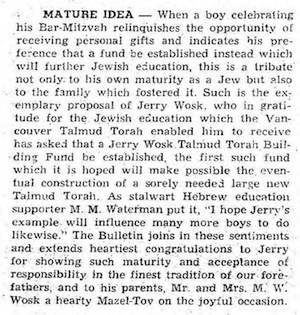
image - Yosef (“Jerry”) Wosk’s decision to donate funds to Vancouver Talmud Torah on the occasion of his bar mitzvah in 1962 drew the attention of editor Sam Kaplan.
Yosef (“Jerry”) Wosk’s decision to donate funds to Vancouver Talmud Torah on the occasion of his bar mitzvah in 1962 drew the attention of editor Sam Kaplan.

Yes, I feel it is important to have a community newspaper. It helps to gather and focus information about the extended family that is the community. It covers diverse topics, such as social events, politics, education, births and deaths, special interest groups, as well as emotional and intellectual concerns.

2. What do you think the JI/JWB specifically has contributed (contributes) to the community?

The newspaper has tried to be a neutral newsgathering and dissemination site. It carries articles that represent the full spectrum of the community, thereby fostering information and conversation.

3. In what ways, if any, is having a print version of value, versus only having an online publication?

The value of a print edition is that it can be read on Shabbat, it is easily accessible to everyone, including technophobes. It is always open and easy to read. Articles can be cut out and distributed. Having a hard copy on your desk or table gives it an immediate physical presence and material voice. In addition, a newspaper or magazine laying around in a public common area or even in a private home will attract readers who may not open an electronic device and search for a particular media address. The electronic edition may provide a number of supplementary links and also be available through a quick search, but it does not negate the value of a printed edition.

4. Do you think that a Jewish community paper will be relevant for your grandkids’ kids?

Who knows? However, newsgathering and dissemination in one form or another has always been of interest to the human condition and, so, I project that a community newspaper will still maintain its value in the future.

Posted on May 15, 2015May 15, 2015Author The Editorial BoardCategories From the JITags Bernie Simpson, community, Gary Averbach, Jewish Independent, Jewish Western Bulletin, newspapers, Shirley Barnett, Yosef Wosk
More than fitness at the JCC

More than fitness at the JCC

The fitness centre at the Rosen JCC in Orlando, Fla. (photo by Cyndy Phillips)

For Daphna Krupp, her workouts at the Jewish Community Centre (JCC or J) of Greater Baltimore have become somewhat of a ritual. She not only attends fitness classes but also engages with the instructors and plugs the J’s social programs on her personal Facebook page.

“It’s the gym and the environment,” said Krupp. “It’s a great social network.”

Krupp, who lives in Pikesville, Md., is one of an estimated one million American Jewish members of more than 300 Js around the country. Each J – in line with the bylaws of their umbrella organization, the JCC Association of North America (JCCA) – has a fitness centre that serves as one of its core businesses. Often, the fitness centre can be perceived as a for-profit enterprise of the J, with thousands of dollars invested annually in facility maintenance and gym advertising. But Steve Becker, vice-president of health and wellness at JCCA, says that is a myth. “JCCs are not fitness centres, we are engagement centres,” he said. “All fitness-related programs are structured to be relationship-building activities.”

The institution of the J was founded in 1854 as the Young Men’s Hebrew Association (YMHA), to provide help for Jewish immigrants. A Young Women’s Hebrew Association was established as an annex to the YMHA in New York in 1888. The first independent YWHA was set up in 1902. In 1917, these organizations were combined into a Jewish Welfare Board, and later renamed Jewish community centres. “After World War One, the Jewish Welfare Board morphed into an organization to meet the cultural, intellectual, physical and spiritual needs of the Jewish community,” said JCCA communications manager Marla Cohen, noting that physical needs were always part of the equation.

The much-debated 2013 Pew Research Centre study of the American Jewish community found that 62 percent of Jews say being Jewish is mainly a matter of ancestry and culture, rather than religion. The study showed a decline in non-Orthodox individuals involved with the organized Jewish community. As such, communal leaders – from award-winning author and lecturer Dr. Erica Brown to Jewish Agency for Israel president and chief executive officer of international development Misha Galperin – have been calling for increased “low-barrier, high-content” programming to meet Jews where they are. This, says Cohen, is a niche the J can fill. “For some people, aside from High Holiday attendance, working out at the J is probably the only flavor of Judaism they have. The J could be a very big part of these people’s Jewish identity,” Krupp said.

In the last two decades, many Js have opened their doors on Shabbat, in consultation with rabbis and community leaders. “These individuals are not choosing between the JCC and synagogue. They are choosing between everything else – the mall, soccer, snowboarding, you name it – and the J,” said Cohen. “The JCC just gives Jews another option. And many JCCs have stepped in offering meaningful programs for Jews seeking something other than a traditional service.”

Read more at jns.org.

Maayan Jaffe is an Overland Park-based freelance writer. Reach her at [email protected] or follow her on Twitter, @MaayanJaffe.


Format ImagePosted on March 27, 2015March 26, 2015Author Maayan Jaffe JNS.ORGCategories WorldTags community, fitness, JCC, Jewish Community Centre, Judaism

The tent is getting smaller

Amid what had been a steady stream of volunteer commitments I had undertaken in the Jewish community, it seems I now have some more free time. I could be pleased by the fact that I am freed from a major board commitment, but I’m not. Because something’s rotten in the state of Diaspora Jewish communal discourse.

Let’s back up. After seven years of dedicated service on the board of a large Jewish organization here in Ottawa, where I helped initiate policies around ecological sustainability, reform the board’s governance and procedures, work on LGBTQ inclusion, and reformulate our mission statement to better reflect the organization’s values, I found myself having risen through the ranks of the board’s executive to the position of vice-chair. All this along with teaching adult education classes at the institution, creating an innovative women’s athletic program there and being a regular user, along with my family, of a variety of programs and services. Normal board succession procedures imply that I would be next in line for chair – a position I had made plain to those in charge that I was willing to take on.

But rumblings over the past half-year suggested that I was potentially radioactive in the minds of some donors. Why? Because of my writings on the subject of Israel. In short, the board’s selection committee made clear that they’d be better off without me.

Readers of my columns know that while I am frequently critical of Israeli policies around the occupation and other anti-democratic moves afoot in Israel, I am squarely in the camp of liberal Zionism. This means that, in addition to criticizing the occupation and pressing Israel to make the necessary conditions to engage in a meaningful peace process, I oppose full-out boycott of Israel leading to the undermining of its core identity as a Jewish state. I have publicly debated anti-Zionists and non-Zionists – both in person and in print – on these issues, and I regularly tout the importance of Israel engagement and Jewish and Hebrew literacy. These are all ideas that I also put forth both in my columns in local Canadian Jewish papers and in international media, in Haaretz, the Forward and, before that, in Open Zion at the Daily Beast. Still, it seems that when it comes to positions of community leadership, none of this is enough to establish one’s loyalty to a tent that is rapidly shrinking.

We’ve heard this all before, of course. Witness the stonewalling reaction Peter Beinart received by the Toronto-based Centre for Israel and Jewish Affairs when his organizers tried to get him an audience with Hillel on campus during his three-city Canadian tour a couple of years ago. And then there’s the canceling of David Harris-Gershon’s talk at the Jewish community centre in Washington, D.C., earlier this year.

It’s by now a truism that the breadth of policy debate among Israelis themselves far outsizes what is evidently permitted within the Diaspora Jewish community. But then, neither do Israeli Jews have to actively work to inculcate Jewish identity, as I frequently have in my writings, including promoting Jewish education, pushing for the active use of Hebrew, examining the value of synagogue affiliation, defending Jewish and Zionist summer camping experiences and, yes, insisting on the value of a Diaspora connection to Israel.

So, I’m left to ask this: what is it, ultimately, that we, as Jewish community volunteers and activists, are being asked to be loyal to? Are we being asked to promote Jewish community vitality, wrestle with ideas around Israeli politics and policies, encourage Jewish literacy, and consider realities that preserve Israel’s Jewish and democratic character? Or are we being asked to simply support the endless occupation just as we see Israel’s democratic character crumbling before our very eyes, as the country becomes more and more of a pariah state? I think I know the answer. But how I wish it weren’t so.

Mira Sucharov is an associate professor of political science at Carleton University. She blogs at Haaretz and the Jewish Daily Forward. A version of this article was originally published on haartez.com.

Posted on December 5, 2014December 3, 2014Author Mira SucharovCategories Op-EdTags community, Diaspora, Diaspora Jews, Israel

Meeting the future together

The turning of the calendar presents opportunities for reflection and gratitude. We at the Jewish Independent are particularly grateful this year for the support we have experienced as a community institution. And that leads us to offer an expression of gratitude to you – our readers, our advertisers, our donors.

This year has seen the JI expand into a more fulsome and engaging online presence, with a fresh website and greater impact on social media. With the paper available in more than 35 locations, our content is reaching a wide audience.

The JI is, ostensibly, a for-profit venture. Realistically, it is a labor of love undertaken by a small group of people led by a sole proprietor. So, it is especially gratifying that the issue that you hold in your hands today – or have before you on your computer – is chockablock with advertisements. These advertisements are the lifeblood of this publication. More than ever before, everything outside of advertising is a zero sum game. Subscription fees cover only mailing costs. Everything else – staff time, writers’ compensation, printing, everything that goes into making a newspaper – is funded almost exclusively by advertising. In the last couple of years, many of you have been generous enough to donate to the paper, and this has helped greatly.

We continue to believe that this newspaper is irreplaceable glue for this community, a mirror and a place for dialogue.

While we need money – we are not going to lie about that – we also need the incredible diversity of talent that defines this community. If you or someone you know could make a contribution of time as a writer, as a filmmaker, a performer, a fundraiser, a social-media maven, or in whatever form suits your talents, you can make an important contribution to the continued success of this 84-year-old community publication.

Do not underestimate the power of your voice. If you saw something insightful in this week’s paper or online, tell your friends. Word-of-mouth may be as valuable as anything else in ensuring that the JI remains vital. Share on Facebook (like us!), Tweet about us (follow us!), pass your hard copy or forward your e-version to friends and family. Visit our website weekly, or even daily. There is always something new to read or watch, and the more activity we can demonstrate, the greater the revenue the site generates, making it possible for us to do more of what we do best.

Consider gift subscriptions for those close to you – or those far away, who would enjoy news from home. When considering birthday, graduation or other gifts, a book or a piece of exercise equipment (the JI understands the mind-body connection, after all), shop for them at Amazon or Astone Fitness via our website, as the paper receives a portion of sales.

If you pick up the paper for free at the Jewish Community Centre or one of our other depots, we value and need your readership, for sure, but please consider a donation. Any contribution is appreciated, and makes more impact than you can imagine.

And, of course, please support our advertisers – and let them know you understand the role they play in strengthening Jewish life in British Columbia by making possible everything we do in these pages and online.

All of these small but vitally important actions can make the difference between whether this 84-year-old community institution survives or whether we follow the fate of many other newspapers in this extremely difficult time for the industry.

We are moving in the right direction. The JI remains a strong example of small media done right (and a wall full of awards attest to the quality of our work). But we can’t do it alone. We need to work together if we – and so many other community organizations and businesses – are going to thrive for another eight decades.

Posted on September 19, 2014September 18, 2014Author The Editorial BoardCategories From the JITags Amazon, Astone Fitness, community

Posts pagination

Previous page Page 1 Page 2 Page 3
Proudly powered by WordPress