Be prepared to speak up

On Sunday, it appeared that Norbert Hofer had been elected president of Austria. By Monday, when absentee ballots were counted, he had lost by a mere 31,000 votes out of 4.6 million. The election captured worldwide attention because Hofer represents the Austrian Freedom Party, one of a string of extreme-right parties catching fire across Europe.

Hofer’s defeat was a relief to many, including Jewish organizations, but the narrowness of it is being declared a wake-up call. It wouldn’t be the first such warning. There have been multiple close calls, going as far back as 2002, when Jean-Marie Le Pen, the antisemitic founder of France’s Front National, made it to the presidential runoff. But never has any far-right figure come as close as Hofer to becoming head of state of a European country.

Hofer’s campaign of anxiety and scapegoating used Middle East immigration and associated (and unassociated) crime as an accelerant. As is happening in various places, including the “Brexit” referendum in the United Kingdom on June 23, countries are reconsidering their positions as part of the larger community of European nations. Part of this, again, goes back to the immigration issue, as some seek to bring immigration decision-making back to national capitals from the European Union.

While Europe appears a hotbed of emerging far-right parties, some Israelis are sounding the alarms over recent events there.

Over the past few days, Israel’s Prime Minister Binyamin Netanyahu has closed the door on a possible unity government with the left-leaning Zionist Union, setting the stage for an alliance with Yisrael Beitenu, and its leader, Avigdor Lieberman, to become defence minister, a position that Moshe Ya’alon abandoned in a flurry of disgust and condemnation of Netanyahu last week.

Some commentators say the result will be the most right-wing government Israel has ever seen. Ehud Barak, former Labor Party prime minister, said the developments amounted to “the seeds of fascism.” Three-time defence minister Moshe Arens predicts a “political earthquake.”

Lieberman, a settler himself and a leader in the movement representing Jews who live outside the Green Line, has a strong base among Russian immigrants, of which he is also one, and a reputation for antagonizing Palestinians and international diplomats. Originally a high-level member of Netanyahu’s Likud, Lieberman broke with Netanyahu over what he saw as Netanyahu’s overly conciliatory approach to the Palestinians during the 1997 negotiations that resulted in the Wye River Memorandum. Lieberman opposed Ariel Sharon’s Gaza disengagement and dismisses land for peace – the primary approach Israel has operated under for years in negotiations with its neighbors – as a “critical mistake” that will destroy Israel.

Suffice to say that politics is a vocation that invites hyperbole. Yet developments in many places – in Europe, in the United States, in Israel – invite strong reactions. The political spectrum has changed; terminology and policies differ with the times. While antisemitism has always been a defining characteristic of the far-right, some extreme-right European parties are now highly pro-Israel and eerily even philosemitic, seeing Israel as a bulwark against the “real” enemy – Islamism (or, less specifically, as is their wont: Islam). While the United States has seen its share of demagogues, it is equally true that, should fascism of some native form find root there, it would almost certainly be led by a buffoon who people underestimated for too long.

Canada sometimes seems like a blessed island in a roiling world – something we should never take for granted. It may be tempting to be smug, but instead Canadians should use our comfort and whatever influence we have to evangelize, to reclaim a phrase, for a world where moderation and tolerance prevail. While we might be more comfortable currently with politely withholding our opinions, the time may be upon us when we are truly called upon to register our disapproval of events – next door, in Israel or anywhere. We shouldn’t be afraid to speak up.
A people or a religion?

Ludicrous as it may sound, it is difficult for some people to understand what Jews are. To be Jewish is to be part of a peoplehood. To adhere to Judaism means one practises the religion of the Jewish people. Yet one can be Jewish and not practise Judaism. This may be called variously humanistic Judaism, cultural Judaism or any number of other imaginative descriptors.

At root, Jewishness is both a peoplehood and a religious identity, sometimes overlapping, sometimes not. This is problematic because it means Jews do not fit neatly into the categories the world likes to assign people. This becomes increasingly difficult as the world moves further toward communicating even complex ideas in 140 characters or less.

Writing in Haaretz Monday, Joel Braunold, executive director for the Washington, D.C.-based Alliance for Middle East Peace and a former leading member of Britain’s National Union of Students, says the antisemitism being exhibited by members of the U.K. Labor Party and the NUS stems at least in part from leftists’ refusal to see Jews as a national group and instead narrowly defining Jews as adherents of a religion.

Braunold makes some insightful observations about how self-identified anti-racism activists can treat Jews differently. In one instance, he writes, an ostensibly anti-racist group distributed flyers lamenting the Holocaust’s toll on Roma, homosexuals and members of other groups, while not mentioning the Shoah’s Jewish victims. They are doing Jews a favor, Braunold says some have told him, by not falling into the Hitlerian trap of defining Jews through racial categorization.

Dejudaizing the Holocaust, obviously, is appalling. Yet there is a far more common approach employed almost universally by people condemning antisemitism. It is the seemingly well-intentioned habit of condemning antisemitism and then carrying on to list many other forms of discrimination. In other words, while it is fully acceptable – as it should be – to condemn anti-black racism when it occurs in the United States or elsewhere without numerating a laundry list of other forms of racism that are unacceptable, it seems almost impossible for many people, including some elected officials, to condemn antisemitism without subsequently providing an exhaustive list of other bigotries that deserve denunciation.

It is hard to argue that this is a sign of ill will. After all, every opportunity to condemn discrimination of every kind is a good opportunity. But when it seems anti-Jewish animus is the only one that cannot be singularly condemned, it should raise questions. We can condemn Islamophobia, misogyny, historical and contemporary treatment of indigenous Canadians, inequality of minorities in Western societies, the historical wrongs perpetrated on Chinese and Indian immigrants (or would-be immigrants who were prevented from entry) to Canada and all range of other victims, yet condemnations of antisemitism seem to need qualifiers.

It may be precisely that Jewishness is confusing to some – is it a religion or is it a national identity? – that allows people to behave the way they do toward Jews. I can’t be racist, one might say, because Judaism is a religion and I should be free to criticize religion.

There is also, in contemporary Canada, a stream of anti-religiosity. “Imagine there’s no countries … and no religion too,” John Lennon sang in an anthem of a generation of dreamers.

In addition to antipathy toward religion, there is a stream of anti-nationalism at play. Some of the criticism of Israel stems from the dream of a post-national world, where, to quote Lennon again, there is “nothing to kill or die for.”

And yet, many who subscribe to some variation of this quest for an ideal post-nationalistic world by targeting for elimination the one state of the Jewish people, a people whose statelessness was the primary reason six million were able to be murdered seven decades ago, should be an obvious indicator of misplaced priorities. Especially when many of these same activists support Palestinian national self-determination, but not the Jewish version.

In his Haaretz piece, Braunold posits a unique motivator for some of the attitudes we see on the left toward Jews. It may not be the magic key that explains it all, but it is a part of the puzzle.

A London lesson

Britain’s Labor Party is going through a crisis as successive low-level and, more recently, senior members of the party express antisemitic attitudes.

Ken Livingstone, the former mayor of London and a Laborite familiarly known as “Red Ken,” told television audiences last week that Hitler was a Zionist, repeating a common and despicable theory usually limited to musty corners of the internet, implying that the Holocaust was all a ploy to engender sympathy that would lead to the creation of the state of Israel. Livingstone apologized if people had taken offence to his words but did not apologize for what he said.

Around the same time as Livingstone – a stalwart of the party’s left for decades – was getting in hot water, so was Naz Shah, a party rising star. The MP accused Israel of behaving like Nazis and suggested that Israel be relocated to the United States, an explicit call for the ethnic cleansing of Jews from the last refuge of the Middle East where they have not yet been eliminated.

The conflict broke into the open, at least in the international media, in February, when one of the co-chairs of the Labor club at Oxford University resigned, declaring that a large proportion of club members have “some kind of problem with Jews.”

Jeremy Corbyn, the Labor Party leader whose own record of allegiances leans more toward Hamas and Hezbollah than it does toward democratic, Jewish Israel, has called an inquiry into antisemitism in his party. Yet, this did not stop one of Corbyn’s shadow cabinet members and closest allies from dismissing allegations that the Labor Party has a problem with Jews as a “smear.” And some have declared the condemnations of antisemitism in the party a “new McCarthyism.”

While all of this sounds like bad news – and it’s hard to argue that the presence of antisemitism in one of the Western world’s major political parties is anything but – there is a silver lining.

The fact is that ideas like these have been percolating on the left and elsewhere for years. They are expressed daily in certain forums on the internet and pop up in private conversation even among people who are respected and trusted on other topics.

In recent years, we have seen individual eruptions of outlandish accusations against Israel – indeed, “apartheid,” “genocide” and accusations of Nazism and the perpetration of a holocaust are accusations thrown routinely at the tiny outpost of democracy. That antisemitic outbursts in Britain’s Labor Party have reached a critical mass that could no longer be dismissed as the unrelated rantings of misguided individuals has led to a much-needed confrontation over the topic. Now, the party must confront and address the problems in its ranks.

From a Canadian perspective, this has particular interest, because our New Democratic Party, in some ways a child of the British parent party, is entering into a period of reflection and reinvention. Its last two leaders, the late Jack Layton and the recently defenestrated Thomas Mulcair, tried to eradicate from their party not-uncommon expressions of anti-Zionism that sometimes relied on anti-Jewish prejudice as an accelerant. The spectacular failure of the Mulcair-led NDP in the last election is leading some to say that a turn to the more extreme left is, if not an electorally advantageous move, at least an ideologically pure way forward. Such recidivism would almost certainly involve some rehabilitation of old anti-Israel fixations.

Yet, it is always better to shine light under these rocks than to allow these ideas to mutate. In Britain right now, we are seeing the predictable illogical extremes to which unchecked anti-Zionism can lead. It will be informative to watch the public discussion that transpires. Though differences are vast, the political cultures of Canada and Britain still have some strong parallels. Perhaps, if Britain confronts in this matter now, Canada will not need to later.

UNESCO a mockery

There are those who envision a future without Israel in it. No one knows what the future holds, yet there are some who, in their enthusiasm for a future without a Jewish state, are reinventing the past.

Last week, UNESCO, the United Nations Educational, Scientific and Cultural Organization, passed a resolution that effectively negates millennia of Jewish history at the Temple Mount in Jerusalem.

The holiest site in Judaism and the physical centre of the Jewish world, is the place where the first and second temples stood. The remnants of the Second Temple, the Western Wall, is the place on earth toward which Jews have prayed for 2,000 years when they have not been able to pray at the Wall itself.

The land is contested because, in the eighth century, Al-Aqsa Mosque was constructed on the site of the temples’ ruins. To be generous, the Jews may have been there first, but it is nevertheless a holy site for Muslims as well. Tell that to UNESCO. According to the wildly ahistorical resolution last week, Jewish claims of ancient connection to the place are bogus.

The resolution, which repeatedly refers to Israel as the “Occupying Power,” includes a litany of offenses allegedly perpetrated by Israel and Israelis, including “storming of Al-Aqsa Mosque/Al-Haram Al-Sharif by the Israeli right-wing extremists and uniformed forces,” and accuses Israel of “planting Jewish fake graves.”

In addition to pages of condemnations of Israel, the resolution repeats familiar accusations that deny any Jewish connection to Judaism’s holiest site.

The resolution was submitted by Algeria, Egypt, Lebanon, Morocco, Oman, Qatar and Sudan, countries that each have their own unique challenges that nevertheless do not detract from their obsession with imagined Jewish slights against Islam.

But the resolution was supported by numerous ostensible allies of Israel, including France, Spain and Sweden, as well as Russia. The United States, Estonia, Germany, Lithuania, the Netherlands and the United Kingdom voted against. (Canada is not on UNESCO’s executive board.)

This sort of nonsense spewed up from agencies of the UN, to say nothing of the General Assembly, further undermines the legitimacy of what could be the world’s most valuable international forum and makes a mockery of the vision of the UN’s founders. None of this matters, of course, to the inmates who are running the asylum.

Hillel BC to Rwanda, Israel

The Hon. Jody Wilson-Raybould, minister of justice and attorney general of Canada, centre, addressed Project Tikkun participants at Hillel BC on March 13. (photo from Hillel BC)

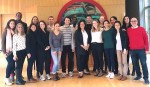
As the academic year winds down on university campuses across the province and students gear up for exams and summer jobs, 15 student leaders from the University of British Columbia and Simon Fraser University are also preparing for a totally different experience: a 16-day experiential learning and service trip to Rwanda and Israel.

Project Tikkun was developed by Hillel BC to challenge students to “understand the essence of hate by breaking down stereotypical thinking.” It is a yearlong program of learning that allows participants to explore the root causes of racism and antisemitism, culminating in a service trip to Rwanda and Israel between May 3 and 18.

The overseas component will enable participants to bear witness to how the diverse citizenry of two relatively young nation-states have grappled with a legacy of genocide. It will provide a firsthand examination of conflict resolution and reconciliation through the humanitarian work and activism pursued in each country to build durable and bonded communities.

According to its website, Project Tikkun brings together “undergraduate students of different ethnic backgrounds, religious practices, sexual orientation and personal beliefs to establish a caring and committed community of change-makers.”

Rebecca Recant, program director at Hillel BC, noted that the intent of the project is also to “build a local community of allies that can support each other when a [hateful] incident comes up, no matter which community.”

Student interest in the program exceeded the limited number of spaces and, last fall, a diverse group of 15 participants was selected. The group includes students of Chinese, Taiwanese, Indian, Korean, Persian and Rwandan backgrounds and a mix of the Jewish, Sikh, Baha’i and Christian faiths. The religious affiliation of the Jewish students varies – some come from secular homes whereas others were raised Orthodox; some have visited Israel and, for others, this will be their first trip to Eretz Yisrael.

Over the course of the year, the participants have been getting to know each other and examining their biases through intensive group learning sessions in which they have explored the history of Canada, Rwanda and Israel. A number of guest speakers, ranging from academics to community activists, have facilitated discussions. Of note, Dr. Andrew Baron, an assistant professor of psychology at UBC whose research examines the cultural and cognitive origins of unconscious bias, structured tests for Project Tikkun participants based on the Harvard Implicit Bias Test that he helped create. Jordana Shani, managing director of Hillel BC, explained that the testing of participants’ level of bias takes place at three different intervals: at the outset of the program, prior to departure and one to two months after return to Canada. The testing provides a way “to measure what we’ve done and how effective the program has been,” she said.

Certainly, much time, effort and money has been channeled into the program, especially the service trip. The journey begins in the capital city of Rwanda, Kigali, where local guides will accompany the students on a tour that will highlight the many landmarks and memorials of the 1994 genocide. The students will then travel to the Agahozo-Shalom Youth Village (ASYV), where they will spend the bulk of their time. Established in 2008 as a residential community-home to protect and nurture Rwandan children who were orphaned during and after the genocide, ASYV now cares for approximately 500 of Rwanda’s most vulnerable high school-aged students. It is modeled after Yemin Orde, an Israeli youth village founded in 1953 to care for orphans of the Holocaust, and it provides a family-like environment for at-risk youth.

The Rwandan students “grow up in this youth village hearing about the youth aliyah village in Israel that [ASYV] was based on,” said Recant. “It’s an Israeli model that is part of the connection between the two countries. They even know Hebrew words, like tikkun olam.”

At the youth village, Project Tikkun participants will learn and live side by side with the ASYV students and volunteer in the classrooms, on the farm and in the kitchen. They will accompany the ASYV students during their foray into town to fulfil a weekly community service commitment.

Libia Niyodusenga, a second-year UBC economics and geography student who was raised at the Agahozo-Shalom Youth Village, is looking forward to returning to Rwanda as part of Project Tikkun. “I think the country itself has the best ways and methods of teaching people through so many organizations that are based in Rwanda and so many history-based sites that you can learn from,” he said.

From Rwanda, Project Tikkun participants will travel to Israel, arriving on Yom Ha’atzmaut, where they will celebrate Israel’s independence in Jerusalem. Later, they will commemorate the victims of the Holocaust at Yad Vashem, tour the Old City and observe Shabbat before moving on to explore other parts of the country, including the Yemin Orde Youth Village. All the while, participants will learn from and volunteer with Israelis who are committed to combating intolerance and inequality – political, religious, ethno-cultural and socio-economic – to effect positive change within Israeli society.

The Israel portion of the trip will demonstrate that complex issues – both regional and domestic – defy the simplistic characterizations often portrayed by the media and that “you can love the country and be critical of it at the same time,” said Shani. The participants, she added, “will meet with people who believe in the right of Israel to exist and who are engaged to make it a better place.”

Jasmeet Khosa, a fourth-year student of international relations at UBC whose Sikh parents immigrated to Canada from Punjab, India, said: “I know that this project focuses on Rwanda and Israel as case studies [for conflict resolution and activism], but what I’ve learned so far is that this extends far beyond – [the message] is universal.”

By all accounts, Hillel BC is pleased with the results of the project thus far. Participants are inspired to help create positive change both at home and abroad and have developed a profound sense of strength through their diversity. As Khosa observed, “… the great thing is that we come from such different backgrounds – academically, culturally, religiously – that everyone brings their own perspective and we get a really great mix in that everyone has something unique to contribute to discussion and friendships, in general.” Niyodusenga added that the connections between program participants are already “deep and intimate.”

In reflecting on the many experiential learning and service trips that she participated in during university and how integral they were to forming her identity, Recant said, “Trips like this are life-changing.”

Shani and Recant are grateful for a grant from the Diamond Foundation that made Project Tikkun possible. While participants will pay a fee, the cost of the program is heavily subsidized to ensure that finances do not pose any obstacles. However, because of the decrease in the value of the Canadian dollar, Hillel BC is continuing to seek financial support for the program. For more information about Project Tikkun, visit projecttikkun.hillelbc.com; to make a donation, call 604-224-4748.

Alexis Pavlich is a Vancouver-based freelance reporter.

Faxes, printers hacked

Simon Fraser University was among those targeted by a hacker spewing antisemitic hate. (photo from facebook.com/PeakSFU)

Simon Fraser University was among many universities targeted by a white supremacist computer hacker purveying antisemitic hate.

Andrew Auernheimer, an Arkansas native now living in Abkhazia, a secessionist region of the republic of Georgia, told the Washington Post that he was responsible for causing at least 20,000 printers and fax machines throughout North America to spew out copies of an anti-Jewish hate poster.

SFU was among the campuses whose fax machines were affected last month, according to Nancy Johnston, executive director of student affairs.

“They weren’t actually posted, they just arrived on people’s faxes,” Johnston said. “It was all just removed and trashed here.”

The sheet featured two swastikas and the words, “White man, are you sick and tired of the Jews destroying your country through mass immigration and degeneracy? Join us in the struggle for global white supremacy at the Daily Stormer,” followed by the web address for the neo-Nazi hate site.

The printer hacking affected administrative and departmental offices at campuses in many U.S. states, the Post reported, adding that an official for the Anti-Defamation League said his organization had received many reports from people concerned about the content emerging from their printers and fax machines.

“Any demonstration of anti-Jewish hostility is a cause of serious concern,” said Nico Slobinsky, director of the Centre for Israel and Jewish Affairs, Pacific region. “This flyer and its contents have no place on any campus in Canada.”

Rabbi Philip Bregman, executive director of Hillel BC, which serves SFU among other campuses, sent this statement to the Independent: “We at Hillel BC are extremely concerned about this latest example of antisemitism that is circulating throughout North American universities. It is our hope and dream that humanity will eventually find a way to live with each other with respect and loving kindness.”

In the UN, on campus

Canada’s foreign minister has called on the United Nations Human Rights Council to review the appointment of Canadian law professor Michael Lynk as its special rapporteur on human rights in Palestine.

Last week, Stéphane Dion tweeted (because that is how diplomacy happens these days): “We call on @UN_HRC President to review this appointment & ensure Special Rapporteur has track record that can advance peace in region #HRC.”

The Centre for Israel and Jewish Affairs has denounced the appointment of the University of Western Ontario academic, who has been associated with anti-Israel activities in Canada. Lynk has said that Israel should be prosecuted for “war crimes,” he accused Israel of “ethnic cleansing,” has spoken at conferences that reject a two-state solution and serves as a leader in a group that promotes Israel Apartheid Week.

While Dion questioned the wisdom of appointing Lynk, CIJA went further, arguing that the position itself is illegitimate.

“It is ludicrous that this is the UN’s only special rapporteur focused on the human rights of a particular community,” said Shimon Koffler Fogel, CIJA’s chief executive officer. “It is likewise shameful that the special rapporteur refuses to investigate the abuse of Palestinian rights by the Palestinian leadership, particularly Hamas in Gaza. In so doing, the special rapporteur obscures genuine human rights violations in the Middle East and the underlying obstacles to Israeli-Palestinian peace.”

A related conflict blew up in academia last week. Just as the appointment of an avowed anti-Zionist as UN rapporteur surely will not advance peace between Israelis and Palestinians, the complete disavowal of the existence of antisemitism on campuses will not promote intellectual discourse or peace.

In the wake of ongoing efforts by the BDS movement to boycott Israeli academics and force universities to divest from Israeli holdings, while occasionally nastily intimidating Jewish students on campuses across North America, the University of California board of regents recently passed a statement condemning antisemitism, along with 10 principles against intolerance as a whole. It is the result of several months’ research and consultation.

The statement that introduces the principles is an amended version of an earlier expression that would have condemned anti-Zionism. Instead, it condemns “antisemitic forms of anti-Zionism.” If the only state in the world targeted for elimination is the only Jewish one, it should be an uphill battle to continue the charade that anti-Zionism is not equivalent to antisemitism, or at least driven by it to a large degree. Nevertheless, the regents’ statement is a starting point for increased civility on campuses that have seen, they note, “an increase in incidents reflecting antisemitism…. These reported incidents included vandalism targeting property associated with Jewish people or Judaism; challenges to the candidacies of Jewish students seeking to assume representative positions within student government; political, intellectual and social dialogue that is antisemitic; and social exclusion and stereotyping.”

Some critics say the statement is designed to stifle opposition to Israeli policies. Others say it could harm free speech. Yet others say it didn’t go far enough, in that it didn’t condemn bigotry against other specific groups.

None of these objections holds water. While the working group’s report might have been initiated by concerns over antisemitism, the document speaks to many other forms of intolerance: “University policy prohibits discrimination based on race, color, national origin, religion, sex, gender, gender expression, gender identity, pregnancy, physical or mental disability, medical condition (cancer-related or genetic characteristics), genetic information (including family medical history), ancestry, marital status, age, sexual orientation, citizenship, service in the uniformed services, or the intersection of any of these factors.”

As for free speech, including, presumably, that about Israel, the document stresses the importance of freedom of expression and of inquiry: “The university will vigorously defend the principles of the First Amendment and academic freedom against any efforts to subvert or abridge them.” And, it notes: “Each member of the university community is entitled to speak, to be heard and to be engaged based on the merits of their views, and unburdened by historical biases, stereotypes and prejudices.”

But: “Regardless of whether one has a legal right to speak in a manner that reflects bias, stereotypes, prejudice and intolerance, each member of the university community is expected to consider his or her responsibilities as well as his or her rights … mutual respect and civility within debate and dialogue advance the mission of the university, advance each of us as learners and teachers, and advance a democratic society.”

The UN – and many others – could learn a thing or two from UC’s regents.

Antisemitism’s blurry lines

Avi Benlolo, president of the Canadian Friends of the Simon Wiesenthal Centre for Holocaust Studies, was recently quoted in the National Post saying that Jewish university-bound applicants should consider options other than Toronto’s York University. The reason? A faculty association executive proposal to divest from weapons manufacturers. The proposal didn’t mention Israel by name.

According to Benlolo, this is a “campaign of censorship against Israel and the Jewish people.” The organization also issued a statement declaring that, in the wake of the proposal, it was “concerned for the safety and security of [York’s] Jewish students and faculty.”

I recently combed through the 2015 report of the Simon Wiesenthal Centre on antisemitism on American campuses, headlined: “A Clear and Present Danger.” Over the 26-page document, I discovered a few antisemitic incidents over the eight preceding years. (I selected an eight-year period to represent two generations of students at a four-year university or college.)

As the report detailed, at Harvard in 2013, to raise awareness of Palestinian home demolitions, activists slipped mock eviction notices into dorm rooms. There was no evidence to suggest whether Jewish students were targeted. And, in 2014-2015 at University of California-L.A., Rachel Beyda, a Jewish student, was barred admission to a judicial position by the student council following accusations that her Jewish heritage made her biased. After an uproar, the administration pressured the council to reverse itself. A similar dynamic played out at Stanford in 2014, when Molly Horwitz was asked, “Given your strong Jewish identity, how would you vote on divestment?”

The report also noted a “decade” of “increasing hostility” at the University of California-Berkeley in 2015, “including “vandalizing Jewish property, spitting at Jewish students, threatening violence, and physically assaulting Jewish supporters of Israel.”

Incidents like these should be called out strongly. But every other event chronicled since 2007 in the Simon Wiesenthal Centre report described political activity directed against Israel or its policies – not instances of antisemitism.

The latest mudslinging debate in the antisemitism wars is more nuanced. It concerns a talk by gender studies scholar Jasbir Puar at Vassar College, an event that authors of a Wall Street Journal op-ed described as antisemitic and a blood libel.

In the talk (of which I received a transcript), Puar made two particularly jarring claims. About the bodies of 17 Palestinian youth that Israel kept for two months at the end of 2015, Puar said, “Some speculate that the bodies were mined for organs for scientific research.” (These youth, it is important to note, had been attacking Israelis. Puar described these Palestinian youth as having been involved in “stabbing” and as part of a “peoples’ rumble” but called their deaths “field assassinations.”)

Puar also suggested that Israel engages in “weaponized epigenetics, where the outcome is not so much about winning or losing nor a solution, but about needing body parts, not even whole bodies, for research and experimentation.”

Puar did not respond to my requests for comment or clarification regarding her accusations.

While academic freedom is a principle meant to protect scholarly speech from legal censure, there is an equally important norm requiring a scholar to provide evidence when making empirical claims. On this, Puar failed.

But is Puar’s scholarly breach antisemitic?

Joshua Schreier, an associate professor of history at Vassar and part of the steering committee of the Jewish studies program that was one of the co-sponsors of the talk, doesn’t think so. He attended the event. “It’s really important,” he told me, “to protect free speech and protect academic speech,” adding that “we have a responsibility, as academics, when we talk about speculation, to note … whether it’s substantiated, whether we’re trying to give new life to those rumors, or not, but none of that makes it antisemitic.”

Unfortunately, the unsubstantiated charge of using “body parts for experimentation” cuts close to the bone of blood libel myths. It is also uttered in the context of a cultural moment on campuses when most criticism of Israel is inappropriately being cast as antisemitic. This surely means that there will be fallout from the talk that will serve to distract debaters from the pressing issues around the ills of occupation. It also means that amid the hyperbolic rhetoric about antisemitism on campuses, actual antisemitism is becoming more difficult to spot when it does occur.

Meanwhile, hundreds of faculty members from across the United States have issued a statement to Vassar’s president asking her to “write a letter to the Wall Street Journal … condemning in no uncertain terms the unjustifiable attack on Vassar and on Professor Puar.”

For its part, the Anti-Defamation League had nothing more damning to say about Puar’s appearance at Vassar than that she has sometimes accused Israel of pinkwashing.

Ian S. Lustick, a professor of political science at University of Pennsylvania, told me by email that he signed the statement “to show solidarity against the campaign to restrict the space of politically correct discussion on anything pertaining to Israel and Palestinians.” About the claim of organ harvesting, Lustick said that “the speculations about horrific

Israeli behavior with respect to organ harvesting from Palestinian bodies are as unlikely to be true as they are likely to be circulated as long as Israel refuses to quickly return bodies of dead Palestinians to their families.”

Debate over campus discourse on Israel (and even on things like armaments, weirdly perceived by some to represent Israel) will continue. Vassar’s president, for her part, invited parents and alumni to an online forum to discuss “current issues and tensions within our community related to the Israeli-Palestinian conflict.”

As for whether actions on campuses over the last decade constitute antisemitism, the ledger is mixed. Verbal or physical harassment directed at Jews for reasons related to their ethnic or religious identity is antisemitism. Same with leveling dual loyalty charges against Jewish students.

But consideration of divestment from weapons companies is not antisemitism. Criticism of Israeli policy is not antisemitism. Criticism of the occupation is not antisemitism. Criticism of violence – whether it is state-sponsored violence or violence carried out by individuals or groups – is not antisemitism.

Presenting unsubstantiated claims against agents of a state in a public lecture is irresponsible. And, if the symbolism chosen for these non-evidenced charges quacks like an infamous antisemitic myth, it will, not surprisingly, be heard by many as redolent of that scourge. But that does not necessarily make it, in and of itself, antisemitism.

Mira Sucharov is an associate professor of political science at Carleton University. She is a columnist for Canadian Jewish News and contributes to Haaretz and the Jewish Daily Forward, among other publications. A version of this article was originally published on haartez.com.

עדיין נחשב לידיד קרוב של ישראל

תצפית אל דרום הכנרת מהכביש היורד מיבניאל. (צילום: אלה פאוסט)

ג’סטין טרודו: מברך את העם היהודי לחג הפורים, מתקומם על החרם נגד ישראל, אך מתנגד להתנחלויות בשטחים

ראש ממשלת קנדה מטעם המפלגה הליברלית, ג’סטין טרודו, מביע לאחרונה את דעתו בפומבי בנושאים שקשורים ליהודים ולישראל. שלא כמו קודמו בתפקיד, סטיבן הרפר, טרודו לא עומד אוטומטית מאוחרי ישראל בכל עניין ועניין והוא אינו חבר של ראש ממשלת ישראל, בנימין נתניהו, אבל עדיין נחשב לידיד קרוב של ישראל.

טרודו פרסם בשבוע שעבר אגרת ברכה לאזרחים היהודים בקנדה לקראת חג הפורים. בברכה נאמר: “חג הפורים מציין את סיפורה של אסתר המלכה והדוד שלה מרדכי, אשר הצילו את העם היהודי בתקופת פרס העתיקה. אירוע זה מזכיר לנו שוב את כוחו ועוצמתו של העם היהודי, אשר שרד וגבר על הרדיפה הבלתי הנתפסת הזו. בזמן שאנו קוראים את מגילת אסתר אנו מאשרים מחדש את המחויבות הקיימת שלנו לנקוט פעולה ולעמוד נגד האנטישמיות, נגד ביטויים אחרים של שנאה ואפליה בקנדה ומחוצה לה”.

רק לפני כחודש חזר טרודו על הבטחתו מקמפיין הבחירות שלו להתנגד לכל חרם על ישראל. טרודו ומרבית חברי המפלגה הליברלית שבראשותו תמכו ב-22 בפרואר בהצעת המפלגה הקונסרבטיבית מהאופוזיציה, לגנות את כל מי שמחרים את ישראל. הפרלמנט הקנדי אישר את ההחלטה הזו ברוב גדול של 229 מול 51 מתנגדים. לפי הצעת הקונסרבטיבים על הממשלה הקנדית לגנות כל ניסיון לקדם את תנועת החרם והסנקציות נגד ישראל בקנדה ומחוצה לה. עוד נאמר בהחלטה כי תנועת החרם הבינלאומית של ‘הבי.די.אס’ פועלת לעשות דה-לגיטימציה ודמוניזציה של מדינת ישראל. שר החוץ הקנדי, סטפן דיון, אמר מספר ימים קודם לכן בצורה ברורה כי העולם לא ירוויח דבר מהחרמת ישראל ויש להילחם באינטישמיות על כל צורותיה השונות.

לעומת כל זאת טרודו לא מהסס להעביר ביקורת פומבית של מדיניותה של ישראל בשטחים. הוא אמר לאחרונה כי ישראל עושה דברים מזיקים כמו למשל ההתנחלויות הבלתי חוקיות. טרודו: “יש זמנים שאנחנו לא מסכימים עם בעלי הברית שלנו, ואנחנו לא נהסס לומרת זאת בקול רם. זהו עניין שחברים צריכים לדעת לעשות. כמו למשל ההתנחלויות שהן בלתי חוקיות”. שר החוץ דיון אמר באותו נושא קודם לכן את הדברים הבאים: “ההתנחלויות פוגעות ביכולת להגיע לפתרון צודק באזור”.

בנושא טרודו והרפר כתב ניצן הורביץ בעיתון ‘הארץ’ בין היתר: “ראש הממשלה החדש הוא איש פתוח, מתקדם ובעל חוש הומור. תשע השנים הרפר היו די והותר לקנדים. הם הבינו שהמדיניות התקציבית המרסנת שלו וההסתמכות העיוורת על חברות אנרגיה הביאו אותם אל עברי פי פחת. לעומת זאת טרודו נמצא בצד הנכון של ההיסטוריה. הוא כבר הציג ממשלה שווה של נשים וגברים”.

האם פיצה גנובה טעימה יותר: שישה שליחי פיצה נשדדו בססקטון לאחרונה

שישה נהגים שמובילים פיצות בריכבם נשדדו החל מסוף פברואר ובמהלך מרץ בעיר ססקטון. באחד מסופי השבוע נשדדו ארבעה שליחים ולאחר מכן נשדדו עוד שניים. המשטרה המקומית מאמינה שיש קשר בין כל ששת המקרים בהם משתתפים שני שודדים. המשטרה קוראת לנהגים להגביר את הזהירות ואמצעי האבטחה. עדיין לא ידועה זהות השודדים שכנראה גם מכורים למגשי פיצות חמות וטריות.

השודדים כנראה ממוצא אינדיאני (בגילאי 18-20) לבושים בשחור ופניהם מכוסות במסכות, פועלים בשעות הבוקר המוקדמות וחמושים בשלל של כלים מאיימים: צמידים מברזל, מפתח צינורות, מוטות מברזל וסכינים. צמד השודדים מאיים על הנהגים המופתעים וגונב את הכסף שבידם עם חלק מהפיצות שברכבם.

Must confront issues

Angela Merkel’s Christian Democratic Union suffered dramatically in state elections in Germany last weekend. The German chancellor’s party received a brutal admonishment from voters, who concurrently gave startlingly strong support to a far-right, anti-immigrant party that is almost brand new to the scene.

The election was a referendum, to a large extent, on Merkel’s liberal approach to refugees from the Middle East. Last year, 1.1 million refugees streamed into Germany after often perilous journeys from the eastern Mediterranean. At the current rate, this year could see even more arrive unless, as some even in Merkel’s own coalition argue, border controls are imposed.

Still, there is no question that Germans – and everyone else on the continent – are confounded by the challenges created by refugees flowing in from Syria, Iraq and elsewhere in the Middle East. Merkel is in the process of negotiating with Turkey a cash deal that would see Turkey offer an alternative destination for those set on Europe. Yet even that would not allay all the concerns among Europeans and others in the West.

Are there potential terrorists among the millions of people on the move? It would be a foolhardy terror leader who would miss the opportunity to plant some agents in the West when an opportunity so ripe as the current porous borders presents itself, so almost certainly. But terrorists will find their marks even if it is not so convenient – and many of the perpetrators of European terror in recent years have legitimately been in the countries they attacked. Some were even citizens. The seriousness of this potential should not be diminished, but neither should we lull ourselves into believing that stanching the refugee flow would eliminate the terror problem.

As we have noted previously, more prevalent dangers may come in the form of some refugees’ attitudes and approaches to women and minorities. Violence (most notably a huge number of sexual assaults on New Year’s Eve) and other anti-social behaviors being reported suggest that there will be a serious challenge integrating some refugees into societies where expectations of women’s and men’s behaviors are radically different than in Syria and Iraq.

Then there are the economic realities, which have been remarkably glossed over. Before 9/11, opponents of admitting immigrants and refugees could be depended upon to raise fears of unemployment and abuse of social services. Thanks to the real or inflated threat of Islamist terror, economics seems to have been eclipsed. Even Donald Trump, whose campaign plays on every imaginable fear of difference or diversity, has limited his hate-fueled anti-Muslim rhetoric almost exclusively to the terror motif. In his mind, evidently, Mexicans take jobs, Muslims are terrorists.

Yet neither Trump’s xenophobia nor Merkel’s open-handedness will solve the underlying problems of war and despair that drive people to risk their lives to reach Europe or the Americas. And even if that crisis were to be solved which, despite U.S. Secretary of State John Kerry’s efforts, seems remote, we need to remind ourselves of a larger issue still.

We are one world. A country may once have been able to close its borders and seal itself off from the rest of humankind. The 20th-century fate of the Jews of Europe is the most memorable reminder that this was once true. But no more. We can set policies and even build walls, but we are part of an irrevocably interconnected and interdependent world. Efforts to stop the advance of this reality will ultimately be futile, even if they were desirable.

We need to find a way to get along. There could hardly be a more simplistic statement, but it is nonetheless true. We need to find ways to coexist inter-culturally and intra-culturally. With those who are coming to Europe and North America, we need to engage in a deep and committed dialogue to find common ground and we must not be afraid, as Canadians so often are, of confronting cultural differences, because ignoring them will cause problems, not solve them.