Jewish tourists in Romania

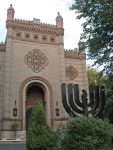
The Choral Temple in Bucharest. (photo from Wikimedia Commons)

We spent two weeks in Romania in the late summer of 2015, also visiting Bulgaria. We took this trip partly because it was an area of vibrant Jewish life from Roman days until the late 1930s. Romania also served as a commercial link between Europe and Asia, and was known for its café life. Its capital, Bucharest, was called the “Paris of the East.” Then came the Nazis and, after them, the Soviets. We wanted to see what remains in these two countries, primarily for Jews but also for the rest of the population.

We arranged a private tour with a knowledgeable guide that generally followed an itinerary designed as a Jewish heritage tour, supplemented by Ruth Ellen Gruber’s Jewish Heritage Travel: A Guide to Eastern Europe (2007). Local information on Jewish sites is surprisingly scant, nothing like what one finds in Lithuania and Latvia. However, the tour company had prearranged talks with people in the larger synagogues, museums and cemeteries, which helped to augment our own observations. There is a monthly Jewish newspaper in Romania, Realistatea Evreiasca, with one page in English and one in Hebrew. As mentioned, our tour in Romania was followed by a visit to Bulgaria, but space limitations permit only scattered references to our time in that country.

Romania and Bulgaria form the southern and eastern parts of the Balkan peninsula in Europe. Romania lies immediately to the north of Bulgaria, with the Danube River forming much of the border between the two before flowing into the Black Sea. Northern and central Romania is dominated by the Carpathian chain of mountains, and southern Romania by the plain of the Danube. Further south lie Greece and Turkey; to the west, various countries that used to be Yugoslavia; and to the east, Ukraine and the always menacing Russia.

Romania was a monarchy until the end of the Second World War. Supported by local antisemites, it fit rather comfortably under Hitler’s leadership and, then, under Nicolae Ceausescu, became one of the most harsh of all Soviet satellites. Today, Romania is best described by a guide at one synagogue who cautiously called it a “developing democracy.” (More on politics later.)

In contrast to the rest of Eastern Europe, Romanians speak a Romance language, which helps make many signs understandable to Anglos. Despite some bumps along the way, the economy in this proto-capitalist country seems to be improving year by year and, in 2007, it became a member of the European Union.

Almost everywhere one looks in Romania, there is an Orthodox church at the street corner. There are some Roman Catholic churches and a few mosques. The Jewish population is now only a few percent and heavily concentrated in Bucharest. Before the Second World War, large numbers of Jews lived in the northern and western parts of the country.

Romanian synagogues tend to have the plain exteriors but elaborate interiors that are common elsewhere in Eastern Europe and in Muslim countries. Romania was more Sephardi than Ashkenazi, but most synagogues now have the bimah at the eastern end rather than in the middle. In some cases, markings on the floor indicate that the bimah had been moved forward in the recent past. With some exceptions, the old Jewish quarter has been destroyed to make way for large, monotonous apartment buildings that are dubbed “Soviet Gothic.”

Restaurant food and wine was great everywhere we went, and available at modest prices – in contrast to what one hears, the white wine is just as good as the red (well, almost as good). Pork is the main meat, but chicken and veal are widely available, as are dairy products. The country is slowly returning to the café culture that was once so famous. The spirit is enhanced by wide avenues for pedestrians complete with street performers.

Some synagogues and Jewish community centres serve kosher meals, but otherwise we saw no kosher restaurants. And then there is rakija, or plum brandy, typically 60% alcohol; our advice is to sip slowly. David was delighted to see a few moderate-sized wind farms and some large solar electric farms. Less happily, there is a lot of smoking by people of all ages and in almost all places.

Our time in Romania began with a couple of days in Bucharest and then went from city to city elsewhere in Romania. Bucharest has two active congregations, one Chabad and the other in a 160-year-old Orthodox synagogue known as the Choral Temple. The adjective “choral” means that there is, or was, a choir. As with other synagogues that we visited, services are generally limited to Shabbat and holidays, though Chabad meets daily. Because of the small Jewish populations and the effects of assimilation, services are typically held in prayer rooms rather than in the large sanctuary. Unhappily, from our perspective, they all retain traditional restrictions on participation by women who, if they appear at all, are kept behind nearly opaque curtains. Synagogues in many of the larger cities are today undergoing renovations, thanks to Romanian, Israeli and European Union money, plus contributions from the Romanian diaspora. In contrast, with scattered exceptions, smaller cities today show little more than deteriorating synagogue buildings and ill-kept cemeteries.

When we visited the Choral Temple, we found that the exterior renovations had been completed but the interior ones were ongoing. About half of the visitors were Romanian, and the rest mostly from the United States or from Israel. As we ended our visit, about six of us were making our way out of the gate, which faces onto a busy street, and saw two local men watching us. One greeted us in French. He wanted to know, in a friendly way, why tourists came to Bucharest. He and David spoke together for awhile in French. The other man was large, probably in his 50s, and stood stock still, forcing us to walk around him to exit the gate. Toby remembers that she had never seen such glaring eyes and such a set jaw. She was transfixed by the unrelenting contempt pouring from this man’s face. She had no language in which to greet or to question him. Was he contemptuous of tourists, of Western tourists, or of synagogues? Toby retains a memory of these two men as two faces of Romania: the one open and friendly; the other full of animosity that may have been antisemitic.

A high point in David’s trip was attending Shabbat services in the last wooden synagogue in Romania. It is located in Piatra Neamt in north-central Romania, and its sanctuary is built below street level to meet some old restriction about not being higher than any church. The building’s formerly wooden base has now been replaced by concrete to protect the wood from deterioration. Everything above the base is the original wood, as is most of the elaborately decorated interior, with many locally created crafts, carvings and paintings.
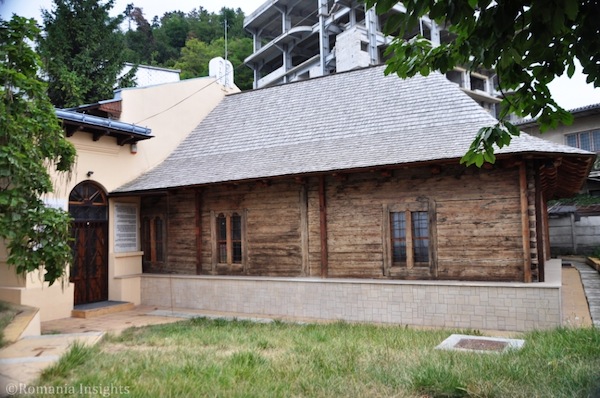
photo - The wooden synagogue in Piatra Neamt
The wooden synagogue in Piatra Neamt. (photo from romania-insights.com)

David entered the building on Shabbat when, clearly, tourists were not welcome. Even though wearing a kippah, he was eyed suspiciously. Was this just a Jewish tourist sneaking a look inside the building at a time when it was closed to tourism? The regulars relaxed a bit when he put on a tallit, and more when, out of a corner of their eyes, they saw him saying the brachah before putting it on. Later, the gabbai gave him an aliyah, and invited him to the kiddush, which was fun, not so much for the bun and wine as for the unlabeled bottle that emerged afterwards and, not surprisingly, turned out to be rakija.

Sighit is located in northwestern Romania, which is the part closest to Hungary, and perhaps for that reason has a long history of antisemitism. The large Jewish cemetery there is remarkable for the practice of adding the names of Jews who died in the Holocaust to the tombstones of family members who had died in the 1930s. The city is the birthplace of Elie Wiesel, and home to a museum dedicated to his works. This is also the area where the Ba’al Shem Tov, the founder of modern Chassidism, lived, and we heard half a dozen (conflicting) statements as to where he taught, studied or served as rabbi.

Tourists to rural Romania will also see a number of Orthodox churches that are densely painted on every surface, and also some monasteries built entirely of wood without the use of nails. And, of course, tourism entrepreneurs have built on the Dracula legend to encourage visits to castles within easy reach of Bucharest. They may be fun, and there is apparently a nugget of truth in the story of Vlad the Impaler. Instead, we wandered in the old city of Bucharest, which is just beyond the city’s modern centre, where one finds the presidential palace, the art museum and other sites of national importance. Within walking distance of the centre is the Peasant Museum, which not only has the usual displays of clothing and tools from different parts of the country, but also entire water mills (for grinding flour) and pressing mills (to make felt) with their roofs removed so they can be viewed from an elevated platform. The museum shop was the best place we found to purchase gifts.

According to the Anti-Defamation League, antisemitic acts are now at a low level in Romania, but the country has not yet emerged from quiet denial of what happened to Jews during first the Nazi era and then the communist era. (For more information, see the recently translated book entitled The Jews of Timisoara by Tibor Schatteles, which details Jewish life in one western Romanian city from Roman times through the present.) We found occasional plaques to commemorate the loss of Jews during the Holocaust, but they were erected by local Jewish groups, not by civil authorities.

Romania did send a lot of its Jewish citizens to their deaths in concentration camps. In some Romanian cities, pogroms were initiated by local antisemites. Statistics from Maramuresh province in the north, which at one time had 52 synagogues, are telling: 35,000 Jews in 1930, 3,100 in 1948 and 48 in 1992. On the other hand, during both Nazi and communist periods, the Romanian government allowed Jews to buy their freedom on ships that would dock at Black Sea ports and pass through the Bosporus en route to Israel or other safe havens.

During the communist era, Jewish communities and institutions suffered mainly from near-total neglect. A 7.2-level earthquake in March 1977 took a heavy toll on Jewish buildings, but only the most serious repairs were undertaken.

What about the future for Romanian Jewish communities? Almost everywhere we were told that most marriages today are mixed, and only a few involve conversion of the non-Jewish partner. The large and relatively active synagogue in Sibiu had only one bar mitzvah child that year. Adjacent to some synagogues are buildings that were formerly Jewish schools, but today most teaching takes place in extra rooms in the synagogue.

While the future for Romania – and for individual Jews who live there – seems distinctly positive, the future for Romania’s Jewish population as a viable minority seems much less assured.

David Brooks is environmental economist who works with a number of organizations in Canada and Toby Brooks works with organizations fighting abuse of women. They live in Ottawa.
Challenging films at VIFF

Soon after he discovered he was Jewish, Csánad Szegedi reached out to Rabbi Boruch Oberlander. Szegedi’s transformation from virulent antisemite to Orthodox Jew is the topic of the documentary Keep Quiet. (photo from Gábor Máté/AJH Films & Passion Pictures)

While this year’s Vancouver International Film Festival holds much that will be of interest to Jewish Independent readers, the list is short when it comes to specifically Israeli or Jewish-related films that will appeal.

Perhaps surprisingly, the Israeli films are harsh critiques of Israel. Beyond the Mountains and Hills (Israel/Germany) is about a dysfunctional family (a metaphor for the country), Junction 48 (Israel/Germany/United States) is about an Arab-Israeli rapper who faces racism, among other Israeli-inflicted ills; Between Fences (Israel/France) is a documentary about Israel’s internment of African refugees at the Holot Detention Centre and Vita Activa: The Spirit of Hannah Arendt (Israel/Canada) is about Hannah Arendt, who, among other things, was critical of Jewish leadership during the Holocaust and did not approve of the state of Israel as it was founded.

Among the other film offerings is Keep Quiet (United Kingdom/Hungary), a documentary about Csánad Szegedi, the staunch antisemite who helped found Hungary’s far-right party Jobbik and its Hungarian Guard, which has since been banned. As a member of the European Parliament, he continued to foment hatred until a fellow nationalist and racist outed him as being Jewish – his grandmother had not been the adopted daughter of the Klein family, as she told him, but their daughter. The documentary includes interviews Szegedi did with his grandmother (about her imprisonment in Auschwitz, and other matters) and a conversation with his mother, who also found out later in life that she was Jewish. He asks both women about his increasing embrace of antisemitism over the years, why didn’t you stop me? Their responses are thought-provoking and sad.

Keep Quiet does not accept Szegedi’s transformation unquestioningly and gives speaking time to the doubters, as well as the cautious believers, such as Rabbi Boruch Oberlander, head of the Orthodox Rabbinical Council in Budapest. Oberlander has supported and taught Szegedi since the former antisemite contacted the rabbi for help. The event that ends the film is Szegedi’s attempt in 2013 to speak in Montreal about his Jewish journey – he wasn’t allowed to stay in the country. Before being put on the next plane home, however, Szegedi recorded a lecture, which was played at the event, with Oberlander fielding the hostility it wrought in some attendees. In Oberlander’s view, we must love every Jew, no matter how wicked. Of his choice to help Szegedi, he says, “I pray that I shouldn’t be disappointed.” Even Szegedi is unsure as to whether he would ever turn his back on Judaism – maybe, he admits, but not likely.

The way in which the filmmakers present Szegedi’s story is informative and balanced, and viewers get a sense of the man and his deeds, as well as about Hungary and how a political party as racist as Jobbik can find success there.

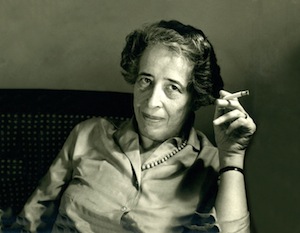
photo - Hannah Arendt
Hannah Arendt (photo from the Hannah Arendt private archive via Zeitgeist Films)

Vita Activa also does a good job of including both fans and critics of Arendt’s work, but mainly uses Arendt’s own words to explain her thoughts and analyses. The film uses as its foundation the Adolph Eichmann trial, about which Arendt wrote Eichmann in Jerusalem: A Report on the Banality of Evil (1963), describing Eichmann as “a typical functionary,” and thus an example of the “banality of evil.” (Viewers should be warned that there are many disturbing Holocaust-related images in this film.)

“Eichmann was quite intelligent but he had that dumbness,” she tells an interviewer in one of the clips included in the documentary. “It was that dumbness that was so infuriating, and that was what I meant by ‘banality.’ It has no depth; it isn’t demonic. It’s simply the unwillingness to ever imagine what others are going through.”

Another of Arendt’s theories – about refugees – remains relevant. With no rights, refugees are considered “superfluous” by a regime, she argued, and denationalization and xenophobia become a powerful weapon of totalitarian politics.

In Keep Quiet, a political journalist describes Hungary as a “part of the world where history has been manipulated” and the effects that such manipulation has upon generations. Arendt broadens that view beyond Europe, saying, “It has been characteristic of our history of consciousness that its worst crimes have been committed in the name of some kind of necessity or in the name of a mythological future.”

In addition to her early work, Vita Activa touches upon Arendt’s personal life, which offers some further understanding of the philosopher, who was seen by many to lack empathy. In one interview, she talks about how Auschwitz shouldn’t have happened, how she could handle everything else but that. Yet, she criticized the Jewish leadership who cooperated with the Nazis – the councils and kapos – and hypothesized that, if there had been no such leadership, there would have been chaos and suffering and deaths but not six million. One professor interviewed for the documentary calls Arendt’s comments “irresponsible,” another says they showed her complete ignorance of history, yet another says she regretted her remarks later in life.

The film also notes Arendt’s change from supporting Zionism to condemning elements within it. Among other things, she said, “A home that my neighbor does not recognize is not a home. A Jewish national home that is not recognized by and not respected by its neighboring people is not a home, but an illusion, until it becomes a battlefield.” And she pointed to tendencies within Zionism that she considered “plain racist chauvinism” that do “not differ from other master race theories.”

The documentary also covers Arendt’s 1951 Book of Thoughts, in which she contemplates the nature of forgiveness, revenge, reconciliation. For her, the latter doesn’t forgive or accept, but judges. When you take on the burden of what someone else did, she believed, you don’t accept the blame or absolve the other of the blame, but take upon yourself the injustice that occurred in reality. “It’s a decision,” she said, “to be a partner in the accountability, not at all a partner to the guilt.”

photo - A “theatre of the oppressed” workshop at the Holot Detention Centre in Israel
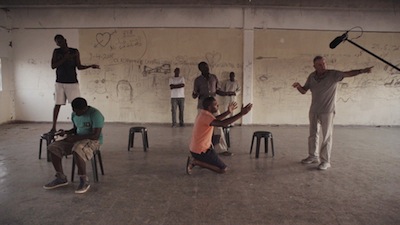
A “theatre of the oppressed” workshop at the Holot Detention Centre in Israel. (photo from Vancouver International Film Festival)

Reconciliation and forgiveness don’t enter the picture in either the documentary Between Fences or the fictional (but based on a real person) Junction 48. They each highlight important, even vital, issues in Israeli society, but do so in such a condemnatory, predictable way that anyone but the choir won’t be able to sit through these films.

Without much context, Between Fences looks at the poor situation in which asylum seekers from Eritrea and Sudan find themselves when they reach the safety of Israel. In many countries, these asylum seekers face problems, but viewers wouldn’t know that from this documentary, nor would they begin to understand the atrocities being committed in their homelands. However, they will learn how Israel doesn’t recognize their refugee status and makes every effort to send them back, how racist Israelis are towards these newcomers and a host of other problems with Israel and its people. Not one government official or Israeli is interviewed, although some Israelis participate in the “theatre of the oppressed” workshops in Holot on which the film focuses. In addition to leaving many questions unanswered, the film also begins and ends confusingly and is slow-paced.

Bias also makes Junction 48 almost unwatchable for anyone who would like to see the Israeli-Palestinian conflict resolved, so that both peoples’ rights and safety are ensured. From the second sentence of the opening, the perspective is made clear: “The Israeli city of Lod is the Palestinian city of Lyd, which once sat on the main railway junction. In 1948, tens of thousands of Palestinians were exiled from Lyd in order to resettle the town with Jews….”

photo - Samar Qupty and Tamer Nafar in Junction 48
Samar Qupty and Tamer Nafar in Junction 48. (photo from VIFF)

We then meet Kareem, an aspiring young rapper, whose parents are worried about his involvement with drug dealers and his future in general. His friends not only deal and take drugs, but visit prostitutes and dabble in other criminal activity. Nonetheless, every Israeli they encounter is the real bad guy, from the police to other rappers to the government, which is knocking down one of their homes to build a coexistence museum. Oh, the irony.

The only entertaining and thought-provoking aspect of this film is the music by lead actor and film co-writer Tamer Nafar, which is available online.

In the end, the Jewish Independent chose to sponsor what a VIFF programmer called a “classic Jewish comedy,” though, having seen a screener of the film, the Jewish aspect is hard to discern. While much lighter (and non-political) fare than the other offerings, it has much to say – or show, really, as the dialogue is minimal – about social awkwardness and a lack of direction in life. The protagonist, Mike, works at a pizza place in New Jersey and has the energy level of a slug and the magnetism of zinc. Yet, somehow, he has friends, albeit not great ones.

Short Stay is one of those films that moves apace with its main character, so slowly and in all different directions, as Mike both physically wanders the streets and mentally wanders to destinations unknown. Viewers don’t gain insight into what motivates Mike, who seems unperturbed by his lack of career, social skills, direction and future, but they root for him, empathize with what must be his loneliness.

photo - The social awkwardness of the protagonist of Short Stay, Mike, is obvious in his exchanges with others
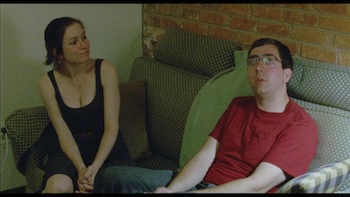
The social awkwardness of the protagonist of Short Stay, Mike, is obvious in his exchanges with others. (photo from VIFF)

Short Stay director Ted Fendt best describes the acting of the nonprofessional cast, many (all?) of whom are his friends. “The film contains a range of performance styles from the fairly natural (Marta and Meg), to Mark and Dan’s B movie ‘villains,’ who might have stepped out of an Ulmer or Moullet film, to the quasi-Bressonian, unaffected manner Mike delivers his lines.” And therein is a Jewish link, Edgar G. Ulmer.

Another Jewish filmmaker – Vancouver’s Ben Ratner – will be premièring his short film, Ganjy, at this year’s festival. About a former boxer suffering from dementia pugilistica, who is in desperate need of help when three friends visit, Ganjy was inspired in part by Muhammad Ali. Its creators are looking to fundraise enough to take the film to other festivals, as well as contribute to the Muhammad Ali Parkinson Centre. For more information, visit indiegogo.com/projects/ganjy-film#.

For more information about and the full schedule of films playing at VIFF, visit viff.org.

Note: This article has been edited so that it is clear Hannah Arendt was speaking of tendencies within Zionism that she considered “plain racist chauvinism” that do “not differ from other master race theories,” and not condemning Zionism as a whole.

Jews leave Venezuela

Moises Brunstein now lives in Toronto, but he still has family in Venezuela. (photo from Moises Brunstein)

Political upheaval, economic disintegration, rising crime rates and the implosion of social services have brought Venezuela to its knees. The lucky ones see Soviet-style, hours-long supermarket lineups; the unlucky see bare shelves in a country said now to have the worst inflation rate on the planet, in some sectors upwards of 700%. The chaos, combined with rising antisemitism, has spurred a massive flight of Jews.

Caracas’ once-thriving Jewish community of nearly 30,000 has dwindled in just a decade and a half to a quarter its former size. The exodus continues in conditions exacerbated by the sudden departure of foreign investment and international corporations.

Interestingly, Venezuela was among the first countries to recognize Israel and, in 1991, supported revoking the 1975 United Nations resolution comparing Zionism to racism. Jews have lived in relative peace there for hundreds of years, until the last decade.

In May 2004, Tiféret Israel – the oldest synagogue in Caracas – was vandalized after demonstrators at a government-sanctioned protest graffitied on city walls slurs such as “Sharon is a murderer of the Palestinian people,” “Viva the armed Palestinian people” and “Free Palestine.”

In November of that year, armed and hooded state policemen broke into the Colegio Hebraica, a Jewish grade school in the city. During the three-hour sweep of the premises, under the pretext of a weapons search, the doors were locked and bolted with the children inside. Agents found nothing of interest.

Venezuela’s chief rabbi condemned the raid as community “intimidation.” The Stephen Roth Institute for the Study of Contemporary Antisemitism and Racism – based at Tel Aviv University in Israel – reported that the intrusion was “perhaps the most serious incident ever to have taken place in the history of the Jewish community.”

In December 2007, Venezuela’s secret police raided the Hebraic Social, Cultural and Sports Centre, again under the pretext of searching for weapons and drugs, of which they found none.

Coincident with the Gaza War (Operation Cast Lead, December 2008-January 2009), a number of incidents occurred, beginning with then-president Hugo Chávez expelling the Israeli ambassador.

Later, in a public broadcast, Chávez said, “From the bottom of my soul, I damn you Israel. You are a criminal and terrorist state that is openly exterminating the Palestinians,” and he accused Israel of “Nazi-like atrocities.”

At the same time, the Venezuelan foreign ministry dubbed Israel’s actions “state terrorism” and government officials were seen wearing keffiyahs and waving Palestinian flags in the streets at an anti-Israel march said to have been organized by Chávez himself.

On a Friday night in January 2009, armed men broke into Tiféret Israel and gagged and bound security guards. The thugs ransacked offices and left antisemitic slogans on the walls, including a call for the expulsion of Jews from Venezuela. Religious objects in the sanctuary were ruined, and a list of the country’s Jews was stolen.

In February 2009, Beit Shmuel Synagogue was the target of a bomb that shattered windows and damaged a nearby car.

According to the 2009 World Conference against Antisemitism, the average of 45 anti-Israel articles published a month in 2008 jumped to five a day during January 2009, and there were newspapers that accused Israel of genocide.

And the situation didn’t improve much after the Gaza War. For example, the country’s main Jewish organization, La Confederación de Asociaciones Israelitas de Venezuela (CAIV), reported more than 4,000 antisemitic incidents in 2013. And, as recently as this year, the Venezuelan United Nations ambassador, Rafael Ramirez, asked in a speech at UN headquarters in New York whether Israel was “trying to impose a ‘final solution’ on the Palestinians in the West Bank.”

Little of this is shocking to Moises Brunstein, an expat now living in Toronto.

A first-generation Venezuelan, Brunstein’s Romanian parents arrived in Venezuela by Red Cross boat in 1941, after having been prisoners in Nazi-occupied France. With no command of the language and no money, Brunstein’s father worked his way up to become president of the local hydro authority.

“We lived a very nice life,” Brunstein told the Independent. That is, until Chávez came to power. Twelve years ago, at age 29, it was time to go, Brunstein said. With only four suitcases, he came to Canada, leaving behind all of his books, furniture and currency. Some cousins remain in Venezuela, but his father’s side has left for Florida, Australia and Spain; his mother’s side for Canada.

It is his belief that the state is trying to squeeze the Jewish community out of Venezuela. “In 2010 and 2011, the main building where Jews had stores was extricated by the government,” he said. “My mother, a lawyer, saw her offices taken over.

“Everything changed when the government aligned themselves to Hamas, Hezbollah and Iran. The Palestinian flag flew in the Venezuelan congress.”

Brunstein last visited Caracas in 2009 for a cousin’s wedding, and found security to be unusually high. “You don’t wear yarmulkes in public,” he warned.

There are various reasons why many Jews remain in the country, he said. The elderly aren’t necessarily mobile and have no command of a second language; those with businesses find it hard to leave.

Brunstein mails his mother basic foods, medicine and personal hygiene products, as well as a Passover care package.

Meanwhile, an expat living in New York, Freddy Steiner, runs his apparel and clothing stores in Caracas – Componix Clothing – from the United States, but his visits back home have steadily declined.

In 2000, about a year after the Chávez revolution, Steiner moved his family from Caracas to Miami.

“Pure safety, the number one issue,” he explained. “The kidnappings start[ed] to rise, the security was deteriorating. More and more people leave each year, knowing how much this is affecting the next generation.”

Caracas, he noted, consistently is ranked among the 10 most dangerous cities in the world, with medical services next to non-existent, except for the wealthy.

“The entire economy is in a coma, shut down,” he said. “Since early spring, malls and restaurants shut down at 7 p.m., there’s no electricity and no water.”

According to Rabbi Ariel Yeshurun of Sky Lake Synagogue in North Miami Beach, which has a sizeable Venezuelan membership, many of his congregants express concern about family who remain in Venezuela.

Abraham Levy Benshimol, former president of CAIV and of the Ascociación Israelita de Venezuela, said that, in addition to the difficulties experienced by all Venezuelans, those Jews who remain are facing increased challenges because of the exodus. “You still have the same number of schools, but you don’t have the same number of contributors,” he said. “So that’s a big problem.”

Chaya Perman, the wife of Rabbi Moshe Perman, director of Venezuela’s Chabad Centre, said, “The recent anti-Zionism is part of what is going on internationally.”

According to Perman, “nearly every Jewish family is affiliated in some way,” with some 90% of Jewish children attending Jewish day school; kosher meat, pizza, and bread products are still available. Given the overall circumstances, however, houses of worship are using up financial reserves to keep afloat, though they are “not yet at the point where they think they need help from wealthy Jewish communities,” she said.

For the Permans, two married children with their husbands and 15 grandchildren remain in Venezuela. They, much like the rest of the community, don’t know whether tomorrow will be better or worse. But there’s always hope.

“It’s a wait-and-see attitude,” said Perman.

Dave Gordon is a Toronto-based freelance writer whose work has appeared in more than a hundred publications around the world.

We have our own issues

American politics, these days, attracts global disbelief and revulsion. The contest pits against each other two of the most unpopular candidates since polling began. One of them, the Republican nominee Donald Trump, is endorsed by the country’s leading white supremacists.

There is no question that Trump has tapped into something. Most of his supporters are not now and never have been members or supporters of the Ku Klux Klan or similar fringe groups. They are, in fact, a large and mainstream enough group that he won the nomination of the Republican party and now stands just a couple of points behind Democrat Hillary Clinton in polls, with at least two in five Americans saying they intend to vote for him. Among white Americans, if they alone were the electorate, polls say Trump would win a landslide.

Leaving aside his nonchalance about the fact that David Duke, the former imperial wizard of the KKK, and other of America’s most prominent racists think he would make a top-notch president, Trump has legitimized a host of barely more discrete forms of bigotry, chauvinism and hatred. People who strive for human respect have responded with two approaches. They have condemned the most overt examples of Trump’s racism, while acknowledging that many Americans are experiencing economic and social displacement that could justify their scapegoating of other groups or otherwise find reason to support a candidate whose policy positions are nothing more than accumulated Twitter tantrums.

If Trump wins, there will be more issues to address than this space can accommodate. If he loses, there will still be a divided country where parents have to explain to their children why it is inappropriate for them to express ideas that have been so effortlessly articulated by one of the two leading candidates for the highest office in the country.

Incongruously – or is it? – we are also in a time when the United States is engaged in a deep public reflection on race. The Black Lives Matter movement, which is partly a result of the murder of young African-Americans by police officers but also of broader systemic racism, has opened an overdue public discussion. Decades after legal racism was upended, there remain serious issues that the country needs to confront. Small gestures like that by Colin Kaepernick, a football player who is refusing to stand for the national anthem as a protest against discrimination, have aroused outrage but also raised legitimate awareness. Can you love your country and still condemn aspects of its nature?

Israelis, perhaps foremost among others, have faced this question for decades. And Canada is also engaged in a discussion around race. While we, too, have a history of racism against people of African descent, this history is different from that of the United States in myriad ways, including the absence of slavery in our history. But our past includes racist and antisemitic immigration policies, social and systemic antisemitism, racism and mistreatment of women, degradations of many varieties and, in something we are only beginning to come to terms with, treatment of indigenous Canadians that was intended to erase their cultural identities. And these are not the only areas where our society fails to live up to our ideals.

It is certainly tempting to look at what is happening to our south and feel superior. It would be more productive as a society for us to acknowledge that, while we see fault in others, we will be a better country when we keep our gaze closer to home, and use our stones for repairing, not throwing.

Glavin fights falsehoods

Terry Glavin (photo from Terry Glavin)

A self-described “man of the left,” journalist Terry Glavin discovered he was an “accidental Zionist” during the Israel-Hezbollah war in 2006, when he noticed how the mood of the antiwar movement on the left was “almost hysterical,” and that it was not, in fact, antiwar, but rather pro-Hezbollah.

“There was something deeply toxic about the phenomenon that described itself as antiwar,” he told the Independent, adding that, irrespective of one’s viewpoint on Israeli policy, “if one was to choose the only principled, progressive position, it would have been to be on Israel’s side.” And, he noted, “Arab friends and Palestinian activists [have] gravitated towards the same idea.”

The Irish-Canadian said he has since “been associated with a sturdy defence of Israel in Canada,” in his columns, which have appeared in the National Post, Vancouver Sun, Globe and Mail, Georgia Straight and Ottawa Citizen.

Glavin will be among the speakers at this year’s FEDtalks on Sept. 22 at Queen Elizabeth Theatre, helping to launch the Metro Vancouver Jewish community’s annual campaign.

In addition to his vast and varied published subject matter, Glavin’s work as a journalist has taken him around the globe. His talk will examine, among other ideas, what Canada could contribute for healing the world, as well as what it means to be an “accidental Zionist,” a phrase he said he borrowed from Martin Sampson of the Centre for Israel and Jewish Affairs.

In his work, Glavin strives to clarify the clashes in Israel, to help people understand them better.

“It’s not an Israeli-Palestinian conflict. The war is with Hamas,” he said. “Who are the worst enemies of Palestinian freedom? It’s not Bibi Netanyahu. The most devoted committed enemy of Palestinian sovereignty, Palestinian liberty, rule of law, democracy, freedom are Hamas, Islamic jihad, Hezbollah and Tehran.

“Anyone who apologizes for them, reiterates their propaganda lines, is an enemy of the Palestinians and their freedoms.”

Having researched and written about the hatred of Jews and Israel, he concludes, “There is something unique about antisemitism.

“It’s not just another bigotry. This talk of Israel eliminationism – if it’s not antisemitism, what is it? It might not be Judenrein (free of Jews), but it’s Judenstaatrein, no Jewish state,” he said.

“The Jews are unique, entitled to a nation-state of their own … [as much,] if not more, than any other nationality on earth.”

The liberal left, moreover, has some self-reflecting to do, to know that “certain postures, certain habits of speech, are now unacceptable, and some obsessive preoccupations are no longer tolerated,” he said.

In his opinion, these statements include using the term Zionist as a pejorative, “a term of abuse”; saying that “Israel is the primary impediment to peace in the Middle East”; and claiming the “false idea that criticism of Israel is automatically antisemitic.”

Seeking to bust this latter myth, in a bulk email to journalist colleagues, Glavin asked if any of them could offer an example where a legitimate critique of Israel has been denounced as antisemitism.

“It didn’t exist,” said Glavin. “I could not find any reputable Jewish or Israel organization or individuals who ever introduced a legitimate criticism of Israel as antisemitic. It’s a canard.”

Meanwhile, another falsehood emanating from the left and from leaders of the Arab world, he said, is the idea that Israel is to blame for the region’s – and, sometimes, the world’s – ills.

“This is what one Arab dictator after the next has forced down the throats of generations of Arabs to explain their own destitution and dysfunction,” he said.

Some are rejecting that narrative, however.

“The people have begun to discover they’ve been lied to – that Israel isn’t the problem,” said Glavin. “The jackboot on [their] neck is Baathist, not Israel.”

For tickets to FEDtalks and information on all of the speakers, visit jewishvancouver.com/fedtalks2016.

Dave Gordon is a Toronto-based freelance writer whose work has appeared in more than a hundred publications around the world.

Tempest in coffee pot

The BDS movement – which seeks to boycott, divest from and sanction the state of Israel – is having an impact. Though maybe not exactly as they’d hoped.

There was a tempest in a coffee pot recently when an East Vancouver café waded into the topic, angering some customers and, we surmise, perhaps some of the establishment’s own employees and investors.

As we addressed in this space last week, Elizabeth May, leader of the Green Party of Canada, was dismayed by the vote by her party in convention to support the BDS movement. She pondered resigning her position but this week announced that she would remain at the helm and seek to revisit the issue with her party.

A social media feed for Bows & Arrows Coffee, on Fraser Street, declared that May’s lack of support for BDS meant that she “got cowardly” on the issue and “caved.” One online commentator responded that the café’s coffee “tastes a little too antisemitic for my liking.”

After some social media back and forth, the co-owner of the café, which is headquartered in Victoria and only recently opened the Fraser Street location, published a statement acknowledging that he had “tweeted without consultation with staff and business partners.” Seemingly surprised that a simplistic #BDS hashtag and name-calling would elicit strong and equally simplistic reactions, he says that he blocked other posters and deleted tweets. He did these things, he claims, because he “wanted to address real arguments, not stand in a storm of accusers that would not engage or address my criticism of a state.”

Hopefully, he has learned that Twitter is not designed for intelligent and in-depth debate or discussion. More hopefully, perhaps he will now consider the possibility that BDS is not necessarily about “solidarity with oppressed peoples everywhere.”

While BDS supporters, including the one involved in this instance, reject the idea that the movement has any antisemitic elements and insist it targets “Netanyahu’s administration and policies of expansion in the territories,” plenty of evidence exists to suggest that BDS aims to end the existence of a Jewish state and, some would argue, this is perforce antisemitic.

Nonetheless, at least one member of the Jewish community went beyond Twitter and invited the B&A co-owner to discuss the issues surrounding BDS. In his email, the community member included a link to an article by Alan Dershowitz that was published by Haaretz, called “Ten reasons why BDS is immoral and hinders peace.” It can be found on the Centre for Israel and Jewish Affairs’ website.

While the brewmaster may contend, as he implies in his statement, that he was a victim of “[t]he silencing that occurs daily via the repetition of the dominant narrative,” what he really experienced was disagreement with his beliefs and a resulting effect on his business. He was not silenced. He voluntarily chose to exit a discussion he started.

In Canada, thankfully, the freedom to speak one’s mind comes with the freedom of others to criticize the views that come from that mind. Such discussions are healthy and can even be enjoyable – especially over a nice cup of coffee.


Roth film now playing

In Indignation, Logan Lerman plays model student Marcus Messner. (photo from indignationfilm.com)

For his directorial debut, veteran producer and writer James Schamus chose a Philip Roth novel set during a turning point in the Jewish-American experience.

Indignation unfolds in 1951, when opportunities and prospects for young Jewish professionals were just beginning to expand in the United States.

“You discover when you start to inhabit that world that there was a genuine sense of optimism, a genuine belief that belonging in this country was possible and real and happening,” said Schamus, 57. “And, on the other hand, you have all the traumas associated with the experiences of extended families in the Holocaust disappearing and a political culture in this country that was bizarrely – especially if you’re of my age, and you didn’t experience it but you realize that your parents did – about as openly antisemitic as you can imagine.”

Schamus cites the covenants for real estate developments that excluded Jews, and the quotas for Jewish students at Ivy League universities. So, Marcus Messner, the protagonist of Schamus’ insightful and moving film adaptation of Roth’s 2008 autobiographical novel, is fortunate to receive a scholarship from a small college in Ohio. He has to travel some distance from his New Jersey home, but not as far as the young Americans fighting in Korea.

A model student, Marcus (Logan Lerman) believes that college – and the world – is a meritocracy, and his brains and hard work will push him forward. His parents worry that he has little margin for error, and dread any disruption, such as Marcus’ involvement with an alluring blond named Olivia Hutton (Sarah Gavon).

“One of the great crises as articulated by the characters in the book is, ‘Oh Lord, my son is dating a shiksa,’” Schamus said with a smile in an April interview before he showed his film at the San Francisco International Film Festival. “The kind of psychic and carnal energy created by that dynamic drives a lot of Roth, but really a lot of the work of most major Jewish-American male artists of mid-century America. It’s a bit of a trope.”

But Schamus, who does inordinate research for all his screenplays, found much more to plumb in Indignation. He realized that the author subtly drew Olivia as a parallel to Roth’s contemporary, Sylvia Plath.

“One of the things that drew me was a spark of recognition that, in this late novel, Roth is going back to a much earlier time than he often [does], that he’s connecting with a generation that we often don’t realize that he’s part of,” said Schamus. “While Roth is growing up in very, very Jewish Newark, N.J., up the road a few towns is Allen Ginsberg, who’s a few years older. In fact, Ginsberg’s aunt was Roth’s English high school teacher.

“So, Indignation, to me, is more than a tip of the hat to, ‘I saw the best minds of my generation, dot, dot, dot.’ It’s the same subject. These were those best minds who were destroyed by precisely the system that Roth rails against in the book.”

Schamus, who grew up Jewish in Los Angeles and has lived and worked in New York for many years, wrote and produced most of Ang Lee’s films, from Pushing Hands through Taking Woodstock. He also headed Focus Features for many years, earning a reputation as a staunch and astute supporter of independent filmmakers. (He financed and distributed the Coen brothers’ A Serious Man, among other titles.)

Well-versed in the etiquette of adaptation, Schamus reached out to Roth as Indignation was about to go into production.

“You don’t adapt one of the world’s greatest writers and not get a little nervous,” said Schamus. “I grit my teeth and sent him the script before we started shooting, which was scary because, if he’d had a violently negative reaction, it would have put me in the pickle of probably not making the movie, to be honest. Philip did me one of the greatest favors anybody’s ever done a filmmaker, and that is he refused to read it.”

At press time, Indignation was screening at Cineplex Odeon International Village.

Michael Fox is a writer and film critic living in San Francisco.

A chance to educate

Monika Schaefer is a violin instructor in the Alberta mountain town of Jasper. She was also a candidate for the Green Party of Canada in the federal elections of 2006, 2008 and 2011. Last week, a video went viral of Schaefer declaring that, after “a great deal of time researching this topic,” she has concluded that what Canadians have been taught about the Holocaust is rife with “inaccuracies.”

“When I started to look at the evidence, and I researched, and I researched and I researched, and the lies are coming apart,” she told the CBC. “This house of cards is crumbling, and that is why there is this very fierce reaction against what I’m saying, because this lie, this public myth, has shaped our world.”

She calls the Holocaust “the six million lie” and “the biggest and most pernicious and persistent lie in all of history.”

With all the things happening in the world today, the misguided ramblings of a soundly defeated candidate for Parliament is far from the most crucial issue we face as a civilization. Yet, the incident deserves consideration.

Despite that the Green party is being rightly condemned for anti-Israel resolutions set for debate at its upcoming national convention, let’s not attribute to an entire group the poison of one of its (soon-to-be-former) members. Holocaust denial and antisemitism have been expressed across the political spectrum and no party has a monopoly on that. Green party leader Elizabeth May responded immediately and appropriately, condemning Schaefer’s comments and moving to have her membership in the party revoked. That is one positive outcome.

The most generous assessment of the video is that Schaefer herself, who is of German heritage, is a victim of the collective trauma of Nazism. As the director of community relations and communications for the Jewish Federation of Edmonton, Tal Toubiana, told the CBC: “I find it curious that a woman who allegedly faced bullying based on her country of origin would rather continue a cycle of irreflexive hate than reflect deeply on the wounded history and trauma the Holocaust did create.… The Holocaust is a historical event that is not only undeniable in regards to the facts and documentation of its existence, but in the collective trauma it created. Ms. Schaefer is a product of the very trauma she claims does not exist.”

This is a very insightful analysis. It is easy to dismiss the people who conjure such fabrications as irredeemably wicked, but to adopt a more humane response in the face of inhumane statements would invite us to wonder what personal circumstance would lead an individual to such a distorted and easily disprovable worldview.

This appears to be the first public utterance Schaefer has made on the subject and perhaps it will open the door for her to be confronted with facts and have the sources upon which her deeply flawed conclusions rest debunked. Whatever happens in this instance, little is to be gained by demonizing the individual even though we rightly demonize her words.

Each time such an incident occurs is an opportunity to return to the basics and realize that we still have work to do. We need continued vigilance and we must educate all people, especially young people, about history.

Googling Schaefer’s name confirms this. Her ideas attract some breadth of support in the dusty extremities of the internet, where she is lauded as a “truth revealer and free speech advocate.” It is, of course, impossible to tell whether the hordes of online comments coming to her defence represent a sizable cohort or a tiny but prolific cluster of keyboard pounders. What they certainly represent is an unadulterated reminder that shockingly inhumane ideas retain sway among some of our fellow citizens.

There are now human rights complaints lodged against Schaefer in the Alberta and Canadian human rights commissions and already Schaefer is positioning herself as a martyr.

“Right now, the issue for me is freedom of speech,” she told a Jasper news outlet. “Last I checked, I thought we had freedom of speech in Canada and suddenly I’m the criminal.”

Wrong again. By law, Schaefer is innocent until proven guilty, so she is not “suddenly” a criminal. Moreover, her research fails her once more. Canada has freedom of speech, but not without limitations. To become the criminal Schaefer contends she already is would require proof that she intended to incite hatred against an identifiable group. This is a very difficult motivation to prove.

Whatever happens in the quasi-judicial processes Schaefer faces, we should be heartened by the response of many of Schaefer’s fellow residents of Jasper and we should take the opportunity to recommit ourselves to sharing the truth.

Greens’ true colors?

Voters in the United Kingdom – well, in England and Wales, at least – have decided to quit the European Union. The referendum last week turned British politics, and world economic markets, upside down.

The potential for a Scottish withdrawal from the United Kingdom is again front and centre. More than this, politicians and commentators worldwide are extrapolating the vote’s meaning across Europe and North America to try to comprehend the potential impacts of a coalescence of disgruntled, anti-elitist, populist, nativist and xenophobic tendencies. Already, the result seems to have given licence to some people to act out on xenophobic hatred, with numerous incidents of verbal and physical assaults against visible minorities reported across Britain in just the couple of days following the referendum.

Among those who supported the losing “Remain” campaign are some who threaten to move to Canada. This is a default for Americans and now, apparently, Brits who dislike the democratic outcomes in their own countries. The Canada strategy is much talked about but rarely executed. Ironically, people from countries that move toward exclusionary practices and tightened immigration policies assume that Canada is an uncategorically welcoming place that would greet them with open arms. On Canada Day, of all times, we should take it as a compliment that our reputation is one of haven and acceptance.

And yet … while Europe may be aflame with xenophobia and demagoguery, Canada is not immune to strains of something nasty. The current example comes from none other than Canada’s Green party.

For a movement that ostensibly subscribes to the precept of thinking globally and acting locally, the policy resolutions for the party’s August convention are starkly parochial. Only two items proposed for consideration approach foreign affairs issues – and both attack Israel.

One resolution calls for the party to join the BDS movement to boycott, divest from and sanction the Jewish state. More hypocritically still, the Green party is seeking to have the Jewish National Fund of Canada’s charitable status revoked. That a Green party would target one of the world’s oldest and most successful environmental organizations is symptomatic of something irrational in the mindset of those who promulgated the resolution. Whether it advances to the convention floor – and what happens then – will tell us a great deal about the kind of people who make up the Green Party of Canada.

In a world where human-made and natural catastrophes seem unlimited, from the entire population of Green party members across Canada, only two statements of international concern bubble to the surface – and both are broadsides against the Jewish people.

Elizabeth May, the party’s leader and sole MP, said she opposes both resolutions but, since the determination of policy is made on the basis of one member one vote, there is a limited amount she can do. She met last week with Rafael Barak, Israel’s ambassador to Canada, and said the Green party’s support for Israel’s right to exist is “immovable.”

We’ll see.

Impact of Brexit vote

In the historic referendum last week, the United Kingdom voted to leave the 28-nation European Union (EU), sending shockwaves throughout Europe and the international community. The results of the so-called “Brexit” vote – 52% in favor of exiting the EU and 48% opposed – spurred the resignation of U.K. Prime Minister David Cameron and called into question the identity and strength of the EU, while leaving many nations, including Israel, wondering how the vote will affect policy and trade in the years ahead.

“It’s hard to know what is going to happen, and nothing is going to happen right away,” said Dr. Oded Eran, the former Israeli ambassador to the EU. “There is no doubt that Israel will be left to follow the agreements that will be made between the United Kingdom and the European Union, and to adjust its economic and trade relations with Britain accordingly.”

Opposition leaders in France and the Netherlands have hailed British voters’ decision, calling for similar referendums on EU membership in their countries. “This is the dilemma that the European Union will face,” Eran said. “If Britain was a singular case, then this would be a simpler situation.”

A major factor in the Brexit vote was the influx of Muslim immigration into Europe. Supporters of the Brexit suggested that Muslim immigration threatens the distinct character of European nations.

Opponents of leaving the EU cited growing xenophobia and anti-Islamic sentiment in British society, often coupled with antisemitic sentiments.

According to Fiamma Nirenstein – a former Italian parliamentarian who served as vice-president of the parliament’s committee on foreign affairs and as a member of the Italian delegation to the Council of Europe – there are opposing views within Europe’s Jewish communities on the causes and potential consequences of the Brexit vote.

Nirenstein noted that one school of thought views the Brexit vote “as a sort of punishment for Europe” for growing anti-Israel and antisemitic sentiment.

“Over the past century, Europe has been so bad to the Jews,” she said. “And, increasingly now, Europe is against Israeli actions, and Europe is seeing an explosion of antisemitism. So, in the view of one camp, there is something wrong with Europe and something needed to happen to demonstrate that, and the Brexit vote represents this.”

On the other side, Nirenstein suggested, is a second camp that views the Brexit vote negatively – “as an event that strengthens and empowers an illiberal right-wing sentiment throughout Europe,” a sentiment that is simultaneously antisemitic and anti-Islamic and, at its core, anti-immigration.

“As a people that have ourselves been strangers in many lands, Jews have always identified with the value of welcoming the other, so this camp of Jews is against the [Brexit] vote,” said Nirenstein, who also served as chairperson of the International Council of Jewish Parliamentarians.


Read more at jns.org.