
Skip to content
  • Home
  • Subscribe / donate
  • Events calendar
  • News
    • Local
    • National
    • Israel
    • World
    • עניין בחדשות
      A roundup of news in Canada and further afield, in Hebrew.
  • Opinion
    • From the JI
    • Op-Ed
  • Arts & Culture
    • Performing Arts
    • Music
    • Books
    • Visual Arts
    • TV & Film
  • Life
    • Celebrating the Holidays
    • Travel
    • The Daily Snooze
      Cartoons by Jacob Samuel
    • Mystery Photo
      Help the JI and JMABC fill in the gaps in our archives.
  • Community Links
    • Organizations, Etc.
    • Other News Sources & Blogs
    • Business Directory
  • FAQ
  • JI Chai Celebration
  • JI@88! video

Recent Posts

  • Sharing her testimony
  • Fall fight takes leap forward
  • The balancing of rights
  • Multiple Tony n’ Tina roles
  • Stories of trauma, resilience
  • Celebrate our culture
  • A responsibility to help
  • What wellness means at JCC
  • Together in mourning
  • Downhill after Trump?
  • Birth control even easier now
  • Eco-Sisters mentorship
  • Unexpected discoveries
  • Study’s results hopeful
  • Bad behaviour affects us all
  • Thankful for the police
  • UBC needs a wake-up call
  • Recalling a shining star
  • Sleep well …
  • BGU fosters startup culture
  • Photography and glass
  • Is it the end of an era?
  • Taking life a step at a time
  • Nakba exhibit biased
  • Film festival starts next week
  • Musical with heart and soul
  • Rabbi marks 13 years
  • Keeper of VTT’s history
  • Gala fêtes Infeld’s 20th
  • Building JWest together
  • Challah Mom comes to Vancouver
  • What to do about media bias
  • Education offers hope
  • Remembrance – a moral act
  • What makes us human
  • המלחמות של נתניהו וטראמפ

Archives

Follow @JewishIndie
image - The CJN - Visit Us Banner - 300x600 - 101625

Tag: anti-racism

Confront racism

On Remembrance Day, pro-Nazi posters were discovered at War Memorial Gym on the University of British Columbia campus. The posters depicted Nazi soldiers with the words “Lest we forget / The true heroes of WWII.”

This incident followed the discovery earlier in the week of antisemitic drawings on a chalkboard in the forestry faculty. Rabbi Philip Bregman, executive director of Hillel BC, sent an email to the community thanking the Forestry Undergraduate Society for making a clear statement of solidarity. While this is the good news, he wrote, there is also bad news. Students are reporting that the latest incidents are a “tip of the iceberg” of similar expressions and depictions that go unreported.

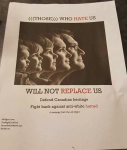
Earlier this month, white supremacist and antisemitic posters also appeared at the University of Victoria. “(((Those))) who hate us / Will not replace us,” read a poster. The use of triple parentheses is a method used online to identify Jews. The fear of white people being “replaced” by non-white people is a recurring theme in the white supremacist movement.

These incidents are local iterations of a larger and obviously deeply troubling phenomenon occurring worldwide. In part a response to the movement of refugees from Syria and elsewhere in the Middle East and North Africa, far-right groups in Europe have grown significantly in recent years. This is evident in the horrifying rally of an estimated 60,000 neo-Nazis, hyper-nationalists and racists in Warsaw, Poland, last weekend. And it is underscored by the neutrality or even affirming noises from those in positions of power at the sight of ralliers carrying signs urging “Clean blood,” “Pray for an Islamic holocaust” and “Jews out of Poland.”

Poland’s governing Law and Justice Party has informal connections with some of the extremist groups that organized Saturday’s rally. Poland’s foreign ministry, on the one hand, condemned the xenophobic, antisemitic and racist messaging, but, on the other hand, called the event “a great celebration of Poles.” The country’s interior minister called the rallying extremists “a beautiful sight.”

This sort of equivocation from leaders is perhaps as worrying, or more so, than the rallying mobs themselves. While the past year has seen numerous European far-right parties fail to live up to expectations in elections, their strength is nevertheless very concerning.

On the subject of elections … off-year elections in the United States last week delivered a strong rebuke to the U.S. president. Although polls indicate that 36% of American voters would vote for him again, no president in the history of polling has been this unpopular this early in his mandate. This is, perhaps, a sign that most Americans are turning against the divisiveness and xenophobia that this president advances.

Encouraging as that may be, possibly (wishfully) portending his defeat in 2020, the damage he is doing to the civil fabric of the country is incalculable. It is saddening to see the president of the United States overtly promote racism against Mexicans and people from Muslim-majority countries, threatening one group with a wall and the other with a travel ban that has been repeatedly deemed unconstitutional by the courts. Among his supporters are openly racist and white supremacist activists.

All of this is to say that the world is experiencing a time of extremism. Rather than throw up our hands in despair, this is a time to rededicate ourselves to the values that motivate us, the values for which Canadian and other Allied soldiers fought.

The posters at B.C. universities should be enough to sweep away any complacency we may have about our shores being free from this sort of racist ideology. This is a good thing. Canadians have a right to be proud of our comparatively decent record of multicultural harmony, but smugness is a blinder that can allow us to ignore very real undercurrents. We must be vigilant in calling out evil ideology when we see it at home and abroad.
Posted on November 17, 2017November 15, 2017Author The Editorial BoardCategories From the JITags anti-racism, antisemitism, British Columbia, racism, UBC, UVic
More racist activities

More racist activities

(photo from Anti-Racist Action UVic/Facebook)

On Nov. 9, the anniversary of Kristallnacht, a swastika and “Heil Hitler” were found written on a hallway blackboard in the University of British Columbia Forest Sciences Centre. The antisemitic graffiti was first reported to Hillel BC, who then contacted security.

This was one of several racist incidents that have occurred on B.C. campuses and across Canada in recent months, including pro-Nazi posters found at UBC on Remembrance Day. On Halloween night and in the days following, posters reading, “It’s okay to be white,” appeared on several Canadian university campuses, apparently based on instructions from a post which Vice Canada traced to the anonymous online forum 4Chan, a hub for the alt-right.

During the same week, antisemitic posters found at the University of Victoria read, “Those who hate us will not replace us. Defend Canadian heritage. Fight back against anti-white hatred. A message from the alt-right.” The word “those” was placed in triple parenthesis, a way of identifying Jews. When the posters were taken down, moderators of Anti-racist Action UVic Facebook page and others reportedly received a backlash of hateful messages online.

The election of Donald Trump one year ago this month is widely perceived as a triumph for the tangle of white supremacists, antisemites, misogynists, racists and ethno-nationalists who have come to be called the “alt-right.” In Kill All Normies, a book about the genesis of the group, journalist Angela Nagle describes an online world where cynicism, irony and absurd in-joke humour have combined with racism and misogyny to produce a “taboo-breaking anti-PC style” that has come to characterize the alt-right. Since then, the movement has tapped into latent racism and xenophobia, bolstered by the rise of people like Richard Spencer and Milo Yiannopoulos.

Not everyone is happy with the use of the term “alt-right.” Given their white supremacist beliefs, “alt-right” is somewhat innocuous. The Associated Press avoids the term because its editors think it downplays the movement’s racist goals.

Long before the 2016 election, the alt-right was gathering strength and allies. Trump granted the racists among his supporters visibility, lowering the social costs of bigotry and inspiring these supporters with a hope that their vision of “white identitarianism” could come to rule America once again. This has emboldened them and brought them out of the shadows.

In the days following the election of Trump, Canada saw a spate of vandalism, hate speech and pamphleteering directed against Jews and other minorities. As in the United States, this did not come to Canada overnight. In 2015, the CBC temporarily closed all online comments on stories featuring First Nations people because of the “staggering number of hateful and vitriolic comments” posted. In August 2016, the premier of Saskatchewan was forced to issue a plea for an end to hate speech following the second-degree murder of an aboriginal man on a farm. As a result, his own Facebook page was flooded with racist messages.

The posters at UVic were discovered by an anti-racist group on campus organized by Tyson Strandlund, who said the increasing activities of the alt-right in the public sphere are what led to his group’s creation in September. Strandlund said there has been heightened concern on campus since last summer, when an art installation meant to inspire conversations about resistance to racism was instead extensively defaced with racist slurs and had to be dismantled. He mentioned a meeting that was to take place in the Student Union Building on Nov. 15, for students and others to discuss anti-racist strategies.

David Blades, president of the Jewish Federation of Victoria and Vancouver Island, said they are “keeping close tabs” on the alt-right movement. “We have a good sense of who these people are,” he told the Independent. “What’s increasing is their public activity, not their numbers, which have remained pretty stable for years.

“Nevertheless,” he warned, “we have to be vigilant because they are also recruiting. There is no question that there is latent racism in Canadian society and it can be tapped into. My concern is that this was not isolated to the University of Victoria, this also happened at the University of Alberta and elsewhere. It was a coordinated national event. That’s my concern as Federation president. This is a shift in the overall organization of this group.”

Blades said he is “really happy with the response of UVic” and that there are plans in the works for “five days of activism against racism.”

“In some ways,” he said, “these incidents have been more effective at inspiring the opposite of what they intended: an increase in anti-racist activism.”

Matthew Gindin is a freelance journalist, writer and lecturer. He writes regularly for the Forward and All That Is Interesting, and has been published in Religion Dispatches, Situate Magazine, Tikkun and elsewhere. He can be found on Medium and Twitter.

Format ImagePosted on November 17, 2017November 15, 2017Author Matthew GindinCategories LocalTags anti-racism, British Columbia, David Blades, Federation, racism, Trump, Tyson Strandlund, UBC, UVic
Progress on anti-racist front

Progress on anti-racist front

An estimated 4,000 to 5,000 people showed up at Vancouver City Hall Aug. 19 to protest a planned racist rally. (photo by Cynthia Ramsay)

A week after the tragedy in Charlottesville, Va., British Columbians faced the prospect of a clash between racist, anti-immigrant and neo-Nazi activists and their opponents.

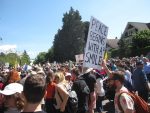
An estimated 4,000 to 5,000 people showed up at Vancouver City Hall Aug. 19 to protest a planned racist rally. Among those at the counter-rally were members of the Jewish community, including several wearing kippot and at least one draped in an Israeli flag.

For those in attendance, it was an odd and strangely uplifting time. As it turned out, most attendees never came in contact with those they came to protest. Many left the event thinking that the other side never showed up. For all intents, they didn’t. Apparently, a couple of extremists appeared at one point but their voices were quickly drowned out. The counter-rally turned out to be the main event.

Since the sound system at the gathering was terrible, most of the crowd couldn’t hear the words of the pro-diversity speakers. For the record, the event was organized by an ad hoc group and the speakers included Vancouver Mayor Gregor Robertson, Ravi Kahlon, the parliamentary secretary for sport and multiculturalism in the new B.C. government, several indigenous representatives and people from a range of faith and multicultural organizations, including Independent Jewish Voices. (Anyone complaining that their own particular views were not represented on the official roster of speakers should bear in mind that we are all free to organize our own rallies, as this ad hoc group did, and those who organize such events are free to invite whoever they like to speak.)

There were concerns by some that the sort of anti-Zionist (and arguably antisemitic) undertones that pervaded some “progressive” events in the United States recently might pop up here, but there appeared to be nothing of the sort. One speaker – one of the few who could be heard, because she led the group in a boisterous chant – specifically identified Jews as brothers and sisters. It was reassuring and welcome.

The crowd was wonderfully diverse, including people of apparently every culture, religion and identity, milling about enjoying witty and positive handmade signs and running into old and new friends. It is probably safe to say that those who attended left feeling encouraged by the show of solidarity in the face of hatred, while social media responses suggest those who did not attend believe the crowd of thousands made the province and the country proud.

A similar event – on an even grander scale – was taking place at roughly the same time in Boston, with roughly as positive an outcome. Elsewhere in America, however, wildfires of hatred fanned by winds directly from the West Wing of the White House continued to spread, with one incident of particular concern to Jews.

Richard Spencer, one of the emerging leaders of white supremacism in the United States, told an Israeli TV interviewer that his “white nationalism” is essentially the same as Zionism.

Jonathan A. Greenblatt, head of the Anti-Defamation League, writing online at the Forward, summarized the stupidity of this comparison.

“Richard Spencer’s movement is based on hate, racism, negativity and exclusion,” wrote Greenblatt. “Zionism, the national liberation movement of the Jewish people in the Jews’ historic homeland, is based on providing for equal opportunity for the Jewish people, like others, to have sovereignty in their land while still fully protecting the rights of minorities who live within Israel. At its core, Zionism is a positive movement and is not intended to be ‘against’ anyone.”

Of course, as Churchill said, a lie gets halfway around the world before the truth has a chance to get its pants on. The equation of Zionism with racism is an idea we have been battling for four decades. Originating from the Muslim bloc at the United Nations, it has been happily incorporated by many organizations of the left.

But things are changing quickly. In just the past week, while the U.S. president has effectively endorsed the Charlottesville racists (or, at the very least, equivocated between good and evil), a new urgency has emerged among anti-racist advocates.

Sometimes, something good comes out of something terrible and, as we said last week in this space, Charlottesville may be a turning point.

In another example, the March for Racial Justice – potentially one of the most significant such rallies in recent U.S. history – has been scheduled for Washington, D.C., on Yom Kippur. The sadness, disappointment and anger expressed by Jews over this timing resulted in what appears to be a deeply heartfelt, apologetic and, honestly, beautiful response from organizers, including the observation: “Our mistake highlights the need for our communities to form stronger relationships.”

This incident is a reminder, much needed, perhaps, not to write off potential allies. We are experiencing an unprecedented lack of moral leadership from what was once deemed the leadership of the free world. That moral vacuum will be filled. As the battle for space in this time of change proceeds, we must continue to make the case for our place in a multicultural society and for Israel’s place in the world.

Format ImagePosted on August 25, 2017August 22, 2017Author The Editorial BoardCategories From the JITags anti-racism, antisemitism, Charlottesville, racism, Vancouver

Posts pagination

Previous page Page 1 Page 2 Page 3
Proudly powered by WordPress