Beth Tikvah Congregation has hired Rabbi Howard Siegel as interim rabbi for the coming year. Siegel is no stranger to the Vancouver and Richmond Jewish community. He served as assistant and associate rabbi of Congregation Beth Israel from 1978-81 and 1986-88. He also served Beth Tikvah as rabbi from 1983-86.
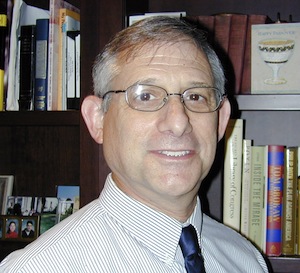
Rabbi Howard Siegel will be with the congregation through June 2015. (photo from Beth Tikvah)
After leaving Vancouver in 1988, Siegel served congregations in Minneapolis and in Houston. In addition to his congregational work, he was the founding director of the Solomon Schechter Day School in St. Louis and the Jewish Information Centre of Texas (an outreach program to unaffiliated Jews in the Houston and Austin communities). In recent years, he has been an interim rabbi in Los Angeles and San Antonio. Siegel and his wife, Dr. Ellen Lefkowitz, currently make their home in Austin.
Beth Tikvah will be looking to Siegel for advice and counsel in revitalizing their religious school, enhancing religious services, and preparing to search for another full-time rabbi.
“My role is to offer Beth Tikvah continuing rabbinical presence while assisting in strengthening their Jewish presence in Richmond and the Lower Mainland,” said Siegel, who is currently officiating at Beth Tikvah and will be with the congregation through June 2015.
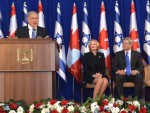
Prime Minister Binyamin Netanyahu at Ben-Gurion Airport with Prime Minister Stephen Harper and wife Laureen. (photo by Ashernet)
A petition calling on the adjudicating committee of the Nobel Peace Prize to reject B’nai Brith Canada outgoing CEO Frank Dimant’s planned nomination of Prime Minister Stephen Harper for the honor says accepting the nomination “would be a disgrace and insult to [the] prestigious award.”
Dimant’s intent to nominate Harper for the 2015 prize – to mark the prime minister’s “moral leadership in the world … especially when it comes to standing up to radical Islamist terrorism” – has garnered considerable backlash, including the online petition, created by Calgary resident Edward Tanas, on the website change.org. As of Sept. 15, the petition had amassed more than 29,500 signatures.
The nomination idea has also drawn criticism from the Vancouver-based Canada Palestine Association (CPA), whose chairperson, Hanna Kawas, was quoted in the Vancouver Observer Sept. 1 as saying “with nominating [Harper], you don’t know whether to laugh or cry … it’s outrageous.”
Charlie Angus, NDP MP for Timmins-James Bay and the official opposition critic for ethics, also spoke out against the nomination, tweeting on Aug. 31, “Nominating Stephen Harper for the Nobel Peace Prize is like nominating [Sun News contributor Ezra] Levant for the Pulitzer Prize. Sorry, Steve, you’re no [Lester] Pearson.”
He later told CJN: “My comment was more sardonic than anything else. I don’t think anyone’s going to pay much more attention to this nomination. The role Canada’s traditionally played internationally is trying to bring parties back to the table, to de-escalate. Mr. Harper hasn’t shown that … we haven’t seen that kind of leadership from this leader.”
Dimant, who, in his capacity as professor of modern Israel studies at Canada Christian College, qualifies as a nominator under Nobel rules, said he viewed the nomination as an opportunity to help restore prestige to an award he believes has been diminished in stature of late.
“When [former Palestinian leader Yasser] Arafat received [the Nobel Peace Prize in 1994], it certainly diminished the very notion of what a peace prize is,” he said. “And when [U.S. President Barack] Obama was given the prize for doing nothing except the anticipation of something, it diminished it. I felt it was time to elevate the prize again to the position it held historically.”
Dimant further praised Harper for “speaking up for the people of Ukraine,” as well as for the prime minister’s vocal condemnations of groups like Hamas, Hezbollah and Islamic State And he gave a nod to Harper’s staunch support of Israel, saying, “Here is a man who truly understands what it means to fight for freedom, national liberation and to understand that people have a right to return to their homeland and live in security and safety.”
This past January, Dimant and a delegation of other Jewish community leaders accompanied Harper on a trip to Israel, at which time Dimant praised Harper’s “unparalleled” support for Israel and his “principled stance on issues of importance to the Jewish community.”
Angus, however, said Harper’s approach isn’t deserving of the Nobel Prize. Issues connected to the Israel-Palestine conflict, he said, “are such emotionally heavy … traumatic issues for people on all sides. We want a prime minister in Canada who says, ‘Let’s find a way to move toward peace and resolution.’” That was the role Pearson, former Canadian prime minister and Nobel winner, played in the Suez Crisis, he continued, when, in 1956, he proposed a United Nations peacekeeping force to help ease the British and French out of Egypt, “and people saw that as a role for Canada to play.”
Neither Tanas nor CPA could be reached for comment, despite multiple attempts to contact them.
The deadline for the 2015 Nobel nominations is next February. According to the Norwegian Nobel Committee website, the 2014 prize has 278 candidates, the highest number on record. The nominees include Pope Francis, Malala Yousafzai, Edward Snowden and Russian President Vladimir Putin. The 2014 winner will be announced in early October.
– For more national Jewish news, visit cjnews.com.
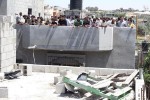
Gazan civilians on the roof of a building that had been used for terror activity. (photo from idfblog.com)
As Palestinians begin to discuss the reconstruction of the Gaza Strip after seven weeks of fighting with Israel, Israeli, Palestinian and international officials warn of the risk of another round of fighting unless there is a diplomatic agreement between the two sides as well as an agreement to rebuild Gaza.
Hamas senior official Musa Abu Marzook said that indirect talks with Israel would resume in Cairo later this month. He hinted that Hamas would be prepared to negotiate directly with Israel, saying that there is no obstacle in Muslim religious law to negotiations with Israel.
Israel, for its part, says that Hamas is a terrorist organization, and it will not negotiate either directly with Hamas or with any government that includes Hamas. This could complicate efforts for a new unity government of technocrats from Hamas and Fatah.
European Union Ambassador Lars Faaborg-Andersen warned last week that without a long-term political solution that would see Palestinian Authority President Mahmoud Abbas in charge of Gaza, violence could start anew. Israel and Hamas agreed to an Egyptian-brokered ceasefire on Aug. 26, and were expected to restart negotiations on long-term issues within a month. These expected talks come amid growing tensions between Abbas’ Fatah movement and Hamas, which is far more popular in Gaza now than it was before the war.
The issues on the table for the Cairo talks include an airport or sea port for Gaza, which Israel is expected to oppose, rebuilding Gaza, which is estimated to cost $7.8 billion, and demilitarizing the Strip, which Hamas has opposed. Cairo is also expected to host an international donors conference in October.
In the short term, the Palestinian Authority has appealed for more than $550 million in emergency aid for Gaza. Tens of thousands of Palestinians are still homeless after the fighting.
Palestinian Deputy Prime Minister Mohammed Mustafa said, “Reconstruction is the ultimate goal, but our government won’t accept a return to the status quo. We are getting to a limit that can no more be accepted. Never again, never again.”
Israeli officials said they would support the PA having control over a demilitarized Gaza Strip.
The parking lot at the Rambam Health Care Campus is a dual-purpose facility capable of converting into a fortified 2,000-bed underground hospital in times of conflict. (photo from Rambam Health Care Campus)
Not unexpectedly, southern Israel suffered more than other areas of the Jewish state during this summer’s conflict with Hamas. Yet up in northern Israel, 30 doctors from the Haifa-based Rambam Health Care Campus (RHCC) were drafted into the Israel Defence Forces (IDF).
“Israel is a small country, so everything affects you whether you are in the conflict or not,” Prof. Rafael (Rafi) Beyar, a renowned cardiologist and the director general of RHCC, told this reporter.
Now, in the aftermath of the 50-day summer war, RHCC is proving that medicine has “no borders,” in Beyar’s words. The week of this interview, doctors at the hospital conducted a successful kidney transplant on a 14-year-old boy from Gaza.
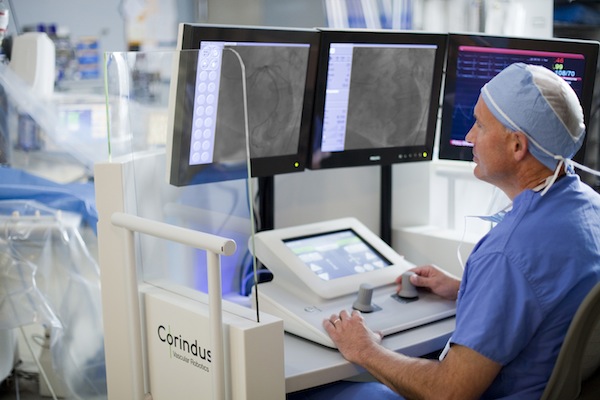
The robotic catheterization system allows the doctor to open heart blockages and implant stents in patients remotely. (photo from Rambam Health Care Campus)
The largest hospital in northern Israel, RHCC serves more than two million residents and functions as the primary medical facility for the Northern Command of the IDF. In addition to treating Gazan patients and training Palestinian physicians, the hospital is receiving wounded Syrian refugees.
Many of RHCC’s Gazan patients are children facing cancer and kidney diseases.
“These kids don’t have any other solutions,” Beyar said.
While suffering from kidney failure, the Gaza boy treated this week also had a blood condition that obstructed some of his blood vessels. Doctors first needed to check for useable blood vessels, and only then could they transplant his sister’s kidney into his body. When it became clear that the boy’s functioning blood vessels could not sustain the new kidney, doctors implanted a synthetic connector that saved his life.
On the Syrian front, RHCC has received nearly 100 wounded refugees over the past few months. IDF soldiers provide the necessary immediate treatment for injured refugees at the Israel-Syria border in the Golan Heights, and then bring them to the hospital. Most of the Syrian patients have sustained injuries from shock, bombs and other blasts. When they are treated and recover, most return to Syria, but some don’t want to go back, said Beyar.
Like the patients from Syria, most of the Gazan patients are thankful for the treatment they receive from RHCC. Although Beyar doesn’t know what happens to the patients once they return to Gaza, he said, “Someone who is treated and whose life is saved knows how to appreciate that.” Beyar added that he believes Israeli medical treatment of Gazans “has a long-term impact” on how Palestinian civilians view Israel.
It’s the children, at first, that inspire awe, the infants now walking, the toddlers talking, the grade schoolers freshly combed and pressed, the high schoolers immense, the college students all but unrecognizable in their newfound sophistication. The brief span of 12 months has metamorphosed them all. They enter the sanctuary this Rosh Hashanah morning with an eye to audience and reunion, conscious, as at few other times, of their own growth and maturity, the oldest children flanking their parents with an air of independence, the slick-haired sons towering over balding fathers, the bejeweled daughters as carefully coifed and clothed as their mothers, all proud of what they have become.
Change is everywhere: new siblings sit wedged between the old, once-single adults arrive partnered, young wives enter expectant, older couples return fractured, cleaved in twain by death or divorce. Gravity exerts its inexorable pull upon the bowed backs of the oldest congregants; the cast of many a head has grown silver; chins have sprouted beards, foreheads become more deeply furrowed, eyes less acute.
I sit among my own altered children marveling at this tidal wave of transformation passing through our midst, hoisting some as it submerges others, bearing all of us, inexorably, toward eternity. From day to day, the alchemy of aging goes unremarked, even as our children molt before our eyes. We are not meant to be conscious of every instant of change, preferring not to be reminded of the mortality and uncertainty it implies. We seek instead a reassuring constancy, a routine that grounds and sustains us, though we know our time here is all too finite, that even as we feel most anchored, we are slowly, imperceptibly, drifting out to sea. The image in today’s mirror looks no different than the one that greeted us yesterday. But a snapshot of that face a year hence tells a very different tale.
And those snapshots are what we carry with us as we enter the synagogue these High Holy Days and stare in amazement at the undeniable alteration a single year has wrought upon the familiar landscape of family and friends. It is both exhilarating and alarming, and it, more than the prayers we have come together to recite, prepares us for these Days of Awe, this personal accounting of conduct and intention, impulse and resolve.
The prospect is daunting as we join our kinsfolk and face squarely into the probing light of conscience. There is no interlocutor but the self, and perhaps no other judge. We arraign ourselves before a court of inquiry, concede doubt and weakness, ask for certainty and strength, then render judgment, emerging chastened, cleansed, perhaps annealed. We give thanks for blessings and acknowledge the fragility of our contentments, knowing that tomorrow may challenge our every conviction, undermine our serenity, rob us of everything we hold dear.
And, as we sit side by side, husbands and wives, brothers and sisters, parents and children, we discover portals to conciliation where perhaps only provocation and resistance prevailed. We rediscover tenderness and vulnerability and the myriad contradictions of our humanness. Against a backdrop of responsive prayer, we reflect upon the great challenges of parenting, on marriage’s call to remain emotionally committed, on the biblical injunction to honor our aging and increasingly infirm parents. We recite the liturgy of awe – admissions of frailty and failure, entreaties for greater understanding, for strength, for forgiveness. The gnawing hunger of Yom Kippur afternoon begins in the murmuring mouth of Rosh Hashanah, as we empty the casks of self-justification, discarding great stores of blind self-interest, and live for a time consuming nothing but the thought of our own imperfection.
And yet … while these Days of Awe clarify and distil us, they cannot sustain us. We are not cloistered contemplatives; we require a richer diet, one free of the astringent bite of continuous self-scrutiny. We need to live, to test our resolve. The gates will close, the great accounting will conclude for another year, and we will turn back to life renewed by these days of honest soul-searching, passing from assessment to action.
As the final song is sung, I turn to my family, wondering what has passed through their hearts during these hours of prayer. My son seems wrung out by so much stasis, eager to shed his confining clothes, grab a basketball and burst back into the light. My daughters yearn for the disembodied voices of friends, silver cellphones shimmering in their restless hands. My wife looks upon them with gratitude, awakening anew to the miracle of their presence in our lives, their youth, their beauty, their remarkable growth. She kisses each cheek, then takes my face in her hands and murmurs, “L’shana tova.”
May it be so for us all.
Steven Schnur, a member of Westchester Reform Temple in Scarsdale, N.Y., teaches writing at Sarah Lawrence College. This article was originally published in Reform Judaism magazine, and can be found at reformjudaism.org/these-days-awe. It is reprinted with permission.
Carrots represent the hope that Israel’s enemies will be “cut off,” or kept away. (photo by Stephen Ausmus / USARS via en.wikipedia.org)
Most Jews, religious or not, celebrate Passover, opening the holiday with a seder – fewer know that a seder is held on Rosh Hashanah, too. Being the year’s first meal, it gains higher importance in Jewish tradition and, therefore, should be special.
In the seder of Rosh Hashanah, a dedicated prayer is said, then a meal with symbolic foods is served, each food representing a different blessing for the people of Israel. Some of these foods have a unique prayer that is said prior to eating them. These foods differ slightly between communities, yet some are common, and are served on both religious and secular tables.
As some of the seder foods may stand for similar blessings, not all of them have been preserved among secular Jews. The most common traditional food served at Rosh Hashanah is an apple, dipped in honey; this custom represents a blessing for the year to be as sweet as honey. Gefilte fish is also served, usually having slightly sweet flavor, for the procreation of the people of Israel like the propagation of fish. On the gefilte fish, sliced carrots are placed, a symbol for Israel’s enemies to be “cut off.”
A fish head is displayed/served, symbolizing a blessing for the people of Israel to be the head and not the tail. This blessing has two meanings: (a) we will be the thinkers, the inventors; (b) we will gain leadership by moving forward, following our own will; not backwards, following other peoples’ will.
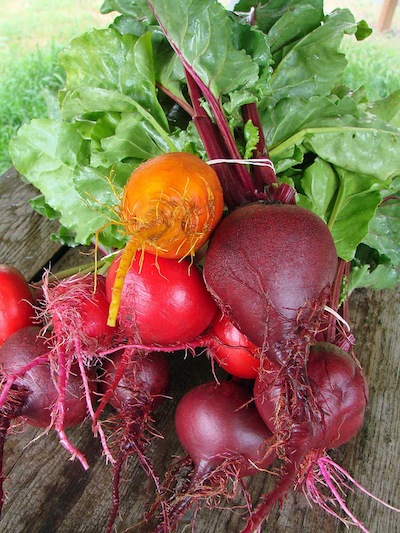
Beets also represent the hope that Israel’s enemies will be kept away. (photo by Jennifer Kleffner / Miles Away Farm via flickr.com)
Sometimes, a beet or beet leaves are served for the removal of Israel’s enemies. A pomegranate is served, its many seeds symbolic of the many mitzvot that the Jewish people have and hope to continue to have.
Although linguistically not necessarily related historically, some of the foods are traditionally linked to their blessings by their Hebrew roots: the carrots placed on the gefilte fish are called gezer (pl. gzarim, root gzr) in Hebrew. The blessing of cutting off Israel’s enemies that is symbolized by the carrots makes use of the root gzr: “sheig az ru oyveynu,” “let our enemies be cut off.” The beet (leaves) is selek (root: slk); the related blessing: “she-is talku oyveynu ve-son’eynu,” “let our enemies and haters be gone,” is also represented by the same root slk, “remove.”
Other traditional foods either make use of a semantic feature of the original notion, or they have undergone a semantic shift to adapt to the holiday’s blessings. For example, we use the feature of quantity of the schools of fish for the parallel blessing: “shenifre ve-nirbe ke-dagim,” “let us procreate [literally: be fruitful and multiply] as fish.”
The fish head represents the brain, as well as the mind, which spiritually lies in the brain, and leadership, by being the head, the first in everything. This word gains a double meaning, as it appears in the name of the holiday, Rosh Hashanah, as well as in rishon, “first,” derived from rosh, “head.”
I wrote down some of these thoughts from my home shelter during the war. Let us hope to be blessed in the future with real rimonim (pomegranates’ fruit), and not rimone-yad (hand grenade). Let us bless southern Israeli fishermen to be able to continue fishing, and farmers to be able to continue selling their honey, carrots and beets, so that all of us can have a peaceful Rosh Hashanah seder. Happy New Year.
Nurit Dekelis an independent academic researcher of colloquial Israeli Hebrew, and principal linguist at NSC-Natural Speech Communication; author of Colloquial Israeli Hebrew: A Corpus-based Survey. She is based in southern Israel.
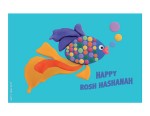
Fish is a traditional part of the Rosh Hashanah meal. Since Rosh Hashanah translates literally as “Head of the Year,” some people will eat the head of a fish as part of the holiday meal, or at least have one on their holiday table. Fish is also a symbol of fertility and prosperity.
Today, we will make a beautiful fish from Plasticine. While you won’t be able to eat it, you can add it to the table with other symbols of the holiday.
For this art project, you will need various colors of Plasticine or Play Doh.
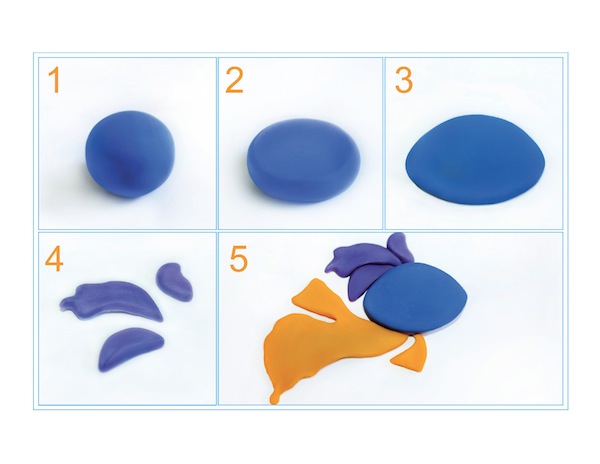
1. First, we make the body of the fish. Roll a small ball from blue Plasticine.
2. Flatten the ball with the palm of your hand and flip onto the other side.
3. With the tip of your fingers, gently raise the edges on both sides.
4. Now make a top fin. You will need three small pieces of dark blue or purple Plasticine. Using a toothpick, attach the top fin to the body of the fish.
5. Use yellow Plasticine to make a bottom fin.
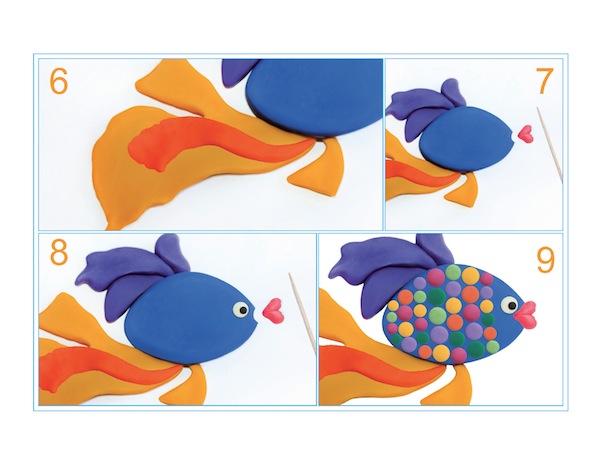
6. Add an orange fin on top of the yellow one.
7. With the help of a toothpick, make an indent for the mouth. Later, using pink Plasticine, create heart-shaped lips. Attach the lips to the body.
8. Using white and black Plasticine assemble an eye, and add it to what you’ve already put together.
9. Our fish is almost ready! We just need to add scales. Make a small green ball and flatten it. Add this newly formed circle to the body. Now, create many of these circles and decorate your fish with beautiful and colorful scales.
Instead of circles, you may create stripes or any other unique designs – and, of course, you can use any colors you want for any part of your fish. Art is a soul’s expression. Imagine, inspire, innovate!
Happy New Year to all young readers and their parents! Curly Orli and I wish you a year full of happiness and joy!
Lana Lagooncais a graphic designer, author and illustrator. At curlyorli.com, there are more free lessons, along with information about Curly Orli merchandise.
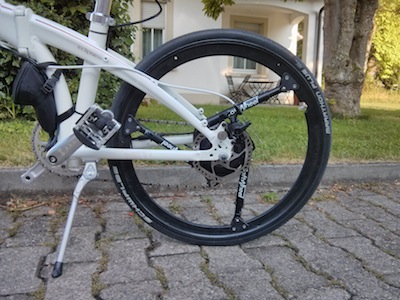
The concept of SoftWheel was initially imagined as an improvement for wheelchairs, but its potential uses are numerous. (photo from SoftWheel)
While new patents and inventions appear all the time, they don’t often aim at a mainstay, like the common wheel, which has had the same design for thousands of years.
Many inventors have focused on how a wheel connects to a vehicle through different suspension systems. An Israeli startup has infused the suspension right into the wheel itself, with a selective shock absorption system.
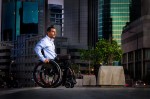
Dubbed “SoftWheel,” the concept was imagined by Israeli farmer Gilad Wolf when, a few years ago, he broke his pelvis and was confined to a wheelchair.
“Sitting on one of the more sturdy wheelchairs, having to manoeuvre around his fields, Gilad decided to design an improved model with suspension,” said Ronny Winshtein co-founder, inventor and former chief executive officer of SoftWheel.
Wolf partnered with some colleagues and an Israeli nonprofit organization for rehabilitation technologies called Milbat and, together, they approached Tel Aviv-based Rad-Biomed Accelerator to assist in funding and developing the project.
“Rad-Biomed CEO David Zigdon liked the idea but decided to come up with a product that would be disruptive in technology and market orientation,” said Winshtein.
(photo from SoftWheel)
With Winshtein, they decided they would put the suspension in the wheel and make it selective – i.e., to work only at high-magnitude shocks – otherwise, the wheel would remain purely round and concentric, functioning like any other wheel.
In 2011, SoftWheel was founded with this notion in mind, and it attracted some of the best and brightest players in Israel to the wheel business. One of them, Ziv-Av Engineering, assisted them in developing the wheel’s unique mechanism.
“Putting suspension into the wheel has many advantages, like giving you the freedom to plug in the suspension onto any frame you like,” said Daniel Barel, SoftWheel’s current CEO. “You can just pick one out of a catalogue. As well, the suspension covers 360 degrees of incoming shocks, rather than [the] linear shocks absorbers provided in most frames.”
Barel explained why a design like theirs had not been done until now. “With promise comes challenges, and having the shocks in the frame of a flexible wheel creates design challenges for the rest of the vehicle’s frame – a challenge fairly non-existent in wheelchairs.”
The biggest problem with wheelchairs is adding suspension to the chair, as it adds weight. “Active wheelchair users commonly disconnect the wheels from the frame when getting into their car, etc., and pull the wheelchair components with a single hand from the ground to the passenger seat … so, weight becomes a major issue,” said Barel. “By adding suspension (meaning, adding some weight) to the wheels, which are always lighter than the frame, [it is easier to manoeuvre the chair portion].… On the other hand, SoftWheel understands the need to have the lightest possible wheels, so the overall wheelchair weight won’t be more than current lightweight wheelchairs.”
What makes SoftWheel’s wheel better than any other, according to Barel, is the embedded suspension. “It’s a real suspension with not only springs, but also dampers, which are needed to absorb the shock. Also, it’s selective, so, during a ride on a regular road, the hub won’t wobble within the frame, keeping more of the good propulsion energy.”
The company has filed several different patent applications for utility and design that they are confident will provide broad protection to their inventions.
Barel acknowledged it is difficult to reconsider one of the oldest possible technologies ever invented, but also exciting.
“We’re currently focused, first and foremost, on the market, with a first product for active wheelchair users … in the very near future,” said Barel. “We also made substantial progress in designing similar wheels for commuter bicycles, some of which also include a motor in the wheel hub.” The prototype is featured in the video below.
“We also develop concepts for other types of vehicles based on our know-how and technology, and have been in discussion with some very interesting players in Israel and abroad,” he added.
The company is very proud to be part of the Israeli startup Kaleidoscope. Winshtein believes that it is not by chance that so many innovative technologies have originated in Israel. He said it is embedded in the culture, the atmosphere, jokingly adding, “Probably, also [the] heat and humidity, but mostly the openness, from any level, to try and change the world for the better.
“SoftWheel has been a globally oriented company from day one, and we already have good and friendly ties with different global and national players from different market segments.”
One of the other companies that has shown interest is an aircraft landing gear manufacturer. Another focus for SoftWheel has been implementing the technology on city bikes, as more and more cities introduce bikes that anyone can pick up and return at different locations (for a cost).
“As the wheels reduce the impact of typical street blows, both wheelchairs and bikes that use them can move around freely without having to access ramps,” said Barel. “The suspension systems currently available in city bikes are unsuitable for such obstacles and often result in the rider taking the impact. Eventually, the product will sell itself and, in doing so, it has to answer real needs for real individuals.
“Like with any new concept, you do everything in your power to bring into the market the best possible product, under time and budget constraints. With time and growth, and feedback from the users, we’ll naturally be able to improve the product in different parameters, ones we already have in mind and ones we probably hadn’t thought of yet.”
It is amazing how many common themes run through even the most disparate books. The selection reviewed by the Jewish Independent this year includes both picture books and novels for teens; the topics range from genocide and oppression, to a grandmother dying and a family getting a dog; the stories take place in fictional worlds and all too real places. Yet, the vast majority of lessons or values imparted are the same.
The importance of family, friendship, resilience, responsibility, creativity, compassion, caring for those less fortunate or more vulnerable, accepting the reality of death – all make an appearance in the books that follow.
From the wonderfully imaginative mind of Joan Betty Stuchner, who sadly passed away earlier this year, Bagels Come Home (Orca Echoes, 2014) is the story of Bagels, a behavior-challenged but friendly dog that the Bernsteins adopt from a shelter. He joins the family’s goldfish, Lox, and their cat, Creamcheese. However, when it proves almost impossible to train him, 8-year-old Josh (who suggested getting a dog in the first place) and his 5-year-old sister Becky must work together (keenly on her part, not so much on his) to keep their parents from returning Bagels. The black and white illustrations by Dave Whamond complement the jovial energy and mood of Stuchner’s tale.
Inspired by a discussion that author Michelle Gilman had with her children after their grandma (bubbie) died, What Grandma Built (Gilman Press, 2014) deals with death straight on. The book – with colorful, childlike drawings by Jazmin Sasky – introduces readers to Grandma when she falls in love with Grandpa. We share in a few of the highlights of their lives, building a house, having children, becoming grandparents. Much of the story is about the fun times that their grandchildren have with them. But then Grandma becomes ill and, despite all the love and care she receives, passes away. The house that Grandma helped build may not last forever, but the home she built, her “cathedral,” will, “especially in the hearts and memories of our family.”
The Magician of Auschwitz (Second Story Press, 2014) by Kathy Kacer is also based on a true story. During the Holocaust, young Werner – whose father died years ago, whose older sister went into hiding with a Christian family two years earlier and who last saw his mother at the police station where he was held before being sent to the concentration camp – is fortunate to meet Herr Levin, whose wife and son are also in the camp, “somewhere.” A gentle soul, Levin treats Werner with kindness so, when Levin is awakened one night, Werner is afraid he may lose his only friend. However, the guards order Levin: “Do your magic!” And he does. Levin’s magic not only saves his life, but Werner’s – a gift Werner never forgets.
The illustrations by Gillian Newland are in dark, rich tones, appropriate for the subject matter, and brightening for the image of an elder Werner teaching his sons the card trick Levin taught him. The book includes a section about the real-life Werner and Levin (the Great Nivelli).
Lynne Kositsky’s The Plagues of Kondar (Dundurn Press, 2014) takes readers to a planet divided by a dense wall of fog: the sun shines on Lightside, while only darkness prevails on Oscura. Arien, 14 cycles old, lives in Lightside, but her life goes from brightness to hardship soon after we meet her. Short on food supplies, her parents set off to see if another settlement has grain to spare, but they don’t make it back. Sold into slavery to pay her parents’ alleged debts, Arien must be strong, confident, resourceful – and kind – to survive. When some Oscurans inadvertently bring a plague to Lightside, Arien is at the centre of the efforts to cure it, and not just for her own people but for the Oscurans, despite the long-told tales that describe them as “ghosts and ghouls.”
Silvana Goldemberg’s Victoria (Turnaround, 2013) is translated from the Spanish by Emilie Smith. Victoria’s title character and her younger twin brothers live with their aunt until the aunt’s boyfriend attempts to sexually assault the 14-year-old. Victoria flees to the streets of Paraná, Argentina, where she must fend for herself among drug dealers and other dangers. Taking control, and keeping to her personal values, Victoria works hard, makes new friends and builds a life that promises better things for her and her brothers.
Building a new life is also central to Rachel’s Hope (Second Story Press, 2014), the third in Shelly Sanders’ Rachel trilogy. We first met Rachel at age 14, in Kishinev, Russia. Her dreams of being a writer are put on hold, as the murder of a Christian man leads to pogroms and chaos, beginning Easter Sunday 1903; however, among all the bad, she is helped by Sergei, a non-Jewish boy.
The unrest in Russia continues and the next time we meet Rachel, her father has been killed and she and the rest of her family flee to Shanghai, where they save money for a ship to America; Sergei remains in Russia, becoming a factory worker, but the horrid conditions lead him to join the rebellions.
Rachel’s Hope begins in winter 1905: Rachel, her sister and brother-in-law, and their young charge, Menahem, have made it to San Francisco (her mother dies in Shanghai); Sergei is still in Russia, part of the revolutionaries. This part of the trilogy introduces readers to the many challenges immigrants face when coming to a new country, encountering a new language, a new culture. But, as hard as life may be in the United States, as unequal as women’s or immigrants’ rights may be, as hard as it is to recover from a natural disaster (the 1906 earthquake in San Francisco), the comparison with Russia at that point in its history is stark. The devastating effects of violent oppression last well beyond the attainment of freedom.