

Carrots represent the hope that Israel’s enemies will be “cut off,” or kept away. (photo by Stephen Ausmus / USARS via en.wikipedia.org)
Most Jews, religious or not, celebrate Passover, opening the holiday with a seder – fewer know that a seder is held on Rosh Hashanah, too. Being the year’s first meal, it gains higher importance in Jewish tradition and, therefore, should be special.
In the seder of Rosh Hashanah, a dedicated prayer is said, then a meal with symbolic foods is served, each food representing a different blessing for the people of Israel. Some of these foods have a unique prayer that is said prior to eating them. These foods differ slightly between communities, yet some are common, and are served on both religious and secular tables.
As some of the seder foods may stand for similar blessings, not all of them have been preserved among secular Jews. The most common traditional food served at Rosh Hashanah is an apple, dipped in honey; this custom represents a blessing for the year to be as sweet as honey. Gefilte fish is also served, usually having slightly sweet flavor, for the procreation of the people of Israel like the propagation of fish. On the gefilte fish, sliced carrots are placed, a symbol for Israel’s enemies to be “cut off.”
A fish head is displayed/served, symbolizing a blessing for the people of Israel to be the head and not the tail. This blessing has two meanings: (a) we will be the thinkers, the inventors; (b) we will gain leadership by moving forward, following our own will; not backwards, following other peoples’ will.
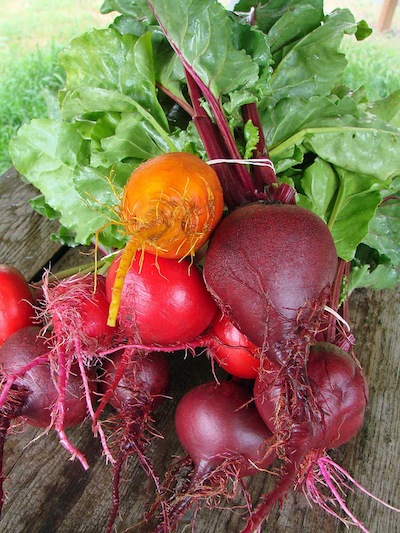
Sometimes, a beet or beet leaves are served for the removal of Israel’s enemies. A pomegranate is served, its many seeds symbolic of the many mitzvot that the Jewish people have and hope to continue to have.
Although linguistically not necessarily related historically, some of the foods are traditionally linked to their blessings by their Hebrew roots: the carrots placed on the gefilte fish are called gezer (pl. gzarim, root gzr) in Hebrew. The blessing of cutting off Israel’s enemies that is symbolized by the carrots makes use of the root gzr: “sheig az ru oyveynu,” “let our enemies be cut off.” The beet (leaves) is selek (root: slk); the related blessing: “she-is talku oyveynu ve-son’eynu,” “let our enemies and haters be gone,” is also represented by the same root slk, “remove.”
Other traditional foods either make use of a semantic feature of the original notion, or they have undergone a semantic shift to adapt to the holiday’s blessings. For example, we use the feature of quantity of the schools of fish for the parallel blessing: “shenifre ve-nirbe ke-dagim,” “let us procreate [literally: be fruitful and multiply] as fish.”
The fish head represents the brain, as well as the mind, which spiritually lies in the brain, and leadership, by being the head, the first in everything. This word gains a double meaning, as it appears in the name of the holiday, Rosh Hashanah, as well as in rishon, “first,” derived from rosh, “head.”
I wrote down some of these thoughts from my home shelter during the war. Let us hope to be blessed in the future with real rimonim (pomegranates’ fruit), and not rimone-yad (hand grenade). Let us bless southern Israeli fishermen to be able to continue fishing, and farmers to be able to continue selling their honey, carrots and beets, so that all of us can have a peaceful Rosh Hashanah seder. Happy New Year.
Nurit Dekel is an independent academic researcher of colloquial Israeli Hebrew, and principal linguist at NSC-Natural Speech Communication; author of Colloquial Israeli Hebrew: A Corpus-based Survey. She is based in southern Israel.