Skip to content
  • Home
  • Subscribe / donate
  • Events calendar
  • News
    • Local
    • National
    • Israel
    • World
    • עניין בחדשות
      A roundup of news in Canada and further afield, in Hebrew.
  • Opinion
    • From the JI
    • Op-Ed
  • Arts & Culture
    • Performing Arts
    • Music
    • Books
    • Visual Arts
    • TV & Film
  • Life
    • Celebrating the Holidays
    • Travel
    • The Daily Snooze
      Cartoons by Jacob Samuel
    • Mystery Photo
      Help the JI and JMABC fill in the gaps in our archives.
  • Community Links
    • Organizations, Etc.
    • Other News Sources & Blogs
    • Business Directory
  • FAQ
  • JI Chai Celebration
  • JI@88! video

Recent Posts

  • Zionism wins big in Vegas
  • Different but connected
  • Survival not passive
  • Musical celebration of Israel
  • Shoppe celebrates 25 years
  • Human “book” event
  • Reclaiming Jewish stories
  • Bema presents Perseverance
  • CSS honours Bellas z”l
  • Sheba Promise here May 7
  • Reflections from Be’eri
  • New law a desecration
  • Resilient joy in tough times
  • Rescue dog brings joy
  • Art chosen for new museum
  • Reminder of hope, resilience
  • The national food of Israel?
  • Story of Israel’s north
  • Sheltering in train stations
  • Teach critical thinking
  • Learning to bridge divides
  • Supporting Iranian community
  • Art dismantles systems
  • Beth Tikvah celebrates 50th
  • What is Jewish music?
  • Celebrate joy of music
  • Women share experiences 
  • Raising funds for Survivors
  • Call for digital literacy
  • The hidden hand of hate
  • Tarot as spiritual ritual
  • Students create fancy meal
  • Encouraging young voices
  • Rose’s Angels delivers
  • Living life to its fullest
  • Drawing on his roots

Archives

Follow @JewishIndie
image - The CJN - Visit Us Banner - 300x600 - 101625

Live doc portrays famous idealist

Live doc portrays famous idealist

Buckminster Fuller in front of the Montreal World’s Fair geodesic dome. (photo from Magnum Photos)

Most of us know Richard Buckminster Fuller as “the dome guy” or, more formally, as the 20th-century genius whose life and vision eventually led to the creation of that most unusual architectural form, the geodesic dome. His early architectural designs, set in the 1970s, would go on to win him worldwide acclaim as an early pioneer in environmental stewardship.

Although it’s no surprise in a city that has always lauded ingenuity, that vision would eventually help remake both Vancouver’s skyline and our concept of enduring, smart, contemporary architecture. But what many 21st-century Vancouverites may not know is that Bucky – as he was equally affectionately called by friends and even strangers – was much more than an architect and a futuristic designer. He was a utopist, a scientist, an idealist, a linguist and probably one of the world’s earliest pioneers in sustainable living.
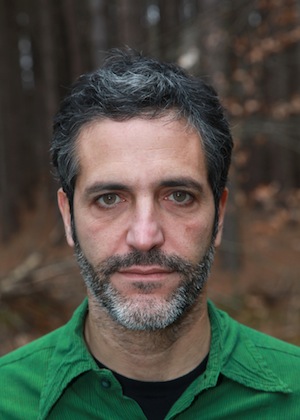
photo - Sam Green
Sam Green (photo by Joanna Eldredge Morrissey)

In fact, he was more than that, says filmmaker Sam Green. Green, who received an Academy Award nomination for his documentary on the Weather Underground in 2003, will be presenting his live documentary of Fuller’s life and accomplishments, The Love Song of R. Buckminster Fuller, at the Vogue Theatre on Nov. 12. Green spent several years pouring through the archives of Bucky’s famous Dymaxion Chronofile to compile this synthesis of the futurist’s life, a legacy that is euphemistically reflected in the title of the film.

Fuller, Green said, “spent almost every waking moment trying to make the world a better place,” a vision that was reflective of the immense affection he carried for the world around him. “There was something about him that struck me as very loving about his enormous amount of energy he put into his projects.”

It’s vigor that seems incredibly relevant to today’s sustainability movement, and our increasing focus on climate change. “I was very struck by the fact that he had these conflicting set[s] of messages,” said Green. “His whole life, or the entire 50 years he spent working on this project [what Green sums up simply as his effort to make the world a better place] are more relevant now than they have ever been.” Doing more with less, smart design, harnessing our resources, “and at the core of all of that is this idea that we have all the resources now to make a high standard of living for everybody on the planet.” It was a viewpoint that not only reflected his unbridled idealism, but his intuitive understanding of the precarious balance of life on what he referred to as “spaceship earth.”

“He was a great poet,” said Green. Fuller instinctually understood the power of allusion. “[He] definitely had a fantastic way with words. A lot of his books have just the most wonderful titles.” Poems with names like “God is a Verb,” whose title might have seemed irreverent at the time, captured the drive of a nascent environmental movement. The name of early work An Operating Manual for Spaceship Earth “would have been a cool title in 1975,” said Green. The treatise clearly showed he was ahead of his time when it was first published as a scientific paper in 1967, and it took readers by storm when it was published as a book a year later. His poems, literary works and uncanny insights into human nature have stood just as much the test of time as his many inventions and forays into architectural design.

Green’s live documentary is an exploration into form and allusion in itself. While this isn’t the first time that the filmmaker has combined live narrative with a pre-recorded film to tell a compelling story, the unorthodox format he uses seems to lend itself to the tale of a man who was clearly not afraid to step outside of the bounds of convention. Green’s personal narration, combined with the live accompaniment by American indie rock band Yo La Tengo, seems to resonate with viewers who, like Green, seek the intimate experience of that old pre-digital-age theatre production.

“One of the reasons I like this form is it keeps the experience in the realm of a kind of cinematic context,” Green explained. “You come to the theatre – we’re going to travel all the way from New York – you’ll buy a ticket and come to the theatre. Everybody will turn their phones off [and] we’ll all experience this piece together. It’ll never be the same way twice, and there is something just wonderful and magic about that.”

For Green, who identifies himself as “culturally Jewish,” Fuller’s story resonates with an element that he finds drives much of his cinematic work: “a kind of yearning quality to it,” he said, “a combination of idealism and yearning, and a little bit of heartbreak that I think is very Jewish.”

It’s the same essence he said that drew him to Yo La Tengo’s emotive work. “I very much wanted to work with them because they had the sound that expresses that. Their sound is beautiful. They make beautiful songs with a little bit of yearning and melancholy to them. And that kind of emotional palate to me is very Jewish.”

Green’s earlier cinematic work includes Utopia in Four Movements, which was featured at the San Francisco Jewish Film Festival in 2010; The Weather Underground (2003), which premièred at the Sundance Film Festival and was nominated for an Academy Award; and Rainbow Man/John 3:16 (1997), detailing the tragic story of unusual sports fan Rockin’ Rollen Stewart. His most recent live documentary, The Measure of All Things (2014) about the Guinness Book of World Records, has also been featured at the Sundance Festival.

But, to be sure, The Love Song of R. Buckminster Fuller isn’t just about an American idealist who helped broaden global viewpoints. The Vancouver première, said Green, is also about Vancouver’s intimate relationship with Bucky and the vision he helped create when he visited the city in 1976.

“There are some great Buckminster Fuller connections to Vancouver,” Green acknowledged, noting that Fuller was a frequent visitor to the city that would eventually lay claim to a geodesic dome of its own – today’s Telus World of Science (better known as Science World), one of this city’s most enduring symbols.

The Love Song of R. Buckminster Fuller will be presented by the PuSh International Performing Arts Festival Nov. 12, 8 p.m., at Vogue Theatre. Tickets, $30.50, can be purchased at voguetheatre.com or by calling Northern Tickets at 1-855-551-9747.

Jan Lee’s articles have been published in B’nai B’rith Magazine, thedailyrabbi.com and Voices of Conservative and Masorti Judaism. She also writes on sustainable business practices for TriplePundit.com. Her blog can be found at multiculturaljew.polestarpassages.com.
Format ImagePosted on October 31, 2014October 29, 2014Author Jan LeeCategories Performing ArtsTags Buckminster Fuller, PuSh International Performing Arts Festival, Sam Green
Facts: A well-crafted crafted play

Facts: A well-crafted crafted play

Left to right, Jerry Wasserman, James Gill and Mehdi Darvish star in United Players’ production of Facts. (photo by Doug Williams)

United Players is set to present Canadian Jewish playwright Arthur Milner’s provocative political drama Facts, loosely based on the true story of the 1992 murder of an American archeologist in the West Bank and the joint Israeli/Palestinian police investigation that followed.

The play has been produced in Ontario and the United Kingdom and was translated into Arabic for a tour of various West Bank cities in 2012. The United Players’ production marks the play’s Western Canadian première, with Jerry Wasserman as Yossi, the hot-headed Israeli detective; Mehdi Darvish as Khalid, Yossi’s Palestinian counterpart; and James Gill as Danny, the fervent settler accused of the murder. Adam Henderson helms this production as it navigates its way through some rough waters, exploring not only the Israeli-Palestinian conflict but also the religious-secular divide between Jews within Israel. The action takes place in a cramped, hot interrogation room in the West Bank and, as the story unfolds, it is revealed that the archeologist was unearthing facts that brought into question some accepted historical beliefs fundamental to Judaism.

The Jewish Independent sat down with Wasserman, Henderson and Darvish one morning before a rehearsal.

Wasserman – who is also a theatre critic and head of the theatre and film department at the University of British Columbia – described himself as an American Jew brought up by liberal Jewish thinkers. He said his research and immersion into this play angered him, but made him see the Middle East conflict in a new light. “This play really presses a lot of emotional buttons for me,” he said. “It digs down through layers into very specific details of [the] lives of people and, through this complexity, we see things more clearly.”

As to his character, Wasserman said, “Yossi’s father was a Zionist who had a dream of a state which has been compromised by the new wave of radical settlers who he sees as having a medieval way of thinking…. This has changed the state of Israel that Yossi loves. The real conflict in this story is not between Yossi and Khalid, but between Yossi and Danny.

“Because Yossi operates at a high emotional temperature, I had to find the proper rhythms and the right places to come up and go down so that I did not peak too early. There were many challenges, but it was infinitely fascinating. You don’t get too many chances to play a role like this.”

The heart of the story is the investigation, as the two detectives sift through various pieces of evidence and theories on the murder.

“I have acted in over 100 police dramas, both television and cinema, and I have to say that this, by far, is the most complex, sophisticated and confusing ones I have ever been involved in,” said Wasserman. “The research has been very detailed and the play is very accurate, re: police investigation and techniques. It is a tremendous intellectual puzzle. The evidence is circumstantial and we never find the smoking gun. The dialogue is an emotional mine field that we, as actors, all have to move through.”

Police dramas often feature a good cop/bad cop relationship. As to whether or not audiences will get to see that dynamic, Wasserman said, “Yossi tries to act the good cop but he is the bad cop by nature. He has lots of emotional buttons to press. The great thing about this play is that everyone’s buttons get pressed. Everyone has a turn to make impassioned monologues and everyone gets to lay his emotional/political cards on the table.”

Gill finds his role of Danny an interesting challenge. “While so much of his absolutist approach to his faith and his politics is antithetical to my own liberalism, nonetheless, being a Jew gives me an empathy for where his faith and politics are grounded,” he said in an email. “That gives me a starting point from which I can start to encompass the character.”

He sees the essence of the play as “the way in which these three men both conform to and transcend their stereotypes. We start with the ‘facts’ of an Israeli, a Palestinian and a settler and, on one level, each of these men is true to those simplistic profiles, but we discover that each of them is much more complicated.”

For Darvish, his involvement in the play also gave him new insights into the conflict. “I came to understand the Israeli position from an emotional perspective better as a result of working on this play,” he said, “but I also see more deeply the Palestinian position. I see the characters often acting like children throwing tantrums instead of sitting down and logically dealing with the situation. It saddens me because right now I do not see a resolution to the dilemma.”

Henderson said he enjoys working with a small cast and a modern-day setting, which contains no idiosyncrasies as to period or language. With an all-male cast, the action is testosterone driven and reflective of the politics of the Middle East, he said.

Henderson expressed surprise that more Canadians do not know about Milner, whose work he has come to appreciate more during the course of his research and preparation for this production.

“Milner has taken a very sensitive subject and effected meticulous research to create a platform to encourage serious dialogue,” he said. “His position is Socratic – he wants to encourage discussion versus making a point and this is brought home by his equivocal ending.”

Henderson acknowledged that the play is likely to be controversial but stressed that, “the key to theatre is that it is a thought experiment where we can do dangerous things with no consequences except people might have their perspectives broadened. If that is what happens in this play, then we will have accomplished something.”

He added, “As the news media move toward ‘infotainment,’ and the sound bites become faster and shallower, the longer form of theatre allows us to look a little deeper at things. For me, it is critical to protect ourselves from merely having our prejudices reinforced. Theatre was invented as a public forum, and we need to gather, to discuss, now more than ever.”

As to why Vancouverites should see the play, Henderson said, “It is an unusually well-crafted play. It is funny, witty, challenging and surprising, and you won’t find anything like it on television. Also, this is a great opportunity to dress up, go out and mingle with community and exercise the soul. Parking is easy and you come out after the show by the beautiful Jericho Beach with something new to talk about.”

Facts is at Jericho Arts Centre from Nov. 7-30. As an added feature, there will be a reading of Masada, Milner’s companion piece to Facts, after every Friday performance. Milner will be in Vancouver the week of Nov. 11 and will be attending performances during that time. For tickets and more information, visit unitedplayers.com.

Tova Kornfeld is a Vancouver freelance writer and lawyer.

Format ImagePosted on October 31, 2014November 6, 2014Author Tova KornfeldCategories Performing ArtsTags Arthur Milner, Israel, James Gill, Jerry Wasserman, Mehdi Darvish, Palestinians, United Players, Zionism
JSA honors dedication, hard work

JSA honors dedication, hard work

Jewish Seniors Alliance of Greater Vancouver board and staff 2014-15. Standing, from left: Janet Kolof, Timothy Newman, Marilyn Glazer, Barbara Bronstein, Lyle Pullan, Claire Cohen, Gyda Chud, Ida Gitlina, Rubin Feldman and Binny Goldman. Seated, from left: Karon Shear (staff), Shanie Levin, Ken Levitt, Serge Haber, Marilyn Berger, Milton Adelson and Rita Propp (staff). Missing from the photo are Debbie Cossever, Marie Doduck, Lionel Fishman, Sylvia Gurstein, Sylvia Hill, Pamella Ottem, Rita Roling, Edith Shier and Jackie Weiler, as well as peer support staff Charles Leibovitch and Grace Hann. (photo from JSA)

As the Jewish Seniors Alliance of Greater Vancouver marked its 11th annual general meeting on Sept. 11 at the Sidney and Gertrude Zack Gallery, it was indeed an evening of celebration inspiration and innovation.

JSA past president Serge Haber welcomed a standing-room-only crowd and led them in a minute of silence to honor those who had passed away during the year.

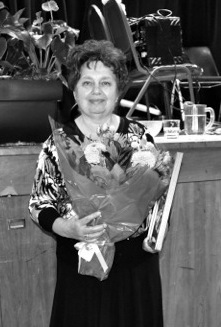
photo - Natasha Likholatnikov, nominated by Chabad of Richmond, has been a volunteer since her arrival in Canada from Ukraine
Natasha Likholatnikov, nominated by Chabad of Richmond, has been a volunteer since her arrival in Canada from Ukraine. (photo from JSA)

Adolf Zilbershtain, president of the Most Bridge Russian seniors group, brought greetings and extended thanks on behalf of its 150 members for the financial support JSA had given them.

Bernard Jackson, president of Jewish War Veterans Shalom Branch – one of only three branches in Canada – followed and gifted JSA with greetings and a monetary donation.

Treasurer Milton Adelson reported that JSA is in good standing but that adequate funding remains an ongoing challenge and priority.

Attendees learned from Pamella Ottem that JSA’s peer support program is now the largest in the city, and that JSA is looked to for guidance, mentorship and support by many organizations offering similar services. Ottem lauded the peer support leadership of Grace Hann and Charles Leibovitch in building the program, which now serves more than 150 seniors and includes peer counseling, a home visiting program, phone calls to isolated seniors, an information and referral phone line, transport to medical appointments and a new bereavement support group.

Representing the membership committee, Lyle Pullan reported that JSA gained 46 new members this past year. He encouraged attendees to consider themselves as committee members, and to “Sign ’em up!” The goal is 100 new JSA memberships for the next year.

Joining the meeting was Shelley Rivkin, associate executive director of the Jewish Federation of Greater Vancouver, who spoke about how much JSA and Haber are valued. She said Haber served as a mentor not only for Federation, but for all who advocate for the well-being of the community’s elders, who number 5,000 and whose numbers are expected to double in the next decade.

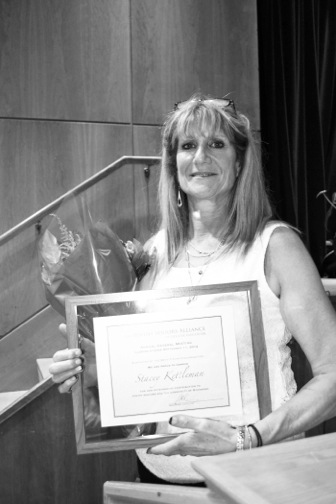
photo - Stacey Kettleman was put forward by Congregation Beth Tikvah.
Stacey Kettleman was put forward by Congregation Beth Tikvah. (photo from JSA)

As JSA celebrated its 11th year and Haber’s nine as president, his report highlighted JSA’s numerous accomplishments in advocacy, outreach, the Seniors Line Magazine, the Empowerment Series, fall symposium and spring forum, where JSA has achieved a 25 percent increase in attendance. He honored the work of executive coordinator Karon Shear, his “right hand,” for her conscientious hard work and dedication, and the commitment of Rita Propp, office assistant. Together with the 4,000 hours of JSA volunteer activity, this is what makes JSA the “best of the best,” he said.

Ken Levitt, board vice-president paid tribute to Haber. Levitt asked the audience to ponder how many 86-year-olds they know who are such exemplary leaders and contribute with such vitality on a tiny, shoe-string budget. Very few, he suggested. Haber was elected president emeritus in a unanimous vote.

Certificates of merit were presented to “retiring yet always rewiring’’ board members, Pullan presented the nominations slate of returning and new board members and the election included the executive board for 2014-15.

Incoming JSA president Marilyn Berger, in her acceptance speech, concluded the AGM with the message, “Let’s do this together, as JSA continues to grow, flourish and thrive.”

After the meeting, there was dinner in the Wosk Auditorium with entertainment by Tzimmes, after which four honorees were celebrated, each of whom were nominated by their individual organizations for their contribution in service to others and ensuring that they enjoy life to the fullest.

Natasha Likholatnikov, nominated by Chabad of Richmond, has been a volunteer since her arrival in Canada from Ukraine. She volunteers in an ongoing capacity often several times each week. According to Rabbi Yechiel Baitelman, Likholatnikov spends more hours at Chabad than he does. She is involved in the Women’s Art Club, whose participants are from the former Soviet Union, and in Chabad’s Community Kitchen. She cooks for Chabad community activities, helps coordinate volunteers, and much more.

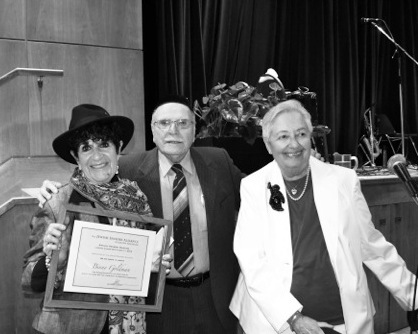
photo - Binny Goldman, left, Serge Haber and Edith Shier also were honored
Binny Goldman, left, Serge Haber and Edith Shier also were honored. (photo from JSA)

Stacey Kettleman was put forward by Congregation Beth Tikvah. She has been a part of Beth Tikvah for many years, and works hard to help many seniors and people who are isolated and need assistance. She thinks nothing of whipping up a meal, whether it be for Shabbat, a Yom Tov or just a warm dinner, and then delivering it to a senior in need. She also ensures the senior has food in his or her home, getting groceries for them if they do not. If Kettleman hears about a senior perhaps not attending an event, she will make a point of getting that person a ride – trying to make sure the senior is not alone, but part of the community.

As a writer, photographer, tribute-card creator and honorary JSA life member, honoree Binny Goldman brings an enthusiastic and positive presence to the many activities she undertakes for JSA. She rarely misses meetings, voluntarily undertakes assignments with devotion and the results are extraordinary.

Last but not least, Edith Shier created Senior Line Magazine, now published three times each year. To quote Haber, the magazine “is the only written communication to the seniors in the Jewish community and continues to receive rave reviews as the best of the best.”

Concluding the festivities, Haber was presented with a gavel and plaque by Berger for the work he has accomplished, the legacy he leaves and the contribution he will continue to make to JSA. He received a standing ovation. For his outstanding contribution to JSA and in memory and honor of his late wife Elinor, the Serge and Elinor z”l Haber Peer Support Fund has been established.

Haber urged everyone to be here and there with all our heart, and to press governments at all levels to play a much stronger role in the well-being of seniors.

Dinner co-chairs were Bernice Dorfman and Regina Boxer.

Gyda Chud is secretary of the Jewish Seniors Alliance of Greater Vancouver executive and board of directors.

Format ImagePosted on October 31, 2014October 29, 2014Author Gyda ChudCategories LocalTags Adolf Zilbershtain, Bernard Jackson, Binny Goldman, Edith Shier, Jewish Seniors Alliance of Greater Vancouver, JSAGV, Ken Levitt, Marilyn Berger, Milton Adelson, Natasha Likholatnikov, Pamella Ottem, Serge Haber, Shelley Rivkin, Stacey Kettleman

Horribly wrong advice

Glenn Greenwald, the journalist who came to our attention as the conduit for Edward Snowden’s Wikileaks cache, has a theory on why members of the Canadian military have been killed in terror attacks like the one last week in Ottawa. They died for the sins of Canada’s foreign policy.

Greenwald wrote a piece after the incident in Quebec on Oct. 20, in which two soldiers were run over – Warrant Officer Patrice Vincent fatally – in a deliberate attack. Greenwald’s article was rerun at rabble.ca on Oct. 22, apparently posted to the site about the time another attack was taking place on and around Parliament Hill in Ottawa.

“It is always stunning,” Greenwald wrote, “when a country that has brought violence and military force to numerous countries acts shocked and bewildered when someone brings a tiny fraction of that violence back to that country.”

Greenwald shifts blame for the soldiers’ deaths from their murderers to Canadian involvement in Afghanistan, Canada’s newly announced air support for the Western battle against ISIS, and on Canada’s being “an enthusiastic partner in some of the most extremist War on Terror abuses perpetrated by the U.S.”

The article has been shared around social media and similar assertions have been made by other commentators.

It needs to be said that both of these incidents, in which the perpetrators themselves were also killed, were apparently “lone-wolf” attacks. Also popping up in social media are demands for greater attention to mental illness in Canada, the implication being that mental instability may have trumped ideology for one or both of these perpetrators. This is an important issue to consider.

Greenwald anticipates the inevitable comeback to his argument – that Islamists are not driven by reaction to our foreign policy but by hatred of our values. That is, they hate us not for what we do, but for who we are.

“They even invent fairy tales to feed to the population to explain why it happens: they hate us for our freedoms,” wrote Greenwald. “Those fairy tales are pure deceit. Except in the rarest of cases, the violence has clearly identifiable and easy-to-understand causes: namely, anger over the violence that the country’s government has spent years directing at others.”

It’s not a stupid idea, but it’s simplistic in the extreme. It suggests not only a self-deception about the ideology driving worldwide terror, but an almost understandable, desperate hope for safety: if we just stop provoking the terrorists, they will leave us alone.

What his position ignores – though it is shared by many – is that the perpetrators are fundamentalists, seeking the destruction of the existing order not only in Syria and Iraq, but worldwide. The deceitful fairy tales are those told and believed by those who refuse to acknowledge evil when they see it beheading people on the internet.

Greenwald’s position, in fact, is a version of the Western colonialist mentality. The actions and worldview of ISIS and other extremists are not born of ideology or theology. No, they are solely a reaction to our actions. It’s all about us. It’s a weirdly imperialist view in its own way.

But even if he is correct, even if the attacks we saw last week and those endured by other democracies including Israel in recent years, were motivated by government actions and policies, his solution is suicide.

Even if there were proof positive that terrorists were motivated by our policies, rather than the fact that we like freedom, equality, an after-dinner drink and mixed-gender dancing, the solution would still not be to change our policy.

For a country to base its foreign policy on whether or not it will be liked or hated by ideologues who scythe off the heads of innocents is a map to self-destruction. The idea that terrorists will target our soldiers and civilians because our government is engaged in far-off conflicts is not completely outlandish, but its corollary – that we should change our foreign policy to one more agreeable for the worst elements in the world – is horribly wrong. That is, to use a hackneyed and ridiculed phrase that is nonetheless spot on, how the terrorists win.

Posted on October 31, 2014October 29, 2014Author The Editorial BoardCategories From the JITags Glenn Greenwald, ISIS, terrorism
Council of good deeds

Council of good deeds

Sarah Marel Schaffer, left, and Sandy Hazan pause while sorting clothing for Operation Dress-Up, a social action project sponsored by the National Council of Jewish Women, Vancouver section. (photo from NCJW Vancouver)

Shlepping bags of new underwear and socks plus bundles of gently used, donated clothing to inner-city Vancouver gives Sarah Marel Schaffer and Sandy Hazan a sense of fulfilment.

The two women spearhead Operation Dress-Up, a social action project of the National Council of Jewish Women, Vancouver section. The clothing they buy, collect and distribute goes to needy children identified by school counselors and principals, by neighborhood youth and family workers, or by the Jewish Family Service Agency.

On Sunday, Nov. 16, the Vancouver section of NCJW will celebrate 90 years of education, advocacy and social action projects such as Operation Dress-Up. The event is set for 11 a.m. to 2 p.m. at VanDusen Gardens, and all are welcome.

Operation Dress-Up, begun 20 years ago, is supported by NCJW fundraising and by grants. United Way recently awarded the project $6,000. Schaffer said they are “quite lucky” to get this amount at one time and will soon call schools to see what’s on their wish lists and determine where the money will be best used.

Both women have been involved in Operation Dress-Up for 10 years. Schaffer said that for her it’s a way to give back to the community. “It’s a joy to dress your own kids in nice clothes and it’s a joy to help out in this way,” she said.

Hazan has found her participation to be a learning experience. “When you see the desperate need in Vancouver, it’s very humbling. I never knew that the poorest postal code in Canada is on the Downtown Eastside. I was shocked,” she said.

While Operation Dress-Up is a hands-on project, NCJW works with many local organizations, mainly by providing grants. One recipient is Children of the Street, whose mission is to intervene to prevent the sexual exploitation and human trafficking of children and youth.

Human trafficking, a modern form of slavery, is a focus for NCJW nationally and internationally. Council has advocated for passage of Bill C-36, to protect girls and women from sexual exploitation, sponsored by MP Joy Smith (Kildonan-St. Paul, Man.).

International Council of Jewish Women has joined with Stop the Traffik (stopthetraffik.org), devoted to ending human trafficking worldwide. ICJW also works on various projects with nongovernment organizations at the United Nations.

In Israel, ICJW lobbies on behalf of women kept captive by unfair divorce laws (agunot), and supports the Women of the Wall in its quest for gender equality. NCJW of Canada supports ALUMA, formerly known as IFCA, Israel Family Services Association.

At the 90th anniversary celebration, a roving magician, speakers – national NCJW president Sharon Allentuck from Winnipeg and international president Robyn Lenn from Australia – and finger food will be part of the fun. Organizations that partner with Vancouver NCJW will be arranged in a “farmers market” of informational booths. Some of these will include the Vancouver Public Library, Richmond Jewish Day School, Vancouver Coastal Health, Elizabeth Fry Society, Jewish Book Festival, Children of the Street, Home Instruction for Parents of Preschool Youngsters (HIPPY), B.C. Transplant Society, Barefoot Books and the Jewish Community Centre of Greater Vancouver. Council’s own projects, Books 4 Kids and Operation Dress-Up, will also be on display.

Tickets to the 90th celebration are $18, available at Vancouver NCJW’s office at the JCCGV. Call the NCJW office at 604-257-5180 for reservations.

Format ImagePosted on October 31, 2014October 29, 2014Author ICJW, International Council of Jewish Women, National Council of Jewish Women VancouverCategories LocalTags National Council of Jewish Women, NCJW, Operation Dress-Up, Sandy Hazan, Sarah Marel Schaffer

Cherie Smith’s support legendary

“Do it! Just do it!” Cherie waves her hands impatiently, puzzled by my hesitation. We are sitting on the white sofa in her bright living room on Point Grey Road. Behind us, through the large picture windows, I see the waters of Burrard Inlet shimmer in the morning sun, framed by the blue mountains of the North Shore.

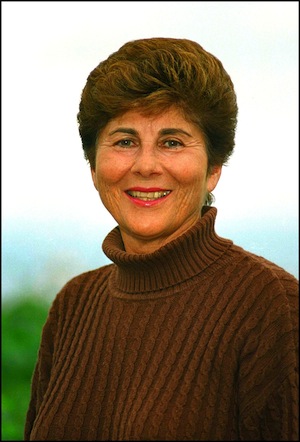
photo - Cherie Smith
Cherie Smith (photo from Jewish Book Festival)

It is mid-morning and light is streaming into the comfortable open space, where each corner bears Cherie’s personal stamp: the beautiful flower arrangement on the glass-top coffee table, the white sculpture on a stand, the painting above the fireplace and the colorful blanket thrown casually over the back of a cozy armchair. Further in, two low steps up, is the large dining room table with the eight high-back, white leather chairs. Behind it, a cupboard with glass doors displays Cherie’s collections of china, glasses of all sorts and other small trinkets. More artifacts are displayed on the heavy, black wood buffet against the wall. The kitchen is small, but efficient, just off the dining room. From where we are sitting, we can see the entrance door and, on the right, a small corridor leading to the second floor where a large triptych, my own painting, hangs over the stairs. One entire wall of the hallway is covered with books.

Books are Cherie’s world.

I met Cherie at a party, a casual encounter in a room full of people. Despite her friendly manner, I was intimidated by her, knowing that she and her husband were not only affluent, but also people who could be defined as pillars of the community. Little did I know that, in time, we would become close friends; much more, that she would become my mentor, giving me all her support and encouragement in my attempt to publish my first book.

Sylvia Barbara, nicknamed “Cherie” by her father, was born in in the middle of the Great Depression, in the small town of Kamsack, Sask. Her father, a general practitioner, delivered her himself, since the local obstetrician was too drunk to perform. Both parents were Jewish immigrants from Poland and Russia, now living in this tiny town of 2,000, including many Doukhobors and First Nations. As a child, Cherie became keenly aware of the racism against minorities, and saw her father trying to offer assistance to those in need at every opportunity. Growing up in Kamsack was a very long way from Cherie’s later life in Vancouver. But, as I was to find out when I got to know her better, her modest childhood was the foundation for her generosity of spirit, her lack of prejudice, her warmth and her humanity.

Slim, well-groomed, her brown-reddish hair cut short, her dress casual but of good quality, Cherie was unaffected and friendly, a mover and a shaker. Once she made up her mind about a certain activity, there was nothing that could stop her. Speaking in quick, concise words, waving her hands about, she passionately advocated her ideas.

As I said before, books were Cherie’s world. She and her husband Buddy owned a bookstore for some time and later promoted writers whenever they could. Cherie would invite writers to speak and even subsidized them by paying their expenses. She was the founder of the Jewish Book Festival, which she tirelessly supported and organized, and now bears her name.

But I digress. Let’s return to that particular sunny morning in Cherie’s living room, where she listens to me worrying about the crazy idea of publishing a book.

“How can I do this? I have never done it before, what if it fails?” I am quite anxious. Perhaps the work is not good enough, perhaps I shall lose all the money lent to me so generously by friends, and perhaps I won’t find a publisher, perhaps, perhaps. But Cherie will have none of that. Doubt and fear of failure are not in her vocabulary.

“Do it! Just do it!” she urges me.

We revisit all the risks and all the benefits of this adventure. She tells me again and again that The Trials of Eve, the largest, most daring and risky work I have ever done, has to be published; it has to be launched into the world. She cajoles, encourages and prods me into taking the plunge. She is willing to help edit my poems; she will help with information and with whatever is needed for the publication process. “Just do it!” she says again and again.

And I did do it. The book came out in due time, first as a limited edition that won the Alcuin Citation Award and, later, as an expanded soft-cover version; both a victory of Cherie’s indomitable spirit.

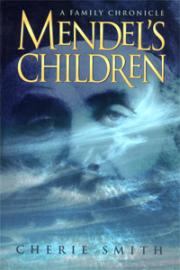
image Mendel's Children cover
Cherie Smith published her memoir as a legacy to her grandchildren in 2001.

When Cherie became ill with the cancer that would eventually take her life, she took it in her usual commonsensical style, bravely fighting her way through without complaining. While visiting her, she told me about her swimming routine at Kitsilano Pool and about her efforts to publish her own book as a special gift to her grandchildren. We would take long walks on the beach, soaking in the beauty of English Bay. She, as usual, continued asking about my activities rather than talking about herself, her warmth and interest flooding over me like sunshine. Later, when she lost her hair due to the harsh chemotherapy she endured, she bought an elegant wig, always putting on a brave front, always concerned about her appearance, but almost never talking about her illness. Only when it became apparent that she was losing the battle did she begin making remarks about luck and fate. She became obsessed with the urgency of finishing the book that she was working on, and kept writing as much as she was capable of in her condition. The book was published before her death.

My last visit with Cherie in her white, sunny living room, took place shortly before her death. Her illness had taken a huge toll. Her body, devastated by the disease, was like a shadow of itself, transparently thin, her face lined, her voice a whisper. She still wanted to know what was happening in my life, but this time she also talked about her own death. I could barely answer her, my voice choking in my throat, tears welling in my eyes. We said goodbye and I left. It was the last time I saw my friend, Cherie.

After this, she refused all visits other than family. She wanted us to remember her as the vibrant, energetic and lively person she had been. And this is how I remember her. But each time I walk past her house, which has now been sold, a dull ache in my chest reminds me that I have lost a very rare, true and irreplaceable friend.

For information and a full schedule of events for the Cherie Smith JCCGV Jewish Book Festival, which runs Nov. 22-27, visit jewishbookfestival.ca.

Pnina Granirer is a visual artist who has exhibited locally, nationally and internationally and whose work is found in numerous private and public collections. Over the years, she has written short essays and poetry, some of which were published in Pnina Granirer: Portrait of an Artist by Ted Lindberg (Ronsdale Press). The Trials of Eve, a work of 12 mixed-media drawings and 12 poems, received an Alcuin Citation Award. This work is in the special collection of the Glenbow Museum in Calgary. The soft-cover edition features a lengthy essay written by the author. Granirer is currently in the process of working on a memoir. This article was originally written in 2009.

Posted on October 31, 2014October 29, 2014Author Pnina GranirerCategories LifeTags Cherie Smith, JCCGV Jewish Book Festival, Mendel's Children
Jerusalem’s spooky historical spots

Jerusalem’s spooky historical spots

The Ministry of Health building in Jerusalem was the scene of a macabre wedding in 1881. (photo by Deborah Rubin Fields)

A government building, a zoological park, a bird observatory and a residential city street: What do these four Jerusalem locations have in common? In fact, each place is shrouded in mystery. Each conceals secrets. Each is part of Jerusalem’s landscape of spooky sites.

Back in 1881, the Ministry of Health building at 86 Jaffa Rd. (located across the street from the Mahane Yehuda market) was destined to be the villa of a well-to-do Christian Arab groom and his new bride. Unfortunately, the old adage “money does not buy happiness” came true. Personal wealth did not prevent personal tragedy; the young man died right before his wedding.

Making a macabre decision, the bereaved parents decided to go ahead with the gathering. At the party, the deceased groom was propped up next to his bride-to-be. Before everyone went off to the funeral, the bereaved mother supposedly honored “the couple” by performing the traditional wedding dance and dabbing the bride with henna.

Not surprisingly, this story had a chilling effect on local residents. The building remained empty for 10 years. After that, the Ottomans turned it into a general municipal hospital, a mustashfa. But because of its morbid history, even the most destitute patients were afraid to go there. It took a long time for people to forget its spooky beginnings, but eventually Jerusalemites, particularly from Lifta, Malha and Silwan, began to use the 30-bed facility.

Although financially strapped, the hospital stayed open until the British took over in 1917. They turned it into the Mandatory’s offices of the Ministry of Health. After 1948, the Israeli government made the building the Jerusalem regional offices of the Health Ministry. Today, Jerusalemites know it as the place to get their anti-rabies shots or their inoculations for the big post-army trip to South America or Asia.

Unfortunately, today the inside looks like many other old Jerusalem buildings: modern fixtures rudely stuck to old structures in utilitarian rather than esthetic fashion. Yet, some of the intriguing architectural additions remain outside: the winding, exposed staircases at the front of the building, for example, still shine. At one point, the stairs led to a roof from which guards had a good command of the comings-and-goings on Jaffa Road, at that time the main artery to the coast.

photo - Both the Jerusalem Biblical Zoo and the Jerusalem Bird Observatory offer visitors a chance to see and learn more about bats
Both the Jerusalem Biblical Zoo and the Jerusalem Bird Observatory offer visitors a chance to see and learn more about bats. (photo by Deborah Rubin Fields)

Some animals also bear the brunt of unearned labels and gossip. Take bats, for example. At one time or another, many of us will have heard fears about bats biting people, as well as the mythical association of bats with vampires.

While some might take points off due to the fact that bats are not considered kosher (see Deuteronomy 14:18), bats deserve credit for keeping our environment in check by consuming copious amounts of insects. Besides that, close up, bats are rather cute.

Strange as it may seem, if you stroll past 83-87 Bar Kochba St. in residential French Hill at dusk (or near HaChayil 41, close to midnight), you might notice some of the small, winged creatures (not larger than an adult hand) darting through the air. At this time of day, bats leave the east side of the street and head for the park on the west side. Look quickly before they disappear from view.

If this subject drives you batty, the Jerusalem Biblical Zoo offers explanation and viewing of both insect-eating bats and fruit-eating bats. The zoo takes part in the research and conservation of the dwindling insect-eating bat population. Moreover, some time ago, the zoo acquired a new male Australian fruit bat. He was apparently quite the hit with the ladies, who evidently enjoyed “hanging out” with him.

In past years, the zoo has hosted summer’s eve tours focusing on bats and other night-active animals. Pre-registration has been mandatory and there is a charge. For more information, call 972-02-675-0111. Children 8 years old and over are welcome to participate.

The Jerusalem Bird Observatory near the Knesset also offers bat- (and other night-active animal-) watching activities for children ages 5 and above. For more information, call 972-02-653-7374 or 972-052-386-9488, or email [email protected]. There is a small fee for the walking tour.

Remember when you visit Jerusalem, keep an eye out for surprising sights and historical facts; things are not always what they appear to be and surprises are in store.

Deborah Rubin Fields is an Israel-based features writer. She is also the author of Take a Peek Inside: A Child’s Guide to Radiology Exams, published in English, Hebrew and Arabic.

Format ImagePosted on October 31, 2014October 29, 2014Author Deborah Rubin FieldsCategories IsraelTags bats, Jerusalem Biblical Zoo, Jerusalem Bird Observatory
Mystery photo … Oct. 31/14

Mystery photo … Oct. 31/14

A group of women at a Hadassah-WIZO event, 1950. (photo from JWB fonds; JMABC L.19711)

If you know someone in this photo, please help the JI fill the gaps of its predecessor’s (the Jewish Western Bulletin’s) collection at the Jewish Museum and Archives of B.C. by contacting [email protected].

Format ImagePosted on October 31, 2014October 29, 2014Author JI and JMABCCategories Mystery PhotoTags Hadassah-WIZO, JMABC
קנדה מגנה את הפיגוע בירושלים

קנדה מגנה את הפיגוע בירושלים


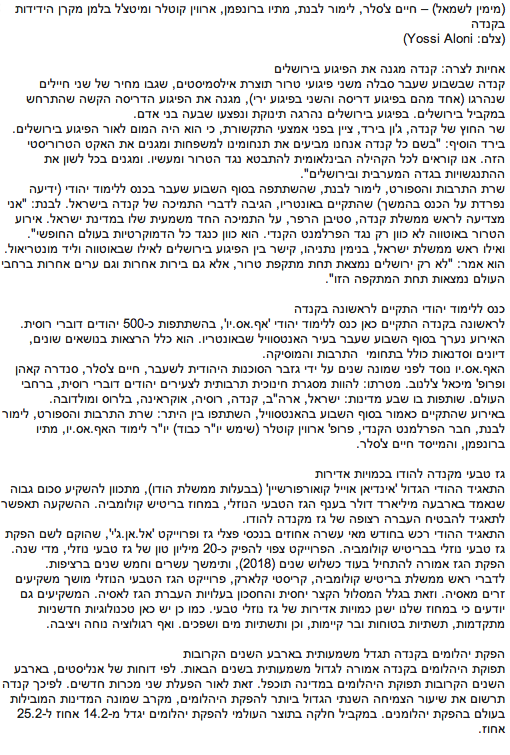
image - Hebrew text for Oct. 31st column, Canada condemns attack in Jerusalem ....


Format ImagePosted on October 28, 2014November 2, 2014Author Roni RachmaniCategories עניין בחדשותTags Binyamin Netanyahu, Chaim Chesler, Christy Clark, diamonds, Irwin Cotler, John Baird, Limor Livnat, Matthew Bronfman, Mitchell Bellman, natural gas, Stephen Harper, terrorism, ארווין קוטלר, בנימין נתניהו, ג'ון בירד, גז טבעי, הפקת יהלומים, חיים צ'סלר, טרור, לימור לבנת, מתיו ברונפמן, קריסטי קלארק
Spielberg opens film festival

Spielberg opens film festival

Roberta Grossman (director), left, and Nancy Spielberg (producer) on the Duxford set of Above and Beyond. (photo from playmountproductions.com)

On Nov. 6, the 26th annual Vancouver Jewish Film Festival begins with the Canadian première of Above and Beyond, about a mainly American group of pilots, veterans of the Second World War, who fought for Israel in 1948. As part of Machal (foreign volunteers), “this ragtag band of brothers not only turned the tide of the war, preventing the possible annihilation of Israel at the very moment of its birth, they also laid the groundwork for the Israeli Air Force.”

Directed by Roberta Grossman, the 96-minute documentary was produced by Nancy Spielberg, who will be in Vancouver for the screening. Spielberg took the time to speak with the Independent via email in anticipation of her visit.

JI: What was it about the Machalniks’ experiences, in particular those of the air force pilots, that you found so compelling that you not only wanted to make a documentary but are following up Above and Beyond with a feature film version?

NS: First of all, we focused on pilots because, frankly, pilots are a lot sexier than infantry! There’s a romantic, tough, swagger, daring, live-on-the-edge, sweep-you-off-your-feet personality that felt bigger than life. I was so curious why these WWII pilots survived their tour of duty for the good ol’ US of A and then turned around and risked their lives for another country, and I was surprised that most of them were not at all Zionistic.

What drives a person to risk everything to save another person in need? Would I do that? Would you? Do we still do that as Americans? Is it part of that generation? Is it part of the American psyche? I was intrigued by their motivation and then I was swept off my feet by their charm and their chutzpah! The “adventures” that took place along the way and during their time in Israel make for great storytelling.

JI: What will a feature film be able to communicate that the documentary could not, or did not?

NS: I do hope that a feature film (dramatization) will communicate the same messages that we hope the doc does – how far does one go to help a brother in need? With a dramatization, we have more freedom to embellish the pilots’ stories and capers that we may have had to reduce in the doc or discard altogether. There are so many details and wild antics that could not be included in the doc but we’d love to explore in the dramatization.

JI: Near the end of Above and Beyond, you ask Coleman Goldstein whether he thought Israel would survive in tough times. What prompted the question and what was your reaction to his response, that, yes, it would survive, as “Israel’s an article of faith”? What is your answer to the question, and is it different now than it would have been when you asked it, given the most recent Israel-Hamas conflict (and the antisemitism it exposed) and as the U.S.-led fight against IS continues?

NS: We asked every pilot we interviewed whether he thought Israel had a fighting chance, or whether he thought he might not make it out alive. George Lichter said, “I thought we would lose….” We were surprised at Coleman’s answer because he was a very pragmatic, matter-of-fact gentleman, and he responded from his heart, as many of the pilots we interviewed did. Maybe they’ve become “softies” in their golden years, but there was a lot of emotion in our interviews.

My personal answer is that I am a spiritual person, and I agree with Coleman and Prime Minister David Ben-Gurion who, in 1956, said, “In Israel, in order to be a realist you must believe in miracles.” I need to hold on to that thought and belief in spite of the latest Israel-Hamas war and the antisemitism that has, once again, reared its ugly head.

JI: How does Israel and Judaism or Jewish culture fit into your life, and what would you tell North American Jewish youth today who, if polling is any indication, aren’t as connected to the Jewish state or Jewish practice as previous generations?

NS: I grew up in Phoenix, Ariz., where our family was the only Jewish family in the neighborhood (who didn’t always take too kindly to us). We were three-times-a-year Jews – Pesach, Yom Kippur and Chanukah. Outside of that, we were gastronomical Jews with a love for Yiddish and Russian melodies.

When I was in fifth grade, I started to go to a Jewish day school, which prompted me to come home and tell my mom that we needed to start keeping kosher so that I could have school friends over for play dates. Slowly, we evolved into kosher and Sabbath observance. When I was 19, I decided to leave UCLA and spend time on a kibbutz in Israel with my sister. That was it! I fell head over heels. I found a home that I didn’t know I was even missing. From that time on, I’ve been involved in Israel, Judaism and Jewish culture. My children went to Jewish schools and Jewish camps. In fact, my 26-year-old, Jessy Katz, has been living in Israel for two years. When I say to her, “I miss you, come home!” She says, “I am home.”

One of my main motivations in making this film is to reach out to the North American Jewish youth who feel very disconnected in the hopes that this film will be a much-needed shot in the arm of Jewish pride. I’m hoping that they will find a connection and take a fresh look at Israel and how it plays an integral part in being a Jew.

Above and Beyond screens at Fifth Avenue Cinemas on Nov. 6, 7 p.m. For more information about the film, visit playmountproductions.com. For the full schedule and tickets for this year’s Vancouver Jewish Film Festival, which runs Nov. 6-13, visit vjff.org.

Format ImagePosted on October 24, 2014October 23, 2014Author Cynthia RamsayCategories TV & FilmTags Above and Beyond, Israeli Air Force, Machal, Nancy Spielberg, Roberta Grossman, Vancouver Jewish Film Festival, VJFF, War of Independence

Posts pagination

Previous page Page 1 … Page 618 Page 619 Page 620 … Page 664 Next page
Proudly powered by WordPress