Salome Henry, second from the right, in Jerusalem on her Ambassadors to Poland trip with, left to right, Deborah Stein, Ashley Solomon and Zahava Rothschild. (photo from Salome Henry)
The Anne Samson Jerusalem Journey (TJJ) is trying to increase Jewish engagement among Conservative, Reform and non-denominational youth. A four-week summer program for public high school teens, TJJ takes participants on a Jewish heritage trip to historical and modern sites in Israel.
Participant Salome Henry, 16, was born in France and later made her way to Vancouver with her family, before recently moving again with her family to Boston. She went on TJJ – which is run by NCSY (National Conference of Synagogue Youth, the international youth movement of the Orthodox Union) – two years ago. She stayed involved with NCSY after the trip, which she took while she was still living in Vancouver.
“I’m hoping to stay connected to the organization,” Henry told the Independent. “I ended up going on a second summer program after TJJ. I went on the Ambassadors to Poland trip, which was spending one week in Poland learning about Jewish history, followed by three weeks in Israel, which was really intensive.”
While Henry goes to public school, her school has a Jewish students union, which she helped get started this past year. “This is one way that I stay connected to the Jewish community, because it’s rather hard if you go to public school.”
Henry said, “Most of the friends I have at school who are Jewish don’t really associate with Judaism, or they don’t consider themselves Jewish, or they celebrate things in different degrees…. I thought to myself that it would be great to have something like this. I know I definitely wanted to be able to talk about Jewish issues that I usually discuss at NCSY, but I feel like a lot of other kids can benefit from it, too.’”
Henry’s school has a large Jewish population from Israeli, Russian and American backgrounds. “It’s a very diverse community,” said Henry. “I remember when I came to the school, I realized there were so many people who are Jewish.”
The Jewish student group is looking at planning a trip next year to Israel or a one-week trip to Poland. At board meetings, they talk about upcoming holidays and there is a rabbi on hand if people have any religious or spiritual questions.
“We just received a lot of funding for next year, so what we are going to be doing is getting speakers to come and speak on important subjects and people will be able to come after school and listen to them,” said Henry.
In addition to putting together the speakers program for next year, Henry is finding places where students can volunteer in conjunction with the local synagogues. “I think it would be nice to add that aspect to our club,” she said.
“I’m going to delegate some work to some younger kids, because I want the club to be able to grow afterwards,” she added. “If all the seniors in the club graduate and no one can take over, that would be unfortunate.”
Another thing weighing on Henry is to find ways to support Israel in the larger community. “When I was in Israel last summer, we talked a lot about what it means to be a Jew on a college campus and how to speak up for Israel, especially in terms of media,” she said. “It’s hard to really talk to people who are so against it.
“A lot of kids have these ideas – they see it [Israel] in the media, which is captured very differently from what the reality is, so they immediately assume that what Israel is doing is wrong. If they took the time to analyze, they’d see what Israel is doing is logical and is what any other country would do.
“If they knew more about the IDF [Israel Defence Forces], they’d know it’s one of the most moral armies out there. So, I think that’s really something that we … today, as American Jewish youth, if we have the resources to learn about it … we really have the duty to tell others around us who don’t know about it, because it’s for the good of the Jewish community. It’s also our reputation that is at stake. Hopefully, we can focus on that next year.”
Being from France, Henry is keeping a close watch on what is unfolding there, as well – and more so as of late, as she will be there this summer. “I’m so concerned, because I know that things in Europe are so much worse for Jews,” said Henry. “With current events, people are starting to realize the intensity of the situation.”
From conversations with her family, Henry has become more aware that this current situation is not a new one for French Jews – something she feels people need to be educated about. “It’s horrifying to think the Holocaust has already happened, but people are still saying the same things that they were in the in 1940s. There’s still so much hate out there.”
Henry’s parents are very proud and happy with her involvement. “Both my parents love my NCSY friends and they are happy that I have that community near me,” she said. “They are thankful, because they know how much they mean to me.”
Seeing her go to Israel last summer with TJJ while Israel was in the midst of a conflict did not overly concern her parents, as they knew she was in good hands with a great group of kids, said Henry. And, indeed, everyone returned home safe.
Positive TJJ stats
According to a recent study commissioned by NCSY, 92% of the Jerusalem Journey “alumni feel emotionally attached or very attached to Israel.”
“The results suggest that TJJ – the trip, the subsequent educational activities and other consequences of participation – played a major role in generating increased Jewish engagement in these areas, and undoubtedly many others as well,” said the report, called The Jewish Impact of the Anne Samson Jerusalem Journey (TJJ): Increasing Jewish Engagement among Conservative, Reform and Non-Denominational Youth.
Conducted by Prof. Steven M. Cohen of Hebrew Union College-Jewish Institute of Religion and Ezra Kopelowitz, chief executive officer of Research Success Technologies in Israel, the internet survey portion of the study took place last spring. Non-Orthodox alumni who had participated in summer programs since 2007 were contacted. Of the 1,784 alumni surveyed, more than 20% provided responses that could be used in the analysis.
Questions focused “on behaviors and attitudes considered to be important to Jewish leaders across the denominational spectrum” in an attempt to answer the question, “Does the Jerusalem Journey help make non-Orthodox-raised Jewish youngsters ‘more Jewish’?” Responses from the TJJ survey were compared with the Pew Research Centre survey of Jewish Americans (2013), the Jewish Community Study of New York 2011 and the Birthright survey of applicants for 2001-05 but who never participated (2010).
According to the report summary, “86% of TJJ alumni said it was very important to raise children as Jewish, compared with 69% of Birthright applicants; 80% of TJJ alumni fasted for the whole of Yom Kippur, compared with only 48% of the 18-to-29-year-olds in the statistically adjusted Pew survey; 75% said it was ‘very important to marry a Jew,’ compared with 55% of Birthright applicants; and 73% of TJJ alumni usually attended a Shabbat meal, compared with only 34% of Birthright applicants.”
As well, “94% of TJJ alumni said they attended a Passover seder last year, 61% said they participate in Jewish learning on a weekly or more frequent basis and 41% said they returned to Israel after attending TJJ…. In general, the survey found that TJJ attracts significant Jewish engagement and identity among young people who were not raised in Orthodox homes.”
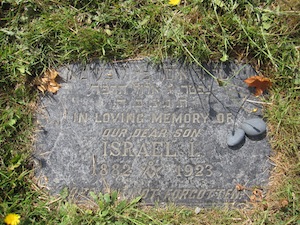
Louis and Toby Rubinowitz and their son, Israel, are buried together in the Jewish section of Vancouver’s Mountain View Cemetery, while Toby’s sister Sarah is buried separately. (photo by Cynthia Ramsay)
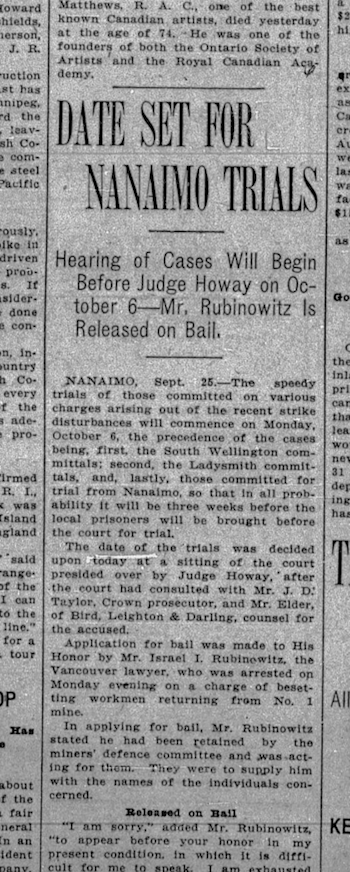
“Like a bolt from the blue, and to my profound astonishment, I was on Tuesday afternoon set upon by a number of special constables and arrested,” Israel Rubinowitz wrote from his prison cell in Nanaimo.
It was autumn 1913 when the budding defence lawyer made a plea for his release, penning a letter to Judge Frederick Howay in the midst of a coal miners’ strike on Vancouver Island. Though a Conservative in politics, Rubinowitz offered a passionate, occasionally radical, perspective in British Columbian courtrooms. He grew up in Vancouver, studied at McGill University in Montreal and attended Oxford University in England on a Rhodes scholarship in 1905. He returned to Vancouver and had only practised law for a short time when he found himself in Nanaimo – as both counsel and accused.
His predicament began when he agreed to represent members of the United Mine Workers of America (UMWA). Conflict had been brewing in mining communities on Vancouver Island’s central east coast since miners set up pickets in 1912. The coal companies refused to bargain and hired strikebreakers to keep their mines operating. “Special” constables, untrained and inexperienced, patrolled the region to keep order. In the summer of 1913, clashes broke out between strikers and replacement workers, starting in Cumberland and Nanaimo and spreading to Extension, South Wellington and Ladysmith. The provincial government declared martial law and sent in a militia on Aug. 13 after one man was killed, several surface mine buildings were burned down and homes were damaged. More than 200 strikers were arrested and 166 charged. None were granted bail. Martial law remained in the area for the next year.
The union hired experienced Vancouver labor lawyers Joseph Edward Bird and John Wallace de Beque Farris to defend the accused members. A group of Nanaimo residents fundraised independently and hired Rubinowitz, despite being advised by union officials and their lawyers that he was too inexperienced.
On that fateful Tuesday afternoon in September, Rubinowitz met with strikers Walter Pryde and William Moore on a Nanaimo street to discuss his clients’ cases. Special Constable Maguire and five other constables were patrolling the neighborhood. Maguire spied Rubinowitz and his companions and told them to move along. The trio continued walking, and were engaged in discussion when a train appeared and came to a halt. Twelve replacement workers disembarked, walking past the three men and the constables.
According to the Nanaimo Free Press, Maguire told Rubinowitz, “You are arrested for picketing.”
“I dare you,” Rubinowitz answered. “You don’t know who I am.”
“I don’t care who you are,” Maguire replied.
“After being publicly paraded through the principal streets,” Rubinowitz wrote in his letter to Howay, “I was taken to the police station where I was ultimately informed after persistent demands, that I was being charged with besetting or watching and following and intimidating workmen.”
Rubinowitz further wrote he had been falsely arrested. “I solemnly declare it is a wicked and deliberate trick to prevent my appearing [in court] for the men.”
After spending a sleepless night in jail, Rubinowitz appeared before Magistrate J.H. Simpson. He denounced the charge against him as “preposterous and fantastic.”
The exchange was reported in the Free Press:
“You put yourself in a false position,” the judge told him.
“You are not entitled to make such a suggestion,” the young lawyer responded.
“I ask for no favors,” Rubinowitz also told the court. “If I do not get justice here, I shall get it elsewhere.”
As reported in the Daily Colonist on Sept. 26, 1913, Israel Rubinowitz was released from jail “on his surety of $500.”
Thomas Shoebotham, acting for the Crown, requested that the bail hearing be moved to Friday, and the judge consented. But Rubinowitz’s letter to Howay and telegrams to newspapers had an impact. His plight received sympathetic media coverage from Victoria to Toronto. After his second night in jail, Rubinowitz was granted bail, though the judge let him know his letter to him was “ill advised.”
Rubinowitz stood before a packed courtroom for a preliminary trial on the Friday. He objected to Simpson’s presence on the bench, arguing Simpson had implied his guilt at the bail hearing and criticized the selection of Shoebotham. The judge overruled both objections.
“I was going to No. 1 mine with Pryde to see the district,” Rubinowitz testified. “I asked Moore to join me.… I stood about a minute pointing north and south. That gesture was seen by police.” Rubinowitz said Special Constable Collison pushed him. “I turned round and may have stared at him indignantly.” As for the arrival of the replacement workers, he said, “I was absorbed by my guides and didn’t notice them.”
Sam Davis, a Crown witness, was one of the workers coming off the train. He testified that he had not been spoken to by any of the accused and had not known anything about the incident until after their arrest.
Simpson seemed determined the case should proceed. “The least can be said is that the three men were in a disturbed district,” he told the court, “and that permission could have been obtained if they cared to have applied for it.” He also defended the special constables’ actions, saying, “… if no notice had been taken of this incident, there was a chance of another outbreak in the district.”
Shoebotham argued that an impartial jury in Nanaimo would be difficult to obtain because public opinion was “inflamed” in favor of the strikers, and requested the trial be moved to the mainland. Rubinowitz agreed but added, “I desire to dissociate myself from the reflection cast upon the good name of the citizens of Nanaimo.” (NFP, Oct. 2)
A month later, dressed in lawyer’s robes, Rubinowitz stood before Judge Aulay Morrison in a Vancouver court. “I appear, my lord on behalf of Pryde and Moore,” he said, “and I ask that they, together with myself, be discharged.” Before the morning was over, a jury found the three men “not guilty.”
By this time, several of the 160 accused strikers had been sentenced, following “speedy trials” in Nanaimo. They pleaded guilty on the advice of lawyers Bird and Farris in the hope of appeasing the court.
The remaining accused, having pled “not guilty,” were being tried in New Westminister. Rubinowitz represented 23 clients, while Bird defended 34. Most were granted bail and, when their trials finally concluded in the spring of 1914, nine went to prison, while others received a suspended sentence or were released because of time already served. Twenty-two men were pardoned. The last union man was released from prison Sept. 25, 1914. The union had been broken and many striking miners were blacklisted and had to find jobs elsewhere.
Rubinowitz was still seeking vindication, despite his acquittal, suing the Nanaimo Herald publisher, J.R.H. Matson, and its editorial writer, R.R. Hindmarsh, for libel. Among the alleged statements was the suggestion Rubinowitz had been purposely “seeking notoriety” the day he was arrested in Nanaimo. The case was tried June 8, 1915, before Justice William Clement with Sidney Taylor, KC, representing Rubinowitz and Robert Reid defending the newspapermen. On the second day, a jury rendered a verdict in favor of Rubinowitz and the Herald was ordered to pay him $1,000 and legal costs.
* * *
Israel Isidore Rubinowitz was the only child of Lithuanian Jewish immigrants, Louis and Toby Rubinowitz. The couple had been among thousands of Eastern European Jews emigrating to North America to seek better opportunities and escape the pogroms under Russian rule. Louis immigrated to New York City in 1879, at age 19, and traveled on to Pittsburgh, where many Lithuanian Jews had already settled. Two years later, he married Toby Rosenthal, and their son Israel was born in 1882. When Israel was 8, the family moved to Vancouver.
The couple were among the first Jews from Eastern Europe to settle in the city. David Oppenheimer, Vancouver’s second mayor, from 1888 to 1891, and a German Jew, represented the small population
of Western European Jews. Antisemitism does not appear to have been widely prevalent in the city’s early years. By the 1920s, this would change in Vancouver and elsewhere. Early tolerance of Jewish residents may be due in part to members of the dominant white population channeling their prejudicial treatment toward residents of Asian background. As well, only 83 Jewish people resided in Vancouver in 1891, increasing to 2,400 by 1931 – compared to 45,000 people in Toronto and 17,000 in Winnipeg.
Louis operated a grocery in Steveston with two partners. In 1894, his family lived in Gastown, the city’s first downtown core. In 1896, Louis opened a department store, Rubinowitz and Co., on the main floor of the five-storey Dominion Hotel, at the corner of Water and Abbott streets. He sold clothing, boots, shoes and other goods.
Sarah Rosenthal is buried separately from the Rubinowitzes, on the edge of the Jewish section of Mountain View Cemetery. (photo by Cynthia Ramsay)
That same year, Toby’s sister, Sarah, 23, arrived from New York, divorced, pregnant and severely depressed. She gave birth to a son, named Abraham, and they lived with the Rubinowitz family. Israel was 13 when his aunt took her life, drowning in Burrard Inlet. At the coroner’s inquest, which confirmed death was by suicide, it was discovered Sarah had been pregnant and had an abortion. The coroner attempted to discover who the man involved with Sarah could have been, but to no avail. Louis and Toby continued to care for Sarah’s son and gave him their surname.
While attending Vancouver High School and College, Rubinowitz helped his father in the store. He won academic awards in his senior year. He volunteered in the Duke of Connaught’s Own Rifles, a local militia that recruited from his high school. Following graduation with a bachelor of arts degree at McGill, Rubinowitz articled in two Vancouver law firms, his training temporarily postponed when he won a Rhodes scholarship – the second British Columbian to do so. He studied at Oxford University, then returned home to complete his articles. Attracted to England, Rubinowitz traveled overseas again to practise law for about two years before returning to Vancouver in 1911. He was admitted to the B.C. bar July 9, 1912.
Living with his parents, Rubinowitz had only a short distance to walk to his law office on Granville Street. He became a member of the Masonic order, continued his involvement with the Vancouver Zionist Society (of which he was a founding member) and, during the First World War, was active as secretary of the B.C. Red Cross.
When the First World War began in 1914, Sarah’s son, Abraham, was working as an electrician and carpenter. After the government implemented conscription in 1917, Abraham, 21, was drafted. Following his service, he moved to the United States.
* * *
Rubinowitz had only been practising for a short time when, in May 1913, he took on the defence of a female nurse arrested for murder. Mrs. Ida Ironmonger, 43, was accused of administering drugs to Mrs. H.O. Anderson to induce an abortion, resulting in her death. Rubinowitz’s attempt to have his client released on bail pending the murder trial was unsuccessful. In October – only four days before his own trial in connection to the Nanaimo arrest – Rubinowitz convinced the court to reduce Ironmonger’s charge to “giving noxious drugs and aiding and abetting a deceased woman to commit an illegal operation.” In the four-day trial, Rubinowitz made the case, which included medical testimony, that “the act might have been committed by the deceased herself.” Ironmonger was acquitted after the jury deliberated a mere five minutes.
Until 1968, abortion was illegal in Canada under the Criminal Code. “There is no place in Canada for the professional abortionist,” Judge Murphy told the court in reference to another Rubinowitz client, Joseph Kallenthe, who was found guilty by a jury in a Vancouver court in 1915. The judge also noted of the accused, “I have no doubt from the skill you displayed that you have had much practice.” Rubinowitz urged mercy, stating it was Kallethe’s wife and two children “on whom the brunt of the punishment will fall,” and Kallethe was sentenced to three years in prison.
In 1918, Rubinowitz represented a couple who had taken out a marriage licence without a religious or secular ceremony. They had two children before learning they were not legally married. Rubinowitz corresponded with the B.C. attorney general’s office, stating it was “only fair, particularly to the woman, that every effort should be made to make the marriage valid and to make the children legitmate.” The government responded that the issue could only be remedied with a private member’s bill, an action his clients could not afford. The couple’s dilemma was submitted by letter to a newspaper editor, signed by a “Vancouver barrister.” This led a reader of the newspaper in the same predicament to write the attorney general. Consequently, the Marriage Act was amended, providing for the legitimization of children to couples in this legal situation.
Rubinowitz was presented with his most challenging cases in the midst of Canada’s 1918-1919 “red scare” era. The federal government had suspended civil liberties, enacting the War Measures Act during the First World War in pursuit of “enemy aliens.” In the social turmoil after the war, fear of an uprising similar to the Russian Revolution in 1917 led to a government crackdown on left-wing activists. Panic – real and imagined – culminated in the spring of 1919 with the Winnipeg General Strike. By June, as the strike was nearing an end, the government amended the Immigration Act. A newcomer to Canada could not be legally landed if suspected of subversive activities, as determined before an immigration board. The verdict rendered – behind closed doors – could not be challenged in a civil court.
A month following the amendment, 27 Russians in British Columbia were charged with participating in an anarchist ring connected to the Union of Russian Workers. Rubinowitz defended several of the accused. Secret service agents working with the Royal Northwest Mounted Police provided most of the evidence for the prosecution. After the hearings, the board ordered the deportation of 14 of the 27 men.
Bird’s son, Henry, also a lawyer, acted for the local defence committee. He appealed the cases to the Ministry of the Interior. It was agreed that one of the accused would not be deported but had to report regularly to the police. In October, the other 13 Russians were sent to an internment camp at Vernon to await further arrangements.
Rubinowitz instigated a perjury charge against two of the secret agents, accusing them of giving false evidence to the immigration board against three of the accused. Rubinowitz pointed out that the immigration board had taken away rights guaranteed by the Magna Carta and Habeas Corpus Act, such as trial by jury and release on bail. He also criticized the board’s composition of appointees, stating they were not familiar with law. Judge Morrison and the Crown lawyer “severely” rapped him for saying fair play had not been done. The judge said the act “was really a war measure” and necessary “for the preservation of the nation.”
On Jan. 14, 1920, the case was moved to a higher court. Meantime, the detention camp in Vernon was closed. One of the 13 accused was released on parole and the others were transported to the B.C. penitentiary.
In May, the two secret agents were acquitted, the judge deciding the evidence had not been sufficient to sustain a charge. Rubinowitz was ordered to pay $2,000 in court costs.
The 12 imprisoned Russians were paroled that December but never deported because the government was unable to find a country willing to accept them. Considered a victory for left-wing activists, these detentions and those elsewhere in Canada had nevertheless served to send an intimidating message to politically active immigrants.
* * *
Rubinowitz was a 41-year-old bachelor when he developed acute bronchopneumonia in the spring of 1923. In the early morning of Aug. 15, he died in his parents’ home. The burial was held the following day.
Israel Rubinowitz died on Aug. 15, 1923, and is buried alongside his parents in Mountain View Cemetery. (photo by Cynthia Ramsay)
News of his death came as a “distinct shock” to members of the legal community, who responded with an “overflow of high esteem,” according to a newspaper account. He was described as a shrewd lawyer, quick to spot a weakness in an opponent’s argument, as well as considerate, courteous and kindly “even in the heat of battle.”
His parents carried on. Louis ran unsuccessfully for mayor three times and for alderman five times over the ensuing years. He “achieved a reputation as an eccentric and perhaps this is why he was not a recognized leader of the [Jewish] community,” observed a writer for the Jewish Independent’s predecessor, the Jewish Western Bulletin.
In 1939, Louis visited Vancouver archivist James Matthews to set down his stories.
* * *
The Rubinowitzes are buried together in the Jewish section of Vancouver’s Mountain View Cemetery. Toby passed away in 1952, aged 90. Louis entered a provincial home for the aged in Coquitlam a few years after his wife died, passing on in 1958 at age 98. Sarah is buried separately on the edge of the Jewish section.
Janet Nicol is a history teacher at Killarney Secondary School in Vancouver and a freelance writer, with a special interest in local history. She blogs at janetnicol.wordpress.com. The writing of this history – which will be published in greater length in the 2016 edition of The Scribe – was inspired by the novel The Sacrifice by Adele Wiseman (1928-1992). In the words of its protagonist, the family patriarch, Abraham: “… and yet there was a time, I think, when I had everything … but now, when I look back, I had at least the beginning of everything.”
On July 21, Prime Minister Stephen Harper announced that negotiations toward an expanded and modernized Canada-Israel Free Trade Agreement (CIFTA) had concluded. “Israel is a priority market for Canada and holds great potential for Canadian companies in a variety of sectors. An expanded and modernized free trade agreement will lead to a strengthened bilateral relationship as well as an increase in jobs and opportunities for Canadians and Israelis alike,” said Harper.
The modernized CIFTA will notably provide expanded market access opportunities for agricultural, fish and seafood products through the reduction or elimination of Israeli tariffs on a large number of products, and duty-free access under tariff rate quotas for certain products.
Four existing areas of the current CIFTA have been amended, namely market access for goods, rules of origin, institutional provisions and dispute settlement. In addition, seven new chapters have been included in the areas of trade facilitation, sanitary and phytosanitary measures, technical barriers to trade, intellectual property, electronic commerce, labor and environment.
Israel is a priority market for Canada under the Global Markets Action Plan. Since CIFTA came into force in 1997, Canada’s two-way merchandise trade with Israel has tripled to $1.6 billion in 2014. Key opportunities for Canadian companies exist in sectors such as defence, information and communications technology, life sciences, sustainable technologies, agriculture and agri-food, and fish and seafood.
The modernized CIFTA will provide expanded market access opportunities for Canadian businesses through the elimination of tariff and non-tariff barriers, and help in creating new sources of jobs, growth and prosperity for both countries in the years ahead. It will support Canadian businesses and investors, deepen trade and investment linkages, and further strengthen Canada’s bilateral relationship with Israel.
Three men eating at the Jewish Community Centre of Greater Vancouver, circa 1965. Rabbi Marvin Hier is sitting on right but the men on the left are unidentified. (photo from JWB fonds; JMABC L.11568)
If you know someone in these photos, please help the JI fill the gaps of its predecessor’s (the Jewish Western Bulletin’s) collection at the Jewish Museum and Archives of B.C. by contacting [email protected].
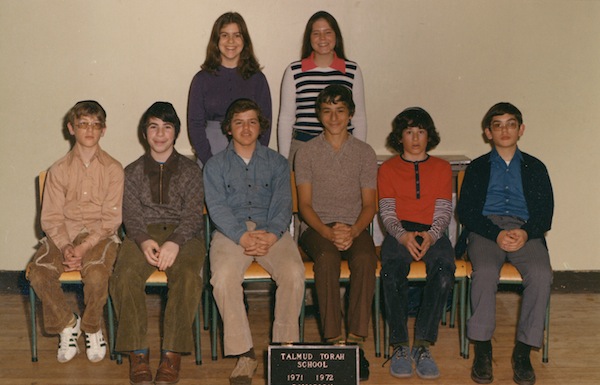
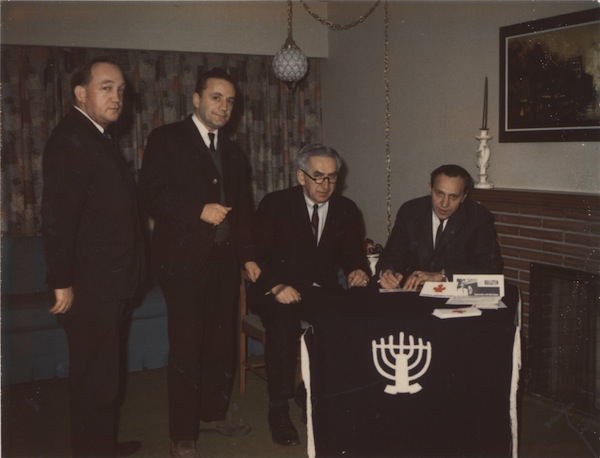
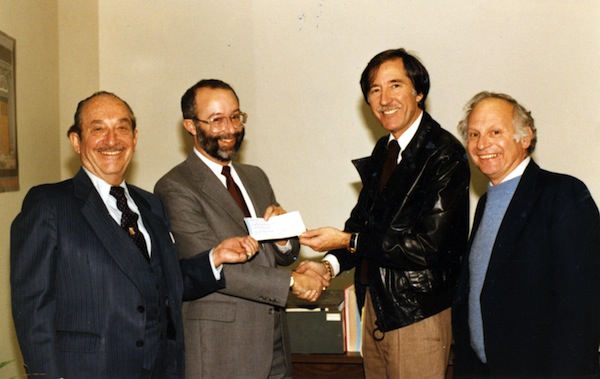
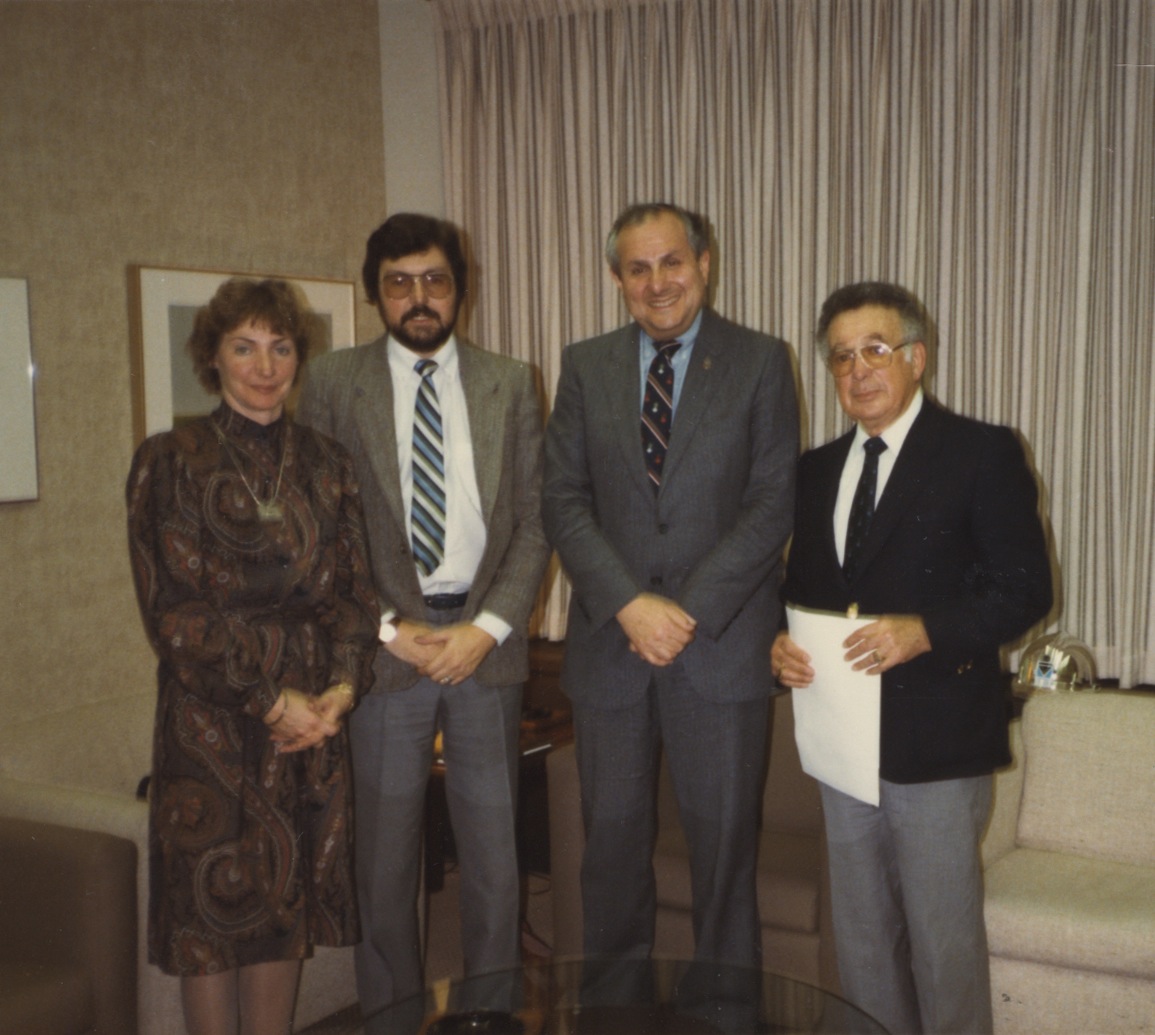
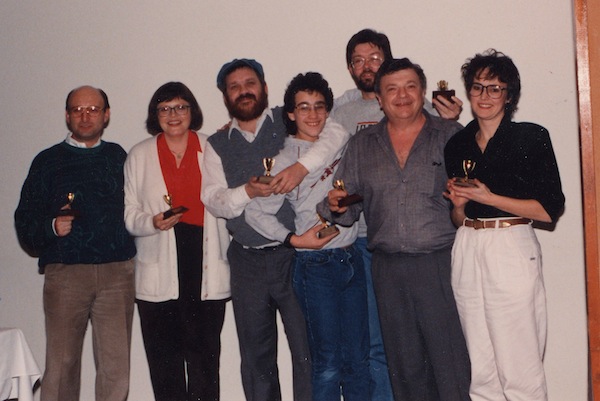
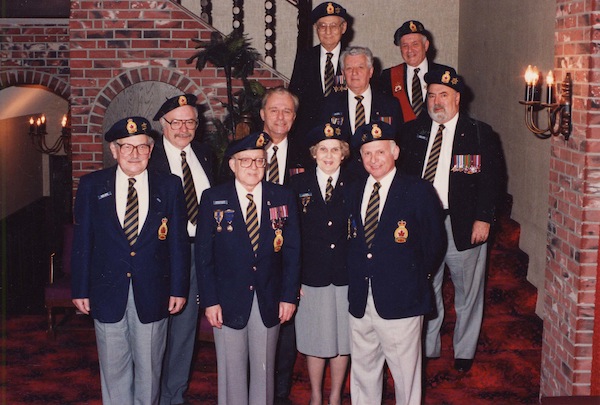
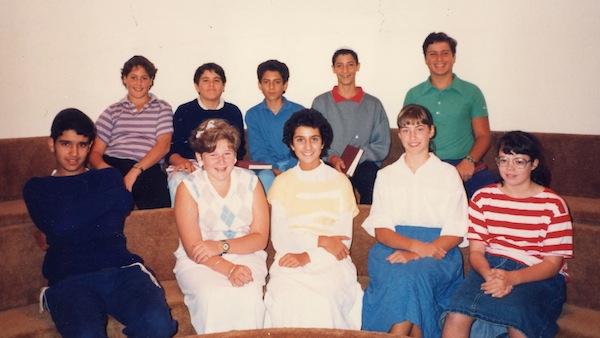
Vancouver Talmud Torah Grade 9 class picture, 1971-1972 school year. (photo from JWB fonds; JMABC L.14845)Men at a B’nai B’rith event in someone’s home, circa 1980. The four men (including Sam Lemer on the left) are preparing to sign a document. (photo from JWB fonds; JMABC L.09565)Presentation of a cheque, B’nai B’rith, 1985. The four men include Sheldon Cole (second from left). (photo from JWB fonds; JMABC L.10228)Canadian Jewish Congress receives a grant, 1983. Unidentified people are with Senator Jack Austin (second from the right) and Sidney Zack (far right). (photo from JWB fonds; JMABC L.10048)First annual Temple Sholom Trivia night, “small trophies,” 1990. (photo from JWB fonds; JMABC L.15060)New Royal Canadian Legion Shalom Branch executive, 1989. (photo from JWB fonds; JMABC L.14258)Maimonides high school’s first Grade 8 students, 1986. (photo from JWB fonds; JMABC L.14998)
רצח מקומי: ישראלי נרצח בקנדה קרוב לוודאי על רקע רומנטי
גבר ישראלי נרצח בעיר קוקויטלם ביום חמישי לפני שבועיים, קרוב לוודאי על רקע רומנטי. גופתו של הישראלי ביחד עם גופתה של אישה מקומית בת חמישים ושש, נמצאו באותו בית ברחוב אלפין ליין, כאמור בשישה עשר ליולי. שמה של ההרוגה הוא אירנה גבליס (ילידת 1959) שהייתה גם בעלת הבית. גבליס היא קנדית ממוצא אוקראיני שהיגרה לקנדה לפני שמונה עשרה שנים. היא החזיקה בחברת הייעוץ ‘נביגייטור קונסלטינג‘ מוונקובר – לאספקת שירותי ראיית חשבון וניהול חשבונות ומיסוי.
המשטרה הפדרלית (האר.סי.אם.פי) בכוחות מתוגברים משלוש תחנות שונות פתחה במצוד נרחב אחר הרוצח, וביום רביעי (לפני כעשרה ימים) הוא נתפס סוף סוף. החשוד בן החמישים וארבע ושמו מוריו (“מו”) סהלי (ממוצא איראני) גר בריצ’מונד, ניהל בעבר מערכת יחסים רומנטית עם גבליס. סהלי הואשם כבר בשני סעיפים של רצח מדרגה ראשונה, והובא למחרת (חמישי) לבית המשפט המקומי לשם הארכת מעצרו.
ששמו של הישראלי ופרטים נוספים עליו טרם הותרו לפרסום והמשטרה רק ציינה, שהוא הגיע לקנדה בארבעה עשר ליולי שזה בדיוק יומיים לפני שנרצח.
רצח מההיסטוריה: באיחור של שישים ותשע שנים קנדי בן תשעים ואחד הודה ברצח אישה אנגליה ב-1946
פוענחה חקירת מקרה הרצח הארוכה ביותר בתולדות המשפט הפלילי באנגליה. תושב קנדי בן תשעים ואחד ממחוז אונטריו הודה לאחרונה ברצח אנגליה בשם מרגרט קוק, שבוצע לפני לא פחות משישים ותשע שנים. הקנדי שמצבו הבריאותי קשה והוא סובל מסרטן עור חשוך מרפא, שוהה במוסד רפואי לחולים סופניים. הקשיש החליט פתאם שהגיע הזמן להתוודות על מה שעשה בעבר השחור שלו. באחד הימים הוא נכנס לתחנת משטרה מקומית באונטריו והודיע לשוטרים הנדהמים, כי בעשרה בנובמבר 1946, רצח נערת ליווי אנגליה שעבדה בסוהו של לונדון, ושאת שמה הוא כבר לא זוכר. המידע הועבר ממשטרת קנדה למשטרה האנגלית. ולאחר שהחומר החקירה נבדק לעומק שני חוקרי הסקוטלנד יארד טסו לקנדה לחקור את החשוד הקשיש. הם הציגו בפניו מספר תמונות של נשים שנרצחו באותה עת בסוהו של לונדון, והוא הצביע במדויק על זו של מרגרט קוק שהייתה אז בת עשרים ושש. החשוד (שמו ומקום מגוריו המדוייק נאסרו לפרסום בשלב זה), סיפר לחוקריו כי ניהל וויכוח סוער וקולני עם קוק על כסף, לאחר שטען כי היא רימתה אותו. בשלב מסויים כשהוויכוח התלהט הוא החליט להוציא מכיסו אקדח רוסי (שיוצר בתקופת מלחמת העולם השנייה) ובמהירות ירה בה למוות. לאחר מכן הרוצח התערה בקהל הגדול שהסתובב ברחוב ונמלט ברכבת התחתית. הוא חי חמש שנים נוספות באנגליה ובשנת1951 החליט להגר לקנדה, התחיל חיים חדשים והקים משפחה.
לאור מספר מקרי רצח דומים של נערות ליווי שאירעו באותו זמן בסוהו, במשטרת לונדון חשבו שמדובר אולי באותו רוצח, אך לא הגיעו לחקירת האמת. אך בציבור הרחב נפוצו כבר שמועות משמועות שונות כי מסתובב בסוהו רוצח סידרתי אימתי, שדומה לג’ק המרטש. חברים של קוק סיפרו אז לעיתונאים כי הם מאוד חששו לחייה, כיוון שעבדה ברחובות החשוכים והמסוכנים. קוק הייתה אגב נשואה ובאופן רשמי עבדה כביכול כרקדנית אקזוטית באחד המועדונים.
הפרקליטות האנגלית פתחה בהליכי הסגרת האזרח הקנדי לאנגליה, תוך תקווה שתצליח להביא להרשעתו בדין. לעומתם גורמים בכירים במערכת המשפט המקומית מעריכים, שלאור גילו ומצב בריאותו הרופף של החשוד הקשיש, לא בטוח כלל שבית המשפט הקנדי יאשר את בקשת ההסגרה.
“Finding success on YouTube has been both the most exciting and confusing thing that has ever happened to me (other than my bat mitzvah),” she wrote recently on her blog.
Raskin, a Scarsdale, N.Y.-native, who now calls Los Angeles home, also performs improv and stand-up around Los Angeles, and produces a weekly webseries, Just Between Us, with her best friend and comedy partner, Gaby Dunn. With more than a hundred segments thus far, they tackle relationship issues in an irreverent and unconventional manner.
“Basically, it’s two girls on a couch giving love advice, but we’re terrible at giving advice,” explained Raskin. “That’s the shtick. It’s not at all about the questions or advice, but about our relationship. People say we’re the odd couple, a classic comedy approach.”
The Jewish Independent recently caught up with Raskin.
DG: What videos of yours are your favorites?
AR: A couple of contenders for different reasons. If Buying Condoms Was Like Buying Birth Control, I’m really proud of that one because I think it had a message and did really well. From a comedic level, that didn’t do well, but the writing was good. The other, Is This a Date?, is a sketch I liked. It’s a miscommunication between a man and a woman, and how their dialogue confused each other.
DG: You’ve done a few videos with Jewish content. Is our heritage and culture inherently funny?
AR: We all know how our families behave. Sometimes there’s a larger familiarity people will get even if they’re not a part of your family. I find things funny in my family and people I grew up with that I’m sure are funny to other people also.
DG: So, how do you make a Jewish video funny to people who don’t know about Jewish culture?
AR: The hope is that you’ll relate, even if you’re not Jewish or have a lot of Jewish friends that get it. At the end of the day, everyone is just human and we all do just funny things. My sister is married to an Italian and their family is very similar to ours. It’s all about the food; everyone is into each other’s lives, it’s all just loud and fun and caring. Even if they’re Roman Catholic, there’s a lot of similar culture there. And Italian has always been our favorite food.
DG: Are any of your comedic influences Jewish?
AR: My friends flatter me and say I’m like a female Woody Allen, but I know they’re just sucking up. But I definitely relate to some aspects of his point of view and I think that there are certain neuroses that I bring to some of my characters that are similar.
Other than that, one comedic influence is Julia Louis-Dreyfus (not Jewish). She has such presence – timeless and perfect and commanding. I love Veep.
DG: Is comedy natural to you?
AR: I think you either have it or you don’t. Have spark of it, or don’t. But you have to nurture and grow with that spark. It’s something you study and refine over years, with stand-up especially. Refining just my presence on stage took a long time, not just the actual jokes, but how I would deliver them was a whole journey. Just have to kind of need to love it.
All I ever want to do is to make a good joke. That’s what drives me day in and day out. Not just on the internet, but also to my best friends.
DG: What’s the environment like with other BuzzFeed actors?
AR: It’s definitely work; but it’s like working at a college campus – everyone is friends, we hang out, it’s great, awesome to be surrounded by young, talented people who want to do the same stuff you want to do. So, it’s definitely a fun office. I’ve been to my dad’s law office and it’s nothing like that.
DG: You’ve done some of the famous taste-test videos of ethnic foods. What would you eat again?
AR: Boiled peanuts. Everything in the Southern taste test was incredible. Okra was incredible. All I think about now is okra and boiled peanuts and how to get them.
DG: Have you tried okra in beef stew?
AR: I don’t eat beef, so maybe I’d pick it out. I’ve been a vegetarian for ethics reasons since I was 8, but now I eat birds and fish.
DG: BuzzFeed fans found out through the Jewish videos that there are other young Jewish actors at BuzzFeed. Do you guys hang out or talk Jewish stuff?
AR: Nah, maybe like “Oh, what are you doing for Passover? Hmm, nothing.” A lot of people were shocked that more than one Jew works at BuzzFeed.
Most of my friends, oddly enough, are Jewish and there’s shared culture there. I thought, with the video of Jews explaining Christmas, some online comments were antisemitic, and then the one with Christians explaining Chanuka nobody cared about.
DG: Did it upset you?
AR: I grew up surrounded by Jews, so I forget that there’s a lot of antisemitism in the world.
DG: What’s funny about being Jewish?
AR: Um, my mother. I just think the traditional Jewish mom is so funny to me. It’s already been passed on; if someone doesn’t call me back, I think they’re dead. I really have to work on my anxiety about thinking everyone’s dead.
DG: OK, pop quiz. Just like in the videos: A Jew explains Easter. Go!
AR: Oh, crap. That’s the one where Jesus is born, no, dies? He dies, right? Something about bunnies and chocolate? Lent, where you swear off doing something? The stores are closed?
Dave Gordon is a Toronto-based freelance writer and managing editor of landmarkreport.com.
Warren Kimmel as Javert in Arts Club Theatre’s Les Misérables. (photo by Ross den Otter)
This October will mark the 30th anniversary of one of the most adored, reproduced, translated and recorded performances of our time.
If you are one of the few who has not seen Les Misérables, take the opportunity now and head down to the Arts Club presentation, which is on at the Stanley Industrial Alliance Stage until Aug. 16. Even if you have seen Les Mis before, this production is worth catching for a number of reasons, not the least of which is seeing Warren Kimmel display his musical prowess on stage.
Les Mis opened in London with the Royal Shakespeare Company in 1985 and has been seen by more than 70 million people worldwide. In the Arts Club version, Kimmel stars as the policeman Javert who has committed his life to capturing prisoner Jean Valjean. Kimmel reveals on his website that he is surprised that this is the role he ended up in, but happy to be finally doing the show.
“It was the thing to see when I was leaving school and going to university … and, when I graduated from drama school, it was top of my list,” he writes. “For one reason or another, I have either declined, missed or chosen not to be a part of many productions. All of those decisions were mistakes in my opinion but I have finally been sucked into the vortex. And, to boot, I am playing the last character I ever imagined I would be. Great hat though!”
The award-winning Kimmel is one of a stellar cast of singers who hardly have a fault among them, and their performances are stirring – from the mournful “I Dreamed a Dream” to the rousing “Do You Hear the People Sing?” to the plaintive “Bring Him Home.” (I dare you not to shed a tear during this heartrending rendition by Kieran Martin Murphy.)
Even a tiny bit by ensemble member Kevin Michael Cripps as Bishop Myriel stands out as a memorable performance. And Kimmel’s interpretation of “Stars” certainly holds its own against that of any of the other Javerts in the musical’s history.
Many people think that Les Misérables was written about the French Revolution of 1789. In fact, the story centres on a lesser-known republican rebellion that took place in 1832. Like a fire that appears to have been squelched but comes back to life after a time, the 1832 insurrection was a reigniting of leftover anger from a larger rebellion in July 1830 that saw the overthrow of the Bourbon monarchy.
The story’s author, Victor Hugo, was on his way home when he was caught in the crossfire in 1832, stuck in an alley behind the barricades that are a key element in the musical. Though originally a staunch monarchist, he became a republican supporter and, 30 years after his experience, he wrote the novel, which is still required reading in many French schools.
So popular has this story been that the musical has been translated into 22 languages. For a taste of some of these, including songs in Swedish, Japanese, Polish and Norwegian, watch “Do you hear the people sing: Sung by 17 Valjeans from around the world” on YouTube.
Though it’s normally performed in large theatres with the capacity for several thousand, the production translates very well onto a smaller stage, and I think the intimate location makes for an even better experience. It has been six years since it played at the Arts Club, and who knows when it will be back? Don’t miss the opportunity.
Baila Lazarus is a freelance writer and media trainer in Vancouver. Her consulting work can be seen at phase2coaching.com.
Dustin Freeland as Link Larkin, Erin E. Walker as Tracy Turnblad, Hannah Williams as Penny Pingleton and ensemble members in Hairspray. (photo by Tim Matheson)
When Theatre Under the Stars announced its lineup earlier this year, I was excited. I’d enjoyed the movie Hairspray, but not seen the stage version, and the last (and only) time I had seen Oliver! was at Winnipeg’s Rainbow Stage when I was just shy of 9 years old. The brutality in that production, in particular Nancy’s death at the hands of Bill Sykes, stayed with me, and I was curious to see how TUTS would handle it.
But first, Hairspray. “Good Morning, Baltimore” is one of the greatest songs. So cheerful and optimistic, its driving beat setting the tone and pace of the entire musical. If only we could all carry such confidence and positive energy out into the world. But I digress. The broad expanse of the movie, in which heroine Tracy Turnblad, sings and dances her way to school through the city that she loves is, of course, not possible on stage, and the added sparseness of Brian Ball’s TUTS set – basically tiered, multi-colored stages with the odd extra prop or flourish – took a little adjustment in perspective. But once I scaled my expectations, I came to appreciate the room his choices made for the dancers. And what dancing! Julie Tomaino’s choreography was not only fabulous, but it was professionally executed by the mainly amateur cast.
Many of the cast members are at least triple threats. Starting with the lead, Erin E. Walker does a commendable job as the boundless Tracy, who, in 1962 Baltimore, sets out to be a dancer on The Corny Collins Show despite her relative largesse, and ends up not only winning a spot on the show but getting its Elvis-like heartthrob Link Larkin (perfectly played by Dustin Freeland) to fall in love with her. Oh, and she also inspires significant social change along the way, succeeding in racially integrating her favorite show. And, she convinces her mother – a pleasantly understated performance by Andy Toth – to come out of the house after a decades-long, self-imposed imprisonment out of shame over her weight.
On her mission(s), Tracy is supported by her best friend, Penny Pingleton, played by the obviously talented Hannah Williams, though the accent she chooses for the role makes her sound incredibly stupid. Thankfully, she sings more than talks. I also had a problem with a couple of the other accent choices – Ryan Purdy as Tracy’s dad sounds like a complete moron, rather than the tenderhearted, somewhat nerdy guy he is; and I’m still trying to figure out how a German prison matron made it to 1962 Baltimore.
For the most part, however, director Sarah Rodgers’ pacing and style are spot on; the costumes by Chris Sinosich are colorful and suit the characters and period; and music director Chris D. King, whose orchestra is fantastic, does an excellent job as Corny Collins. And three other standouts cannot go without mention: Cecilly Day as Motormouth Maybelle and, as Maybelle’s children, David Lindo-Reid as Seaweed J. Stubbs and Marisa Gold as Little Inez.
Oliver! is a much more uneven performance. TUTS valiantly tries to evoke 1843 England beyond the stage and, by the time the show starts, kids (and older folk) have had the chance to see a Punch and Judy show, compete in a 20-yard dash, show their strength in a bell-ringer contest and watch some comedic but able strongmen. While the “village fair” is a lot of fun and a great idea in concept, it sets the wrong tone for the musical – poor orphan Oliver, after all, left in a workhouse after his mother dies giving birth to him, does not get to have much fun.
The first few musical numbers also struggle to respect the darkness of the story. At the workhouse, the main “problem” is the portrayal of Mr. Bumble, who is played much too loudly and vulgarly by Damon Calderwood. At the undertaker’s (to whom Oliver is sold), dancing zombies and more overacting detract one’s attention from Oliver’s plight. A rushed rendition of the beautiful ballad “Where is Love” is a lost opportunity to latch on and care for Oliver, who is well-played by Carly Ronning.
It is only when Oliver manages to walk himself to London and find a home with Fagin’s gang of thieves that director Shel Piercy’s vision becomes more uniform and appropriate to the subject matter.
Stephen Aberle as Fagin, Carly Ronning as Oliver (centre, on floor) and the young cast of Oliver! (photo by Tim Matheson)
The young Nathan Piasecki as the Artful Dodger is one of the highlights of this production, as is his boss, Fagin, played by Jewish community member Stephen Aberle. The connection I felt some 36 years ago to Nancy just wasn’t there, however. Calderwood fares better as the evil Bill Sykes than Mr. Bumble, but again without any refinement, so it is hard to understand why Nancy, played ably by Elizabeth Marie West, would love him. She also was dressed quite fancily and seemed like a lady, so it was a wonder that she would be involved with him and Fagin in the first place. I had to stop myself from rolling my eyes during her rendition of “As Long As He Needs Me,” when I should have been sympathizing with her predicament – to be loyal to her (dangerous) man or risk her life to save Oliver. While the character’s death may have semi-traumatized me as a child, I can say this – it was both moving and memorable, neither of which applies as much to this version.
All that said, it is worth repeating that, from the moment Oliver meets the Artful Dodger just over halfway through Act 1, and is encouraged to consider himself part of Fagin’s “family,” TUTS’s Oliver! is a solid, enjoyable production. The ensemble – which includes community members Kat Palmer and Julian Lokash – are an incredibly talented and energetic group well worth seeing and hearing in action. They land the choreography of Keri Minty and Shelley Stewart Hunt and are in perfect tune with the orchestra, led by music director Kerry O’Donovan.
Theatre Under the Stars presents Hairspray and Oliver! on alternate evenings at Malkin Bowl in Stanley Park until Aug. 22 (tuts.ca or 1-877-840-0457).
Left to right, Jay Hindle, Josh Epstein and Daniel Doheny in Bard on the Beach’s Love’s Labor’s Lost. (photo by David Blue)
How do you get more people interested in Shakespeare? Give ’em what they want – music, song, dance, comedy and words that are easy on the ears. Bard on the Beach has incorporated all these elements into its production of Love’s Labor’s Lost, set in a speakeasy in Chicago in the Roaring Twenties.
Think Prohibition, gangsters, molls, spats, fedoras, shoulder holsters, Cole Porter, flappers, the Charleston and vaudeville, all in glorious Technicolor, and you get an inkling of what is to come. Set on the intimate Howard Family Stage in the Douglas Campbell Studio, the fun begins the minute you walk through the tent flaps, as cast members accompany you to your seats with song and dance (and martinis – theirs, not yours). It continues with introductory remarks by a ventriloquist dummy that looks (and sounds) a lot like artistic director Christopher Gaze.
Ferdinand, aka “the king” of the gangsters (Jay Hindle), decides to shut down his nightclub, Navarre, devote three years of his life strictly to academic study and abstain from all vices including women (ouch!). He talks his friends Berowne (Jewish community member Josh Epstein) and Dumain (Daniel Doheny) into joining him in this escapade and the three sign a pact. However, just as they embark on their chaste journey, they meet blond bombshell Princess (Lindsey Angell) and her two friends, Rosaline (Luisa Jojic) and Katherine (Sereana Malani), each of whom catches the fancy of one of the potential abstainers.
To woo their respective ladies, the smitten men write secret letters and have a messenger, the resident clown Costard (Andrew Cownden), deliver them to the objects of their affection. Meanwhile, a fourth love story is brewing during all of this action, that of Don Amato (Andrew McNee), Ferdinand’s Italian house guest, who has fallen for Jaquenetta (Dawn Petten), one of the Navarre flappers – who has also written a letter to be delivered by Costard. A mix-up occurs (naturally) and what happens next is an hilarious musical romp through courtship interruptus with the men disguised and the women masked.
Princess’ chaperone, Boyet (Anna Galvin), gets into the game as the go between the men holed up in Navarre and the women forced to camp outside the building. Witty repartee abounds as the battle of the sexes heats up, and we all know who eventually wins that battle.
As musical director, Ben Elliott (with Jewish community member Anton Lipovetsky as his assistant) has done a great job of bringing iconic hits from the ’20s into this show. The jazz band (piano, bass, trumpet and drums) is the perfect background for the actors who, during an intense soliloquy, suddenly break into songs like, “It Had to Be You,” “Ain’t Misbehavin’,” “Second Hand Rose” and “Blue Skies.”
Epstein – who is the face of this production with Jojic on the season poster – wows with his voice in every number he sings and is certainly one of the standouts along with McNee, who sports a soprano-like gangsta accent and puts on a daring one- “woman” show (accompanied by his sidekick, Moth, played by Lili Beaudoin), and Petten, with her nasal voice and horizontal dance rendition (she rolls down the stairs and right back up).
This is the same cast that performs A Comedy of Errors on the BMO Mainstage (reviewed in the July 3 Independent) and it is a credit to their collective comedic acting talents that they can pull off both shows with success.
The set and lighting provide the feel of an underground Chicago speakeasy. The costumes by Rebekka Sorensen-Kjelstrup are simply divine, sparkly, fringed sheath dresses, rolled-up silk stockings, beautiful headdresses and glamorous fur stoles for the women; snappy suits, hats and Oxfords for the men. Valerie Easton’s peppy choreography is spot on.
Some will say that this production goes too far, and is not really Shakespeare – after all, Shakespeare: The Musical, who would have thought it possible? As with Bard on the Beach’s Comedy this year, purists are going to lament the loss of classical productions but, on Love’s opening night, audience members were humming along with the songs, tapping their feet to the catchy tunes and they jumped up in unison for a standing ovation before the last note was sung in the closing song, “Dream a Little Dream of Me.”
You have to give Gaze credit for taking a chance on director Daryl Cloran’s vision, which includes cutting half of the original text and omitting some characters. As he writes in the director’s notes, “Ultimately, that’s what’s so exciting to me about adapting a script – the process of exploring, shedding and inventing to get to the heart of the story and find a way of telling it so that it resonates with a contemporary audience.” It is a safe bet that even old Will himself would be doing the Charleston Stratford-on-Avon way if he saw this version of his play. If you are a lover of jazz and showmanship, this production is a must-see. While it runs until Sept. 20, word on the street is that shows are selling out quickly so don’t wait too long to book your tickets (bardonthebeach.org or 604-739-0559).
Tova Kornfeldis a Vancouver freelance writer and lawyer.
The Coast-to-Coast March of the Living group, as well as a few Israeli youth, in Israel. (photo from Talya Katzen)
This past spring, I took part in the March of the Living 2015 program – a two-week trip to Poland and Israel, where people from 45 different countries are brought together to learn about the Holocaust and the current state of Judaism in Israel.
The trip was the most emotional and heartbreaking two weeks of my life. I never could have anticipated the kind of life-changing journey I was about to embark on.
Participants in March of the Living stand together in front of the ashes of those murdered in the concentration camp, Majdanek. (photo from Talya Katzen)
The week in Poland was extremely draining, and I came to many realizations. I felt so strongly about things I simply cannot put into words. Our pre-trip informational sessions came nowhere near to preparing me for what I was going to witness. How can anything prepare you for walking through a gas chamber where, just 70 years ago, thousands of innocent lives were erased each day? Pictures may speak louder than words, but physically being there is like a blood-curdling scream right in your face.
Each day’s event was a new brick dropped on my shoulders and, as the bricks piled up, I came to appreciate more and more the wonderful life I have been blessed with. The weather in Poland was cold and windy, spitting rain into our eyes as we walked through extermination camps, cemeteries and ghettos in our warm down coats and hats. Our complaints about the cold were no match to the below-zero temperatures that those starving prisoners in the thousands of concentration camps across Europe had to face day in and day out.
The tour of Majdanek concentration camp was truly an experience that will be with me for the rest of my life. The defining moment of the journey was visiting the monument that holds the ashes of the victims of the camp. A recording of the prisoners, just liberated from Bergen-Belsen, singing “Hatikvah” began to play as we all stood hand-in-hand. My mind was blank and completely full at the same time. The mutual sorrow all we marchers felt was overpowering. A connection to one another that I doubt will ever be broken.
Left to right, Talya Katzen, Hayley Kardash, Shauna Miller and Alyssa Diamond participate in Yom Ha’atzmaut celebrations in Israel. (photo from Talya Katzen)
This feeling of grief was flipped on its back upon our arrival in the beautiful state of Israel, a country that is now home to Jews who have survived some of the worst events in history – and prospered. I was fortunate to be there during the festival that celebrates Israeli Independence Day. Israelis gather together to celebrate community and overcoming many hardships. Having just experienced the height of grief in Poland, I could not have been more grateful for Israel, and the promise it holds for the Jewish people. Of course, our celebrations of freedom were constantly overshadowed by the memory of those who perished in Europe, who never had the chance to visit our homeland. It made me realize how absolutely crucial it is for young Jewish people of the world to experience this journey so that we may never forget.
March of the Living taught me that I have family all over the world who are just as passionate about keeping Judaism alive as I am, and that it is completely up to us to carry the torch from generation to generation, to keep the flame of the Jewish people burning forever. I am a third-generation survivor and it is my duty to be a witness, to live out the lives of those who never had the chance to see their 10th or 18th or 85th birthday simply because of who they were. Hitler and the Nazis may have been successful in murdering millions of people who didn’t fit their blueprint of the ideal race, but they failed miserably in taking away our Jewish identity. I am a person, I am a witness, I am a Jew, and no one can take that away from me.
Talya Katzenoriginally wrote this article as a Lord Byng Secondary school assignment. Jewish Federation of Greater Vancouver offsets the cost of March of the Living by $2,000 for each local participant. The funds for this are generated through the Federation annual campaign, and are distributed to participants through the Israel and Overseas Connections fund. Jewish Federation also provides support through staff resources, program leader training and participant education.