
Skip to content
  • Home
  • Subscribe / donate
  • Events calendar
  • News
    • Local
    • National
    • Israel
    • World
    • עניין בחדשות
      A roundup of news in Canada and further afield, in Hebrew.
  • Opinion
    • From the JI
    • Op-Ed
  • Arts & Culture
    • Performing Arts
    • Music
    • Books
    • Visual Arts
    • TV & Film
  • Life
    • Celebrating the Holidays
    • Travel
    • The Daily Snooze
      Cartoons by Jacob Samuel
    • Mystery Photo
      Help the JI and JMABC fill in the gaps in our archives.
  • Community Links
    • Organizations, Etc.
    • Other News Sources & Blogs
    • Business Directory
  • FAQ
  • JI Chai Celebration
  • JI@88! video

Recent Posts

  • Supporting the Iranian people
  • The power of photography
  • A good place to start
  • When boundaries have shifted
  • Guitar virtuosos play
  • Different concepts of home
  • Broadway’s Jewish storylines
  • Sesame’s breadth and depth
  • Dylan Akira Adler part of JFL festival
  • Mortality learning series
  • A new strategy to brighten up BC
  • Sharing latkes and light
  • Johnson awarded for human rights work
  • Cherished tradition ensured … Silber Family Agam Menorah
  • Nothing as lovely as a tree
  • Camp welcomes new director
  • Popular family camp expands
  • A life-changing experience
  • Benefits of being a counselor
  • Camper to counselor
  • האלימות בישראל מורגשת בהרבה מגזרים
  • טראמפ עוזר דווקא לנושא הפלסטיני
  • New rabbi settles into post
  • A light for the nations
  • Killed for being Jewish 
  • The complexities of identity
  • Jews in time of trauma
  • What should governments do?
  • Annie will warm your heart
  • Best of the film fest online
  • Guitar Night at Massey
  • Partners in the telling of stories
  • Four Peretz pillars honoured
  • History as a foundation
  • Music can comfort us
  • New chapter for JFS

Archives

Follow @JewishIndie
image - The CJN - Visit Us Banner - 300x600 - 101625

Byline: Sybil Kaplan

Unique fictional viewpoint

As far as books go – especially books about the Holocaust – The Jewish Dog by Asher Kravitz (Penlight Publications, 2015), published in Hebrew in 2007, is certainly unique. The novel was awarded a citation by the Israeli Publisher’s Association and it is easy to understand why.

Kravitz is a Jerusalem-born physics and mathematics professor and photographer of wildlife. He has written three earlier books: two whodunits and a book about an Israeli soldier in an anti-terrorist unit. The narrator of this novel is a 12-year-old Jewish dog raised by a single mother (a dog, that is) in 1930s Germany.
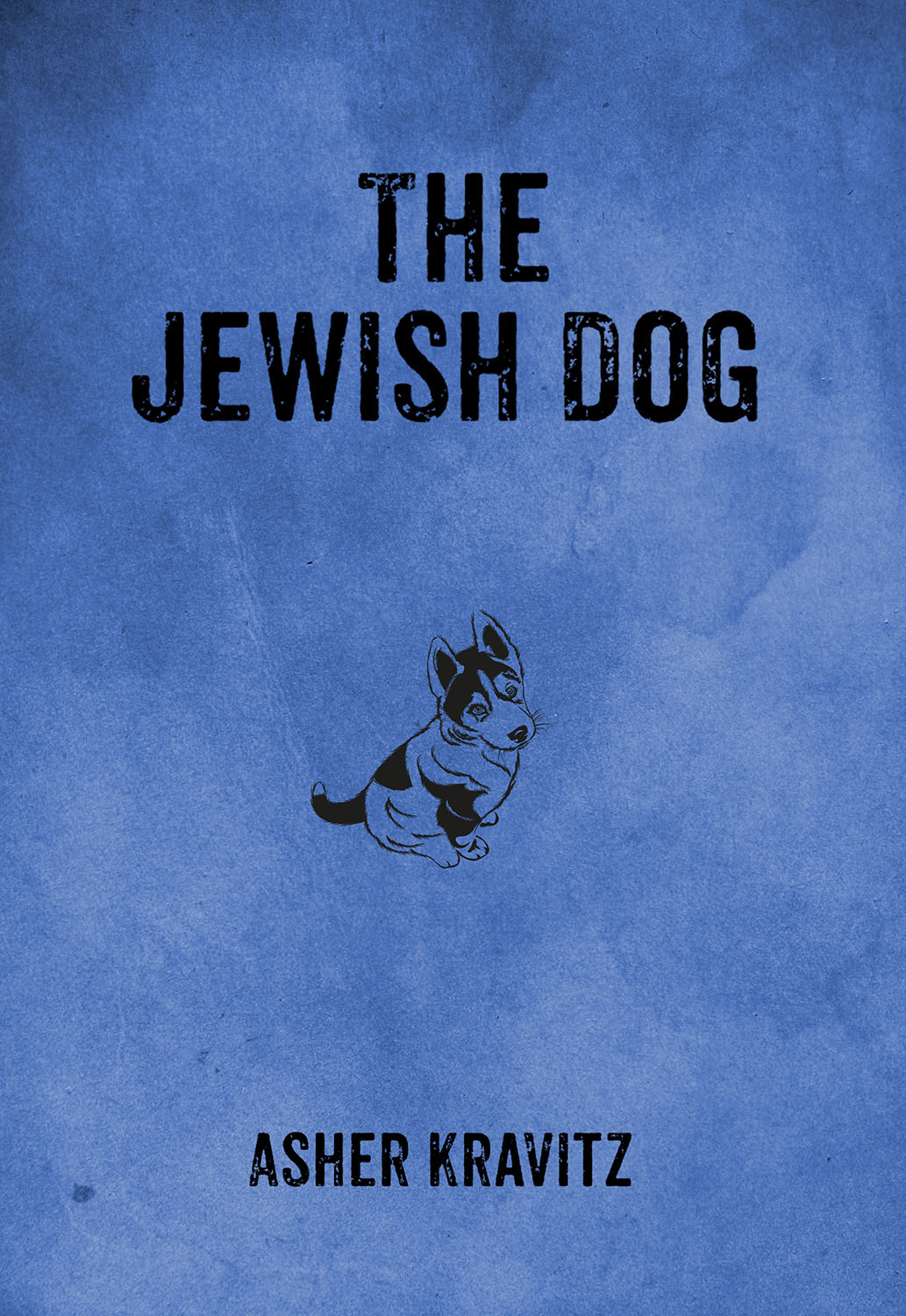
book cover - The Jewish Dog by Asher KravitzWhen he is born, his mother lives with the Gottlieb family. Despite the family conflict about keeping any of the puppies, when the dog finds the afikoman at the seder, Herschel, the family’s son, declares that the prize is allowing the dog to stay. They name him Caleb.

Caleb is an exceptional animal. He learns to decipher human speech and can read the moods of the adults.

As the story continues, Caleb witnesses the rise of Nazism and the laws being forced upon the family – the housekeeper prevented from working for the Jewish family; the children prohibited from attending school; and Jews forbidden to own a dog.

Caleb is given to a Christian family, where the wife mistreats him, and the story follows his adventures joining a pack, his training as a facility guard dog at Treblinka, and more. All the while, we read Caleb’s philosophical commentaries and are given a great deal of food for thought on human and animal behavior.

Kravitz has produced a well-written novel that is poignant and compelling. Some might say The Jewish Dog is for young adults, but anyone wanting to read a distinctive presentation of the pre-Holocaust and Holocaust period will find this book absorbing.

***

After reading and reviewing this most unusual book, I was prompted to ask the author some questions about this work. When I asked him what prompted him to this type of novel, Kravitz recalled that, as a high school student, he participated in an international quiz about the Second World War, which focused on the Holocaust. One of the anti-Jewish laws enacted by the Nazis was that “raising a dog is prohibited for Jewish families.” He also remembered the images of the signs posted on restaurant and coffee shop doors, “No entrance for dogs or Jews.”

“This is almost a built-in symbol of the Holocaust that connects dogs and Jews,” he said.

Kravitz also related a conversation that he had with an elderly survivor of Auschwitz, who had a deep understanding of dogs and had been a dog feeder in the camp.

The novel began its life as a short story, which Kravitz then expanded. It took more than four years to complete. He said that he studied “the behavior of my own two dogs in order to learn their mannerisms and reactions so that The Jewish Dog would narrate as realistically as possible as a dog.”

Kravitz did not expect the novel to become so popular. “I attribute [its success] to the responsibility I felt for the seriousness of the subject matter and also to the aid I received from the editor who worked with me throughout the writing process,” he said.

Another writer and director adapted the book into a one-man play, which ran in Tel Aviv for almost three years, and The Jewish Dog is now required reading for high school matriculation exams in literature. It has been translated into French, Turkish and English.

Sybil Kaplan is a journalist, foreign correspondent, lecturer, food writer and book reviewer who lives in Jerusalem. She also does the restaurant features for janglo.net and leads weekly shuk walks in English in Jerusalem’s Jewish food market.
Posted on March 27, 2015March 26, 2015Author Sybil KaplanCategories BooksTags Asher Kravitz, Holocaust
Charoset’s many variations

Charoset’s many variations

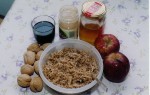
Ashkenazi-style charoset: apples, walnuts, cinnamon and red wine. (photo by Yoninah via commons.wikimedia.org)

What Passover seder symbol is common to all communities but is not mentioned in the biblical passage that enjoins us to eat the paschal offering, matza and bitter herbs? Charoset.

Charoset is loosely defined as a paste of fruit, spices and wine, symbolic of the mortar used by the Hebrews when they were slaves in Egypt.

The word is of unknown origin but may be from the word heres, meaning clay, because of its color. The custom of eating charoset is thought to have come from the time of the Babylonians, who dipped food in relishes or sauces to add flavor.

Some years ago, I surprised all my seder guests by serving both the traditional Ashkenazi version and a Sephardi version of charoset, which everyone loved and wanted in future years.

The New York Times Passover Cookbook, edited by Linda Amster, says that the Iraqi version of charoset is one of the oldest and most time-consuming recipes, dating back to the Babylonian exile of 579 BCE. Made into a jam from dates, grapes, pomegranate and honey, it was a sweetener in the ancient world and is still used by Iraqi, Burmese, Syrian and Indian Jews.

The Talmud says charoset must be sharp in taste and similar to clay in substance and color. Differing geographies is one of the reasons there are differing charoset recipes.

Ashkenazim tend to use apples, chopped almonds, cinnamon, red wine and perhaps even matza meal; sometimes walnuts or other nuts are used. Sephardi and Mizrahi Jews tend to use fruits that grew in Eretz Israel in biblical times, such as grapes, figs, dates, almonds and pomegranates. Israelis often turn charoset into a dessert by adding bananas, dates, orange juice and/or sugar.

Abraham Chill, author of The Minhagim (The Customs), writes that each ingredient symbolizes something different from the Egypt experience. The mixture as a whole stands for the mortar used by the Jews in making bricks, and the cinnamon resembles the color of the bricks they made. Wine represents the blood of the Jewish infants thrown into the Nile. Almonds are used because the Hebrew word for almond, shaked, is also a word that means to accelerate, as G-d accelerated the end of slavery. Apples are used because it was said that Jewish women during that time gave birth to their babies under apple trees in order to avoid detection by the Egyptians.

In her book The Jewish Holiday Kitchen, Joan Nathan states that charoset is “one of the most popular and discussed ritual foods served at the seder.” She says the fruits and nuts refer to verses in the Song of Songs, which mention an apple tree and the garden of nuts; the red wine recalls the Red Sea.

Because the maror or bitter herb is so strong, some say that the real purpose of charoset is to allay the bitterness. As part of the seder, the charoset and maror are placed between matzot to make a sandwich, which is said to have been invented by the first century CE Rabbi Hillel, hence, its name, the “Hillel sandwich.”

There are as many variations on the ingredients of charoset as there are Jewish communities.

Jews from the island of Rhodes use dates, walnuts, ginger and sweet wine. Jews of Salonika, Greece, add raisins. Other Greek Jews use walnuts, almonds, pine nuts, raisins, cinnamon, cloves and red wine and spread it thickly on matza. Turkish Jews include orange.

A Moroccan friend told me she used some of the seven species from the Bible in her charoset: dates, almonds, nuts, pomegranate seeds, figs, wine and cinnamon. Jewish Daily Forward Food Maven columnist Matthew Goodman once wrote in the Forward that Moroccan Jews sometimes make charoset paste and roll it into balls. He says this is a legacy from Jews of medieval Spain, who made the balls of apples, dried fruit, almonds, cooked chestnuts, sugar and cinnamon (but no wine) and then drizzled the balls with white vinegar before serving.

Jews of Venice use chestnut paste, dates, figs, poppy seeds, walnuts, pine nuts, orange peel, dried apricots, raisins, brandy and honey, while Jews of Bukharia use nuts, almonds, dates, raisins, apples and wine. Egyptian charoset contains dates, nuts, banana, apples, wine, cinnamon and pomegranate seeds.

An Iraqi woman told me that instead of a paste type of charoset, they would buy a special date honey and sprinkle chopped nuts on top. Goodman, again in the Forward, explained that its foundation is a syrup, halek, made by boiling dates, straining the liquid and then reducing it over a low flame until thick. Halek is one of the earliest of all sweeteners and may be the source of the reference in “land flowing with milk and honey.” Chopped walnuts or almonds are then added to the syrup. Jews of Calcutta also follow this custom.

A Dutch woman told me that she makes a chunky mixture with more apples and only a few nuts, plus cinnamon, sugar, raisins and sweet wine. Jews from Surinam in Dutch Guiana use seven fruits and coconut.

Following the injunction to have a sharp taste, Persian Jews use dates, pistachios, almonds, raisins, apples, orange, bananas, pomegranate seeds, sweet wine, cloves, cardamom, cinnamon, vinegar and black pepper. Likewise, Yemenite Jews use dates, raisins, almonds, nuts, figs, dates, sesame seeds, apples, pomegranate seeds, grape juice, ginger, cinnamon, cardamom, cloves and black pepper. Jews from Afghanistan pound charoset in a mortar with a pestle and use walnuts, hazelnuts, almonds, apples, sweet wine, pomegranate seeds, dates and black pepper.

One exception I have found to Ashkenazim following the strictly sweet version was a friend whose father’s family came from Galicia. He recalled that their charoset was made from apples, nuts, wine, cinnamon and horseradish.

Here are but a few recipes.

CLASSIC ASHKENAZI CHAROSET

6 chopped apples
1/3 cup chopped nuts
1/4 cup raisins
1 tsp cinnamon
2 tbsp sugar
1/4 cup red sweet wine

Combine apples, nuts and raisins. Add cinnamon, sugar and wine. Depending on your preference, this can also be made in a food processor.

DATE CHAROSET

1/2 cup seeded, finely chopped dates
1/2 apple, grated
1/2 cup chopped almonds
1/8 cup red wine
1/2 tsp cinnamon
1/4 tsp ginger

Combine dates and apple. Add nuts, wine, cinnamon and ginger.

SEPHARDI CHAROSET

1/2 cup chopped dates
1/2 cup chopped raisins
1 cup chopped walnuts
1/4 cup chopped almonds
1/4 cup red wine
2 tbsp lemon juice
1/8 tsp cinnamon

Combine dates and raisins. Add walnuts, almonds, wine, lemon juice and cinnamon. Form into balls.

SPICY CHAROSET

12 figs
1 1/2 cups pitted dates
2/3 cup raisins
2 seeded oranges
2/3 cup almonds
1/2 cup dry red wine
1/4 tsp cayenne pepper
1 tsp cinnamon

In a food processor, coarsely chop figs, dates, raisins, oranges and almonds. Try to keep the fruit chunky unless you prefer it pureéd. Pour into a bowl. Add wine, cayenne, cinnamon and blend.

Sybil Kaplan is a journalist, foreign correspondent, lecturer, food writer and book reviewer who lives in Jerusalem. She also does the restaurant features for janglo.net and leads weekly shuk walks in English in Jerusalem’s Jewish food market.
Format ImagePosted on March 27, 2015March 26, 2015Author Sybil KaplanCategories Celebrating the HolidaysTags Ashkenazi, charoset, Passover, recipes, seder, Sephardi
Chicken for Pesach midweek

Chicken for Pesach midweek

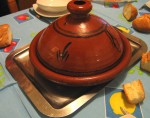
A tagine is a North African, slow-cooked savory stew, named after the earthenware clay pot in which it is cooked. (photo by Iron Bishop via commons.wikimedia.org)

After the sedarim, by midweek, you may be looking for some creative ideas for Passover dinners. Here are three dishes I frequently serve.

A mina is a traditional Sephardi savory layered pie, which is a great way to use up leftover chicken. In Spain and Turkey, it is called mina; in Egypt, maiena or mayena; in Algeria, meguena; and, in Italy, scacchi. The pie is also popular among Jews from the island of Rhodes and Yugoslavia.

A tagine is a North African, slow-cooked savory stew, named after the earthenware clay cooking pot, whose base is flat and circular with low sides. The cover is cone or dome shaped, which traps the steam and returns the condensed liquid to the pot, thus requiring very little liquid when cooking. In a chicken tagine, vegetables or dried fruit, nuts and spices are added.

Finally, leek patties known as kyeftes de prasa in Ladino, kifte in Turkish, keftas or keftes in Greek, are popular among Mediterranean Jews for Passover. I like to add chicken to mine.

CHICKEN MINA
6-8 servings

2 cups cooked, shredded chicken
1/2 cup chopped scallions
1/2 cup chopped Italian parsley
1/4 cup chopped mint
1/4 cup chopped dill
5 eggs
6 matzot
chicken soup
olive oil
1/2 cup tomato sauce
1/4 tsp nutmeg

  1. Preheat oven to 350˚F. Grease a rectangular or oval baking dish.
  2. In a bowl, combine chicken, scallions, parsley, mint and dill. Add two eggs and blend.
  3. In another bowl, combine three eggs, tomato sauce and nutmeg.
  4. Place matzot in bottom of a deep dish. Pour enough chicken soup to soften, about three minutes.
  5. Place two matzot in greased baking dish. Brush with olive oil. Spread half the chicken filling on top. Add two more matzot, brush with oil and spread rest of chicken filling on top. Top with remaining two matzot.
  6. Pour tomato sauce on top. Bake for 45 minutes. Cut into squares to serve.

CHICKEN TAGINE
8 servings

1 cup matza meal
8 pieces of chicken
4 cups chopped onions
2 cups chicken soup
1 1/2 – 3 cups prunes, apricots or other dried fruit
2 tsp cinnamon
1 tsp ginger
1/4 cup lemon juice
2 tsp lemon peel
1 cup slivered almonds
oil

  1. Place matza meal in a shallow dish. Dip chicken pieces in the meal.
  2. Heat oil in a soup pot. Add chicken and brown. Add onions, chicken soup and dried fruit and simmer until chicken is cooked.
  3. Add cinnamon, ginger, lemon juice, lemon peel, and almonds. Simmer another 20 minutes.

CHICKEN-LEEK PATTIES
6-8 servings

3 leeks
1 cup chopped onions
2 cups chopped cooked chicken
2 eggs
1 cup mashed potatoes
1/2 cup matza meal, plus extra
salt and pepper to taste
1 beaten egg
oil

  1. Place cut-up leeks and onions in a saucepan with water, bring to a boil, reduce heat and simmer 30 minutes.
  2. Drain and chop. Add chicken, eggs, 1/2 cup matza meal, mashed potato, salt and pepper and blend.
  3. Place egg in one shallow bowl and additional matza meal in the second bowl. Take chicken mixture and make into patties. Dip into beaten egg then in matza meal for coating.
  4. Refrigerate for awhile at this point if serving later. Before serving, heat oil in a frying pan and fry until patties are brown on both sides. Drain on paper towels.

Sybil Kaplan is a journalist, foreign correspondent, lecturer, food writer and book reviewer who lives in Jerusalem. She also does the restaurant features for janglo.net and leads weekly shuk walks in English in Jerusalem’s Jewish food market.
Format ImagePosted on March 27, 2015March 26, 2015Author Sybil KaplanCategories Celebrating the HolidaysTags chicken, Passover, recipes, seder, tagine
And, why the poppy seeds?

And, why the poppy seeds?

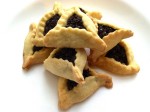
Poppy seed hamantashen from owl-at-home.blogspot.ca.

Purim has its share of food customs as it is observed by Jewish communities around the world, but for this article, I will narrow my question to one: why the poppy seeds – particularly in hamantashen?

A little research indicates that Esther ate seeds as part of her efforts to maintain a kosher diet. They are also said to have been the only food Esther ate during the three-day fast before she went to see the king.

Another interpretation indicates that poppy seeds symbolize the promise G-d made to Abraham (Genesis 22:17): “I will bless thee and, in multiplying, I will multiply thy seed as the stars of the heaven, and as the sand which is upon the seashore …” because this is the antithesis of the annihilation planned by Haman.

Mohn, the Yiddish word for poppy seed, was combined with milk, sugar or honey and sometimes raisins and nuts and used as a filling as early as medieval times. Tasch is German for pocket, so the original name was mohntaschen, pockets filled with poppy seeds. Why pockets? Because of Haman’s coat pockets, where he carried the lots (purim) he cast to determine on which day the Jews would be killed.

When Jews fled Germany for Eastern Europe, in the Middle Ages, they took the poppy seed pastry with them and added the Yiddish prefix ha, thus making it hamohntaschen.

By the way, if you plant poppy seeds, you end up with poppy flowers. Their unripe seed capsules, when processed, are the source of heroin, opium and morphine. It is said that if you consume poppy seed-filled cake or pastry, including hamantashen, you could test positive on a drug test. Many years ago, a state police crime lab in Oregon tested the driving ability of subjects who had consumed 25 grams of poppy seeds baked into a bundt cake and found that their driving ability was not impaired – however, they did test positive for opiates. Another bit of research indicated that eating two poppy seed bagels could cause failure of a drug test!

Poppy seeds contain high amounts of oil and are best refrigerated when not being used. They are also an excellent source of calcium. But don’t eat too many, as a 50-gram hamantash may have 200 calories.

Speaking of poppy seeds, poppy seed cookies, or mohn kichel, are also popular for Purim, as is mohn torte, or poppy seed cake where two layers of pastry dough are filled with a mixture of poppy seeds, sugar or honey, ground almonds and raisins.

Another interesting note: for Purim, some people make challah shaped into a very long braid – to symbolize the rope used to hang Haman. And, in keeping with tradition, why not add some poppy seeds to it?

Sybil Kaplan is a journalist, foreign correspondent, lecturer, food writer and book reviewer who lives in Jerusalem. She also does the restaurant features for janglo.net and leads weekly shuk walks in English in Jerusalem’s Jewish food market.
Format ImagePosted on February 27, 2015February 26, 2015Author Sybil KaplanCategories Celebrating the HolidaysTags hamantashen, poppy seeds, Purim
Put color in your chag

Put color in your chag

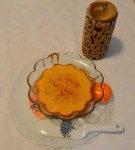
Mix it up this holiday with a colorful orange spice cake. (photo by Barry A. Kaplan)

In honor of Tu b’Shevat on Feb. 3-4, why not try some variety to celebrate the New Year of the Trees? One usually thinks of dates, figs and carob on this holiday, specifically the species of fruits that are listed in the Torah as native to Eretz Yisrael. In Israel today, sometimes we augment that with other in-season fruits, like apples, persimmons, strawberries (though beautiful, they are expensive!) or varieties of delicious citrus. Here are some recipes using oranges.

SYRIAN ORANGE CHICKEN
makes four servings

1 tbsp margarine
1 tbsp oil
1 cut-up chicken
1/2 cup orange juice
1 cup chicken soup
1 1/2 tsp corn starch
1/2 chopped onion
juice of 1/2 lemon
6-9 halved, pitted dates
orange slices

  1. Preheat oven to 350°F. Grease a baking dish.
  2. Heat margarine and oil in a frying pan and brown chicken. Place in a baking dish.
  3. Add orange juice, chicken soup, cornstarch, onion and lemon juice to frying pan and cook, stirring, until sauce thickens. Pour over chicken.
  4. Cover and bake 45 minutes.
  5. Garnish with dates and orange slices, cover and bake at least 15 minutes or until chicken is done. Serve with rice.

ORANGE JUICE SALAD DRESSING
The dressing is good on a salad with lettuce, avocado and grapefruit.

3/4 cup oil
6 tbsp orange juice
1/2 tsp sugar
pinch dry mustard

  1. Combine oil, orange juice, sugar and mustard in a jar.
  2. Shake well.

ORANGE SPICE CAKE

6 seeded, peeled, cut-up small oranges, such as mandarins or tangerines
1/3 cup canola oil
3 eggs
1 cup brown sugar
1/2 tsp ginger
1/4 tsp cinnamon
1 tsp vanilla
1 3/4 cups flour
1 1/2 tsp baking powder
1/2 cup non-dairy creamer

  1. Preheat oven to 350°F. Grease a cake pan, two loaf pans or place mini papers in a mini-muffin pan and spray with vegetable spray.
  2. Place orange pieces, oil, eggs and brown sugar in a mixer or food processor and blend a few seconds.
  3. Add ginger, cinnamon, vanilla, flour, baking powder and non-dairy creamer and blend.
  4. Spoon into baking pans. Bake 25 minutes or until a toothpick inserted in the centre comes out clean.

ORANGE DROP COOKIES
makes three dozen

1 cup sugar
2/3 cup unsalted pareve margarine
2 eggs
1/2 cup orange juice
1 tbsp grated orange peel
2 1/4 cups flour
1/2 tsp baking soda
1/2 cup chopped nuts

  1. Preheat oven to 350°F. Grease cookie sheets.
  2. Cream sugar and margarine with eggs. Stir in orange juice and orange peel.
  3. Add flour, baking soda and nuts and mix well.
  4. Drop by teaspoon onto cookie sheets. Bake 10 minutes or until golden brown.

Sybil Kaplan is a journalist, foreign correspondent, lecturer, food writer and book reviewer who lives in Jerusalem. She also does the restaurant features for janglo.net and leads weekly shuk walks in English in Jerusalem’s Jewish food market.
Format ImagePosted on January 30, 2015January 29, 2015Author Sybil KaplanCategories Celebrating the HolidaysTags New Year of the Trees, seder, Tu b'Shevat
Eight crazy dog nights

Eight crazy dog nights

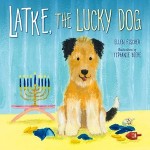
Narrated by the dog himself, Latke, The Lucky Dog by Ellen Fischer (Kar-Ben Publishing, 2014) is a charming book for kids 2-7 years old. In it, Latke the dog tells readers how lucky he is that a family with two children came to a shelter on the first night of Chanukah and took him home, naming him Latke because of his color. However, since poor Latke isn’t used to being with a family, his story is all about his eight nights of misadventures, coupled with his repeated acknowledgement that he is such a lucky dog to have been chosen by this family.

Although the story is very cute, there isn’t much about the family trying to train Latke, so parents could use the book as an opportunity to talk with their kids about what it means to adopt a pet and the responsibilities pet ownership entails. Or, parents could broaden the discussion to what it means to bring someone or something new into your environment – what role you might play, what changes you might need to make in your daily routine.

Fischer has written a number of children’s books and lives in Greensboro, N.C. The lively illustrations in a jagged style by artist Tiphanie Beeke, who lives in the south of France, fit the mood of the book very well.

Sybil Kaplan is a journalist, foreign correspondent, lecturer, food writer and book reviewer who lives in Jerusalem. She also does the restaurant features for janglo.net and leads weekly shuk walks in English in Jerusalem’s Jewish food market.
Format ImagePosted on December 12, 2014December 22, 2014Author Sybil KaplanCategories BooksTags dogs, Ellen Fischer, Kar-Ben Publishing, kids books, Tiphanie Beeke
Latke, latka: ‘cause it’s tradition!

Latke, latka: ‘cause it’s tradition!

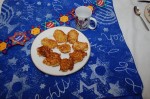
Latkes are a simple yet delicious holiday treat. Try baking instead of frying, or dress them up with dill sauce and fish. (photo by Barry A. Kaplan)

They’re sometimes greasy, sometimes salty and soggy, and they are fried in oil. They’re high in calories, sometimes; high in fat, sometimes; high in cholesterol, sometimes. But they’re oh, so good! What are they? They’re potato pancakes, otherwise known as latkes (or latkas), in what we believe to be Yiddish, or as levivot in Hebrew.

With all the oil used for frying, traditional latkes may be considered an unhealthy food. Yet, each Chanukah, many of us who are staunch-hearted and old-fashioned spend time hand-grating potatoes (nearly always accidentally suffering at least one scraped knuckle). The more modern among us risk producing a sort of liquid mush by using a food processor or blender, a different take on a holiday classic.

Why do we keep making these little pancakes year after year? Why do we eat them for Chanukah in the first place? Tevye might answer, “It’s tradition!” An old folk proverb says, “Chanukah latkes teach us that one cannot live by miracles alone.”

The word latke is not Yiddish as everyone assumes, after all, writes Jewish food writer and cookbook author Joan Nathan. Rather, it comes from the Russian latka, which is a type of pastry, “perhaps from obsolete Russian oladka … flat cake of leavened wheat dough.” This, in turn, probably came from a Middle Greek word eladion, oil cake, she writes, which probably comes from elaion, meaning olive oil.

Potato pancakes do seem to have originated among poor Eastern European Jews, but potatoes did not actually become a staple food for these Jews until the mid-19th century. John Cooper, in Eat and Be Satisfied: A Social History of Jewish Food, writes that Jews from Lithuania ate pancakes made from potato flour for Chanukah and had borrowed the idea from the Ukrainians, who made a potato pancake dish with goose fat called kartoflani platske, which they ate for Christmas. Since Chanukah fell about the same time, and there were plenty of geese to provide goose fat (schmaltz), we could conclude that schmaltz became a substitute for oil, following the holiday tradition. Jews living in the Pale of Settlement in the 17th century probably adapted the recipe for Chanukah as a way to dress basic potatoes differently for the holiday. Cooper adds that many Eastern European Jews ate buckwheat latkes for Chanukah, while Polish Jews made placki, pancakes of potato flour fried in oil.

MY MOM’S CLASSIC LATKES
six servings

6 peeled potatoes
1 medium onion
2 eggs
1 1/2 tsp salt
1/4 tsp pepper
1/2 cup flour
oil

  1. Grate potatoes and onion into a bowl or chop with blender or food processor.
  2. Add eggs, salt, pepper and flour and blend.
  3. Heat oil in a frying pan. Drop batter by tablespoon around pan. Fry until brown on both sides. Drain on paper towels.

(Note: this recipe can also be used to make potato kugel by pouring the batter into a greased casserole dish and baking in a 350°F oven for 45 minutes.)

LOW-FAT LATKES
eight-10 servings

3 lbs coarsely grated potatoes
1 coarsely grated onion
1/3 cup flour
1/2 tsp baking powder
1 cup egg substitute or 2 eggs plus 4 whites
salt and pepper to taste
olive oil spray

  1. Preheat oven to 450 degrees. Place nonstick baking sheets in oven to heat.
  2. Drain off as much liquid as possible from bowl with grated potatoes and onion.
  3. Add flour, baking powder, eggs or egg substitute, salt and pepper and blend.
  4. Spray baking sheet with oil. Spoon small mounds of potato mixture onto baking sheets.

Bake until brown on one side then flip to other side, making sure to place them where there is oil. Transfer to a platter and serve at once.

WOLFGANG PUCK’S POTATO PANCAKES WITH SMOKED SALMON AND DILL SAUCE

1 pound coarsely grated potatoes
1 small coarsely grated onion
1 egg
2 tbsp flour
1/2 tsp baking powder
1 tsp salt
1/4 tsp pepper
oil
1/2 cup sour cream
1 tsp chopped dill
1 tsp lemon juice
salt and pepper to taste
1 tbsp snipped chives
1/2 pound thinly sliced smoked salmon* 

  1. Squeeze dry the potato-onion mixture after grating. Add egg, flour, baking powder, salt and pepper.
  2. Heat oil in a frying pan. Drop tablespoons of the mixture around pan and flatten with the back of a spoon. Fry until golden brown on both sides. Drain on paper towels and continue with remaining batter.
  3. In a bowl, combine sour cream, dill lemon juice, salt and pepper.

Sprinkle with chives. Arrange pancakes on a platter. Serve with dill cream and smoked salmon.

*In place of or in addition to salmon, you can serve with two ounces of caviar.

Sybil Kaplan is a journalist, foreign correspondent, lecturer, food writer and book reviewer who lives in Jerusalem. She also does the restaurant features for janglo.net and leads weekly shuk walks in English in Jerusalem’s Jewish food market.
Format ImagePosted on December 12, 2014December 22, 2014Author Sybil KaplanCategories Celebrating the HolidaysTags latkas, latkes, levivot, potato pancakes, Wolfgang Puck
It’s time to make sufganiyot

It’s time to make sufganiyot

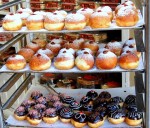
There are so many flavors of sufganiyot to be found in Jerusalem around this time of year. (photo by Barry A. Kaplan)

From Israel have come two popular foods for Chanukah: sufganiyot (doughnuts, often filled with jelly) and ponchikot, which are ball-shaped, resembling a doughnut hole.

Gil Marks, in The World of Jewish Desserts, writes that doughnuts fried in oil, ponchikot, were adopted by Polish Jews for Chanukah. The name is taken from the Polish paczki (pronounced poon-chkey), which led to the nickname ponchiks, the Polish name for jelly doughnuts. Paczki are similar to jelly doughnuts, only larger, more dense and more rich, and are traditionally served on Shrove Tuesday, the day before Ash Wednesday, which marks the beginning of Lent. Paczki were made to quickly use up stores of shortening and eggs, which were prohibited during Lent.

Sufganiyot also have interesting history. Some say sufganiyah, which in Hebrew means sponge-like, is reminiscent of the sweet, spongy cookie popular along the Mediterranean since the time of the Maccabees. Hebrew dictionaries say the word comes from the Greek sufgan, meaning puffed and fried.

In The Jewish Holiday Kitchen, Joan Nathan, an acquaintance of mine from our Jerusalem days and noted cookbook author and maven of American Jewish cooking, said she learned a fanciful fable about the origins of sufganiyot from Dov Noy, an Israeli folklorist. Noy relates a Bukhharan fable in which the first sufganiyah was given to Adam and Eve as compensation for their expulsion from the Garden of Eden. The word sufganiyah, he writes, comes from the word sof meaning end, while gan means garden and Y-ah is G-d. Thus, sufganiyah means the end of G-d’s garden. Noy clarifies that clearly this fable was created at the beginning of the 20th century, since sufganiyah is a spoken Hebrew word coined by pioneers.

CLASSIC SUFGANIYOT
makes 32-36

3 1/2 cups flour
2 eggs
4 3/8 tsp baking powder
3/8 tsp salt
2 cups vanilla yogurt
2 tsp sugar
1/2 tsp vanilla
oil
confectioner’s sugar or cinnamon sugar

  1. Mix flour, eggs, baking powder, salt, yogurt, sugar and vanilla in a mixing bowl until well blended.
  2. Heat oil in a soup pot. Drop tablespoon of batter around the pot, fry until brown on both sides, drain on paper towels.
  3. Roll in cinnamon sugar or confectioner’s sugar.

OVEN-BAKED SUFGANIYOT
makes 24

1 cup skim milk
2 tbsp unsalted butter
1/4 cup sugar
1 tsp salt
1 egg
3 1/2 cups flour
2 tbsp instant yeast

Syrup:
2 cups sugar
3/4 cup water

Sugar coating and filling:
1/4 cup sugar
jam 

  1. Preheat oven to 375°F. Grease mini muffin cups.
  2. Heat milk and butter in a saucepan. Stir in sugar and salt. Let cool.
  3. In one mixing bowl, combine egg and milk mixture. In a second bowl, combine three cups of flour with yeast, then add to egg-milk mixture and beat for two minutes with mixer or hand mixer.
  4. Stir in half-cup flour to make soft batter. Cover and let rise until double in volume.
  5. Turn dough onto a floured work space. Roll dough into a log. Cut off pieces and form into balls. Place each ball in a muffin cup. Cover pans and let rise for 30 minutes.
  6. Place in oven and bake 12-15 minutes until lightly browned.
  7. In the meantime, combine sugar and water in a saucepan. Heat, then boil until thick. Reduce heat and keep warm.
  8. Remove doughnuts to a cooling rack then toss in sugar syrup and remove with a slotted spoon. Roll in sugar. To inject, poke a hole in the side of each doughnut, inject jelly. If not serving immediately, wait to dip in sugar syrup and rolling in sugar.

These can be made three months ahead and frozen after cooled. To use, defrost, cover with foil, reheat in 350°F oven 15 minutes, dip in sugar syrup and either roll in sugar or inject with jelly.

PAREVE CHANUKAH PONCHIKOT
makes 36

2 cups flour
1/4 cup sugar
1 tbsp baking powder
1 tsp salt
1 tsp nutmeg
1/4 cup vegetable oil
3/4 cup non-dairy creamer
1 egg
oil
confectioner’s sugar or cinnamon sugar 

  1. In a mixing bowl, combine flour, sugar, baking powder, salt and nutmeg. Mix.
  2. Add oil, non-dairy creamer and egg and mix.
  3. Heat oil in a soup pot. Drop by teaspoon into oil and fry on all sides until brown. Drain on paper towels.
  4. Roll in confectioner’s sugar or cinnamon sugar.

Sybil Kaplan is a journalist, foreign correspondent, lecturer, food writer and book reviewer who lives in Jerusalem. She also does the restaurant features for janglo.net and leads weekly shuk walks in English in Jerusalem’s Jewish food market.

Format ImagePosted on December 12, 2014December 22, 2014Author Sybil KaplanCategories Celebrating the HolidaysTags Chanukah, ponchikot, sufganiyah, sufganiyot
Latin American treats

Latin American treats

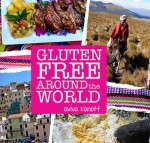
Aviva Kanoff has been described as “the Indiana Jones of cooking,” and the subtitle of her latest book, Gluten Free Around the World (Brio Books, 2014), is “a journey of food, travel and extraordinary adventure.” She is a graduate of the French Culinary Institute and has worked as a chef, painter and photographer. Her previous book, The No-potato Passover, received the Gourmand Award for the best Jewish cuisine in 2012 and was original; so is this book.

Her 104 recipes are divided into breakfast, soups and salads, sides, vegetarian, fish, poultry, meat and desserts. There are recipes from England, Thailand, France, Ireland, Israel, Ecuador, Vietnam, Italy, India, Morocco, Spain, Scotland, Cambodia, Indonesia and Arizona. Ingredients are listed clearly and – my favorite – directions are numbered. Each recipe is accompanied by a mouth-watering color photograph and additional photos from its country of origin, all of which enhance the presentation of the book and make it unique.

Not only is this a great book for anyone who is gluten free; it is good for people who enjoy recipes from different countries that are distinctive and innovative. This would be a great gift for anyone who collects cookbooks or who likes to try imaginative recipes.

Here are a couple of recipes that would work perfectly as Chanukah treats in keeping with the tradition of eating foods made with oil.

CHURROS
Reviewer’s note: Churros are a fried-dough pastry popular in Spain, France, the Philippines, Portugal, Mexico and Latin America. The recipe that follows is from Ecuador.

1/4 cup granulated sugar
3/4 tsp ground cinnamon
1 cup water
1/2 cup unsalted butter
2 tbsp brown sugar
1/2 tsp salt
1 cup gluten-free all-purpose flour
1 large egg
1/4 tsp pure vanilla extract
canola oil for frying
confectioner’s sugar

  1. In a medium bowl, combine granulated sugar and cinnamon. Set aside for topping.
  2. In a medium saucepan, combine water, butter, brown sugar and salt. Bring to a boil over medium heat. Add flour all at once, stirring vigorously with a wooden spoon. Cook and stir until the mixture forms a ball and pulls away from the sides of the pan. Remove from the heat and let cool.
  3. Line a baking sheet with greased parchment paper. After the dough has cooled for 10 minutes, add the egg and vanilla to the saucepan, and beat ingredients with a wooden spoon to blend them completely. Transfer the mixture to a decorating bag fitted with a large star tip. Pipe four-inch lengths onto the prepared baking sheet.
  4. Heat three inches oil in a deep saucepan over medium high heat. Fry a few strips at a time in hot oil (at least 375°F), turning once, until golden brown on all sides, about five minutes. Drain on paper towels. Roll warm churros in the cinnamon-sugar mixture to coat. Serve warm.

BOCADITOS DE PAPA
Ecuadorian potato-cheese fritters

1 lb russet potatoes, peeled and quartered
1 cup shredded pepper jack or cheddar cheese
2 tbsp shredded Parmesan cheese
3 large eggs, lightly beaten
1 tbsp chopped fresh cilantro
1/4 tsp salt
1/4 tsp ground cumin
1/4 tsp cayenne pepper
canola oil
salsa (optional)

  1. In a large saucepan, place potatoes in enough salted water to cover. Bring to a boil then reduce heat. Simmer, covered for 15-20 minutes or until potatoes are tender, then drain.
  2. In a large bowl, mash potatoes with a potato masher until smooth. Fold in cheeses, eggs, cilantro, salt, cumin and cayenne pepper. Shape mixture into 12 three-inch-diametre patties. If desired, covered and chill for up to 24 hours before cooking.
  3. In a large skillet, heat one-inch of oil to 375°F. Add potato patties, three or four at a time and fry about two minutes or until golden brown, turning once halfway through cooking time. Drain on paper towels. Serve hot and top with salsa if desired.

Sybil Kaplan is a journalist, foreign correspondent, lecturer, food writer and book reviewer who lives in Jerusalem. She also does the restaurant features for janglo.net and leads weekly shuk walks in English in Jerusalem’s Jewish food market.

Format ImagePosted on December 12, 2014December 22, 2014Author Sybil KaplanCategories Celebrating the HolidaysTags Aviva Kanoff, churros, gluten

Knishes: “Jewish soul food”

When I lived in New York for 10 years in the 1960s, going to the Lower East Side was a very regular part of my Sunday routine. However, while the name Yonah Schimmel might sound familiar to anyone traveling the same circuit during that time, regrettably, I never came across Mrs. Stahl. That’s because knishes were not part of my regular eating regimen.

That said, being a food writer and cookbook author, Knish (Brandeis, 2014) by Laura Silver was a fascinating read – because I learned more about the “pillow of filling tucked into a skin of dough” – but even more so because I learned about Silver’s favorite source of knishes: Mrs. Stahl in Brooklyn’s Brighton Beach neighborhood. When Mrs. Stahl went out of business, Silver’s “mourning” took the form of her search for “Jewish soul food.”image - Knish book cover

Silver has written on food and culture for the New York Times and the Forward, and she is the author of what her publisher calls “the one and only absolutely definitive biography of the knish,” making her the world de facto authority on the Jewish pastry.

Mrs. Stahl’s produced “baked round mounts, each plump with a stuffing, savory or sweet. Each piece – the size of a fist or just bigger – revealed a hint of filling on the top, a bald spot, as if for a yarmulke…. If you cut the knish in half, the cross-section revealed a membrane of dough that split the innards into chambers, like those of the human heart.”

From this, we divert to two of the strong influences in Silver’s life: her Riga-born grandmother who arrived in New York in 1906 and their relationship until her death, as well as the 2005 closing (after 70 years) of the infamous Mrs. Stahl’s, which started her on the journey. “Knishes,” she writes, “were my family’s religion.”

Beginning with the Brighton Beach Neighborhood Association, Silver investigates many New York connections to the knish; she travels to Israel, Paris, Warsaw, Bialystok and Knyszyn, Poland, where she found her family’s roots. She goes to Banff and St. Paul, where she finds groups of seniors making knishes, and San Francisco where she meets Mrs. Stahl’s granddaughter.

Closing her book, she lists the best spots for knishes today, including New York, Michigan, Baltimore, Boston, Florida, Los Angeles, San Francisco and Minnesota. The book also contains many pages of interesting notes, an extensive bibliography, an index and acknowledgments. In between, she recounts her visit to such knish hot spots as the Pasta Factory in Vineland, N.J., which purchased Mrs. Stahl’s bakery knish recipes. Then she tells the story of Gussie Schwebel, a New York knish maker, who learned that Eleanor Roosevelt was going to be in town and wanted to introduce her to the knish, several of which were dispatched at 5 p.m. on Jan. 27, 1942, to the first lady’s New York apartment.

Even if you’ve never been a big fan of knishes, this is an utterly charming book that recreates a bygone world and captures Silver’s hope that “Jewish soul food” is ready for its second renaissance.

In San Francisco, Silver met Toby Engelberg, Mrs. Stahl’s granddaughter and includes the famuos family recipe.

TOBY ENGELBERG’S POTATO KNISHES

Dough
3 1⁄4 cups flour
1 tbsp sugar
1 tsp salt
1⁄2 cup vegetable oil
1 cup lukewarm water

Turn oven on low until dough is ready. Mix flour, sugar and salt. Add oil and water. Mix with a spoon until the dough pulls together, or use a food processor or stand mixer (with a dough hook). Turn out on board and knead, incorporating all pieces. Knead until dough is one piece and is smooth and glossy. Turn off oven. Oil dough and place in oiled, covered bowl. Place in oven until ready to use. Let rest at least two hours; the dough should barely rise, if at all. Keeping the dough overnight in the refrigerator is fine. Bring back to room temperature before use.

Potato filling
6 lbs russet or new potatoes
1 cup oil
1⁄4 cup salt, or to taste
1 1⁄2 tsp pepper
8 cups raw thinly sliced onions

Scrub potatoes and peel (except if using new potatoes with very thin, unblemished skins). Boil about 20 minutes until knife tender and drain. Mash with a potato masher. Add oil, salt (not adding all at once and tasting as you add) and pepper, and mix. Stir in the onion.

Assembling and baking:
Vegetable oil and flour as needed

Preheat oven to 450°F. Roll out about half the dough on a lightly floured counter or table top. Roll with a handle-less, rod-style rolling pin out from the centre until dough is thin enough to see through, about 1/16-inch thick.

Oil top edge of dough with a pastry brush. Place two-inch diameter line of filling about two inches from top edge. Pick up top edge and drape over filling. Brush oil on dough in a two-inch strip on the bottom edge of the filling. Pick up the dough with filling and roll again onto the oiled dough, compressing the filled dough as you turn it. Repeat until the dough covers filling three to four times, being sure to always brush oil on the dough first. Cut to separate the filled potato knish log from the remaining dough. Cut off edges of filled dough. Cut the filled roll into pieces about six- to eight-inches long and coil like a snail, tucking last end under the coil. Alternatively, place roll onto ungreased cookie sheet, and slash with a knife crosswise every two inches. Either rolls or snails should be placed on the pan with an inch of space between. Repeat with remaining dough on countertop. When that is used up, repeat with reserved dough.

Bake 20-25 minutes (starting knishes on lowest oven rack and raising to top rack after about 10-12 minutes) until tops are browned and knishes are cooked through. Cool in pan. If cooked in rolls, cut into serving pieces. Knishes can be reheated in the oven or in a skillet on the stove top.

Makes 16-18 knishes.

Sybil Kaplan is a journalist, foreign correspondent, lecturer, food writer and book reviewer who lives in Jerusalem. She also does the restaurant feature for janglo.net and leads weekly shuk walks in English in Jerusalem’s food market.

Posted on November 7, 2014December 22, 2014Author Sybil KaplanCategories BooksTags knish, Laura Silver, Toby Engelberg

Posts pagination

Previous page Page 1 … Page 11 Page 12 Page 13 Next page
Proudly powered by WordPress