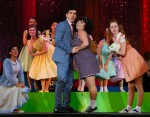
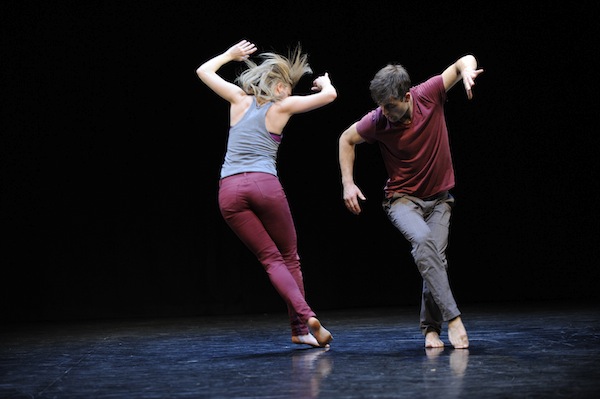
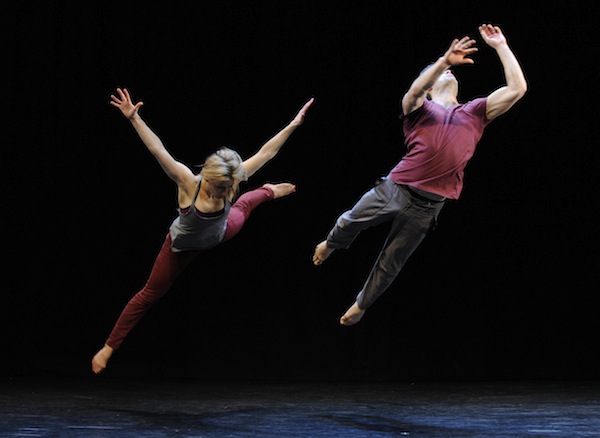
Dustin Freeland as Link Larkin, Erin E. Walker as Tracy Turnblad, Hannah Williams as Penny Pingleton and ensemble members in Hairspray. (photo by Tim Matheson)
When Theatre Under the Stars announced its lineup earlier this year, I was excited. I’d enjoyed the movie Hairspray, but not seen the stage version, and the last (and only) time I had seen Oliver! was at Winnipeg’s Rainbow Stage when I was just shy of 9 years old. The brutality in that production, in particular Nancy’s death at the hands of Bill Sykes, stayed with me, and I was curious to see how TUTS would handle it.
But first, Hairspray. “Good Morning, Baltimore” is one of the greatest songs. So cheerful and optimistic, its driving beat setting the tone and pace of the entire musical. If only we could all carry such confidence and positive energy out into the world. But I digress. The broad expanse of the movie, in which heroine Tracy Turnblad, sings and dances her way to school through the city that she loves is, of course, not possible on stage, and the added sparseness of Brian Ball’s TUTS set – basically tiered, multi-colored stages with the odd extra prop or flourish – took a little adjustment in perspective. But once I scaled my expectations, I came to appreciate the room his choices made for the dancers. And what dancing! Julie Tomaino’s choreography was not only fabulous, but it was professionally executed by the mainly amateur cast.
Many of the cast members are at least triple threats. Starting with the lead, Erin E. Walker does a commendable job as the boundless Tracy, who, in 1962 Baltimore, sets out to be a dancer on The Corny Collins Show despite her relative largesse, and ends up not only winning a spot on the show but getting its Elvis-like heartthrob Link Larkin (perfectly played by Dustin Freeland) to fall in love with her. Oh, and she also inspires significant social change along the way, succeeding in racially integrating her favorite show. And, she convinces her mother – a pleasantly understated performance by Andy Toth – to come out of the house after a decades-long, self-imposed imprisonment out of shame over her weight.
On her mission(s), Tracy is supported by her best friend, Penny Pingleton, played by the obviously talented Hannah Williams, though the accent she chooses for the role makes her sound incredibly stupid. Thankfully, she sings more than talks. I also had a problem with a couple of the other accent choices – Ryan Purdy as Tracy’s dad sounds like a complete moron, rather than the tenderhearted, somewhat nerdy guy he is; and I’m still trying to figure out how a German prison matron made it to 1962 Baltimore.
For the most part, however, director Sarah Rodgers’ pacing and style are spot on; the costumes by Chris Sinosich are colorful and suit the characters and period; and music director Chris D. King, whose orchestra is fantastic, does an excellent job as Corny Collins. And three other standouts cannot go without mention: Cecilly Day as Motormouth Maybelle and, as Maybelle’s children, David Lindo-Reid as Seaweed J. Stubbs and Marisa Gold as Little Inez.
Oliver! is a much more uneven performance. TUTS valiantly tries to evoke 1843 England beyond the stage and, by the time the show starts, kids (and older folk) have had the chance to see a Punch and Judy show, compete in a 20-yard dash, show their strength in a bell-ringer contest and watch some comedic but able strongmen. While the “village fair” is a lot of fun and a great idea in concept, it sets the wrong tone for the musical – poor orphan Oliver, after all, left in a workhouse after his mother dies giving birth to him, does not get to have much fun.
The first few musical numbers also struggle to respect the darkness of the story. At the workhouse, the main “problem” is the portrayal of Mr. Bumble, who is played much too loudly and vulgarly by Damon Calderwood. At the undertaker’s (to whom Oliver is sold), dancing zombies and more overacting detract one’s attention from Oliver’s plight. A rushed rendition of the beautiful ballad “Where is Love” is a lost opportunity to latch on and care for Oliver, who is well-played by Carly Ronning.
It is only when Oliver manages to walk himself to London and find a home with Fagin’s gang of thieves that director Shel Piercy’s vision becomes more uniform and appropriate to the subject matter.
Stephen Aberle as Fagin, Carly Ronning as Oliver (centre, on floor) and the young cast of Oliver! (photo by Tim Matheson)
The young Nathan Piasecki as the Artful Dodger is one of the highlights of this production, as is his boss, Fagin, played by Jewish community member Stephen Aberle. The connection I felt some 36 years ago to Nancy just wasn’t there, however. Calderwood fares better as the evil Bill Sykes than Mr. Bumble, but again without any refinement, so it is hard to understand why Nancy, played ably by Elizabeth Marie West, would love him. She also was dressed quite fancily and seemed like a lady, so it was a wonder that she would be involved with him and Fagin in the first place. I had to stop myself from rolling my eyes during her rendition of “As Long As He Needs Me,” when I should have been sympathizing with her predicament – to be loyal to her (dangerous) man or risk her life to save Oliver. While the character’s death may have semi-traumatized me as a child, I can say this – it was both moving and memorable, neither of which applies as much to this version.
All that said, it is worth repeating that, from the moment Oliver meets the Artful Dodger just over halfway through Act 1, and is encouraged to consider himself part of Fagin’s “family,” TUTS’s Oliver! is a solid, enjoyable production. The ensemble – which includes community members Kat Palmer and Julian Lokash – are an incredibly talented and energetic group well worth seeing and hearing in action. They land the choreography of Keri Minty and Shelley Stewart Hunt and are in perfect tune with the orchestra, led by music director Kerry O’Donovan.
Theatre Under the Stars presents Hairspray and Oliver! on alternate evenings at Malkin Bowl in Stanley Park until Aug. 22 (tuts.ca or 1-877-840-0457).
The multiple-award-winning singer, songwriter, guitarist and producer is well-known to many in the Jewish community, having performed at Rothstein Theatre and in the Chutzpah! Festival a number of times, including opening for Idan Raichel last year. Her most recent CD is Hearts Up to the Sun, which has earned deserved praise. On her website, Capilano University’s Gary Cristall – who, among many other career milestones, was a co-founder of the Vancouver Folk Music Festival – describes Hearts: “Musically, it is as hot as Louisiana hot sauce and the horn arrangements sound like they might well have come from there. Babe’s voice is sounding as good or better than ever. The band is great. But the songs … wow! The songs mark a step forward. They are even better than the ones she won awards for with her last release, SideDish.”
The Jewish Independent recently interviewed Gurr about her work and its beginnings.’
JI: I understand that it wasn’t until you were in your 20s that you joined a band and set off on a musical path. How did you end up joining a band, and what type of band was it? What were you doing (or planning on doing) as a job/career at the time?
BG: I joined my first band when I was 25 and it was a jazz/pop band, which was very stupid and daring of me as I knew nothing of jazz music other than what I heard of my parents’ album collection. I was living in Victoria at the time and working as a dental assistant, which never really fit as a job for me, but when I graduated high school, my parents didn’t think music could or would ever be an option and so steered me toward something respectable like working with teeth. Nothing against teeth – we all have and need them but, ugh, not for me. I really wanted to be involved with music and so I auditioned for this jazz/pop band and, amazingly, they took me under their wing and taught me the ropes of being in a band and, on the side, the lead guitar player, Dave English, would give me lessons on how to play the jazz chords on the guitar. Later on, I also started to sing and joined various bands over the years, playing rock, jazz, folk and top 40, before I started to write my own music.
JI: What was it about music that made you so passionate about it that you wanted to create it and try to make a living at it?
BG: That is a hard thing to put a finger on. I knew from a very young age I liked music and would lay on the floor with my head near my parents’ stereo speakers listening intently to the music. But I guess the pivotal point was seeing the Beatles on The Ed Sullivan Show when I was a little girl – I just was completely wowed!
JI: You released Hearts Up to the Sun earlier this year, your fifth CD, I believe. How would you say your music/style has changed/evolved since your first recording?
BG: My music is a mash up of so many genres these days, pop, roots, blues, rock, world and a hint of jazz. I guess that is the result of the freedom one has when you are an independent artist and you have been around awhile, you just stop worrying about fitting in and create what you like, and then hope that you still have an audience for it.
JI: Do you have a specific creative process? If so, could you share how, in general, an idea becomes a song?
BG: I am fascinated by how a song will come to me – not that they are brilliant or complex but, still, it is a strange process, creativity. The music comes as a result of noodling on my guitar until I find something I like and the lyrics can be inspired by so many sources, some personal and others influenced by all that is happening around me.
JI: Could you tell me a bit about your band, how you guys got together, how long you’ve been playing together?
BG: I love the guys I play with, whether it is my three-piece or eight-piece band, they are all such talented players and so fun to work with. I have been playing with Nick Apivor, percussion/piano, for many years – I think we started to play in a duo in the late 1800s; actually, we met in our 20s. Then, I guess, violinist Tom Neville has been with me for about 10 or 12 years. The newer additions to the band are sax player Steve Hilliam, Malcolm Aiken on trumpet, Liam MacDonald on drums, Adam Popowitz on lead guitar and Darren Parris on bass.
JI: Are there any projects on which you’re currently working that you’d like to share with readers?
BG: There is a really interesting project that I will be involved with and we will be starting to workshop this summer, that puts together various dancers with a variety of musicians, but I am not able to talk about it yet – mum’s the word, for now.
JI: If there is anything else you’d like to add, please do.
BG: Another hat I like to wear is that of a record producer and I have been lucky enough to have produced a number of talented singers’ CDs along with my own. It probably is my favorite thing to do in the music business. I compare it to a painter who sits with a blank canvas with an idea and then takes that idea and expands and enhances it with colors and strokes or, in the musical sense, arrangements and various instruments and sounds. It is so exciting to hear a song come to life in the studio.
For information on Babe Gurr’s upcoming shows, visit babegurr.com.
Shtreiml and Ismail Fencioglu will play at the Vancouver Folk Music Festival, as well as concerts on Vancouver and Salt Spring islands. (photo from Vancouver Folk Music Festival)
Shtreiml and Ismail Fencioglu will be right at home among the top talent that will gather at the Vancouver Folk Music Festival July 17-19. As did their previous recordings, the group’s fourth CD, Eastern Hora, received critical acclaim – it also resulted in the band’s nomination as group of the year in the 2014 Canadian Folk Music Awards.
Shtreiml is composer, pianist and harmonica player Jason Rosenblatt; trombonist Rachel Lemisch, originally from Philadelphia, who met Rosenblatt at KlezKanada (the couple dated long-distance for a few years, marrying in 2004); drummer Thierry Arsenault; bassist Joel Kerr; and composer, oud player and vocalist Ismail Fencioglu, who harkens from Istanbul.
Rosenblatt met Fencioglu a couple of years after Shtreiml was formed. The two played together at Festival du Monde Arabe in 2004.
The festival’s artistic director, Joseph Nakhlé, is “very forward-thinking, and he wanted the festival to be “more inclusive and, of course, Jewish people have had a presence in the Arab world for thousands of years, so he wanted to have a Jewish group,” Rosenblatt told the Independent in a phone interview from Montreal. While Shtreiml is not a Mizrahi or Sephardi group by any stretch, he said, Nakhlé wanted to add another element of the Middle East, “so he introduced us to Ismail, and we started this collaborative project.
“The first concert, we played all traditional tunes … traditional Jewish or traditional Turkish melodies, and we’ve just been working ever since at creating our own music. He writes music for the group, I write music for the group, and we created this hybrid sound.”
Rosenblatt attributes the success of Shtreimel to several factors. “First of all, I think when we perform live, it’s engaging in the sense that … you have the instrumentation that people don’t see very often … it’s instruments that people aren’t necessarily familiar with … so, to see someone from Turkey playing the oud and also singing in a style (microtonal), getting the notes in between the notes, I think that’s interesting.”
Another factor, and Rosenblatt said he never thought he would describe the band in this way, but “people like to see an Orthodox Jew and a Muslim playing together. He’s a secular Muslim and I don’t make a secret that I’m an Orthodox Jew, I wear kippa on stage, but I think there’s something heartwarming about it.” The two have been friends for a long time now, and they still get along really well, said Rosenblatt.
And, of course, there’s the music. “We try to stay away from cliché compositions … and, if we do play something that’s super-traditional, we try to add our own flavor, our own spin on it.”
Rosenblatt grew up in a musical family.
“Jewish music was always in the house,” he said, “but the main form of music that my parents listened to was folk and blues, early jazz, that type of thing. But we always had klezmer greats, Dave Tarras, Naftule Brandwein, somewhere in the background; Yossele Rosenblatt [no relation] from cantorial music, my grandmother sang Yiddish folk songs. But my main love of music was – I was influenced by my parents to get into – blues and early jazz.”
Rosenblatt’s dad is a doctor but he plays guitar, and he would play for the kids when Rosenblatt was growing up. His mother is a folksinger, Abigail Rosenblatt, with recordings of her own, and she has accompanied Rosenblatt’s bands on various occasions and on recordings. He has four siblings, who all played an instrument when they were growing up, but did not choose music as a profession, or at least not their main profession, as one of his brothers, Eli, who is a lawyer, has made recordings.
Rosenblatt grew up singing in synagogue, leading services; he took piano lessons. He said he picked up his first harmonica when he was 15 years old because his dad had a bunch lying around. He thought that “Oh Susannah” might have been his first tune, then his parents gave him a tape of Sonny Terry and Brownie McGhee, “an African-American duo that were big in the ’30s, and then, with the folk music revival of the 1960s, a bunch of white, Jewish people rediscovered all these amazing African-American musicians, and it kind of brought them out of retirement. While these guys were out of style for the black community, for these young Jewish people that were rediscovering blues-roots music, these guys became stars again.”
Later, when Rosenblatt started getting into the electric harmonica and Chicago blues, his parents gave him other records to inspire him, Paul Butterfield Blues Band, for example.
While he majored in economics, many of his undergraduate credits were in music, he said, and, during his subsequent MBA, he was still playing weddings and other gigs.
He headed to Israel for about five years, in the latter half of the 1990s, to work in software design. It was an educational multimedia firm, he said, “so they had these various videos and diagrams explaining certain things, historical tours, they did different projects. One of them was the genius of Edison, and Leonardo da Vinci, so they explained various inventions and each invention that was being explained was in a video and I was doing the music for those videos, and then, at night I would play [music] in bars.”
In terms of college-level music instruction, Rosenblatt said he had “one year of serious music education,” the rest was on his own and through mentors, such as Howard Levy, a well-known harmonica player.
“I studied European music at the Rimon School of Jazz [and Contemporary Music] in Israel,” he said. “Then, toward my mid 20s, I started getting into Jewish music a little more seriously, the roots of Jewish music, klezmer and cantorial music, through an organization called KlezKanada…. And I really got into listening again to klezmer greats, trying to apply the repertoire, the ornamentation, etc., to the harmonica, and also to the piano.
“Out of that experience of learning these tunes,” he continued, “I needed some sort of outlet and I formed a band called Shtreiml…. I formed it with Josh Dolgin, who’s known as Socalled … and it started off as a young group playing traditional klezmer music with somewhat untraditional instruments because I was playing harmonica, my wife was on trombone, Josh Dolgin was on accordion, and then we had bass and drums. The group kind of morphed, we played traditional repertoire, to a certain degree, until we felt we couldn’t take the repertoire much further. Then, I started writing a bunch of new material, Jewish instrumental music based on traditional modes, using traditional ornamentation and improvisation, and that’s how the band started.”
As to his compositions, Rosenblatt said, “I listen to a lot of music and I come up with ideas. I don’t just compose in the Jewish realm, I also … have a new album coming out of ragtime and jazz, and not just instrumental music but vocal music as well…. Especially with regards to the Jewish material, I saw a need for it because we were researching a lot of old klezmer tunes and we kind of got tired of always having to research and look for something old, why not create something new? We always say that we have great new music that has a reverence for the past.”
Eastern Hora follows Harmonica Galitzianer (2002), Spicy Paprikash (2004) and Fenci’s Blues (2006). Between Eastern Hora and Fenci’s Blues, Rosenblatt was working with a group called D’Harmo, “and I came out with an album with them, I was working quite a bit with them. I was doing another project, called Jump Babylon, which is a Jewish rock project. It’s difficult, we are self-managed, in other words, I manage everything…. So, to try to do projects simultaneously, especially recording projects, it’s difficult, so that’s the reason for that gap in recordings for Shtreiml because I was doing other things in between [including his continuing role as artistic director of the six-year-old annual Montreal Jewish Music Festival, which will take place in August]. But that doesn’t mean that the band was on hiatus. We were still performing and, since the new record came out, I’ve been putting a lot of emphasis on trying to book the group because it’s fun and we get along, it’s fun to tour together. I think also that the playing of the group matured quite a bit between 2006 and 2014, and I think audiences see that the compositions are little more complex and I think our stage presence is better.”
Shtreiml and Fencioglu will be doing four gigs in British Columbia. He and Lemisch are bringing the whole mishpocha with them: four kids, 7, 5, 3 and seven months. “I’m looking forward to coming to Vancouver, it’s our second time. We were there last year for a wedding…. We have what we call functional music and then we have original music, and so we’re excited to be playing our artistic project for what I know is going to be an appreciative audience because whenever we go to folk festivals, it’s always people are there because they want to hear music.”
Shtreiml and Ismail Fencioglu will be at the Vancouver Folk Music Festival July 17-19, Congregation Emanu-El in Victoria July 15, Vancouver Island Musicfest in Comox July 10-12 and Fulford Hall on Salt Spring Island July 9.
Left to right: Nathan Piasecki (Artful Dodger), E. Marie West (Nancy) and Stephen Aberle (Fagin) in Theatre Under the Stars’ production of Oliver! Aberle also plays Mr. Brownlow. (photo by Tim Matheson)
Actor Steven Aberle describes Theatre Under the Stars as “a thrilling combination of enthusiastic, amazingly talented youth and, as they say, ‘seasoned’ pros.” In this instance, Aberle – who plays both Fagin and Mr. Brownlow in TUTS’s Oliver! – counts among the seasoned pros, while fellow Jewish community member Kathryn Palmer, who plays Strawberry Seller and is in the ensemble, is one of the talented youth, though Aberle and the other seasoned pros also have plenty of that, of course. The Independent caught up with both actors by email earlier this month.
More than just luck
JI: You’re a relative newcomer to the Vancouver stage. Could you share some of your performing background?
Kathryn Palmer is Strawberry Seller / ensemble in Oliver! (photo from TUTS)
Kathryn Palmer: I have always had a deep-seated passion for music and performing. When my home life started getting rocky, my Auntie Kathryn, who was a professional opera singer, seized the opportunity to get me out of the house for a few hours a week and into her studio for voice lessons. I was hooked and completely inspired! It wasn’t long before I was accepted into the voice program at Canterbury Arts High School, taking Royal Conservatory Exams, singing in choirs, competing in music festivals across Canada and performing in as many musicals as I could.
JI: You’re a graduate of the Canadian College of Performing Arts in Victoria. Are you from Victoria? Can you share some of your personal background, including what role, if any, Judaism or Jewish culture or community has played (plays) in your life?
KP: Born and raised in Ottawa, I moved to Victoria to study at the Canadian College of Performing Arts. I was very fortunate to graduate with about two years of paid theatre work … beginner’s luck, I call it.
At school, we were always told to use what makes us different and unique. One of the things my auntie had taught me was all about Jewish folk music. Being able to sing folk songs in Yiddish and Ladino was definitely something that made me unique but also grounded me. Being Jewish doesn’t exclusively impact the work I choose to do but it definitely infuses it. When I’m doing these musicals that are set in the past, I always wonder that would my life be like a young Jewish woman during this time. I also get excited to perform in shows with a more Jewish theme, like Hodel in Fiddler on the Roof at the Gateway Theatre or Louise Philo in Girl Rabbi at Congregation Emanu-El in Victoria.
JI: What are some of your aspirations regarding a career in performance?
KP: I adore theatre. I love musical theatre. I also love working with kids. I want to go back to school within the next few years and do my ECE [early childhood education]. I’m hoping to one day move back to Ottawa and start a theatre school there. Hopefully, I can inspire children the same way my auntie inspired me.
Not just the beard
JI: You seem to have been very busy on stage in the last couple of years. Can you share with readers some of your performance highlights since the JI last spoke with you in December 2013 about Uncle Vanya?
Stephen Aberle: I have been blessed with busy-ness these past several years, yes, kein ayin hara [no evil eye]. I guess I’m at that stage in my career where, if one remains alive, willing and (unfortunate but still true in today’s theatre) male, opportunities arise. Since
Uncle Vanya, I’ve had the good fortune to perform in Snapshots: A Musical Scrapbook, with music by Stephen Schwartz (of Godspell and Wicked fame) at Studio 1398 on Granville Island last fall. That was an opportunity to work on some amazing material with a wonderful company, including director Chris McGregor and Wendy Bross Stuart as music director.
I’ve been fortunate to perform with Wendy many times, including a couple of shows together at TUTS. We’ll be doing Snapshots again this coming fall [late October, early November], at Presentation House in North Vancouver, this time to be directed by Max Reimer.
I got to be part of a workshop of Hamelin: A New Fable by Leslie Mildiner (another member of the Jewish community) for Axis Theatre, although, unfortunately, scheduling didn’t make it possible for me to be in the touring production. And, earlier this year, I was in What You’re Missing, a lovely new play by Vancouver-born playwright Tamara Micner (she’s now based in London), at the Chutzpah! Festival.
JI: What most attracts you to, and repels you about, the character of Fagin? How are you approaching the role?
SA: Well, Fagin is one of the great characters of 19th-century literature – and, in Dickens’ novel at least, one of the great antisemitic caricatures of all time. That kinda sums up both the attraction and the repulsion: the character and his motives and passions are grand, fascinating, delicious for both performers and audiences; he’s also, let’s not mince words, a brutal travesty – again, as Dickens originally conceived and presented him in the novel Oliver Twist.
I want to rise to the level of the challenges the character offers. He’s big, and I need to honor and own that and, at the same time, find the truths in the character and his situation. Lionel Bart, who was Jewish and who created the musical Oliver!, trod a careful line in dealing with Fagin. There are no explicit references in the play to Fagin’s being a Jew, but Bart wove klezmerish themes into a lot of his music. The late great Ron Moody, also Jewish, who originated the role in London and who played it in the movie, followed that line, playing into Jewish nuances in the music and in the character’s accent.
The story of Oliver Twist and of the musical Oliver! deals with some dark themes – themes that are very much still with us, here and now. Grinding poverty rubbing shoulders with enormous wealth and privilege; love, hatred, loyalty and betrayal; violence against women; criminality, justice and injustice; prejudice; legitimacy and illegitimacy and the arbitrariness of those categories. Our director, Shel Piercy, is not shying away from that darkness, and I’m interested in his approach, his color palette. There can be a tendency, sometimes, for musical comedy to be cutesy, all fun and games and sweetness and light; that’s not the intention with this production. So, I’m looking for ways to explore Fagin’s breadth and depth. He’s devious, avaricious, by turns fearful and bold, can be selfish and brutal; he’s also probably the closest thing to a parent most of his gang of little thieves have ever known. He uses them, but he also feeds them and shelters them and plays with them and teaches them the only way he knows how to make a living, which happens to be thieving.
Shel has made some intriguing casting choices. One actor – Damon Calderwood – plays both Mr. Bumble and Bill Sykes, and Shel has me playing both Fagin and Mr. Brownlow, the kind gentleman who strives to rescue Oliver from Fagin’s clutches. I get to play both the wicked and good father (or grandfather) figures, if you like. A practical consequence of that choice is that I spend a lot of time on stage, so one important goal for me as an actor will be to remain upright. It’s going to be a workout.
JI: You were Buffalo Bill in a prior TUTS season. How did you come to start auditioning with TUTS, and have there been other roles? Does performing on an outdoor stage present unique challenges?
SA: I first worked at TUTS (in those days it was called Theatre in the Park, or TITPark) in the mid-’70s as a carpenter and stagehand, and I’ve had the pleasure of performing there each decade since – in Anything Goes in ’87, as Tevye in Fiddler on the Roof in ’97 and as Buffalo Bill in Annie Get Your Gun in 2008.
I started auditioning for TUTS soon after I graduated from Studio 58, and I keep auditioning there when I’m free and I think there might be a role for me. I love it there. The people are great, a thrilling combination of enthusiastic, amazingly talented youth and, as they say, “seasoned” pros. There’s a lot of love around the place. A special smell pervades the atmosphere, although it no longer carries as much of the whiff of pigeon droppings as it had in the old days. I’ve probably been just about everywhere it’s possible for a human being to get to in that building, including all over way up in the gridwork, where I spent a great deal of my time during those summers in the ’70s.
Playing outdoors presents some curious and inspiring challenges, yes indeed. There are obvious ones, like wildlife, for example. You never know when you might be joined on the stage by a raccoon or a squirrel or a crazed moth, and every actor knows that small children and animals – even insects – are far more interesting to watch on stage than we are because they’re unselfconscious and unpredictable.
We’re playing in Vancouver in the summer and the days are long, so the first half or so of the show is hard to light – you can’t use light to draw the audience’s attention very effectively because it’s hard to compete with the sun. Shel pointed this out to us in rehearsal: “Your movement is my spotlight.” We as performers need to provide focus through our actions, positions, motions and stillnesses. We’re also quite far away from the audience, so we have to use our bodies fully. Someone in the 20th or 30th row may barely be able to make out my features, so I need to release my thoughts and emotions into my body: to smile and frown and laugh and wonder, not just from the neck up but with all of me….
JI: If there is anything else you’d like to share with readers, please do.
SA: Well, there is one other thing. It’s interesting to me that, especially in the last few years, so many of the characters I’ve played have been Jewish. Tevye in Fiddler, Jacob in Joseph … plays at the Chutzpah! Festival, now Fagin. I think I get called to audition for most of the film and TV rabbi parts that come into town.
I guess it’s the beard.
Oliver! alternates evenings with Hairspray from July 10-Aug. 22 at Malkin Bowl (tuts.ca).
Jewish community member Mira Oreck, director of public engagement for the Broadbent Institute, has announced that she will seek the federal NDP nomination in the riding of Vancouver Granville. She spoke with the Jewish Independent about that decision. For more information, readers can visit miraoreck.ca.
JI: Why have you chosen to seek a nomination for the NDP?
Mira Oreck (photo from Mira Oreck)
MO: I am seeking the NDP nomination in Vancouver Granville because I believe in Tom Mulcair, his vision for Canada and the impressive group of leaders he has assembled to turn that vision into reality. In particular, I am compelled by his commitment to address climate change, to create affordable and accessible childcare for $15 per day and the solutions he has put forward to address the growing rate of income inequality in Canada.
JI: Why now in your career path are you seeking this nomination?
MO: I spent a number of years living in New York City and watching from afar as the direction of our country began to change. Science and evidence-based policy were being ignored. The judicial system was under attack. The core of our democracy was being challenged. I moved back to Vancouver because I could no longer watch that happen to Canada. I’m seeking the NDP nomination because I believe Canadians are ready for a change, that Mulcair is the leader with the clearest values and most ready to govern, and I want to be part of that change.
JI: Foreign policy, in particular towards Israel, is a main issue for many in the Jewish community. What are your thoughts on the Canada-Israel relationship and how would you want that to change (or not) if you were to become an NDP MP?
MO: I grew up in this riding, in the heart of the Jewish community, and a deep relationship with Israel has always been part of my world. I have visited Israel over a half-dozen times and spent a year living in Jerusalem studying at
Hebrew University. In this sense, I relate to the Jewish community’s concerns, both in terms of domestic policy issues and foreign policy, with respect to Israel in particular.
I am proud to run for a political party that supports the state of Israel and, importantly, is working towards a two-state solution. As Canadians, we were once known for listening and hearing the various sides of a conflict. I know many people on every side of this conflict – and the vast majority, even the most frustrated among them, want trust-building efforts that can lead to solutions for Israelis and Palestinians. I believe we, as Canadians, have a responsibility to be bridge-builders. I trust that the NDP under Tom Mulcair would be just that.
JI: When is the nomination vote taking place; who else is running? What would make you a better candidate for the Jewish community, or in general?
MO: The nomination meeting date has not yet been set but will likely be the final week of July. There is another candidate in the race and the vote will be among current NDP members in Vancouver Granville.
It would be an honor to serve as a member of Parliament for a riding with a large concentration of Jewish community members, many of whom I grew up with. As a former director of Canadian Jewish Congress, Pacific Region, I am acutely aware of the issues facing the community and have a track record of advocating for them. I know that, for many people in the community, issues of affordable child care, investments in public transit, an increase in the minimum wage and addressing climate change are at the core of their beliefs.
I know that members of the community are members of all political parties, and strongly support and encourage political engagement. I have been thrilled by the support I have received from members of the Jewish community who have joined the NDP to support me in this nomination race.
JI: If there is anything else you’d like to add, please do.
MO: The importance of civic and political engagement is a direct result of my family’s work within the Jewish community and my experience in USY and at summer camp. Recently, I have been inspired by a younger generation of leadership in Israel who believe in the political system making change. Watching them seek and hold office and shape their own country has shown me the importance of diving in!
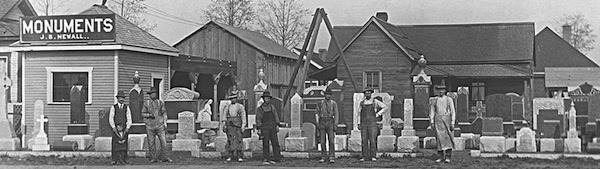
The process of restoring headstones comprises many steps. (photos from J.B. Newall Memorials Ltd.)
Among the headstones restored in the Jewish section of Mountain View Cemetery was that of Bessie Rosenberg.
Last month, the restored Jewish section of Mountain View Cemetery was rededicated in a public ceremony that was the culmination of three years of work undertaken by a group of volunteers headed by Shirley Barnett and others. Among the contributors to the project was J.B. Newall Memorials Ltd.
“The restoration project in the Jewish section at Mountain View Cemetery was a very special project for us,” Meghan Newall told the Independent in an email. “Knowing that many of these pieces were designed and created by the Newall family over the past decades gave us a sense of honor and pride to be able to work on them once again. A great deal of work went into the cleaning, restoring and re-stabilizing of the markers and monuments, as each piece is unique and required a number of different methods and procedures (and patience!).”
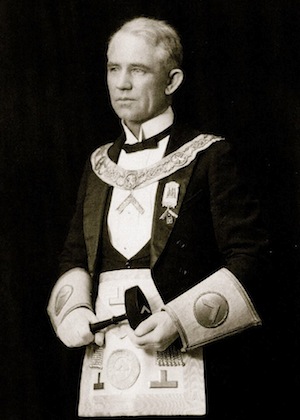
John Brodie Newall
Newall’s great-grandfather, John Brodie Newall, established J.B. Newall Memorials in 1909.
Described as “an accomplished poet, scholar and master mason,” on the company’s website, the history reads that he “parted with his family in 1905 from the town of Dalbeattie, Scotland. He left his brother David the family business – a granite quarry and monumental works company that gave birth to the town of Dalbeattie in 1820 – which continues to produce today.”
Shared his great-granddaughter, “We are (unfortunately) unsure why he decided to leave the granite business in Scotland to start over in Vancouver but are happy he did!”
She added, “I recently had the opportunity to visit the town in Scotland where our family started out and even saw one of the original quarries that is still in operation today, though it is now a sand and gravel quarry operated by a different company.”
One of the first ads run by J.B. Newall in the Jewish Western Bulletin (Aug. 8, 1933). The company stills supports the community paper.
Eventually, her great-grandfather arrived in Vancouver. “He set up shop here, at our current location in 1909, where his son Nathan Newall continued the tradition,” explained Meghan.
Grandson Alan, his wife Rosemarie and their children, Meghan and her brother Brodie, “continue to create memories out of stone,” said Meghan. “Our works can be seen throughout British Columbia cemeteries as well as civic projects throughout the city.”
For more information about the cemetery restoration project, search jewishindependent.ca for “Mountain View Cemetery.” For more information about J.B. Newall Memorials, visit jbnewall.com.
J.B. Newall has been in the same location since its establishment in 1909.
Tara Cheyenne Performance’s how to be, part of Dancing on the Edge. (photo by Wendy D Photography)
This year’s Dancing on the Edge festival, which runs July 2-11, once again features the talents of many Jewish community members. The Jewish Independent asked several of them to describe the work they are presenting in the festival and to explain what makes it “edgy.” Their responses appear in the order in which their work appears in the festival.
Vanessa Goodman (photo by Jeff Pelletier)
Container, choreographed and performed by Vanessa Goodman, with original sound composition by Loscil, is a new work “that explores heritage, culture and resilience.” (Part of Edge 1, July 3 and 4, 9 p.m., at Firehall Arts Centre.)
“What makes the work ‘edgy’? Well, I am not 100% sure that I would categorize the work as edgy,” said Goodman. “However, I would say that the physicality/embodiment shifts between different extreme states, taking the witness/audience on a journey of my experience within the work.”
Re:Play: a duet choreographed by Naomi Brand and performed by Hilary Maxwell and Walter Kubanek. (Part of Edge Up, July 5 and 6, 8 p.m., at Firehall Arts Centre.)
“The piece is a playful exploration of the space between two bodies in dialogue,” said Brand. “It looks at what we choose to display and disclose and what gets hidden and smoothed over in conversation. The element of play is a theme that drives the duet as the dancers show and tell, watch and listen, repeat, respond and react to one another. The piece is set to a sound score that brings the process to light, with dancer Walter Kubanek practising Chopin’s Nocturne Op. 9 No. 1 on piano, and sound clips of the dancers in rehearsal. Playing on the edge between cooperation and competition, the dancers engage in a dynamic negotiation of space.”
Hilary Maxwell and Walter Kubanek in Re:Play. (photo by Chris Randle)
Feasting on Famine: choreographed by Shay Kuebler, Radical System Art. (Part of Edge 5, July 9 and 11, 7 p.m., at Firehall Arts Centre.)
“This performance looks into the extremes of bodybuilding culture and how it references capitalism and the corporatization of the human body – growth edges out all other aspects of self. One man’s physically charged journey into the depths of extreme health and fitness will leave the audience on the edge of their seat.
“The work combines theatre, dance, and martial arts to construct an edgy and modern look at the extremes of society,” said Kuebler.
Duck Dances “promises to be a whimsical exploration of curious imagery, woven together with the color red to reveal a charming tableau of events within the framework of Dusk Dances,” reads the description on Dancing on the Edge’s website. (July 9, 10 and 11, 7 p.m., at Portside Park.)
“I am creating a piece in collaboration with Jennifer Mascall and Susan MacKenzie for Dusk Dances. We’re calling it Duck Dances,” Amber Funk Barton told the Independent. “For me, this work is ‘edgy’ because I have never created a site-specific work and our intention is that our performers will also be all ages and abilities. Using Crab Park as a studio instead of a studio is not only inspiring but challenging me to work outside of my comfort zones and creativity.
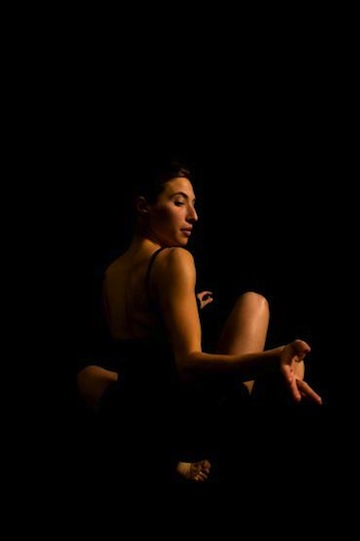
how to be is “the latest ensemble creation to emerge from the strange mind of Tara Cheyenne Friedenberg (Tara Cheyenne Performance). The piece examines how we think we should ‘be,’ how we think others should be and how impossible and futile it all is. Using ideas found in malignant social media, cultural restrictions, and the ceaseless voices in our heads, how to be traces five characters as they navigate how to be.” (Part of Edge 6, July 10, 7 p.m., and July 11, 9 p.m., at Firehall Arts Centre.)
“I consider this piece ‘edgy’ because it plays with text, audience relationship, what is ‘appropriate’ in life and in performance,” said Friedenberg. “This is not a typical dance piece, but it is a piece only highly trained dancers could do. I expect to tiptoe very near the edge of extremely uncomfortable and deliciously funny.”
Left to right, Susan Skemp, Ken Charko and James E. Taylor are making a movie about Dunbar Theatre’s history. (photo by 5U54N & J4M35 Productions)
To celebrate Dunbar Theatre’s 80th anniversary, the theatre is making a short film about its history to enter into film festivals around the world and for film and music awards in Canada. One of the goals is to raise awareness of the theatre, one of the few independent theatres still around.
“Our short film will showcase all eight decades the theatre has been playing movies for the Dunbar community. With the use of old movie clips, newsreels, actors, models, music and their resident ghost, Delores, we intend on making a very entertaining film,” said Susan Skemp (producer, writer and songwriter) in an email to the Independent.
The production team includes Skemp, Ken Charko (executive producer and owner of the Dunbar Theatre) and James E. Taylor (director, writer, editor). One of the many participants in putting together the film is Jewish community member Adam Abrams, who will voice one of the newsreels.
“I came up with the idea to make the film last December when Ken Charko and I were discussing what to do to celebrate the theatre’s 80th,” Skemp explained. She said she suggested making a movie about a movie theatre and Charko liked the idea; then Taylor joined the production team as director.
“We have assembled a wonderful group of people and I have likened us to Orson Welles and his Mercury Players group,” said Skemp.
“My idea for the script really came from the theatre and the people from the community who have passed through its doors and the films that have played on the screen. Even though the film is a history of the theatre, our goal is to make it as entertaining as possible,” she stressed. “The fact that the theatre has a ghost helps.”
The crowdfunding goal to bring the film to fruition is $20,000. Contributions to the fundraiser at fundrazr.com/campaigns/fxGG2 come with different perks for each donation level: from a DVD and an invitation to a red-carpet screening ($25), to those items plus two tickets to any film at the Dunbar ($100), to a film credit as an associate producer ($500), to listing as a producer ($2,500).
There are a few remarkable things that one notices when looking at the press material for Scratch, which is being presented by Theatre Plexus at Havana Theatre until June 13.
First, the play itself. Part of the story is in its title, which refers to the protagonist, a teenage girl who loses her mother at the same time as she is dealing with an egregious case of head lice. The other part is in the script by Charlotte Corbeil-Coleman: the original mounting of the production by Toronto’s Factory Theatre in 2008 was nominated for the Dora Mavor Moore Award for outstanding new play.
Second, Theatre Plexus. A relatively new company, it has gathered a small but experienced cast and production team for this show, its third.
“Theatre Plexus started somewhat organically, born out of the necessity of having an umbrella under which to put my personal projects,” explained actor and producer Caitlin McCarthy. “The first show I produced in Vancouver was 8 Girls Without Boyfriends in 2013, but it wasn’t until the following year when I applied for the Vancouver Fringe that I came up with the name. I was performing a show I had written, called Saudade. It occurred to me that I had a mandate (personal and professional): it was important to me to produce work with a strong female voice, and I preferred intimate theatre spaces. I know a staggering number of talented female actors who just don’t get stage time in Vancouver as often as they should, and I want to help remedy that. Scratch has four women in it out of a cast of six, and these women have scenes together that aren’t just related to a male protagonist. In fact, it’s a young, female protagonist.”
Caitlin McCarthy (photo from Theatre Plexus)
McCarthy plays that young protagonist, Anna, and it was one of the aspects that drew her to the play.
“I picked up a copy of Scratch because I liked some of the monologues – as an actor, I am always looking for good Canadian monologues, and Charlotte Corbeil-Coleman is based in Toronto. I was struck by how tender the play is – and how it presents grief from multiple angles. I also like that the play has a sense of humor and, though it is a play about loss, it is ultimately uplifting. Also, as I mentioned, there are four women in it (and, of course, two wonderful men) and I am an unapologetic feminist when it comes to choosing and casting plays.”
The co-producer of Scratch is Stephanie Izsak, who is also playing the character of Madelyn. Izsak is one of the many members of the production team affiliated with Langara College’s professional theatre training program, Studio 58. This is another remarkable aspect of the local production.
“Steph and I knew each other from Studio,” explained McCarthy of the connections, “and we approached the incredible Genevieve Fleming to be our director – I had gone to school with her…. Eileen Barrett did go to Studio, but I knew her from a playwriting group, Genevieve had seen a lot of Markian’s [Markian Tarasiuk] work while he was a student, we all knew David Bloom as the solo show teacher, and Jeff [Elrick] was recommended by the faculty as he’s still a student. So yes, there is a Studio 58 community to easily draw from, but we didn’t exclusively cast from a Studio pool. I feel so lucky to have Tamara McCarthy and Flo Barrett on board – now that I know them, they will definitely be part of the community I try to work with!”
The process from idea through casting to opening night on June 4 has taken some time, said McCarthy. “Steph approached me two years ago to work together, and I thought of Scratch as a project we could do. It took us a long time to find a venue we liked before we decided on the Havana. I wish there were more independent venues in Vancouver! The lack of space in this city has certainly given rise to some very creative site-specific theatre, but I wish there were more small, traditional theatre spaces to do plays.
“Once we booked the Havana (back in November), it all started to fall into place. We assembled this wonderful group of like-minded artists who felt like the play resonated with them, and we got everything in order for rehearsals to start.”
One of those artists is the aforementioned Bloom, who is a playwright, director, actor, producer and teacher, with a wide range of theatre and television credits, and a Jessie award for Palace of the End with co-directors Katrina Dunn and Mindy Parfitt.
“When Genevieve Fleming asked me to be in Scratch, I said yes very quickly because I liked the writing, and I knew that several scenes would be challenging to play,” Bloom told the Independent. “The other reason I said yes, though, was that I like and admire all the people involved in the project. Four of them are former students and our stage-manager/lighting designer is still one of my students. Theatre Plexus is a fledgling theatre company whose mandate is to do intimate plays with a strong female voice, in small spaces. I’m working with a great group of smart, talented people. How could I possibly say no?”
Bloom said he got into acting “by accident” in Grade 10, as a favor to a teacher.
“In elementary school, I had written and performed sketches with friends,” he explained, “but by high school, I had decided to be a writer; acting was not on my radar. Our drama teacher was short on men for a production of Twelfth Night and he asked me to take on the small role of Sebastian. I was not a popular kid, and I got laughs and applause. It was like catnip to me. I felt a rush during those two performances stronger than any drug. The truth is, I got into acting for exactly the wrong reason: ego gratification. I’ve never had that feeling quite like that again, and it’s no longer what I look for from theatre.
“At a certain point in my 20s, I came to believe in theatre as a spiritual/humanist practice. (The history of the art form has often been deeply entwined with various societies’ religious practices, as well as a way of channeling difficult, dangerous and thrilling ideas.) One of my more embarrassingly naive statements in my early 20s was, ‘Acting is like a priesthood. It’s like practise for being human!’ I understand how ridiculous and self-important that sounds. Luckily for my mental health, I’m also drawn to theatre’s ability to skewer pomposity, especially in myself. There’s something very freeing about being willing to look like an idiot in front of thousands of people.”
“There’s a sense of community that happens when a group of people with limited resources decide to work together to make a performance. It’s intimate and intoxicating.”
Bloom produced his first production at 17. “Nobody had told me that I couldn’t do it, so I did. I’ve continued in that vein ever since. I’d fall in love with the idea of a show, invite friends to my house to talk about it, and the group would create its own momentum that drove us to produce shows in crappy little spaces (the Firehall before it was a theatre, on the set of other people’s shows at midnight, whatever was available). There’s a sense of community that happens when a group of people with limited resources decide to work together to make a performance. It’s intimate and intoxicating. The people involved develop a sense that they’re part of something bigger than themselves. Like most human endeavors, it’s an illusion,” he said, referring to Waiting for Godot, which examines human beings’ need to try to “create meaning for themselves in a meaningless universe.”
This need led Bloom, among other things, to start his own company. “Humans are social animals and we crave a sense of belonging; we need to believe our lives are meaningful. As a result, we’re easily manipulated (street gangs, political parties and xenophobic movements all manipulate that need). It’s also a source of community, sacrifice and some of the best qualities of humanity. I bonded with a group of people who shared my obsession and formed the Grinning Dragon Theatre Company in 1991. We changed our name to Felix Culpa about 15 years ago. Latin for “happy fault,” it is a reference to eating from the forbidden tree of knowledge (my co-director Linda Quibell is a very lapsed Catholic). The focus of the company’s work is the power of language and its unique ability to explore complex subjects such as morality, beauty and the subjective nature of truth.”
Bloom said he has been teaching since 2000, and it suits him “to a T.” The students have to create a one-person show and perform it before they graduate from Studio 58. “I feel blessed to have this job,” said Bloom. “It means that once a week, eight months a year, I have to think about what theatre is, how many different forms it can take and also how to solve specific challenges brought up by the imagination of wonderfully talented young minds. They regularly do work that astounds me. Then they go out into the world and, within a few years, many of them are far more successful than I am. I guess there’s a kind of legacy in that. Also, for awhile, they think I’m really smart, and that brings me right back to the egocentric pleasures that got me into the profession in the first place.”
A member of the Jewish community, Bloom described his family as “secular, intellectual, socially conscious.” He said, “My father is one of Canada’s great physicists. His sisters are, respectively, a mathematician who devoted most of her career to studying how math is taught (not well, in her opinion) and a school principal who pioneered methods of working with disabled children. They grew up on St. Urbain Street and other streets in that Montreal neighborhood, and they all went to Baron Byng High School.
“My father doesn’t remember Mordecai Richler from the school, but when my aunt met him, Richler remembered my father, something I get a kick out of. Long before I read The Apprenticeship of Duddy Kravitz, my father had told me all the stories in the first chapter about ‘Flanders Field’ high school (for example, the teacher who would start each year asking the students, ‘How does a Jew write the letter S?’ and then draw a $ on the blackboard).
“Much of my work is an attempt to understand how human beings can treat each other so vilely. I am often attracted to artistic work that goes to very dark places. I’m also drawn to stories about people who are not accepted by mainstream society, whether they be Jews, queers, radical thinkers, dissidents, melancholics, eccentrics, Muslims, the list goes on.”
“It’s a little morbid,” continued Bloom, “but I first felt deeply Jewish watching an episode about the Holocaust on the amazing BBC documentary series World at War. I realized that Hitler wouldn’t care that we weren’t religious, didn’t follow the dietary laws, that my mother had converted when she married my father. Something about being the ‘other’ landed for me that afternoon and I was stricken. On many levels, the rest of my life has been colored by that. Much of my work is an attempt to understand how human beings can treat each other so vilely. I am often attracted to artistic work that goes to very dark places. I’m also drawn to stories about people who are not accepted by mainstream society, whether they be Jews, queers, radical thinkers, dissidents, melancholics, eccentrics, Muslims, the list goes on.
“My father told me that his mother sent him off to school every day with the admonition, ‘Ask some good questions!’ He explained to me that you would get the best out of your teachers if you challenged them and their ideas. It was acceptable, even essential, to challenge intellectual (and other) authorities because it would make them work harder. I was often a trial to my teachers, as you might imagine, but the best of them had a deep impact on me.
“There is a long history (one might say a talmudic history) of Jews being argumentative, especially with people we love. I consider myself part of that tradition. I love that about us as a people, and I love our love of literacy and our tendency to be stubborn and tenacious. But my instinct to challenge extends to challenging actions of myself, my fellow Jews, the state of Israel and the whole patriarchal, monotheistic basis of the religion…. There are probably many Jews who would not consider me a ‘real’ Jew,” he concluded, “but I believe myself to be true to our culture and the values of intellectual and spiritual inquisitiveness that have made us simultaneously unpopular and essential around the world for thousands of years.”
Tickets for Scratch are $18, with Saturday matinées $10, and are available at brownpapertickets.com. Partnering with Theatre Plexus on the production is the Living Through Loss Counseling Society of British Columbia. “All of the proceeds collected will go to counseling and group therapy for women at risk,” said McCarthy. “It’s very important for me as a producer to question what my contribution is to society – larger than just the theatre community. Grief is such a central part of this story and an inevitable part of human life and I believe this play has the potential to unite people in processing a very universal experience. Because what else is theatre for than to witness our own humanity and bring us closer together?” LTLCS will be holding a talk-back on Tuesday, June 9.
Dance Centre’s 12 Minutes Max features works from five up-and-coming choreographers on June 12. Pictured here is Con8 Collective: Charlotte Newman, left, and Georgina Alpen. (photo by Andy White)
An abundance of riches. Scotiabank Dance Centre’s 12 Minutes Max on June 12 showcases the talents of five up-and-coming choreographers – three of whom have Jewish community connections.
Started in 1994, 12 Minutes Max was redesigned and relaunched last year, “with a strong focus on choreographic development, critical feedback and dialogue.” In a season, there are three modules and the June show features artists selected from these sessions, with each performance lasting 12 minutes or less. Among the artists featured are Caitlin Griffin, Charlotte Newman (Con8 Collective) and Naomi Brand.
Griffin was featured in the JI last August for a piece that was influenced by her time in Israel in 2013 with the Kibbutz Contemporary Dance Company, as part of its Dance Journey (Masa) program.
An exploration of the impact of war on women, what was then called The Way They Walked Through the World featured three dancers, and pairs of army boots played a central role. In 12 Minutes Max, Griffin’s work is performed by Delphine Leroux and set to Bach’s Klavierbüchlein für Wilhelm Friedemann.
“The work has evolved significantly from last September’s showing in several ways,” Griffin told the JI. “The process I went through of collecting choreographic material and experimenting with the boots has distilled my areas of interest and inspired new curiosity about the themes of conflict and femininity. While I am still working with the boots in other offshoot projects, in this incarnation, here or there focuses on the established movement vocabulary, transplanted into a classical music environment without boots. It has become a study of the potential within the movement. It is the development of one layer of my continued interest in the material.”
Griffin said The Way They Walked “served as an invaluable project to create a sketch of my interests and goals in this stage of my artistic development. Since then, I have been selecting small seeds from within that larger sketch and developing them into their own short solos. Ultimately, I may use them in combination in a more developed, longer work, but for now I am learning a lot by seeing them as individual studies to explore and cultivate my creative process.”
Con8 Collective’s Newman is new to the JI. Born and raised in Seattle, she moved to Vancouver to study at Simon Fraser University, graduating last year with a BFA in dance. She told the JI that she hopes to call Vancouver home “for the foreseeable future.”
Con8’s contribution to 12 Minutes Max is Vanilla to the Touch. Created and performed by co-artistic directors Newman and Georgina (Gina) Alpen, in collaboration with Robert Azevedo and Elliott Vaughan, it is described as “a quick-thinking, tongue-in-cheek look at growing up in West Coast suburbia, pulling from experiences of bras, boys, rolled-over jeans, juice boxes and more.”
“Like many young girls, I started dancing around the age of 3 and simply never stopped,” Newman said about the beginnings of her career. “In the past 20 years, I have had amazing opportunities to work with varying groups of dancers, in the context of performances, festivals, site-specific creation, music videos and more. I am especially passionate about choreography. I love investigating movement through the lens of our own physical limitations and strongly believe in the power of sharing ideas, concepts and questions through sharing movement.”
Newman said she “grew up with many cultural connections to Judaism.”
“I have many fond childhood memories of Chanuka dinners of endless latkes, Passovers with friends and Shabbat dinners at my grandparents’ house,” she shared. “Only in the past few years, having moved away from my family and many of these rituals I took for granted, have I become more cognizant and questioning of this identity – how do I want to bring Judaism into my own life? On this journey of exploring my own Jewish heritage, I had the amazing opportunity to join in the gift of Taglit-Birthright on a 10-day trip to Israel in May of 2014. The trip was eye-opening, thought-provoking, inspiring and pushed me to continue investigating how Jewish culture fits into my life as young adult – a question I’m still answering.”
She’s also exploring dance, of course, and its manifold permutations and meanings.
“Con8 is a play on the word ‘connate,’ meaning existing from birth and uniting to form a single entity,” she explained. “Gina and I feel these definitions truly encompass the collective’s artistic values – we strive to constantly explore through an innate creativity and unite the collective’s collaborators to make a stronger body of work as one.
“We also embraced the idea of a ‘con,’ meaning a confidence trick. Throughout our choreographic process, we often explore physical games, tricks and rules that lead to very specific movement choices and rhythms, leading to secrets within the performance that the audience will never see.
“Among many similarities,” she concluded, “we share the same birthday – May 8.”
Con8 leans toward “extremely detailed and stylized pedestrian movement that has been brought into the framework of dance performance,” said Newman. “Tight unison, rhythmical timing and a playful attack to serious movement exploration complement this movement vocabulary.”
She said, “Vanilla to the Touch began months ago as a radically different idea. With each new process, Gina and I use rehearsal space as a blank slate – in the beginning of a process, no idea is knocked down and, in a few minutes, we’ll be tossing out ideas one after the other as fast as we can. This process leads to hours of ultimately discarded material, many physically impossible and improbable proposals, and the usual bruises and bumps. We feed off of the other’s energy so hungrily, every rehearsal feels like play. In the midst of this process – around late February – we realized we had about four hours of movement to mold into 12 minutes, thus beginning the second phase of trying on, molding or discarding existing movement as we narrow our vision.
“In Vanilla to the Touch, as we are both performing the entire time, we relied on the eyes of collaborators for their outside perspectives and questions. Through the constant process of cutting, reconstructing and questioning, each movement has a meaning and each phrase was chosen with an exact specificity in mind.”
Unlike Newman, fellow Jewish community member Brand didn’t start dancing at a very young age.
“I danced a bit recreationally and in my teens was a part of a dance group run by a contemporary dancer who focused on modern dance and contact improvisation and got us choreographing on each other,” she explained. “I didn’t take a ballet class until I was 18 and so I often feel that I came to dance technique late.
“My interests in dance have always been diverse. A mentor of mine instilled in me early the importance of having a wide range of skills in order to increase your chances of being successful in the art form and so I have pursued dancing, performing, choreography, teaching and writing in order to have many avenues. I attended the dance program at the University of Calgary, where I earned my BA and an MFA in choreography, and where I also taught for a number of years after graduating.”
Originally from Toronto, Brand said, “I grew up with a secular Jewish identity. I recognized early on that a disproportionate number of artists, writers and progressive thinkers that I admired were Jewish, and that there was a connection between Jewish culture and creative thinking. My parents raised me with very strong values for learning, encouraging me to ask lots of questions and be curious, and also for social justice, family and community, values that I attribute to Judaism. These are values that have permeated my work as a dance artist. I try very consciously to make work that speaks to the relationship between the individual and the community. In my teaching practice, I encourage students to be inquisitive and inclusive, and use dance as a metaphor for how we could be in the world.”
Brand moved to Calgary when she was 19. After 10 years in the city – where she was a recipient of the 2012 Lieutenant Governor of Alberta Arts Awards Foundation’s emerging artist award – she said, “I was looking for a change, new opportunities and challenges, and so I relocated to Vancouver in 2013.”
Naomi Brand’s Re:play. (photo by Chris Randle)
For 12 Minutes Max, Brand is presenting Re:play, performed by Walter Kubanek and Hilary Maxwell. It is described as “an intricate duet that looks at action and reaction in the space between two bodies.”
In addition to being a choreographer, Brand is a writer, as well. “I think that my process in writing and in choreographing are very similar,” she said. “A lot of my training has been as an improviser and so I am most comfortable in the initial stages of generating ideas, jotting things down and spewing material out. Both choreographing and writing are about problem-solving to me. Once I have material to work with, it is about piecing things together, arranging, rearranging and searching for some kind of logic in what I have created. It’s like figuring out a puzzle, when at first you see a perhaps incompressible mass of ideas, words or moments and, then, through playing around with it, a structure or logic reveals itself. I rarely know what exactly it is that I want to say until it is made.”
Brand is also on the board of the Training Society of Vancouver, which has as its focus the quality and sustainability of contemporary dance.
“The field of dance is changing just as culture is changing,” she said. “What it means to be a professional dance artist today is completely different from previous generations, where the company structure was pervasive. Nowadays, everyone has to forge their own path and, in Vancouver, I see many fabulous examples of dancers with tons of drive pursuing their work and making their own opportunities. I have always been interested in being connected to dance from numerous different angles, as a performer, teacher, choreography, writer, advocate and administrator. For me, this diversity keeps me interested and engaged and able to keep perspective on my work.”
12 Minutes Max is at the Dance Centre, 677 Davie St., on June 12, 8 p.m. Tickets ($28/$22) are available from Tickets Tonight, 604-684-2787 or ticketstonight.ca. For more information on all the performers and works featured, visit thedancecentre.ca.